
Brewers Sign Luis Rengifo
Feb. 24: Rengifo will make a $2MM salary in 2026 with a $1.5MM buyout on a $10MM mutual option, per Jon Heyman of The New York Post. The incentives are based on plate appearances, with $100K for 150 and then each 50 PA increment up to 350, followed by $250K for 400 and 450, then $500K for 500. There’s also a one-time assignment bonus of $250K if Rengifo is traded.
Feb. 16: Milwaukee has officially announced the addition of Rengifo. With room on the 40-man roster, the Brewers did not need a corresponding move.
Feb. 13: The Brewers are bringing in Luis Rengifo on a one-year major league deal, reports Mark Feinsand of MLB.com. The veteran infielder has spent his entire seven-year MLB career with the Angels. He’s a client of MVP Sports Group. The team has yet to announce the move.
Feinsand adds that Rengifo will be guaranteed $3.5MM. The agreement includes a $10MM mutual option for 2027. Rengifo can also make an extra $1.5MM in incentives this year.
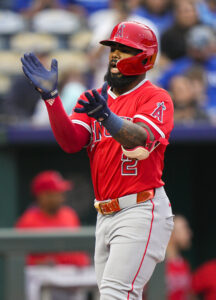
Milwaukee had a hole to address in the infield after dealing Caleb Durbin to the Red Sox. This might not be the move MLBTR’s Steve Adams had in mind when he wrote about the potential for another notable addition, but Rengifo could provide credible production at multiple spots. The 28-year-old had delivered three seasons of above-league-average offense before struggling mightily last year. He has considerable experience at second base, third base, and shortstop.
Rengifo debuted with the Angels in 2019. He held down the second base job for the majority of the season. The infielder managed an 83 wRC+ across 406 plate appearances. He earned poor marks for his work at the keystone (-4 Defensive Runs Saved, -4 Outs Above Average). Rengifo fell into part-time work over the next two seasons, scuffling at the plate but offering defensive versatility.
The 2022 campaign represented a breakout for Rengifo. He slugged 17 home runs in 127 games. Rengifo came into the year with just 14 career homers. He improved his hard-hit rate while striking out just 15.5% of the time. Rengifo maintained the offensive gains the following year, popping 16 home runs with a 115 wRC+.
Rengifo remained a valuable asset in 2024, though his production took a different shape. He only left the yard six times, but stole 24 bases and hit an even .300. Rengifo had totaled 18 thefts in the previous five MLB seasons. He’d maxed out at a .264 batting average. Biceps and wrist injuries limited Rengifo to 78 games, and could have been to blame for his lack of power.
Last season was a challenge for Rengifo. His OPS tumbled to .622, his worst mark since 2021. He did chip in nine home runs and 10 steals. Rengifo managed to stay healthy for the full year, playing in a career-high 147 games.
The switch-hitting Rengifo has typically been better from the right side. He’s slashed .268/.311/.438 against lefties in his career, compared to .242/.305/.360 when facing righties. Rengifo didn’t show noticeable splits last season, with just two points separating his OPS from each side of the plate.
It’s been more quantity than quality for Rengifo with the glove. He’s logged at least 98 appearances at all three infield positions excluding first base, but doesn’t have a DRS better than -4 at any spot. Rengifo posted a -5 DRS at third base last season, though he was a +5 at second base.
Photos courtesy of Gary A. Vasquez and Jay Biggerstaff, Imagn Images
Brewers Notes: Rotation, Woodruff, Garabito
Right-hander Brandon Woodruff is easily the most experienced arm in Milwaukee’s rotation mix after the Freddy Peralta trade but health has been an ongoing issue in recent years. He appears to be a bit behind schedule in camp this year after finishing 2025 on the injured list due to a lat strain. He spoke to reporters, including Adam McCalvy of MLB.com, about his ramp-up and wouldn’t commit to being ready by Opening Day.
“I think it’s too early to say right now,” Woodruff said, when asked about the chances of him being ready by the start of the season. “It’s up in the air right now. I know that term’s used a lot but, like I said, there’s one goal I have this year and that’s to be healthy… I want to be available at the end of the year when it matters most. What that looks like early on could be a little bit different. There’s nothing set in concrete. All I know is I threw 25 pitches today live. I feel good. I feel good after, sitting here talking to you guys. That’s a great sign, so I’ll just continue to build off that and progress.”
Woodruff was a mainstay of the club’s rotation for most of the 2019 to 2022 seasons but has been less reliable recently. Shoulder issues limited him to 11 starts in 2023 and ultimately required surgery, which wiped out his 2024 season. He was activated off the IL in July and made 12 starts. His velocity was a couple of ticks below his pre-surgery form but the results were still good. He allowed 3.20 earned runs per nine with a 32.3% strikeout rate and 5.4% walk rate. He hit the IL with a lat strain in September and missed the postseason.
Given the tumultuous nature of his past few years, it makes sense that he and the Brewers would be cautious and focused on the long season ahead as opposed to forcing the issue in late March. If Woodruff misses a few starts to begin the campaign, they have a lot of depth they can use in the interim.
Jacob Misiorowski and Quinn Priester probably have two spots locked up. Chad Patrick and Logan Henderson are strong candidates for two more. DL Hall, Aaron Ashby, Brandon Sproat, Robert Gasser, Ángel Zerpa, Kyle Harrison, Shane Drohan, Coleman Crow and Carlos Rodríguez are all on the roster. Some of those guys will end up in relief but they’re all optionable and could be in the majors or in the Triple-A rotation or they could be shuttled between the two throughout the year.
That huge pack of rotation options means that a non-roster arm like Gerson Garabito was going to be hard-pressed to earn a roster spot. That won’t even be his focus now, as he’ll have to prioritized his health for a while. Manager Pat Murphy recently told reporters, including Todd Rosiak of the Milwaukee Journal Sentinel, that Garabito had surgery to address a broken bone in his foot and will be out for four months.
It’s a tough break for the righty, who is looking to make a return to affiliated ball. He signed with the Samsung Lions of the Korea Baseball Organization in June and posted a 2.64 ERA in 15 starts for that club. He parlayed that showing into a minor league deal with the Brewers. He’ll have to recover from his surgery before he can push for a roster spot. His major league career consists of 21 appearances with the Rangers with a 5.77 ERA.
Photo courtesy of Charles LeClaire, Imagn Images
Brewers Not Yet Settled On Late-Game Bullpen Roles
The bullpen was again a strength for the Brewers in 2025, and closer Trevor Megill led the way with 30 saves, a 2.49 ERA over 49 innings, and an All-Star nod. As well as Megill has pitched in the ninth-inning role over the last two seasons, however, manager Pat Murphy was non-committal on the topic of who his closer will be in 2026.
“I feel like we’ll look at the matchups and see what’s best. We’ll look at the health of the pitcher. You might see other guys in that mix too,” Murphy told Todd Rosiak of the Milwaukee Journal Sentinel. While noting that it is still early in Spring Training for such decisions, Murphy hinted at more of a committee approach by saying “I mean, that’s kind of like the message to the whole Milwaukee Brewers team, right? You have to be uncommon. That’s an uncommon mindset for us to thread the needle the way we want to.”
Megill’s status might’ve been more secure if it hadn’t been for a right flexor strain that sent him to the injured list late last August. Megill missed a little over a month of action and was able to return for one regular-season game before the postseason got underway, as well as five playoff appearances. Megill had a 2.25 ERA over his four postseason innings, but as Rosiak notes, the Brewers used him in non-closing leverage roles. This even included a perfect inning for Megill as the opener in the winner-take-all Game 5 of the NLDS. which ended up being a 3-1 Brewers victory over the Cubs.
While Megill was on the IL, fellow hard-throwing righty Abner Uribe stepped in to record five saves as the fill-in closer, adding to Uribe’s resume over a dominant season. Uribe posted a 1.67 ERA, 53.2% grounder rate, 30.2% strikeout rate, and 9.1% strikeout rate over 75 1/3 innings and 75 appearances. By comparison, Megill had a 2.49 ERA, 39.3% grounder rate, 31.3K%, and 8.9BB% across his 47 frames, and SIERA had the two pitchers as virtually equal — Uribe with a 2.89 and Megill with a 2.93.
Uribe’s 75 appearances tied him for the seventh-most games of any pitcher in 2025. This durability could mean that Megill ultimately ends up closing more games, if Milwaukee returns to Uribe as a heavily-used reliever for all sorts of leverage or set-up situations. The Brewers’ projected bullpen is unusually heavy on left-handed pitchers, so the right-handed Uribe and Megill could conceivably be used in more situational high-leverage scenarios, with a southpaw like Jared Koenig or Angel Zerpa deployed to lock down the ninth.
As of last week, Megill said he hadn’t heard anything about his role for the coming season. While he felt “I think we can probably roll the same way we rolled last year,” Megill stressed that he is happy in whatever job the Brewers see fit, and praised his partnership with his friend Uribe as “a great dynamic.” On the health front, Megill added that he had a PRP injection during the offseason to help address his right flexor.
The bigger-picture element of bullpen lineup is that Uribe may now be viewed as Milwaukee’s long-term closer of the future, if not the immediate present. Uribe doesn’t turn 26 until June and he is under team control through the 2030 season. Megill is entering his age-32 season and has one more year of arbitration eligibility before he hits free agency following the 2027 campaign.
Megill and the Brewers avoided arbitration by agreeing to a $4.7MM salary for the 2026 season. It’s a healthy raise over the $1.94MM Megill earned in 2024, and reflective of how save totals can quickly boost a pitcher’s earning potential. Arbitration panels favor traditional counting stats like wins, strikeouts, or (in a reliever’s case) saves ahead of advanced metrics, so consistent ninth-inning work usually leads to bigger paydays through a closer’s arb years.
The Brewers could be looking to curb Megill’s 2027 salary potential by limiting his save totals in 2026, though there is probably a better possibility that Megill’s future salaries will be another team’s problem. The Brewers tend to trade higher-salaried players as they approach free agency, including past closers as Josh Hader and Devin Williams. Megill’s first extended taste of closing work came in 2024 when Williams was sidelined with stress fractures in his back, and while Milwaukee was likely always going to be trading Williams during the 2024-25 offseason, Megill’s success as the stopper certainly made the front office’s decision easier.
Megill was involved in some trade rumors of his own this winter, as such teams as the Yankees and Mets were reportedly interested in acquiring the right-hander. It’s not entirely out of the question that Megill is still dealt, which could be why the Brewers have been hesitant about naming a full-time closer. While Opening Day is still over a month away, however, the fact that camp has already started probably lowers the chance of a Megill trade. Moving your closer in Spring Training is far different than moving your closer at the trade deadline a la the Hader deal in 2022, but since trading Hader infamously disrupted the Brewers’ chemistry, the team is certainly more sensitive about how such transactions can shake up a clubhouse.
For Megill, he took the trade speculation in stride, saying “There’s always people calling and seeing what’s what. I’m sure they’re still doing it. But just knowing how the team is and the cycle of the closer here, you just see it more as business and it might happen at any time. Just have to be OK with that and be a good teammate until it happens.”
Brewers, Pat Murphy Agree To New Contract
6:50pm: Murphy’s deal comes with $8.95MM in new money, reports Jeff Passan of ESPN.
5:50pm: The Brewers and manager Pat Murphy have agreed to a new deal, reports Ken Rosenthal of The Athletic. It’s a three-year contract with a club option for 2029. Murphy was previously going into the final season of a three-year deal he signed ahead of the 2024 campaign. This deal reworks the final year of his previous pact, adds two more guaranteed seasons and the option.
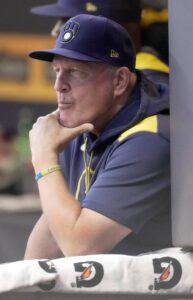
It’s not at all surprising that the Brewers and Murphy have worked out a deal to keep their relationship going. Murphy took over two seasons ago after Craig Counsell surprisingly departed for the division-rival Cubs. The Brewers didn’t miss a beat, going 93-69 in 2024 and winning the National League Central division crown. Murphy won N.L. Manager of the Year honors in his first season at the helm. The club was eliminated in the Wild Card round but awards voting takes place before the playoffs.
It was more of the same last year. The Brewers increased their win total to 97, which was enough for them to repeat as division champs and was actually the best record in the majors. Murphy took home Manager of the Year honors yet again. The club advanced as far as the NLCS but were felled by the Dodgers.
As mentioned, Murphy had initially signed a three-year deal when taking over for Counsell and had already gone through two thirds of that pact. Teams generally don’t like their managers or executives to be serving in lame-duck status. Given Milwaukee’s success during Murphy’s tenure, it seemed highly likely that his contract status would change before the 2026 campaign kicked off.
While there is consistency in the manager’s seat, the roster has seen turnover. Most notably, Freddy Peralta and Tobias Myers were traded to the Mets for Jett Williams and Brandon Sproat. Another big deal saw Caleb Durbin shipped to the Red Sox as part of a trade including six players and a draft pick.
Murphy has had experience guiding the club through such changes. The Brewers traded Corbin Burnes to the Orioles ahead of Murphy’s first season. Ahead of the 2025 campaign, Willy Adames left for the Giants via free agency and Devin Williams was traded to the Yankees. Despite the notable departures, the club has continued to have success in the regular season.
Going into 2026, the club surely expects more success but the division will be tougher. The Cubs and Reds both snagged Wild Card spots last year and have made big moves to upgrade for 2026. The Cubs have added Alex Bregman and Edward Cabrera, among others. The Reds were able to add Eugenio Suárez. The Pirates have one of the best farm systems in baseball and have brought in Brandon Lowe, Ryan O’Hearn and Marcell Ozuna this winter.
Despite the stronger field, the Brewers will go into 2026 as one of the favorites for another strong performance. Murphy will look to get them back to the playoffs yet again and, ideally, take them farther into the postseason.
Photos courtesy of Kirby Lee, Mark Hoffman, Imagn Images
MLBTR Podcast: The Tigers’ Rotation, A Brewers-Red Sox Trade, And Late Free-Agent Signings
The latest episode of the MLB Trade Rumors Podcast is now live on Spotify, Apple Podcasts, and wherever you get your podcasts! Make sure you subscribe as well! You can also use the player at this link to listen, if you don’t use Spotify or Apple for podcasts.
This week, host Darragh McDonald is joined by Anthony Franco of MLB Trade Rumors to discuss…
- Tarik Skubal winning his arbitration hearing against the Tigers (1:30)
- The Tigers loading up the rotation by signing Framber Valdez and also Justin Verlander but losing Reese Olson for the year (13:25)
- The six-player trade between the Red Sox and Brewers headlined by Caleb Durbin and Kyle Harrison, with Milwaukee then signing Luis Rengifo (24:15)
- The Orioles signing Chris Bassitt and losing Jackson Holliday to injury (35:35)
- The Diamondbacks signing Zac Gallen and potentially losing Corbin Carroll to the injured list (44:30)
- The Braves losing Spencer Schwellenbach and maybe Hurston Waldrep while showing little urgency about bolstering the rotation (52:20)
- Tony Clark stepping down as MLBPA executive director, recorded as the news was still trickling out (59:15)
Check out our past episodes!
- Twins Front Office Shake-Up, The Brendan Donovan Trade, Eugenio Suarez, And More! – listen here
- Examining MLB’s Parity Situation – Also, Bellinger, Peralta, Robert, And Gore – listen here
- What The Tucker And Bichette Contracts Mean For Baseball – Also, Nolan Arenado And Ranger Suarez – listen here
The podcast intro and outro song “So Long” is provided courtesy of the band Showoff. Check out their Facebook page here!
Photo courtesy of Junfu Han, Imagn Images
NL Central Notes: Saggese, Grichuk, Steele, Urias
The Cardinals are known to be looking for outfield help, and preferably a right-handed bat given previous statements from president of baseball operations Chaim Bloom. Adding a free agent is still a possibility, though Derrick Goold of the St. Louis Post-Dispatch reports that the Cards “have not expressed much interest in” Randal Grichuk, and target Austin Hays chose the White Sox over the Cardinals in part because Chicago was offering more playing time.
Rather than bring in a new player, the Cards are also exploring internal options by using Thomas Saggese and Jose Fermin as outfielders this spring. This isn’t anything new for Fermin, who has played six MLB games and 19 minor league games as an outfielder in addition to his larger amount of playing time at second, third and shortstop. For career infielder Saggese, he told Goold that he hasn’t played in the outfield since he was 10 years old.
Nonetheless, adding to his defensive versatility should help Saggese in his bid for more playing time. Saggese drew some top-100 prospect attention prior to his big league debut in 2024, though he has hit only .250/.292/.336 over the small sample size of 347 Major League plate appearances. Sticking in the infield could be tricky with Masyn Winn at shortstop, top prospect JJ Wetherholt on the verge of his MLB debut (likely at second base), and Nolan Gorman penciled in for third base. It could be that St. Louis is trying to mold Saggese into a right-handed hitting version of the now-traded Brendan Donovan, as a super-utility option who can be bounced around the diamond.
More from around the NL Central…
- Justin Steele told Maddie Lee of the Chicago Sun-Times that his rehab work has progressed to 30-pitch bullpen sessions, and he is planning to return to the Cubs rotation in May or June. Steele underwent a UCL revision surgery last April that included the installation of an internal brace in his elbow, and “as I started throwing again, it felt the same. There was no difference — whereas the first Tommy John I had [in 2017], it felt like I had a new arm, I had to re-learn how to use it.” It remains to be seen if Steele can immediately recapture his old form once he returns, but having a former All-Star back should provide a nice boost for the Cubs in their request to return to the postseason.
- Before Luis Rengifo was signed to a one-year, $3.5MM guarantee on Friday, the Brewers also had interest in free agent infielder Ramon Urias, according to The Athletic’s Ken Rosenthal. Since Milwaukee apparently plans to use Rengifo primarily as a third baseman, Rosenthal notes that the signing was “somewhat curious” from a glovework perspective — Urias was the AL Gold Glove winner at third base in 2022, and his career defensive metrics at both second and third base are far superior to Rengifo’s numbers. The Brewers are the first team known to have interest in Urias since the Astros non-tendered him in November rather than pay a projected $4.4MM in arbitration salary. Urias had a 108 wRC+ (from a .262/.328/.408 slash line) over 1465 PA in part-time action with the Orioles from 2020-24, but he slumped to an 87 wRC+ and a .241/.292/.384 slash in 391 PA with Baltimore and Houston in 2025.
Brewers Sign Gary Sánchez
Feb. 14: Milwaukee has officially announced the Sánchez deal. The Brewers had room on the 40-man roster, so no corresponding move was needed.
Feb. 11: The Brewers have agreed to terms on a deal with veteran catcher Gary Sánchez, reports Jon Heyman of the New York Post. The MDR Sports client will be guaranteed $1.75MM on the deal.
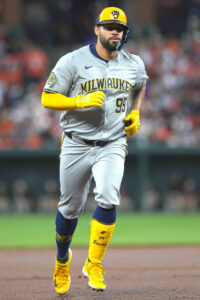
Sánchez, 33, spent the 2025 season with the Orioles organization but was limited to just 30 games and 101 plate appearances due to wrist inflammation and, more seriously, a sprain of the posterior cruciate ligament in his right knee. He was reasonably productive when healthy, popping five homers and turning in a .231/.297/.418 batting line (100 wRC+).
This will be Sánchez’s second stint with the Brewers in the past three seasons. He spent the 2024 campaign in Milwaukee as well, hitting .220/.307/.392 with 11 homers in 280 plate appearances. He served as a backup to William Contreras and a part-time (40 games) designated hitter that season and figures to reprise that role in 2026.
A former top prospect and an All-Star earlier with the Yankees early in his career, Sánchez has settled into a backup/part-time role in recent seasons. He appeared in 128 games and totaled 471 plate appearances with the Twins in 2022 after being traded from the Bronx to Minnesota, but he’s taken only 648 plate appearances combined in the three subsequent seasons (albeit, in part due to last year’s injuries).
Sánchez developed a reputation as a defensive liability earlier in his career but progressed to the point that he turned in solid defensive marks behind the dish in both 2022 and 2023. He was closer to average in ’24 and slipped back below average in 2025, per both Defensive Runs Saved and Statcast, though that was obviously a small sample (175 innings). He’ll return to a Milwaukee club where he’s familiar with some members of the staff (e.g. Brandon Woodruff, Abner Uribe, Trevor Megill, Aaron Ashby, Jared Koenig), but the Brewers’ staff has turned over a fair bit even in the roughly 18 months since Sánchez’s initial departure.
The Brewers recently signed veteran catcher Reese McGuire to a minor league deal and invited him to spring training. He’d been in line to serve as the backup to Contreras but now seems likely to be ticketed for Triple-A Nashville — if he doesn’t have an out clause in his contract that allows him to explore other opportunities late in camp.
The addition of those two veterans gives the Brewers the ability to be more patient with top prospect Jeferson Quero, who is widely regarded as the heir to Contreras behind the plate but still has just 59 games and 251 plate appearances of Triple-A ball under his belt. He could push his way into the mix with a big enough season in Nashville, and it’s feasible that he’ll be ready for a full-time look in 2027, when Contreras will be entering his final season of club control (and likely be an offseason trade candidate, as is often the case with top Brewers players who are a year from reaching free agency).
Do The Brewers Have Another Move Up Their Sleeve?
Monday's surprise trade sending Rookie of the Year finalist Caleb Durbin from Milwaukee to Boston plugged a hole in the Red Sox' infield while ostensibly opening one for the Brewers. Not only did the Brewers trade their incumbent third baseman, the deal also sent Andruw Monasterio and Anthony Seigler to Boston -- two of Milwaukee's top options on the third base depth chart. The Brewers picked up speedster David Hamilton in that swap and will give him some spring reps at the hot corner, but he's played all of one game professionally at third base. Hamilton's value is derived primarily from plus second base glovework and his abilities on the basepaths. He's not a natural fit to take the reins at third base.
Though the Durbin trade opened up a hole at third base, it also further deepened the Brewers' already deep collection of starting pitchers. Even after trading ace Freddy Peralta to the Mets for top prospects Brandon Sproat and Jett Williams, the Brewers boast a starting staff that'll include Brandon Woodruff, Jacob Misiorowski, Quinn Priester and Chad Patrick in the top four spots. Plausible candidates for the fifth spot include Sproat, Logan Henderson, Robert Gasser, DL Hall, Aaron Ashby and newly acquired lefties Kyle Harrison and Shane Drohan, who came to Milwaukee alongside Hamilton.
The Brewers are no strangers to putting the finishing touches on their big league roster once spring training is already underway. In fact, it's become almost something of an annual tradition. In 2025, Milwaukee didn't sign Jose Quintana until early March. Even their trade for Priester came a week or so into the season. In 2024, they signed Gary Sánchez and re-signed Brandon Woodruff after camp had opened. Their late signings in 2023 included Luke Voit, Justin Wilson and Jon Singleton.
By the time camp opens, many clubs have finished conducting the bulk of their heavy lifting. That hasn't been the case for the Brewers, and with at least one open question in their infield, it's fair to think president of baseball operations Matt Arnold and his staff are looking into one more finishing piece even as pitchers and catchers travel south to Arizona for the beginning of the Cactus League season.

Unlock Subscriber-Exclusive Articles Like This One With a Trade Rumors Front Office Subscription
- Access weekly subscriber-only articles by Tim Dierkes, Steve Adams, and Anthony Franco.
- Join exclusive weekly live chats with Anthony.
- Remove ads and support our writers.
- Access GM-caliber tools like our MLB Contract Tracker
Brewers, William Contreras Avoid Arbitration
The Brewers and star catcher William Contreras avoided arbitration by agreeing to a one-year deal with a club option for the 2027 season, per a team announcement. The Octagon client will earn $9.4MM in 2026, and the 2027 option is valued at $14.5MM, per Jon Heyman of the New York Post. Contreras’ camp had filed for a $9.9MM salary. The team filed at $8.5MM.
Contreras wasn’t eligible for free agency until the 2027-28 offseason, so the option doesn’t give the Brewers any additional club control. It does provide some potential cost certainty, however, while ensuring that this deal to avoid arbitration can’t be used as a data point in future arbitration cases; one-year arrangements with option years are considered multi-year deals for arbitration purposes and thus aren’t eligible to be cited as comps (by the Brewers or other clubs).
If Milwaukee ends up declining that option, Contreras would still be under club control. He’d simply be arbitration-eligible again. The Brewers declined a $12MM club option on Contreras for the upcoming season back in November. The two parties went back to negotiations, exchanged figures, and narrowly avoided a hearing.
Contreras’ $9.4MM salary lands just above the $9.2MM midpoint between the figures exchanged by team and player. If he has a big season and projects for a salary in the $14-15MM range, that 2027 option may end up being exercised, but if not, he’ll likely find himself in a similar boat next winter.
The 2025 season was a solid one but still a down year by Contreras’ lofty standards. After slashing .283/.363/.472 in three seasons from 2022-24, he hit “just” .260/.355/.399 in 659 trips to the plate this past season. Health was a factor, to be sure; Contreras played through a fracture in his left middle finger for the majority of the season — an injury originally revealed in May but not addressed in full until he underwent surgery following the season. In that sense, suiting up for 150 games, including 128 behind the plate, and delivering above-average offense is an impressive feat in and of itself.
The 2026 season will be Contreras’ penultimate year of club control. He’ll head into the year with a cleaner bill of health and look to get back to that 2022-24 form as the Brewers defend their NL Central crown. The general expectation is that Milwaukee will be in the thick of the division race — or at least the Wild Card chase — once again this season, even after trading ace Freddy Peralta and 2025 breakout rookies Isaac Collins and Caleb Durbin.
If that doesn’t come to pass, Contreras could well see his name surface in trade rumors this summer. Milwaukee tends to listen to offers on its best players as those players approach free agency. Josh Hader was traded at the deadline in his own penultimate season with the Brew Crew. This offseason, Peralta joined Corbin Burnes, Devin Williams and others as the latest Brewers star to be traded as his control window waned. It’s likelier than not that Contreras will stick in Milwaukee through the current season, but his name will assuredly pop up on the rumor mill next offseason, regardless of what happens with that club option.
Red Sox Acquire Caleb Durbin In Six-Player Trade
The Red Sox and Brewers pulled off a six-player trade on Monday. Boston acquired infielders Caleb Durbin, Andruw Monasterio and Anthony Seigler, as well as Milwaukee’s Competitive Balance Round B pick in exchange for pitchers Kyle Harrison and Shane Drohan and infielder David Hamilton. All six players in question were on their clubs’ 40-man roster, so no corresponding moves were necessary.
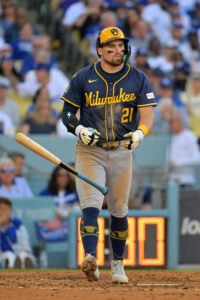
Durbin is a notable pickup for the Boston infield and should be penciled in for everyday at-bats — presumably at third base, though he can also handle second base if the Red Sox prefer Marcelo Mayer at the hot corner from a defensive standpoint. The 25-year-old Durbin (26 in a couple weeks) finished third in National League Rookie of the Year voting in 2025 after he batted .256/.334/.387 with 11 home runs, 25 doubles, 18 steals (24 attempts), a 5.9% walk rate and a tiny 9.9% strikeout rate. He turned in above-average marks for his glovework at third in the estimation of both Defensive Runs Saved (5) and Outs Above Average (2).
He’s not the big middle-of-the-order presence many Sox fans have coveted, but Durbin is an affordable, controllable and versatile defender who’ll further the Red Sox’ pivot toward run prevention and help to lower a team strikeout rate that was 10th-highest in the sport last year at 22.9%. He’s a right-handed hitter whose pull percentage (43.3%) is a bit higher than league average (40.6%), which should play well with the Green Monster at Fenway Park. Durbin comes to the Red Sox with five full seasons of club control and two minor league option years remaining (not that there’ll be any thought of optioning him to the minors anytime soon after last year’s strong performance).
If Durbin is ticketed for the hot corner, that’ll leave second base to a combination of the left-handed-hitting Mayer and righty-swinging Romy Gonzalez. Recently signed utilityman Isiah Kiner-Falefa can back up both those positions as well as shortstop.

The 28-year-old Monasterio could also factor in at either second or third base, although like Gonzalez and Kiner-Falefa, he’s a right-handed hitter. As is the case with Gonzalez, Monasterio also carries notable platoon splits. He’s a career .255/.352/.375 batter against lefties but a .246/.303/.338 hitter against fellow righties. He’s coming off a career-best showing in the majors — albeit in a limited sample of 135 plate appearances — having slashed .270/.319/.437 (111 wRC+) with four homers. He’s controllable for another four seasons and won’t be arbitration-eligible until at least next offseason (possibly later, depending on how much time he spends in the minors this year).
Monasterio also has nearly 3500 professional innings at shortstop under his belt, so he gives Boston another backup option to oft-injured Trevor Story at shortstop (alongside Kiner-Falefa). He also has a full slate of three minor league option years remaining, so there’s no guarantee he’ll open the season on Boston’s major league roster. He’ll have the opportunity to win a role in camp, but barring injury and/or trade, Boston’s bench seems likely to include Gonzalez, Kiner-Falefa, catcher Connor Wong and outfielder/designated hitter Masataka Yoshida.
All of that assumes that Mayer makes the Opening Day roster, but it’s possible that the former No. 4 overall pick could open the season in Triple-A Worcester, too. Mayer’s .228/.272/.402 slash was well below league-average in 2025, but he only turned 23 in December and has an impressive minor league track record. That includes a .271/.347/.471 showing in Triple-A last year. He’ll have every opportunity to win a starting job in camp with the Red Sox, but late additions of Durbin and Kiner-Falefa lessen the team’s reliance on the still largely untested top prospect.
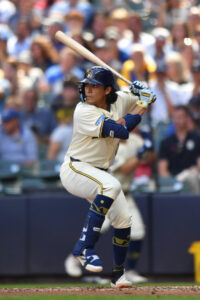
Boston also picks up the 26-year-old Seigler, who’ll provide some depth in the upper minors and could be a frequently used bench piece over the course of the coming season. He’s batted just .194/.292/.210 in an insignificant sample of 73 major league plate appearances, but Seigler hit .285/.414/.478 with eight homers, 16 doubles, four triples, 23 steals (27 attempts), a 16.9% walk rate and a 19.2% strikeout rate in 307 Triple-A plate appearances this past season. He’s been used as an infielder (second base, specifically) far more frequently than a catcher in recent seasons due to troubles controlling the run game and a susceptibility to passed balls.
Even if he’s rarely deployed behind the plate, Seigler is at the very least an interesting third catcher option who also is comfortable at second base and third base. He has two minor league option years remaining and doesn’t even have a full season of major league service, making him controllable for at least the next six full seasons.
The Red Sox also add a Competitive Balance draft choice — the only picks permissible to be traded under MLB rules. Milwaukee’s Round B selection is the first in that round, currently 67th overall (although that could change by a spot or two depending on what happens with Zac Gallen, the final remaining free agent who rejected a qualifying offer and is thus subject to draft pick compensation). They’ll not only get to add an extra player but will also add that selection’s slot value to their draft bonus pool. Last year’s No. 67 selection came with a $1.285MM value. This year’s should be up from that a bit. The Red Sox don’t need to spend that amount on this pick specifically; the slot value will be added to their bonus pool, which they can freely divide up among their picks how they see fit.
Turning to Milwaukee’s side of the swap, it feels like a precursor to another acquisition. The Brewers not only traded their incumbent starter at third base — they traded two of the top depth options behind him in the same swap. Perhaps there’s some infield shuffling on the horizon, but it feels like the Brewers will need to add some help on the dirt. Hamilton could see reps at the hot corner this spring but has spent far more time at second base in the Red Sox organization. Shortstop Joey Ortiz and second baseman Brice Turang are plus defenders who could both slide one position over to the left, but doing so might weaken the overall defensive aptitude of the group.
Bringing in some help at third base seems prudent, but options there are few and far between. Time will tell if president of baseball operations Matt Arnold has another move up his sleeve, but for right now, the Brewers look thin at third base.
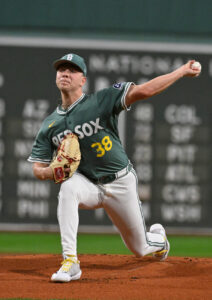
Their pitching depth, however, continues to grow — even after trading ace Freddy Peralta to the Mets last month. Today’s trade brings in a pair of big league-ready arms. Harrison, 24, already has 42 big league games (37 starts) under his belt. He’s pitched to a 4.39 ERA with a 22.9% strikeout rate and 8% walk rate in that time.
At the moment, Harrison profiles as a fifth starter option for the Brewers, but he carries more upside than most back-of-the-rotation candidates. The 2020 third-round pick ranked as one of the top minor league talents in all of baseball for several years, peaking as the No. 26 prospect in the entire sport on Baseball America’s top-100 prior to the 2023 season. He’s yet to put it all together in the majors, but Harrison has fanned better than 30% of his opponents in parts of two Triple-A seasons.
The Brewers have developed a reputation as one of the sport’s top “pitch labs.” They worked wonders with righty Quinn Priester in 2025 and have helped to facilitate turnarounds or breakouts from relievers like Trevor Megill, Joel Payamps, Bryse Wilson, Colin Rea, Nick Mears, Jared Koenig and others. There are plenty of parallels between Priester’s trajectory and that of Harrison; both were former top prospects traded to Boston and quickly buried on the Red Sox depth chart. The Brewers will hope to convert on that same profile for a second consecutive season now.
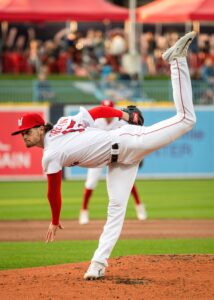
Drohan just turned 27 last month, making him old for a “prospect,” but he nonetheless sat 15th on Baseball America’s recent update of Boston’s system. His path to big leagues has been slowed both by injury and a selection in the Rule 5 Draft. The White Sox took Drohan back in 2023 after Boston left him unprotected. He required a nerve decompression surgery in his shoulder that spring, however, which limited him to 16 1/3 rehab innings that season. A forearm injury in 2025 limited him to 54 minor league frames.
When he’s been healthy, Drohan has looked the part of an interesting prospect. His Triple-A numbers are skewed by a rough showing late in 2023 and during some rehab work in 2024 — both potentially impacted by his shoulder — but he was excellent last season, tossing 47 2/3 innings with Worcester and recording a 2.27 ERA, a 35.3% strikeout rate, an 8.4% walk rate and a massive 17.3% swinging-strike rate. He also posted a 2.17 ERA in parts of two Double-A seasons and was part of the 2023 Futures Game. Drohan sat 93.3 mph with his four-seamer in Triple-A in 2025, complementing the pitch with an 84.7 mph slider, an 88.8 mph cutter, an 84.3 mph changeup and a 77.9 mph curveball (listed in order of usage rate).
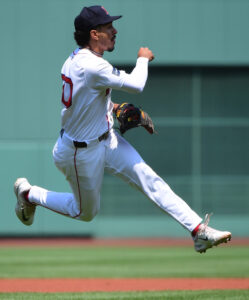
Hamilton, 28, returns to the club that originally drafted him but traded him to Boston as part of 2021’s Hunter Renfroe swap. He’s played in parts of three seasons with Boston and totaled 550 plate appearances with a .222/.283/.359 batting line.
Hamilton hasn’t hit much but is a plus runner with 95th percentile sprint speed, per Statcast, and 57 career steals in 68 attempts (83.8%). On a rate basis, he’s been one of the game’s elite defensive second basemen during his time in the majors, piling up 16 Defensive Runs Saved and 8 Outs Above Average in only 679 innings.
The Brewers originally drafted Hamilton in the eighth round of the 2019 draft out of the University of Texas. Arnold and top lieutenants like AGMs Matt Kleine, Will Hudgins and Karl Mueller were all in the Milwaukee front office when they first signed Hamilton out of the draft. That familiarity with him both as a player and as a person presumably played a role in this morning’s trade.
Adam McCalvy of MLB.com reports that Hamilton will see plenty of reps at third base this spring. Whether his stellar second base defense carries over to third base and whether Hamilton performs well enough to secure a job will determine his roster status come Opening Day. He has a minor league option year remaining, so if the Brewers do make another acquisition or if Hamilton simply struggles to a great enough extent this spring, he can be sent to Triple-A Nashville without needing to pass through waivers. The Brewers can control him for at least four additional seasons — five if he spends more than 25 days in the minors this year.
For the Red Sox, today’s trade seems to largely round out the infield. With Kiner-Falefa also aboard as a glove-first utility option, there doesn’t appear to be much more room to add. Durbin should be an upgrade of a couple wins, and his extreme put-the-ball-in-play approach and defensive aptitude should help to raise Boston’s floor quite a bit, even if the offense as a whole looks suspect beyond the top few hitters.
The Brewers are now 10 to 12 deep in their rotation mix, which could set the stage for another trade. They could also simply hold onto that depth, knowing they’ll need an army of pitchers to get through a 162-game season and that many of their current arms have less than a full year of experience in the majors, but some form of additional infield depth seems likely to be on the horizon after today’s trade thinned them out.
Jeff Passan of ESPN was first to report Durbin, Harrison, Drohan and Hamilton’s inclusions. Will Sammon of The Athletic first reported Seigler, Monasterio and the draft choice.