
Zach Plesac Hires CAA Sports
Indians righty Zach Plesac has hired CAA Sports to represent him, per MLB.com’s Mark Feinsand (via Twitter). The relationship is now reflected in MLBTR’s Agency Database.
Plesac isn’t closing in on any major contractual milestones, but he has certainly raised his profile and with it his potential for earning opportunities of all kinds. The 2016 12th-rounder entered 2019 as a little-known prospect and left it as a potentially significant part of the Indians’ future.
Though he was optioned as part of the Cleveland organization’s coronavirus shuffling, Plesac certainly seems deserving of another full run in the rotation. He earned his way up last year with a dominant run in the upper minors and ultimately delivered 115 2/3 innings of 3.81 ERA ball in the bigs.
To be fair, there are some questions of sustainability. Plesac underwhelmed with 6.9 K/9, 3.1 BB/9, and 1.48 HR/9. Statcast identified a massive gap in anticipated (.347 xwOBA) and actual outcomes (.315 wOBA) based upon the quality of contact produced by opposing hitters.
It remains to be seen whether Plesac can recreate the magic — or, perhaps more realistically, continue to make strides to establish himself as a viable long-term rotation piece. But there’s little question he has done enough to earn a longer look.
The Mariners’ Future Payroll Promises
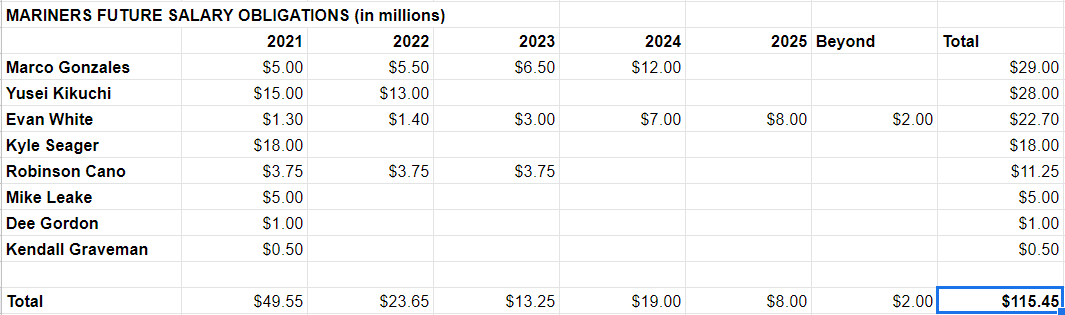
2020 salary terms are set to be hammered out in the coming days. But what about what’s owed to players beyond that point? The near-term economic picture remains questionable at best. That’ll make teams all the more cautious with guaranteed future salaries.
Every organization has some amount of future cash committed to players, all of it done before the coronavirus pandemic swept the globe. There are several different ways to look at salaries; for instance, for purposes of calculating the luxury tax, the average annual value is the touchstone, with up-front bonuses spread over the life of the deal. For this exercise, we’ll focus on actual cash outlays that still have yet to be paid.
We’ll run through every team, with a big assist from the Cot’s Baseball Contracts database. Next up is the Mariners:
(click to expand/view detail list)
Mariners Total Future Cash Obligation: $115.45MM
*includes Yusei Kikuchi 2022 player option
*includes buyouts of club options
Brent Honeywell Undergoes Ulnar Nerve Procedure
May 22: Rays pitching coach Kyle Snyder tells reporters that the organization hopes Honeywell will be cleared to throw off a mound prior to the offseason (Twitter link via Marc Topkin of the Tampa Bay Times). Suffice it to say, that seems to rule out any contributions in 2020.
May 21: The Rays announced Thursday that touted pitching prospect Brent Honeywell Jr. underwent a decompression procedure on his right ulnar nerve yesterday. He’ll start strength and mobility exercises next Monday, MLB.com’s Juan Toribio tweets.
It’s yet another arm-related setback for Honeywell, a 2014 second-round pick who has ranked among the game’s premier pitching prospects in each of the past five offseasons. The 25-year-old hasn’t pitched in a minor league game since 2017, however. He underwent Tommy John surgery after sustaining a UCL tear in spring 2018, and he fractured his elbow last June while rehabbing from that Tommy John procedure. Honeywell had returned to a mound early in Spring Training this year, but there’s now no clear timetable for when he’ll resume throwing.
Scouting reports on Honeywell tout him as a high-impact starter — one who possesses a legitimate five-pitch mix, with each offering carrying average or better potential. One of the few pitchers in today’s game tossing a legitimate screwball, Honeywell has long been considered a potentially vital cog to the Rays’ future pitching plans, but his arm simply hasn’t cooperated. When he’s been healthy enough to take the mound, Honeywell has turned in 416 innings of 2.88 ERA ball with 9.9 K/9, 2.0 BB/9, 0.58 HR/9 and a ground-ball rate near 41 percent.
The Rays obviously have ample pitching depth. Their five-man rotation would consist of Charlie Morton, Tyler Glasnow, Blake Snell, Yonny Chirinos and Ryan Yarbrough. Beyond that quintet lies a quality stock of secondary options including Brendan McKay, Anthony Banda, Trevor Richards and Jalen Beeks. Southpaw Shane McClanahan, the No. 31 pick in 2018, isn’t too far behind that group. That said, few arms in that bunch can match Honeywell’s ceiling, making the latest bout of uncertainty regarding his health all the more difficult for the organization.
Scooter Gennett On Why He Didn’t Sign Anywhere This Winter
Former Reds, Brewers and Giants second baseman Scooter Gennett remains unsigned, and the 2018 All-Star chatted with Doug Fernandes of the Sarasota Herald-Tribune this week about his decision not to accept an offer over the winter. Gennett details that he did receive some offers, but they were either non-guaranteed or not to his liking from a financial standpoint. The top offer he received was a $1.5MM guarantee with incentives, but he’d been targeting a deal in the $5MM range. That offer also came from a club with an everyday second baseman, it seems, so he’d likely have been viewed as a bench piece.
Many fans will bristle at Gennett’s candid comments on free agency and compensation, particularly given the current economic crisis that has been brought about by the COVID-19 pandemic. Gennett, though, has earned more than $19MM in his career to date and has clearly set a personal valuation both on his abilities and the level of compensation he’d require to spend another season on the road and away from his wife and family, as any player would. “You’re 220 days away from your family,” says Gennett.
The 2019 season was a tough one for Gennett, who tore a muscle in his groin during Spring Training and now acknowledges that he came back before he was ready. That was his own decision, he emphasizes, and his results clearly suffered. After hitting a combined .303/.351/.508 with 50 home runs for the Reds in 2017-18, Gennett limped to a .226/.245/.323 slash in 139 plate appearances last year. The Reds traded him to the Giants just prior to the trade deadline, receiving only cash consideration in return. San Francisco released him less than a month later.
Over the winter, Gennett reportedly drew interest from as many as six teams, with the Cubs known to be one suitor. The Cubs, however, have avoided major free agent signings over the past two offseasons and were looking for more of a low-cost pickup. Not long after being linked to Gennett, they instead signed Jason Kipnis to the same type of minor league contract to which Gennett expresses aversion in his interview with Fernandes.
Gennett is still just 30, so there’s certainly time for him to stage a comeback if he chooses to play again. He’s still working out, but he’s also frank in telling Fernandes that he is “fine with not playing.” If salary is the sticking point, it’s hard to envision his earning power on his next contract being higher than it was over the winter. A club doesn’t seem likely to top that offer once play resumes, given the revenue losses throughout the league, and sitting out for a year would surely limit him to a minor league deal if he did decide he wanted to return to the game.
Which 15 Players Should The Giants Protect In An Expansion Draft?
In a few weeks, we’ll be running a two-team mock expansion draft here at MLBTR. Currently, we’re creating 15-player protected lists for each of the existing 30 teams. You can catch up on the rules for player eligibility here.
So far, we’ve covered the Rangers, Mariners, Athletics, Angels, Astros, Twins, Royals, Tigers, Indians, White Sox, Rays, Yankees, Red Sox, Blue Jays and Orioles. The Giants are up next.
We’ll start by removing free agents Hunter Pence, Jeff Samardzija, Tony Watson, Drew Smyly, and Kevin Gausman.
Buster Posey, Brandon Belt, and Brandon Crawford will make the protected list by virtue of their no-trade clauses. I’ll also protect Mike Yastrzemski, Alex Dickerson, Mauricio Dubon, and Logan Webb out of the gate. So these seven players will be protected:
Buster Posey
Brandon Belt
Brandon Crawford
Mike Yastrzemski
Alex Dickerson
Mauricio Dubon
Logan Webb
That leaves eight spots for these 26 players:
Shaun Anderson
Tyler Anderson
Abiatal Avelino
Tyler Beede
Sam Coonrod
Johnny Cueto
Jaylin Davis
Steven Duggar
Wilmer Flores
Enderson Franco
Aramis Garcia
Jarlin Garcia
Trevor Gott
Jandel Gustave
Evan Longoria
Conner Menez
Reyes Moronta
Wandy Peralta
Dereck Rodriguez
Tyler Rogers
Sam Selman
Chris Shaw
Austin Slater
Donovan Solano
Andrew Suarez
Kean Wong
With that, we turn it over to the MLBTR readership! In the poll below (direct link here), select exactly eight players you think the Giants should protect in our upcoming mock expansion draft. Click here to view the results.
Latest On Teams’ Plans For Second Spring Training
While the league and the MLBPA have yet to reach a formal agreement on either player compensation or health/safety protocols for a rebooted 2020 season, teams are still preparing for a shortened restart of “Spring” Training — ideally beginning in mid-June. The goal is for a three-week training period to lead into an 82-game season that kicks off in early July. The latest on plans for a few NL clubs…
- The Mets will likely hold their version of Spring Training 2.0 at their spring facility in Port St. Lucie, Fla. rather than at Citi Field in New York, Tim Healey of Newsday reports. New York City remains the U.S. epicenter for the coronavirus, and beyond the pure health aspect of the decision, staging their training camp in Florida gives the Mets access to multiple fields. As Healey notes, the Mets completed a $57MM renovation project at Clover Field back in February, which has improved the overall quality of the facilities and equipment available to Mets players — several of whom are already in Florida.
- The Phillies are likely to remain in Philadelphia for their second wave of Spring Training, per Jim Salisbury of NBC Sports Philadelphia. The Phillies’ Urban Youth Academy, across the street from Citizen’s Bank Park, has two full-size fields that could be made available, and Salisbury notes that the Phils have ownership stake in their nearby Triple-A and Double-A affiliates, which could allow those parks to be used as well. Both affiliates are fewer than 70 miles away from Citizen’s Bank Park.
- The Diamondbacks have opened Chase Field for individual workouts, USA Today’s Bob Nightengale tweets. Unlike other clubs, the D-backs have the luxury of their home field and spring facility being a mere 20 miles apart. Nightengale notes that in addition to Chase Field opening up, some players are also reporting to the Salt River Fields spring facility in preparation for a second Spring Training.
Ranking The All-Time No. 1 Picks
In case you missed it, we just recapped the careers of every No. 1 pick from the first amateur draft in 1965 through last year (1960s, 1970s, 1980s, 1990s, 2000s, 2010s). So now let’s round up how those players fared or, in the cases of those who are still active, have fared since hearing their names called at the top of their respective classes. For simplicity’s sake, we’ll use fWAR as the defining stat. Granted, it’s not the end-all, be all, and it doesn’t account for the postseason, but it does give you a pretty good idea of a player’s performance. Of course, not every first selection has played in the majors. Recent choices like Mickey Moniak (2016), Royce Lewis (2017), Casey Mize (2018) and Adley Rutschman (2019) are trying to work their way up. Meanwhile, Steve Chilcott (1966), Brien Taylor (1991), Mark Appel (2013) and Brady Aiken (2014) never reached the majors.
- Alex Rodriguez, 3B/SS (1993) – 113.7 fWAR
- Chipper Jones, 3B/OF (1990) – 84.6 fWAR
- Ken Griffey Jr., OF (1987) – 77.7 fWAR
- Joe Mauer, C/1B (2001) – 52.5 fWAR
- David Price, SP (2007) – 41.7 fWAR
- Darryl Strawberry, OF (1980) – 41.5 fWAR
- Harold Baines, OF (1977) – 38.4 fWAR
- Justin Upton, OF (2005) – 36.8 fWAR
- Stephen Strasburg, SP (2009) – 36.7 fWAR
- Adrian Gonzalez, 1B (2000) – 36.4 fWAR
- Andy Benes, SP (1988) – 36.2 fWAR
- Bryce Harper, OF (2010) – 35.1 fWAR
- Mike Moore, RHP (1981) – 34.7 fWAR
- B.J. Surhoff, C/INF/OF (1985) – 31.4 fWAR
- Rick Monday, OF (1965) – 31.1 fWAR
- Floyd Bannister, SP (1976) – 30.8 fWAR
- Tim Belcher, RHP (1983) – 30.3 fWAR
- Gerrit Cole, SP (2011) – 28.8 fWAR
- Darin Erstad, 1B/OF (1995) – 28.5 fWAR
- Josh Hamilton, OF (1999) – 27.9 fWAR
- Ben McDonald, SP (1989) – 20.5 fWAR
- Bob Horner, 3B/1B (1978) – 19.5 fWAR
- Pat Burrell, OF (1998) – 19.0 fWAR
- Carlos Correa, SS (2012) – 18.5 fWAR
- Jeff Burroughs, OF (1969) – 18.3 fWAR
- Jeff King, INF (1986) – 17.0 fWAR
- Phil Nevin, C/1B/3B/OF (1992) – 15.2 fWAR
- Kris Benson, SP (1996) – 14.8 fWAR
- Luke Hochevar, SP/RP (2006) – 9.0 fWAR
- Paul Wilson, SP (1984) – 8.7 fWAR
- Ron Blomberg, 1B (1967) – 8.3 fWAR
- Mike Ivie, C/INF/OF (1970) – 7.5 fWAR
- Shawon Dunston, SS (1982) – 7.4 fWAR
- Tim Foli, SS (1968) – 6.1 fWAR
- Tim Beckham, INF/OF (2008) – 4.3 fWAR
- David Clyde, SP (1973) – 4.1 fWAR
- Dansby Swanson, SS (2015) – 3.9 fWAR
- Bill Almon, INF/OF (1974) – 2.5 fWAR
- Matt Bush, SS/RP (2004) – 2.2 fWAR
- Dave Roberts, INF (1972) – 0.6 fWAR
- Matt Anderson, SP (1997) – 0.5 fWAR
- Bryan Bullington, SP (2002) – minus-0.2 fWAR
- Al Chambers, OF (1979) – minus-0.5 fWAR
- Danny Goodwin, 1B (1975) – minus-1.2 fWAR
- Shawn Abner, OF (1984) – minus-1.2 fWAR
- Delmon Young, OF (2003) – minus-1.3 fWAR
2000-09 AL Rookies Of The Year: At Least 2 Future Hall Of Famers
We just began a series that examines how the Rookies of the Year from each decade panned out. Naturally, after going from 2000-09 in the National League, we’ll stay in that decade and turn our attention to the AL…
2000 – Kazuhiro Sasaki, RP, Mariners:
- Sasaki was a star in his homeland of Japan before immigrating to the majors and signing with Seattle, where he continued to keep runs off the board at an impressive rate. The right-hander put up 62 2/3 innings of 3.16 ERA ball with 37 saves as a rookie. While Sasaki only played through 2003, he enjoyed a nice major league career in which he posted a 3.14 ERA with 9.75 K/9, 3.1 BB/9, 129 saves and two All-Star appearances over 223 1/3 frames.
2001 – Ichiro Suzuki, OF, Mariners:
- Back-to-back Mariners, both from Japan. Ichiro, who beat out then-Indian C.C. Sabathia for ROY honors, was among the driving forces on an incredible M’s team that won 116 regular-season games. Not only was he the top rookie in his first season, but the exhilarating Ichiro took home the MVP, won his first of two batting titles and made his first of 10 All-Star teams with a .350/.381/.457 line, 56 stolen bases and 6.0 fWAR. Ichiro didn’t spend his entire career in Seattle – he also was a Yankee and Marlin – but things came full-circle when he wrapped up his playing days as a Mariner in 2019. He should be a first-ballot Hall of Famer when the time comes.
2002 – Eric Hinske, 3B, Blue Jays:
- Hinske peaked in Year 1 with a .279/.365/.481 showing, 24 homers and 4.8 fWAR. He did play through 2013 with a few other teams, but he didn’t register especially valuable production after his first season. However, Hinske did end up as a .249/.332/.430 hitter with 137 HRs and 11.2 fWAR, so he had a better MLB career than most.
2003 – Angel Berroa, SS, Royals:
- Hideki Matsui, Rocco Baldelli and Mark Teixeira were also among the AL’s top rookies that year, but they all lost out to Berroa. Those three ultimately had far better overall careers than Berroa, though. While Berroa was a .287/.338/.451 batter who totaled 17 HRs, 21 steals and 2.7 fWAR in his rookie season, he never came close to matching that output again. Berroa, also a Dodger, Met and Yankee through 2009, was a minus-0.1 fWAR player for the rest of his career, and he said goodbye as a .258/.303/.374/ hitter.
2004 – Bobby Crosby, SS, Athletics:
- Another sign that ROY voting isn’t an indicator of long-term success: Zack Greinke finished fourth in that year’s balloting. Crosby was productive that season and the next, during which he combined for 6.4 fWAR, but was nowhere near as valuable thereafter. He posted a combined 0.1 fWAR with the A’s, Pirates and Diamondbacks into 2010, the last season he appeared in the majors.
2005 – Huston Street, RP, Athletics:
- The second consecutive winner for Oakland, Street beat out runner-up Robinson Cano by logging a sterling 1.72 ERA and converting 23 of 27 save opportunities. It was the beginning of a strong career for Street, who managed a 2.95 ERA with 324 saves from 2005-17 as an Athletic, Rockie, Padre and Angel. Notably, Street was part of the 2008 blockbuster that saw him, Carlos Gonzalez and Greg Smith go to Colorado in exchange for Matt Holliday.
2006 – Justin Verlander, SP, Tigers:
- Future Hall of Famer No. 2 on this list. The fireballing Verlander pitched to a 3.63 ERA across 186 innings in 2006, when the Tigers lost to the Cardinals in the World Series, yet his production has trended way upward since then. Now a member of the Astros, with whom he has won two pennants and a World Series, the 37-year-old is the owner of a 3.33 ERA with 9.07 K/9 and 2.57 BB/9 in 453 starts and just under 3,000 innings. Verlander’s an eight-time All-Star, someone who has pitched three no-hitters, won two AL Cy Youngs (including last season) and taken home an MVP. He’s also 27th all-time in pitcher fWAR (72.0).
2007 – Dustin Pedroia, 2B, Red Sox:
- Pedroia may also have a Hall of Fame case, though injuries have ruined a tremendous career over the past few seasons and could prevent the 36-year-old from making his way back to a major league diamond. Nevertheless, Pedroia will go down as one of the most accomplished Red Sox players ever. It all began in Year 1 with a .317/.380/.442 line and 3.7 fWAR. Pedroia was on his first of three World Series-winnings teams then. He’s also now a four-time All-Star, a four-time Gold Glover and a one-time MVP who has slashed .299/.365./439 with 140 homers, 138 steals and 46.6 fWAR in the bigs.
2008 – Evan Longoria, 3B, Rays:
- We’re on a good run now. Longoria batted .272/.343/.531 with 27 homers and 5.6 fWAR as a rookie to help the Rays to their only AL pennant. He’s now a franchise icon who largely thrived in Tampa Bay through 2017, though the team traded him to San Francisco after that. Longoria’s production has dropped off lately, but there’s no denying he has had a wonderful career. The 34-year-old is a three-time All-Star and a three-time Gold Glove winner who has batted .267/.335/.474 with 297 HRs and 51.1 fWAR.
2009 – Andrew Bailey, RP, Athletics:
- The decade concluded with three A’s winning this award. Bailey earned it with 83 1/3 innings of 1.84 ERA ball and 26 saves, and he continued to hold his own over the next couple years. However, injuries took their toll after that, and Oakland traded Bailey to Boston in 2011 in a deal that delivered Josh Reddick to the A’s. That worked out for the A’s, but Bailey wasn’t often healthy or effective as part of the Red Sox from 2012-13. He went on to pitch for Yankees, Angels and Phillies from 2015-17, though he also couldn’t revisit his A’s form with any of those teams. That said, Bailey had a more-than-respectable career, in which he logged a 3.12 ERA with 9.05, 2.99 BB/9 and 95 saves, and earned two All-Star nods.
MLB’s 5 Most-Traded Players
Trades are the life blood of this website. This is the longest we’ve ever gone without one! We’re all pining for the good old days … which got me thinking about the players who have been constant fodder for MLBTR posts.
Plenty of other names have appeared on the site more often in rumors. And there are lots of players who’ve ended up moving around more often by other mechanisms. (See, e.g., Oliver Drake, the reigning king of the waiver claim.) But among those players that appeared in the majors in 2019, no man (so far as my research revealed) has matched or exceeded these five-time-traded players when it comes to being dealt …
5 (tie). Mark Melancon (5)
- Yankees to Astros (7/10)
- Astros to Red Sox (12/11)
- Red Sox to Pirates (12/12)
- Pirates to Nationals (7/16)
- Giants to Braves (7/19)
5 (tie). Drew Butera (5)
- Mets to Twins (7/07)
- Twins to Dodgers (7/13)
- Dodgers to Angels (12/14)
- Angels to Royals (5/15)
- Royals to Rockies (8/18)
5 (tie). J.A. Happ (5)
- Phillies to Astros (7/10)
- Astros to Blue Jays (7/12)
- Blue Jays to Mariners (12/14)
- Mariners to Pirates (7/15)
- Blue Jays to Yankees (7/18)
4. Tyler Clippard (6)
- Yankees to Nationals (12/07)
- Nationals to Athletics (1/15)
- Athletics to Mets (7/15)
- Diamondbacks to Yankees (7/16)
- Yankees to White Sox (7/17)
- White Sox to Astros (8/17)
2 (tie). Cameron Maybin (7)
- Tigers to Marlins (12/07)
- Marlins to Padres (11/10)
- Padres to Braves (4/15)
- Braves to Tigers (11/15)
- Tigers to Angels (11/16)
- Marlins to Mariners (7/18)
- Indians to Yankees (4/19)
2 (tie). Edwin Jackson (7)
- Dodgers to Rays (1/06)
- Rays to Tigers (12/08)
- Tigers to Diamondbacks (12/09)
- Diamondbacks to White Sox (7/10)
- White Sox to Blue Jays (7/11)
- Blue Jays to Cardinals (7/11)
- Athletics to Blue Jays (5/19)
1. Jesse Chavez (8)
- Rangers to Pirates (7/06)
- Pirates to Rays (11/09)
- Rays to Braves (12/09)
- Braves to Royals (7/10)
- Blue Jays to Athletics (8/12)
- Athletics to Blue Jays (11/15)
- Blue Jays to Dodgers (8/16)
- Rangers to Cubs (7/18)
Latest On MLB Teams’ Plans For Employees
A variety of MLB teams have already revealed plans for the year for non-player employees. Some have instituted furloughs and/or pay cuts while others have committed to carry employees through the fall. Still other teams are taking things on a month-to-month basis, with several revealing their latest plans in recent days.
At least three teams have decided to continue paying employees in full through at least the end of June. The Cardinals are one such team, Derrick Goold of the St. Louis Post-Dispatch reports on Twitter. The Twins are also in that camp, Jeff Passan of ESPN.com tweets. And the White Sox are adjusting work hours but not take-home pay, per Ken Rosenthal of The Athletic (via Twitter).
Elsewhere in the central divisions, there were some cuts. The Cubs are keeping their full slate of employees at full-time capacity, but are instituting some salary reductions, Jeff Passan of ESPN.com reported on Twitter. And though the Pirates will not draw down their baseball operations staff, they will reduce pay in that arena while furloughing some business employees, as Jason Mackey of the Pittsburgh Post-Gazette reports.
Out west, the Giants will retain their entire full-time staff but will be trimming pay for those earning over $75K, Henry Schulman of the San Francisco Chronicle reports. Part-timers have been furloughed.
The Astros have committed to maintaining full pay and benefits for full-time employees, but only through June 5th, Chandler Rome of the Houston Chronicle reports. Whether some action could occur beyond that point remains to be seen. The Orioles are also still in flux, but the organization appears to be leaning towards keeping staff as usual through June, per Dan Connolly of The Athletic (via Twitter).