
Poll: Improving Boston’s Offense
From an offensive standpoint, the Red Sox didn’t thrive in Year 1 of the post-David Ortiz era. While Boston finished 93-69 and won its second straight American League East title in 2017, the club wasn’t the hitting juggernaut it had been throughout Ortiz’s tenure from 2003-16. The Red Sox led the majors in runs scored six times during that 14-year span, including in 2016, and only landed outside the majors’ top 10 in runs and FanGraphs’ wRC+ metric one time apiece – in 2014, when they placed 18th and 25th in those categories.
This year’s Red Sox, whom Houston dismissed from the playoffs in a four-game ALDS, did cross the plate the 10th-most times in the league, but they fell to 22nd in wRC+ after the Ortiz-led outfit ranked first last season. The majority of the Red Sox’s regulars posted mediocre numbers at the plate, and according to Statcast’s xwOBA metric (via Baseball Savant), the only ones who outperformed their results were Mitch Moreland and Hanley Ramirez.
An Ortiz-esque thumper obviously would have been of use to the Red Sox this year, and it’s possible president of baseball operations Dave Dombrowski will attempt to find one in the offseason. That said, the vast majority of Boston’s position player group already looks settled for next year. Outfielders Mookie Betts and Andrew Benintendi, third baseman Rafael Devers, shortstop Xander Bogaerts, second baseman Dustin Pedroia and Ortiz’s DH successor, Ramirez, are locks. Sure, the Red Sox could stand to improve offensively behind the plate, where catchers Christian Vazquez and Sandy Leon combined to rank a below-average 19th out of the majors’ 30 teams in wRC+, but each offered significant value in the pitch-framing department (per Baseball Prospectus). And with Jonathan Lucroy having fallen off in 2017, there don’t appear to be any surefire upgrades set to hit free agency next month.
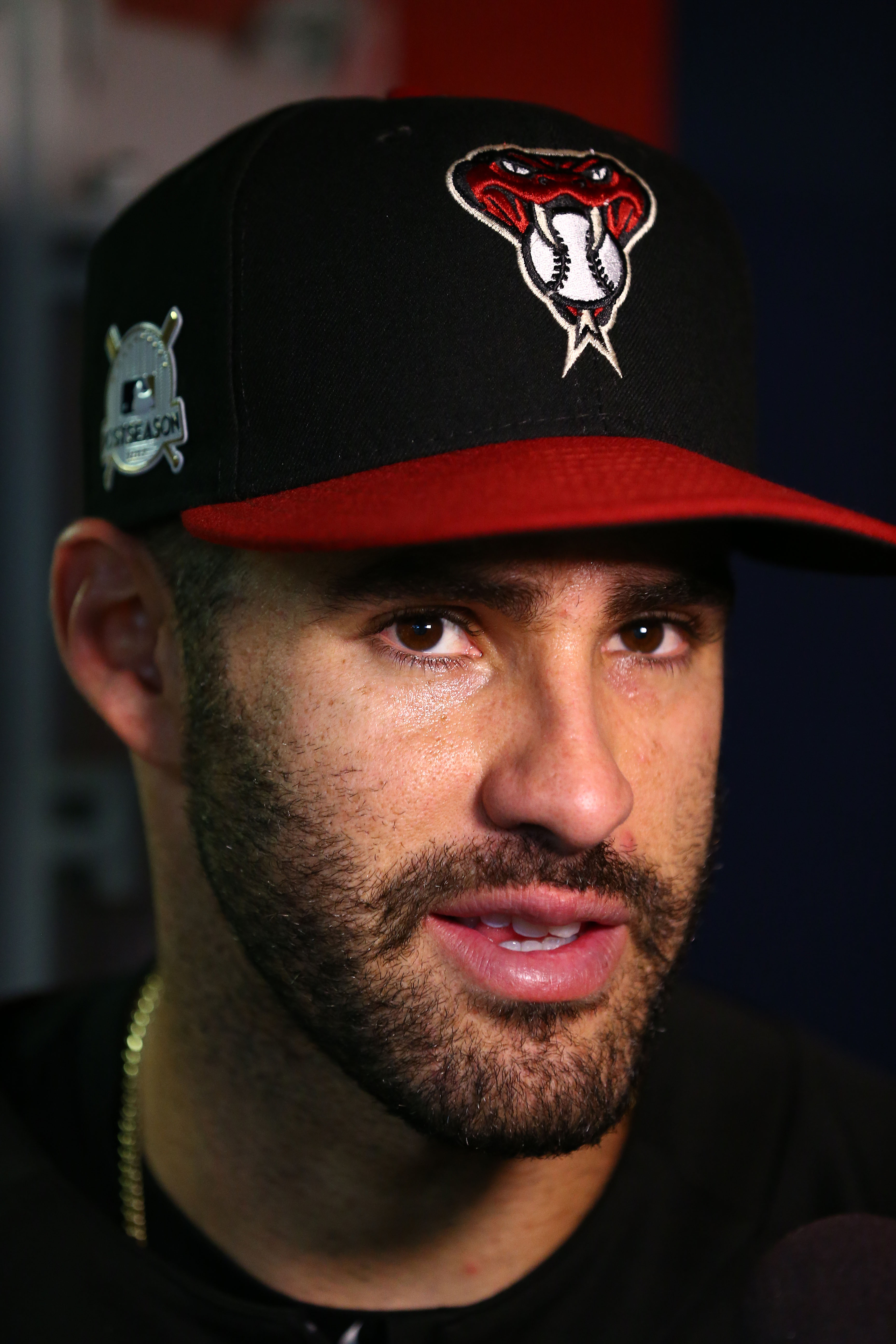
While the aforementioned players are good bets to return to Boston next year, the status of center fielder Jackie Bradley Jr. looks less certain. The Red Sox could trade the 27-year-old Bradley, who’s controllable for three more seasons, move Benintendi from left to center and reel in an offensive force such as J.D. Martinez or Justin Upton via free agency to join Beninendi and Betts in the grass. Martinez and Upton (if he opts out of his contract with the Angels) will come at much higher prices than Bradley, who will earn around $6MM in 2018, but the righty-swingers would likely mash at Fenway Park. And it’s worth noting that Dombrowski has already acquired Martinez in the past. When he was the Tigers’ general manager in 2014, Dombrowski took a flyer on the then-struggling Martinez.
Despite Dombrowski’s familiarity with Martinez, it’s possible the Red Sox will elect to stick with Bradley. Although he had a subpar year offensively, batting just .245/.323/.402 in 541 plate appearances, he was an easily above-average hitter the previous two seasons. Further, even if he doesn’t revisit his 2015-16 levels with the bat, Bradley’s still capable of providing surplus value in other ways. In fact, Bradley ranked third at his position in Defensive Runs Saved (nine) and seventh in Ultimate Zone Rating (4.2) in 2017. He also fared nicely on the bases, placing 11th in FanGraphs’ BsR metric. So, even in a down 2017, Bradley was still part of the overall solution for the Sox.
It’s up in the air whether Boston will have a new outfield alignment next year, whereas change at first base looks highly likely. Moreland is probably going to leave as a free agent, and the Red Sox don’t seem to have a ready-made replacement on hand. Prospect Sam Travis, 24, is fresh off an uninspiring year at Triple-A Pawtucket, where he hit for almost no power across 342 PAs (six home runs, .105 ISO), and didn’t distinguish himself during an 83-PA major league debut in Boston. The Red Sox would be hard pressed to count on him, then, which could point them toward free agency or the trade market for a first baseman.
Free agents-to-be Eric Hosmer, Carlos Santana, Logan Morrison, Jay Bruce and Yonder Alonso all had successful offensive seasons in 2017 and could land on Boston’s radar. On the other hand, Dombrowski has never been shy about making deals and is only a year removed from swinging a blockbuster with the rebuilding White Sox, who have a star first baseman and potential trade candidate in Jose Abreu. The soon-to-be 31-year-old Abreu and his two remaining seasons of team control would warrant a quality haul, but the right-handed slugger and Fenway Park would make for an enticing match.
Whether the Red Sox make a play for Abreu or another high-profile hitter over the winter, it does seem fair to expect an offensive upgrade to come in some form. What do you think Dombrowski will do?
(Poll link for App users)
Will the Red Sox make any major offseason moves to improve their offense?
-
Yes 88% (5,524)
-
No 12% (733)
Total votes: 6,257
Photo courtesy of USA Today Sports Images.
Offseason Rumblings: J.D., Grichuk, Cards, Twins, Rockies
Along with the Diamondbacks (his current team), the Giants, Angels, Cardinals and Red Sox all stand out as potential offseason fits for impending free agent outfielder J.D. Martinez, Jon Morosi of MLB.com writes. While the Cardinals and Red Sox already have logjams in the outfield, a trade could open up room for Martinez, notes Morosi, who adds that whether the Angels pursue the offensive superstar is going to depend on Justin Upton‘s opt-out decision. The Giants, meanwhile, are in dire need of a slugger and a corner outfielder, making them arguably the most logical match for Martinez, Morosi opines.
- Outfielder Randal Grichuk has come up as someone the Cardinals could trade, and the 26-year-old realizes he may have played his last game in their uniform. On whether he expects to be a Redbird in 2018, Grichuk told Jenifer Langosch of MLB.com: “No. Not necessarily. But who knows. Anything is possible. It’s going to be a fun offseason. It’s going to be an interesting offseason to see what direction the club goes with a lot of guys. I’m excited to see what the future holds.” Grichuk has registered decent production across 1,386 career plate appearances in St. Louis (.249/.297/.488, .239 ISO) and put up back-to-back 20-home run seasons, but a lack of plate discipline has somewhat offset his impressive power and made him a trade candidate. Grichuk is projected to earn $2.8MM in 2018, his first of three arbitration-eligible seasons.
- After Twins pitchers recorded the majors’ third-worst swinging-strike rate in 2017, team brass is hoping to build a staff capable of missing more bats, Mike Berardino of the Pioneer Press details. At the same time, the Twins aren’t ruling out having some pitch-to-contact types on hand. In fact, even though closers Matt Belisle and Brandon Kintzler (now with the Nationals) generated fewer swings and misses than the average reliever this season, the club’s interested in re-signing the former and reuniting with the latter in free agency, according to Berardino.
- For the second straight offseason, the Rockies will have to work on shoring up their bullpen, Patrick Saunders of the Denver Post observes. The Rockies signed Greg Holland and Mike Dunn to sizable contracts last winter, but Holland’s now set to opt out of his deal and head to the open market again. Colorado probably won’t be able to re-sign the closer, Saunders writes, and the fact that Holland isn’t the team’s only key reliever who could exit in free agency only worsens matters. Jake McGee and July trade acquisition Pat Neshek are also unsigned entering the offseason. Holland, McGee and Neshek were among the best options in a bullpen that made big strides from 2016 to ’17, jumping from 23rd in fWAR to sixth and last in ERA to 20th.
Offseason Outlook: New York Mets
MLBTR is publishing Offseason Outlooks for all 30 teams. Click here for the other entries in this series.
After preventing left fielder Yoenis Cespedes from departing in free agency last offseason, the Mets entered 2017 on the shortlist of potential contenders in the National League. But injuries and down years beset nearly all of the Mets’ top players this season, leading to a 70-win campaign and the end of Terry Collins’ run as their manager. GM Sandy Alderson & Co. are currently searching for Collins’ replacement, but regardless of who’s atop the dugout next season, roster improvements are clearly in order.
Guaranteed Contracts
- Yoenis Cespedes, OF: $87.5MM through 2020
- David Wright, 3B: $47MM through 2020
- Juan Lagares, OF: $15.5MM through 2019 (club option for 2020)
Contract Options
- Asdrubal Cabrera, INF: $8.5MM club option or $2MM buyout
- Jerry Blevins, RP: $7MM club option or $1MM buyout
Arbitration-Eligible Players (service time in parentheses; projections via Matt Swartz)
- Nori Aoki (5.148) – $6.3MM
- Tommy Milone (5.113) – $2.2MM
- Matt Harvey (5.072) – $5.9MM
- AJ Ramos (5.030) – $9.2MM
- Jeurys Familia (5.024) – $7.4MM
- Zack Wheeler (4.098) – $1.9MM
- Travis d’Arnaud (4.044) – $3.4MM
- Wilmer Flores (4.003) – $3.7MM
- Jacob deGrom (3.139) – $9.2MM
- Noah Syndergaard (2.149) – $1.9MM
- Hansel Robles (2.127) – $1.0MM
- Non-tender candidates: Aoki, Milone
Free Agents
[Mets Depth Chart; Mets Payroll Information]
The Mets were never able to get off the mat after a 10-14 April, and as the season wore on, it became obvious Alderson was going to sell the team’s free agents-to-be in the summer. Ultimately, with the exception of Jose Reyes, Alderson dealt every notable Met on an expiring contract either before the July 31 non-waiver trade deadline or prior to the Aug. 31 waiver deadline. During those two months, the Mets said goodbye to outfielders Curtis Granderson and Jay Bruce, first baseman Lucas Duda, second baseman Neil Walker and reliever Addison Reed, among a couple others. All five of those players weighed heavily into the Mets’ franchise-record $155MM Opening Day payroll, a figure that will reportedly decrease by around $20MM in 2018. When factoring in the Mets’ arbitration projections and a couple club options they’re likely to exercise, roughly $100MM of their payroll for next season already looks settled. As such, New York probably won’t be a major player for the premier members of this offseason’s free agent class. That means Alderson is going to have to strike gold on some bargain pickups in order to help the team return to contention.
There’s a litany of question marks on the Mets’ roster heading into the offseason, but the most suspect area may be their infield. Aside from 21-year-old starting shortstop Amed Rosario – who, despite his elite prospect pedigree, struggled in his first 170 big league plate appearances – it’s anyone’s guess how the four-man unit will look in 2018. Third baseman and franchise icon David Wright will continue to loom over the Mets’ payroll through the next three years, but upper body injuries have prevented him from playing in the bigs since May 1, 2016, and he just underwent yet another surgery. The Mets can’t count on Wright to bounce back, something Alderson realizes, so they’re going to have to figure out what to do at the hot corner.
With Wright sidelined for all of 2017, Reyes, Asdrubal Cabrera, Wilmer Flores and T.J. Rivera combined to fare decently, but that doesn’t mean any are locks to start at third next season. Reyes is probably done as a Met, while they’ll have to make a decision on Cabrera’s $8.5MM option. The Mets will have to pay Cabrera a $2MM buyout if they decline to bring him back, which looks unlikely. After all, the 31-year-old has offered solid offensive production during his two-season tenure as a Met, and he’s capable of playing multiple infield positions. Flores and Rivera also bring respectable bats and defensive versatility to the table, making them strong bets to continue factoring in across the infield.
Should Cabrera, Flores and Rivera stays in their plans (and if Rivera’s recovery from Tommy John surgery goes smoothly), the Mets might not feel obligated to make any significant changes at either third or second, but if they do, there will be some reasonably priced options available in the coming weeks. Mike Moustakas figures to be out of the Mets’ price range at third, though fellow impending free agents Todd Frazier (a New Jersey native), Eduardo Nunez and, if he’s willing to move off shortstop, Zack Cozart might be fits. Nunez or Cozart could be solutions at second, too, which also holds true for Walker – who enjoyed his stint with the Mets – Howie Kendrick and trade candidates such as Ian Kinsler (Tigers), Yangervis Solarte (Padres) and Logan Forsythe (Dodgers). The speedy Nunez stands out as an especially intriguing possibility for a team that stole the majors’ fourth-fewest bases in 2017 (58) and finished fifth from the bottom in FanGraphs’ BsR metric. Notably, no Met acquitted himself better in either of those departments this season than Reyes, so losing him and adding Nunez would essentially be a lateral move from a baserunning standpoint.
As right-handed hitters, Flores and Rivera could be platoon mates at first for the lefty-swinging Dominic Smith, but the Mets might want to find an upgrade there. Smith, who debuted with the Mets in August as a top 100 prospect, was woeful during his 183-PA introduction in 2017. While the Mets don’t necessarily have to abandon hope on the 22-year-old, they also shouldn’t hand him the job at first next season if their goal is to contend. With three minor league options remaining, Smith could go back to Triple-A while the Mets turn to a more established player at first. That’s not to suggest they’ll splurge on Eric Hosmer or Carlos Santana, but Bruce, Duda, Yonder Alonso, Logan Morrison and Mitch Moreland may be on their radar as more payroll-friendly types (admittedly, giving Smith another shot might make more sense than turning to the mediocre Moreland).
As Joel Sherman of the New York Post noted last month, Bruce could also act as a right field fill-in if breakout star Michael Conforto‘s late-season shoulder surgery keeps him out of action in early 2018. Conforto’s injury somewhat clouds the outfield picture, but it still seems fair to surmise that the Mets’ alignment in the grass next season will mostly consist of him and Cespedes flanking a Juan Lagares/Brandon Nimmo tandem in center. With those players on hand, the Mets could cut ties with expensive reserve Nori Aoki. Although Aoki performed well after signing with the Mets late in the season, his low-ceiling skillset may not be worth $6MM-plus to a team with many holes and limited spending room.
While the Mets’ group of position players has plenty of issues – including behind the plate, arguably, though it appears they’ll stay the course with Travis d’Arnaud and Kevin Plawecki – their pitching was the weaker area in 2017, surprisingly enough. The Mets’ staff looked elite coming into the year, but their starters and relievers wound up recording the majors’ third-highest ERA (5.01) and 10th-worst fWAR (10.0). Injuries were at fault to a degree, especially considering fireballer and all-world ace Noah Syndergaard was barely available on account of a torn right lat. Syndergaard sat out all of May, June, July and August, limiting him to 30 1/3 innings on the year, but he returned late in campaign and figures to take the ball on Opening Day in 2018.
If healthy, Syndergaard and Jacob deGrom are about as good as it gets atop a rotation, but certainty is difficult to find anywhere else among the Mets’ cadre of starters. Former ace Matt Harvey will be back in his last year of arbitration eligibility, and while it does make sense to tender him a contract, his leash may be short next season. In his first action since undergoing July 2016 thoracic outlet syndrome surgery, Harvey pitched to a 6.70 ERA/6.37 FIP across 92 2/3 innings. More of that next year could send him to the bullpen or out of New York entirely. Harvey certainly wasn’t the only Mets starter who disappointed this season, though, as Steven Matz and Zack Wheeler were also ineffective before seeing their years end early thanks to arm problems. The fact that they opened the season with durability concerns makes their truncated, below-average 2017s all the more troubling. Meanwhile, the other Mets who amassed double-digit starts – Robert Gsellman, Seth Lugo and Rafael Montero – also failed to distinguish themselves as rotation locks this year. The only member of the trio without any options left is Montero, which means he could find himself out of the organization if he doesn’t at least crack the Mets’ bullpen next spring.
The Mets clearly have enough arms to fill in a rotation behind Syndergaard and deGrom, but as evidenced above, there’s substantial risk with each of those hurlers. As such, it would behoove the Mets to search for a competent innings eater – something they had in Bartolo Colon from 2014-16. If they’re not in big-spending mode, expecting to find the type of production Colon offered during that three-year stretch may be unrealistic, but there will still be affordable free agents who could help their cause. Doug Fister was on the Mets’ radar early in 2017 and is due to reach the market again after an encouraging showing in Boston. Other potential targets in free agency may include CC Sabathia (it’s hard to imagine the Yankees not re-signing him, though), Jaime Garcia, Jhoulys Chacin, Jeremy Hellickson, John Lackey, Jason Vargas, Miguel Gonzalez and Chris Tillman, to name several.
Moving to the bullpen, there will be an array of quality relievers available in free agency, which is good news for a Mets club on the lookout for late-game stability. Jeurys Familia, like many other Mets, was both injured and unspectacular in 2017, pitching to a 4.38 ERA and walking nearly 5.5 batters per nine innings over 24 2/3 frames. His struggles played a part in the Mets’ bullpen posting the majors’ second-worst ERA (4.82) and fifth-lowest fWAR (1.2). Only one bullpen – the Brewers’ – recorded a higher walk rate than the Mets’ 4.25 per nine, while just eight induced fewer groundballs. The Mets’ woes in the walk department came despite having Reed for the majority of the season. Reed put up an extremely impressive 1.1 BB/9 in 49 innings with the Mets this year, and he’s one of several control artists headed for the open market. As shown in the previous link, no free agent-to-be combines appealing walk and grounder rates like Brandon Kintzler, who was top seven this year among impending FA relievers in each category. If signed, he’d join Familia, Jerry Blevins and AJ Ramos as the Mets’ go-to arms in high-leverage spots. However, the Mets may opt for a far more strikeout-minded reliever(s) than Kintzler, who barely punched out four batters per nine innings this season.
Evidenced in part by their pitching staff, a lot has changed in the past year for the Mets, who went into last offseason bent on keeping a playoff-caliber roster intact. Twelve months later, they’re an NL also-ran that closed this season with a dreadful record and the league’s third-worst run differential (minus-128). Better health alone will prevent such a poor finish from happening again in 2018, but management will have to make a variety of shrewd moves this winter in order to restore the club to the winning ways it displayed from 2015-16.
Baseball Blogs Weigh In: Jays, Braves, Dodgers, Cards, Bucs, BoSox
This week in baseball blogs:
- Jays Journal wants Toronto to pursue a trade for Marlins center fielder Christian Yelich.
- When Sid Slid shares a Braves offseason blueprint.
- theScore has some concerns about Clayton Kershaw.
- Pop Culture Abstract is leery of reliever Greg Holland, a potential target for the Cardinals in free agency.
- The Point of Pittsburgh looks at Gerrit Cole‘s issues with homers this season.
- The Sports Tank argues that Brad Ausmus should be the next manager of the Red Sox.
- Everything Bluebirds explains why Toronto should consider trading Josh Donaldson in the offseason.
- Underthought examines how starting pitchers who entered games as relievers have fared this postseason.
- Mets Daddy is glad they passed on Matt Wieters last winter.
- Atlanta Baseball Talk (podcast) chats with David O’Brien, who covers the Braves for the Atlanta Journal-Constitution.
- Pirates Breakdown talks with Bucs left-hander Jack Leathersich.
- Clutchlings believes the Blue Jays will have a legitimate chance to land Shohei Otani if he leaves Japan.
- Hardball Via Hardcore flashes forward to life without Nelson Cruz for the Mariners.
- DiNardo’s Dugout (podcast) hands out NL awards.
- The Loop Sports assesses James Shields‘ season.
- Call to the Pen delves into the possibility of the Phillies trading for pitching.
- Clubhouse Corner’s Bernie Pleskoff (links: 1, 2) analyzes impact players and rosters from both leagues.
- The Runner Sports (links: 1, 2,) writes about the importance of starting pitching, and has a piece on Astros outfielder Josh Reddick.
- Rotisserie Duck highlights the best clutch hitters of 2017.
- Ladodgerreport is impressed with Kenta Maeda in his new relief role.
- The 3rd Man In profiles right-hander Adam Kloffenstein, a 2018 draft prospect.
- Pinstriped Prospects (links: 1, 2) lists five underrated performances from Yankees hitting and pitching prospects in 2017.
-
Jays From the Couch opines that Toronto’s outfield should not be its top priority this offseason.
- MetsMind points out that the club was terrible against playoff teams this year.
- The Giants Cove doesn’t hold Dusty Baker in high esteem.
Submissions: ZachBBWI @gmail.com.
East Notes: Nats, Tillman, Red Sox, Marlins
We haven’t yet heard a full breakdown of the Nationals‘ offseason plans following the club’s hard-to-fathom postseason exit on Thursday night. But president of baseball operations Mike Rizzo has shared some preliminary thoughts on the team’s latest NLDS disaster, as MLB.com’s Mark Feinsand reports. Despite the obvious disappointment, Rizzo suggests there’s not much to be done beyond continuing to “just keep getting there, keep giving ourselves opportunities” in the postseason. He cited a quality core both “on the current club” and “in the farm system to supplement us,” which certainly has been reflected in the regular season results. So, how can the Nats respond to the loss? “Keep grinding, keep building, keep getting quality people in here. We’re going to be fine here in Washington,” Rizzo says.
More from the East Coast:
- With a 7.84 ERA and minus-1.o fWAR across 93 innings, right-hander Chris Tillman was among the worst pitchers in baseball this year, but Roch Kubatko of MASNsports.com doesn’t sense that the Orioles have moved on from the free agent-to-be. Both sides are comfortable with each other, Kubatko writes, which could lead to Tillman staying with the starter-needy Orioles on a one-year deal in an effort to rebuild his value. Tillman gave Baltimore’s rotation respectable production from 2012-16, but the shoulder issues he dealt with toward the end of last year disrupted his offseason routine and likely played some part in his difficult 2017. A more typical winter and spring could make Tillman a bounce-back candidate next year, then.
- It’s not particularly likely that the Red Sox will bring back any of their impending free agents, Jen McCaffrey of MassLive.com suggests. Out of Eduardo Nunez, Mitch Moreland, Chris Young, Doug Fister, Fernando Abad, Addison Reed, Rajai Davis and Blaine Boyer, it seems Boston is most interested in re-signing Nunez, but McCaffrey points out that he may be able to land more playing time someplace else. Should the Red Sox re-up Nunez, it could be a sign that they’re concerned about second baseman Dustin Pedroia‘s health, McCaffrey observes. The 34-year-old Pedroia went on the disabled list twice because of knee issues in 2017 and only appeared in 105 games – down from 154 the previous season.
- New Marlins part-owner Derek Jeter has already made some decisions contrary to predecessor Jeffrey Loria’s advice, Jon Heyman of FanRag writes. Specifically, Loria would have retained four executives Jeter’s group fired – assistant general manager Mike Berger, vice president of player development Marc Delpiano, VP of pitching development Jim Benedict and VP of player personnel Jeff McAvoy – and parted with scouting director Stan Meek, whom Jeter kept. Jeter and majority owner Bruce Sherman will have to pay the axed execs between $6.5MM and $9MM, Heyman adds.
East Notes: Girardi, Braves, Marlins, Mets/Nats Affiliate
Currently in the last year of his contract, Yankees manager Joe Girardi has been noncommittal about his future in recent weeks. On the heels of a rough few days for Girardi, ESPN’s Buster Olney says he expects Girardi’s time as the Yankees’ skipper to conclude at season’s end (podcast link). Of course, things are beginning to look quite a bit different than they did after a baffling Girardi decision that likely cost them Game 2. Now, the ALDS is tied and the Yankees could well find themselves among the last four teams standing, depending upon the outcome of the decisive game in Cleveland. Regardless of how things play out from this point forward, the long-experienced skipper will surely land on his feet, though Joel Sherman of the New York Post writes that some believe Girardi may be interested in some time away from the grind. Interestingly, the Mets have actually talked about Girardi as a possible successor to the ousted Terry Collins, but they “fully expect” him to stay in the Bronx, Mike Puma of the New York Post tweets.
More from the eastern divisions:
- Braves director of baseball operations Billy Ryan is a candidate to take over as their general manager, along with the previously reported trio of Royals GM Dayton Moore and Nationals assistants Doug Harris and Dan Jennings, per Bob Nightengale of USA Today. However, according to the Nationals, the Braves haven’t yet requested permission to interview anyone from their organization (Twitter links). Of course, no matter how the Atlanta organization proceeds, it has more questions to answer than who’ll take over for resigned GM John Coppolella. As David O’Brien of the Atlanta Journal-Constitution writes, some in the game anticipate the league will uncover broad malfeasance by the organization. There are quite a few remaining questions, writes O’Brien, for a club that now has to operate with care to get back on the right track.
- While the Marlins are now formally transitioning to a new ownership group, there’s still some potential work to be done before Miami-Dade County and outgoing owner Jeffrey Loria go their separate ways. As Douglas Hanks of the Miami Herald reports, there could be a battle brewing relating to the publicly-financed ballpark deal that brought Marlins Park into existence. The local authorities have already lined up an auditor to review Loria’s group’s assessment of money owed to the government under the financing deal, which seemingly has some room for interpretation as to how much of the sale proceeds must be shared by the ownership group.
- The Mets and Nationals will both undergo some changes at the highest level of their farm systems, as Mark Weiner of Syracuse.com writes. The New York organization has agreed to buy the Triple-A Syracuse Chiefs, which previously had an affiliate agreement with the Nats. It’s not clear at this point where the Washington organization will end up parking its Triple-A club in the future, though the change evidently will not take place until after the 2018 season.
Minor MLB Transactions: 10/9/17
Monday’s minor moves from around baseball:
- The Rays have outrighted right-hander Kevin Gadea to Triple-A Durham, according to Marc Topkin of the Tampa Bay Times. Gadea joined the Rays last December as a Rule 5 pick from the Mariners, but elbow problems prevented him from throwing a pitch with his new organization in 2017. Tampa Bay offered Gadea back to Seattle after removing the 22-year-old from the 60-day disabled list and before outrighting him, but the Mariners declined, Topkin reports. Therefore, unless someone takes Gadea in this year’s Rule 5 draft, he’ll stay with the Rays.
- The Marlins have re-signed infielder Peter Mooney to a minor league deal with an invitation to spring training, according to agent Marc Kligman (h/t: Tim Healey of the South Florida Sun Sentinel, on Twitter). In 2017, his second season with the Marlins organization, the 27-year-old Mooney hit .213/.290/.308 across 455 plate appearances with Triple-A New Orleans.
Poll: The Future Of Miami’s Outfield
Those who have visited this website with any regularity over the past few months know that Marlins outfielders Giancarlo Stanton, Christian Yelich and Marcell Ozuna have frequently come up as potential trade chips. With the MLB offseason set to begin in earnest in a few weeks, questions regarding the trio will continue to abound, especially with a fresh ownership group at the helm. While the Marlins’ new face of baseball operations, part-owner Derek Jeter, essentially did nothing but win during his acclaimed career as the Yankees’ shortstop from 1995-2014, he’s likely in for some tough times in Miami.
The Marlins’ most recent playoff trip came in 2003 – a season in which they knocked off Jeter & Co. in the World Series – and given their limited talent in the majors, a weak farm system that Baseball America ranks last in the sport and a dire financial situation, the future Hall of Famer’s newest chapter in the game will begin with at least a few lean years. Jeter realizes that, judging by some of the comments he made during the introductory press conference he and principal owner Bruce Sherman held in Miami last week. Although Jeter was reluctant to say that losing will continue for the Marlins in the near term, he did admit that there’s a need to “rebuild the organization,” adding that “there’s going to be at times unpopular decisions that we make on behalf of the organization.”
To a Marlins fan base that loathed the franchise’s prior owner, Jeffrey Loria, in part because of his penny-pinching ways, there probably wouldn’t be a less popular move than trading Stanton – especially after he enjoyed an MVP-caliber 2017 in which he smashed a league-high 59 home runs. But getting out from under at least some of the $295MM he could rake in through 2028 would improve the franchise’s bottom line, so it seems likely Miami will consider offers for the 27-year-old. In theory, Stanton’s full no-trade rights – not to mention an opt-out clause after 2020 – could scuttle a potential deal, but it doesn’t seem he’d stand in the way of a swap if an acquiring team would give him a chance to play meaningful baseball into the fall.
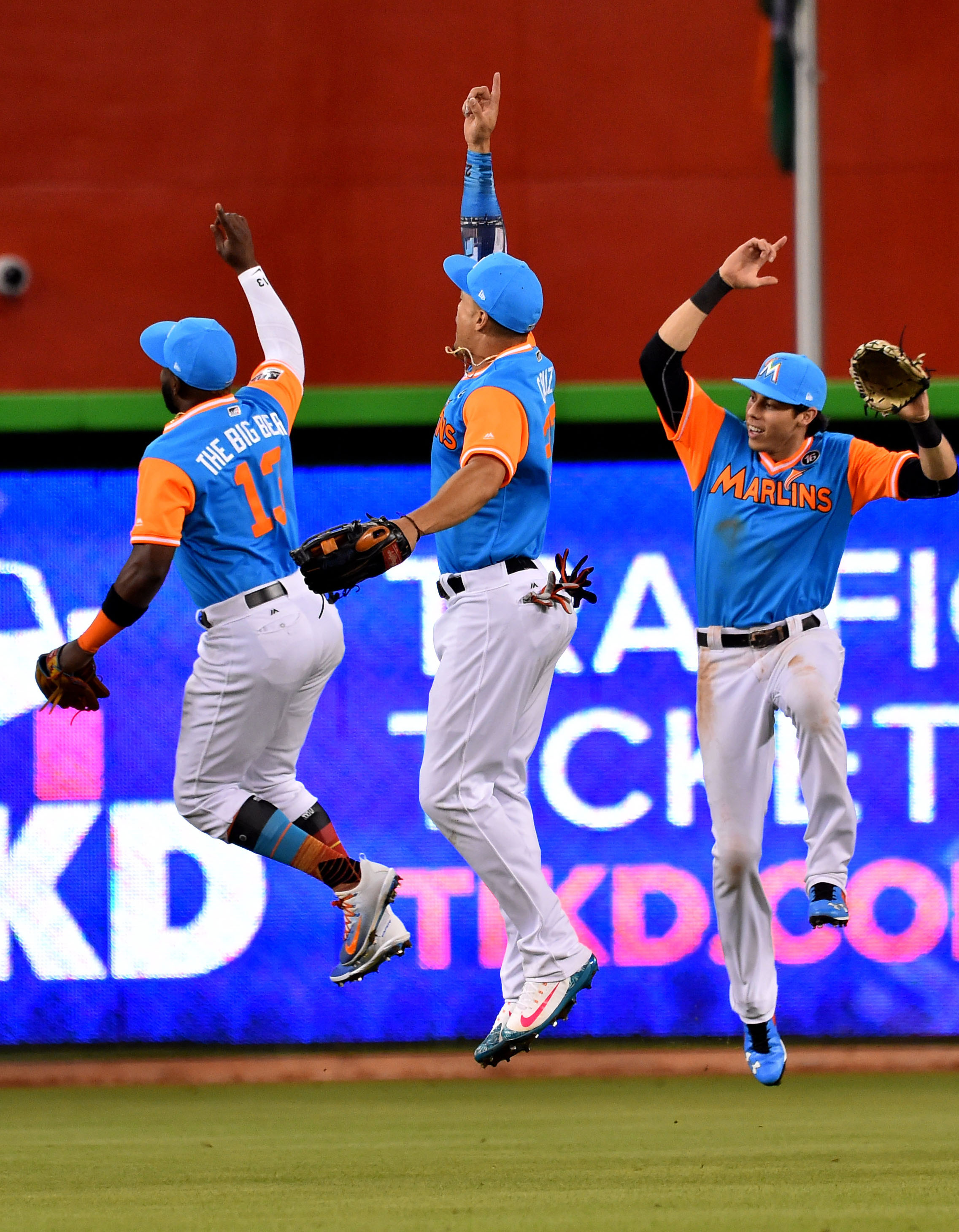
“I don’t want to rebuild. I’ve lost for seven years,” the right fielder said last month.
Despite their best efforts, Yelich and Ozuna have joined Stanton in doing plenty of losing as Marlins. Considering their affordability, moving either would be far less complicated for Miami than trading Stanton, and it would beef up the team’s farm system.
Yelich, the 25-year-old center fielder, has been worth 4.5 fWAR in three of four seasons since becoming a full-time major leaguer (including in 2017) and is signed to a palatable deal. He’s due a guaranteed $43.5MM through 2021 and will collect either a $15MM salary or a $1.25MM buyout in 2022. Yelich is all the more appealing when considering the best outfielders who could hit free agency next month (J.D. Martinez, Justin Upton and Lorenzo Cain) are already over 30 and will rake in far richer contracts than his.
Ozuna doesn’t come with Yelich-esque team control, but the left fielder still has two arbitration-eligible years remaining after making $3.5MM in 2017, a career season. Across 159 games and 679 trips to the plate, the 26-year-old slashed .312/.376/.548 with 37 homers – much better production than he put up over the previous four years, though he was still a fairly respectable contributor from 2013-16. With an appreciable raise on the way this offseason and a trip to free agency only a couple years off, now may be the time for Miami to wave goodbye to the Scott Boras client.
There are other players the Marlins figure to market in the next few months, but their highest-profile chips are their starting outfielders, a trio that hit a combined .288/.368/.519 this year and topped the NL in fWAR (16.1). Marlins fans may not like it, but with the franchise going in a new direction, it stands to reason Stanton, Yelich and Ozuna have lined up in the same outfield together for the last time. Which player(s) do you think the Fish will part with in the offseason?
(Poll link for app users)
Which outfielder(s) will the Marlins trade?
-
More than one 45% (3,977)
-
Stanton 26% (2,332)
-
Ozuna 13% (1,135)
-
Yelich 8% (732)
-
None 8% (706)
Total votes: 8,882
Photo courtesy of USA Today Sports Images.
Front Office/Managerial Notes: Marlins, Brewers, Tigers
The latest front office and managerial updates from around the majors:
- Yankees vice president of player development Gary Denbo is leaving the Bombers to become the Marlins’ director of player development and amateur scouting, George A. King III of the New York Post reports (on Twitter). Denbo will work under Michael Hill, who will stay on as the Marlins’ president of baseball operations, Barry Jackson of the Miami Herald tweets. Since a group including former Yankees shortstop Derek Jeter agreed to purchase the Marlins in August, there had been plenty of speculation about Denbo heading to Miami. Denbo served in various capacities during multiple stretches with the Yankees dating back to the 1990s and even managed Jeter in the Gulf Coast League in 1992. The two still have a close relationship, paving the way for Denbo to reunite with Jeter in Miami. The Marlins haven’t requested permission to speak with anyone else from the Yankees’ front office, per Mark Feinsand of MLB.com (Twitter links).
- The Brewers’ David Stearns-led front office has promoted Karl Mueller to vice president of player personnel, Matt Kleine to director of baseball operations and Scott Campbell to special assignment scout, according to a team announcement. Mueller, a 14-year veteran of Milwaukee’s baseball department, spent the past two seasons in Kleine’s new position. Kleine, who’s entering his 12th year with the Brewers, most recently served as their manager of baseball operations. Campbell, yet another longtime member of the organization (he’s entering his 13th year), was the Brewers’ assistant director of video scouting from 2015-17.
- Royals catching instructor Pedro Grifol is an early candidate to become the Tigers’ next manager, Jon Morosi of MLB Network tweets. Grifol has served in that position since 2014. He also has experience as a major league hitting coach (Royals, 2013-14) and a minor league manager (with low-level Mariners affiliates from 2003-05 and in 2012)
NL Notes: Martinez, Cardinals, Nationals
Diamondbacks right fielder J.D. Martinez has been one of majors’ top offensive players over the past few years, but his 2014 breakout wouldn’t have come if not for Los Angeles-based hitting coaches Craig Wallenbrock and Robert Van Scoyoc, Nick Piecoro of the Arizona Republic details. When Martinez first visited the duo four years ago, his swing “was pretty terrible, to be honest,” according to Van Scoyoc. Added Wallenbrock, “We probably made more drastic changes with him than we did with anybody.” Martinez began working diligently with the pair after the 2013 season (before the Astros released him in March 2014), and the fly ball-first approach they preach has paid enormous dividends. As an Astro from 2011-13, Martinez hit .251/.300/.387 with 24 home runs and a 33.3 percent fly ball rate in 975 trips to the plate. Since then, Martinez has combined for 2,143 plate appearances with the Tigers and D-backs and slashed .300/.362/.574 with 128 HRs and a 40.1 percent fly ball rate. The 30-year-old currently stands as one of the game’s premier free agents-to-be, and realizes he wouldn’t be where he is without Wallenbrock and Van Scoyoc. “I am who I am because of them,” Martinez said.
More from the National League:
- The Cardinals are in search of power, something third baseman Jedd Gyorko provided both last year and this season, but it’s possible he’ll be on another roster in 2018, Rick Hummel of the St. Louis Post-Dispatch writes. While Gyorko has hit a team-high 50 home runs since 2016 (20 this year) and, in manager Mike Matheny’s words, “played a phenomenal third base,” the Cardinals could shop him if they make changes at his position or elsewhere in in the infield. Gyorko, who’s controllable through 2020 at reasonable costs, wants to stay where he is. “I would love to be here, but who knows?” he said. “If I could spend the rest of my career here that would be great. I can’t see any reason why you wouldn’t want to play here.”
- Elsewhere in the Cardinals’ infield, the presence of power-hitting shortstop Paul DeJong gives them a leg up on most teams, Benjamin Hochman of the Post-Dispatch argues. Of the top eight shortstops in home runs this year, five ended up in the postseason, Hochman points out. The 24-year-old DeJong was one of the three who didn’t, but the rookie still posted outstanding production with 25 long balls – good for second at his position – to go with a .285/.325/.532 line and a .247 ISO over 443 PAs. But DeJong’s output did come with some good fortune – with 124 strikeouts against 21 unintentional walks, he logged one of the worst ratios in the game. Further, according to Statcast (via Baseball Savant), DeJong’s expected weighted on-base average (.323) lagged far behind his actual wOBA (.365). Sill, Hochman expects DeJong to be the answer for the Cards at short, a position Aledmys Diaz couldn’t lock down this season after unexpectedly bursting on the scene as a rookie in 2016.
- In a decision that raised eyebrows at the time, outfielder Jayson Werth left the contending Phillies for the upstart Nationals’ seven-year, $126MM offer in December 2010. The Nationals have turned into a winning organization since then, in part because of Werth, Nats GM Mike Rizzo told Mark Bowman of MLB.com. “I brought him here to shape us as a championship-caliber franchise,” Rizzo said. “Slowly, we’ve kind of morphed into a very professional organization. We have a protocol and a process. He has been an instrumental factor in getting us where we’re at.” Werth’s production has been a mixed bag in D.C., but the club “got everything we intended to get out of” signing him, Rizzo contends. Werth, meanwhile, is “proud” of the “first-class organization” the Nats have become during his seven-year run, and he’s content to “leave this organization in a better state than when I arrived.”