
Which Players Will Reach 10-And-5 Rights This Year?
As players continue to bounce around the league with greater frequency for a variety of reasons — teams leaning increasingly toward shorter-term deals, financial incentive to reach free agency, etc. — the number of players gaining 10-and-5 rights have diminished in recent years. For those unfamiliar or those who need a reminder, 10-and-5 rights are granted to a player who has accrued 10 years of MLB service time, including five consecutive years with his current team. These players are given veto power over any potential trade involving them.
It’s rare that a player invokes his 10-and-5 rights, although we’ve seen them come into play in the past. Adam Jones utilized his 10-and-5 provision to block a deal to the Phillies two summer ago, and Brandon Phillips quashed a pair of trades that would’ve sent him out of Cincinnati before he finally acquiesced on a deal sending him to Atlanta.
In other cases, such as Coco Crisp‘s trade from Oakland back to Cleveland in 2016, players are willing to waive that veto power for the right deal and/or some additional financial incentive. Those rights were a major factor in the Rays’ decision to trade Evan Longoria when they did; had he opened the 2018 season with Tampa Bay, he’d have gained full no-trade power just two days into the year.
As a reminder, players will receive a year of service time even if no games are played in 2020. And if a season is played, the service time will be prorated to match the truncated nature of the season. In other words, current big leaguers are going to get their year of service unless they’re optioned to the minors or released.
With all that said, some 10-and-5 rights looming on the horizon (I’ve omitted players such as Buster Posey, whose contracts already included full no-trade protection)…
- Kenley Jansen: Jansen’s five-year, $80MM contract with the Dodgers didn’t include a no-trade clause, although it does pay him a $1MM assignment bonus in the event of a trade. Jansen has nine years, 73 days (9.073) of MLB service time, so he’ll clear 10 years of service in 2020 with or without a season. As such, he’ll have full no-trade power next winter, when he’d have one year and $20MM remaining on his contract.
- Jason Heyward: Heyward is getting to the elusive 10-and-5 status in a bit of a different manner. He’s already reached 10 years of service, and once this year elapses, he’ll have spent five years in a Cubs uniform. His contract allows him to block deals to a dozen teams of his choosing in 2020, but he’ll gain full no-trade power next winter. His contract would be cumbersome to move in the first place, given the four years and $86MM remaining on his deal at the moment.
- Johnny Cueto: Like Heyward, Cueto already has the requisite decade of MLB service, but he’s only spent four years with his current team. Next offseason, Cueto will have spent five seasons as a Giant, giving him veto power if the club wants to trade the sixth season of that deal and the subsequent club option. He’s owed $21MM in 2021 and a $5MM buyout on his 2022 club option.
- Freddie Freeman: There’s no real reason to think the Braves would be entertaining the notion of trading a player who has long been considered the face of the franchise (even if Ronald Acuna Jr. is now taking over that title), but Freeman’s eight-year, $135MM contract didn’t contain any no-trade protection and he currently has 9.033 years of service. He’s owed $22MM in 2021, the final season of his current contract, but an extension seems likelier than a trade.
The D-backs Replaced Paul Goldschmidt With A Waiver Claim — And It Worked
It’s been three years since Christian Walker rode the waiver carousel. A 2012 fourth-round pick of the Orioles, Walker’s chance of being a regular with the Baltimore organization likely went up in flames the moment owner Peter Angelos green-lighted the seven-year, $161MM deal that brought Chris Davis back to the club after he’d reached free agency. The Orioles still had a designated hitter spot, but a year later in the 2016-17 offseason, the Orioles re-signed Mark Trumbo to a three-year deal that only further cut into Walker’s opportunities. In Spring Training 2017, Walker was cut loose when the O’s acquired Richard Bleier from the Yankees.
From there, it was a whirlwind month for Walker — and likely one with a fair bit of frustration. After being blocked in Baltimore by Davis and Trumbo, Walker was surely hoping for a clearer path to the Majors. Instead, he landed in the National League, with no DH… behind Freddie Freeman. The Braves claimed Walker four days after his DFA in Baltimore but tried to sneak him through waivers themselves not two weeks later. Walker was again left to hope for a path to the Majors. Upon landing in Cincinnati on another claim, he was, of course, looking straight up at an in-his-prime Joey Votto. Three weeks later, Walker hit waivers again when the Reds tried to outright him at the end of camp. This time, he landed directly behind Paul Goldschmidt in Arizona.
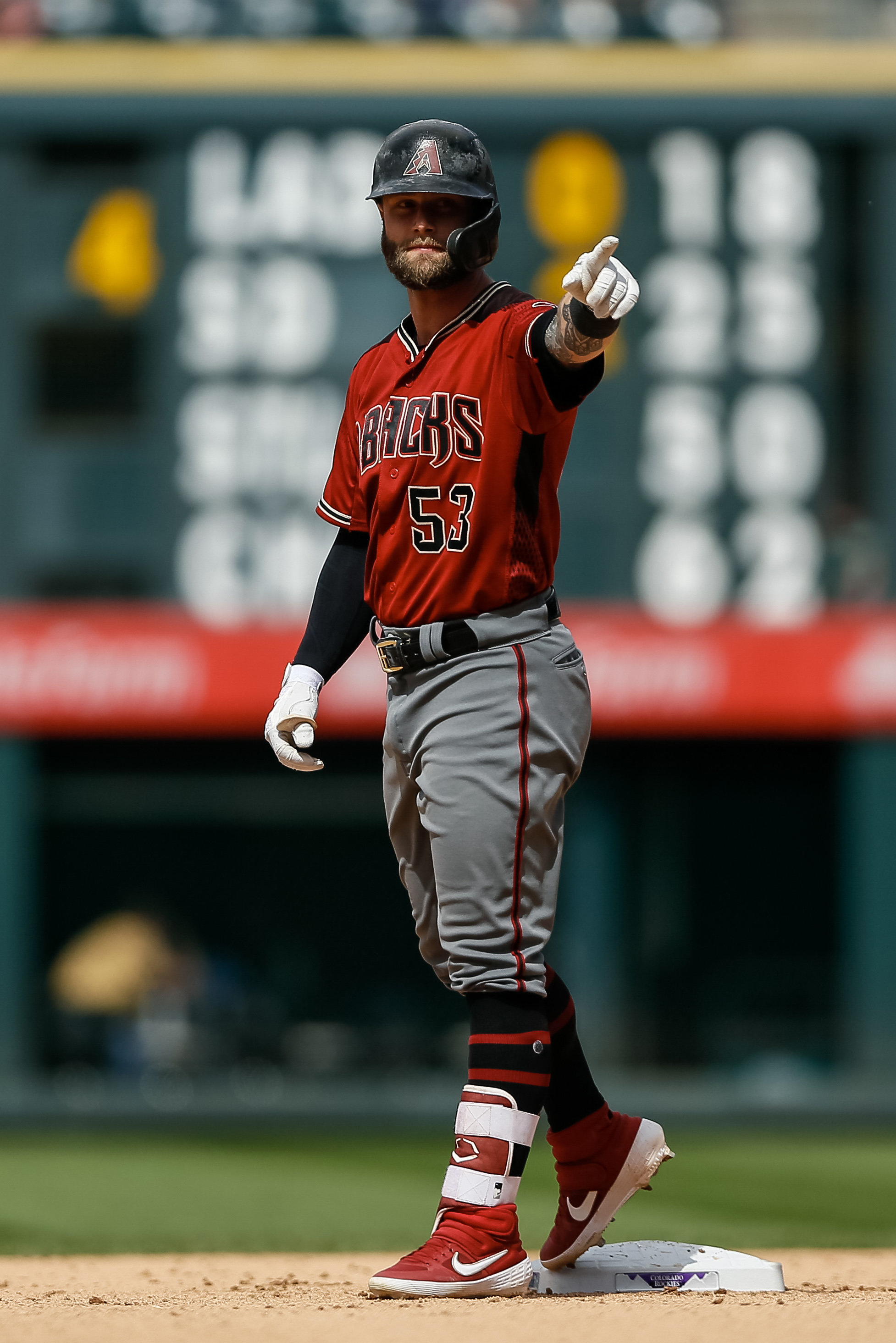
The D-backs finally succeeded in passing him through waivers, though they selected him back to the big leagues later that year. For two seasons, Walker obliterated Triple-A opposition, slashing a combined .305/.372/.586 (142 wRC+) with 50 home runs, 59 doubles and 13 triples. And yet, his Major League counterpart matched him blow for blow in the big leagues; Goldschmidt posted a ridiculous .294/.396/.547 (144 wRC+) with 69 home runs, 69 doubles and eight triples. By the time the 2018 season concluded, Walker was out of minor league options while Goldschmidt entered the final season of his contract.
A trade of Goldschmidt seemed plausible but hardly a sure thing entering the winter of 2018-19. There was little hope of the D-backs re-signing him with Zack Greinke still on the books. Goldschmidt had already signed one team-friendly extension in his career and wasn’t likely to do so a second time. The D-backs explored deals involving both Goldschmidt and Greinke that winter, ultimately lining up with the Cardinals on a return of Luke Weaver, Carson Kelly, Andy Young and a Competitive Balance draft pick (Round B).
Even at that point, though, Walker wasn’t a lock to step into Goldschmidt’s shoes. The D-backs had re-signed Eduardo Escobar to a three-year deal, crowding the third base mix and perhaps pushing Jake Lamb across the diamond to first base. Lamb’s 2018 season was ruined by a shoulder injury, but he hit 59 home runs from 2016-17, batting a combined .248/.345/.498 along the way. A platoon looked to be the likeliest outcome for the right-handed-hitting Walker and the lefty-swinging Lamb, and that’s indeed how the club operated — until Lamb landed on the injured list once again on April 5 with a quadriceps injury that would sideline him into late June.
Prior to the 2019 season, Walker hadn’t started consecutive games in the Majors since Sept. 2014. With Goldschmidt out the door and Lamb on the shelf, however, the everyday opportunity he’d sought in the nearly five years since making his MLB debut was sitting right in front of him, and he seized it. Walker appeared inn 71 games while Lamb was on the IL — starting 66 of them — and hit .258/.333/.461 with 11 homers, 17 doubles, a triple, four steals and elite defense at first base. Even with Lamb back in the fold and playing on a $4.825MM salary, Walker had earned the trust of the organization and earned himself an everyday role.
By season’s end, the then-28-year-old Walker had compiled a .259/.348/.476 slash and 29 home runs. While his hitter-friendly home park and the juiced ball that prompted home run totals throughout the league to explode rendered that production perhaps a bit lighter than some might expect (112 wRC+, 111 OPS+), Walker complemented his output at the plate with quality baserunning and with some of the best glovework of any first baseman in the Majors. Walker’s 11 Defensive Runs Saved and 9 Outs Above Average trailed only Oakland’s Matt Olson for the MLB lead at his position. Walker’s 3.0 bWAR, in fact, topped the 2.4 mark of the franchise icon he’d replaced.
It’ll be important to see how he carries himself at the plate in the event of a course correction with regard to the composition of the baseball, but there’s little reason to doubt his ability. Walker (fittingly) drew a base on balls in 11.1 percent of his plate appearances and was among the game’s very best in terms of hard-hit rate (94th percentile), average exit velocity (85th percentile), xwOBA (81st percentile) and percentage of barreled balls (90th percentile). And even if those numbers take a step back, his superb glovework and excellent baserunning (relative to his positional peers) help to give Walker a relatively high floor.
All of that should be music to the ears of the D-backs, whose patience in hanging onto Walker was rewarded not only with a potential everyday heir to the first base slot — but one that can be controlled all the way through the 2024 campaign. Heading into the 2020 season — assuming there is one — there should be little doubt that Walker has a firm grip on the starting job that’s eluded him for his entire career. As insane as it would have sounded when Walker was acquired in 2017 and as improbable as it might’ve seemed even last spring, the D-backs look like they’ve successfully replaced Goldschmidt with a waiver claim.
Do The Nats Have Yet Another High-Quality Starter On Their Hands?
The trio of Max Scherzer, Stephen Strasburg and Patrick Corbin is enough to make almost any club enviable — not necessarily of the price tags but of their raw abilities on the mound. When the Nats added Anibal Sanchez to that bunch on the heels of a resurgent 2018 season, it almost seemed as though it didn’t even matter who the fifth starter was. With Strasburg re-upping on what was briefly a record deal at this year’s Winter Meetings, that same thought might’ve crossed the minds of some. And while it’s true that the Nats’ rotation will be stacked with or without a decent fifth starter, they might have a better option on their hands than most realize.
Austin Voth is already 27 years old (28 in June) and only pitched 43 2/3 innings for the Nationals in 2019. He and fellow righty Joe Ross were set to battle it out for the final rotation spot in camp this spring, and while I was personally all aboard the Ross train back in 2015-16, it’s Voth who now looks like the breakout candidate in the making.
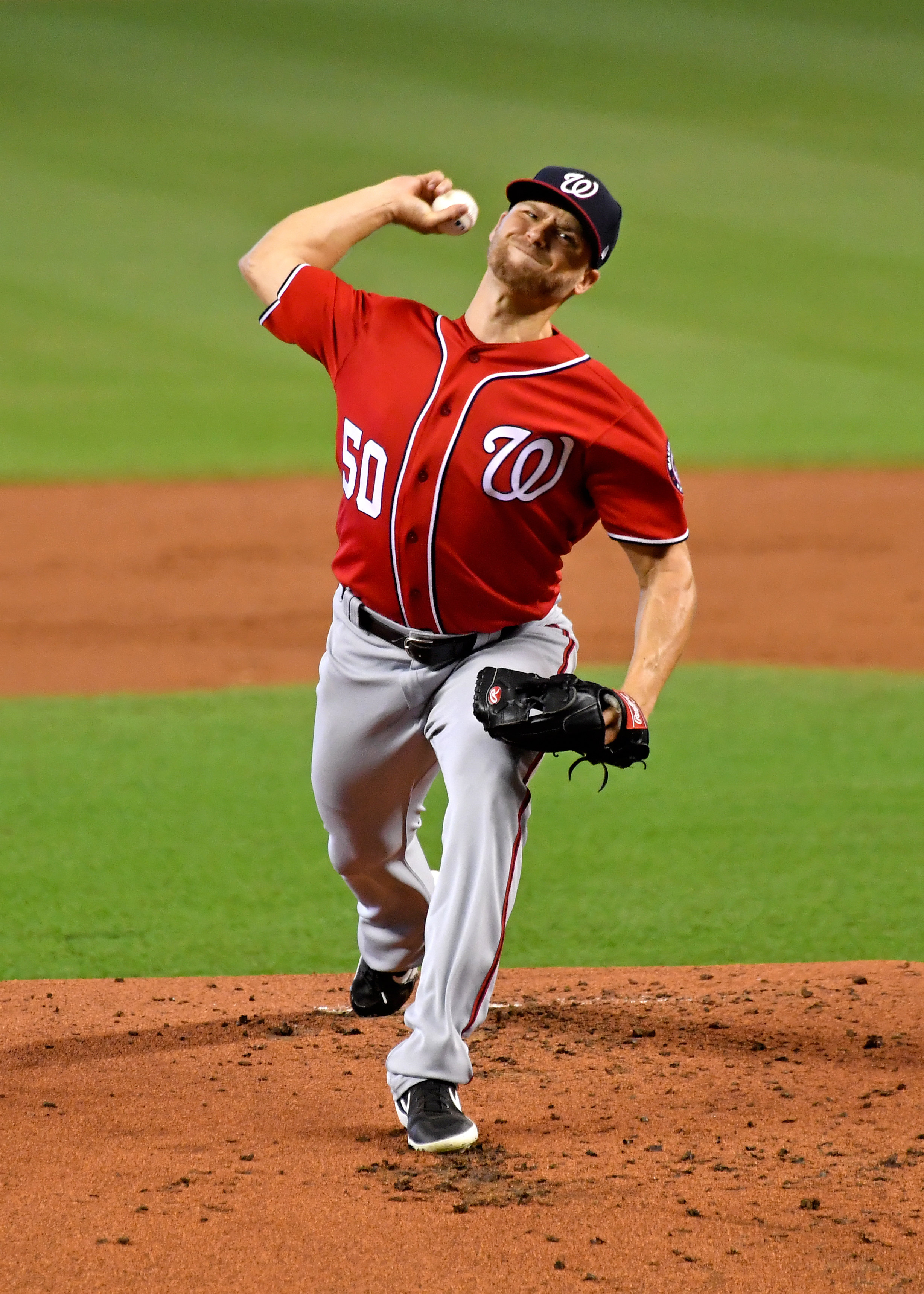
A former fifth-round pick of the Nationals (2013), Voth isn’t exactly new to their rotation radar. Back in 2016, he spent his age-24 season in Triple-A and spun 157 innings off 3.15 ERA ball with 7.6 K/9, 3.3 BB/9, 0.63 HR/9, a 49.7 percent ground-ball rate and near-identical marks in FIP (3.53) and xFIP (3.55). He wasn’t ranked among baseball’s elite prospects, but he was a strong Triple-A performer with a decent draft pedigree who looked ready for a big league rotation chance.
The 2017 Nationals, though, had Scherzer, Strasburg, Gio Gonzalez and Tanner Roark in their top four rotation spots. Ross had posted a 3.52 ERA and 3.46 FIP in 35 games across the two preceding seasons. With no immediate room in the rotation, Voth headed to the minors and looked like he’d be the first line of defense in the event of an injury. But when Ross went down with a torn UCL, Voth was in the midst of a catastrophically bad season in Syracuse. Through his first 13 starts, he’d pitched to a ghastly 6.38 ERA before going down with an injury himself. He never recovered his footing upon returning and finished the season with a 5.94 ERA. He rebounded with respectable showings in Triple-A in 2018-19, but he never appeared to recapture that 2016 form… until he got his first extended run in the big leagues last year.
In 43 2/3 frames last season, Voth worked to a 3.30 ERA with 44 strikeouts against 11 unintentional walks. His 92.8 mph average fastball was up 1.4 mph over the velocity he’d shown in a briefer 2018 cup of coffee, and Voth leaned heavily on a wipeout curveball to complement that improved heater. Voth induced chases outside the zone at a healthy 31 percent clip and recorded a 12.7 percent swinging-strike rate. His curve, which sits in the 90th percentile among MLB hooks in terms of spin rate, came with a gaudy 20.9 percent whiff rate. Opponents hit .176/.222/.265 when they put the pitch in play, and the .207/.295/.424 slash against Voth’s fastball wasn’t much better.
Not only was Voth adept at creating swings and misses — he also induced plenty of hapless contact. His 29.2 percent opponents’ hard-hit rate, per Statcast, was the 41st-best mark of the 558 pitchers who had 50-plus balls put into play against them last year. Opponents hit 47 fly-balls against Voth in 2019, and 10 of them were infield flies — effectively automatic outs. Voth’s .276 xwOBA ranked 55th in the game (min. 150 plate appearances against), placing him directly alongside the likes of Luis Castillo (.277), Walker Buehler (.275) and Chris Paddack (.275). That’s pretty nice company for a 27-year-old rookie-eligible hurler to keep after posting a combined ERA over 4.00 in the prior three Triple-A seasons.
Voth was off to a fine start this spring prior to the shutdown, tossing seven innings and allowing just one run with six strikeouts and one walk allowed. He obviously needs to prove that he’s capable of sustaining this type of output over a sample greater than last year’s eight starts (and one relief outing), but Voth showed the type of promise in 2019 that his chief rotation competitor, Ross, hasn’t flashed since prior to Tommy John surgery. That’s not to disparage Ross, who was very clearly on a fast-rising upward trajectory prior to getting injured and could yet recapture some of that form. But if the Nats were to choose one starter to plug into the rotation based on recent performance, Voth’s 2019 had the makings of not just a serviceable fifth starter but perhaps yet another high-quality arm on which the club can lean.
That’s certainly the hope for the Nationals organization, as an affordable rotation cog to slot alongside the massive salaries of their top three starters would certainly help with long-term payroll flexibility. (Sanchez is controllable for 2021 via club option.) Voth has yet to accrue even a full year of service, meaning he’s controlled all the way through 2025 and won’t even reach arbitration until the 2022-23 offseason.
Both Voth and Ross are out of minor league options, so they’ll almost certainly both make the roster if play is able to resume in 2020. And with a shortened season likely to feature fewer off-days and plenty of doubleheaders, perhaps they’ll each be afforded some opportunities to start games. If you’re taking a longer-term look at the Nationals’ starting staff or scouring the NL for breakout candidates, though, Voth’s strong showing in 2019 has placed him squarely in the mix.
MLB Announces “The Show” League Featuring 30 Players
If you’re pining for some actual competition among baseball players, Major League Baseball, the Players Association and Sony are doing their best to accommodate. The trio announced in conjunction today the first “MLB The Show Players League,” wherein 30 big leaguers — one from each team — will square off in a month-long, online league in MLB The Show on PS4. Each player will each other player once in a three-inning game, and the top eight records will advance to the postseason.
Games, which begin tonight, will be streamed on MLB’s social media accounts, MLB Network’s Twitch channel and MLB The Show’s social media accounts. MLB, the MLBPA and Sony are donating $5,000 to the Boys & Girls Club in all 30 markets, and the winner will receive an extra $25,000 for his community’s Boys & Girls Club. Your 30 players are:
AL East
Bo Bichette, Blake Snell, Eduardo Rodriguez, Tommy Kahnle, Dwight Smith Jr.
AL Central
Lucas Giolito, Trevor May, Carlos Santana, Niko Goodrum, Brett Phillips
AL West
Joey Gallo, Lance McCullers Jr., Jesus Luzardo, Ty Buttrey, Carl Edwards Jr.
NL East
Juan Soto, Jeff McNeil, Rhys Hoskins, Ryne Stanek, Luke Jackson
NL Central
Josh Hader, Matt Carpenter, Amir Garrett, Cole Tucker, Ian Happ
NL West
Hunter Pence, Gavin Lux, Fernando Tatis Jr., David Dahl, Jon Duplantier
Watching players compete in a video game version of the sport we’re all craving might not be everyone’s cup of tea — but it’ll provide fans with the opportunity to see some of their favorite players interact with each other and can serve as a welcome, baseball-themed distraction at a time when those are few and far between.
Will you watch any of tournament? (Link to poll for Trade Rumors mobile app users.)
Will you tune in for any of MLB The Show Players' League?
-
Are you kidding me? No way. 50% (2,224)
-
Yes -- I'm desperate. 31% (1,371)
-
I'd watch this even if actual baseball were happening! 20% (872)
Total votes: 4,467
MLB Has Discussed Realignment For 2020 Season
In another example of the radical measures that Major League Baseball is contemplating as it seeks to play as many games as possible in a truncated 2020 season, USA Today’s Bob Nightengale reports that one proposal would see the traditional American League and National League scrapped for the 2020 season only — and replaced by the Cactus and Grapefruit Leagues in which the clubs play during Spring Training. The 15 teams with spring facilities in Arizona and the 15 with spring facilities in Florida could each call their spring parks home, playing games in empty parks in realigned divisions.
As with the all-Arizona plan that was reported on earlier this week, a Cactus/Grapefruit arrangement is an intriguing concept but one that is also wrought with potential pitfalls. Securing ample coronavirus testing capabilities is still a challenge on a national scale, and Florida in particular is a problematic area with regard to the ongoing COVID-19 pandemic.
While the idea of empty parks ostensibly caps the number of people present for a given contest, it may not do so quite to the extent one would initially think. In addition to hosting a pair of rosters that would likely be expanded to 29 or more players, empty-park games would still need to have coaching staffs on hand in addition to umpires, medical/training personnel, camera crews, a production team and security staff for the facility in question (to say nothing of the potential for scouts and other front-office personnel as well).
Securing temporary housing for that many players, too, could be problematic. And as with the all-Arizona plan, the Florida-Arizona plan carries questions about weather conditions — playing primarily in open-air stadiums in the dead of an Arizona or Florida summer is clearly sub-optimal — and prolonged separation of players and their families. The looming issue of how to proceed if (or more likely when) an active player tests positive for the virus remains perhaps the most notable obstacle to address.
All of that said, it’s nevertheless fascinating to think about a season played out under such radical conditions. Nightengale suggests, for instance, that with the AL and NL designations scrapped, a universal DH could be implemented for one season. That’d seemingly put would-be NL clubs that hadn’t prepped for that change at a bit of a disadvantage, although concessions will surely have to be made by many parties if a season is to be played at all.
The potential for divisional realignment creates myriad new rivalry possibilities and shuffles the deck such that we might see some current postseason long shots gifted greater hope at the playoffs. Nightengale runs through one preliminary realignment scenario that would see the “Cactus League Northwest” division comprised of the Brewers, Padres, Rangers, Mariners and Royals. Over in the “Grapefruit League South” division we’d see a hyper-competitive trio of the Braves, Twins and Rays joined by the Red Sox and Orioles. Obviously, that’s merely one hypothetical alignment in a larger-scale hypothetical undertaking that may never even come to pass.
But at this juncture, as MLB joins the rest of us waiting for more robust testing/treatment and the blessing of public health experts and government officials to relax our social distancing measures, there’s no reason for the league not to cast a wide net in dreaming up creative solutions. To the contrary, thinking outside the box is arguably their best course of action right now. This, like the Arizona plan, is likely one of dozens of scenarios that has been or will be discussed by decision-makers as they seek to find a way to restore some sense of normalcy — to whatever extent is possible while maintaining the broader health of the general public.
Revisiting Dave Stewart’s D-backs Trades
Dave Stewart’s transition from agent to Diamondbacks general manager was both brief and frenetic. Not afraid to make moves that bucked industry trends, Stewart’s regime aggressively moved young talent for veterans, seemingly placed a lower value on draft picks than other clubs and made what proved to be a pair of high-profile missteps on the international market as they set out on a clear win-now path.
In 2016, the Diamondbacks marketed an “evolutionary” year for the franchise following an offseason that was headlined by their stunning signing of Zack Greinke to a six-year, $206.5MM deal. That 2016 campaign did prove to be a major turning point for the organization, although surely not in the manner the front office had hoped; Arizona finished out the year with a 69-93 record that led to a swift front office overhaul and the dismissal of manager Chip Hale.
Here’s a look back at the two years of hectic wheeling and dealing under the watch of Stewart, Tony La Russa and De Jon Watson…
2014-15 Offseason
- Acquired RHP Jeremy Hellickson from the Rays in exchange for OF Justin Williams and SS Andrew Velazquez
- Acquired LHP Robbie Ray and 2B/SS Domingo Leyba from the Tigers in a three-team trade that sent SS Didi Gregorius from D-backs to Yankees and RHP Shane Greene from Yankees to Tigers
- Acquired RHPs Zack Godley and Jeferson Mejia from the Cubs in exchange for C Miguel Montero
- Acquired RHPs Rubby De La Rosa and Allen Webster and INF Raymel Flores from the Red Sox in exchange for LHP Wade Miley
- Acquired RHP Myles Smith from the Red Sox in exchange for RHP Zeke Spruill
- Acquired OFs Josh Elander and Victor Reyes and cash from the Braves in exchange for RHP Trevor Cahill and a Competitive Balance Round B pick (announced as two separate deals on April 2 and April 6, as competitive balance picks couldn’t technically be swapped until after Opening Day)
2015 Season
- Acquired C Welington Castillo, RHP Dominic Leone, OF Gabby Guerrero and INF Jack Reinheimer from the Mariners in exchange for 1B/OF Mark Trumbo and LHP Vidal Nuno
- Acquired SS Phil Gosselin from the Braves in exchange for RHP Touki Toussaint and RHP Bronson Arroyo (the Braves effectively purchased Toussaint by taking on the remainder of the injured Arroyo’s contract)
- Acquired SS Dawel Lugo from the Blue Jays in exchange for INF Cliff Pennington
- Acquired LHP Junior Garcia from the Astros in exchange for LHP Oliver Perez
- Acquired RHPs Matt Koch and Miller Diaz from the Mets in exchange for RHP Addison Reed
2015-16 Offseason
- Acquired C/OF Chris Herrmann from the Twins in exchange for OF Daniel Palka
- Acquired RHP Sam McWilliams from the Phillies in exchange for RHP Jeremy Hellickson
- Acquired RHP Shelby Miller and LHP Gabe Speier from the Braves in exchange for SS Dansby Swanson, OF Ender Inciarte and RHP Aaron Blair
- Acquired SS Jean Segura and RHP Tyler Wagner from the Brewers in exchange for RHP Chase Anderson, 2B Aaron Hill, 2B Isan Diaz and $5.5MM
2016 Season
- Acquired INF Luis Alejandro Basabe and RHP Jose Almonte from the Red Sox in exchange for Brad Ziegler
- Acquired RHP Vicente Campos from the Yankees in exchange for RHP Tyler Clippard
- Acquired OF Jason Heinrich from the Orioles in exchange for OF Michael Bourn
—
How would you grade Stewart’s swaps as general manager in Arizona? (Link to poll for Trade Rumors mobile app users.)
Grade Dave Stewart's trades as D-backs GM:
-
D 34% (2,291)
-
C 30% (2,026)
-
F 23% (1,549)
-
B 12% (818)
-
A 2% (143)
Total votes: 6,827
Curious to look back on additional GMs and their trade histories?
We’ve already polled on Diamondbacks GM Mike Hazen, recently fired Astros president Jeff Luhnow, Brewers president of baseball ops David Stearns, Angels GM Billy Eppler, Rockies GM Jeff Bridich, Tigers GM Al Avila, Braves GM Alex Anthopoulos, Blue Jays GM Ross Atkins, Mariners GM Jerry Dipoto, Phillies GM Matt Klentak, Padres GM A.J. Preller, Dodgers president of baseball operations Andrew Friedman, Rays GM Erik Neander, ex-Red Sox front office leader Dave Dombrowski, Mets GM Brodie Van Wagenen, Reds GM Dick Williams and Orioles GM Mike Elias.
Red Sox Notes: Sale, Pillar, Witte
Red Sox lefty Chris Sale spoke with reporters this week, acknowledging and even agreeing with some of the frustration felt by fans who suggested he could’ve had the surgery months ago (link via MassLive.com’s Chris Cotillo). However, like most players, Sale viewed surgery as an absolute last resort. “Some people call it wasting time. And hey, it is,” Sale conceded. “We wasted time because the end result is Tommy John. We could have done this six months ago. Having said that, I appreciate the process and I wouldn’t have been 100% go as I was this past time. We turned over every stone. We did every possible thing we could have to prevent this. And I’m okay with that.”
With Sale shelved, the Red Sox’ rotation is going to be a patchwork unit at best, should the season eventually be played out. He’s in the first season of a five-year, $145MM contract he inked with the Red Sox last spring — a deal for which he opted in lieu of testing free agency this past offseason. The 31-year-old southpaw will miss at least the first season of that deal and some of the second, but he’s hopeful that the surgery could allow him to “get 10 more great years” out of his elbow.
More on the Sox…
- Outfielder Kevin Pillar chatted with Julian McWilliams of the Boston Globe about his revamped approach at the plate heading into the 2020 season. Long a pull-happy hitter, Pillar’s pull tendencies spiked to new heights in 2019, prompting him to refocus on taking the ball up the middle and hitting to all fields. The 31-year-old belted a career-high 21 homers last year — likely in part due to said spike in pull percentage and also due to the juiced ball — but he’s hopeful that more of all-fields approach will bring about a more well-rounded offensive game. Specifically, Pillar noted that going through the offseason and better “understanding how teams value players now” fueled his approach. Pillar, of course, was non-tendered by the Giants after racking up 21 homers, 37 doubles and four triples due in some part to his dismal .287 OBP. He eventually signed a one-year, $4.25MM deal with Boston late in the offseason.
- Infielder Jantzen Witte, in camp as a non-roster invitee with the Sox, is in many ways a microcosm of the challenges that minor league players face as a whole, writes WEEI’s Rob Bradford. A career-long minor leaguer, Witte had never earned more than $12,000 in a single season. However, he reached minor league free agency this winter and was slated to see his earnings increase considerably, even if he simply spent the year in Triple-A. Witte, though, impressed in camp and caught the eye of manager Ron Roenicke, creating the outside possibility of securing a bench spot with the club and at least putting him on the radar for a midseason call-up. Now, he’s collecting a $400 weekly stipend through the end of May — a rate that checks in under his previous $12,000 salary even when prorated for a whole season — with no clue what’ll happen thereafter (financially speaking). Bradford spoke with Witte about his efforts to remain in shape, the financial uncertainty he’s facing and the woodcarving side business he’s started up while awaiting clarity. The 30-year-old Witte hit .277/.339/.394 in Triple-A last year while playing third base, second base, first base and left field.
Carlos Rodon On Schedule In Tommy John Rehab
White Sox southpaw Carlos Rodon is “on schedule” in his rehab from last May’s Tommy John surgery, the lefty himself tells Daryl Van Schouwen of the Chicago Sun-Times. Rodon is throwing three times per week, including two bullpen sessions, and could be ready to face live hitters within a matter of weeks. Rodon believes it’s “realistic” that he’d be ready to pitch in a game setting by June, although we of course don’t yet know when (or if) games will be resuming.
A healthy Rodon would be a boost to an already improved White Sox rotation, and if he does indeed prove ready to pitch in a game setting from the get-go or shortly into a delayed season, that’d be of particular benefit to the Sox given what’s likely to be a condensed schedule featuring frequent doubleheaders. Currently, the White Sox are set to rely on Lucas Giolito, Dallas Keuchel, Dylan Cease, Gio Gonzalez and Reynaldo Lopez, but the delayed start to the year could drop Rodon into the mix before long and could also allow prized prospect Michael Kopech to join the fray earlier than anticipated. Kopech, who is returning from Tommy John surgery of his own (Sept. 2018), did make it into a spring game and pitched one inning before play was halted.
It’s a group that’s teeming with ability but lacking in terms of certainty. Giolito, the former first-round pick and uber-prospect broke out with a huge showing in 2019 and looks like the leader of the staff after tossing 176 2/3 innings of 3.41 ERA ball with 11.6 K/9 against 2.9 BB/9. Even he only has one successful season under his belt, though.
Keuchel is, of course, a steady presence in the rotation but looks more like an innings eater now than the ground-ball savant who captured a Cy Young Award back in 2015. Gonzalez was sharp for Milwaukee last year but averaged barely 4 2/3 innings per start. Some of that is due to the atypical way in which the Brewers deploy their pitchers, but he’s never been known as an efficient starter.
Beyond that trio, each of Cease, Lopez and Kopech have been considered among the game’s premier overall prospects at times. Lopez hasn’t really delivered on that hype outside of a 2018 season that saw him post a 3.91 ERA with concerning peripherals that pointed to regression — which is indeed what happened in 2019. Cease’s impressive fastball and swing-and-miss ability was on display in his 2019 debut, but so were his difficulties in locating the ball. Kopech has the pedigree and potential of a front-of-the-rotation arm but has yet to harness his own control and didn’t pitch at all in 2019 while rehabbing.
In terms of raw talent, it’s hard to find a better collection of young starters who are all on the same big league radar, but much of that potential remains untapped. As such, the return of a veteran arm like Rodon would be particularly welcome. He may not have quite reached the heights that some fans had hoped when he was drafted third overall in 2014, but he’s compiled 529 career innings with a 4.08 ERA and nearly a strikeout per frame. Getting back into games will be of particular importance for him on a personal level as well, given that Rodon is controlled only through the 2021 season and could use all the opportunities he can get to reestablish himself prior to free agency in the 2021-22 offseason.
Marlins’ Michael Hill On Alfaro, Stanek, NRIs
Marlins president of baseball operations Michael Hill spoke with reporters on a conference call today, providing updates on multiple injured players and addressing the status of the wave of veterans who’d been in camp on non-roster deals this spring (all Twitter links via the Miami Herald’s Barry Jackson and SportsGrid’s Craig Mish).
Catcher Jorge Alfaro, who had been questionable for Opening Day due to a strained left oblique, now seemingly has put that injury behind him. Had Alfaro required an IL stint to open the season, Miami would’ve begun the year trotting out Chad Wallach and offseason signee Francisco Cervelli as the top two catching options, as there are no other backstops on the 40-man roster. (Alternatively, the club could’ve selected non-roster invitee Ryan Lavarnway.) If play does resume in 2020 now, they’ll instead take a continued look at the 26-year-old Alfaro, who came over from the Phillies in the J.T. Realmuto swap and slashed .262/.312/.425 with a career-high 18 home runs in 465 plate appearances for the Fish.
Updates on a pair of relievers were a bit less concrete. Flamethrowing righty Ryne Stanek, whom the Marlins acquired in the deal that sent unexpected breakout reliever Nick Anderson to the Rays last July, has been receiving some treatment for back discomfort and is now doing well. Fellow right-hander Jeff Brigham was slowed by a biceps injury in Spring Training and is still working his way back from that issue. A timetable for him wasn’t provided.
Stanek, 28, was impressive for the Rays in ’19 but saw his control completely disappear upon being traded to Miami. While he upped his strikeout rate with the Marlins, he also went from respectable walk rates with the Rays (3.2 BB/9, 8.8% overall) to astonishingly high levels with the Marlins (8.0 BB/9, 19.2%). At the time of the trade, Stanek seemed like a potential closing option for Miami — although so did Anderson — but his late struggles might’ve contributed to the Marlins’ offseason desire to add a veteran ninth-inning option (which they did in Brandon Kintzler).
Like most other clubs, the Marlins had a slew of big league veterans in camp on non-roster deals hoping to secure a spot on the club. The aforementioned Lavarnway, Matt Kemp, Sean Rodriguez, Brad Boxberger, Ryan Cook, Pat Venditte and Josh A. Smith were among the names hoping to secure a job. Everyone from that group is still with the organization, per Hill, despite any spring opt-out dates they might’ve had worked into their deals. However, until another iteration of training camp resume and teams know how many players they’ll be carrying on their rosters, Hill indicated that the club can’t make determinations or even indicate who is likely to be on the roster.
Mish and MLB.com’s Joe Frisaro had both previously reported that Boxberger seemed very likely to break camp with the team. Kemp, Mish noted again today, appeared unlikely to make the club prior to the leaguewide shutdown — and Hill himself acknowledged that the former All-Star had gotten out to a poor start (4-for-28, no extra-base hits, 11 strikeouts in 30 plate appearances). With Corey Dickerson, Matt Joyce, Garrett Cooper, Lewis Brinson, Magneuris Sierra, Harold Ramirez, Monte Harrison and Jesus Sanchez all on the roster as potential corner candidates — Jonathan Villar is expected to play center field — Miami isn’t exactly hurting for options.
Mark Reynolds Announces Retirement
Veteran slugger Mark Reynolds, who enjoyed a 13-year big league career split between the Diamondbacks, Rockies, Orioles, Indians, Cardinals, Nationals, Yankees and Brewers, announced in an appearance on Mad Dog Sports Radio on SiriusXM that he’s officially retired (Twitter link, with audio).
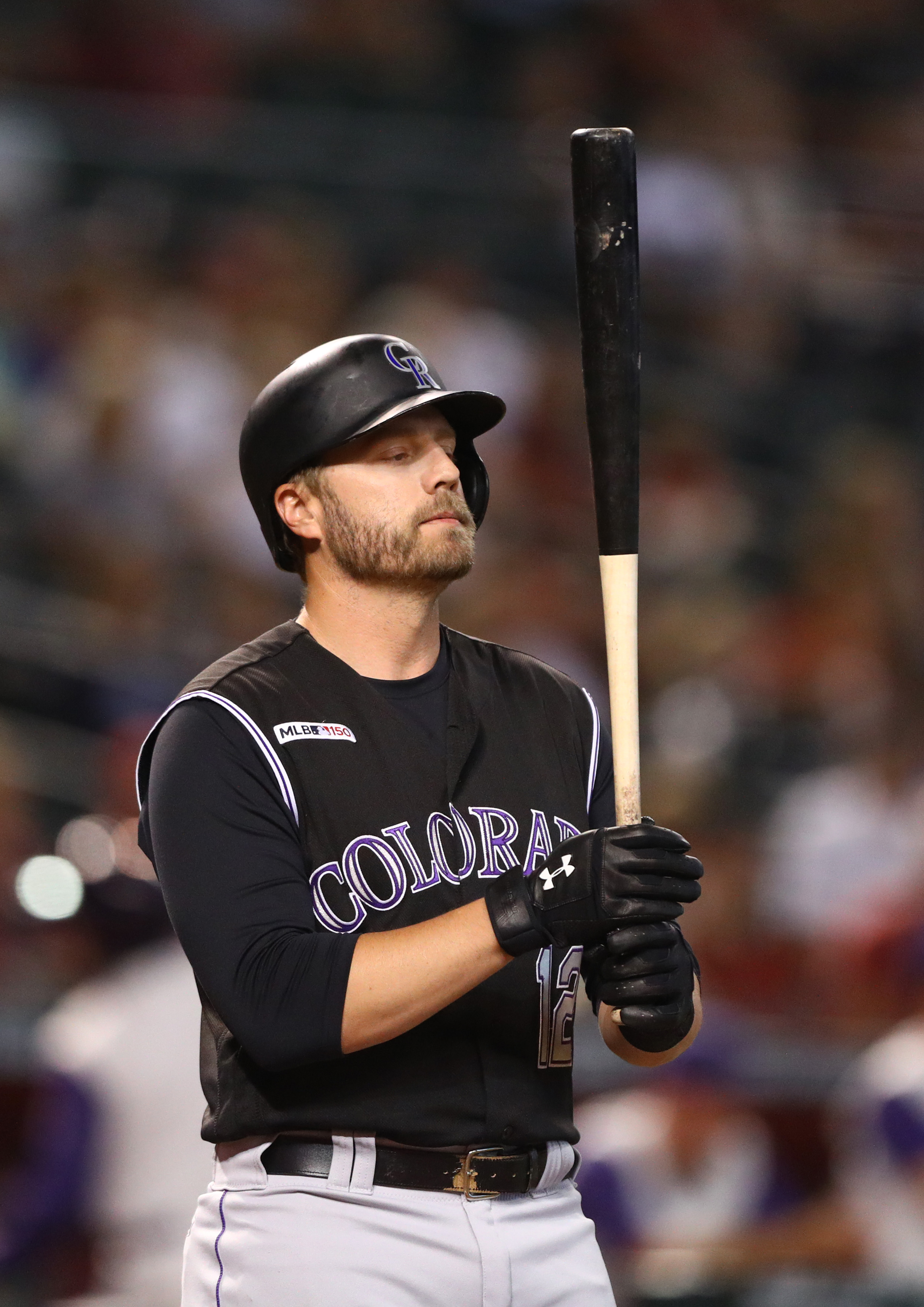
“I’ve moved beyond that,” Reynolds said when asked if he planned to seek another contract once MLB’s transaction freeze has been lifted. “I’ve retired. … I’m really enjoying time with my family, and it’s time for me to move on and find something else to do.”
The 36-year-old Reynolds spent the majority of the 2019 season in the Rockies organization, serving as a part-time first baseman and a bench bat until he was cut loose on July 28. He’d enjoyed a quality season with the Nationals a year prior in 2018, but Reynolds struggled to the lowest offensive numbers of his career with the Rox last year.
Originally a 16th-round pick of the Diamondbacks out of the University of Virginia back in 2004, Reynolds made his big league debut less than three years after being drafted. Reynolds was never considered one of the organization’s premier prospects — his No. 7 ranking on Baseball America’s list of D-backs prospects prior to the ’07 campaign was the only time he broke their top 30 — Reynolds hit the ground running. He was promoted to the big leagues in mid-May and closed out the remainder of the season as a regular in the lineup, hitting .279/.349/.495 with 17 home runs.
By 2008, Reynolds was Arizona’s everyday third baseman. His power was unquestionable, although the same could be said of his questionable contact skills. Reynolds became one of the game’s quintessential boom-or-bust players, regularly headlining home run and strikeout leaderboards alike. From 2008-11, he averaged 35 big flies per season but also led his league in strikeouts each year along the way. At that time, a player who was punching out in roughly a third of his plate appearances was an alarming anomaly; the league average strikeout rate back in Reynolds’ first full year was 17.5 percent — a full six percent lower than 2019’s mark.
Reynolds had a rough year in 2010, prompting the D-backs to trade him to the Orioles in return for reliever David Hernandez and prospect Kam Mickolio. He bounced back with the Birds and helped them to the postseason in 2012, but Baltimore declined an $11MM club option over Reynolds’ final arbitration year that offseason and non-tendered him, making him a free agent for the first time in his career.
Reynolds would bounce from Cleveland to New York to Milwaukee to St. Louis to Colorado to D.C. and back to Colorado on a series of one-year and minor league deals from that point forth. He delivered some productive seasons along the way and even popped 30 homers for the 2017 Rockies before giving the Nationals an absurd 5-for-5, two-homer, 10-RBI day in 2018 (video link).
Reynolds will conclude his playing career with a .236/.328/.453 batting line over the life of 6243 plate appearances and 1688 Major League games. In that time, he belted 298 home runs, 253 doubles, 14 triples and stole 64 bases while also scoring 794 times and knocking in 871 runs. The slugger took home nearly $30MM in career earnings while providing a litany of tape-measure home runs on which we can all fondly look back. Best wishes to Reynolds and his family in whatever lies ahead.