
Nomar Mazara Doesn't Need Thumb Surgery
- As of last weekend, offseason thumb surgery looked like a possibility for Rangers outfielder Nomar Mazara. It turns out that he won’t need it, though, Jeff Wilson of the Star-Telegram tweets. Mazara’s thumb was a problem during the second half of the season, when he spent roughly a month on the disabled list and saw his production decline to a notable extent upon his return. All told, the 23-year-old hit .258/.317/.436 (96 wRC+) with 20 HRs in 536 trips to the plate.
Silver Linings: American League West
In our Silver Linings series, we’re checking in on the most promising developments for non-contending teams during an otherwise disappointing 2018 season. We’ll finish it out with the American League West.
[Previous “Silver Linings” Posts: AL Central, NL Central, NL East, AL East, NL West]
With the Astros back on top on the American League West and the Athletics gearing up for a Wild Card date with the Yankees, that leaves three clubs nursing their wounds. Here are the silver linings from the division…
Mariners – A promising core
And no — not the core they once boasted, which featured an in-prime Robinson Cano, Kyle Seager, Felix Hernandez and an aging-but-still-productive Nelson Cruz. This Mariners team won 89 games largely in spite of that group (Cruz being the exception), as Cano was suspended 80 games while Seager and Hernandez had the worst seasons of their still-excellent careers.
Instead, it was Mitch Haniger, Jean Segura, Edwin Diaz, James Paxton and Marco Gonzales who carried the Mariners for much of the season. At 30 years old next month, Paxton is by far the oldest of that bunch, meaning the Mariners should have a good chunk of each player’s prime left.
Haniger and Segura turned in star-caliber performances on the season as a whole (even if each slumped late in the year). Both were deserving All-Stars. Diaz set a franchise record with 57 and posted a preposterous 15.2 K/9 mark with a 1.96 ERA that fielding-independent metrics actually felt was indicative of some poor luck (1.61 FIP, 1.78 xFIP, 1.49 SIERA). Paxton pitched a career-high 160 1/3 innings with career-best K/BB numbers. Gonzales’ 4.00 ERA doesn’t immediately stand out, but he showed excellent control and was credited with a more encouraging 3.43 FIP and 3.59 xFIP through 166 2/3 innings.
General manager Jerry Dipoto has been widely panned for some of his trades — there’s no getting around the Chris Taylor/Zach Lee swap, for instance — but that’ll come with the territory for virtually any top-level executive (especially one who trades so prolifically). To this point, though, Dipoto & Co. deserve credit for the acquisitions of Haniger, Segura, Gonzales, James Pazos and even veteran Mike Leake (4.36 ERA, 4.14 FIP, 4.15 xFIP in 185 1/3 innings). Each has yielded positive results thus far. There are payroll problems and aging veterans that complicate things in Seattle, but the Mariners have a nice foundation in place — especially if either Seager or Hernandez can bounce back to some extent.
Angels – Co-Stars
Remember those quaint days this spring when many were wondering if Shohei Ohtani would deliver anything close to the hype — both on and, especially, off the mound? The 24-year-old has laid waste to the doubters of his offensive abilities, even as his season as a pitcher ended in disappointment and the Halos’ team effort crumbled.
It’s hard to overemphasize just how impressive Ohtani has been. He hit .285/.361/.564 with 22 homers and 10 steals in just 367 plate appearances, which was 52 percent more productive than a league-average bat when adjusting for park and league (152 wRC+). Among players with 350 PAs, that wRC+ ranked Ohtani eighth in all of baseball. Still, he won’t be on the mound next year after undergoing Tommy John surgery this week, meaning he’ll be limited to providing impressive work from the plate. That leaves a direct conundrum — how to manage the situation with Albert Pujols — along with gaping hole at the top of the rotation.
Fortunately, the Halos have stockpiled some other star performers to place around centerpiece Mike Trout like the side stones in a ring. Andrelton Simmons is now providing enough offense to rate not “just” as one of the league’s top defenders, but rather as one of the its best overall players. Justin Upton‘s .257/.344/.463 slash rated more than 20 percent better than the league-average hitter by measure of stats like OPS+ (122) and wRC+ (124). And 24-year-old rookie David Fletcher held his own with the bat while providing terrific defense at both second base and third base.
The rotation is mired with question marks, to be sure, but the makings of a solid relief corps are there with Blake Parker, Jose Alvarez, Cam Bedrosian and up-and-coming Ty Buttrey all giving reason for optimism.
Rangers – Young players on the rise
Frankly, it feels like Jurickson Profar should be older than 25 at this point. The switch-hitting infielder was the Baseball America’s No. 1 overall prospect way back in the 2012-13 offseason — and that was already his third consecutive season drawing Top 100 fanfare. After shoulder injuries wiped out two seasons for the Curacao native, he delivered a forgettable 2017 campaign that called his upside into question. Fast forward a year, and Profar hit .254/.335/.458 with a career-high 20 homers and 10 steals while appearing at five different positions.
It’s not just Profar, either. Rougned Odor signed a $49.5MM extension prior to the 2017 campaign and promptly faceplanted with an abysmal .204/.252/.397 slash last season. This year, however, Odor rebounded to the tune of a .253/.326/.424 with 18 homers, a dozen steals and radically improved defensive numbers at second base — all while nearly doubling his previous career-high walk rate.
Perhaps no Texas youngster shined brighter than emergent closer Jose Leclerc, though. The 24-year-old reined in last season’s ghastly 7.9 BB/9 mark and managed to up his strikeout rate in the process. Leclerc posted 57 2/3 innings of 1.56 ERA ball in 2018, averaging 13.3 K/9 and 3.9 BB/9 while allowing just one home run along the way. His 17.2 percent swinging-strike rate ties him with Craig Kimbrel for the fifth-best among qualified relievers, trailing only Josh Hader, Edwin Diaz, Blake Treinen and Ryan Pressly. Controlled through 2022, Leclerc could either be a long-term piece or, if he can sustain his success a bit longer, the the type of power arm for which opposing teams would surrender a king’s ransom on the trade market.
Joey Gallo, meanwhile, clubbed 40 homers with his typical brand of absurd strikeout totals. Ronald Guzman swatted 16 home runs in an uneven debut season. Nomar Mazara had his best season to date, even if he’s yet to achieve the stardom many expected. The Rangers’ 2019 rotation looks like a disaster waiting to happen, but their bats — even veteran Shin-Soo Choo turned back the clock with an excellent 2018 — and their otherworldly young closer give fans something to look forward to next year.
Latest On Adrian Beltre, Elvis Andrus
- There is a chance the left side of the Rangers’ infield will consist of two new starters next season, as third baseman Adrian Beltre could retire and shortstop Elvis Andrus has an opt-out in his contract. In the latest update regarding the two close friends, Jeff Wilson of the Star-Telegram tweets that Beltre is “genuinely torn” on whether to come back in 2019. Evan Grant of the Dallas Morning News believes Beltre will walk away, and he explains why in a piece which pays respect to the future Hall of Famer. Andrus, meanwhile, is still planning to stay with his current contract, as was the case a few weeks ago, according to Wilson. Vacating the remainder of the deal would mean leaving a four-year, $58MM guarantee on the table, which may be too risky in the wake of a down season for Andrus.
Rangers Notes: Eovaldi, Holland, Mazara, CF
With the Rangers heading into the offseason in dire need of starting pitchers, Evan Grant of the Dallas Morning News runs down several options they could consider in the coming months. Red Sox pending free agent Nathan Eovaldi is among them, and the Rangers “have always liked him,” Grant writes. The 28-year-old returned from 2016 Tommy John surgery to post a 3.81 ERA/3.60 FIP with 8.19 K/9, 1.62 BB/9 in 111 regular-season innings between Tampa Bay and Boston. While Eovaldi could be a realistic offseason target for the Rangers, the same may be true of Giants left-hander Derek Holland, who’d “love” to return to Texas, according to Grant. Holland – who, like Eovaldi, is a soon-to-be free agent – was a Rangers draft pick in 2006 who had a largely successful run with the franchise through 2016. After a couple down campaigns, the 31-year-old has revived his career in San Francisco, where he has put up a 3.61 ERA/3.89 FIP with 8.88 K/9 and 3.51 BB/9 in 169 1/3 frames this season.
- Rangers outfielder Nomar Mazara may undergo right thumb surgery after the season, Grant reports. The thumb has troubled Mazara throughout the second half of the season, including when he sat out from mid-July through mid-August, and has likely played a role in his poor post-All-Star break production. After recording a .789 OPS in the first half of the season, Mazara’s down to .679 in the second half. Texas will know more on the 23-year-old after he visits a hand specialist Tuesday.
- Assuming he’s healthy, Mazara’s sure to once again occupy a starting spot in the Rangers’ outfield next season. There’s uncertainty in center field, though, as Grant points out. While Delino DeShields has been excellent in the field, his offense has been woeful. And slugger Joey Gallo, who has played some center of late, may not be a long-term fit there. “I don’t think I’m a center fielder,” Gallo said. “But I’m not against it. It definitely affects you physically. But it also gives you a lot more value. Can I do it? I’ve already done it this year. I do think it adds to what I can do to help a team win.” Along with Deshields and Gallo, Texas has Carlos Tocci and Scott Heineman among its in-house options, and general manager Jon Daniels suggested the team could add center field help over the winter. Regardless, it seems he’s prepared to field inquiries for the outfielders already on hand. “I feel like the outfield is an area of depth,” he said. “I think it’s an area we will get hit on [by trade requests] this winter. Everything is interconnected.”
Rangers Notes: Beltre, Bullpen, Wakamatsu, Beasley
Adrian Beltre is expected to play in all three games of this weekend’s final series for the Rangers, writes Jeff Wilson of the Fort Worth Star-Telegram, but beyond that there’s still no certainty about his future. Beltre did, however, indicate that he won’t make any sort of announcement on Sunday, nor will he drag the decision on for a significant chunk of the offseason. Whatever Beltre’s decision will be — retire, return to the Rangers, or sign a one-year deal with a contender — it appears that his mind is not yet made up just yet.
Here’s more out of Arlington…
- Though the season has been a disastrous one for the Rangers, the club is seeing some encouraging signs out of some young relievers late in the year, writes Evan Grant of the Dallas Morning News. Jose Leclerc has been one of the best relievers on the planet over the past few months, allowing just two runs in a span of 32 2/3 innings dating back to June 20. In that time, the once-erratic Leclerc has turned in a phenomenal 51-to-11 K/BB ratio and allowed a mere 10 hits. There are some encouraging signs from 26-year-old Connor Sadzeck as well, despite a dismal 10 walks in 9 1/3 innings since being recalled from Triple-A. Sadzeck is averaging 97 mph on his fastball and has shown some mechanical improvements, interim skipper Don Wakamatsu explained to Grant. Namely, Sadzeck has been able to speed up his delivery while maintaining his premium velocity after previously struggling to work quickly with men on base in the minors. Leclerc, 25 in December, has solidified himself as the Texas closer heading into 2019 and is controlled all the way through 2022. Sadzeck, meanwhile, should get every opportunity to earn a spot after whiffing 53 hitters in 42 minor league innings.
- Speaking of Wakamatsu, Wilson writes in another column that the Rangers’ interim manager is expected to remain with the team even if he is not ultimately hired as the new full-time manager. Wakamatsu is under contract through next season as the bench coach and tells Wilson he’d like to be with the team regardless of whether he’s selected as Jeff Banister’s replacement. GM Jon Daniels told reporters, including Wilson, that the organization is still “gathering information” and has yet to speak to any potential candidates about the managerial vacancy.
- One familiar face for Rangers fans who’s hoping to be considered is third base coach Tony Beasley, reports MLB.com’s T.R. Sullivan. “I know the heartbeat of this team,” Beasley tells Sullivan. “I would love to be considered for it.” Although the 51-year-old has never managed at the MLB level, he does come with eight seasons of minor league managerial experience which, Sullivan adds, includes six postseason appearances and a Double-A Manager of the Year Award.
Rangers Purchase Contract Of Brandon Mann
The Rangers announced today that they have selected the contract of lefty Brandon Mann. He’ll join the team for its final series.
Mann, 34, has already had a season to remember, having debuted in the majors after first becoming a professional way back in 2002. Now, he’ll get a chance to suit up in Seattle, not far from where he grew up.
Though he was not terribly effective in his six MLB appearances this year, Mann got the job done at Triple-A. Over 52 1/3 frames in 36 appearances, he posted a 2.41 ERA with 7.7 K/9 and 4.1 BB/9.
Latest On Rangers' Managerial Options
- Rangers GM Jon Daniels discussed the team’s preliminary preparations to replace just-fired skipper Jeff Banister, as Jeff Wilson of the Fort Worth Star-Telegram reports. Though the organization has already compiled a list of names, it hasn’t begun lining up interviews. No doubt that’ll change as the regular season draws to a close. The slate of possibilities will also likely evolve, says Daniels, who added that there’s no specific timeline in mind.
Past, Present & Future: American League Closer Turnover
By the end of the 2017 season, the list of pitchers closing out games for their respective teams included Matt Belisle, Alex Claudio, Juan Minaya and Mike Minor. Three of them were without a career save coming into the season—Belisle had five in 13 MLB seasons—and none had been expected to fill a significant late-inning bullpen role. By way of injuries, trades or ineffectiveness from those ahead of them on the depth chart, they were given a chance to record the final out in a close win and proved themselves capable.
Things haven’t changed much this year. Raise your hand if you thought Wily Peralta would have one save in 2018. He has 13! Of the 15 American League teams, only four currently have a closer situation that mirrors what they had on Opening Day. When it comes to closers, uncertainty is the only certainty. And that’s why Mariano Rivera and Trevor Hoffman are Hall of Famers and the relief pitchers who will join them in Cooperstown in the future are few and far between.
Here’s a look back at each American League team’s closer situation on Opening Day versus where they are now and where they will be as they head into the offseason. (Click HERE to view the National League.)
[Related: MLB closer depth chart at Roster Resource]
Baltimore Orioles | Orioles Depth Chart
Opening Day 2018: Committee — Brad Brach, Darren O’Day, Mychal Givens
September 2018: Mychal Givens
Future Outlook: Brach got the majority of the committee’s save chances prior to Zach Britton reclaiming the job shortly after returning from the disabled list in late June. Soon after, Givens was the last man standing following a series of July trades (Brach to the Braves; Britton to the Yankees). O’Day, meanwhile, suffered a season-ending hamstring surgery and was later traded to Atlanta in a separate deal.
A valuable setup man for most of the past three seasons, Givens has done a fine job since taking over ninth-inning duties. In his last 19 appearances, he has a 2.18 ERA and eight saves in 10 chances. With so many holes to fill on the roster, upgrading at the closer position is probably low on the Orioles’ priority list. Givens, therefore, likely enters 2019 with the job — if he isn’t traded himself this offseason as the O’s continue their rebuilding efforts.
—
Boston Red Sox | Red Sox Depth Chart
Opening Day 2018: Craig Kimbrel
September 2018: Craig Kimbrel
Future Outlook: Kimbrel, who recently became the fourth pitcher in MLB history to record at least 40 saves in five different seasons, has been a huge part of Boston’s historic season. As a free agent following the 2018 campaign, the 30-year-old will command a contract that rivals the highest-paid relievers in the game. Can the Red Sox afford to let him walk? Just in case he does, they’ll have to plan accordingly.
With Joe Kelly also set to become a free agent, Matt Barnes is the logical choice to inherit the closer’s gig. He’s earned the opportunity with a 3.28 ERA and 25 holds while serving as the primary setup man on the best team in baseball. The 28-year-old also has an impressive 13.9 K/9 in 60.1 innings of work, an increase from 10.7 K/9 in ’17 and 9.6 K/9 in ’16. The only question is whether a team capable of winning over 100 games will entrust the role to someone with two career saves. If Kimbrel signs elsewhere, it seems likely that the Sox would pursue alternatives in free agency and/or trades.
—
Chicago White Sox | White Sox Depth Chart
Opening Day 2018: Joakim Soria
September 2018: Committee — Nate Jones, Jace Fry, Minaya, etc.
Future Outlook: Soria was as good as he’d been in years, posting a 2.56 ERA with 16 saves and 11.4 K/9 in 40 appearances. The White Sox cashed in by sending him to the Brewers for two pitching prospects in late July. Since then, they’ve handed off the closer’s job to a committee that included just about any relief pitcher on their active roster—seven different pitchers have recorded saves since the Soria trade.
The next step for the rebuilding White Sox is to put together a roster that can, at the very least, be a .500 team and potential playoff contender. Having a reliable closer would be an important part of that plan. Jones looks the part, but he’s missed most of the last two seasons recovering from elbow surgery and still might not be ready to take on the workload of a primary closer. A healthy Zack Burdi, the team’s first-round draft pick in 2016 and one time “closer of the future,” could also be in the mix at some point, though he spent 2018 recovering from Tommy John surgery. They’ll likely play it safe, however, and add at least one veteran with closing experience this offseason.
—
Cleveland Indians | Indians Depth Chart
Opening Day 2018: Cody Allen
September 2018: Co-Closers – Allen and Brad Hand
Future Outlook: Allen has a lot of mileage on his arm, averaging 71 relief appearances per season since 2013, and it’s showed at times during the current season. With Andrew Miller on the disabled list and Allen’s ERA creeping up near 5.00, the Indians’ acquisition of Brad Hand from the Padres on July 19th was a no-brainer.
Not only has it helped them down the stretch—Hand has a 2.45 ERA and eight saves while Allen has 10 consecutive scoreless appearances—it also gives the Indians a very good closer option for 2019. Allen and Miller are both headed for free agency while the 28-year-old Hand is under contract through 2021. The job should be his moving forward.
—
Detroit Tigers | Tigers Depth Chart
Opening Day 2018: Shane Greene
September 2018: Shane Greene
Future Outlook: With a 5.20 ERA and six blown saves in 37 chances, Greene is probably lucky to have held on to the job for the entire season. But on a rebuilding Tigers team, who is going to close out games for them is the least of their worries. With that said, Greene probably fits best as a setup man. Even if they don’t upgrade this offseason, All-Star Joe Jimenez (11.2 K/9, 22 holds, 3 saves, 2.88 FIP) could supplant Greene in 2019.
—
Houston Astros | Astros Depth Chart
Opening Day 2018: Co-Closers – Chris Devenski and Ken Giles
September 2018: Roberto Osuna
Future Outlook: Despite a drop in strikeout rate—8.0 K/9 in ’18; 11.7 K/9 in ’17—Osuna has continued to perform at a high level amid abuse allegations that led to a 75-game suspension under MLB’s domestic abuse policy. The Astros still decided to acquire him in a trade with the Jays despite the ongoing investigation.
Barring any struggles during the team’s playoff run — he’s postseason eligible in spite of that suspension — or any further off-the-field troubles, the 23-year-old Osuna seems likely to enter 2019 as the Astros’ closer. He’s under club control through the 2020 season.
—
Kansas City Royals | Royals Depth Chart
Opening Day 2018: Kelvin Herrera
September 2018: Wily Peralta
Future Outlook: Soon after Herrera was traded to Washington in mid-June, Peralta emerged from the closer committee to become one of the unlikeliest ninth-inning success stories of 2018. It hasn’t always been pretty, but the 29-year-old has 13 saves in 13 chances and a 9.5 K/9 rate.
After getting booted from the Brewers’ rotation last May, he had a disastrous 11-appearance stint as a relief pitcher (17 1/3 innings, 23 ER, 28 H, 15 BB) before getting designated for assignment in late July. He signed a Major League deal with Kansas City this offseason, only to be designated for assignment again and outrighted to Triple-A. He returned to the Majors one day before the Herrera trade and picked up his first MLB save eight days later.
Peralta has a $3MM club option in 2019, which could very well be exercised. Even if it’s not, he’s remain under team control for one more season via arbitration. While he’s been better than anyone could’ve anticipated in his current role, his 22 walks in 31 1/3 innings serve as a red flag that will likely keep the Royals from locking him into the job next season without some form of competition.
—
Los Angeles Angels | Angels Depth Chart
Opening Day 2018: Keynan Middleton
September 2018: Ty Buttrey
Future Outlook: Blake Parker, who finished 2017 as the closer, picked up the team’s first save of 2018 after finishing last season in the role. But it was Middleton who got the call for the next six save chances, all successful, making it clear that he was manager Mike Scioscia‘s preferred choice in the ninth inning. A few weeks later, however, Middleton had undergone season-ending Tommy John surgery and it was back to the drawing board for the Angels.
Parker got the majority of save chances with Middleton out. And as was the case in 2017, he got the job done with a 3.21 ERA and 13 saves in 16 chances from May 14th—the day after Middleton’s last game— through September 3rd. But Buttrey, acquired from the Red Sox in the July deal for Ian Kinsler, is getting a chance to show what he can do as of late. In six appearances from September 7th through September 18th, the 25-year-old tossed seven scoreless innings with 10 strikeouts and four saves. He has failed to convert his last two save chances, though.
Regardless, there probably wasn’t enough time for Buttrey to seal the job for 2019. He will be a candidate alongside Parker, though, unless the Angels acquire a closer this offseason.
—
Minnesota Twins | Twins Depth Chart
Opening Day 2018: Fernando Rodney
September 2018: Trevor Hildenberger
Future Outlook: After saving 25 games and solidifying the ninth inning for Minnesota over the first four months of the season, Rodney was traded to Oakland in August. Ryan Pressly, who would’ve been the logical choice to succeed him, was traded to Houston in late July. A closer committee appeared likely, but Hildenberger has been the go-to guy with seven saves in eight chances since Rodney’s departure. Taylor Rogers, while serving mostly in a setup role, has not allowed a run over his last 23 2/3 innings while logging two saves and 11 holds over that span.
Between Hildenberger, Rogers, Addison Reed and Trevor May, who has five walks and 31 strikeouts in 23 innings in his first season since Tommy John surgery, the Twins have some decent late-inning options for 2019. It’s probably not enough to keep them away from the offseason closer’s market, though.
—
New York Yankees | Yankees Depth Chart
Opening Day 2018: Aroldis Chapman
September 2018: Co-Closers – Zach Britton and Dellin Betances
Future Outlook: Chapman might not have enough time to reclaim the closer’s job before the end of the regular season—he returned from the disabled list last Wednesday—or even the playoffs for that matter. But there’s no reason to think a change is on the horizon in 2019. The 30-year-old lefty, who is 31-for-33 in save opportunities and is striking out 16.1 batters per nine innings, will be entering year three of a five-year, $85MM contract.
—
Oakland Athletics | Athletics Depth Chart
Opening Day 2018: Blake Treinen
September 2018: Blake Treinen
Future Outlook: Treinen has been one of the breakout stars in 2018, saving 37 games while posting an 0.80 ERA and striking out 11.1 batters per nine innings for a playoff-bound A’s team. The 30-year-old is still under team control for two more seasons, although he’s in line for a significant raise from the $2.15MM he made in ’18. Barring injury, there’s no doubt that he’ll retain the job in 2019.
—
Seattle Mariners | Mariners Depth Chart
Opening Day 2018: Edwin Diaz 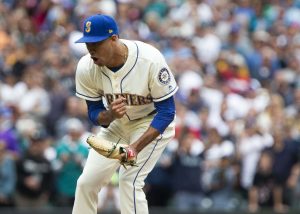
September 2018: Edwin Diaz
Future Outlook: No other closer, arguably, has contributed more to his team’s success than the 24-year-old Diaz, who has 14 more saves (56) than any other pitcher in baseball and 13 more save chances (60). The Mariners play a lot of close ballgames—they are 36-21 in one-run games—and Diaz rarely gives his opponent a chance in the ninth inning. He has held his opponent scoreless in 59 of his 71 appearances and hitless in 44. He also has 41 multi-strikeout games.
The 24-year-old is going to get paid once he reaches arbitration, although he could fall just short during the upcoming offseason. The Super Two cutoff has not fallen under 2.122 (two years, 122 days) since 2009. Diaz will be one day shy of that total.
—
Tampa Bay Rays | Rays Depth Chart
Opening Day 2018: Alex Colome
September 2018: Co-Closers – Sergio Romo/Jose Alvarado
Future Outlook: When Colome was traded to Seattle on May 25th, the Rays were two games under .500 and 10 games out in the division. It’s not clear whether they were throwing in the towel or whether they just had enough confidence in Romo, who had 84 career saves coming into the season, and the remaining group of young arms. In any case, it’s worked out just fine.
Since the trade, the Rays are 64-44 with Romo as the primary closer (3.38 ERA, 23-for-28 in save chances) and Alvarado, a 23-year-old lefty, also playing an integral role (1.98 ERA, 7 saves). Not that you can count on the Rays to do anything conventional like name a closer prior to the season or at any point during the regular season, but Alvarez and the hard-throwing Diego Castillo would be the leading in-house candidates if they did. Tampa Bay could also look to bring Romo back into the fold.
—
Texas Rangers | Rangers Depth Chart
Opening Day 2018: Keone Kela
September 2018: Jose Leclerc
Future Outlook: No relief pitcher has boosted their value more in the second half of the season than Leclerc, who spent the first four months in a setup role. Once Kela was traded to the Pirates on July 31st, it was the 24-year-old Leclerc’s chance to shine. It’s hard to imagine a more convincing way to show that he wouldn’t be relinquishing the job anytime soon.
Aside from converting each of his 11 save opportunities, Leclerc has allowed just two hits and six walks over 17 scoreless innings while striking out 28. The Rangers will look to bolster their bullpen this offseason, but finding a new closer isn’t likely to be on the agenda. Leclerc is controlled through 2022.
—
Toronto Blue Jays | Blue Jays Depth Chart
Opening Day 2018: Roberto Osuna
September 2018: Ken Giles
Future Outlook: Despite being the primary closer on the World Champion Astros, it was clear that Giles was not trusted with the game on the line. The trade to Toronto in late July gave the 28-year-old a chance to re-establish himself, out of the spotlight, as a reliable late-inning reliever. So far, so good.
After a few shaky appearances to begin his Blue Jays tenure, Giles has settled into the closer’s role with 1.29 ERA over his past 15 appearances with 12 saves in 12 chances. It might not be enough to prevent the Jays from pursuing another option this winter, but Giles should at least be in the mix.
—
Brad Brach
Zach Britton
Sean Doolittle (if $6MM club option is declined)
Jeurys Familia
Joe Kelly
Craig Kimbrel
Ryan Madson
Andrew Miller
Sergio Romo
AL West Notes: Rangers, Felix, Cruz
Let’s check in on the latest out of the American League West …
- As the Rangers prepare to find a new manager, Evan Grant of the Dallas Morning News explores the case for simply keeping interim skipper Don Wakamatsu. It’ll obviously be hard for Wakamatsu to move the needle on the team’s bottom line over his brief tenure, but he is in some respects in the midst of a live audition for the job. As Grant notes, the former Mariners manager not only “has a long history with the Rangers and, in particular, [GM Jon] Daniels,” but also arguably offers the right blend of “continuity” and change. Wakamatsu certainly has a broad array of experiences in different dugouts, as is well documented in the piece.
- Longtime Mariners ace Felix Hernandez is slated to return from a hamstring injury to make one last start in the 2018 season, as MLB.com’s Greg Johns reports. The veteran hurler, who has fallen on hard times on the mound of late, says he “just want[s] to finish strong and show them I can still pitch.” From the club’s perspective, skipper Scott Servais says, they hope to send Hernandez “into the offseason with peace of mind” to he can know how best to “get ready for next year.” Of course, there’s also a line of thinking that both player and team could be best served by a clean break at the end of this season — as Bob Dutton recently discussed (but did not specifically advocate).
- Meanwhile, Dutton tackles the case of veteran Mariners slugger Nelson Cruz in another post on the KLAY 1180 AM blog. Both sides are saying they are hopeful of a reunion, but they have yet to hold contract talks. It’s an interesting dynamic, as Dutton explains, because there’s an argument to be made that Seattle ought to utilize its resources in a different manner — particularly with Robinson Cano on hand as a potential part-time DH. Of course, as Dutton also rightly notes, there is still plenty of time left to chat before Cruz formally returns to the open market — and, of course, he could still return thereafter. It’ll be interesting to see how things pan out.
5 Middle Infielders That Posted Surprisingly Strong 2018 Seasons
It’s an exceedingly quiet day on the transactional front, which affords an opportunity to look at some higher-level developments around the game as the 2018 season comes to an end. My perusal of the stat pages revealed that there are several interesting middle infielders — by trade, if not always by use this year — who have posted surprisingly strong campaigns.
There are obviously other shortstops and second basemen who have likewise excelled beyond expectations — e.g. Scooter Gennett and Trevor Story — but it feels as if they’ve received proper recognition and examination already. It’s worth taking a closer look at this handful of players:
- Jurickson Profar, Rangers: Yes, folks, the former top overall prospect in baseball has finally arrived … at the ripe old age of, um, 25. Through 567 plate appearances this season, Profar has produced a .255/.337/.457 slash with 18 home runs and ten steals. He has gone down on strikes just 79 times while drawing 52 walks. While the defensive work hasn’t been valued as highly — whether due to frequent position shifts, Profar’s shoulder issues, short-sample blips, or otherwise — he has made up for that with highly valued work on the bases. All said, it’s the sort of campaign that was once envisioned for a player who debuted at 19 years of age. He’ll remain arbitration eligible for two more campaigns and could step in at third base if Adrian Beltre departs, though Profar’s capabilities in the middle infield still help buttress the Rangers’ options (including in potential trade scenarios).
- Johan Camargo Braves: While Camargo has been handling third base this year, and doing so with aplomb, he spent most of his time in the minors at short and could still factor there in the future, so he gets a spot on this list. Interesting young infielders abound in Atlanta, but this one has come from way off the radar to turn in a season every bit as impressive (if not moreso) than those of his more celebrated brethren. If his 2017 results suggested some likelihood of regression, Camargo’s 2018 follow-up indicates that he has made serious strides. Through 499 plate appearances, he owns a .273/.353/.457 slash with 18 home runs. He’s drawing free passes in ten percent of his trips to the dish (double his rookie rate) while strikeout out twenty percent of the time. Only a surprisingly poor baserunning grade (-3.4 BsR) has held him to an even 3.0 fWAR on the season.
- Joey Wendle, Rays: Entering his age-28 season, Wendle had appeared in just 36 MLB contests. Thus far in 2018, he has contributed 521 plate appearances of .301/.356/.439 hitting with seven long balls and 15 steals. Wendle may struggle to sustain those numbers, given that he’s relying upon a hefty .355 BABIP and isn’t quite supported by Statcast (.341 wOBA vs. .320 xwOBA). Still, he offers value in the other facets of the game and at worst seems to be quite a useful, affordable asset for the surprising Rays. It’s all the better for Tampa Bay given that Wendle was acquired out of DFA limbo over the winter.
- Marcus Semien, Athletics: We can probably stop waiting for Semien to break out at the plate. He’s yet again firmly ensconced between the 90 and 100 wRC+ range — smack dab in the middle, in fact, at 95. He might finish with only about half the dingers he smacked in 2016 (27), but is reaching base at a palatable enough clip. So … his inclusion on this list is almost entirely dependent upon what one thinks of his glovework. Semien is humming along at +8 DRS and +7.8 UZR after mostly posting poor metrics in past seasons. He hasn’t entirely eliminated the errors that once plagued him, though with twenty this year he’s still well shy of the 35 he recorded in 2015. What he is doing is earning big marks for ranging to balls and converting them into outs. The result? 3.6 fWAR and 4.0 rWAR.
- Jose Peraza, Reds: There isn’t a ton to get excited about with Peraza, who has posted solidly average marks in most regards while providing an extra boost on the bases. Still, that makes him a potential regular player — much more than he seemed capable of after his first full MLB run in 2017. At 24 years of age, he’s youthful and controllable. Peraza has made clear strides in the power department, where he has socked nearly as many dingers (13) as he had at all levels in the prior three seasons combined (14). He’s also converting his frequent contact into a high-enough batting average (.290) to support a reasonable on-base percentage (.328) despite a piddling (albeit still-improving) 4.4% walk rate. Though the defensive metrics aren’t in love with the glove, it’s good enough to hold down the position. The overall package is sufficient to induce the Reds to pencil in Peraza at short for some time, giving top prospect Nick Senzel a look in the corner outfield this fall rather than exploring other potential infield configurations.