
Out Of Options 2018
The following 40-man roster players have less than five years service time and are out of minor league options. That means they must clear waivers before being sent to the minors. I’ve included players on multiyear deals. This list was compiled through MLBTR’s sources when possible, but may be incomplete for a handful of teams. I’ll update the post as confirmed information comes in.
Angels
Jose Alvarez, Cam Bedrosian, Jefry Marte, Blake Parker, Carlos Perez, J.C. Ramirez, Noe Ramirez, Alex Meyer
Astros
Athletics
Liam Hendriks, Raul Alcantara, Renato Nunez, Chris Hatcher
Blue Jays
Braves
Lane Adams, Charlie Culberson, Sam Freeman, Jose Ramirez
Brewers
Jesus Aguilar, Jett Bandy, Oliver Drake, Jeremy Jeffress, Hernan Perez, Manny Pina, Eric Thames, Jonathan Villar, Stephen Vogt
Cardinals
Tyler Lyons, Tommy Pham, Greg Garcia, Sam Tuivailala, Miles Mikolas
Cubs
Eddie Butler, Justin Grimm, Mike Montgomery
Diamondbacks
Brad Boxberger, Chris Herrmann, T.J. McFarland, John Ryan Murphy, Albert Suarez
Dodgers
Tony Cingrani, Wilmer Font, Tom Koehler, Trayce Thompson
Giants
Cory Gearrin, Sam Dyson, Hunter Strickland, Gorkys Hernandez, Jarrett Parker
Indians
Erik Gonzalez, Ryan Merritt, Rob Refsnyder, Giovanny Urshela, Trevor Bauer, Dan Otero, Danny Salazar
Mariners
Marco Gonzales, Mike Morin, Erasmo Ramirez, Nick Vincent
Marlins
Derek Dietrich, Justin Nicolino, Dan Straily, Tomas Telis, Jose Urena
Mets
Wilmer Flores, Rafael Montero, Kevin Plawecki
Nationals
A.J. Cole, Brian Goodwin, Matt Grace, Enny Romero
Orioles
Dylan Bundy, Kevin Gausman, Mike Wright, Gabriel Ynoa
Padres
Brad Hand, Kirby Yates, Matt Szczur, Christian Villanueva, Bryan Mitchell
Phillies
Jorge Alfaro, Luis Garcia, Cesar Hernandez, Adam Morgan
Pirates
Bryce Brentz, Elias Diaz, George Kontos, Felipe Rivero, A.J. Schugel, Nik Turley*
Rangers
Juan Centeno, Jurickson Profar
Rays
Chris Archer, Alex Colome, C.J. Cron, Dan Jennings, Chaz Roe, Jesus Sucre
Red Sox
Brian Johnson, Deven Marrero, Steven Wright, Heath Hembree, Tyler Thornburg, Christian Vazquez, Sandy Leon, Blake Swihart
Reds
Rockies
Royals
Jesse Hahn, Cheslor Cuthbert, Brian Flynn, Wily Peralta, Jorge Soler
Tigers
Mike Fiers, John Hicks, Dixon Machado, Leonys Martin, Drew VerHagen
Twins
Ehire Adrianza, Robbie Grossman, Jorge Polanco, Ryan Pressly, Kennys Vargas
White Sox
Leury Garcia, Matt Davidson, Luis Avilan, Danny Farquhar, Yolmer Sanchez
Yankees
Austin Romine, Chasen Shreve, Dellin Betances, Aaron Hicks, Gary Sanchez
* on restricted list
Offseason In Review: San Francisco Giants
This is the latest entry in MLBTR’s 2017-18 Offseason In Review series. Click here to read the other completed reviews from around the league.
It may take some time for baseball fans to adjust to Evan Longoria and Andrew McCutchen in different uniforms, but the Giants are hoping that these two veteran stars can help erase the memory of an ugly 2017 campaign at AT&T Park.
Major League Signings
- Tony Watson, RP: Two years, $9MM (includes a $2.5MM player option for 2020 that has a $500K buyout)
- Austin Jackson, OF: Two years, $6MM
- Nick Hundley, C: One year, $2.5MM
- Total spend: $17.5MM
Trades And Claims
- Acquired 3B Evan Longoria and $14.5MM from the Rays for OF Denard Span, IF Christian Arroyo, LHP Matt Krook, and RHP Stephen Woods
- Acquired OF Andrew McCutchen and $2.5MM from the Pirates for RHP Kyle Crick, OF Bryan Reynolds, and $500K in international bonus pool funds
- Acquired RHPs Israel Cruz and Sam Wolff from the Rangers for SP Matt Moore, and $750K in international bonus pool funds
- Acquired cash/player to be named later from the Orioles for IF Engelb Vielma
- Selected RHP Julian Fernandez from the Rockies in the Rule 5 Draft
Notable Minor League Signings
- Gregor Blanco, Andres Blanco, Derek Holland, Chris Heston, Josh Rutledge, Hector Sanchez, Chase d’Arnaud, Alen Hanson, Manny Parra, Casey Kelly, Jose Valdez, Kyle Jensen
Notable Losses
- Span, Arroyo, Moore, Albert Suarez
Giants 25-Man Roster & Minor League Depth Chart; Giants Payroll Overview
Needs Addressed
No team received less from its outfielders (to the tune of a cumulative 0.8 fWAR and -2.5 bWAR) in 2017 than the Giants, so it was no surprise that San Francisco was connected in rumors to just about every outfielder available in free agency or trade talks. The major prize ended up being McCutchen, as the longtime Pirates icon was acquired for a pair of notable-but-not-elite prospects (Kyle Crick and Bryan Reynolds), $500K in international bonus pool money and the Giants’ willingness to absorb $12.25MM of McCutchen’s $14.75MM salary in 2018.
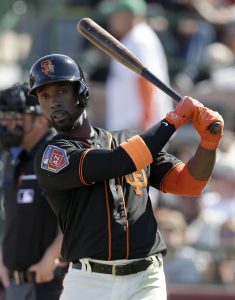
McCutchen’s declining defensive numbers as a center fielder won’t be an issue, as the Giants have already announced that the former NL MVP will be the everyday right fielder. (Pittsburgh also intended to deploy McCutchen in right field last season before Starling Marte‘s suspension forced McCutchen back into regular center field duty.) The position change should better suit McCutchen’s defensive skillset at this stage of his career, and his bat already made a nice rebound in 2017 after a very disappointing 2016 season. McCutchen is also scheduled to hit free agency next winter, so while the Giants gave up a significant amount for just one year of his services, the club also has the freedom to pursue a longer-term solution if it so chooses after the season.
The outfield depth chart received another boost in the form of Austin Jackson, coming off an outstanding (though quite possibly BABIP-fueled) 318 plate appearances for the Indians last season. Jackson is currently penciled in for the bulk of time in center field, though he could shift into a general fourth outfielder role if rookie Steven Duggar wins himself a roster spot in Spring Training. Denard Span, the Giants’ regular center fielder for the past two seasons, is no longer an option after being dealt to Tampa Bay (in a salary offset situation) as part of San Francisco’s other blockbuster deal of the offseason.
Longoria will look to stabilize a third base position that has become another problem area for the Giants, with former third baseman-of-the-future Christian Arroyo serving as the prospect centerpiece of the deal with the Rays. There are certainly some questions surrounding the Longoria trade, as we’ll cover later. The Giants will no doubt be happy if the veteran can at least replicate his 2017 performance (2.5 fWAR, 3.6 bWAR).
Of course, all of that took place against the backdrop of a tough balancing effort of making hefty roster upgrades while staying below the $197MM luxury tax threshold. With Longoria and McCutchen’s hefty salaries joining the ledger, the Giants found payroll space by unloading Span to the Rays, and also by trading Matt Moore and his $9.75MM to the Rangers.
Some more payroll creativity was required to sign southpaw Tony Watson, whose two-year deal only officially guarantees $9MM over three years (if he exercises a player option for the 2020 season) but also allows him to earn more than twice that number by reaching various incentive clauses. Watson is coming off a bit of a down year by his standards, though given the size of other reliever contracts on the open market this year, he may prove to be a nice bargain for the Giants. Ultimately, like many teams this offseason, the Giants weren’t too active in free agency, only making modest agreements with Watson, Jackson, and backup catcher Nick Hundley.
Notable moves also took place off the field in San Francisco. President of baseball operations Brian Sabean is again taking more of a hands-on role in the front office’s day-to-day moves, while several long-time coaches were shifted either to new coaching duties or into front office roles.
Questions Remaining
Of all the outfielders linked to the Giants, the most notable was Giancarlo Stanton, and the Giants were deep in talks with the Marlins about a trade that would’ve seen the Giants reportedly covering some or all of the $295MM on Stanton’s contract. While both the Giants and Cardinals submitted offers to Miami’s liking, however, Stanton wasn’t willing to waive his no-trade protection to join either team, eventually approving a deal to the Yankees.
Needless to say, adding Stanton would’ve completely changed the Giants’ plans. The club would’ve had less salary flexibility and might well have abandoned its plan to get under the competitive balance tax entirely. While one can certainly argue that McCutchen and Longoria at two positions make for more of a help than Stanton at one position, a Giants team with Stanton in right field plus some prospects (Arroyo, Crick, etc.) still bolstering an already-thin farm system and a willingness to exceed the luxury tax threshold might’ve been better positioned to address remaining needs. Rather than add Longoria for the long term and McCutchen for the short term, would the Giants have been better off with Stanton as the long-term asset and a third baseman like Todd Frazier (who only found a two-year deal with the Mets) as a shorter-term answer? That was certainly the team’s preference, but it wasn’t able to convince the superstar to come to San Francisco.
On the other hand, that aforementioned lack of prospect depth could’ve also been the reason why the Giants weren’t able to swing deals for other notable outfielders on the market, like Christian Yelich or Marcell Ozuna. The Giants also weren’t keen on the idea of giving up a draft pick as compensation for signing a free agent who rejected a qualifying offer, such as Lorenzo Cain (who could’ve solved the center field hole), given the organization’s strong placement in the 2018 draft. Given both of these factors, the McCutchen trade looks like a solid move for San Francisco, assuming that 2016 truly was just an aberration for McCutchen.
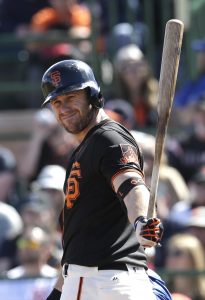 Longoria’s situation, though, is a bit more complicated. His 2017 season, which ended with a .261/.313/.424 slash line, represented the first campaign in which he graded a below-average run creator (96) in Fangraphs’ wRC+ metric. He also hit more grounders and fewer fly balls than any other season in his ten-year career. While still a durable player and a good defender, Longoria could very well be on the decline as he enters his age-32 season. Though the Rays added some money in the trade, the Giants still owe Longoria $73.5MM over the next five seasons, making him yet another high-priced veteran on the San Francisco roster who is looking to bounce back from a disappointing 2017. He is something of an odd fit on a team that entered the winter looking to theoretically get younger and cheaper, though the Giants have traditionally been open to adding experienced players and, if anything, feel veteran players may be underrated in the current baseball marketplace.
Though outfield defense was a priority for the team, the planned alignment of McCutchen in right field, Jackson in center and Hunter Pence in left represents only a moderate improvement; while McCutchen should help in right, Jackson’s defensive metrics as a center fielder have been at best mixed for several years. Duggar is widely regarded as a strong defender and he has some strong hitting and on-base numbers in the minors, though he hasn’t had much Triple-A (or even Double-A) playing time. A jump to the big leagues might be a reach unless the Giants are willing to accept Duggar as strictly a glove-only player in the early going. Gorkys Hernandez, Austin Slater, or minor league signing Gregor Blanco could also see time in center field, though none are optimal options. Presumably, McCutchen could get the occasional start in a pinch.
Moore suffered through a very rough 2017 season, so the Giants may have felt the $9.75MM ticketed for the left-hander was better utilized elsewhere rather than hoping that Moore could rebound. His departure, however, leaves the team with a lot of inexperienced pitchers battling for two rotation spots rather than one. Ty Blach and Chris Stratton are the favorites to be the fourth and fifth starters, with rookies Tyler Beede, Andrew Suarez, Tyler Herb, Joan Gregorio also in the mix, and veterans Derek Holland and Chris Heston in camp on minor league contracts.
Were the Giants not already so close to the $197MM tax threshold, another veteran starter (even a mid-tier name, not of the Jake Arrieta/Lance Lynn/Alex Cobb class) would be a big help, though a price fit simply doesn’t seem possible unless the Giants could move salary elsewhere. With this payroll crunch in mind, the Giants were surely disappointed to fall short in their pursuit of Shohei Ohtani, as San Francisco was one of seven finalists for the Japanese two-way star before he eventually signed with the Angels.
Watson ended up being the only significant addition to a bullpen that struggled overall last year, though a healthy Mark Melancon would go a long way towards improving matters. The plethora of young starters that miss out on the rotation battle could also provide some further depth behind Melancon, Watson, Sam Dyson, Hunter Strickland, Cory Gearrin, and Steven Okert. Rule 5 draft pick Julian Fernandez is also in the mix but a total wild card, as he has never pitched above the A-ball level. Veteran lefty Will Smith is targeted to return in May or June after undergoing Tommy John surgery almost a year ago.
Overview
While the Giants are clearly planning to contend in 2018, this season could also serve as something of a bridge year for the franchise. Come next winter, the Giants will have McCutchen and Pence off the books, be free of a recurring luxury tax penalty, and be positioned exceed the threshold in pursuit of expensive free agents (such as Bryce Harper?) or trade chips. By then, the club should also have more of an idea of what it has in younger talents like Blach, Stratton, and Duggar, or even more-established players like Joe Panik. The Giants may also have advanced further in extension talks with ace Madison Bumgarner. A total rebuild doesn’t seem likely even in the event of another 98-loss season, though the Giants would surely look to move some veterans at the trade deadline.
Despite this uncertainty, San Francisco still went ahead to further bolster its veteran core, and Longoria and McCutchen should provide quite a bit more value than Span and Moore did last season (or are likely to provide this season). The Giants have left themselves with very little luxury tax room to maneuver for upgrades at the trade deadline, though the team still has its upper crust of prospects — Heliot Ramos, Beede, Chris Shaw — to offer if a big acquisition is required.
Rather than the start of a decline period for a veteran team, 2017 could potentially be seen as simply a perfect storm of fluke injuries (especially Bumgarner’s) and subpar performances — if, at least, the team’s veterans can return to their 2016 form. Between McCutchen, Longoria, and the low-cost free agent signings, the Giants might have filled all the holes they need to fill, provided some of their younger players can step up.
What’s your take on the Giants’ winter? (Link for app users.)
How Would You Grade The Giants' Offseason Moves?
-
B 51% (2,964)
-
C 25% (1,444)
-
A 16% (903)
-
D 5% (313)
-
F 3% (197)
Total votes: 5,821
Photos courtesy of USA Today Sports Images
Poll: $6.5MM Contracts
As Opening Day draws closer, we’re beginning to see the unfortunate penalties for players who overestimated their markets at the offseason’s outset. A number of our top-50-ranked free agents have fallen well short of the expectations we had for them, including three players ranked in our top five (Masahiro Tanaka excluded) who’ve been guaranteed at least $35MM less than we predicted.
That group includes Mike Moustakas, who so far seems to be the abnormal offseason’s biggest victim. We thought “Moose” would receive a guarantee in the $85MM range, but he ended up settling for a contract with the Royals that’ll pay him just $6.5MM, including a buyout of a mutual option for 2019. Logan Morrison and Jonathan Lucroy have also signed deals that guarantee them that exact same amount, despite the fact that they were widely expected to earn far more money. It should be noted that Moustakas has $2.2MM in available incentives in 2018 based on plate appearances, while Morrison can earn an extra $1.5 MM in similar fashion and can increase the base value of his 2019 option (or even cause it to vest) based on his 2018 plate appearances. However, these are excruciatingly small consolation prizes compared to the money they hoped to earn at the start of the winter.
The biggest subject of the offseason of course, has been why it’s been so unusual. But one of the more obvious answers is that the league-wide home run surge has likely resulted in a league-wide devaluation of power. That would certainly explain cooler-than-expected demand for players like Moustakas and Morrison, both of whom slugged 38 homers last season but had notable flaws elsewhere in their game. That Lucroy’s power mysteriously evaporated entirely might have contributed to the evaporation of the market for his services.
Regardless, these players are all likely to provide excess value on their respective contracts. bWAR and fWAR generally agree on their values in relation to replacement level last season; Moustakas was worth somewhere around 2 WAR, Morrison close to 3.5 WAR, and Lucroy about 1 WAR. And even though Lucroy rated the least valuable of the three, it’s worth noting that he plays a premium position and been an immensely valuable player in the past (both offensively and defensively). Even a modest bounceback from the outgoing Rockies catcher could result in a solid season for the A’s.
Below are the Steamer and ZiPS projections for these players, taken from Fangraphs.com. As with any projections, they should be taken with a grain of salt.
Lucroy:
Steamer: .273/.347/.427, 11.8 Defense Rating, 2.9 fWAR
ZiPS: .298/.365/.449, 3.6 Defense Rating, 1.7 fWAR
Moustakas:
Steamer: .268/.328/.494, 2.1 Defense Rating, 2.7 fWAR
ZiPS: .267/.318/.485, 1.5 Defense Rating, 1.5 fWAR
Morrison:
Steamer: .249/.340/.461, -11.6 Defense Rating, 0.7 fWAR
ZiPS: .255/.345/.477, -10.8 Defense Rating, 1.9 fWAR
Who do you think will provide the most value on his $6.5MM contract? Here’s a poll link for app users.
Who Will Provide The Most Value On His Contract?
-
Mike Moustakas 52% (5,117)
-
Jonathan Lucroy 28% (2,735)
-
Logan Morrison 21% (2,056)
Total votes: 9,908
Extension Candidate: Whit Merrifield
The Royals front office is in an interesting spot as it attempts to engineer a soft landing after multiple seasons of contention from a roster whose core is no longer fully intact. Despite the obvious challenges, GM Dayton Moore says he’s as optimistic as ever about the organization’s outlook.
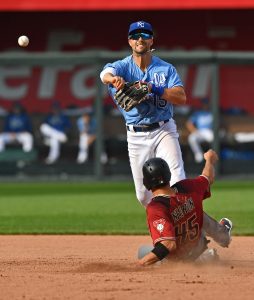
Perhaps no single player embodies that hope and this team’s unique approach more than infielder Whit Merrifield, a late-bloomer who quietly became one of the team’s best players. Given their current stance, the Royals shouldn’t be opposed to considering long-term deals with key players. But is Merrifield a worthwhile target?
As is often the case for teams that push for a World Series in — in this case, successfully — there’s a dent to the future outlook. That frequently shows up in the form of lost prospects, missed opportunities to swap veterans for younger talent, and ongoing commitments to expensive, older veterans. In this case, Alex Gordon and Ian Kennedy stand out as underperforming contracts.
At the same time, the Kansas City organization does have some valuable deals on the books — namely, the extensions agreed to with lefty Danny Duffy and catcher Salvador Perez. There’s still potential for those agreements to sour, but at present they seem to represent appealing commitments. And they both run through 2021. It’s worth remembering, too, that the club pursued star first baseman Eric Hosmer. Though it’s clear the Royals will be increasingly attentive to drawing down salary commitments, they did not force deals for players such as Duffy, Perez, or even pending free-agent closer Kelvin Herrera this winter. While Kansas City did give up talent to move some salaries (see here and here), those swaps are nothing like the full-throated efforts we’ve seen some other clubs take after a downturn in fortunes.
Unlike some small-market organizations that find themselves in this general situation, then, the Royals do not appear to be pursuing a strip-down rebuild. The retention (to this point) of Herrera and the signing of Lucas Duda confirm that the club isn’t just punting in the hopes of securing favorable draft position. Trying to remain at least somewhat competitive while undergoing a roster transition comes with quite a different blend of risk and benefit from a “tanking” strategy — which brings us back around to Merrifield, who deserves some consideration as a potential extension target after compiling 3.9 rWAR and 3.1 fWAR in his first full MLB campaign.
In most cases, perhaps, a player who achieves that kind of value immediately upon reaching the majors would be a clear candidate for a long-term deal. Here, though, there’s no getting around the fact that Merrifield is already 29 years of age — older than Hosmer and just a smidge younger than Mike Moustakas. With just 1.101 years of MLB service to his credit, though, he won’t quality for arbitration until 2020 and can’t reach the open market until 2023, when he’ll be entering his age-34 season.
Given that they already control him until he’s 33, the Royals need not be in any rush to secure Merrifield for the long haul. At the same time, though, the club ought to have ample leverage, so perhaps we shouldn’t immediately dismiss the merits of exploring a deal. While picking up control over Merrifield’s earliest-possible free agent campaigns might be a nice feather in the cap, the potential value for the team lies mostly in locking in future salaries at an appealing rate while announcing the presence of a new core piece to go with Duffy and Perez.
Despite his late ascension to the majors, Merrifield showed good promise in a half-season of time in 2016, with decent hitting output along with high-end glovework and baserunning. Though he took a slight step back in the latter two areas on a rate basis last year, at least by the numbers we have to work with, Merrifield also took a step forward with the bat. His low walk rate (4.6% in 2017) means he’ll probably never be an OBP monster, but he made plenty of contact (14.0% strikeout rate), showed a sudden power outburst (19 home runs, .172 isolated slugging), and produced overall at about five percent better than league average. It doesn’t hurt that Merrifield can steal a bag, having recorded 34 swipes in his first full season in the big leagues.
There’s some risk here, to be sure. Merrifield needs to hit at a high average to maintain a palatable on-base percentage. And he’s no sure thing to keep up the power surge — he never maintained an ISO that high over a full minor-league season — though perhaps Merrifield is one of those players who has benefited from a bouncier baseball. As Eno Sarris of The Athletic recently explained (subscription link), history suggests that Merrifield likely won’t have more than a few more quality seasons before the aging curve catches him.
In the aggregate, though, there’s good reason to believe that Merrifield will at least continue to profile as an above-average regular for some time. His athleticism and background — he has plenty of professional time at second, third, and the corner outfield, and the team is trying him in center this spring — suggests he could move around the diamond as the team’s needs change, providing value even if he checks back into a reserve role.
Merrifield may not be a face-of-the-franchise type, but taking an opportunity to lock in value on a player of his ilk is just the kind of move that can pay dividends for an organization that is already thinking about how it will compile a winning roster in the near future. To be sure, it would be a somewhat novel contract to negotiate. While players with non-star profiles and equally thin track records (and service time tallies) have certainly agreed to terms in the past — e.g., Juan Lagares (4 years, $23MM) and pre-breakout Jose Altuve (4 years, $12.5MM) — they were significantly younger. Perhaps the Yan Gomes contract, a six-year, $23MM pact that included two options at the end, would be a closer fit, but even he was just 26 years of age at signing.
There are certainly some light shades of Ben Zobrist here, though it’s a stretch to draw any strong comparisons. As a quality player who can move around the diamond, Merrifield could be viewed as a much lesser version of the renowned utilityman, who commanded only a $18MM guarantee in an extension with the Rays back in 2010. Zobrist was 28 at the time but was already a Super Two. Of course, that deal was a ridiculous bargain; on the other hand, there’s nothing to suggest Merrifield will ever approach Zobrist in overall value.
In truth, the Zobrist pact is tough to use as a comp for any purposes because it was so unique. The same might hold for a hypothetical Merrifield extension. My own thought is that Merrifield’s age/service status ought to make him much more amenable to taking a discount on his anticipated future earnings while also leaving the Royals with less incentive to give value for the right to control any prospective free-agent campaigns than they would for a more youthful player. (To be clear, that’s all speculation based on my outside observation of the circumstances.) Perhaps, then, the sides could explore a contract that includes a relatively limited overall guarantee for most or all of Merrifield’s pre-arb and arb-eligible seasons, with a range of possible options scenarios to be considered.
At what price might this become attractive for the Royals? Merrifield is going to earn just over the league minimum for 2018 and 2019. His salary for the ensuing three campaigns will depend upon what he does in the meantime, of course, but there are some comps that give some idea of what Merrifield could earn if he continues playing at the same general level. Joe Panik just agreed to a $3.45MM first-year arb salary, for instance, while DJ LeMahieu started with $3.0MM and has taken down a total of $16.3MM in his three seasons of arbitration.
Even if we peg Merrifield’s anticipated earnings through 2022 in the realm of $16MM or so — give or take a few million – that doesn’t mean the Royals should be willing to spend that much on an extension. Pre-committing isn’t necessary unless there’s some benefit to the club, yet the rights to free-agent years won’t have that much value for an older, non-star performer. Perhaps the Royals would promise Merrifield something in the realm of his likely arb earnings if he agrees to very low prices on two option years. Or maybe the team will pursue a discount on the arb seasons if the contract includes an option or two at higher prices (such that they likely won’t be exercised unless Merrifield succeeds beyond expectations, in which case he’d be rewarded). The most interesting scenario, though, may be a deal that only locks the sides in through the first two seasons of arbitration while leaving team options for the third arb year, at a discounted rate, along with one or two would-be free-agent years. That might give the late bloomer the security he needs while affording the team an appropriate blend of protection and expected cost savings.
To reiterate: there’s no urgency here and likely not a huge amount of upside to be captured for K.C. But if this organization really does intend to remain competitive in the relatively near future while steadily building up a new core, it’ll require a whole lot of incremental moves that add value. Exploring a new deal with Merrifield offers just that sort of potential opportunity, but only in the right circumstances.
Photo courtesy of USA Today Sports Images.
The Lack Of A Market For Neil Walker Doesn’t Make Sense
At this point, there’s little point in expounding upon what an odd offseason it’s been for Major League free agents. Relievers got paid handsomely, the devaluation of bat-first corner players is more apparent than ever, and nearly 20 percent of MLBTR’s Top 50 free agents remain unsigned on March 5. Readers can choose whichever of the myriad explanations that’ve been presented this winter they prefer — the new CBA makes losing too appealing, Scott Boras’ waiting game, younger front offices valuing players near-identically, players overvaluing themselves — but the fact remains that it’s jarring to see so many quality names on the market.
Chief among the surprising eye-opening reports that have surfaced regarding the remaining free agents, at least in my view, is Neil Walker is being offered minor league contracts.
As many predicted earlier this winter, there have been some significant bargains in recent weeks — Carlos Gomez at $4MM to the Rays, Eduardo Nunez to the Red Sox at $8MM total (over two years with a player option) and Logan Morrison to the Twins at $6.5MM (plus a vesting option) — but those players were all at least rewarded with big league contracts and millions in guaranteed dollars. The notion of Neil Walker having to settle for a minor league contract seems utterly baffling.
To be sure, he was hurt by a lack of teams seeking starting second basemen, but we’ve probably never seen a player with Walker’s track record have to take a non-guaranteed deal at just 32 years of age.
Track Record
Let’s be clear — Walker isn’t a star. He’s an above-average hitter on a yearly basis that has been generally below average in the eyes of defensive metrics for the better part of the past eight seasons. His glove isn’t a killer at second, but it rarely adds to his value, at least from a purely statistical standpoint.
Walker has been remarkably consistent at the plate since establishing himself as a big league regular. Generally speaking, I don’t think citing career numbers is especially worthwhile when it comes to free agents; what a player did at age 24 isn’t really indicative of what he’s going to do in his 30s. But Walker’s level of consistency is fairly remarkable and is of some note.
He’s hit between 12 and 23 homers per season, walked between 7.3 percent and 9.1 percent in every year but 2017 (when he jumped to 12.3 percent), and he’s never struck out at even a 20 percent clip. By measure of OPS+ and wRC+, he’s been 14 to 15 percent better than the league-average hitter over those eight years, and he’s never had a single season come in anywhere worse than six percent above-average.
Clearly, I’m not the only one flabbergasted by the fact that Walker is seemingly struggling to find a big league offer; MLB.com’s Mike Petriello published a column on this exact same scenario earlier today. (Naturally, I was already well into this look at Walker’s perplexingly bleak market.) As Petriello points out, Walker is one of just six hitters in all of baseball from 2010-17 to post an OPS+ of 105 or better and 12-plus homers per season. The other five? Giancarlo Stanton, Justin Upton, Robinson Cano, Adrian Beltre and Edwin Encarnacion. Not bad company.
Detractors may worry about his platoon splits, as Walker faceplanted against lefties to the tune of a .214/.313/.298 slash in 2017. That line, however, came in a sample of just 84 plate appearances. Walker batted .330/.391/.610 in 110 PAs against lefties a year prior, and he’s logged a below-average but passable .264/.325/.366 slash (91 wRC+) when facing southpaws in his career. Coupled with a 122 wRC+ against righties, whom he faces more often, Walker’s overall bat is plenty valuable.
Walker does come with some injury concerns, but his medical history isn’t as daunting as the six DL trips he’s experienced in the past eight years might suggest at first glance. His 2016 back surgery and a partially torn hamstring in 2017 combine with his age (32) to create some doubt, but earlier career DL stints were caused by an appendectomy, a lacerated finger that required stitches after being spiked and a two-week absence due to soreness in his right side. His back, the largest potential red flag, didn’t keep him out of action at all in 2017.
Injury risk and minor platoon issues notwithstanding, Walker is a 32-year-old old, consistently above-average offensive performer who hits from both sides of the plate and can pass at three different positions.
Weak Market at Second Base
Walker is hardly the only free agent to struggle to find a decent offer this winter, and in his case, the reasons are perhaps easier to see than most. There simply weren’t that many clubs in the market for an everyday second baseman heading into the offseason.
The Angels had a clear need but filled that void by trading for Ian Kinsler. Walker told Billy Witz of the New York Times last week that he had some talks with the Yankees, but they ultimately acquired Brandon Drury instead. The Marlins saw a void created when they dealt Dee Gordon to Seattle, but they took on the rest of Starlin Castro‘s contract in the Giancarlo Stanton swap. The Red Sox filled their short-term hole created by Dustin Pedroia‘s knee surgery with Eduardo Nunez. The Blue Jays didn’t have a clear starting gig and also turned to the trade market for depth (Yangervis Solarte, Aledmys Diaz).
There are a few remaining spots where Walker could step into the mix and function as an everyday second baseman, but more and more it seems like he’s a potential bargain add for a contender (or hopeful contender) who could still provide plenty of value by bouncing between second base, third base and first base. He doesn’t have loads of experience at the infield corners in recent years, but he played more than 3000 minor league innings at the hot corner and saw time at both places in the Majors last season. As a switch-hitter with some defensive flexibility and enough bat to potentially spend some time at DH, Walker seems like he’d provide quite a lot of value as a bench player that could still vie for 400+ plate appearances as he rotates around the diamond.
Potential Everyday Fits
There aren’t too many teams throughout the league where Walker is going to push out an incumbent option at second base, but a return to the Brewers certainly makes sense. Milwaukee was discouraged enough with the combination of Jonathan Villar, Eric Sogard and Hernan Perez in 2017 to go out and trade for Walker in August. He hit well there, and the team is now carrying that same trio atop its depth chart in a 2018 season where it hopes to contend. If 2016 Villar shows up, that’s a much better option than Walker. However, Villar’s strikeout problems are glaring, and he was never going to repeat 2016’s .373 BABIP.
The Tigers could simply push Dixon Machado into a utility role and give Walker everyday at-bats at second base with the hope of flipping him to a contender whose second baseman is injured this summer. He probably wouldn’t net a huge prospect return this summer given the lack of offseason demand, but Machado could get regular at-bats at shortstop later in the year once Jose Iglesias is (presumably) traded.
Turning to the D-backs, Chris Owings has never hit all that much in the Majors; his best season, by OPS+ and wRC+, came in 2014 when he was five to nine percent below average, depending on your preferred metric. Walker’s worst seasons at the plate have come when he’s “only” been about six percent better than average. Owings has also spent considerable time on the disabled list (more than Walker) in three of the past four seasons. The younger player could bounce around the diamond as a true super-utility player anyhow; even if he finally makes good on the pedigree he showed as a minor leaguer, a platoon of Walker and Jake Lamb at third base would help to mitigate Lamb’s struggles against lefties. The Snakes would need to cut ties with third catcher Chris Herrmann or fellow infielder Daniel Descalso to make the fit really work, but Walker would serve as an easily identifiable upgrade. Their payroll may be tight, but this team was coming up with scenarios to squeeze J.D. Martinez onto the books just two weeks ago.
The Rays, right now, are hoping for a Brad Miller rebound at second base or for Joey Wendle to seize the position, but Walker’s consistency should hold some level of appeal. If he can be had on a bargain one-year deal similar to their pact with Carlos Gomez, then either shifting Miller to a utility role or just paying him the 30 days’ termination pay to which he’d be entitled upon being released from his non-guaranteed arbitration deal would upgrade the team. Walker would give Tampa Bay some added protection if Matt Duffy‘s ongoing injury troubles persist as well. The Rays don’t seem likely to spend much, though, and perhaps they don’t love the idea of a player with recent back and hamstring injuries roaming the turf at Tropicana Field for 81 games next season.
The Royals reportedly offered Walker a minor league deal, which he unsurprisingly rejected. But there’s a clear fit with Kansas City, as the Royals are already toying with the idea of moving Whit Merrifield to center field to create some space for Adalberto Mondesi. The Royals could use Walker at second base, as insurance for Cheslor Cuthbert at third and as a potential platoon bat with Lucas Duda at first. GM Dayton Moore, though, has repeatedly spoken about the importance of the “economic” component of any signing, and Kansas City’s minor league offer indicates they aren’t comfortable offering much.
Super Utility Fits
The Angels are currently projected to break camp with light-hitting Kaleb Cowart on the bench as a utility option and Luis Valbuena as at least a part-time first baseman along with Albert Pujols. Walker would be a significant upgrade over Cowart, and the fact that he can’t cover shortstop in the event of an Andrelton Simmons injury isn’t a big deal when the Halos could just slide Zack Cozart over to shortstop, thus opening third for Walker or Valbuena.
Walker reportedly “intrigues” the Orioles, and they’re in a similar spot to the Angels. There’s no clear utility infielder in Baltimore at the moment, and if an injury to Manny Machado occurs, the O’s can slide Tim Beckham from third to short and place Walker at the hot corner. Baltimore has been pining for a left-handed bat for much of the offseason, and as previously noted, Walker’s bat against righties is perennially productive.
The Phillies aren’t ready to give up on Maikel Franco just yet, but they don’t need to be in order to clear room for Walker. The Phils are set to carry Tommy Joseph on their bench despite his defensive limitations and his skill set’s redundancies with Rhys Hoskins and Carlos Santana on the roster. Walker could back up Franco, Cesar Hernandez and Santana around the infield, and if Franco’s struggles persist, he could potentially assume a larger role at third.
Atlanta added some depth at second and third base with today’s pickup of Ryan Schimpf, but Schimpf has options remaining or could be cut loose himself. The Braves feel that Austin Riley isn’t far from Major League readiness, but Walker could pair with Johan Camargo to help bridge the gap; Camargo did all of his damage against left-handed pitching last year and could pair nicely in a platoon role with Walker at third. Walker would also give them an insurance policy against either Ozzie Albies or Dansby Swanson struggling, as if either ultimately needed to be optioned to the minors, Walker could man second with either Albies or Swanson handling shortstop.
—
Earlier this offseason, when we were doing preliminary discussions for our Top 50 free agent rankings, Tim Dierkes, Jeff Todd, Jason Martinez and myself spent a bit of time discussing whether it made more sense to project three years or two years for Walker. My initial instinct was three, but we ultimately agreed on two years given Walker’s age, recent injuries and the general lack of teams expected to be looking for second basemen.
At this point, I’d be stunned to see Walker land a two-year contract even though nothing has really changed with regard to his skill set or the value he could bring to a club. The seeming lack of interest reminds me of the 2015-16 offseason, in which MLBTR projected a comparable two-year, $20MM deal for David Freese based on his track record as a fairly consistent, average player. We even had one top executive suggest to us that winter that Freese would land a deal in the three-year, $30MM range.
In the end, Freese’s market never really materialized, and he took a one-year deal with Pittsburgh worth $3MM. Walker’s track record and consistency top the consistency Freese carried into his own free agency, but it seems plausible that he could be facing a similarly modest commitment. If that’s the case, some team will be adding a bargain before Opening Day.
MLBTR Originals
Here’s the roundup of the original content from the past week on MLB Trade Rumors…
- With several big names still on the open market, Steve Adams ranked the top nine remaining free agents and speculated on which teams could be fits for these notable players.
- Three of the top five names on that list (Jake Arrieta, Lance Lynn, Alex Cobb) are starting pitchers, and thus teams with rotation needs have a particularly strong set of options to choose from if they decide to splurge on pitching. Jeff Todd asked the MLBTR readers which team has the most urgent need for one of those top arms, with 23.51% of respondents citing the Brewers.
- In another MLBTR poll, Kyle Downing asked the readership to predict where Carlos Gonzalez will play this year. Given the veteran slugger’s rough 2017 numbers and lack of firm interest within his free agent market, it perhaps isn’t surprising that the most votes (19.5%) actually went towards “nobody,” as in readers felt CarGo wouldn’t land a contract before Opening Day.
- Jason Martinez has the full list of MLB veterans who are currently in Spring Training camps as non-roster invitees. This listing will be updated throughout March as players come and go from teams’ rosters.
- Live from a hotel hallway, Tim Dillard is back with his latest Inner Monologue post, detailing some of the trials and tribulations of a veteran player at minor league Spring Training camp. After reading, you might also start using “W.W.N.R.D.” as a mic drop-style conversation-ender.
- March usually isn’t a big month for free agent signings, though that will certainly change this year. As Steve Adams notes, it seems a near-lock that we’ll see a record amount of money spent on March signings given all of the name talent available to be signed.
Poll: Who Will Sign Carlos Gonzalez?
A majority of the free agent dust has settled by now, but as MLBTR’s Steve Adams recently noted, there’s a large handful of top-50-ranked free agents who are still searching for a contract. The best outfielder on that list is Carlos Gonzalez, who appears mired amidst some unfortunate circumstances.
As Adams noted, the left-handed-hitting Gonzalez put up the worst season of his career in 2017. Under any circumstances, it would pretty bad timing for a player to do this in his walk year. However, Gonzalez’ walk year just happened to coincide with an abnormal offseason that’s moved at a historically slow pace. Further worsening his situation is the fact that power has been abundant in MLB for the past couple of seasons, and therefore bat-first corner outfielders might not hold as much value in the eyes of front offices around the league.
Not only that, but front offices seem wary of promising long-term contracts to average players on the wrong side of 30. Although CarGo has put up some impressive offensive seasons, hehasn’t played at an especially above-average level since 2013, and he comes with an injury history as well.
At this stage in his career, Gonzalez should probably be shielded against left-handed pitchers. He managed just a 29 wRC+ against them across 137 plate appearances during the 2017 campaign. If front offices see him strictly as a platoon player, that could put an even lower cap on his price tag.
Now we’re into March, and Gonzalez seems to be in a bad spot. Logan Morrison, another bat-first left-handed hitter, received just a $6.5MM guarantee from the Twins. Although the two have very different MLB track records on the whole, the Morrison contract doesn’t exactly shine optimism on Gonzalez’ market.
The list of suitors for Gonzalez at this point is short. The Orioles, Rockies, White Sox, Royals, Astros and Blue Jays are among the teams who shown interest in the outfielder at some point during the offseason. While those teams are all reasonable fits in theory, the market for him seems tepid at this time. With opening day fast approaching, the one-year, $12MM contract we predicted at the beginning of the offseason is beginning to look out of reach, barring some sort of injury that creates a need for his services.
What do you think? Where will Gonzalez end up? (Poll link for app users)
Who Will Sign Carlos Gonzalez?
-
Nobody will sign him before opening day 19% (3,051)
-
The Rockies 18% (2,839)
-
The Orioles 16% (2,627)
-
Someone else 14% (2,277)
-
The White Sox 12% (1,868)
-
The Blue Jays 9% (1,381)
-
The Royals 7% (1,096)
-
The Astros 6% (891)
Total votes: 16,030
The Inner Monologue of @DimTillard W.W.N.R.D.
It’s 4:13pm in Pheonix, Arizona. Thursday March 1st, 2018. My name is Tim Dillard. I’m a Minor League baseball player in spring training hoping to win a job for my 16th professional season. Currently though, I’m seated in a hotel hallway waiting patiently for the maintenance man to fix whatever’s wrong with Room 124. About this time last year MLB Trade Rumors asked if I’d be interested in writing for them. I told them I was VERY interested… but couldn’t promise the same enthusiasm from the reader. So I’m taking this hotel hallway hiatus to explain how I got here today.
4:18pm: After the Triple-A season was over last year, the Milwaukee Brewers signed me back, and extended me a BIG invitation… to Minor League spring training camp. They offered free coffee at all of their Minor League affiliates, so it was a no brainer.
4:20pm: Two weeks ago I loaded my spikes, gloves, cup, and other equipment into my 2005 Mercury Mariner (Mercury was a car company that used to exist) and drove 1,600 miles from Nashville to Phoenix. Leaving behind my wife, my three kids, my friends, my dog, my house, my bed… actually it wasn’t that hard leaving the dog behind. That’s not mean to say. She’s like 84 in dog years, and probably doesn’t even know I left. And just like everybody else… there’s a good chance she’ll never read this anyway.
4:23pm: During last year’s drive to spring training, I visited the vast and awe inspiring Grand Canyon for the first time! Truly amazing! So to try and top that marvelous experience, I stopped this year and visited the one and only Meteor Crater just outside of Winslow, Arizona!! It was ok I guess… seemed a bit small.
4:27pm: The maintenance man is still working hard. And I really need to get in the room to charge my computer, but honestly if my computer dies and I can’t finish this… it’s probably best for everyone.
4:28pm: Anyway, when the 27-hour cross-country meteor adventure ended, I once again found myself in the spring training atmosphere. You know, spring training is hard for a baseball player. It’s long hours, very difficult, very tiring, and very demanding… but good thing for me I’m a pitcher! And today, pitchers were done before lunch, so after a few awkward minutes on the treadmill, I skedaddled over to Taco Bell! (If the $1 Beefy Fritos Burrito doesn’t sum up the Minor League lifestyle…. nothing does.)
4:33pm: Pitchers however, do have in-depth conversations about the pitching craft — like the other day during stretch when we were talking about pick-off moves to first base. I, without being asked, decided to just start dropping all sorts of knowledge on the subject. But after several minutes of talking, one of the young guys asked me just how many pick-offs I had in my career. I pretended to think for a moment (like I don’t know ALL my stats off hand), then answered: “Well, in my career I’ve thrown over 1,200 innings… and um… yeah I’ve never actually picked anyone off before.” They all looked a bit surprised. Then shaking his head, the young buck said: “Are you for real? You’ve thrown over 1,200 innings? Wow, how old are you?”
4:39pm: So yeah, so far it’s been a typical spring training for me.
4:39pm: Earlier today, a group of pitchers were in the clubhouse talking about the upcoming season. They were picking brains, listing philosophies, and asking each other all sorts of questions. I kind of walked into the discussion right after I completed a heavy total body lift. (And by heavy total body lift I mean… filming a dumb video for my social media. In my defense, I did film it in the weight room!) But not really knowing the topic, and not really hearing the question, I was asked something by one of the guys. I could’ve said nothing or asked them to repeat the question. But instead I just made up an answer. With four sets of eyes on me, and ears waiting to listen, I dug deep. Looked straight at them and said: “W.W.N.R.D.”
4:44pm: “Huh?”
4:44pm: “W.W.N.R.D.? What’s that mean?” Making sure I had all my letters correct I said with utmost confidence: “W.W.N.R.D…. What. Would. Nolan. Ryan. Do.”
4:45pm: Not entirely sure if what had just came out of my mouth made sense or not… I just went ahead and treated it as a mic drop moment, and sauntered out the door back toward the weight room. (I had forgotten my camera stand in there.)
4:48pm: When I walked back into the weight room, I noticed a Yankees game was on TV and CC Sabathia was pitching. With name-dropping in mind, I quickly jumped on a treadmill and started talking to the guy jogging next to me. “Yeah. I was teammates with CC Sabathia with the Brewers way back in 2008 you know. In fact, about a month ago I actually FaceTimed with CC on Bill Hall‘s iPhone for like 7 minutes!”
4:52pm: It was only then I noticed the rookie Dominican pitcher take out his tiny headphones, look at me and say: “Hola Dealer!”
…
9:02pm: Alright I’m back. Here’s the update. My computer gave up and ran out of juice earlier. I was finally able to get into the hotel room. Apparently my room or the room above had a plumbing problem. The maintenance man was very nice, but I could’ve done without that empty Taco Bell bags comment.
9:04pm: It’s getting late… time for Advil. W.W.N.R.D.
To Be Concluded…
Slow Market Likely Means Record March Spending
In an offseason that’s been unlike any in big league history, it should come as no surprise that the month of March is on track for an unprecedented level of spending. While the remaining free agents at the top of the market almost certainly won’t find contracts matching the expectations they carried into the offseason, they still figure to draw some significant offers. The ongoing open-market presence of Jake Arrieta, Lance Lynn, Alex Cobb, Mike Moustakas, Neil Walker, Carlos Gonzalez and Jonathan Lucroy, among others, should lead to a record-setting amount of money spent in the month of March.
Going back over the past decade, the largest contract given to any player in the month of March was Manny Ramirez‘s two-year, $45MM contract with the Dodgers prior to the 2009 season. That contract represents one of just two multi-year deals worth more than $10MM per season over that span. The second belongs to Kyle Lohse, who signed a three-year, $33MM deal with the Brewers back in 2012.
In fact, over the past decade, there have only been three multi-year deals hammered out in the month of March at all, and the third was a modest two-year, $4.25MM contract for Oliver Perez with the Diamondbacks. And outside of the deals for Ramirez and Lohse, the only other player to top a $10MM salary in the month of March was Ervin Santana, who signed a one-year, $14.1MM deal with the Braves in 2013 after languishing on the market for much of the offseason after initially seeking a reported six-year deal which teams universally deemed to be too rich.
The Santana situation, perhaps, could be instructive for the likes of Lynn and Cobb. Santana’s $14.1MM salary that season was a dead match for the qualifying offer he rejected from the Royals some four months prior to signing in Atlanta. While it still seems plausible that either Lynn or Cobb could land a multi-year deal in free agency — something in the Lohse neighborhood, seemingly, would hold appeal to multiple clubs — there’s perhaps also a case to be made that thsoe players would be well-served to take a salary comparable to the one they rejected on a short-term deal and look instead to cash in next winter. Santana landed his current four-year, $55MM deal with the Twins a after a solid season with the Braves despite receiving a second qualifying offer that winter. Unlike Santana, Lynn, Cobb and Arrieta will not receive a second qualifying offer, as the CBA now stipulates that a player may receive only one in his career.
Turning to position players, the Ramirez deal stands out as a notable exception. Pedro Alvarez‘s $5.75MM contract with the Orioles in 2015 constitutes the next-largest contract in recent memory, followed by Austin Jackson‘s $5MM deal with the 2016 White Sox and David Freese‘s $3MM deal with the Pirates that same season.
Generally speaking, those types of signings — veterans with notable flaws in their game or significant injuries in their recent past who’ve taken one-year deals at modest salaries — have typified signings in the month of March. I’ve not found a March in recent memory where the total spending topped the Ramirez year, but there are presently at least three free agents who could conceivably approach or exceed that total. Arrieta, Cobb and Lynn could all still draw that kind of money, and we certainly expected a big contract for Mike Moustakas at the outset of the offseason. Even if expectations are trending down, for Moustakas in particular, injuries could still shake things up. And it’s only fair to point out that the agent shared by Arrieta and Moustakas, the inimitable Scott Boras, is also the person who negotiated the only three prior multi-year March deals.
Barring some truly dramatic hold-outs into the 2018 season, we’re likely to see an unprecedented amount of free-agent spending over the next thirty days.
Placing The Remaining Top 50 Free Agents
It’s not uncommon for one or two top-ranked free agents to see their unemployment stretch into the month of March, but the 2017-18 offseason has, of course, proven to be anything but common. It’s March 1, and an unprecedented eight of MLBTR’s Top 50 free agents remain unsigned — some with a handful of clubs holding interest but waiting out a bargain but others with no clear market for their services at all.
[RELATED: 2017-18 MLB Free Agent List; 2017-18 MLB Free Agent Tracker]
We’ll re-rank the nine best remaining free agents here and assess their current prospects:
1. Jake Arrieta
Arrieta is the top pitcher and top free agent remaining, but he holds that distinction in a market where no club appears poised to offer even four years to any free agent at this point. Agent Scott Boras compared Arrieta to Justin Verlander and Max Scherzer earlier this offseason, but it seems abundantly clear that a contract in that duo’s $180-210MM range isn’t happening. (Such numbers always seemed far-fetched.)
The Phillies have been linked to Arrieta in recent weeks, though every report out of Philadelphia has suggested that the team is only interested in capitalizing on a lackluster market and inking Arrieta to a short-term deal — perhaps for three years at a premium annual value. The Brewers have been said to hold some degree of interest but are also unlikely to pay top-of-the-market rates. The Nationals are reportedly maintaining interest, and perhaps that’s Boras’ best bet; he’s pitched directly to owner Ted Lerner in the past and has a strong relationship there. Plus, there’s no clear fifth starter for the Nats, who are currently set to go with A.J. Cole in that spot.
Earlier in the offseason, there were some connections between Arrieta and the Cardinals, though there’s been little in the way of reports connecting the two sides over the past two months. St. Louis already has a full rotation in addition to several 40-man options that appear ticketed for Triple-A to open the season.
The Twins and Angels are reportedly more or less finished with their offseason shopping, though there’s a clear on-paper fit for him in either organization.
Best remaining fits: Brewers, Phillies, Nationals, Cardinals, Twins, Angels
At this point, it’s hard to see Moustakas commanding a significant multi-year deal. The 29-year-old belted a career-high 38 homers last year but did so with a .314 OBP that fell within close proximity to his career .305 on-base percentage. Moustakas’ power surge came at a time when the entire league hit long balls at a historic rate, thus mitigating the value of that improvement. Moose and Boras need not look any further than Logan Morrison, who also slugged 38 homers last season and recently settled for a $6.5MM guarantee from the Twins, for proof that those homers aren’t going to be compensated as they once were.
The Cardinals added one power bat to their lineup in Marcell Ozuna this offseason but could conceivably play Matt Carpenter at first, Moustakas at third and split Jose Martinez‘s time between first base and the outfield. Bringing him in would likely push the out-of-options Greg Garcia off the roster and make Jedd Gyorko the primary utility option.
The White Sox could toy with the idea of pushing Yolmer Sanchez to a utility role to accommodate Moustakas, while the Braves could do the same with Johan Camargo. But, both of those teams would need to weigh the idea of hurting this year’s draft pool by signing Moustakas, who rejected a qualifying offer in November.
The Phillies could be another dark horse here, given their minimal payroll commitments and the recent underperformance of Maikel Franco. They’d be selling low on Franco if they moved him, though, so it’s far from clear whether there’d be real interest.
Best remaining fits: Cardinals, White Sox, Braves, Phillies, Royals
3. Lance Lynn
Lynn tossed 186 1/3 innings over 33 starts with a 3.43 ERA in his return from Tommy John surgery, prompting him to reject a qualifying offer. However, he also turned in career-worsts in K/9, BB/9, HR/9 and chase rate while matching his career-low in fastball velocity. Lynn’s .244 BABIP was the lowest among qualified big league starters, while his 79 percent strand rate was among the highest.
Teams surely see value in Lynn as a stabilizing force at the back of a rotation, but it’s doubtful that many of today’s more data-driven clubs are evaluating him based on an ERA that looks poised for some significant regression. The five-year term Lynn reportedly sought earlier this winter isn’t going to come into play, and even three or four years at a solid AAV could be a reach at this point.
There’s still a case for a multi-year deal, of course, and all of the teams listed as plausible landing spots for Arrieta make sense for Lynn as well. One could argue that he also fits on some clubs with less payroll flexibility like the Orioles and Mariners, though neither has been linked to him. If you’re looking for a more concrete indication for how teams value Lynn, Darren Wolfson of 1500 ESPN reported in his most recent podcast that the Twins threw out a low-ball offer of about $12MM total over two years. Unsurprisingly, Lynn’s agents at Excel quickly shot that down, but it’ not a great sign when that’s the type of interest he’s fielding in early March.
Best remaining fits: Brewers, Phillies, Nationals, Twins, Angels, Orioles, Mariners
4. Greg Holland
Holland reportedly had the opportunity to return to the Rockies on a three-year deal earlier this offseason, but the Rox moved on and signed Wade Davis when Holland continued shopping for better deals. It’s hard to see him coming anywhere near the $51MM that Davis secured now, and any three-year deal at a premium rate would come as a surprise.
The Cardinals still don’t have much name value at the back of their ‘pen, and speculatively speaking, the Cubs could make a bargain play for Holland if he’s willing to sign a two-year deal. The Angels would reportedly consider him at the “right price.” The D-backs could use some bullpen depth and were willing to stretch payroll for J.D. Martinez, so there’s probably enough wiggle room to make it happen — especially on a backloaded deal. The Rockies, meanwhile, have been stockpiling arms, so if Holland’s price drops enough, perhaps they’d further double-down on that strategy in hopes of compiling a super-pen.
Houston was tied to Holland earlier this winter and never added a big-name reliever, while the Phillies have payroll flexibility and some open spots in the bullpen should they decide that Holland’s price has lowered to the point where he’s a good value proposition. The Nationals have been connected to Holland at times, but it seems likelier they’ll focus elsewhere after adding multiple relievers already.
Best remaining fits: Cardinals, Cubs, Angels, D-backs, Rockies, Astros, Phillies
5. Alex Cobb
Reports of Cobb’s “willingness” to sign for a four-year term in the $70MM range back in January seemed optimistic for a variety of reasons. Now, with Spring Training underway, it’s even tougher to see him landing anything within arm’s reach of those numbers. Like Lynn, Cobb posted a solid ERA in his comeback season from Tommy John, but his profile is teeming with red flags. He’s never made 30 starts or topped 180 innings in a season, his swinging-strike rate was the third-worst in all of baseball last season, and multiple reports have cited scouts questioning the effectiveness of his formerly above-average changeup.
His market overlaps with those of Arrieta and Lynn, but he also comes with draft/international forfeitures after turning down a qualifying offer. Cobb reportedly turned away a three-year deal in the $42MM range from the Cubs earlier this offseason, and I’d be surprised if he topped that figure at this point.
Best remaining fits: Brewers, Phillies, Nationals, Twins, Orioles, Mariners
Lucroy’s bat bounced back with the Rockies after a terrible start to the season with the Rangers, but his framing numbers plummeted and his power was nowhere to be found — even at Coors Field. There simply aren’t many (or perhaps even any) clubs looking for starting catchers, and the ones that arguably should be aren’t in aggressive pursuit of upgrades.
The A’s could certainly stand to look for an improvement over Bruce Maxwell, who hasn’t hit much in the Majors and is facing some troubling off-field allegations. However, Oakland brass has voiced commitment to Maxwell on more than one occasion. The Nationals would be well-served to find an alternative to Matt Wieters after a dreadful first year in D.C., but perhaps they don’t relish the idea of buying low on a second veteran in hopes of a rebound.
Speculating, the Brewers could look at Lucroy as an insurance option for Manny Pina, who stumbled in the season’s second half last year after a surprising first half. Stephen Vogt and Jett Bandy are in camp as backup options, though Vogt is out up to three weeks with a shoulder issue and on a non-guaranteed arbitration contract, while Bandy is out of minor league options and struggled tremendously in 2017. The Blue Jays, meanwhile, are currently slated to use light-hitting Luke Maile as their backup to Russell Martin. There’s a fit there, but Lucroy probably prefers more playing time as he seeks to reestablish himself.
Best remaining fits: Athletics, Nationals, Brewers, Blue Jays
7. Neil Walker
Walker might be the toughest of the remaining free agents to place. He told Billy Witz of the New York Times this week that he thought he was close to going to the Yankees before they acquired Brandon Drury, and that swap now looks to have eliminated one of the top on-paper fits for him. The Brewers still need a second baseman, and Walker, a switch-hitting veteran who has steadily been an average or better regular throughout his career would be an improvement for them.
Outside of Milwaukee, there just aren’t many teams — contenders or non-contenders — looking for help at the keystone. The Tigers could conceivably move Dixon Machado to a utility role and add Walker if they feel he’s a bargain that they could flip in a trade this summer. Perhaps the Rays could view Walker as an underpriced bargain and cut ties with Brad Miller, whose arb deal isn’t guaranteed, in order to bring Walker in at second base.
The White Sox or Braves could sign him to put him at third base, though displacing current options to play Walker out of position seems like a stretch even by the loose standards set within this writing. Barring a spring injury, the market for Walker is extremely limited, which is unfortunate for him, as he’s long been a solid contributor. At the very least, he’s an intriguing bench option for contending clubs in a role not dissimilar to the one he was likely exploring with the Yankees.
Best remaining fits: Brewers, Tigers, Rays
CarGo picked a bad time for the worst offensive performance of his career, but it’s worth noting that he raked at a .327/.401/.553 clip over his final 227 plate appearances (albeit with a massively unsustainable .401 BABIP). Both the trade and free-agent markets in recent years have illustrated very clearly that modern front offices simply don’t value bat-first corner options in the same manner as their front-office predecessors. Gonzalez is hardly a butcher in the outfield, but he’s 32 years old and even favorable projections aren’t likely to peg him as more than an average right fielder.
The Orioles are the clear best fit in my eyes, having spent the offseason pining for a left-handed bat to play in right field but to this point settling on minor league deals for Colby Rasmus and Alex Presley. (Meanwhile, prospect Austin Hays‘ shoulder is barking, though that seems like a short-term issue.) Adding CarGo on a short-term deal would fit well with a closing window as most of their stars are set to depart this coming offseason. A return to the Rockies isn’t exactly a clean fit given the outfield options they already possess, but Colorado has kept in touch with Gonzalez all offseason, per GM Jeff Bridich, and the slugger is already being missed in the clubhouse.
The White Sox strike me as a team with room to add, and striking a deal with CarGo would bump Leury Garcia to a super utility role for which he may be better suited than everyday activity. But, GM Rick Hahn has suggested recently that he’s not in a rush to take at-bats away from potential longer-term options. The Royals recently brought Michael Saunders in on a minor league pact and continue to face some outfield uncertainty, but GM Dayton Moore has stressed that the economic component of any signing is critical to them right now. (Put another way: CarGo is probably too expensive for them.)
Best remaining fits: Orioles, Rockies, White Sox, Royals
9. Jon Jay
Jay doesn’t bring any power to the table and isn’t a great center fielder, but he’s a solid on-base guy that can be used at all three outfield slots. He hits left-handed but without a significant platoon split, and he’s been an average or better overall hitter each season in the Majors except his ugly 2015 campaign (by measure of OPS+ and wRC+).
Perhaps that means he’s not an ideal starter, but he’d make for a useful fourth outfielder or something slightly more — similar to the manner in which the Cubs used him last year when he received 433 plate appearances. He’d fit the Orioles’ desire for a lefty outfielder — the center-field capability also helps there — and he’d perhaps be more affordable for the Royals than Gonzalez. The Tigers could use him as a fourth outfielder, or he could be a stopgap for the Braves until Ronald Acuna reaches the Majors. The Marlins were linked to him before they signed Cameron Maybin, but he still makes some sense there. And I could see him landing with the Nationals if they view him as an upgrade over Brian Goodwin as a fourth outfielder.
Best remaining fits: Orioles, Royals, Tigers, Braves, Marlins, Nationals