
2017 Opt-Out Clause Update
Recently, I took a quick look at all of the players with vesting options for the 2018 season, noting that many of the outcomes within will have significant ramifications for both the upcoming free-agent market and the future of those players’ respective teams. The implications are even greater for the eight players that have opt-out provisions of some type at the end of the current season. In some cases, the opt-out in question could either liberate that player’s team from more than $80MM in future commitments or saddle them with that same burdensome amount. (And, in most cases, if the player isn’t opting out, the remaining salary is indeed a burden, as the player either performed too poorly to opt out and/or got hurt.)
Here’s a look at the opt-out decisions that are looming at season’s end…
- Justin Upton, Tigers: The disastrous start to Upton’s six-year, $132.5MM contract now looks like a distant memory. After struggling to a .228/.286/.369 batting line through his first three months in the Motor City, Upton has surged with a .255/.342/.535 slash and 31 home runs over his past 471 big league plate appearances. Strikeouts are still an issue for Upton, but he’s also walking more than ever (15 percent in 2017). He’s on pace to finish the season right around the 30-homer mark, and if he can do so with an OBP in the mid-.300s and respectable marks in left field — he’s currently at +4 DRS and +3.4 UZR — then the remaining four years and $88.5MM on his contract will pose an interesting decision for Upton, who is currently playing out his age-29 season.
- Johnny Cueto, Giants: Cueto looked like an ace in his first year with San Francisco but has stumbled to a 4.50 ERA through his first 58 innings with the Giants in 2017. He’s still averaging better than eight punchouts per nine innings to go along with solid (but diminished) control. However, he’s seen his ground-ball rate plummet from 50 percent to 39 percent, and paired with the increase in walk rate (1.8 BB/9 to 2.5 BB/9), that has led to some issues. There’s still plenty of time for Cueto to get back on track, but the remaining four years and $84MM on his contract doesn’t look quite as easy to walk away from as it did just seven weeks ago. He’ll be 32 next season.
- Masahiro Tanaka, Yankees: Cueto’s slow start looks Cy Young-worthy when juxtaposed with Tanaka, who has logged a ghastly 6.56 ERA through 48 innings in 2017. Like Cueto, Tanaka has seen his control take a step back, though his strikeout and ground-ball rates are consistent, and his velocity is fine. Tanaka’s average on balls in play is up, however, and his homer-to-flyball rate has skyrocketed from 12 percent to 24.5 percent. Given his age (29 in November), Tanaka would be a virtual lock to opt out of the remaining three years and $67MM on his contract with a good season. If he can’t overcome his home-run woes, however, he may instead opt for the substantial amount of guaranteed cash remaining on his deal.
- Wei-Yin Chen, Marlins: Chen’s opt-out is perhaps the easiest to determine of any player on this list. Unfortunately for the Marlins, that’s due to the fact that he’s currently sidelined indefinitely due to arm troubles. Chen is on the disabled list with arm fatigue, though it’s been reported previously that he’d been pitching through a slight tear in his ulnar collateral ligament, which was sustained in 2016. Chen hasn’t pitched well as a Marlin even when healthy, and at this point it would take a quick recovery and a dominant finish for him to even consider opting out of the remaining three years and $52MM on his contract.
- Ian Kennedy, Royals: Kennedy has logged a solid 3.74 ERA in 233 1/3 innings since signing a five-year deal with Kansas City, but he’s already in his age-32 season. His strikeout rate and control have taken a step back in 2017 as well, and he’s remained homer-prone despite pitching half his games at the spacious Kauffman Stadium. Kennedy turned in a very strong final four months in his last contract season — which helped him land this surprising contract in the first place — but it doesn’t seem likely that he’ll opt out of the remaining three years and $49MM on his current contract.
- Greg Holland, Rockies: To be clear, Holland cannot technically opt out of his contract just yet. The one-year, $7MM contract that he signed with the Rox contained a $10MM mutual option that can vest as a $15MM player option if Holland finishes 30 games. At this juncture, though, it seems as if an injury is all that can stop Holland’s player option from vesting. He’s already finished 20 of the 30 games he needs, and he’s currently boasting a preposterous 0.96 ERA with a 26-to-6 K/BB ratio through 18 2/3 innings. Apparently, pitching at Coors Field suits Holland just fine, though if he keeps this up, it’s a foregone conclusion that he’ll turn down the one year and $15MM he’d receive for a second season at Coors and hit the market in search of a lucrative three- or four-year contract.
- Matt Wieters, Nationals: The stagnant offseason market for Wieters’ services culminated in a two-year, $21MM contract with the Nats that offers Wieters the opportunity to test free agency once again next winter, if he wishes. To this point, it’s looking likely that Wieters will pass on that player option. His walks, hard-hit rate and BABIP are up, none of which has come at the expense of his strikeout rate. Wieters is hitting a solid .283/.358/.442 with four homers on the year. His caught-stealing rate is down (23 percent), and his framing remains questionable, but the improved offense makes it seem likely that, even if Wieters again struggles to find the strong multi-year deal he craves, a contract comparable to the one year and $10.5MM he can opt out of will once again be available on the open market.
- Welington Castillo, Orioles: Castillo’s two-year, $13MM contract with the Orioles was a pleasant surprise for a player who had previously been locked into arbitration in Arizona before surprisingly being non-tendered. He’s off to a torrid .348/.375/.543 start to the season with four homers and six doubles through 96 plate appearances. There’s a fair bit of luck involved in that production, as evidenced by the 30-year-old’s .418 BABIP. But his strikeouts are down this season, and he’s thrown out a career-best 41 percent of attempted base thieves. His framing marks, while still below average, have improved on a per-pitch basis as well. His glove may prevent him from fully cashing in, but Castillo’s bat could make the remaining one year and $7MM on his contract easy enough to walk away from, assuming he’s healthy.
MLBTR Originals
Here’s a look back at MLBTR’s original content from the past week.
- MLBTR contributor Chuck Wasserstrom continued his detailed look back at the 1992 expansion draft, from which the Rockies and Marlins assembled their first rosters. Part 3 came out this week; here are parts 1 and 2. “Eric Young turned out to be a heckuva ball player. Vinny Castilla turned out to be an All-Star. So we made some good selections – as did (then-Marlins GM) David (Dombrowski),” said then-Rockies GM Bob Gebhard. Dombrowski grabbed players like Trevor Hoffman, Jeff Conine and Carl Everett.
- MLBTR contributor and pitcher Tim Dillard shared a collection of “random thoughts” in the latest installment of his Inner Monologue series, including a look back at a conversation he once had with childhood hero Bobby Bonilla.
- Chuck also offered a long look back at the 2009 Diamondbacks draft that produced A.J. Pollock, as well as Paul Goldschmidt, who lasted until the eighth round. “Once he got into pro baseball, he reshaped his approach, reshaped how he ate, reshaped how he went about his business in physical training, and of course, then jetted himself to what he’s doing now,” Tom Allison, the Diamondbacks’ scouting director at the time, told Chuck. “Those are the great ones.”
- Tim Dierkes looked at the top ten free agents of the upcoming offseason, with a trio of starting pitchers — Yu Darvish, Johnny Cueto and Jake Arrieta — at the top.
- Jeff listed 2017’s top 30 trade deadline candidates, headed by White Sox closer David Robertson.
- On a related topic, Connor Byrne listed seven trade candidates who have hurt their stock. Pirates star Andrew McCutchen tops the list.
- Jason Martinez profiled prospects from the Rays, Rangers, White Sox, Mets and Braves in the latest entry in his Knocking Down The Door series.
- Jeff examined the impending free agency of A’s first baseman Yonder Alonso, who’s been one of the season’s most pleasant surprises so far.
7 Trade Candidates Who Have Hurt Their Stock
Major League Baseball’s 2017 season is already at the quarter pole, making it a reasonable time to begin evaluating potential trade candidates. Of the seven players featured below, five have found themselves in trade rumors dating back to last season. Meanwhile, the other two signed short-term contracts with bottom-feeding teams during the winter and, as a result, entered the year as prospective trade chips. While there are more than seven trade possibilities around the majors who are underperforming (some of whom are part of Jeff Todd’s expansive, must-read piece from earlier this week), this particular group stands out…
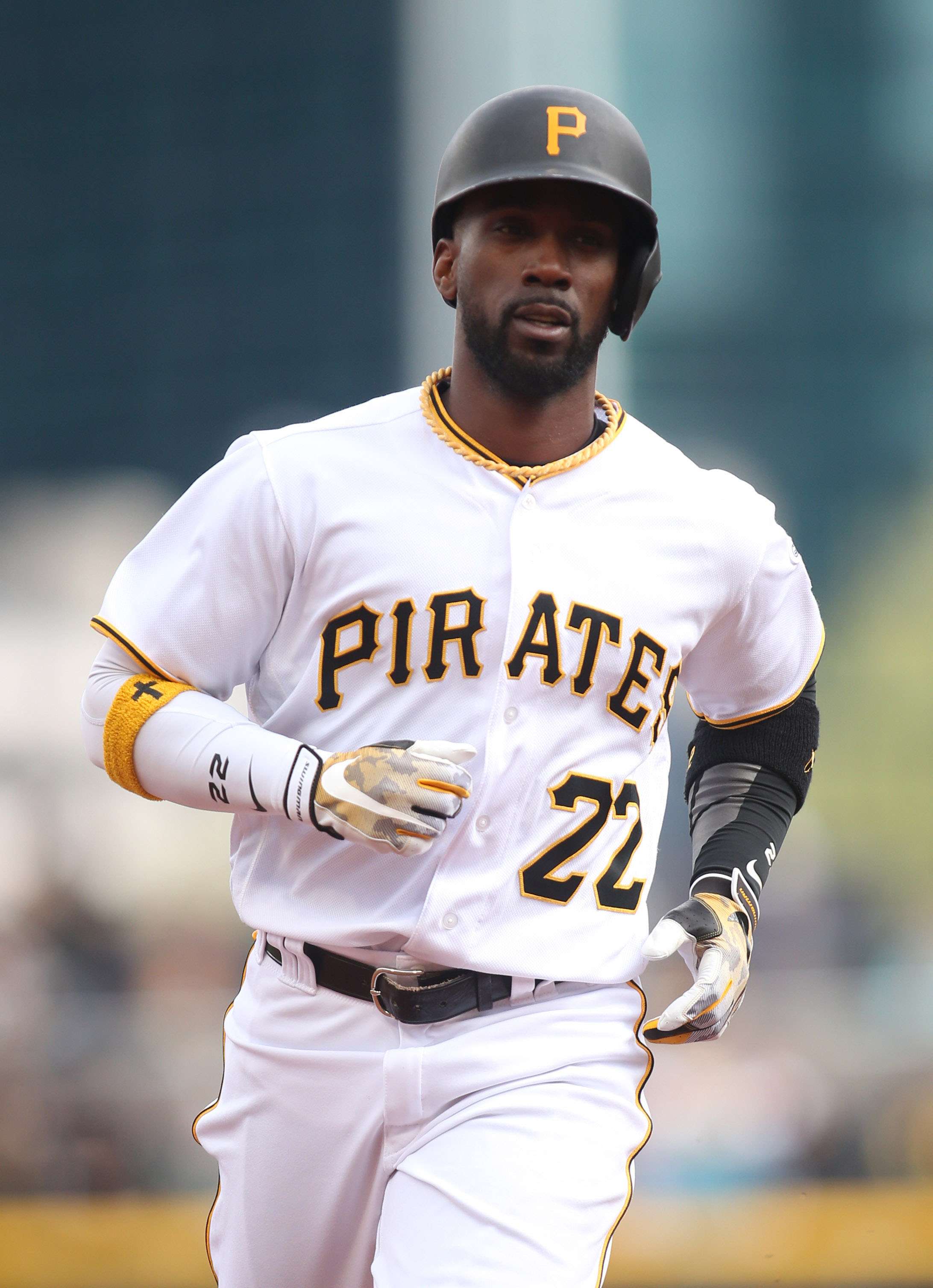
Andrew McCutchen, Pirates: Few players had more fascinating offseasons than McCutchen, a five-time All-Star who looked like a strong bet to leave the Pirates via trade over the winter. Ultimately, no one was willing to meet the Pirates’ reportedly astronomical asking price for the longtime face of the franchise, so they retained McCutchen but moved him from center field to right field. At the time, McCutchen was coming off the worst season of his career as a defender, hitter and baserunner. While a bounce-back could still be in the offing this season for McCutchen, who’s back in center as a result of Starling Marte‘s 80-game suspension, the 30-year-old hasn’t shown many signs of a reawakening yet.
Encouragingly, McCutchen has stolen five bases on six attempts (far better than last season’s six steals on 13 tries), yet he owns a meager .215/.286/.386 batting line in 175 plate appearances and has already cost the Bucs four runs in 244 innings as a center fielder, per Defensive Runs Saved. Offensively, McCutchen’s ridiculously low .233 batting average on balls in play won’t last, which will lead to better production, but his days of being a force at the plate could be over. According to expected weighted on-base average (xwOBA), which uses exit velocity and launch angle to judge hitters, McCutchen should have a .325 wOBA. That’s much better than his actual wOBA, .292, but barely superior to the .319 league average. Given McCutchen’s mediocre production since last season, his once-appealing contract no longer looks as though it’ll enhance his trade value. He’s on a $14MM salary this year and carries a $14.5MM club option for 2018.
Brian Dozier, Twins: Like McCutchen, Dozier was prominent in trade rumors over the winter, when it looked as if the Twins would send the second baseman to the Dodgers. However, fresh off a season in which he mashed 42 home runs and stole 18 bases on 20 attempts, the Twins balked at swapping Dozier for high-end pitching prospect Jose De Leon. It’s up for debate whether that will go down as a mistake for Minnesota, which has exceeded expectations so far this year.
The Twins’ success has come without peak Dozier, who has hit a so-so .230/.331/.385 in 157 PAs, seen his ISO drop from a lofty .278 last year to .156 this season and successfully swiped just six of 11 bases. It’s also worth noting that, compared to 2016, the 30-year-old is hitting far more ground balls, far fewer fly balls and pulling the ball much less, all of which bodes poorly for his power output. That’s not to say the well-rounded Dozier will continue to post pedestrian numbers, though, as he’s in the midst of a solid May after a quiet April and is running quality walk and strikeout rates of 12.1 percent and 18.5 percent, respectively. Moreover, his xwOBA sits at .353, indicating his .315 wOBA is largely the product of bad luck. Nevertheless, Dozier doesn’t look like the player he was a year ago, and he’s gaining on a trip to the open market after the 2018 season. As such, if the Twins fall out of contention and put Dozier back on the block, he’s probably not going to return a De Leon-type prospect.
Jeremy Hellickson, Phillies: The Phillies are already willing to listen to offers for Hellickson, which isn’t surprising considering they’re a rebuilding team and he’s on a one-year contract. Despite his 3.44 ERA over 49 2/3 innings, though, the right-hander doesn’t have the makings of a rotation stabilizer for a playoff-caliber team in need of starting help. Hellickson, after all, ranks last among qualified starters in strikeouts per nine innings (3.62) and strikeout percentage (9.9). He’s also benefiting from an unsustainable BABIP (.205) and a home run-to-fly ball ratio (12.2 percent) that could skyrocket if his 33.9 percent ground-ball rate and 44.8 percent fly ball mark don’t start going in different directions. And while Hellickson has only surrendered a .300 wOBA against and essentially turned opposing hitters into the 2016 version of Yonder Alonso (who wasn’t good), his xwOBA (.364, right in line with Manny Machado‘s .366 last year) portends trouble. Hellickson’s not cheap, either, as he accepted the Phillies’ qualifying offer last fall and is making $17.2MM as a result.
Michael Saunders, Phillies: Then with the Blue Jays, Saunders was among the game’s top offensive players during the first half of last season, which led to his first All-Star berth. Saunders fell off a cliff as the season went on, however, and has continued to struggle in 2017. Now with the Phillies on a one-year, $9MM contract (with a $10.5MM club option for 2018), Saunders has batted a meek .239/.287/.403 in 143 trips to the plate. It’s nice that the 30-year-old’s strikeout and swinging-strike rates have dropped off significantly since last season, but his walks and ISO have also experienced notable declines. Further, Saunders’ xwOBA matches his .295 wOBA, so it’s hard to bank on a turnaround. Consequently, it’s hard to bank on Saunders having much of any trade value. It’s fair to say that isn’t what the non-contending Phillies had in mind when they handed him a short-term pact.
Todd Frazier, White Sox: As is the case with Dozier, Frazier’s xwOBA (.353) is quite promising. However, the actual production hasn’t been there for the 31-year-old, who’s slashing just .200/.285/.358 with four home runs and a .158 ISO in 137 PAs. Frazier entered this season having combined for 104 homers (40 in 2016) and a .223 ISO over the prior three years, and both his power-hitting ways and plus defense during that span helped offset a .316 on-base percentage. Frazier is walking more and striking out less than ever, and his .220 BABIP will rise, so those factors plus his aforementioned xwOBA create reasons for hope. Given that he’s in the final year of his contract and playing for a bad team, Frazier looks like a shoo-in to switch homes prior to the trade deadline. Until then, the White Sox are left to hope Frazier’s production positively regresses and increases his value. So far, the $13MM man has at least one potential suitor.
Melky Cabrera, White Sox: With a .238/.282/.318 line in 163 PAs, Cabrera has been even worse than his teammate Frazier, which certainly isn’t ideal for a White Sox club that would like to acquire long-term assets for its veterans on expiring contracts. Cabrera has hit well at times in the past, including last season, but as a poor defensive outfielder who’s not producing at the plate, he doesn’t look like someone any contender would want at the deadline. While the 32-year-old’s .265 wOBA could regress toward his .326 xwOBA, the latter figure still isn’t particularly good for a player who doesn’t offer value in the field or on the base paths.
Bartolo Colon, Braves: Since his improbable resurgence in 2011, the fun-loving Colon has offered quality innings in three teams’ rotations, most notably the Mets’ from 2014-16. Unfortunately for the scuffling Braves, who signed Colon to a one-year, $12.5MM deal in the offseason, that hasn’t continued in his age-44 season. After racking up four straight 190-plus-inning seasons prior to 2017, Colon hasn’t completed six frames in a start since April 21. He also has just two quality starts in nine attempts, the latest of which came April 16. All told, Colon has managed a dreadful 6.38 ERA in 48 innings (up from 3.43 last year), and his .357 xwOBA doesn’t indicate that a significant amount of bad luck has gone into the unsightly wOBA (.368) he has surrendered. Barring drastic improvement over the next couple months, it’s hard to imagine any playoff hopeful dealing anything of consequence for Colon, who looked like a potential trade chip in the making when rebuilding Atlanta added him in November.
Photo courtesy of USA Today Sports Images.
Top 30 Trade Deadline Candidates For 2017
It’s time to bring back our trade-deadline power rankings, drawing from our power ranking approach to pending free agents. As the summer trade market develops, you can expect more regular updates when modifications to the list are warranted.
As with last year, the approach is pretty straightforward. We’re looking at both trade value and trade likelihood in compiling the list. In terms of value, it starts with overall on-field value — with a premium on an ability to make an impact in the current season — with an adjustment for contract and market factors. As for the probability of a swap, the focus is on potential selling teams’ motivation to deal, with contract status, near and long-term roster fit, and overall competitiveness all weighing heavily. Some teams simply aren’t in a position at present where it makes sense to include their top potential trade chips, but that will evolve over the coming weeks.
You’ll note that the list includes quite a few relievers and short-term veterans. That’s because teams often find a need to add complementary pieces at the deadline, with selling clubs more willing to cash in on that type of asset. You’ll also notice an absence of players from some teams that aren’t in good shape in the standings. But that’s because I have utilized my discretion to hold off on considering players from a few teams that could fall back despite a quick start (e.g., the Twins) or that seem to have reasonable hopes of making a surge back toward contention (e.g., the Blue Jays, Mariners, Giants, Mets).
It’s subjective; it’s debatable; it’s all sure to change over the coming months. And that’s what makes it fun. Here’s the first list, with some additional names and teams to keep an eye on appended at the end:
1. David Robertson, RP, White Sox: The deadline is typically a good time to move closers, and Robertson looks more likely to be as readily available as any. He has also rebounded somewhat from a down 2016 season thus far, though his walk rate is still up a bit. His contract isn’t cheap, but in the context of soaring relief salaries perhaps it’s also not as much of a burden as it seemed over the winter given the turnaround.
2. Lorenzo Cain, OF, Royals: Unless K.C. can author another great run, there’ll be plenty of players available. Perhaps none will be more sought after than Cain, who could be the best rental outfielder dangled. He’s reaching base at a prodigious clip with outstanding plate discipline thus far, though his value would be boosted if he can rediscover some lost power.
3. Zack Cozart, SS, Reds: Few players have boosted their free-agent and trade stock to the extent Cozart has thus far. His suddenly excellent walk rate has combined with his typically good power to make him one of the game’s better-performing hitters through the first six weeks of the season. Given his status as a premium defender up the middle, Cozart could draw plenty of interest as a rental. The only limitation may be the lack of a clear market, though if he keeps this up perhaps a contender will bump another player off of shortstop to make room for Cozart.
4. Yonder Alonso, 1B, Athletics: His stock is rising quickly with a newfound power stroke. And it doesn’t hurt that he’s on a cheap contract that runs out after the season, making him a fairly easy and obvious trade piece if the A’s remain buried in the AL West. Demand is still an open question, but it stands to reason that a few organizations will be looking for a slugger; if J.D. Martinez isn’t ultimately marketed, Alonso could be the top available source of offensive production.
5. Jose Quintana, SP, White Sox: It’s still not certain whether the White Sox will move Quintana, but he’ll undeniably be available. The question here is whether he can tamp down a rising walk rate and get back to his steady productivity. That would go a long way toward drawing sufficient trade offers to get Chicago to bite on moving its best-remaining veteran asset.
6. Kelvin Herrera, RP, Royals: There’s an argument that Herrera could be the top relief arm available, but there are some caveats. Kansas City may elect to hold onto him even if the team is buried, given that he has another year of control. And the 27-year-old has seen a strikeout dip early on, though his swinging-strike rate and velocity remain at typically excellent levels.
7. Tony Watson, RP, Pirates: Though his results this year are outpacing his peripherals, Watson is well-established as a high-end relief arm and is set to enter free agency after the year. While he’s closing for the Pirates, it’s not immediately clear whether he’ll be targeted in that role by contenders. Either way, barring a turnaround from the Bucs, he seems quite likely to be a top trade piece this summer.
8. Pat Neshek, RP, Phillies: With free agency beckoning, the veteran reliever is probably the Phils’ clearest trade piece. He has been excellent thus far, even showing improved performance against left-handed hitting, and could be a very valuable addition for a lot of organizations.
9. Brad Hand, RP, Padres: If Watson can’t hold the line, it could well be that Hand is the top shutdown lefty on the market. He’s running at more than 11 strikeouts per nine yet again — this time with a whopping 15% whiff rate — and currently owns a 1.88 ERA through 24 frames. San Diego doesn’t have to make a deal, since Hand is cheap and comes with two more years of control, but odds are the rebuilding club will see this as an opportune moment to cash in.
10. Jason Vargas, SP, Royals: No, we shouldn’t expect Vargas to keep pitching like an ace. But he is showing a big jump in swinging strikes and doesn’t need to be an elite hurler to be an appealing trade candidate. The typically steady veteran will be a free agent at year’s end and would help patch up many rotations for the home stretch.
11. A.J. Ramos, RP, Marlins: Though he has been effectively wild thus far, there are some worrying signs. Ramos is getting whiffs just 10.8% of the time, the lowest rate of his career, even as his walk rate has ballooned to 5.5 per nine. Still, he’ll have value with an established track record of sub-3.00 ERA pitching in spite of the control problems. He also has an added year of arb control.
12. Joakim Soria, RP, Royals: The 33-year-old is getting a ton of swings and misses (14.5%, best in his career) with the results to match. But he is also continuing his late-career walk rate inflation and has benefited thus far from an absence of dingers. Plus, he isn’t cheap, with a $9MM salary this year and another $11MM due for 2018 (plus an option buyout).
13. Ryan Madson, RP, Athletics: With 8.8 K/9 against just 1.7 BB/9, Madson’s 2.20 ERA through 16 1/3 innings is deserved. And the velocity, health, and whiff rates are all looking good. Like Soria, that’s a nice bounceback from a rough first season under a new contract. Also like Soria, there’s still a fair bit of cash left to go for 2018 ($7.5MM) — and Madson is closing in on 37 years of age.
14. Marcell Ozuna, OF, Marlins: It’s anyone’s guess whether the Fish would pull the trigger on a deal this significant with the team weighing a sale, but Ozuna looks to be the top possible trade chip on a club that is in need of some fresh talent. Ozuna is reaching new heights — .302/.379/.564 with 11 home runs and an 11.2% walk rate through 169 plate appearances — at 26 years of age. While he would also be an obvious extension candidate, the Marlins have already reportedly tried and failed. With two more years of arb control left, now may be the time to move him — and the return could be substantial.
15. Mike Moustakas (3B) & Eric Hosmer (1B), Royals: Both have had their ups and downs early, but would likely represent solid regulars for contenders that need to plug holes. The demand side likely won’t be as robust as in the case of Cain, who could fit on plenty of different teams.
17. Anthony Swarzak, RP, White Sox: Chicago caught lightning in a bottle with the breakout 31-year-old righty, who’ll be back on the market next winter. If he can maintain anything approaching his current form — 1.37 ERA on 10.1 K/9 and 0.9 BB/9 with a league-leading 19.8% swinging-strike rate — as the deadline draws near, he’ll be quite a nice deadline asset.
18. Jed Lowrie, INF, Athletics: The veteran is back on the upswing as he prepares to hit the open market. Injuries and performance issues have limited his value since Lowrie last turned in this kind of effort, but he has done it before. Currently, he’s hitting .268/.345/.436 with five dingers and a 10.1% walk rate through 168 plate appearances.
19. Todd Frazier (3B) & Melky Cabrera (OF/DH), White Sox: Neither veteran is hitting much early on, but that doesn’t mean they aren’t still likely trade pieces. While the Sox will likely need to eat some salary even if both bounce back, they seem quite likely to end up playing elsewhere for the second half of the season given that both will hit the open market after the year.
21. Ian Kennedy, SP, Royals: The big question here is how teams will view Kennedy’s contract. He has been as solid as could have been hoped when he signed before the 2016 season, but it’s a backloaded deal and Kennedy is already 32 years old. Whether or not he’s dealt, he’ll enter the winter with a three-year, $49MM player option (or, instead, a $6MM buyout). While that could be a palatable price tag, potential shoppers will need to consider the uncertainty in weighing an offer.
22. Alex Cobb, SP, Rays: We’ve heard that Tampa Bay is already putting out feelers on Cobb, and the team’s rotation depth would allow it to swing a deal for the pending free agent while still maintaining some hope for a Wild Card. The 29-year-old is performing well after returning late last year from Tommy John surgery, but he hasn’t really shown signs yet of fully returning to his pre-injury form. Since the team is still in the pack, he’s the only player from the Rays roster I’m putting on the list at this time.
23. Jeremy Hellickson, SP, Phillies: There’s real concern in Hellickson’s plummeting strikeout tallies, given that he’s also sporting a career-low 7.4% swinging-strike rate while showing a slight velocity decline. And he’s hardly cheap. Still, it stands to reason that the Phillies will look to cash him in this year after holding off on doing so in 2016. (*NOTE: Hellickson left tonight’s game with what appeared to be an injury to his side.)
24. Andrew McCutchen, OF, Pirates: This’ll be a story until a deal comes together. While the Bucs will be hesitant to sell low on the currently scuffling veteran, the team is also on track to be in a clear selling stance this summer.
25. Sonny Gray, SP, Athletics: In a somewhat analogous situation, Oakland is surely wondering when the time will be right to make a move involving Gray. He is delivering a 9.9% swinging-strike rate that’s actually over any single-season mark for his career, but the strikeouts (6.8 per nine) and results (3.97 ERA) haven’t caught up to his 2014-15 levels.
26. David Freese, 3B, Pirates: Now 34 years old, Freese is slashing a robust .271/.373/.443 with three home runs and a career-best 13.3% walk rate. Plus, his strikeout rate has trended down to 16.9%. His two-year, $11MM deal looks like a bargain, though that could motivate the Pirates to hold onto him given the ongoing uncertainty with Jung Ho Kang.
27. Matt Kemp & Nick Markakis, OF, Braves: It’s not quite clear whether Atlanta will end up looking to move these moderately priced veterans, but both are swinging the bat well and could be useful pieces in the right situation.
29. Derek Holland, SP, White Sox: Though Holland has put up excellent results, he is posting typical peripherals that peg him as a back-of-the-rotation arm. The same holds true of rotation-mate Miguel Gonzalez. Both could plug gaps for contenders who need depth.
30. Drew Storen, RP, Reds: Storen’s peripherals are largely in line with what he posted last year, and the velocity has dropped further, but he’s carrying a 1.93 ERA through 18 2/3 frames while relying more heavily on his offspeed offerings. So far, he has tamped down on the gopher balls and is also getting grounders at a career-best 60.8% rate. He’ll need to show that he can sustain this level of success for a while longer before moving up the list, though.
Injured: Nate Jones (White Sox), John Axford & Sean Doolittle (Athletics), Trevor Cahill (Padres)
Also Considered:
Rays: Chris Archer, Jake Odorizzi, Corey Dickerson, Logan Morrison, Alex Colome, Erasmo Ramirez, Danny Farquhar
White Sox: Miguel Gonzalez, Tommy Kahnle, Jose Abreu
Royals: Alcides Escobar, Brandon Moss, Jason Hammel, Mike Minor
Athletics: Stephen Vogt, Trevor Plouffe, Rajai Davis, Matt Joyce, Santiago Casilla
Braves: Kurt Suzuki, Jim Johnson, Arodys Vizcaino, Jaime Garcia, R.A. Dickey, Bartolo Colon, Julio Teheran
Phillies: Freddy Galvis, Cesar Hernandez, Michael Saunders, Daniel Nava, Joaquin Benoit
Marlins: David Phelps, Kyle Barraclough, Edinson Volquez
Pirates: Josh Harrison, Ivan Nova, Gerrit Cole, Juan Nicasio, Wade LeBlanc
Padres: Yangervis Solarte, Clayton Richard, Jhoulys Chacin, Ryan Buchter, Brandon Maurer
The Inner Monologue of @DimTillard Random Thoughts Vol. 1
It’s 10:58am on Thursday May 18th, 2017. I’m Milwaukee Brewers veteran MINOR league sidearm pitcher of over fourteen years, Tim Dillard. Of course you haven’t heard of me, but that’s beside the point. I’ve experienced a lot in my middlewhelming career, and have witnessed even more.
11:01am Sometimes I write for MLB Trade Rumors… that is, when I’m not playing baseball, reciting Star Wars, making minute long Oscar-worthy short films, or continually watching Sherlock on Netflix. And I have a beard… so yes, I am extremely wise.
11:04am Though the beard wasn’t always so. In fact, for my first ten years in professional baseball, I made sure I was clean-shaven. I would shave before EVERY game as part of my pregame routine. The reasoning for my “baby face” look was that… just maybe there’d be a scout in the stands, and he might mistake me for a young up-and-coming prospect! So far I have no confirmation this was affective. And when I turned thirty I thought… “Well, I fooled ’em as long as I could.”
11:08am Anyway, I cordially invite you and thank you for going on this random minute-by-minute baseball journey with me! (I misspelled “cordially” four times before googling it)
11:10am I play for the Triple-A Sky Sox, and we’re currently on a road trip in El Paso, Texas. There’s a night game tonight, and then we bus to Albuquerque, New Mexico right after. At the moment, I’m in the hotel just killing time before the maid kicks the door in and asks me to vacate the room. (checkout’s at noon)
11:13am A few weeks ago I was checking out of a hotel in Memphis, Tennessee and I got an interesting text message. It read, “When you get a chance give me a call! -Bobby Bo”
11:14am Bobby Bo? Now, I don’t know about you… but the only “Bobby Bo” I’ve ever heard of is the famous Major League All-Star Bobby Bonilla! The same Bobby Bonilla who played for the Pittsburgh Pirates in the late 80’s and early 90’s! The same Bobby Bonilla who I watched play at Pirate City every spring training growing up in Bradenton, Florida! The same Bobby Bonilla that has one of his broken bats literally sitting in my parents’ garage right now!
11:18am Anyway, yeah… same dude.
11:18am Well I called him back and he totally answered! We talked for, I don’t know… let’s say it was, twenty-three minutes and forty-seven seconds or so. And I told him how I yelled “hey” to him across a crowded Brewers big league camp clubhouse in 2010, but he claimed he didn’t remember.
11:20am Bobby Bo told me he loves the pointless videos I post on twitter, instagram, and the Infield Chatter app, and encouraged me to continue enjoying the clubhouse and making videos. Bobby Bonilla!
11:22am It was a very cool moment for yours truly because that guy is a household name, and a childhood hero of mine! I have so much nostalgia from those years with him, Barry Bonds, Andy Van Slyke, Doug Drabek, and a before the Braves’ Sid Bream! (come to think of it… not sure where he got my phone number)
11:24am Speaking of heroes, last week, I realized the true hero of the minor league bullpen. And it’s a towel! Yeah you read that right. “It’s always good to bring a towel!” I believe that every relief pitcher should bring a towel with them to the bullpen.
11:26am There are so many uses for a towel: It can act as a cushion for the buttocks… cause you could be down there awhile. If the unergonomical flat metal bench is dirty or wet… wipe it down. If there’s rain in the forecast… it can keep you dry. If it’s, “Kinda hot in these rhinos.”… use it to wipe off sweat. Cold?… bundle up. Don’t want to hold your glove?… wrap it up. Too much red hot or atomic balm… scrub for dear life!
11:29am Just heard the maid knock across the hall… I’m running out of time. Realizing I spent too much time bragging to you my “Bobby Bo” story.
11:30am So yeah, the towel is a bullpen friend.
11:30am You know, one of the luxuries of being a relief pitcher in baseball is that you’re able to watch the game without pressure. The pressure of playing every inning, the pressure of coaching, or the pressure of being a fan. And in this role, I observe many happenings.
11:35am Like those things you never noticed until someone points out… then you see it all the time. For example, how Mark Wahlberg plays the exact same character in EVERY movie he’s ever been in, or how ALL minivans have dents. (just wait… you’ll see it)
11:37am Or like baseball: How in every game, at least one hitter will hit a foul ball between his legs. Or like when time-out is called right before a pitch, the umpire will specifically show who asked for the time-out by pointing at the culprit. (still not sure why this matters)
11:39am But that is what makes baseball so attractive! There are so many things that happen, and you never know what you could possibly witness during a baseball game!
11:40am Years ago when I was too old to play Mississippi high school summer ball, I played “semi-pro” baseball. It was an all-black league before my two older brothers and I started playing. (by the way, I’m a super pale white guy)
11:42am To this day it’s one of the most competitive environments I have ever played in! For me it was baseball in it’s purest form. I experienced so many memorable moments out there that I have yet to experience again.
11:43am We would play on amazing make-shift fields throughout the heartland of Mississippi. Most had bleachers, and some had outfield fences. One field had a giant tree in left-center. And one field had a goat that would stand and balance itself atop a propane tank for the entire game.
11:46am Every weekend was satisfying baseball! And after each game, it was a gentlemen’s celebration! Both teams covered in sweat would shake hands, hug, then sit talking and laughing about the game for hours. We would eat fish sandwiches while some drank brews. Stories would be shared, and legends would grow.
11:48am I remember a shortstop for the Verona Black Sox who would place his cigarette behind second base in-between pitches. And how the play-by-play announcer with a simple microphone and speaker would address my oldest brother Jeff as the “Godfather”. I remember facing two brothers who played for Poplar Springs that could flat out hit! And I had to throw 138 pitches over eleven innings to beat them during the playoffs! (shameless plug)
11:52am Baseball is amazing in so many ways. And there is amazing baseball being played all across this country and in many countries around the world.
11:53am Mathematically, historically, universally, baseball is special. It has it’s own timeline, and brings people together. An incredible game that transcends every barrier the world can conjure!
11:55am There’s the knock… time to checkout.
To Be Concluded…
2017-18 MLB Free Agent Power Rankings
About 24% of the MLB regular season is in the books. The Astros, Yankees, and Nationals currently reign supreme. Familiar names Mike Trout, Bryce Harper, and Chris Sale top the WAR leaderboards. Though we’re only in mid-May, there’s a subset of players who can’t help but look ahead: those eligible for free agency after the season. Here, we attempt to rank the projected free agents based on their earning power. For the full list of 2017-18 MLB free agents, click here.
1. Yu Darvish. Nine starts into his season, Darvish is not quite in vintage form. His 2.76 ERA ranks 11th in the American League, though strikeouts are down and walks are up. The key stat might be his 58 2/3 innings pitched, good for a second-place tie in the league. Darvish’s second career 200-inning campaign would quiet concerns after his 22-month Tommy John layoff, possibly leading to the largest contract of the winter. In the short term, the question is whether Darvish will be traded this summer. The Rangers have climbed into the Wild Card discussion with an eight-game winning streak, though they’re already eight games behind the Astros for the division lead.
2. Johnny Cueto. In the early going of 2017, Cueto has posted his worst ground-ball rate since his 2008 rookie season. He’s allowing home runs twice as often as last year and also has an abnormally low strand rate, leading to a 4.50 ERA. I think his numbers will be fine in the end, and he’ll opt out of his remaining four years and $84MM. The Giants may attempt to extend Cueto prior to that point, or they could wind up trading him this summer. The slow-starting club already faces an uphill battle to reach the playoffs.
3. Jake Arrieta. As Jeff Sullivan of FanGraphs put it in the headline of his article this week, “Jake Arrieta Has Not Been Good.” The surface statistical reasons bear some similarity to Cueto: ground-balls are down, home runs are up, and he’s been stranding fewer runners on the bases. 5.44 ERA notwithstanding, Arrieta is still a quality pitcher in his present form. He may settle in as a sub-4.00 ERA number three-type starter, which would only be disappointing compared to the dizzying heights of his 2015 Cy Young season. Darvish, Cueto, and Arrieta should all by vying for five-year deals, and may shuffle spots in these rankings all year long.
4. Jonathan Lucroy. Since we last checked in, Lucroy’s bat has come alive with a .328/.380/.469 line in 71 plate appearances. Talking to Evan Grant of the Dallas Morning News, Lucroy did not attribute his April struggles to his impending free agency, as you’d expect him to say. On the defensive side, Samuel Hale of WFAA wrote an article contending that Lucroy “used to be an elite framer, but that time has passed.” Lucroy’s pitch framing numbers will be worth monitoring as we try to assess whether he will receive the largest contract for a catcher in free agent history.
5. J.D. Martinez. After suffering a foot injury on March 18th, Martinez made his 2017 Tigers debut last Friday. He’s clubbed five homers in six games since then, so I’d say his foot is fine. Martinez, 30 in August, may establish himself as the top free agent bat and move higher in these rankings.
6. Eric Hosmer. Don’t count Hosmer out yet. The Royals’ much-maligned first baseman is hitting .347/.411/.484 in 107 plate appearances since we last checked in. The 27-year-old has apparently been laying off inside pitches in recent weeks, to much success. The Royals are in last place in the AL Central and are unlikely to make the playoffs, which could prompt a summer sell-off of impending free agents like Hosmer, Lorenzo Cain, Mike Moustakas, Jason Vargas, and Alcides Escobar.
7. Justin Upton. Upton has posted a fine season so far, with a .248/.368/.504 line in 144 plate appearances. Interestingly, he’s drawn a walk in 15.3% of plate appearances, though he’s never reached 12% in a full season and bottomed out at 8% last year. Upton’s newfound selectivity and move toward becoming a Three True Outcomes hitter has been a net positive. If he posts another 30 home run season but draws 90 walks instead of 50-60, Upton may be compelled to opt out of the remaining four years and $88MM on his Tigers contract.
8. Masahiro Tanaka. Tanaka has always been on shakier ground than the Big Three of this free agent class, given his health history, lower strikeout rate, and home run tendencies. More than a fifth of the flyballs Tanaka has allowed this year have left the yard. Those 10 home runs allowed in 45 innings have helped his ERA balloon to 5.80. His last outing was particularly ugly, with four long balls leading to a second-inning exit on Derek Jeter Day. There’s talk of a mechanical issue, and maybe this is nothing more than a blip on the radar. With a rough year, Tanaka could have a tricky decision on his opt-out clause, since he has three years and $67MM remaining on his Yankees contract.
9. Michael Pineda. Tanaka’s rotation-mate has a home run problem as well, with a full quarter of Pineda’s fly-balls going for home runs. Nonetheless, he’s posted a ridiculous strikeout-to-walk ratio accompanied by a solid 3.42 ERA through eight starts. Despite the 10 home runs allowed, Pineda has been able to avoid disaster starts. Has the 28-year-old actually “figured it out” and harnessed his considerable stuff? Jake Devin of Pinstripe Alley asked that question earlier this week, and found the results to be inconclusive.
10. Wade Davis. Davis has been utterly dominant to start off his Cubs career, with 17 1/3 scoreless innings and 22 strikeouts against five walks. Davis’ streak actually goes back another seven innings, into last September with the Royals. He’s no stranger to this kind of dominance, having been unscored upon for 31 2/3 innings in 2014 (tied for the 17th-best scoreless streak for a reliever in MLB history). If Davis continues to distance himself from last year’s flexor strain, he could surpass Mark Melancon‘s four-year, $62MM contract from last winter.
While Davis moves into the No. 10 spot on the list, his former teammate, Greg Holland, is close behind. Holland has been dominant and needs to finish just 30 games to trigger a $15MM player option. He entered the day with 18 under his belt already. Perhaps Holland’s lengthy Tommy John layoff will make teams reluctant to give him four years, but he’s a few months younger than Davis and is quickly reestablishing himself. Reds shortstop Zack Cozart leads all impending free agents with two wins above replacement already, and he very nearly snagged the final spot on the list. The 31-year-old has a shot at a four-year deal if his stellar play continues. Athletics first baseman Yonder Alonso has also put himself on the radar by changing his approach and crushing 12 home runs in 137 plate appearances. The Rays’ Logan Morrison, also part of the 2017-18 free agent class, is right behind him with 11 bombs.
With an OBP of .291, Mike Moustakas has fallen outside the top 10 for now. He joins honorable mentions such as Lorenzo Cain, Chris Tillman, Lance Lynn, Carlos Gonzalez, Carlos Santana, Marco Estrada, and Alex Cobb. Though the 34-year-old Jason Vargas is unlikely to obtain top 10 earning power, he warrants mention for his 2.03 ERA, which entered the day ranked third in the American League.
One last name you might be wondering about is Shohei Otani, the 22-year-old Nippon Ham Fighters two-way ace. He’ll have a late start to his season due to a thigh injury. While Otani aims to move from Nippon Professional Baseball to the Majors for the 2018 season, and that would be a huge story on MLBTR, he’s seemingly capped at about $10MM in earning power due to a change in the new CBA.
Inside The Draft Room: The 2009 Diamondbacks
When you look back at the 2009 Arizona Diamondbacks draft, there are quite a few storylines that jump off the page at you.
The Diamondbacks had eight selections over an 80-pick span from No. 16 in the first round to No. 95 in the third round – including a pair of first-round selections, a trio of supplemental picks and two second-round choices. Six of those eight – and 12 overall – reached the majors, although the team’s first overall pick peaked at Double-A. And of the 12 with big league time, six are playing significant roles in 2017.
The Diamondbacks had two opportunities to draft high school outfielder Mike Trout – he went to the Angels as part of their draft haul that same year – but opted instead to take a high school third baseman and a college outfielder.
While Trout has turned out to be the best player in that draft class, the second-best player has been Paul Goldschmidt, who the Diamondbacks did pick … in the eighth round … with their 13th pick … and as the draft’s 246th overall selection.
Before there’s any uproar – as in, “How could they have missed on Mike Trout?” – consider that if future success could have been accurately predicted for the New Jersey prep or for Goldschmidt (then a first baseman for the Texas State University Bobcats), then both would have been long gone before the Diamondbacks’ turn to pick. There are no crystal balls with the draft.
Knocking Down The Door: Faria, Guzman, Moncada, Rosario, Sims
This week’s installation of “Knocking Down The Door” includes two of the best middle infield prospects in baseball, a 22-year-old first baseman with a .404 OBP in Triple-A, and a pair of starting pitchers who combined for 23 strikeouts in their last start.
Jacob Faria, SP, Tampa Bay Rays (Triple-A Durham)
Despite not making it through the fifth inning in his latest start, the 23-year-old Faria has likely propelled himself to the top of the Rays’ “next in line” spot in the starting rotation. Striking out 13 hitters while recording 14 outs does tend to get a pitcher noticed, as will his overall numbers on the season (3.47 ERA, 3.7 BB/9, 14.4 K/9).
Coincidentally, there is a spot open after Blake Snell was optioned to Triple-A over the weekend. The Rays will certainly discuss whether Faria can have more success than the inconsistent and inefficient Snell, who has completed six innings only six times in 27 MLB starts. Prior to his 108-pitch, 4 2/3-inning outing on May 10th, Faria had back-to-back six-inning starts in which he threw 89 and 91 pitches, respectively, while allowing only two runs with one walk and 17 strikeouts. That should help his cause.
—
Ronald Guzman, 1B, Texas Rangers (Triple-A Round Rock)
Mike Napoli‘s four homers and two doubles over a 10-game span to start the month, as well as the team’s recent six-game win streak, should at least temporarily halt any talk of a lineup shakeup. However, Triple-A first baseman Ronald Guzman hasn’t slowed down one bit, and Napoli is still just 6 for his last 34 with with an overall season slash line of .165/225/.353. Even for a well-respected veteran with a strong track record, that’s not going to cut it for much longer.
The left-handed hitting Guzman struggled after a late-season promotion to Triple-A in 2016, but he’s having no such trouble this time around. After a multi-homer game on Sunday, the 22-year-old is slashing .343/.404/.518 with five homers, five doubles and two triples in 36 games with Triple-A Round Rock.
—
Yoan Moncada, 2B, Chicago White Sox (Triple-A Charlotte)
The White Sox could have a lineup spot available after optioning designated hitter Cody Asche to the minors today. The corresponding move is a reliever, but that could be temporary with the team possibly calling up another position player in the near future. A pair of candidates, Nick Delmonico, a Knocking Down The Door pick from three weeks ago, and Danny Hayes, haven’t hit much this month and Triple-A Charlotte’s two most productive hitters, Kevan Smith and Willy Garcia, are already in the Majors. Would they promote top prospect Moncada just days after general manager Rich Hahn shot down the idea? It wouldn’t be the first time a team has misled the media on a player move or simply just changed their mind.
The 21-year-old Moncada is still striking out at an alarming rate (42 K in 153 PAs) and was overwhelmed in a late-season stint with the Red Sox in 2016. But he’s also putting up huge numbers in Triple-A (.333/.405/.511 with six homers, four doubles and 10 stolen bases) and his plate discipline has improved drastically this month. He had 10 walks and 30 strikeouts in April; he has seven walks and 12 strikeouts in May.
At this point, Moncada’s free agency has already been pushed back another season—he won’t be eligible until after the 2023 campaign, at the earliest. Calling him up now, or in the near future, would allow him to gain some valuable experience while possibly providing an offensive spark for a team that has probably been more competitive than many expected.
—
Amed Rosario, SS, New York Mets (Triple-A Las Vegas)
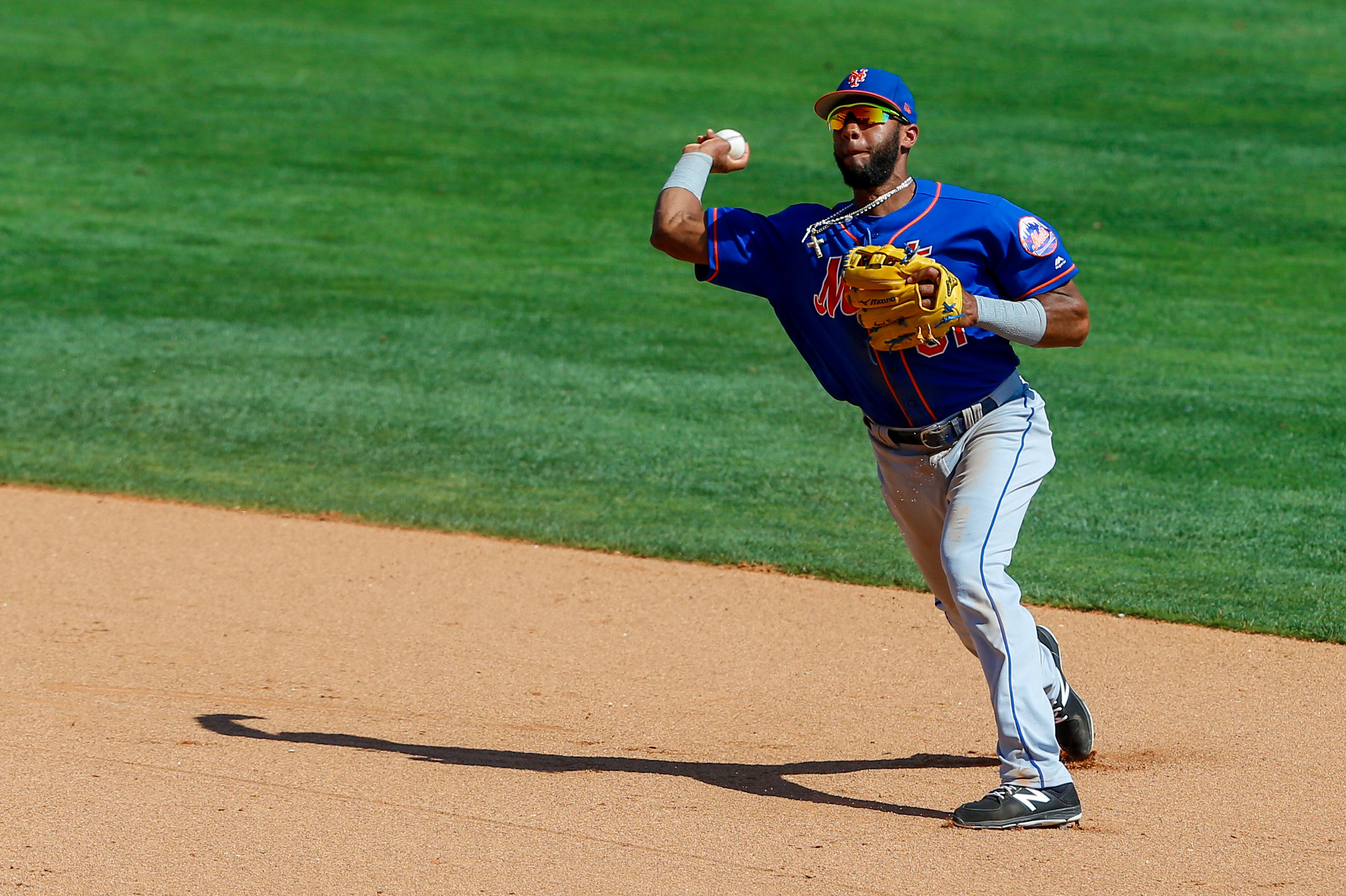
Asdrubal Cabrera‘s torn thumb ligament could send him to the disabled list at some point, maybe even today, which could prompt Rosario’s immediate call-up. Let’s be clear, though. The 21-year-old shortstop has done everything in his power to warrant the promotion and a good argument could be made even if Cabrera was healthy.
After all, the defensive-savvy Rosario is knocking the cover off of the ball in his first Triple-A stint—.359/.401/.493 with two homers and 11 doubles—and this struggling Mets team could use all the help it can get.
—
Lucas Sims, SP, Atlanta Braves (Triple-A Gwinnett)
The Braves’ successful finish to the 2016 season—they won 35 of their last 62 games—had some fans thinking playoffs in 2017. Instead of taking a chance on their unproven young pitching prospects to fill out the MLB rotation, the Braves added three veteran starters over the offseason: Bartolo Colon, R.A. Dickey and Jaime Garcia. This was not a bad decision, as they didn’t break the bank for free agents Colon or Dickey and they give up elite prospects to acquire Garcia. However, things are going poorly. The Braves are 13-21 and 9.5 games behind the 1st place Nationals — and we could still see a youth movement in Atlanta before long.
Sims, the 21st overall pick in the 2012 draft, is leading the charge. The 23-year-old lowered his ERA to 2.16 after tossing two-hit ball over 6 2/3 scoreless innings with a walk and 10 strikeouts in his last start. In 50 Triple-A innings last season, he had a 7.56 ERA with 10.1 H/9, 6.7 BB/9 and 10.4 K/9. In 41 2/3 innings in 2017, the right-hander has a 5.4 H/9, 1.9 BB/9 and 9.1 K/9. That’s what’s called “making the proper adjustments”.
—
“Knocking Down the Door” is a weekly feature that identifies minor leaguers who are making a case for a big league promotion.
Photos courtesy of USA Today Sports Images.
Looking Back at the 1992 Expansion Draft (Part 3)
This is the third of a three-part series looking back at the 1992 MLB Expansion Draft, when the Colorado Rockies and then-Florida Marlins mined their competitors’ rosters to launch their respective organizations. Click here to read Part 1; click here to read Part 2.
Two different approaches starting from Day One. Two different philosophies – both in the short-term and the long run.
But the goals were the same: To put a representative team on the field right off the bat, and to win sooner than later.
When they arrived in New York City for the November 1992 expansion draft, Colorado Rockies general manager Bob Gebhard and his Florida Marlins counterpart, Dave Dombrowski, finally were able to start assembling their rosters.
For Gebhard, the mandate was pretty simple; he knew he had a limited budget in constructing the Rockies for their inaugural season. His task was to amass a group that hopefully would have some staying power – along with finding pitchers that could handle the high altitude of Denver.
Meanwhile, Dombrowski was operating with a bigger budget and the lure of having a team in sunny South Florida. The expansion draft created the first batch of players coming his way, but they were by no means the only players he had to work with.
While the Marlins made more deals in New York City – and only had Jeff Conine for any real length of time with them via the expansion draft – the Rockies selected a core group of players that had extended stays in Denver.
“We felt confident in so many of the players that we got,” Gebhard explained. “We wanted to keep them and see how they would fit in on an expansion club. It was all pretty interesting to see how it went.
“Not all of the selections worked out, as you would expect. We were happy with David Nied. He certainly was going to be everything we expected until he hurt his arm. But there were some surprises in there.
“Eric Young turned out to be a heckuva ball player. Vinny Castilla turned out to be an All-Star. So we made some good selections – as did David (Dombrowski). David had a little different agenda because he had more money to spend, and some of his selections we could not have made because of the contract that would have come with the player.
“We drafted some guys that played for us awhile and were with us in ’95 when we went to the playoffs. So it wasn’t just a one-day flash-in-the-plan type of draft. We wanted players that would hopefully be Rockies for a number of years.”
From Dombrowski’s perspective, it was all about building a foundation – whether the players were Marlins for a single day or for an extended period.
“At times, I’ve looked back and commended our scouts for the job that they did,” he said. “The reality is, there were some good players that were taken by the organization that were around for a long time – either with our organization or traded. A guy like Jeff Conine became ‘Mr. Marlin’ and was there for a long time. Frank Wren was the guy who scouted the Kansas City organization and really liked him a great deal.
“Even in the second round, we got guys like Carl Everett – who had a long major league career. The scouts did a great job. I think there were a lot of good selections that were made.”
Looking back, Dombrowski has the dual gratification of knowing his inaugural team was competitive on the field – and the organization was only five years away from a World Series win in part to some trades that were made involving players selected in the expansion draft. The biggest, of course, was sending Trevor Hoffman (No. 8 overall), Jose Martinez (No. 4) and Andres Berumen (No. 45) to San Diego to land Gary Sheffield midway through the 1993 campaign.
“But don’t forget about Cris Carpenter. He was a prime example of the type of guy we were looking for,” Dombrowski said of the setup man, who was selected at No. 37. “Colorado had a better record than us that first year, and a lot was made of it at the time. But we kept saying, ‘That’s not really important.’ Cris Carpenter and Bryan Harvey were probably as good of 8th- and 9th-inning guys as there were in the league for the first half of the year. But Texas was looking for a setup guy, and we ended up trading them Carpenter. Who did we get? We not only acquired Kurt Miller (who pitched in parts of three seasons for the Marlins), but we got Robb Nen in that trade – who was the closer on our world championship club.
“So there were so many moves. The foundation was really there to help us move along for the future.”
– – –
One doesn’t have to look any further than Opening Day 1993 to see the different styles deployed by the Marlins and the Rockies.
Florida’ first-ever Opening Day lineup included:
- Two players selected in the first round of the expansion draft: Bret Barberie and Jeff Conine;
- Junior Felix, who was a third-round selection (No. 59 overall);
- Walt Weiss, who was acquired from Oakland on the day of the expansion draft;
- Scott Pose, who was selected in the December 1992 Rule 5 draft;
- Orestes Destrade, a free agent who had spent the previous four years with the Seibu Lions in Japan;
- and veteran free agents Benito Santiago, Dave Magadan and Charlie Hough – the 45-year-old knuckleballer who was the Marlins’ Opening Day starter.
Colorado’s Opening Day lineup consisted of:
- Andres Galarraga, who was signed as a free agent – and the club’s first player – the day before the expansion draft;
- Dante Bichette, who was acquired from Milwaukee in a draft-day deal;
- six players selected in the first round of the draft (Eric Young, Alex Cole, Jerald Clark, Charlie Hayes, Joe Girardi and David Nied);
- and Freddie Benavides, the club’s first pick in the second round.
Of the Rockies’ 36 expansion draft-day selections, 27 appeared in at least one game for Colorado during the team’s inaugural campaign.
In fact, when the Rockies went to the postseason in 1995 in just their third year of existence, 12 players on the roster were acquired by Gebhard during his draft excursion to New York (Galarraga, Bichette, Young, Girardi, Vinny Castilla, Jayhawk Owens, Darren Holmes, Curtis Leskanic, Lance Painter, Steve Reed, Armando Reynoso and Kevin Ritz). In addition, two members of Colorado’s first amateur draft class in 1992 were on the postseason roster – second-round pick Mark Thompson and seventh-round selection Jason Bates.
– – –
It was mid-February 1993, and the Rockies began reporting to spring training in Tucson, Ariz.
The site was Hi Corbett Field – the same location where, just a few years earlier, the movie Major League was filmed. There was a little bit of irony in having an expansion club in that setting.
The Rockies might not have had Willie Mays Hayes on their roster, but “yeah, it was a lot different than other spring trainings,” said Don Baylor, who was running a big league camp as a manager for the first time. “Now all of a sudden you’re there, and you have these purple tops running everywhere.”
To learn about managing an expansion team, Baylor reached out to Gene Mauch – the Montreal Expos’ first skipper – and leaned on guidance from his own bench coach, former big league manager Don Zimmer, who was an infielder with the first-year New York Mets in 1962.
“Playing at 5,280 altitude, we knew we would have to be in better condition than most people,” Baylor said. “We did a lot of wind sprints and a lot of long-distance running. I knew that they were all in when guys like Bichette and Galarraga were doing it.
“But we also knew we had to lighten it up a little bit. For some guys during that camp, it was life-or-death. ‘If I don’t make this expansion team, I might be through as a player.’ So we lightened it up a little bit so guys could have some fun.”
As Joe Girardi recalled, “We actually put on ‘Hello My Name Is’ tags as we went out for spring training. That camp … it was kind of like being signed and walking into a clubhouse for the first time, because you really didn’t know anybody. You played against them, and I was familiar with some of the faces that were in that draft, but I hadn’t really played with any of these guys.”
According to Eric Young, “What was good about that first camp was that we all knew we had a chance to make it happen for our careers. We just knew we had a chance, and you’ll never know what happens. Put a bunch of castaways together, and maybe they’ll win one day. We were just so hungry. Each guy wanted to go to work with no complaints. Everybody had the attitude that ‘I can play’ and ‘I can play every day’ – which was really good.”
While the Rockies were getting ready in the Valley of the Sun, the Marlins had set up shop for their first Grapefruit League spring in Cocoa, Fla.
Rene Lachemann was in his third tour of duty as a major league manager, having spent three years with the Seattle Mariners (1981-1983) and one with the Milwaukee Brewers (1984). He then was a big league coach for an extended run with postseason teams, coaching in Boston (1985-1986) and Oakland (1987-1992). The Red Sox went to the World Series in 1986; the Athletics went to three straight World Series, winning the title in 1989.
“I was looking forward to this new challenge,” Lachemann said. “I knew it was going to take time. I knew I had to have patience. I knew we were going to take beatings at times.
“I basically used the stuff I learned from being on four World Series teams – knowing what it takes to get to that point. It’s the basic fundamentals of playing the game hard and playing the game right. I remember telling them, ‘I know we are going to be outmanned at certain times, but I could go to a 7-11 store to find guys who play the game hard and run the ball out – but to play the game right is something different. You have to know what to do in certain situations, when to hit cutoff men, how to run bases. Those are things that are part of playing the game right, and that ends up helping you win ball games. You guys have been given a chance to perform at the major league level. The biggest thing is doing those things. You do those things and we won’t have any problems. That’s what I’m looking at.’
“It was a challenge at times and we took our lumps, but they went out and gave a lot of effort.”
Lachemann found a big backer in Jeff Conine, who had spent his professional career in the Kansas City organization before being taken in the expansion draft.
“I love Lach. He was great,” Conine said. “He kept it light, but at the same time, he commanded hard work and performance. I think he was the perfect guy in that situation – with the perfect personality – to get all of us together and create this major league team.
“Spring training overall was a bit bizarre. At first, I really didn’t know anyone from any other teams. When you go to your school team for the first time or when you get to your first minor league team, you don’t know anybody else. It was kind of like that. It just felt different, because this was the big leagues; this was the real deal. And it seemed out of place not to be able to know all your teammates before you go into a major league season.”
A player with previous ties to Lachemann was Walt Weiss, who had come over from Oakland after the expansion draft in a prearranged deal. Weiss had been a member of the Athletics for their back-to-back-to-back World Series appearances and was looking to resurrect his career. The shortstop was one of several veterans the Marlins brought in for their opening campaign.
“Like a lot of teams in that situation, we labeled ourselves the ‘Island of Misfit Toys.’ We were castoffs from all teams,” Weiss said. “That certainly creates a bond, because everyone for the most part is in the same boat. In one way or another, you’ve been cast off from another team, and you’re in this environment where there was a lot of excitement – being the first team in franchise history and the first big league team in Florida. It was an exciting year, but definitely a 180 from what I was used to in Oakland, where we had a very established club and a championship-caliber club every year that I was there. But at the time, I welcomed that.”
Weiss has a unique perspective on the whole expansion process. Not only was he a first-year Marlin in 1993, but he then signed with the Rockies as a free agent for the 1994 campaign.
“In Florida, it seemed like, that first year, there were some established stars on that team,” Weiss said. “Benito Santiago … we traded for Gary Sheffield … Orestes Destrade was a star that came over from Japan … Charlie Hough … Bryan Harvey – he was one of the best closers in the game at that time. So we had some All-Star players.
“In Colorado, it seemed like they built more for the long haul. I don’t know what the philosophies were when they were putting their teams together, but on the surface, that’s what it seemed like to me.
“I got to Colorado their second year, but it was the same type of feel. Guys came from other organizations and you have that immediate bond. They made some nice free agent signings like Larry Walker and Billy Swift. It was a fun team to be a part of … those early years with the Rockies. It was almost like playing on your college team again. We had a tight-knit group, and that team grew close very quickly.
“I signed there for a couple years, and after two years signed for a couple more. I ended up laying down family roots there. All my children were born and raised there, and I’m still there to this day. It was really a life-changing move going to Colorado that second year.”
– – –
On April 5, 1993, it became real for both franchises.
While the Rockies began their first campaign on the road, the Marlins played host to the Los Angeles Dodgers at Joe Robbie Stadium. Sandwiched in the lineup between veterans Santiago and Weiss, Conine went 4-for-4 in the 6-3 victory – including three singles off Orel Hershiser.
“It was surreal. I had never played in front of a crowd that large before,” Conine said. “We had made huge strides as far as getting to know each other in spring training. Now, we were a team. We were feeling good. We get out there on Opening Day, and everyone was talking about Joe Robbie being a converted football stadium – but I thought they did a great job of turning it into a baseball facility. There were 44,000 people in the stands and Charlie Hough was on the mound.
“And then at the end of the game, you look up at the scoreboard and you’re batting 1.000. My parents were there to see it. I don’t think you could have scripted a better Opening Day for a franchise than what we had that day.”
Conine quickly became a fan favorite – and was the only member of the Marlins’ expansion draft class to remain with the team for the 1997 World Series run. He later returned to Florida in 2003 – picking up a second World Series ring. Along the way, he picked up the moniker “Mr. Marlin.”
“At first, I didn’t embrace the nickname. I didn’t understand it … I was just doing my job,” said Conine – who spent eight total seasons as a Marlins player and is now in his ninth year with the club as a special assistant to the president. “As time has worn on, it’s a term of endearment that associates me with this franchise and this city. I definitely embrace it now and appreciate it – and appreciate all the fans that still call me that because of what we did during my time here.”
– – –
The Rockies began their maiden voyage with two games against the Mets at Shea Stadium.
“We happened to face Dwight Gooden and Bret Saberhagen,” Gebhard said, laughing, “so by the time we came home, we were 0-2. We were pretty excited to finally bring the team to Denver.”
In the franchise opener, Colorado managed just four singles in a 3-0 loss. Young, the first batter in Rockies history, immediately got the managerial eye roll from Baylor when he bunted into an out on the season’s fourth pitch.
“I told him, ‘You’re not starting a franchise by bunting for a base hit,’” Baylor said.
“He gave me that look,” Young said. “(Baylor) didn’t know what was going through my head at the time. He didn’t realize that when Dwight Gooden threw that first pitch at 96, I said ‘Oh, man, I’m going to have trouble with this. Let me see if I can just put it down.’ That’s why I bunted. That first pitch of the game got on me so quick, I backed up. All I was thinking was that I couldn’t strike out that first at-bat.
“I made sure I didn’t bunt that first game at home, though.”
Let’s set the scene: Opening Day at Mile High Stadium (April 9) … bottom of the first inning … Young was at the plate facing Montreal’s Kent Bottenfield … all of Denver was watching – or so it seemed – with a major league-record 80,277 in the ballpark … Young worked the count to 3-2, then became a Rockies legend when he went deep … the home run was the first blow in the club’s 11-4 victory.
“All I was thinking the whole at-bat was to get on base and jump-start the offense,” Young said. “We scored only one run in the two-game series in New York, and my job was to get the offense started.
“So when I connected, I said to myself, ‘Oh, man, I think I got under it a little bit.’ It was a high fastball. I didn’t know about the mile high effect and the thin air; I didn’t know about that then. But I’ll tell you what … 80,000 rose to their feet, and it just seemed like they lifted that ball over the fence. It was just magical – just the roar when I connected. And then the roar of it going over … it was unbelievable. I can use all the adjectives, but you can’t even describe ever having a feeling like that. And it won’t ever happen in a major league ballpark, because you’ll never get 80,000 people in one stadium for a baseball game. It was electrifying; the whole stadium was shaking like it was going to come down.”
– – –
After going 67-95 in 1993, the Rockies were only 11 games under .500 when the 1994 season was cut short by a labor dispute. Colorado then went 77-67 in 1995 – going to the postseason as the National League’s Wild Card club.
“We certainly wanted to do better than they did the first year, and I guess we did,” Gebhard said. “We didn’t lose as many games. We were in the playoffs in just our third year, which was unheard of at that point in time. They, in turn, won the World Series in their fifth year.
“But to put that club together … that ranks right up there with winning two World Series in Minnesota. Those three baseball-wise were the three biggest thrills in my life – to be with Minnesota in ’87 and ’91 when we won, and to having the opportunity to put together an expansion club. I’ve always said that every lifetime baseball administrator should have that opportunity once – but only once – because it wears you down.”
The Marlins went 64-98 their first year. After seeing steady increases in their winning percentages – from .443 in 1994 to .469 in 1995 to .494 in 1996 – they went 92-70 in 1997 and shocked the baseball world in winning the World Series.
“We put a representative team on the field that first year,” Dombrowski said. “We didn’t go out there and get shellacked on a regular basis. There were some times in which we played some very competitive baseball.
“Looking back, it was one of the most rewarding and enjoyable experiences I’ve been involved in. The ability to start an organization from Day One, and being in a position where you can put in your own philosophies and bring in your own personnel, and then be in a position where you grow that organization … eventually, we grew the organization and won a world championship together. So to me, it was one of the most rewarding experiences. Probably short of winning a world championship, but the experience of starting an expansion team is one of the most exciting things I’ve ever done.”
– – –
Chuck Wasserstrom spent 25 years in the Chicago Cubs’ front office – 16 in Media Relations and nine in Baseball Operations. Now a freelance writer, his behind-the-scenes stories of his time in a big league front office can be found on www.chuckblogerstrom.com.
Free Agent Stock Watch: Yonder Alonso
Last fall, it came as something of a surprise when the Athletics elected to tender a contract to first baseman Yonder Alonso. Though it cost the club just $4MM, that seemed a fairly hefty sum for a player who had contributed so little in the preceding season.
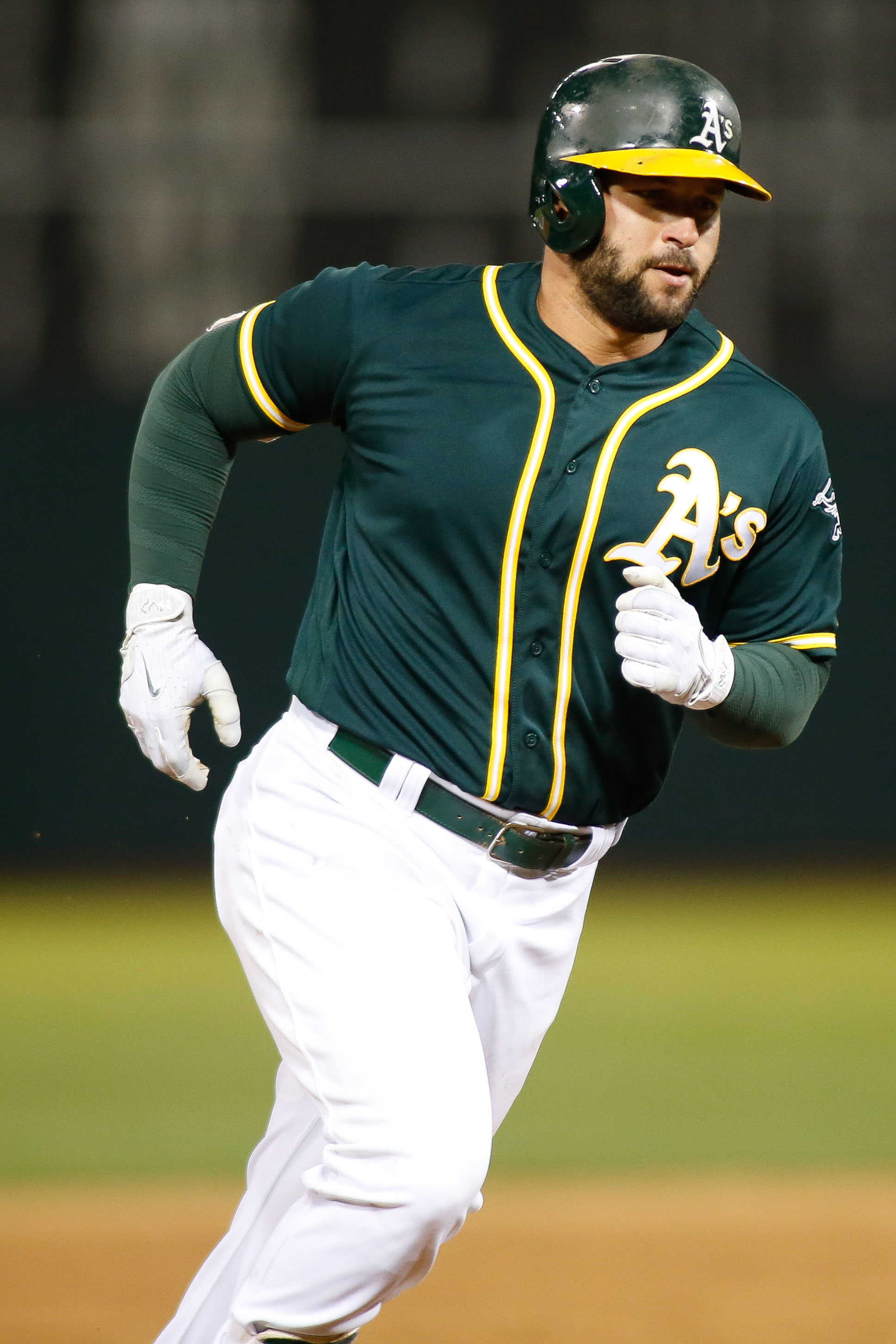
At the time, Alonso was coming off of a 2016 campaign in which he slashed just .253/.316/.367 over 532 plate appearances. While he continued to post low strikeout rates — 13.9% on the year — Alonso hit only seven home runs and also rated poorly with the glove.
Still, the A’s maintained faith. Oakland had parted with what turned out to be a significant asset — lefty Drew Pomeranz — to acquire Alonso, and clearly believed there was more to be found in his bat. What he has done thus far, though, has probably still come as a surprise.
Over his first 125 trips to the plate thus far in 2017, Alonso has been a revelation. He’s striking out more than ever, with a 21.6% K rate, but is also walking at a career-best 12.0% rate. And the former top prospect has finally tapped into his power potential, with a dozen long balls — matching his cumulative tally over the prior two seasons and 934 plate appearances. All said, he’s currently carrying a .291/.376/.664 batting line.
That remarkable turnaround has come despite a pedestrian .282 BABIP, so there’s obviously more at play than batted-ball fortune. Clearly, Alonso has employed some fundamental changes to his approach. At present, he’s hitting fly balls at a 54.2% clip while putting it on the ground just 24.1% of the time. That’s a stark reversal of his career rates of 33.6% flies and 44.4% grounders. As Eno Sarris of Fangraphs explored this spring in a remarkably prescient piece, it’s part of a dedicated plan.
We’ll obviously need to see how pitchers respond, and Alonso replies, before making any final assessments. But the early returns are obviously quite promising. And it’s fair to say that the opposition has taken notice. Remarkably, Alonso is seeing first-pitch strikes at only a 44.8% clip — a precipitous dive from his 58.7% career rate.
Alonso has accomplished the breakout not by swinging more, but by swinging more aggressively. In fact, he’s currently carrying a career-low 42.4% swing rate while chasing out of the zone at a career-low 23.5% rate. But he’s swinging through pitches 9.0% of the time, a fair bit above his typical levels (7.9%), which has led to the bump in strikeouts. Obviously, though, the contact has been much better when he does make it. Alonso’s exit velocity is over 91 mph, comfortably above league average, and his launch angle of 22.10 degrees is nearly double that of the field (12.89 degrees).
So, what’s it all mean? As noted already, Alonso will need to demonstrate that this is sustainable, even as the league adjusts. And there’ll surely be some regression, as his current 26.7% homer-per-flyball ratio likely will dip. (For his career, it’s just 8.1%.) There’s also the question of platoon splits. Alonso has historically struggled badly against left-handed pitching, with a lifetime .240/.307/.353 batting line. He has popped three dingers off of opposing southpaws thus far, but has only one other hit to go with two walks in his 23 plate appearances without the platoon advantage. And metrics have continued to see a decline in Alonso’s once-excellent defensive work at first. Still, his profile has clearly changed for the better, and that also means he’s now looking at bigger earnings when he hits the open market after the season.
It’s way too soon to put hard numbers down for contract expectations. And it’s worth bearing in mind that many accomplished sluggers failed to find the money they expected last winter, so the upside is perhaps limited. Despite swatting 47 home runs, Mark Trumbo took down just three years and $37.5MM, while even Edwin Encarnacion couldn’t find a fourth year. There’ll be competition next year, too, with more established sluggers like J.D. Martinez, Carlos Gonzalez, Jay Bruce, Todd Frazier, Carlos Santana, and perhaps Justin Upton also slated to hit the open market. At first base, Alonso will need to contend with Eric Hosmer, as well. It’s perhaps also now conceivable that Alonso could do enough damage that he’s worthy of a qualifying offer — though that possibility could well be foreclosed by a mid-season trade.
Alonso only just turned 30 years of age, so his representatives at MVP Sports can rightly tout that he’s a relatively youthful free agent. And that list of free-agent competitors hasn’t exactly gotten off to a compelling start, as a whole. If Alonso can stay healthy and productive, he could find himself among the top bats available next winter. He has already turned the A’s $4MM investment into a bargain, and that could look like a pittance when he signs his next contract. As things stand, it seems reasonable to believe that Alonso could command a three or four-year guarantee when he puts pen to paper next winter.
Photo courtesy of USA Today Sports Images.