
Latest On Mets’ Pitching Staff
While the Mets seem to have largely built out their 2019 pitching staff, there’s still some potential offseason work to be done. That may not mean bringing in new arms, though, so much as looking into new deals with existing ones.
There had been a general expectation that the Mets would pursue another rotation piece, whether to compete with or displace Jason Vargas in the #5 spot. General manager Brodie Van Wagenen cast doubt on that concept in an interview today with Andy Martino of SNY.tv (video link).
The Mets will “still stay in touch” with free agents, says Van Wagenen, but the team presently has “no plans to sign an additional starting pitcher.” Rather, per the rookie GM, the plan is to head down to camp and evaluate from there.
Whether or not Spring Training will provide opportunities — or create needs — for the Mets to consider additional hurlers, it’s expected to serve as a stage for contract talks. In particular, indications are that the club still intends to explore a new deal with star pitcher Jacob deGrom.
That negotiations haven’t yet started “has left the deGrom camp, at a minimum, disappointed,” according to Joel Sherman of the New York Post. From the team’s perspective, Van Wagenen did not indicate that anything has changed. To the contrary, he says that he still “hope[s] Jacob deGrom is a lifelong Met.” There’s still ample time for talks to get started, of course — camp hasn’t opened, and deGrom is controlled for two more seasons — but it’s certainly interesting to hear that deGrom’s reps have been displeased at the lack of communication to this point.
Interestingly, Sherman also reports that the Mets have designs on holding talks with Zack Wheeler, who is earning $5.975MM in 2019 before reaching free agency. Wheeler is an interesting potential extension target, as he’s fresh off of an impressive season in which he re-emerged following a three-year run of injuries and struggles. He’s younger than deGrom and closer to free agency, but hasn’t reached his rotation mate’s successes on the mound and has a much more worrisome track record. Wheeler is a difficult player to value in a hypothetical extension scenario, so it’ll be interesting to see if the sides are able to line up on a deal.
Projecting Payrolls: New York Mets
As we continue to wait for the new homes of Bryce Harper and Manny Machado, let’s move on to the 13th team payroll projection. Below find the links to the earlier posts in this series.
Philadelphia Phillies
Los Angeles Dodgers
Los Angeles Angels
Atlanta Braves
New York Yankees
Chicago White Sox
Boston Red Sox
Minnesota Twins
Milwaukee Brewers
San Francisco Giants
St. Louis Cardinals
Chicago Cubs
If you have questions about financial information made available to the public and the assumptions used in this series, please refer to the Phillies piece linked above.
Today, we look into a club that has surprised the baseball world move after move this winter: the New York Mets.
Team Leadership
Despite having been around for 57 seasons, the Mets have really had only three owners. They were founded as an expansion franchise in 1962 by Joan Payson with her widower running the show for five years after her death before he sold the club to publisher Nelson Doubleday’s company in 1980. Doubleday individually grabbed the club along with Fred Wilpon in 1986 and Wilpon, along with his business partners, bought out Doubleday in August 2002 with the Wilpon ownership group assuming full control. To say that Wilpon ownership got off to a bad start is quite an understatement as the team made just one trip to the playoffs from 2003-14, memorably falling to St. Louis in a seven-game NLCS in 2006 before a pair of heartbreakingly close playoff misses in 2007 and 2008. The club was rejuvenated, fueled by elite young pitching, in 2015, reaching the World Series and following that up with another playoff trip in 2016, albeit just a Wild Card Game loss.
Following an eight-year run during which Sandy Alderson rebuilt the club into a true contender, Wilpon went outside the box — way outside the box — and hired former Creative Artists Agency player agent Brodie Van Wagenen to be the new general manager in October 2018. Although his hiring was initially met with some skepticism and questions about possible conflicts of interest, Van Wagenen has set the baseball world on fire with a series of marquee moves, as we’ll discuss below.
Historical Payrolls
Before hitting the numbers, please recall that we use data from Cot’s Baseball Contracts, we’ll use average annual value (“AAV”) on historical deals but actual cash for 2019 and beyond, and deferrals will be reflected where appropriate. And, of course, the value of examining historical payrolls is twofold: they show us either what type of payroll a team’s market can support or how significantly a given ownership group is willing to spend. In the most useful cases, they show us both. We’ll focus on a 15-year span for the Mets, covering 2005-18 for historical data as a means to understanding year 15: 2019. This period covers nearly the entirety of Wilpon’s sole ownership, so this provides an excellent window into what to expect from the club. We’ll also use Opening Day payrolls as those better approximate expected spending by ownership.
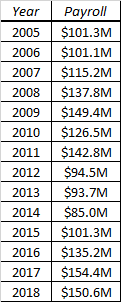
Wilpon kept spending largely consistent during the early days of his sole ownership, but payroll jumped in a big way to fuel the successful teams of the late 2000s. As that roster aged and faded, the payroll dipped substantially, including a massive one-year drop of nearly $50 million before the 2012 season. Payroll largely stagnated until a return to significant spending in the 2016 season as the Mets attempted to return to the World Series, followed by another jump before the 2017 year.
The Mets paid a $1.1 million luxury tax bill for the 1999 season under the previous tax regime, but that was the only year in club history during which they’ve incurred the tax. They came in narrowly under the threshold in 2003 by less than $1 million, but they haven’t come particularly close to the tax line over the past 15 seasons. The club has regularly played in the international amateur space, though they’re not known for the type of boundary-pushing spending that teams like the Yankees, Red Sox, Dodgers, and Cubs have employed.
Future Liabilities
Mets spending in 2019 is set to take a new leap, setting a new franchise high by a solid margin. Unsurprisingly, a bevy of guaranteed deals lead the way.
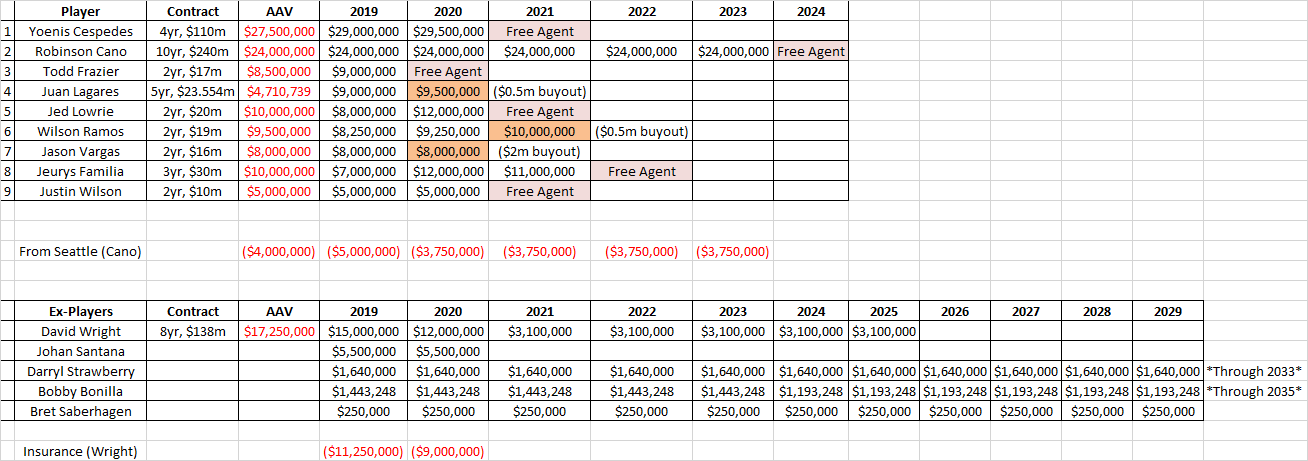
Despite some huge numbers for Cespedes and Cano, the club is far from hamstrung by its current deals as there is very little money committed beyond the 2020 season.
Speaking of Cespedes, he provides unquestioned offensive firepower…when he’s on the field. Since being acquired by the Mets at the 2015 trade deadline, signing a new deal with the club before the 2016 season, opting out, and securing a long-term deal covering the 2017-20 years, Cespedes has blasted his way to a powerful .282/.346/.543 batting line. However, Cespedes has seen his games played dwindle each year, tumbling from 159 in 2015 to 132 in 2016, 81 in 2017, and finally just 38 last season. The front office has given repeated indications that any contribution from Cespedes in 2019 will be gravy given his lengthy recovery timeline following heel surgery.
While Cespedes has struggled to stay on the field, new Met Cano has been a picture of consistency, playing at least 156 games each year from 2007-16 before dipping all the way to 150 games in 2017. However, Cano was slapped with an 80-game suspension last year after a test revealed the presence of a diuretic in his system before undergoing arthroscopic knee surgery in December. It’s likely Van Wagenen’s tenure will be defined in large part by how Cano performs in his new (old) city. Regardless, from a purely financial standpoint, Cano represents a fairly safe risk: whenever he plays, he has been remarkably productive and if he fails another drug test, Cano will be suspended for an entire season without pay. It’s also worth noting that the Mariners are subsidizing Cano’s deal both by sending cash to the Mets annually and by absorbing the remaining amounts due to Jay Bruce and Anthony Swarzak. It should be noted that the most sought-after player in the Cano deal was reliever Edwin Diaz, who fell 13 days short of Super Two status for 2019 and will therefore earn just $570,800 in his first year with the Mets.
Among the guaranteed deals for current players, longtime Met Juan Lagares is the sole remaining holdover who spent a significant chunk of time under the Alderson regime. Lagares plays a mean center field and runs well, but his bat never developed, so it figures that the Mets will pay his 2020 salary and wish him well nine months from now.
The remaining players are all middle class veterans on short-term deals. Frazier and Vargas both enter their walk years while Van Wagenen filled out the remainder of his roster by throwing modest sums of cash at solid, unspectacular veterans. Lowrie enters off of a stellar year but turns 35 shortly after Opening Day. Ramos, Familia, and Wilson each enjoyed success in 2018 and prior years, though each comes with a recent red flag: a knee injury for Ramos, a domestic violence suspension for Familia, and a nightmarish loss of command in recent years for Wilson.
Finally, we get to the payments to ex-players, and holy smokes, what a walk down memory lane this is. Wright has two years remaining on his eight-year contract, though insurance figures to pay about 75 percent of his guaranteed money, after which the team owes him $3.1 million annually through 2025. Santana’s deferred money carries just two years into the future.
But Strawberry, Bonilla, and Saberhagen? They basically define the risk of long-term deferrals. The team will spend over $3 million on that trio through the 2020s while owing nearly $2.8 million to the Strawberry-Bonilla duo for additional years. It’s true that those dollar figures aren’t astronomical when considering team budgets, but $3 million represents an annual flier on someone like Shelby Miller or a modest bullpen upgrade like Shawn Kelley. Instead, the Mets will continue to spend that cash on players through their 60s. Yikes.
Turning to the arbitration ranks, the Mets feature their best talent:
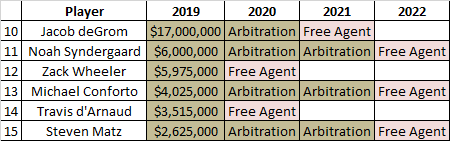
deGrom and Syndergaard are arguably the team’s two best players. Wheeler finally recovered from a slew of injuries to realize his promise as a strong rotation cog, and Matz still carries plenty of promise to do the same. Conforto played at an All-Star level in 2017 before slipping to be a merely plus regular in 2018; he just turned 25. Only d’Arnaud figures to play a less than prominent role as his sterling 2015 becomes a thing of distant past more so than a predictor of future stardom. Nevertheless, the arbitration table carries much of the intrigue for the Mets in 2019 and beyond.
What Does Team Leadership Have to Say?
Wilpon didn’t offer much insight as to what team spending would look like early on in the offseason, stating only that “Brodie knows what the parameters of what the payroll is and what we’re planning to do.”
Accordingly, this pushes us toward Van Wagenen for insight on the team’s expected spending…which also yields no useful information. Back in November, the general manager stated that the club was “open for sure to moving money off the roster” but “willing to add money as well” before deferring more specific questions to ownership.
It seems that franchise leadership has no interest in making their spending plans public knowledge. For competitive advantage purposes, I can’t say I blame them.
Are the Mets a Player for Bryce Harper or Manny Machado?
Probably not. They haven’t been mentioned as one of the clubs seeking a sit-down opportunity with either mid-20s star and that speaks volumes, especially now that we’ve reached February.
Furthermore, following his expensive forays into the marketplace to acquire Cano and Familia, sources indicated that Van Wagenen would be focusing his efforts on an outfield bat, rotation depth, or a lefty reliever, not exactly an indication that Harper or Machado would be meeting with Mets brain trust in the near future.
Still, it can’t be ignored that Mets play in a major metropolitan area and feature a fan base that supported attendance totals regularly in excess of three million annually, even eclipsing four million fans in 2008. They exceeded 2.6 million fans only twice since then. If ownership and the business operations folks believe that a contending Mets team can draw at least 3.1 million fans like they did each year from 2006-09, that extra revenue could surely support another marquee addition, though doing so would push the team into taxpayer status depending on how Wright’s insurance coverage is factored. They currently have a tax payroll of approximately $186.5 million, meaning they can only afford a $20 million addition before exceeding the tax line.
For now, assume that the Mets are out on both players while holding a tiny glimmer of possibility in the back of your mind. While you hold onto that thought, consider this idle, baseless speculation: in addition to Wright’s, Cespedes’ contract is insured as well, though the Mets were hazy on the specifics. If they truly think that he’ll be unable to play at all in 2019 and the policy covers roughly 75 percent of his salary after a disability period is reached, the club may recover something north of $10 million on the policy. The prospect of another big expenditure starts to look eminently more reasonable.
What Will the 2019 Payroll Be?
Well, it’ll be a new team record, that’s for sure. But just how high will it go?
Currently, team payroll comes in at $159.5 million including the substantial payments of deferred money. The luxury tax won’t be a factor unless the team adds $20 million or more to current payroll, so this number is a good approximation.
How much room is there for additional expenditures? It seems reasonable to assume that Van Wagenen took the job with the understanding that payroll would increase by some amount, even if that amount is more in the five-to-ten percent neighborhood than something more substantial. A ten percent increase fits the bill as the club seeks to contend in their final years of depressed-cost control over deGrom and Syndergaard. But don’t be stunned if the percentage increase is more like fifteen or twenty in the end. For now, we’ll estimate at the low number.
Projected 2019 Payroll: $165 million
Projected 2019 Payroll Space: $5.5 million
Checking In On The Worst Bullpens Of 2018
The importance of having a dominant bullpen was on display in 2018, when four of the majors’ five best relief units in terms of fWAR helped pitch their teams to the postseason. On the other hand, four of the league’s five worst relief corps (and nine of the game’s bottom 10) watched the playoffs from home. So now, with the spring fast approaching, where do last year’s bottom-feeding bullpens stand? As you’ll see below, at least one has made major improvements this winter, but the rest look iffier. While there’s still time for these teams to add help from a free-agent class that remains awash with veterans, this quintet’s bullpen-related heavy lifting may be all but complete for the offseason.
Royals (minus-2.2 fWAR; projected season-opening bullpen via Jason Martinez of Roster Resource ): Going by fWAR, the Royals’ 2018 bullpen was among the five worst of the past decade, though the unit “only” posted the majors’ second-highest ERA (5.09) a year ago. Those hideous numbers came in spite of the presence of Kelvin Herrera, who logged a near-spotless 1.05 ERA over 25 2/3 innings before the Royals traded the then-pending free agent to the Nationals in June. They also came thanks in large part to Brandon Maurer, who’s now a Pirate after pitching to a ghastly 7.76 ERA/6.58 FIP in 31 1/3 innings out of Kansas City’s bullpen last season.
Heading into the upcoming campaign, there’s a lot of work to be done to turn this Herrera-less group into a strength, but the Royals haven’t addressed it in any major way this offseason. However, considering they’re coming off a 58-win season and also won’t approach contention in 2019, it’s not surprising the Royals have shied away from major league free agency. They’ve instead taken less expensive routes to acquire potential bullpen pieces, having pulled in Michael Ynoa on a minor league deal, Sam McWilliams and Chris Ellis in the Rule 5 Draft and Conner Greene via waivers. Unfortunately, going by ZIPS projections, no one from that quartet looks like a promising bet to produce much in 2019. Likewise, ZIPS doesn’t have particularly high hopes for the majority of the Royals’ bullpen holdovers from 2018. The system does, however, like 23-year-old left-hander Richard Lovelady – who has turned in excellent minor league numbers but hasn’t yet reached the majors.
Marlins (minus-2.1 fWAR; projected season-opening bullpen): At 5.34, the Marlins’ relief corps managed the game’s worst ERA last year and the sport’s third-highest mark since 2009. The main culprits were Ben Meyer, Junichi Tazawa and Tyler Cloyd, who combined for 56 2/3 innings and each registered an ERA of at least 8.68. Tazawa and Cloyd are now out of the organization. Meyer, meanwhile, is still around, but he’s not even on Miami’s 40-man roster. But neither is righty Nick Wittgren, who led Marlins relievers in ERA (2.94) and FIP (3.13) in 33 2/3 frames last year. The Marlins made the odd choice to designate the 27-year-old Wittgren for assignment earlier this week to make room for the signing of infielder Neil Walker, who’s six years Wittgren’s senior and only under control for one season. Other notable contributors no longer in the mix include Kyle Barraclough (who nosedived in 2018 and was dealt to the Nationals in October), Brad Ziegler (Miami traded him to Arizona last July, and he has since retired) and Javy Guerra (now a Blue Jay after putting up a 5.55 ERA in 2018).
The best returning pieces in Miami’s bullpen look to be Drew Steckenrider and Adam Conley, who each registered solid seasons in 2018. Otherwise, it’s a largely unproven cast – one that hasn’t picked up any major league free agents and seems likely to once again record below-average numbers this year. As with the Royals, the Marlins are rebuilding, so they’ve explored alternative paths for help. Thus far, they’ve acquired Nick Anderson (via trade with the Twins), Tyler Stevens (via trade with the Angels), minor league free agents R.J. Alvarez and Brian Moran, Rule 5 selection Riley Ferrell, and intriguing waiver claim Julian Fernandez.
Mets (minus-0.6 fWAR; projected season-opening bullpen): Unlike the Royals and Marlins, the Mets are making a real effort to win in 2019. As a result, the bullpen has been a key area of focus for new Mets general manager Brodie Van Wagenen, who has swung a blockbuster trade to reel in arguably the best closer in baseball (ex-Mariner Edwin Diaz) and spent a combined $40MM on free agents Jeurys Familia and Justin Wilson this winter. Diaz, Familia and Wilson will join Seth Lugo, who was outstanding in 2018, and Robert Gsellman to give the Mets no fewer than five capable relievers.
Perhaps the Mets will also benefit from less heralded pickups in Luis Avilan and Arquimedes Caminero, whom they signed to minors deals, and Rule 5 pick Kyle Dowdy. Regardless, New York’s new cast of relievers looks a whole lot better than last year’s bullpen, which relied too much on the likes of Paul Sewald, Jerry Blevins, Jacob Rhame, Tim Peterson and Anthony Swarzak, among other ineffective options, en route to a 4.96 ERA. Sewald, Rhame and Peterson are still in the organization, albeit as depth pieces, while Blevins and Swarzak are now gone. All things considered, ZIPS expects the Mets’ revamped bullpen to end up as one of the majors’ best in 2019.
Indians (plus-0.4 fWAR; projected season-opening bullpen): Cleveland found its way to another division title in 2018 despite its weak bullpen, which limped to a 4.60 ERA as innings leaders Cody Allen, Dan Otero, Zach McAllister, Neil Ramirez and Andrew Miller scuffled. Allen, McAllister and Miller are now gone, leaving the Indians with a bullpen that, in spite of the great Brad Hand‘s presence, still looks somewhat questionable. The club did well to re-up lefty Oliver Perez, whose 2018 renaissance earned him a guaranteed deal last month, though he’s the only major league free agent Cleveland has signed. The team also made a waiver claim for A.J. Cole, whose penchant for surrendering home runs led both the Nationals and Yankees to give up on him in the past eight months, and brought in veterans Justin Grimm and Brooks Pounders on minor league accords. Big league success has eluded Grimm and Pounders over the past couple years, however, so the Indians surely aren’t expecting significant contributions from either. Instead, their relief corps will count on returning Indians – potentially including flamethrower Danny Salazar, a starter from 2013-17 who missed all of last season because of shoulder problems. While Salazar could factor in at some point, it won’t be at the start of the season.
Nationals (plus-0.4 fWAR; projected season-opening bullpen): Washington, another prospective contender, has made a couple of interesting bullpen moves this offseason after last year’s underwhelming showing. In addition to trading for the hard-throwing Barraclough, who held his own from 2015-17, they inked fellow high-velocity righty Trevor Rosenthal to a $7MM guarantee in free agency. Rosenthal, 28, sat out all of last season while recovering from Tommy John surgery, but the former Cardinals closer was mostly tremendous out of their bullpen from 2012-17.
Should a healthy Rosenthal return to form, it would be an enormous boon for the Nationals, who saw a different ex-Cards reliever – Greg Holland – experience a rebirth in their uniform last season. But after logging a microscopic 0.84 ERA in 21 1/3 innings in D.C., Holland joined the Diamondbacks in free agency. The Holland-less Nats are now slated to rely mostly on elite but oft-injured closer Sean Doolittle, Barraclough, Rosenthal, Justin Miller, Koda Glover, Sammy Solis and Matt Grace, with Tanner Rainey (acquired from the Reds for Tanner Roark) and minor league signings Vidal Nuno and J.J. Hoover around as depth. All said, it’s a high-risk, high-reward bunch, given the injuries Doolittle and Rosenthal have dealt with and the up-and-down performances of Barraclough, Miller, Glover, Solis and Grace.
Quick Hits: Mets, deGrom, A. Jones, Marlins, Jays
A few notes from around the game…
- The Mets and right-hander Jacob deGrom began discussing a contract extension in December, but the two sides haven’t exchanged any offers yet, Anthony DiComo of MLB.com reports. DeGrom, who’s controllable through 2020, is on track to enter camp on the $17MM salary he secured upon avoiding arbitration earlier this month. It stands to reason, however, that the team and player will engage in more substantive talks prior to the season. If serious negotiations take place, they’ll be particularly interesting to monitor given that deGrom’s previous agent, Brodie Van Wagenen, is now the Mets’ general manager. Van Wagenen challenged the Mets to either extend or consider trading deGrom last season, but the club’s previous front office didn’t bite in either case. The rookie GM will now have to help decide how much the team should pay his ex-client over the long haul.
- Interest in free-agent outfielder Adam Jones has picked up, Nick Cafardo of the Boston Globe suggests. It’s unclear which teams are chasing Jones, but rumors centering on the longtime Baltimore center fielder have been scarce this winter. Although he’s a highly respected veteran, the 33-year-old Jones’ halcyon days appear long gone. Jones may no longer be a viable option in center, where he posted minus-18 Defensive Runs Saved and a minus-10.5 Ultimate Zone Rating in 2018, and has only been a league-average offensive player in 1,920 plate appearances dating back to 2016.
- Before he signed a minor league contract with the Marlins in November, Harold Ramirez received offers from 15 teams, the outfielder tells Walter Villa of Baseball America (subscription required). The Blue Jays, with whom Ramirez played at the Double-A level from 2016-18, offered the largest bonus ($32K), but he accepted the Marlins’ $25K proposal because he believes they present a more immediate path to the majors. In fact, the Marlins informed Ramirez that only one of their outfielders, Lewis Brinson, is a lock for a major league roster spot in 2019. Considering the dearth of established outfielders on hand, the 24-year-old Ramirez – formerly a well-regarded prospect – will have an opportunity to vie for a big league job with the Marlins.
Mets Sign Arismendy Alcantara To Minors Deal
In a move that slipped through the MLBTR cracks, the Mets have reportedly agreed to a minor league contract with IF/OF Arismendy Alcantara.
Alcantara, 27, spent much of 2018 in the Mexican League after being designated for assignment by Cincinnati in late 2017. The versatile Dominican, who’s appeared at six positions during his four-year MLB tenure with the Cubs, A’s, and Reds, figures to be in the utility mix for a Mets club that’s been on a depth-piece binge for the better part of the offseason.
The 5’9 switch hitter burst onto the national prospect landscape after a strong 2013 showing for Chicago’s AA affiliate, slashing .271/.352/.451 with 31 steals in 133 games. A solid follow-up the next season left the then-22-year-old poised to become the charter MLB member of Chicago’s burgeoning minor-league crop, but big-league pitching soon stopped him in his tracks. Alcantara slashed just .205/.254/.367 in his first stint with the Cubs, and never seemed to regain his upper-minors mojo in subsequent demotions to AAA.
The Cubs quickly soured on the switch-hitter: a June 2016 trade sent Alcantara to Oakland, where he received scant opportunity with the parent club. The Reds picked him up the following year, where he scuffled through an injury-riddled campaign before being jettisoned in late summer. Alcantara did show promise in last year’s Mexican League stint, and still boasts considerable upside, given his both-sides power and ability to hold down multiple defensive forts, if he can somehow recapture his mid-decade form.
NL Notes: Giants, Mets, Reds
Speaking alongside President and CEO Larry Baer, Farhan Zaidi rationalizes the Giants’ winter action thus far, saying “Our goal this offseason has been to surround our core of players, which we still believe is a championship core of players, with the right complementary players.” Henry Schulman of the San Francisco Chronicle provides the clip (via Twitter), wherein Zaidi charms a crowd with good-natured humor, referring to his title as “the guy who reports to [Baer],” while also holding firm to an offseason strategy that has preached patience above all else. To hear him refer to the roster as having a “championship core” feels a tad hopeful, though to his credit, Buster Posey, Madison Bumgarner, Brandon Crawford and Brandon Belt, did quite literally form the core of two World Series winners – three for Posey, Bumgarner and Pablo Sandoval, who were all on the 2010 squad. So while Zaidi’s not wrong, one might also point out they also have the core of an 84-win team, an 87-win team, a 64-win team, and a 73-win team. Let’s check in on the goings-on from a couple other NL clubs…
- While the Mets continue to keep tabs on lefty Gio Gonzalez, their interest has not reached the “multiyear level,” per sny.tv’s Andy Martino (via Twitter). The Mets are emboldened by a strong second half from Jason Vargas, who combines with Jacob deGrom, Noah Syndergaard, Steven Matz and Zack Wheeler to form the presumptive starting five for the Amazins. Given the injury history of that group, starting depth is an important consideration for GM Brodie Van Wagenen, but Gonzalez should land a clearer path to a guaranteed rotation role elsewhere. If Gio’s market never does materialize, the Mets could circle back, but for the time being they appear content with the likes of Walker Lockett, Corey Oswalt and Hector Santiago providing the rotation depth. Martino notes that Seth Lugo, who started 31 games for the Mets across the past three seasons, will not be considered for the rotation, as they plan on deploying him solely as a reliever in 2019. Lugo, 29, impressed in a swing role last year as his strikeout rate saw a year-over-year increase from 7.5 K/9 to 9.1 K/9.
- The Reds have been active on the trade market all winter, especially in hunting starting pitching. They were one of the teams with early noted interest in Corey Kluber before swinging separate deals for Alex Wood, Tanner Roark, and Sonny Gray. They have also kept tabs on J.T. Realmuto, still one of the teams in the running for the Marlins’ star backstop. One name that both the Indians and Marlins have asked about is Jonathan India, the Reds top draft choice from a year ago. Per Fangraphs’ Kiley McDaniel (via Twitter), top prospects Nick Senzel, Hunter Greene, and Taylor Trammell are viewed as tough gets, leading teams to ask for India instead, but Cincinnati has as of yet refrained from including India in any kind of deal. It certainly makes sense for the Reds to hold onto India in the event that Scooter Gennett departs in free agency after 2019, but they’ll have a tough time getting a talent of Kluber’s or Realmuto’s caliber without surrendering any of the four aforementioned youngsters.
Outrighted: Gavin Cecchini, Max Povse
A pair of players has been outrighted after clearing waivers …
- The Mets will retain the rights to former first-round draft pick Gavin Cecchini, who was recently dropped from the 40-man roster and seemed a plausible candidate to be claimed. Evidently, no rival clubs were intrigued enough to create the roster space that would have been required. Cecchini is still just 25 years old and has at times hit well in the minors, but he has never developed much power and was limited by injuries last year.
- Also heading to Triple-A after losing his roster spot is Mariners righty Max Povse. The writing was on the wall after Povse scuffled through his two seasons with the Seattle organization, though the former third-rounder still has some impressive physical tools. The M’s will presumably be glad to hang on to the 6’8 hurler. If he throws well in camp or at the outset of the season, it’s still possible he could find his way back to the MLB mound in the season to come.
Padres, Mets Among Teams Interested In Gio Gonzalez
The Padres have been connected to a number of high-profile names over the past week — Manny Machado, Bryce Harper, J.T. Realmuto — and MLB.com’s Jon Morosi now adds that they’re also considering free-agent lefty Gio Gonzalez. The Mets, too, have maintained contact with Scott Boras regarding Gonzalez, Mike Puma of the New York Post reports (via Twitter).
Gonzalez, 33, has made 31 or more starts in all but one season dating back to 2010, with the lone exception being a 2014 campaign in which he took the ball 27 times. Last season, in 171 innings between the Nationals and Brewers, the two-time All-Star logged a respectable 4.21 ERA but did so with his lowest K/9 (7.8) and highest BB/9 (4.2) marks since cementing himself as a big league starter. Of course, a year prior, Gonzalez tossed 201 innings of 2.96 ERA ball with 8.4 K/9 against 3.5 BB/9.
Earlier this winter, the Padres were linked more to younger rotation options, as their goal at the time appeared to be to add a pitcher on a multi-year deal who’d still be in his prime during San Diego’s return to contention. Gonzalez may not fit that bill, though it’s also quite possible that like many other free agents, his asking price has dropped. And, it’d be easy enough for the Padres to fit Gonzalez into their rotation picture, given the general lack of experience among the team’s current rotation options. San Diego has numerous young options with more upside than Gonzalez, but Gonzalez is one of the most reliable sources starts remaining on the open market and could thus help to stabilize that young group.
As for the Mets, Puma notes that they’re debating internally whether he’s enough of an upgrade over in-house options. Certainly, Gonzalez would appear to be an upgrade over Jason Vargas, although Vargas is owed $8MM this season, which would likely be a factor to consider when potentially displacing him. Beyond that, it’s worth noting that each of Noah Syndergaard, Steven Matz and Zack Wheeler spent time on the disabled list last season. The Mets’ rotation is quite talented, though health has long been an issue for the collective group, and depth beyond the team’s top quintet is thin, too.
It’s been a quiet winter on the Gonzalez front, with few known suitors beyond today’s pairing, although the Brewers were mentioned as a possibility by the Milwaukee Journal Sentinel’s Tom Haudricourt just yesterday.
Mets Name John Ricco Senior Vice President & Strategy Officer
The Mets announced Tuesday evening that senior vice president of baseball operations/assistant general manager John Ricco will be changing roles and now holds the newly created title of senior vice president and senior strategy officer. The North Jersey Bergen Record’s Matt Ehalt first reported that Ricco was taking on a new role within the organization (Twitter links).
“John has been invaluable to this organization for many years,” Wilpon said in the press release announcing the change. “I’m extremely grateful that he’s remaining with us. He brings a wealth of knowledge on a variety of topics and we know he will have a lot of success in his new role.”
It’s a hybrid role for Ricco, who’ll continue to have a hand in baseball operations matters but will also report directly to chief operating officer Fred Wilpon and play a larger role in some key financial prospects for the club (e.g. construction projects at the team’s Spring Training and minor league facilities). On the baseball side of the coin, the Mets’ release specifies that Ricco will continue to work with general manager Brodie Van Wagenen in “salary arbitration and oversight of the Baseball Operations budget and Major League payroll.”
This past summer, Ricco was one of three veteran executives tasked with overseeing the baseball operations department after Sandy Alderson stepped down from the position due to a recurrence of the cancer he’d battled for several years. (Alderson, for those who missed it, accepted a role as a senior advisor in the Athletics front office earlier today.) Ricco, J.P. Ricciardi and Omar Minaya split Alderson’s duties among them, but Ricciardi is no longer in the organization and it seems now that Ricco will have a more limited role in baseball operations after it was long believed that he was being groomed as a possible successor to Alderson.
Dillon Gee Announces Retirement
Right-hander Dillon Gee took to Instagram on Monday evening to announce that after a professional career that spanned more than a decade and included parts of eight MLB seasons and a season in Japan, he is retiring from the game.
Gee, who’ll turn 33 in April, spent the 2018 season with the Chunichi Dragons of Japan’s Nippon Professional Baseball but, prior to that, appeared in eight consecutive MLB seasons with the Mets, Royals, Rangers and Twins.
Gee’s most prominent role came with the Mets, his original organization, from the 2011-14 seasons, during which he was largely a fixture in the team’s rotation. Gee appeared in 101 games, 98 of them starts, across that four-year stretch and gave the Mets a fairly steady stream of reliable innings. While he was oft overshadowed by a series of vaunted arms who were emerging on the scene around that same time (e.g. Jacob deGrom, Matt Harvey, Zack Wheeler), Gee turned in 606 2/3 innings of 4.01 ERA ball in that four-year period.
Unfortunately, as is the case with so many pitchers, injuries took their toll on Gee following that run. Gee dealt with a blood clot that required surgery in 2012 and perhaps even more detrimentally underwent the dreaded thoracic outlet surgery following the 2016 season. He’d go on to return with better results than many TOS patients, pitching to a 3.47 ERA through 49 1/3 innings between the Rangers and Twins in 2017, though that also proved to be his last MLB action.
In all, Gee will retire with a career 51-48 record, a 4.09 ERA, 6.5 K/9, 2.8 BB/9 and 1.2 HR/9 over the life of 853 2/3 Major League innings. Though he’ll retire at a relatively young age, Gee still did quite well for himself in baseball, taking home north of $13MM in player salaries — a sum that most 21st-round selections can scarcely fathom.