
Projecting Payrolls: New York Mets
As we continue to wait for the new homes of Bryce Harper and Manny Machado, let’s move on to the 13th team payroll projection. Below find the links to the earlier posts in this series.
Philadelphia Phillies
Los Angeles Dodgers
Los Angeles Angels
Atlanta Braves
New York Yankees
Chicago White Sox
Boston Red Sox
Minnesota Twins
Milwaukee Brewers
San Francisco Giants
St. Louis Cardinals
Chicago Cubs
If you have questions about financial information made available to the public and the assumptions used in this series, please refer to the Phillies piece linked above.
Today, we look into a club that has surprised the baseball world move after move this winter: the New York Mets.
Team Leadership
Despite having been around for 57 seasons, the Mets have really had only three owners. They were founded as an expansion franchise in 1962 by Joan Payson with her widower running the show for five years after her death before he sold the club to publisher Nelson Doubleday’s company in 1980. Doubleday individually grabbed the club along with Fred Wilpon in 1986 and Wilpon, along with his business partners, bought out Doubleday in August 2002 with the Wilpon ownership group assuming full control. To say that Wilpon ownership got off to a bad start is quite an understatement as the team made just one trip to the playoffs from 2003-14, memorably falling to St. Louis in a seven-game NLCS in 2006 before a pair of heartbreakingly close playoff misses in 2007 and 2008. The club was rejuvenated, fueled by elite young pitching, in 2015, reaching the World Series and following that up with another playoff trip in 2016, albeit just a Wild Card Game loss.
Following an eight-year run during which Sandy Alderson rebuilt the club into a true contender, Wilpon went outside the box — way outside the box — and hired former Creative Artists Agency player agent Brodie Van Wagenen to be the new general manager in October 2018. Although his hiring was initially met with some skepticism and questions about possible conflicts of interest, Van Wagenen has set the baseball world on fire with a series of marquee moves, as we’ll discuss below.
Historical Payrolls
Before hitting the numbers, please recall that we use data from Cot’s Baseball Contracts, we’ll use average annual value (“AAV”) on historical deals but actual cash for 2019 and beyond, and deferrals will be reflected where appropriate. And, of course, the value of examining historical payrolls is twofold: they show us either what type of payroll a team’s market can support or how significantly a given ownership group is willing to spend. In the most useful cases, they show us both. We’ll focus on a 15-year span for the Mets, covering 2005-18 for historical data as a means to understanding year 15: 2019. This period covers nearly the entirety of Wilpon’s sole ownership, so this provides an excellent window into what to expect from the club. We’ll also use Opening Day payrolls as those better approximate expected spending by ownership.
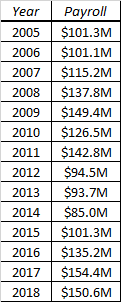
Wilpon kept spending largely consistent during the early days of his sole ownership, but payroll jumped in a big way to fuel the successful teams of the late 2000s. As that roster aged and faded, the payroll dipped substantially, including a massive one-year drop of nearly $50 million before the 2012 season. Payroll largely stagnated until a return to significant spending in the 2016 season as the Mets attempted to return to the World Series, followed by another jump before the 2017 year.
The Mets paid a $1.1 million luxury tax bill for the 1999 season under the previous tax regime, but that was the only year in club history during which they’ve incurred the tax. They came in narrowly under the threshold in 2003 by less than $1 million, but they haven’t come particularly close to the tax line over the past 15 seasons. The club has regularly played in the international amateur space, though they’re not known for the type of boundary-pushing spending that teams like the Yankees, Red Sox, Dodgers, and Cubs have employed.
Future Liabilities
Mets spending in 2019 is set to take a new leap, setting a new franchise high by a solid margin. Unsurprisingly, a bevy of guaranteed deals lead the way.
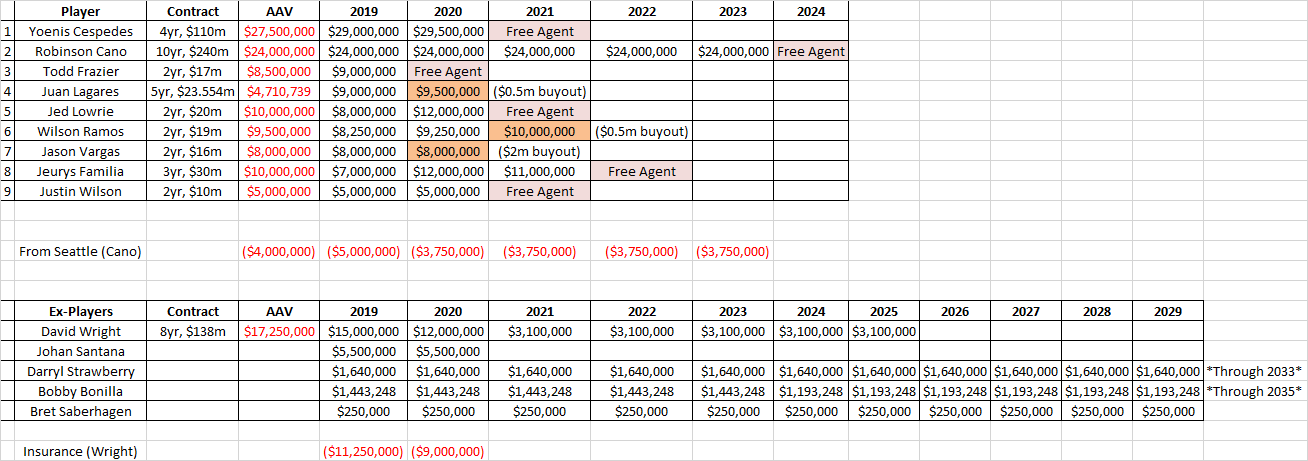
Despite some huge numbers for Cespedes and Cano, the club is far from hamstrung by its current deals as there is very little money committed beyond the 2020 season.
Speaking of Cespedes, he provides unquestioned offensive firepower…when he’s on the field. Since being acquired by the Mets at the 2015 trade deadline, signing a new deal with the club before the 2016 season, opting out, and securing a long-term deal covering the 2017-20 years, Cespedes has blasted his way to a powerful .282/.346/.543 batting line. However, Cespedes has seen his games played dwindle each year, tumbling from 159 in 2015 to 132 in 2016, 81 in 2017, and finally just 38 last season. The front office has given repeated indications that any contribution from Cespedes in 2019 will be gravy given his lengthy recovery timeline following heel surgery.
While Cespedes has struggled to stay on the field, new Met Cano has been a picture of consistency, playing at least 156 games each year from 2007-16 before dipping all the way to 150 games in 2017. However, Cano was slapped with an 80-game suspension last year after a test revealed the presence of a diuretic in his system before undergoing arthroscopic knee surgery in December. It’s likely Van Wagenen’s tenure will be defined in large part by how Cano performs in his new (old) city. Regardless, from a purely financial standpoint, Cano represents a fairly safe risk: whenever he plays, he has been remarkably productive and if he fails another drug test, Cano will be suspended for an entire season without pay. It’s also worth noting that the Mariners are subsidizing Cano’s deal both by sending cash to the Mets annually and by absorbing the remaining amounts due to Jay Bruce and Anthony Swarzak. It should be noted that the most sought-after player in the Cano deal was reliever Edwin Diaz, who fell 13 days short of Super Two status for 2019 and will therefore earn just $570,800 in his first year with the Mets.
Among the guaranteed deals for current players, longtime Met Juan Lagares is the sole remaining holdover who spent a significant chunk of time under the Alderson regime. Lagares plays a mean center field and runs well, but his bat never developed, so it figures that the Mets will pay his 2020 salary and wish him well nine months from now.
The remaining players are all middle class veterans on short-term deals. Frazier and Vargas both enter their walk years while Van Wagenen filled out the remainder of his roster by throwing modest sums of cash at solid, unspectacular veterans. Lowrie enters off of a stellar year but turns 35 shortly after Opening Day. Ramos, Familia, and Wilson each enjoyed success in 2018 and prior years, though each comes with a recent red flag: a knee injury for Ramos, a domestic violence suspension for Familia, and a nightmarish loss of command in recent years for Wilson.
Finally, we get to the payments to ex-players, and holy smokes, what a walk down memory lane this is. Wright has two years remaining on his eight-year contract, though insurance figures to pay about 75 percent of his guaranteed money, after which the team owes him $3.1 million annually through 2025. Santana’s deferred money carries just two years into the future.
But Strawberry, Bonilla, and Saberhagen? They basically define the risk of long-term deferrals. The team will spend over $3 million on that trio through the 2020s while owing nearly $2.8 million to the Strawberry-Bonilla duo for additional years. It’s true that those dollar figures aren’t astronomical when considering team budgets, but $3 million represents an annual flier on someone like Shelby Miller or a modest bullpen upgrade like Shawn Kelley. Instead, the Mets will continue to spend that cash on players through their 60s. Yikes.
Turning to the arbitration ranks, the Mets feature their best talent:
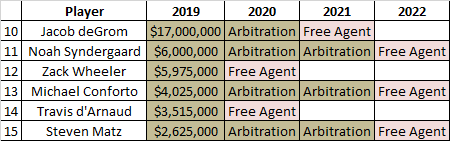
deGrom and Syndergaard are arguably the team’s two best players. Wheeler finally recovered from a slew of injuries to realize his promise as a strong rotation cog, and Matz still carries plenty of promise to do the same. Conforto played at an All-Star level in 2017 before slipping to be a merely plus regular in 2018; he just turned 25. Only d’Arnaud figures to play a less than prominent role as his sterling 2015 becomes a thing of distant past more so than a predictor of future stardom. Nevertheless, the arbitration table carries much of the intrigue for the Mets in 2019 and beyond.
What Does Team Leadership Have to Say?
Wilpon didn’t offer much insight as to what team spending would look like early on in the offseason, stating only that “Brodie knows what the parameters of what the payroll is and what we’re planning to do.”
Accordingly, this pushes us toward Van Wagenen for insight on the team’s expected spending…which also yields no useful information. Back in November, the general manager stated that the club was “open for sure to moving money off the roster” but “willing to add money as well” before deferring more specific questions to ownership.
It seems that franchise leadership has no interest in making their spending plans public knowledge. For competitive advantage purposes, I can’t say I blame them.
Are the Mets a Player for Bryce Harper or Manny Machado?
Probably not. They haven’t been mentioned as one of the clubs seeking a sit-down opportunity with either mid-20s star and that speaks volumes, especially now that we’ve reached February.
Furthermore, following his expensive forays into the marketplace to acquire Cano and Familia, sources indicated that Van Wagenen would be focusing his efforts on an outfield bat, rotation depth, or a lefty reliever, not exactly an indication that Harper or Machado would be meeting with Mets brain trust in the near future.
Still, it can’t be ignored that Mets play in a major metropolitan area and feature a fan base that supported attendance totals regularly in excess of three million annually, even eclipsing four million fans in 2008. They exceeded 2.6 million fans only twice since then. If ownership and the business operations folks believe that a contending Mets team can draw at least 3.1 million fans like they did each year from 2006-09, that extra revenue could surely support another marquee addition, though doing so would push the team into taxpayer status depending on how Wright’s insurance coverage is factored. They currently have a tax payroll of approximately $186.5 million, meaning they can only afford a $20 million addition before exceeding the tax line.
For now, assume that the Mets are out on both players while holding a tiny glimmer of possibility in the back of your mind. While you hold onto that thought, consider this idle, baseless speculation: in addition to Wright’s, Cespedes’ contract is insured as well, though the Mets were hazy on the specifics. If they truly think that he’ll be unable to play at all in 2019 and the policy covers roughly 75 percent of his salary after a disability period is reached, the club may recover something north of $10 million on the policy. The prospect of another big expenditure starts to look eminently more reasonable.
What Will the 2019 Payroll Be?
Well, it’ll be a new team record, that’s for sure. But just how high will it go?
Currently, team payroll comes in at $159.5 million including the substantial payments of deferred money. The luxury tax won’t be a factor unless the team adds $20 million or more to current payroll, so this number is a good approximation.
How much room is there for additional expenditures? It seems reasonable to assume that Van Wagenen took the job with the understanding that payroll would increase by some amount, even if that amount is more in the five-to-ten percent neighborhood than something more substantial. A ten percent increase fits the bill as the club seeks to contend in their final years of depressed-cost control over deGrom and Syndergaard. But don’t be stunned if the percentage increase is more like fifteen or twenty in the end. For now, we’ll estimate at the low number.
Projected 2019 Payroll: $165 million
Projected 2019 Payroll Space: $5.5 million
AL East Notes: Orioles, Sanchez, Farquhar, Pham
Cuban shortstop Yolbert Sanchez will formally be eligible to sign with teams beginning tomorrow, and Joe Trezza of MLB.com looks at the Orioles‘ chances of signing the soon-to-be 22-year-old. While Baltimore’s level of interest in Sanchez isn’t fully clear to this point, they still have to be considered the favorite to add Sanchez given that their near-$6MM international pool is more than four times larger than the next-largest pool: the Dodgers’ $1.4MM. Trezza spoke to one non-Orioles exec who likened Sanchez to a second- or third-round pick in terms of overall talent, given his limited offensive potential but quality glove and speed. Still, while he may not be an elite prospect, Sanchez looks like the best international talent on the board at the moment, and the O’s have the spending capacity to trounce any offer made during the current signing period. Sanchez could, alternatively, wait until July 2 to sign, which would open the field up considerably.
Elsewhere in the division…
- Right-hander Danny Farquhar discussed his remarkable comeback in an appearance on MLB Network Radio on SiriusXM (Twitter link, with audio). Farquhar, who recently inked a minor league contract with the Yankees, was fighting for his life 10 months ago after suffering a brain aneurysm in the White Sox’ dugout. Soon to turn 32, Farquhar acknowledged that he’s lucky to be alive but also put a positive spin on his harrowing medical status, noting that in the time since recovering, he’s been able to dedicate himself solely to training. While this time of year brings about frequent “best shape of his life” stories, Farquhar’s is certainly of more note than most others given a recent near-death experience. While the Yankees’ bullpen will be a tough one to crack, Farquhar can either head to Triple-A as a depth option if he doesn’t make the roster or, potentially, attract the interest of another team with a strong spring showing for the Yankees.
- Outfielder Tommy Pham‘s arbitration hearing with the Rays is set to take place today, tweets MLB Network’s Jon Heyman. Pham logged a ridiculous .333/.448/.622 slash with seven homers, seven doubles and six triples in 174 plate appearances with Tampa Bay following last summer’s trade from the Cardinals organization. He’d struggled previously in St. Louis, though his combined .275/.367/.464 slash between the two teams was still quite strong. Pham filed for a $4.1MM salary, while the Rays countered at $3.5MM — as can be seen in MLBTR’s 2019 Arbitration Tracker.
Minor MLB Transactions: 2/3/19
Rounding up the latest in minor moves from around the game . . .
- The Braves have reportedly agreed to a minor league deal with veteran reliever Ben Rowen. Rowen, an extreme submariner, is the owner of a rare high-grounder, low-walk profile, and has turned in a number of impressive seasons at the AAA level. The 30-year-old’s last big-league appearance came in 2016 with Milwaukee, for whom he made three late-season appearances. The Virginia Tech-product debut also threw 8 innings for the 2014 Rangers, but has mostly made his way around the International and Pacific Coast Leagues over the last six seasons. In 245 career innings at the Triple-A level, the 6’4 righty has pitched to a stellar 3.08 ERA, allowing just 0.44 homers per nine. He figures to be a candidate for the Peter Moylan role at the front end of the Atlanta bullpen, and should make a nifty righty specialist if the club can spare the roster space.
Poll: Marwin Gonzalez’s Payday
29-year-old Marwin Gonzalez – he’ll be 30 by Opening Day – entered the offseason primed to a secure healthy payday from one of perhaps two dozen interested suitors around the league. Armed with gloves to play six positions, an incredibly goofy nickname christened by superagent Scott Boras, and the whiff of 2017’s 4.0 fWAR breakout still detectable to the sharpest of senses, Gonzalez’s camp has touted the longtime Astro as the right-sized plug to fill almost any hole.
But the market surrounding the Venezuelan-born infielder/outfielder, to this point in the offseason, has been exceedingly quiet – muzzled, even. The Braves, Padres, and Astros have all been connected to Gonzalez at various hot-stove junctures, though none seem particularly aggressive. Other teams, like the oft-linked Brewers and Cubs, or the MLBTR-projected Twins, seem to have no interest at all. Is the tepidity a product of an exorbitant Boras ask, or are teams just not nearly as enamored with “Swiss G” as originally surmised?
Gonzalez, who scuffled through seven minor league seasons before his 2012 debut with the Astros, has turned in a number of solid-to-good offensive seasons in the majors, posting above-league-average marks in four of the last five. His overhauled approach – more walks, fewer balls on the ground – has paid dividends as well, with the aforementioned 2017 breakout (.303/.377/.530) his career high-water mark. While not a multi-positional defensive wizard like Ben Zobrist, Gonzalez has acquitted himself well all across the diamond, and could conceivably be a full-time fit at second base, third, or in the corner outfield.
Still, one can’t exactly use a pen when projecting Gonzalez’s forthcoming production. The best utility men are at least competent at shortstop, and Gonzalez, who’s nearing the age at which range, in both the infield and outfield, declines precipitously, has been dreadful there. The track record, too, is a little light, and Steamer, arguably the standard in baseball’s forecasting industry, projects the utility man to post just 1.3 WAR this season (the number is closer to two when assuming full-time play).
In the free agent freeze of the last two offseasons, it’s the mid-tier player who’s been hurt the worst. Always reluctant to dish out the long term deal, teams now balk at even short-term ones for players whose production can safely be approximated by much cheaper, in-system options. Houston’s Tony Kemp, while probably not an option at shortstop, would seem to fit this bill, as would a number of others on suspected Gonzalez suitors around the league.
How Much Guaranteed Money Will Marwin Gonzalez Earn On His Next Deal?
-
$11MM-20MM 39% (6,199)
-
$1MM-10MM 26% (4,152)
-
$21MM-30MM 24% (3,875)
-
$31MM-40MM 8% (1,260)
-
$41MM+ 3% (464)
Total votes: 15,950
Astros Avoid Arbitration With Chris Devenski
The Astros and reliever Chris Devenski have settled on a $1.525MM salary for the 2019 season, reports Ken Rosenthal of The Athletic. Per Rosenthal, the deal also includes a club option for $2.625MM in 2020, which can increase to $2.725MM if the righty appears in 50 or more games in 2019. The salary will increase to $2.825MM if he appears in 60 games, and $2.925MM if Devenski, represented by MVP Sports Group, makes 68 appearances.
Devenski had originally asked for $1.65MM in his first arbitration-eligible season, with the club filing at $1.4MM.
The 28-year-old Devenski broke out in 2016, posting an absurdly high (for a reliever) 2.8 fWAR in just 48 appearances. His once-dominant changeup, though, has become far more hittable of late – AL hitters teed off on the righty last season, smashing nine homers in just 47.1 IP and making hard contact nearly 34% of the time. Devenski did continue to strike batters out, whiffing 9.7 men per nine after a career high of 11.6 K/9 in 2017.
He’ll likely fill a long role in a deep Astro bullpen that includes stalwarts Roberto Osuna, Ryan Pressly, Hector Rondon, and Will Harris, with the Houston analytic team surely on the prowl for ways in which the unorthodox righty can keep more balls on the ground.
MLBTR Originals
Rounding up the latest in original content from the MLBTR staff . . .
- Jeff Todd wrote in fascinating detail about the curiously team-friendly Whit Merrifield extension.
- Colorado’s Kyle Freeland turned in one of 2018’s most polarizing statistical outputs, notching 8.4 rWAR despite middling peripherals, even when adjusting for park (his 104 xFIP- checked in below the 100 league-average mark). Our Tim Dierkes took a closer look at potential extension figures for the 26-year-old lefty.
- The Red Sox have straddled the top bracket of the luxury tax for the offseason’s entirety, reluctant to eclipse the $246MM threshold and pay the hefty 75% tax for offenders. But couldn’t their shaky bullpen – arguably the defending champs’ only weakness – use a major upgrade? Steve Adams explored the situation and its many nuances on Friday.
- Connor Byrne’s piece on the worst bullpens of ’18 includes three teams with serious playoff aspirations in the upcoming campaign. Connor also took a peek at Nolan Arenado’s future in Colorado, where a major payday could severely hinder the team’s financial flexibility in the years to come, and asked readers to project the suddenly-imposing Luke Voit‘s 2019 output. Judging by the early poll returns, most MLBTR readers are not yet converts.
Poll: Projecting Luke Voit’s 2019
Among major leaguers who finished with at least 150 plate appearances in 2018, future Hall of Famer Mike Trout unsurprisingly led the way in wRC+ (191). But who finished second? Was it AL MVP Mookie Betts, NL MVP Christian Yelich or another big-name superstar? No, it was Luke Voit, who put up a 187 wRC+ in 161 PAs divided between the Cardinals and Yankees. Voit took a mere 13 trips to the plate until late July, when New York acquired him from St. Louis for a pair of relievers, and then proceeded to give the first baseman-needy Yankees an answer at the position over the final couple months of the season.
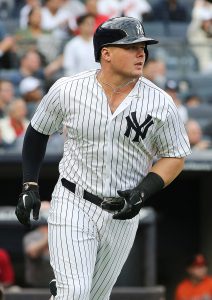
During his first 148 PAs as a Yankee, the burly, boisterous Voit batted a video game-like .322/.398/.671 with a Ruthian ISO (.350) and 15 home runs. And Statcast backed up Voit’s production, ranking the soon-to-be 28-year-old first in barrels per plate appearance and expected weighted on-base average (.437) among those who racked up at least 150 PAs on the season. While Voit benefited from a .365 batting average on balls in play, a number he may not approach again, the Yankees are understandably optimistic he’s good enough to serve as their No. 1 option at first going forward.
This has been an active offseason in the infield for New York, which has signed DJ LeMahieu and Troy Tulowitzki while showing interest in Manny Machado, but the team has been quiet at first base. Despite Voit’s limited track record, the right-handed slugger’s incredible showing toward the end of 2018 has made him the odds-on favorite to start at first in 2019 for the Yankees, whose previous long-term hope, the lefty-swinging Greg Bird, has fallen short of expectations because of a spate of injuries and less-than-stellar overall production. The Yankees have been bullish on Bird, but he missed all of 2016 because of a shoulder injury, and then produced very little from 2017-18 while dealing with foot problems. His horrific 2018 campaign made it necessary for the World Series-contending Yankees to address first, where they ultimately chose to turn to Voit over the summer.
While it’s still too soon to give up on the 26-year-old Bird, he may not receive regular playing time with the Yankees again unless Voit falls flat. Although Bird was a much better prospect than Voit during their younger days, there’s no doubt the latter has been the superior major leaguer to this point. Consequently, as the Yankees prepare for a championship push, they’ll continue with Voit at first, undoubtedly hoping last season wasn’t a mirage and they’ve acquired a star-caliber hitter for next to nothing.
The Steamer projection system doesn’t expect the 2019 version of Voit to serve as an offensive force, though, as it predicts he’ll wind up with an above-average but hardly world-beating .262/.335/.458 line. That would make for a .793 OPS, far better than what Yankees first basemen managed from 2016-18 but also much less impressive than the production Voit offered during his abbreviated showing last season. Now that he’s the Yankees’ preferred choice at first, how do you expect Voit to perform in 2019?
(link for app users)
Predict Luke Voit's 2019 OPS
-
.800-.850 33% (4,599)
-
.751-.799 33% (4,595)
-
.750 Or Below 18% (2,591)
-
.851-.899 10% (1,381)
-
.900 Or Better 6% (883)
Total votes: 14,049
Photo courtesy of USA Today Sports Images.
Latest On J.T. Realmuto
SUNDAY: The Rays “appear content” with their current lineup, according to the Tampa Bay Times’ Marc Topkin, who adds it would be “unexpected” for the club to make any more trades with spring training nearing. That seems to cast doubt on the possibility of the Rays acquiring Realmuto.
SATURDAY: Twists and turns continue in the saga of Marlins catcher J.T. Realmuto, who has been a dominant presence in trade rumors throughout the offseason. As of Thursday, the Padres, Reds, Dodgers and Braves were reportedly the last remaining suitors for Realmuto, but the Rays have worked their way back into the mix, according to Joe Frisaro of MLB.com. While it seemed earlier this week that Tampa Bay had exited the race for Realmuto, the club has “re-engaged” as spring training nears, per Frisaro.
Fresh off a surprising 90-win season in 2018, the Rays entered the winter as candidates to make noteworthy upgrades, despite their low-payroll ways, but have mostly shied away from headline-grabbing moves. The Rays’ biggest pickup thus far has been right-hander Charlie Morton, whom they inked to a two-year, $30MM contract, and they’ve also reeled in the less expensive trio of catcher Mike Zunino (via trade with Seattle), infielder Yandy Diaz (via trade with Cleveland) and outfielder Avisail Garcia (one year, $3.5MM guarantee). With those four in tow, the Rays are only projected to open the season with a $59MM-plus payroll – far below their $76MM-plus mark from 2018 – as Jason Martinez of Roster Resource estimates.
Fortunately for the small-spending Rays, acquiring Realmuto would not cause a sizable dent in their budget. He’ll earn $5.9MM this year, his second-last arbitration season, and that relatively inexpensive sum only increases his appeal from their standpoint. At the same time, it also helps explain why the Marlins have been holding out for a bounty for the soon-to-be 28-year-old Realmuto, who was the majors’ top catcher last season. And the Rays, whose farm system features nine of ESPN’s Keith Law’s top-100 prospects (subscription required), likely have the ammunition to get a deal done if they’re motivated.
However, should the Rays land Realmuto, it’s an open question whether Zunino would remain in place. Tampa Bay could simply keep Zunino as Realmuto’s backup, thus giving it the game’s best behind-the-plate tandem, but the former may once again become a trade chip in his own right. With a quality track record, two years of arbitration eligibility remaining and a sub-$4.5MM salary for 2019, Zunino could bring back a player(s) capable of helping the Rays’ roster at another position. Zunino has already netted a solid return in a trade once this offseason, as the Rays acquired him in a five-player deal in which they parted with a cheap, starting-caliber outfielder in Mallex Smith.
The Marlins, meanwhile, may receive a Realmuto replacement as part of a trade, which could make Zunino an attractive target for them. While that’s merely speculation, they have discussed veteran backstop Tucker Barnhart in trade talks with the Reds, Jonathan Mayo of MLB.com tweets. Additionally, a potential deal with Cincinnati could include 22-year-old third baseman Jonathan India (previously reported) – whom the Reds selected fifth overall in last summer’s draft – as well as at least one “lesser” prospect, Mayo relays. Acquiring Realmuto would be the latest sign that Cincinnati’s aiming to return to contention in 2019. The Reds are currently coming off their fifth straight sub-.500 season and fourth straight campaign with fewer than 70 wins, but they’ve since picked up a slew of household names in various trades.
Like the Reds, the Padres seem hopeful they’ll put several years of irrelevance behind them during the upcoming season. Although the Padres haven’t made any significant improvements yet, they’ve been connected to Realmuto and other stars in the rumor mill. Trading for Realmuto would surely take a bite out of the Padres’ loaded farm system – a unit which includes a whopping 10 top-100 prospects, per Law; subscription required). Jon Morosi of MLB.com reported last week that the Marlins wanted big-hitting catcher prospect Francisco Mejia from the Padres in exchange for Realmuto, but it doesn’t seem that’s the case anymore. At this point, Miami’s interest in Mejia isn’t “especially high,” according to Morosi, Therefore, it’s “likely” that the Marlins would instead need one of Fernando Tatis Jr., MacKenzie Gore or Luis Urias from the Padres in a Realmuto package, Morosi writes. Tatis, Gore and Urias rank first, second and fourth among the Padres’ prospects at MLB.com, which places Mejia third.
It’s currently anyone’s guess which uniform Realmuto will don in 2019, but it seems we’ll find out in the coming days. The Marlins are within two weeks of opening camp, and it’s unlikely Realmuto will still be on their roster at that point, Frisaro suggests.
Checking In On The Worst Bullpens Of 2018
The importance of having a dominant bullpen was on display in 2018, when four of the majors’ five best relief units in terms of fWAR helped pitch their teams to the postseason. On the other hand, four of the league’s five worst relief corps (and nine of the game’s bottom 10) watched the playoffs from home. So now, with the spring fast approaching, where do last year’s bottom-feeding bullpens stand? As you’ll see below, at least one has made major improvements this winter, but the rest look iffier. While there’s still time for these teams to add help from a free-agent class that remains awash with veterans, this quintet’s bullpen-related heavy lifting may be all but complete for the offseason.
Royals (minus-2.2 fWAR; projected season-opening bullpen via Jason Martinez of Roster Resource ): Going by fWAR, the Royals’ 2018 bullpen was among the five worst of the past decade, though the unit “only” posted the majors’ second-highest ERA (5.09) a year ago. Those hideous numbers came in spite of the presence of Kelvin Herrera, who logged a near-spotless 1.05 ERA over 25 2/3 innings before the Royals traded the then-pending free agent to the Nationals in June. They also came thanks in large part to Brandon Maurer, who’s now a Pirate after pitching to a ghastly 7.76 ERA/6.58 FIP in 31 1/3 innings out of Kansas City’s bullpen last season.
Heading into the upcoming campaign, there’s a lot of work to be done to turn this Herrera-less group into a strength, but the Royals haven’t addressed it in any major way this offseason. However, considering they’re coming off a 58-win season and also won’t approach contention in 2019, it’s not surprising the Royals have shied away from major league free agency. They’ve instead taken less expensive routes to acquire potential bullpen pieces, having pulled in Michael Ynoa on a minor league deal, Sam McWilliams and Chris Ellis in the Rule 5 Draft and Conner Greene via waivers. Unfortunately, going by ZIPS projections, no one from that quartet looks like a promising bet to produce much in 2019. Likewise, ZIPS doesn’t have particularly high hopes for the majority of the Royals’ bullpen holdovers from 2018. The system does, however, like 23-year-old left-hander Richard Lovelady – who has turned in excellent minor league numbers but hasn’t yet reached the majors.
Marlins (minus-2.1 fWAR; projected season-opening bullpen): At 5.34, the Marlins’ relief corps managed the game’s worst ERA last year and the sport’s third-highest mark since 2009. The main culprits were Ben Meyer, Junichi Tazawa and Tyler Cloyd, who combined for 56 2/3 innings and each registered an ERA of at least 8.68. Tazawa and Cloyd are now out of the organization. Meyer, meanwhile, is still around, but he’s not even on Miami’s 40-man roster. But neither is righty Nick Wittgren, who led Marlins relievers in ERA (2.94) and FIP (3.13) in 33 2/3 frames last year. The Marlins made the odd choice to designate the 27-year-old Wittgren for assignment earlier this week to make room for the signing of infielder Neil Walker, who’s six years Wittgren’s senior and only under control for one season. Other notable contributors no longer in the mix include Kyle Barraclough (who nosedived in 2018 and was dealt to the Nationals in October), Brad Ziegler (Miami traded him to Arizona last July, and he has since retired) and Javy Guerra (now a Blue Jay after putting up a 5.55 ERA in 2018).
The best returning pieces in Miami’s bullpen look to be Drew Steckenrider and Adam Conley, who each registered solid seasons in 2018. Otherwise, it’s a largely unproven cast – one that hasn’t picked up any major league free agents and seems likely to once again record below-average numbers this year. As with the Royals, the Marlins are rebuilding, so they’ve explored alternative paths for help. Thus far, they’ve acquired Nick Anderson (via trade with the Twins), Tyler Stevens (via trade with the Angels), minor league free agents R.J. Alvarez and Brian Moran, Rule 5 selection Riley Ferrell, and intriguing waiver claim Julian Fernandez.
Mets (minus-0.6 fWAR; projected season-opening bullpen): Unlike the Royals and Marlins, the Mets are making a real effort to win in 2019. As a result, the bullpen has been a key area of focus for new Mets general manager Brodie Van Wagenen, who has swung a blockbuster trade to reel in arguably the best closer in baseball (ex-Mariner Edwin Diaz) and spent a combined $40MM on free agents Jeurys Familia and Justin Wilson this winter. Diaz, Familia and Wilson will join Seth Lugo, who was outstanding in 2018, and Robert Gsellman to give the Mets no fewer than five capable relievers.
Perhaps the Mets will also benefit from less heralded pickups in Luis Avilan and Arquimedes Caminero, whom they signed to minors deals, and Rule 5 pick Kyle Dowdy. Regardless, New York’s new cast of relievers looks a whole lot better than last year’s bullpen, which relied too much on the likes of Paul Sewald, Jerry Blevins, Jacob Rhame, Tim Peterson and Anthony Swarzak, among other ineffective options, en route to a 4.96 ERA. Sewald, Rhame and Peterson are still in the organization, albeit as depth pieces, while Blevins and Swarzak are now gone. All things considered, ZIPS expects the Mets’ revamped bullpen to end up as one of the majors’ best in 2019.
Indians (plus-0.4 fWAR; projected season-opening bullpen): Cleveland found its way to another division title in 2018 despite its weak bullpen, which limped to a 4.60 ERA as innings leaders Cody Allen, Dan Otero, Zach McAllister, Neil Ramirez and Andrew Miller scuffled. Allen, McAllister and Miller are now gone, leaving the Indians with a bullpen that, in spite of the great Brad Hand‘s presence, still looks somewhat questionable. The club did well to re-up lefty Oliver Perez, whose 2018 renaissance earned him a guaranteed deal last month, though he’s the only major league free agent Cleveland has signed. The team also made a waiver claim for A.J. Cole, whose penchant for surrendering home runs led both the Nationals and Yankees to give up on him in the past eight months, and brought in veterans Justin Grimm and Brooks Pounders on minor league accords. Big league success has eluded Grimm and Pounders over the past couple years, however, so the Indians surely aren’t expecting significant contributions from either. Instead, their relief corps will count on returning Indians – potentially including flamethrower Danny Salazar, a starter from 2013-17 who missed all of last season because of shoulder problems. While Salazar could factor in at some point, it won’t be at the start of the season.
Nationals (plus-0.4 fWAR; projected season-opening bullpen): Washington, another prospective contender, has made a couple of interesting bullpen moves this offseason after last year’s underwhelming showing. In addition to trading for the hard-throwing Barraclough, who held his own from 2015-17, they inked fellow high-velocity righty Trevor Rosenthal to a $7MM guarantee in free agency. Rosenthal, 28, sat out all of last season while recovering from Tommy John surgery, but the former Cardinals closer was mostly tremendous out of their bullpen from 2012-17.
Should a healthy Rosenthal return to form, it would be an enormous boon for the Nationals, who saw a different ex-Cards reliever – Greg Holland – experience a rebirth in their uniform last season. But after logging a microscopic 0.84 ERA in 21 1/3 innings in D.C., Holland joined the Diamondbacks in free agency. The Holland-less Nats are now slated to rely mostly on elite but oft-injured closer Sean Doolittle, Barraclough, Rosenthal, Justin Miller, Koda Glover, Sammy Solis and Matt Grace, with Tanner Rainey (acquired from the Reds for Tanner Roark) and minor league signings Vidal Nuno and J.J. Hoover around as depth. All said, it’s a high-risk, high-reward bunch, given the injuries Doolittle and Rosenthal have dealt with and the up-and-down performances of Barraclough, Miller, Glover, Solis and Grace.
Cubs Sign Christian Bergman
The Cubs have signed right-handed swingman Christian Bergman to a minor league contract, according to Matt Eddy of Baseball America.
The 30-year-old Bergman was a member of the Mariners over the previous two seasons, though he spent the majority of that period with their Triple-A affiliate. Bergman pitched to a 5.00-plus ERA in both the 2017 and ’18 seasons in Tacoma, where he combined for 227 2/3 innings and 42 appearances (41 starts). Overall, Bergman – who’s also a former Rockie – owns a 4.66 ERA with 6.6 K/9 and 2.1 BB/9 in 376 2/3 frames at the minors’ highest level.
While Bergman has seen major league action in each season dating back to his 2014 debut, he had difficulty preventing runs in all five of those campaigns. In 215 2/3 innings, 14 of which came in 2018, the soft-tossing Bergman has managed just a 5.59 ERA/5.09 FIP with 5.43 K/9, 2.04 BB/9 and a 37.1 percent groundball rate.