
Starting Pitching Rumors: Cardinals, Castillo, Mariners, AL Central
The Cardinals are “intent on upgrading the rotation, not just spackling it,” Derrick Goold of the St. Louis Post-Dispatch reports in a comprehensive look at the team’s potential deadline trajectories. While past deadline trades have often brought stopgaps options to St. Louis (e.g. Jon Lester and J.A. Happ just last year), the Cardinals could aim a bit higher this time around. Athletics right-hander Frankie Montas and Marlins righty Pablo Lopez are among the starters in whom the Cards have expressed interest, per the report. Goold also lists Angels right-hander Noah Syndergaard as a name of interest, and there are surely others the Cardinals are considering as they look to offset injuries to Jack Flaherty, Steven Matz, Alex Reyes and Dakota Hudson (who has struggled even when healthy this season).
St. Louis has upwards of $155MM already on the books for the current season, though that number will dip to around $90MM for the 2023 campaign (not including several notable arbitration raises). The Cardinals are still nearly $10MM shy of their record Opening Day payroll ($164MM), and they’ve gone a bit further than that with some midseason acquisitions in recent years, so there should still be payroll space to accommodate players making substantial salaries. They also have one of the game’s deepest farm systems, allowing them to bid competitively for the market’s top arms.
Some more notes on the trade market for starters…
- The Mariners are looking for rotation help, and Ken Rosenthal reports in his latest appearance with FOX Sports that Reds ace Luis Castillo “seems to be their main focus and target” at this juncture (Twitter link, with video). Seattle’s top four starters — Logan Gilbert, Robbie Ray, Marco Gonzales and Chris Flexen — have made at least 19 starts, and they’ve received good results from top prospect George Kirby since plugging him into the rotation (3.50 ERA through 13 starts). However, Kirby is at 96 innings between the minors and big leagues combined, which is already a notable jump from last year’s total of 67 2/3 innings. Gilbert’s 123 innings effectively match last year’s total of 124 1/3 frames. Beyond that, the Mariners probably can’t expect to avoid any notable injuries on the starting staff all season — few teams can — so there’s good sense in adding another arm to support the group. In Castillo’s case, he’d of course slot right in alongside Gilbert and Ray into a playoff rotation and give the M’s an excellent trio upon which to lean both this season and next.
- For all the teams seeking pitching help, however, it’s the trio of AL Central front-runners that are the most aggressive at the moment, Mark Feinsand of MLB.com tweets. The Twins, Guardians and White Sox are all looking to bolster their pitching staffs (rotation and/or bullpen help alike). The American League Central is the one division in the sport where there are three legitimate contenders for the division crown at the moment, and both Cleveland and Chicago (who currently trail Minnesota) are within 3.5 games of a Wild Card berth as well. There’s been prior speculation (here included) about the White Sox potentially going another direction, but they’ve been playing some of their best ball of the season this month and have thusly not had any discussions about the possibility of trading away veteran arms like Lance Lynn and Lucas Giolito, MLB.com’s Jon Morosi tweets.
- As for the Twins, 1500 SKOR North’s Darren Wolfson suggested in yesterday’s podcast that Reds right-hander Tyler Mahle could be the likeliest name to land in Minnesota by Tuesday’s deadline, though the Twins are casting a wide net as they seek both rotation and bullpen help. Minnesota has also spoken to the Marlins about righty Pablo Lopez, Wolfson added.
Twins Rumors: Mahle, Castillo, Marlins, Coulombe, Winder, Catcher
The Twins currently hold a 2.5-game lead in the American League Central, but another poor performance from a pitching staff that has squandered far too many leads this season cost them a win over the Brewers last night. Upgrading the pitching staff will be a priority for the Twins before next Tuesday’s deadline, and to that end, they’ve been in the market on both Reds ace Luis Castillo and Athletics top starter Frankie Montas, per ESPN’s Jeff Passan.
The Athletic’s Dan Hayes, however, writes that the Twins are more interested in Castillo’s teammate Tyler Mahle than in Castillo himself. Hayes adds that the Twins have been in talks with the Marlins about pitching help. Minnesota and Miami, it should be noted, have had talks regarding potential swaps sending pitching to Minnesota frequently in offseasons past. The Marlins are reportedly open to offers on Pablo Lopez, and reliever Anthony Bass, Dylan Floro and Steven Okert are a few speculative trade candidates in the Marlins’ bullpen. Generally speaking, the Marlins are deep in pitching options that’ll appeal not only to the Twins but other clubs seeking upgrades.
Whether the preference for Mahle over Castillo — which Hayes also indicated back in the offseason — is a reflection of asking price or of the Twins’ belief that he has the superior raw stuff isn’t clear. But Mahle has flown somewhat under the radar for the past few seasons despite being quite similar, statistically, to both Castillo and Montas since 2020.
It’s hard not to wonder just what Mahle’s performance might look like in another uniform, as his numbers away from the homer-happy Great American Ball Park are tantalizing. Few pitchers have such a dramatic home/road split as Mahle, who since 2020 has pitched to a 2.93 ERA on the road but an ugly 4.89 mark at home. Mahle has allowed 1.75 homers per nine innings pitched in Cincinnati, compared to just 0.52 long balls per nine on the road. He also has a better strikeout rate and opponents’ hard-hit rate than either Castillo or Montas, dating back to 2020 — albeit with the highest walk rate of the three.
Broadly speaking, Mahle is much closer to the Montas/Castillo tier of pitcher than most pundits credit him. And, with a $5.2MM salary compared to Castillo’s $7.35MM mark, he’s a bit more affordable than his teammate and right in line with Montas ($5MM). Like that duo, he’s controlled through the 2023 season.
Mahle got out to an awful start in 2022, pitching to a 6.32 ERA through his first ten appearances. However, most of the damage against him came in two brutal outings — eight runs versus the Cubs on May 24 and seven runs against the Dodgers on April 17 — and he’s been excellent over the past two months. Dating back to May 29, Mahle has a 2.81 ERA, 27.5% strikeout rate and 7.7% walk rate in 51 1/3 innings. Overall, he’s sitting on a 4.48 ERA this season, but marks like xERA (3.30) and FIP (3.78) feel he’s been quite a bit better than that. A minor shoulder strain sent him to the IL earlier this month, but Mahle returned Sunday to fire six quality innings.
Regardless of the specific names they acquire, the Twins seem nearly certain to augment both their rotation and their bullpen in the next six days. Jhoan Duran and Griffin Jax have been their only two consistently reliable arms, and their ‘pen depth took a further hit yesterday when left-hander Danny Coulombe was transferred to the 60-day injured list. The Twins announced today that Coulombe required season-ending surgery to repair the labrum in his left hip, subtracting a quietly useful lefty from the mix.
The 32-year-old Coulombe is a journeyman southpaw who found a home in the Twins organization back in 2020. He only made two appearances with the Twins that season but returned on a minor league deal in 2021 and has been solid overall in the Twins’ relief corps. Dating back to 2020, Coulombe has pitched 49 1/3 innings with aa 2.92 ERA, 22% strikeout rate and 9.3% walk rate. He’ll get big league service time while finishing out the year on the 60-day IL, but he’ll be a clear non-tender candidate following that surgery.
Meanwhile, Phil Miller of the Minneapolis Star Tribune tweets that promising young righty Josh Winder, one of the Twins’ brightest arms and currently the game’s No. 68 prospect at Baseball America, is being shut due to recurring shoulder discomfort. The Twins are still trying to determine the cause of the issue, but the loss of Winder, who’s already given them 45 1/3 Major League innings (3.77 ERA) is a huge hit to the Twins’ rotation and bullpen depth.
For all the focus on the Twins’ pitching staff, it’s not their only area of need. Catcher Ryan Jeffers‘ fractured thumb will sideline him for up to eight weeks, which has pushed Gary Sanchez into a starting catcher role with Minnesota. He’d previously been used more evenly between designated hitter and catcher, but Sanchez will now get the lion’s share of playing time behind the plate now. Caleb Hamilton, a 2016 23-round pick who’d never hit much above A-ball prior to this season, is currently serving as his backup.
It’s not terribly surprising, then, that Darren Wolfson of 1500 SKOR North mentions in his latest podcast that the Twins will explore the market for a more veteran backup to Sanchez. Twins fans probably shouldn’t expect to see Willson Contreras riding into town anytime soon, but players like Tucker Barnhart or Pedro Severino jump out as possibly available veteran backups.
Wolfson adds, via Twitter, that outfield prospect Matt Wallner and infield prospect Spencer Steer have been mentioned in trade scenarios the team has had recently — and understandably so. Wallner, the No. 39 overall pick in 2019, recently jumped to Triple-A after posting a .299/.436/.597 batting line (157 wRC+) and 21 homers in 342 plate appearances with the Twins’ Double-A club. Steer, selected just 51 picks after Wallner, is hitting a combined .274/.359/.549 in 78 games between Double-A and Triple-A. He recently just landed in the No. 99 spot on Baseball America’s latest Top 100 prospect ranking. Certainly, neither Wallner nor Steer would be included in a small trade for a backup catcher, but it’s easy to see both being the type of players coveted by teams peddling controllable help in the rotation and bullpen.
Marlins Open To Trade Offers On Pablo Lopez, Looking To Upgrade Offense
The Marlins have stumbled out of the All-Star Break, dropping three of their first five contests against below-.500 teams in the Rangers, Pirates and Reds. Paired with a three-game sweep at the hands of the division-rival Phillies to close out the season’s unofficial first half, Miami has dropped six of eight before tonight’s contest with Cincinnati.
Sitting 45-51 and 5 1/2 games out of the National League’s final Wild Card spot, the Marlins look increasingly unlikely to compete for a postseason berth. That’s particularly true with the news that the club’s best position player, Jazz Chisholm Jr., won’t return until September at the earliest due to a stress fracture in his back. In the face of those mounting odds, general manager Kim Ng and her staff are apparently willing to consider dealing notable players from the major league roster.
Jon Heyman of the New York Post tweeted this afternoon that the Fish are willing to listen to offers on everyone other than ace Sandy Alcantara. It’s hard to imagine Miami trading Chisholm since he’s controllable through 2026 and currently on the injured list, but it seems the bulk of the team could be available. Aside from Alcantara and Chisholm, perhaps no one else on the roster would draw more interest than starter Pablo López. While Miami hasn’t previously shown much appetite for dealing López, Barry Jackson and Craig Mish of the Miami Herald report that the Marlins are now willing to hear offers on the 26-year-old righty. According to Jackson and Mish, the Fish aren’t actively shopping López, but they’re “no longer dismissing calls” from interested teams.
Assuming Ng and her staff are willing to seriously consider offers on López, he’d be one of the top options available for rotation-needy clubs. After missing most of the second half of last season due to a shoulder injury, he’s stayed healthy this year to take 20 starts. López owns a 3.03 ERA with an above-average 25.5% strikeout rate, a stingy 7.6% walk percentage and a solid 47.4% ground-ball rate. It’s the continuation of a few excellent years for the Venezuelan-born hurler, who has posted a sub-4.00 ERA with better than average strikeout and walk rates in each of the past three seasons.
López is only in his first season of arbitration-eligibility. He’s making an affordable $2.45MM salary, around $974K of which is still to be paid before the end of the season. That’s affordable enough for every club, and López comes with an additional two seasons of control before he can hit free agency after the 2024 campaign. He’s both cheaper and under a longer window of control than any of Luis Castillo, Tyler Mahle or Frankie Montas — the three hurlers who have generally been viewed as the top rotation trade candidates on the market.
There’s no need for Ng and her front office to force a deal given that extended window of club control, but they could view this as an opportunity to move him at the peak of his trade value. The Herald writes that the Marlins have not engaged López’s representatives at Excel Sports Management about a possible extension. Miami also has a fair bit of rotation depth and is looking for opportunities to invigorate an offense that carried a meager .238/.302/.376 line into play tonight.
Jackson and Mish write that the Marlins would like to add a left-handed power hitter for the 2023 lineup. Whether that’d come directly in a López deal is unclear — it’s rare for contenders to trade off their big league roster to address another area — but an openness to dealing away one of their top arms while searching for ways to add a controllable hitter suggests Ng and her staff aren’t approaching the deadline as a strict “buyer” or “seller.” Rather, it seems they’ll be one of a handful of teams — the Red Sox, Rangers, Angels and Orioles could be others — approaching the deadline more flexibly, recognizing that competing in 2022 is a longshot while still searching for ways to preemptively add to next year’s roster.
Of course, the rotation depth that could make the Marlins more amenable to parting with López has also been hit hard by injuries. Former top prospect Sixto Sánchez hasn’t thrown a major league pitch in two years. Jesús Luzardo and Edward Cabrera have been on the injured list for months, and rookie Max Meyer joined them over the weekend after leaving the second start of his MLB career with elbow discomfort.
In a worrisome development, Jackson and Mish report that Tommy John surgery could be on the table for Meyer. The team is still awaiting the results of a recent MRI before determining whether surgery will be required, but a UCL reconstruction would likely cost him all of the 2023 season. Miami is certainly hoping the electric 23-year-old will be able to avoid that fate; the club figures to provide an update on the righty’s status in the coming days.
Whether Meyer eventually goes under the knife or not, the injury serves as a reminder that even teams with a seeming surplus of starting pitching can see that depth thinned out rather quickly. Indeed, Miami’s rotation has largely been propelled by excellent seasons from Alcantara and López. 2021 breakout southpaw Trevor Rogers has had a disappointing follow-up campaign, and the back of the rotation has been hit by the aforementioned injuries along with a woeful showing from Elieser Hernández, who found himself demoted to the bullpen.
If Miami follows through on dealing some veterans, López wouldn’t be the only player on the roster to attract interest. MLBTR examined a few of the club’s other possible trade candidates last week. First baseman/designated hitter Garrett Cooper has a season and a half of remaining control and is hitting .279/.347/.426 on the year. He landed on the 10-day injured list due to a right wrist contusion this afternoon, but he indicated he expects to return when first eligible on August 3 (link via Christina De Nicola of MLB.com). He won’t play again before next Tuesday’s trade deadline, but injured players are able to be dealt, and it stands to reason other clubs will look past the injury if Cooper’s likely to return next week.
Brian Anderson and Jon Berti each looked like potential trade candidates, but they’re on the IL themselves. Anderson suffered a shoulder injury over the weekend, while Berti has yet to begin a rehab assignment after hurting his groin a little less than two weeks ago. They seem less likely than Cooper to be dealt given their longer-term recovery timelines.
Miami also has a handful of veteran relievers who could change hands. Right-hander Anthony Bass is controllable next season via $3MM club option, but he should draw interest with a 1.51 ERA through 41 2/3 innings on the year. Southpaws Steven Okert and Tanner Scott have missed plenty of bats and are controllable for multiple seasons beyond 2022, although each has struggled with his control. Richard Bleier is a more stable ground-ball specialist from the left side, while Dylan Floro is a righty with a broadly similar profile as Bleier.
Pre-Break Sweep Raises Questions About Marlins’ Deadline Outlook
With the trade deadline two weeks away, a good portion of the league has a general idea of how they plan to approach things. 16 teams either occupy or are within two games of a playoff spot. Barring a massive losing streak coming out of the All-Star Break, those clubs figure to explore ways to improve the 2022 roster. 11 more teams are six or more games out of the playoff race, and with the exception of the Rangers, they’ve all been outscored by 30+ runs on the year. How aggressively they’ll sell will vary, but there’s little reason for those teams to not at least explore the possibility of dealing some impending free agents.
That leaves three teams in a somewhat nebulous middle ground. The Orioles and White Sox each sit 3 1/2 back in the AL Wild Card standings, while Chicago is three out in the division race. MLBTR examined the Orioles’ deadline dilemma last week, while the White Sox seem likely to stay the course and hope for better second halves from some key players. The final team between two and six games out is the Marlins, whose deadline approach figures to be tied quite heavily to how they perform in the first week out of the break.
Miami was within 2 1/2 games of a playoff spot as recently as last Friday. A weekend sweep at the hands of the Phillies, who moved into a tie for the NL’s third Wild Card spot in the process, dropped the Fish to 43-48 and 5 1/2 out. It was a brutal three games that dealt a real hit in the standings — the club’s playoff probability fell from 7.6% to 2.7% over the weekend, according to FanGraphs’ estimates — but the Marlins will have an opportunity to salvage their postseason hopes before the August 2 trade deadline. Miami kicks off the unofficial second half with a standalone game against Texas before hosting Pittsburgh (three games) and going to Cincinnati (four games). If the Marlins can take six of those eight contests, they’d be back around .500 heading into their pre-deadline series against the NL East-leading Mets. Going 4-4 or even 5-3 over those relatively soft first two series probably wouldn’t be enough to deter general manager Kim Ng and her group from dealing some near-term talent.
Another full teardown seems unlikely. Earlier this month, Ken Rosenthal of the Athletic wrote that Miami owner Bruce Sherman didn’t want to orchestrate a deadline sell-off “barring a collapse” from the team. Exactly what constitutes a “collapse” in Sherman’s and Ng’s eyes obviously isn’t clear, but it seems unlikely one sweep would cause Miami to totally reevaluate whether they want to move a controllable star like Pablo López. Yet even if Miami isn’t willing to part with their most valuable trade pieces this summer, they could make a few decent role playing types available.
Who might be attainable if the Marlins do decide to sell?
Garrett Cooper, 1B/DH
Cooper has been frequently mentioned as a trade candidate on MLBTR’s pages over the past couple years. The 31-year-old is a consistently good hitter when healthy, but he’d missed notable time each season from 2018-21. Cooper has avoided the injured list this season (aside from a very brief stint for virus symptoms) and played his way to an All-Star Game for the first time. He owns a .283/.349/.434 line with seven home runs and 21 doubles through 327 plate appearances. Throughout his career, he’s shown a knack for running strong batting averages on balls in play. He makes a lot of hard contact, hits plenty of line drives and generally uses the whole field to hit for gap power, even as he’s never hit more than 15 homers in a season.
Miami has resisted trading Cooper to this point, but he’s down to his final season and a half of club control. He’s only making $2.5MM this year, but that’s likely to jump to the $5MM range for his final season of arbitration eligibility. That’s certainly not onerous but the Marlins annually run a bottom ten payroll and this could be the best chance to recoup decent prospect value while Cooper’s healthy. Jon Heyman of the New York Post wrote this month that the Dodgers could have interest.
Jon Berti, INF/OF
Berti’s a versatile speedster who’s having a career-best season. He’s hitting .271/.365/.375 with a pair of home runs and an excellent 12.2% walk rate across 222 plate appearances. That plate discipline has allowed Berti to reach base quite frequently, and he’s wrecked havoc once there. He has swiped 28 bases on the year, six more than anyone else in MLB despite only playing in around 64% of the team’s games. Berti’s slash-and-dash approach is rare, but he’s making it work and had earned a role at the top of the Miami lineup before going on the 10-day injured list late last week with a mild left groin strain.
The team hasn’t provided a timetable on his return, and perhaps the injury will rule him out as a trade candidate. If it’s minor enough he returns before the deadline and looks no worse for wear as a runner, though, it stands to reason he’ll draw interest from contenders. In addition to his baserunning acumen, he’s started multiple games at each of third base, second base, shortstop, and in left field this year. Miami can control him through 2025, so they don’t have to make a deal even if they move some other players, but he’s already 32 years old and having perhaps a career season. This’ll probably be the apex of his trade value, particularly since this year’s infield market is very thin.
Brian Anderson, 3B/COF
It’s unlikely the Marlins deal both Berti and Anderson, but they may have enough infield depth to feel comfortable parting with one of the two. Miami acquired Joey Wendle from the Rays over the winter, intending to supplant Anderson at third base after he underperformed in 2021. Wendle has been solid when healthy but missed a notable stretch between May and June with hamstring troubles. That afforded Anderson more playing time at the hot corner than anticipated, and he’s bounced back with a solid .262/.358/.393 showing across 193 plate appearances.
Anderson, 29, is controllable through the end of next season via arbitration. He’s already making $4.475MM this year and will earn a bit of a bump during his final season of arb-eligibility. As with Cooper, it’s possible Miami sees this as an opportunity to bring in some young talent while reallocating the projected 2023 salary elsewhere. Anderson is a good player, a well-rounded everyday third baseman. Yet Miami already has Wendle and Berti as options at the position, and they signed Avisaíl García and Jorge Soler to multi-year deals over the winter to plug the corner outfield. It’s a deep collection of corner players that might squeeze Anderson out of the mix.
Elieser Hernández, RHP
Hernández would be more of a change-of-scenery candidate than a solution for a contender. Throughout his big league tenure, he’s shown a strong combination of strikeouts and walks but given up far too many home runs. He’s taken that to a particular extreme in 2022, serving up a staggering 18 longballs in 53 innings (3.06 HR/9). That’s far and away a career-worst mark for a pitcher who was already one of the league’s most homer-prone arms. Unsurprisingly, Hernández has an ERA above 6.00 and lost his spot in the rotation in May.
Perhaps the home run troubles are so pronounced there won’t be much interest. Hernández hasn’t been able to keep the ball in the yard even in one of the game’s more spacious home parks. Still, we’ve seen teams place bets on pitchers like Andrew Heaney and Yusei Kikuchi over the years, valuing strikeout stuff and betting that tweaks to a pitcher’s repertoire and/or simple home run rate regression will even things out. Perhaps some team feels the same way about Hernández and will look to buy-low on a pitcher making just $1.325MM and arb-eligible through 2024.
Anthony Bass/Steven Okert/Dylan Floro, RP
Miami has a handful of capable if unexciting middle relief arms who should draw some attention from contenders. Bass, 34, is a prototypical journeyman but has posted an ERA below 4.00 in each of the past five seasons. He throws in the mid-90s, pounds the strike zone and misses bats at a slightly above-average rate. He’s making $3MM this year and has a matching club option for 2023.
Okert isn’t yet arbitration-eligible, while Floro is making $3MM and arb-eligible for one more season. A former minor league signee, Okert is a 31-year-old southpaw who has posted swinging strike rates north of 13% in each of the last two years. He’s fanned nearly 30% of batters faced as a result, and he’s handled hitters from both sides of the plate. Okert struggles with walks and home runs, but a southpaw who misses bats is always likely to attract some amount of interest. Floro is essentially the polar opposite. The 31-year-old righty doesn’t throw hard or generate many whiffs, but he’s a volume strike-thrower who consistently induces grounders at a strong clip.
Longer shot possibilities
Ng and her staff could also try to find a taker for first baseman Jesús Aguilar, who is set to hit free agency at the end of the year (assuming the team declines its end of a 2023 mutual option). Interest figures to be modest for a defensively-limited player who’s hitting just .252/.299/.401 while making $7.5MM, however. It’s possible they could flip Wendle or catcher Jacob Stallings, but Miami acquired both over the winter to upgrade the lineup. With each controllable for at least another season (and Stallings having a down year), that seems unlikely.
Coming out of the All-Star Break, the team will try to play its way out of any sort of sell-off. They’ll have a stretch of below .500 teams to start off, giving them an opportunity to get back into the playoff periphery. Getting swept heading into the break digs them a significant hole, though, and the Miami front office figures to field a number of calls on their veteran complementary players with dwindling windows of control.
Latest On Orioles’ Deadline Outlook
The Orioles surprisingly enter deadline season with some questions about the course of action they could take over the next few weeks. Baltimore looked like a slam-dunk seller as recently as ten days ago, but an eight-game win streak that has pulled them within two games of a Wild Card spot at least raises the possibility of the club reconsidering that approach.
It’s unfamiliar territory for general manager Mike Elias, who has been overseeing a complete rebuild since he was hired in November 2018. The baseball operations leader acknowledged as much in a chat with Ken Rosenthal of the Athletic yesterday, saying the O’s could be in position for “one of the more flexible trade deadlines that we’ve encountered.” Elias acknowledged the club’s playoff chances remain low given the strength of the AL East but noted the next few weeks of games could have an impact on the team’s plans.
Even if the O’s continue to play well through the end of the month, the front office is unlikely to push many chips in to add impending free agents. Both Rosenthal and Mark Feinsand of MLB.com float the possibility of Baltimore looking to acquire players under control beyond this season, though. Elias told Rosenthal the front office is of the belief the O’s “2023 picture is increasingly bright,” and Rosenthal writes that team officials have downplayed the chance of parting with controllable core pieces like Cedric Mullins and Austin Hays in the wake of their solid run.
The Orioles are one of a handful of teams in the middle-ground of the standings that could resist strict bucketing into “buyer” or “seller” territory. There’s room for the club to explore dealing away players on shorter-term contracts — particularly if they stumble over the next three weeks and fall a bit out of the playoff picture — while remaining open to opportunities to add more controllable talent. In such a scenario, first baseman Trey Mancini would seemingly be the top trade candidate, as he’s likely to decline his end of a mutual option and hit free agency at the end of the season.
Mancini is the only notable impending free agent on the roster, but Roch Kubatko of MASNsports.com notes that starter Jordan Lyles could be made available as well. The right-hander signed a one-year, $7MM guarantee over the offseason. That deal contains an $11MM club option for next season, but that seems likelier to be bought out. Through 17 starts, Lyles has tossed 98 innings of 4.50 ERA ball. He’s thrown plenty of strikes but posted below-average strikeout (18.9%) and ground-ball (40.6%) rates. Lyles is a durable source of innings, and Kubatko writes he’s been a strong veteran mentor for the team’s younger starters. Nevertheless, the Orioles aren’t likely to take him off the table if they field offers on short-term veterans.
As for the possibility of simultaneously looking to add controllable talent, infield and/or rotation pickups could be areas of interest. Rosenthal suggests the O’s may be a fit for Blake Snell if the Padres look to deal a starter to free breathing room against the luxury tax. Whether San Diego is willing to subtract from its rotation depth remains to be seen, but the Friars have virtually no payroll space to accommodate midseason additions if they’re intent on not surpassing the base tax threshold.
San Diego is expected to seek outfield help this summer, and Rosenthal reports they’ve had interest in Baltimore’s Anthony Santander in the past. Santander is playing this season on a $3.15MM salary and is arbitration-eligible through 2024; Snell is counting for $10MM against the Friars’ tax ledger, although his actual salary is a bit higher at $13.1MM. He’s under contract for $16.6MM next year before hitting free agency. Baltimore seems unlikely to accept a straight Snell for Santander swap, but they have virtually no commitments on the books next season and could look into an opportunity to buy low on Snell as part of a larger deal.
Feinsand, meanwhile, hears industry chatter the O’s might try to make a push for Marlins starter Pablo López. Unlike Snell, López is eminently affordable ($2.45MM salary) and arbitration-eligible through 2024. It’s easy to see the appeal for Baltimore, but the vast majority of teams around the league would be involved in Miami were to make López available. The Fish entered play Tuesday four games back in the National League Wild Card race and don’t seem likely to shop the 26-year-old over the next few weeks anyhow.
In either event, Snell and López serve as examples of myriad possibilities Elias and his staff could consider. Baltimore probably won’t be motivated enough to outbid bona fide contenders for top-of-the-market trade candidates like Luis Castillo or Frankie Montas, but they’re at least in position to entertain a wide range of outcomes for the first time in a long while.
Marlins Select Jimmy Yacabonis
The Marlins announced a series of roster moves before this afternoon’s matchup with the Phillies (relayed by Jordan McPherson of the Miami Herald). Miami selected reliever Jimmy Yacabonis onto the big league club and recalled left-hander Daniel Castano from Triple-A Jacksonville. To free a pair of active roster spots, right-handers Edward Cabrera and Cole Sulser have each landed on the 15-day injured list, retroactive to June 13. Southpaw Jesús Luzardo was transferred from the 15-day to the 60-day IL to open a spot on the 40-man for Yacabonis.
Assuming Yacabonis gets into a game, it’ll be the fifth season in which he’s logged some big league action. He pitched with the Orioles and Mariners between 2017-20 and briefly appeared on Seattle’s active roster last year, but he was designated for assignment without making an appearance. Yacabonis has worked 104 cumulative innings across 57 MLB games, posting a 5.71 ERA while working primarily in long relief.
A St. John’s product, Yacabonis has worse than average strikeout, walk and ground-ball numbers as a big leaguer. He has, however, been effective at the Triple-A level over the past couple seasons. The righty worked to a 2.17 ERA across 37 1/3 frames with the Mariners top affiliate last year, and he’s pitched quite well through 23 2/3 innings in Jacksonville after signing a minor league deal this spring. Yacabonis owns a 3.42 ERA and has punched out an excellent 35% of batters faced, easily the highest single-season mark of his pro career. That’s come with a spike in free passes, but the Fish will see if he can carry that bat-missing success over against big league hitters.
Yacabonis is out of minor league option years, so the Marlins will now have to keep him on the active roster or designate him for assignment. The injury to Sulser, in particular, could afford an opportunity for Yacabonis to stake a claim to a bullpen role. Acquired from the Orioles over the offseason, Sulser has a 3.86 ERA through 23 1/3 innings. He’s currently battling a lat strain, however, and that’ll put his solid first season in South Florida on hold.
Cabrera, meanwhile, is dealing with tendinitis in his throwing elbow. One of the more highly-regarded young arms around the game, Cabrera has started ten games for the Marlins over the past couple seasons. The hard-throwing hurler has a 4.93 ERA through 42 innings as he’s struggled to throw strikes, but he’s also flashed swing-and-miss stuff. Cabrera has started three games with the MLB club and five games for the Jumbo Shrimp this year.
Castano will get the ball this afternoon, his first start of the season. He steps in for Pablo López, who won’t make his start as scheduled due to a wrist contusion. The right-hander was struck by a comebacker during his outing last Friday, and he’s apparently still not ready to get back on the mound. The Marlins haven’t placed López on the injured list, suggesting they’re not overly concerned about his long-term status.
Luzardo has been out for a month with a forearm strain. Today’s transfer keeps him out for 60 days from the time of his original IL placement, so he’ll first be eligible to return shortly before the All-Star Break. It’s unlikely Luzardo will be ready by that point anyhow, as the team is understandably taking things slowly with the promising young hurler given the injury. He did progress to playing catch off flat ground this week (McPherson link), but he’ll still need to build back arm strength and likely throw a bullpen session or two before the team considers sending him on a minor league rehab assignment.
Marlins Have Been Rewarded For Hanging Onto Pablo Lopez
There was a bit of offseason speculation about the possibility of the Marlins trading right-hander Pablo López in an attempt to balance the roster. Miami had a surplus of starting pitching but a lackluster offense, and multiple reports indicated they could deal from their rotation to address the lineup.
That didn’t really wind up transpiring, aside from Miami including depth arm Zach Thompson in the deal that brought back Jacob Stallings from the Pirates. Otherwise, the Fish signed Sandy Alcantara to a long-term extension and held onto López, Elieser Hernández and their collection of highly-touted younger arms. Perhaps general manager Kim Ng and her staff wish they’d more aggressively shopped Hernández given the magnitude of his struggles thus far, but holding onto López certainly looks to have been the right call.
The Venezuelan-born righty has quietly been one of the sport’s better arms for the past few years. López was an unspectacular back-of-the-rotation starter for his first two seasons, but he elevated his game during the shortened 2020 campaign. López posted a 3.61 ERA while striking out batters at a solid rate for the first time, a promising 11-start showing he’d hope to replicate or improve upon over a full schedule. He was well on his way to doing so last season, pitching to a 3.03 ERA with an above-average 27.1% strikeout percentage and an excellent 6.1% walk rate in 101 frames through July.
Unfortunately, López suffered a right rotator cuff strain around the All-Star Break. That injury cost him virtually the rest of the season, as he only returned for a 1 2/3 inning appearance during the final weekend of the year — long after the Marlins had been eliminated from postseason contention.
Perhaps the shoulder issue complicated whatever efforts Miami might’ve made to deal him over the winter. Potential acquiring teams may not have valued him as highly as they’d had a few months before because of the health uncertainty. Maybe Ng and her staff never would’ve seriously entertained dealing López anyways, viewing him as the kind of rotation building block that could get the club back to contention. Whatever the case, López has picked up right where he’d left off pre-surgery, putting him on track to earn his first career All-Star nod.
Across 11 starts, the 26-year-old has a 2.18 ERA while averaging six innings per appearance. That’s the 10th-lowest ERA among 87 pitchers with 50+ innings entering Friday, and he finds himself in the top 30 in both strikeout/walk rate differential (19th at 19.5 percentage points) and ground-ball rate (26th at 46.8%). López has induced swinging strikes on 13.7% of his offerings, the highest rate of his career and the #11 mark league-wide. He’s freezing hitters for a fair number of called strikes, and batters are making less contact than ever when they have swung.
López has seen velocity drops on both his fastball and cutter relative to last season, perhaps a moderate concern given the shoulder issue. He’s averaging 92.8 MPH on his four-seam, a middling number that’s down a tick from the 94.1 MPH average he’d owned before last year’s surgery. His cutter is down three MPH, although that could be a deliberate alteration to generate more two-plane movement. Whether intentional or not, the slower cutter has been a better swing-and-miss pitch than last season’s harder but shorter version.
More than anything, however, the changeup is the key to López’s success. That pitch has continued to thrive. He’s always had a plus offspeed offering, but he’s using it more and with greater success than ever. López is throwing his changeup a career-high 37.5% of the time, a virtual equal rate to his four-seam fastball usage. Among starters, only Tyler Anderson and Shane McClanahan has gotten hitters to swing through the pitch more often, per Statcast. The changeup has continued to be an elite weapon even as López has more frequently featured it in his arsenal.
As he’s doubled down on his 2021 success, the 6’4″ hurler will be of plenty of interest to pitching-needy contenders in advance of the August 2 trade deadline. Nothing forces the Marlins to seriously consider offers, of course, and Jon Heyman of the New York Post reported yesterday they currently “have no plans” to trade López.
That’s no surprise, as Miami sits only four and a half games out of the final Wild Card spot in the National League. They’ve started just 25-30 and would have to climb four teams to get into playoff position, but they’ve also outscored opponents by 21 runs on the year. Winning eight of nine games over the last-place Nationals certainly helps, but the Fish entered 2022 intending to compete and could point to their run differential to argue they’re better than their record indicates. Regardless, they’re close enough to the Wild Card race it’d be more eye-opening if they were planning to move López at the moment.
If the team struggles over the next six weeks, perhaps they’d reconsider that course of action, but there’s no pressing contractual urgency to make a deal. López is playing on a modest $2.45MM salary, and he’s controllable via arbitration through 2024. The asking price on two and a half years of cheap control for a starter of this caliber would be astronomical if the Fish were to make him available at all.
That won’t stop other clubs from inquiring if Miami fades in the standings, and one could argue the plethora of young arms on the horizon and the injury risk associated with any pitcher should lead Ng and her staff to be genuinely open to offers. It isn’t hard to find recent examples — the Tigers with Matthew Boyd, the Orioles with John Means, etc. — of teams holding firm to high asking prices on controllable starters, only to see those pitchers lose much of their trade value to injury or performance regression. The Marlins would no doubt prefer to have López taking the hill for meaningful games in Miami than see him don another uniform, though, and Heyman’s report makes it seem even likelier he’ll remain in South Florida for the foreseeable future.
Marlins Win Arbitration Hearing Against Pablo Lopez
The Marlins have won their arbitration hearing against right-hander Pablo Lopez, MLB.com’s Mark Feinsand reports (via Twitter). Lopez had been seeking a $3MM salary in his first year of arbitration eligibility, but the arbiter ruled in favor of the $2.45MM salary figure submitted by the club.
One of the many intriguing young arms in Miami’s organization, Lopez could be in the midst of a breakout season, with an outstanding 1.57 ERA, 27% strikeout rate, and 6.2% walk rate over his first 46 innings of the 2022 campaign. Statcast and fielding-independent metrics are also loving his work, though after shoulder problems limited Lopez in both 2019 and 2021, the biggest question down the stretch could be whether or not Lopez can last something close to a full season of work.
It could be that Lopez’s limited track record hampered his arbitration case, as he tossed only 102 2/3 innings last year due to a rotator cuff strain that sidelined him for virtually the entire second half. Needless to say, he’ll be lined up for a big raise in his second arb year if he stays healthy and effective. Since there is still some question about how much the Marlins are able or willing to spend on payroll, it’s possible that Lopez’s rising price tag might make him more of a trade chip, yet Miami didn’t have any interest in moving Lopez last winter despite plenty of interest from opposing teams.
With Lopez’s case completed, the Marlins are still slated for a hearing with Jacob Stallings unless they can reach an agreement to avoid arbitration. You can monitor all of the completed and still-pending arb situations around baseball via MLBTR’s Arbitration Tracker.
Latest On Marlins’ Rotation
It’s been clear throughout the offseason that the Marlins are willing to deal from a deep stockpile of starting pitching that is perhaps unrivaled in terms of quantity. The Fish already moved righty Zach Thompson to the Pirates in the trade that netted them catcher Jacob Stallings, and they’re expected to continue pursuing offensive help after the lockout — be it on the trade market or in free agency. With an enviable stockpile of arms, there’s been plenty of speculation as to who might be on the move, and Barry Jackson of the Miami Herald lists righty Elieser Hernandez as one possibility. Perhaps even more notably, Jackson adds that Miami isn’t particularly interested in moving any of its top three starters: Sandy Alcantara, Trevor Rogers and Pablo Lopez.
On Alcantara and Rogers, that’s wholly unsurprising. Miami just signed Alcantara to a five-year, $56MM extension shortly before the lockout, and the possibility of an Alcantara trade evaporated the moment the ink on that deal dried. Rogers, meanwhile, might’ve had a legitimate shot at National League Rookie of the Year had he not stepped away from baseball for a harrowing month of August, during which his mother was placed on a ventilator after contracting Covid-19 and both of his grandfathers passed away. Rogers, now 24, still made the All-Star team and finished second in Rookie of the Year voting after tossing 133 innings of 2.64 ERA ball.
As for Lopez, he seems more like a potential on-paper trade candidate given that he’s now into his arbitration years and the Marlins have so many up-and-coming arms who could potentially offset his loss. He’s more established than the arms behind him but seemingly a tier below Alcantara and Rogers; that ostensibly would make him valuable enough to help fetch a legitimate bat for the lineup but not necessarily irreplaceable to the extent of the organization’s top two rotation members.
That said, Lopez also missed more than two months with a strained rotator cuff, and the Marlins can hardly be blamed if they’re not open to selling low on the talented 26-year-old. Over his past 160 innings, Lopez has notched a 3.26 ERA with a 26.4% strikeout rate, a 6.7% walk rate and a 49% grounder rate — all very strong marks.
As for Hernandez, he’s also 26-year-old righty who, like Lopez, is now into his arbitration years and controlled another three seasons. MLBTR contributor Matt Swartz projects him to earn just $1.4MM this coming season, making him overwhelmingly affordable for any team in need of starting pitching. Of course, Hernandez’s own injury troubles, which have suppressed his innings totals, are the reason that projected price tag is so low. Over the past two seasons, he’s missed time with a lat strain, a quad strain and biceps inflammation.
Selected out of the Astros’ organization in the 2017 Rule 5 Draft, Hernandez was clobbered in his first two seasons of big league action before beginning to find success in 2020. The aforementioned injuries have limited him to just 77 1/3 innings over the past two seasons, but he’s logged a tidy 3.84 ERA in that time while posting a sharp 26.3% strikeout rate and an outstanding 5.7% walk rate.
The problem for Hernandez, in addition to his difficulty staying on the field, has been a penchant for serving up the long ball. Hernandez has surrendered an average of 2.09 homers per nine frames — this in spite of the Marlins’ pitcher-friendly home setting. He averages just 91.2 mph on a four-seam fastball that opponents bashed at a .350/.394/.690 pace this past season. It’s a brutal line for plate appearances that culminate with Hernandez’s primary offering being thrown, but working in Hernandez’s favor is that his other two offerings have absolutely flummoxed opposing batters. In 2021, opponents batted .188/.241/.400 with a 30.6% strikeout rate in plate appearances that ended with Hernandez’s slider. They posted an even worse .167/.211/.333 slash against his changeup, going down in 18.2% of those plate appearances.
A team that believes itself capable of optimizing Hernandez’s fastball could feel there’s untapped potential. Given his heater’s lack of velocity and substandard spin rate, Hernandez will probably always be somewhat homer-prone, but even tamping that down to merely higher-than-average levels (as opposed to nearly the highest in the league) could go a long way toward a Hernandez breakout. Even if he simply continues on as a homer-prone fourth starter with injury concerns, his price tag in arbitration is so low that he’d provide surplus value in that capacity.
Looking past Hernandez, there are still other arms to at least consider. The Marlins don’t seem likely to sell low on Sixto Sanchez when his return from shoulder surgery is still unsettled, but he’s just one of many rotation candidates they have. Jesus Luzardo struggled immensely both in Oakland and Miami last year. Edward Cabrera is a touted top prospect himself but battled command issues in last year’s brief MLB debut. Further down the depth chart are fifth starter candidates like Nick Neidert, Braxton Garrett and Cody Poteet. Top prospects like Max Meyer, Jake Eder (recovering from Tommy John surgery) and Eury Perez would presumably only be in play if the Marlins were poised to land a major name on the trade market.
Just how the Marlins will look to fortify their roster after the lockout remains up in the air. Miami is known to be on the hunt for an additional bat to deepen the lineup — ideally one that can play in the outfield. A center fielder would be most prudent, but the club has previously indicated a willingness to play offseason signee Avisail Garcia in center if a prominent corner slugger can be acquired via trade or signed. If the former route is the path they choose to tread, Hernandez would be a sensible part of a package, but there are so many arms in the system that it’s easy to draw up various permutations of deals.
Post-Lockout Trade Candidates: Impact Players With A Chance To Move
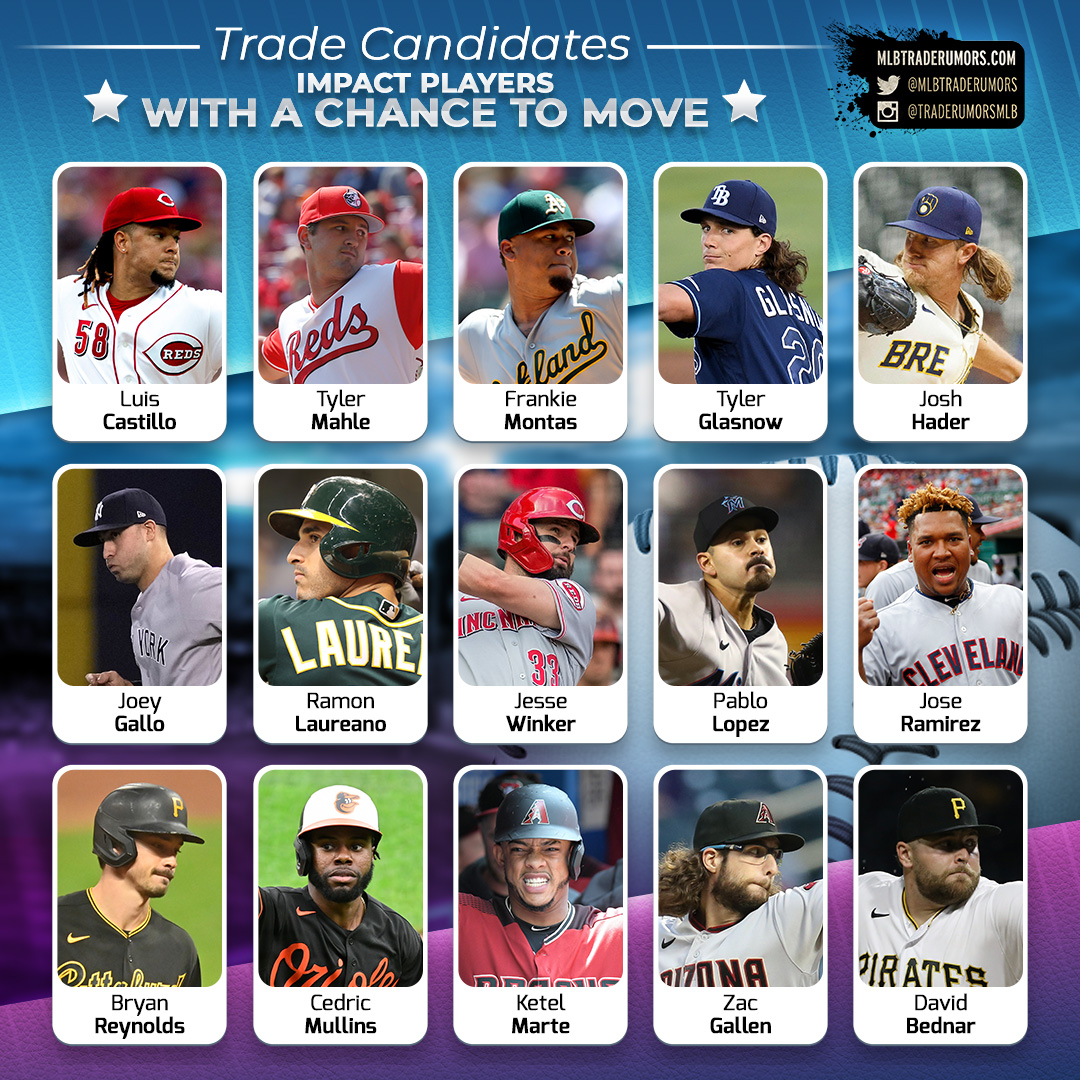
Earlier in the week, MLBTR owner Tim Dierkes published our list of the 14 players we consider to be the likeliest trade candidates following the ongoing MLB lockout. That list was the result of an extensive talk with Tim, myself and Anthony Franco, wherein we considered the possibility of more than 100 players and whether they could (or could not) viably change hands. While that Athletics-heavy list contained who we agreed to be the likeliest, it certainly didn’t represent every plausible trade candidate in our eyes.
As Tim noted within that post, we wound up sorting our list of plausible trade candidates into various buckets/tiers. The top 14 was simply the likeliest, regardless of contract or quality of player, but for the remainder of the exercise, we chose to categorize things based on how impactful a player might be to his new team. This, admittedly, is subjective. We didn’t establish a defined set of concrete parameters in labeling this group “impact” players; rather, we focused on mid-rotation (or better) starting pitchers, high-leverage relievers and hitters with recent All-Star-worthy performances (even if they didn’t necessarily result in an actual All-Star berth). Three wins above replacement in a given season wasn’t a firm cutoff, but we did ask at multiple points whether we a player had recently or could be reasonably expected/projected to turn in a 3-WAR season while sorting them.
Once these players were tiered, we further broke them down by whether they were legitimately plausible candidate to change teams or just someone whom other clubs would be trying to pry away. Basically, none of Tim, Anthony or myself would bat an eye to see Luis Castillo or Frankie Montas traded. Bryan Reynolds or Cedric Mullins, though? We’ll probably hear about teams trying to pry those players loose from their respective clubs (hence their inclusion), but a deal coming together seems like a long shot and would register as a mild surprise (if only because of the asking price and remaining club control).
As Tim explained, some of these players are interconnected. While the Reds have three starters who could plausibly change hands, we don’t necessarily think all three will move. It’s the same with the A’s roster. They could plausibly move multiple players — GM David Forst said amid November reports of a mandate to slash payroll that they’d have to listen on the whole roster — but that doesn’t mean the A’s are going to trade seven or eight players.
Anthony will follow this list up in the near future with a collection of solid regulars who we believe could change hands and/or will be in high demand following the lockout, but for now, here’s our second tier of trade candidates — legitimate impact players who could plausibly change teams but perhaps aren’t as likely to go as those listed by Tim earlier in the week…
Plausible/Decent Chance to Move
Luis Castillo / SP / Reds
The Reds’ offseason transactions since the close of the 2020 season have included a salary dump of Raisel Iglesias, non-tendering another quality reliever (Archie Bradley), trading Tucker Barnhart to Detroit, and placing Wade Miley on waivers rather than picking up a reasonable $10MM option. GM Nick Krall kicked off the 2021-22 offseason by declaring a need to “align our payroll to our resources.” Rumors of trades involving Luis Castillo, Sonny Gray (listed among our 14 likeliest candidates due to his age and larger price tag) and Tyler Mahle naturally followed.
Even if the Reds aren’t actively shopping the 29-year-old Castillo, teams will be calling to inquire, and Krall and his staff will be listening. The Reds probably aren’t going to shop him and simply let him go for the best offer, as they control him through 2023. They could always hold and market him again this summer or next offseason if no enticing offer materializes post-lockout.
Still, Castillo might be the best starting pitcher who could feasibly change hands. He got out to a brutal start in 2021, but over his final 22 starts, Castillo was excellent. He racked up 135 1/3 innings (six-plus innings per start) and notched a 2.73 ERA with a 26% strikeout rate, a 9.4% walk rate and a massive 59.9% ground-ball rate. Castillo’s ugly April/May results skew both his 2021 numbers and his collective numbers from 2019-21, but over the past three seasons he’s still posted a 3.61 ERA while fanning 27% of his opponents.
Maybe he’s not a true “ace,” but Castillo is a playoff-caliber starter for virtually any team. He’s projected to earn $7.6MM in 2022 and would be owed one more arbitration raise in 2023. Essentially, he’ll cost somewhere in the neighborhood of $20MM for the next two seasons — a bargain rate that should be reflected in a huge asking price from the Reds.
Tyler Mahle / SP / Reds
Mahle doesn’t have the name value that Castillo brings to the table, and his track record of success is shorter. Nonetheless, he’s blossomed into a sharp mid-rotation arm over the past two seasons, sporting a 3.72 ERA with a 28.1% strikeout rate and 8.9% walk rate. Unlike Castillo, he’s a fly-ball pitcher, which has at times bitten him at his bandbox of a home stadium; Mahle has given up 30 home runs in 227 2/3 frames dating back to Opening Day 2020, and 24 of them have come at home. He posted a 2.30 ERA away from Great American Ball Park in 2021 and, in his career, has a 5.09 ERA at home versus a 3.72 mark on the road.
A spacious home park would benefit Mahle perhaps even more than your average starter, although his penchant for yielding fly-balls will likely always make him a bit susceptible to the long-ball. Mahle has also been more of a guy who pitches into the sixth rather than completes six or seven frames (5 1/3 innings per start since 2020), but that’s increasingly common in today’s era of aggressive bullpen usage.
Mahle’s shorter track record may give some fans pause, but teams are likely comfortable projecting him as a quality arm based on the past two seasons of missing bats at a high level. And, that shorter track record has left him with a lower price point in arbitration, as he’s projected to earn $5.6MM in 2022. Like Castillo, he’s controlled through 2023, so there’s no immediate urgency to move him — especially given his affordable price tag. Still, teams will be calling, and the Reds can justifiably ask for a strong return.
Frankie Montas / SP / Athletics
Sticking with pitchers who have two remaining years of club control, Montas joins a long list of Athletics who could be traded post-lockout. Amid reports of a mandate to slash payroll, GM David Forst outwardly acknowledged back in November that the A’s will have to listen to offers on the majority of their roster.
Montas, unlike free-agents-to-be Sean Manaea and Chris Bassitt, is controlled through 2023. And unlike Matt Olson and Matt Chapman, his projected $5.6MM salary is a bit easier for the A’s to stomach. That’s why Montas is in this “bucket” of our trade candidate rankings, but even if he’s not as likely to move as some of his teammates, a deal is certainly still plausible.
Though Montas isn’t without red flags — he served an 80-game PED suspension in 2019 and had never reached 100 innings in a big league season prior to 2021 — it’s hard to ignore the quality results. Since 2018, Montas has pitched 401 innings of 3.57 ERA ball with a 24.4% strikeout rate, 7.3% walk rate and 43.7% ground-ball rate. His swinging-strike rate has continued to improve, and this past season’s 26.9% strikeout rate was a career-best. He’ll turn 29 in May, and he’s an upgrade for any team’s rotation.
Tyler Glasnow / SP / Rays
Glasnow is the most talented name on this list and, when healthy, looked the part of a legitimate ace with Tampa Bay. From 2019-21, Glasnow tallied 206 innings with a 2.80 ERA and fielding-independent marks to match. He punched out a ridiculous 36% of his opponents, walked just 7.8 percent of them and kept the ball on the ground at a 45% clip. Among the 114 starting pitchers who totaled at least 200 innings in that time, Glasnow ranks tenth in swinging-strike rate and second to only Shane Bieber in his combined percentage of called and swinging strikes. Only Jacob deGrom and Gerrit Cole had higher strikeout rates.
With that type of profile, two years of team control remaining and a projected $5.8MM salary for the 2022 season, a healthy Glasnow would be a no-brainer for the Rays to keep. Of course, Glasnow is not healthy. He’s likely to miss most, if not all of the upcoming season after undergoing Tommy John surgery last August. Arb-eligible players who miss an entire season due to injury typically sign on for a repeat of their prior year’s salary, meaning that in 2023 Glasnow will likely pitch on the same salary as 2022. Using that same $5.8MM projection, the Rays would be looking at about $11.6MM for one season of Glasnow, when his workload would need to be monitored coming back from major surgery.
Glasnow’s career-high innings total in the Majors is 2018’s 111 2/3, and his career-high for any professional season is when he reached 155 innings between Triple-A and Pittsburgh combined back in 2017. Realistically, the Rays would probably be thrilled to get 100-120 innings from Glasnow in 2023 — and an $11-12MM price tag on that modest total is rather steep for a team with Tampa Bay’s general payroll concerns.
Other clubs would welcome the opportunity to take that chance, however. We’ve seen two-year pacts for Tommy John rehabbers like Drew Smyly ($10MM with the Cubs), Michael Pineda ($10MM with the Twins) and Garrett Richards ($15.5MM with the Padres). Glasnow’s price tag is toward the lower end of that spectrum in terms of dollars, but the cost of trading prospects also has to enter into the equation. For an arm of this caliber, however, there are plenty of teams that would take the plunge.
Glasnow, for his part, recently told Chris Rose that he strongly hopes to remain with the Rays (YouTube link). Perhaps there’s a contract to be worked out that could benefit both parties, but Glasnow himself acknowledged the uncertainty surrounding his status and that president of baseball operations Erik Neander will have to listen to some offers if and when other teams come calling.
Josh Hader / RP / Brewers
Teams have been trying to get their hands on Hader for years, and the Brewers have steadfastly refused all overtures. The reluctance is understandable, as Hader has established himself as arguably the best reliever in the sport. In 282 1/3 career innings, he’s posted a 2.26 ERA and fanned exactly four out of every nine batters faced. No longer being used for multiple innings at a time, Hader posted a career-best 1.23 ERA in 58 2/3 frames this past season. The homer he allowed to Freddie Freeman in the NLDS isn’t a great note on which to close a season, but looking at Hader’s broader playoff track record, he has a 1.88 ERA and 23-to-3 K/BB ratio in 14 1/3 innings.
Trading the game’s most impactful reliever wouldn’t be easy for president of baseball operation David Stearns, but Hader’s value is at its apex. He’s also projected to see his salary spike to $10MM in 2022, with a fourth and final arbitration raise coming in 2023. Hader is dominant, but the typically low-payroll Brewers are flirting with what would be a record $123MM payroll. It’s not accurate to suggest that the presence of a second powerhouse reliever, Devin Williams, makes Hader expendable, but Williams’ excellence would at least slightly soften the blow of a theoretical Hader trade.
Milwaukee could still stand to improve its offense, and moving Hader could both free up some financial resources and simultaneously net some immediate help for the big league lineup. The Brewers don’t have to move Hader now, to be clear. However, they probably wouldn’t move him in-season if they’re contending — meaning it’s now or next winter, when they’d be marketing one year and a $15MM+ salary. That would net far less long-term value. It’s a fine line to walk.
Joey Gallo / OF / Yankees
Gallo popped 13 homers in 58 games following a July trade from Texas to the Bronx, but it’s fair to say the deal didn’t work out as New York had hoped. Gallo’s strikeout rate, which had dipped a bit with the Rangers, spiked to 38.6% as a Yankee. The resulting .160/.303/.404 batting line in 228 plate appearances is one of the more bizarre slashes you’ll ever see from a regular player.
Struggles in New York aside, Gallo was hitting .223/.379/.490 through 388 plate appearances in Texas and had bashed 25 homers in that span — putting him on pace for what would’ve been his third career 40-homer season had he not dropped off with the Yankees.
Gallo has as much power as anyone in baseball, and he’s made himself into a strong defender in the outfield corners (who can handle center from time to time). However, he’s projected to earn $10.2MM in arbitration this season, and it’d be understandable if the Yankees were hesitant at that price based on his post-trade struggles. New York is projected to top $226MM in luxury tax concerns, so moving Gallo could prove beneficial if owner Hal Steinbrenner is again intent on dipping beneath the threshold (wherever that’ll ultimately lie in 2022).
The Yankees have Aaron Judge, Aaron Hicks and Giancarlo Stanton as outfield options, with Estevan Florial serving as a possible reserve. Were they to give Gallo a change of scenery by moving him to a team seeking pop in the outfield, they could always sign a free agent to replenish some of the depth. It’s not clear that the Yankees will shop Gallo once the lockout lifts, but the New York Post’s Joel Sherman wrote about the possibility back in October, reporting within that as many as seven other teams tried to land Gallo at the deadline. If he’s on the block, there’ll be interest.
Longer Shots due to Asking Price and/or Remaining Club Control
Ramon Laureano / CF/ Athletics
Given Forst’s comments and the reports of forthcoming payroll reduction, it’s viable that anyone earning a salary of some note will at least be discussed. Laureano, projected to earn $2.8MM this coming season after his first trip through the arbitration process, also represents one of the few plausible center field options on the market, which should lead to plenty of teams inquiring on his availability.
Trading Laureano is more complicated than moving some of his teammates. He’s currently in the midst of an 80-game PED ban which, beyond raising questions about his performance to date, could come with major service time implications. Laureano still needs to serve 27 games of that suspension, which could impact his path to free agency. He currently has three years and 14 days of service time, meaning he’d need 158 days in 2022 to cross the threshold into four years of service and remain on track to hit the open market post-2024. There are only 187 days in a standard season, making it unlikely he’ll end up accruing the necessary time on the roster to get to that point. (Remember that off-days spent on the MLB roster count as a day of service.)
There’s always the small chance that some other factor impacts this trajectory (e.g. the ongoing labor talks, a potentially shortened 2022 schedule, a grievance filing), but as it stands, Laureano could wind up under team control through 2025 rather than 2024. An extra year of team control both heightens his appeal but also makes it tougher to trade him.
Beyond the service-time considerations, Laureano underwent core muscle surgery after the season, which adds another layer to a complicated scenario. But looking solely at Laureano’s numbers, he’s a difference-maker for a team in need of a center fielder (e.g. Phillies, Marlins, Guardians). A career .263/.335/.465 hitter with 25-homer pop, good speed and plus center field defense isn’t a hard sell.
Jesse Winker / OF / Reds
I explored Winker’s situation at length last week, with the bottom-line point being that it makes little sense to listen to offers on starting pitchers with two years of club control remaining (e.g. Castillo, Mahle, Gray) without doing the same on Winker. The 28-year-old slugger has had some issues with durability, doesn’t hit lefties well (though he’ll still draw his walks against them) and isn’t a great defender. That’s an odd trio of qualities to focus on when talking about someone’s trade candidacy, but the other side of the coin is more compelling: Winker’s production against right-handed pitching is at Bryce Harper/Juan Soto levels of brilliance.
Since 2020, Harper and Soto are the only two qualified hitters in baseball with a better mark than Winker’s 169 wRC+ against righties. In terms of more traditional slash metrics, he’s batting an outrageous .322/.417/.619 when holding the platoon advantage. With all the talent on the Reds’ roster, I think Cincinnati should be in aggressive, win-now mode. Krall’s early comments and their dealings since 2020 suggest otherwise, however, and if you’re going to listen on the other guys with four-to-five years of MLB service — why not listen on Winker as well? Cleveland, Colorado, Philadelphia and so many others are looking for offensive upgrades in the outfield corners.
Pablo Lopez / SP / Marlins
As is a common refrain on this list, the Marlins have no urgency to move Lopez, who’ll turn 26 in March. He was limited to 102 2/3 innings by shoulder issues last season and has yet to top 111 2/3 frames in a Major League season, but Lopez has been pretty darn good when healthy. From 2020-21, in particular, he’s compiled 31 starts and 160 innings of 3.26 ERA ball with a 26.4% strikeout rate and a 6.7% walk rate. He’s in his first trip through arbitration and projected for a highly reasonable $2.5MM salary.
So, why even bother considering a move? The Marlins are still hopeful of landing some help in center field, and they’re also so deep in pitching talent that it borders on comical. The old adage that a team can never have too much pitching always rings in the back of our minds, but the Marlins aren’t short on options beyond Lopez. Sandy Alcantara, Trevor Rogers, Elieser Hernandez, Jesus Luzardo, Sixto Sanchez, Edward Cabrera, Braxton Garrett, Nick Neidert, Cody Poteet and Daniel Castano are all on the 40-man — and top prospect Max Meyer is quickly rising through the minors. Injured top prospect Jake Eder will be back in 2023.
Jose Ramirez / 2B, 3B / Guardians
The favorite subject of so many hypothetical trade scenarios from fans, Ramirez does feel likely to end up traded … at some point. The question is whether now’s the time. Cleveland has him for $11MM this year plus a $13MM option in 2023. Given Ramirez’s elite play, there’s little chance of the Guardians extending him beyond that 2023 season, but there’s also good sense in Cleveland taking another run at the AL Central with Ramirez as a focal point. The pitching is still excellent, and while the lineup clearly needs another bat or two, the 2022 payroll is currently projected at only $49MM. There’s room to add some help for Ramirez and Franmil Reyes, and a deep farm system could also provide some in-house upgrades.
It’s also impossible to look at the situation without accounting for public relations. We’re only a year removed from Cleveland trading Francisco Lindor in a wildly unpopular move, and many fans’ anger with further fueled by the team’s name change. The newly-named Guardians are looking to usher in a “new era” of Cleveland baseball, and trading their best player for a second straight offseason isn’t a great way to foster good will.
If the first half of the season goes poorly, I’d expect Ramirez to be among the most talked-about names at the 2022 trade deadline, and there’d be a much stronger chance he moves at that point. With regard to the offseason, however, there’s just not enough urgency to push something across the line unless Toronto or another on-paper suitor puts forth an over-the-top offer. Even then, fans who’ve already purchased new Guardians gear bearing Ramirez’s name are going to feel rather jilted. It’d be tough for the front office to make this move now.
Bryan Reynolds / OF / Pirates
Reynolds is the best player on a last-place team that’s squarely in the midst of a rebuild so it’s hardly a surprise that he’s been in trade rumors dating back to the summer. Rival teams know the Pirates are open for business, and it’s only natural they’d try to acquire a center fielder capable of posting a .302/.390/.522 slash like the one Reynolds logged in 2021.
On the one hand, there’s an argument that the rebuilding Buccos ought to listen on anyone — and they surely will. But on the other hand, Reynolds is 27 and controlled another four seasons. His trade value won’t diminish substantially if the Pirates hold onto him, giving the fans at least one recognizable and marketable star player. Reynolds is a Super Two player who’s projected to earn an eminently affordable $4.5MM in 2022, so there’s no financial pressure. Everyone has their price in a trade, especially on a team like the Pirates, but for some context, that price reportedly included Mariners uber-prospect Julio Rodriguez (and more) when the two teams last talked. Baseball America currently ranks Rodriguez as the No. 2 prospect in all of baseball.
Cedric Mullins / OF / Orioles
Most of what was written about Reynolds applies to Mullins. The Orioles’ breakout star put together a 30-30 season last year while hitting .291/.360/.518 and is controllable for another four seasons — through age 30. No one expects the Orioles to contend in 2022, but they’ll get a look at top prospects like Adley Rutschman, Grayson Rodriguez and D.L. Hall this year. Reinforcements from the farm are on the way, and it’s feasible that by 2023 (and certainly by 2024), they could be on the cusp of turning a corner. Mullins will be under control, affordable and in his prime at that point.
The Orioles aren’t going to declare anyone on their Major League roster “untouchable,” but Mullins would only be available for a staggeringly strong offer. A Mullins trade doesn’t seem likely, but teams are going to at least try to force GM Mike Elias’ hand.
Ketel Marte / 2B, CF / Diamondbacks
Teams have been trying to pry Marte from the D-backs for more than a year. Arizona reportedly took the extra step of plainly telling rival clubs in early July — weeks before the trade deadline — that Marte wouldn’t be moved. That probably didn’t stop clubs from trying, and teams will be trying again post-lockout. The Marlins, Yankees, Mariners and quite a few others have at least been speculatively linked to Marte, whose team-friendly deal heightens his appeal. Marte will earn $8MM in 2022, and his contract calls for a $10MM team option in 2023 and a $12MM team option in 2024.
Dating back to 2019, Marte boasts a .318/.374/.543 batting line with 48 dingers, 79 doubles, 11 triples and a lowly 14% strikeout rate (versus a 7.6% walk rate). He’s rated poorly in center field, from a defensive standpoint, but is well-regarded defensively at second base. A 28-year-old switch-hitter with power, some speed, plenty of versatility and a grand total of $30MM owed to him over the next three years ($21MM of which isn’t even guaranteed) is wildly appealing. The D-backs, however, have shown little inclination to move him in the past, and assistant GM Amiel Sawdaye echoed that sentiment in November, calling Marte a “cornerstone” player around whom the D-backs can build.
Zac Gallen / SP / Diamondbacks
Twenty-six years old and controlled another four seasons, Gallen is precisely the type of pitcher that pitching-needy teams like the Rangers, Twins, Nationals and so many others would dream of acquiring. A forearm issue slowed him in 2021 and limited his workload, but Gallen has now made 50 starts in the Majors with a 3.46 ERA, a 27.6% strikeout rate and a 9.6% walk rate to show for it. He’s already been traded twice — going from St. Louis to Miami in the Marcell Ozuna deal before being flipped to Arizona in what amounted to a rare prospect-for-prospect swap sending Jazz Chisholm back to the Fish.
The D-backs didn’t even trade Merrill Kelly at this past summer’s deadline when he was a fourth starter with 1.5 cheap years left on his contract. It’s hard to imagine they’ll be excited about the idea of giving up four seasons of Gallen — particularly when his stock is down a bit, owing to last season’s arm issue. Gallen closed out the 2021 season quite well, with a 3.19 ERA and 52-to-15 K/BB ratio in his final 48 frames (eight starts). Sawdaye listed Gallen as a “cornerstone” player right alongside Marte, adding that the D-backs never plan to fully punt on a given season. Their signing of Mark Melancon for two years and $14MM meshes with the notion that this is not a team on the brink of a full-fledged teardown. Teams can try to nab Gallen, but it’d likely require some young MLB-ready talent going back to Arizona. Overall, the odds are low.
David Bednar / RP / Pirates
One of several pieces acquired in last winter’s Joe Musgrove trade, the 27-year-old Bednar stepped up and solidified himself as the Pirates’ likely closer in 2022. Through 60 2/3 innings, Bednar posted a tiny 2.23 ERA with a 32.5% strikeout rate, an 8.0% walk rate and a 41.4% grounder rate. Bednar yielded only five home runs all season (0.74 HR/9) and averaged 97 mph on his heater. He looks the part of a legitimate high-leverage weapon, and he’s controlled for five more years — all the way through 2026.
With such good results, a pre-arbitration salary and so much team control remaining, Bednar probably isn’t going anywhere. (As a bonus, he’s a Pittsburgh-area native.) The Pirates can’t (or at least won’t) simply trade every player who shows some semblance of value, after all. That said, the last thing most rebuilding clubs need is a high-end closer, and bullpen help is always in demand. Bednar will be 29 or 30 by the time the Pirates are realistically turning a corner, and the attrition rate on relievers is higher than anywhere else on the diamond. The argument for capitalizing on his value right now is pretty clear, but as with the rest of this “long shot” list, it’s hard to see a team meeting what would surely be a pretty substantial asking price.