
Reds Have Shown Interest In Corey Seager
The Reds came into the winter ripe for an upgrade at shortstop, but they haven’t done much at the position thus far. The club’s biggest move there has been picking up light-hitting veteran Freddy Galvis‘ $5.5MM option. As things stand, Galvis is slated to enter 2020 as the Reds’ starter at short, though they have their sights set on a much more notable option. Cincinnati has “shown interest in” the Dodgers’ Corey Seager throughout the offseason, Ken Rosenthal of The Athletic writes (subscription link).
There is no indication the Dodgers are about to trade Seager, nor is it clear what the Reds would be willing to give up for him. No doubt, though, he’d cost a significant amount in assets. Seager, who debuted in 2015, won NL Rookie of the Year honors the next season, has earned a pair of All-Star nods, and has established himself as one of the game’s most well-rounded shortstops. While the past two seasons were injury-truncated campaigns for Seager, the 25-year-old nonetheless put up 3.3 fWAR and hit .272/.335/.483 with 19 home runs across 541 plate appearances in 2019.
Any team acquiring Seager would be getting a player with two arbitration-eligible seasons left, not to mention someone who’s projected to rake in a more-than-reasonable $7.1MM in 2020. The Dodgers – despite a fairly quiet offseason so far – continue to have the makings of an elite team, so there’s no pressure on their part to give up Seager. That said, dealing Seager would bring back a valuable return that could help LA in another area, and it would free up short for super-prospect Gavin Lux or, in a less probable scenario, the Indians’ Francisco Lindor. The Dodgers have shown interest in Lindor, but if we’re to believe Indians brass, it’s unlikely he’ll change homes prior to the season.
Dodgers Sign Jimmy Nelson
6:35pm: The Dodgers have announced the signing.
9:45am: The Dodgers have reached a one-year deal with righty Jimmy Nelson, according to Jorge Castillo of the Los Angeles Times (Twitter link). The contract includes a $1.25MM guarantee and the possibility of greater earnings, including a vesting/mutual option for another season, according to Castillo, Bob Nightengale of USA Today (Twitter links), and MLB.com’s Adam McCalvy (Twitter links).
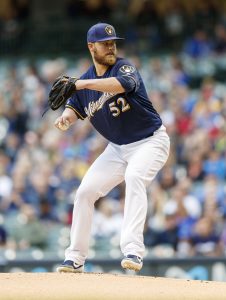
Nelson will reportedly be promised just $750K this year. But he’ll earn $1MM in incentives if he makes the Opening Day roster and $500K apiece if he remains on it for 45 and 90 days. Further incentives could also add $1.5MM to Nelson’s 2020 earnings.
As for the option, it will start out as a $2MM club option with a $500K buyout that makes up the remainder of the guaranteed cash. If Nelson throws sixty innings and/or makes forty appearances, it’ll convert to a $5MM mutual option. That price can reach as much as $9MM if Nelson throws 170 frames for Los Angeles in the coming season.
Once a foundational player in Milwaukee, Nelson was non-tendered by the Brewers in December when the club deemed his projected $3.7MM salary too steep. That decision came on the heels of two injury-ruined campaigns.
Nelson did get back on the hill in 2019 after missing the entirety of the prior season, but allowed 17 runs over 22 frames. While he racked up 26 strikeouts in that span but also coughed up 17 walks and four long balls.
It’s hard to know what to expect out of Nelson, who’s now thirty years of age. He exhibited a fairly significant velocity loss but still sat at around 93 mph in 2019. He dove in both first-strike rate (50.5%) and chase rate (23.6%), suggesting some reduction of command, pitch quality, and/or confidence. But Statcast still identified well-above-average spin on Nelson’s pitches.
It will be interesting to watch whether Nelson can return from the shoulder and elbow woes that derailed his career. It’s equally fascinating to see another upside pitching play from a Dodgers organization that has otherwise remained quiet this winter. While the club continues to explore major additions, it has yet to pull off a big strike this winter.
Photo courtesy of USA Today Sports Images.
Dodgers To Sign Edubray Ramos
The Dodgers have a minors deal with righty Edubray Ramos, according to Bob Nightengale of USA Today (via Twitter). It includes an invitation to MLB camp.
Ramos, 27, is a nice buy-low candidate to roll the dice on. He had been an effective hurler for the Phillies but was non-tendered after an injury-riddled 2019 season in which he was ineffective and showed reduced velocity when he was available to pitch.
If all works out, the Dodgers can retain Ramos for years into the future via arbitration. He threw 42 2/3 innings of 2.32 ERA ball with 8.9 K/9 and 3.2 BB/9 for the Phils in 2018.
Arbitration Breakdown: Cody Bellinger
Over the coming days, I am discussing some of the higher profile upcoming arbitration cases. I rely partly on my arbitration model developed exclusively for MLB Trade Rumors, but will also break out some interesting comparables and determine where the model might be wrong. 2020 projections are available right here.
Cody Bellinger seeks to break the record for first-time eligible players in 2020, after putting up an MVP campaign in his platform season to tack onto a resume that already has a Rookie of the Year award. Bellinger hit 47 home runs and knocked in 115, while batting .305 and stealing 15 bases through 661 plate appearances. For his career, that gives Bellinger 111 HR, 288 RBI, a .278 average, and 39 steals in 1841 plate appearances. That immediately puts him in rarified air.
In recent memory, only three players have entered arbitration for the first-time with both an ROY and an MVP award. Ryan Howard smashed the first-time eligible arbitration record way back in 2008 with these accomplishments. He had also hit 47 home runs in his platform season, but had batted only .268 (although he did knock in 136 runs). His 129 career home runs and 353 career RBI, plus his .291 career average, led to a $10MM salary after he beat the Phillies in arbitration (who had filed for only $7MM).
It took five more years for another player to reach arbitration with an ROY and MVP, and that was Buster Posey. Posey had only hit 24 HR in his platform year though, and 46 in his career, and ended up with a less remarkable $8MM.
It was not until Kris Bryant again accomplished that combination in 2018 that we saw Ryan Howard’s decade-old record fall as Bryant earned $10.85MM. Bryant is the most obvious comparable for Bellinger here. Bryant had a .295/29/73 platform in 665 PA, which is definitely weaker than Bellinger’s .305/47/115 in 661 PA—especially because Bellinger stole 15 bases to Bryant’s seven. For career numbers, Bryant also fell short in HR (94 versus 111), RBI (274 versus 288), and SB (28 versus 39), but he did have a .288 average to Bellinger’s .278. Of course, batting average has historically been far less important than power numbers for arbitration cases, so it stands to reason Bellinger should top Bryant’s $10.85MM. My model estimates $11.6MM, which may be on the low side.
Finding other comparable players is quite challenging. Two other players have received eight figure salaries in their first year of eligibility. Mookie Betts in 2018 had a .264/24/102 platform year, but had 26 stolen bases that season as well as a career .292/78/310 line and 80 total stolen bases. He got $10.55MM, and Bellinger’s case also looks favorable to his. Last year, Francisco Lindor had a platform .277/38/92 campaign with 25 SB, along with .288/98/310 career along with 71 SB. Lindor received $10.55MM. Again, Bellinger’s case compares favorably.
Overall, this seems likely to just be a matter of how much Bellinger will break Bryant’s record by. I think the floor is probably the $850K difference that the model projects (at $11.6MM), and I could easily see Bellinger landing north of $12MM or perhaps even $13MM.
Stan Kasten Discusses Dodgers’ Offseason, Cole, Spending
Though the Dodgers have been linked to several big names in both trade rumors and free agency, it’s been a pretty quiet offseason at Chavez Ravine, with the club’s one-year, $10MM deal with Blake Treinen standing out as the biggest move of note. The lack of action to date hasn’t sat well with many fans and pundits, including Bill Plaschke of the Los Angeles Times, though Dodgers president and CEO Stan Kasten strongly defended his club’s strategies in a recent phone conversation with Plaschke.
As one might expect, Kasten took issue with what he described as “the L.A. Times’ characterization that everyone hates us,” which he felt was incorrect given strong attendance numbers. While “for sure there are some fans…and a lot of people in the Twitterverse” who are critical of the Dodgers’ decisions, “based on the fans that support us…including this coming year…incredibly strong support and ticket sales…you keep trying to convince yourself that everyone hates us. I just think you’re wrong.”
Kasten denied that the Dodgers were in any way limited by payroll considerations, or lacked full commitment to winning their first World Series since 1988, saying “we really need” to capture that elusive title.
“There are metrics in business that are mostly private that we look at, and I’d say we feel successful there,” Kasten said. “But there’s no question that all of us who are competitive, from every owner that has a piece of the team to the junior people in the front office, we’re laser-focused on winning the World Series….It’s obviously not about what you spend, it is about the moves you make, the decisions you make. I think questioning those things, criticizing those things, that’s absolutely fair. But just to say there’s a [payroll] number you need to hit and if you don’t hit it you’re not trying, that’s just silly.”
To that end, Kasten noted that the Dodgers were fourth in spending last season, and are likely to be beyond the $208MM Competitive Balance Tax threshold by season’s end. Roster Resource’s Jason Martinez estimates that L.A. has a current luxury tax number of just under $189MM, though “the team we have now is not going to be the team we have to start the postseason,” Kasten said. “I expect that team, this year, it looks like it’s going to be well over the CBT, or somewhat over.”
The types of larger-salaried players who would boost a CBT number could come sooner rather than later, as Kasten said “there are guys that we think could be difference makers and we have pursued them, we are continuing to pursue them, when there is an opportunity we will certainly jump at it.” One of the players who was on the Dodgers’ radar earlier this winter was Gerrit Cole, though Kasten doesn’t believe Cole shared that interest in coming to L.A., no matter the dollars involved. Cole joined the Yankees on the largest contract ever given to a pitcher — a nine-year, $324MM deal.
“It is clear now, I think it was clear to us in the middle of the process, he wanted to be a Yankee, he just did,” Kasten said. “In retrospect, I think we were just the stalking horse to get a number he finally could get from a team he wanted to go to. I don’t have any quibble with his approach…it was all very fair, but he wants to be somewhere, he got a lot of money to be where he wanted to be.”
Whether adding a particular star player is necessarily the right move to finally put Los Angeles over the top in a World Series, however, is far from a certainty. Kasten points out that recent postseason heroes Daniel Hudson (with the Nationals in 2019) and Steve Pearce (with the Red Sox in 2019) were unheralded additions to their respective teams.
This strikes to the heart of the debate between Kasten and Plaschke, as the latter is concerned that the Dodgers’ focus on sustained success will keep the team from making a direct and concentrated push to end the championship drought in any one given year. Kasten, by contrast, feels that the team’s approach allows it to be in the hunt every season.
“We won 106 games and came a couple of outs away from beating the team that won the World Series, that doesn’t suggest to me a system that needs to be completely torn apart,” Kasten said. “What about the renewed pipeline, the old Dodger value of a player pipeline that I think we’ve had a reasonable amount of success at rebuilding? How about the kids that are homegrown Dodgers? We have a payroll of $200 million. How can you call us cheap? It blows my mind.“
Minor MLB Transactions: 1/4/20
Baseball America has posted its traditional roundup of minor moves dating to the start of the offseason. We’ve already covered quite a few of the transactions over the past several weeks, but there are several additions on minor-league pacts that have to this point eluded detection …
- The Braves have signed left-handed pitcher Chris Nunn to a minor-league deal that includes an invite to spring training, according to Robert Murray. Nunn, originally a 2012 draftee of the Padres, has yet to see Major League action since his professional debut, making stops in Independent leagues along the way. Now 28 years old, he’s played in the upper minors with the Astros and Dodgers organizations in the last two years. Last year, in 50 2/3 innings between Double-A and Triple-A, Nunn struck out 66 batters while walking 24. After posting a 1.33 ERA in Double-A, his numbers ballooned at the next level, though he largely maintained his bat-missing prowess.
- The Padres signed outfielder Abraham Almonte. The 30-year-old switch-hitter saw action in 17 MLB games for the division-rival Diamonbacks in 2019. He was quite productive with the Snakes’ Triple-A affiliate in Reno last season, slashing .270/.382/.558. That dwarfs his prior MLB performance, though. In 1,138 plate appearances over the past six seasons, the center field-capable Almonte has compiled a .239/.298/.373 line (81 wRC+).
- The Reds re-signed infielder Christian Colón and added catcher Francisco Peña to the organization. Colón, most known for his top five draft status and World Series heroics with the Royals, logged eight MLB plate appearances in Cincinnati last season. That rewarded a solid .300/.372/.443 line in extended action with Triple-A Louisville, although Colón was unsurprisingly bumped from the 40-man roster at season’s end. Peña tallied 202 uninspiring MLB plate appearances with the Royals, Orioles and Cardinals from 2014-18. He’s shown decent pop for a catcher at Triple-A, though; in parts of six seasons at the minors’ highest level, he has compiled a .259/.301/.469 line.
- The Dodgers re-signed right-hander Justin De Fratus. The former Phillie has spent the last two seasons in the L.A. organization, but he hasn’t seen the majors since 2015. While all 191 of De Fratus’ MLB appearances have come out of the bullpen, he’s primarily been a starting pitcher in the minors in recent years, albeit with uninspiring results. The Dodgers also added hard-throwing lefty reliever Reymin Guduan. Guduan is still just 27 and had little trouble racking up strikeouts in the Astros’ organization, both in the high minors and at the MLB level. He’s always issued a few too many walks, though. Perhaps more concerning, Houston released Guduan in September after a team-imposed suspension for an undisclosed disciplinary issue.
- The Rockies re-signed righty reliever Wes Parsons. The 27-year-old was claimed off waivers midseason from the Braves, but a dreadful MLB showing cost him his 40-man roster spot. Parsons logged a cumulative 5.45 ERA with more walks (29) than strikeouts (26) in 34.2 innings. Colorado also signed outfielder Michael Choice. The former top prospect, now 30, hasn’t logged significant MLB action since 2014. He’s spent the past two seasons in the Mexican League, but a strong 2019 effort there earned him another look in affiliated ball.
- The Braves signed veteran infielder Pete Kozma. The longtime Cardinal has just a .215/.278/.291 career line (54 wRC+) in parts of seven MLB seasons. He hasn’t done much at the dish in the minors, either, but he’s a well-regarded defender around the infield.
- The Angels signed former Cubs’ prospect Arismendy Alcántara. Alcántara hasn’t played at the highest level since 2017, and his career .189/.235/.315 line (49 wRC+) reflects the plate discipline woes that have done him in. He’s still just 28 years old, though, and his 2019 return to affiliated ball following a year in the Mexican League went well. The utilityman was productive across two minor-league levels in the Mets’ organization last season and showed better discipline than he has in his MLB career.
- The Mets added former White Sox outfielder Ryan Cordell. Twice traded as a prospect, the 27-year-old fell flat in his first extended MLB look in 2019, with just a .221/.290/.355 line (73 wRC+). He’s capable of logging some time in center field, though, and he put together a decent minor-league resume between myriad injuries.
- Finally, the Yankees brought aboard utilityman Rosell Herrera. Herrera logged fair MLB time with the Reds, Royals and Marlins the past two seasons. His resultant .225/.286/.316 slash (63 wRC+) won’t turn any heads, but Herrera has an 82nd percentile sprint speed, per Statcast, and has logged time at six different positions (short, second, third, and all three outfield spots) as a big leaguer.
Josh Donaldson Reportedly Sets Asking Price
Weeks of bidding has reportedly driven the price tag for Josh Donaldson into the nine-figure range over a four-year term, with at least three clubs said to be sitting at that lofty price point. The end game may now be upon us.
The star third baseman has given teams what amounts to a firm and final asking price, according to a report from Ken Rosenthal of The Athletic (subscription link). Donaldson is “simply waiting for one of the clubs to hit his number” — around $110MM — per the report.
It seems, then, that the Braves, Nationals, Twins, Rangers, Dodgers, and any other lurkers need only place a single phone call to Donaldson’s reps to get the paperwork started. With the first three of those clubs reportedly already close to Donaldson’s asking price, it doesn’t seem like a huge stretch to bridge the gap. On the other hand, it may be that these teams feel they’ve already moved well out of their comfort zone for a 34-year-old player with a not-so-distant injury history, however talented he may be.
We have seen this sort of bidding situation emerge before. Sometimes, the player ends up picking from among multiple, roughly equivalent offers, as reportedly occurred a few years back with Jason Heyward and Ben Zobrist. In other cases, a team leaps up to meet the asking price, as then-Blue Jays and now-Braves GM Alex Anthopoulos did to land Russell Martin — a situation he discussed last year.
It’s interesting now to see Anthopoulos weighing another tough call on an older free agent. He has twice acquired Donaldson, first via trade in Toronto and then through free agency in Atlanta, and has twice been rewarded for doing so. But while Anthopoulos made no shortage of big-money strikes during his time with the Jays, he has run quite a tight ship with the Braves. Most teams pressing to win end up going out on a limb at some point or another. No doubt Anthopoulos is presently weighing whether to do so with Donaldson or take on somewhat different risks by seeking an alternative path to the quality bat he wishes to acquire.
The calculus is much the same for the other teams involved. For the Nationals, the luxury tax line is fast approaching after a series of other moves. Adding Donaldson would probably mean going past it, though that seems to be a palatable outcome after dipping under the bar last year and going on to snag a World Series win. The Twins have ample flexibility after piecing together a cost-conscious series of rotation moves. It’s arguable that the Minnesota organization is most in need of a boost and best positioned to take on the long-term financial risks. But there are probably other ways the team could go to improve as well.
It could be that we’re seeing a bit of a staring contest here. Even if every organization knows that it controls its own destiny with regard to Donaldson — meet his ask and he’s yours — they’d each rather get him for less. There are some exceptionally talented alternatives in Kris Bryant and Nolan Arenado, but they’ll each require a sacrifice of talent and it’s far from clear how appealing the trade terms will be in both cases. Other possibilities, such as trading for Kyle Seager or signing Todd Frazier, rate as backup plans in comparison to the addition of Donaldson or one of his talent-level peers.
Latest On Dodgers’ Interest In Mookie Betts
The Dodgers have been linked to several superstar players in both free agency and potential trades this winter, though with so many of the big free agents already signed elsewhere, the trade market might be Los Angeles’ best avenue to land a major roster upgrade. To this end, the Dodgers have continued to explore the possibility of acquiring Mookie Betts from the Red Sox, according to MLB.com’s Jon Paul Morosi.
The deal could potentially be expanded to involve multiple players heading from Boston to Chavez Ravine, as Morosi suggests that David Price might be a fit as the veteran arm the Dodgers are looking to add to their rotation. With the Red Sox looking to cut payroll and ideally get under the luxury tax threshold, rumors have swirled all winter about Price, Betts, and other high-priced Boston names being floated as trade chips. Betts is projected for a hefty $27.7MM salary in his final year of arbitration, though that’s certainly a reasonable price to pay (especially for a big-market team like the Dodgers) for one of the sport’s very best players.
As game-changing as the idea of a Betts trade may be, the Sox aren’t actively trying to deal him, since the club would naturally prefer to explore other cost-saving options before parting ways with the 2018 AL MVP. Moving Price and the $96MM owed to the southpaw through 2022 would be one of those preferred options. While the Sox have drummed up some trade interest in Price, however, it still seems unlikely that a suitor would take on most of that contract given Price’s age (34) and recent injury concerns.
Moving Betts along with Price would definitely make a trade suitors more willing to absorb perhaps even all of Price’s contract, though obviously the Red Sox aren’t willing to move Betts just for the sake of a salary dump. Indeed, Sox chief baseball officer Chaim Bloom recently downplayed the idea of giving away any sort of younger talent along with Price, saying “so much of what we’re always going to be trying to accomplish, but certainly now, is to make sure we have as strong a farm system as possible.”
Morosi opines that the Red Sox would want one of the Dodgers’ top young pitchers (i.e. Dustin May or Tony Gonsolin) as part of a trade, though “Boston appears less insistent on” including infielder Gavin Lux as part of a trade package. It could be for this reason that L.A. is perhaps currently more focused on Betts than on Indians shortstop Francisco Lindor, another All-Star who has been heavily rumored to be on the Dodgers’ list of targets. The Lindor talks appear to be in something of a stalemate — Cleveland has continued to demand Lux in any deal for Lindor, while the Dodgers think so highly of Lux’s potential that they “have refused to include him in any offer for Lindor alone.” The Dodgers are also known to be pursuing Cleveland righty Mike Clevinger, so it’s safe to assume that some multi-player offers have been floated in the Tribe’s direction.
Latest On Josh Donaldson
The Braves could lose third baseman Josh Donaldson in free agency, but they’re not going down without a fight. They’ve made the longtime star a four-year offer, David O’Brien of The Athletic tweets. They join the Twins and Nationals as teams known to have made recent four-year proposals for Donaldson. Mark Feinsand of MLB.com said Thursday that all three teams seem willing to go to the four-year, $100MM range. The Dodgers and the Rangers can’t be counted out of the race, either, per Feinsand.
This has become an especially fascinating trip through free agency for Donaldson, who MLBTR predicted would sign a three-year, $75MM contract when the proceedings began. However, with fellow third baseman Anthony Rendon and a slew of other standout performers already off the market, the 34-year-old Donaldson is now easily the game’s premier player without a contract. And he partly controls the third base market, as teams that lose out on the Donaldson sweepstakes might pivot to a trade for the Cubs’ Kris Bryant or the Rockies’ Nolan Arenado with no other studs left in free agency.
In the Braves’ case, they could have the prospect capital to trade for Bryant or Arenado, though it remains to be seen whether they’ll go that route. The seven-year, $234MM Arenado’s still owed could prove too rich for their blood. Donaldson shouldn’t cost anywhere near that much in cash, nor would the Braves have to cough up young players for him, and they already know he can thrive in their uniform. The one-time MVP was an integral member of a 2019 Atlanta roster that took home its second consecutive NL East title.
Morosi: 50/50 Chance Of Nolan Arenado Trade
With the market showing a big appetite for star third basemen, the Rockies now appear to be increasingly likely to strike a trade involving Nolan Arenado. MLB.com’s Jon Morosi reports on Twitter that there’s now “roughly a 50/50 chance” of a deal coming together with one of the six teams to have expressed interest.
Oddsmaking of this sort is inherently ambiguous and non-verifiable, so skepticism is well warranted. And we heard just days ago that the Colorado organization hasn’t been especially aggressive in hammering out scenarios involving its biggest star. But if Morosi’s sources have an accurate read on the thinking of the Rockies’ leadership, then it’s at least now highly plausible that a swap could emerge. And that’d represent a notable development given the highly speculative nature of Arenado’s trade availability to this point. GM Jeff Bridich has previously made clear the team is open to considering proposals, but it has never seemed particularly likely that Arenado would be moved.
Notably, Arenado has full no-trade rights. But he has expressed a desire to win and may be willing to facilitate a deal if it means finding a better chance elsewhere. The Rox have decided against further payroll expansion and look to be in a bit of a bind when it comes to finding much-needed roster upgrades.
Even if that’s not a major complication, interested teams will be wary of giving up too much in trade capital for a contract that includes a post-2021 opt-out provision. It’d be one thing if Arenado was simply a high-cost player with two years of control, as is the case for Kris Bryant of the Cubs (another potential trade candidate, at least once his service-time grievance is wrapped up). But what’s worrisome in the Arenado deal is the combination of the threat of losing the player, in the event he performs well enough to opt out, with the fear of what it would mean if he doesn’t.
We just got open-market confirmation that the Rockies paid full boat for Arenado when they inked him last winter. Fellow star third bagger Anthony Rendon landed a seven-year, $245MM pact that just topped the $234MM promise Arenado received for the rights to the same number of would-be free agent campaigns. You could argue for days over which player is preferable — Rendon has outperformed Arenado in recent seasons, but also has had some health challenges in the past and is a bit older — but it seems fair to assess them both in the same general range of value.
Rendon’s deal includes full no-trade protection but no opt-out chances. Other than the cash required, it cost the Angels only some upcoming draft compensation. Given that, it’s a bit difficult to imagine an organization that came up short on Rendon would be particularly anxious to part with major young talent to acquire Arenado.
There is certainly some interest, though. The Rangers have perhaps been tied most closely to Arenado; the organization was highly disappointed to see Rendon land elsewhere in the division. The Braves are also said to have reached out, but it remains difficult to imagine that organization suddenly opening the books for such a massive deal. Morosi hints that the Dodgers have had some level of interest, but also says they’re not the primary suitor. It seems the Rox are not enamored of the idea of placing Arenado in the NL West. We might presume that the reputed pursuers of free agent Josh Donaldson — along with the Braves, the Twins and Nationals — are going to have at least some level of interest in Arenado. It seems there’s at least a mystery suitor or two floating around as well. Arenado is, after all, good enough to displace even a solid existing regular.
Morosi suggests (Twitter link) that the Nats have indeed spoken with the Colorado organization about Arenado. Unsurprisingly, the report indicates that the Nats aren’t keen to part with young center fielder Victor Robles for Arenado — or for the Cubs’ Kris Bryant. That more or less goes without saying, at least with regard to Arenado, for all of the reasons noted above (particularly since Rendon was the Nats’ own free agent). Robles has some things to iron out, but he’s also still just 22 years of age, can be controlled through the 2024 season, and just turned in a 2.5 fWAR / 4.1 rWAR campaign.
It’s tough to imagine a deal in which another team offers up significant assets to take on the entire Arenado contract. But the Rockies presumably won’t be interested in a deal that doesn’t feel like a win, both internally and to the fanbase. It’s interesting to ponder whether involving additional players — the Rox have a mix of surplus-value talent and underperforming contracts — might help form a more plausible structure than a classic veteran-for-prospect deal.