
Braves Extend Alex Anthopoulos Through 2031
The Braves announced this morning that they’ve signed president of baseball operations Alex Anthopoulos to an extension that will keep him with the team through the 2031 season. Anthopoulos had previously been entering the final season of a three-year contract extension that spanned the 2022-24 seasons. He’ll now be in Atlanta for an additional seven years.
“Alex and I have enjoyed a wonderful working relationship, and I look forward to that continuing for many years to come,” Braves CEO Terry McGuirk said in the team’s press release announcing the extension.

“I have been around this game a very long time and know that Alex’s track record of success is truly something special. There is simply no one better in the business. This extension gives Alex the runway to make long-term decisions and the opportunity to continue his track record of assembling teams that are perennial contenders. I have the utmost confidence in his ability to deliver championship baseball for our fans well into the future.”
The seven-year term of the contract extension is massive in relation to Anthopoulos’ baseball operations peers throughout the sport; most president of baseball operations and/or general manager contracts are three to five years in length. Given the unparalleled young core that the Braves have not only developed but also largely managed to sign to club-friendly contract extensions under Anthopoulos’ watch, however, it’s not surprising to see the team reward him with an uncommonly lengthy contract of his own — one that’ll allow him to see the bulk of those player extensions play out in full.
The 46-year-old Anthopoulos’ ascension to the top of the sport’s executive sphere is one rooted in the humblest of beginnings. His first job in baseball came with the Expos, where he was an unpaid intern working in their mail room and printing stat sheets. Expos scouts eventually took Anthopoulos under their wing, and he was moved to the team’s scouting department before being hired by the Blue Jays in 2003. From there, Anthopoulos climbed the ranks of Toronto’s baseball operations staff, rising all the way to general manager — a role he’d hold through 2015 before rejecting an extension under incoming president and CEO Mark Shapiro.
The Dodgers quickly added Anthopoulos to their front office, hiring him as a vice president of baseball operations working alongside president of baseball ops Andrew Friedman and then-GM Farhan Zaidi. That proved to be less than a two-year stop, as Atlanta hired Anthopoulos away from Los Angeles and named him general manager after former GM John Coppolella was dismissed and banned from baseball following reported violations on the international free agent market and in the MLB draft. (Major League Baseball lifted Coppolella’s “lifetime” ban after six years, in 2023.)
While some of the core pieces comprising the Braves’ roster were signed or drafted under the former regime — most notably, Ronald Acuna Jr., Ozzie Albies, Austin Riley and Max Fried — it was Anthopoulos who oversaw the extensions for each of Acuna (eight years, $100MM), Albies (seven years, $35MM) and Riley (ten years, $212MM). While Anthopoulos himself doesn’t necessarily oversee the draft, he did hire now-former scouting director Dana Brown — who’s since been hired as Houston’s general manager — and set the stage for a remarkable run of success in the amateur draft. (Brown and Anthopoulos worked together both in Montreal and in Toronto.)
From 2019 onward, Atlanta drafted names like Michael Harris II, Spencer Strider, Bryce Elder, Vaughn Grissom and Shea Langeliers (among others), each of whom has either emerged as a core contributor or been included in a trade to help build out the club’s current roster. (Langeliers was sent to Oakland in the Matt Olson trade; Grissom recently was traded to the Red Sox for Chris Sale.)
In addition to Acuna, Albies and Riley, Anthopoulos has succeeded in brokering long-term deals with the majority of Atlanta’s core. While Freddie Freeman and Dansby Swanson did ultimately depart in free agency — and Fried could well do the same next winter — the Braves have had more success on the extension front than any team in the game. Harris inked an eight-year, $72MM deal midway through his rookie season. Strider followed suit with a six-year, $75MM contract.
Less than 48 hours after acquiring Olson in what’s now a wildly lopsided trade with the A’s (who received Langeliers, Cristian Pache, Joey Estes and Ryan Cusick in return), Anthopoulos signed his new first baseman to an eight-year, $168MM extension. A year later, Anthopoulos again pried a star away from Oakland on the trade market, acquiring catcher Sean Murphy in a three-team deal that sent William Contreras to Milwaukee. As with Olson, Murphy quickly put pen to paper on a new contract: a six-year, $73MM deal.
The Braves, under Anthopoulos, have also made veteran Charlie Morton a fixture in the rotation, repeatedly signing him and extending him on a series of short-term contracts. Morton, originally drafted by Atlanta back in 2002, is now entering his fourth straight season as a Brave and has given the team 521 innings of 3.77 ERA ball and was a key part of the team’s 2021 postseason staff (3.24 ERA in 16 2/3 innings). Similarly, catcher/designated hitter Travis d’Arnaud has become a veteran staple on the club, winning a Silver Slugger in 2020 and making the 2022 All-Star team while combining for a solid .256/.315/.446 slash in four seasons since originally signing.
That 2021 postseason run, of course, is the crowning achievement of Anthopoulos’ career thus far. The Braves, powered by a juggernaut core and buoyed by deadline acquisitions like Jorge Soler and Eddie Rosario, blitzed through the second half of the season as the sport’s hottest team and rode that momentum all the way to a 2021 World Series title.
As with any baseball operations executive, not every move Anthopoulos has made has worked out. The three-year, $40MM deal for lefty Will Smith and the four-year, $65MM signing of Marcell Ozuna have had mixed results, at best, and the trade to swap out Smith for Odorizzi played out poorly as well. Smith rebounded in Houston, while Odorizzi struggled in Atlanta before being sent to the Rangers, with the Braves remaining on the hook for the bulk of his 2023 salary after Odorizzi exercised a player option. The Braves also acquired Kevin Gausman at what now looks like a bargain rate from the Orioles in 2018 but cut him loose via waivers a year later after he struggled in Atlanta. Gausman signed with the Giants the following offseason, broke out in San Francisco, and has since become a bona fide No. 1 starter in Toronto, where he signed a five-year free agent deal.
In comparison to the litany of successes under Anthopoulos, however, those misses are relatively minor in nature. And, while perhaps the Braves would like mulligans on some of those decisions, the simple fact of the matter is that none of them have stood as roadblocks to success. The Braves have won the NL East in all six of Anthopoulos’ seasons as general manager, and the team’s unrivaled collection of talent under long-term contract has positioned Atlanta as a legitimate dynasty in the division.
We’re reminded each year of the MLB postseason’s intrinsic randomness, but it’d be a surprise if the Braves didn’t reach the playoffs in the majority of the seasons under this new contract for their president — and another World Series appearance (if not victory) wouldn’t be a bad bet, either. It’s somewhat fitting that an executive known for his ability to hammer out club-friendly extensions now secures his own long-term deal — one that’ll assure him the opportunity to reap the benefits of the incredible crop of talent that’s been drafted, acquired, developed and signed long-term under his watch.
“I’d like to thank Terry for his continued support and trust,” Anthopoulos said in his own statement this morning. “The Braves are an incredible organization to be a part of, and I’m proud of the success we’ve achieve together. I am grateful for the opportunity to continue to lead baseball operations and to strive to bring another World Series to Atlanta.”
2024 Arbitration Tracker
Today is the deadline for players and teams to exchange figures in arbitration — an annual deadline that leads to a slew of one-year deals and, typically, a handful of multi-year deals. Today should see upwards of 100 players agree to salaries for the 2024 season, although the majority of clubs and players now wait until the very last minute to agree. The deadline for agreements is noon CT, and we’ll see terms on plenty of last-minute/buzzer-beating deals filter in shortly thereafter. Players and teams that do not reach an agreement will exchange salary figures at 7pm CT tonight.
Each player’s service time is in parentheses, and you can of course check back to see each player’s projected salary from MLBTR contributor Matt Swartz. We’ll keep this updated as deals come in — refresh for updates — and break off some of the larger, more prominent agreements in separate entries. All agreements are for one year unless otherwise noted.
Angels
- Griffin Canning (4.075): $2.6MM agreement today (via MLB.com’s Rhett Bollinger)
- Luis Rengifo (4.043): $4.4MM agreement today (via ESPN’s Kiley McDaniel)
- Taylor Ward (3.164): Did not reach agreement, will likely exchange figures (via MLB.com’s Mark Feinsand)
- Patrick Sandoval (3.149): $5.025MM agreement today (via Bollinger)
- Jose Suarez (3.084): Did not reach agreement, figures exchanged (via Feinsand)
- Jose Quijada (3.046): $840K agreement today (via Bollinger)
Astros
- Framber Valdez (4.163): $12.1MM agreement today (via The Athletic’s Chandler Rome)
- Kyle Tucker (4.079): $12MM agreement today (via Rome)
- Jose Urquidy (4.049): $3.75MM agreement today (via Rome)
- Mauricio Dubon (3.162): Did not reach agreement, will likely exchange figures (via KPRC-2’s Ari Alexander)
- Luis Garcia (3.083): $1.875MM agreement today (via Alexander)
- Bryan Abreu (3.022): $1.75MM agreement today (via Alexander)
- Chas McCormick (3.000): $2.85MM agreement today (via Rome)
Athletics
- Sean Newcomb (4.113): $1MM agreement in November
- Miguel Andujar (4.053): $1.7MM agreement in November
- Paul Blackburn (4.018): $3.45MM agreement today (via the San Francisco Chronicle’s Susan Slusser)
- Seth Brown (3.104): $2.6MM agreement today (via FanNation’s Marc Delucchi)
- Abraham Toro (3.011): $1.275MM agreement in November
Blue Jays
- Trevor Richards (5.084): $2.15MM agreement today (per The Athletic’s Kaitlin McGrath)
- Danny Jansen (5.050): $5.2MM agreement today (via FanSided’s Robert Murray)
- Vladimir Guerrero Jr. (4.157): Did not reach agreement, will file figures (per Feinsand)
- Tim Mayza (4.156): $3.59MM agreement today (via Sportsnet’s Ben Nicholson-Smith)
- Cavan Biggio (4.129): $4.21MM agreement today (via Morosi)
- Erik Swanson (4.096): $2.75MM agreement today (via Nicholson-Smith)
- Jordan Romano (4.051): $7.75MM agreement today (via McDaniel)
- Genesis Cabrera (4.011): $1.5125MM agreement today (via MLB.com’s Jon Morosi)
- Santiago Espinal (3.149): $2.725MM agreement today (via Morosi)
- Daulton Varsho (3.128): $5.65MM agreement today (via Feinsand)
- Alejandro Kirk (3.047): $2.8MM agreement today (via Sportsnet’s Shi Davidi)
- Nate Pearson (3.005): $800K agreement today (per McGrath)
Braves
- A.J. Minter (5.154): $6.22MM agreement today (via McDaniel)
- Max Fried (5.148): $15MM agreement today (via Murray)
- Huascar Ynoa (3.011): $825K agreement last week
Brewers
- Willy Adames (5.105): $12.25MM agreement today (via Murray)
- Corbin Burnes (5.049): $15.6375MM agreement today (via Jon Heyman of The New York Post)
- Taylor Clarke (4.120): $1.25MM agreement in November
- Hoby Milner (4.068): $2.05MM agreement yesterday
- Devin Williams (4.056): $7.25MM agreement today, including buyout of 2025 option (per Jeff Passan of ESPN)
- Jake Bauers (3.084): $1.35MM agreement today (via the Milwaukee Journal-Sentinel’s Curt Hogg)
- Bryse Wilson (3.036): $1.000025MM agreement today (via MLB.com’s Adam McCalvy)
- Joel Payamps (3.027): $1.65MM agreement today (via Feinsand)
Cardinals
- Andrew Kittredge (5.070): $2.63MM agreement today (via the St. Louis Post-Dispatch’s Derrick Goold)
- Tommy Edman (4.114): No agreement reached, will exchange figures, per team announcement
- Ryan Helsley (4.105): $3.8MM agreement today (via MLB.com’s John Denton)
- Dylan Carlson (3.104): $2.35MM agreement today (via Goold)
- JoJo Romero (3.045): $860K agreement today (via Feinsand)
- John King (2.148): $1.005MM agreement today (via Feinsand)
Cubs
- Yency Almonte (4.143): $1.9MM agreement in November; acquired in trade with Dodgers today
- Nick Madrigal (3.163): $1.81MM agreement today (via Morosi)
- Mike Tauchman (3.143): $1.95MM agreement today (via Morosi)
- Julian Merryweather (3.109): $1.175MM agreement today (via 670 The Score’s Bruce Levine)
- Patrick Wisdom (3.058): $2.725MM agreement in November
- Adbert Alzolay (3.050): $2.11MM agreement today (via ESPN’s Jesse Rogers)
- Mark Leiter Jr. (3.031): $1.5MM agreement today (via Rogers)
- Justin Steele (2.143): $4MM agreement today (via Rogers)
Diamondbacks
- Christian Walker (5.124): $10.9MM agreement today (via Murray)
- Paul Sewald (5.072): $7.35MM agreement today (via Murray)
- Zac Gallen (4.100): $10.011MM agreement today (via Feinsand)
- Ryan Thompson (3.095): $1.35MM agreement today (via Feinsand)
- Kevin Ginkel (3.032): $1.225MM agreement today (via Alexander)
- Joe Mantiply (3.029): $925K agreement today (via Feinsand)
Dodgers
- Walker Buehler (5.168): $8.025MM agreement today (via Murray)
- Ryan Yarbrough (5.117): $3.9MM agreement today (via McDaniel)
- Caleb Ferguson (5.093): $2.4MM agreement today (via The Athletic’s Fabian Ardaya)
- Will Smith (4.090): $8.55MM agreement today (per MLB.com’s Juan Toribio)
- Dustin May (4.059): $2.135MM agreement today (via the L.A. Times’ Jack Harris)
- Brusdar Graterol (3.167): $2.7MM agreement today (via Ardaya)
- Evan Phillips (3.136): $4MM agreement today (via Ardaya)
- Gavin Lux (3.114): $1.225MM agreement today (via Harris)
- J.P. Feyereisen (3.108): $770K agreement today (via Harris)
- Alex Vesia (3.078): $1MM agreement today (via Ardaya)
Giants
- Austin Slater (5.147): $4MM agreement in November
- J.D. Davis (5.137): Did not reach agreement, likely to file (via Feinsand)
- Mike Yastrzemski (4.128): $7.9MM agreement in November
- LaMonte Wade Jr. (4.035): $3.5MM agreement today (via Slusser)
- Tyler Rogers (4.034): $3.2MM agreement today (via Delucchi)
- Thairo Estrada (3.169): $4.7MM agreement today (via Slusser)
Guardians
- Shane Bieber (5.097): $13.125MM agreement today (via McDaniel)
- Scott Barlow (5.030): $6.7MM agreement today (per Paul Hoynes of Cleveland.com)
- Ramon Laureano (4.165): $5.15MM agreement in November
- Josh Naylor (4.127): $6.5MM agreement today (per Hoynes)
- James Karinchak (3.099): $1.9MM agreement today (per Hoynes)
- Triston McKenzie (3.074): $1.6MM agreement today (per Hoynes)
- Sam Hentges (2.157): $1.1625MM agreement today (per Hoynes)
- Nick Sandlin (2.157): $1.075MM agreement today (per Hoynes)
Marlins
- Tanner Scott (5.059): Did not reach agreement, will exchange figures (via Feinsand)
- Luis Arraez (4.121): Did not reach agreement, will exchange figures (via Feinsand)
- JT Chargois (4.101): $1.285MM agreement today (via SportsGrid’s Craig Mish)
- Christian Bethancourt (4.038): $2.05MM agreement today (per Feinsand)
- Jesus Luzardo (3.165): $5.5MM agreement today (via Feinsand)
- A.J. Puk (3.124): $1.8MM agreement today (via Mish)
- Steven Okert (3.109): $1.0625MM agreement today (via Christina De Nicola of MLB.com)
- Trevor Rogers (3.094): $1.53MM agreement today (via Delucchi)
- Jazz Chisholm Jr. (3.075): Did not reach agreement, will exchange figures (via Jordan McPherson of the Miami Herald)
- Anthony Bender (2.153): Team announced one-year agreement, terms not known
- Jesus Sanchez (2.118): $2.1MM agreement today (per Feinsand)
Mariners
- Luis Urias (4.098): $5MM agreement today (via McDaniel)
- Ty France (4.089): $6.775MM agreement today (via MLB.com’s Daniel Kramer)
- Trent Thornton (3.148): $1.2MM agreement today (via Morosi)
- Josh Rojas (3.126): $3.1MM agreement today (via Morosi)
- Sam Haggerty (3.044): $900K agreement today (via Morosi)
- Justin Topa (3.044): $1.25MM agreement today (via Kramer)
- Logan Gilbert (2.144): $4.05MM agreement today (via Morosi)
Mets
- Drew Smith (5.034): $2.225MM agreement today (per MLB.com’s Anthony DiComo)
- Adrian Houser (5.010): $5.05MM agreement today (via Murray)
- Pete Alonso (5.000): $20.5MM agreement today (per Passan)
- Joey Lucchesi (4.112): $1.65MM agreement today (via the New York Post’s Joel Sherman)
- Tyrone Taylor (3.093): $2.025MM agrement today (via Feinsand)
- David Peterson (3.089): $2.15MM agreement today (via Sherman)
- DJ Stewart (2.168): $1.38MM agreement in November
- Phil Bickford (2.134): Did not reach agreement, number filed (per Feinsand)
Nationals
- Victor Robles (5.033): $2.65MM agreement in November
- Tanner Rainey (4.127): $1.5MM agreement in November
- Hunter Harvey (4.047): $2.325MM agreement today (per Feinsand)
- Lane Thomas (4.014): $5.45MM agreement today (via the Washington Post’s Andrew Golden)
- Ildemaro Vargas (4.007): One-year agreement in September
- Kyle Finnegan (4.000): $5.1MM agreement today (per Feinsand)
- Luis Garcia (2.142): Team announced one-year agreement, terms not known
Orioles
- Anthony Santander (5.162): $11.7MM agreement today (via Murray)
- Danny Coulombe (5.008): Did not reach agreement, likely to exchange figures (via MLB.com’s Jake Rill)
- John Means (5.007): $3.325MM agreement today (via Morosi)
- Ryan O’Hearn (5.002): Did not reach agreement, will exchange figures (via the Baltimore Banner’s Andy Kostka)
- Cedric Mullins (4.078): $6.325MM agreement today (via MASNsports.com’s Roch Kubatko)
- Austin Hays (4.057): Did not reach agreement, will exchange figures (via the Baltimore Banner’s Andy Kostka)
- Dillon Tate (4.048): $1.5MM agreement today (via Morosi)
- Jorge Mateo (4.000): $2.7MM agreement in November
- Ryan Mountcastle (3.105): $4.1375MM agreement today (via Morosi)
- Sam Hilliard (3.094): $800K agreement in November
- Cionel Perez (3.085): Did not reach agreement, will exchange figures (per Sherman)
- Cole Irvin (3.083): $2MM agreement today (via Kostka)
- Keegan Akin (3.079): $825K agreement in November
- Jacob Webb (3.046): Did not reach agreement, will exchange figures, MLBTR has learned
- Ramon Urias (3.025): $2.1MM agreement today (via Feinsand)
- Tyler Wells (2.132): $1.9625MM agreement today (via Feinsand)
- Ryan McKenna (2.123): $800K agreement in November
Padres
- Kyle Higashioka (5.005): $2.18MM agreement today (via Jeff Sanders of the San Diego Union-Tribune)
- Michael King (4.004): $3.15MM agreement today (via Morosi)
- Adrian Morejon (3.140): $850K agreement today (via Jeff Sanders of the San Diego Union-Tribune)
- Enyel De Los Santos (3.015): $1.16MM agreement today (via Jeff Sanders of the San Diego Union-Tribune)
Phillies
- Jeff Hoffman (5.084): $2.2MM agreement today (via The Athletic’s Matt Gelb)
- Ranger Suarez (4.112): $5.05MM agreement today (via Gelb)
- Gregory Soto (4.102): $5MM agreement today (via Alexander)
- Jake Cave (4.071): $1MM agreement in November
- Edmundo Sosa (3.140): $1.7MM agreement today (via the Philadelphia Inquirer’s Scott Lauber)
- Dylan Covey (3.138): $850K agreement in November
- Garrett Stubbs (3.120): $850K agreement in November
- Alec Bohm (3.106): Did not reach agreement, will exchange figures, per club announcement
Pirates
- Ryan Borucki (5.006): $1.6MM agreement in November
- Mitch Keller (4.026): $5.4425MM agreement today (via the Pittsburgh Post-Gazette’s Jason Mackey)
- JT Brubaker (4.000): $2.275MM agreement yesterday
- David Bednar (3.076): $4.51MM agreement today (via Mackey)
- Edward Olivares (3.049): $1.35MM agreement today (via Mackey)
- Connor Joe (2.136): $2.125MM agreement today (via Mackey)
Rangers
- Nathaniel Lowe (3.145): $7.5MM agreement today (per Kennedi Landry of MLB.com)
- Jonathan Hernandez (3.131): $1.245MM agreement today (per Landry)
- Jonah Heim (3.097): $3.05MM agreement today (per Bob Nightengale)
- Adolis Garcia (3.095): Did not reach agreement, will exchange figures (per Sherman)
- Dane Dunning (3.083): $3.325MM agreement today (via Morosi)
- Brock Burke (3.065): $1.035MM agreement today (per Landry)
- Josh Sborz (3.055): $1.025MM agreement today (per Landry)
- Leody Taveras (2.124): $2.55MM agreement today (via Sherman)
Rays
- Shawn Armstrong (5.113): $2.05MM agreement today (via Morosi)
- Harold Ramirez (4.124): Did not reach agreement, likely to file (via Feinsand)
- Colin Poche (4.114): $2.375MM agreement today (via Feinsand)
- Aaron Civale (4.058): $4.9MM agreement today (via Sherman)
- Tyler Alexander (4.058): $1.95MM agreement in November
- Zack Littell (4.043): $1.85MM agreement today (via Feinsand)
- Jason Adam (3.132): Did not reach agreement, likely to file (via Feinsand)
- Randy Arozarena (3.129): $8.1MM agreement today (via Francys Romero)
- Drew Rasmussen (3.111): $1.8625MM agreement today (via Feinsand)
- Isaac Paredes (2.160): $3.4MM agreement today (via Feinsand)
- Shane McClanahan (2.158): Agreed to two-year, $7.2MM deal (via Murray)
Red Sox
- Nick Pivetta (5.166): $7.5MM agreement today (via Alex Speier of the Boston Globe)
- Tyler O’Neill (5.059): $5.85MM agreement today (via Murray)
- Reese McGuire (4.027): $1.5MM agreement today (via Morosi)
- John Schreiber (3.027): $1.175MM agreement today (via Rob Bradford of WEEI)
Reds
- Lucas Sims (5.014): $2.85MM agreement today (via the Cincinnati Enquirer’s Gordon Wittenmyer)
- Tejay Antone (4.000): $830K agreement today (via Wittenmyer)
- Alex Young (3.143): $1.16MM agreement today (via Morosi)
- Jake Fraley (3.097): $2.15MM agreement today (via Wittenmyer)
- Tyler Stephenson (3.056): $2.525MM agreement today (via MLB.com’s Mark Sheldon)
- Jonathan India (3.000): Did not reach agreement, likely to exchange figures (via Feinsand)
Rockies
- Jalen Beeks (5.003): $1.675MM agreement in November
- Cal Quantrill (4.132): $6.55MM agreement yesterday
- Austin Gomber (4.111): $3.15MM agreement today (via MLB.com’s Thomas Harding)
- Brendan Rodgers (4.075): $3.2MM agreement today (via Harding)
- Peter Lambert (3.128): $1.25MM agreement today (via Harding)
- Lucas Gilbreath (2.148): $760K agreement today (via Feinsand)
Royals
- Nick Anderson (4.153): $1.575MM agreement today (via USA Today’s Bob Nightengale)
- Josh Taylor (4.118): $1.1MM agreement in November
- Brady Singer (3.156): $4.85MM agreement today (via MLB.com’s Anne Rogers)
- Kris Bubic (3.135): $2.35MM agreement in December
- Kyle Wright (3.062): $1.8MM agreement today (via Rogers)
- Carlos Hernandez (2.145): $1.0125MM agreement today (via Rogers)
Tigers
- Tarik Skubal (3.114): $2.65MM agreement today (via Morosi)
- Casey Mize (3.111): Didn’t reach agreement, likely headed to hearing (via the Detroit Free Press’ Evan Petzold)
- Jake Rogers (3.040): $1.7MM agreement today (via Petzold)
- Akil Baddoo (2.119): $1.55MM agreement today (via Morosi)
Twins
- Caleb Thielbar (5.131): $3.225MM agreement today (via McDaniel)
- Kyle Farmer (5.129): $6.3MM agreement today, including buyout of 2025 mutual option (via Dan Hayes of The Athletic)
- Willi Castro (4.017): $3.3MM agreement today (per Hayes)
- Jorge Alcala (4.014): $790K agreement today, including buyout of 2025 mutual option (via Hayes)
- Ryan Jeffers (3.089): $2.425MM agreement today (via SKOR North’s Darren Wolfson)
- Alex Kirilloff (2.141): $1.35MM agreement today (via Wolfson)
- Nick Gordon (2.136): No agreement reached, likely headed to hearing (via Bobby Nightengale)
White Sox
- Nicky Lopez (4.139): $4.3MM agreement today (via Morosi)
- Michael Soroka (5.009): $3MM agreement, per a team announcement
- Dylan Cease (4.089): $8MM agreement today (via Murray)
- Michael Kopech (4.041): $3MM agreement today (via Bob Nightengale)
- Matt Foster (3.093): $750K agreement in November
- Touki Toussaint (3.071): $1.3MM, per a team announcement
- Garrett Crochet (3.028): $800K, per a team announcement
- Andrew Vaughn (3.000): $3.25MM agreement today (via Bob Nightengale)
Yankees
- Gleyber Torres (5.162): $14.2MM agreement today (per Sherman)
- Juan Soto (5.134): $31MM agreement today (per Sherman)
- Alex Verdugo (5.078): $8.7MM plus performance bonuses agreement today (per Feinsand)
- Clay Holmes (5.031): $6MM agreement plus performance bonuses today (per Sherman)
- Jonathan Loaisiga (5.022): $2.5MM agreement today (per Sherman)
- Nestor Cortes (4.094): $3.95MM agreement today (per Sherman)
- Jose Trevino (4.063): $2.73MM agreement today (per Heyman)
- Trent Grisham (4.060): $5.5MM agreement today (via Murray)
- Victor Gonzalez (3.058): $860K agreement today (via Sherman)
- Clarke Schmidt (2.148): $2.025MM agreement today (via Sherman)
Yankees Sign Marcus Stroman
The Yankees’ rotation has gotten a boost, as the club has announced that they have signed veteran righty Marcus Stroman. It’s a two-year deal with a conditional player option for 2026 that reportedly comes with a $37MM guarantee. The 2026 vesting option would become an $18MM player option if he reaches 140 innings in 2025. Stroman is represented by Roc Nation Sports.
Stroman, 33 in May, was a first-round pick by the Blue Jays in the 2012 draft. A fast riser to the big leagues, the right-hander made is debut in 2014 and performed well in his rookie season with a 3.65 ERA and 2.84 FIP in 130 2/3 innings of work. Though Stroman was limited to just four starts in his sophomore season by a torn ACL, the righty established himself as a fixture in Toronto’s rotation in the following years.
By the time the club shipped him to the Mets in a deal at the 2019 trade deadline, Stroman had compiled a solid 3.76 ERA and 3.60 FIP across 135 appearances (129 starts) in a Blue Jays uniform. The right-hander’s tenure in New York was somewhat shortened by him opting out of the shortened 2020 campaign, but Stroman pitched well when on the mound for the Mets, including a 3.02 ERA and 3.49 FIP across a league-leading 33 starts during the 2021 season.
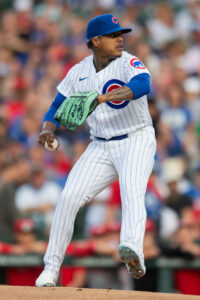
Having accepted a qualifying offer to return to the Mets in 2021, Stroman entered the 2021-22 offseason as an unrestricted free agent and found a new team quickly, agreeing to a three-year deal with the Cubs just before the players were locked out in early December. Stroman pitched solidly in his first season as a Cub, with a 3.50 ERA and 3.76 FIP across 138 2/3 innings of work. Entering the 2023 campaign, it appeared the righty had taken a step forward at the age of 32 as he pitched to an incredible 2.28 ERA with a 3.33 FIP in 98 2/3 innings of work across the first 16 starts of his season.
Unfortunately, things came apart from there as Stroman allowed a whopping 28 runs (24 earned) in just 27 innings across his next six starts before heading to the injured list with a hip issue. His stay on the shelf was extended by a rib cartilage fracture and by the time he returned to action in mid-September, the veteran righty was only able to muster eight middling innings of performance over his final four appearances in a Cubs uniform. Despite the rough second half, Stroman nonetheless finished the 2023 campaign with solid overall numbers, including a 3.95 ERA and 3.58 FIP in 136 2/3 innings of work.
Likely with his sights on a multiyear deal, Stroman opted of the final year and $21MM of his deal with the Cubs, returning to free agency. Stroman’s free agent market remained quiet for much of the offseason, though he was connected to the Royals before Kansas City ultimately opted to add right-handers Michael Wacha and Seth Lugo last month. The righty’s market reportedly picked up as the calendar flipped to 2024, with Heyman noting that the Red Sox, Orioles, Giants, and Angels were among the teams interested in the veteran’s services outside of the Bronx. Ultimately, Stroman’s contract matches well with the two-year, $44MM prediction MLBTR made back on November 6th.
Now, Stroman is set to return to New York to pitch on the other side of the Subway Series. The right-hander adds some veteran stability to the club’s rotation behind ace Gerrit Cole after southpaws Nestor Cortes and Carlos Rodon both produced uneven, injury-marred campaigns in 2023. As things stand, right-handed youngster Clarke Schmidt figures to round out the club’s starting quintet after producing solid back-end results across 33 appearances (32 starts) with the Yankees last year.
While Stroman has never been much of a strikeout artist, typically punching out around 20% of batters faced in a given year, he sports a strong 6.9% walk rate for his career and has been extremely effective at keeping the ball on the ground across his ten years as a major league player. Stroman’s groundball rate has never dipped below 50% throughout his career, and his 57.1% grounder rate last year actually slightly surpasses his career mark of 56.7%. Only Logan Webb, Framber Valdez, and Dallas Keuchel have generated grounders at a higher clip than Stroman throughout their careers among active players, and only Webb walks fewer batters among that group. It’s a style of play that should work particularly well in Yankee stadium, which was the third-most homer friendly park in the majors last year according to Statcast.
The addition of Stroman takes the Yankees over the final $297MM luxury tax threshold, with RosterResource projecting the club for a luxury tax payroll of just under $306MM in 2024. Every dollar the Yankees spend beyond that $297MM threshold will be taxed at a whopping 110% rate, given the team’s status as a third-time payor in 2024. The club’s actual 2024 payroll is similarly high, sitting at just over $294MM. That will be the highest payroll in club history, according to Cot’s Baseball Contracts.
Adding a starting pitcher to the club’s rotation appeared to be the Yankees’ biggest need at this point in the offseason, so it’s possible the club is mostly done for the winter at this point. Recent reports have indicated the club has some level of interest in the likes of Blake Snell, Jordan Montgomery, Dylan Cease, Shane Bieber and Jesus Luzardo, including a report earlier today that the club had made an offer to Snell. All of that was prior to the club’s addition of Stroman, of course, though it’s at least feasible the club could look to add another starter to pair with Cole at the front of the rotation, likely pushing Schmidt into a swing role out of the bullpen.
Jon Heyman of the New York Post first reported that the sides were “making progress” on a deal. Mike Mayer of Metsmerized was first with the sides coming to an agreement. Bob Nightengale of USA Today first reported that the deal, which is pending a physical, is for two years with an option for a third. Joel Sherman of the New York Post first reported the deal’s average annual value of $18.5MM a season, while Heyman first added that the third year is a vesting option. Sherman reported further details on the option.
Yankees, Juan Soto Avoid Arbitration
The Yankees and star outfielder Juan Soto have avoided arbitration, according to Joel Sherman of the New York Post. The sides settled upon a $31MM salary for the 2024 season — a new record for the largest salary every agreed to by an arbitration-eligible player. Soto, a client of the Boras Corporation, surpasses the $30MM benchmark that was established by two-time AL MVP Shohei Ohtani just last offseason.
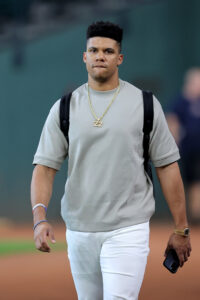
The 25-year-old Soto is coming off another strong season at the plate. After being shipped to the Padres at the 2022 trade deadline, the young phenom struggled with his new club early in the 2023 campaign with a .183/.345/.344 slash line in his first 27 games.
Soto managed to flip a switch from there, however, slashing an excellent .293/.423/.554 the rest of the way to elevate his season-long slash line to a strong .275/.410/.519. The performance saw Soto walk more often than he struck out for the fourth consecutive season, earn his third consecutive All-Star appearance as well as his fourth consecutive Silver Slugger award, and finish sixth in NL MVP voting while appearing in all 162 games for San Diego.
Between that walk year performance and the three prior times he’d been through the arbitration process as a Super Two player, Soto now stands alone as the highest-paid arbitration player in history (at least on a one-year deal). A new record was always the expectation; MLBTR contributor Matt Swartz’s model projected a $33MM salary for Soto, and both the Padres and the Yankees were surely anticipating a new highwater mark as well.
The looming precedent served as the impetus behind the deal that shipped Soto to the Bronx earlier this winter, as the Yankees surrendered right-handers Michael King, Jhony Brito, and Randy Vasquez as well as catcher Kyle Higashioka and top pitching prospect Drew Thorpe to acquire Soto and center fielder Trent Grisham. The Padres, after years of ultra-aggressive spending in free agency and on the trade market, were known to be looking to scale back payroll by as much as $50MM and simultaneously looking to replenish a rotation mix that lost Blake Snell, Seth Lugo, Nick Martinez and Michael Wacha to free agency.
Soto’s stop in the Bronx could well be for one year, though the Yankees will surely do everything in their power to keep him long-term. However, he’ll reach free agency at just 26 years of age next winter and do so as one of the most accomplished young bats to ever reach the open market so early.
The rarity of this type of talent becoming a free agent at such a young age could position Soto to command a contract in excess of the $460MM net present value of Ohtani’s extraordinarily deferred 10-year, $700MM deal — and it’s also possible that he could lock in the lengthiest contract ever put forth if he and agent Scott Boras prioritize that. Last offseason saw teams willing to dole out contracts greater than a decade in length to Trea Turner and Xander Bogaerts, each running through the players’ age-40 season. A contract covering Soto’s age-40 season would need to extend a mammoth 15 years in length, but for a player of this caliber at such a young age, anything could be on the table.
Soto, in fact, already rejected a staggering 15-year, $440MM contract offer from the Nationals back in 2021, which led to his original trade from D.C. to San Diego. Detractors panned the decision at the time, but with today’s $31MM agreement, he’ll already have pocketed $54MM since spurning that overture. He’ll “only” need to top $386MM in free agency to come out ahead, and as surreal as that number sounds, it also feels quite feasible.
Any talk of a record-setting deal (or close to it) in free agency next winter is putting the cart before the horse to some extent, of course. Soto will need to remain healthy in 2024 and continue to produce at the prodigious levels we’ve come to expect throughout his incredible big league tenure. Despite having just turned 25 in October, Soto already has 160 career home runs and is a lifetime .284/.421/.524 hitter in 3375 plate appearances. That incredible OBP currently stands as the 19th-best mark in MLB history.
Yankees Have Made Offer To Blake Snell
The Yankees have made an opening contract offer to free agent starter Blake Snell, reports Jon Heyman of the New York Post. Terms of the proposal aren’t clear, but Heyman adds the team and Snell’s representatives at the Boras Corporation remain “far apart” in talks.
New York is one of the teams that has been most frequently connected to Snell in recent weeks. That’s at least in part because they’re seemingly involved on most or all of the big-name pitchers available. They’ve been linked to old friend Jordan Montgomery and right-hander Marcus Stroman in free agency. On the trade front, reports have tied the Yankees to the likes of Dylan Cease, Jesús Luzardo and Shane Bieber.
It doesn’t seem they’re all that close on any of those players. Heyman reports the Yankees have thus far balked at Chicago’s asking price on Cease, which he adds involves a prospect package centered around 2022 first-round pick Spencer Jones. Baseball America recently ranked Jones, who hit .268/.337/.450 with 13 homers in High-A last year, as the #2 talent in the New York farm system. That’s consistent with various reports that Chicago wants multiple high-end prospects for Cease.
Meanwhile, Heyman notes there’s been “no traction” between the Yankees and Miami on talks involving Luzardo or righty Edward Cabrera. It’s unclear whether rentals like Bieber or Corbin Burnes will move this offseason. If New York doesn’t pick up steam on any of their trade conversations — they’ve surely discussed possibilities beyond what has been publicly reported — that could increase their urgency to add a top-of-the-rotation starter via free agency.
Snell and Montgomery are the clear top two options available. The incumbent Rangers have been linked to Montgomery throughout the offseason. Teams like the Angels, Giants, Phillies and Red Sox have been tied to both left-handers. The Giants and Halos have been more frequently linked to Snell than have the latter two clubs.
The Yankees are the first team known to have an offer on the table (although that’s certainly not to say there aren’t others that were unreported). Snell is coming off his second career Cy Young campaign. He worked to an MLB-best 2.25 ERA over 180 innings. He fanned over 31% of batters faced and was utterly dominant down the stretch, posting a 1.23 ERA from June 1 onward. His command is erratic, but few pitchers are as difficult to hit when they’re on.
A pursuit of Snell is fairly reminiscent of last winter’s run at Carlos Rodón, another left-hander with huge stuff coming off an excellent platform year despite some career inconsistency. Rodón’s six-year, $162MM deal looked disastrous in year one. While one could argue that should make the Yankees gun-shy about pursuing a similar pitcher, it also increases the need for another high-end starter. Neither Rodón nor Nestor Cortes looked like top-of-the-rotation arms last season. That leaves New York looking for another star to pitch behind Gerrit Cole and reduce some of the pressure on Rodón and Cortes.
MLBTR predicted a seven-year, $200MM deal for Snell, who turned 31 last month. A signing team would also forfeit draft compensation because he rejected a qualifying offer from the Padres. For a team that paid the luxury tax like the Yankees, that’d be their second- and fifth-highest selections next year and $1MM in international signing bonus space. New York’s luxury tax payroll sits around $291MM, according to Roster Resource. They’re taxed at a 95% rate on spending up to the $297MM mark and will pay a 110% tax on every dollar beyond that figure.
Reds To Sign Brent Suter
The Reds are in agreement with left-hander Brent Suter on a one-year deal, reports Robert Murray of FanSided. It’s a $3MM guarantee that takes the form of a $2.5MM salary in 2024 and a $500K buyout on a $3.5MM club option for ’25. The deal is still pending a physical for the Diamond Sports Management client. Cincinnati will need to make a corresponding move to clear a spot on the 40-man roster once the contract is finalized.
It’s the latest move in a pitching-heavy offseason. The Reds have added Frankie Montas to the rotation and Emilio Pagán to the late innings. Swingman Nick Martinez could contribute in either role. Suter seems ticketed for the bullpen, although he reportedly drew some interest as a starting pitcher this winter.
The 34-year-old has spent the past half-decade in relief. Suter saw some work out of the rotation early in his career with the Brewers. Despite finding a decent amount of success, he was pushed to the bullpen by 2019 as Milwaukee graduated pitchers with higher caliber stuff.

While Suter isn’t a prototypical power reliever, he has been a valuable bullpen piece. The Harvard product has turned in a sub-4.00 ERA in five straight seasons. Suter’s profile has been built around strong control and excellent contact suppression. He has posted better than average ground-ball rates over the past five seasons and is consistently one of the game’s toughest pitchers to square up.
Opponents have averaged between 84-86 MPH in exit velocity in each of the last four seasons, per Statcast. That ranked in the 95th percentile or better in all four years. Batters made hard contact (an exit velocity at or above 95 MPH) on only 26.3% of their batted balls a season ago. Among qualified pitchers, only Phil Maton, Tom Cosgrove and Tanner Scott did a better job avoiding authoritative contact.
The ability to stay off barrels allowed Suter to overcome hitter-friendly home environments. He turned in strong results in Milwaukee and had no issues acclimating to Colorado’s Coors Field after a waiver claim last offseason. In 69 1/3 innings, he turned in a 3.38 ERA for the Rockies, including a 3.66 mark in 32 frames in Denver. A track record of success in difficult home parks is surely appealing to a front office building a pitching staff in Great American Ball Park.
Nevertheless, teams generally harbor skepticism about a pitcher who succeeds on guile and command without overpowering pure stuff. Suter’s only season with an above-average strikeout rate came during the abbreviated 2020 campaign. Last year, he punched out just 18.8% of opponents while sitting in the mid-upper 80s with his sinker and four-seam fastball.
Suter’s age and lack of velocity was always likely to limit his market. It’s still somewhat surprising that he landed a $3MM guarantee. Next year’s salary is a half million dollars below the $3MM he made last year, his final arbitration season. Suter grew up in Cincinnati and attended high school there, so it seems fair to presume that geography played a role in his decision — particularly if his camp was sorting through a number of low-cost, one-year offers.
He joins Sam Moll and Alex Young as left-handed relief options for skipper David Bell. The Reds have Alexis Díaz in the ninth inning and brought back Buck Farmer to join Pagán and Lucas Sims as right-handed setup candidates. Ian Gibaut, who is out of options, could compete with Fernando Cruz and Tejay Antone for the final spot or two in the middle innings.
Image courtesy of USA Today Sports.
Cubs Acquire Michael Busch, Yency Almonte
The Dodgers and Cubs announced a trade sending rookie infielder Michael Busch and reliever Yency Almonte from Los Angeles to Chicago for prospects Jackson Ferris and Zyhir Hope. The deal clears a pair of 40-man roster spots for L.A. — one of which will go Teoscar Hernández once his free agent pact is finalized. The Cubs designated catcher Brian Serven for assignment in a corresponding move.
Busch has the more significant value of the players headed to Chicago. Los Angeles selected the UNC product with the 31st overall pick in the 2019 draft. Regarded as a bat-first prospect with questions about his defensive fit, Busch has mostly lived up to that billing during his time in the minors.
Over parts of four seasons, the left-handed hitter owns a .283/.390/.529 line. That includes a robust .293/.385/.544 showing in just under 1000 plate appearances at Triple-A. Busch has connected on 48 home runs and 58 doubles with an excellent 11.8% walk rate at the top minor league level. His 22.5% strikeout rate is closer to league average, but Busch has shown a strong combination of power and patience.
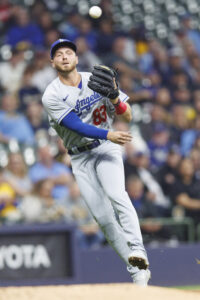
Despite his excellent Triple-A production, the 26-year-old hasn’t gotten much of an MLB opportunity. He didn’t reach the majors until last April. He appeared in 27 games scattered over the course of the season. Through his first 81 plate appearances, he hit only .167/.247/.292 with a pair of home runs. He struck out in a third of his trips.
There’s not much to be gleaned from such a small sample of MLB work. At the same time, that the Dodgers haven’t given Busch extended run is indicative of a few factors. The Dodgers have had strong position player groups in recent years. That’s an impediment to a young hitter, but L.A. had some questions at second base and left field last season. Were Busch regarded as a better defensive player, perhaps he’d have forced his way into the discussion at one or both of those spots.
L.A. has given Busch opportunities at a few positions in the minors. While he has played primarily second base, he’s also gotten work at both corner infield spots and in left field. Prospect evaluators have graded him as a below-average defender at every spot, raising questions about his athleticism and arm strength. Baseball America nevertheless ranked him as the top prospect in the Dodgers system this offseason on the strength of his offensive ceiling.
In some respects, the Cubs will face the same question on Busch as they do on Christopher Morel — where to find at-bats for a promising hitter who hasn’t defended well at any position. That’d most likely come at a corner infield spot or at DH. Morel projects for a starting role at either first base or DH. Some combination of Patrick Wisdom and Nick Madrigal are the top options at the hot corner. The Cubs could still pursue a free agent target at either spot — they’ve been tied to Rhys Hoskins and Matt Chapman this winter — but Busch adds an affordable, high-upside lefty bat to the mix.
Busch still has a pair of minor league option years, so he’s not a lock to open the season on the MLB roster. He’s at least three years from arbitration and won’t be eligible for free agency for at least six seasons. Future minor league assignments could push that back even further.
A secondary part of the return, Almonte steps into the middle relief corps. The 29-year-old righty pitched in 49 games a year ago, working to a 5.06 ERA across 48 innings. He struck hitters out at a solid 23.6% clip but issued free passes to more than 11% of opponents. That continues an up-and-down career for Almonte, who has three seasons with a sub-3.00 ERA and a trio of campaigns allowing more than five earned runs per nine.
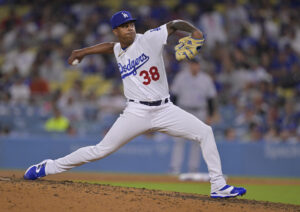
Almonte and the Dodgers already agreed to a $1.9MM arbitration salary back in November. The Cubs will take on that near-$2MM sum to add a pitcher with a mid-90s fastball and a low-80s sweeper that has generated a strong number of whiffs throughout his career. He’s out of options, so he’ll very likely have a spot in the Opening Day bullpen. The Cubs could control him via arbitration for the 2025 season as well.
To add immediate MLB help, Chicago parts with two promising lower-level players. Ferris, who turns 20 next week, was a second-round pick in the 2022 draft. A 6’4″ left-hander, he signed for a well overslot $3MM bonus as a high school prospect. Ferris made his professional debut last season, turning in a 3.38 ERA over 18 starts for Low-A Myrtle Beach. He punched out nearly a third of his opponents while walking almost 14% of batters faced.
As a young, lanky pitching prospect, it’s not particularly surprising that Ferris has yet to dial in his control. Baseball America praised a 93-95 MPH fastball and a pair of potential above-average or plus breaking balls this offseason, slotting him as the #10 prospect in the Chicago system. He’s a high-upside development play whose future will largely be determined by how well his command develops.
Hope was an overslot signee for $400K in the 11th round last summer. A left-handed hitting outfielder from a Virginia high school, he played in 11 rookie ball games after the draft. In a pre-draft report, BA wrote that Hope was among the fastest players in last year’s class. He’s regarded as a viable fit in center field with a line drive approach, although BA expressed trepidation about his aggressiveness at the dish.
Juan Toribio of MLB.com first reported the Dodgers were discussing Almonte and Busch in trades with the Cubs. Jon Heyman of the New York Post confirmed an Almonte deal was agreed upon. Ken Rosenthal of the Athletic reported the Dodgers were receiving two players not on the 40-man roster, which Toribio specified included a highly-regarded pitching prospect. Ari Alexander of KPRC 2 was first to report L.A. would receive Ferris and Hope.
Images courtesy of USA Today Sports.
Cubs Sign Shota Imanaga To Four-Year Deal
The Cubs officially announced the signing of left-hander Shota Imanaga to a four-year contract. It’s reportedly a $53MM guarantee. The deal contains a fifth-year team option and could reach $80MM. The Cubs will need to decide after the 2025 and potentially ’26 seasons whether to exercise the option for 2028. If the club declines the option at either point, Imanaga would have the ability to opt out and become a free agent. He receives limited no-trade rights and would earn a full no-trade clause if the Cubs exercise either of their options.
On top of what they’ll pay Imanaga, the Cubs owe a posting fee to the Yokohama BayStars of Nippon Professional Baseball. That’ll initially be a $9.825MM sum and would increase if the team exercises the option and/or Imanaga unlocks more money via escalators. The Cubs would owe the BayStars an additional 15% of whatever money the southpaw earns beyond the initial guarantee.
It’s the first MLB free agent pickup of the offseason for the Cubs. It’s a big acquisition, as the southpaw is one of the more intriguing pitchers in this year’s class. That makes the financial terms unexpected. At the beginning of the offseason, MLBTR predicted a five-year, $85MM contract. Reporting in recent weeks had suggested he could top $100MM. Even with the conditional opt-out possibilities, a $53MM guarantee and an $80MM maximum value comes in below general expectations.
Imanaga has spent the past eight seasons with the BayStars in his home country. He owns a career 3.18 ERA in a league generally regarded as the second-best level in the world. Imanaga has turned in a 3.08 or better in each of the past three seasons, including a sub-3.00 figure for the last two years.
During the 2023 campaign, he allowed 2.80 earned runs per nine through 148 innings. He led all NPB hurlers with 174 strikeouts, narrowly topping Dodgers’ $325MM signee Yoshinobu Yamamoto in that regard. That’s an impressive 29.2% clip that’s well above the 22.1% MLB average. He paired that with a tidy 4% walk rate, ranking him among NPB’s best pitchers at dominating the strike zone.
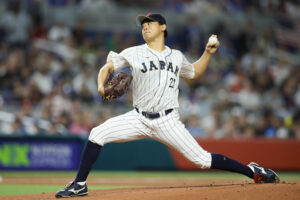
Despite the strong strikeout and walk profile, Imanaga doesn’t come with the kind of excitement generated by Yamamoto. That’s in part due to age. Having turned 30 last September, Imanaga is a typical age for a first-time free agent starter. More importantly, his repertoire points more toward a projection as a solid mid-rotation arm than a potential ace.
Evaluators with whom MLBTR spoke before the offseason suggested Imanaga profiles as a #3/4 pitcher in a big league rotation. Baseball America’s Kyle Glaser pegged him as a #4/5 type in a scouting report from early December. The 5’10” hurler typically sits in the low-90s with his fastball, touching the 94-95 MPH range in shorter stints.
Evaluators have credited him with above-average life on the pitch, allowing it to play for whiffs at the top of the strike zone despite the pedestrian velocity. Glaser writes that Imanaga backs that up with an above-average split but suggests his MLB upside may be capped by middling breaking stuff.
The main concern in Imanaga’s statistical profile has been the longball. He surrendered 17 homers last season, the second-most of any NPB pitcher. While some of that is attributable to workload — he was 15th in innings pitched — it hints at a fly-ball profile that could give some evaluators pause. The Yankees reportedly stayed on the periphery of the bidding in part because of concerns that Imanaga wouldn’t profile well in a very hitter-friendly home park. Statcast’s Park Factors rate Wrigley Field as slightly favorable to home runs, but it’s not among the top handful of hitting venues in MLB.
Imanaga’s stellar strikeout/walk profile and consistently strong results generated a decent amount of reported interest. The Red Sox, Giants and Angels were all reported to be in the bidding of late. He’ll bypass those teams to step into a Chicago rotation that seems likely to lose Marcus Stroman to free agency.
Imanaga joins Justin Steele, Kyle Hendricks and Jameson Taillon as locks for the Opening Day rotation. The likes of Jordan Wicks, Javier Assad, Hayden Wesneski and prospect Ben Brown could battle for the #5 job. There’s still plenty of time for president of baseball operations Jed Hoyer and his front office to add another starter if they want to solidify the final spot and push all their younger, unproven arms into depth roles.
The fee to the BayStars is proportional to the contract value: 20% of the deal’s first $25MM ($5MM), 17.5% of the next $25MM ($4.375MM) and 15% of further spending ($450K). The 15% rate also applies to whatever future earnings Imanaga secures.
A posting fee is on top of the sum to the player but not included in the deal’s competitive balance tax calculation. The average annual value checks in at $13.25MM. According to Roster Resource, that’ll push the team’s CBT number north of $198MM. That’s nowhere near next year’s $237MM tax threshold. Evenly distributing the salaries would move the team’s 2024 payroll commitments to roughly $191MM — slightly beyond last year’s approximate $184MM Opening Day mark.
Bob Nightengale of USA Today first reported the Cubs had an agreement with Imanaga. Jon Heyman of the New York Post reported the presence of various escalators and option provisions and the deal’s $80MM maximum value. ESPN’s Jesse Rogers reported the four-year, $53MM agreement, as well as the club option/opt-out possibilities after years two and three. Patrick Mooney of the Athletic reported the no-trade provisions.
Image courtesy of USA Today Sports.
Dodgers Sign Teoscar Hernandez
The Dodgers have continued their free agent spending spree, announcing a one-year, $23.5MM deal with outfielder Teoscar Hernandez. Only $15MM of that salary will be paid to Hernandez this year, as the rest is deferred and will be paid out in installments from 2030-39. Hernandez is represented by Republik Sports.
Reports about the Dodgers’ interest in Hernandez surfaced soon after the free agent market opened back in early November, and L.A. maintained that interest all the way up until today’s agreement. The Dodgers were known to be still be looking for a right-handed bat, and they’ve now addressed that need in a big way with a former All-Star and Silver Slugger who has hit 147 home runs over 3002 plate appearances since the start of the 2018 season.
After a string of productive years with the Blue Jays, Hernandez was dealt for Erik Swanson and Adam Macko last offseason, and Hernandez’s move to Seattle resulted in a downturn in his production. While he still went yard 26 times, Hernandez batted only .258/.305/.435 over 678 plate appearances, and his 105 wRC+ was well below his 133 wRC+ from 2020-22. Since Hernandez’s underlying metrics were largely the same as his career norms, it seems possible that the biggest culprit was simply T-Mobile Park. Hernandez hit only .217/.263/.380 in the Mariners’ home ballpark last season, as opposed to a much stronger .295/.344/.486 slash line on the road.
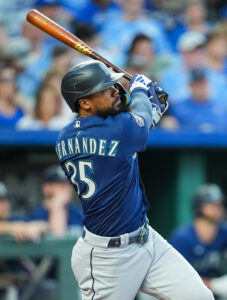 While Dodger Stadium has something of a pitcher-friendly reputation itself, it stands to reason that the 31-year-old Hernandez might get back on track in a new environment, and this one-year deal might reflect his desire to re-establish himself before committing to a longer-term contract. MLB Trade Rumors ranked Hernandez 12th on our list of the winter’s top 50 free agents and projected him for a four-year, $80MM deal, under the logic that the offseason’s lack of premium bats would still lead to a big contract for Hernandez even in the wake of an underwhelming 2023 campaign.
It could also be the case that Hernandez was open to a one-year pact specifically to join the Dodgers, as the outfielder is now joining arguably baseball’s most loaded lineup. Los Angeles already racked up plenty of runs in their 100-win 2023 campaign, and that powerful collection of position players has now added Shohei Ohtani to the DH spot and Hernandez to a corner outfield role.
Hernandez now gets to join a contender and possibly win a World Series ring, while ideally posting a better platform year that would allow him to score a big multi-year contract next winter. The Angels and Red Sox were two other teams known to be in the running for Hernandez’s services, and reporter Francys Romero and MassLive.com’s Chris Cotillo (X links) each relayed that those teams had interest in the outfielder on two-year deals. In Boston’s case, Cotillo wrote that the Sox were interested in something akin to a two-year, $28MM pact.
Hernandez now looks to be the Dodgers’ everyday option primarily in left field, though he could slide over to right field when a left-hander is on the mound (thus sending Jason Heyward to the bench). L.A. is still perhaps a little unbalanced with left-handed hitters in its first-choice lineup, yet Hernandez now joins Mookie Betts and Will Smith as big righty swingers, plus the Dodgers have other right-handed bats in Chris Taylor, Manuel Margot, and Miguel Rojas available off the bench.
Margot was also recently acquired as part of the Tyler Glasnow trade with the Rays but is known more for his defense than his bat. Taylor can fill in at multiple positions, and his hitting also became a question mark after a down year in 2022, though he did bounce back with a 104 wRC+ over 384 PA last season. Having Taylor as a supersub around the diamond is perhaps a better use for his skillset than a regular spot in left field, even if defensive metrics have been mixed at best about Hernandez’s outfield glovework during his career.
Hernandez has never drawn many walks during his career, and his high strikeout totals add even more swing-and-miss to a team that already saw Taylor, James Outman, Max Muncy, and even Ohtani rank well below the league average in strikeout rate in 2023. Still, the relative lack of contact is something of a minor flaw compared to the huge upside provided by the Dodgers’ overall offensive attack.
The deferred money will lower the luxury tax number on Hernandez’s $23.5MM salary, but his signing represents yet another big expenditure for a Los Angeles team that has basically lapped the rest of the league combined in offseason spending. Led by Ohtani’s $700MM deal and Yoshinobu Yamamoto‘s $325MM contract, the Dodgers have now spent slightly under $1.067 billion on free agents alone this winter, to say nothing of the extra money taken on when L.A. acquired and then extended Glasnow. As per Roster Resource, the Dodgers’ tax number for 2024 now sits at roughly $302.32MM, well over the Competitive Balance Tax’s highest penalty threshold of $297MM.
Even with the luxury tax bill continuing to escalate, there is little reason to think L.A. is done making moves, as starting pitching continues to be a need even after adding Yamamoto and Glasnow. More signings obviously can’t be ruled out, or the Dodgers could move more young talent in other trades for another starter. The sky is basically the limit for Los Angeles at this point, as the Dodgers have outpaced even their usual high-spending ways (with the many deferrals kicking the financial can down the road to some extent) in building a veritable superteam with Ohtani, Betts, Yamamoto, and Freddie Freeman among the cornerstones.
Reporter Moises Fabian (via X) was first with the news that Hernandez had signed with Los Angeles, and ESPN’s Jeff Passan (X links) reported details about the one-year term, the salary, and the deferred money.
Photo courtesy of USA Today Sports Images
Mets Sign Harrison Bader
TODAY: Bader’s $10.5MM guarantee breaks down as a $1MM signing bonus and a $9.5MM salary in 2024, according to Jon Heyman of the New York Post (X link). Up to $350K in incentive bonuses is also available.
JANUARY 5: The Mets have officially announced that they have signed Bader.
JANUARY 4: The Mets are signing Harrison Bader, reports Andy Martino of SNY. It’s a one-year deal worth approximately $10MM, per Martino. Joel Sherman of The New York Post reports the salary as $10.5MM for the Vayner Sports client.
 Bader, 30 in June, is an elite defensive outfielder who has had mixed results as a hitter and has also struggled to stay consistently healthy. Since his debut in 2017, he has racked up 52 Defensive Runs Saved, 68 Outs Above Average and a grade of 46.6 from Ultimate Zone Rating. All three of those figures place him in the top 10 among all outfielders in the league in that time. He’s also stolen 77 bases in 95 tries.
The offensive side of his game is less impressive, however. He’s hit .243/.310/.396 in his career for a wRC+ of 92, indicating he’s been 8% below league average overall. He has been above average at times, posting a wRC+ of 107 in 2018 and a 108 in 2021, but the past two years have been rough. He split 2022 between the Cardinals and Yankees, getting flipped for Jordan Montgomery at the deadline. He finished that year with a batting line of .250/.294/.356 and a wRC+ of just 85. His production fell even further in 2023, as he hit .232/.274/.348 on the year for a wRC+ of 70, going to the Reds late in the year as the Yankees looked to dump salary by putting Bader on waivers.
Health has also been a concern in each of the past three seasons, with Bader getting into 287 games over that stretch, never getting into more than 103 in any of those seasons individually. Those past three seasons have seen him hit the injured list due to a right rib hairline fracture, right foot plantar fasciitis, a left oblique strain, a right hamstring strain and a right groin strain.
The Mets have been planning for 2024 to be a sort of transition year, signing players to modest deals and making other depth moves as new president of baseball operations David Stearns evaluates the organization before likely ramping up aggressiveness next winter. Luis Severino, Joey Wendle, Jorge López, Austin Adams and Michael Tonkin have all joined the roster via one-year pacts, while the club also acquired Adrian Houser and Tyrone Taylor from the Brewers. They have claimed Penn Murfee, Zack Short, Tyler Heineman and Cooper Hummel off waivers and given out a number of minor league deals.
Bader will fit into that strategy while bolstering the outfield mix. His strong defense will allow Brandon Nimmo, whose defensive grades dipped in 2023, to spend a bit more time in a corner. Bader also has notable platoon splits, which could perhaps allow the Mets to deploy him selectively. He has hit .262/.330/.494 against lefties in his career for a wRC+ of 121, but .236/.304/.364 against righties for a wRC+ of 82. Nimmo hits from the left side but also fares well against pitchers of either handedness. DJ Stewart is a lefty hitter who mashes righties and is a poor defender to boot, meaning he and Bader could nicely augment each other’s weaknesses.
The outfield picture now includes Bader, Nimmo, Stewart, Taylor and Starling Marte. Nimmo and Marte have injury histories of their own, so perhaps the Mets will use the designated hitter slot to give out occasional rest days and keep everyone healthy over the course of the season.
MLBTR predicted Bader for a two-year, $20MM deal, perhaps with an opt out that would allow him to return to the open market with a better offensive platform. Instead, he lands a straight one-year pact at roughly the same average annual value. The one-year, $10.5MM framework is the exact same as the deal between Kevin Kiermaier, another glove-first outfielder, and the Blue Jays.
Despite the relatively modest offseason, the Mets are still way into competitive balance tax territory. Roster Resource has their CBT figure at $307MM, north of the fourth and final bracket of $297MM. As a third-time payor, they are set to pay a 110% tax on any spending above that line, meaning they could end up paying over $20MM for one year of Bader’s services. However, the tax payments aren’t calculated until the end of the year. If the Mets don’t find themselves in contention this summer, they could move some salary by trading players such as Pete Alonso or José Quintana and alter their final tax status.