
Rangers Fire President Of Baseball Operations Jon Daniels
The Rangers are dismissing longtime president of baseball operations Jon Daniels, Ken Rosenthal and Levi Weaver of The Athletic report (via Twitter). Texas announced the move shortly thereafter, adding that general manager Chris Young will now oversee all baseball operations decisions and processes. The move comes just days after the organization fired manager Chris Woodward.
“This morning I informed Jon Daniels that his contract would not be renewed at the end of the season and that he is being relieved of his duties effective immediately,” managing partner Ray Davis said in a press release announcing the move. “Jon’s accomplishments in his 17 years running our baseball operations department have been numerous. He and his staff put together the best teams in this franchise’s history that resulted in five playoff appearances and two American League pennants between 2010 and 2016. His impact on the growth of our player development, scouting, and analytics groups has been immense. Jon has always had the best interests of the Rangers organization in mind on and off the field and in the community.
“But the bottom line is we have not had a winning record since 2016 and for much of that time, have not been competitive in the A.L. West Division. While I am certain we are heading in the right direction, I feel a change in leadership of the baseball operations department will be beneficial going forward.”
Daniels had been atop the Rangers’ baseball operations hierarchy since way back in 2005, when at just 28 years of age he became the sport’s youngest general manager. Prior to today’s ousting, he was the sport’s third-longest-tenured baseball ops leader, trailing only Athletics executive vice president Billy Beane and Yankees general manager Brian Cashman.
As Davis alluded to, Daniels oversaw some of the finest years in Rangers franchise history, including a pair of back-to-back World Series appearances in 2010-11. Those teams thrived in no small part due to savvy trades made by Daniels. His blockbuster deal sending Mark Teixeira to the Braves (in exchange for shortstop Elvis Andrus, 2010 AL Rookie of the Year Neftali Feliz, catcher Jarrod Saltalamacchia and lefty Matt Harrison) and Daniels’ acquisitions of Josh Hamilton (from the Reds in exchange for Edinson Volquez) and Nelson Cruz (from the Brewers for Carlos Lee) helped set the stage for those halcyon days in Arlington.
The success carried into the mid-2010s, as Texas won the AL West and enjoyed a 97-win season back in 2016. That came on the heels of some other high-profile moves — e.g. signing Yu Darvish and Adrian Beltre, acquiring Cole Hamels — which led to multiple contract extensions for Daniels over the years. Since that time, however, ill-fated signings have begun to mount while what should have been pivotal trades have failed to bear fruit.
The 2014 signing of Shin-Soo Choo to a seven-year, $131MM contract ultimately proved to be a misstep, for instance, and shorter-term deals for veterans like Andrew Cashner and Carlos Gomez also came up empty. Texas’ 2016 acquisition of Jonathan Lucroy went south in 2017, and the Rangers ultimately received little to no value in trades of production veterans such as Yu Darvish and Mike Minor, which further set the farm system back. Meanwhile, homegrown talents projected for stardom never achieved those ceilings; Nomar Mazara, Martin Perez, Leody Taveras, Hans Crouse, Willie Calhoun (acquired for Darvish) and Chi Chi Gonzalez are among the many former Top-100 Rangers prospects who never really developed into impact players (though Perez’s 2022 breakout has at least finally changed the narrative on him to an extent).
That difficulty regarding player development wasn’t unique to the organization’s very best prospects, either. Rather, Texas’ ability to develop big leaguers through the draft has simply stalled out in recent years. Incredibly, not one member of the Rangers’ 2018-21 draft classes has reached the Majors yet. Dating back to 2016, right-hander Joe Barlow is the only player drafted by the Rangers to produce even 1.0 wins above replacement in the Majors.
Certainly, that doesn’t all fall solely on Daniels’ shoulders. The Rangers have had scouts, analysts and dozens of other executives contributing to those collaborative processes throughout that dry period, but as general manager (and eventually president of baseball operations), Daniels was the final call both on baseball operations decisions, on filling out the scouting and player development ranks, etc.
Speaking of general managers — those duties will now all fall to Young, the 43-year-old former big league pitcher who has rapidly ascended into the game’s executive ranks following the conclusion of a 13-year Major League career. A Princeton product, Young was always touted as one of the sport’s brightest baseball minds, even during his playing days. He broke into executive work not with a team but working in Major League Baseball’s offices, where he served as the league’s senior vice president of on-field operations, initiatives and strategy.
Young was tabbed as the new Rangers’ general manager in somewhat out-of-the-blue fashion in Dec. 2020. It was his first post working in a Major League front office, but the Rangers weren’t the only club with interest. The Mets, in owner Steve Cohen’s first offseason at the wheel of the team, had interest in interviewing Young for their own GM vacancy. He interviewed for the post but withdrew his name from consideration, citing the fact that he did not want to move his family from Dallas to New York as the key factor in that decision. A week later, the Rangers announced his hiring.
Young may not have the typical resume most up-and-coming executives bring to the table, but he’s spent the past two years learning under Daniels — who, for all the Rangers’ recent struggles, remains one of the game’s most widely respected executives. That experience will prove vital as Young now sets forth to execute his own vision for the franchise.
Daniels, meanwhile, would surely be a welcome addition to countless baseball ops departments around the game, though it’s not yet clear whether he’ll immediately pursue another position or whether he’ll step back and take some time with his family after a near two-decade grind leading the Rangers. He’s been tied to his hometown Mets in the past, and there will be at least one GM vacancy this offseason now that the Tigers have fired Al Avila. Time will tell, but Daniels should have little trouble finding a new role if he’s so inclined — though for the time being, it may not be running his own department.
Athletics Release Elvis Andrus
The A’s announced Wednesday that they’ve released veteran shortstop Elvis Andrus. Infielder Sheldon Neuse is up from Triple-A Las Vegas to take his spot on the roster.
Once Andrus wasn’t traded either in the offseason or at the trade deadline earlier this month, the writing was on the wall for Andrus, whose contract contains a vesting player option for the 2023 season that would become kick in upon reaching 550 plate appearances. The rebuilding Athletics unsurprisingly had no interest in allowing that option to vest, and the mere presence of that option has made the possibility of trading Andrus seem both complicated and frankly unlikely since this past winter. Now that he’s been released, however, it’s a moot point; the option won’t vest an Andrus will simply become a free agent at season’s end.
[Related: Vesting Options Updates on Flexen, Maldonado, Carrasco, Andrus]
Andrus can now sign a new deal that does not require a new club to pay him $15MM in 2023 if he reaches 550 plate appearances on the season. (He’s currently at 386 trips to the plate and would’ve needed another 164 to reach that threshold.) Any team that signs Andrus would need only pay him the prorated league minimum for any time spent on the Major League roster; the A’s will remain on the hook for the rest of this year’s salary.
It’s been a decent season for Andrus at the plate and with the glove. The 33-year-old (34 next week) is no longer the hitter, but he’s turned in a respectable .237/.301/.373 batting line (97 wRC+) with eight home runs, 24 doubles and seven stolen bases. Defensive metrics on Andrus are something of a mixed bag this season; Defensive Runs Saved pegs him six runs below average, but neither Ultimate Zone Rating (2.6) nor Outs Above Average (-1) is quite so sour on his glovework. It’s fair to say that Andrus is clearly no longer the premium defender he was early in his career, when he was regarded as one of the sport’s top gloves at any position.
With Andrus out the door, the A’s will turn shortstop over to a player who has just that type of defensive prowess right now, in the early stages of his own career. Nick Allen, 23, has managed just a .215/.279/.316 slash through his first 173 trips to the plate in the big leagues, but he’s considered one of the best defensive shortstops in the minors and has a more palatable .266/.371/.358 slash in 206 plate appearances for Triple-A Las Vegas, where he’s walked almost as often as he’s struck out (13.1% versus 16.5%).
Allen will likely never hit for power in the big leagues, but with regular playing time, his walk rates, speed and bat-to-ball skills could lead to some 20-steal seasons with solid OBP marks and plus defensive contributions. If the lack of power proves too limiting for Allen to hit like an everyday player, the glove and above-average speed should make him a useful utility infielder who can provide excellent defense at shortstop, second base and third base.
Braves, Michael Harris II Agree To Eight-Year Extension
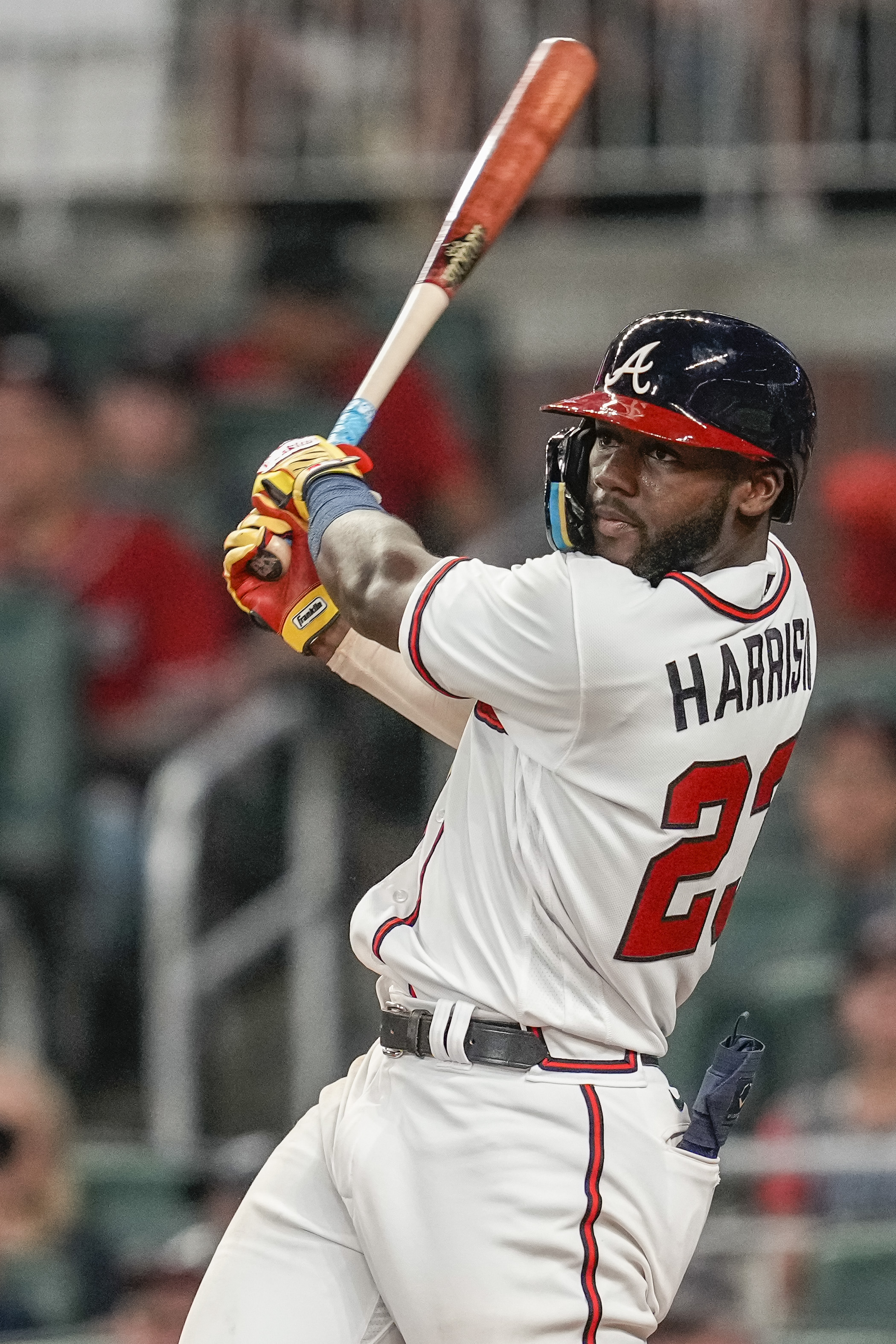
The Braves have moved swiftly to lock up yet another budding star on a contract extension, announcing on Tuesday night that they’ve signed rookie center fielder Michael Harris II to an eight-year, $72MM contract spanning the 2023-30 seasons. The contract contains club options for the 2031 and 2032 seasons as well.
The Braves, one of the few Major League teams to publicly disclose terms of their contracts, added that Harris will earn $5MM per season in 2023-24, $8MM annually in 2025-26, $9MM in 2027, $10MM annually from 2028-29, and $12MM in 2030. The 2031 option is valued at $15MM, and the 2032 option is valued at $20MM. Both come with $5MM buyouts.
Harris, a frontrunner to finish in the top two of National League Rookie of the Year voting — perhaps alongside teammate Spencer Strider — would’ve been a free agent after either the 2027 (with a top-two Rookie of the Year finish) or after the 2028 season but will instead forgo a trip to the open market in his mid-20s to sign a long-term pact with his hometown team.
The eight-year pact continues an aggressive trend from an Atlanta front office that has been unafraid to pay sizable sums to its young stars early in their careers. Outfielder Ronald Acuna Jr. (eight years, $100MM) and second baseman Ozzie Albies (seven years, $35MM) both signed early, very club-friendly extensions that included a pair of club options beyond their guaranteed years. Acuna’s deal, like the one being discussed with Harris, was agreed upon before he even had a full year of Major League service time.
More recently, the Braves inked Matt Olson to an eight-year, $168MM extension the day after acquiring him in a five-player blockbuster with the A’s. And, this past summer, while so many teams were focused on the trade deadline in late July, the Braves hammered out a ten-year, $212MM extension for third baseman Austin Riley (before also making a handful of trades themselves, of course).
Harris, 21, was the No. 98 overall pick in the 2019 draft and bolstered his prospect stock with a torrid race through the minors that culminated in him skipping Triple-A entirely earlier this year. Despite being promoted right from Double-A, Harris hasn’t missed a beat in the Majors. He’s logged 268 plate appearances in the Majors, tonight’s performance included, and turned in a robust .287/.325/.500 batting line with a dozen homers, 14 doubles, two triples and 13 steals (in 13 tries). Couple that production with plus center field defense (5 Defensive Runs Saved and Outs Above Average alike), and it’s easy to see how the Braves have quickly become enamored of the dynamic young outfielder.
As with any extension for a young player, there’s certainly some risk to both sides. Harris has but 71 games of big league experience under his belt with no Triple-A seasoning of which to speak. In fact, he played only 43 games in Double-A prior to his promotion. And, as good as he’s been thus far in his big league career, the Braves would surely like to see him improve upon a dismal 3.7% walk rate. He’s currently sporting a .345 average on balls in play that’ll likely drop a bit, although players with Harris’ type of speed (94th percentile sprint speed, per Statcast) can often sustain BABIP numbers higher than the league average.
The risk for Harris, meanwhile, is the same that teammates such as Acuna and Albies took when inking their own deals. He’s locking in a life-changing sum of money, to be sure, but a top-two finish in Rookie of the Year voting would have put Harris on track for arbitration following the 2024 season (or, absent that top-two finish, after the 2025 campaign). As things stand, he could’ve either been a free agent following the 2027 season, heading into his age-27 season, or following the 2028 campaign (when he’d be heading into his age-28 season). Free agents who are that young are the sorts who tend to land decade-long contracts north of $200MM or even $300MM.
Certainly, we can’t know whether Harris will sustain his current pace for a full six years. We see players debut with great fanfare and fade from the spotlight somewhat regularly, and injuries can always impact a player’s development and open-market earning power. Harris is surely aware that any early-career extension like this has the potential to turn into an unmitigated bargain for the team, just as the Braves are aware that Harris isn’t necessarily a lock to cement himself among the game’s elite young outfielders. That’s the balance all teams and players strive to strike in early extensions like this, and it appears that in this instance, the Braves and Harris found a sweet spot that’ll clock in a ways short of the Acuna deal but line up nicely with the recent eight-year, $70MM extension signed by Pirates third baseman Ke’Bryan Hayes.
While these contracts tend to be bargains of significant nature when they hit — as they’ve done near universally for the Braves to this point — it’s also worth pointing out that they do inflate a team’s luxury-tax ledger earlier than might otherwise be the case. A $72MM contract for Harris will give him an immediate $9MM luxury hit (the contract’s average annual value) when he’d otherwise have counted for less than $1MM against the tax line.
Atlanta has a $207MM luxury payroll this year and $128MM already counting against next year’s ledger, and that’s before including a Harris contract or arbitration raises for any of Max Fried, A.J. Minter, Mike Soroka or Tyler Matzek (plus any free-agent or trade additions this winter). The extensions are still likely to be cost-effective moves for the team in the long run, but the Braves will have about $50MM of luxury commitments to Acuna, Albies, Riley and Harris alone next season if this deal indeed goes through.
None of that should serve as a deterrent, of course. Harris looks the part of a budding young star, and pairing him alongside Acuna in the outfield and alongside Acuna, Riley and Albies in the lineup for the foreseeable future gives the Braves the upside of an explosive quartet being controlled at a mere fraction of market value. The reduced nature of their salaries — relative to market pricing — ought to allow the team to continue to invest in free agents to supplement the core, keeping the Braves well positioned to contend in the National League East for the foreseeable future. That Harris grew up in the Atlanta area and attended high school just 37 miles south of Truist Park only makes him all the more marketable to the fan base, and surely only makes tonight’s deal sweeter for the latest homegrown, hometown star in Atlanta.
FanSided’s Robert Murray first reported that the two sides were “deep” in talks on an eight-year deal. Jon Heyman of the New York Post reported that the contract would contain at least one option and would be valued at $72MM (Twitter links).
A’s Shut Paul Blackburn Down For Rest Of Season
The Athletics are shutting All-Star right-hander Paul Blackburn down for the remainder of the season, manager Mark Kotsay announced to reporters (Twitter link via Matt Kawahara of the San Francisco Chronicle). Blackburn has been plagued by discomfort in his pitching hand and recently saw a specialist regarding inflammation in his right middle finger. An exact diagnosis has not been announced by the team just yet, nor has a treatment plan, but it seems there’s enough concern that they’ll call it a season for the 28-year-old righty.
Blackburn was the Athletics’ lone All-Star representative — as one would expect for a club in the early stages of a rebuild — but was a plenty deserving candidate all the same. Through his first 16 starts this year, the right-hander worked to a tidy 2.90 ERA, and while that came with a pedestrian 18.8% strikeout rate, Blackburn’s strong 6.2% walk rate and 48.7% grounder rate helped him to overcome that sub-par mark.
Things have gone off the rails completely for Blackburn in his five most recent starts, however. In that span of 24 1/3 innings, he’s been tattooed for 25 runs on 31 hits — eight of which have left the yard — and eight walks. The average velocity on his sinker is down about a half mile per hour over those five starts, and it seems quite likely that Blackburn was pitching at less than 100 percent as he labored through that ugly stretch of five starts.
That string of poor outings ballooned Blackburn’s ERA from 2.90 all the way to 4.28, but that’ll still go down as one of the sharper seasons of his career to date. Blackburn was removed from the A’s 40-man roster prior to the 2021 season, after all, going unclaimed on waivers and battling his way back to the Major League roster. His early breakout and All-Star nod made for one of the best storylines of the year for A’s fans in an otherwise miserable campaign that has seen a beloved manager and several popular veterans depart while the front office commences yet another teardown of the roster.
Blackburn’s solid showing through 111 1/3 innings will net him a decent raise in arbitration, which he’ll reach for the first time this winter. While teams surely inquired on his availability prior to the trade deadline, it seems unlikely that the A’s would sell low on him following a season-ending hand injury. As such, even with a bump to a couple million dollars or so in the offing this winter, Blackburn figures to be back with Oakland in 2023. The A’s can control him all the way through the 2025 season.
Mets To Promote Top Prospect Brett Baty
The Mets are calling top infield prospect Brett Baty up to the Major League roster, reports ESPN’s Jeff Passan (via Twitter). The 2019 No. 12 overall draft pick will need to have his contract formally selected to the 40-man roster. Mike Puma of the New York Post further reports that the move to select Baty won’t officially take place until tomorrow (Twitter link).
New York also appears set to recall righty Stephen Nogosek from Triple-A, as MLB.com’s Anthony DiComo tweets that there’s a locker in the clubhouse for him. Nogosek will likely take the roster spot of Carlos Carrasco, who’s IL-bound due to an oblique strain.
Baty, 22, has split the season between Double-A and Triple-A, posting monster numbers at each stop (albeit through just six games in Triple-A thus far). Ranked as the game’s No. 26 prospect at FanGraphs, No. 28 at Baseball America and No. 38 at The Athletic, the lefty-swinging Baty has turned in an outstanding .315/.410/.533 batting line with 19 home runs and 22 doubles in a combined 420 plate appearances. He’s walked at a hearty 11.7% clip and fanned in 24.8% of his plate appearances so far.
Rumors of a potential Baty promotion were swirling over the weekend, although Mets skipper Buck Showalter briefly put an end to those yesterday, when he specifically indicated that a Baty promotion wasn’t in the cards. Whether that statement only applied to Monday or whether the organization simply had a change of heart matters little at this point. Baty will join the Mets in Atlanta and figures to see regular playing time with Luis Guillorme out up to six weeks and veteran Eduardo Escobar currently banged up. (Teams don’t call up prospects of Baty’s caliber just to sit them on the bench or deploy them in minimal roles.)
Scouting reports on Baty suggest that he’s both begun to elevate the ball more often in 2022 — resulting in an uptick in power output — and improved defensively at the hot corner. The Mets have also tried him out in left field on occasion, but with Guillorme shelved and Escobar not at 100%, Baty seems likely to be installed at his traditional position, third base, for the time being. It’ll be a telling trial run, as Baty has all the tools necessary to be the long-term option at the hot corner in Queens — and this could well be the onset of that anointment.
The Mets are surely more focused on their production over the season’s final few weeks than on Baty’s service time, but it’s still worth quickly touching on his outlook in that regard. Baty can’t get to a full year of service in 2022, nor will he be able to accrue enough time to push the boundaries of Super Two eligibility. Even he’s up for the rest of the season, he’ll still be on track to reach arbitration eligibility following the 2025 campaign and will remain under team control all the way through 2028. Future optional assignments could further push back those critical milestones, of course.
If Baty indeed cements himself as a viable regular in the coming weeks, Escobar’s role on the club will become increasingly murky. Signed to a two-year, $20MM contract in the offseason, the 33-year-old veteran has floundered en route to a .216/.269/.384 batting line through 409 plate appearances. With Baty at third base and Jeff McNeil at second, Escobar’s role would seemingly be relegated to that of a pricey bench piece.
Carlos Carrasco Diagnosed With Low-Grade Oblique Strain
The Mets announced that starter Carlos Carrasco has been diagnosed with a low-grade strain of his left oblique. The team added that recoveries from a strain of this nature typically take three-to-four weeks.
It’s not unexpected news after the right-hander was sent for an MRI this morning. Carrasco departed last night’s start against the Braves after two innings with soreness in his side, immediately raising the possibility of an oblique issue. It’s certainly not ideal that he’ll have to go on the injured list and could miss around a month of action, but the club is also fortunate he’s dodged a more serious strain that would have impacted his availability for the postseason.
Carrasco started last night’s game and made it through one inning before weather forced a 55-minute delay. The 35-year-old stayed in the contest despite the long layoff, throwing inside the facility while waiting for the rain to subside. That Carrasco felt discomfort within an inning of getting back on the mound has led to some speculation that manager Buck Showalter’s decision to stick with the veteran after the delay could’ve played a role in the injury. However, both the skipper and Carrasco told reporters they believed the injury to be coincidental, noting that Carrasco had kept himself loose and felt fine until his final pitch. (Braves manager Brian Snitker also stuck with his starter, Spencer Strider, who ended up throwing five innings and 87 pitches).
Carrasco has been an effective mid-rotation arm during his second season in Queens, pitching to a 3.92 ERA with an above-average 23.4% strikeout rate over 23 starts. He missed most of his first year as a Met with a torn right hamstring, but he’d avoided the IL thus far in 2022. Carrasco had been slated to start one half of a doubleheader against the Phillies on Saturday, but the club now seems likely to turn to swingman Trevor Williams to pair with sixth starter David Peterson, who is expected to be recalled from Triple-A Syracuse, as Anthony DiComo of MLB.com wrote last night.
The Mets hold a 4 1/2 game lead over Atlanta in the NL East. The division winner is all but certain to get the newly-instituted first-round bye in the Wild Card round, with a huge margin between the leaders in the NL East and NL Central. A starting five of Jacob deGrom, Max Scherzer, Chris Bassitt, Taijuan Walker and Peterson is still an excellent group, but there’s no question the club would feel better with Carrasco also in the fold. They seem likely to welcome Carrasco back in some capacity before the postseason gets underway, but it remains to be seen to what extent he’ll be able to build his arm strength back up after the layoff. It’s possible he’s limited more to relief or abbreviated starting work heading into the playoffs.
The injury also has important ramifications for Carrasco contractually. The Mets hold a $14MM option on his services for 2023. That provision would vest (become guaranteed) if he throws 170 innings this season and finishes the year healthy. Carrasco has tallied 126 1/3 frames thus far, leaving him 43 2/3 innings shy of the threshold. There’s no chance for him to work that much over the final three weeks of the season, so the injury eliminates any possibility of Carrasco reaching the vesting trigger.
Of course, the Mets could deem a $14MM price point reasonable enough they exercise Carrasco’s option regardless. He’s been a valuable member of a team that could lose deGrom, Bassitt, Walker and Williams to free agency. New York will need to retain or add plenty of starting pitching this winter, and there could be value in simply keeping Carrasco around. At the same time, they already have an estimated $194MM in guaranteed commitments on the 2023 books and are facing a massive free agent class that also includes Brandon Nimmo and Edwin Díaz. Even with a payroll that may be the highest in the majors (and could well tip over $300MM), they’re likely to lose a couple key contributors from this year’s club.
A’s Promote Shea Langeliers, Release Stephen Piscotty
The A’s announced they’ve selected the contract of top catching prospect Shea Langeliers. The club also recalled David MacKinnon from Triple-A Las Vegas. In corresponding moves, Oakland placed Ramón Laureano on the 10-day injured list, retroactive to August 15, with a left oblique strain, and released outfielder Stephen Piscotty.
It’s a notable shakeup for the A’s, who’ll get their first look at a player they hope to be a key piece of the future. Langeliers was one of four players Oakland received from the Braves in the Matt Olson trade this spring. Arguably the headliner of the deal, the righty-hitting backstop is regarded by most prospect evaluators as a potential above-average regular behind the dish.
The ninth overall pick in the 2019 draft, Langeliers has spent the past three years progressing up the minor league ladder. He got off to a somewhat slow start late in his first pro season — not too surprising for a catcher logging the most action in any year of his career. The following minor league season was wiped out by the pandemic, and Atlanta pushed the Baylor product to Double-A to start 2021. Langeliers spent virtually the entire year there, putting up an impressive .258/.338/.498 line with 22 home runs in 92 games in a pitcher-friendly environment.
That would’ve been quality power production for any player, but it’s particularly impressive for a highly-regarded defensive catcher. Langeliers fits that bill. Most evaluators peg him as at least an average receiver, and he draws unanimous praise for his arm strength. Each of FanGraphs, Keith Law of the Athletic, Baseball America and Kiley McDaniel of ESPN placed him among the back half of their top 100 overall prospects heading into the 2022 season, and the A’s acquired him as part of their Spring Training teardown.
Langeliers has continued to impress in his new organization. He’s spent the year in Triple-A, his first extended stretch there after a brief cameo late last season. Over 402 plate appearances, the 24-year-old has hit 19 homers and posted a solid 10.7% walk percentage against a manageable 21.9% strikeout rate. Las Vegas is one of the more favorable environments in the affiliated ranks for hitters, but Langeliers’ .283/.366/.510 line is a strong showing even in that context. With nearly 200 upper minors games under his belt over the past two seasons, he had little left to prove before earning an MLB look.
The A’s would have had to add Langeliers to the 40-man roster this offseason to prevent him from being selected in the Rule 5 draft. General manager David Forst indicated last week they were hoping to get him a look earlier than that, and he’ll presumably spend the final seven weeks of the season on the active roster. The club has been playing out the string in a brutal season, but Langeliers’ promotion will give the fanbase and organization a glimpse at a potential core piece for 2023 and beyond. BA recently named him the game’s #81 farmhand, while McDaniel pegs him as the second-best prospect in the organization.
First-year manager Mark Kotsay will be tasked with divvying up playing time between the rookie and incumbent backstop Sean Murphy. Oakland’s primary catcher is arguably the team’s best player. An elite defender with an above-average .244/.323/.422 showing at the dish, Murphy is one of the best catchers in the game. He’ll certainly remain in the lineup on most days, although Langeliers’ promotion could afford Murphy some additional quasi-rest work at first base or as a designated hitter. Langeliers himself figures to see some action at those spots as well.
That’ll at least be the temporary arrangement, but a solid showing from Langeliers during his first look at big league pitching would only ramp up speculation about Murphy’s long-term future. With Murphy controllable through 2025, the A’s certainly don’t have to deal him away next offseason. He’ll only be going through arbitration for the first time in the winter, and next year’s salary (while a notable raise over his pre-arb payouts) won’t be onerous — even for an Oakland club that’s likely to run one of the league’s lowest payrolls. Yet a significant portion of the value of each of Murphy and Langeliers lies in their defensive acumen behind the plate. That’s nowhere near as valuable at first base or DH, of course, so one could argue for the A’s to deal Murphy over the winter and turn to Langeliers on a regular basis in 2023. Murphy drew interest from teams like the Guardians and Red Sox before this summer’s trade deadline, and the A’s will certainly get plenty of calls about his availability once teams are again allowed to trade MLB players.
Langeliers’ promotion won’t have huge immediate ramifications from a service time perspective. Enough time has passed that he won’t accrue enough action to reach a full year of service or qualify for early arbitration after 2024 as a Super Two player. If he’s on the MLB roster for good, Langeliers would reach arb-eligibility after the 2025 campaign and would first hit free agency over the 2028-29 offseason. Oakland can option him back to the minors over the next few years, and any demotions could impact his service trajectory.
While the Langeliers call-up is the most significant news for the A’s as they look ahead to future seasons, the corresponding transaction subtracts a player who has spent almost five years with the team. The A’s acquired Piscotty, a Bay Area native and Stanford product, from the Cardinals heading into the 2018 season. The righty-hitting outfielder had broken into the majors with two excellent seasons to earn a $33.5MM contract extension from St. Louis leading into the 2017 campaign. He didn’t perform at the same level his final season in St. Louis, but the A’s took a shot on a bounceback (and brought Piscotty closer to his family as his mother battled ALS) in a trade at the end of that year.
Initially, the change of scenery seemed to work wonders for Piscotty’s career. He popped 27 longballs and put up a .267/.331/.491 line over 151 games during his first season in green and gold. At age 27, Piscotty looked to have rediscovered his early-career form and seemed poised to settle in as a middle-of-the-order bat for years to come. That unfortunately hasn’t played out, as he’s posted below-average numbers in all four years since then.
Going back to the start of 2019, Piscotty owns a .229/.287/.378 line in just shy of 900 plate appearances. He’s hitting .190/.252/.341 with a 34.5% strikeout rate over 42 games this year. He’s gotten just one start over the past eight days, as the club has increasingly turned to Laureano in right field while playing rookie Cal Stevenson in center. With Piscotty earning such sporadic playing time, the A’s have decided to move on entirely.
Piscotty will technically be available to the league’s 29 other teams via release waivers over the next couple days. Any team that claims him would assume the approximate $2MM remaining on his $7.25MM salary, as well as the $1MM buyout on a $15MM team option for next season. That makes it a certainty he’ll clear waivers, with the A’s remaining on the hook for the rest of that sum. Piscotty will be a free agent in the next few days, at which point he’ll have the right to explore other opportunities. If he signs elsewhere before September 1 — even on a minor league contract — he’d be eligible for a new team’s postseason roster.
Laureano, meanwhile, will now miss at least the next week and a half. The team hasn’t provided further specifics on his diagnosis, but it’s common for oblique strains to cost players upwards of a month of action. Laureano missed the first month of the season as he finished out a PED suspension handed down last summer. He’s returned to play in 84 games, hitting .223/.300/.395 with 12 homers while splitting his time between center and right field.
Images courtesy of USA Today Sports.
Rangers Fire Manager Chris Woodward
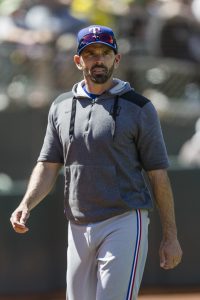
The Rangers have made a change atop the dugout, announcing the dismissal of manager Chris Woodward on Monday afternoon. Third base coach Tony Beasley will take over on an interim capacity for the remainder of the 2022 season.
“(General manager) Chris Young and I had the very difficult task of informing Chris Woodward of our decision today,” president of baseball operations Jon Daniels said in the press release announcing the decision. “In his tenure as Rangers’ manager, Chris worked tirelessly under what was at times some difficult circumstances. He has been dedicated and passionate in his efforts to improve the on-field performance of the Texas Rangers, and it is greatly appreciated. He has represented the organization with class and dignity.
We have had extensive discussions over the last several weeks and while the team’s current performance is certainly a big part of this decision, we are also looking at the future. As the Rangers continue to develop a winning culture and put the pieces together to compete for the postseason year in and year out, we felt a change in leadership was necessary at this time. On behalf of the entire Texas Rangers organization, we thank Chris and wish him and his family the very best.”
Woodward, 46, spent a bit under four seasons at the helm in Arlington. Texas hired him off the Dodgers coaching staff over the 2018-19 offseason, making him the permanent replacement after dismissing Jeff Banister that September (with some intervening interim work from Don Wakamatsu). Woodward stepped into a difficult situation, taking over a team coming off a last-place finish that was cutting payroll as it embarked upon a rebuild.
Texas bounced back a bit during Woodward’s first season, finishing in third place in the AL West at 78-84. The club was outscored by 68 runs that year, though, and regression hit the following season. Texas went 22-38 during the shortened campaign, then stumbled to a 60-102 record in 2021. It marked back-to-back last place finishes, but Texas nevertheless signed Woodward last November to an extension that ran through 2023.
At the time, Daniels praised the skipper for “(helping) to lay the foundation of our culture” throughout his first three seasons. The Texas front office certainly couldn’t have expected great results with the rosters they’d trotted out through 2019-21, and Woodward’s extension reflected the organization’s confidence in his ability to guide the club to a more competitive phase. Texas signaled a desire to push payroll forward at the start of the offseason, and they followed through with a far more aggressive winter than many might have expected.
The Rangers signed four players to multi-year free agent contracts, including two of the three largest overall guarantees of the offseason. Texas added Corey Seager for $325MM over a decade not long after signing Marcus Semien for seven years and $175MM. They stepped in as the Rangers foundational middle infield, while the club signed Jon Gray to a four-year, $56MM pact to anchor the starting rotation. Texas brass acknowledged that leaping from a 60-win team to immediate postseason contention seemed like a stretch, even with such an aggressive offseason overhaul. Yet they no doubt anticipated a marked improvement that’d serve as a stepping stone to a playoff run in 2023.
The results on that front have been mixed. The Rangers are on pace for their best season in three years, with a 51-63 record that has them in third place in the AL West. A 44.7% winning percentage is much better than the sub-40% marks of 2020-21, but that still translates to a roughly 90-loss pace over the course of a full schedule. They’re 9 1/2 games out in the Wild Card and virtually certain to miss the playoffs again, with little hope of playing meaningful games in the season’s final couple weeks.
At the same time, one could argue the Rangers have been more competitive than their record would suggest. They’ve been outscored by only two runs on the season with more blowout wins (games decided by five-plus runs) than losses. Had they played to a roughy .500 record that aligned with their run differential, they’d be in the Wild Card picture and the general tenor of the franchise would be far more optimistic. Instead, they’ve gone an atrocious 6-24 in one-run contests, losing so many tight games they’re nowhere near contention.
How much responsibility Woodward bears for that record is open to debate. There’s no doubt some amount of misfortune with a record that poor, but one could also note that Woodward is ultimately in charge of managing a bullpen that has blown 18 leads (the eighth-most in the majors). Texas has gotten productive seasons from some of their young position players (i.e. Jonah Heim and Nathaniel Lowe), but the club hasn’t gotten much from their younger starting pitchers aside from Dane Dunning. Meanwhile, Texas has gotten solid seasons from Seager and Gray, but Semien has underperformed in the inaugural season of his free agent deal.
Of course, managerial decisions are made based on far more than just the club’s on-field results. Teams are evaluating a skipper’s handling of the clubhouse and behind-the-scenes work that takes place out of public view. Daniels and Young evidently determined the time had come for a change in the voice atop the clubhouse.
Over the next two months, that’ll come with the elevation of Beasley to the manager’s chair. A former minor league skipper in the Pirates and Nationals farm systems, Beasley first joined Texas’ coaching staff in advance of the 2015 season. The 55-year-old is now in his eighth year with the Rangers, a stint that overlapped Banister’s and Woodward’s time as skipper. This will be his first major league managerial opportunity.
Texas will conduct a search for a full-timer next offseason. They’re the fourth team that’ll be doing so, as each of the Phillies (Joe Girardi), Angels (Joe Maddon) and Blue Jays (Charlie Montoyo) have dismissed their skippers in-season. Philadelphia has gone on a tear under interim manager Rob Thomson, while the Angels continued to flounder under their temporary skipper Phil Nevin. The Blue Jays have improved an already-productive club in their first month under interim manager John Schneider.
Evan Grant of the Dallas Morning News first reported Woodward’s dismissal.
Image courtesy of USA Today Sports.
Walker Buehler To Undergo Season-Ending Elbow Surgery
The Dodgers announced Monday that right-hander Walker Buehler will undergo season-ending surgery on his right elbow on Aug. 23. He’s been out since June 10 after being diagnosed with a Grade 2 flexor strain. Fabian Ardaya of The Athletic tweets that Buehler’s recent MRIs weren’t conclusive enough to determine the extent of the damage in his elbow, but Dr. Neal ElAttrache saw enough to recommend surgery. Presumably, the Dodgers will provide further details once the procedure has been performed.
That injury initially called for a six- to eight-week shutdown from throwing, and the Dodgers had surely hoped that Buehler might be able to make a comeback in late September and/or perhaps in the postseason. Instead, he won’t pitch again until next season at the earliest. Further details aren’t clear, as the team declined to provide specifics on the nature of the procedure in its initial announcement.
Buehler, 28, finished fourth in National League Cy Young voting last season but has now had multiple arm issues this season. Once it was clear that the forearm strain would sideline Buehler for as long as three months, he underwent an arthroscopic procedure to remove a bone spur from his elbow — an issue he said had plagued him for the past few seasons.
The arm issue(s) have limited Buehler to 65 innings in 2022, during which time he’s posted a 4.02 ERA with a career-low 21.2% strikeout rate. They’re pedestrian numbers by his lofty standards — both roughly in line with the league-average production among MLB starting pitchers (4.09 ERA, 21.4% strikeout rate).
Dating back to his first full big league season, in 2018, Buehler has established himself as a rock in the Dodgers’ rotation and as one of the most talented arms in the National League. He ranks 23rd in the Majors in innings pitched from 2018-22 — even with this year’s glut of missed time — and also ranks seventh in ERA (2.95), 25th in strikeout rate (27%) and 32nd in walk rate (6.2%) amid a field of 152 qualified starting pitchers in that time.
For the time being, Buehler will join both Clayton Kershaw (lower back discomfort) and Dustin May (recovering from 2021 Tommy John surgery) on the injured list. Both May and Kershaw figure to return before the end of the regular season. May recently punched out 10 hitters over five innings in his fifth Triple-A start of the season. He’s built up to 70 pitches. Kershaw, meanwhile, recently underwent an epidural injection and has resumed throwing, though there’s no immediate timetable for him to return to the Major League mound.
With that trio on the shelf, the Dodgers will look to Julio Urias, Tony Gonsolin, Tyler Anderson, Andrew Heaney and rookie Ryan Pepiot as rotation options — though Pepiot could soon be pushed out by May. Even absent a pair of big-name arms like Kershaw and Buehler, it’s a formidable group thanks to breakout performances from each of Gonsolin (2.24 ERA, 116 1/3 innings pitched), Anderson (2.81 ERA, 128 1/3 innings) and Heaney (1.16 ERA, 32.3% strikeout rate in 31 innings).
Obviously, not being able to pencil Buehler into a hopeful postseason rotation stings, but the group of Urias, Gonsolin and Kershaw is still a formidable top three, with May, Anderson and Heaney all standing as potential playoff starters as well. The broader question for the Dodgers is just what Buehler’s recovery and 2023 outlook will be.
Even in the event that Buehler required Tommy John surgery and would need to miss the majority of the 2023 season — which, to be emphatically clear, has not been indicated or even implied by the team — he’d still be a lock to be tendered a contract. The 2022 campaign was the second of a two-year, $8MM deal buying out Buehler’s first two arbitration years. He’ll be arb-eligible four times as a Super Two player, meaning he has two raises to go. Because of this year’s limited workload, he’ll be due only a modest raise on his $4.25MM salary, making it a no-brainer for the Dodgers to keep him in the fold.
That said, the extent of Buehler’s recovery period will surely impact the Dodgers’ offseason direction and inform the level of aggression with which they pursue rotation help. The Dodgers currently stand to see Kershaw, Anderson and Heaney all potentially walk as free agents, so they’ll definitely be in the mix for starting pitching help this offseason.
Orioles Promote DL Hall
TODAY: The Orioles officially announced Hall’s promotion. Left-hander Nick Vespi was optioned to Triple-A to make room on Baltimore’s active roster.
AUGUST 12, 9:41pm: Hall will start Saturday’s game, Hyde confirmed to reporters (including Rich Dubroff of Baltimore Baseball). Kostka first suggested as much this afternoon.
2:59pm: Top pitching prospect DL Hall is traveling to meet the Orioles in St. Petersburg for their upcoming series against the Rays, Roch Kubatko of MASNsports.com reports (Twitter link). Manager Brandon Hyde confirmed that Hall was being promoted but suggested the team has yet to decide when he’ll first pitch (via Andy Kostka of the Baltimore Sun).
It’s been a half-decade since Hall entered the organization as the 21st overall pick in the 2017 draft. A Georgia high school product, he received a $3MM signing bonus on the strength of a mid-90s fastball and a curveball that most evaluators considered at least a plus offering. Hall also showed a promising changeup but had some questions about the consistency of strike-throwing ability.
That report — monster raw stuff paired with spotty control — has become perhaps even more extreme during his time in the professional ranks. Baseball America wrote over the offseason that Hall now touches 100 MPH and averages around 97 MPH on his heater. That’s atypical velocity for any starter but particularly rare for a left-hander. Among MLB starters with 30+ innings on the season, Jesus Luzardo and Shane McClanahan are the only southpaws averaging north of 96 MPH (although Carlos Rodon, Blake Snell and Aaron Ashby are all between 95.5 MPH and 96 MPH).
BA credits Hall with two distinct breaking pitches — a mid-80s slider and a somewhat softer curveball — and grades both as at least above-average offerings. The outlet also credits him with the solid changeup he’s long had in his arsenal, giving him one of the better repertoires for any young pitcher. Hall has appeared among BA’s top 60 overall prospects entering each of the past four years, and he earned the #59 ranking on the publication’s latest update from last week.
That elite arsenal has unsurprisingly translated into plenty of whiffs at the minor league level. Hall has fanned more than a third of opponents at every stop since hitting High-A in 2019. That includes a massive 36% strikeout rate through 18 starts with Triple-A Norfolk this season. Among International League pitchers with 50+ frames, only teammate Grayson Rodriguez (who’s widely regarded as the top pitching prospect in the sport) has punched out batters at a better clip.
Unlike Rodriguez, however, Hall has still yet to consistently harness his arsenal. He’s walked upwards of 10% of batters faced at each level and has doled out free passes to 13.9% of opponents in Norfolk. No qualified big league starter has a walk rate anywhere near that high, and it’s the third-highest mark among that group of International League hurlers with 50 or more innings. The free passes, paired with an elevated .340 batting average on balls in play against him, have contributed to a lackluster 4.76 ERA over his first 70 Triple-A innings.
Nevertheless, the Orioles are set to get a look at Hall against big league hitters in what is surprisingly a pivotal series for Baltimore. They’re 58-53 on the year, just half a game behind the Tampa Bay club against which he’s likely to make his debut for the American League’s last Wild Card spot. The next three games are arguably as important as any the franchise has played in over five years. Giving Hall the ball in any of those contests is a strong show of faith in the 23-year-old.
Hall is already on the 40-man roster, having been added last offseason to keep him from being taken in the Rule 5 draft that never wound up happening. He’s in the first of three minor league option years and could certainly bounce between Baltimore and Norfolk over the coming weeks. We’re already well past the date for Hall to get either a full season of service time or enough to have a serious possibility at qualifying for early arbitration as a Super Two player after 2024. Even if he’s in the big leagues from here on out, he won’t reach arbitration until after the 2025 campaign and won’t hit free agency until the 2028-29 offseason. That trajectory could be pushed back further by future options to the minor leagues.