
Reds Outright Patrick Kivlehan, Deck McGuire
The Reds announced Friday that infielder/outfielder Patrick Kivlehan and right-hander Deck McGuire have been sent outright to Triple-A Louisville after clearing waivers. Both can elect minor league free agency. Cincinnati also reinstated lefty Brandon Finnegan and righty Anthony DeSclafani from the 60-day disabled list, so their 40-man roster remains at 33 players for the time being.
Kivlehan, 28 next month, tallied a career-high 204 plate appearances but posted a bleak .208/.304/.399 batting line in that time. He showed some pop, hitting nine homers with five doubles and a triple, but the former Mariners/Rangers prospect also fanned in 30 percent of his plate appearances. Kivlehan has experience at both corner infield and outfield positions, and he’s a career .255/.308/.437 hitter in 223 Triple-A games.
The 28-year-old McGuire is a known name to some thanks to his No. 11 overall selection out of Georgia Tech by the Blue Jays back in the 2010 draft. He’s yet to live up to that draft billing, struggling greatly in Triple-A for the Jays, Athletics, Dodgers and Cardinals before landing in the Reds organization this past winter.
While McGuire spent the year in Double-A rather than the minors’ top level, he notched a strong 2.79 ERA with 9.1 K/9 against 3.1 BB/9 with a 38.8 percent ground-ball rate through 168 innings (27 starts). He made his MLB debut with the Reds in September, tossing 13 2/3 innings with 11-to-2 K/BB ratio and notching his first big league victory along the way.
Cubs Claim Randy Rosario From Twins
The Cubs announced that they’ve claimed left-hander Randy Rosario off waivers from the Twins. Chicago’s 40-man roster count now sits at 33 players.
The 23-year-old Rosario was rocked in his big league debut with the Twins this past season (eight runs in 2 1/3 innings) but has been considered among the team’s 20 to 30 best prospects in recent years. A hard-throwing lefty out of the Dominican Republic, Rosario’s performance has deteriorated as he’s ascended through Minnesota’s minor league ranks. This past season, he tossed 57 1/3 innings with a 4.08 ERA and 7.1 K/9 against 3.6 BB/9 with a 50.9 percent ground-ball rate in Double-A.
To Rosario’s credit, he was dominant at the Double-A level through the season’s first half. However, he collapsed in significant fashion from late July through season’s end, yielding 19 earned runs on 31 hits with a 13-to-11 K/BB ratio in his final 17 2/3 frames at the Double-A level.
Mariners Claim Zach Vincej From Reds
The Mariners announced that they’ve claimed infielder Zach Vincej off waivers from the Reds. Their 40-man roster now stands at 37 players.
Vincej, 26, was the 1132nd pick of the 2012 draft — all the way down the board in the 37th round. He’s slowly risen through the minor league ranks and had a huge performance in last year’s Arizona Fall League before hitting .270/.325/.370 in his first taste of Triple-A this year. Vincej made his big league debut as a September call-up this season and went 1-for-9 with a walk and five strikeouts in just 12 plate appearances. He comes with a solid defensive reputation at shortstop but didn’t rank among Cincinnati’s top prospects. He’ll provide some middle infield depth for the Mariners if he sticks with the organization this offseason.
Marlins Decline Ichiro’s Option, Claim Chad Wallach From Reds
The Marlins announced that they’ve declined a $2MM club option on outfielder Ichiro Suzuki and also claimed catcher Chad Wallach off waivers from the Reds. The pair of moves leaves Miami’s 40-man roster count at 34 players.
Ichiro, who turned 44 two weeks ago, will see his three-year tenure with the Marlins come to an end as the team’s new ownership begins to trim salary in a reported effort to shed $40-50MM off the payroll for 2018. The future Hall of Famer had a productive second year with the Marlins in 2016, hitting .291/.354/.376 in 365 trips to the plate. However, the 2017 season saw Ichiro receive the smallest amount of playing time he’s had in Miami — just 215 plate appearances — and resulted in a dreary .255/.318/.332 batting line.
The 10-time All-Star is a Cooperstown lock, but he’s had just one season of above-average production (by measure of OPS+) in the past seven years. While it’s natural to wonder if the beloved Ichiro is nearing the end of his playing days, he recently told Tim Healey of the South Florida Sun-Sentinel that he’d continue to play until he’s “at least 50” if he continues getting opportunities. He may very well have to settle for a minor league pact this offseason, but it’s not out of the question that a team would look to bring the veteran into its outfield mix — particularly an NL club capable of carrying a deeper bench.
Wallach, who will turn 26 tomorrow, was originally drafted by the Marlins in the fifth round of the 2013 draft. Miami shipped him and right-hander Anthony DeSclafani to the Reds in exchange for a one-year rental of Mat Latos in what now looks to be a lopsided deal (DeSclafani’s injury status notwithstanding).
The son of former big league infielder Tim Wallach, Chad turned in a respectable .240/.363/.410 batting line in 243 Double-A plate appearances in 2016. However, his bat took a big step back in 2017 upon reaching Triple-A Louisville, where he batted just .226/.280/.398 and saw his strikeout rate jump nearly seven percent in the same number of PAs (243). He did make his MLB debut with the Reds in ’17, going 1-for-11 with a single and five strikeouts.
Astros Exercise Club Options On Jose Altuve, Marwin Gonzalez
In perhaps the least-surprising decision of the offseason, Astros general manager Jeff Luhnow tells reporters that the team will indeed exercise its 2018 club options over Jose Altuve and Marwin Gonzalez (Twitter link via the Houston Chronicle’s Jake Kaplan). Altuve will earn $6MM next year, and Gonzalez will take home a $5.125MM salary.
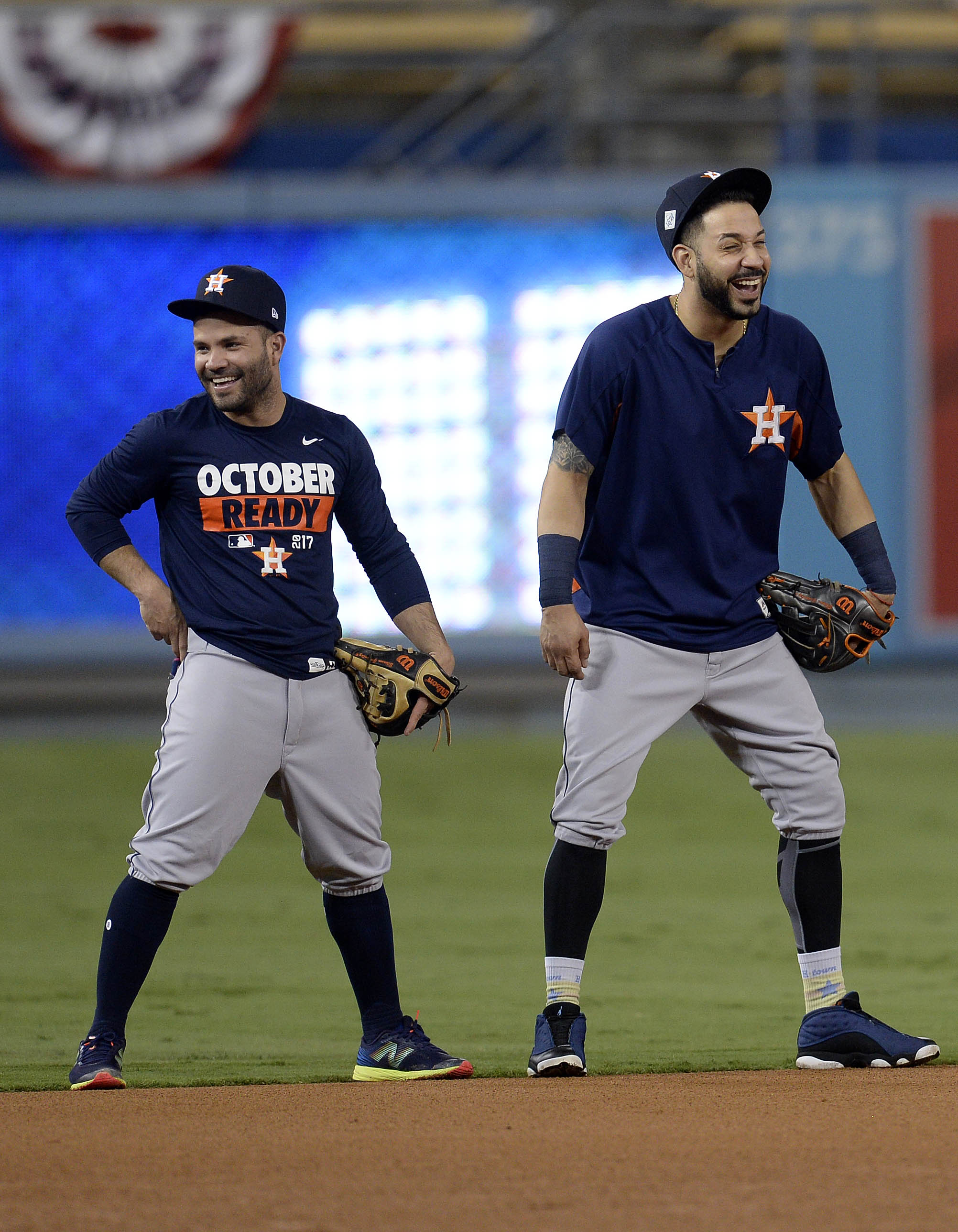
Altuve, of course, is one of the front-runners for American League MVP honors on the heels of a season in which he batted a ridiculous .346/.410/.547 with 24 homers and 32 stolen bases.
The 27-year-old superstar won his second consecutive American League batting championship and his third in the past four seasons. All told, he was a roughly eight-win player by both Fangraphs’ and Baseball-Reference’s version of Wins Above Replacement. In all likelihood, the American League Most Valuable Player Award will come down to a two-horse race between Altuve and Aaron Judge.
He’s led the American League in hits for the past four seasons, topping 200 total knocks in each of those years. Houston holds one more option over Altuve’s services for the 2019 season — yet another bargain at $6.5MM — before the five-time All-Star will be eligible for free agency in the 2019-20 offseason.
Gonzalez, 29 next March, had one of the most impressive and unexpected breakouts of any player in Major League Baseball. After hitting .268/.309/.413 in nearly 1200 plate appearances from 2014-16, the switch-hitting utility man erupted with a .303/.377/.530 batting line in 515 plate appearances. Gonzalez’s 23 homers and 34 doubles shattered his previous career-highs of 13 and 26, respectively. The former Rule 5 pick more than doubled his walk rate and also cut his strikeout rate by nearly four percent when compared to the preceding season.
Beyond his excellence at the plate, Gonzalez saw at least 130 innings at all four infield positions, including 281 at shortstop. He also played 331 innings in left field during the regular season before serving as the team’s primary left fielder in the playoffs. Gonzalez will be a free agent following the 2018 season.
Photo courtesy of USA Today Sports Images.
Top 50 Free Agents Chat Transcript
MLBTR’s Top 50 Free Agents list is out, and people have questions. Many questions. Click here to read a transcript of me, Tim Dierkes, trying to answer some of them.
Mike Minor To Decline Mutual Option
Left-hander Mike Minor has declined his half of a $10MM mutual option and is now a free agent, MLB.com’s Jeffrey Flanagan reports (via Twitter). He’ll receive a buyout of $1.25MM as part of the two-year, $7.25MM contract he inked with Kansas City prior to the 2016 campaign. The Royals have interest in re-signing Minor as their closer moving forward, he adds, but he’ll first have the opportunity to gauge interest from other clubs now that he’s hitting the open market.

Minor, 30 in December, missed the 2015 season due to shoulder surgery but landed a two-year pact in Kansas City, as they expected that he’d be ready to return to the mound as a rotation option in the first half of the 2016 campaign. However, lingering effects of that shoulder procedure kept Minor from taking the mound in the Majors at all in 2016.
Though he didn’t make good on the first year of that two-year pact, Minor nonetheless proved to be an immense bargain. Healthy in 2017, Minor shifted to the bullpen and climbed the ranks in the Royals’ relief corps, beginning with low-leverage innings but eventually serving as the team’s closer late in the year.
Minor was a genuine weapon working as a reliever. In 77 2/3 innings he averaged 10.2 K/9 against 2.6 BB/9 with a 42.4 percent ground-ball rate en route to a 2.55 ERA. Minor allowed just five homers all season and was utterly dominant against left-handed opponents (.161/.228/.196) while also rendering right-handed bats largely useless (.221/.281/.383). That performance made the decision to walk away from a potential $10MM salary in 2018 (a net of $8.75MM for Minor when factoring in the buyout) an easy one, as Minor should have no problem handily topping that mark in free agency.
While some clubs will undoubtedly have some trepidation about the fact that Minor missed a pair of seasons following a shoulder operation, he showed no ill effects in 2017 and should be poised to command a strong multi-year deal. Bullpen help is in demand for all 30 teams each offseason, and left-handed relievers that can dominate both left- and right-handed hitters alike are rare commodities. That Minor exhibited an ability to work multiple innings throughout the year is a strong point in his favor as teams gravitate further away from rigid, one-inning relief roles.
Minor figures to draw interest both as a closer and as a setup option for teams that already have strict closers in place. He could also find some interest from clubs that are intrigued by plugging him back into the rotation, but he’d almost certainly be leaving money on the table right now by rolling the dice on a return a starting role. Whatever contract he signs may contain some incentives based on starts and total innings if that’s a route he’s interested in pursuing, but more than half the teams in the league will probably be interested in adding Minor to their bullpen. That’s the best route for him to maximize his earning power, which figures to be substantial. We ranked Minor 18th on yesterday’s Top 50 Free Agent list and pegged him for a four-year deal just south of Brett Cecil‘s $30.5MM pact in St. Louis.
Photo courtesy of USA Today Sports Images.
Offseason Outlook: Toronto Blue Jays
MLBTR is publishing Offseason Outlooks for all 30 teams. Click here to read the other entries in this series.
After an injury-riddled season, the Blue Jays are looking to rebound back into the AL East race. With Josh Donaldson and several other key veterans only under contract through 2018, however, it remains to be seen if the Jays will acquire upgrades that will only help them next season, or if they’ll aim for longer-term assets.
Guaranteed Contracts
- Troy Tulowitzki, SS: $54MM through 2020 ($15MM club option for 2021, $4MM buyout)
- Russell Martin, C: $40MM through 2019
- Kendrys Morales, DH: $23MM through 2019
- Lourdes Gurriel, IF/OF: $18.4MM through 2023
- Marco Estrada, SP: $13MM through 2018
- J.A. Happ, SP: $13MM through 2018
- Steve Pearce, OF/1B: $6.25MM through 2018
- Justin Smoak, 1B: $4.125MM through 2018 ($6MM club option for 2019, $250K buyout)
Arbitration Eligible Players (service time in parentheses; projections via MLB Trade Rumors)
- Josh Donaldson (5.158) – $20.7MM
- Aaron Loup (5.040) – $1.8MM
- Tom Koehler (4.090) – $6.0MM
- Ezequiel Carrera (4.039) – $1.9MM
- Marcus Stroman (3.148) – $7.2MM
- Kevin Pillar (3.113) – $4.0MM
- Ryan Goins (3.106) – $1.8MM
- Aaron Sanchez (3.069) – $1.9MM
- Devon Travis (3.000) – $1.7MM
- Roberto Osuna (3.000) – $5.6MM
- Dominic Leone (2.123) – $1.2MM
- Non-tender candidate: Koehler
Free Agents
[Toronto Blue Jays Depth Chart; Blue Jays Payroll Overview]
One major bit of offseason business has already been handled, as Marco Estrada agreed to a one-year, $13MM extension to return to the Jays next season. 2017 was easily the worst of Estrada’s three seasons in Toronto, though much of the damage was came during a midseason slump that Estrada has said was partially caused by off-the-field issues. Given that Estrada looked closer to his old form during the second half of the season, he’ll give the Jays another solid arm to slot in behind Marcus Stroman, J.A. Happ and Aaron Sanchez in the rotation.
Of course, that’s assuming Sanchez is able to recover from the blister and fingernail problems that kept him on the disabled list for much of the season. A full offseason of recovery time would theoretically have Sanchez ready to go for Spring Training, though given the unpredictable nature of his recurring injury, re-signing Estrada was particularly important for the Jays.
Sanchez’s blister was essentially a metaphor for the entire 2017 Blue Jays season. The team was simply never able to get rolling due to a swath of injuries and a lack of performance from most of the players who were able to stay healthy. The starting rotation couldn’t duplicate its 2016 success, and the lineup delivered some of the poorest offensive numbers of any team in baseball. A 2-11 start put the Jays behind the eight ball from the very beginning, and the club wasn’t able to achieve as much as a .500 record at any point during the year.
Better health will only go so far in solving the Jays’ problems. The team can reasonably count on Donaldson, Happ, and Russell Martin delivering closer to full seasons, though Martin turns 35 in February. Sanchez’s status is yet to be determined, and the substantial injury histories of Troy Tulowitzki, Devon Travis and Steve Pearce make them question marks rather than reliable regulars for next year’s lineup.
As one might expect in the wake of such a season, GM Ross Atkins has stated that adding roster depth is a big priority for the club. The challenge will be in deciding where to acquire that depth, since the Jays are thin at several positions and don’t have much in the way of MLB-ready talent at the upper levels of the minors.
One such area is starting pitching, as the Blue Jays don’t have a fifth starter lined up. Joe Biagini is the current favorite for the job but was inconsistent as a starter last season. Tom Koehler (if he isn’t non-tendered) or prospect Ryan Borucki could be candidates, while other internal options like Chris Rowley seem more like minor league depth options. The case could also be made that Biagini and Koehler are better utilized as relievers.
Between the fifth starter opening and Sanchez’s blister concerns, the Blue Jays could have cause to add a veteran starter on a short-term deal. Jason Vargas, CC Sabathia, Jaime Garcia, Doug Fister, and familiar face Brett Anderson are a few of the experienced arms available in free agency, though with Estrada and Happ both under contract for just one more year, I’d argue that Toronto could make a bigger splash for a front-of-the-rotation type. Yu Darvish or Jake Arrieta seem like long shots, but the Jays have already been cited as a likely suitor for Alex Cobb, and Lance Lynn is another second-tier rotation arm who would require a substantial, but not a bank-breaking multi-year contract.
Of course, Shohei Otani would be a great fit for Toronto, as he would in the rotation of every other MLB team. The Jays’ interest in Otani is known, though it doesn’t seem like they are frontrunners for his services, if he is even made available to MLB teams at all this winter (which is looking less clear than ever). If Otani did sign with the Jays, one would think the team would look to trade Kendrys Morales (even while eating some money in a deal) to free up the DH spot for Otani to get at-bats.
Even without an Otani signing, the idea of dealing Morales or another veteran regular may still have to be explored. Morales and Tulowitzki have little to no trade value given their poor 2017 seasons and the money remaining on their contracts; Martin is also owed $40MM through the next two years, and there aren’t many contenders in need of catching help.
Atkins has said that the Jays aren’t looking to trade from their MLB roster, though that may be a necessity given their lack of minor league trade chips (and obviously top prospects Vladimir Guerrero Jr. and Bo Bichette aren’t going anywhere). A rebuilding team could have interest in Travis given his youth and the potential he’s shown when he has been able to play. Justin Smoak’s breakout year turned his contract into a bargain, and Toronto could look to sell high on him, though teams could prefer to just sign a free agent first baseman rather than make a trade. Teams could be interested in Kevin Pillar’s elite center field glove, and the Jays could conceivably replace Pillar in center field with Teoscar Hernandez or Anthony Alford.
The biggest trade chip, of course, is Donaldson, though he reportedly isn’t on the table as a trade candidate since the Jays plan to contend next year. The star third baseman has expressed interest in an extension that would keep him in Toronto beyond 2018, though if contract talks fail to materialize over the winter, trade speculation will only increase. The Cardinals are known to be one of several teams interested in Donaldson’s services, and they’re a particularly interesting potential trade partner since they can offer outfielders and multi-positional infielders. Even if Donaldson isn’t up for discussion, I’d imagine the Jays will have some talks with the Cards this winter.
These may seem like bold moves for a team that doesn’t seem to be planning any sort of huge shakeup. That said, if the Jays intend to add (in the words of president/CEO Mark Shapiro) “Durability. Athleticism. Flexibility,” to the roster, one way to achieve those goals is to move some of the players that don’t fit those categories. Trading Travis, for instance, would make it easier for the Jays to sign a multi-position infielder like Eduardo Nunez, as Toronto could then offer Nunez regular time at second base and then have the option of bouncing him around the diamond as the situation warrants. As mentioned, Morales couldn’t be dealt without eating a big chunk of the $23MM remaining on his contract, though moving a DH-only player who posted below-average hitting numbers last year would go a long way to giving the Blue Jays a more well-rounded roster.
If Toronto eschews bigger moves in search of pure depth additions, someone like Stephen Drew stands out as a left-handed hitting utility infield option. Backup catcher is a notable area of need, as Jays backup catchers combined for -1.5 fWAR last year — a particular issue given that Martin played in just 91 games. Miguel Montero struggled badly after joining the Jays last summer and isn’t likely to be re-signed.
The corner outfield positions are the most obvious areas to add much-needed speed and left-handed hitting into the mix. The team has already confirmed that it won’t be picking up its end of Jose Bautista’s mutual option, ending the franchise icon’s tenure in Toronto on a sour (-0.5 fWAR) note. This leaves Pearce as the top option in left field and Hernandez as the current favorite in right field after his impressive September performance. Alford and Ezequiel Carrera are also in the mix as platoon or backup options, with former top prospect Dalton Pompey slated for Triple-A after missing almost all of 2017 due to a concussion and a knee injury.
There is clearly room for improvement here, as Pearce and the youngsters could be slated for left field and a new face could play right. Jay Bruce has been a Blue Jays target in the past and would bring some much-needed left-handed pop to right field, so Toronto is likely to check in on his availability in free agency. Left-handed bats like Curtis Granderson or Jon Jay aren’t quite ideal for everyday roles, though the Jays can use Pearce and Hernandez as their corner outfielders when a southpaw is on the mound. If the Indians decided to decline their club option on Michael Brantley in the wake of Brantley’s recent ankle surgery, you’d expect Atkins and Shapiro to be all over Brantley given their past Cleveland ties.
Beyond free agents, teams like the Marlins, Indians, White Sox and (as mentioned) the Cardinals all could have outfielders for sale this winter. Jays fans may cringe at the idea of another big trade with the Marlins, but since Toronto had some interest in Dee Gordon last summer, Miami fits as a trade partner that could address the Jays’ needs at both second base and in the outfield in a single blockbuster. This is just my speculation, however — the Blue Jays may not have the prospects necessary to attract the Marlins’ attention on their star outfielders, and the Jays reportedly balked at Gordon’s remaining salary ($38MM through 2020).
Speaking of salary, the Jays have approximately $142.5 MM tied up in 19 players (eight guaranteed salaries and their 11-player arbitration class) for next season. This gives them some room to spend if they approach their $163.3MM payroll from last Opening Day, though even with Bautista off the books, big arb raises for Donaldson, Pillar, Stroman, Koehler, and Roberto Osuna will wipe out a lot of those savings. Koehler’s $6MM arbitration price tag is probably too high for the Jays’ liking, though they could look to re-sign him at a lower salary given his potential value as a swingman, multi-inning reliever, or fifth starter candidate.
Now that Osuna’s strong numbers no longer come with the benefit of a pre-arbitration salary, there will likely be some trade talk surrounding the 22-year-old closer. Osuna had a career-high 3.38 ERA and ten blown saves in 2017 while also dealing with some anxiety issues. S everal advanced metrics, though, indicate that the young closer was as dominant as ever last season and just ran into some bad luck (only a 59.5% strand rate) and perhaps some complications from increased usage of a cutter rather than his normal fastball-heavy arsenal. While teams will surely approach the Blue Jays with offers, it would be a surprise to see Osuna dealt given that his salary is still quite reasonable for a closer with his track record.
The Jays also need Osuna to anchor a bullpen that posted some decent numbers last year despite being heavily overworked; Jays relievers pitched 596 2/3 innings, the third-most of any club in baseball. Beyond Osuna, Toronto has some solid options on hand (Danny Barnes, Dominic Leone, Ryan Tepera, Carlos Ramirez) and could be further bolstered depending on what happens with Biagini or Koehler. Aaron Loup is the only southpaw in the pen, so expect the Jays to check in on left-handed relievers this winter. The club could look to replicate its low-cost signings of Joe Smith and J.P. Howell from last offseason, hoping for a better than their .500 return — Smith pitched well and was flipped at the trade deadline, while Howell battled injuries and was released in August.
The Atkins/Shapiro regime hasn’t made many big splashes in its two offseasons running the front office, though more is required this winter in the wake of the Jays’ disappointing 2017 campaign. Counting on better health to fix the problems is a big risk, especially since the club’s roster is old enough that decline is just as big a concern as injuries at this point. As intent as the Blue Jays are on contending, the AL East is competitive enough that another slow start could quickly turn the Jays into deadline sellers. Some significant roster shuffling is needed for the Jays to make 2017 into an aberration, rather than the first sign that their contention window is closing.
Coaching Notes: Amaro Jr., Astros, Pirates, Red Sox, Tigers
Ruben Amaro Jr. will leave the Red Sox‘ coaching staff and join the Mets as their new first base coach and outfield/baserunning coach, reports Ken Rosenthal of The Athletic (via Twitter). Amaro, long the general manager of the Phillies, has spent the past two seasons as the first base coach in Boston. While his path from the front office to a big league coaching staff is anything but conventional, but his experience in a front office will add a unique perspective to rookie manager Mickey Callaway’s staff. It was reported yesterday that the Mets were also promoting Pat Roesseler to hitting coach and hiring veteran pitching coach Dave Eiland.
A few more notes out of the dugout from around the league…
- The Astros will hire Yankees third base coach Joe Espada as their new bench coach, reports ESPN’s Marly Rivera. Espada will step into the role that was vacated when Alex Cora left the Astros to become the new manager of the Red Sox. Like Cora, the 42-year-old Espada will bring a relatively youthful presence to the Houston coaching staff. He’s spent seven seasons as a third base coach at the big league level (2010-13 in Miami, 2015-17 in New York) and has also served as a professional scout in the Yankees organization for a year. He’s also served as a minor league hitting coach and infield coordinator in the Marlins organization.
- After recently extending general manager Neal Huntington and manager Clint Hurdle, the Pirates announced yesterday that their entire coaching staff has been extended through the 2019 season. Hurdle’s current contract runs through the 2021 season. Renowned pitching coach Ray Searage is the most oft-discussed member of Hurdle’s staff, which also includes bench coach Tom Prince, first base coach Kimera Bartee, third base coach Joey Cora, bullpen coach Euclides Rojas, hitting coach Jeff Branson and Major League coach Dave Jauss.
- The Red Sox will have a former big league manager on their staff to support rookie skipper Alex Cora, the team announced yesterday. Former Brewers manager Ron Roenicke, who spent the 2016-17 seasons as the Angels’ third base coach, will serve as Cora’s bench coach. Former Mets first base coach Tom Goodwin will join Boston’s staff as the first base coach and outfield instructor, effectively meaning the Mets and Red Sox have swapped first base/outfield coaches. The Sox also announced that Carlos Febles, who managed their Double-A affiliate in 2017, will join the club as its new third base coach and infield instructor. Bullpen coach Dana LeVangie, will return for his sixth season in that role. He’ll also serve as a catching instructor and assist in advance scouting.
- The Tigers also announced their full staff under new manager Ron Gardenhire yesterday. Former Twins coach Steve Liddle will serve as Gardenhire’s bench coach, returning to the dugout for the first time since 2012 after an 11-year run in Minnesota. Third base coach Dave Clark and hitting coach Lloyd McClendon will return to the staff, and the Tigers are adding minor league hitting coach Phil Clark to the big league staff as an assistant hitting coach as well. Former big league infielder Ramon Santiago, who recently retired from his playing career, will jump right onto the Tigers’ staff as a first base coach. As had already been reported, the Tigers plucked Twins bench coach Joe Vavra to serve as a Quality Control coach and hired former Twins pitching coach Rick Anderson to serve as the bullpen coach. Both were with Gardenhire throughout his tenure as Twins skipper. The club also confirmed its hiring of recently dismissed Cubs pitching coach Chris Bosio to occupy that same role in Detroit.
2017-18 Top 50 MLB Free Agents With Predictions
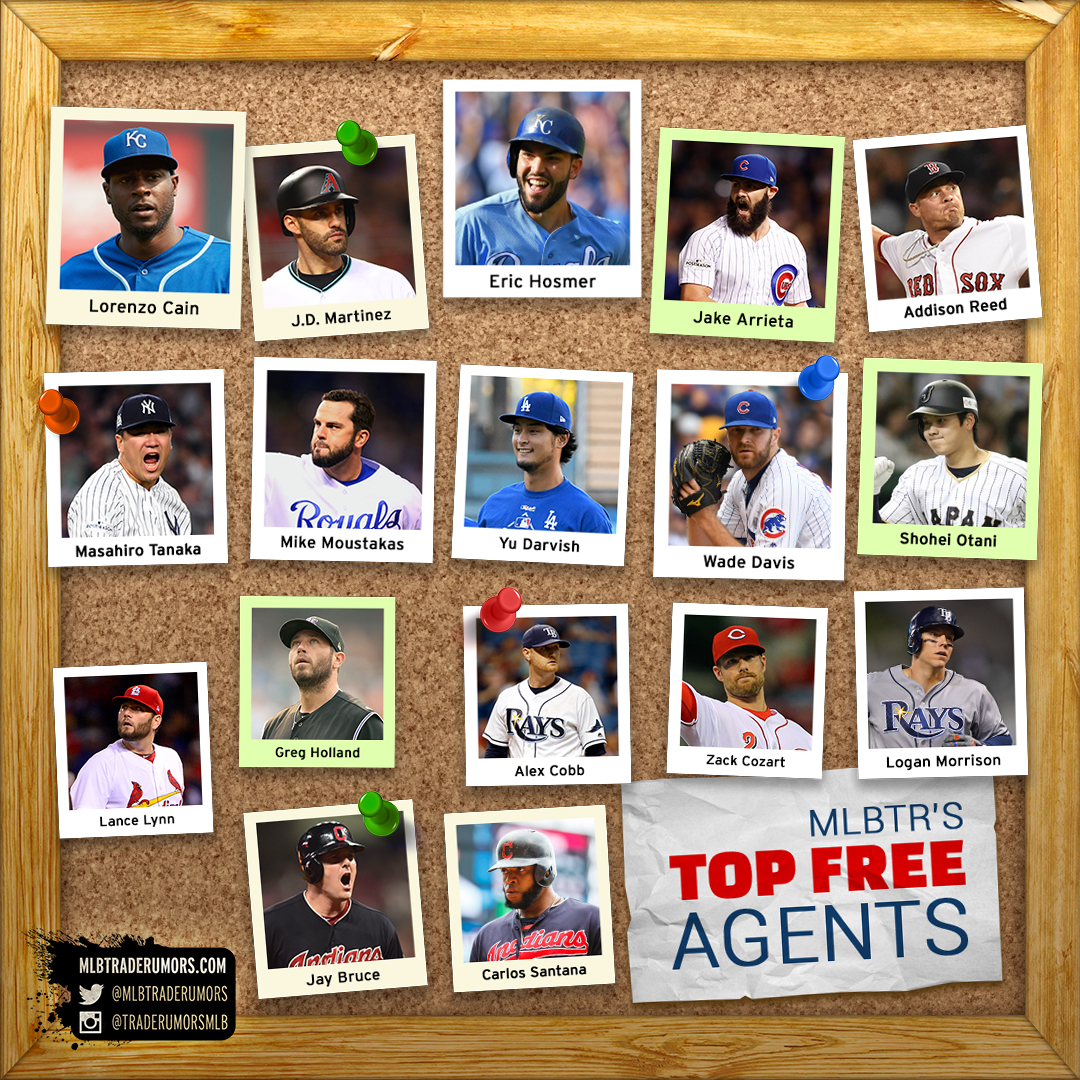
MLB Trade Rumors is proud to present our 12th annual Top 50 Free Agents list! The entire list of available free agents can be found here, and you can filter by position, signing team, and qualifying offer status with our mobile-friendly free agent tracker here.
New to MLBTR? You can follow us on Twitter, like us on Facebook, follow us on Instagram, and download our free app for iOS and Android.
MLBTR writers Steve Adams, Jeff Todd, and Jason Martinez joined me in this collaboration, debating free agent contracts and destinations for many hours. We vetted these as much as possible, but with 50 predictions and a volatile free agent and trade marketplace, we know we’ll be off on some. Let us know what you think in the comment section!
Looking for Shohei Otani? Scroll to the bottom of the post for information on Japan’s Babe Ruth, whose free agency is a special case. On to our Top 50 free agents:
1. Yu Darvish – Cubs. Six years, $160MM. Let’s start by addressing the elephant in the room. Darvish recorded a mere ten outs in his two brutal World Series starts for the Dodgers. With those ugly outings fresh in our minds, projecting him to receive the winter’s largest contract creates cognitive dissonance. However, Darvish remains what he was a week ago: a very good starting pitcher and the best in this free agent class.
Darvish spent the first seven years of his career in Japan starring for the Nippon Ham Fighters. The Fighters made Darvish available to MLB teams in December 2011, at a time when there was no limit on bidding for the exclusive right to negotiate with the player. The Rangers beat out the Blue Jays, Yankees, and Cubs with a $51.7MM bid and signed Darvish to a six-year, $56MM deal on top of that. Darvish’s fine Rangers career included 782 2/3 innings of 3.42 ERA ball with a 11.0 K/9, plus four All-Star appearances and a second-place Cy Young finish. He was traded to the Dodgers in July, making him ineligible for a $17.4MM qualifying offer. While with the Rangers, Darvish went about 22 months between starts due to Tommy John surgery. He’s been injury-free this year and nudged his way past the 200-inning plateau in his brief start last night. The 31-year-old righty should have no problem setting a new free agent record for a Tommy John survivor, passing Jordan Zimmermann’s five-year, $110MM deal. Seven-year contracts have historically been reserved for slightly younger pitchers without elbow surgery on their resume, so we’re expecting six years for Darvish. Free agent starters have exceeded a $25MM salary four different times, and we’re projecting Darvish to become the fifth. If the Dodgers decide to move on, the Cubs, Phillies, Nationals, Cardinals, Astros, and Twins could be potential suitors. There’s a shortage of obvious big-market players here, allowing for dark horses to enter the mix.
Signed with Cubs for six years, $126MM. Deal includes opt-out clause after second year.
2. J.D. Martinez – Red Sox. Six years, $150MM. Martinez came up through the Astros’ farm system but struggled through 975 plate appearances in the Majors and was released in March 2014. The Astros didn’t understand the impact of his recently-overhauled swing. The Tigers scooped Martinez up on a minor league deal, and he went on to rake at a .300/.361/.551 pace with 99 home runs in 1,886 plate appearances for them from 2014-17. A trade to the Diamondbacks this past July removed the possibility of a qualifying offer and boosted Martinez’s stock further as he went nuts with 29 home runs in 62 games. He finished with a career-high 45 bombs on the season. The biggest knock on Martinez is his right field defense, which has been a clear negative for the last two years. He also missed significant time with an elbow fracture in 2016 and a foot sprain to begin this year. Still, Martinez’s right-handed power will make him the most coveted bat on the market, enough that teams without corner outfield openings could trade someone to create a spot. The Diamondbacks may not have the payroll space to retain Martinez, leaving the Cardinals, Red Sox, and Giants as top suitors.
Signed with Red Sox for five years, $110MM. Deal includes opt-out clauses after second, third, and fourth years.
3. Eric Hosmer – Royals. Six years, $132MM. Every year one free agent is particularly polarizing, and this winter it’s Hosmer. The first baseman did solid work for the Royals over seven seasons, with a well-timed career-best batting line of .318/.385/.498 in 671 plate appearances this year. He just turned 28 and will be looking for at least six years — quite likely more. However, defensive metrics rate his glove poorly (a 2017 Gold Glove nomination notwithstanding), and off years with the bat resulted in replacement level seasons in 2014 and ’16. A case will be made for a $200MM contract, but it’s not a very good case. Teams seeking a first baseman have free-agent alternatives such as Carlos Santana, Logan Morrison, and Yonder Alonso, as well as trade candidate Jose Abreu. If Hosmer gets a huge contract, it probably won’t be from the game’s more analytical teams. The Royals seem likely to make a spirited effort to retain Hosmer as the face of their franchise, while the Red Sox, Cardinals, Mariners, and Rockies could enter the market to varying degrees. Hosmer is a lock to receive and reject a qualifying offer.
Signed with Padres for eight years, $144MM. Deal includes opt-out clause after fifth year.
4. Jake Arrieta – Brewers. Four years, $100MM. A July 2013 trade from the Orioles to the Cubs rebooted Arrieta’s career, which peaked with the NL Cy Young Award in 2015. Arrieta’s star has dimmed since then, as he’s become more prone to walks, home runs, and hits and stopped pitching deep into games. He still provided value to the 2017 Cubs, with 30 starts of 3.53 ERA ball. Though he turns 32 in March, Arrieta’s case for a long-term deal is boosted by excellent physical conditioning. We expect him to come out looking for a six-year deal, but land at four or five. Arrieta appears likely to move on from the Cubs, with whom he was unable to agree to an extension in the past few years. However, it’s possible Arrieta could circle back to the Cubs later in the offseason if his market disappoints. We don’t see a clear favorite to sign him, so we’ve chosen a dark horse pick in the Brewers. The Cardinals, Nationals, Astros, Rangers, Phillies, Yankees, Angels, Mariners, Braves, Twins, and Dodgers could be in the mix depending on the price.
Signed with Phillies for three years, $75MM. Deal includes opt-out clause after second year, which Phillies can void with two-year extension.
5. Masahiro Tanaka – Phillies. Five years, $100MM. Tanaka, 29 this month, is coming off his fourth and perhaps worst MLB season. He posted a 4.74 ERA in 30 regular season starts, with a ridiculous 21.2% of his flyballs allowed becoming home runs. It wasn’t a Yankee Stadium problem, as Tanaka was even more homer-prone on the road. On the bright side, Tanaka put up a career-best strikeout rate, a 3.77 ERA in the second half, and three excellent, homer-free postseason starts. Back in January 2014, Tanaka joined the Yankees via the Japanese baseball posting system after pitching seven years for the Rakuten Golden Eagles. With the posting fee capped at $20MM, the Yankees won the bidding over the Cubs, White Sox, Dodgers, and Diamondbacks with a seven-year, $155MM deal that included an opt-out that comes due at midnight on Saturday. The biggest wrinkle in Tanaka’s long-term prospects may be the partially torn UCL in his right elbow, which surfaced more than three years ago. Tanaka went the rehab route instead of undergoing Tommy John surgery. In 2015 Tanaka missed time with a forearm strain and had arthroscopic elbow surgery in the offseason. This year, he had a DL stint for shoulder fatigue. If Tanaka opts out, he will be walking away from three years and $67MM left on his Yankees contract. Ervin Santana was able to land a four-year deal with a rehabbed and healed UCL, and it seems that opting out is the right call for Tanaka. The Yankees could be in a position to lower their luxury tax hit by adding a year or two and reducing the average annual value of his contract. If Tanaka moves on from the Yankees, the Cubs, Nationals, Astros, Cardinals, Dodgers, Angels, Phillies, Twins, Mariners, Rangers, and Brewers could be possibilities. If he does opt out, the Yankees will assuredly issue a qualifying offer in order to collect draft-pick compensation.
Elected to remain with Yankees, forgoing opt-out clause and free agency.
6. Mike Moustakas – Braves. Five years, $85MM. Moustakas, 29, set a Royals franchise record with 38 home runs this year. The second overall draft pick in 2007, Moustakas didn’t click as a hitter until 2015. The third baseman suffered an ACL tear in May 2016, ending that season early, but exhibited no health problems in his return this year. The biggest flaw in Moose’s game is his low 5.7% walk rate this year, resulting in a .314 OBP that drove down his overall value as a hitter despite the power. Defensive metrics were also down on his once well-regarded glovework this year, though teams may be willing to chalk that up to rust coming off his knee injury. Regardless, he should do well in free agency. If the Royals move on, the Angels, Braves, and Cardinals could be options. Like Hosmer, Moustakas is going to receive and reject a qualifying offer.
Re-signed with Royals for one year, $6.5MM.
7. Lorenzo Cain – Giants. Four years, $70MM. Yet another Royals free agent, Cain adds value with his hitting, baserunning, and glove as a center fielder. He’s a speedy, well-rounded player who was worth more than four wins above replacement this year. Dexter Fowler’s five-year, $82.5MM deal with the Cardinals will be a likely model, though Cain is a year older than Fowler was. Cain is the only plus defensive center fielder on the market who also carries an above-average bat, which should create plenty of demand. If the Royals don’t retain him, the Giants, Mariners, Blue Jays, and Rangers could be matches. The Royals have reportedly yet to decide on a qualifying offer for Cain, but it’d be a big surprise if he doesn’t get one.
Signed with Brewers for five years, $80MM.
8. Wade Davis – Astros. Four years, $60MM. Davis, 32, came up as a starter in the Rays system and was traded with James Shields to the Royals in a December 2012 blockbuster. 2013 was a tumultuous year for Davis – his wife had a baby, he lost his stepbrother unexpectedly, and he pitched his way out of the rotation by August. He began 2014 as the Royals’ setup man and never looked back, garnering Cy Young votes in a dominant season. He moved into the team’s closer role when Greg Holland got hurt the following year and will forever be remembered flinging his glove into the air after punching out Wilmer Flores looking to end the 2015 World Series. Davis missed time late in 2016 with a flexor strain in his pitching elbow, but the Cubs were not deterred in deftly trading Jorge Soler for him last offseason. Davis had a fine year as the Cubs’ closer, though he walked more than five batters per nine innings in the second half and that trend continued as manager Joe Maddon pushed him into multi-inning postseason stints. Despite a few warts, Davis is the best closer available and will likely be targeting Mark Melancon’s four-year, $62MM deal from last winter. The Cubs shied away from big-money closers last winter, but it’s still possible they could pony up for Davis. If the Cubs look elsewhere, the Astros, Cardinals, Rangers, Nationals, Twins, Braves, and Rockies could be fits. Davis is another slam-dunk recipient of the qualifying offer and will reject in search of a long-term deal.
Signed with Rockies for three years, $51MM.
9. Lance Lynn – Rangers. Four years, $56MM. Lynn, a 30-year-old righty, kicks off the second tier of free-agent starting pitching. He made 161 starts for the Cardinals in his career, regularly topping 30 per year. Lynn went under the knife for Tommy John surgery in November 2015. He missed all of 2016, as expected, but was one of only 12 pitchers to reach 33 regular season starts in 2017. While Lynn was never a big control guy, his 3.8 walks per nine innings was the second-worst mark of all qualified MLB starters. His strikeout and home run rates were also career worsts, so his 3.43 ERA can be attributed largely to a .241 batting average on balls in play. If Lynn’s BABIP regresses and other rates hold steady, his ERA could easily jump past the mid-4.00s. Still, Lynn takes the ball every fifth day and has had a lot of big league success since 2012. The righty’s reported asking price of $100MM+ over five years seems unattainable, but half of baseball is seeking rotation help. That includes the Rangers, Orioles, Twins, Mariners, Phillies, Cubs, and Brewers. Given the expected demand for Lynn, the Cardinals are likely to make a qualifying offer, and he’s likely to reject.
Signed with Twins for one year, $12MM.
10. Greg Holland – Cardinals. Four years, $50MM. Holland ascended to the Royals’ closer job when they traded Jonathan Broxton at the 2012 trade deadline. He established his dominance in 2013-14 with a 1.32 ERA and 13.4 K/9 in 129 1/3 regular season innings, earning Cy Young Votes and All-Star nods in each season. Holland apparently tore his elbow ligament late in the 2014 season, pitching through the injury in 2015 before succumbing to Tommy John surgery shortly before his team began its World Series run. He spent 2016 as a rehabbing free agent and landed a one-year contract with the Rockies in January of this year. A $15MM player option for 2018 vested in that contract, which he will reportedly decline in search of a multiyear deal. Holland was healthy in 2017 and was one of the best relievers in baseball for the first two months of the season. He endured a brutal eight-game stretch in August before rebounding with a strong finish in his final 11 regular-season appearances. Holland will have a market similar to that of his former setup man, Wade Davis. Considering the fact that he’s turning down a $15MM player option, Holland is a lock to also reject a one-year, $17.4MM qualifying offer.
Signed with Cardinals for one year, $14MM.