
Phillies To Introduce Bryce Harper Today At 2pm
Newest Phillie Bryce Harper will be available to the media at his introductory press conference today at 2pm EST in Clearwater, Florida. You can watch the press conference live on MLB.com and MLBNetwork.
Along with Harper and agent Scott Boras, GM Matt Klentak and managing partner John Middleton will be present and available to the media from the top of the first base dugout at Spectrum Field, where the press conference is taking place. The Phillies gave word of their 13-year union with Harper via tweet yesterday.
In a separate press release, the Phillies officially announced the signing. The Phillies title Harper “one of the premier players in Major League Baseball” and “a multi-media star” while often referencing Harper’s age alongside his varied career accomplishments.
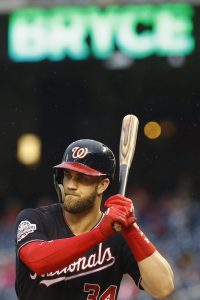
Harper himself tweeted a photo of the new cover for Sony’s MLB the Show 19, on which he appears in his new Phillies garb. After wearing number 34 in Washington, Harper will switch to number three in Philadelphia.
Check out a roundup of MLBTR’s Notes & Observations from the Harper signing here, or find out what the readers think of the new deal with this MLBTR Poll.
Phillies Sign Bryce Harper
TODAY: The deal is official, as per a simple tweet from the Phillies’ Twitter feed stating “We got him.”
THURSDAY, 7:23pm: Harper will receive a $10MM salary and a $20MM signing bonus for the upcoming season, tweets Heyman. He’ll then be paid $26MM annually from 2020-28 and $22MM annually from 2029-31.
1:51pm: The Phillies and star outfielder Bryce Harper have made quite the commitment to one another, according to reports. The sides have agreed in principle to a 13-year, $330MM deal that puts Harper in Philadelphia through his age-38 season.
Unlike virtually all recent mega-contracts, this one comes without caveats. Harper gets full no-trade rights and does not possess any opt-out opportunities. The contract won’t come with deferrals, though it is said to have a front-loaded structure.
The end to Harper’s drawn-out free agency seemed to come suddenly. It may be that the Phillies finally met his asking price after late-breaking interest from the Dodgers and Giants.
When the dust settled, Harper had landed the biggest contract in MLB history. He just tops the $325MM guarantee the Marlins gave Giancarlo Stanton over a 13-year term, though it’s important to note that deal came in an extension scenario.
In taking the largest overall contract, Harper did make a clear sacrifice on average annual value. He’ll earn just over $25MM per season annually, well under the $30MM average commanded recently by Manny Machado in his deal with the Padres and $33.4MM promised in the seven new seasons covered by Nolan Arenado‘s extension with the Rockies.
That reduced annual value won’t likely mean much in the way of sacrificed earning power, as it covers only three late-career seasons. It does help the Phillies to reduce the annual competitive balance tax hit from the signing, which could assist the organization as it looks to maintain competitiveness over a long marriage with its new star.
Beyond the market impact, this move sets the stage for a fascinating season (and beyond) in the National League East. The Phillies, Nationals, and Mets have all made win-now moves in hopes of dethroning a Braves team that is still full of young talent.
Harper’s move up the interstate from D.C. brings an end to a productive tenure with the Nats, reversing the career arc of recently retired former teammate Jayson Werth on a much grander scale. Harper’s exciting debut campaign was punctuated by a memorable run-in with the Phillies and then-ace Cole Hamels, the club that the Nationals were then seeking to eclipse as the premier outfit in the division.
The Washington organization did make a run at keeping Harper, but wasn’t able to work things out. Some might say that he’d have been better off taking the ten-year, $300MM offer that was reportedly put on the table. Reports have made clear that a roughly a third of that money would have been deferred, greatly driving down its true value.
Rather than take a deferred contract, Harper searched for and found the type of fully guaranteed, non-deferred deal he sought with the Philadelphia organization. The move punctuates an offseason that lived up to expectations for the Phillies’ faithful. The club already added the game’s best catcher in J.T. Realmuto, acquired a strong shortstop in Jean Segura, and added veterans including Andrew McCutchen and David Robertson. It’s imaginable that there’s more still to come, though perhaps the initial focus will be on making a roster-clearing move to accommodate the newest addition.
Investing in Harper gives the Phillies the game’s most recognizable player. He’s also quite a good one, even if he hasn’t shown that he can consistently produce at the otherworldly levels he did in a magical 2015 season. Harper’s ups and downs have come with a very lofty mean, of course — he’s a .279/.388/.512 career hitter with 184 home runs in nearly four thousand career plate appearances — though the aggregate remains every so slightly disappointing given his nearly unmatched talent level. Defensive questions arose last year, as Harper graded quite poorly. That was cause for concern in some quarters, though there’s also reason to believe that he can turn things around.
We at MLBTR would be remiss not to acknowledge that the out-on-a-limb estimation we put forth on Harper early in the offseason — a 14-year pact worth $420MM — ultimately proved to be a dramatic overreach. At the time of our initial top 50 rankings, we were of the belief that because Harper and Machado were non-traditional free agents (i.e. legitimate superstars who’d not yet played their age-26 seasons), traditional contractual structures wouldn’t apply to them. With so much talk in the preceding offseason about the teams who bend over backward to dip below the luxury tax in advance of this offseason’s crop of free agents, our team fully anticipated a widespread level of interest that simply never came to fruition.
Rather, with only three to four serious bidders for most of the winter, Harper and Boras had to claw to reach a point at which we expected the bidding to begin. The end result — a significantly lengthier term with the intent of tamping down the average annual value/luxury tax hit — was, as noted at the time, a highly plausible outcome, though securing a record-setting guarantee required lowering the AAV further than our forecast.
Predictions aside, Harper’s deal sets a new high-water mark on which premier players of the future will set their sights when seeking open-market contracts or, at least, extensions on the cusp of free agency. One can imagine, to varying extents, the Harper guarantee at least serving as a talking point when Mike Trout and Mookie Betts, both controlled through the 2020 season, begin to take an earnest look at their next contracts. Of course, they’d reach free agency at three and two years older than Harper was this winter, respectively, so it’s far from a direct comparison. But, as the Stanton contract did in this instance, the Harper contract will now serve as a barometer that agents and superstar players alike will aim to topple — even if by only a narrow measure.
Jon Heyman of MLB Network (Twitter link) first reported the deal. Jeff Passan of ESPN.com (Twitter links) and Jim Bowden of The Athletic (Twitter link) had the key terms, with Barry Svrluga of the Washington Post (Twitter link) and MLB.com’s Jesse Sanchez (via Twitter) adding details.
Photo courtesy of USA Today Sports Images.
MLBTR Poll: The Bryce Harper Contract
It’s not the biggest-ever salary promise if you account for inflation, but Bryce Harper‘s reported deal with the Phillies does have the highest number ever attached to a big league guarantee: $330MM. The star slugger took a discounted annual rate of pay over 13 seasons to get there. Lacking an opt-out and with full no-trade rights for the player, Harper is rather likely (though hardly assured) to remain in Philadelphia until the end of the 2031 season.
We ran through some of the post-signing reporting on the deal this morning. You’ll find some key details on the negotiations there. Harper’s value has been debated endlessly, of course. Ultimately, the market gave us an answer. But it’s one that many find unappealing, either on the high or low side. For a contract that has been this long in the making — many looked forward to Harper’s free agency before he even signed his first professional contract with the Nationals — it seems worthy of a poll.
How would you characterize the Harper deal? (Link for app users.)
What Did The Phillies Get In The Bryce Harper Deal?
-
an overpay 49% (11,646)
-
a fair market price 34% (8,108)
-
a bargain 16% (3,795)
Total votes: 23,549
Notes & Observations From The Bryce Harper Deal
“Harper’s Bazaar” has reached a conclusion. The Phillies reached an agreement to sign Bryce Harper to a 13-year, $330MM contract that now stands as the largest fully guaranteed contract in all of professional sports. While the journey to this terminus was tedious (surely even more so for those involved than for those of us following at a distance), it would appear that Harper and Boras ultimately met the goals they set out to achieve.
Boras, speaking to Joel Sherman of the New York Post (all Twitter links), made clear that Harper’s goal all offseason was to secure the longest contract possible. “Bryce wanted one city for the rest of his career,” said Boras. “That’s what I was instructed to do. It is very difficult in this time to get length of contract that takes a player to age 37, 38, 39.” That difficulty led to a trade-off in terms of annual value. Boras added that the hitter-friendly nature of Citizens Bank Park and owner John Middleton’s commitment to the courtship process both helped to sway Harper as well.
Here’s more:
- One notable aspect of Harper’s deal was the lack of a player opt-out clause — a contract term that has largely become a standard feature of big deals. Boras went on record with Tom Verducci of SI.com on this point, saying that his client “refused to allow me” to negotiate an opt-out because he wanted “to be with one team.” While some may raise an eyebrow when hearing an agent suggest that his client didn’t want an opt-out clause in the contract, Harper’s former manager, Dusty Baker, suggested the same thing in a recent interview on MLB Network Radio on SiriusXM (Twitter link, with audio). “I’ve been told that he wants to be a free agent one time in his career, so I’m sure that’s probably got a lot to do with his decision,” said Baker. If you’re looking for a broad narrative account of Harper’s market experience — with loads of intriguing details and Boras’s commentary on many aspects of the deal and process — you’ll want to give Verducci’s piece a full read.
- Talks between the Phillies and Harper’s camp escalated so rapidly on Thursday morning that general manager Matt Klentak didn’t even have time to get to the team offices, per Todd Zolecki of MLB.com. According to Zolecki, Klentak closed out the negotiations alone from his condo. Zolecki details some of the many twists and turns negotiations took this weekend, noting that at one point, because the Phillies were worried about losing Harper to a shorter-term deal with a record-shattering average annual value, they put forth three separate offers: a short-term deal with that same type of AAV, a “mid-term” deal and the 13-year, $330MM offer to which Harper eventually agreed. Tacking on those final three seasons without actually upping the $330MM guarantee many expected it’d take to sign Harper was indeed a means of lowering Harper’s luxury tax hit to provide future flexibility when constructing rosters.
- The Giants‘ top offer to Harper checked in at a hefty $310MM over a 12-year term, as first reported by Alex Pavlovic of NBC Sports Bay Area (via Twitter). The Giants would’ve been willing to go higher, according to Pavlovic, but they’d have had to push their final offer quite a ways north of $330MM given the discrepancy between taxes in California and taxes in Pennsylvania. At the end of the bidding, Boras asked the Giants to top the winning bid “by at least $20 million,” per Andrew Baggarly of The Athletic (subscription link). San Francisco was long rumored to be interested in Harper only on a short-term pact, though it appears that the team did indeed step up and make a larger push for Harper in the late stages of negotiations. Notably, as Baggarly reports, team CEO Larry Baer says that it was president of baseball ops Farhan Zaidi — not ownership — that “was the leading advocate for Harper.” While the Giants entered the fray relatively late in the game, Baer says the club’s interest emerged after Zaidi had spent time evaluating his resources and watching the market develop.
- Meanwhile, USA Today’s Bob Nightengale reports that the Dodgers never really deviated from their insistence on a short-term deal (Twitter link). Per his report, though, Los Angeles put forth offers with enormous annual values — a three-year, $135MM pact ($45MM AAV) and a four-year, $168MM offer as well ($42MM AAV). That’s contrary to what Ken Rosenthal of The Athletic reported (subscription link); his sources indicate that the Dodgers were “well below $40 million” in annual value in their bidding. It’s worth noting that Boras, in his previously mentioned comments to Sherman, flatly indicated that he received offers of $45MM in AAV (without specifying the source) and stated that Harper had a “full buffet” from which to choose. MLBTR’s Tim Dierkes opines (via Twitter), that the Dodgers “went overboard” with their insistence on a short-term deal in not even showing a willingness to pay Harper into his age-30 or age-31 season on a five- or six-year contract. It seems fair to say, too, that Harper also made a bold choice in his own right by turning down those fantastical annual salaries — if indeed they were on offer.
- While many will tab the contracts given out to Harper and Manny Machado as overpays, Eno Sarris of The Athletic argues to the contrary, calling each deal a relative bargain (subscription required). Looking at long-term projection models for each player’s production, Sarris concludes that the Phillies are effectively paying Harper at a $/WAR valuation that starts at $6MM in the first year of the contract (and increases from there with inflation). That, he notes, was considered the going rate for a win in free agency more than a decade ago (in 2008). As Sarris notes, projection systems are hardly flawless, and the same goes for the dollars-per-win argument. However, he also notes that when factoring inflation into the equation, the Harper and Machado contracts don’t rank anywhere near the top of the scale in terms of present-day dollars despite the fact that MLB revenues are higher than ever. (To that end, I’ll point out that Harper’s AAV is scarcely even higher than the $25.2MM annual value achieved by Alex Rodriguez with the Rangers nearly 20 years ago.)
Phillies’ Interest In Kimbrel, Keuchel Limited To Short-Term Deals
The Phillies put an end to the lengthiest, most high-profile free agent pursuit in MLB history today when they agreed to terms with Bryce Harper on a 13-year contract worth a record $330MM, And while there have been suggestions that the Phils could look into Dallas Keuchel and/or Craig Kimbrel once their pursuit of the market’s top two position players (Harper and Manny Machado) had wrapped up one way or another, Todd Zolecki of MLB.com tweets that it’s “unlikely” the Phils would sign either unless one pitcher’s asking price suddenly dropped to a short-term deal. MLB Network’s Jon Heyman offers similar thinking, tweeting that while the Phils “may” look into the market’s top remaining free agents, the organization’s “initial thought” would be short-term.
It’s been a quiet offseason in terms of rumors surrounding both pitchers. Keuchel and Kimbrel have different agents but both entered free agency reportedly hoping to score contracts of $100MM or more; that initial asking price may have turned off some suitors entirely, as there’s been little in the way of teams reported to have interest in the duo. That certainly doesn’t mean that the two haven’t had any interest, but the fact that they’re unsigned with just hours until the calendar flips to March also (obviously) suggests that their current asking price isn’t generating much in the way of bites from potential suitors. Unsurprisingly, both are still in search of multi-year deals, per Mark Feinsand of MLB.com.
Either pitcher would be an obvious fit for the Phillies, though after adding Harper, Andrew McCutchen, David Robertson, J.T. Realmuto and Jean Segura already this winter, it doesn’t seem as though GM Matt Klentak, president Andy MacPhail and owner John Middleton are prepared to pay top-of-the-market prices. Still, the Phillies are presently relying on a trio of unproven starters — Nick Pivetta, Zach Eflin, Vince Velasquez — behind ace Aaron Nola and veteran Jake Arrieta. Velasquez has long been tabbed as a potential reliever in the end anyhow, and bringing Keuchel aboard could push him to that role while adding a durable, dependable arm to the mix.
In the bullpen, the Phillies are looking at Robertson and sophomore Seranthony Dominguez as a formidable one-two punch at the back end of games. A rebound from Hector Neris and/or better health from veterans Pat Neshek and Tommy Hunter would give Philadelphia an even deeper collection of ‘pen arms, but even with that potentially strong quintet, Kimbrel would push everyone down a peg and give manager Gabe Kapler a cavalcade of impressive arms. (It should be noted, too, that there’s at least a bit of early concern surrounding Hunter’s right arm.)
Even after adding Harper on his record-setting deal, the Phillies’ 2019 payroll projects at just north of $163MM. Their luxury-tax ledger is a bit more crowded at a projected $191.1MM at present (per Roster Resource’s Jason Martinez), so adding either Kimbrel or Keuchel would likely put the Phils over the $206MM barrier (barring the trade of another player on a guaranteed contract).
Phillies Injury Notes: Hernandez, Quinn, Hunter
Even as they consider further acquisitions, the Phillies are dealing with a few health issues involving existing players. None seem particularly worrisome, but a few are worthy of note as the roster takes shape:
- Second baseman Cesar Hernandez has been diagnosed with a grade 1 hip flexor strain, Matt Breen of Philly.com was among those to report on Twitter. It’s not known at this point how long the injury will keep him sidelined, though it’s surely promising that the diagnosis is of the lowest grade. Hernandez has been plenty durable in recent seasons, though he is already working to return from offseason foot surgery.
- There’s also some worry surrounding the outfield health. Roman Quinn is dealing with a “mild” oblique strain, as MLB.com’s Todd Zolecki reports. That’s a tricky area of the body, but the real red flag here is Quinn’s own track record. Since he reached the professional ranks in 2012, the former second-round draft pick has yet to appear in 100 games in a single season. Quinn says he has done everything possible to “put my body in position to work at a high level,” making for a “really frustrating” situation. The Phils will hope that this latest malady heals up quickly, as Quinn had been slated to battle for a job on the MLB roster.
- Reliever Tommy Hunter, meanwhile, says he’s not terribly concerned with the status of his forearm. While he has been diagnosed with a grade 1 flexor strain, Hunter says the injury is one he has experienced “pretty much every year.” This one was significant enough to require a pause, but it seems he expects to come through just fine. Even if that means missing some time early on in the season, Hunter says he’s confident in the organization’s relief depth.
Latest On Offers To Bryce Harper
If it seems we’re making only incremental progress in our understanding of the Bryce Harper saga, that may be due to the fact that the bidding is still progressing in a cautious manner. We learned yesterday that the Giants’ interest extended to the ten-year contract range, and there’s more chatter this morning, though it’s fair to wonder whether the recent movement is mostly just setting the stage for a final frenzy.
Harper’s camp seemingly expects to sign a record-breaking contract, Bob Nightengale of USA Today reports. It remains to be seen both where Harper will land and what record(s) he’ll break, but Nightengale writes that the three primary remaining contenders — the Dodgers, Giants, and Phillies — “have vowed to provide Harper with either the biggest overall free-agent contract in North American sports history or the largest average annual salary anyone has ever received in the sport.” The present record-holders in each of those two measures are Giancarlo Stanton ($325MM total contract) and Zack Greinke ($34.42MM AAV).
Agent Scott Boras is said to be “circling back with other teams” to see if they wish to get involved at the last moment. Presumably, that’ll include a phone call to the Nationals, Harper’s only professional club to date and a frequent match with Boras clients. It’s unknown at this point whether any other organizations will jump into the mix or whether the bidding is down to a final three. Regardless, Nightengale suggests, it seems the final stage of the process is finally upon us.
Here’s a quick breakdown of where the three aforementioned primary contenders stand, based upon reporting to date:
- The Phillies “still have the highest offer on the table,” per Nightengale. As Matt Breen of Philly.com reported yesterday, though the club is increasingly pessimistic of landing the star. The Phils are holding the line for the time being, per Andy Martino of SNY.tv (via Twitter), with Harper looking to move past the Stanton guarantee. Clearly, there’s some tension between this report and Nightengale’s assessment of the organizations’ willingness to set new high-water marks in the financial department.
- The Dodgers are evidently still not willing to go to a decade, as ESPN.com’s Buster Olney reported yesterday on Twitter. They are, however, prepared to “obliterate” Greinke’s AAV record, Nightengale says. It seems the organization believes it’d need to dangle a term of “at least five years,” though that element of the interest is largely unknown. Neither is it known just how high the Dodgers would go in single-season AAV. It’s worth noting that the opt-out(s) included would be of even greater importance under this kind of scenario, though it’s unclear as yet how that could factor in.
- As for the Giants, Nightengale says the club is willing to go past $300MM on a ten-year term to land Harper. That’s unsurprising, as it emerged yesterday that the San Francisco organization was willing to go to that length, but is notable nevertheless. Nightengale cites “panic and desperation about season-ticket sales and fan interest” as driving what is “strictly an ownership pursuit.”
NL East Injury Notes: Hunter, Glover, Soroka, Victor Victor
The Mets have had a few notable health issues arise early in camp, with Todd Frazier (link) and Jed Lowrie (link) each coming down with maladies. But they aren’t alone in that regard. Here are injury notes from the remaining four teams in the National League East:
- Phillies setup man Tommy Hunter has been diagnosed with a Grade 1 flexor strain in his right forearm and won’t throw for two weeks, manager Gabe Kapler told reporters Tuesday (Twitter link via the Philadelphia Inquirer’s Matt Breen). Hunter, 32, missed the first month of the 2018 season due to a hamstring strain and now looks to be in some degree of jeopardy as pertains to Opening Day 2019, though if he’s cleared to resume activities in two weeks’ time, he could potentially be built back up in time for the regular season. Hunter, owed $9MM in the second season of a two-year contract, pitched to a 3.80 ERA with 7.2 K/9, 2.1 BB/9 and 0.8 HR/9 in 64 frames of relief when healthy last season.
- Similarly, the Nationals got more bad news on right-hander Koda Glover, who is being shut down for the time being due to a forearm strain in his right arm, as Mack Zuckerman of MASNsports.com writes. The Nats, by all accounts, love Glover’s potential but have been unable to keep him on the field over the past two seasons, as he’s been shelved by back, hip and shoulder injuries. Once looked at as a potential closer of the future in D.C., Glover has managed just 35 2/3 innings at the MLB level across the past two seasons. Despite only having pitched a total of 55 1/3 innings in the Majors, Glover already has more than two full seasons of MLB service time given his lengthy DL stays. On the plus side, the 25-year-old’s MRI revealed no damage to his elbow ligament. Glover expressed confidence that the issue will ultimately prove minor, though only time will tell whether that will ultimately be the case.
- Braves righty Mike Soroka will pick up the ball again on Thursday, skipper Brian Snitker told reporters including David O’Brien of The Athletic (via Twitter). The hope surely is that a week or so of rest will allow his shoulder discomfort to subside. If not, it stands to reason that the Atlanta organization’s medical staff will order up an even lengthier timeout and further medical examination. Soroka is hoping for a healthy 2019 after his promising debut campaign was cut short by shoulder troubles.
- An MRI revealed that Marlins prospect Victor Victor Mesa suffered a Grade 1 hamstring strain when beating out a possible double-play grounder in Sunday’s Grapefruit League contest, per a team announcement. While that’s the lowest grade of strain, Mesa will be sidelined for a bit and has been reassigned to minor league camp as a result. Manager Don Mattingly called the injury disappointing (link via MLB.com’s Joe Frisaro), given that the Miami organization had hoped to get Mesa as many at-bats as possible in big league camp as it gets a first extended look at his skill set. Mesa will likely head to Class-A Advanced or Double-A for his first taste of professional ball in the States, Mattingly added.
Phillies’ Offer To Harper Reportedly Worth More Than $300 Million
The Phillies have put forth an offer to free-agent outfielder Bryce Harper that would guarantee him more than $300MM, reports MLB Network’s Jon Heyman (via Twitter). That would indicate a willingness to top Manny Machado‘s record-setting $300MM free-agent deal with the Padres. It’s not clear if Philadelphia’s offer is also greater than Giancarlo Stanton‘s overall record $325MM contract.
Heyman suggests that there’s at least one other club that has expressed a willingness to top $300MM to sign Harper, which would be a surprising new development at this stage in his free agency. While the Nationals offered Harper an extremely deferred $300MM back in late September, there have been no recent indications that any of the remaining Harper suitors would come close to that mark
As of yesterday, the Dodgers and Giants were said to be the only two teams still in the mix for Harper, and both were said to be pursuing him on shorter-term contracts with sizable average annual values. The presence of another $300MM+ offer, if accurate, would represent a considerable change of heart for either of those California-based clubs (or the presence of another team involved in the bidding). Joel Sherman of the New York Post explored the situation yesterday, noting that the Dodgers appear willing to offer Harper a record-setting annual value — “at least $35 million a year, perhaps closer to $40 million” — but only over four or, at absolute most, five years. Sherman writes that he spoke to one person involved who “insisted not to undersell the Giants,” as well.
Over the weekend, the Phillies were optimistic of completing a 10-year deal with Harper by yesterday — an outcome that clearly didn’t happen and was likely impacted by the Dodgers’ Sunday-evening meeting with Harper in Las Vegas. Harper still expects to finally make his decision this week, per USA Today’s Bob Nightengale, bringing to an end an exhausting saga and likely resulting in at least one type of contractual record.
Health Notes: Nelson, Herrera, Swanson, Oaks
Brewers hurler Jimmy Nelson is pausing his throwing program owing to “arm fatigue discomfort,” president of baseball operations David Stearns tells reporters including Tom Haudricourt of the Milwaukee Journal-Sentinel. All involved say they’re unconcerned with the development, with manager Craig Counsell labeling it “a very minor setback.” It has been a long road back already for Nelson, who hasn’t thrown a competitive inning since undergoing a labrum procedure in September of 2017. He’ll need to wait a while longer before taking the bump in a Spring Training contest, with the club understandably maintaining a conservative plan in light of his health history.
More health notes from around the game …
- The Phillies say that outfielder Odubel Herrera is dealing with a grade 1 hamstring strain, Matt Breen of Philly.com reports on Twitter. He’s said to be “coming along,” though skipper Gabe Kapler couldn’t specify when Herrera will be ready to take the field. It’s not a terribly worrying injury at the outset of camp, though it will limit Herrera’s opportunities to get in a groove after a disappointing 2018 season. The wild card in the situation is the Phils’ ongoing pursuit of Bryce Harper and their as-yet-unknown plans for shuffling the outfield deck if they sign him. The injury might impact Herrera’s marketability, if he’s a player the team would consider moving to make way for Harper.
- Braves shortstop Dansby Swanson is readying for his first Spring Training game action at the end of the week, per Gabe Burns of the Atlanta Journal-Constitution (via Twitter). That seems to represent a positive sign for a player who underwent wrist surgery at the conclusion of the 2018 campaign. Swanson had a quiet but reasonably promising 2018 campaign, with sparkling glovework and baserunning making up for still-lagging production at the plate. Swanson produced only a .238/.304/.395 slash (80 wRC+) with 14 home runs and ten steals over 533 plate appearances, but that represented a step forward after a rough 2017 effort. He’ll open camp with a presumption of at least semi-regular playing time, but could face pressure from Johan Camargo over the course of the season.
- Hip surgery is on the table for Royals righty Trevor Oaks, Rustin Dodd of The Athletic reports (subscription link). If it is determined that he needs to go under the knife for a labrum tear, the 25-year-old will miss a significant portion of the season to come. Oaks turned in 128 1/3 innings of 3.23 ERA ball at Triple-A last year after he was acquired in last winter’s Scott Alexander swap. He managed only 4.9 K/9 with 3.1 BB/9 on the year, though did post a 50.2% groundball rate (which actually lags his well-above-average minor-league career groundball numbers). Oaks also made a brief MLB debut in 2018. As Dodd explains, it didn’t seem likely that he’d crack the active roster to open the coming campaign. Nevertheless, the loss would dent the Royals’ rotation depth.