
Yankees Acquire Jazz Chisholm Jr.
Jazz Chisholm Jr. is on his way to the Big Apple. The Yankees announced they’ve acquired Chisholm from the Marlins for three prospects: catcher Agustin Ramirez and infielders Jared Serna and Abrahan Ramirez.
Chisholm, 26, was a consensus top-100 prospect when the Marlins acquired him from the Diamondbacks in the deal that sent right-hander Zac Gallen to Arizona. While Gallen has blossomed into one of the NL’s top starters since arriving in the desert, Chisholm’s time in Miami has been far less consistent. After a rookie 2021 campaign where he split time between shortstop and second base with roughly league average offense, Chisholm committed to second full-time in 2022 and broke out in a big way with an excellent .254/.325/.535 (136 wRC+) slash line that year. Unfortunately, Chisholm’s All-Star campaign was cut short by a stress fracture in his back that limited him to just 60 games that year.
That injury combined with the Marlins’ lack of quality options in the outfield led Miami to move Chisholm out of the infield ahead of the 2023 season, installing him in center field. The results of that experiment were somewhat mixed, as Chisholm took a step backwards on offense with a 103 wRC+ and was limited to just 97 games by a bout of turf toe but proved to be surprisingly solid defensively in center with +4 Outs Above Average, although Defensive Runs Saved disagreed with that assessment and graded him as one of the ten worst outfield defenders in the sport last year with a -14 figure. Chisholm’s offense hasn’t rebounded much in 2024 as he’s slashing .249/.323/.407 (104 wRC+) on the year, but his defensive metrics have settled in a bit more to paint him as a roughly scratch defender (+1 OAA, -4 DRS) in center field. Perhaps most importantly, the youngster has stayed healthy and on the field this year as he’s appeared in 101 of Miami’s 104 games while even getting some work in at second base again in recent weeks.
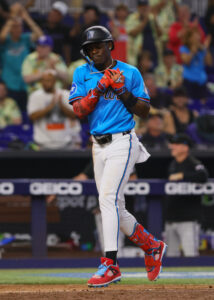
Chisholm’s versatility is surely part of what makes him an attractive addition for the Yankees. While Aaron Judge and Juan Soto‘s otherworldly 2024 campaigns have kept the Yankees offense afloat for the most part to this point and allowed the club to post a solid 60-45 record overall, they’ve gone just 6-13 in the month of July thanks in part to a lackluster supporting cast that has seen only catcher Austin Wells post above average numbers by measure of wRC+ among healthy Yankees players with at least 100 PA this year not named Judge or Soto.
With so many spots in the lineup that could do with an upgrade, Chisholm’s slightly better than average bat and versatility figure to be a major asset for the Yankees. SNY’s Andy Martino was among those to suggest following news of the trade that Chisholm’s position with the Yankees is not yet fully set in stone, and it’s easy to see why. Chisholm’s ability to play center could allow manager Aaron Boone to turn to struggling left fielder Alex Verdugo, who has posted a wRC+ of just 56 since the start of June, less often while pushing Judge to a less taxing spot in the outfield or perhaps even allowing him to DH on days where both Chisholm and Verdugo are roaming the outfield.
On the other hand, Gleyber Torres is having a relative down season (96 wRC+) as the club’s regular second baseman and third base has been a massive hole for the Yankees all season, though neither Torres nor Chisholm have any experience at the hot corner in the majors. Given Torres’s excellent 119 wRC+ against lefties and Verdugo’s brutal 63 wRC+ against fellow southpaws this season, it’s possible even to imagine Chisholm (who sports a decent 96 wRC+ against southpaws in spite of his own lefty bat) playing the outfield against lefty starters while mixing into the infield more often against righties, allowing the Yankees to play matchups more effectively for both Verdugo and Torres, especially in the event that New York brass don’t want to have either Chisholm or Torres learn third base on the fly.
Of course, another factor in Chisholm’s value to the Yankees is the fact that he’s controlled through the end of the 2026 season. For an offense that figures to see Soto, Torres, Verdugo, J.D. Davis, and perhaps Anthony Rizzo all depart for free agency following the 2024 campaign, adding Chisholm to the lineup as a long-term building block alongside sluggers Judge and Giancarlo Stanton as well as youngsters Wells, Anthony Volpe, and Ben Rice offers the Yankees the ability to decide Chisholm’s long-term home on the diamond based on both his defensive performance and the needs of the roster surrounding him in an offseason where re-signing Soto figures to be the top priority. It’s possible to imagine Chisholm settling in as a fixture of the club’s mix in either the infield or outfield depending on both the club’s external additions this winter and the performance of up-and-coming youngsters in the club’s system like infielder Oswald Peraza and outfielder Jasson Dominguez, both of whom could vie for everyday roles in 2025.
As for the Marlins, they’ll receive a package of three prospects in return for the youngster who has been the club’s lone productive hitter this year ever since Luis Arraez was dealt to San Diego back in May. The closest to making an impact at the major league level of that group is Ramirez, a 22-year-old catcher who is already on the 40-man roster and reached the Triple-A level earlier this year. The youngster is just the #20 prospect in the Yankees system according to MLB Pipeline but is a far more robust third in the system according to Baseball America.
A bat-first catcher who slashed an impressive .290/.372/.570 in 58 games at the Double-A level this year prior to his promotion to the next level, Ramirez offers enticing raw power and a knack for making contact in the zone, though upper-level breaking balls have given him trouble and both Pipeline and BA suggest that he’ll need to improve his swing decisions a bit to reach his potential as a hitter. Scouts have plenty of questions about whether or not Ramirez will be able to stick behind the plate in the majors, though there’s optimism that he’ll have a future in the big leagues even if he ends up moving off catcher to a more offensively demanding position like first base.
Also heading to Miami in the return is Serna, a 22-year-old infielder in the midst of a solid season at the High-A level. The club’s #19 prospect per Pipeline and #11 prospect per BA, Serna has slashed a respectable .253/.341/.444 in 88 games with the Yankees’ affiliate in Hudson Valley while swiping 11 bags and slugging 13 home runs, although his body doesn’t project for much more power and he’s expected to slug at below average levels in the majors. Serna is also viewed as unlikely to stick at shortstop long-term, with BA noting that his fringey arm means he’s likely to end up at second base although he does have experience in the outfield and at the hot corner as well.
As for the latter Ramirez, he signed with the Yankees out of Venezuela back in 2022 on a $30,000 bonus (h/t Jesse Sanchez of MLB.com) and made his stateside debut earlier this year. In 49 games in complex ball this year, the 19-year-old has looked good with an excellent .348/.447/.513 slash line in 189 trips to the plate while splitting time between shortstop as well as second and third base. Ramirez is not ranked within the Yankees’ top-30 prospects by any major public-facing evaluators at the moment, although given his youth and big numbers in complex ball it wouldn’t be a shock to see him make some noise in that regard with Miami at some point in the future.
Craig Mish of SportsGrid first reported the Yankees and Marlins were in talks about a deal that’d send Chisholm to New York for three prospects. Ken Rosenthal of the Athletic was first to say the deal was done. ESPN’s Alden González reported Agustin Ramirez was the headliner and Abrahan Ramirez’s inclusion. Christina De Nicola of MLB.com had Serna’s inclusion.
Image courtesy of USA Today Sports.
Latest On Yankees’ Deadline Plans
The Yankees swung a major trade earlier today when they acquired second baseman and center fielder Jazz Chisholm Jr. from the Marlins in exchange for a three-prospect package. The addition of Chisholm helps to address an offense that has struggled to produce when anyone other than Juan Soto or Aaron Judge is at the plate, but Joel Sherman of the New York Post wrote in the aftermath of the Chisholm trade this evening that the club plans to continue being aggressive on the trade market as they look to return to the postseason after missing for the first time since 2016 last year.
According to Sherman, the Yankees’ ideal deadline involves acquiring at least two hitters and two relievers. The addition of Chisholm locks up one of those hitting additions, although there’s still plenty of room for improvement around New York’s lineup. Ben Rice has held his own at first base in place of the injured Anthony Rizzo, and Anthony Volpe appears certain to continue getting everyday reps at shortstop, but third base appears to be a clear hole for the club. SNY’s Andy Martino reported earlier today that the Yankees were planning to address the hot corner before the trade deadline. While it’s theoretically possible to imagine Chisholm, a former shortstop with enough arm to handle center field, sliding over to third base for the Yankees, he’s never played the position before as a professional and the club may prefer to keep him in more familiar spots on the diamond for the time being.
If the Yankees do pursue an addition at third base, Sherman suggests that Isaac Paredes of the Rays, Luis Rengifo of the Angels, and Matt Chapman of the Giants could be among the options the club entertains. Chapman’s 111 wRC+ is the lowest of those three options but any of them would be a major upgrade over the paltry 75 wRC+ the club has gotten from its third baseman this year, a figure that ranks third worst in baseball this year. A deal for a third baseman, according to Sherman, could free up the Yankees to move another bat such as second baseman Gleyber Torres or center fielder Trent Grisham in a deal for bullpen help, though it also stands to reason that Chisholm could bounce between the keystone and the outfield depending on matchups, allowing the club to sit struggling lefties like Verdugo and Grisham against southpaws while giving players like Torres and LeMahieu more days off against right-handed starters.
As for the bullpen, the Yankees are known to have interest in Marlins southpaw Tanner Scott, and today’s deal between the sides for Chisholm does not figure to stop the clubs from getting together on another deal before the deadline should they be able to reach in agreement regarding the lefty. That being said, there are plenty of other late-inning relief options that figure to be available this summer. Nationals closer Kyle Finnegan and Rays closer Pete Fairbanks are both among the arms with closing experience rumored to be available. NJ.com’s Randy Miller reported earlier today that the Rays and Yankees were in the midst of “serious talks” regarding a Fairbanks deal, though MLB.com’s Bryan Hoch subsequently reported that nothing is close between the sides regarding Fairbanks.
Failing a reliable late-inning option, there figure to be plenty of other potentially interesting options available such White Sox flamethrower Michael Kopech, Cubs veteran Hector Neris, and Blue Jays righty Trevor Richards. Each of that trio have struggled to varying degrees this year but could be a fairly interesting addition for the Yankees bullpen, particularly if acquired as a secondary addition behind a more impactful arm like Fairbanks, Scott, or Finnegan.
Another possibility for bolstering the club’s relief corps Sherman suggests would be looking at the market for rental starting pitching. As reported by Sherman, the Yankees have inquired after Tigers right-hander Jack Flaherty, who sports an excellent 2.95 ERA and 3.10 FIP in 106 2/3 innings of work for Detroit this year, Sherman suggests that such a move could allow the Yankees to move right-hander Luis Gil to the bullpen as a high leverage arm. Such a move would both fortify the relief corps while also helping to limit Gil’s innings. The righty has already thrown 107 1/3 frames this year after throwing just 138 1/3 total innings between 2021 and 2023 due to a variety of injuries.
The idea of preserving Gil’s health by moving him to the bullpen might be an attractive one for New York, although it’s worth noting that it would require a starter of Flaherty’s caliber for the loss of Gil from the rotation mix not to be a downgrade overall. Gil’s first big league action since 2022 has gone exceptionally well as he’s posted a 3.10 ERA with a 3.52 FIP across 20 starts for the Yankees this year while filling out the club’s rotation in the place of injured starters—first Gerrit Cole, then Clarke Schmidt.
Marlins, Pirates Have Had “Exploratory” Talks On Jazz Chisholm
Jazz Chisholm Jr. is one of the more interesting position players who is likely to move by the end of the month. The Yankees, Royals and Mariners have all been linked to Miami’s center fielder/second baseman. The Pirates have also been loosely floated as a potential Chisholm fit.
Craig Mish of the Miami Herald and SportsGrid appeared on 93.7 The Fan this afternoon (YouTube link, beginning around 9:27). Mish said that Pittsburgh and Miami have indeed discussed Chisholm, though he characterized those talks as “exploratory” in nature. According to Mish, a few teams other than Pittsburgh have expressed more serious interest to this point. While there’s clearly nothing imminent, Chisholm is on Pittsburgh’s radar to some extent as the Bucs look to add offense.
Chisholm’s defensive flexibility makes him a viable target for a lot of teams. He has primarily played center field going back to the start of the 2023 season. Miami gave him a start at second base last weekend for the first time since 2022. Chisholm was back in center field for tonight’s series opener against the Mets.
The 26-year-old can fit on teams looking for help at either position. The Pirates haven’t gotten much production out of either center field or second base. Pittsburgh center fielders entered play tonight with a dismal .206/.267/.297 slash line that bests only the Cardinals’ offensive output. Michael A. Taylor remains an elite defender but he’s having the worst offensive season of his career, hitting .203/.258/.279 in 73 games.
Pittsburgh hasn’t been a whole lot better at second base. They’ve gotten a .253/.315/.349 performance out of the position. Nick Gonzales got out to an excellent start to the season upon being recalled in May. The former seventh overall pick has slumped to a .240/.269/.349 line in 156 plate appearances since the start of June. Gonzales hit a walk-off single tonight to complete an 8-7 comeback win over the Phillies, but he wasn’t performing well going into the All-Star Break.
Tonight’s victory pushed the Pirates above .500 at 49-48. They’re half a game back of the Mets and Diamondbacks, who are tied for the National League’s last Wild Card spot. Pittsburgh is in position to add at the deadline for the first time in years, although it’s unclear how willing GM Ben Cherington would be to subtract from the top of their farm system. As Darragh McDonald explored in a piece for Front Office subscribers on Wednesday, the Bucs have ample rotation depth. Miami isn’t going to look for immediate starting pitching in a Chisholm deal — Mish suggests the Marlins could target prospects who are two to three years from the big leagues — but the Bucs’ depth could free them to deal a pitching prospect or two for offense. Chisholm is hitting .251/.322/.407 and is under arbitration control through 2026.
Latest On Jazz Chisholm’s Market
Jazz Chisholm Jr. stands as one of the top position players available in what could be a relatively light market for bats. Trade chatter regarding Chisholm has picked up over the past week. The Marlins only added fuel by moving him back to second base over the weekend, seemingly an effort to demonstrate his defensive versatility for potential trade partners with two weeks until the deadline.
A middle infielder by trade, Chisholm moved to center field in 2023 in deference to Luis Arraez. Defensive metrics have been mixed on Chisholm’s outfield performance. Defensive Runs Saved has him as a well below-average center fielder, while Statcast has him as a neutral to solid outfielder. Both metrics were fonder of his early work at second base than they’ve been on his center field defense.
Even a couple weeks of reps back at second base could raise teams’ confidence that Chisholm could play there down the stretch. The New York Post’s Jon Heyman wrote last week that the Yankees have considered Chisholm, presumably as an infield fit. Bob Nightengale of USA Today reported yesterday that the Royals — a team openly seeking a player who can bounce between the infield and outfield — have shown interest in Chisholm. Nightengale suggests the Mariners, another club that hasn’t made any secret of its desire to upgrade the offense, is also in the mix.
While there should be a broad range of teams interested in a player with Chisholm’s defensive flexibility, Nightengale indicates the Phillies are not showing much interest in their division rival. (The Athletic’s Jim Bowden had loosely linked Chisholm, among various other players, to Philadelphia last week.) The Phils are set in the middle infield with Trea Turner and Bryson Stott. They’re looking for outfield help, although that could take the form of a right-handed platoon bat rather than an everyday player.
Chisholm, a left-handed hitter, wouldn’t address Philadelphia’s desire for more balance in the outfield. He’d be a clear offensive improvement as an everyday center fielder on Johan Rojas. Rojas is a gifted defender, though, and the Phils might not feel that Chisholm’s a marked enough overall upgrade to beat the offers put forth by other teams that are more desperate for hitting.
The 26-year-old Chisholm is having a second straight solid but not incredible season. He goes into the All-Star Break with a roughly average .249/.321/.407 slash line. Chisholm has hit 12 homers and stolen 18 bases (although he’s been thrown out eight times). That’s similar to last year’s .250/.304/.457 showing. An average hitter with the ability to cover multiple up-the-middle positions is certainly a valuable player, yet Chisholm hasn’t developed into the franchise building block he seemed during an All-Star first half in 2022.
Injuries have been a factor. Most notably, a stress fracture in Chisholm’s back cut short that potential breakout year in ’22. Toe and oblique issues limited him to 97 games a year ago. He has avoided the injured list thus far in 2024. The injury history has kept him from accumulating the kind of counting stats that’d result in significant arbitration earnings. Chisholm is playing on a very affordable $2.625MM salary and won’t reach free agency until the 2026-27 offseason.
Marlins To Give Jazz Chisholm Jr. Playing Time At Second Base
Jazz Chisholm Jr. has been prominently floated in trade speculation as the deadline approaches, and some more fuel was added to that fire with today’s news that the Marlins will again be deploying Chisholm as a second baseman on at least a part-time basis. Chisholm took some grounders at second prior to today’s game with the Reds, and manager Skip Schumaker told reporters (including MLB.com’s Jeff Wallner) that Chisholm was happy “to do whatever’s best for the team.”
The decision is about “trying to keep his bat in the lineup every day,” Schumaker said. “Also trying to keep him playing every day for 160-plus games, which he’s never done. So trying to get him DH days. Maybe second base is a way to get him off his feet a little bit. Because I think he could play that in his sleep.”
These are all valid baseball-related reasons for the position change, as Chisholm is coming off a pair of injury-shortened seasons. Not only has Chisholm not reached the 160-game plateau, his 124 games in 2021 represent the highest total of his four Major League seasons. He played in only 157 of a possible 324 games in 2022-23, but has thus far taken the field in 91 of Miami’s 94 contests in 2024. Chisholm is no stranger to the keystone after playing mostly second base during his first three MLB seasons, but he has exclusively played center field (with a few DH days) since the Marlins decided to move him to outfield duty prior to the 2023 season.
As logical as Schumaker’s explanation is, moving Chisholm to second base could also be very easily viewed as Miami’s way of showcasing his versatility to potential trade partners in advance of July 30. Chisholm’s center field work has been average at best, depending on the defensive metric of choice — Defensive Runs Saved (-14) and UZR/150 (-7) have both panned his glovework, while Chisholm has +4 Outs Above Average over his 1541 innings as a center fielder. Over 1308 1/3 big league innings at second base, Chisholm has a +7 DRS and +8 OAA, though UZR/150 again has him below average with a -2.6 number.
While this resume as a second baseman doesn’t exactly reflect a level of “he could play that in his sleep” defensive performance, it seems logical to assume that Chisholm is a better defensive option as an infielder than as an outfielder going forward. The ability to play center field on at least a passable basis obviously adds to Chisholm’s trade value, but it could be that some potential suitors eyeing Chisholm as primarily a second baseman wanted some evidence that he could still handle the position before meeting what is likely a big asking price in trade talks.
Chisholm is only in the first of three arbitration-eligible seasons, earning $2.625MM in 2024 and under team control through 2026. Miami therefore isn’t under any crunch to move Chisholm by the deadline, and an argument could be made that waiting until at least this offseason to make a move might only help the Marlins’ chances at a premium return. If Chisholm stays healthy, fully re-establishes himself as a second base candidate, and improves on his okay (103 wRC+, .251/.320/.410 in 388 PA) but not outstanding offensive production, he’ll still be a prime trade chip for the Marlins as they continue their latest roster overhaul.
Yankees Have Discussed Jazz Chisholm
The Yankees have had some discussions regarding Jazz Chisholm Jr., writes Jon Heyman of the New York Post. It’s not clear how serious New York’s interest is or whether they’ve been in contact with Miami’s front office.
Chisholm will be the subject of ample trade chatter over the next three weeks. Craig Mish of the Miami Herald wrote earlier in the week that there’s increased belief around the industry that he’ll be dealt. The Marlins probably won’t take many players off the table as they continue the rebuild they truly commenced with the Luis Arraez trade at the start of May. Thanks to a brutal series of injuries that has decimated their rotation, Chisholm is probably Miami’s most valuable deadline trade chip.
[Related: Top 50 Trade Candidates]
The lefty-hitting Chisholm connected on his 12th homer of the season in today’s loss to the Astros. He’s carrying a slightly above-average .255/.324/.419 slash line through 377 plate appearances. Chisholm has stolen 18 bases but been thrown out on eight occasions. He’s walking at an average 8.5% clip while striking out just over a quarter of the time.
It might not be dominant production, but Chisholm at least looks like a solid everyday player. Some teams could still view him as an upside play at age 26. Chisholm was a staple on top prospect lists thanks to his evident combination of athleticism and raw power potential. He’s shown glimpses of that ceiling at the big league level — most notably during an All-Star 2022 season in which he hit .254/.324/.535 over his first 60 games. Chisholm’s seeming breakout year was cut short by a stress fracture in his back. He has been a good but not elite player over the past season and a half, hitting .253/.314/.436 with 30 longballs and 40 steals over 755 plate appearances.
That more recent stretch has coincided with a position change. Chisholm was a middle infield prospect who broke into the majors as a primary second baseman. The Marlins moved him to center field when they acquired Arraez going into ’23. Defensive metrics are mixed on his outfield work. Defensive Runs Saved has rated Chisholm 14 runs below average in more than 1500 center field innings. Statcast has him as a neutral defender.
While the Yankees don’t necessarily need outfield help, they should be looking for ways to deepen the lineup. New York has Juan Soto and Alex Verdugo in the corner positions. Aaron Judge has played mostly designated hitter since Giancarlo Stanton landed on the injured list, drawing Trent Grisham into the lineup in center field. Playing Grisham regularly isn’t ideal, but Stanton could be back around the deadline (thereby pushing Judge back to center).
Miami hasn’t played Chisholm for a single inning on the infield dirt since 2022. Manager Skip Schumaker flatly shot down the idea of getting him infield reps after the Fish designated Tim Anderson for assignment at the start of July (X link via Isaac Azout of Fish on First). Other teams may be more willing to rotate Chisholm into the middle infield, at least on occasion. Heyman suggests that if the Yankees were to make a serious run at Chisholm, it’d likely be with an eye to the infield. Neither Gleyber Torres nor DJ LeMahieu have gotten things going offensively, leaving the Yankees without much production from second or third base.
Chisholm is under team control for two and a half seasons, so Miami should net a significant return if they do move him. He’s making just $2.625MM this year, a little less than half of which has yet to be paid.
Report: “Growing Belief” That Marlins Will Trade Jazz Chisholm Jr.
The Marlins announced their status as deadline sellers more than two months ago with their surprising early trade of Luis Arraez, and with the trade deadline now just 22 days away, their activity on that front should pick back up. While much of the focus has been on closer Tanner Scott, who’s a free agent at season’s end, Craig Mish of SportsGrid and the Miami Herald reports that there’s a “growing belief” Jazz Chisholm Jr. will also be traded. Mish lists the Mariners as a “club to watch” if Chisholm is moved and also suggests the Pirates and Royals could join the bidding.
Chisholm, 26, is enjoying a solid season at the plate, hitting .255/.326/.407 (105 wRC+) with ten homers and 17 steals (albeit in 25 tries). He’s struggled with strikeouts on the past, and while his 24.9% rate is still worse than average, it’s a notable improvement over the 29.2% clip he registered in the four prior seasons. He’s paired those improved contact skills with a career-best 8.8% walk rate.
There’s little doubting Chisholm’s raw tools and star-caliber upside. He’s averaged 26 homers and 32 steals per 162 games played in his career. However, he’s never topped 124 games in a season and has only reached 400 plate appearances once to this point in his major league career. Injuries have frequently hobbled Chisholm and caused him to miss significant time. Since establishing himself as a regular in 2021, Chisholm has missed time due to a shoulder injury, a back strain (which required a 60-day IL stint), turf toe and an oblique strain.
Chisholm is earning an affordable $2.625MM this season and is controlled for two more years following the current campaign. He’s been the Marlins’ primary center fielder over the past two seasons, though that move was borne out of necessity. Miami has been unable to develop a center fielder and has come up empty in its long-running attempts to acquire a controllable option at the position. Chisholm, a natural shortstop who slid over to second base early in his career, moved to center field last year and has drawn mixed reviews from most public defensive metrics. He was a plus defender in just over 1300 innings at second base before the move to the outfield.
All three of the potential teams listed in Mish’s report stand as clear fits in a theoretical Chisholm deal. Royals general manager J.J. Picollo has been open about his desire to add a bat capable of playing both the infield and the outfield — a need Chisholm would fill nicely. The Royals have fairly even platoon splits as a team, but the bulk of the team is right-handed — including Kansas City’s two best hitters, Bobby Witt Jr. and Salvador Perez. First baseman Vinnie Pasquantino and second baseman Michael Massey (who’s been limited to just 142 plate appearances due to injury) are the only left-handed bats on the roster who have turned in average or better production, by measure of wRC+.
The Pirates, meanwhile, have received sub-par offensive production from second base this season. Since being called up, former first-round pick Nick Gonzales has delivered roughly league-average offense (.269/.307/.414, 99 wRC+), but he’s been more productive against lefties than righties. Pittsburgh outfielders are also hitting just .227/.299/.352 as a collective unit this season. Chisholm could provide an offensive boost in either role or potentially split his time between the two positions based on matchups.
Both the outfield and second base have been weaknesses for the AL West-leading Mariners as well. The hope in Seattle was that the offseason acquisition of Jorge Polanco would have solidified second base, but the switch-hitter’s steady offensive output unexpectedly cratered this season; in 214 plate appearances, the former Twins infielder has slashed just .189/.280/.284 with a career-worst 33.6% strikeout rate. Their outfielders have combined for a .230/.285/.365 batting line.
With two and a half seasons of club control remaining, an affordable salary and another productive season highlighted by his typical blend of speed and power, Chisholm should come with a relatively steep cost of acquisition. Mish notes that a deal in the offseason is possible as well, if the Marlins don’t get an offer to their liking in the next three weeks, and suggests that even some current non-contenders could look into a deal for Chisholm (both now and in the offseason) as they look toward the 2025 campaign and beyond.
Who Could The Marlins Trade This Summer?
A team can’t cement a playoff spot in April, but they can certainly play their way out of the mix. Such is the case with the Marlins. Miami blew a 7-0 lead against the Nationals yesterday to fall to an MLB-worst 6-23 start. Whatever slim hope they had of competing for a playoff spot entering the season is gone. They’re going to be deadline sellers. It’s just a matter of when they start moving players and who will go.
New president of baseball operations Peter Bendix figures to be broadly open to dealing anyone beyond Eury Pérez and Sandy Alcantara, both of whom are rehabbing Tommy John surgeries anyhow. Much of the roster was assembled before he was hired last November, so he probably doesn’t have a ton of attachment to this group.
Bendix also joined Miami after a long stint with the Rays, a front office that was never afraid to move established players as they navigated payroll limitations. Tampa Bay occasionally made key deals at atypical times on the schedule, including trading Austin Meadows just before Opening Day in 2022 and swapping Willy Adames for Drew Rasmussen and J.P. Feyereisen the previous May.
The Fish are more likely to deal some players than others, of course, so let’s run through a few of the top possibilities:
Rogers was an All-Star and the NL Rookie of the Year runner-up in 2021. He was ineffective in 2022 and limited to four starts last season by injury. The 6’5″ southpaw is one of the rare Miami pitchers who hasn’t been impacted by health concerns early this year. Rogers isn’t back to his early-career peak, but he has looked the part of a capable mid-rotation arm through five starts. He owns a 4.10 ERA in 26 1/3 innings.
The former first-rounder’s velocity is sitting around 92 MPH — down from the 94-95 he was pumping as a rookie — and his strikeout rate sits at a personal-low 20.6%. He’s getting ground-balls at a near-52% clip, though, and he’s done a solid job throwing strikes. Even if Rogers might not be the top-end arm he seemed three years ago, he’s an affordable mid-rotation starter who is under arbitration control for two seasons beyond this one. He’s making just $1.53MM this year, as the injuries prevented him from building much of a résumé going into his arb window.
Entering the season, Luzardo was the left-hander more teams were probably monitoring. He could certainly still be a coveted deadline target, but he’ll need to rebound from a rough couple weeks. Luzardo has been rocked for a 6.58 ERA with elevated walk and home run rates through his first 26 innings. He went on the 15-day injured list late last week with elbow tightness. It’s still not clear how serious that is.
If Luzardo returns to health and looks more like his 2023 self, he’d be one of the top upside plays on the market. He was an upper mid-rotation starter last season, turning in 178 2/3 innings of 3.58 ERA ball. Luzardo’s fastball velocity was sitting in its customary 97 MPH range before he went on the IL and he continued to miss plenty of bats. He and the Fish agreed to a $5.5MM salary to avoid arbitration last winter. Like Rogers, he’s under team control for two more years.
Garrett, 26, was a quietly effective rotation piece a year ago. The control artist turned in his second straight sub-4.00 ERA showing over 159 2/3 frames. He fanned an above-average 23.7% of opponents and kept the ball on the ground nearly half the time batters made contact.
The former #7 overall pick hasn’t pitched in the majors in 2024. He opened the year on the IL with a shoulder impingement. He had a brief setback when he experienced dead arm after a throwing session, but it’s not believed to be serious. He threw three innings in a rehab start last Friday. Garrett is making around the league minimum and will be go through arbitration four times after this season. He doesn’t have eye-popping velocity, but he misses bats with his offspeed stuff and has a career 3.86 ERA with peripherals to match. The Fish should get plenty of calls on him in July if he’s healthy.
Cabrera rounds out the quartet of potentially desirable rotation pieces. He may be the hardest of the group to evaluate. The former top prospect has huge stuff. His fastball sits in the high-90s. Cabrera can miss bats and generate plenty of grounders with all three of his secondary pitches (changeup, curveball, slider). At 26, it’s still not out of the question that he blossoms into a top-of-the-rotation starter.
Yet the Dominican-born righty has never thrown 100 innings in a major league season (although he fell one out shy of that arbitrary cutoff last year). That’s partially because he has a few arm-related injured list stints, including a two-week stay to open this season resulting from a shoulder impingement. He’s also nearly as wild a starter as there is in MLB. Cabrera walked 15.2% of batters faced last year and has issued free passes at a near-14% clip in his big league career.
The Marlins won’t feel obligated to move Cabrera for whatever they can get. He’s under control for four years after this, though he’ll qualify for early arbitration as a Super Two player next winter. The Fish considered trade possibilities over the offseason, so he’s unlikely to be off the table, but a team will need to meet a lofty asking price.
Of Miami’s hitters, Arraez is the biggest name. A defending two-time batting champ, he’s probably the best pure contact hitter in the sport. His .305 average through his first 129 plate appearances would be the second-lowest of his career. Arraez is going to reach base at a high clip, but he offers minimal power — career-high 10 homers, zero in 2024 — and plays a well below-average second base.
Arraez will still draw interest, but his trade value isn’t as high as one might assume based solely on the batting average. In addition to his defensive limitations, his control window is shrinking. Arraez is playing this season on a $10.6MM salary and will go through the arbitration process once more before getting to free agency. He’d likely earn something in the $13-15MM range next season, which could motivate the Marlins to deal him this summer.
Chisholm hasn’t quite developed into the franchise player that he seemed he might become early in his career. He has been a solid regular with flashes beyond that, though. The switch-hitter connected on 19 homers and stole 22 bases in just 97 games last season, albeit with a modest .304 on-base percentage. He has dramatically increased his walk rate in the early going this year, running a .245/.342/.382 slash through his first 117 plate appearances.
Injuries have been a recurring problem. Chisholm missed a good portion of 2022 to a back issue. He lost chunks of the ’23 campaign with toe and oblique woes. If he stays healthy through this season’s first half, Chisholm could be one of the more intriguing trade candidates of deadline season. He has a tantalizing power/speed combination and can play center field, albeit with differing reviews from public metrics on his glove. Chisholm is making $2.65MM this year and has two more seasons of arbitration control.
Lefty Relief Trio
Each of Tanner Scott, A.J. Puk and Andrew Nardi could be attractive left-handed relief options. They’ve all been hit hard in the early going but have high-octane stuff and performed well last season. The Marlins unsuccessfully auditioned Puk in the rotation but will move him back to relief once he recovers from shoulder fatigue.
Nardi is the least well-known of the group, but he’s controllable for four-plus seasons and won’t be eligible for arbitration until 2026. He has a career strikeout rate north of 30% in 83 2/3 innings. Scott is an impending free agent who has worked the ninth inning for Miami over the last couple seasons. He hasn’t been able to find the strike zone this year, a disappointing start after he issued walks at a career-low 7.8% clip in 2023. Scott is playing this season on a $5.7MM salary. Puk is making $1.8MM and will go through arbitration twice more.
———————
A few others could draw attention, although they’re probably less likely than the players listed above to move. Many teams would love to land Max Meyer, but it’d take a Godfather offer for the Marlins to move him.
Ryan Weathers leads the team in innings thus far. He’s a former top 10 pick who has pushed his average fastball to 96 MPH and is getting plenty of whiffs on his breaking ball. It’s conceivable teams could have interest, but Weathers has a career 5.67 ERA with subpar strikeout and walk numbers. Anthony Bender has returned from Tommy John surgery to post excellent strikeout and walk rates through his first 11 innings. His ERA is atrocious because of an elevated average on balls in play, but that should normalize well before the deadline.
The Marlins aren’t likely to find a taker for any portion of the Avisaíl García contract. That’d also be the case for Josh Bell unless he has a dramatic turnaround at the plate. He’s hitting .176/.270/.287 and playing on a $16.5MM salary. Neither Nick Fortes nor Christian Bethancourt has contributed anything offensively.
The Fish took a $5MM rebound flier on Tim Anderson over the offseason. That was likely with an eye towards a midseason trade, but he’s out to a .223/.270/.255 start after hitting .245/.286/.296 in his final year with the White Sox. He’ll need to perform significantly better to draw any kind of interest. Bryan De La Cruz, Jesús Sánchez and Jake Burger are low-OBP corner bats. They’d each have modest value if the Marlins wanted to deal them.
Marlins Win Arbitration Case Against Jazz Chisholm Jr.
The Marlins and outfielder Jazz Chisholm Jr. went to an arbitration hearing with the arbiters siding with the club, per Jon Heyman of The New York Post. The outfielder will make a salary of $2.625MM this year instead of the $2.9MM that he and his representatives were seeking.
It’s an unwelcome birthday present for Chisholm, who turns 26 years old today. He’s now played parts of four big league seasons, showcasing incredible talent but also having trouble staying on the field. He’s appeared in 302 games, hitting 53 home runs and slashing .245/.304/.452 for a wRC+ of 103. He’s also stolen 59 bases in 77 tries. His defense has been a mixed bag as he has been moved around the diamond to suit the club’s roster needs.
But health has been an ongoing issue, particularly in the past two years. A stress fracture in his back limited him to just 60 contests in 2022, while a turf toe injury to his right foot and then a left oblique strain capped him at 97 games last year.
Despite that missed time, MLBTR contributor Matt Swartz projected him for a salary of $2.8MM this year, his first time qualifying for arbitration. He and the club couldn’t come to an agreement, with each filing a proposed figure just barely on each side of the projection. Arbiters can’t choose a middle ground figure and must choose one or the other, opting for the club’s number in this case.
The decision won’t have a huge impact on the Marlins in 2024, given the narrow gap between the two numbers. But it could lead to some modest savings in the next two years since Chisholm’s future arbitration raises will be calculated from a lower starting point. For Chisholm, that will give him a bit less earning power as he approaches free agency.
The Marlins still have two players with undetermined salaries for this year. Infielder Luis Arráez filed at $12MM with the Marlins at $10.6MM, while reliever Tanner Scott requested a $5.7MM salary as the team filed at $5.15MM.
Requested Salary Figures For 22 Players Who Didn’t Reach Agreements By Arbitration-Filing Deadline
Today was the deadline for teams and players eligible for arbitration to exchange salary figures for the 2024 season ahead of possible arbitration hearings. And, as usual, the vast majority of eligible players worked out deals for 2024 (and, in some cases, beyond) before the deadline this afternoon. While these agreements are all listed in MLBTR’s Arbitration Tracker, unfinished business remains around the league. 22 players have not yet settled on a salary for the 2024 and are therefore at risk of having their salaries determined by an arbiter. That number is down considerably from last season, when 33 players exchanged figures. Of note, this list does not include Brewers right-hander Devin Williams. While the sides exchanged figures earlier this evening, they managed to avoid arbitration after the deadline had passed.
This year, arbitration hearings will begin on January 29th and run through February 16th, two days after pitchers and catchers are due to report for Spring Training. While there’s nothing stopping teams and players from settling to avoid arbitration between now and their hearing, the majority of clubs employ a “file and trial” approach to arbitration hearings, stopping negotiations prior to the formal exchange of figures in order to put additional pressure on players to agree to a deal early. While this approach generally puts a moratorium on discussion of one-year deals, teams are typically still willing to discuss multi-year pacts beyond today’s deadline.
Below are the 22 players who have yet to reach an agreement regarding their 2024 salaries, as well as the players’ requested salaries and the counteroffers issued by clubs. The league tends to pay close attention to arbitration salaries because outliers can serve as precedent going forward, raising the bar both for individual players and players as a whole in the future. That reality incentivizes teams to strictly stick to a “file and trial” approach in arbitration and risk a tense hearing between club and player rather than bridge even fairly minimal gaps between club and player salary figures.
[RELATED: Arbitration projections from MLBTR contributor Matt Swartz]
14 of the league’s 30 clubs have at least one case that has yet to be settled. The Orioles have the most cases that have yet to be settled, with five players on track for a hearing against the club. That being said, it’s worth noting that Baltimore has a massive, 17-player class of arbitration-eligible players, so it’s hardly a surprise that they wound up exchanging figures with an elevated number of players. Toronto first baseman Vladimir Guerrero Jr. submitted the highest salary figure among all players headed for a hearing at $19.9MM, while the Rangers and outfielder Adolis Garcia narrowly top Guerrero and the Blue Jays for the largest gap between figures, with $1.9MM separating Garcia’s request of $6.9MM from the Rangers’ $5MM counteroffer.
The total list, which will be updated as settlements are reached and the results of hearings are made available…
- Taylor Ward: $4.8MM in desired salary….Angels offered $4.3MM (via MLB.com’s Mark Feinsand)
- Jose Suarez: $1.35MM….Angels $925K (via Feinsand)
- Mauricio Dubon: $3.5MM….Astros $3MM (via Feinsand)
- Vladimir Guerrero Jr.: $19.9MM….Blue Jays $18.05MM (via Shi Davidi of Sportsnet)
- Tommy Edman: $6.95MM….Cardinals $6.5MM (via Feinsand)
- J.D. Davis: $6.9MM….Giants $6.55MM (via Feinsand)
- Luis Arraez: $12MM….Marlins $10.6MM (via Feinsand)
- Tanner Scott: $5.7MM….Marlins $5.15MM (via Feinsand)
- Jazz Chisholm Jr.: $2.9MM….Marlins $2.625MM (via Feinsand)
- Phil Bickford: $900K….Mets $815K (via Feinsand)
- Austin Hays: $6.3MM….Orioles $5.85MM (via Feinsand)
- Ryan O’Hearn: $3.8MM….Orioles $3.2MM (via Feinsand)
- Danny Coulombe: $2.4MM….Orioles $2.2MM (via Feinsand)
- Cionel Perez: $1.4MM….Orioles $1.1MM (via Feinsand)
- Jacob Webb: $1MM….Orioles $925K (via Feinsand)
- Alec Bohm: $4MM….Phillies $3.4MM (via Feinsand)
- Adolis Garcia: $6.9MM….Rangers $5MM (via Feinsand)
- Harold Ramirez: $4.3MM….Rays $3.8MM (via Feinsand)
- Jason Adam: $3.25MM….Rays $2.7MM (via Feinsand)
- Jonathan India: $4MM….Reds $3.2MM (via The Cincinnati Enquirer’s Gordon Wittenmyer)
- Casey Mize: $840K….Tigers $815K (via Ken Rosenthal of The Athletic)
- Nick Gordon: $1.25MM….Twins $900K (via Feinsand)