
Mets To Issue Qualifying Offers To Severino, Manaea
The Mets are issuing the $21.05MM qualifying offer to both Luis Severino and Sean Manaea, reports Jon Heyman of The New York Post (X links). There’s no surprise in Manaea’s case, though Severino was more of a borderline call. The pitchers will have until November 19 to determine whether to lock in that salary. That’ll give their representatives just over two weeks to gauge the market.
Manaea is coming off one of the better platform years of anyone in the rotation class. He turned in a 3.47 earned run average while striking out a quarter of opponents through a career-high 181 2/3 innings. The southpaw had an excellent second half that coincided with a dip in his arm angle and an increased use of his sinker. He’ll probably be limited to three-year offers as he enters his age-33 season, though those could come at a comparable annual value to the QO price. He shouldn’t give much consideration to accepting.
Severino could have a more interesting decision. The hard-throwing righty worked to a 3.91 ERA across 182 frames spanning 31 starts. It was a nice rebound from his terrible final season with the Yankees. Severino improved his ground-ball rate to 46% but didn’t find the kind of bat-missing ability that made him a high-end starter during his early days in the Bronx. He fanned 21.2% of batters faced while getting swinging strikes at a well below-average 9.4% clip.

The lack of whiffs could lead to trepidation from some teams. Severino has plus velocity and good control, though, and he proved capable of shouldering a full workload for the first time since 2018. With Manaea virtually certain to decline the QO, the Mets were willing to risk bringing Severino back on a decent one-year salary. They’re likely to find themselves in the top tier of luxury tax penalization next season. That’d entail paying a 110% tax, potentially putting them on the hook for more than $44MM.
If Severino declines the offer in search of a three- or four-year deal, the Mets would be in line for modest draft compensation. As luxury tax payors, New York receives the lowest form of compensation for losing qualified free agents. They’d get compensatory picks after the fourth round if Manaea and/or Severino sign elsewhere. The prospect value of those picks is minimal, but it’d tack on a few hundred thousand dollars to next year’s amateur signing bonus pool.
Image courtesy of Imagn.
Stearns: Mets Need To Add Multiple Starting Pitchers
The Mets had a good run in 2024 but came up just short of the final goal, getting eliminated by the Dodgers in the NLCS a few days ago. President of baseball operations David Stearns met with members of the media today to discuss the season that was and the offseason ahead, with SNYtv relaying the entire half-hour press conference on X.
Stearns discussed a number of topics but a major theme was the club’s high number of departing free agents. Each of Pete Alonso, Jose Quintana, Luis Severino, Harrison Bader, J.D. Martinez, Jesse Winker are Jose Iglesias headed to the open market, along with a number of relievers. Sean Manaea is also going to be added to that list eventually, once he officially declines his $13.5MM player option.
That leaves a lot of holes on the roster but also means a lot of money is coming off the books. The Mets also ate money in facilitating trades in previous years, sending out players like Max Scherzer, Justin Verlander and James McCann. Those contracts are also expiring now, freeing up even more cash. RosterResource projects the Mets for about $161MM for next year’s roster, well below this year’s $336MM. A few non-tenders and Manaea opting out will widen that gap even farther.
“We’ve got financial flexibility,” Stearns said when asked about that subject. “It means that pretty much the entirety of the player universe is potentially accessible to us. That’s an enormous opportunity. I envision us taking advantage of that opportunity and being aggressive in certain spaces.”
Since Steve Cohen has purchased the club, the Mets have been one of the top clubs in terms of spending, often at the very top of payroll lists. Stearns was only hired a year ago and an unknown factor in the Mets’ future is how he will operate with that spending capacity, after spending most of his career with a lower-spending club in Milwaukee.
His first offseason running the Mets saw the club spread the money around to various players but without any long-term commitments. He signed nine players to one-year deals with Manaea the only player to get even a second season, and even that came with an opt-out after one year. That offseason came after a disappointing 2023 campaign that turned the Mets into sellers, which included the aforementioned Scherzer and Verlander deals, but still with lots of money tied up. What remains to be seen is if Stearns will now act differently on the heels of a more successful season and with much more powder dry.
“We also have to recognize,” Stearns continued, “that we want to set up our organizational pattern so that we can invest in free agency, invest where we think we need to to complement the club on an annual basis. So, you’re right. We have a lot of money coming off the books. I would expect us to spend some of that, a good portion of that, to complement our team, to improve our team heading into next year. We’re also not going to do anything that hamstrings us in future years and prevents us from continually adding, supplementing to our core.”
Those comments could be interpreted in many ways. Even the highest payroll clubs want to spend their money as wisely as possible, which is naturally part of what he’s referencing here. While that could perhaps be a suggestion that the club will have some restraint with their new spending capacity, he also wouldn’t be doing himself any favors by coming out and baldly declaring that he was planning on spending his winter throwing money out the back of a train. Simply for leverage in contract talks, it makes sense for him to play his cards close to the vest when discussing plans like this.
Time will tell whether this offseason will see the Mets signing a bunch of superstars or making more measured additions, but Stearns didn’t shy away from the rotation question. As mentioned, the club is set to lose a bunch of players, including three starting pitchers in Manaea, Severino and Quintana. Each of those guys topped 170 innings in 2024, so the combined subtraction of that trio will be significant. Christian Scott also underwent UCL surgery in September and will likely miss all of 2025.
Next year’s rotation currently projects to include Kodai Senga, David Peterson and Tylor Megill. Senga missed most of 2024 due to various injuries while Peterson and Megill are a tier below fully established starters, as the Mets have moved each to the minors or the bullpen on occasion. Stearns was asked about Peterson, Megill and José Buttó but wouldn’t commit on whether any of those guys would be more likely to be in the rotation or bullpen in 2025. The club can retain Paul Blackburn via arbitration but he has battled multiple injuries in his career and recently underwent a spinal procedure that’s going to take months to recover from, which could lead to a non-tender.
“We faced a similar task last offseason. We’re going to have to replace innings,” Stearns said when asked about the rotation. “Certainly, part of that could potentially be from some of those guys returning or we may look elsewhere. But we’re going to have to add starting pitching. We’re going to have to add multiple starters. We understand that. We went into last offseason with the same need and I think we’ll be able to do it.”
Last winter, the rotation was without Verlander and Scherzer after those trades while Carlos Carrasco had also become a free agent. As mentioned, Stearns gave a one-year deal to Severino while Manaea got two years with an opt-out, and the club also acquired Adrian Houser from Milwaukee.
The Severino and Manaea deals both worked out well, which is why Manaea is now slated to opt-out and is also likely to receive a qualifying offer. Severino could get one as well but is perhaps more of a borderline case, as explored by MLBTR’s Anthony Franco yesterday.
The Mets could look to bring those guys back, as Stearns said, but the market will have other options. Corbin Burnes, Blake Snell, Max Fried and Jack Flaherty will be the top free agents this winter and could command nine-figure deals. Stearns never spent on pitching in that way with the Brewers but was also working with far less spending capacity. He continued to invest somewhat modestly last winter but perhaps could pivot now that the Mets are in a different position than they were a year ago.
If he and the Mets prefer to stick to a lower level of free agency, Manaea, Severino and Quintana will be there alongside guys like Yusei Kikuchi, Michael Wacha, Nick Pivetta, Nathan Eovaldi and others. Despite all the available payroll space, Stearns said he still planned to explore the trade market, which would be another path to upgrading the rotation. Garrett Crochet, Sonny Gray, Zack Littell and just some of the names that could speculatively available in that space.
Along somewhat similar lines, there is the Pete Alonso question. Stearns never spent big money on first basemen during his time in Milwaukee, with the three-year, $15MM deal for Eric Thames being his largest investment in that position. Alonso will certainly command more than that and reportedly already turned down an extension offer of $158MM from the Mets in June of 2023, before Stearns was hired.
The merits of spending that kind of money on a first baseman whose contributions are mostly in the power department can be debated, but Alonso is also a franchise icon at this point, thanks to his homegrown status as well as his crowd-pleasing performances in home run derbies and playoff games. Stearns said the club would love to have the Polar Bear back but that Alonso deserves to explore the free agent market.
“All of that is important,” Stearns said, when asked about weighing Alonso as a player but also as a staple of the franchise. “Who Pete is as a person is important. What he means to this franchise is important. Who he is as a player is also important and what he contributes on the field. There’s no magic formula to this. There’s no equation that spits out what all of that is for us. And so, there’s judgment involved. There’s evaluating the market involved. And we’ll see how this process goes throughout the offseason.”
Stearns was also asked about hiring a general manager, which he didn’t seem in a rush to do. Billy Eppler was going to work in that role under Stearns until he stepped down a year ago after it was revealed he was under investigation for the club misusing the injured list. Stearns said he is happy with the current front office makeup and doesn’t plan to do any kind of GM search, though he would consider making a hire if someone intriguing became available.
There’s still plenty to be determined in exactly how the Mets will operate this winter, but given the number of openings on the roster and the club’s spending capacity, it doesn’t seem like anything is off the table at this point.
Mets Currently Have Buyer Mentality, Could Focus On Bullpen Help
A month ago, the Mets looked like also-rans in the National League playoff picture. They followed up a 9-19 showing in the month of May with a pair of losses to begin June, but the Mets have since turned things around in dramatic fashion, going 16-6 over their past 22 games. Manager Carlos Mendoza’s squad is still a game under .500 and has minimal hope of catching the best-in-MLB Phillies (55-29), who lead the NL East by a margin of eight games over the Braves and 13.5 games ahead of New York. However, even at 40-41, the Mets are only two games out of the final spot for the final National League Wild Card spot.
Jon Heyman of the New York Post reports that as things stand right now, the Mets are approaching the July 30 deadline with an eye toward adding to the team. President of baseball operations David Stearns tells Heyman that the bullpen, specifically, is an “area of the team we’re going to continue to monitor.”
Mets relievers rank 14th in the majors with a 3.77 earned run average. Both their 3.73 FIP and 3.47 SIERA rank more favorably among MLB clubs, and the Mets’ bullpen leads all of baseball with a 26.8% strikeout rate on the season. They’re not without their flaws, however. The bullpen in Queens has a 10.5% walk rate that ranks as the fifth-worst in MLB. The Mets also just lost righty Drew Smith to probable Tommy John surgery, and they’ve had an uneven season from closer Edwin Diaz. The Mets’ $102MM closer posted a 5.40 ERA in 20 innings before landing on the injured list due to a shoulder impingement, returned to rattle off three straight scoreless innings (three strikeouts, no walks) — but then was hit with a 10-game ban following a failed foreign substance check in his most recent appearance.
For much of the season, the focus on the Mets has been about who they might have to peddle to contending clubs at the deadline. Pete Alonso‘s name, in particular, has been a hotly debated topic, though Heyman writes that as of this time, the slugger “isn’t going anywhere.” So long as the Mets remain in arm’s reach of a postseason bid — particularly with considerable momentum on their side after their play in the past three weeks — it seems they’ll avoid straight sell-side transactions.
That said, both Heyman and SNY’s John Harper suggest there’s room for the Mets to walk both paths. New York’s pitching depth is improving with Kodai Senga on the mend. The Mets have several starters on short-term deals — Luis Severino and Jose Quintana most notably. The Post’s Mike Puma reported yesterday that the Mets could look to move some veteran starters, knowing that Senga is progressing toward a return while top prospect Christian Scott and young righty Jose Butto continue to impress in the upper minors.
Among their short-term veterans, Severino would presumably have the most value but is also the least likely to change hands. The longtime Yankee hurler has posted a 3.42 ERA in a team-high 97 1/3 innings with strong walk (8%) and ground-ball (50%) rates. Severino has a career-low marks in strikeout rate (18.5%) and swinging-strike rate (8.3%), but his revamped, sinker-heavy approach has nonetheless yielded impressive results. Moving him would register as a surprise, given that he’s presumably viewed as a leading candidate to make playoff starts, alongside a hopefully healthy Senga.
Lefty Sean Manaea, too, can become a free agent at season’s end. There are different sorts of hurdles when it comes to trading him. The veteran southpaw has turned in a 3.89 ERA in 76 1/3 innings with a strong 23.6% strikeout rate but also a career-worst 10.6% walk rate. More concerning for interested teams than his walk rate, though, would be the lefty’s contract. He inked a two-year, $28MM contract over the winter, but the second season of that deal is a $13.5MM player option.
Broadly speaking, teams are reluctant to trade for players who have player options and/or opt-out clauses on their contracts. Those clauses are pure downside for the acquiring team. If the player performs well or exceeds expectations post-trade, he’s all but assured taking the out clause and becoming a free agent. If said player incurs an injury or performs poorly, the acquiring team could be stuck with an additional year(s) of the player on a contract that outpaces his market value. Effectively, if the player performs well post-trade, he becomes a rental. If he plays poorly or gets hurt, it becomes an underwater multi-year contract.
Of the team’s veteran starters, Quintana might be the most straightforward option to change hands. The 35-year-old has had some struggles this season, posting a 4.57 ERA and proving uncharacteristically susceptible to home runs (1.42 HR/9). Quintana has a below-average 18.1% strikeout rate but a sharp 8.1% walk rate. He’s kept the ball on the ground at a strong 44.5% clip.
Quintana has also pitched much better of late. An eight-run drubbing at the hands of the Rays back on May 3 represents nearly 20% of the lefty’s total earned runs this season. He’s allowed three or fewer runs in 13 of his 16 starts this season and owns a tidy 3.70 ERA over his past eight trips to the hill. Quintana is earning $13MM this season, with about $6.36MM of that sum yet to be paid out as of this writing. For the Mets, there’s some extra incentive to shed some of that salary; they’re paying a 110% tax on it because of their current luxury tax status. Though Quintana himself is only owed that remaining $6.36MM, trading him would save the Mets just shy of $13.5MM when factor in luxury tax considerations.
It bears emphasizing that there’s no indication the Mets view shedding a veteran starter as a necessity or even a likelihood. Being open-minded to that sort of move is nothing new for Stearns, who made several trades of big league players during his time atop the Brewers’ front office — even when the Brewers were in the midst of a contending season. And, as with most teams currently on the Wild Card bubble, the current mentality is presumably subject to change. The Mets played themselves into this spot with a torrid late-June showing, but it stands to reason that if the pendulum swings in the other direction and they lose several games in a row to fall considerably further back in the standings as the trade deadline draws nearer, they’d consider operating more as a conventional seller.
Red Sox Rumors: Second Base, Rotation, Turner, Outfield
The Red Sox have a clear need at second base this winter, and as recently noted, newly installed chief baseball officer Craig Breslow indicated to reporters that he feels a trade is likelier than a free-agent signing. Jen McCaffrey of The Athletic adds some more context from Breslow’s media session, noting that he called the “ideal” acquisition a right-handed bat and plus defender.
Second base was a black hole in the Boston lineup last year. Ten different players saw time there — Christian Arroyo, Enmanuel Valdez, Luis Urias and Pablo Reyes primarily — and combined for a .240/.286/.376 slash on the whole. Urias has since been traded to the Mariners. Arroyo was outrighted and became a free agent. Reyes and Valdez remain on the roster, but the former is a career .256/.318/.367 hitter who’s best suited for a utility role, while the latter has all of 149 MLB plate appearances to his name.
Veteran Whit Merrifield headlines the free-agent crop of second basemen, though bounceback candidates like Amed Rosario and Adam Frazier hold some appeal to clubs in search of help at second base as well. The trade market offers far more intriguing possibilities. The Reds have an enviable surplus of infield talent, and 2021 Rookie of the Year Jonathan India has been an oft-rumored candidate to change hands (though Cincinnati president Nick Krall downplayed the possibility recently). The Twins have their own glut of infield talent and are open to offers on veteran Jorge Polanco as they seek to reduce payroll and bolster the pitching staff. McCaffrey suggests that San Diego’s Ha-Seong Kim would be of interest if available, although that would presumably only be the case if the Padres continue to scale back payroll — and the prospect cost to acquire Kim would hardly be insignificant.
As one would expect for a newly hired baseball operations leader who’s trying to turn around a last-place team, Breslow has plenty of balls in the air at the moment. In addition to the pursuits at second base, Boston has also been active in the rotation market. Reports this week indicated they’re among the top suitors for Seth Lugo, and McCaffrey writes that the Sox were interested in Luis Severino before he signed with the Mets. Jon Heyman of the New York Post tweets that the Sox had interest in a reunion with Eduardo Rodriguez but didn’t want to make a commitment with NPB newcomers Yoshinobu Yamamoto and Shota Imanaga both still in play via free agency. The Sox have interest in both.
Beyond the pitching staff, the Sox remain engaged with Justin Turner about a potential reunion, Breslow confirmed yesterday (via Pete Abraham of the Boston Globe). Turner declined a player option with Boston after hitting .276/.345/.455 with 23 home runs in his first year with the team. That was a foregone conclusion, however, as the net $6.7MM value of that option (after factoring in the buyout he received) is well shy of what Turner can command in free agency, even at 39.
Breslow also suggested that he’d like to add a right-handed bat who can handle center field (via Abraham), though he stopped short of calling it a “need.” MassLive.com’s Chris Cotillo tweets that Breslow also implied the Sox could stand pat in the outfield and head into the 2024 season with the current group of Wilyer Abreu, Jarren Duran and Ceddanne Rafaela, though that’s obviously an inexperienced group and a further addition clearly hasn’t been ruled out. Boston was linked to right-handed-hitting outfielders Michael A. Taylor and Lourdes Gurriel Jr. this week, though only the former is an option in center field (and a very good one, at that).
Mets Sign Luis Severino
The Mets are reportedly in agreement with free agent starter Luis Severino on a one-year, $13MM guarantee. The deal also includes $2MM in performance bonuses. Severino, who is represented by Rep 1 Baseball, would receive $500K for reaching 27 starts and $750K apiece for his 29th and 31st start.
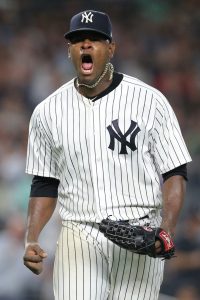 Severino, 30 in February, is a wild card of this winter’s free agent market. He once looked like one of the best pitchers in the majors but has spent the past five years either injured or ineffective or both. He made 63 starts over 2017 and 2018, throwing 384 2/3 innings with a 3.18 earned run average. He punched out 28.8% of batters faced while walking just 6.2% of them and keeping 45.8% of balls in play on the ground. FanGraphs calculated him as worth 11 wins above replacement over that two-year span, trailing just four pitchers around the league: Max Scherzer, Chris Sale, Jacob deGrom and Corey Kluber.
He and the Yankees agreed to a four-year, $40MM extension prior to 2019, with that deal also having a $15MM option for 2023. But shortly after that deal was signed, he ran into health problems. He only made three starts in the first year of that deal due to shoulder and lat injuries, then Tommy John surgery kept him off the field entirely in 2020 and for most of 2021. More lat issues came in 2022, but he was at least able to make 19 starts and log 102 innings with a 3.18 ERA, followed by a couple of playoff starts.
That relatively healthy showing was enough for the Yankees to trigger the player option for 2023. Another lat strain prevented him from making his season debut until May and then an oblique strain in September ended his season early. In the middle of those IL stints, he tossed 89 1/3 innings but with an awful 6.65 ERA. He struck out just 18.9% of opponents, a huge drop from his 27.7% rate in 2022.
Severino averaged 96.5 mph on his fastball in 2023, a bit down from his 97.6 from 2018. It’s higher than his 96.3 mph average from 2022, when he was still effective. His slider had a bigger drop, averaging 84.6 mph in this year whereas it sat 88-89 prior to his injury troubles. But he was still getting good results in 2022 with a slider that averaged 85.1 mph.
Despite the rough season, some club was going to take a chance on Severino’s track record and hope for a bounceback with better health. MLBTR predicted Severino to secure a contract of one-year and $14MM. His guarantee is just beneath that but the bonuses could help him climb to the other side.
That the Mets are the club to take the chance on Severino makes plenty of sense, with reporting from a couple of weeks ago suggesting they were interested. Last year’s struggles led them to trade Max Scherzer and Justin Verlander ahead of the deadline. Then Carlos Carrasco reached free agency and David Peterson required hip surgery that will force him to miss the start of next season.
All of that left the Mets with a 2024 rotation consisting of Kodai Senga and José Quintana in two spots. They had some candidates to fill out the back end, such as Tylor Megill, Joey Lucchesi and José Butto, but each of those guys can be optioned to the minors and make more sense as depth options than as part of the club’s Opening Day plans.
It’s still unclear exactly what kind of offseason the Mets are planning to have and this transaction won’t make that much clearer. The 2023 club had the highest payroll in baseball history but reporting from the deadline indicated that they may opt for a somewhat less-aggressive approach for 2024. But stepping back from unprecedented heights could still lead to plenty of activity, depending on the size of the step.
This deal is fairly modest by free agent standards but could always be paired with a larger move. For example, the Cardinals were looking for three starters this winter and started with one-year deals for Lance Lynn and Kyle Gibson before a bigger three-year strike on Sonny Gray. Perhaps the Mets have a bigger move to come, having been connected to Yoshinobu Yamamoto. But time will tell if that kind of big strike is realistically in their plans.
For now, they’ve added a former star on a short-term deal. He could either help them return to contention or perhaps turn himself into a deadline trade chip. If he isn’t able to get back in good form, the Mets won’t have impacted their plans for competing in the long term.
In the short term, this seems like it will cost them more than the $13MM sticker price. According to Roster Resource, this move pushes the club’s competitive balance tax calculation to $288MM, well beyond next year’s base tax threshold of $237MM. The CBT features escalating penalties for paying in consecutive years and the Mets are set to be a third-time payor in 2024. That means they pay a 50% tax on all overages, 62% for spending over the $257MM line and 95% for going past the third line of $277MM. They could always shed salary somehow but they are already past the third line and not too far from the fourth line of $297MM, when their tax rate would jump to 110%. The tax isn’t calculated until the end of the season, so they could significantly alter all of these calculations between now and next fall, but it’s distinctly possible that they end up paying something close to double that $13MM figure that Severino will receive.
Mark Feinsand of MLB.com first reported Severino was nearing agreement with the Mets. Jeff Passan of ESPN reported the sides were finalizing a one-year, $13MM deal that included $2MM in bonuses. Jon Heyman of the New York Post reported the specific bonus structure.
How Aggressive Will The Tigers Be This Winter?
The ill-fated Miguel Cabrera extension is off the books in Detroit, leading to the most payroll flexibility the team has had in quite some time. As it stands, the only three players on guaranteed contracts for the 2024 season are Javier Baez, Mark Canha and Carson Kelly. That trio combines for $40MM in guaranteed salary. Only Baez is signed beyond the 2024 season. Detroit also has a small arbitration class. Left-hander Tarik Skubal, righty Casey Mize, catcher Jake Rogers and outfielder Akil Baddoo project to earn a combined $7.5MM, per MLBTR contributor Matt Swartz.
Suffice it to say, there’s ample payroll space available in the Motor City. Detroit trotted out a payroll as high as $200MM back in 2017, albeit under the ownership of the late Mike Ilitch. Since his son, Chris, took over as the team’s control person, the Tigers haven’t fielded an Opening Day payroll north of $135MM. Then again, the Tigers have been rebuilding for much of Chris’ time in charge of the club, so aggressive spending hasn’t typically on the radar.
Many Tigers fans entered the current offseason expecting some degree of change in that regard, however. The AL Central is perhaps the sport’s weakest division, and the Tigers have some interesting young players emerging to form a core group. Spencer Torkelson and Riley Greene both took big steps forward in 2023. Skubal returned from flexor surgery and pitched like a genuine top-of-the-rotation arm. Reese Olson looks like a mid-rotation piece. Kerry Carpenter has swatted 26 homers and hit .277/.334/.473 in his first 149 big league games. Former No. 1 overall pick Casey Mize will come back from Tommy John surgery in 2024. Jason Foley, Will Vest, Tyler Holton and Alex Lange all had nice years in the bullpen (Lange’s command issues notwithstanding). It’s easy to see the reasons for optimism.
At the same time, that doesn’t necessarily portend a return to the Tigers’ former status as one of the league’s most aggressive offseason spenders. For one thing, the now-former front office regime helmed by Al Avila attempted to reestablish the Tigers as just that when signing Baez and Eduardo Rodriguez. The former hasn’t worked out at all and now stands as one of baseball’s most immovable/undesirable contracts. The latter performed well enough to opt out of the remaining three years and $49MM after an uneven tenure in Detroit.
New president of baseball operations Scott Harris will surely be wary of further saddling the team with unwanted contracts. His most recent organization — the Giants, where he was GM — has a recent track record of clearly preferring shorter-term, manageable commitments in free agency. They haven’t inked a free agent for more than three years under Farhan Zaidi’s watch as president of baseball operations. That doesn’t mean Harris will operate from the exact same playbook, but it’s notable context nonetheless.
To that end, the general expectation surrounding the Tigers this winter has been that the team will at least one, if not two arms in free agency. Adding a bat to the middle of the lineup also seems like a sensible enough fit. The question is: to what extent are the Tigers willing to spend?
Recent reports have indicated that the Tigers have interest in both Seth Lugo and Kenta Maeda, for instance, but Evan Petzold of the Detroit Free Press wrote this morning that the Tigers prefer Lugo on a one-year deal. He’s understandably seeking a three-year pact after a breakout 2023 campaign. Petzold also reports that rebound candidate Luis Severino is on the Tigers’ radar. He’s likely to sign a one-year deal this winter. Maeda is generally expected to sign for no more than two years. Between those three targets, a preference for shorter-term additions seems to be on the table for the Tigers.
Cody Stavenhagen of The Athletic frames things similarly in his latest mailbag, writing that the Tigers seem likelier to dish out multiple short-term deals — similar to last year’s one-year pact with Michael Lorenzen — than they are to ink a notable arm on a heftier deal. The Tigers reportedly checked in on Lance Lynn before he signed a one-year, $11MM deal with the Cardinals. Stavenhagen suggests that contracts of that nature (and the Cardinals’ one-year, $12MM deal with Kyle Gibson) are roughly what one could expect the Tigers to offer in free agency. Similarly, he writes that Canha could be the team’s most significant position-player acquisition this winter.
There’s no firm indication that the Tigers won’t be a bit more aggressive in free agency and pursue some notable names on multi-year deals. Unexpected market circumstances can always emerge, perhaps leading a team to land a major free agent they never expected early in the winter. The Twins surely didn’t enter the 2021-22 offseason expecting to sign Carlos Correa, for instance, and the Tigers’ ample flexibility leaves them open for opportunistic adds of that nature, should they arise.
The trade market also can’t be discounted as a means of adding some notable talent. Harris and his staff proved over the past year that they’re plenty willing to make deals with other clubs. Since the beginning of last offseason, Detroit has traded Joe Jimenez to Atlanta and Gregory Soto and Michael Lorenzen to Philadelphia (in separate swaps). The Tigers picked up Zach McKinstry in a spring trade with the Cubs earlier this year and added Canha in a deal with Milwaukee just a few weeks ago. It’s perfectly reasonable to think they might be more active in trades than in free agency; some combination of both avenues is likely at the end of the day.
However, those hoping for a bigger splash may want to look back to Harris’ comments earlier this month when asked about having sufficient resources to sign a premier free agent (link via Chris McCosky of the Detroit News): “If we feel like we are close enough to where a big free agent pushes us over the edge, sure, we have an ownership that’s going to support us to be able to do that. But, as this game has taught us time and time again, sometimes, teams over-estimate their proximity to being a team that’s right on the verge of the playoffs, and they spend a lot of money and it doesn’t push them forward. It pushes them back. We have to be really careful.”
Mets Interested In Luis Severino
Luis Severino‘s trip through free agency could lead him to another New York borough, as the former Yankees right-hander has gotten some interest from the Mets, The Athletic’s Will Sammon reports. Mets officials are planning a meeting with the 29-year-old to explore the possibility of a deal between the two sides.
A reunion with the Yankees doesn’t appear to be happening for Severino, but at least eight teams were known to have some level of interest in the two-time All-Star. It’s probably safe to guess that an even higher number will at least check in before the offseason is over, given the widespread need for pitching around the league and Severino’s potential as a reclamation project.
Severino’s career got off to such a promising start that the Yankees signed him to a four-year, $40MM extension prior to the 2019 season, a rare move for a team that usually doesn’t explore contract extensions on general principal. Unfortunately for the Yankees, they perhaps should’ve stuck to their policy in this case, as Severino’s career went into a tailspin due to injuries. He pitched only 18 total big league innings from 2019-21, primarily due to Tommy John surgery but with shoulder, lat, and groin problems also contributing to those three lost years.
More lat injuries limited Severino’s availability in 2022, but he at least returned to pitch 102 innings and post a 3.18 ERA, so the Bombers exercised their $15MM club option on the righty’s services for 2023. This was another transaction that backfired, as Severino again battled injuries (an oblique strain and another lat strain) en route to a 6.65 ERA in 89 1/3 frames.
In all likelihood, Severino and his agents at Rep 1 Baseball will be aiming for a one-year contract this winter. (MLBTR projected him for a one-year, $14MM pact.). This would allow Severino to re-enter the market next winter, theoretically after he has enjoyed the type of healthy and productive season that would serve as a better platform for a pricey multi-year commitment. As noted earlier, many teams would be fits for Severino, and his willingness to take a one-year deal would open the door to offers from both big spenders and smaller-market clubs.
This means that in lieu of a bidding war based purely on money, Severino might prioritize environment and an organization with a track record of rejuvenating pitchers’ careers. The Mets themselves don’t have that kind of reputation, but new president of baseball operations David Stearns is coming from a Brewers team that had a knack for developing and finding plenty of hidden-gem arms over the years. Heading to Queens would also allow Severino to remain in New York, and once again play for Carlos Mendoza, as the new Mets skipper spent the previous six seasons on the Yankees’ coaching staff.
Kodai Senga and Jose Quintana are the only locks for the Amazins rotation in 2024, so it isn’t any surprise that the Mets are looking to acquire at least two more arms to a staff that also has Tylor Megill, Jose Butto, Joey Lucchesi, and (after a midseason return from hip surgery) David Peterson in the mix for starts. Severino may not be the most stable of options given his long injury history, yet with the Mets willing to spend at high end of the market, the team has the flexibility to pursue both frontline arms and slightly lower-cost fliers like Severino.
Luis Severino Drawing Widespread Interest
Free agent right-hander Luis Severino is drawing plenty of attention around the league, reports Brendan Kuty of The Athletic. As many as eight teams have made their interest known, though Kuty says the Yankees aren’t believed to be one of them.
Severino will be an interesting bounceback candidate in this winter’s market since he previously was one of the best pitchers in the game but his recent struggles should significantly hamper his market. Over 2017 and 2018, he made 63 starts and logged 384 2/3 innings with a 3.18 earned run average. He struck out 28.8% of batters faced and walked just 6.2% of them, while also keeping 45.8% of balls in play on the ground. FanGraphs calculated him as worth 11 wins above replacement over that two-year span, with only four pitchers ahead of him in that category: Max Scherzer, Chris Sale, Jacob deGrom and Corey Kluber.
Going into 2019, the Yankees locked him up with a four-year, $40MM contract with a $15MM option for 2023. Unfortunately, he was injured for most of the next three seasons. In 2019, he was only able to make three starts due to shoulder and lat injuries, then Tommy John surgery wiped out his 2020 and most of his 2021 season. In 2022, he again dealt with lat issues but was able to throw 102 innings over 19 starts with a 3.18 ERA, then a couple more starts in the postseason.
The Yanks felt good enough with that return to trigger the option but 2023 didn’t go well. Another lat strain kept him out of action until May and an oblique strain ended his season in September. In between, he tossed 89 1/3 innings with a 6.65 ERA. His strikeout rate dropped to 18.9%, after being at 27.7% last year, which was pretty close to his peak.
Despite that rough season, it’s understandable that teams would still be intrigued, though it appears the Yankees may not be one of them. They will likely pursue some kind of starting pitcher, based on their current rotation. Gerrit Cole is likely to grab a Cy Young next week based on his excellent campaign, but there’s little certainty beyond that. Both Carlos Rodón and Nestor Cortes are coming off injury-marred seasons. Michael King showed promise in his move from the bullpen to the rotation but he’s still fairly inexperienced as a starter. Clarke Schmidt could be in the back end after posting a 4.64 ERA this year. The Yanks aren’t likely to be satisfied with that group and could perhaps circle back to Severino later but he may not be the first name on the list.
This winter’s market has some less risky pitchers to bank on, but guys like Blake Snell, Jordan Montgomery, Aaron Nola and Yoshinobu Yamamoto will likely require nine-figure guarantees. Sonny Gray, Eduardo Rodriguez and Shota Imanaga might come in just under the nine-figure line. Not every team will be willing to shop on Main Street and some will be combing the beach looking for buried treasure.
MLBTR’s Top 50 Free Agents predicted a contract of one year and $14MM for Severino this winter. Assuming his market is indeed in that range, plenty of teams will be willing to take the risk, particularly if they have a plan of how to get the best results out of him. Despite the injuries, Severino’s fastball averaged 96.5 mph in 2023. That’s a bit down from 2018, when he was at 97.6, but not by much. It’s also higher than the 96.3 mph he averaged in 2022, when he was still quite effective. His slider saw a bigger drop, averaging 84.6 mph in 2023 whereas it would sit 88-89 prior to his lengthy injury absences. But again, he was still getting good results in 2022 with a slider averaging 85.1 mph.
Kuty relays that Severino is back to throwing, having rehabbed from the oblique strain that ended his most recent campaign. His recent track record makes him a significant wild card, but one that will surely be played at some point in the coming months.
Luis Severino Won’t Return In 2023 Following High-Grade Oblique Strain
6:44PM: The specifics of Severino’s injury have become clear, as manager Aaron Boone told reporters (including Brendan Kuty of The Athletic) that the right-hander had suffered a “high-grade” left oblique strain. The injury brings a difficult 2023 campaign for Severino to an end, and leaves the 29-year-old’s health as a major question mark just two months before he’s scheduled to hit free agency for the first time in his career.
9:39AM: As expected, the Yankees placed Severino on the 15-day IL, and called up right-hander Ron Marinaccio from Triple-A in the corresponding move. The specific nature of Severino’s injury isn’t yet known, as the club announced he was sidelined with “a left upper body injury (pending further results).”
SEPTEMBER 8: Luis Severino departed this evening’s start against Milwaukee in the fifth inning. The right-hander left in obvious pain after throwing a pitch to Brice Turang.
The Yankees didn’t provide many specifics, saying only that Severino would go for additional testing on a left side injury. After the game, the pitcher said he felt like he’d been shot, calling it “deep, sharp pain” (via Brendan Kuty of the Athletic).
More will be known in the coming days, but it seems as if Severino is trending to a trip to the injured list. With three weeks left in the regular season and the Yankees all but certain to miss the playoffs, it’s fair to wonder if his 2023 campaign will be cut short.
It has been a nightmarish season for the 29-year-old hurler. Severino spent the first six weeks of the season on the injured list after suffering a Spring Training lat injury. He returned in late May and had been healthy up until tonight, but he has posted some of the worst numbers of any pitcher in the league. Including his performance this evening, he carries a 6.65 ERA through 89 1/3 innings. He’s striking out a below-average 18.9% of opposing hitters and has allowed a staggering 2.32 home runs per nine.
It’s a huge drop-off for a pitcher who worked to a 3.18 ERA with a 27.7% strikeout rate in 102 innings a year ago. Severino battled injuries (most notably a February 2020 Tommy John procedure) going back to 2019. Yet his rate statistics last season weren’t much worse than those of his 2017-18 peak when he made consecutive All-Star games and finished as high as third in Cy Young balloting.
Even if Severino were to finish this year healthy, it’d be a tough time for his first career trip to free agency. He already looked like a candidate for a one-year, bounceback deal in hopes of a better platform season going into the 2024-25 offseason. If he requires a stint on the injured list to close out the year, he’d head into the winter with an additional question mark.
Nestor Cortes’ Season In Jeopardy After Second Rotator Cuff Strain
The Yankees announced they’ve recalled right-handers Jhony Brito and Randy Vásquez. One roster spot was opened when left-hander Nick Ramirez was optioned to Triple-A yesterday. The other corresponding move is lefty Nestor Cortes landing on the 15-day injured list, retroactive to August 8, with a left rotator cuff strain.
Cortes told reporters that while surgery isn’t under consideration, he’ll be shut down from throwing entirely for around one month (relayed by Brendan Kuty of the Athletic). Given that timetable, skipper Aaron Boone acknowledged it’s unlikely the southpaw will make it back this season, though the club hasn’t officially ruled him out for the year (via Erik Boland of Newsday).
The ’23 campaign has been exceedingly frustrating for last year’s eighth-place Cy Young finisher. Cortes strained his hamstring in February, knocking him out of the World Baseball Classic and putting him behind the eight ball in his ramp-up. He was able to return by the start of the season but didn’t pitch as well as anticipated through 11 starts. During the first week of June, Cortes suffered a rotator cuff strain that wound up costing him around two months.
He returned from that rehab last weekend but managed only one four-inning outing before the injury resurfaced. Given the month-long shutdown and need to subsequently restart the rehab process, it seems a similar absence could be on the table. With less than two months to go in the regular season, there might not be enough time for him to return to the mound.
Cortes has made 12 starts overall, working to a 4.97 ERA over 63 1/3 frames. It’s a far cry from last year’s 2.44 ERA, though that always seemed likely to regress. Cortes still struck out over a quarter of opponents with a solid 7.5% walk percentage, with a spike in home runs and an uptick in the average on balls in play against him contributing to the less impressive results.
The 28-year-old is playing this season on a $3.2MM arbitration salary. He’ll receive a raise — albeit a fairly modest one — on that next winter and is eligible for arbitration twice more. Even if he can’t make it back this season, Cortes should be a key part of the projected starting staff heading into 2024.
New York’s short-term rotation outlook is far less settled. Injuries have cost Frankie Montas the season to date and shelved Cortes and Carlos Rodón on multiple occasions. Gerrit Cole has been phenomenal and Clarke Schmidt has settled in after a rocky April, but the rest of the group has struggled.
Luis Severino has been one of the worst pitchers in the league, posting an 8.06 ERA across 14 outings. Were the Yankees in a better position, they quite likely would’ve bumped him from the rotation by now. With so many injuries, Severino has tenuously held his rotation spot. Boone told reporters this afternoon he’s likely to get another start on Tuesday against Atlanta (via Bryan Hoch of MLB.com). Brito and Vásquez are likely to fill out the rotation for now.