
Market Chatter: Greinke, Suzuki, Eovaldi, Reds, Nats, Phils
The Diamondbacks are “aggressively shopping” righty Zack Greinke, according to Bob Nightengale of USA Today (via Twitter). With $95.5MM of salary still due over the next three years, he’s an expensive option. But the deal is at least cabined in length, and the Snakes have a good shot at getting out from under most of it. (Alternatively, the club might be able to pay down a larger portion and recoup some talent in a swap — or go in the other direction and include additional talent to make the whole contract go away.) It’s still largely unclear how things will shake out, but the fact that the Arizona organization is looking for a taker certainly makes a trade seem quite plausible.
Here’s the latest chatter on the rest of the market:
- It is a testament to veteran backstop Kurt Suzuki that he has been re-signed, re-acquired, or extended by three of the four organizations he has played for. One of those, the Athletics, could have designs on a third stint. Per Susan Slusser of the San Francisco Chronicle, there has already been some discussion between the Oakland club and the 35-year-old free agent. Suzuki has never been more productive at the plate than he was over the past two years with the Braves, when he turned in a cumulative .276/.341/.485 slash with 31 home runs in 697 plate appearances. Slusser also notes that reliever Shawn Kelley remains a possibility to return, with four other teams also inquiring about securing his services.
- Nathan Eovaldi‘s health is a major factor in his free agency. Though he’s only 28 years of age, the righty has undergone a pair of Tommy John surgeries and required another elbow procedure before making it back to the mound in 2018. Of course, the results were quite promising, and he has now also received a strong endorsement from his surgeon today, as Evan Drellich of NBC Sports Boston reports. Dr. Christopher Ahmad says that, after conducting an extensive examination, he “would consider [Eovaldi] in the same category of somebody who has a healthy arm.” While any signing team will want to take a look for itself, it’s obviously quite a notable opinion to receive at the outset of free agency.
- The Reds would surely love to land Eovaldi or another higher-end arm, though it’s still questionable whether they’ll dabble in that end of the market. What is clear, president of baseball operations Dick Williams said in a radio interview, is that the club hopes to find a pair of new pitchers — likely starters (via Bobby Nightengale of the Cincinnati Enquirer). Getting the right arms won’t just mean waiting to see what shakes loose at a cheap price, says Williams. Rather, the club intends “to be in front of these agents and these other teams talking more aggressively.” Sure enough, Jon Heyman of Fancred says the Reds have engaged with the Mariners (James Paxton), Indians (Corey Kluber, Carlos Carrasco), and Yankees (Sonny Gray). With the Cinci org said to be hesitant to move its best assets, getting the desired arms could mean exploring some creative trades. That said, Williams shot down recent chatter surrounding purported Padres interest in star Reds third baseman Eugenio Suarez. “Just to sort of nip that in the bud, I’ll tell you that rumor is unfounded,” said Williams.
- It’s also clear that the Nationals are on the lookout for starters, though here also it’s hard to know just where the team may focus. As I discussed recently in setting forth the team’s outlook for the 2018-19 offseason, there are an abundance of possibilities at this point. Chelsea Janes of the Washington Post provides some insight into the club’s thinking while ticking through the options. She notes that the Nats “think highly” of free agent Dallas Keuchel — the match we predicted when we broke down our Top 50 Free Agents. That’s not to say, of course, that he’s a uniquely clear fit in D.C. As Janes explains, the organization still seems likely to canvass the market, though it seems reasonable to anticipate that it’ll come away with at least one significant new hurler.
- Staying in the division, it’s worth looking back at a post we missed at the time. Jim Salisbury of NBC Sports Philadelphia reported recently that the Phillies are quite likely to deal away third baseman Maikel Franco. Indeed, it seems there’s a reasonable match already under contemplation with the Padres. Of course as noted above, the Friars clearly are interested in looking around the rest of the market before pulling the trigger on a deal for Franco. The Phils are also said to be willing to discuss Cesar Hernandez, though he seems much less likely to be shipped out. It’ll be interesting to see how everything will unfold in Philadelphia, as the team is known to be chasing some of the biggest names on the market but also has some less consequential moves that it could contemplate pulling off first.
Looking For A Match In A Carlos Santana Trade
Earlier this week, Ken Rosenthal of The Athletic reported via a rival executive that the Phillies are “shopping the hell” out of first baseman Carlos Santana. The Rhys Hoskins left field experiment went poorly this year, so it’s logical for GM Matt Klentak to attempt to trade the veteran Santana to allow Hoskins to move back to first base in 2019.
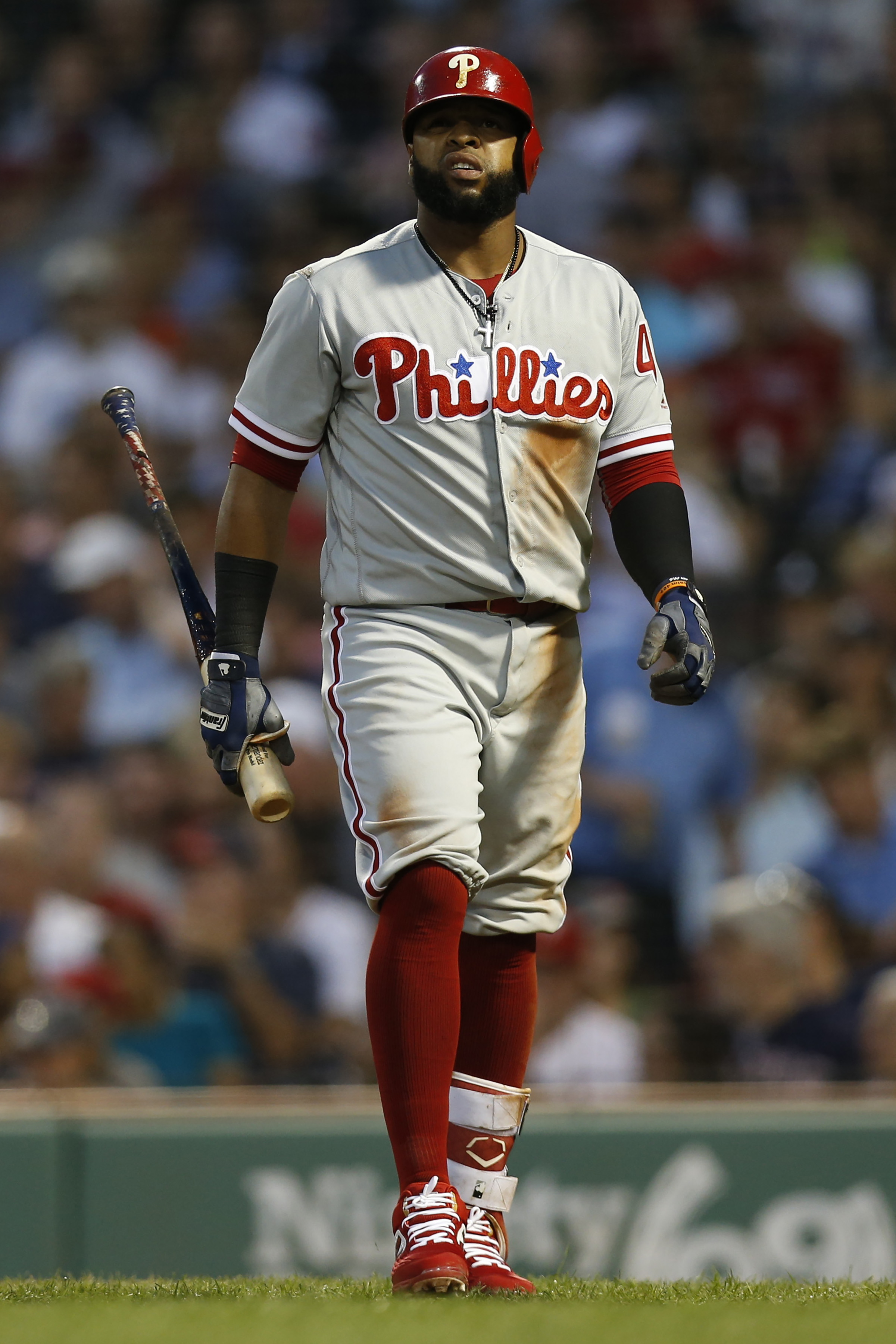
First, let’s take a look at what Santana is in this stage of his career. He’s a switch-hitting walk machine with modest power. He put up a 109 wRC+ for the Phillies this year, and 119 from May onward. Steamer projects a 119 mark on the whole for Santana next year. That’s a level he’s reached only once in the last four seasons, so it would be fair to question such optimism.
Though it’s an unscientific and more conservative guess, I’d expect 110-115. Certainly if you’re a rival GM and Santana is being shopped to you, you’d take my position on his expected offense. Santana has spent most of his time as a first baseman in recent years with the Phillies and Indians, and of course he’s an option at designated hitter as well.
Santana’s contract is a major factor in any potential trade. He’s owed $35MM over the next two years. Given Santana’s strong projection for next year, a case can be made that the Phillies shouldn’t need to pay his contract down significantly. However, I think in reality there are enough cheaper alternatives on the market that the Phillies will have to kick in at least $10MM, or else take back a contract or attach a prospect.
For a look at the other first basemen available this winter, check out Jeff Todd’s market snapshot from last month. The free agent market doesn’t offer any first baseman who qualifies as a definite regular, but the trade market could be robust. Paul Goldschmidt is obviously superior to Santana, while Justin Smoak is a fairly similar hitter who is earning only $8MM in 2019. Though better suited at DH, the Cardinals’ Jose Martinez is also in Santana’s class as a hitter. Martinez has yet to reach arbitration and can be controlled for four more years. I’m not convinced Jose Abreu and Brandon Belt will be on the move this winter. The trade market at first base could also feature a variety of more flawed options, such as Justin Bour (now on waivers), Eric Thames, or Wil Myers. The bottom line: the presence of Goldschmidt, Smoak, and perhaps Martinez could clog Santana’s market, as Goldy is an impact hitter and the others have more desirable contract situations.
There’s also the idea that a team with an established first baseman could acquire Santana to serve primarily as its designated hitter. The DH trade market could include Kendrys Morales, Mark Trumbo, Shin-Soo Choo, C.J. Cron, Matt Davidson, and Miguel Cabrera. As a hitter, only Cabrera is on Santana’s level, and he’s basically immovable due to his hefty contract. The free agent market does offer one option that is superior to Santana as a DH: Nelson Cruz. Cruz projects at a 132 wRC+ next year, and we expect him to sign for less than the $35MM owed to Santana. So if you’re looking to fill a DH spot, you would talk to Cruz’s agent before you’d worry about trading for Santana – unless the Phillies offer to pay down Santana’s contract significantly. You might also look at a player like Daniel Murphy, who carries a similar projection to Santana and should sign for less than $30MM.
If the Phillies are viewing Santana as mainly a contract dump, they might need to kick in $15MM to get him down to the equivalent of a two year, $20MM deal. If the commitment was reduced that far, Santana might start to rise up on teams’ lists above someone like Murphy. Here’s a look at the teams that could be a match for Santana this winter:
- Twins: With Joe Mauer retiring and Logan Morrison reaching free agency, the Twins have an opening at first base and the need for a bat like Santana. They also have room in the payroll for most of his contract. It’s a reasonable match.
- Astros: The Astros make a lot of sense for Santana. He’s a better hitter than their incumbent first baseman, Yuli Gurriel, and they’re open at DH with Evan Gattis reaching free agency. Still, it would be easier for the Astros or Twins to just sign Cruz, so the Phillies would have to make it worth their while.
- Rays: Earlier this month, Marc Topkin of the Tampa Bay Times wrote that the Rays “seek more of a feared overall hitter” than the arbitration eligible C.J. Cron. The Rays also have more payroll space than they’ve had in recent years, making Santana a pretty good fit. The Rays also have Jake Bauers at first base. 27-year-old Ji-Man Choi pitched in at DH this year and should have a job against right-handed pitching. The Rays are a sleeper pick for Santana, though like the Astros and Twins they’d need to be convinced he’s a better option than Cruz.
- Rockies: After giving the bulk of first base time to Ian Desmond this year and getting replacement level production, the Rockies could seek an upgrade. GM Jeff Bridich spoke earlier this month of being “a little bit more focused on our offense this offseason as compared to last season,” and Santana could give a boost compared to Desmond or Ryan McMahon. However, the team’s payroll appears fairly tight and they may also address deficiencies at catcher and in a corner outfield spot.
- Cardinals: The Cardinals deployed the aforementioned Jose Martinez as well as Matt Carpenter at first base this year. Carpenter could move to third base to accommodate a first base acquisition like Santana. However, replacing Martinez with Santana would upgrade the defense more than anything, since they are hitters of similar ability. I could see the Cards taking a look at Santana, but not as their first choice.
- White Sox: The Sox appear likely to stick with Jose Abreu at first base, and could run out a Daniel Palka-Matt Davidson DH platoon. Palka is an option at an outfield corner, so the White Sox could feasibly add Santana as a primary DH who also chips in at first base. They’ve got plenty of payroll space as well.
- Angels: The presence of both Shohei Ohtani and Albert Pujols make the Angels an unlikely match for Santana. Still, the Halos should have some at-bats available at first base and DH, as Ohtani and Pujols are hardly locks for 150 games apiece. And theoretically, Santana could try to fake it at third base as he did in 119 innings for the Phillies this year.
- Rangers: With Shin-Soo Choo locked in at DH, the Rangers could acquire Santana as a replacement for first baseman Ronald Guzman. It might be too early to give up on the 24-year-old Guzman, and the Rangers have stronger needs on the pitching staff and at catcher. Still, if they’re simply looking to get better next year in any way possible, replacing Guzman with Santana should at least be on the table.
- Marlins: This is an outside the box option, since most of the focus with the Marlins is on which veteran pieces they’ll sell off as their rebuild continues. The team does have a few internal options at first base for next year such as Peter O’Brien and Garrett Cooper. Marlins president of baseball operations Michael Hill said a month ago, “We’re going to look at internal candidates, and we’re going to look at external candidates.” Why not Santana? For one thing, a trade can work well for a rebuilding club seeking a veteran boost, since free agents are typically reluctant to sign unless such a team overbids. Plus, the Marlins arguably have the payroll space to take on Santana’s entire contract, especially if they unload players like J.T. Realmuto, Dan Straily, and Derek Dietrich. In taking on all $35MM, the Marlins could demand that the Phillies throw in a quality prospect. It’s still a long shot scenario for the division-mates to match up on a Santana deal, however.
- Orioles: The Orioles are stuck with Chris Davis through 2022, unless they’re willing to release him. They’ve also got Trumbo under contract for one more year. Adding Santana only makes sense in the same vein as the Marlins: take the entire contract, and get a quality veteran hitter plus a prospect.
- Tigers: The Tigers could slot Miguel Cabrera in at DH and acquire Santana for first base. They’ve got the payroll space for Santana, at least compared to historical spending. But a bargain option makes more sense here unless the Phillies offer something enticing, putting the Tigers in the same group as fellow rebuilders like the Marlins and Orioles.
- Red Sox: The Red Sox have first baseman Mitch Moreland under contract for $6.5MM for 2019 and J.D. Martinez locked in at DH. The most likely path is just bringing back Steve Pearce as Moreland’s right-handed hitting complement, but the Sox could theoretically acquire Santana and plug him in as the everyday first baseman. Doing so would likely make the team better, though a first base switch doesn’t appear to be an offseason priority. Plus, acquiring Santana would worsen Boston’s luxury tax penalty.
- Yankees: The Yankees have Luke Voit and Greg Bird as first base options, and Giancarlo Stanton spending at least some of his time at DH. There’s no real point to replacing Voit with Santana, and the Yankees have bigger needs, so this match appears unlikely.
- Royals: The Royals don’t have anyone at first base or DH that would preclude an acquisition of Santana. But with the team looking to cut payroll, trading for Santana hardly makes sense.
Phils Have Some Concerns But Still Open To Machado Pursuit
- Drama aside, Machado is still an ideal target for the Phillies, Jim Salisbury of NBC Sports Philadelphia opines. Salisbury reports that Phillies officials do indeed have some concerns about Machado’s makeup, though he rightly notes that Machado is largely the same player/person he’s always been — even if those ill-timed comments came while playing on the biggest possible stage. Concerns notwithstanding, the Phils are still very much open to pursuing Machado. Salisbury quotes general manager Matt Klentak from last week’s GM Meetings: “If you’re trying to find the young free agent who’s good at everything and a prince in the clubhouse, you’re going to be looking for a long time.”
Phillies Place Justin Bour On Waivers
The Phillies have placed first baseman Justin Bour on waivers, tweets Jim Salisbury of NBC Sports Philadelphia. The move comes in advance of a fairly notable deadline, as teams have until Tuesday of next week to protect players from the Rule 5 Draft by adding them to the 40-man roster.
The decision to place Bour on waivers effectively amounts to a non-tender that was not all that difficult to foresee. The former Marlins first baseman was eligible for arbitration for a second time this winter and was projected by MLBTR contributor Matt Swartz to get a raise from $3.4MM to $5.2MM. Bour was acquired in an August swap that sent minor league lefty McKenzie Mills to the Marlins. His time with the Phils proved to be exceptionally brief, as he tallied just 54 plate appearances in a limited role and batted .224/.296/.347. Bour was picked up to be a bench bat down the stretch and never looked like a long-term fit on a roster that included both Rhys Hoskins and Carlos Santana.
Bour, 30, had a down season overall at the plate in ’18, hitting .227/.341/.404 between Miami and Philadelphia. That marked a notable drop-off from his most productive seasons, when he batted a combined .279/.359/.510 in 750 PAs from 2016-17 with the Marlins. Though Bour has always had his limitations — that impressive slash line from 2016-17 is the product of being heavily shielded from opposing lefties, and he’s limited to first base only — there was still reported trade interest in him two summers ago. President of baseball ops Michael Hill said at the time that he wasn’t interested in discussing long-term assets in trades, though, and Bour stayed put in Miami. Under new ownership, the Marlins went on to strip down the roster and trade numerous controllable assets just months after Hill originally made those comments.
Other teams will have the chance to claim Bour off waivers, but if they do so, he’ll remain arbitration-eligible and carry that same projected salary to a new team. If Bour clears waivers, he has enough service time to reject an outright assignment in favor of free agency — a route he’d surely take. That said, even with his impressive numbers from 2016-17, Bour could find a fairly tepid market in free agency. Teams haven’t spent much on first-base-only sluggers in recent winters, as evidenced by minimal contracts secured by the likes of Matt Adams, Lucas Duda and Logan Morrison, among others.
Projecting Payrolls: Philadelphia Phillies
I’m ecstatic to join the MLBTR team to offer insight on an essential topic in the baseball world, especially this time of year: team payrolls. We’ll be combing through the league this winter, focusing first on the teams that figure to be the biggest players in the free agent marketplace.
There’s no better place to start than Philadelphia.
Team Leadership
The Phillies have one of the more complicated ownership structures in the league. Current managing partner John Middleton first purchased an ownership stake in the team in 1994, acquiring additional interests in the club over time until finally reaching a plurality 48% interest, becoming manager partner in 2015. The Buck family owns the other plurality 48% interest via their Tri-Play group. Despite the fact that Middleton has been managing partner for only four years, his longtime involvement with the club as well as that of the Buck family provides solid continuity.
The front office is headed by longtime baseball man and team president, Andy MacPhail, the prior president of the Orioles and former general manager for the Cubs and Twins. Current general manager Matt Klentak enters his fourth season at the helm, still searching for his first winning season and Philadelphia’s first winning season since the 2011 club blitzed its way to 102 regular season victories. While Klentak appears to have strong support from ownership, the fourth year of a rebuild is traditionally moving time: if it’s going to work, the wins need to show up and in a big way.
Historical Payrolls
Before digging into Phillies specifics, here are a few general notes when looking at historical data:
- Generally speaking, we’ll be using the data from Cot’s Baseball Contracts, maintained by Baseball Prospectus, for our historical data.
- Because the data comes from Cot’s and not from a meticulously detailed historical record of internal, proprietary information maintained by individual teams, the figures cited here will tend to be annual salaries plus prorated bonus amounts for each year. This is not how most Major League free agency contracts pay out: the various bonuses paid to players are often paid at specified times and not ratably over the course of deals. Nevertheless, using the data from Cot’s will help provide a strong estimate.
- Deferrals are difficult to capture. For example, the Nationals owe Max Scherzer a $35 million salary in 2019…but they won’t pay him a penny of his base salary for 2019 until 2022 (he does receive a $15 million portion of his signing bonus next year). Because of the difficulty in capturing deferrals, I’ll use something of an arbitrary cutoff, only factoring them into the numbers when they figure to have a significant impact on team spending, as is the case with the Nationals and Orioles, for example, given a bevy of deferred obligations, but as is likely not the case with the Rockies who owe only a relatively small amount to Todd Helton into the future.
- There are two primary considerations in examining historical payrolls: they show us either what type of payroll a team’s market can support or how significantly a given ownership group is willing to spend. In the most useful cases, they show us both.
With those housekeeping items out of the way, let’s dig in on what the Phillies have actually done in recent years.
Defining “recent” can be tricky. Changes in ownership, competitive windows, and market forces can yield wildly different payrolls over time. As a result, we’ll focus on a 15-year span in this series, covering 2005-18 for historical data as a means to understanding year 15: 2019. We’ll also use Opening Day payrolls as those better approximate expected spending by ownership. Here is what the Phillies have spent in the prior 14 seasons:
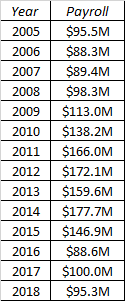
The Phillies payroll history tells a compelling and clean history of the club over the past decade and a half. They emerged in the mid-2000s as a young team supplemented by some expensive veterans, got extraordinarily expensive at the end of the 2000s and beginning of the 2010s as the core reached its peak earning years, endured some bloated payrolls despite meager win totals as the 2010s went on, and kept payroll to a minimum as a rebuild began. The Phillies carried a top-six leaguewide payroll each year from 2009-14 before tumbling to be among the 10 lowest payrolls in each of the past three seasons, a truly remarkable swing.
Philadelphia has not been a franchise to push the boundaries in the amateur market either, eschewing the big-bonus deals given to the likes of Latino amateurs Yoan Moncada (Red Sox) and Yadier Alvarez (Dodgers), among many others, by other big-market ball clubs. As such, the Major League payroll is a strong indication of true spending capacity for the team.
Future Liabilities
Some teams are loaded up with future guaranteed money, significantly hampering their ability to commit significant dollars to free agent targets. We’ll address teams like the Cubs and Rockies later in this series.
Other teams find themselves with barren future guarantees. We’ll spend time discussing the Twins and White Sox later as well.
The Phillies find themselves largely in the middle space of teams with regard to future commitments. Here is a look at their future guarantees with the powder blue highlight indicative of a player option whereas the peach indicates a club option. Note that the numbers shown on here are cash payments by year, not the salary plus the prorated amount of any bonus.
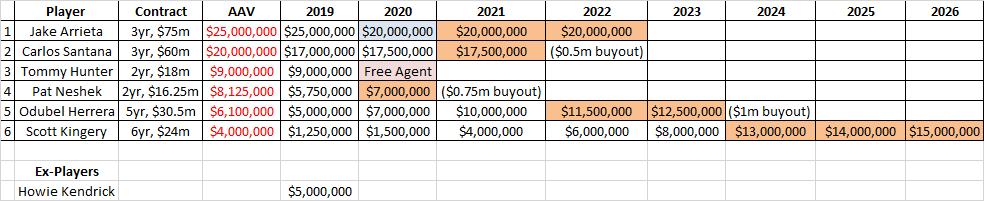
The future commitments are not exactly staggering. We’ll start at the bottom of the list. Kendrick’s $5 million in 2019 is the only deferral on Philadelphia’s chart, and it obviously shouldn’t impact future spending. Kingery’s extension basically guarantees him salaries commensurate with that of an above-average regular throughout what would have been his arbitration years with the 2024-26 options reflecting discounts over free agent salaries for a similarly effective player. If he turns out to be dead weight going forward (unlikely), the commitment remains relatively meager: $21.75 million through 2023, including the $1 million buyout of his 2024 option. That’s not breaking the bank and could provide strong value. Herrera is quite similar, just a few years further along the way; Herrera also figures to bounce back from poor BABIP luck in 2018, a year in which his defense also failed the metrics for the first time. Hunter and Neshek provide short-term guarantees with Neshek’s option in 2020 serving solely as a value play with minimal downside.
Instead, the big numbers to focus on here are Santana and Arrieta. Because Santana’s contract featured a significant signing bonus ($10 million), his future guarantee is both closer to approximating his actual value than it otherwise would be and easier to fit into a ballooning payroll, should that be the case. Nevertheless, Ken Rosenthal of The Athletic recently reported that the Phillies are aggressively shopping Santana, hoping to move his salary while opening up a defensive home for young (and cheap) slugger Rhys Hoskins.
Arrieta, on the other hand, has a contract structure that functions as a real wild card thanks to its unique language and Arrieta’s recent production. Arrieta earned $30 million in 2018, he gets $25 million in 2019, and then the chaos begins. Arrieta may opt out of his contract following the 2019 season, forfeiting a $20 million guarantee in the process. However, the Phillies may preempt the opt-out clause by exercising their club option on a two-year, $40 million extension covering 2021-22, Arrieta’s age-35 and age-36 seasons. The club option years may increase to a total of $50 million based on Arrieta hitting an unknown innings pitched threshold over 2018-19*, but that number is likely to be quite high meaning that Arrieta’s 172 2/3 innings from 2018 likely foreclosed the possibility of hitting that escalator.
*=Editor’s Note: MLBTR has since learned that the escalators are based on games started as opposed to innings pitched. By starting 31 games in 2018, Arrieta has boosted the base salary in both club option seasons by $2.5MM apiece, making the combined value of those seasons $45MM. He’d boost each by $1MM with 28 starts in 2019, plus another $500K each for starts 29, 30 and 31.
The Arrieta decision appears fascinating for both player and club. Arrieta is projected for another season of being a roughly league-average starting pitcher who throws about 180 innings. If he performs at such a rate, he has a strong incentive to opt out of his contract as the market will likely yield something in the neighborhood of $40-50 million on a multi-year guarantee for that production. On the other hand, the Phillies have an incentive to keep him around for that production but it isn’t so strong as to risk buying Arrieta’s mid-30s at the rate of $60 million over three years. Unless Arrieta erupts for another Cy Young-caliber season or melts down due to injury or ineffectiveness in 2019, the parties appear headed for a November 2019 staredown regarding their respective decisions.
Nevertheless, among the names listed above, the Phillies won’t be hamstrung due to their future guarantees.
Moving to arbitration, the Phillies feature some significant likely expenditures, particularly as ace Aaron Nola and slugging third baseman Maikel Franco age through raises. Franco may represent a tough non-tender decision in future years if he continues to struggle getting on base, but for now, he has age, power, and pedigree on his side, justifying his $5.1 million figure.
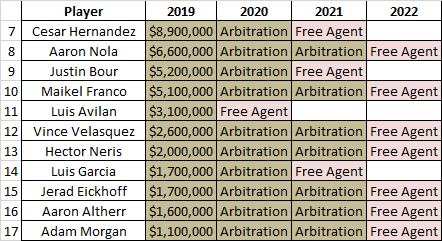
It is overwhelmingly likely that Bour is non-tendered or traded given the presence of Santana and Hoskins. Altherr and Garcia could also be non-tendered, though taking them out of the salary table results in relatively little change to spending from a team-wide perspective.
What Does Team Leadership Have to Say?
This will likely come as little surprise: despite clamoring for continued financial flexibility into the future, Klentak admitted that the Phillies have the wherewithal to make a significant addition to payroll in 2019. Addressing the media at the general manager meetings in early November, Klentak stated, “It’s a pretty bad feeling to go into an offseason knowing that you have things you need to address and not having the financial resources to do it because your money is tied up in players. I don’t think we ever want to put ourselves in that position. But some players are going to demand more than three-year contracts, and we have to be open to that. If it makes sense, we can do it. This is a franchise that carried big payrolls for a long, long time. We will likely get back to that again.”
Middleton provided a similar directive from ownership last offseason, offering that, , “[y]eah, I think we’re close. They [the front office] came to us with a budget, and we said, ‘Guys, if you want to put that number in for the budget, that’s fine, but don’t live with that. If something comes up, and it breaks the bank relative to the budget, and you don’t pursue it, we’re going to be upset.’ And they know that.” In an era where ownership frequently addresses the need to cut costs and operate efficiently, such an admission from Middleton is startling, even if it occurred nearly a year ago.
There is one final consideration that requires mention here: attendance. The Phillies regularly sported attendance figures just shy of two millions visitors each year until they opened Citizens Bank Park in 2004. Attendance figures ballooned to 3.25 million that year, dipping to about 2.7 million in each of 2005 and 2006 before climbing over the three million threshold again in 2007 and staying there through 2013, peaking at 3.777 million in 2010. From 2014 onward, however, attendance has tumbled back to the 1.8 million to 2.4 million territory.
Are the Phillies a Player for Bryce Harper or Manny Machado?
For some teams, this will be a really interesting examination. For the Phillies, it isn’t: they’re definitely players for Harper and Machado, and from a purely financial perspective, it’s within the realm of possibility that they could be contenders to sign both young stars. That said, there has been no indication to date that ownership or management is mulling such an unprecedented dual pursuit of both talents.
What Will the 2019 Payroll Be?
It’s worth providing what is likely an obvious disclaimer: ownership and management knows the actual budget whereas we’re focusing on historical data and other relevant factors to project future spending in the immediate and more distant years to come.
Nevertheless, there are numerous reasons to expect the Phillies to spend and to spend big this winter. Between Nola, Nick Pivetta, Vince Velasquez, Zach Eflin, and Arrieta, the Phillies already have a cheap, controllable playoff rotation in-house before considering possible contributions from bounce-back candidate Jerad Eickhoff and the late-season prospect arrivals of the much-hyped Sixto Sanchez and Adonis Medina.
The position player talent, however, is another story. Philadelphia’s team-wide wRC+ of 91 last year ranked 21st in baseball, narrowly ahead of the lowly Rangers and Royals. For a team looking to make the jump to postseason contention, the Phillies are in desperate need of an offensive jolt and it isn’t coming from the farm unless 2017 top pick outfielder Adam Haseley finds a way to bring his plus on-base skills up from Double-A despite a low-power profile.
Taken in the aggregate, the above shows that the Phillies:
- have a significant need for an impact bat or two,
- can afford to stick that bat (or bats) at just about any defensive position outside of first base,
- have traditionally carried significantly weightier payrolls than they have in recent years,
- possess an ownership group and front office ready to take the plunge into big-spending territory,
- feature a roster loaded with young talent that is traditionally supplemented by veteran talent for winners, and
- have a front office that needs to win now to stick around.
Add it all up and the Phillies are going to spend and spend big. Whether through free agency or the absorption of significant liabilities on the trade market, payroll is going to climb in a meaningful way. It’s unlikely that payroll reaches the heights of the earlier part of this decade ($170 million plus) in one year as that type of one-year spending jump is a rarity, but I expect that Philadelphia will get close. The projections below assume that Bour is non-tendered/traded and that Franco is shipped out should the Phillies add Machado to take his job. Things could get significantly more interesting if the Phillies succeed in their quest to ship out Santana and perhaps Hernandez, utilizing Kingery and J.P. Crawford up the middle. The available space could grow in a big way if Klentak chooses to go that route. The below assumes that both Santana and Hernandez stay.
Projected 2019 Payroll: $155-165 million
Projected 2019 Payroll Space: $52.25 million to $62.25 million
Phillies To Promote Chris Young To Pitching Coach
The Phillies are set to promote Chris Young to their primary pitching coach position, per Ken Rosenthal of The Athletic (via Twitter). He had been the assistant to Rick Kranitz, who’ll now be allowed to speak with other organizations about their openings.
Young — not to be confused with this Chris Young … or that Chris Young — just wrapped up his first year with the Phillies organization after working as a scouting supervisor with the Astros. He came on board last winter, taking over the assistant job that had just been vacated by Kranitz, as the team built out a staff under skipper Gabe Kapler.
Evidently, Young made quite an impression on the Philadelphia organization — along with some of its rivals. Per Rosenthal, this move was occasioned by the fact that Young was drawing interest as a target from other clubs, leaving the Phils in need of a means of keeping him around. Kranitz will end up being bumped from his post as a result; just where he might end up isn’t yet clear.
Phillies Looking To Move Carlos Santana
- Rosenthal quotes a rival executive who says the Phillies are “shopping the hell” out of first baseman Carlos Santana. If they could move off the two years and more than $35MM owed to Santana, the Phils would love to move Rhys Hoskins back to first, since he recorded an unsightly -24 DRS in left field last season. Adam Dunn is the only left fielder to record less defensive runs saved in a single season since 2003, when Sports Info Solutions introduced the data. For Santana’s part, he’s been decent defensively at first over the last few seasons with the Indians and Phillies, even managing 1 DRS in 119 innings at third for the Phils last year. Still, he’s probably more of an asset to an American League team where he could cycle in and out of the designated hitter slot.
Early Rumors On The Bryce Harper Market
Bryce Harper‘s free agency — or, as agent Scott Boras termed at the GM Meetings today, “Harper’s Bazaar” — will be one of the most fascinating storylines the 2018-19 offseason has to offer. Boras has already made clear that he’ll be marketing Harper as a future Hall of Famer, given that the few players who’ve reached Harper’s level of production prior to the age of 26 are virtually all enshrined in Cooperstown. Boras doubled down on that thinking today when holding court with upwards of 100 reporters (link, with video, via SNY’s Scott Thompson).
Boras tabbed Harper as a “generational” and “iconic” player — citing the Nationals’ stark increase in attendance, television ratings and overall franchise value since Harper joined the team. While Harper’s presence on the Nats is realistically one of the myriad factors that have effected those changes, those types of milestones could very well carry more weight with some franchise owners than with baseball operations leaders.
As we settle in for the beginning of Harper’s Bazaar — which, in case you were wondering, is “fashionable,” “elite,” “historical” and “has inspirations that deal with great shoes and great hair,” according to Boras — here’s the latest chatter on his market…
- Fancred’s Jon Heyman spoke with Boras this morning, and while the agent wouldn’t tip his hand much in terms of total asking price, he did suggest that players with Harper’s level of accolades at this age often play until they’re 40. That, Heyman notes, could indicate that Boras is seeking a deal as long as 14 years in length for the 26-year-old Harper. The agent also pointed out that the current record average annual value — Zack Greinke‘s $34.4MM — went to “a 32-year-old pitcher.” None of that, of course, offers a clear indication as to what Boras is thinking as a viable goal for Harper, though that’s perhaps largely by design. MLBTR estimated a 14-year contract for Harper in our annual Top 50 Free Agents rankings — albeit at a considerably lower annual value than that of Greinke.
- The Nationals‘ reported offer to Harper near the end of the season, said to be valued at around a $300MM guarantee, “wasn’t close” to getting the job done, writes Joel Sherman of the New York Post. Boras spoke today about the immense surplus value the Nats reaped from Harper’s pre-arbitration and arbitration seasons and suggested that comparisons to Giancarlo Stanton‘s 13-year, $325MM deal have “nothing to do with Bryce Harper.” While many fans grow weary of Boras’ colorful quotes, it’s also a valid point that an extension signed two years prior to a fellow star-caliber player’s free agency should carry much influence over Harper’s eventual contract. Extensions for Stanton and fellow superstar Jose Altuve ($30MM annual value) were signed without the benefit of open-market bidding, Boras noted, and thus shouldn’t be viewed as comparables when looking at Harper’s earning power.
- Heyman further tweets that the Nats‘ ~$300MM is currently “off the table,” though the team has still not ruled out signing Harper and would welcome the opportunity for further negotiations — which Boras will surely oblige.
- Both ESPN’s Buster Olney and SNY’s Andy Martino throw cold water on the notion of Harper landing with the Yankees. Olney tweets that a source has “emphatically” told him that Harper to the Yankees is simply “not happening,” while Martino suggests that the Yankees “are not excited enough about Harper” to force the ensuing outfield logjam that would come with signing him (Twitter link, with video).
- USA Today’s Bob Nightengale writes that many executives and agents throughout the industry feel that Harper will ultimately land with the Phillies, though that opinion appears largely predicated on a belief that the Yankees (and not the Phillies) will ultimately sign Manny Machado — a scenario that is entirely plausible but is by no means a given at this stage of the offseason. It’s always interesting to hear where the popular industry opinion lies at a given time, though it’s often best taken with a grain of salt; there were similar columns written regarding the Yankees and Eric Hosmer this time a year ago, for instance.
- The Giants have been an oft-suggested landing spot for Harper over the past several seasons, but Alex Pavlovic of NBC Sports Bay Area cites multiple sources in calling the interest “overblown.” One Giants exec tells Pavlovic that the team is “shocked” to be so frequently connected to Harper, adding that the Giants would only be in play for the outfielder if he “really, really” wanted to be a Giant and spurned larger offers elsewhere.
Phillies Interested In Kikuchi, Kimbrel
- The Phillies intend to pursue Japanese hurler Yusei Kikuchi, according to Jim Salisbury of NBC Sports Philadelphia. It bears noting that the Philadelphia organization is also said to be interested in quite a few other appealing free agent hurlers, but it’s particularly notable that the Phils like Kikuchi after watching him pitch in his native Japan. Per a report from the Japan Times, it seems that Kikuchi’s formal posting will be processed sooner than later.
- The Phillies intend to pursue Japanese hurler Yusei Kikuchi, according to Jim Salisbury of NBC Sports Philadelphia. It bears noting that the Philadelphia organization is also said to be interested in quite a few other appealing free agent hurlers, but it’s particularly notable that the Phils like Kikuchi after watching him pitch in his native Japan. Per a report from the Japan Times, it seems that Kikuchi’s formal posting will be processed sooner than later.
- If there are several starters on the menu for the Phillies, it seems they could also play at the upper reaches of the relief market. Morosi tweets that they are at least looking into top available closer Craig Kimbrel. Elsewhere, while a reunion between Kimbrel and the Red Sox can’t be counted out, Nick Cafardo of the Boston Globe suggests that it does not seem particularly likely, either. The vibe of the post is that the Boston organization is probably not preparing to out-bid the market on the veteran closer. Though Kimbrel would obviously still have appeal at a reasonable price, Cafardo seems to hint at relatively tepid interest. For instance, he writes, “Red Sox officials usually shrug their shoulders when asked about Kimbrel’s future.”
Market Chatter: White Sox, Zunino, Kimbrel, Cards, Giants, Phils, Yanks
What role will the White Sox play in this free agent market? It’s an open question whether the club will come away with any significant players, but it also seems increasingly likely that it will be heavily involved at all levels of the market. MLBTR did not pick the South Siders to land any of the top fifty free agents, but as noted in that post, the club could pursue quite a few of the players listed. MLB.com’s Jon Morosi even names the White Sox as potential pursuers of Manny Machado and Bryce Harper. Ken Rosenthal of The Athletic points out the case for the Sox to spend (subscription link), while Jon Heyman of Fancred tweets that the club is expressing an inclination to “take a step forward now.” Meanwhile, on the other side of town, indications remain that the Cubs will not spend a big chunk of change this winter, as Joel Sherman of the New York Post is the latest to report (Twitter link).
Clearly, the White Sox are an interesting team to watch. Even if it’s arguably a bit premature for significant investments, it certainly doesn’t hurt that they play in the sport’s worst overall division. Elsewhere …
- The competition in the AL West seems to be driving the Mariners to sell. It’s unclear as yet how deep the cuts will go, but talks are already opening up. The M’s are chatting with the Rays about catcher Mike Zunino, per Rosenthal (via Twitter). With two years of control remaining, the 27-year-old backstop presents an interesting alternative to the free agent market for catchers. He’s an inconsistent but high-powered offensive performer who is generally seen as a quality defender.
- The Cardinals and incumbent Red Sox are among the suitors for veteran closer Craig Kimbrel, according to Jon Morosi of MLB.com. Kimbrel is among the players who appear to be candidates to land earlier-than-usual contracts, by Morosi’s reckoning. (He mentions a few possible landing spots for others on his list, though it’s not apparent that the connections are based upon more than his analysis.)
- Certainly, it seems the motivation is there for the Cardinals to pursue significant players. As Derrick Goold of the St. Louis Post-Dispatch writes, the St. Louis front office is looking hard at ways to improve. GM Mike Girsch says the team has a competitive roster as things stand, but wants to exit the offseason with “a division-leading roster.” The piece is full of worthwhile reading for Cards fans, particularly those interested in gaining some perspective on the team’s market positioning in relation to Harper and Machado. All told, it seems reasonable not to rule the Cards out as a possible pursuer of any free agent.
- Manny and Bryce are popular considerations for most teams, of course, even if they won’t realistically be pursued by all that many organizations. The Giants are perhaps a likelier suitor than may be evident from a passing glance, John Shea of the San Francisco Chronicle writes. While the San Francisco organization struggled last year, has quite a few big contracts on the books, and doesn’t currently have a GM in place, Shea says that this kind of ownership-driven decision could still be pursued.
- Lost in the hype for those popular young free agents is the never-ending search for pitching. While the rotation was and is a strong suit for the Phillies, that doesn’t mean they can’t improve. Indeed, as Jim Salisbury of NBC Sports Philadelphia writes, it could make sense for the organization to use some trade assets to add a starter — in addition, of course, to pursuing a superstar position player on the open market. Salisbury tabs southpaws Robbie Ray of the Diamondbacks and James Paxton of the Mariners as two particular names to watch.
- Likewise, as they consider their pitching options, the Yankees will look at the still-developing trade market. Per Heyman, via Twitter, the Yanks have at least some level of interest in the top arms that have newly entered the sphere of trade candidates. New York’s brass will meet with their counterparts with the Indians, who are dangling Corey Kluber and Carlos Carrasco. The Yankees are also said to have some interest in Paxton. Those three are among the game’s better starters, so it’s hardly surprising to hear the connections.