
Dodgers Interested In Luis Castillo, Sonny Gray
With the Reds seemingly looking to cut payroll, the Dodgers are looking to capitalize, as USA Today’s Bob Nightengale writes that Los Angeles has had talks with the Reds about right-handers Luis Castillo and Sonny Gray. It isn’t known if the two sides progressed far into negotiations, or if the Dodgers were doing their due diligence on potential pitching acquisitions.
Both pitchers come with two years of control. Castillo is arbitration-eligible through the 2023 season, and is projected to earn $7.6MM in 2022 (Castillo’s age-29 season). The 32-year-old Gray will earn $10.7MM in 2022, the final guaranteed season of his three-year/$30.5MM contract, and the Reds hold a $12.7MM club option on his services for 2023.
Castillo’s youth and higher ceiling makes him the bigger trade chip of the two hurlers, though Gray is hardly just a consolation prize for the Dodgers or any other team looking to dip into the Reds’ pitching staff. After an All-Star season in 2019 (his first in Cincinnati), Gray has continued to be solid in 2020-21, with a 4.05 ERA, 48.3% grounder rate, and 28% strikeout rate over his last 191 1/3 innings of work. Control is Gray’s persistent issue, as he hasn’t posted an above-average walk rate since the 2015 season when he pitched for the Athletics.
Reports from earlier this week suggested that the Reds are more open to trade discussions about Castillo than they’ve been in the past, which may be indicative of the Reds’ desire to cut the budget. Cincinnati already parted ways with one pitcher last week when Wade Miley was put on waivers and then claimed by the Cubs, thus saving the Reds the $1MM buyout of Miley’s $10MM club option for 2022, and saving the team the “risk” (from the perspective of this Reds payroll crunch) of not finding a trade partner for Miley if that option was exercised.
Any number of teams figure to be exploring just how much of a fire sale is taking place in Cincinnati, and Castillo and Gray will both garner lots of attention on the trade market. The Dodgers have a particular need for starting pitching, as Max Scherzer and Clayton Kershaw are both free agents, Dustin May‘s rehab from Tommy John surgery will keep him out until the second half of the 2022 season at the earlier, and Trevor Bauer‘s future is in limbo because of legal charges and a possible suspension. Los Angeles has already made one early move for pitching in signing left-hander Andrew Heaney on Wednesday, but a higher-profile addition like Castillo or Gray would slot in nicely behind Walker Buehler and Julio Urias in the Dodgers’ rotation, while still leaving the door open for Scherzer or Kershaw to return.
Cardinals Notes: Reyes, Hicks, Scherzer, Matz
The Cardinals’ rotation for 2022 is 80% set, with Adam Wainwright, Jack Flaherty, Miles Mikolas and Dakota Hudson pencilled into four out of the five slots. However, that last spot could still seemingly go in many different ways, either with internal or external options. Derrick S. Goold of the St. Louis Post-Dispatch spoke to the team’s president of baseball operations John Mozeliak about the various paths they’re choosing between.
The club is apparently giving consideration to Alex Reyes and Jordan Hicks, both of whom having been primarily working as relievers in recent years and are questionable fits for rotation jobs. Reyes had an excellent year out of the bullpen in 2021, eventually becoming the team’s closer. In 72 1/3 innings, he had an ERA of 3.24 with a strikeout rate of 30% and notched 29 saves. However, that also came with a walk rate of 16.4%, around twice the league average. He also comes with a lengthy injury history that has limited his contributions in his career thus far. Those 72 1/3 innings from this year are the most he’s thrown since 2016, when he threw 111 1/3 between Triple-A and the big leagues, which is the most he’s logged in a single season. That was followed by a completely lost season in 2017 and three straight years of just a few dozen each.
The situation with Hicks is somewhat comparable, as he had an excellent season in 2018, throwing 77 2/3 innings out of the bullpen with a 3.59 ERA. However, he was limited to 28 2/3 innings in 2019 before having to undergo Tommy John surgery, opted out of 2020 and then was limited by injuries to just 13 innings in 2021, between Triple-A and the big leagues. Expecting him to jump into a rotation job at this point seems like a tall ask, and Mozeliak admitted as much. “My guess is no better than yours or anybody else’s,” he said, in regards to what Hicks could provide in the future. “For him to go out and pitch north of 100 innings would be maybe putting him in a difficult spot.”
In addition to those two, Goold also lists Jake Woodford, Johan Oviedo and Genesis Cabrera as those who are in the mix. Despite all of those candidates, the club is still looking into external options, which is understandable based on how 2021 went. Multiple injuries caused the club the struggle in the first half, leading them to make the mid-summer additions of Jon Lester, J.A. Happ and Wade LeBlanc. Although that helped stabilize the staff and get the club into the playoffs, they’re all now free agents. As Mozeliak puts it, “Last year, we thought we had nine or 10. I think you’ve got to have some protection going in regardless of what we say we’re going to get them to do… Having some additional arms is healthy.”
Goold’s report says that free agent Max Scherzer “would entertain an offer from the Cardinals”, which is notable because Scherzer was apparently unwilling to waive his no-trade clause to join them this past summer, preferring to become a member of a West Coast club. However, now that he is trying to maximize his earning potential, it makes sense that he would try to keep as many buyers at the table as possible, in order to ensure healthy bidding. Even if Scherzer is genuinely open to working in Missouri, where he was born and raised, the club may have trouble fitting him into the budget, as their 2022 payroll is currently over $142MM, according to Jason Martinez of Roster Resource. That’s around $20MM shy of 2021’s opening day payroll, which was a franchise record, per Cot’s Baseball Contracts. Scherzer is likely to command much more than that for an annual salary, with MLBTR recently predicting he garners a contract of $120MM over three years, an annual average value of $40MM.
A pitcher who will come much cheaper is Steven Matz, who was at the GM Meetings yesterday, according to Tim Healey of Newsday. Healey lists the Cardinals as being interested in his services, along with the Red Sox, Angels and Dodgers. MLBTR predicted Matz to land a deal of $27MM over three years, an AAV of $9MM which would certainly fit into the Cards’ payroll much more neatly than Scherzer’s. Matz had a solid year for the Blue Jays in 2021, throwing 150 2/3 innings with an ERA of 3.82. He figures to be popular among teams hesitant to surrender draft picks, as he didn’t receive a qualifying offer from the Jays.
Dodgers Notes: Friedman, Payroll, Betts, Roberts, Heaney, Injuries
Dodgers president of baseball operations Andrew Friedman spoke with reporters (including The Los Angeles Times’ Mike DiGiovanna, The Athletic’s Fabian Ardaya, and The Orange County Register’s Bill Plunkett) about several topics surrounding the team, including how much payroll might be available to acquire or re-sign premium players this winter. Unsurprisingly, Friedman didn’t state any kind of dollar figure, noting that he has yet to receive an official budget for 2022. That said, he noted that “our [ownership] group has demonstrated at every single turn its strong desire to win, and this year will be no different. What that means in terms of an actual payroll number, I’m not sure, but I feel confident we’ll have the requisite talent to be a real championship competitor.”
By far the biggest spenders in baseball in 2021, the Dodgers soared over the Competitive Balance Tax threshold with an approximated $275MM tax number. While it isn’t clear if L.A. will quite hit those payroll heights again, it seems very likely that the Dodgers will pay more tax penalties next year considering how much money is already on their books. Of course, we also don’t know what the luxury tax threshold will even be next year, or if the CBT will be altered as players and owners negotiate a new collective bargaining agreement.
More from Friedman…
- It doesn’t seem like Mookie Betts will need any sort of procedure to fix the hip injuries that plagued him in 2021. Hip inflammation twice sent Betts to the 10-day injured list for brief absences last year, and while his production was down from his usual numbers, Betts still hit .264/.367/.487 with 23 homers over 550 plate appearances even while being less than 100 percent for most of the season.
- Freidman reiterated that the team wants manager Dave Roberts “to be a big part of what we accomplish looking forward,” though the Dodgers have more immediate offseason business that must be addressed before the club can talk with Roberts about a contract extension. Roberts’ four-year deal is up after the 2022 season, and the 49-year-old has an outstanding 542-329 record over his six seasons as the Los Angeles manager, with the 2020 World Series championship, two other NL pennants, and five NL West titles on his resume.
- The Dodgers already made a quick move to sign Andrew Heaney to a one-year, $8.5MM deal, and the Dodgers “feel like there’s some real upside we can tap into,” Friedman said. “He’s got really strong ingredients in place, and there are a few different levers we feel like we can potentially pull with him that he’s bought into and is eager to dive in on.” After a rough 2021 season, Heaney is hoping to rebound in Los Angeles and then re-enter the free agent market on the strength of a much better platform year. This one-year commitment is just fine with Friedman, as he noted that adding a veteran as rotation depth allows the Dodgers’ pitching prospects more seasoning time in the minors.
- Friedman also provided on some of the Dodgers’ Tommy John recovery cases. Tommy Kahnle and Caleb Ferguson respectively underwent their procedures in August 2020 and September 2020, and the PBO said both hurlers should “be ready by Opening Day or shortly thereafter.” Dustin May underwent his TJ surgery almost exactly six months ago and has already started a throwing program, tentatively setting up a return after the All-Star Game. “Everything to this point has been incredibly positive. I think [May] is going to impact us at some point in the second half,” Friedman said.
Dodgers Sign Andrew Heaney
Andrew Heaney is headed back to Southern California, as the Dodgers announced on Wednesday that they’d signed the southpaw to a one-year contract that’ll reportedly pay him $8.5MM. Heaney is a client of Icon Sports Management.
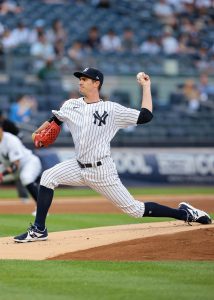
It’s the first major significant free agent strike of the offseason, as Heaney checked in 50th on MLBTR’s just-released free agent rankings. His reported contract terms land a couple million dollars north of MLBTR’s projected $6MM guarantee. The southpaw split the 2021 campaign between the Angels and the Yankees, who acquired him at the trade deadline for a pair of pitching prospects.
The past few seasons haven’t been smooth for Heaney, as he’s posted an ERA of 4.46 or higher every year since 2018. The 2021 campaign was especially challenging, as the 30-year-old managed just a 5.83 ERA over 129 2/3 frames. He struggled at both stops, posting a 5.27 mark in Orange County and putting up a ghastly 7.32 figure in pinstripes. Those issues in the Bronx became significant enough for the Yankees to transition him into a bullpen role and eventually outright him off the 40-man roster just before the end of the season.
Needless to say, Heaney hasn’t gotten the results he or his teams have desired in recent seasons. His poor run prevention totals are essentially attributable to what happens after batters make contact, though. Heaney fanned 26.9% of opposing hitters this past season, a mark that checks in more than four percentage points above the league average for starters. (His strikeout rate during his time as a starting pitcher was an even more impressive 27.5%). That was supported by a 12.5% swinging strike rate that’s more than a tick above average, while his 7.3% walk percentage was very slightly lower than the league mark. It’s no surprise, then, that Heaney put up a 3.84 SIERA that’s nearly two full runs lower than his ERA.
That kind of line is nothing new for Heaney, who has managed strikeout and walk numbers befitting a mid-rotation arm for the past few seasons. In each of the last four years, his SIERA has hovered between 3.74 and 4.08. Given that SIERA has proven more predictive of a pitcher’s future ERA than even past ERA itself, it’s easy to see why the Dodgers are willing to roll the dice in hopes of forthcoming positive regression. They’re not alone in their optimism, as Mark Feinsand of MLB.com relays that Heaney drew interest from twelve-plus teams during his extremely brief stay on the open market.
That said, the Dodgers aren’t acting without risk. Heaney’s bottom line ERA has exceeded his SIERA in each of the past four campaigns, largely due to consistent issues keeping the ball in the yard. Heaney has allowed home runs at a higher-than-average clip in three of the past four years, and he was among the game’s most homer-prone arms this past season. The former first-round pick allowed 2.01 HR per nine innings in 2021, a rate eclipsed by just five other hurlers (minimum 100 IP). That’s an untenable mark no matter how good a pitcher’s strikeout and walk rates are, so Heaney and the Dodgers’ coaching staff will have to formulate a plan to better avoid the longball in 2022.
While Heaney finished this year in the Yankees’ bullpen, he seems likely to get a crack in the Los Angeles rotation to open next season. Jason Martinez of Roster Resource projects he’ll be joined by Walker Buehler, Tony Gonsolin, Julio Urías and David Price at the moment, and there’s certainly the possibility for future additions. Heaney’s reported deal pushes the Dodgers’ projected payroll to $206MM, about $40MM shy of the figure the club carried into 2021, according to Cot’s Baseball Contracts. Should they desire, the Dodgers likely still have the resources to pursue a reunion with star free agents Max Scherzer and/or Clayton Kershaw.
As for Heaney, he returns to an area of the country in which he’s spent most of the past seven years. It’ll technically be his second stint as a Dodger, as Heaney was a member of the organization for a few hours between trades during the 2014 Winter Meetings (a tenure highlighted by a tongue-in-cheek tweet thanking the club for their “good run” together). If his results converge with his more promising underlying numbers in 2022, he’d hit next offseason’s free agent market with a good chance at landing a much stronger multi-year deal. In the intervening season, he’ll try to help the Dodgers to their tenth straight playoff appearance and third consecutive trip to the NL Championship Series.
Ken Rosenthal of the Athletic first reported that Heaney and the Dodgers were in agreement on a one-year deal worth north of $8MM. Mark Feinsand of MLB.com reported Heaney’s salary at $8.5MM.
Image courtesy of USA Today Sports.
Andrew Friedman Discusses Clayton Kershaw QO Decision
The Dodgers made the surprising decision not to issue a qualifying offer to Clayton Kershaw before Sunday afternoon’s deadline. President of baseball operations Andrew Friedman told Fabian Ardaya of the Athletic (Twitter link) this evening that call was not any sort of indication the team wants to move forward without the three-time Cy Young award winner.
“We’ve made it very clear that if Kersh wants to come back, he will always have a spot with what he’s meant to this organization — not just looking back but with what we think he can do for us next year,” Friedman said. “I know (Kershaw) wants to take a little time with (his wife) Ellen and figure out what’s best for them and also more importantly, get to a point where he feels good health wise. We have no reason to believe that he won’t.”
As for why the Dodgers declined to issue Kershaw a qualifying offer if they were open to him returning in 2022, Friedman implied it was an appreciative gesture on the organization’s part. “I think just with our respect for him and for what he’s done for this organization, that wasn’t something that we wanted to do and put him on that kind of clock when he wasn’t ready for it,” Friedman told Ardaya.
Players tagged with a qualifying offer have until November 17 to decide whether to accept the offer or reject it to explore the free agent market. With Kershaw’s apparent desire to spend some time with his family and continue to rehab the elbow injury that ended his season prematurely, the Dodgers determined not to put an artificial clock on his decision-making process.
There’s no questioning Kershaw’s status as a franchise icon. He’s won five ERA titles and an MVP award over his illustrious career, and he’ll one day wind up in the Hall of Fame wearing a Dodger cap. As Friedman suggested, Kershaw’s still capable of being highly productive, even if his days as the game’s best pitcher are probably behind him. Over 121 2/3 innings, the 33-year-old worked to a 3.55 ERA this past season. That kind of production would upgrade any team’s rotation, so it’s easy to understand the Dodgers’ openness to bringing Kershaw back even before considering his legacy.
14 Players Receive Qualifying Offers
Today was the last day for teams to issue qualifying offers to eligible free agents, as teams had to make their decisions by 4pm CT. With the deadline now behind us, here are the players who were issued the one-year, $18.4MM offers…
- Brandon Belt, Giants (link)
- Nick Castellanos, Reds (link)
- Michael Conforto, Mets (link)
- Carlos Correa, Astros (link)
- Freddie Freeman, Braves (link)
- Raisel Iglesias, Angels (link)
- Robbie Ray, Blue Jays (link)
- Eduardo Rodriguez, Red Sox (link)
- Corey Seager, Dodgers (link)
- Marcus Semien, Blue Jays (link)
- Trevor Story, Rockies (link)
- Noah Syndergaard, Mets (link)
- Chris Taylor, Dodgers (link)
- Justin Verlander, Astros (link)
This is the highest number of qualifying offers issued since the 2015-16 offseason, when a record 20 players received the QOs. Only six players received qualifying offers last winter, which was the lowest ever issued in an offseason, yet not really surprising given the pandemic’s impact on the 2020 season and league revenues.
These 14 players now have until November 17 to decide whether or not to accept the offer. If they accept, they’ll receive $18.4MM next season, and can’t be traded until June 15, 2022. They also won’t be eligible to receive a qualifying offer in any future trips to free agency (players are also ineligible for the qualifying offer if they haven’t spent at least one full season with their current team). Since the qualifying offer system was introduced in the 2012-13 offseason, 10 of the 96 players to receive a QO have taken the deal.
If a player rejects the qualifying offer, draft pick compensation is now attached to their market, unless they re-sign with their former team. Teams who sign a QO free agent will have to surrender at least one draft pick, and potentially some international bonus pool money depending on their status as revenue-sharing recipients or whether or not they exceeded the luxury tax threshold. (Here is the list of what every team would have to give up to sign a QO free agent.)
If a QO free agent signs elsewhere, that player’s former team receives a compensatory draft pick based on this criteria….
- A draft pick after Competitive Balance Round B will be awarded if the team losing the free agent did not receive revenue sharing or if the free agent in question signed a contract worth less than $50MM in guaranteed money.
- A draft pick after Round 1 will be awarded if the team losing the free agent received revenue sharing and the free agent in question signed for more than $50MM.
- A draft pick after Round 4 will be awarded if the team losing the free agent paid luxury tax penalties in the preceding season.
As always, several factors are weighed by both teams and players about whether or not to issue or accept qualifying offers. This winter provides yet another wrinkle — this could be the final year of the current qualifying offer system due to the expiration of the current Collective Bargaining Agreement on December 1. It is widely expected that the owners could lock out the players if a new deal isn’t reached by that date. In the event of a lockout, MLB would institute a roster freeze on all transactional business involving Major League players, thus bringing the free agent market to a halt.
With this deadline looming, it is possible we could see some QO recipients (those less certain of landing big multi-year contracts) choose to accept the one-year deal in order to guarantee themselves some financial and contractual security prior to a possible lockout. By that same token, this could make teams warier about extending the qualifying offer to certain players due to a larger suspicion that they would accept…or perhaps a player’s willingness to accept could make a team more inclined to issue a QO to a so-called borderline case.
Free Agent Notes: Verlander, Schwarber, Heaney
Justin Verlander will hold a showcase for scouts and evaluators tomorrow, The Athletic’s Britt Ghiroli reports (Twitter links). This is the first time Verlander will throw in front of evaluators from other teams since his Tommy John surgery in September 2020. Multiple teams are expected to have personnel on hand, if just as a matter of simple due diligence rather than a clear interest in signing Verlander on the free agent market. As WFAN’s Sweeny Murti observes, it probably safe to assume the Yankees will have personnel on hand — Verlander is throwing at a Cressey Sports Performance facility, and Eric Cressey is the Yankees’ director of player health and performance.
It stands to reason that Verlander will probably hold multiple showcases in order to prove that his arm has recovered from the TJ procedure, and that he’ll be ready to roll when Spring Training camps open. The timing of a second showcase could be particularly important, however, since Verlander has until November 17 to decide whether or not to accept the qualifying offer extended by the Astros today. If Verlander throws well and gets some good buzz coming out of Monday’s session, it could make him lean against taking the one-year, $18.4MM offer to return to Houston, if he gets an indication that at least one other club is interested in making him a more lucrative multi-year deal on the open market.
More from the free agent market….
- J.D. Martinez‘s decision to pass on his opt-out clause will keep the veteran slugger in Boston for another season, though it doesn’t mean that free agent Kyle Schwarber is necessarily roadblocked from a return to the Red Sox. Chief baseball officer Chaim Bloom told reporters (including The Boston Globe’s Alex Speier) that the Sox have already been in touch with Schwarber and will continue to monitor his market throughout the winter. Martinez’s role as the regular DH and a fill-in outfielder might be the ideal spot for Schwarber, as while Schwarber did okay at first base for someone who had never played the position before, he probably isn’t a viable solution at first over the longer term (plus, the Sox have Bobby Dalbec and prospect Triston Casas ready for more first base time). However, Schwarber hit so well during his two-plus months in Boston that it isn’t surprising that the club will look to get creative in trying to find a fit for him in the lineup. For his part, Schwarber said after the ALCS that he would be interested in a return to the Sox.
- Despite Andrew Heaney‘s very rough 2021 season, several teams are eyeing the left-hander as a possible bounce-back candidate. The New York Post’s Joel Sherman (Twitter link) lists the Blue Jays, Cardinals, Dodgers, and Nationals as some of the teams interested in the free agent hurler. Heaney still had above-average strikeout and walk rates last year, as most of his problems stemmed from an inability to avoid home runs — Heaney allowed a whopping 29 homers over his 129 2/3 innings with the Angels and Yankees.
Dodgers Don’t Issue Qualifying Offer To Clayton Kershaw
As expected, the Dodgers officially announced that both Corey Seager and Chris Taylor will receive qualifying offers prior to today’s 4pm CT deadline. However, Seager and Taylor were the only players mentioned, meaning that Clayton Kershaw will enter free agency without the qualifying offer attached to his services.
Kershaw, Taylor, and Seager were the only Dodger free agents who were both eligible for the QO (Max Scherzer and Kenley Jansen weren’t eligible, for the record) and seemed like candidates to be issued the one-year, $18.4MM deal. Seager was obviously a no-brainer and Taylor also seemed like an increasingly obvious lock for the QO, but Kershaw’s case suddenly became much cloudier due to his season-ending forearm injury. While Kershaw’s injury won’t require surgery and he expects to be ready for Spring Training, the issue certainly seems substantial enough for the Dodgers to have doubts about an $18.4MM commitment.
It isn’t a guarantee that Kershaw would have accepted a qualifying offer, but it would certainly seem like a possibility considering his injury-shortened 2021 campaign. Elbow inflammation sidelined Kershaw for over two months, and his forearm problems then prevented him from taking part in the Dodgers’ postseason run. Over 121 2/3 innings pitched, however, Kershaw still posted a 3.55 ERA with outstanding strikeout (29.5%) and walk (4.3%) rates.
The lack of a QO doesn’t necessarily spell the end of Kershaw’s run in a Dodgers uniform. President of baseball operations Andrew Friedman has already said that the team will approach Kershaw’s trip to the open market in a different manner than they would a normal free agent, given Kershaw’s legendary status in Los Angeles.
Interpreted another way, however, it could be that the Dodgers are giving Kershaw a bit of leeway towards a potential departure by not extending a qualifying offer. If Kershaw rejected a QO, his new team would have to give up a draft pick and potentially international bonus pool money to sign him, which could have hampered Kershaw’s market to some extent.
Now, the southpaw doesn’t have anything hindering his first-ever trip to free agency, which would at least slightly increase the chance that Kershaw’s Dodgers tenure could be up after 14 seasons. There has been speculation that the Texas native might be interested in pitching closer to home, which would put the Astros and particularly the Rangers (Kershaw is from Dallas and lives in the area) on the radar as possible landing spots.
Dodgers Decline Option On Joe Kelly
The Los Angeles Dodgers have declined the $12MM club option for Joe Kelly for the 2022 season, per the team. The right-hander will receive a $4MM buyout and head to the open market, though a return to LA is certainly a possibility.
Kelly was hurt in his last appearance this postseason after serving as an opener. The pain “stemmed from the musculocutaneous nerve in Kelly’s arm,” per Jorge Castillo of the Los Angeles Times. He is expected to resume a throwing program in six weeks, so he should have no problem getting ready for opening day.
Kelly and his mustache had a solid season in relief for the Dodgers. The 33-year-old appeared in 48 games, tossed 44 innings, and put up a 2.86 ERA/3.08 FIP. The power righty picked up a pair of saves and 13 holds while striking out a robust 27.5 percent of batters and walking a league-average 8.2 percent. He’ll be an attractive option for a contender given his postseason and high leverage experience.
Dodgers Outright Scott Alexander, Two Others
The Dodgers outrighted three players off the 40-man roster this evening, the team informed reporters (including Juan Toribio of MLB.com). Relievers Scott Alexander and Jimmie Sherfy and utilityman Andy Burns have all passed through waivers unclaimed. All three players have the right to become minor league free agents.
Alexander is the most notable of the group, as he’d been a productive bullpen option for manager Dave Roberts when healthy. That’s a rather significant qualifier, though, as he hasn’t eclipsed twenty innings in any of the past three seasons. Alexander posted a sub-4.00 ERA in all four seasons as a Dodger (and in two preceding years with the Royals), but he’s been plagued by injuries in recent years.
The southpaw missed a good portion of the 2019 campaign with forearm inflammation, and he missed around four months of this past season because of a shoulder issue. Alexander didn’t pitch after July 19, and Los Angeles elected to clear a 40-man roster spot rather than bring him back for his final year of club control on a projected $1.3MM arbitration salary. Before the injury, the 32-year-old put up numbers right in line with his career trend. He’d tossed 15 1/3 frames of relief with a strong 2.93 ERA, making up for a minuscule 11.9% strikeout percentage with one of the game’s highest ground-ball rates (61.1%).
Sherfy also ended the season on the injured list, in his case due to a bout of elbow inflammation. L.A. had claimed him from the archrival Giants not long before, and Sherfy’s time in Dodger blue looks likely to consist of just four appearances. Between San Francisco and Los Angeles, the 29-year-old tossed 15 frames of 4.20 ERA ball in 2021. He spent the 2017-19 campaigns with the D-Backs and owns a 3.28 ERA with roughly average strikeout and walk rates (23.8% and 8.3%, respectively) in 60 1/3 big league innings.
Burns played in just nine regular season games before being outrighted off the roster. He was re-selected back after Justin Turner’s season-ending injury during the NLCS necessitated the club adding some extra infield depth. Burns didn’t wind up appearing in a playoff game, though, and he’s likely headed back to the open market. The 31-year-old hit .232/.361/.412 over 216 plate appearances with Triple-A Oklahoma City this year but has very limited MLB experience.