
Out Of Options Players: NL East
The following 40-man roster players have less than five years service time and are out of minor league options. That means they must clear waivers before being sent to the minors, so the team would be at risk of losing them in attempting to do so. I’ve included players on multiyear deals. This list was compiled through MLBTR’s sources. Today, we’ll take a look at the NL East.
Braves: Zoilo Almonte, Juan Jaime, Josh Outman
The Braves signed Almonte, 25, to a Major League deal in November. According to MLB.com’s Mark Bowman, he’s competing for the primary backup outfielder role with Todd Cunningham and Eury Perez. If Nick Markakis is not ready for the start of the season, that could improve Almonte’s chances of making the team.
The Braves inked Outman to a big league deal in January. Outman seems likely to be a part of the team’s Opening Day bullpen, even though they’ve also got lefty relievers James Russell and Luis Avilan. Avilan, perhaps, could be a trade candidate this month. Jaime is pretty well buried on the team’s bullpen depth chart and has had a couple of rough spring outings, so he’s probably not long for the team or at least its 40-man roster.
Marlins: Mike Dunn, Brad Hand, Adeiny Hechavarria, Bryan Morris
Dunn and Morris have two of the Marlins’ seven bullpen spots locked down. Tom D’Angelo of the Palm Beach Post wrote on Sunday that Hand is competing for one of two remaining bullpen jobs, and could slot in as the team’s long reliever. One complication is Rule 5 pick and fellow southpaw Andrew McKirahan, who would have to be returned to or at least acquired from the Cubs if he doesn’t make the team. Clark Spencer of the Miami Herald wrote about that situation on Sunday.
Mets: Wilmer Flores, John Mayberry, Jenrry Mejia, Kirk Nieuwenhuis, Cesar Puello, Ruben Tejada, Carlos Torres
Mayberry definitely has a spot, and Nieuwenhuis is likely to make the Opening Day roster as well. Puello, however, figures to find his way off the Mets’ 40-man roster soon.
Phillies: Cesar Hernandez, Phillippe Aumont, Justin De Fratus, Freddy Galvis, Andy Oliver
De Fratus is expected to make the Phillies’ bullpen. Oliver being out of options is irrelevant, because he’s a Rule 5 pick from the Pirates. As MLB.com’s Todd Zolecki noted earlier this month, the Phillies are in good position to stash a project like Oliver in their bullpen all year.
This could be the end of the road for Aumont, who is the last player remaining from the December 2009 deal in which the Phillies sent Cliff Lee to the Mariners. The 26-year-old righty has been hit hard in four outings this spring. The team is considered to have three open bullpen spots, according to Jake Kaplan of the Philadelphia Inquirer, so at least Aumont has some openings.
Galvis is the team’s starting shortstop after the offseason trade of Jimmy Rollins. Hernandez is looking to be the backup middle infielder, and he appears to be in good position to win that job.
Nationals: Xavier Cedeno, Sandy Leon, Jose Lobaton, Tyler Moore
Will the Nationals break camp with a third lefty reliever behind Matt Thornton and Jerry Blevins? Cedeno could fill that role, though Mets reporter Adam Rubin of EPSNNewYork.com hears he’s unlikely to make the team and could be available in trade.
With Lobaton expected to serve as the backup to catcher Wilson Ramos, it’s hard to see how Leon can make the team. Moore, 28, is vying for a chance to serve as a backup at first base and left field. That might become more likely if Jayson Werth or Nate McLouth has to start the season on the DL, but there’s no indication of that at present. Aside from Lobaton, all of the Nationals’ out of options players look like trade candidates this spring.
Offseason In Review: Minnesota Twins
The Twins have spent four years in the cellar of the AL Central, but they’ve begun to spend on free agents in the past two offseasons in anticipation of the arrival of some of the game’s most highly touted prospects.
Major League Signings
- Ervin Santana, SP: Four years, $54MM
- Torii Hunter, OF: One year, $10.5MM
- Tim Stauffer, SP/RP: One year, $2.2MM
- Total spend: $66.7MM
Trades and Claims
- None
Extensions
- Phil Hughes, SP: Three years, $42MM
Notable Minor League Signings
Notable Losses
Needs Addressed
The Twins finished seventh in the Majors in runs scored last season and batted a combined .254/.324/.389, making them one of 10 teams in baseball to outproduce the production of a league-average hitter, per Fangraphs’ wRC+ metric (102). However, while scoring runs wasn’t a problem for Minnesota, preventing them certainly was, as their pitching and defense were each among the league’s worst.
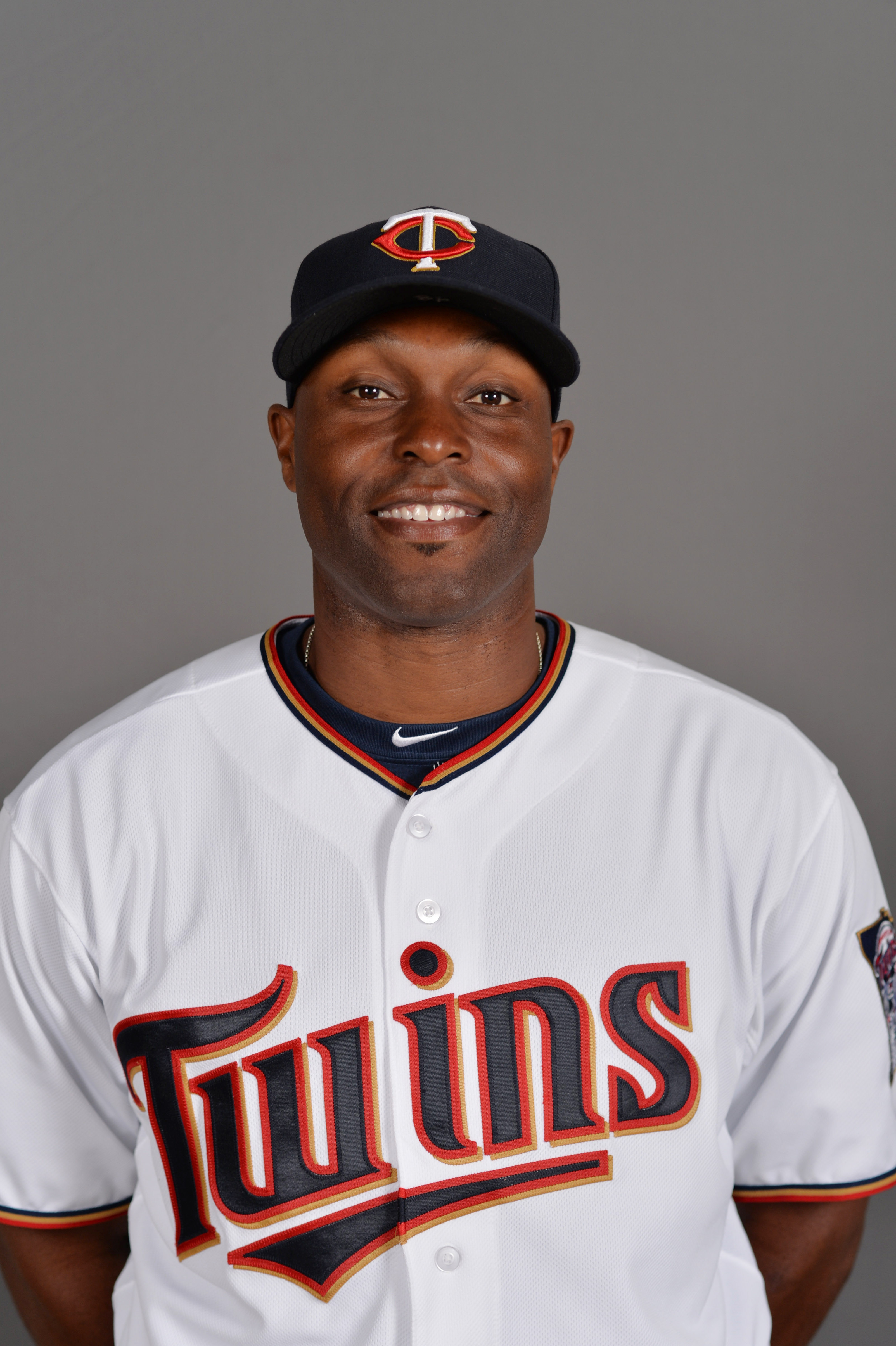 The Twins explored multiple options on the starting pitching market this offseason before eventually agreeing to a four-year, $54MM contract with Ervin Santana. Minnesota had interest in Santana last year in Spring Training, so it wasn’t a shock to see them pursue the righty again. Santana should provide the team with 200-ish league-average or slightly better innings — something it has been lacking in recent years. That’s much the same role that Ricky Nolasco was supposed to fill when he was signed prior to 2014, but Santana has a superior track record and has already demonstrated recent success in the American League.
Though the Twins have a number of outfield prospects rising through the system, none are quite ready to make the leap to the Majors just yet. Understandably then, they sought to find a stopgap, and the Twins made a sentimental play to bring back franchise favorite Torii Hunter on a one-year deal. The 39-year-old Hunter was the Twins’ first-round pick back in the 1993 draft, and he emerged as a star and a core player for the Twins in the mid-2000s as the team perennially contended for the AL Central crown. Hunter can still hit — .286/.319/.446 last year — but his defense has deteriorated significantly. Though he’s on a one-year deal, he’s expressed an openness to returning beyond this season if he’s still productive. With top prospect Byron Buxton fast approaching the Majors alongside other well-regarded prospects like Eddie Rosario, I would think that Hunter may have to accept a reduced role, perhaps as soon as 2016, in order for that to occur.
The Twins also quietly added Tim Stauffer on a one-year deal with a reasonable $2.2MM base salary. He’ll compete for a spot in the rotation, but the likelier outcome is that Stauffer will end up in the bullpen to pick up some of the innings that Jared Burton, now with the Yankees, had accounted for in previous seasons. (The Twins elected to buy out Burton’s $3.6MM option rather than retain him.)
For a team that finished in last place once again, this is a relatively brief “Needs Addressed” section, but the Twins will likely be counting on their farm system to fill in many of the holes around the roster. Oswaldo Arcia, Danny Santana, Kennys Vargas, Josmil Pinto, Trevor May and Alex Meyer are all eventually to contribute in varying capacities this season. Top prospects Buxton, Miguel Sano and Jose Berrios could also debut in 2015 as well.
Questions Remaining
The Twins have spent aggressively on the starting pitching market over the past two offseasons, giving a combined $138MM to Nolasco, Mike Pelfrey, Phil Hughes and now Santana. While they struck gold on Hughes, who set the Major League record for single-season K/BB ratio last year (11.63) and parlayed that into a three-year, $42MM extension, Nolasco and Pelfrey contributed nothing in 2014. It remains to be seen whether Santana will live up to his deal, but certainly given the expenditure they’ve put forth, one would hope their rotation would have a better outlook. As it is, however, Hughes, Santana and former first-round pick Kyle Gibson will likely be joined by Nolasco and one of Pelfrey, Tommy Milone, Alex Meyer or Trevor May in the fifth slot. While there’s some depth there and Meyer has top-of-the-rotation upside, the unit as a whole looks underwhelming.
As I opined in my Offseason Outlook for the Twins, perhaps the best way to help the pitching may have been to improve an outfield defense that ranked as one of the worst in baseball last season (-36.2 UZR, -50 Defensive Runs Saved). Someone such as Peter Bourjos or Craig Gentry, for instance, could have had their relatively light bat hidden in an otherwise-serviceable lineup while drastically improving the defense. The Twins went another route by bringing back Hunter, who, as mentioned before, has plenty of life in his bat but has seen his once-sterling defensive reputation tarnished with age. Hunter was worth -18 runs per both UZR and DRS last season, so the Twins will again employ a pair of range-challenged corner outfielders in Hunter and Arcia, who will shift to left field with Hunter taking right.
Between them will likely be Aaron Hicks, a former first-round pick and Top 30 prospect that has yet to pan out at the plate or in the field. Though Hicks possesses an incredible throwing arm and is fleet of foot, poor route-running has led to sub-par defensive marks in center field. This will be the now-25-year-old Hicks’ third crack at establishing himself after originally skipping Triple-A to open the 2013 season as the team’s center fielder. He’s batted just .201/.293/.313 in 150 big league games. Hicks could be pushed for playing time by Jordan Schafer, who impressed the Twins after being claimed on waivers last year. Schafer is a lock to make the team either as a fourth outfielder or in a more regular role, but he, too, is a former top prospect that has never realized his offensive potential.
The Twins’ bullpen will be anchored by Minnesota native Glen Perkins, though the 32-year-old ended last season with a minor elbow issue that caused his ERA to balloon in the final month. That’s cleared up now, but he’s been battling an oblique problem in Spring Training as well. It seems minor enough, but the Twins’ bullpen group is thin on established arms. Casey Fien has been nothing short of brilliant in the first half of each of the past two seasons before wilting in each second half, but he’ll be the primary setup man. I’d imagine that Stauffer will take one bullpen slot, and Brian Duensing, who had struck me as a non-tender candidate, will be back in the fold from the left side. If manager Paul Molitor deploys him primarily against southpaws, he should be effective. Pelfrey seems likely to end up in the bullpen as well if he doesn’t win the final rotation spot.
Beyond that mix, names like Michael Tonkin, Caleb Thielbar, Ryan Pressly, Aaron Thompson, A.J. Achter, Logan Darnell and Lester Oliveros will get looks. Non-roster invitee Blaine Boyer would seem to have a good chance as well following a nice comeback effort with the Padres last year. Still, it’s a thin group, and with Perkins ailing somewhat, I wouldn’t be surprised if Scott Boras were trying to sell GM Terry Ryan on Rafael Soriano to come in and solidify the bunch.
For all of the questions elsewhere on the roster, the infield is relatively set. The Twins will hope that better health means a rebound to some degree for Joe Mauer. Brian Dozier emerged as the team’s regular second baseman over the past two seasons and may yet land a long-term deal this spring. Danny Santana had an excellent rookie season playing mostly center field, but he’ll be back at his natural shortstop in 2015. He won’t repeat his preposterous .405 BABIP, but his strong line-drive rate and speed do suggest that he can maintain a mark well above the league average in that regard. Trevor Plouffe continues to see year-to-year improvement and was quietly worth 3.5 fWAR/4.0 rWAR last season. Still, he may be a placeholder until Sano’s massive bat surfaces in the Majors.
Kurt Suzuki signed a two-year, $12MM extension last summer, but as a slow-footed catcher, his .310 BABIP will be tough to repeat, so he may see some regression at the plate. If Pinto hits like he did in 2013 rather than in 2014, the two may eventually flip. Vargas will be the team’s everyday DH after an impressive .274/.316/.456 debut, but he’ll need to refine his approach and improve his abysmal 63-to-12 (5.25) K/BB ratio.
The biggest question surrounding the Twins may simply be if/when Buxton, Sano, Meyer and possibly Berrios arrive in 2015. That group of lauded top prospects is widely believed to be a quartet of potential core players, and Twins fans have long been awaiting their arrival.
Deal of Note
Though the Twins were willing to give Santana three years and $30-33MM this time last year, Santana preferred to bet on himself and take a one-year deal in the NL with the hope of securing a better deal a second time around. (Had he taken the Twins’ offer, he’d have essentially given away the 2015-16 seasons for $16-19MM total.) The Twins reeled him in this time around, however they did so by offering an extra year and another $20MM or so despite the fact that Santana is now a year older.
Santana was often used as an example of why players should accept qualifying offers throughout the 2014 season, but this contract shows that the more likely culprit in his 2013-14 offseason woes was an unreasonable asking price. It’s worth noting that he’ll come away with a combined $68.1MM over his age-31 to age-35 seasons, so he ultimately did well despite having to take a one-year deal in his first foray into free agency.
The greater note, however, is that the signing signals that the Twins do believe they can compete within their division this season. Next year’s market features a wealth of starting pitching options, so it would have made some sense for the Twins to lay low this winter and pounce in six months’ time, adding a premium starter rather than a middle-of-the-road arm to complement a young core that is transitioning to the Majors. Minnesota may still play in free agency next year, depending on how things pan out with Gibson, Nolasco, Milone, Meyer, Berrios and May, but Ryan has said that the Santana signing was made to compete in 2015.
Additionally, it has to be pointed out that the Twins surrendered a high second-round pick (their first-rounder is protected) in order to land Santana. The No. 47 overall pick in last year’s draft was worth $1.188MM, and it could be worth around $1.29MM in the coming draft. That’s a significant amount of bonus money, which might have been used to add to an already excellent farm system.
Overview
The Twins seem likely to be a better club than they were in 2014. The addition of Santana will improve what was, but may still be, a below-average pitching staff. For Minnesota, the 2015 season will be expected to be one in which a corner is turned; looking around the lineup, three spots — shortstop, left field and DH — will be occupied by top organizational prospects that have graduated to the Majors and already begun to realize some of their potential. In the rotation, Gibson will be asked to take a step forward, and the Twins can only hope for some degree of breakout from Hicks in center field. If he’s not able to contribute, he may not factor into their plans much longer, with outfielders Buxton, Arcia and Eddie Rosario presenting a possible trio to build upon.
Reinforcements will be on the way throughout the season, but it still seems a stretch to peg this team as a wild card or division contender. Stranger things have happened, and the talent is there if some prospects make a greater-than-expected impact, but 2016-17 seems like a more realistic timeframe for the Twins to again find themselves in a playoff hunt.
Photo courtesy of USA Today Sports Images.
Out Of Options Players: AL Central
The following 40-man roster players have less than five years service time and are out of minor league options. That means they must clear waivers before being sent to the minors, so the team would be at risk of losing them in attempting to do so. I’ve included players on multiyear deals. This list was compiled through MLBTR’s sources. Today, we’ll take a look at the AL Central.
White Sox: Maikel Cleto, Conor Gillaspie, Javy Guerra, Dan Jennings, Hector Noesi
The White Sox claimed Cleto off waivers from the Royals in February 2014, removing him from their 40-man roster in May and re-adding him in August. He and Guerra are among those vying for a couple of spots in the team’s revamped bullpen, which features new additions David Robertson, Zach Duke, and Jennings. Opening the season with an eight-man pen is possible. In a Saturday post, Jim Margalus of South Side Sox ranked Cleto ahead of Guerra.
Indians: Trevor Bauer, Carlos Carrasco, Nick Hagadone, Zach McAllister, Brandon Moss
Carrasco and Bauer have rotation spots locked down for the Indians. McAllister is competing with a pool of others for two open spots, with Gavin Floyd‘s injury creating an opening. About a month ago, Indians manager Terry Francona implied McAllister will make the club, either as a starter or reliever. Also about a month ago, MLB.com’s Jordan Bastian described Hagadone as a “virtual lock” for the Tribe’s pen.
Tigers: Jose Iglesias, Hernan Perez, Andrew Romine
Perez and Romine were thought to be in competition for one bench spot, writes James Schmehl of Mlive.com, but Tigers manager Brad Ausmus said recently the team could break camp with both on the roster. If healthy, Iglesias will be the everyday shortstop.
Royals: Louis Coleman, Jarrod Dyson, Erik Kratz
Andy McCullough of the Kansas City Star broke down the Royals’ bullpen situation yesterday. Relievers Greg Holland, Wade Davis, Kelvin Herrera, Jason Frasor, and Chris Young are locked into a pen that could break camp with eight. At present, it seems likely they’ll be able to find a spot for Coleman.
As McCullough noted in an earlier article, Kratz is competing with Francisco Pena for the backup catcher job. He feels that the 34-year-old Kratz is a better fit for the gig than Pena, who is 25. Dyson will be the team’s fourth outfielder.
Twins: Eduardo Escobar, Eduardo Nunez, Trevor Plouffe, Jordan Schafer
Escobar seems assured a utility infield job on the team, but Nunez’s status is uncertain. A trade seems possible. Schafer’s all but certain to be Minnesota’s fourth outfielder.
Offseason In Review: San Francisco Giants
The World Series winners brought back some familiar faces from their latest championship team, yet they’ll have to account for a Panda-sized hole in their lineup.
Major League Signings
- Jake Peavy, SP: Two years, $24MM
- Sergio Romo, RP: Two years, $15MM
- Nori Aoki, OF: One year, $4MM ($5.5MM club option for 2016 with $700K buyout; option becomes mutual with 550 plate appearances)
- Ryan Vogelsong, SP: One year, $4MM
- Total spend: $47.7MM
Notable Minor League Signings
- Alfredo Aceves, Travis Blackley, John Bowker, Ronny Cedeno, Robert Coello, Edgmer Escalona, Cory Gearrin, Juan Gutierrez, Brandon Hicks, Justin Maxwell, Curtis Partch, Guillermo Quiroz, Clay Rapada, Carlos Triunfel
Trades And Claims
- Acquired 3B Casey McGehee from Marlins for SP Kendry Flores and RP Luis Castillo
Extensions
- Gregor Blanco, OF: Two years, $7.5MM
Notable Losses
Needs Addressed
With five key members (two position players and three pitchers) of last year’s roster facing free agency, the Giants brought back all three of the arms. Madison Bumgarner, Tim Hudson and a hopefully-healthy Matt Cain will be joined in the rotation by the re-signed Jake Peavy. Ryan Vogelsong seemed to be on the verge of going to the Astros, but after a bit of controversy scuttled that deal, he ended up re-signing with the Giants. Vogelsong is currently slated to fill a long relief role but he (or Yusmeiro Petit) could be elevated to the fifth starter’s role if Tim Lincecum‘s struggles continue.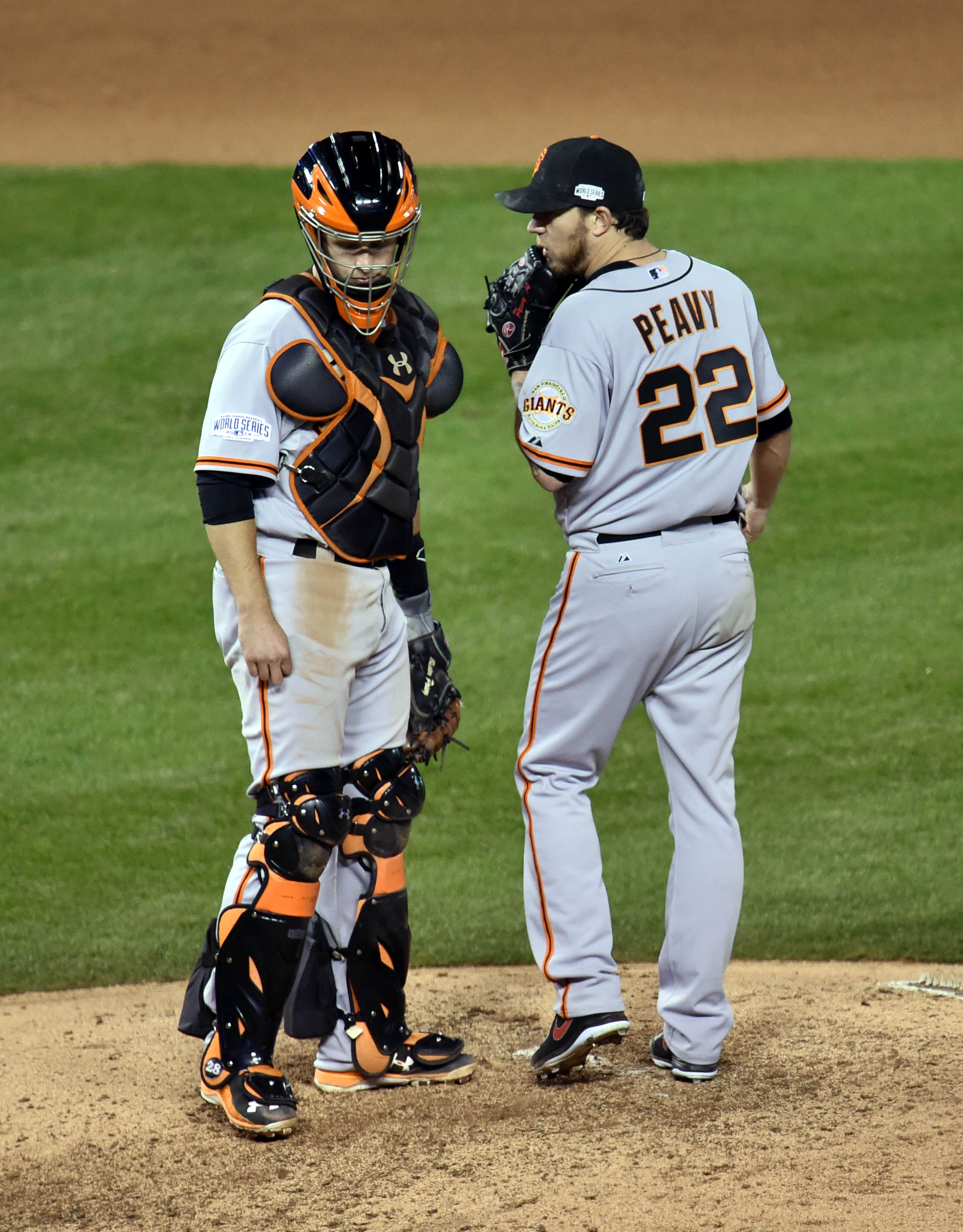
After receiving some interest from the Astros, Dodgers, Yankees and Red Sox, Sergio Romo instead returned to San Francisco on a two-year, $15MM deal. The veteran relief trio of Javier Lopez (37 years old), Santiago Casilla (34) and Romo (32) have played major roles in the Giants’ three World Series titles since 2010, and they’ll continue to hold down the back of the bullpen.
The Giants will miss Mike Morse’s .279/.336/.475 batting line (133 wRC+, or 33 percent better than the league-average hitter) and 16 homers, yet in replacing him in left field with free agent signing Nori Aoki may be an overall upgrade. While Aoki posted only a 104 wRC+ and obviously fell far short of Morse in the power department, he generated 2.3 fWAR to Morse’s 1.0 fWAR last season due to a big edge in defense and baserunning, as well as a better batting average and OBP. Aoki’s skill-set makes him a good fit for AT&T Park, and his defensive versatility may already have come in handy for the Giants; Aoki may be a short-term replacement in right field while Hunter Pence is on the DL.
Sabermetrically speaking, the gap between Pablo Sandoval and the newly-acquired Casey McGehee was closer than you might expect at first glance. Sandoval posted a .279/.324/.415 slash line, 16 homers, a 111 wRC+ and .323 wOBA over 638 PA last season and generated 3.0 fWAR. In his return to North American baseball after spending 2013 in Japan, McGehee hit .287/.355/.357 with four homers over 691 PA, good for a 102 wRC+, .319 wOBA and 2.0 fWAR. Since McGehee will earn $4.8MM in 2015 as compared to Sandoval’s $17MM salary from the Red Sox, the Giants will be overjoyed if there’s only a one-win gap between the two third basemen next year.
Questions Remaining
While the Giants brought the band back together pitching-wise, Bumgarner’s postseason dominance obscured the fact that the club actually didn’t get much from its rotation in 2014. San Francisco starters generated only 8.2 fWAR last season, the third-lowest total in baseball. While this number should rise with Cain’s return and a full season from Peavy, there is still plenty of uncertainty given Cain’s health, the fifth starter spot and the 39-year-old Hudson’s fade down the stretch last year. Hudson’s health isn’t a 100 percent guarantee, either, as the veteran righty underwent January surgery to remove bone spurs from his ankle. Though he’s expected to be ready for Opening Day, the aftereffects of that operation are yet undetermined.
With questions surrounding their rotation, the Giants checked in on several top free agent pitchers this offseason. They were serious suitors for both Jon Lester and James Shields (though their four-year, $80MM offer to Shields was reportedly taken off the table once they signed Peavy), and they at least considered the likes of Max Scherzer, Francisco Liriano and Ervin Santana. I would guess that if the Giants are still in the race by midseason but have one or two pitchers struggling, they’d be prime candidates to pick up a top-tier arm at the trade deadline.
It seemed that “close-but-no-cigar” was the theme of the Giants’ offseason, as they explored what would’ve been very notable trades and signings for the likes of Nelson Cruz, Justin Upton, Torii Hunter, Ben Zobrist, Chris Johnson, Asdrubal Cabrera, Chase Headley, Jed Lowrie, Nick Markakis, and some of Boston’s extra outfielders. They also fell short in the bidding for Cuban slugger Yasmany Tomas, who could’ve helped the club in either left or third. Timing seemed to be an issue on some of these non-moves; with the Giants not knowing until the Winter Meetings if they would land Lester, they couldn’t make other commitments until they knew if they’d need the $140-150MM they had earmarked for the ace southpaw.
The Giants also made a strong push to re-sign Sandoval, though the Panda had reportedly made up his mind to leave San Francisco before last season even began. (His postseason hitting display was quite the parting gift.) McGehee’s 2014 stats were boosted by a .335 BABIP, and given Sandoval’s clear edge in career hitting totals, McGehee will likely fall well short of matching Sandoval’s production. Given how the Giants looked elsewhere for third basemen this winter, McGehee might just be a one-year stopgap until they can find a more long-term answer at the hot corner.
Losing Sandoval and Morse will damage a Giants’ lineup that posted middle-of-the-pack numbers in most offensive categories last year. Missing Pence for potentially all of April certainly won’t help in the team’s search for more runs. On the flip side, the lineup should get a bit of a power boost with Brandon Belt healthy again after an injury-plagued 2014.
Romo actually posted a negative fWAR (-0.3) last season, largely due to career highs in both FIP (3.94) and HR/9 (1.4). He lost the closer’s job partway through the season but rebounded enough that he earned a share of the closing duties with Casilla, though it was Casilla who received all four save opportunities during the playoffs. As a result, Casilla will be the Giants’ closer going into Spring Training.
With this in mind, guaranteeing $15MM to a 32-year-old setup man coming off his worst statistical season was something of a risky move. San Francisco already had a pretty strong bullpen without Romo, and with Vogelsong/Petit (or maybe Lincecum) added in a swingman or long relief role, a case could be made that the Giants could’ve let Romo go and spent that $15MM elsewhere. Romo does provide depth for Casilla, who’s a non-traditional closer, but the Giants are investing a lot in the hope that Romo’s poor first half was just an aberration.
Deal Of Note
While the Giants couldn’t land a frontline ace like Lester or Shields, they did sign a guy who pitched like an ace while in a Giants uniform. Peavy posted a 2.17 ERA, 3.41 K/BB rate and 6.6 K/9 in 78 2/3 innings after his late-July trade from Boston to San Francisco, though his peripherals (3.03 FIP, 4.01 xFIP, 3.91 SIERA) indicate that he enjoyed some good fortune ERA-wise.
A 2.17 ERA over a full season probably isn’t in the cards, yet Peavy should provide the team with quality innings and a solid return on their two-year, $24MM investment. As Peavy himself hinted while speaking with reporters (including MLBTR’s Zach Links) after his signing, he may have taken less money than he could’ve found elsewhere to return to the Giants due to his love of the organization and his desire to win.
Overview
While the Giants’ projected $170MM payroll for 2015 is one of the game’s highest, it was expected they would spend a little more than $52.7MM (their free agent signings and McGehee’s salary) on players given the extra revenues from their playoff run. It seems like the team expected the same thing given the number of high-salaried targets they pursued but couldn’t land.
Still, a fairly quiet offseason is not a huge cause for alarm. Not spending in winter means that the Giants probably have some cash to spend in June or July. As mentioned earlier, the club could be contenders for pitching upgrades, or potentially could aim for bullpen help or lineup additions should the need arise. The Giants could add short-term rentals, or pursue pricier players who are signed beyond 2015. San Francisco can afford to consider such additions since they’ll have roughly $53MM coming off the books after the season (expiring deals for Lincecum, Hudson, McGehee, Vogelsong, Jeremy Affeldt, Marco Scutaro and Joaquin Arias) and possibly more if club options for Casilla and Aoki aren’t exercised.
For now, however, the Giants should be in pretty good stead given that they’re returning the large majority of a world championship roster. Bruce Bochy will have to work some of his usual creativity to make up for the absences of Sandoval and Morse, and the club will have a tougher road in the NL West with the reloaded Dodgers and the rebuilt Padres both looking like contenders. Still, anyone writing off the 2015 Giants simply due to the “Odd Year Curse” does so at their own peril.
Photo courtesy of Peter Aiken/USA Today Sports Images
2014-15 Free Agent Market: Multi-Year Deals In Context
Last year, I compiled a whole lot of data on free agent spending to assess overall spending trends over the 2007-08 to 2013-14 time period. That post was the culmination of a lot of research, and includes plenty of observations about the broader period in question which I will not repeat here.
Recently, I updated thing to assess the 2014-15 free agent market, which is in its very final stages as we speak. First, I broke out spending by team. Then, I looked at overall spending, noting that the total outlay had declined from the all-time high in 2013-14 but that AAV continued to rise.
I also touched upon the trends as regards multi-year contracts, showing that the average total commitment ($41.59MM) and AAV ($12.85MM) for contracts of two or more years in duration had both risen significantly. That is particularly notable since that element of spending had remained largely flat over the 2011-12 to 2013-14 timeframe, even as the total number of players achieving multi-year commitments rose.
Here, again, is the table:
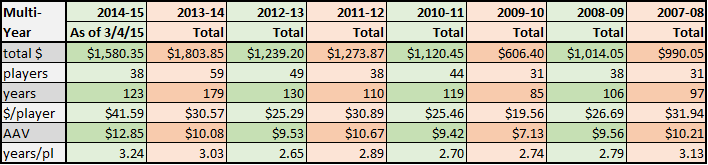
Now, let’s take a look in more visual form. The charts show a similar shape for both measures, and make clear that there continues to be healthy growth in spending on the game’s best players.
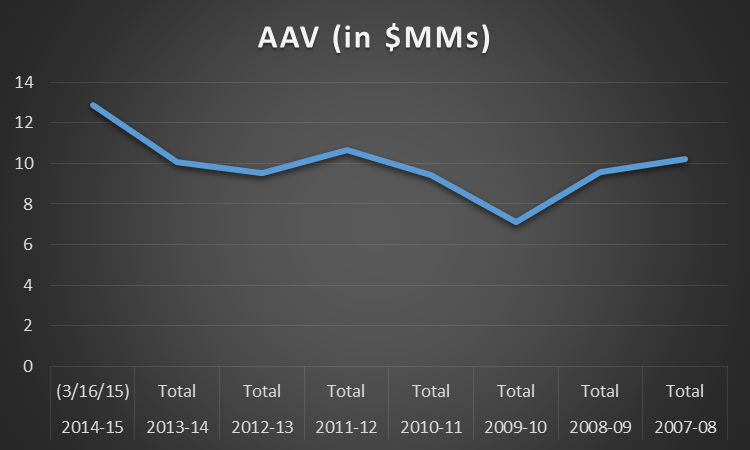
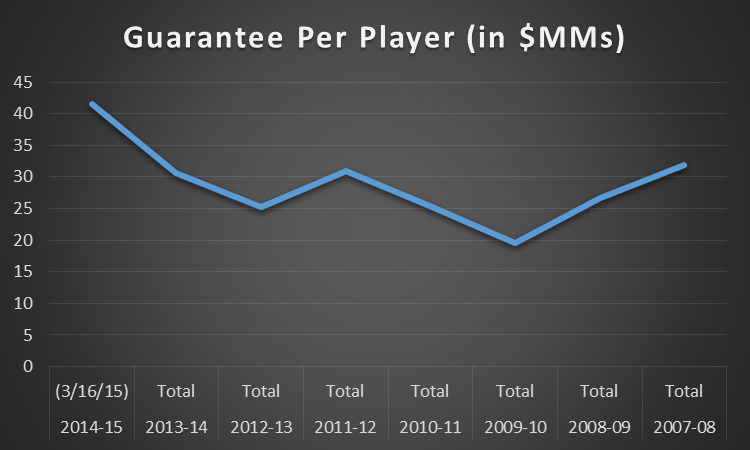
Of course, that only provides part of the story. As the data also reveals, this year’s market showed a rather significant drop in the absolute number of players who were able to achieve those kinds of commitments.
Previously, I showed only the multi-year deals as a group. Now, we’ll look at them in more detail. First, total contracts by year:

And now, by percentage:
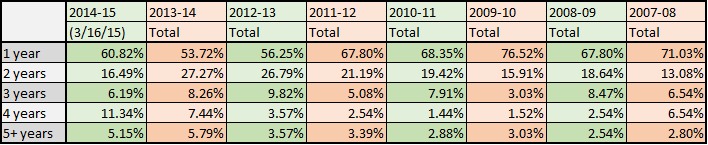
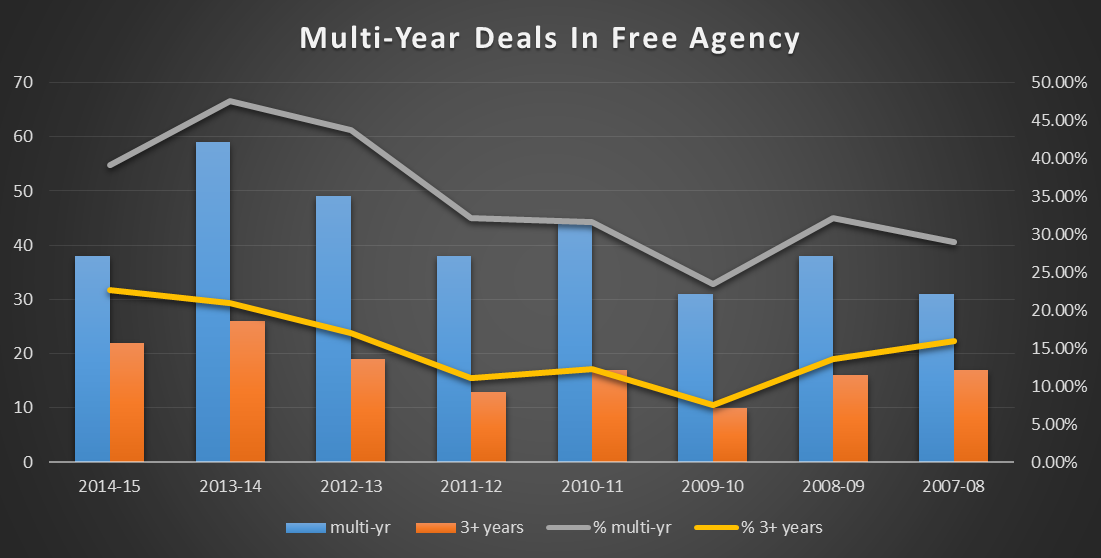
There are several elements at play here. As I already discussed in my previous post, there were simply less MLB contracts given out this year, which does influence the absolute numbers. Nevertheless, less of those deals were of the multi-year variety. In particular, two-year deals fell rather dramatically. On the other hand, as the below table also demonstrates, the likelihood of a big league contract going for three or more years actually continued to rise (as a percentage of total MLB deals).

Here is the above table in chart form. It is largely impossible to make any definitive statements about the reasons for the step back in multi-year contracts, but it seems most plausible to hypothesize that the differences are due largely to the necessarily different group of free agent players available in each season.
What is most interesting, perhaps, is what the 2014-15 market tells us about how to interpret the 2013-14 market, which seemingly represented a rather substantial increase in all types of spending as the league continued to cash in on television contracts. As I noted then, however, variations in the market — if, say, Robinson Cano and Masahiro Tanaka had not been available, or if the Yankees had not chosen to spend big — could make things look quite a bit different.
That is the case this year as well, but in the inverse: many of the team’s highest-revenue teams (Yankees, Dodgers, Phillies, etc.) largely kept their money on the sidelines; there were no nine-figure foreign players; a previous extension prevented Clayton Kershaw from hitting the market as one of the most valuable free agents in history. And then there’s the fact that next year’s market appears to be loaded, with both top-end talent and depth. This spring has yet to produce a major extension for a 2015-16 free agent; if that class stays largely intact it should be rather interesting to check in this time next year.
Extension Candidate: Tyson Ross
Since arriving from the Athletics organization in a seemingly minor trade following the 2012 season, starting pitcher Tyson Ross has blossomed in San Diego. He followed a strong 2013 with a terrific 2014 campaign in which he posted a 2.81 ERA, 9.0 K/9 and 3.3 BB/9, with his only obvious blemish coming when he missed his last start due to a slight forearm strain. Ross looks like a starting pitcher the Padres can build around, and at least for now, the Padres seem to agree, declining to trade Ross and Andrew Cashner even though new GM A.J. Preller used the trade market to transform much of the rest of the team this winter.
 Ross posted a 1.88 ERA in the pitcher’s haven of PETCO Park and a 3.79 ERA elsewhere in 2014, but he seems like the sort of pitcher who should be able to succeed in any home ballpark. His strikeout and walk totals are strong, and his 56.2 ground ball percentage over the past two seasons is outstanding, ranking third among pitchers who have thrown at least 300 innings in that time. He also has a mid-90s fastball, although he’s relied on that less in recent years, turning instead to a sinker and a ridiculous slider that help generate all those ground balls. If anything, his exceptional ground ball abilities are somewhat wasted in the dead air of PETCO Park.
The Padres control Ross’ rights through the 2017 season, and already the Wasserman Media Group client has established a fairly high salary baseline as a Super Two player. Ross and the Padres settled for $5.25MM this winter for 2015, his second year of arbitration eligibility. That could put him on pace to make about $25MM from 2015 through 2017, depending on how he performs in the next two seasons.
There haven’t been many recent extensions for pitchers with arbitration situations similar to Ross’. Perhaps the one that comes closest is that of Gio Gonzalez, who signed a five-year, $42MM deal with a team option and a player/vesting option three years ago. At the time of that deal, Gonzalez, also a Super Two player, was heading into his first season of arbitration eligibility, with MLBTR projecting a $4.2MM salary for that year. Ross is one year closer to free agency than Gonzalez was, and salaries have escalated throughout the game since then, so the Padres would likely have to pay more heavily than the Nationals. But a deal for Ross in the $55MM-$60MM range with a structure similar to the Gonzalez contract would seem fair. The end result might look something like Matt Harrison‘s current five-year, $55MM deal with the Rangers, which includes one club option.
If Ross has interest in a long-term contract, the circumstances would seem favorable for the Padres to sign him. San Diego has a lucrative new TV deal, and the Padres’ new ownership and seems intent on spending. And while the team has a fairly strong rotation now, they might not have one forever. Ian Kennedy is eligible for free agency after the season, and Cashner after 2016. Even with young or relatively young arms like Odrisamer Despaigne, Robbie Erlin, Matt Wisler and Casey Kelly in the system, signing at least one of Kennedy, Cashner or Ross would seem prudent — the pitcher who remains with the Padres long-term could join James Shields as a veteran rotation anchor.
Of course, with Preller, one never knows. It wasn’t he who traded for Ross, and he hasn’t yet shown strong attachments to players he didn’t acquire. (And he already traded Tyson’s brother Joe to the Nationals in the Wil Myers deal.) Preller could have his mind on something else entirely, particularly given the strong group of starting pitchers available on the free-agent market next winter. There are reasons to be somewhat cautious of Ross, too — he pitched about 60 more innings in 2014 than he did the previous year, and he has unusual mechanics and relies heavily on his slider. All those factors could make him an injury risk. But there’s little else to dislike about him, and if the Padres are comfortable with his health, perhaps the two sides can strike a deal at some point.
Photo courtesy of USA Today Sports Images.
MLBTR Originals
A look back at the original reporting and analysis found on MLBTR the last seven days:
- Right-hander Shawn Camp, who first announced his retirement in a statement given to MLBTR, joined host Jeff Todd to discuss his decision and reflect upon his 11-year MLB career on the latest episode of MLB Trade Rumors Podcast. A new edition of MLB Trade Rumors Podcast drops every Thursday and can be accessed on iTunes, SoundCloud, and Stitcher.
- Tim Dierkes examined the 40-man roster players who have less than five years service time and are out of minor league options (compiled through MLBTR’s sources) in the AL East (with an assist from Steve Adams), AL West, and NL West.
- Steve and Mark Polishuk continued MLBTR’s Offseason In Review series with a synopsis of the Indians, Tigers, Royals, Yankees, and Rays.
- Charlie Wilmoth pegged Josh Donaldson as an extension candidate, but opines it will be a tricky negotiation given the third baseman’s age and arbitration status.
- Steve asked MLBTR readers who will sign Hector Olivera. Nearly one-quarter of you believe the Braves are the front-runners with the Padres and Dodgers close behind.
- Jeff asked MLBTR readers to predict the financial terms of a Olivera contract. More than 58% of you see the winning bid being in the $40-50MM range.
- Steve hosted the MLBTR live chat this week.
- Zach Links put together the best of the baseball blogosphere in Baseball Blogs Weigh In.
Offseason In Review: Kansas City Royals
The Royals snapped a 28-year postseason drought with quite a bit of flair, enjoying a dramatic comeback win over the A’s in the AL Wild Card game. The victory kicked off an eight-game win streak that brought them to the World Series, where they fell just shy of the ultimate prize in a seven-game classic with the Giants. They’ll look to return to the playoffs in 2014, but they’ll do so with a fairly different cast of characters following an active winter.
Major League Signings
- Edinson Volquez, SP: Two years, $20MM with a $10MM mutual option ($3MM buyout)
- Kendrys Morales, DH: Two years, $17MM with an $11MM mutual option ($1.5MM buyout)
- Alex Rios, OF: One year, $11MM with a $12.5MM mutual option ($1.5MM buyout)
- Luke Hochevar, RP: Two years, $10MM
- Kris Medlen, SP: Two years, $8.5MM with a $10MM mutual option ($1MM buyout regardless of which side declines)
- Jason Frasor, RP: One year, $1.25MM with a $2MM mutual option ($550K buyout)
- Chris Young, SP/RP: One year, $675K
- Yohan Pino, SP: One year, unknown amount (presumably at or near league minimum)
- Total Spend: $68.425MM
Trades and Claims
- Acquired LHP Brian Flynn and minor league RHP Reid Redman from the Marlins in exchange for RHP Aaron Crow
- Acquired minor league OF Reymond Fuentes from the Padres in exchange for minor league LHP Kyle Bartsch
- Acquired INF Ryan Jackson from Dodgers in exchange for cash considerations (Jackson was eventually outrighted to Triple-A Omaha)
- Acquired minor league RHP Brian Broderick from the Angels in exchange for 2B Johnny Giavotella
Extensions
- Eric Hosmer, 1B: Two years, $13.9MM
- Kelvin Herrera, RP: Two years, $4.15MM
Notable Minor League Signings
- Joe Paterson, Ryan Roberts, Ryan Madson, Alex Liddi, Roman Colon, Brandon Jacobs, Franklin Morales, Casey Kotchman
Notable Losses
- James Shields, Billy Butler, Nori Aoki, Josh Willingham (retired), Brett Hayes
Needs Addressed
The Royals entered the 2014-15 offseason with two key free agents — James Shields and Nori Aoki — and a decision to make on Billy Butler’s $12.5MM option. The decision was made to buy out Butler’s option for $1MM, essentially signaling that the Royals didn’t feel he was worth $11.5MM on a one-year deal. As for Shields and Aoki, both were allowed to test the waters of the free agent market, and both signed in the NL West (San Diego and San Francisco, respectively).
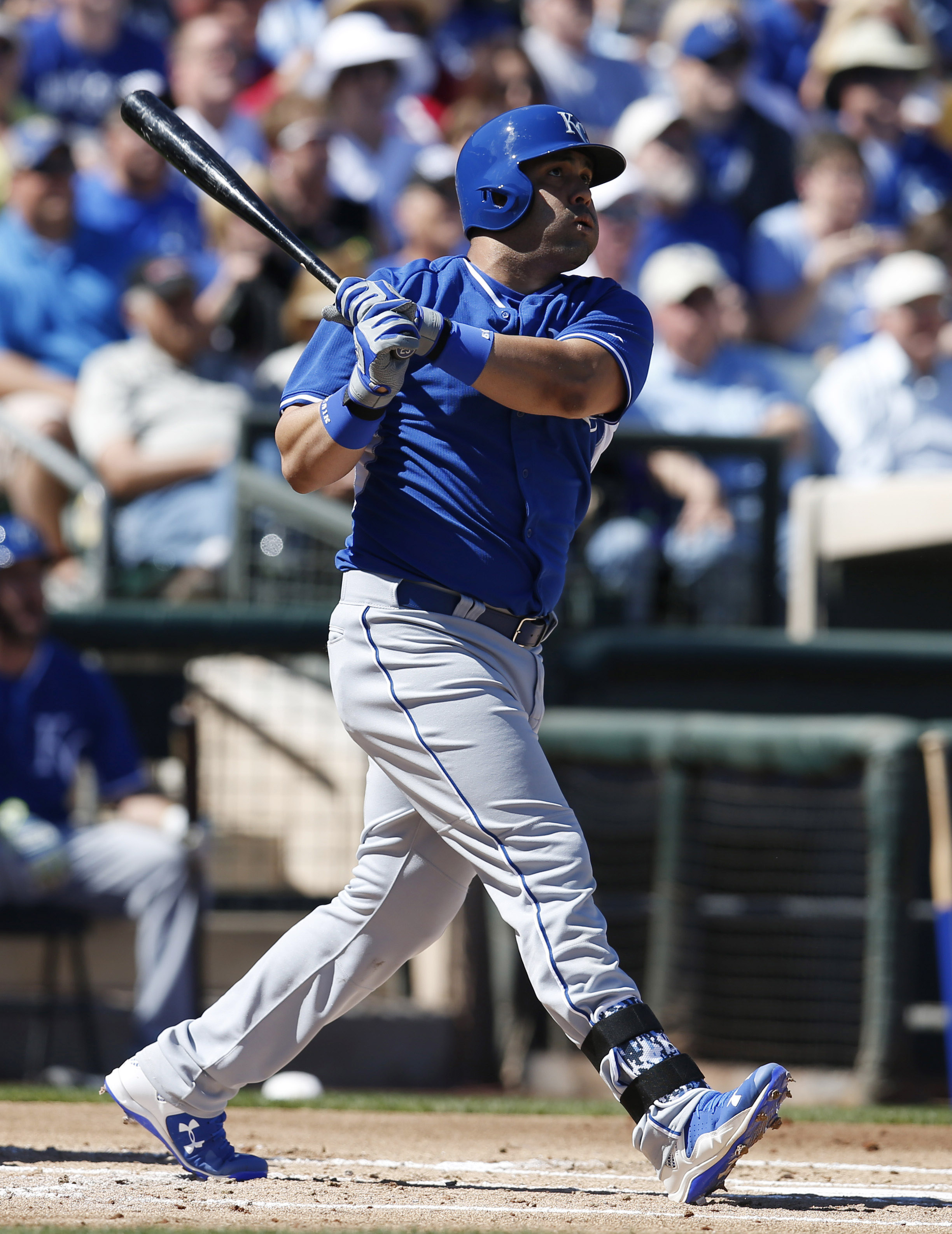 Now with three critical spots to fill — right field, DH and a starting pitcher — the Royals opted to diversify their risk by spreading out their offseason budget over the course of several one- and two-year deals. Mutual options — which are almost never exercised by both parties — were used as an apparent accounting tactic by GM Dayton Moore and his staff, as the team handed out five such options, likely in order to defer some money rather than commit to spending the entire $68MM+ over the next two years. The glut of mutual options comes with $7.55MM worth of buyouts that can obviously be delayed until after the 2016 season, somewhat lessening the immediate financial ramifications of Kansas City’s spending.
Structure wasn’t the only similar thread running throughout Kansas City’s offseason contracts, however. The Royals also employed a similar philosophy with many of these contracts. That is to say, they bought low on a surprising number of players. Kendrys Morales and Alex Rios both performed poorly in 2014, while Kris Medlen and Luke Hochevar didn’t throw so much as a pitch in the Majors due to spring Tommy John surgeries.
A healthy Hochevar would both replace and likely outperform the departed Aaron Crow, if Hochevar is able to pitch anywhere near the level he did in 2013. Jason Frasor’s bullpen spot was filled by none other than Jason Frasor, who re-signed and will again contribute to what should be a very strong relief group.
Volquez was signed to fill Shields’ rotation spot, though not necessarily his production. However, it’s worth noting that both rWAR and RA9-WAR value Volquez and Shields similarly, as both produced excellent bottom-line results in 2014. Clearly, Volquez lacks the track record of Shields, and his peripheral stats are far more concerning. However, while Volquez detractors who point out that much of his success was due to Pittsburgh’s excellent defense and expansive home park may have a point, those same claims can be made about the Royals. It’s not unreasonable, then, to think that Volquez could produce another solid ERA mark, if his newfound control can be repeated.
The addition of Pino on a Major League deal was a surprise, and perhaps the Royals wouldn’t have extended that offer had they known that Young would be available for $675K some four months later, but there’s little financial commitment here, and the pair gives Kansas City some rotation depth and a pair of candidates for long relief in the event of an injury to a starter. Cheap rotation depth is never a bad thing, and in Young’s case, the same caveats that applied to Volquez’s success apply to his own 2014 triumphs; it’s difficult to imagine a decisively better landing spot than Kansas City for a fly-ball pitcher with questionable peripherals.
But, perhaps the best lottery ticket purchased by Moore and his staff this offseason was Medlen, who could be ready to join the rotation (or bullpen) by midseason, which gives the Royals an excellent contingency plan in the event that a starter falls to injury. Moreover, with Jeremy Guthrie set to hit the open market following this season, Medlen will have a rotation spot open for him in 2016, when he is presumably back to full strength. A healthy Medlen is one of the more underrated pitchers in baseball — career 2.95 ERA, 3.23 FIP, 3.39 xFIP in 512 2/3 innings — and Kansas City’s stellar defense and spacious park should offset the transition from the NL to the AL.
The extensions for Hosmer and Herrera didn’t buy out any free agent years, and both will still be arbitration eligible after those deals are finished, but the club did spare itself some negotiation time next winter and attain a degree of cost certainty, which could be significant if Hosmer puts together a big season.
Questions Remaining
For all of the work the Royals did, there are still plenty of question marks surrounding this team. As noted above, the Royals bought low on a number of players, but they did so by paying a higher price than one might typically expect for bounceback candidates. Morales was one of baseball’s worst hitters in 2014, and while his contract could look like a bargain if he returns to his 2013 form, it could also look disastrous — particularly for a payroll-conscious team like Kansas City — if he cannot improve upon last year’s lack of production. (Also of note on the Morales deal, it’s worth pointing out that despite a putrid 2014 season, he will earn about $24.5MM from 2014-16 — a sum that is not wildly lower than the three-year, $30MM which he was criticized for rejecting in July 2013).
Rios was plagued by a thumb injury in 2014 that may have contributed to the disappearance of his power. Jumping to Kauffman Stadium doesn’t figure to boost his power numbers any, though better health may allow him to reach double-digit homers. Even if his bat bounces back, Ultimate Zone Rating gave him a negative mark in right field last year, and Defensive Runs Saved has given him negative marks in both of the past two seasons. Obviously, his defense could rebound, but Rios is also at the age where it wouldn’t be a surprise to see his glove-work begin to deteriorate.
The Royals will also be counting on a rebound from Omar Infante in the second season of his four-year contract, as the 32-year-old’s .252/.295/.337 batting line was his worst since 2005. On the other side of the diamond will be the confounding Mike Moustakas — an elite defender with notable power but feeble numbers versus lefties and a proclivity for infield flies. Moustakas would seem, on the surface, to have the tools of a star-level player, but he’s never hit consistently in the Majors. The same is true, albeit to a lesser extent, with Hosmer, who has shown flashes of the elite hitter he was projected to be but has never sustained that production for a full season. The fate of the 2015 Royals lies largely in the hands of their talented but inconsistent corner infielders.
The bullpen, of course, is among the game’s best, thanks to the late-inning triumvirate of Greg Holland, Wade Davis and Kelvin Herrera. A return to form for Hochevar would only strengthen that group, and bringing Frasor back was a strong low-cost move. However, the Royals will be without their top lefty, as Tim Collins is out for the year following Tommy John surgery. It’s possible that the injury will open a door for Brandon Finnegan, who was a force out of the bullpen in 2014. However, Finnegan, their top pick from last year’s draft, is viewed as a starter long-term, so the role may yet be given to Brian Flynn or a non-roster invitee like Franklin Morales or Joe Paterson.
Looking to the rotation, there’s no question that the loss of Shields will hurt, and Guthrie’s peripheral stats have indicated that a collapse could be imminent for years (though 2014 was his best season in quite some time). Whether or not Yordano Ventura and Danny Duffy can take steps forward will be a critical component for this team.
Deals of Note
For all of the transactions made by Moore and the Royals this winter, the first one they made strikes me as the most curious. Declining Butler’s option seemed understandable from a statistical standpoint, given a two-year offensive decline and lack of defensive value. However, the fact that he signed a three-year, $30MM contract with the A’s seems to suggest that Butler likely would have had some legitimate trade value at one year and $12.5MM.
Oakland’s winning bid indicates that at least one other team had to be willing to pay somewhere in that neighborhood, and his option was valued at just $2.5MM higher than his eventual AAV, but with two fewer years of risk. Perhaps the Royals would only have gotten something of nominal value in return — similar to their own acquisition of Ervin Santana in exchange for Robert Fish two offseasons ago — but it does appear that there may have been an opportunity there.
Overview
As is the case in any offseason, it’s admittedly unfair to look back with the benefit of hindsight, but I can’t help but point out that the Royals spent $11MM on Rios when Aoki signed in San Francisco for a total of $4.7MM on a one-year deal. And, the ~$69MM total spent this offseason is just $6MM shy of the figure for which Shields signed in San Diego.
Clearly, there’s merit to spreading out the risk and shortening its length, as Kansas City did, but the club’s detractors will no doubt wonder if the team would have been better served spending about $80MM to retain Aoki and Shields than rolling the dice on so many uncertainties. While that path may have necessitated taking a minor league flier at the DH position, one could argue that there’s greater upside in taking that type of gamble on Ryan Ludwick or Juan Francisco than in giving Morales $17MM.
But, the risk of the Morales investment is somewhat of a microcosm of the entire Royals offseason. Diversified risk and deferred spending (in the form of backloaded deals and mutual options) characterize this past offseason, and Medlen’s contract in particular was one of the best low-risk signings of the winter in my eyes. If even a couple of the short-term deals issued by the reigning AL Champs pan out, they’ll be well-positioned in what should be a competitive AL Central.
Offseason In Review: New York Yankees
The Yankees rebuilt their infield and bullpen this winter, yet depth could still be an issue given their several veterans with injury histories.
Major League Signings
- Chase Headley, 3B: Four years, $52MM
- Andrew Miller, RP: Four years, $36MM
- Stephen Drew, MI: One year, $5MM
- Chris Capuano, SP/RP: One year, $5MM
- Chris Young, OF: One year, $2.5MM
- Jose De Paula, SP: One year, $510K (split contract)
- Total spend: $100.5MM (not counting the split deal)
Notable Minor League Signings
- Andrew Bailey, Scott Baker ($1.5MM if he makes the MLB roster), Jared Burton ($2MM if he makes the MLB roster), Kyle Davies, Cole Figueroa, Slade Heathcott, Nick Noonan
Trades And Claims
- Acquired SP Nathan Eovaldi, 1B/OF Garrett Jones and SP Domingo German from Marlins for IF Martin Prado, SP/RP David Phelps and $6MM in cash
- Acquired SS Didi Gregorius from Diamondbacks as part of a three-team trade (Tigers received SP Shane Greene from Yankees; Diamondbacks received SP Robbie Ray and MI Domingo Leyba from Tigers)
- Acquired RP David Carpenter and RP Chasen Shreve from Braves for SP Manny Banuelos
- Acquired RP Justin Wilson from Pirates for C Francisco Cervelli
- Acquired RP Johnny Barbato from Padres for RP Shawn Kelley
- Acquired RP Chris Martin from Rockies for cash considerations
Notable Losses
- David Robertson, Hiroki Kuroda, Brandon McCarthy, Ichiro Suzuki, David Huff, Preston Claiborne, Zelous Wheeler, Prado, Phelps, Greene, Cervelli, Kelley, Banuelos, Derek Jeter
Needs Addressed
While there was some question as to whether or not the Yankees would be willing to go to four years to re-sign Chase Headley, the team indeed brought him back on a four-year, $52MM contract to solidify the hot corner. Headley will provide New York with outstanding third base defense, and the team obviously hopes that playing in Yankee Stadium will get his bat back on track — the .262/.371/.398 slash line and 119 OPS+ that Headley posted over 224 PA as a Yankee last season is a good step in that direction.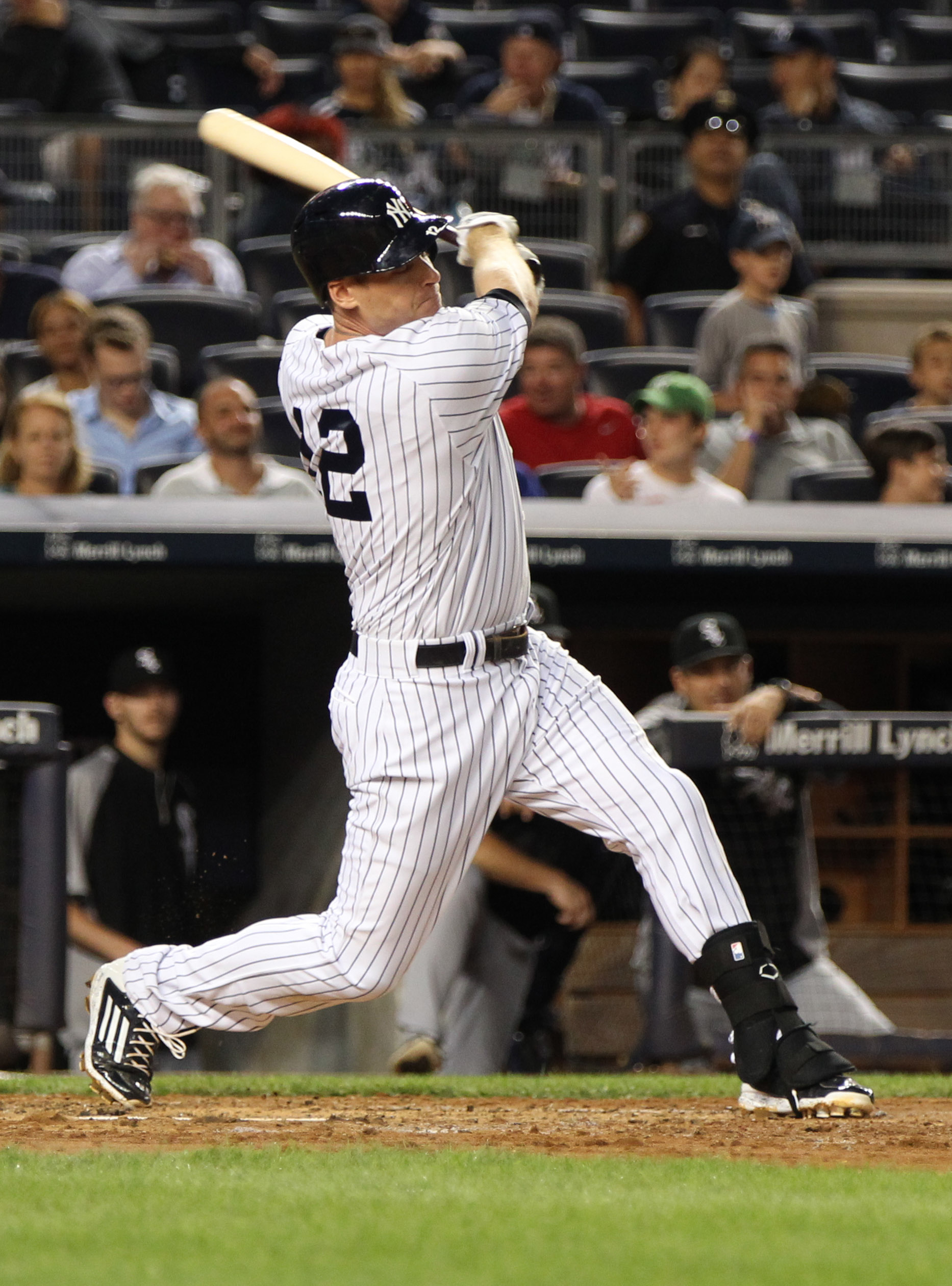
In Didi Gregorius, the Yankees have addressed their hole at shortstop while still giving themselves flexibility for a future move should they feel Gregorius isn’t a long-term solution. Gregorius hasn’t shown all that much either at the plate (career 84 wRC+) or in the field (-3.3 UZR/150 at shortstop) during his brief career, yet it’s important to note that he’s had only 724 MLB plate appearances and he’s entering his age-25 season. He isn’t even arbitration-eligible until next winter, though assuming he accumulates a full year of Major League service time this season, Gregorius will have an extra year of arbitration eligibility due to him as a Super Two player.
Going into the offseason, the consensus was that the Yankees would address their infield by acquiring an everyday second or third baseman, with the versatile Martin Prado then playing the other position. Instead, Prado was shipped out to the Marlins as part of the multi-player deal that brought Garrett Jones and Nathan Eovaldi to the Bronx. Jones has an .811 OPS against right-handed pitching over his career, and with Yankee Stadium’s infamous short right field porch, Jones could provide some nice pop off the bench and also spell Mark Teixeira at first or Carlos Beltran in right field.
Eovaldi injects some youth and, perhaps just as importantly, durability into New York’s rotation, as the 25-year-old righty tossed 199 2/3 innings for Miami last season. Almost any hurler would be challenged by moving from pitcher-friendly Marlins Park to hitter-friendly Yankee Stadium, especially one who doesn’t strike out many batters like Eovaldi (career 6.28 K/9), though he’s working on a splitter to try to miss more bats.
With David Robertson off to the White Sox, the Yankees replaced one ace reliever with another as they signed Andrew Miller. It remains to be seen whether he or Dellin Betances will get the lion’s share of saves (or if they split the job), but however it shakes out, New York owns one of the most imposing one-two bullpen punches in the game. Miller was the most high-profile of several bullpen acquisitions for the Yankees, as they also added right-hander David Carpenter and lefties Chasen Shreve and Justin Wilson in separate deals with the Braves and Pirates. Between Miller, Shreve and Wilson, the Yankees greatly improved their left-handed relief depth, which has been an issue in recent years.
Questions Remaining
Between Masahiro Tanaka‘s slightly torn UCL, Michael Pineda‘s long history of shoulder problems and C.C. Sabathia‘s recent knee injuries, the Yankees are going into the season crossing their fingers for good health from the top of their rotation. Compounding the problem, the re-signed Chris Capuano will start the year on the DL, robbing the club of its favorite for the fifth starter role.
Despite all these durability issues, the Yankees did little to address their rotation’s depth. Eovaldi will essentially serve as a replacement for Shane Greene, who enjoyed a nice breakout year in 2014 but was sent to the Tigers as part of the Gregorius deal. Swingman David Phelps was traded to Miami, and the Yankees didn’t re-sign either Hiroki Kuroda or Brandon McCarthy (though they looked into bringing McCarthy back, albeit only on a two-year deal).
This isn’t to say, however, that GM Brian Cashman hasn’t been actively looking for rotation upgrades. The Yankees have seemingly come the closest of any team to acquiring Cole Hamels from the Phillies, though as CBS Sports’ Jon Heyman subsequently reported, the two sides weren’t actually very close to working out a deal. Since the chance remains that any of all of Tanaka/Pineda/Sabathia could be healthy and productive, the Yankees will likely continue to play the waiting game until a move becomes essential. I would expect the Yankees to eventually aggressively pursue Hamels or any other high-priced aces (especially those who are pending free agents) at midseason in order to fill any clear holes that might emerge in the rotation.
Second base remains an unsettled position for New York, as while Stephen Drew was re-signed on a one-year, $5MM deal, it’s hard to know what to expect from the veteran given his sub-replacement level performance in 2014. Drew’s lengthy free agent stint and lack of a Spring Training could certainly be extenuating circumstances, yet as Drew enters his age-32 season, it’s unclear to what extent he’ll be able to bounce back. Drew may not get a lot of time to prove himself, as prospects Jose Pirela and Rob Refsnyder are waiting in the wings if Drew continues to struggle. Prado’s trade was something of a surprise given that he hit so well for the Yankees last season and his versatility was a boon on a team with so many injury and depth concerns. If Drew or the rookies can’t handle second base and/or Eovaldi struggles, questions will be asked about why Prado had to be moved.
Prado’s departure could be an even bigger issue if Headley struggles. While he did well in his short time in the Bronx, the Yankees have now committed $52MM to a player entering his age-31 season who has battled some recent injuries and been showing signs of decline at the plate. I can’t be too critical of the Headley deal given his solid track record or the lack of other available third base options this offseason, yet his signing doesn’t exactly make third base a worry-free zone for the team.
Like third base, shortstop is also still far from a certainty. Gregorius hasn’t been able to hit left-handed pitching at all, and it’s worth noting that two teams (the D-Backs and Reds) have to some extent already passed on Gregorius as their “shortstop of the future.” If Gregorius doesn’t play well, the Yankees don’t have much depth at short aside from Brendan Ryan, barring a scenario where Drew moves back to shortstop and Pirela or Refsnyder takes over at second.
No discussion of the 2015 Yankees is complete without the obligatory mention of Alex Rodriguez‘s return. Even if Headley falters, it’s hard to see A-Rod getting significant time back at third given that he’s been slated for (at best) a part-time role as a DH and backup first baseman. Between Jones and the several full-time veterans the Yankees can rotate through the DH spot on rest days, the team has already protected itself against the possibility that Rodriguez may not be productive given his age, injury history and long absence from the game.
The Yankees signed 10 of Baseball America’s top 28 international prospects from the 2014-15 signing class, far exceeding their signing bonus limit and resulting in a punishment of not being allowed to sign any international prospect for more than a $300K bonus over each of the next two signing periods. With this looming restriction in mind, it may come back to haunt New York that the club was unable to land two of the higher-profile international prospects of the last few months — Yoan Lopez and Yoan Moncada, who respectively signed with the Diamondbacks and Red Sox. Missing out on Moncada was particularly hurtful for the Yankees, given that they were one of the finalists for the Cuban phenom and that he signed with their Boston arch-rivals.
Deal Of Note
While Miller will likely end up getting some save opportunities this season, he can still boast about landing the largest contract ever given to a reliever without any closing experience. It’s no surprise that the Yankees had to go to four years and $36MM to land the southpaw given that he had perhaps the widest market of any free agent this winter — a reported 23 teams showed some degree of interest in Miller’s services. In fact, the Yankees had only the second-largest deal on the table, as Miller turned down a four-year/$40MM offer from the Astros.
Committing four years to any reliever is a risk, especially since Miller has only been an effective bullpen arm since 2012 (as a lefty specialist) and he’d never posted a BB/9 of less than 4.5 prior to last season. This said, Miller was so dominant in 2014 that if he has turned the corner, he’s as good as any reliever in baseball.
It could be argued that the Yankees didn’t need to spend so much on a big bullpen arm given Betances’ presence, though Betances himself has less than two seasons as a full-time reliever. In a way, Betances and Miller are acting as each other’s security blankets; if one takes a step back this season, the Yankees will still have the other to stabilize the closer’s job.
Overview
After spending over $500MM on free agents in the 2013-14 offseason, this winter was a much quieter one for New York (though spending “only” $100MM on free agents counts as quiet only by Yankees standards). There was speculation that the Yankees would pursue one of the major free agent starters — Max Scherzer, Jon Lester, James Shields — this winter, though nothing much developed on that front.
It’s worth noting that signing Scherzer or Shields would’ve cost the Yankees a first round draft pick, and after their free agent splurge last year, the team didn’t seem keen on again limiting its draft pool. In fact, the Pinstripers are now up an extra pick for the 2015 draft due to the compensatory pick they’ll receive for Robertson signing elsewhere and saw the fourth-largest increase in their draft pool of any team from 2014 to 2015.
In my Yankees Offseason Outlook piece from last October, I predicted the team could be more active on the trade market than in free agency this winter, under the logic that the Yankees could use their financial resources more wisely by acquiring high-priced veterans (i.e. their midseason deals for Prado, McCarthy and Headley last year) from rebuilding teams. In some ways, that proved to be correct since the team filled more holes via trades than they did via free agents, though most of New York’s trade acquisitions weren’t veterans, but rather younger players like Gregorius, Eovaldi, Wilson, Carpenter and Shreve who all carry several years of team control.
As noted earlier about Gregorius, having controllable players gives the Yankees the flexibility to rather easily move on in the case of a downturn in performance. These players could also possibly become trade chips themselves should the Bombers pursue more high-profile upgrades later in the season.
These kinds of moves for young talent are necessary given how much money New York has tied up in expensive veterans. Between Teixeira, Sabathia, Rodriguez, McCann and Beltran, the Yankees will pay $100.125MM in 2015 to five players who combined for 2.7 fWAR in 2014. Various injuries (and, in A-Rod’s case, his suspension) obviously played a role in that low fWAR total, yet it’s almost impossible to imagine that all five will be totally healthy and productive this season. The Yankees are accounting for this to some extent, though even they can only plug so many holes; if Tanaka’s UCL issues worsen, or Pineda’s shoulder acts up, or if injuries strike Headley, Drew, Miller, etc., then the season will start to resemble a war of attrition with the disabled list, much like the team’s 2013-14 campaigns.
The lack of a clear favorite in the AL East certainly gives the Yankees a path to return to the playoffs for the first time since 2012. They’ll just need to rely on a lot of good health, a few breakout performances and a few returns to form from established players to manage it.
Image courtesy of Andy Marlin/USA Today Sports Images
Out Of Options Players: NL West
The following 40-man roster players have less than five years service time and are out of minor league options. That means they must clear waivers before being sent to the minors, so the team would be at risk of losing them in attempting to do so. I’ve included players on multiyear deals. This list was compiled through MLBTR’s sources. Today, we’ll take a look at the NL West.
Diamondbacks: Randall Delgado
Delgado is competing with many pitchers for a spot in the Diamondbacks’ rotation, helping himself with a strong outing Wednesday. Earlier this month, Zach Buchanan of The Arizona Republic took a look at Delgado’s situation. At this point, I would guess Delgado will find his way onto the Opening Day pitching staff, barring a trade.
Rockies: Christian Friedrich, D.J. LeMahieu, Michael McKenry, Tyler Chatwood
Friedrich, the Rockies’ first-round pick in 2008, is now 27 years old. Back in February, Patrick Saunders of the Denver Post suggested the lefty has a good shot at making the team’s bullpen. It is a fairly crowded pen, however, so the situation bears watching.
LeMahieu and McKenry have clear spots on the team, while Chatwood is on the 60-day DL due to July 2014 Tommy John surgery.
Dodgers: A.J. Ellis, Chris Hatcher, Juan Nicasio
Ellis will be in a job share with new catching addition Yasmani Grandal. Hatcher and Nicasio are assured spots in the Dodgers’ bullpen, despite lots of competition for the last few jobs.
Padres: Yonder Alonso, Tim Federowicz, Tyson Ross, Dale Thayer, Alex Torres
Everyone here is assured a spot on the team, though Federowicz will start the season on the DL due to knee surgery.
Giants: Erik Cordier, George Kontos, Jean Machi, Ehire Adrianza, Yusmeiro Petit, Gregor Blanco, Travis Ishikawa
The Giants’ “Core Four” of Jeremy Affeldt, Javier Lopez, Sergio Romo, and Santiago Casilla is locked in for the bullpen. Petit and Ryan Vogelsong are also projected to be in the bullpen, as there’s currently no room in the rotation. That leaves one spot for Machi, Cordier, and Kontos. In addition to those three out-of-options arms, the Giants have the hard-throwing Hunter Strickland in the mix, but Strickland does have options remaining, which could hurt his chances of making the club. Right-hander Juan Gutierrez is in camp as a non-roster invitee as well, and he pitched 63 2/3 innings for San Francisco last year.
Grant Brisbee of McCovey Chronicles assessed this situation earlier this month, noting that a trade and/or injury seems likely. Certainly, teams seeking bullpen depth should be calling the Giants.
Andrew Baggarly of the San Jose Mercury News broke down the Giants’ bench situation earlier this month, explaining that Blanco, Joaquin Arias, and a backup catcher will take three of the five spots. Adrianza and Ishikawa could take the last two, but Juan Perez and Matt Duffy are also in the mix.