
Poll: Will The Indians Trade Corey Kluber?
Entering the winter, it seemed to be a rather bleak trade market for starting pitching. That changed a bit when the Mariners opened up James Paxton for bidding. And we’ve seen some chatter on still-excellent but super-expensive D-Backs veteran Zack Greinke, though the latest indications are he could stay put. Ivan Nova and Tanner Roark have been dealt; Sonny Gray will be; and a few other bounce-back candidates (e.g. Marcus Stroman, Robbie Ray) have at least been talked about in negotiations.
There are some quality names on that list, to be sure. But none come with anywhere near the allure of Indians ace Corey Kluber, who checks more boxes than all but a few starters around the game. He’s extremely effective, with outstanding strikeout ability and elite control (career 9.8 K/9 vs. 1.9 BB/9). He’s a proven workhorse who’s rarely sidelined (five-straight 200-inning seasons). And he’s controllable at a very reasonable rate of pay ($52.5MM over three years, two via option). Though he’s already 32 years of age, that’s really the only flaw in the profile.
In some respects, it’s a total surprise to see Kluber’s name continuously run through the rumor mill. In others, it makes sense. The Indians have other needs to address and have already moved some prospect assets in recent seasons. No doubt they see the remainder of their pitching staff as an ongoing strength. And perhaps there’s also a belief that this is a clear opportunity to cash in on a not-youthful star hurler who comes with all the same risks of any other such pitcher. Indeed, at one point, it seemed nearly a fait accompli that Kluber (or rotation-mate Trevor Bauer) would be dealt this winter. Then, the Indians swung some other trades to shave payroll, perhaps enhancing their leverage with their key pitchers.
All things considered, it is presently unclear whether and how a deal might come together,. Recently, the Dodgers, Brewers, Phillies, Reds, and Padres have been connected to Kluber to varying extents. It’s certainly not hard to imagine other clubs having interest at this stage of the winter. But the Indians surely won’t move Kluber unless they not only achieve commensurate value but also accomplish their roster goals — presumably, boosting the immediate outfield mix, trimming salary, and enhancing the organization’s long-term outlook. The ask will be high, but it surely ought to be. And teams considering Kluber won’t have any open-market alternatives, with Dallas Keuchel representing the best-available free agent hurler.
So, given where the market stands as a whole, do you think the Indians will end up dealing Kluber? (Link for app users.)
Will The Indians Trade Corey Kluber This Winter?
-
Yes 51% (10,081)
-
No 49% (9,693)
Total votes: 19,774
Poll: Assessing The Indians’ Outfield Situation
Early on in the 2018-2019 offseason, I wrote that the outfield was the Indians’ biggest area of need. That was hardly a unique opinion; many around the industry have surmised the same, and it’s fair to wonder whether the Tribe can confidently go toe to toe with some notable AL rivals if their outfield picture as currently constructed doesn’t change.
Since the time of the aforementioned post, the club has watched free agent Michael Brantley sign with the Astros, while fellow outfielder Rajai Davis inked a minor-league pact with the Mets. Cleveland did pad its outfield prospect depth a bit with the acquisition of Daniel Johnson (as a component of the Yan Gomes trade with the Nationals), though he hasn’t played above Double-A and realistically only projects as a fourth outfield type. And while some might consider newcomer Jake Bauers as someone who improves the outlook there, defensive concerns there make it much more likely he’ll fulfill a first base/DH role.
All this is to say that it seems quite likely that the Indians will bring at least one more notable player into the fold. The possibility they’ll stand pat and fill all three roles internally can’t be entirely eliminated, of course, but such an approach would be irresponsible from a club trying to capitalize on a weakening window of contention. A mix-and-match crew of fourth outfielder types won’t help the club make a serious postseason run, after all. The picture is even more bleak when looking beyond the near-term, as the club’s best bet for league-average production, Leonys Martin, is set to depart in free agency next winter.
There are still some notable outfielders available on the free agent market. Keep in mind that any speculation about whether or not the Indians will sign a full-time outfielder must be met with the caveat that the club already went through an arduous effort to trim payroll this offseason, signifying some not-insignificant financial constraints in putting together the roster for 2019. That said, there are some interesting potential fits even in the wake of Andrew McCutchen and Brantley coming off the board.
The top free agent outfielder, Bryce Harper, is light years past being a realistic target for the small-market Indians. Beyond him, the next-best free agent outfielder available is A.J. Pollock. Any realistic pursuit of Pollock would probably involve some additional payroll maneuvering, but the Indians have shown a willingness to pony up, relatively speaking, for talented hitters in recent years (most notably Edwin Encarnacion). If Pollock’s contract ask comes down to four or even three years, he’d be an excellent fit for the Tribe. Marwin Gonzalez is the most talented alternative, and while he’d be paid at least in part for his defensive versatility, his projected contract could be palatable for the Tribe.
Looking at the lower tiers of the free agent market, the Indians could take a chance on the moderate upside of Nick Markakis or Adam Jones. Such a move could provide clubhouse intangibles in addition to a stable fixture at an outfield corner. On the whole, though, it would commit a disproportionate amount of the club’s available finances in order to make a marginal upgrade. Worth mentioning: with some bullpen issues to address, the payroll consequences of the options in free agency shouldn’t be overlooked.
The Indians have a much wider (and more efficient) array of options on the trade market. With excessive rotation depth and some interesting prospects on the farm, the Tribe has the unique ability to appeal to rebuilding clubs and fellow contenders alike. There’s certainly been no shortage of rumors involving the Indians and rival clubs with outfield depth.
The most serious rumblings to date have been centered around Dodgers prospect Alex Verdugo. The price would be a steep one, as the structures discussed would involve the Tribe sending two-time Cy Young Award-Winner Corey Kluber to Los Angeles for Verdugo and (presumably) other pieces. The Indians have also been connected to Reds prospects Nick Senzel and Taylor Trammel, though Cincinnati’s recent acquisition of Alex Wood might reduce their need for rotation pieces at this juncture.
The Phillies and Brewers are the only other teams who’ve been definitively connected to the Indians in trade rumors, though that doesn’t necessarily mean that other talks haven’t taken place. Speculatively speaking, rebuilding clubs like the Rangers (with whom the Indians recently discussed a trade involving Joey Gallo) could be interested in some of the Tribe’s high-ceiling talent in the lower minors.
The recap above being fairly comprehensive, we’ll turn the discussion over to the readers at this point. How do you think the Indians will address their outfield need? (poll link for app users)
How Will The Indians Address Their Outfield Need?
-
They'll trade from their major-league rotation depth 36% (3,525)
-
They'll sign a lower-tier free agent 31% (2,996)
-
They'll make multiple acquisitions by the means listed above 16% (1,572)
-
Nothing more than a MiLB pact or two 9% (891)
-
They'll trade from their prospect depth 5% (510)
-
They'll sign an upper-tier free agent 3% (283)
Total votes: 9,777
Poll: Projecting Gary Sanchez’s 2019
With the New Year approaching, the focus in Yankees Universe continues to be on whether the club will sign Manny Machado, the transcendent, polarizing free agent who’d provide an enormous boost to the left side of its infield. However, regardless of whether Machado heads to the Bronx, it’s fair to say the Yankees won’t reach their peak potential in 2019 without a bounce-back effort from their most polarizing star, catcher Gary Sanchez.
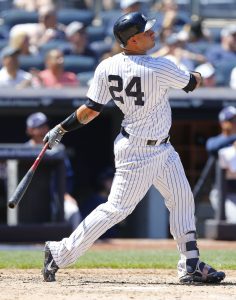
An elite prospect throughout his time in the Yankees’ system, Sanchez burst on the scene in 2016, his abbreviated rookie season. After the Yankees promoted him for full-time duty that August, Sanchez proceeded to swat an astounding 20 home runs in just 229 plate appearances and tie Mike Trout for the majors’ best wRC+ (170). Sanchez came back to earth the next year – his first full campaign – to some degree, though he still left the yard 33 times and registered a 129 wRC+ over 525 PAs.
Based on Sanchez’s output during his initial two seasons, there was little reason to doubt he’d continue serving as one of the Yankees’ cornerstones (and one of the game’s foremost catchers) last year. Instead, Sanchez never really got off the ground during what proved to be an injury-shortened, 89-game campaign, as he slashed a mere .186/.291/.406 (89 wRC+) in 374 PAs. Not only did Sanchez’s newfound offensive struggles frustrate fans, but so did his oft-maligned defense. For the second straight year, Sanchez finished with the American League’s most passed balls (18), which also ranked last in the majors. Unsurprisingly, then, he rated poorly as a blocker at Baseball Prospectus, which graded him second last in that department.
Despite Sanchez’s woes in 2018, general manager Brian Cashman was steadfast in defending the backstop throughout the season, telling anyone who’d listen the Yankees have a franchise catcher on their hands. That hasn’t stopped this offseason, even though trade rumors featuring Sanchez have been plentiful. Earlier this month, Cashman told Jack Curry of the YES Network that Sanchez is “not for sale,” adding that the Yankees expect they’ll be “proven correct” that he’s a foundational piece.
If we’re to take Cashman at his word, it’ll continue to be Sanchez donning the tools of ignorance for the Yankees in 2019 – not a trade possibility like the Marlins’ J.T. Realmuto or the No. 1 free agent available, Yasmani Grandal. Both Realmuto and Grandal outclassed Sanchez last year, but before the latter’s Murphy’s Law 2018, he belonged in the discussion with those two and the game’s other top catchers. It’s understandable Yankees brass has the 26-year-old Sanchez’s back, then, and it becomes easier to see why when considering some of his underlying numbers from last season.
Sure, Sanchez’s overall offensive production was a colossal disappointment, but it still came with some encouraging signs. He continued to flash prodigious power, totaling 18 homers and logging a .220 ISO (well above the league average of .161). Further, compared to his previous two seasons, there weren’t any alarming trends in Sanchez’s strikeout, walk, swinging-strike, chase or contact rates. When Sanchez did put the bat on the ball, he often made it count, as he placed fifth in the majors in average exit velocity on line drives/fly balls (97.7 mph) and 19th in barrels per plate appearance (tying a pretty good duo consisting of teammate Aaron Judge and the Braves’ Ronald Acuna). Sanchez’s ability to make hard contact helped lead to a solid expected weighted on-base average (.343) which easily outdid his real wOBA (.304).
So what went wrong? Poor fortune seems largely to blame, given that Sanchez managed a meager .197 batting average on balls in play – down 111 points from the more normal-looking .308 mark he recorded between 2016-17. Granted, Sanchez didn’t help his cause by hitting far fewer line drives and far more pop-ups than he did in 2017. Sanchez’s 19.2 percent infield fly rate ranked last among qualified hitters, and because a pop-up is essentially an automatic out, that’s going to have to change going forward.
As for Sanchez’s work behind the plate, perhaps it’s unfair to regard his presence as disastrous to the Yankees’ defensive efforts. For one, the cannon-armed Sanchez caught at least 30 percent of would-be base stealers for the third consecutive year. And while blocking pitches has been a problem for Sanchez, Baseball Prospectus has assigned him high framing marks to this point. The outlet did hand Sanchez a negative overall grade in its Fielding Runs Above Average metric last season, though there were still plenty of worse catchers (admittedly, that’s faint praise).
Heading into 2019, Sanchez’s final pre-arbitration season, there’s clearly ample room for improvement both at the plate and behind it. Whether Sanchez will take the field on Opening Day is in question, though, as he’s only about a month and a half removed from left shoulder surgery. Sanchez’s shoulder – which had been an issue since 2017 – may have helped lead to his downfall last year, and if his recovery goes well, there are legitimate reasons to believe he’ll rebound in 2019. The Steamer projection system is on board, as it pegs Sanchez for 3.5 fWAR, a .245/.322/.482 line (116 wRC+) and 31 homers. How do you think he’ll fare?
(poll link for app users)
Which Gary Sanchez Will Show Up In 2019?
-
Something In Between 52% (9,323)
-
The Star-Caliber Version 34% (5,973)
-
The 2018 Version 14% (2,464)
Total votes: 17,760
Photo courtesy of USA Today Sports Images.
MLBTR Poll: Who Won The Dodgers/Reds Trade?
The Los Angeles Dodgers and Cincinnati Reds recently agreed to a seven-player trade that shook up the National League and set the rumor mill afire. In case you missed it, the deal sent the quartet of Yasiel Puig, Matt Kemp, Alex Wood, and Kyle Farmer, plus $7MM cash to the Reds in exchange for Homer Bailey and two prospects: Josiah Gray and Jeter Downs, the Reds’ 13th and 8th ranked prospects, respectively, per Fangraphs. Reactions and analysis have landed on both sides of the ledger, though any subsequent transactions stemming from the payroll and roster changes on either side will give further cause for debate down the line.
The Reds have been vocal about upgrading no matter the cost this winter, especially for pitching, and while the additions were to presumably come via increased spending in free agency, here they explore a more creative means of adding talent. Having seen enough of Homer Bailey over the years, President of Baseball Ops Dick Williams put the $28MM owed Bailey to good use in acquiring three proven major league contributors. Under different circumstances, Williams might be praised for not handcuffing the team with future payroll obligations, but given that this deal feels in part driven by Cincinnati’s inability to attract major free agents, the one-year contracts of Puig, Kemp and Wood only highlights the lack of guaranteed long-term value in the return.
The primary critique here for the Reds is that they surrendered twelve total years of control in Downs and Gray, who slot in as the Dodgers’ new #7 and #16 ranked prospects, per MLB.com. The complete absence of guaranteed future value puts a lot of pressure on the team to capitalize in 2019, a real challenge coming off a 95-loss season. Should Puig, Kemp and Wood walk at the end of the year, they will have surrendered legitimate future talent for a trio that’s not likely to pull them from the depths of the NL Central. Even if the Reds do surprise this season and leapfrog the Pirates, Cardinals, Cubs and Brewers, they still could lose this trio to free agency and be worse off for the future than they were before their acquisition.
On the other hand, attendance has waned at Great American Ballpark. Puig’s power and personality both ought to play well there and give fans something to root for. Further, if for instance, they’ve been unable to get much traction on this year’s crop of lefty free agent starters, then having a one year head start with Wood might be the best way to sign him long-term in Cincinnati. Prospects are high-risk assets, and it could be the Reds don’t believe the future value of Downs and Gray is all that high. Or, they might be banking on getting better prospect value in return at the trade deadline should the Reds fall out of contention early. There’s a lot of speculation above, but the fact is the Reds front office found a way to turn Homey Bailey into two exciting, productive players/trade chips (plus Matt Kemp).
For the Dodgers, they jettisoned 6 fWAR from their 2018 pennant winning team for $28MM in dead money and a pair of prospects. If they don’t turn around and use the cost savings in free agency, that’s a lot of talent to send away just so their billionaire owners can avoid paying the luxury tax. For all Puig’s antics, he brought real fire to the club, and in his six seasons with the team, not only did he accumulate 16.8 fWAR, but they won the NL West in each of those six seasons. As for Wood, one could argue there’s a lot of uncertainty around the lefties remaining in the Dodger rotation: Clayton Kershaw and Hyun-Jin Ryu have not been fully healthy, Rich Hill, 38, is a full decade older than Wood and Julio Urias, 22, may be ready to step into the rotation, but after missing almost all of 2018, he’s far from a sure thing. Wood has his own injury history, but he is a proven asset when healthy, which he has been of late, and he carries a career 3.29 ERA (3.36 FIP, 3.49 xFIP, 3.66 SIERA). As the adage goes, you can never have enough pitching.
On the other hand, the Dodgers added two pretty decent prospects and slipped below the tax line (for now) while dealing from areas of depth. The outfield was log-jammed anyway with Kemp and Puig. Without them, there should be enough at bats to go around for Chris Taylor, Joc Pederson, Enrique Hernandez, Andrew Toles and Cody Bellinger. Plus, top prospect Alex Verdugo, still only 22, may finally have the opportunity to shine at the big league level. As for the rotation, add Walker Buehler and Kenta Maeda to the names above and the Dodgers have enough top-of-the-line starting pitching to enter 2019 even if they decide to pocket the savings from this deal. Kemp and Puig were fun, but they were volatile on-field assets who were going to siphon at bats from the younger, higher upside outfielders (namely, Bellinger and Verdugo) already on the roster.
The elephant in the room, of course, is Bryce Harper. Heads were immediately sent spinning with the possibility of this move being a precursor to the Dodgers signing Harper in free agency, and what’s worse – that makes a lot of sense. They cleared payroll space and positional opportunity, in doing so creating the market/payroll/need fit that previously didn’t seem to exist for Harper. The White Sox and Phillies are ready to spend, but they likely can’t compete with a fully armed Los Angeles payroll. The Cubs are said to be watching, the Nationals haven’t given up on him in theory, and nobody believes the Yankees when they say they aren’t interested, which is, in-and-of-itself, a testament to how classic a suitor they really are.
This blockbuster has the makings of a touchstone moment that will, in part, define this winter’s dealings, but it’s time to see where MLBTR readers land on judging the returns. Does the flexibility this deal affords the Dodgers make them the winners? Or did the Reds take advantage of the Dodgers desire to shed some payroll and walk away with the better return? Let us know your Dodgers grade, your Reds grade, and who you think “won the deal” in this poll.
How Did The Dodgers Do?
-
B 33% (7,872)
-
C 32% (7,542)
-
A 17% (4,107)
-
D 11% (2,692)
-
F 6% (1,463)
Total votes: 23,676
How Did The Reds Do?
-
A 40% (9,491)
-
B 36% (8,665)
-
C 16% (3,777)
-
D 6% (1,326)
-
F 3% (687)
Total votes: 23,946
Who Won The Dodgers/Reds Trade?
-
Reds 45% (11,697)
-
Win-Win 25% (6,378)
-
Dodgers 18% (4,785)
-
Bryce Harper 9% (2,253)
-
Lose-Lose 3% (772)
Total votes: 25,885
MLBTR Poll: Likeliest Landing Spot For Manny Machado
Star infielder Manny Machado is rolling into Philly today after previous stops in Chicago and New York. That’s the extent of his 2018-19 winter tour, so far as is known, but that doesn’t mean there isn’t keen interest. The White Sox seem inclined to make a splash, the Yankees are squared up against some other powerful teams in the AL, and the Phillies face lofty expectations. Plus, there’s ongoing chatter about a mystery team, though there are conflicting reports on that score.
As things stand today, what’s the likeliest landing spot for Machado? (Response order randomized. Link for app users.)
Likeliest Landing Spot For Manny Machado
-
Yankees 43% (15,923)
-
Phillies 28% (10,232)
-
White Sox 15% (5,344)
-
Mystery Team 14% (5,282)
Total votes: 36,781
MLBTR Poll: Andrew McCutchen / Michael Brantley Contracts
As the MLBTR team put together this year’s ranking of the top fifty free agents, it became clear that there were a few bunchings of multiple players in similar market positions. That’s apparent most obviously at the top, where Bryce Harper and Manny Machado are both trying to push the bounds of what a 26-year-old star can earn (albeit at different positions), and in the sub-elite tier of the relief market, where there are a variety of very good pitchers who possess at least one or two obvious limitations on value.
It may be, though, that the tightest race between any two players — at least, in terms of ink spilled in relation to the level of contract we were debating — was between Andrew McCutchen and Michael Brantley. Proof? Tim Dierkes wrote Steve Adams and me an email on October 25th entitled, “Brantley vs Cutch revisited.”
In such situations, at some point, you’re forced to pick between the players — unless you take the easy way out (as I often do in our summer trade ranking list!) by grouping multiple players at one spot. Since Tim is made of sterner stuff than I, he was determined to put one ahead of the other — even if they ended up at the same predicted contract, as ultimately proved to be the case. I thought it’d be interesting to look back at some of our lengthy debate on the topic, and use it as a jumping-off point for a poll now that we’ve seen both players agree to deals.
It was something of an upset that Tim decided to place Brantley first. After all, he led off that aforementioned email with a series of power arguments that’d make Cutch’s agents blush: McCutchen has more power, doesn’t have platoon issues, “is indestructible,” and is a more versatile defender. Pop, offensive balance, durability, flexibility … seemed like a closed case.
Of course, there are counter-arguments in favor of Brantley, and Steve was happy to provide them in exhaustive detail. He summed up the main thrust of his viewpoint thusly: “Even if you look at their last three seasons, the only thing Cutch has on Brantley is volume of games played. Brantley has been a better hitter (same wRC+, but I’ll take the one that comes with a .300 average and half the strikeout rate) and a wildly better baserunner and defender.” With a slight age advantage to boot, there was quite a bit to like about Brantley.
It was a lively debate — and one that I was glad mostly to sit out while making observations that would keep me in the good graces of both of the warring MLBTR factions. Pro-Brantley: “He doesn’t walk. But he has super-elite contact ability that has allowed him to be a steadily outstanding producer of OBP.” Pro-Cutch: “.360+ OBP the past two years and still above-average power (which might play up in a smaller park). Plate discipline is as good as ever. Durability is a very fair point as well. Lack of platoon splits is nice.”
Ultimately, we predicted three-year, $45MM deals for both players. But that’s not how it has turned out. McCutchen secured a surprisingly hefty $50MM guarantee from the Phillies, who’ll bank on him as a steady and reliable (if not literally “indestructible”) asset for at least the next three seasons. That left us feeling optimistic about Brantley’s market, but word emerged this evening that he will not secure a third guaranteed season, reportedly agreeing to a two-year, $32MM-ish deal with the Astros. Though Houston wants to get the bat in the lineup as much as possible, it wasn’t forced to take on extra injury risk with another promised campaign in order to lure Brantley.
All that being said … how do you view the predictions and signings? (Response order randomized; poll link for app users.)
How Would You Characterize The McCutchen & Brantley Outcomes?
-
Phillies overpaid; Astros got good value 64% (12,393)
-
Astros took more risk; Phillies got the better/more reliable player 20% (3,849)
-
Both contracts are fair -- MLBTR just whiffed on its predictions! 17% (3,240)
Total votes: 19,482
Poll: Who Will Be The Next Top-10 Free Agent To Sign?
A year ago on this date, only one of the top ten names on MLBTR’s list of the top 50 free agents of the 2017-18 offseason had decided on their team for the upcoming season. That player, in fact, wasn’t technically even a free agent at all — Masahiro Tanaka decided against opting out of his contract with the Yankees, thus avoiding the open market altogether.
So, at least in comparison to the uniquely slow pace of last year’s offseason, we’ve already seen quite a bit of action on the free agent front this winter. After today’s news of Wilson Ramos‘ deal with the Mets, seven of the top 25 players in this year’s top 50 ranking have already reached agreements, including three members of the top ten — Patrick Corbin (#3) signed with the Nationals, Nathan Eovaldi (#7) re-signed with the Red Sox, and J.A. Happ (#9) has reportedly agreed to rejoin the Yankees.
There have been a lot of rumors swirling around the remaining seven players in our top ten, and it’s anyone guess as to which will be the next to sign. Let’s take a look at where things reportedly stand with each member of this septet….
Bryce Harper: With Harper and agent Scott Boras reportedly looking for nothing less than the biggest contract in baseball history, it would admittedly be surprising to see the former Nationals outfielder come off the board next. Harper, his wife Kayla, and Boras has reportedly held court with multiple teams in private meetings in Las Vegas, though the specific identities of these teams isn’t yet clear. Teams like the Dodgers, White Sox, Phillies, and Cardinals are known to have some level of interest in Harper’s services, while we’ve also heard some teams (like the Nationals and Yankees) seemingly count themselves out of “Harper’s Bazaar,” as Boras calls it. Speculative fits like the Cubs or Giants could also be out due to budget constraints. Boras has a penchant for waiting until deep into the offseason to find a satisfactory contract for his clients, so I’d guess that we won’t know the identity of Harper’s next team before 2018 is over.
Manny Machado: The star infielder is set for in-person meetings with the White Sox, Yankees, Phillies, and at least one more team this week. It’s impossible to mention Machado’s free agency without also mentioning Harper, as the two share many of the same suitors and it seems highly unlikely that one team would be willing to spend big enough to add both to the same roster. Machado’s controversial history of overly-aggressive (or, as some might say, outright dirty) play has been a factor in his market, as was his October interview with The Athletic’s Ken Rosenthal about his admitted lack of maximum effort on some plays, and his admission that “I’m not the type of player that’s going to be ‘Johnny Hustle.’ ” While questions about Machado’s personality are legitimate, especially as he is looking for a record-breaking contract, it’s also possible some teams are using Machado’s interview as leverage to try and lower his price tag. We should know more about Machado’s status once these in-person meetings are complete, and if a team’s concerns about his work ethic are erased after a face-to-face meetings, it isn’t impossible that a signing could come before Christmas.
Dallas Keuchel: Another Boras client, Keuchel might not have quite as long a wait on the market since there has already been something of a run on free agent starting pitching, as Corbin, Eovaldi, Happ, and Charlie Morton have all found new teams. On the trade front, there now seems to be less chance that the Indians could deal Corey Kluber or Trevor Bauer, while the Mets’ flurry of acquisitions have made a Noah Syndergaard trade less likely. Teams that missed out on these frontline arms may now be willing to meet Keuchel’s hefty asking price, and give up the draft pick compensation necessary to sign the lefty since he rejected the Astros’ qualifying offer. Teams like the Reds, Braves, Padres, Blue Jays, Phillies, and Nationals have all been reported to have varying levels of Keuchel’s services.
Craig Kimbrel: Teams would also need to surrender a draft to sign Kimbrel since he turned down a QO from the Red Sox, and might also have to fork over the biggest contract ever given to a relief pitcher. A big initial ask is a common negotiating tactic, of course, though even at a lower amount, Kimbrel and his representatives clearly see him worthy of a deal akin to Aroldis Chapman/Kenley Jansen money. The Cardinals and Phillies have both been linked to Kimbrel, and the Red Sox may or may not still be in on their former closer. The recent signings of Jeurys Familiar and Joe Kelly indicate that the bullpen market is starting to move, though Kimbrel is obviously in a higher financial level than those types of contracts.
Yasmani Grandal: The Angels, Astros, and White Sox have all been linked to Grandal, though Houston might be out of the catching market after signing Robinson Chirinos. Chicago also recently added James McCann, though that isn’t quite as significant an obstacle to a future move for Grandal, should the Sox deal Welington Castillo and then install Grandal as the starter ahead of McCann. Even before Ramos became a Met, Grandal’s biggest competition has likely been J.T. Realmuto, though teams have thus far balked at meeting the Marlins’ large asking price in a trade. The Mets are one team that decided to simply sign a quality catcher rather than trade for Realmuto, and another backstop-needy team could do the same by inking Grandal, though he’s another QO free agent. There has been some indication that the Marlins could decide by Christmas whether to keep or trade Realmuto, so once that decision is made either way, Grandal’s market will gain some clarity.
A.J. Pollock: Here’s another player who turned down a qualifying offer, and another with a pricey contract demand (reportedly in the $80MM range). The Mets, Braves, Reds, and Astros are known to have interest in Pollock, plus with so many trade rumors swirling around other outfielders, more suitors could easily emerge as more outfield spots are created.
Michael Brantley: Machado and Brantley are the only two of these seven players who don’t have QO compensation tied to their services, which gives Brantley in particular a boost as he tests free agency for the first time in his career. Furthermore, Brantley also appears willing to try playing first base, which adds a bit of extra versatility to his repertoire for any interested teams, even if Brantley would still primarily play as an outfielder. What could dampen enthusiasm, however, is Brantley’s initial asking price, reportedly something akin to a $20MM average annual value over three years. We’ve already heard that the Braves aren’t meeting that price, and other Brantley suitors like the Astros, Cardinals, and White Sox are also sure to aim for a lower number.
(poll link for app users)
Which Free Agent Is The Next To Sign?
-
Yasmani Grandal 25% (5,213)
-
Dallas Keuchel 22% (4,595)
-
A.J. Pollock 18% (3,701)
-
Michael Brantley 15% (3,104)
-
Manny Machado 11% (2,326)
-
Craig Kimbrel 5% (985)
-
Bryce Harper 4% (793)
Total votes: 20,717
Trade Candidate Faceoff: Yasiel Puig Vs. Nicholas Castellanos
For at least the past year, a pair of right fielders – the Dodgers’ Yasiel Puig and the Tigers’ Nicholas Castellanos – have been among the majors’ biggest potential trade chips. Neither player has gone anywhere to this point, but it now looks like only a matter of time before both Puig and Castellanos don new uniforms.
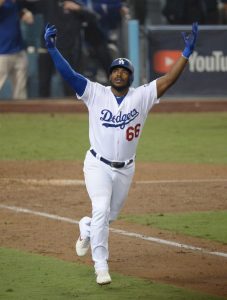
During this week’s Winter Meetings, reports surfaced indicating the Dodgers are “actively” attempting to trade Puig and the Tigers are “determined” to ship out Castellanos. As of now, Puig and Castellanos haven’t been connected to the same teams in the rumor mill, but it stands to reason they’d have similar suitors. Los Angeles may even replace Puig with Castellanos, who would likely offer analogous on-field value and perhaps cause fewer behind-the-scenes headaches.
A native of Cuba, Puig signed with the Dodgers to great fanfare in 2012 and made a dazzling debut the next season, when he was as captivating as he was productive. The early version of Puig – the one who often inspired awe at the plate, in the field and on the bases – was not only a perfect fit for Hollywood, but he was also among the majors’ elite players. From 2013-14, Puig’s first two seasons, only Mike Trout, Miguel Cabrera, Andrew McCutchen and Paul Goldschmidt finished ahead of him in wRC+ (153). Meanwhile, just those four and 10 other position players outdid Puig in fWAR (9.5), despite the fact that he accrued fewer plate appearances than everyone near the top of the leaderboard.
Had Puig continued to produce at anything resembling the blistering pace of his first two seasons, it’s possible the Dodgers may have worked to extend him by now. Instead, the 28-year-old’s numbers nosedived after his second season, and his relationship with the Dodgers has soured along the way. Thanks in part to those factors, Puig’s entering his last year of team control, and it seems like a strong possibility that he has taken his final at-bat with the championship-contending Dodgers.
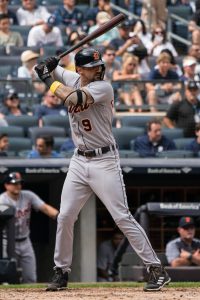
There haven’t been any reports of problems between Castellanos and the Tigers, on the other hand. Nevertheless, as a team in a rebuild, Detroit’s positioned to bid goodbye to Castellanos – whom it chose in the first round of the 2010 draft. Like Puig, the soon-to-be 27-year-old Castellanos is entering his final season of control, and the two players are projected to earn matching $11.3MM salaries in 2019. The similarities continue in the form of their respective outputs dating back to 2016, Castellanos’ breakout season.
Since Castellanos finally began living up to the billing he had as a prospect, he has accumulated 1,790 PAs and 7.0 fWAR on the strength of a .285/.336/.495 batting line – good for a healthy 121 wRC+. During the same period, Puig totaled far fewer PAs (1,382) but still managed 5.8 fWAR, thanks largely to a .264/.334/.470 slash and a 115 wRC+. Puig also swiped 35 bases, easily trumping Castellanos’ seven, and destroyed his fellow trade candidate in the field. From 2016-18, only nine outfielders piled up more Defensive Runs Saved than Puig’s 29. Meanwhile, Castellanos has struggled to find a position – he was a butcher at third base from 2016-17 and also fared poorly in the outfield last season. Consequently, Castellanos’ future may be at first base or designated hitter.
Aside from their dissimilarities in the field and on the bases, the two right-handed hitters have also provided their offensive production in different ways. Castellanos tortured left-handers from 2017-18 – a 308-PA sample in which he slashed .338/.386/.585 (159 wRC+) – whereas Puig was borderline unplayable versus southpaws in the same span. Although Puig was a formidable presence against lefties earlier in his career, they held him to a feeble .197/.292/.320 line and a horrid 66 wRC+ over the previous two seasons and 259 PAs. As a result, the Dodgers limited his playing time when a righty wasn’t on the hill last season, reportedly leading to discontentment from Puig and an open-minded attitude toward a trade.
Both Puig and Castellanos may well have new homes come 2019, potentially joining the top free-agent corner outfielders – Bryce Harper, Michael Brantley and McCutchen – in that regard. McCutchen’s already off the board, and for teams that aren’t in position to ink Harper to a record contract or hand Brantley a lucrative multiyear payday, Puig and Castellanos could represent appealing alternatives. The question is: Which player would you rather have?
(poll link for app users)
Which trade candidate do you prefer?
-
Nicholas Castellanos 59% (7,492)
-
Yasiel Puig 41% (5,282)
Total votes: 12,774
Photos courtesy of USA Today Sports Images.
MLBTR Poll: How Much Will Dallas Keuchel Earn In Free Agency?
The starting pitching market is off to a rather solid start, even if the movement hasn’t exactly been fast and furious. Patrick Corbin and Nathan Eovaldi topped MLBTR’s predicted contract values, J.A. Happ and Charlie Morton appear to be landing in range of their own anticipated prices, and Lance Lynn scored a surprising three-year pact.
We’ve seen former Astros lefty linked to a variety of teams, but his market has not been as hot as those of some other hurlers. Multiple reports have the Reds and Phillies in the mix. The Blue Jays are involved, though it’s fair to wonder to what extent. The Braves have been connected, and disconnected. It’s certainly not hard to imagine some other clubs with interest, though we clearly haven’t seen a bidding war develop to this point.
Entering the winter, MLBTR predicted that Keuchel would secure a four-year, $82MM deal, with the bet being that teams would be willing to promise him a significant AAV but not a terribly long term entering his age-31 campaign. Kiley McDaniel of Fangraphs pegged the value just a shade higher than we did, at 4/$84MM .Others were somewhat more bullish, with Fancred’s Jon Heyman and his anonymous expert predicting a five-year pact in the $95MM to $105MM range.
Given how the market has developed to this point, what do you expect? Will Keuchel find himself frozen out of the biggest contracts? Do the early signings set the stage for a big payday? Or, perhaps, is he still on track to land where MLBTR guessed at the start of the offseason? (Response order randomized. Link for app users.)
Estimate Dallas Keuchel's Free Agent Contract
-
Something in the range of the four-year, $82MM MLBTR prediction 42% (5,631)
-
It'll end up being a disappointment, but still a big ($50MM+) contract 33% (4,441)
-
He'll get to five years and perhaps even reach $100MM 15% (1,925)
-
Keuchel is headed for a pillow contract or weak multi-year deal 10% (1,263)
Total votes: 13,260
Poll: Grading The Goldschmidt Trade
First baseman Paul Goldschmidt, he of the career .297/.398/.532 line, was one of the most coveted assets on the offseason trade market. After a bitterly disappointing end to the Diamondbacks season, in which the club won just eight out of their final 28 games after staking a claim to top of the division on August 30th, a full-scale shuffling of parts was sure to be in order. The club was almost certainly set to lose ace Patrick Corbin, who this week signed a monster $140MM deal with Washington, plus center-field stalwart A.J. Pollock, who, despite several injury-marred campaigns, posted a robust 14.9 fWAR in his final five seasons with the team. And flimsy depth on the 25-man roster and in the upper minors paired with a system devoid of high-impact talent to offer a mostly inauspicious outlook in seasons to come.
Was it finally to time to cash in on the organization’s most valued trade chip? The answer, in the end, was a resounding “yes”: On Wednesday, the organization finally agreed to a package with the 31-year-old’s most oft-rumored suitor, the St. Louis Cardinals. 25-year-old right-hander Luke Weaver and catcher Carson Kelly, 24, are the two most notable pieces going back to Arizona in the deal; Andy Young, a 24-year-old minor league infielder, and a Competitive Balance Round B pick are also part of the return for the D’Backs.
Goldschmidt, of course, is entering the final year of a contract that will pay him just $14.5MM in 2019. His presence figures to move defensive yo-yo Matt Carpenter back to his original home at third base, where the 33-year-old has, encouragingly, graded out as mostly above average with the glove in limited time over the last two years after a series of dreadful campaigns in the middle portion of the decade.
Infielder Jedd Gyorko and 1B/COF Jose Martinez, then, would seem to be left bench-ridden, and could be prime trade chips in the weeks to come. Speculatively, major bullpen upgrades could be in order — as a whole, the unit posted an abysmal 4.50 xFIP and 4.34 BB/9 last season, both of which ranked in the bottom five across the league. Though the departing package was significant, the Redbirds are left with a most prominent feather in their collective cap: with nine big-league-tested starting pitchers in the fold for next season, and a super surplus at catcher — the immortal Yadier Molina, plus top prospect Andrew Knizner — the Cards figure to lose very little in present-day value.
For the Diamondbacks, the return may have eclipsed even their wildest hopes, with one executive reportedly dubbing the package a “boatload.” Weaver and Kelly come with a combined 11 seasons of team control, and each should project around league average in the upcoming campaign. Kelly, a former top 50 prospect, seems especially intriguing — with the offensive baseline at catcher approaching its all-time nadir (catchers slashed a putrid .232/.304/.372 as a whole last season, for an 84 wRC+), the 24-year-old needs only to supplement his sterling defense with marginal offensive production to become an above-average big leaguer.
So, how would you grade this deal for each club?
Grade the Paul Goldschmidt acquisition for the Cardinals
-
A 68% (15,642)
-
B 23% (5,342)
-
C 6% (1,278)
-
F 2% (359)
-
D 1% (268)
Total votes: 22,889
Grade the Goldschmidt trade for the Diamondbacks
-
B 34% (7,283)
-
C 31% (6,621)
-
A 18% (3,814)
-
D 11% (2,345)
-
F 6% (1,248)
Total votes: 21,311