
Nationals Agree To Multi-Year Extension With Mike Rizzo
The Nationals announced this morning that they’ve agreed to terms on a multi-year contract extension with president of baseball operations and GM Mike Rizzo. The sides were reported as close to an agreement when manager Dave Martinez extended with the club on a two-year deal with a club option for 2026 late last month.
Rizzo, 62, has been part of the Nationals organization since 2006. He’s been at the helm of Washington’s baseball operations since 2009, and now figures to continue in that role for the foreseeable future, though the exact length of the deal has not yet been reported. Rizzo guided the club through eight consecutive winning seasons from 2012-2019, a stretch that including five postseason appearances with a World Series championship in 2019.
Recent years have been far less kind to Washington, however, as the club has finished in last place in the NL East in three consecutive seasons and is currently trending toward a fourth in 2023 with a 65-80 record. The downturn in production was thanks not only to the departure of key players like Bryce Harper prior to the 2019 season and Anthony Rendon the following winter, but also a pair of ill-fated big money contracts; both left-hander Patrick Corbin and homegrown ace Stephen Strasburg haven’t panned out since the club’s championship in 2019, with Strasburg throwing just 31 1/3 big league innings since and Corbin posting a brutal 5.61 ERA in 102 starts over the past four seasons.
With the team’s performance declining and over $300MM owed to Corbin and Strasburg in the coming years, Rizzo made the decision to kickstart the club’s current rebuild back in 2021. In doing so, he dealt not only short term rental pieces like Kyle Schwarber and Jon Lester but also franchise cornerstones Max Scherzer and Trea Turner. A year following that 2021 sell-off, Rizzo pulled the trigger on a trade of young superstar Juan Soto, shipping him to the Padres for a package of prospects and young players.
Difficult as the past few seasons have been for Nationals fans, the future is bright for an organization now brimming with young talent. MacKenzie Gore, CJ Abrams, James Wood, Robert Hassell, Keibert Ruiz, Lane Thomas, and Josiah Gray were all added to the organization at the trade deadline in recent seasons, while the draft has produced top talents like Dylan Crews and Brady House. Today’s extension announcement is not only a vote of confidence from ownership in Rizzo’s leadership, but an opportunity for Rizzo to personally see the fruits of the recent rebuild begin to manifest in the coming years.
Mets Reach Agreement To Hire David Stearns As President Of Baseball Operations
What’s long seemed like an inevitable pairing has come to fruition, as the Mets have reached an agreement with David Stearns to oversee their baseball operations department, SNY’s Andy Martino reports. Stearns, who was the president of baseball operations with the Brewers before stepping down and taking on an advisory role following the 2022 season, will hold that same president of baseball operations title with his hometown Mets. He’ll officially start in his new role at the end of the regular season. He will be signing a five-year contract, reports Bob Nightengale of USA Today. Martino adds that Billy Eppler will stay on in his general manager position.
 Stearns, now 38, has long been speculatively connected to the Mets based on his roots. Born and raised in Manhattan, he worked for the Mets earlier in his career, though his baseball journey would take him to many other places before winding back to New York. After graduating from Harvard, he interned with the Pirates, then worked for the Mets before bouncing to Major League Baseball and then Cleveland.
In November of 2012, he was given the title of assistant general manager of the Astros, working under general manager Jeff Luhnow. That club was deeply committed to a rebuild at the time, as that year was their second of three consecutive 100-loss seasons. They would eventually emerge from that period of futility in 2015 by going 86-76, starting a run of excellence that continues to this day, having made the playoffs in every full season from that year to the present.
But for most of that success, Stearns was in Milwaukee, having been hired away by the Brewers in September of 2015. That club made him general manager and hoped to follow a similar trajectory to the Astros. The Brewers had been hovering around .500 for a few years but dipped to 68-94 the year Stearns came aboard. The next three years saw the win total increase to 73 and then 86 and then 96, as the club won the National League Central in 2018, their first of four consecutive trips to the postseason.
As the Brewers flourished under Stearns, rumors about bringing him back to New York naturally followed. As far back of November of 2020, when the Mets were looking to replace general manager Brodie Van Wagenen, Stearns was connected to the job. But the Brewers had already signed him to an extension and promoted him to president of baseball operations. Standard practice in baseball usually sees teams allow their front office employees to pursue promotions but not lateral moves. Since Stearns already had the top job in Milwaukee, the Brewers denied the Mets the opportunity to speak with him.
As Stearns stayed in Milwaukee, the front office search for the Mets didn’t yield a permanent solution. Jared Porter was hired in December of 2020 but fired just a few weeks later when it was revealed that he harassed a female reporter in 2016. Zack Scott was then named acting general manager but was charged with driving while intoxicated in September of 2021. He would eventually be acquitted of those charges but the club had already moved on and hired Eppler as general manager in November of that year.
The results of late have been mixed, to say the least. Owner Steven Cohen has signed off on unprecedented spending levels, with the club signing many marquee free agents in recent years. That resulted in 101 wins last year, the second-best record in franchise history. But the club was quickly eliminated from the playoffs and didn’t carry their success into 2023. Various injuries, particularly to the starting rotation, quickly pushed the club out of contention and they went into the recent trade deadline as sellers instead of buyers. They are currently 65-78, just half a game ahead of the last place Nationals in the East division.
As the Mets have been going through those highs and lows over the past few years, they would continue to be connected to Stearns in rumors but his position in Milwaukee continued to be an obstacle, with his deal running through the 2023 season. Stearns stepped down as president of baseball operations last October, though he stayed with Milwaukee in an advisory capacity for the final year of his contract. At the time, he said he was “looking forward to taking a deep breath, spending time with my family and exploring some other interests.”
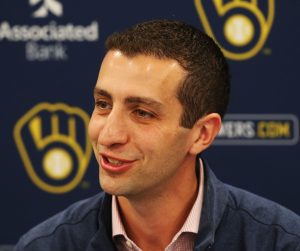 This led to immediate speculation that Stearns was setting the table for a move out of Milwaukee. The Astros parted ways with general manager James Click at the end of last season and owner Jim Crane was reportedly interested in bringing Stearns back to Houston. That job ultimately went to Dana Brown and Stearns stayed in Milwaukee with diminished responsibilities. It was then reported a week ago that Stearns had been reinvigorated by his smaller role and was contractually able to pursue other opportunities after August 1. He had already spoken with the Mets and Astros and now, at long last, he and the Mets are officially reuniting. As mentioned, he’ll take on the president title with Eppler beneath him as the general manager.
The Mets will be hoping that this is the perfect marriage to set off a proper dynasty in Queens. Since taking over the club at the end of 2020, Cohen has cited the Dodgers as a model franchise that he wanted the Mets to emulate. The Dodgers hired Andrew Friedman away from the Rays in October of 2014, allowing him to implement the creative, data-driven and analytical approach he deployed in Tampa but with more resources for signing or retaining star players. That club has continually produced significant players from its own system and indeed spent at the top of the market to great success. They last finished under .500 in 2010 and haven’t missed the playoffs since 2012.
Stearns already has a strong track record from his time in Milwaukee, even without massive financial resources. Per Cot’s Baseball Contracts, Milwaukee’s payroll was never in the top half of the league during the Stearns tenure, topping out at 17th place in 2019. Their success has been built on homegrown players like Corbin Burnes, Brandon Woodruff and Devin Williams, as well as trading for players like Christian Yelich, Willy Adames and many more. The Mets, on the other hand, ran up the highest payroll in baseball history this year.
Time will tell what kind of timeline the club has in mind for its next steps. After being traded to the Rangers, Max Scherzer said he was told that the Mets would be taking something of a step back in 2024, focusing a bit more on the future and being a bit less aggressive in pursuit of short-term competitiveness. Eppler and Cohen responded and more or less confirmed that would be the case. Perhaps Stearns will take a year to get to know the club’s inner workings, keeping the moves modest until he gathers the necessary information to guide the club into the future.
The short-term trajectory will be revealed as the summer turns to fall and then to winter. But the long-term goal seems clear, as both Cohen and Eppler have long stressed the importance of building a strong farm system to supplement the club’s financial might. The Mets and their fans will be hoping that the combination of Stearns leading the baseball decisions and Cohen writing the checks will lead to a similar run of success as the Dodgers have enjoyed.
Images courtesy of USA Today Sports.
Royals’ Austin Cox, Freddy Fermin Require Surgeries
Royals left-hander Austin Cox has been diagnosed with a full ACL tear and partial MCL injury in his left knee, tweets Anne Rogers of MLB.com. While he’s going for a second opinion, the expectation is that he’ll require surgery.
Cox was injured last week in Toronto. Scrambling to cover first base on a grounder that had deflected to the right side of the infield, he twisted his knee when he lunged to try to find the base. The Royals immediately placed him on the 60-day injured list. While the club initially termed the injury as a knee sprain, the ACL tear is a more unfortunate diagnosis.
It’ll surely keep him out well into next season, potentially costing him more than half the year. The Royals could keep Cox on the 60-day IL during the season, but they’d have to carry him on the 40-man roster throughout the winter. It doesn’t seem out of the question they’ll non-tender the former fifth-round draftee to clear an offseason roster spot.
A Mercer product, Cox logged 35 2/3 big league innings as a rookie. He posted a 4.54 ERA, striking out a respectable 22.1% of batters faced but walking opponents at a lofty 11.4% clip. He had similar strikeout and walk marks in 47 1/3 innings at Triple-A Omaha, where he worked to a 3.61 ERA.
In other Royals news, backup catcher Freddy Fermin underwent surgery to address a fractured right middle finger, according to Rogers. He’s done for the season but is expected to be ready for Spring Training. Fermin solidified his spot on the roster with a solid showing in a part-time role. The 28-year-old backstop hit .281/.321/.461 across 235 plate appearances. He should go into 2024 with a hold on the #2 catching job behind Salvador Perez as a result.
Giants Release Luis Gonzalez
The Giants are releasing outfielder Luis González, tweets Robert Murray of FanSided. He’ll head directly to free agency. González had already been outrighted off the 40-man roster after clearing waivers last month.
The lefty-swinging outfielder hasn’t appeared in the majors this season. González began the year on the injured list after undergoing back surgery in Spring Training. He was sidelined into August and immediately optioned to Triple-A upon his return. A week thereafter, the Giants designated him for assignment.
González, who turned 28 over the weekend, hasn’t found much of a rhythm in Triple-A. He’d hit .255/.355/.362 over 110 plate appearances for San Francisco’s top affiliate. While that’s a respectable line on the surface, it’s well below-average by measure of wRC+ in the context of a hitter-friendly Pacific Coast League. His 11.8% walk rate and 18.2% strikeout percentage were each strong, but González has connected on only one home run.
San Francisco evidently decided they wouldn’t call him back to the majors this season. He would’ve qualified for minor league free agency at year’s end. The Giants will cut him loose a few weeks early.
While González is likely to be limited to minor league offers, he’ll surely find interest as a depth option going into 2024. The former third-round pick looked the part of a solid rotational outfield piece a year ago. He got into 98 games and picked up 350 plate appearances for the Giants in 2022, hitting .254/.322/.360 with decent strikeout and walk numbers. He didn’t hit for much power, but he swiped 10 bases in 12 attempts.
Previewing The 2023-24 Free Agent Class: Second Base
With the regular season winding down, a number of teams (and their fanbases) are already starting to turn their attention towards the offseason. Identifying free agent targets is a big part of that prep work, so it’s worth taking an early look at the players who’ll be available on the open market.
We’ve already covered the catchers and first basemen. Today, we move to the keystone. It’s a weak infield class in general and that’s reflected in the second base group. There are players at other positions who could ostensibly move to second base. Virtually every shortstop is capable of playing the less demanding middle infield spot, for instance. Those players will be covered in future positional previous, though, so we’ll limit this list to players who have logged some action at second base this season.
Note: only players who have been on an MLB roster in 2023 are included. Ages listed are for the 2024 season.
Potential Everyday Options
- Amed Rosario (28)
Rosario has been a shortstop for the bulk of his career, but the Dodgers have played him more frequently at second base since adding him at the deadline. One of the youngest players in the entire free agent class, Rosario hits the market coming off a down year. He was a roughly league average hitter from 2021-22 but has slumped to a .261/.302/.377 line over 516 plate appearances. He’s hitting for more power in Los Angeles than he had in Cleveland — largely because the Dodgers have more selectively deployed him in favorable platoon situations — but has reached base at just a .288 clip with L.A.
The righty-swinging Rosario has performed well against left-handed pitching throughout his career. He’s a well below-average offensive player versus righties. Some teams may prefer to keep him in more of a short side platoon role, but the middle infield class is weak enough that he figures to land an everyday job somewhere. Public metrics pegged Rosario as one of the sport’s worst defensive shortstops; he has rated more favorably at second base, though it’s tough to put much stock in a 153-inning sample.
- Whit Merrifield (35)
Merrifield’s contract contains an $18MM mutual option with a $500K buyout. The Jays are very likely to decline their end, sending the veteran back to free agency. A three-time All-Star and two-time hits leader, Merrifield is one of the game’s better contact hitters. While he’s no longer performing at peak level, he owns a solid .281/.324/.396 slash with 11 homers through 549 plate appearances. He has kept his strikeouts to a modest 16.6% clip. He’s a fine defender at second base and can play the corner outfield.
The league has increasingly devalued the hit-first second base profile to which Merrifield belongs, however. Players like Jean Segura (over two years) and Adam Frazier (one year) received annual salaries in the $8MM – 8.5MM range last offseason. Merrifield’s platform year is more in line with Segura’s than Frazier’s, so he has a decent case for a two-year pact despite his age.
- Adam Frazier (32)
Speaking of Frazier, he has rebounded somewhat from his down 2022 campaign. After hitting .238/.301/.311 a season ago, he owns a .248/.304/.415 slash through 409 plate appearances with the Orioles this year. His 13 home runs are a career high, and while he has added a moderate amount of swing-and-miss as a tradeoff, he’s still keeping his strikeouts to a tidy 13.4% clip.
Yet Frazier’s overall production has hovered around replacement level this year, largely thanks to a sharp drop in his defensive metrics. While Defensive Runs Saved and Statcast had each rated him as an average or slightly above-average second baseman for the majority of his career, they’ve soured on his work in 2023. Statcast metrics indicate that Frazier has particularly struggled on balls hit up the middle, perhaps related to a drop in his throwing velocities from the keystone. Whether teams feel that’s a blip or a more worrisome indication of dwindling athleticism as he gets into his 30s could determine whether he matches last winter’s $8MM deal.
Multi-Positional Types
- Elvis Andrus (35)
Andrus has gotten into 98 games for the White Sox this season. It hasn’t gone all that well, as he’s hitting .251/.311/.353 with five longballs across 355 plate appearances. That’s more in line with the numbers he posted from 2018-21, making last year’s 17-homer showing look like a blip. Andrus is still a good baserunner and can play either middle infield spot, but he’s better suited for a utility role than regular playing time at this stage of his career.
- Enrique Hernández (32)
Hernández had a brutal start to the season, struggling to adjust to the Red Sox pushing him into regular shortstop run. He is better suited for the utility role he’s played throughout his career, logging most of his action at second base or in center field. The right-handed hitter was amidst a second straight well below-average offensive season when Boston traded him to the Dodgers a couple weeks before the deadline. He has turned things around in Southern California, hitting .266/.331/.435 in 139 plate appearances since the swap. The Dodgers acquired Hernández in hopes of bolstering their production against left-handed pitching, but he’s been far better against righties than lefties in that minuscule post-trade sample.
- Tony Kemp (32)
Kemp is a contact-hitting second baseman who can also play left field. He was a solid regular for the A’s from 2021-22 before a down ’23 campaign. He’s hitting just .214/.309/.307 across 389 trips to the dish this season. That’s in large part a reflection of an unsustainably poor .227 average on balls in play. Kemp has excellent plate discipline and bat-to-ball skills; he’s one of just four players (Luis Arraez, Ronald Acuña Jr. and José Ramírez being the others) with 300+ plate appearances and more walks than strikeouts. It seems likely he’ll find a guaranteed big league opportunity as a result.
- Donovan Solano (36)
After barely playing in the majors between 2015-18, Solano has surprisingly put together a five-year run as an above-average hitter late in his career. He has continued on that trajectory for the Twins this season, putting up a .290/.376/.409 line over 402 trips to the plate. Solano is a bat-first utility option who can play either corner infield spot or second base. Even at age 36, he continues to produce and should earn himself a raise on this year’s $2MM salary.
Utility/Depth Players
- Hanser Alberto (31)
Alberto got into 30 games for the White Sox, hitting .220/.261/.390 in 90 trips to the plate. The right-handed hitter hasn’t caught on since being released by Chicago in early June.
- Isan Díaz (28)
A one-time top prospect, Díaz is a .177/.267/.274 hitter at the big league level. He has spent the majority of the last two seasons in Triple-A, appearing in eight MLB games this year between the Giants and Tigers. Detroit released him a few weeks ago.
- Matt Duffy (33)
Duffy cracked the Royals’ roster out of camp after signing a minor league deal. The well-traveled infielder has spent the entire season on the big league club. He’s hitting .254/.309/.312 over 188 trips to the plate, picking up scattered starts at each of first, second and third base.
- Eduardo Escobar (35)
Escobar has mostly split his playing time between third and second base. The switch-hitting veteran is wrapping up the second season of a two-year free agent pact that didn’t turn out as the Mets had envisioned. Escobar was surpassed on the depth chart by Brett Baty early in the season. The Mets dealt him to the Angels at a time when the Halos were still pushing to compete and decimated by infield injuries. The trade hasn’t worked out, as Escobar is hitting .229/.268/.333 with a 28.1% strikeout rate over 47 games in Orange County.
- Josh Harrison (36)
Harrison posted a .204/.263/.291 batting line over 41 games with the Phillies this year. Released shortly after the trade deadline, he spent some time in the Rangers’ system but didn’t crack the Texas roster. Harrison opted out of his deal with Texas in late August and has been unsigned since then.
- Rougned Odor (30)
After an early-career run as the Rangers’ starting second baseman, Odor has played for four clubs since 2020. He’s been a below-average hitter at every stop, showing some power but running consistently low on-base marks. Odor got into 59 games for the Padres this year, putting up a .203/.299/.355 slash before being released in July. He hasn’t signed elsewhere.
- Jonathan Schoop (32)
A former All-Star, Schoop has hit .204/.248/.311 going back to the start of 2022. While he played Gold Glove caliber defense for the Tigers a season ago, the complete lack of offensive production led Detroit to release him around the All-Star Break. The 11-year MLB veteran hasn’t signed anywhere since, though he is yet to turn 32 and could still find minor league interest if he wants to give it another go.
- Kolten Wong (33)
Wong had a brutal few months as a Mariner, hitting .165/.241/.227 over 67 games. Seattle released their offseason trade pickup at the beginning of August. He’s playing out the stretch with the Dodgers, getting selected to the MLB roster as part of September expansion after initially inking a minor league deal. Wong’s defensive marks have fallen from his Gold Glove peak and he has been one of the least effective hitters in the majors this year. Yet he was an above-average offensive performer just a season ago, when he hit .251/.339/.430 over 497 plate appearances for Milwaukee.
Player Options
- Justin Turner (39)
Turner is a near-lock to head back to free agency. His contract with the Red Sox contains a $13.4MM player option with a hefty $6.7MM buyout. With a buyout worth half the option value, it should be an easy call for the two-time All-Star to head back to free agency. He’d surely beat the $6.7MM difference on his next deal.
Clubs probably won’t view Turner as an everyday second base option going into his age-39 season. He has logged 49 innings there this season, though, showing the ability to moonlight up the middle in addition to his more extensive work at the corner infield spots. The team that signs Turner is doing so for his bat, as the consistent veteran owns a .285/.355/.480 slash with 23 homers over 561 trips to the dish.
Club Options
- Jorge Polanco (30)
It’s unlikely Polanco will get to the open market. The Twins hold a $10.5MM option for next season with a $1MM buyout. The $9.5MM difference is strong value for a quality bat-first middle infielder. The switch-hitting Polanco owns a .260/.341/.461 line on the season. While injuries have kept him to 290 plate appearances, it’s the third straight year in which he’s been a well above-average hitter on a rate basis. Polanco would be the best player in the second base class if he were available. Barring a major injury, he probably won’t be.
* All stats entering play Tuesday
Padres Shut Down Yu Darvish For Season
The Padres are shutting down Yu Darvish for the rest of the season, skipper Bob Melvin told reporters (including Dennis Lin of the Athletic). Testing revealed an olecranon stress reaction in the veteran righty’s throwing elbow.
Darvish has been on the injured list since August 26. The issue was first diagnosed as inflammation. The stress reaction is more serious, though it’s expected that Darvish will be able to rehab the injury without surgery. There’s little reason for the Friars to take chances with any notable player now that their playoff hopes are dashed.
The 37-year-old Darvish is a key rotation member beyond this season. Last winter, San Diego signed him to an extension which tacked on five years and $90MM in new money. It’s a bold investment that runs through the pitcher’s age-41 campaign.
While Darvish was coming off a 3.10 ERA showing last season, he didn’t replicate that production in 2023. He concludes his year with a 4.56 ERA across 24 starts and 136 1/3 innings. His underlying marks didn’t have the same level of decline, however. Darvish’s fastball velocity still sat just under 95 MPH on average. His strikeout rate dropped just one percentage point from 25.6% to 24.6%, while he lost less than one point on his swinging strike percentage. He issued a few more walks and allowed a bit more hard contact, but his profile beyond the ERA doesn’t look all that different from prior seasons.
It’s crucial for the Padres that Darvish perform at a mid-rotation or better level next year. The Friars have plenty of uncertainty in the starting staff. Blake Snell is headed to free agency. Seth Lugo is almost certain to join him by declining a $7.5MM player option. Each of Michael Wacha and Nick Martinez (the latter of whom has again worked almost exclusively in relief anyways) have complex options on their contracts but could potentially hit free agency themselves.
Darvish and Joe Musgrove — who is also on the injured list and might not return this season — are the only pitchers assured of spots in next year’s rotation. The upcoming free agent class is deep in starting pitching, so president of baseball operations A.J. Preller and his staff figure to add two or more arms from the open market.
Injury Notes: Belt, Candelario, Lee, Reid-Foley
The Blue Jays placed Brandon Belt on the 10-day injured list this afternoon. He’s dealing with lumbar spine muscle spasms. Outfielder Nathan Lukes is up from Triple-A Buffalo to take the roster spot.
Toronto didn’t provide a timetable for Belt’s return. There are just under three weeks to go in the regular season and the Jays are on the edge of the playoff race. They go into the second game of this week’s series against the Rangers in possession of the American League’s second Wild Card spot, half a game above Texas and one game better than the Mariners.
Belt has had a strong first season in Toronto. Signed to a $9MM free agent deal, the veteran first baseman is hitting .251/.369/.470 with 16 homers across 382 plate appearances. The Jays have used him a platoon capacity, keeping him to just 31 at-bats versus same-handed pitching. His injury could leave more at-bats for lefty-swinging rookie Spencer Horwitz, who is in the lineup tonight against Max Scherzer.
In other injury news:
- The Cubs plan to place Jeimer Candelario on the 10-day injured list with a back issue, tweets Jesse Rogers of ESPN. Rookie outfielder Alexander Canario will be recalled to take the roster spot. Candelario suffered the injury on Sunday, so the placement will likely be backdated by one day. He’ll first be eligible to return a week from Thursday. Acquired from the Nationals at the deadline, Candelario is hitting .237/.324/.449 in 36 games during his second stint as a Cub. He’d hit well in August before falling into a slump over the past couple weeks.
- The Braves have placed Dylan Lee on the 15-day injured list with shoulder inflammation, the club announced. He had originally been optioned to Triple-A Gwinnett, but that demotion was voided thanks to the injury. Lee will continue to be paid at the MLB rate. Unfortunately, that’ll come at the cost of the rest of his season. Justin Toscano of the Atlanta Journal-Constitution writes that the Braves will shut the southpaw down until 2024. Lee was out from mid-June until the start of September because of shoulder soreness. He returned to make just four appearances before the shoulder sent him back to the IL. His season wraps up with 23 2/3 innings of 4.18 ERA ball. Atlanta has A.J. Minter and Brad Hand as their top left-handed relief duo going into the playoffs.
- Mets reliever Sean Reid-Foley suffered a lat strain, tweets Anthony DiComo of MLB.com. That’ll certainly end his season. New York recalled Reed Garrett to take Reid-Foley’s place on the active roster. It’s a frustrating development for the 28-year-old Reid-Foley, who was limited to eight appearances since the club selected his contract at the end of August. He’d been out since last May working back from a Tommy John procedure. Reid-Foley tossed 7 2/3 innings of three-run ball this year in the majors, striking out 16 while walking six.
Dodgers Select Kyle Hurt
5:48pm: Los Angeles has officially announced Hurt’s promotion. Victor Gonzalez was optioned in a corresponding move. To create space on the 40-man roster, L.A. transferred Varland to the 60-day injured list. His season is over because of a knee issue.
12:43pm: The Dodgers are planning to select the contract of right-hander Kyle Hurt, reports ESPN’s Jeff Passan. He’s started 16 games in the minors this year (plus another nine relief outings) but will work primarily out of the bullpen in Los Angeles.
Hurt, 25, was a fifth-round pick by the Marlins in 2020 who went to Los Angeles alongside lefty Alex Vesia in a trade that sent Dylan Floro from L.A. to Miami. The 6’3″, 240-pound righty posted fairly nondescript numbers in his first two professional seasons but has put himself on the prospect map in 2023 with 88 1/3 innings of 3.87 ERA ball and, more interestingly, a ridiculous 39% strikeout rate between Double-A and Triple-A. As is often the case, that ability to miss bats at an elite level is accompanied by some shaky command (11% walk rate). Still, Hurt’s strikeout rate is the highest among the 613 minor league pitchers with at least 70 innings so far in 2023.
To his credit, Hurt has tamped down that walk rate a bit since moving up the minor league ladder. After walking 11.8% of his opponents in Double-A this year, he’s issued walks at a much tidier 8.6% clip in 23 1/3 Triple-A frames. He’s also seen his ground-ball rate jump from 44.2% in Double-A to 52.1% in Triple-A.
As a college arm (USC) who was drafted in 2020, Hurt was a lock to be added to the Dodgers’ 40-man roster this winter, as opting not to do so would’ve left him eligible for the Rule 5 Draft. The Dodgers were never going to leave an arm capable of missing bats at this level unprotected, so one way or another, his contract would’ve been selected sooner than later. They’ll opt to take a look at Hurt down the stretch and evaluate him for a possible role in the postseason bullpen. While Hurt wasn’t on the 40-man roster at the time the postseason eligibility deadline passed back on Sept. 1, he can be added to the roster as a replacement for any number of injured Dodgers, by virtue of the fact that he was at least in the organization prior to Sept. 1.
The Dodgers have a staggering ten relievers currently on the 15-day or 60-day injured list. Each of Yency Almonte, Tyler Cyr, J.P. Feyereisen, Daniel Hudson, Joe Kelly, Jimmy Nelson, Alex Reyes, Wander Suero, Blake Treinen and Gus Varland is currently shelved with an injury. They’ve patched things together with a characteristic hodgepodge of little-known names and veteran reclamation projects, getting key innings from waiver-wire closer Evan Phillips, minor league signee Ryan Brasier and resurgent veteran Shelby Miller — among others. Hurt will join that group and vie for a spot in the playoff bullpen with a big showing in the season’s final three weeks.
Oneil Cruz Won’t Return This Season
Pirates shortstop Oneil Cruz won’t be able to return to the club this season, manager Derek Shelton said on his 93.7 The Fan radio show, as relayed by Alex Stumpf of DK Pittsburgh Sports. Cruz has been been on the injured list since April and hoped to return before season’s end, but it seems that won’t happen.
It’s hardly a shocking development, as it was reported last month that Cruz had “plateaued” in his rehab. He was still experiencing soreness in his leg at that time and had been shut down for seven to 10 days already. A few weeks have gone by since then but the end of the season is drawing nigh and the Bucs are out of contention, making it sensible to focus on next year.
Though not surprising, the news is surely still disappointing to Cruz, the club and its fans. It was hoped that 2023 would be the year Cruz answered questions about his long-term path forward. But in just his ninth game of the season, he collided with catcher Seby Zavala of the White Sox while attempting to score and suffered a left ankle fracture that required surgery. The club provided an estimated four-month timeline on his return to action but it seems things haven’t been able to follow that plan.
The Pirates will now go into 2024 with the same questions they had coming into this year, and perhaps more. Cruz has showcased elite tools in his time in the big leagues, with his exit velocity, arm strength and sprint speed all featuring at or near the top of league leaderboards. But there were also reasons for hesitation. He struck out in 34.9% of his plate appearances last year, a mark that only Joey Gallo and Chris Taylor topped, among those with at least 350 plate appearances.
There have also long been questions about whether he can actually stick at shortstop, as no one with his 6’7″ frame has ever done it before. He was given a +1 grade from Defensive Runs Saved last year but Ultimate Zone Rating had him at -7.5 and Outs Above Average at -9.
Ideally, 2023 would have been a chance for him to show progress in those areas and convince the Bucs that he is their franchise shortstop going forward. Or even in the scenario where he didn’t progress, it would at least give them the information that they needed to start getting him time at other positions and find other solutions for the position. Instead, it’s been essentially a lost season, with Cruz sitting out the vast majority of it. The club sprinkled the shortstop playing time to various other players without any of them doing anything to cement themselves at the position.
Those questions around Cruz’s long-term fit will now linger, with the added uncertainty of how his ankle will heal. Perhaps more rest over the winter and a normal Spring Training will get everything back on track for next year, but his inability to get healthy on the expected timeline this year is at least somewhat concerning.
Although the Pirates showed signs of life early in the year, they ultimately fell out of contention and are in fourth place in the National League Central. With still many question marks around the roster, perhaps the club can still give him the chance to prove himself that he didn’t get here this year. But they will have to make a pivot towards contention at some point, which will eventually force some kind of decision on Cruz.
Marlins Designate Daniel Castano For Assignment
The Marlins have designated left-hander Daniel Castano for assignment, per Jordan McPherson of the Miami Herald. Left-hander Josh Simpson has been recalled to take his place on the roster and will be making his major league debut as soon as he gets into a game.
Castano, 28, was outrighted off Miami’s roster in the offseason but selected back onto it in April. He was outrighted again in June and could have elected free agency but decided to stay in the organization. He got added back to the roster on the weekend but has now been bumped off yet again.
Around those transactions, Castano has made just two appearances in the majors this year, allowing seven earned runs in three innings. He’s spent most of his time in Triple-A, tossing 57 2/3 innings at that level with a 4.06 earned run average, 22.4% strikeout rate, 8.9% walk rate and 45.4% ground ball rate.
The Marlins will place Castano back on waivers in the coming days and it’s possible the same sequence of events plays out as earlier in the year, with Castano clearing and then accepting an outright assignment, though that will be determined in due time.
As for Simpson, now 26, he was a 32nd round selection of the Marlins in the 2019 draft. Last year, he split his time between Double-A and Triple-A with a combined 3.97 ERA in 68 innings, walking 12.4% of batters but with a massive 40.7% strikeout rate. That got him added to the 40-man roster in November, to prevent him from being available in the Rule 5 draft.
Here in 2023, he’s mostly been in Triple-A, carrying over a similar profile. He has struck out 37.9% of batters faced in his 32 innings for Jacksonville but also given out walks at a 15.2% rate, leading to an ERA of 4.50 at that level this year. Despite the obvious control issues, the Marlins will bump him up to the majors to see how his stuff plays against big league hitters.