
Angels Acquire Aaron Slegers, Designate Dillon Peters
The Angels have acquired right-hander Aaron Slegers from the Rays for a player to be named later or cash considerations, Marc Topkin of the Tampa Bay Times tweets. The Halos also designated lefty Dillon Peters for assignment, per Maria Torres of the Los Angeles Times.
Slegers, a fifth-round pick of the Twins in 2013, was traded to Tampa Bay before 2019 and then had his most experience at the big league level last season. While Slegers combined for 32 innings in the majors from 2017-19, that barely outpaced the 26 frames he amassed in 2020. In all, the soft-tossing, 6-foot-10 Slegers has put up a 4.66 ERA over 58 major league frames.
Peters, who – like Slegers – is 28 years old, was with the Marlins and Angels from 2018-20. He recorded a 5.83 ERA/5.22 SIERA then with a 16.7 percent strikeout rate and a 9.9 percent walk rate in 132 2/3 innings between the clubs
Cardinals To Re-Sign Yadier Molina
7:49pm: Molina will earn $9MM, according to Jon Heyman of MLB Network. He’s a client of MDR Sports Management.
7:24pm: It will be a one-year agreement, Derrick Goold of the St. Louis Post-Dispatch tweets.
6:50pm: The Cardinals are nearing a deal to re-sign free-agent catcher Yadier Molina, Ken Rosenthal of The Athletic reports. This isn’t a remotely surprising development, as multiple sources reported a little over a week ago that Molina would remain in St. Louis.
Molina has been a Cardinal dating back to the 2000 draft, when they chose him in the fourth round. He debuted in the majors in 2004 and has since batted .281/.333/.404 with 160 home runs in 2,025 plate appearances, though simply citing his offensive numbers doesn’t do Molina justice. He is, after all, a nine time-All Star and a nine-time Gold Glove winner who has always been a highly regarded clubhouse leader and could wind up in the Hall of Fame. The soon-to-be 39-year-old Molina also has a pair of World Series on his resume, further adding to his mystique in St. Louis.
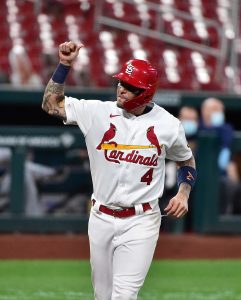
Molina received interest from other clubs earlier this winter, but a return to the Cardinals has looked like an inevitability for weeks. A reunion between the two has seemingly become even more probable since the Cardinals kicked their offseason into high gear in late January. Dating back to then, they have re-signed right-hander Adam Wainwright, who’s close with Molina and also ranks as a franchise icon, and swung a massive deal with the Rockies for superb third baseman Nolan Arenado.
Molina, assuming he returns, will once again line up as the Cardinals’ No. 1 catcher in 2021. While Molina isn’t the star he was in earlier years, he did bat .262/.303/.359 (passable relative to his position) in 156 plate appearances last season and throw out an eye-popping 45 percent of would-be base thieves. It appears he’ll once again mentor younger Cards backstop Andrew Knizner during the upcoming campaign.
Molina’s exit from the open market will take away another option at catcher, which is arguably devoid of starting-caliber free agents there. MLBTR ranked Molina as the 32nd-best overall free agent at the start of the offseason and predicted he would re-sign with the Cards on a one-year, $10MM contract.
Photo courtesy of USA Today Sports Images.
Rays Sign Hunter Strickland To Minor League Contract
The Rays recently signed right-handed reliever Hunter Strickland to a minor league contract with an invitation to major league spring training, per Danny Russell of DRaysBay (h/t: Marc Topkin of the Tampa Bay Times).
Strickland has already appeared in the majors with four teams – the Giants, Mariners, Nationals and Mets – since his 2014 debut. He was a tremendous part of the Giants’ bullpen from 2014-17, during which he combined for 180 2/3 innings of 2.64 ERA/3.58 SIERA pitching, posted a 23.7 percent strikeout rate against a 7.9 percent walk rate, and averaged 96.5 mph on his fastball.
While Strickland looked like a high-end reliever earlier in his career, he was not nearly as effective in the previous three seasons. His fastball velocity has largely remained intact, but offenses tattooed him in 2019, when he put together career worsts in ERA (5.55) and strikeout percentage (17.1) over 24 1/3 innings between the Mariners and Nationals. The 32-year-old inked a minors deal with the Mets before last season, but he threw just 3 1/3 frames and couldn’t consistently stay on their roster during the campaign.
Reds Sign Dee Strange-Gordon To Minor League Deal
FEB 8, 4:19pm: Strange-Gordon will earn a base salary of $1MM if he makes the Reds’ roster, Mark Sheldon of MLB.com tweets.
10:25 am: The Reds have announced the signing of Strange-Gordon. He’ll get an invite to spring training with the opportunity to compete for playing time at shortstop and/or in a utility role.
FEB 7: The Reds are in agreement on a minor-league deal with infielder Dee Strange-Gordon, reports Kiley McDaniel of ESPN (via Twitter). The deal contains an invitation to MLB spring training, per C. Trent Rosecrans of the Athletic.
A two-time All-Star and three-time stolen base leader early in his career with the Dodgers and Marlins, Strange-Gordon was traded to the Mariners in advance of the 2018 season. His tenure in Seattle proved to be a disappointment, though. Strange-Gordon never took to the Mariners’ attempt to convert him to a center fielder that year. At the same time, his production at the plate had a significant drop, limiting his opportunities to do damage on the base paths.
Over the past three seasons, Strange-Gordon has hit a meager .266/.293/.343 (73 wRC+). That made Seattle’s decision to decline a $14MM option on his services for 2021 easy. Still, there’s no harm for the Reds in bringing in a respected ten-year veteran on a non-guaranteed pact and giving him an opportunity to compete for a roster spot.
Cincinnati has a glaring hole at shortstop, the position at which Strange-Gordon broke into the big leagues. He’s mostly played second base over the past seven years, but he’s continued to pick up sporadic playing time at short (as well as in the outfield). That’s likely his path to regular playing time with the Reds, who have Mike Moustakas lined up for the lion’s share of work at the keystone. Nevertheless, given Strange-Gordon’s pronounced struggles over the past three years, it’d be surprising if the Reds didn’t bring in additional competition for incumbent shortstop options José García, Kyle Farmer and Kyle Holder. Cincinnati has been in recent contact with Jonathan Villar, arguably the top shortstop still available in free agency.
Twins Sign Keon Broxton To Minor League Deal
The Twins have signed outfielder Keon Broxton to a minor league contract with an invitation to MLB spring training, Dan Hayes of The Athletic relays. They’ve also added lefty Andrew Albers (previously reported) and righties Robinson Leyer and Chandler Shepherd on minors pacts.
Broxton, who will turn 31 in May, garnered quite a bit of playing time as a Brewer from 2016-17, in which he slashed a respectable .227/.318/.424 with 29 home runs and 44 stolen bases across 707 plate appearances. But Broxton struck out in more than 37 percent of PA during that span, and after he logged subpar production in 2018, the Brewers traded him to the Mets. Dating back to ’18, Broxton has combined for a .170/.253/.312 line with a horrid 41.6 percent strikeout rate as a Brewer, Met, Mariner and Oriole in 317 PA. He rejoined the Brewers on a minors contract before 2020 but didn’t see any action with the team last season.
Despite his recent struggles, Broxton could emerge as a useful backup outfield option in Minnesota, having put up 20 Defensive Runs Saved and a 9.7 Ultimate Zone Rating in 349 games in the grass. The Twins have two established outfielders (Byron Buxton in center and Max Kepler in right), while Broxton, Alex Kirilloff, Trevor Larnach, Jake Cave and Brent Rooker could be among those competing for reps in left.
Minor MLB Transactions: 2/8/21
The latest minor league moves from around the sport…
- The White Sox have outrighted hurler Emilio Vargas to Triple-A Charlotte, James Fegan of The Athletic tweets. The team previously designated the righty for assignment a week ago. Now that he’s staying in the organization, the 24-year-old Vargas will have a chance to compete for a spot in the spring. A waiver pickup from the Diamondbacks earlier in the offseason, Vargas has pitched to a 3.86 ERA in 121 1/3 innings at the Double-A level.
Earlier updates:
- The Twins have signed left-hander Andrew Albers to a minor league deal that includes an invitation to the team’s big league Spring Training camp, FanSided’s Robert Murray reports (via Twitter). Albers will earn $750K if he makes Minnesota’s active roster. Albers posted a 4.10 ERA, 15.1 strikeout percentage, and 4.8 walk percentage over 120 2/3 MLB innings from 2013-17, with 77 of those frames coming in two separate stints with the Twins. Over the last three seasons, the 35-year-old Albers has been pitching in Japan for the Orix Buffaloes, with a 4.02 ERA, 17.5K%, and 4.78BB% over 266 1/3 innings of NPB action.
Phillies Sign Chase Anderson
FEB. 8: The Phillies have announced the signing.
FEB. 3, 9:55am: Anderson will be guaranteed $4MM, tweets Scott Lauber of the Philadelphia Inquirer.
9:40am: It’s a one-year, Major League deal for Anderson, MLBTR has learned.
9:10am: The Phillies are in agreement on a contract with free-agent righty Chase Anderson, reports Fansided’s Robert Murray (via Twitter). The Hub Sports Management client will join a growing stockpile of experienced arms vying for innings at the back of the Philadelphia rotation. His deal is pending the completion of a physical.
Anderson, 33, spent the 2020 season with the Blue Jays but missed the beginning of the shortened season by an oblique strain. He returned and pitched well in August before scuffling through a rough month in September. Overall, he totaled just 33 2/3 innings with a 7.22 ERA.
That unsightly mark notwithstanding, there are plenty of reasons to expect that the Anderson pickup could be a worthwhile, low-cost investment. From 2014-19, Anderson was a durable source of average or better innings, pitching to a 3.94 ERA and 4.43 SIERA over the life of 857 frames between the D-backs and the Brewers. Anderson’s only IL stints in that time were a minimum stay for triceps tightness in 2015 and then brief absences due to an oblique strain and a laceration on his finger. His arm held up nicely in the rotation both in Arizona and Milwaukee, and even last year’s absence had nothing to do with his elbow or shoulder.
Digging a bit deeper into his 2020 work, there’s cause for optimism there as well. Anderson decreased the use of his four-seamer in favor of more cutters and changeups, and the results were encouraging in some regards. He posted a career-high 24.7 percent strikeout rate that checked in above the league average, and his 6.5 percent walk rate was an improvement over his Brewers days, coming in well south of the league average. Anderson was plagued by a .362 average on balls in play and a home-run rate so lofty that positive regression is nearly inevitable (2.94 HR/9).
Anderson has been somewhat homer-prone throughout his career, but there’s little reason to expect such pronounced struggles to continue. Fielding-independent metrics that normalize home-run rate, such as xFIP (4.09) and SIERA (4.01), were quite a bit more bullish on him than his baseline ERA.
Anderson will join lefty Matt Moore on the big league roster as a cost-effective option at the back of the rotation behind top starters Aaron Nola, Zack Wheeler and Zach Eflin. His addition could allow the Phillies to give top prospect Spencer Howard more time in Triple-A and to move Vince Velasquez to the bullpen, but it’s likely that each of Moore, Anderson, Howard and Velasquez will start games for the Phils in 2021. Teams are going to be more cautious than ever with workloads after last year’s shortened slate of games, so having multiple starting options is of increased importance. The Phils have also added Ivan Nova and Bryan Mitchell on minor league pacts.
Angels Sign Shohei Ohtani To Two-Year Extension, Avoid Arbitration
The Angels have announced a two-year, $8.5MM contract extension with pitcher/designated hitter Shohei Ohtani. The deal will keep the two sides from an arbitration hearing, after they failed to reach an agreement on Ohtani’s 2021 salary prior to the arb deadline. Jeff Fletcher of the Orange County Register (Twitter link) reports that Ohtani will earn $3MM in 2021 and $5.5MM in 2022.
The agreement wraps up the Angels’ final outstanding arbitration-eligible case for the 2020-21 offseason, and also sidesteps that may have been one of the more unusual arb hearings of all time. Ohtani and his camp were looking for $3.3MM in his first trip through the arbitration process, while Los Angeles countered with a $2.5MM figure. Given Ohtani’s unique two-way status, the injuries that have limited him on the mound over the last two seasons, and his down year the plate in 2020, an arbiter would have had plenty to weigh in determining Ohtani’s salary considering the lack of precedent.
Teams using the “file and trial” approach to arbitration cases usually don’t negotiate past the initial deadline unless a multi-year deal is being discussed. The two-year contract will give the Angels some cost certainty while also giving Ohtani $8MM in guaranteed money, and an opportunity at another arbitration raise for his third and final year of arb eligibility in 2023. (Assuming, of course, that Ohtani and the Angels don’t work out a longer-term deal before then that would extend the Halos’ team control over his services.)
After arriving in Major League Baseball with great fanfare during the 2017-18 offseason, Ohtani is still something of a question mark through three seasons, but he has also shown signs of why he was such a sought-after player. He captured AL Rookie Of The Year honors after hitting .285/.361/.564 with 22 homers over 367 plate appearances while also posting a 3.31 ERA and an outstanding 29.9 strikeout percentage and 19.4K-BB% over 51 2/3 innings on the mound.
Since that incredible debut, however, Ohtani has pitched only 1 2/3 MLB innings. The right-hander didn’t pitch at all in 2019 due to Tommy John surgery, and then a flexor strain shut down his 2020 pitching endeavors after just two outings — Ohtani crushed for seven runs over those 1 2/3 frames. Ohtani was still able to serve as a DH in 2019 and hit a very solid .286/.343/.505 over 425 PA, but then struggled to a .190/.291/.366 slash line in 175 PA this past season.
Ohtani made no excuses for his 2020 performance, describing his play as “pathetic” during a Kyodo News interview back in November. He is expected to be healthy for Spring Training, however, and Ohtani is intent on re-establishing himself as a two-way threat. Help on either front would be eagerly welcomed by an Angels team that has designs on finally getting back into contention in 2021, but a rebound from Ohtani as a pitcher would be particularly helpful considering how Anaheim has long looked for a front-of-the-rotation ace. The Halos acquired Jose Quintana and Alex Cobb this offseason to help beef up a six-man pitching staff, as Ohtani is again expected to pitch only one day per week.
League Notes: Baseball Design, Spring Training
Some changes are coming to Major League Baseball in the form of an altered Spring Training schedule and a slightly different baseball. The latter may have the bigger impact on the season as a whole, as The Athletic’s Eno Sarris and Ken Rosenthal (subscription required) report that the league has sent a memo to teams outlining some changes made to the Rawlings baseballs that will be in use during the 2021 campaign.
The new ball will be reduced in weight by under one-tenth of an ounce, and will also be slightly less bouncy (as determined by the coefficient of restitution, or COR). While the end result of these changes won’t be entirely known until we see the baseball in action during the season, the changes seem to have been made in order to “increase consistency in the ball” and also deaden it to some extent. An independent lab cited in the league memo detailed a reduction by one or two feet of distance on fly balls hit beyond 375 feet, and an analyst who spoke with Sarris and Rosenthal believes “it’ll be like adding five feet of outfield walls to every wall in the big leagues.” The analyst believes an overall five percent reduction in home runs is possible, though it isn’t yet known how the newer ball will be affected by drag.
Home run totals have soared over the last few seasons, which has led to criticism in both fan and league circles that the sport is becoming too homer-heavy and strikeout-heavy at the expense of more traditional and action-oriented station-to-station baseball. If the new ball is indeed successful at reducing home runs, Sarris and Rosenthal write that there is some risk “that it will leave the game with all those swings and misses and fewer big flies,” but it should also be noted that pitchers will surely also have to make some adjustments to how they grip and throw a slightly lighter ball.
In a more clearer attempt to deaden the ball, five more teams will join the Diamondbacks, Mariners, Rockies, Red Sox, and Mets in storing baseballs in a humidor prior to the game. The addition of a humidor at Chase Field prior to the 2018 season led to a noteworthy dropoff in the Diamondbacks’ homer totals, and it is still too early to really gauge the impact for the Mets, Sox, and Mariners since their humidors were only in place for the anomalous 2020 season.
The changes to Spring Training will be more immediately visible, given how camps are set to open in a little over a week. The 15 teams in the Grapefruit League will be split into pods in western or eastern Florida, according to Rosenthal and The Athletic’s Matt Gelb (via Twitter). The plan is for the “East” teams to play 24 games against each other and then four intra-squad games, while teams on the “West” side of the equation would play a 28-game schedule against each other. This would seem to imply that the 15 teams will be split into three pods of five teams, which also makes geographical sense since only five Grapefruit League teams (the Marlins, Mets, Cardinals, Astros, and Nationals) are based in Eastern Florida.
It isn’t yet known if a similar strategy will be planned for the Cactus League. USA Today’s Bob Nightengale (Twitter links) reports that split-squad games are being eliminated, so the schedule will be reduced to some extent. The league and the players’ union are aiming to have health and safety protocols for Spring Training arranged by tomorrow, and more specifics could be revealed at that point. Since some tickets for previously-scheduled Grapefruit League games had already been sold, Rosenthal tweets that teams will individually handle those situations.
Yoshihisa Hirano Signs With NPB’s Orix Buffaloes
Yoshihisa Hirano is heading back to Nippon Professional Baseball, as the Orix Buffaloes announced that the right-hander has signed a one-year deal. According to The Mainichi and other news outlets, Hirano will earn approximately $1.4MM, plus the contract also contains incentive bonuses.
Hirano (who turns 37 in March) rose to prominence over 11 seasons with the Buffaloes from 2006-17, posting a 3.10 ERA, 22.09 strikeout percentage, and 5.7 walk percentage over 974 2/3 innings. After transitioning into relief pitching in 2009, Hirano became one of NPB’s top closers, racking up 156 saves during his previous stint in a Buffaloes uniform.
Hirano came to North America after signing a two-year, $6MM deal with the Diamondbacks in the 2017-18 offseason. The transition was initially smooth, as Hirano posted a 2.44 ERA over 66 1/3 innings out of Arizona’s bullpen and finished sixth in NL Rookie Of The Year voting in 2018. Some elbow problems hampered Hirano in 2019, however, and after signing a free agent deal with the Mariners last winter, his arrival to Seattle’s Summer Camp was delayed by a positive COVID-19 diagnosis.
All told, Hirano delivered a 3.69 ERA over 131 2/3 innings in the Show — not bad results for a pitcher who lacked a big fastball, and posted only a middle-of-the pack 23.5K% and 14K-BB%. Hirano induced a lot of soft contact from hitters and had a 47.3% grounder rate over his MLB career, though home runs became an increasingly larger issue for the righty.