
Minor MLB Transactions: 10/16/17
Here are the day’s minor moves from around the league…
- The Angels announced that left-hander Jason Gurka has cleared waivers and been assigned outright to Triple-A Salt Lake. The 29-year-old was designated for assignment when the Halos picked up right-hander Felix Pena from the Cubs. Gurka appeared in just three games for the Angels late in the season, facing only five batters and recording two outs. The former Orioles draftee (15th round, 2008) has seen big league time with the Rockies both in 2015 and in 2016 but has struggled in a small sample in the Majors; through 18 innings, he’s yielded 18 runs on 34 hits and five walks with 14 strikeouts. Gurka does come with a strong track record as a left-handed reliever in Triple-A, where he’s posted a 3.27 ERA with 9.6 K/9 against 2.4 BB/9 in 118 1/3 innings across parts of four seasons.
Offseason Outlook: Milwaukee Brewers
MLBTR is publishing Offseason Outlooks for all 30 teams. Click here for the other entries in this series.
In what most expected to be another transitional season, the Brewers spent much of the year in contention for the NL Central title and finished just shy of an NL Wild Card berth. With an 86-76 record under their belts and a promising core of controllable players, the Brewers will no longer enter the offseason with a “rebuilding” label and will instead likely add pieces with an eye toward winning in 2018 and beyond.
Guaranteed Contracts
- Ryan Braun, OF: $57MM through 2020 (includes buyout of 2021 option)
- Eric Thames, 1B/OF: $12MM through 2019 (includes buyout of 2020 option)
Arbitration-Eligible Players (Service time in parenthesis; projections via MLBTR contributor Matt Swartz)
- Jared Hughes (5.162) – $2.2MM projected salary
- Carlos Torres (5.114) – $3.3MM
- Jeremy Jeffress (4.104) – $2.6MM
- Stephen Vogt (4.084) – $3.9MM
- Chase Anderson (3.146) – $5.4MM
- Jonathan Villar (3.113) – $3.0MM
- Jimmy Nelson (3.107) – $4.7MM
- Hernan Perez (3.079) – $2.2MM
- Corey Knebel (2.151) – $4.1MM
- Non-tender candidates: Torres, Jeffress, Vogt
Free Agents
[Milwaukee Brewers Depth Chart | Milwaukee Brewers Payroll Outlook]
General manager David Stearns and his staff caught some flak from Brewers fans this summer for not acting more aggressively to add pieces to a surprising contender. While flipping prospects Ryan Cordell and Eric Hanhold to add a pair of solid veteran rentals (Swarzak and Walker) definitely strengthened the roster, the division-rival Cubs went for broke and shelled out multiple top prospects for Jose Quintana, Justin Wilson and Alex Avila. It’s possible that had the Brewers splurged in similar fashion, adding Quintana or Sonny Gray, that they could’ve emerged as the NL Central champs, but Stearns & Co. steadfastly refused to part with top-echelon prospects — most notably center field prospect Lewis Brinson. Now, they’ll spend the offseason looking for long-term help while holding onto the luxury of plugging Brinson and other top prospects into the lineup in the near future.
Starting on the position-player side of the equation, the Brewers made several then-unheralded moves in the 2016-17 offseason that now look to have helped form a solid nucleus. Manny Pina enjoyed a breakout behind the plate and should at the very least be in an even timeshare with Stephen Vogt (or another veteran backstop should Vogt be non-tendered). Eric Thames cooled after a Cinderella start to his comeback season in MLB, but his overall numbers were strong. Jesus Aguilar, a waiver claim out of the Indians organization last winter, gives Thames an affordable platoon partner. Travis Shaw, meanwhile, was deemed expendable by the Red Sox with Rafael Devers on the horizon and instead broke out as one of the NL’s best third basemen after the Brewers acquired him in a December trade.
Top prospect Orlando Arcia showed quite well at shortstop as the season wore on, and the Brewers will return Braun and Domingo Santana as corner outfield options with plenty of pop. (Thames, too, can play some corner outfield.) Keon Broxton saw the bulk of the time in center field in 2017 and could be reinstalled there to open the 2018 season if the Brewers want to play some service time games with Brinson. But center field should go to Brinson by midseason, assuming good health, so it’s possible that the Brewers will look to shop Broxton this summer. His 37 percent strikeout clip is an eyesore, but Broxton has plenty of speed and power, and he handles center field well enough. Brett Phillips gives the Brew Crew another option in center, should they ultimately move Broxton, or he could simply spell Braun, Broxton and Santana in a semi-regular role.
The biggest question mark for the Brewers, then, is at second base. Jonathan Villar had a breakout 2016 season, but the Brewers likely feel as though they dodged a bullet when Villar reportedly rejected a contract extension last offseason. The 26-year-old’s strikeout woes returned stronger than ever in 2017, and he hit just .241/.293/.372 in 436 PAs. Veteran Eric Sogard saw plenty of action at second base as Villar lost playing time, and Walker stepped in and hit well there following his acquisition. With both Walker and Sogard set to hit the open market, the Brewers will need to decide whether they can once again trust Villar or if external reinforcements are needed.
Re-signing Sogard to an affordable one-year deal could provide some insurance, but the Brewers must now also think more like a contender. If there’s an obvious hole to fill, they’ll likely covet more certainty. Milwaukee had interest in Ian Kinsler before the non-waiver deadline, and he’s all but certain to be traded by the Tigers this winter. Re-signing Walker would be more expensive than retaining Sogard, though he’d bring more reliable production. Other free-agent options are fairly thin, though Howie Kendrick and Eduardo Nunez could stabilize the spot. The trade front is more interesting, where Philadelphia’s Cesar Hernandez and Miami’s Dee Gordon will both be available. Gordon is owed $38MM over the next three seasons, but the Brewers can afford to take on some significant financial commitments this winter.
It’s also worth mentioning that Braun’s name figures to once again surface in trade rumors at least occasionally this offseason. However, he’s coming off his worst season since 2014 and has full veto power over any trades (to say nothing of the $57MM he’s still owed through 2020). A deal doesn’t seem particularly likely.
On the pitching front, things are far less clear for the Brewers. Emergent ace Jimmy Nelson will miss a yet-unreported amount of time in 2018 following shoulder surgery. That leaves Chase Anderson and Zach Davies as the two locks for rotation spots. Brent Suter performed well in 14 starts, but he’s averaged just 124 1/3 innings across the past three seasons. Relying on him for 170+ frames would be difficult, but he’ll certainly be in next year’s rotation mix. Righty Brandon Woodruff showed flashes of potential but didn’t cement himself, while Junior Guerra posted terrible numbers in his followup to his out-of-the-blue rookie success at age 31. Touted prospect Josh Hader shined in the bullpen, but the lefty will likely get a look as a starter next year.
The Brewers look as though they’ll need to add at least one established starter, and making a second, smaller-scale addition wouldn’t be unwise. One glance at the “guaranteed contracts” section above is evidence that they could afford to spend as aggressively as they wish this offseason, though the team’s lower payroll ceiling creates less margin for error when shelling out cash to a Jake Arrieta or Yu Darvish. Second-tier names like Alex Cobb or Lance Lynn seem much more plausible, though their last foray into that price range (Garza) didn’t pan out.
Alternatively, the Brewers have an exceptionally deep farm — deep enough that they can acquire both one-year rentals and more controllable options. Given the Brewers’ questionable on-paper rotation, relatively blank payroll slate and wealth of prospects, there are literally dozens of scenarios on which to potentially speculate. Suffice it to say — they’ll be connected to a plethora of arms this winter.
The Milwaukee bullpen brings a bit more clarity. Corey Knebel broke out as one of the game’s most dominant relievers, posting baseball’s fourth-highest strikeout percentage and second-highest K/9 rate in 2017. His walk rate is still troublesome, but Knebel functioned as a genuinely elite bullpen weapon in his record-setting 2017 season (most consecutive relief appearances with at least one strikeout). If Hader isn’t in the rotation, he’ll be back in the bullpen, pairing with Knebel to create a formidable duo. Jacob Barnes and Jared Hughes should return as additional right-handed options. Jeffress is a fan favorite in Milwaukee and showed improvement after returning in a July 31 trade, but his overall output makes less certain to be brought back. I’d still expect him to be tendered, though perhaps at a lower rate than the projected $2.6MM sum, as our algorithm doesn’t factor in context such as Jeffress’ off-the-field issues.
Swarzak was terrific after being acquired from the White Sox, so a potential reunion with him is something the Brewers will surely explore. Milwaukee also needs to add at least one left-handed reliever — if not two, depending on what happens with Hader. The Brewers were without a southpaw reliever for much of the year and certainly would prefer to have greater matchup flexibility in 2018 and beyond. Tyler Webb is one intriguing internal option, and the free-agent market bears names such as Jake McGee, Brian Duensing and Tony Watson. As ever, the trade market will be rife with options in this department, though Brad Hand stands out as the likeliest name to be bandied about on the rumor mill this winter.
An oft-overlooked component of the offseason among fans is the possibility of extending core pieces. While many focus on what pieces can be added to a contending core (or shipped off of a rebuilding roster), the Brewers are in a strong position to obtain some cost certainty and perhaps some additional club control over long-term cornerstones. After trying to do with Villar last winter, they’ll likely try once again with other targets as Spring Training nears in 2018. Arcia, Shaw and Davies all make sense as candidates for a long-term pact. Anderson does as well, to a lesser extent. He’s already controlled through his age-32 season, but the club could try to buy out his arbitration years in one fell swoop and possibly tack on a club option over his age-33 season in exchange for the up-front payday. As a late bloomer, he could be more amenable to that type deal than some younger arms would be.
The Brewers enter the 2017-18 offseason with a sizable portion of a contending club already in place, though they’ll still need to make some adjustments — most notably at second base and on the pitching staff. Their unexpected status as contenders in 2017 has undoubtedly accelerated their timeline to contention, though, and their deep stash of prospects and pristine long-term payroll ledger should give Stearns and his charges plenty of opportunities to creatively supplement a roster that roster that looks infinitely better than it did one year ago at this time.
Reds’ GM On Cozart, Young Players, Rebuild
Reds president of baseball operations and general manager Dick Williams sat down with C. Trent Rosecrans and Zach Buchanan of the Cincinnati Enquirer for an excellent, lengthy Q&A covering a number of topics pertaining to the Reds’ upcoming offseason and ongoing rebuild.
Of most interest, perhaps, was the fact that Williams was straightforward in stating that he planned to “continue to talk” to Zack Cozart about the possibility of re-signing the shortstop. The 32-year-old Cozart is up for free agency for the first time in his career, and while his age might not necessarily align with the rebuilding Reds’ timeline to contend, he’s one of the team’s longest-tenured players and is fresh off a career year at the plate. In 507 plate appearances, he hit .297/.385/.548 with a career-high 24 homers and a dramatically improved walk rate (to say nothing of his typically excellent glovework at shortstop).
The Reds will face a tough decision on Cozart, who seems to at the very least be a candidate for a $17.4MM qualifying offer. (MLBTR readers were split about 55-45 in favor of the Reds giving him a QO in early September.) If Cozart isn’t retained, though, it doesn’t sound as if the Reds’ top priority would be to delve into the free-agent or trade markets to attempt to replace him.
“[T]he primary candidate would be (Jose) Peraza,” said Williams when discussing a replacement for Cozart, if needed. “We believe that he showed at the end of ’16 with an extended look that this is a young, athletic, talented player. He’s still one of the youngest guys on our roster. … This year, we really asked him to move around a decent amount. I think that made it a little tougher on him than if he settled in at one spot.”
Peraza is, as Williams suggests, still somewhat of a work in progress. Although he’s spent the bulk of the past two seasons in the Major Leagues, Peraza won’t even turn 24 until April 30 of next year. The former top 100 prospect demonstrated a good deal of promise with an impressive .324/.352/.411 batting line and 21 steals in 72 games last year, but he struggled for the majority of the 2017 campaign before turning things around in the season’s last couple of months. In Peraza’s final 48 games (31 starts), he batted .293/.361/.338 with just 18 strikeouts in 149 plate appearances.
[Related: Cincinnati Reds depth chart and payroll outlook]
Williams did go on to state that while he believes Eugenio Suarez to be capable of playing shortstop, he likes Suarez at third base and would like to have two additional players on the roster that can handle shortstop regularly. Conceivably, that could mean a re-signed Cozart and Peraza, or Peraza and a veteran bench option with experience at the shortstop position as well.
More broadly, Williams didn’t reject the notion that top prospect and former No. 2 overall pick Nick Senzel could play in the Majors next season, though it doesn’t sound as if the team will rush him out of Spring Training. Senzel, according to Williams, is capable of playing second, third, shortstop and perhaps even the outfield corners, but the team is reluctant to bounce him around the diamond too much. Second base seems to be a position at which he’ll get a look, as the Reds have Suarez thriving at the hot corner presently.
Senzel raked at a .321/.391/.514 clip in 507 PAs between Class-A Advanced and Double-A last year, mashing his way through the Southern League to the point that many expect him to begin the 2018 season in Triple-A. Scooter Gennett, of course, gives the team another option at second base, though with just two years of club control remaining, I’d imagine that the Reds wouldn’t have many qualms about ultimately moving him if and when Senzel proves ready (though that’s just my own speculation).
Williams also spoke at length about the struggles of several of the Reds’ young pitchers in 2017, noting the lack of innings most of the team’s young starters were able to log in Triple-A. Injuries to Anthony DeSclafani, Brandon Finnegan and Homer Bailey forced Cincinnati to tap into its reservoir of young pitchers more often than the team would’ve liked. Jesse Winker is also discussed quite a bit, with Williams hinting that he’s intrigued by Winker’s high-OBP skill set as a potential top-of-the-order option. Just 24 years old, Winker hit .298/.375/.529 with seven homers, a 10.9 percent walk rate and a 17.5 percent strikeout rate in 137 big league plate appearances.
While no one should expect the Reds to shell out top dollar in free agency this winter, the GM does suggest that he’ll have some money to spend and that the team’s list of targets is a broad one, including some players looking to move from Japan over to the Major League (and more than just the highly publicized Shohei Otani). The entire Q&A is (obviously) stuffed with quotes from Cincinnati’s top baseball ops executive and is well worth a full read for Reds fans and non-Reds fans alike. Williams gives plenty of insight into where he feels the team is at in its rebuild, his own thoughts on his first year as a general manager and the team’s approach in the upcoming offseason.
NL West Notes: Seager, Rockies, Padres
Dodgers phenom Corey Seager feels “normal-ish”, according to manager Dave Roberts (via an article by Ken Gurnick of MLB.com). Seager was injured while sliding into second base during the game in which the Dodgers clinched the NLDS series victory, and hasn’t done any baseball activity since then. Roberts adds that Seager won’t be traveling with the team to Chicago, though that could change under certain circumstances. Regardless, Seager can’t be added to the NLCS roster at this point unless someone on the current roster gets injured. In that case, the player Seager replaces would be ineligible for the Dodgers’ World Series roster, should the team advance that far. The 23-year old Seager batted .295/.375/.479 with 22 home runs during the regular season, and ranked first among all NL shortstops in fWAR. His situation will certainly be worth monitoring closely.
More from baseball’s NL West division…
- In a mailbag article for MLB.com, Rockies beat writer Thomas Harding points out that Colorado used only eight total starting pitchers this past season, which was incredibly lucky considering they averaged 12 starters per season from 2011-2016. Seven of those eight starters are set to return in 2018, and while they have youth on their side, Harding wonders how the organization will adapt if their luck with pitcher injuries regresses to the mean. The Rockies playoff hopes for the next few years will rest largely on the health and development of their young starters, including Jon Gray, Jeff Hoffman, Antonio Senzatela, German Marquez and Kyle Freeland.
- Speaking of mailbag articles for MLB.com, Padres beat writer AJ Cassavell suggests that San Diego’s bullpen-related offseason plans will largely hinge on whether any teams will meet GM A.J. Preller’s asking price on lefty Brad Hand. If Hand is traded, the Padres’ bullpen will likely need a significant overhaul, including some spending on established major leaguers. However, if he isn’t moved and the club is able to retain Craig Stammen, their relief corps may only need a few tweaks for 2018. To say that Hand essentially was the Padres’ bullpen in 2017 isn’t an exaggeration; his 3.89 Win Probability Added (WPA) ranked fourth-best among all relievers in baseball. All other Padres relievers combined for -1.76 WPA, and Stammen was the only other arm in their ‘pen to exceed 0.20.
Looking For A Match In A Billy Hamilton Trade
After a second consecutive 68-94 season, the Cincinnati Reds’ rebuilding process still has no clear end in sight. Complicating things further for the organization are the facts that they already owe $68.7MM in guaranteed contracts to five players for the 2018 season, and $56.6MM to four players in 2019. Although the organization has shown a willingness to spend in the past, they aren’t exactly a large-market payroll juggernaut, so it stands to reason that the Cincinnati front office is unlikely to spend big across the next two seasons in order to compete for a pennant amidst a highly competitive NL Central division.
Enter Billy Hamilton. A free agent at the end of the 2019 season, the speed demon will probably reach the open market before October baseball returns to Cincinnati. It makes perfect sense, then, that the Reds might seek to explore the trade market for their fleet-footed center fielder.
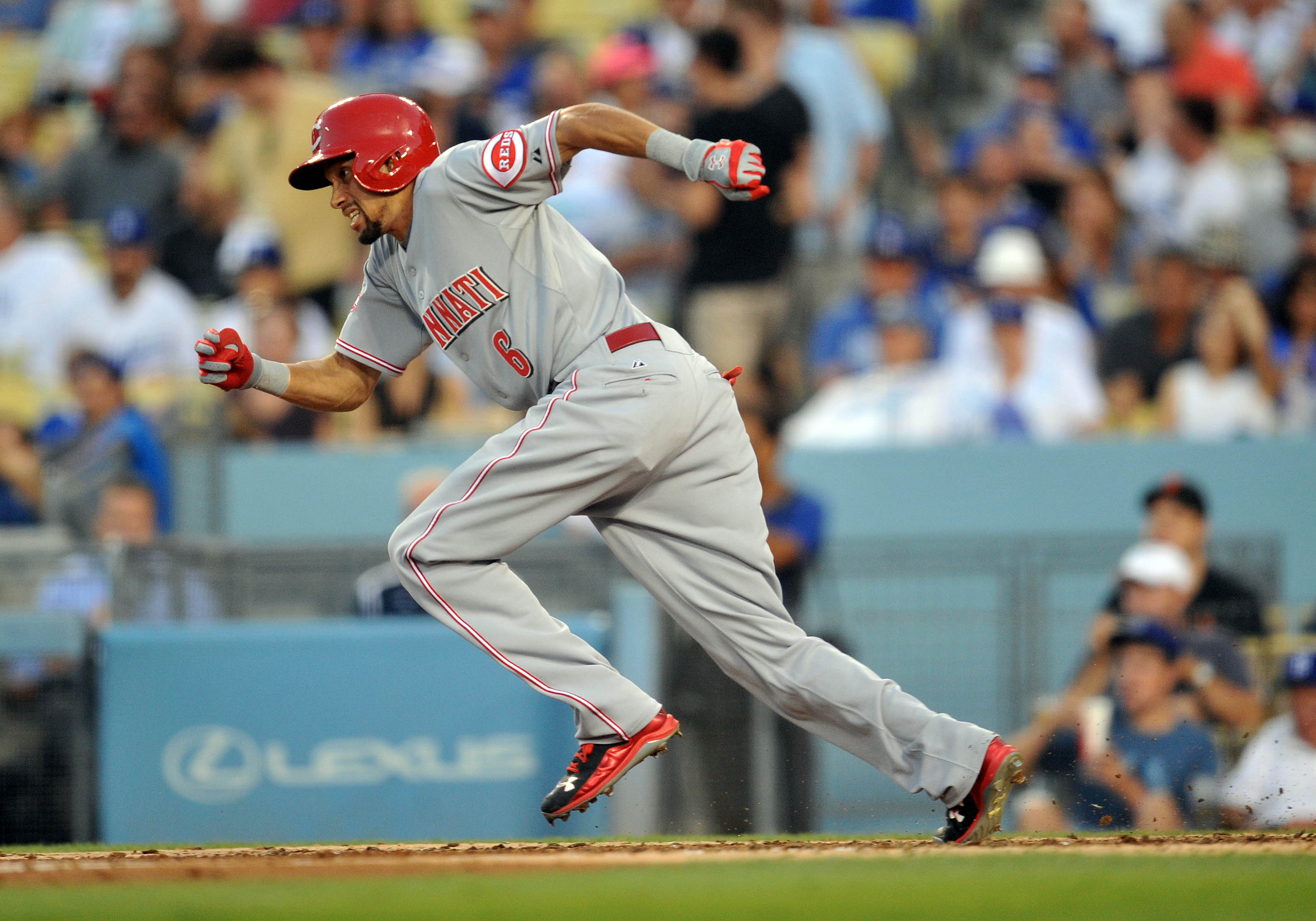
The 27-year old’s value is largely tied up in his legs. Statcast’s sprint speed leaderboard ranks Hamilton as the second-fastest sprinter in the game (behind Minnesota’s Byron Buxton), while Fangraphs rated his defense third-best among qualifying center fielders in 2017. He’s stolen at least 56 bases in each of his four full seasons at the major league level, and has routinely created runs by through aggressive base running.
The well-known achilles heel of Hamilton’s game has always been his terrible offensive output. Despite tremendous speed down the first base line, Hamilton owns a putrid career .248/.298/.338 batting line across 2,180 plate appearances at the major league level, good for a 71 wRC+ since his promotion in September of 2013.
So, when exploring potential suitors for Hamilton, it makes the most sense to start with teams that have a dire need for a defensive upgrade in center field. It’s also worth noting that Hamilton’s base running skills aren’t as useful to teams that rely heavily on the home run ball, such as the Rays, Athletics and Yankees.
With the above factors in mind, the Giants could be a particularly good match. AT&T Park’s outfield is particularly large, making it difficult for their hitters to put runs on the board via the long ball. Hamilton’s base running prowess would surely be a great asset to a team that finished dead last in baseball with 128 homers, but ranked 8th-best in contact rate. What’s more, San Francisco center fielders ranked as the third-worst defensive group in all of baseball via Fangraphs’ defensive metric. Hamilton would provide a considerable upgrade over that of the aging Denard Span.
Similarly, the Dodgers’ pitching staff could benefit from having Hamilton manning center field in the pitcher-friendly Dodgers Stadium, with Chris Taylor sliding to second base. The Royals could be on the lookout for a center field option if they don’t retain Lorenzo Cain. Hamilton could provide an overall upgrade for the Brewers over the strikeout-plagued Keon Broxton, though they’re more likely to see what they have in Lewis Brinson before looking to external options.
Though Hamilton’s lifetime fWAR of 10.6 pegs him as only a slightly above-average player for his major league career, his skill set is unique. He could fill a hole for many major league clubs, and there’s a good chance he could help fortify the Reds’ farm system while they continue to rebuild.
Photo courtesy of USA Today Sports Images
Daniel Webb Dies In ATV Accident
Former White Sox pitcher Daniel Webb passed away due to an ATV accident last night, according to a report from wpsdlocal6.com. Chris Davis, Sheriff of Humphreys County, confirmed the news via telephone.
The Blue Jays selected Webb in the 18th round of the 2009 June amateur draft, but the Kentucky native spent most of his career in the White Sox organization. During his time at the MLB level, he compiled 110 relief innings at the major league level, including 67 2/3 innings in 2014 with a 3.99 ERA. Webb showed promise with a fastball that averaged 96 MPH, but hadn’t pitched since undergoing Tommy John surgery in 2016.
The White Sox issued the following statement in the wake of the 28-year old’s passing.
“Daniel left many friends within the Chicago White Sox organization, and we are all shocked and stunned by the news of last night’s terrible accident. He was a terrific young man with a full life ahead of him. All thoughts and prayers go to his family and friends as they deal with today’s tragic news.”
MLBTR sends its condolences to Webb’s family and friends during this difficult time.
East Notes: Yankees, Sox, Nats, Orioles
With the Yankees intent on getting under the $197MM luxury tax threshold in 2018, Joel Sherman of the New York Post wonders if they’ll shop relievers Dellin Betances and Adam Warren in the offseason. While the two, especially Betances, are high-end bullpen options, the Yankees may not want to spend the projected $7.5MM on the pair given that their relief corps would still be loaded without one or both. Aroldis Chapman, David Robertson, Chad Green and Tommy Kahnle will stick around next season, and all four of them are currently ahead of Betances and Warren in the Yankees’ late-game pecking order. Both Betances and Warren are likely to file for larger arbitration requests than their projected figures, Sherman notes, which could be especially interesting in the former’s case. After all, the relationship between Betances and the Yankees took a sour turn during the arbitration process last winter.
- Landing a big bat, adding depth in their rotation and middle infield, and finding another setup man could be on the Red Sox‘s offseason to-do list, Chad Jennings of the Boston Herald writes. Regarding Boston’s power-needy offense, which we touched on earlier today, Jennings lists impending free agents J.D. Martinez, Justin Upton, Eric Hosmer, Mike Moustakas and Jay Bruce as possible fits.
- The Nationals’ playoff trip this year ended in more disappointment for the franchise, but manager Dusty Baker’s return still looks likely, Chelsea Janes of the Washington Post. The future of Baker, who doesn’t have a contract for next year, is one of the biggest offseason questions facing the Nationals, opines Janes. In terms of their roster, the Nats will have to make decisions on whether to re-sign impending free agent outfielder Jayson Werth, whether to upgrade behind the plate and in the rotation, and how to assemble their bench, Janes adds.
- The Orioles’ coaches will see their contracts run out at the end of the month, but the team still hasn’t made a final decision on Buck Showalter’s staff for next season, according to Roch Kubatko of MASNsports.com. If Showalter has his way, all of his assistants – including beleaguered pitching coach Roger McDowell – will return, per Kubatko. However, general manager Dan Duquette didn’t rule out changes when speaking to reporters on the final day of the season. “All those things with the coaches and the staffing, all those things need to be addressed, and I think you have to look carefully at them when you don’t have a strong year and see if there are some adjustments that you can make,” Duquette said.
Free Agent Stock Watch: Carlos Santana
The Indians’ ALDS loss to the Yankees may well go down as Carlos Santana‘s last hurrah in Cleveland, an organization he has been a member of since 2008. The soon-to-be 32-year-old is slated to reach free agency next month and has the credentials to rake in one of the richest paydays of the offseason. It’s possible Santana’s next contract will come from the Tribe, of course, but the small-market club is only a year removed from handing fellow first baseman/designated hitter Edwin Encarnacion a substantial deal. The Indians could opt for a cheaper free agent to replace Santana, then, or perhaps they’ll turn to someone already on their talent-rich roster for aid.
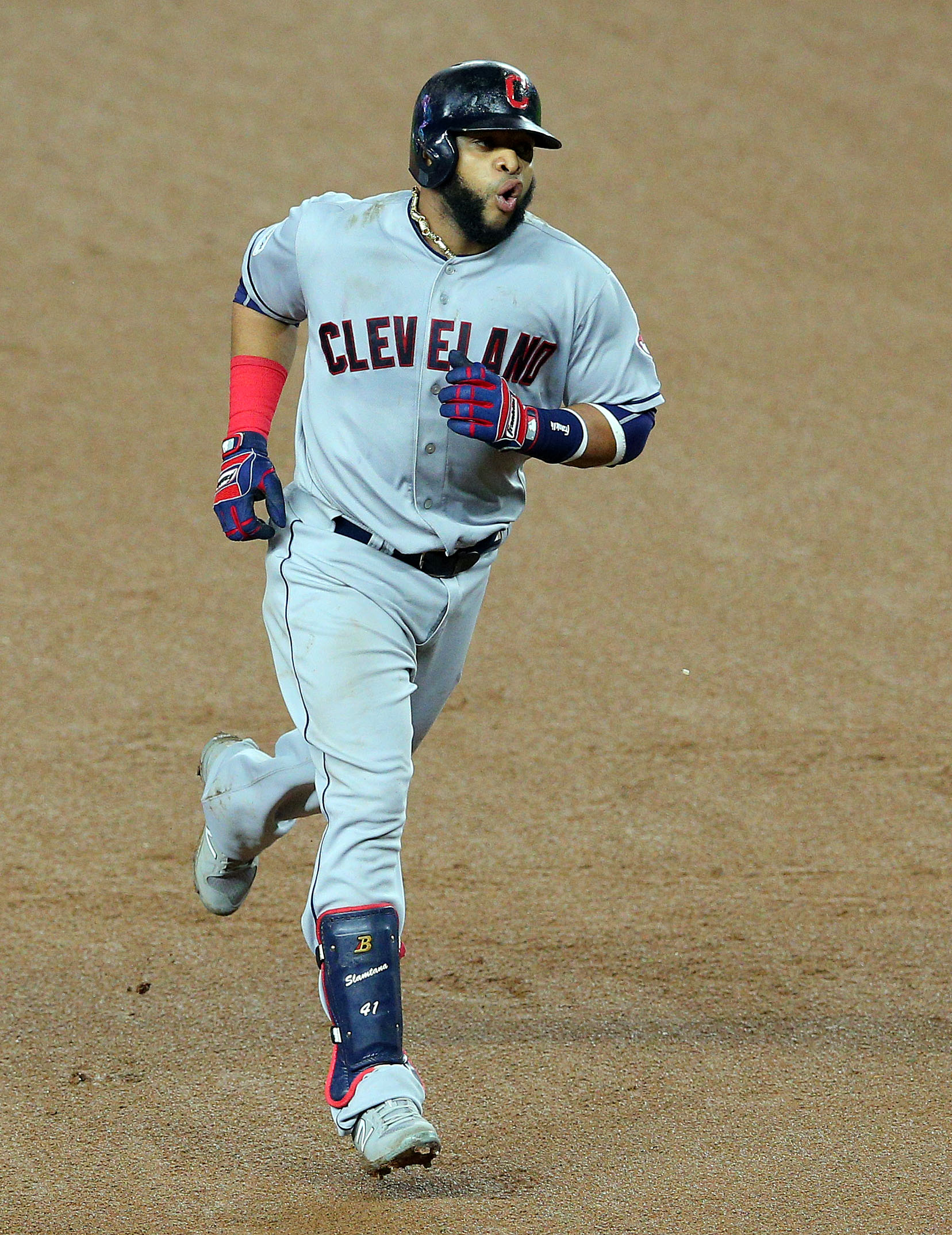
If Santana has played his last game as an Indian, the Octagon client’s void will be a difficult one for the team to fill. Not only is he a switch-hitter who has consistently provided above-average offensive production from both sides of the plate dating back to his 2010 debut, but Santana has also been quite durable. Since 2011, his first full season, Santana has appeared in no fewer than 143 games in any individual campaign. He played in 154 games this year, giving him six seasons with at least 150 appearances.
The 2017 season, in which he earned $12MM to close out a bargain contract (six years, $33MM-plus), didn’t begin in ideal fashion for Santana. His production was down through June, somewhat mirroring his team’s win-loss output. The Indians sat a mildly disappointing 42-36 through the season’s first three months before going on a 60-24 tear to wind up as the AL’s top seed.
Santana played a key role in the Tribe’s memorable second-half run, as he posted a wRC+ of 169 in July, 161 in August and 119 in September. For the year, he put up a 117 mark and slashed .259/.363/.455 with 23 home runs and a .196 ISO across 667 plate appearances. Santana continued to show off his signature plate discipline along way, walking in 13.2 percent of trips and striking out only 14.1 percent of the time. It was the second straight year in which Santana struck out in under 15 percent of PAs, making him one of the few hitters trending in the right direction in a league with skyrocketing K totals.
Including his most recent output, Santana has batted .249/.365/.445 with a .196 ISO, to go with a 15.2 percent strikeout rate against a 17 percent walk mark, in his 4,782-PA career. And while Santana’s not known for his glove work, the former catcher excelled at first this season, setting career highs in games (140), Defensive Runs Saved (10) and Ultimate Zone Rating (4.8). Between his work at the plate and in the field, Santana was worth 3.0 or more fWAR for the second straight year and the fourth time in his career. He has never registered a worse fWAR than 2.1 during a full season and has accrued 23.0 in Cleveland.
To this point, Santana’s numbers look rather similar to the production former teammate Nick Swisher logged before signing a four-year, $56MM contract with the Indians as a 32-year-old in January 2013. In 5,013 PAs from 2004-12, the switch-hitting Swisher racked up 25.0 fWAR and hit a Santana-like .256/.361/.467, adding a .211 ISO and solid walk and strikeout rates (13.3 percent and 21.1 percent, respectively). Of course, the Swisher experiment failed miserably in Cleveland, which is a reminder that even free agents with seemingly safe skillsets can rapidly decline.
Although the Swisher signing came almost a half-decade ago, something in the vicinity of his contract still looks like a fair benchmark for Santana’s next deal. While the Indians, Red Sox, Mariners and Angels are among a few potential fits, it’s worth noting that most teams were averse to spending big on first base/DH types a year ago. The leaguewide reluctance to splurge on those positions played a part in the Indians unexpectedly reeling in Encarnacion for a three-year, $65MM guarantee, and if it carries into this winter, it might enable them to re-up Santana at a reasonable rate. Further, it probably won’t help Santana’s cause that fellow first base options Eric Hosmer, Logan Morrison, Yonder Alonso, Lucas Duda and teammate Jay Bruce will join him in free agency after quality seasons of their own.
Hosmer and Santana are the class of the group and the only two who figure to garner qualifying offers, which could also drive down their appeal on the market. But if Santana rejects a $17.4MM qualifying offer from the Tribe and manages to land a guarantee of at least $50MM from another team, the Indians would be entitled to a compensatory pick after the first round because they’re a revenue-sharing recipient. So, while losing Santana would be a tough blow for Cleveland, at least there’s a chance the franchise would get a nice consolation prize in return.
Photo courtesy of USA Today Sports Images.
Offseason Outlook: Oakland Athletics
MLBTR is publishing Offseason Outlooks for all 30 teams. Click here for the other entries in this series.
The Athletics posted their third straight last-place finish in the American League West in 2017, but for the first time since their fateful Josh Donaldson trade in November 2014, the franchise has a clear direction. Not only did the A’s commit to a full rebuild in the middle of the season, but a couple of their prospective long-term core pieces – first baseman Matt Olson and third baseman Matt Chapman – burst on the scene to provide immediate hope and contribute to a roster that closed the season on a 17-7 run. Led by executive vice president of baseball operations Billy Beane and general manager David Forst, the A’s will continue with a mostly youth-oriented approach in 2018, which means a fairly quiet winter could be in the offing.
Guaranteed Contracts
- Matt Joyce, OF: $6MM through 2018
- Santiago Casilla, RP: $5.5MM through 2018
Contract Options
- Jed Lowrie, IF: $6MM club option or $1MM buyout
Arbitration-Eligible Players (service time in parentheses; projections via Matt Swartz)
- Chris Hatcher (4.146) – $2.2MM
- Khris Davis (4.104) – $11.1MM
- Liam Hendriks (4.038) – $1.9MM
- Marcus Semien (3.118) – $3.2MM
- Josh Phegley (3.114) – $1.1MM
- Blake Treinen (3.065) – $2.3MM
- Jake Smolinski (3.016) – $700K
- Kendall Graveman (3.014) – $2.6MM
- Non-tender candidates: Phegley, Smolinski
Free Agents
- None
Athletics Depth Chart; Athletics Payroll Information
Evidenced by its handful of veteran signings in free agency last offseason, Oakland’s hope was to piece together a roster capable of pushing for a wild-card spot in 2017. But the A’s ended up well out of contention by summertime, paving the way for them to cut ties with several established players, most of whom were on expiring contracts. The primary exceptions were relievers Sean Doolittle and Ryan Madson and starter Sonny Gray, a trio of controllable players whose trades brought back returns which could benefit Oakland for years to come.
Of the A’s top 15 prospects, five came from those deals, per MLBPipeline.com. Doolittle and Madson netted left-hander Jesus Luzardo (No. 5) and third baseman Sheldon Neuse (No. 14) from the Nationals (plus major league reliever Blake Treinen), while Gray’s two-plus years of team control garnered outfielder Dustin Fowler (No. 3), infielder/outfielder Jorge Mateo (No. 4) and righty James Kaprielian (No. 10) from the Yankees.
The Gray deal was especially notable not just for the prospect haul the A’s picked up, but because it was the end result of multiple years of trade rumors centering on the hurler. The A’s orchestrated a weekslong bidding war for Gray before moving him at the non-waiver trade deadline on July 31, and though two of the farmhands they acquired for him are on the mend from significant injuries, they still made out well in the swap. Fowler’s recovering from a ruptured patellar tendon, but the soon-to-be 23-year-old will have a legitimate chance to serve as the A’s starting center fielder from the get-go in 2018, according to Susan Slusser of the San Francisco Chronicle. And Kaprielian, who’s working back from the Tommy John procedure he underwent in April, could enter Oakland’s rotation sometime next year.
The aforementioned prospects are each important pieces of an ascending farm system, one the A’s could further bolster by selling well-performing veterans such as slugger Khris Davis and infielder Jed Lowrie in the coming months. However, they seem inclined to keep the pair. Fresh off his second 40-home run season in a row, Davis has only two years of arbitration control remaining and is projected to earn upward of $11MM in 2018. Despite Davis’ declining control and increasing price tag, A’s brass wants him in the fold.
“He fits in perfectly here,” Beane said after the season, while Forst brushed off concerns about Davis’ rising salary.
“If it is, it is,” Forst said of Davis’ arbitration case potentially being difficult. “I don’t think you could overstate the impact he has on the rest of the lineup.”
Lowrie, meanwhile, is down to his last year of control, but the A’s will pick up his affordable option and write him in as their starting second baseman for 2018. Doing so will allow them to give top prospect Franklin Barreto further seasoning at Triple-A after a rough 2017 debut in the majors, albeit over just 76 plate appearances.
With Davis and Lowrie seemingly returning next year, the majority of the A’s lineup already looks set. The infield will typically feature Olson, Chapman, Lowrie and shortstop Marcus Semien, while Fowler, Davis, Matt Joyce, Boog Powell and Chad Pinder will divvy up most of the reps in the outfield. For now, the designated hitter slot looks as if it’ll primarily belong to corner infielder Ryon Healy, but the A’s could attempt to move him to strengthen their bullpen, according to Slusser. The 25-year-old Healy isn’t even scheduled to reach arbitration until after the 2019 season, which could certainly appeal to teams searching for a long-term offensive piece, though he’s coming off a so-so year at the plate. While Healy belted 25 homers for a team that finished fourth in the majors in long balls (234), his .271/.302/.451 line across 605 PAs hovered around league average, thanks in part to a bottom-of-the-barrel walk rate (3.8). Healy wasn’t much better in that category in his 283-PA rookie year, 2016, when he logged a 4.2 percent mark that a .305/.337/.524 line helped mask.
Regardless of whether Healy sticks around, the A’s will have a chance to build on an offense that placed seventh in the league in wRC+ (102) this year, particularly if they get better production from behind the plate. The A’s catchers, primarily Bruce Maxwell, now-Brewer Stephen Vogt and Josh Phegley, combined to hit just .217/.298/.334 this year. The lefty-swinging Maxwell was the best of the three in 2017 and is likely to collect most of the playing time at catcher next season, but the A’s could at least stand to improve over the righty-hitting Phegley. The 29-year-old non-tender candidate batted a meek .201/.255/.336 in 161 trips to the plate and, like Maxwell, ranked among Baseball Prospectus’ worst pitch framers. Fortunately for Oakland, there will be a few reasonably priced upgrades over Phegley available in free agency, including Chris Iannetta, Nick Hundley and Rene Rivera.
It’s fair to expect the A’s to add a catcher via the open market, but taking that path to find a starting pitcher may not be in the cards.
“The preferred route is to create the pitching staff organically. That’s where we’ve had the most success,” Beane said.
A’s starters ranked 20th in the game in ERA (4.74) and 21st in fWAR (7.9) in 2017, and much of that production came from the departed Gray. Despite that subpar performance, though, the A’s still have a mishmash of 20-something rotation candidates they may prefer to go forward with, including two somewhat established options – Sean Manaea and Kendall Graveman – as well as Jharel Cotton, Andrew Triggs (recovering from hip surgery), Daniel Mengden, Jesse Hahn, Paul Blackburn and Daniel Gossett, among others. There’s also Kaprielian and lefty A.J. Puk, the sixth overall pick in 2016, knocking on the door. But even though Beane isn’t gung-ho on free agency, the A’s could still reel in one of the many soon-to-be available veteran stopgaps capable of eating innings. Notably, only three A’s surpassed 100 frames in 2017.
Oakland’s rotation clearly had problems this season, but the bullpen didn’t help the club’s cause. A’s relievers registered the majors’ sixth-highest ERA (4.57) and ranked just 19th in strikeout percentage (22.0). And remember, that was with Doolittle and Madson around for a large portion of the campaign. Treinen, who came over in that trade, was outstanding for Oakland, though he’s the only returning standout in its relief corps. Santiago Casilla, Ryan Dull, Liam Hendriks, Chris Hatcher and Daniel Coulombe remain controllable for 2018, but nobody from that group was a world-beater this year. So, whether it’s via trade or free agency, it would behoove the A’s to upgrade their bullpen. Beane hasn’t been hesitant to use the market to pick up relievers recently, having added Madson, Casilla and John Axford over the previous two offseasons, and could do so again. Free agency will overflow with possibilities, many of them appealing and affordable. Speculatively, with Coulombe as their only semi-established lefty option, the A’s could look to a southpaw like San Jose native Jake McGee, Brian Duensing, Tony Watson or Fernando Abad for late-game improvement.
Given their new course, any players the A’s go after in free agency during the coming months are likely to be modestly priced Band-Aids, meaning there won’t be another Edwin Encarnacion-type pursuit this winter. Beane noted at his season-ending press conference that the A’s are aiming to take a “disciplined” course in the early stages of their rebuild, revealing that their primary concern is to identify which youngsters are bona fide linchpins worth locking up for the long haul. As such, any lengthy deals the A’s hand out prior to next season are likely to go to players who are already in their organization.
Poll: Improving Boston’s Offense
From an offensive standpoint, the Red Sox didn’t thrive in Year 1 of the post-David Ortiz era. While Boston finished 93-69 and won its second straight American League East title in 2017, the club wasn’t the hitting juggernaut it had been throughout Ortiz’s tenure from 2003-16. The Red Sox led the majors in runs scored six times during that 14-year span, including in 2016, and only landed outside the majors’ top 10 in runs and FanGraphs’ wRC+ metric one time apiece – in 2014, when they placed 18th and 25th in those categories.
This year’s Red Sox, whom Houston dismissed from the playoffs in a four-game ALDS, did cross the plate the 10th-most times in the league, but they fell to 22nd in wRC+ after the Ortiz-led outfit ranked first last season. The majority of the Red Sox’s regulars posted mediocre numbers at the plate, and according to Statcast’s xwOBA metric (via Baseball Savant), the only ones who outperformed their results were Mitch Moreland and Hanley Ramirez.
An Ortiz-esque thumper obviously would have been of use to the Red Sox this year, and it’s possible president of baseball operations Dave Dombrowski will attempt to find one in the offseason. That said, the vast majority of Boston’s position player group already looks settled for next year. Outfielders Mookie Betts and Andrew Benintendi, third baseman Rafael Devers, shortstop Xander Bogaerts, second baseman Dustin Pedroia and Ortiz’s DH successor, Ramirez, are locks. Sure, the Red Sox could stand to improve offensively behind the plate, where catchers Christian Vazquez and Sandy Leon combined to rank a below-average 19th out of the majors’ 30 teams in wRC+, but each offered significant value in the pitch-framing department (per Baseball Prospectus). And with Jonathan Lucroy having fallen off in 2017, there don’t appear to be any surefire upgrades set to hit free agency next month.
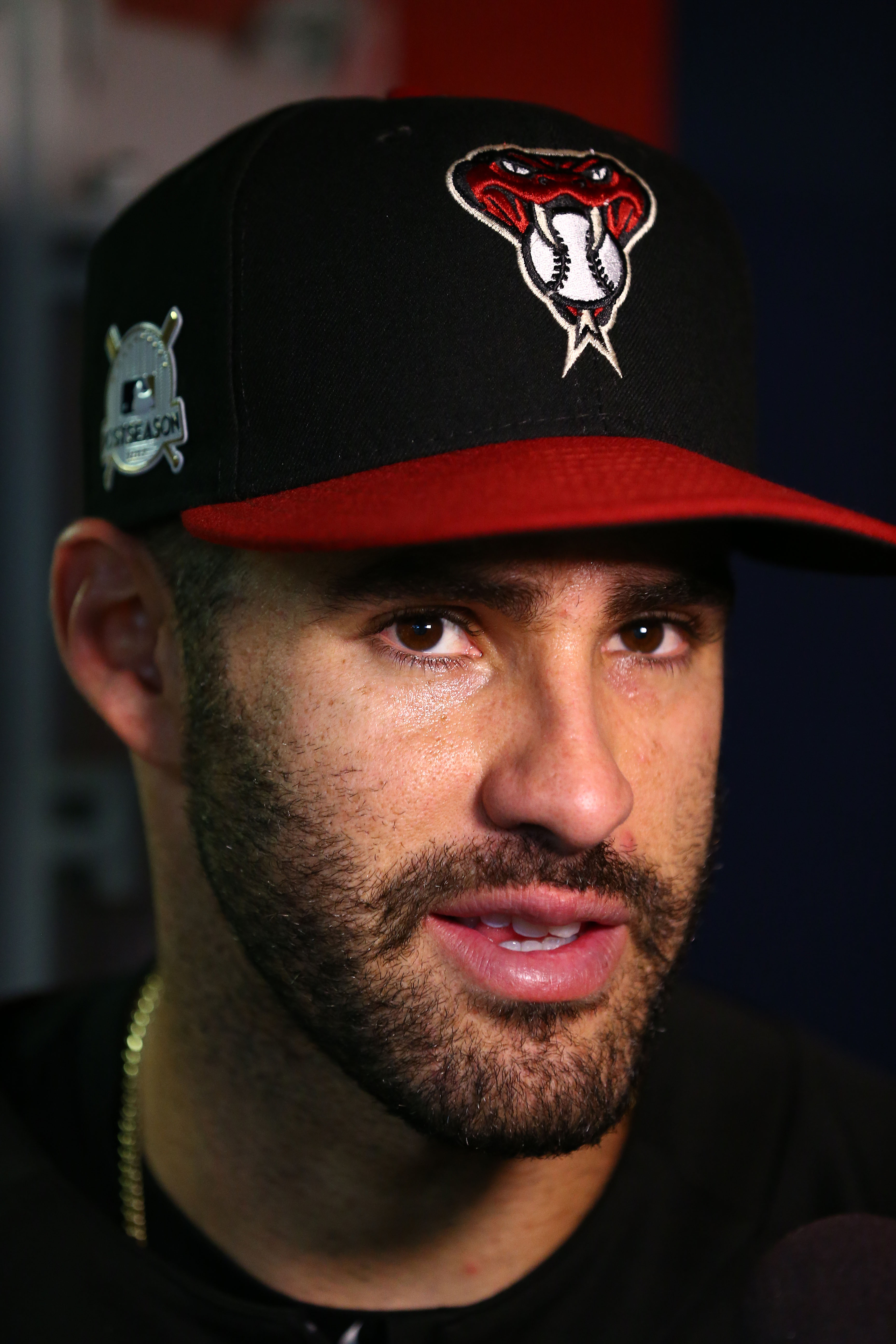
While the aforementioned players are good bets to return to Boston next year, the status of center fielder Jackie Bradley Jr. looks less certain. The Red Sox could trade the 27-year-old Bradley, who’s controllable for three more seasons, move Benintendi from left to center and reel in an offensive force such as J.D. Martinez or Justin Upton via free agency to join Beninendi and Betts in the grass. Martinez and Upton (if he opts out of his contract with the Angels) will come at much higher prices than Bradley, who will earn around $6MM in 2018, but the righty-swingers would likely mash at Fenway Park. And it’s worth noting that Dombrowski has already acquired Martinez in the past. When he was the Tigers’ general manager in 2014, Dombrowski took a flyer on the then-struggling Martinez.
Despite Dombrowski’s familiarity with Martinez, it’s possible the Red Sox will elect to stick with Bradley. Although he had a subpar year offensively, batting just .245/.323/.402 in 541 plate appearances, he was an easily above-average hitter the previous two seasons. Further, even if he doesn’t revisit his 2015-16 levels with the bat, Bradley’s still capable of providing surplus value in other ways. In fact, Bradley ranked third at his position in Defensive Runs Saved (nine) and seventh in Ultimate Zone Rating (4.2) in 2017. He also fared nicely on the bases, placing 11th in FanGraphs’ BsR metric. So, even in a down 2017, Bradley was still part of the overall solution for the Sox.
It’s up in the air whether Boston will have a new outfield alignment next year, whereas change at first base looks highly likely. Moreland is probably going to leave as a free agent, and the Red Sox don’t seem to have a ready-made replacement on hand. Prospect Sam Travis, 24, is fresh off an uninspiring year at Triple-A Pawtucket, where he hit for almost no power across 342 PAs (six home runs, .105 ISO), and didn’t distinguish himself during an 83-PA major league debut in Boston. The Red Sox would be hard pressed to count on him, then, which could point them toward free agency or the trade market for a first baseman.
Free agents-to-be Eric Hosmer, Carlos Santana, Logan Morrison, Jay Bruce and Yonder Alonso all had successful offensive seasons in 2017 and could land on Boston’s radar. On the other hand, Dombrowski has never been shy about making deals and is only a year removed from swinging a blockbuster with the rebuilding White Sox, who have a star first baseman and potential trade candidate in Jose Abreu. The soon-to-be 31-year-old Abreu and his two remaining seasons of team control would warrant a quality haul, but the right-handed slugger and Fenway Park would make for an enticing match.
Whether the Red Sox make a play for Abreu or another high-profile hitter over the winter, it does seem fair to expect an offensive upgrade to come in some form. What do you think Dombrowski will do?
(Poll link for App users)
Will the Red Sox make any major offseason moves to improve their offense?
-
Yes 88% (5,524)
-
No 12% (733)
Total votes: 6,257
Photo courtesy of USA Today Sports Images.