
Rays Unlikely To Move Yandy Diaz, Brandon Lowe
The Rays entered the offseason likely to shed some payroll via trades of veteran players — a frequent reality for the budget-crunched Tampa Bay club — which prompted many (MLBTR included) to speculate on the possibility of trading infielders Yandy Diaz and Brandon Lowe. The Rays are teeming with young infield options, and both players are set to earn eight-figure salaries in 2025. However, teams that have spoken to the Rays about Diaz and Lowe have been given the impression that Tampa Bay is likely to hold onto both players for the start of the upcoming season, reports SNY’s Andy Martino. More broadly, Ken Rosenthal of The Athletic implies that the Rays aren’t keen on subtracting from the offense at all between now and Opening Day.
Tampa Bay has indeed shed some notable salary this winter, but it’s come in the form of trades and non-tenders. Left-hander Jeffrey Springs and his $10.5MM salary in each of the next two seasons went to the A’s in exchange for flamethrowing righty Joe Boyle, a pair of minor leaguers, and the Athletics’ Competitive Balance selection in the upcoming 2025 draft. Jose Siri (projected $2.3MM salary) was traded to the Mets in exchange for reliever Eric Orze. Nearly $10MM of additional projected salary was shed when the team non-tendered outfielder Dylan Carlson and lefties Colin Poche, Tyler Alexander and Richard Lovelady.
That collection of cost-cutting maneuvers trimmed $22-23MM from next year’s books. The only salary of note the Rays have added in place of those departures is the $8.5MM guaranteed to catcher Danny Jansen, who signed with Tampa Bay in mid-December. RosterResource currently projects the Rays for a $76MM payroll and about $104MM of luxury obligations — down from last year’s respective marks of $89MM and $115MM.
One of the motivations behind freeing up payroll space with trades of veterans would be to afford more at-bats to young players with little left to prove in Triple-A (e.g. Jonathan Aranda, Curtis Mead) while also creating flexibility to bring in other free agents of note. Circumstances well beyond the Rays’ control have hobbled any such efforts, however. The damage wrought on Tropicana Field by Hurricane Milton both left the Rays facing even more financial uncertainty than usual and also made it harder to lure free agents. The Rays will play their 2025 home games at a minor league facility — Tampa’s Steinbrenner Field, the Class-A home of the Yankees — which is going to reduce interest for plenty of players on the open market.
The Rays scored the second-fewest runs in MLB last year, with their collective 604 mark leading only the White Sox. Tampa Bay ranked 27th in the majors in batting average (.230), 24th in on-base percentage (.302), 29th in slugging percentage (.366) and 28th in home runs (147). Viewed through that lens, subtracting one or both of Diaz (.281/.341/.414, 120 wRC+) and Lowe (.244/.311/.473, 123 wRC+) would feel counterproductive — at least in a vacuum.
However, the Rays habitually trade quality players as their salaries rise and their club control dwindles. Their willingness to engage in such frequent roster churn and their ability to successfully identify quality long-term contributors in the return for such trades has become a hallmark of the organization’s success and led to near-perennial contention in a stacked AL East — despite bottom-of-the-barrel payroll numbers. Diaz is earning $10MM this coming season and has a $12MM club option (no buyout) in 2026. Lowe will be paid $10.5MM this year and has an $11.5MM club option in 2026 ($500K buyout). Both are free agents in the 2026-27 offseason.
The dwindling club control on both players will make them prime trade candidates this summer if things don’t go well for the Rays or if Tampa Bay feels their production can be replaced by turning their respective positions over to younger options. The Rays aren’t the type of club to be shy about dealing solid contributors from the roster even in the midst of contending seasons.
With regard to the 2025 roster, however, the hope will ostensibly be for inexperienced players like Aranda and third baseman Junior Caminero to make strides at the plate, while other young players like Josh Lowe and Christopher Morel hopefully rebound at the dish. Both had strong showings in 2023 before wilting in 2024. Adding Jansen should be an upgrade to a catching corps that produced disastrous results at the plate in 2024 — even if the longtime Blue Jays backstop can’t recover from his own 2024 struggles with the bat. Jansen hit just .206/.308/.348 in 328 plate appearances last year, but even that would be an upgrade over the woeful .194/.272/.291 output from Tampa Bay backstops in 2024. And, if Jansen can rediscover the .237/.317/.487 form he displayed from 2021-23, it’d be a massive boon for the Rays.
Time will tell just how the Rays’ offense recovers — or fails to recover — from last year’s doldrums. Trades can never be expressly ruled out for a club like the Rays, but for the time being, it seems they’ll hang onto the veteran bats they have and reassess their trade candidacy this summer. Others on the roster (e.g. Pete Fairbanks, Zack Littell) have also come up in trade rumblings this winter, but there’s been some recent cold water thrown on that pair being available as well.
Rays Sign Drew Rasmussen To Extension
The Rays finalized a two-year extension with right-hander Drew Rasmussen on Tuesday afternoon. The Beverly Hills Sports Council client is guaranteed $8.5MM for what would have been his final two arbitration years. The deal includes a 2027 club option that has a base value of $8MM.
He will receive a $500K signing bonus, a $2MM salary next season, and a $5.5MM salary in 2026. The option comes with a $500K buyout. Various escalators could increase the option value by another $12MM. The price could increase anywhere between $1.5MM and $6MM based on Rasmussen’s health over the next two seasons. He could unlock another $6MM based on his start totals in 2026: $500,000 for eight starts, $750,000 for 12, $1MM each for 16 and 20, $1.25MM for 24 and $1.5MM for 28.
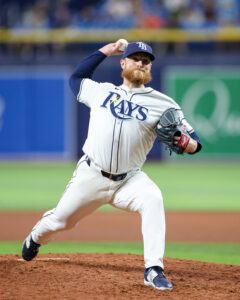
Ramussen, 29, missed the bulk of the 2023-24 seasons recovering from an internal brace procedure to repair the ulnar collateral ligament in his right elbow. That surgery tamped down his workload in both seasons as well as his expected price tag in arbitration. MLBTR contributor Matt Swartz projected a modest $2MM salary for the talented righty in the upcoming season. By virtue of his salary and that signing bonus, he’ll top that sum under this new multi-year arrangement while also sacrificing a year of free agency to lock in some immediate earnings.
It’s an understandable trade-off for Rasmussen, who didn’t get a full look in a big league rotation until his age-26 season (2022) and has since missed ample time due to injury. A sixth-round pick of the Brewers back in 2018, Rasmussen signed for just a $135K bonus and didn’t make his big league debut until 2020. In total, he’s earned under $4MM in his career thus far.
Rasmussen was traded from Milwaukee to Tampa Bay in the 2021 deal that sent Willy Adames to the Brewers. He was sharp down then stretch in a hybrid role for Tampa Bay but had a full-fledged breakout in 2022, That season, Rasmussen pitched a career-high 146 innings and turned in a 2.84 earned run average with a slightly below-average 21.4% strikeout rate against a terrific 5.3% walk rate. He kept the ball on the ground at a strong 46.6% clip. Rasmussen averaged 95.5 mph on his heater, deftly avoided hard contact and recorded a 12.1% swinging-strike rate that suggested more punchouts could be in the tank down the road.
That indeed looked to be the case early in 2023, too. Rasmussen notched an even better 2.62 ERA but saw his strikeout rate spike to 26.6%. He maintained plus command (6.2%) and also saw his ground-ball rate surge to 52.6% — an increase of six percentage points over the prior season. For a span of 36 starts from 2022-23, Rasmussen pitched like a genuine No. 1 or 2 starter — a clear playoff arm who could pitch near the front of any rotation.
Injuries, however, had other ideas for the talented righty. The Rays announced on July 8, 2023 that Rasmussen would require surgery. He wound up missing 13 months of action, returning to a big league mound on Aug. 7 of this past season. The Rays used him primarily as a reliever. He “started” four games but did so throwing only two innings apiece and working as an opener. The results, however, were excellent. In 28 2/3 frames, Rasmussen posted a 2.83 ERA, 30.2% strikeout rate, 5.2% walk rate and 53.3% grounder rate.
The plan now is for Rasmussen to return to the rotation. He’ll join Shane McClanahan (returning from Tommy John surgery), Ryan Pepiot, Taj Bradley, Shane Baz and Zack Littell in a very talented mix of arms. Each of McClanahan, Rasmussen and Baz could face some form of workload limitations, as Baz has yet to pitch a full season since returning from his own ligament surgery in 2022 — though he did pitch 118 2/3 innings combined between Triple-A and the majors in 2024.
For the Rays, there’s little to no impact on their 2025 budget. Rasmussen will only earn a nominal $500K more than his projected arbitration price, thanks to that signing bonus. They’ll also lock in the right-hander’s 2026 salary, gaining some cost certainty. It’s possible that Rasmussen could’ve outpaced that $5.5MM salary in arbitration with a big year, but likely not by much, given the low platform from which he’d be starting. The concession for locking in that ’26 salary is giving up a would-be free-agent season — his age-31 year. So long as he’s healthy, that option will pay him at least $8MM, though with good health there’s a good chance it’ll be a fair bit higher.
While it’s not quite to the same scale as the Rays’ extension with former ace Tyler Glasnow, there are some parallels here. Tampa Bay is putting down some guaranteed money on a talented but oft-injured righty. Glasnow’s $25MM salary in the final season of his own extension was guaranteed, whereas Rasmussen will have to remain healthy to push close to that number. Still, it’s a potentially weighty salary by the Rays’ standards, and one that could render Rasmussen a trade candidate down the road. The extension gives the Rays some extra control over a potential frontline arm but also a viable trade candidate down the road. It’s perhaps cynical to point out the manner in which an extension boosts a player’s trade value in the immediate aftermath of the agreement, but the Rays have a track record of operating in this manner.
For the time being, Rasmussen will head into the season as a locked-in member of a deep and talented rotation. The Rays haven’t done much to improve their middling lineup — though Danny Jansen provides a potential notable upgrade behind the plate. Rather, they’ll apparently hope for big strides from ballyhooed third baseman Junior Caminero and rebounds from Josh Lowe and Christopher Morel, both of whom experienced notable drops at the plate following very productive 2023 campaigns.
Marc Topkin of the Tampa Bay Times first reported that the Rays and Rasmussen were nearing a two-year, $8.5MM extension with an $8MM option for 2027. Topkin reported the presence of escalators in the option, which The Associated Press specified.
Rays Have Previously Expressed Interest In Harry Ford
The Rays have previously expressed interest in Mariners catching prospect Harry Ford, according to Adam Jude of The Seattle Times. There is no indication that Tampa’s interest in the youngster is current or that there are any ongoing trade negotiations between the two clubs.
Ford, 22 in February, was Seattle’s first-round pick in the 2021 draft and is a consensus top-50 prospect in the game. He’s managed to hit well at every level of the minors he’s been exposed to from the moment he kicked off his pro career with a .291/.400/.582 slash line in 19 rookie ball games shortly after being drafted. He made the jump to full season ball in 2022 and found success there as well, slashing .274/.425/.438 at the Single-A level in 2023 before posting a nearly identical .257/.410/.430 slash line at High-A the following year. During both of his stops in A-ball, Ford floated walk rates north of 17% while while flashing 10-to-15 homer power. Most interestingly, he showed off very impressive wheels for a catcher and flashed 25-steal speed on the basepaths.
The youngster hit his first real roadblock in 2024 upon reaching the Double-A level. In his age-21 campaign this past year, Ford hit a solid but unspectacular .249/.377/.367, which was good for a 119 wRC+ at the level. Ford’s 14.1% walk rate remained impressive and he reached new heights on the bases with 35 steals, but his power output cratered as he swatted just seven homers in 523 trips to the plate. Even that relative down season was still noticeably above average relative to his league, however, and that feat is all the more impressive given the fact that Ford was one of just five qualified hitters in the Double-A Texas League who played the 2024 season at age-21 or younger.
While Ford’s bat is generally very well regarded, there are some questions about whether or not he’ll be able to stick behind the plate. Ford’s athleticism has drawn plenty of praise, but he’s a well below average fielder behind the plate at the moment which has led some to suggest he might follow in the footsteps of Daulton Varsho, who was also an athletic and speedy catching prospect through the minor leagues but moved to the outfield early in his big league career. For the time being, however, the Mariners appear poised to continue developing his skills behind the plate.
Given the Rays’ interest in Ford, it seems likely they too believe in his ability to stick behind the plate. Tampa’s needs behind the plate entering the offseason were well-known as they not only lacked a clear complement to Ben Rortvedt at the big league level for 2025 but also have no catching prospects of particular note currently coming through their pipeline. A look at MLB.com’s Top 30 Rays prospects list reveals just two catchers: catching convert Dominic Keegan ranks 13th, while 19-year-old J.D. Gonzalez ranks 27th despite having hit just .161/.268/.198 in his first taste of stateside baseball this past season.
Swinging a deal for Ford would do little to improve the club’s short-term catching situation given the fact that he’s not yet reached the Triple-A level and is still considered very raw behind the plate defensively. With that being said, the Rays already addressed their immediate need at catcher by signing Danny Jansen to a one-year deal, slotting him in ahead of Rortvedt in the club’s catching tandem. That leaves the club fairly set behind the plate for 2025, but those questions figure to come up once again when Jansen departs for free agency a year from now. Adding a top catching prospect like Ford who’s around a year away from the majors would make some sense for the Rays, then, allowing Jansen to serve as a bridge to the future of the position this year.
Even as Ford still makes sense as a potential trade target for the Rays, however, it’s fair to wonder how likely a deal coming together is even if Tampa remains interested in the young catcher. The Mariners are well known to be in the market for infield help this winter, having previously spoken to the Cubs and Phillies about Nico Hoerner and Alec Bohm. Those talks haven’t appeared to gain much traction, which makes pivoting to a Rays infielder like Yandy Díaz or Brandon Lowe at least theoretically feasible for Seattle.
With that being said, Diaz and Lowe figure to be key cogs in a Rays lineup that struggled to create runs last year, and with no apparent need to cut payroll further after dealing Jeffrey Springs to the A’s it’s unclear whether either player would even be available this winter. Perhaps a deal could be worked out involving a less-established Rays infielder like Jonathan Aranda, Curtis Mead, or Osleivis Basabe, but it’s unclear whether the Mariners would be interested in adding a youngster of that variety or are more focused on established players with a big league track record.
Rays Sign Coco Montes To Minor League Deal
The Rays have agreed to a minor league contract with infielder Coco Montes, reports Marc Topkin of the Tampa Bay Times. The deal comes with an invitation to spring training. Montes last played for the Yomiuri Giants of NPB. He is a client of O’Connell Sports Management.
Selected by the Rockies late in the 2018 draft, Montes worked his way up through Colorado’s farm system. Though he was never a highly-rated prospect, he produced above-average offensive numbers every season in the minors while splitting his time between second base, third base, and shortstop. Amidst a strong 2023 season at Triple-A Albuquerque (.317/.400/.550, 128 wRC+), Montes earned his first promotion to the majors. However, his minor league success failed to translate to the MLB level. He went 7-for-38 (.184) with a 38 wRC+. To add insult to injury, he managed to accumulate -3 Outs Above Average in a minuscule 93-inning sample size at second base. He was designated for assignment and outrighted to Triple-A in September.
Montes earned an invitation to big league spring training in 2024, but he failed to make the team out of camp. Undeterred, he continued hitting well at Triple-A in 2024. In fact, it was arguably the best season of his career. In 297 trips to the plate, he slashed .335/.414/.551, good for a 140 wRC+. Yet, the Rockies never gave him another chance to test his righty bat in Colorado. Rather, they granted him his release in June, allowing him to sign with the Yomiuri Giants in Japan.
In 46 games with the Giants, Montes slashed .272/.308/.391 with a .699 OPS. That might not seem as impressive as his Triple-A slash lines, but keep in mind that he was playing in a completely different offensive environment. Indeed, Montes outperformed the Central League averages in all three triple-slash categories. His 13.2% strikeout rate was also much better than the 18.8% league average. That low strikeout rate helped him produce above-average offensive numbers despite drawing just seven walks and hitting only one home run.
Now entering his age-28 season, Montes will look to make his way back to MLB with the Rays. His defensive versatility is his main asset; Topkin suggests he could cover left field in addition to playing all around the infield. If the Rays can help him translate some of his offensive success from Triple-A and NPB to the majors, even better.
Topkin also points out that Montes will have opportunities to opt out of his contract if he does not make the big league roster. In addition, he will have the choice to elect free agency at the end of the 2025 season.
Rays Sign Eloy Jimenez To Minor League Deal
3:13 pm: Jimenez will earn a guaranteed $2MM salary if he makes it onto the team, reports Héctor Gomez of Z101 Digital. He can earn an additional $2MM in playing time incentives.
12:13 pm: The Rays are in agreement with designated hitter Eloy Jimenez on a minor league deal, per a report from Jesse Rogers of ESPN. The deal presumably includes an invite to major league Spring Training.
Jimenez, 28, signed with the Cubs out of the Dominican Republic as an international amateur and made his pro debut in 2014. He quickly rocketed up prospect rankings and was eventually included alongside Dylan Cease in the crosstown trade that brought Jose Quintana to Wrigley Field. Jimenez’s top prospect star continued to shine with the White Sox, and they eventually signed him to a long-term deal prior to his big league debut in 2019. The $43MM guarantee gave Chicago control over Jimenez for eight seasons in a record-setting deal for a prospect who had not yet made his big league debut.
The deal initially looked like something of a coup as the slugger burst onto the scene in the majors with a fourth-place finish in AL Rookie of the Year voting in 2019 before Jimenez slashed .295/.332/.559 (138 wRC+) with 14 homers in just 55 games during the shortened 2020 season. Jimenez’s excellent offense helped to lead the White Sox to their first playoff appearance since 2008, and while they fell to the A’s in three games it seemed as though the South Siders were in position to compete for years to come with Jimenez as a key part of the core.
Things didn’t turn out that way, unfortunately. Jimenez was limited to just 139 games and 558 trips to the plate over the next two seasons due to a myriad of injuries, and while he posted a 125 wRC+ during that time the missed time combined with Jimenez’s lackluster defense in the outfield led Chicago to make him more or less a full-time DH going forward. While Jimenez stayed healthy enough to play 120 games in 2023, his offense left much to be desired as he slashed just .272/.317/.441 with 18 homers in 489 trips to the plate. That was good for a 105 wRC+ which, while above average, left him as a roughly replacement level DH (0.6 fWAR).
After losing 101 games in 2023, the White Sox were surely hoping Jimenez would rebound enough in 2024 to build up his trade value and bring in an interesting piece or two for the rebuild they had kicked off by trading away Dylan Cease and declining Tim Anderson‘s club option during the offseason. Unfortunately, the slugger did anything but as he turned in by far the worst performance of his career in 2024. In 98 games with the White Sox and Orioles, Jimenez hit a paltry .238/.289/.336 and was worth -0.9 fWAR. That below replacement level production made it an easy decision for Baltimore to cut him loose this winter, making him a free agent for the first time in his career.
That’s led him to the Rays, who are coming off a disappointing 2024 season in large part thanks to a lackluster offense. Given Jimenez’s own offensive struggles, he’s hardly a guarantee to help with that. But adding a bat with his potential upside on a minor league deal can’t hurt the club’s efforts to but forth a stronger lineup in 2025, and even if Jimenez only manages the 105 wRC+ he posted 2023 that would still be an upgrade over the 97 wRC+ the Rays got out of their DH slot last year. Should Jimenez make the roster out of camp, he’d join youngsters like Christopher Morel, Jonathan Aranda, and Jonny DeLuca in vying for playing time in the outfield and at DH.
Wil Myers Ends Playing Career
Wil Myers has decided to call it a career after 11 big league seasons, the longtime Padres first baseman/outfielder told MLB.com’s AJ Cassavell. While Myers stressed that he wouldn’t ever “officially” retire, he made his decision in June 2023 after he’d been released by the Reds and was dealing with some shoulder problems.
“I had a great career. I loved what I did. I made a lot of great friends. I have no regrets,” Myers said. “If you had told me the day I was drafted that this would be your career, I would’ve taken it in a heartbeat. I loved what I did, and now it’s just kind of onto the next chapter of life.”
Myers, who just recently turned 34, will hang up his glove after an even 1100 career games with the Rays, Padres, and Reds from 2013-23. Myers hit .252/.326/.437 with 156 home runs over 4290 plate appearances, good for a 107 wRC+ during his time in the Show. He spent the majority of his time in the field as a first baseman and right fielder, but also with a big chunk of time at the other two outfield positions and some time at third base (primarily in 2018, when the Padres had several first base/outfield types they were trying to fit into the lineup).
A third-round pick for the Royals in the 2009 draft, Myers quickly became one of baseball’s most highly-touted prospects, and made headlines before his MLB career even began due to his involvement in a blockbuster trade. In December 2012, the Royals sent Myers, Jake Odorizzi, Mike Montgomery, and third-base prospect Patrick Leonard to Tampa Bay in exchange for James Shields, Wade Davis, and Elliot Johnson. Kansas City’s farm system was viewed as deep enough that it could afford to move even a top prospect like Myers in exchange for win-now help, and the decision paid off — K.C. won the AL pennant in both 2014 and 2015, and Davis was one of the relief aces of the Royals’ 2015 World Series title team.
For the Rays, the deal paid some immediate dividends, as Myers won AL Rookie of the Year honors in 2013 on the strength of 13 homers and a .293/.354/.478 slash line over 373 plate appearances. However, Myers then battled wrist injuries and the sophomore slump in 2014, leading to his involvement in an even bigger trade. The Rays, Padres, and Nationals combined on a mammoth three-team, 11-player deal that is perhaps best remembered today as the swap that brought Trea Turner to Washington (and thus setting the table for the Nats’ 2019 World Series championship).
From Myers’ perspective, the deal kicked off an eight-year run in San Diego that was overall a success, albeit with plenty of ups and downs. Much of his time with the Padres is viewed through the lens of the six-year, $83MM extension he signed prior to the 2017 season, which at the time was the largest contract in San Diego franchise history. The big salary inevitably led to higher expectations that Myers didn’t entirely fulfill, as injuries and a propensity for strikeouts limited Myers’ production.
That said, Myers still had plenty of notable performances over the length of the deal. Myers was an All-Star in 2016, hit 30 homers during the 2017 season, and was one of the best hitters in baseball during the pandemic-shortened 2020 campaign. That 2020 campaign was particularly notable since the Padres earned a wild card berth, marking San Diego’s first postseason appearance since 2006 and the official end of the team’s lengthy rebuild. Ironically, Myers’ contract made him difficult to trade amidst the Padres’ other cost-cutting moves, and as a result, Myers ended up being “the one player on hand for the entirety of the franchise’s turnaround,” Cassavell writes.
As the 2022 season rolled along, Myers became a part-time player and was again hampered by injuries, so it was no surprise when the Padres declined their $20MM club option on Myers’ services for the 2023 season. A free agent for the first time in his career, Myers landed in Cincinnati on a one-year deal worth $7.5MM in guaranteed money, but he hit only .189/.257/.283 in 141 PA over what will end up as his final season in the majors.
MLBTR congratulates Myers on a fine career and we wish him all the best in his post-playing endeavors.
Rays Notes: Littell, Outfield, Caballero, Front Office
The Rays made a long-awaited trade from their rotation depth last week when they packaged left-hander Jeffrey Springs and reliever Jacob Lopez in a deal with the A’s that brought back right-hander Joe Boyle, two minor leaguers, and a pick in Competitive Balance Round A of the 2025 draft. Prior to that deal, Springs was viewed alongside right-hander Zack Littell as the two most likely Rays hurlers to be moved this winter. Now that Springs is off the board, however, ESPN’s Jeff Passan suggests that the Rays are “less likely” to part with Littell this winter.
That’s not exactly surprising. After all, while the Rays have a considerable rotation surplus with a number of excellent potential arms, those arms generally come with question marks. Shane McClanahan and Drew Rasmussen will both have recently returned from elbow surgery and could see their innings managed, while youngsters like Shane Baz, Ryan Pepiot, and Taj Bradley have never even thrown 150 innings in a big league season before in their careers. That leaves Littell, who threw 156 1/3 innings of work across 29 starts for the Rays last year, as potentially the club’s most durable arm headed into 2025. Given the frequency with which pitchers get hurt in the modern game, having a sixth starter locked and loaded is hardly a bad idea in case of injuries for any club, to say nothing of the value it could provide a club with a rotation that sports as many injury risks as the Rays’ does.
Of course, it’s impossible to rule out a trade completely when discussing a player with just one year remaining before free agency on the Rays. The club’s front office typically attempts to cash in their players on the trade market before they reach free agency, and even if Littell starts the season with the Rays a midseason trade can’t be ruled out. With that said, Marc Topkin of the Tampa Bay Times recently suggested that the club might be more or less done making moves after dealing Springs and adding Danny Jansen in free agency. One place Topkin suggests the club could look to make an addition is in the outfield, particularly if a lefty bat were to fall into the club’s lap in free agency or via trade. Topkin makes particular mention of Joc Pederson and Jurickson Profar as hypothetical options, though he’s quick to note that either player would surely need to see their market in free agency crater before they’d become realistic options for the Rays as things stand.
A more likely outcome in Topkin’s view seems to be going with internal options. That could include giving infielder José Caballero a serious look in the outfield. With Josh Lowe locked into one starting outfield spot and some combination of Jonny DeLuca, Christopher Morel, and Richie Palacios slated to handle the rest of the playing time on the grass as things stand, mixing Caballero in would give the club additional depth in the outfield should they fail to make an external addition. It’s easy to imagine Caballero’s strong glove at shortstop translating fairly well to the outfield grass, and getting a speedster who stole an AL-best 44 bases in just 483 plate appearances last year into the lineup more regularly could help to spark the club’s offense. With that being said, Caballero’s .227/.283/.347 (83 wRC+) slash line last year likely isn’t enough to make it as an outfield regular unless he proves to be a plus defensive option in center.
Turning to off-the-field matters, Topkin also reports that the club currently has no plans to install a GM beneath president of baseball operations Erik Neander. Current Marlins president of baseball operations Peter Bendix served as GM of the Rays under Neander before taking his current gig with Miami last winter, but Topkin suggests that the club’s current set up of two vice presidents and four assistant GMs serving as Neander’s top lieutenants suits the Rays just fine and that Bendix’s title will remain unfilled for the foreseeable future.
Rays, Joey Gerber Agree To Minor League Deal
The Rays are in agreement with reliever Joey Gerber on a minor league contract, reports Marc Topkin of the Tampa Bay Times. The right-hander receives a non-roster invitation to MLB camp.
Gerber, 27, is attempting to get to the big leagues for the first time in five years. The Illinois product debuted with the Mariners during the shortened 2020 season. He allowed eight runs (seven earned) across 15 2/3 innings. A forearm injury essentially robbed him of the next two years, leading the Mariners to release him midway through the ’22 season. Gerber caught on with the Yankees shortly after being released by Seattle, but injuries continued to plague him. He missed all of 2023 and spent the first half of this past season on the minor league IL.
In late June, Gerber was finally healthy enough to be reinstated. The Yankees assigned him to Double-A Somerset. He struck out 18 while only allowing three runs across 15 1/3 frames. That earned him a bump to Triple-A Scranton/Wilkes-Barre. Gerber wasn’t quite as dominant as he’d been in Double-A. He tossed 14 innings and allowed 10 runs (six earned). He punched out 15 and issued eight walks.
Gerber’s fastball averaged 93.5 MPH during his Triple-A work this year. That’s in line with his velocity from his 2020 debut campaign. He got swinging strikes on a solid 13.4% of his offerings for Scranton. The arm strength and swing-and-miss were intriguing enough for the Rays to give him a non-roster camp invitation. If Gerber is able to stay healthy, he could find his way into Kevin Cash’s bullpen at some point.
Naoyuki Uwasawa Signs With NPB’s SoftBank Hawks
Right-hander Naoyuki Uwasawa‘s foray into North American ball will come to a close after one season. The SoftBank Hawks of Japan’s Nippon Professional Baseball announced this week that they’ve signed the 30-year-old righty to a four-year contract (link via The Mainichi).
Uwasawa signed a non-guaranteed deal with the Rays last offseason as he looked to make the jump to Major League Baseball on the heels of a nice nine-year run with NPB’s Nippon-Ham Fighters. He only spent spring training with Tampa Bay, however, as he triggered an assignment clause in his minor league deal at the end of camp when he was told he wouldn’t make the team. That prompted a trade to the Red Sox, who sent cash back to the Rays and selected Uwasawa to the 40-man roster the following day.
Uwasawa only wound up pitching in two games with Boston. He gave the Red Sox four innings of one-run ball across those two appearances but didn’t get a longer look, due in large part to his struggles down in Triple-A Worcester. The soft-tossing righty was hammered for a 7.63 ERA over 59 1/3 innings, during which time he fanned 16.8% of his opponents against a 12.9% walk rate. For a pitcher who was never a big strikeout arm in Japan but offset the lack of punchouts with sharp command, the walks were as uncharacteristic as they were problematic.
The Red Sox passed Uwasawa through waivers unclaimed in July. He was assigned outright to Triple-A and became a minor league free agent at season’s end. While there may have been some interest from other MLB clubs on a minor league deal, a four-year guarantee to return home to Japan understandably appears to have been too tempting for the right-hander to overlook.
Uwasawa will head back to Japan and look to build on what’s already a fine track record in NPB. He’s pitched 1118 1/3 innings at Japan’s top level and turned in a 3.19 ERA, a 70-62 record, a 19.7% strikeout rate and a 7.5% walk rate (though his strikeout rate has dwindled as his walk rate has improved further in recent NPB seasons).
MLBTR Podcast: Kyle Tucker To The Cubs, And Trades For Devin Williams And Jeffrey Springs
The latest episode of the MLB Trade Rumors Podcast is now live on Spotify, Apple Podcasts, and wherever you get your podcasts! Make sure you subscribe as well! You can also use the player at this link to listen, if you don’t use Spotify or Apple for podcasts.
This week, host Darragh McDonald is joined by Anthony Franco of MLB Trade Rumors to discuss…
- The Cubs acquiring Kyle Tucker from the Astros for Isaac Paredes, Hayden Wesneski and Cam Smith (1:45)
- The Yankees acquiring Devin Williams from the Brewers for Nestor Cortes and Caleb Durbin (17:20)
- The Athletics acquiring Jeffrey Springs and Jacob Lopez from the Rays for Joe Boyle a draft pick and two prospects (27:55)
- The Orioles signing Tomoyuki Sugano to a one-year deal (36:00)
- The hot pitching market could push pitchers onto the trade market, including Luis Castillo of the Mariners, Dylan Cease of the Padres and Jesús Luzardo of the Marlins (40:25)
Check out our past episodes!
- Winter Meetings Recap – listen here
- Blake Snell, Dodger Fatigue, And The Simmering Hot Stove – listen here
- Yusei Kikuchi, The Aggressive Angels, And The Brady Singer/Jonathan India Trade – listen here
The podcast intro and outro song “So Long” is provided courtesy of the band Showoff. Check out their Facebook page here!