
White Sox Outright Four Players
The White Sox announced Friday that outfielder Brian Goodwin, right-hander Evan Marshall, right-hander Jimmy Cordero and left-hander Jace Fry have cleared outright waivers and been removed from the 40-man roster. All four will become free agents. Chicago has also selected the contract of left-hander Anderson Severino from Triple-A Charlotte, bringing their current 40-man roster to a total of 34 players.
Signed to a minor league deal during the season, the veteran Goodwin was quickly brought to the big league club as the Sox found themselves reeling from injuries to Eloy Jimenez and Luis Robert. While Goodwin’s overall .221/.319/.374 batting line doesn’t stand out, he played a vital role in stabilizing the outfield mix over the summer, and that end-of-season line was dragged down by a pronounced slump late in the year. From mid-June through mid-August, when the Sox’ outfield need was at is peak, Goodwin turned in a .246/.331/.465 batting line through 161 plate appearances, chipping in seven homers, eight doubles and a triple.
Unfortunately, things went south in a hurry. Goodwin hit just .183/.300/.237 in his final 110 plate appearances, ceding at-bats to both Robert and Jimenez as they returned from injury. Goodwin, who turned 31 earlier this week, will head back to the free-agent market as a lifetime .244/.318/.440 hitter in 1395 plate appearances between the Nats, Angels, Royals, Reds and ChiSox.
Marshall, also 31, is set for Tommy John surgery this week and will likely miss the entire 2022 season, so it’s no surprise to see the Sox remove him from the roster. It’s possible they’ll look to re-sign him to a minor league pact so he can rehab with the team but not occupy a 40-man spot all winter, though he’ll have the opportunity to talk with other clubs now.
A minor-league signee after being cut loose by Cleveland following the 2018 season, Marshall pitched well with the ChiSox from 2019-20, notching to a 2.45 ERA with a 23.5% strikeout rate and against a 10.3% walk rate. He struggled to an ERA of 5.60 in 27 1/3 innings this season, however, before going on the injured list and eventually being diagnosed with a ligament tear that will necessitate that Tommy John procedure.
The 30-year-old Cordero underwent Tommy John surgery himself this year but did so way back in March, meaning he’ll likely be ready early in the 2022 season. The 6’4″, 240-pound righty had a nice run with the 2019 Sox after they picked him up off waivers, notching a 2.75 ERA in 36 frames. That ERA jumped to 6.08 in 2020, however, thanks in no small part to a sky-high .352 average on balls in play and a fluky 59.6% strand rate. (Cordero’s 3.87 FIP was more than two runs lower than his ERA.) Cordero hasn’t found much MLB success yet, but he boasts a career 97.8 mph average on his heater and ought to find several clubs interested in a minor league deal/Spring Training invite.
Fry, 28, posted a 4.43 ERA and punched out 29.6% of his opponents in 126 frames for the White Sox from 2018-20, but back surgery limited him to just 6 2/3 innings this season — during which time he allowed eight runs. Fry has little issue missing bats but has walked an untenable 14% of the opponents he’s faced in the big leagues. Still, a lefty who sits around 93 mph with his heater and can punch out roughly 30% of his opponents should find teams willing to take a look this winter, assuming he’s back up to full strength.
Severino, 27, could’ve become a minor league free agent were he not added to the team’s 40-man roster. He signed a minor league pact after spending the 2014-20 seasons in the Yankees organization and gave the White Sox 45 2/3 innings of 2.36 ERA ball with a 27.3% strikeout rate but a bloated 16.5% walk rate between Double-A and Triple-A. His walk rate did improve upon moving up to Triple-A, and the hard-throwing southpaw certainly missed plenty of bats. Rather than let him pursue a deal with another club, the Sox will carry him on the 40-man roster, making him an option out of the bullpen at any point next season.
Guardians Exercise Option On Jose Ramirez, Decline Option On Roberto Perez
The Guardians announced Friday that they’ve exercised their 2022 club option on third baseman Jose Ramirez and declined a club option on catcher Roberto Perez, making him a free agent for the first time in his career. Cleveland also confirmed the previously reported hiring of Chris Valaika as the team’s new hitting coach.
Ramirez’s $12MM option was among the easiest option calls any team will ever have to make. His contract also contains a $14MM club option for the 2023 season. Perez, meanwhile, will receive a $450K buyout in lieu of a $7MM option and explore the open market.
There was never a shred of doubt that Ramirez’s option would be picked up. The 29-year-old has cemented himself as one of the game’s elite players and lived up to that billing once again in 2021, slashing .266/.355/.538 with 36 home runs, 32 doubles, five triples, 27 stolen bases and elite defense at the hot corner.
With just two years remaining on his contract, Ramirez will surely be the subject of offseason trade inquiries, but Cleveland needn’t feel obligated to move him unless an absolutely mammoth trade offer is made. Ramirez’s contract is the only one on the books for the team in 2022, and with a modest arbitration class there’s no real financial concerns for Cleveland, even if the hope is to again operate on a relatively stripped-down payroll. Suffice it to say, president of baseball ops Chris Antonetti and GM Mike Chernoff will have plenty of leverage if (when) clubs do come calling about Ramirez.
For all the speculation about a potential Ramirez trade, however, it’s important to note that there’s no reason Cleveland can’t seek to contend in 2022. Ramirez will return alongside a core that features Shane Bieber, Aaron Civale, Triston McKenzie and 2020 breakout arm Cal Quantrill. The lineup is rife with question marks, but Amed Rosario hit well in his first season with the club and there are several top-end prospects on the cusp of big league readiness. For the first year under a rebranded moniker, it’s only sensible that the Guardians would look to put out a more compelling product.
As for Perez, he’s been unable to replicate his breakout 2019 showing at the plate — a season that saw him swat 24 home runs and post a .239/.321/.452 batting line. Paired with his excellent defense, that offensive output made Perez one of baseball’s best all-around catchers in 2019. Since then, he’s dealt with a pair of shoulder injuries and a fractured finger. It’s quite obviously possible that the arm/hand injuries have combined to sap Perez’s production, but with a more affordable and comparably strong defender available in the form of Austin Hedges, Cleveland unsurprisingly chose to move on.
White Sox To Decline Option On Cesar Hernandez
The White Sox will decline their $6MM club option on second baseman Cesar Hernandez, reports ESPN’s Jesse Rogers (via Twitter). There’s no buyout on that option. Hernandez will become a free agent once the move is made official.
Hernandez slugged a career-high 21 home runs between Cleveland and Chicago this season but did so with a lackluster .232/.308/.386 batting line on the whole. He was more productive prior to the trade (.231/.307/.431) than he was after being moved (.232/.309/.299). Just three of Hernandez’s 21 long balls came with the White Sox.
Chicago’s acquisition of Hernandez was necessitated by a hamstring tear to Nick Madrigal, the former No. 4 overall pick whom the South Siders had pegged as the second baseman of the future. That unfortunate injury also set the stage for the Sox to boldly trade an injured Madrigal, controlled another five seasons, in a crosstown deal that netted Cubs closer Craig Kimbrel. The entire gambit fell shy of the front office’s hopes, and the ChiSox now face both a tough decision on Kimbrel’s $16MM option and a long-term hole at second base.
Hernandez might’ve been a reasonable stopgap, but the White Sox’ decision to cut him loose points to the likelihood that the 2021 AL Central champs have their sights set higher. With the Twins expected to reload and try for better results in 2022, the Tigers expected to spend aggressively this winter and the Royals moving into win-now mode as their own top prospects bubble to the surface in the big leagues, next year’s AL Central could be the most competitive it’s been in years.
Chicago’s decision to move on from Hernandez also speaks to the potential that he’ll find a rather tepid market for his services this winter. Hernandez has long been a solid regular at second base, but his two prior dalliances into free agency haven’t produced a multi-year deal. He’ll now hit the market on the heels of his weakest all-around showing since 2014 and in advance of his age-32 season — an obviously suboptimal set of circumstances.
Hernandez signed a one-year, $5MM guarantee off a much better showing in the 2020-21 offseason, and the Sox are effectively indicating that the market doesn’t value him at $6MM on a one-year term. Hernandez could have to settle for a lower base salary on an incentive-laden deal as he looks to recapture the form that saw him bat .280/.357/.396 in more than 2800 plate appearances from 2016-20.
Joc Pederson Declines Mutual Option
Braves outfielder Joc Pederson has declined his end of a $10MM mutual option in favor of a $2.5MM buyout, the Associated Press reports. Unlike teammate Adam Duvall, who also declined a mutual option this week, Pederson has more than six years of Major League service time and is thus a free agent now that he’s declined his end of the option.
Signed by the Cubs to a one-year deal last winter, Pederson was guaranteed $7MM in the form of a $4.5MM base salary and the $2.5MM buyout on the option he’s now declined. He can’t receive a qualifying offer by virtue of the fact that he was traded midseason (from Chicago to Atlanta), though it’s unlikely he’d have been a candidate for such an offer anyhow.
Pederson, 30 in April, posted similar overall numbers in 256 plate appearances with the Cubs and 173 plate appearances with the Braves, resulting in an overall .238/.310/.422 batting line on the season. He connected on 18 home runs, 19 doubles and three triples.
It’s perhaps encouraging that the left-handed-hitting Pederson, who has some longstanding struggles against left-handed pitching, hit lefties at a solid .265/.348/.378 clip in 2021 — albeit in a small sample of 112 plate appearances. However, it’s also concerning that his typically outstanding production against right-handers dwindled; in 369 plate appearances with the platoon advantage, Pederson slashed an uncharacteristically pedestrian .230/.298/.435.
When the page flipped to the postseason, the “Joctober” narrative took full effect, as Pederson clubbed a pair of pivotal pinch-hit home runs during Atlanta’s NLDS victory over the Brewers. Pederson homered early in the NLCS as well, but his bat went dormant for the remainder of the postseason, as he finished out the playoffs in a 2-for-26 swoon with a walk and eight strikeouts. It’s worth pointing out that, fun as the “Joctober” moniker may be, his career postseason line of .256/.332/.482 now quite closely resembles his lifetime .232/.332/.462 regular-season batting line.
Pederson will now head back out into what he hopes will be a healthier free agent market than he encountered last winter, when many clubs simply opted not to spend on the heels of a 2020 season played without ticket revenues. The expiring collective bargaining agreement will create similar uncertainty for free agents, but it’s likelier that teams will be more amenable to spending than they were last time around. Pederson’s 2021 showing didn’t exactly send his free-agent stock soaring, but it was still an improvement over a woeful .190/.285/.397 showing from that 2020 season. A multi-year deal seems possible, but with a fairly deep crop of corner outfielders available in free agency, he might settle for a second consecutive one-year pact.
Kyle Schwarber Declines Mutual Option
Red Sox outfielder Kyle Schwarber declined his half of an $11.5MM mutual option and is now a free agent, per the Associated Press. Schwarber signed a one-year, $10MM contract with the Nationals last winter — a deal that guaranteed him a $7MM salary in 2021 plus a $3MM buyout on the option he’s now declined. The Red Sox will not be able to issue a qualifying offer, as he’s ineligible to receive one after being traded from Washington to Boston midseason.
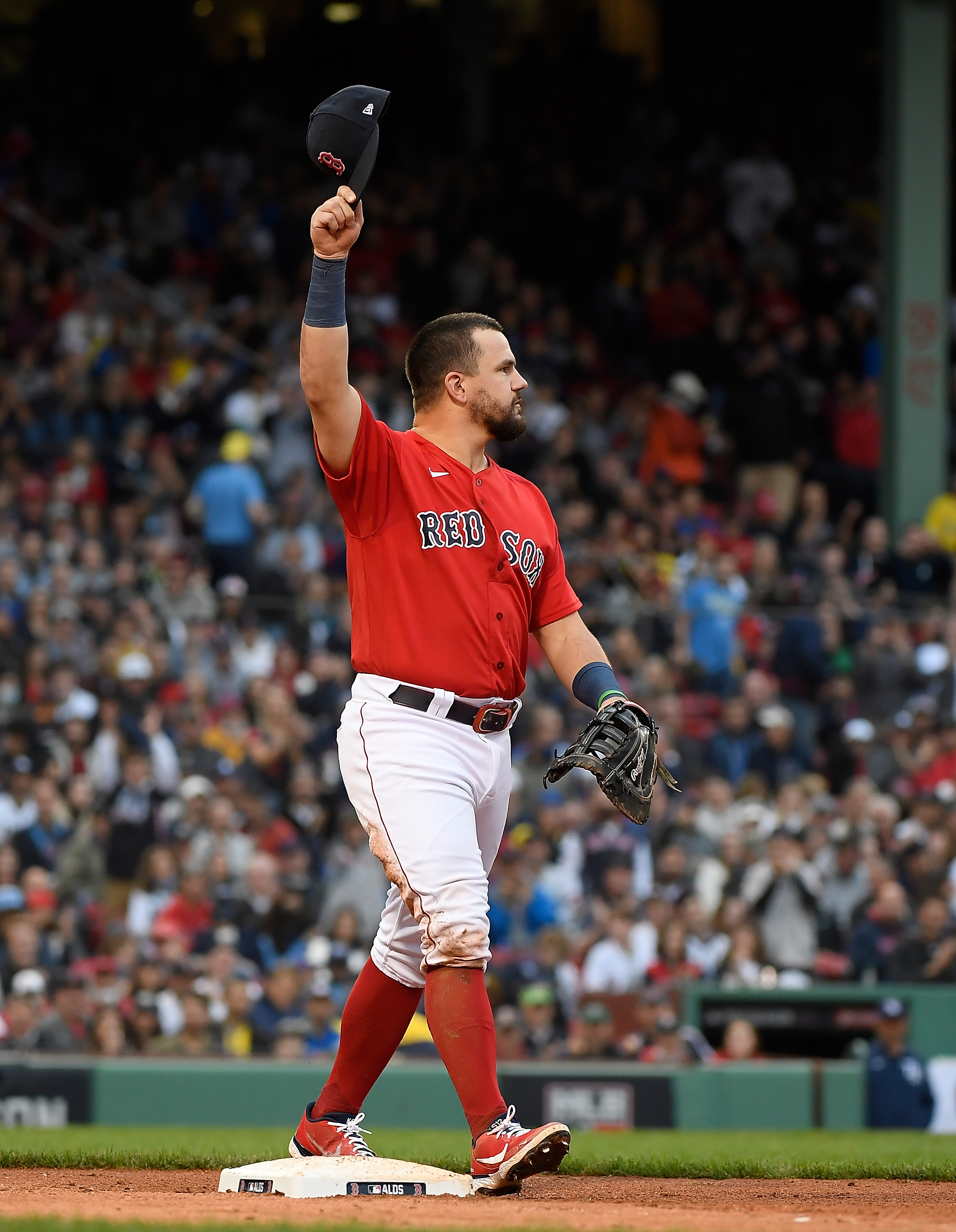
It was a season to remember for the 28-year-old Schwarber, who opened the year with a rather pedestrian two-month stretch in D.C. before embarking on one of the great hot streaks in the history of Major League Baseball. The former No. 4 overall draft pick carried a .218/.312/.404 batting line through his first 215 plate appearances in Washington, making the Cubs’ decision to non-tender him the prior winter look at least somewhat justified. From that point forth, however, Schwarber found another gear and delivered the best production of his career.
On June 12, Schwarber went 1-for-3 with a solo homer in the first game of a doubleheader. An inauspicious game in and of itself, that kicked off a prodigious stretch that saw Schwarber blast a near-unfathomable 16 home runs in a span of 18 games — a total of just 77 plate appearances. From June 12 through July 2, Schwarber posted a Herculean .338/.409/.974 batting line. It looked as though no pitcher could stop Schwarber at that point, but unfortunately for both him and the Nats, an injury could. A hamstring strain landed Schwarber on the injured list on July 3, and during his absence, a free-falling Nats club engineered a rare (for them) fire sale that saw an injured Schwarber traded to the Red Sox.
The Sox knew full well that Schwarber wouldn’t be ready for a bit at the time of his acquisition, but his activation on Aug. 13 was rather surprising. The Sox, facing some dire needs in the lineup, reinstated Schwarber from the injured list after a six-week layoff without even sending him out on a minor league rehab assignment. And yet, despite being dropped cold into the throes of the AL East, Schwarber immediately resumed his juggernaut status at the plate.
In 168 plate appearances down the stretch with the Sox, Schwarber mashed at a .291/.435/.522 clip with seven home runs and 10 doubles. The hot streak carried on into the postseason, where Schwarber opened with a 9-for-32 showing with three home runs — including an epic Game 3 ALCS grand slam. That proved to finally be the stopping point for Schwarber, however, as he was held hitless in his next 16 plate appearances as the Astros came back to topple the Sox and end their season.
Schwarber played in just 113 regular season games but nevertheless belted 32 home runs while slashing a stout .266/.374/.554 with a 13.6% walk rate and a 27.0% strikeout rate. He won’t win any awards for his glovework in the outfield, and his brief foray at first base wasn’t exactly smooth sailing. However, the the likely advent of the designated hitter in the National League and a mammoth showing at the plate, Schwarber should see a robust market for his services this winter.
Teams may still have some questions about Schwarber’s ability to handle lefties. He hit .268/.389/.398 against them in 2021, albeit with a .377 average on balls in play and in only 149 plate appearances. In 435 prior plate appearances against southpaws, from 2015-20, Schwarber managed only a .197/.301/.348 output. He did cut his strikeout rate and improve his walk rate against southpaws in 2021, however, so the gains weren’t solely BABIP-driven. The extent to which he can sustain (or build upon) those improvements against lefties will be pivotal to Schwarber’s market, but regardless, he’s positioned himself as one of the top bats of the offseason.
Nick Castellanos To Exercise Opt-Out Clause
Reds right fielder Nick Castellanos has exercised the opt-out clause in his contract and will reenter the free agent market, reports MLB Network’s Jon Heyman (Twitter link). The Scott Boras client had two years and $34MM remaining on his contract but will seek a lengthier contract (and a heftier annual value) on the open market. The Reds can, and surely will, extend an $18.4MM qualifying offer to Castellanos — which he’s a lock to reject.
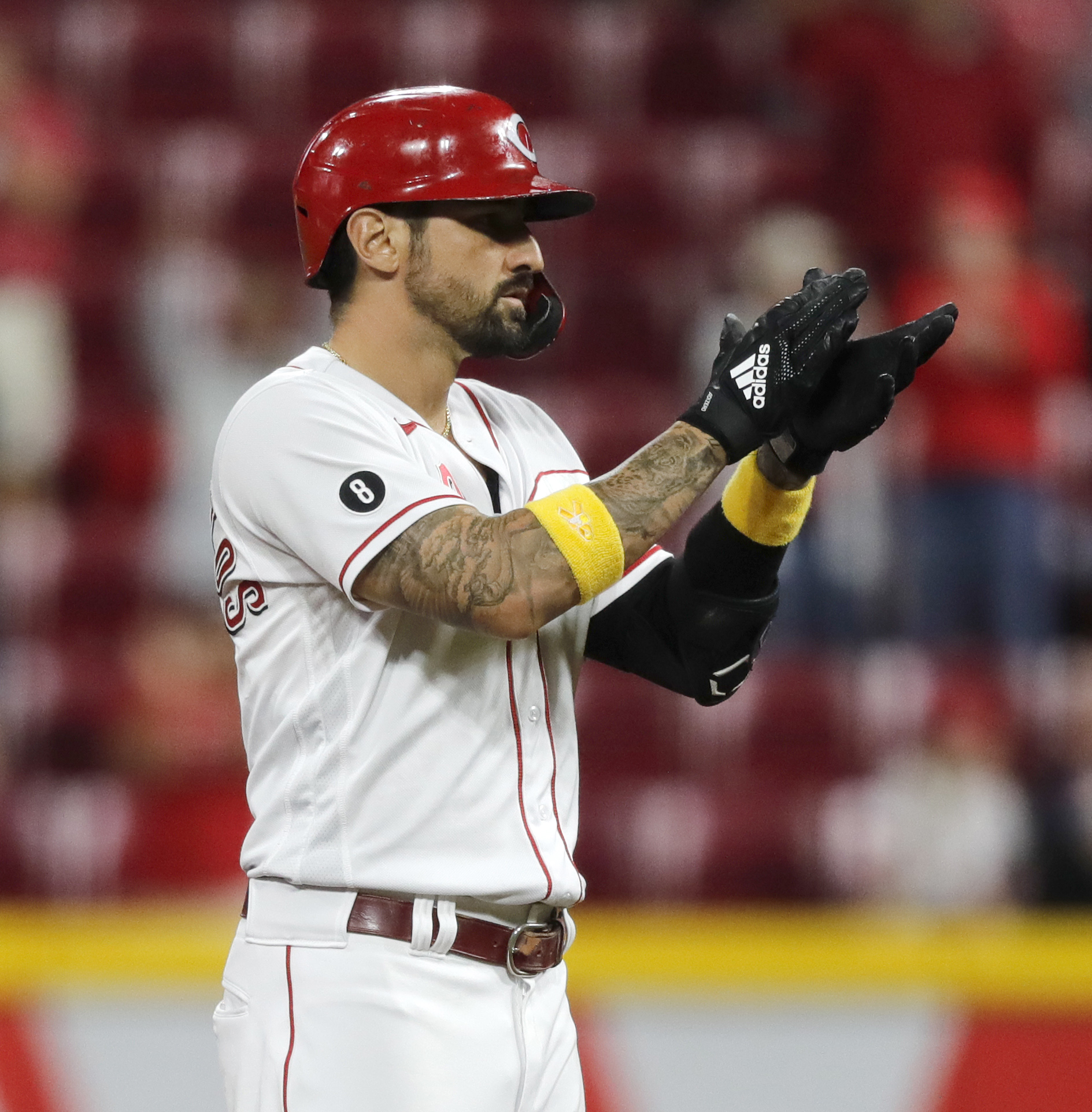
Castellanos, 30 in March, has been a near-lock to opt out of this contract for months now. While he decided to forgo the first opt-out provision in his deal last winter after a slumping through the pandemic-shortened season’s final weeks, he’s been one of the best hitters in the National League throughout the 2021 season. Had the microfracture in his wrist suffered back in late July proven to sideline him for a longer period or weigh down his production in the final two months, perhaps it’d have been another story, but Castellanos finished the season on a blistering tear at the plate.
On the whole, Castellanos batted .309/.362/.576 this season, complementing a career-high 34 home runs with 38 doubles and a triple en route to a stout 140 wRC+ on the season. That includes a .294/.335/.606 slash and 14 round-trippers in his final 176 plate appearances, which surely allayed any concern that the July wrist injury would linger and impact his production at the dish.
On the defensive end of the equation, Castellanos once again had his share of struggles. Virtually any defensive metric will paint him as below average in right field, and that’s been an issue for him dating back to his days as a third baseman in Detroit. Defensive Runs Saved and Outs Above Average both pegged Castellanos at -7 in 2021 — which is actually an improvement over recent seasons — and he checked in with a -1.5 Ultimate Zone Rating. Some may be surprised to see that Castellanos actually has above-average sprint speed (65th percentile among MLB position players), but Statcast also puts him in just the seventh percentile in terms of his outfield jumps.
Overall, the lack of defensive value shouldn’t matter too much. Castellanos has been a consistently above-average hitter since a breakout 2016 campaign with the Tigers, and he enjoyed the best season of his career this past season. With the widely expected advent of the designated hitter in the National League, it’s possible that he’ll be more valuable than ever before in 2022. Full-time (or even semi-regular) DH work was never an option for Castellanos in Detroit thanks to the presence of Miguel Cabrera and Victor Martinez, and he’s spent his two and a half seasons away from the Motor City in the National League. Even if he doesn’t immediately slide into full-time DH territory, Castellanos at the very least could see fewer innings in the outfield than he has in the past.
While it’s likely that Castellanos’ mind has been made up on this matter for some time, last night’s comments from Cincinnati general manager Nick Krall surely didn’t create any second thoughts. Krall didn’t outright say that the Reds are going to further slash payroll, but that was the overwhelmingly clear implication as the GM voiced a need to “align our payroll with our resources” and stressed the importance of “scouting and developing young talent from within our system.”
The Reds dumped Raisel Iglesias‘ $9.125MM salary on the Angels last offseason and surprisingly non-tendered Archie Bradley just three months after trading for him. Krall’s Wednesday comments — and, to a lesser extent, yesterday’s trade of stalwart catcher Tucker Barnhart — suggest that there’s more of the same in store this winter. In fairness to the Reds, they have a ready-made, offensively superior 2022 option at catcher in Tyler Stephenson, and Barnhart’s salary was steeper than most any team would pay for a backup catcher. How the Reds handle their $10MM club option on southpaw Wade Miley will be more telling.
Suffice it to say, it seems difficult to imagine the Reds pushing to re-sign Castellanos to a new contract that figures to include both a raise on his annual value and at least double the years he previously had remaining. Castellanos is arguably (although not definitively) the best hitter on the free-agent market this winter, and if the designated hitter indeed comes to the National League, he’ll have a vast market of teams bidding on his services. A contract of at least four years in length seems certain, and it’s quite possible that even with a qualifying offer in tow, bidding could push into the five-year range.
D-backs Decline Option On Tyler Clippard
6:19 pm: Arizona confirmed (Twitter link) that they declined their end of Clippard’s mutual option for the 2022 season.
11:34 am: Diamondbacks right-hander Tyler Clippard has been formally declared a free agent, per an announcement from the MLBPA. Clippard’s contract with Arizona had a $3.5MM mutual option for the 2022 season that came with a $500K buyout.
D-backs general manager Mike Hazen told the Arizona Republic’s Nick Piecoro yesterday that he could not yet say whether Clippard’s option would be picked up or bought out. It’s not immediately clear which side declined the option — Clippard had the right to decline before the D-backs made their intent known — but the result is the same: Clippard will receive that $500K buyout and return to the free-agent market in search of a new opportunity.
Clippard, 37 in February, is a perennially effective and perennially underrated reliever who’ll now likely look to sign what would be a fifth consecutive one-year deal. The veteran changeup specialist signed a one-year pact in Arizona last year, suffered a shoulder strain during Spring Training, and spent nearly four months on the injured list. However, when healthy, Clippard had another generally productive run. In 25 1/3 innings, he yielded a solid 3.20 ERA with just three home runs allowed.
That said, Clippard’s 2021 season wasn’t without its red flags — even beyond the injury. This year’s 18.9% strikeout rate was his lowest since 2008, while his 9.9% walk rate was his highest since 2017. Clippard has never been a flamethrower, but his 89.1 mph average fastball this season was also a career-low and ranked as the 16th-lowest mark among 344 relievers with at least 20 innings pitched.
It should also be pointed out that while Clippard and that signature changeup have historically dominated opposing left-handed batters, that was far from the case in 2021. Rather, Clippard was clubbed for a .279/.354/.581 line by opposing lefties. Clippard’s dominance over lefties and similarly (and more expected) sharp results against right-handers has long been one of his most desirable assets, so this year’s struggles in that regard could further dampen his market.
Mets, Kevin Pillar Decline 2022 Option
Veteran outfielder Kevin Pillar is headed back to the open market after both he and the Mets declined the dual options on his contract, per MLB Network’s Jon Heyman (Twitter link).
Pillar held a $2.9MM player option for the 2022 season, which did not carry a buyout, while the Mets held a $6.4MM club option with a $1.4MM buyout. Pillar’s decision was due first, and he opted to decline his end knowing that he had least the $1.4MM buyout of the Mets’ club option waiting for him. It’s a bit of a bet on himself, but so long as he tops $1.5MM in 2022 earnings, he’ll come out ahead in the gambit.
It was a rather unconventional contract that essentially boiled down to one of three outcomes: two years and $6.5MM (if Pillar exercised his end); two years and $10MM (if the Mets exercised their end); or one year and $5MM (both parties declining).
It was a convoluted way to get there, but the Mets effectively were able to sign Pillar for a year and $5MM while utilizing a player option (which counts as “guaranteed” money for luxury-tax purposes) to reduce the luxury hit to $3.25MM. The Mets wound up a good bit shy of the luxury threshold anyhow, but Pillar’s unique contract structure would’ve provided some additional in-season flexibility had they sought to add some payroll at the deadline.
Pillar’s 2021 season was disrupted by a grisly injury that saw him sustain multiple nasal fractures when an errant Jacob Webb fastball hit him in the face. Down on the field for several minutes following that frightening hit-by-pitch, Pillar was eventually able to walk off the field under his own power. Remarkably, Pillar missed only two weeks of action — a welcome outcome after what carried the potential for a far more severe injury.
With the Mets, Pillar tallied 327 plate appearances and turned in a .231/.277/.415 batting line with 15 home runs, 11 doubles, a pair of triples and four stolen bases. His 3.2% walk rate was the lowest in baseball for any player with at least 300 trips to the plate — an ongoing theme throughout Pillar’s career that has continually curbed his on-base percentage. Defensively, Pillar clocked in below average by most measures. Although he was once an otherworldly defender in center, he hasn’t turned in a positive mark in Defensive Runs Saved since 2017.
It’s a thin market for free-agent center fielders, though, and Pillar’s extensive experience there (and ability to play both corners) ought to generate some interest. He’s also a career .280/.312/.459 hitter against left-handed pitching (104 wRC+), so he could land a spot as a part-time outfielder on a contender’s bench next year or perhaps a larger role on a rebuilding team in search of an affordable veteran option.
Andrew Chafin Declines Mutual Option
Athletics left-hander Andrew Chafin is declining his half of a $5.25MM mutual option and will become a free agent, tweets MLB Network’s Jon Heyman. He’ll be paid a $500K buyout and return to the open market as one of the more appealing left-handed relievers available in free agency. Oakland has since announced that Chafin declined his portion of the option and that the team exercised its own half (although Chafin’s decision was due first).
The 31-year-old Chafin was nothing short of excellent for both the A’s and the Cubs in 2021, pitching to a combined 1.83 ERA with a 24.1% strikeout rate and a 7.1% walk rate through 68 2/3 innings. Chafin held left-handed hitters to a laughable .170/.250/.233 batting line and was only marginally more vulnerable against right-handed opponents, who mustered just a .196/.247/.304 slash against the southpaw.
Chafin yielded an average exit velocity of just 87.7 mph in 2021, ranking in the 78th percentile of big league hurlers, and Statcast placed him in the 85th percentile or better in hard-hit rate, opponents’ chase rate, expected ERA, expected opponents’ average and expected opponents’ slugging — all based on the quality of the contact he allowed and his K-BB tendencies.
That terrific season marked not only a rebound from a poor showing in 9 2/3 frames during the shortened 2020 season but also a career year on the mound. Chafin was a strong lefty option with the D-backs from 2015-19, pitching to a combined 3.55 ERA in 251 innings of relief, but the 2021 campaign is far and away the best work of his career to date.
Given the relatively thin market for left-handed relievers and the outstanding work he delivered this season, Chafin should command interest on multi-year deals from contending clubs looking to add some southpaw firepower to the back of their relief corps.
Adam Duvall Declines Mutual Option, Will Be Arbitration-Eligible
Braves outfielder Adam Duvall has declined his half of his $7MM mutual option, reports Craig Mish of SportsGrid and the Miami Herald (via Twitter). He’ll receive a $3MM buyout. However, because Duvall has fewer than six years of Major League service time, he’ll remain with the Braves as an arbitration-eligible player — should they wish to tender him a contract. MLBTR contributor Matt Swartz projects a $9.1MM salary for the veteran slugger.
Duvall signed that one-year deal with the Marlins last winter, after being non-tendered by a Braves team that ultimately reacquired him prior to the trade deadline. The 33-year-old Duvall has long been a strong defender with a perilously low OBP and plenty of power, but he dialed that skill set up to new heights in 2021. Duvall slugged a career-best 38 home runs and posted a whopping 19 Defensive Runs Saved (in addition to a 9.9 UZR and 5 Outs Above Average), but he also turned in a .281 OBP that tied him for the second-worst mark among all qualified hitters in Major League Baseball. The bottom-of-the-barrel OBP was enough for weighted metrics like wRC+ and OPS+ to peg his overall offense at just two to three percent better than the league average.
Still, a 30-homer bat with plus defense in the outfield corners is a plenty useful player, even if Duvall perennially ranks near the bottom of the league in on-base percentage. The projected $9.1MM price point is plenty reasonable for a player who posted 3.1 bWAR and 2.4 fWAR on the season, but it bears repeating that the Braves non-tendered Duvall not even one year ago, when he carried a smaller arbitration projection and was coming off a similar season. In 209 plate appearances with Atlanta in 2020, Duvall hit .237/.301/.532 with 16 home runs — a pace that falls pretty closely in line with this year’s .228/.281/.491 output.
Of course, the Braves have less certainty in their outfield than they did last year — and their World Series win likely gives them some additional resources. A good chunk of that extra cash has to be earmarked for a hopeful Freddie Freeman extension, but the Braves can clearly afford to keep Duvall in the fold if they so choose. And with each of Eddie Rosario, Jorge Soler and Joc Pederson set to hit free agency, plus Ronald Acuna Jr. on the mend from an ACL tear and Marcell Ozuna‘s status up in the air following an alleged domestic assault, Atlanta could well decide place a premium on the certainty that’d come from tendering a contract to Duvall.
They’ll have until Dec. 2 to make that call, although with the collective bargaining agreement set to expire one day earlier, on Dec. 1, it’s best not to assume anything transaction-wise from that point forth.