
MLB Daily Roster Roundup: Myers, Pomeranz, Samardzija, Zunino
ROSTER MOVES BY TEAM
(April 19th-April 20th)
NATIONAL LEAGUE
- ARIZONA DIAMONDBACKS | Depth Chart
- Promoted: SP Matt Koch
- Koch started in place of Taijuan Walker (season-ending Tommy John surgery)
- Optioned: RP Silvino Bracho
- Promoted: SP Matt Koch
- ATLANTA BRAVES | Depth Chart
- Promoted: SP Matt Wisler
- Wisler started on Thursday and is expected to remain in the rotation for at least one more turn.
- Activated from 10-Day DL: RP Josh Ravin
- Optioned: RP Lucas Sims
- Designated for assignment: OF Lane Adams
- Promoted: SP Matt Wisler
- CHICAGO CUBS | Depth Chart
- Placed on 10-Day DL: RP Eddie Butler (strained groin)
- Promoted: RP Luke Farrell
- CINCINNATI REDS | Depth Chart
- Activated from 10-Day DL: OF Scott Schebler
- Schebler was not in the lineup on Friday (vs RHP).
- Optioned: RP Cody Reed
- Activated from 10-Day DL: OF Scott Schebler
- COLORADO ROCKIES | Depth Chart
- Reinstated from 5-game suspension: 3B Nolan Arenado
- Arenado played 3B and batted 4th on Friday. Charlie Blackmon hit 3rd for the first time ever with Arenado in the lineup.
- Reinstated from 5-game suspension: 3B Nolan Arenado
- MIAMI MARLINS | Depth Chart
- Placed on 10-Day DL: RP Odrisamer Despaigne (strained forearm), RP Chris O’Grady (sprained shoulder)
- Promoted: RP Merandy Gonzalez, RP Nick Wittgren
- MILWAUKEE BREWERS | Depth Chart
- Acquisition: INF/OF Tyler Saladino (acquired from White sox for cash considerations)
- Saladino was optioned to Triple-A
- Designated for assignment: SP/RP Alec Asher
- Acquisition: INF/OF Tyler Saladino (acquired from White sox for cash considerations)
- SAN DIEGO PADRES | Depth Chart
- Activated from 10-Day DL: OF Wil Myers, RP Kirby Yates
- Myers played RF and batted 2nd on Friday.
- Optioned: SP Luis Perdomo, RP Tyler Webb
- Eric Lauer and Brett Kennedy are the leading candidates to take Perdomo’s rotation spot.
- Activated from 10-Day DL: OF Wil Myers, RP Kirby Yates
- SAN FRANCISCO GIANTS | Depth Chart
- Activated from 10-Day DL: SP Jeff Samardzija
- Placed on 10-Day DL: OF Hunter Pence (sprained thumb)
- Promoted: OF Mac Williamson
- Williamson played LF and batted 7th on Friday.
- Optioned: RP Derek Law
- ST. LOUIS CARDINALS | Depth Chart
- Promoted: OF Tyler O’Neill
- O’Neill was not in the starting lineup on Thursday or Friday.
- Optioned: RP John Brebbia
- Promoted: OF Tyler O’Neill
- WASHINGTON NATIONALS | Depth Chart
- Promoted: RP Carlos Torres (contract purchased)
- Designated for assignment: SP/RP A.J. Cole
—
AMERICAN LEAGUE
- BALTIMORE ORIOLES | Depth Chart
- Promoted: RP Tanner Scott
- Optioned: INF Engelb Vielma
- BOSTON RED SOX | Depth Chart
- Activated from 10-Day DL: SP Drew Pomeranz
- Optioned: RP Marcus Walden
- CHICAGO WHITE SOX | Depth Chart
- Acquisiton: OF Trayce Thompson (acquired from Athletics for PTNBL or cash)
- Thompson was not in the starting lineup on Friday.
- Acquisiton: OF Trayce Thompson (acquired from Athletics for PTNBL or cash)
- DETROIT TIGERS | Depth Chart
- Promoted: OF Mike Gerber, RP Warwick Saupold
- Gerber was the 26th man for Friday’s double-header. He was not in the starting lineup for either game.
- Optioned: RP Chad Bell
- Promoted: OF Mike Gerber, RP Warwick Saupold
- KANSAS CITY ROYALS | Depth Chart
- Promoted: RP Scott Barlow
- Barlow was the 26th man for Friday’s double-header.
- Promoted: RP Scott Barlow
- NEW YORK YANKEES | Depth Chart
- Activated from 10-Day DL: SP CC Sabathia
- Placed on 10-Day DL: RP Luis Cessa (strained oblique)
- OAKLAND ATHLETICS | Depth Chart
- Promoted: RP Chris Bassitt, RP Josh Lucas
- Optioned: RP Danny Coulombe, RP Lou Trivino
- SEATTLE MARINERS | Depth Chart
- Activated from 10-Day DL: C Mike Zunino
- Gamel played C and batted 7th on Friday.
- Optioned: C Mike Marjama
- Activated from 10-Day DL: C Mike Zunino
- TAMPA BAY RAYS | Depth Chart
- Activated from 10-Day DL: 1B Brad Miller
- Miller played 1B and batted 4th on Friday.
- Designated for assignment: INF/OF Brandon Snyder
- Activated from 10-Day DL: 1B Brad Miller
- TORONTO BLUE JAYS | Depth Chart
- Activated from 10-Day DL: DH Kendrys Morales
- Morales was the DH and batted 6th on Friday.
- Promoted: INF Lourdes Gurriel Jr.
- Gurriel played 2B and batted 9th in his MLB debut on Friday.
- Optioned: INF Gift Ngoepe, RP Tim Mayza
- Activated from 10-Day DL: DH Kendrys Morales
—
FUTURE EXPECTED MOVES
- LAA: SP Jaime Barria will be recalled from the minors on Sunday April 22nd, according to Maria Guardado of MLB.com.
- SEA: SP Erasmo Ramirez will be activated from the DL on Sunday April 22nd, also according to Johns.
- TEX: Delino DeShields Jr. began a rehab assignment on Thursday April 19th and will be re-evaluated on Saturday, according to Jeff Wilson of the Fort Worth Star-Telegram. He could be activated from the DL sometime this weekend.
Offseason In Review: Cincinnati Reds
This is the latest entry in MLBTR’s 2017-18 Offseason In Review series. Click here to read the other completed reviews from around the league.
The Reds added a few role players but largely turned in a quiet offseason.
Major League Signings
- David Hernandez, RHP: two years, $5MM
- Jared Hughes, RHP: two years, $4.5MM
- Yovani Gallardo, RHP: one year, $750K (unknown whether fully guaranteed)
- Total Spend: $10.25MM
Trades and Claims
- Acquired RHP Robinson Leyer from White Sox for unknown return
- Acquired RHP Miguel Medrano from Rangers for $350K in international bonus pool availability
- Claimed 1B Kennys Vargas from Twins (later lost via waiver claim)
- Claimed LHP Justin Nicolino from Marlins
- Claimed LHP Kyle Crockett from Indians (later non-tendered and re-signed to minors deal)
- Claimed LHP Jairo Labourt from Tigers (later lost via waiver claim)
- Selected RHP Brad Keller from Diamondbacks in Rule 5 draft (later traded to Royals for cash/PTBNL)
Extensions
- Signed 3B Eugenio Suarez to seven-year, $66MM contract with $15MM club option ($2MM buyout) for 2025
Notable Minor League Signings
- Dylan Floro, Phil Gosselin, Rosel Herrera, Patrick Kivlehan, Joe Mantiply, Cliff Pennington, Oliver Perez, Kevin Quackenbush, Ben Revere, Tony Sanchez, Mason Williams, Vance Worley
Notable Losses
Needs Addressed
The Reds entered this winter, much as the two previous ones, in something of a stasis at the major-league level. While there have been some encouraging signs from certain young players, the organization has not yet found cause to invest in high-quality veterans, both because it has yet to fully develop a new core of young talent and because the payroll is still burdened by several large contracts.
There’s no doubt that the Cincinnati ballclub is in a rebuild. It has failed to top seventy wins or crawl out of the NL Central basement since 2014. Unlike many organizations that find themselves in such a position, however, the Reds have not been able (or, to some extent, willing) to drastically slash payroll, which has barely dipped below $90MM over the past several years — not that far off of the ~$115MM high-point reached in 2014 and 2015.
On the one hand, that’s simply a product of circumstances. Several of the team’s most expensive players — Homer Bailey, Devin Mesoraco, and Brandon Phillips before them — have been essentially untradeable due to injuries, performance, and/or no-trade protection. But the team has also not found appealing opportunities to deal other expensive assets. Well-compensated superstar Joey Votto has full no-trade rights. Closer Raisel Iglesias — who’s relatively cheaper at this point but could opt into arbitration next fall — is rightly seen as a long-term asset, though certainly there’s risk in keeping a high-end young reliever. Center fielder Billy Hamilton was a frequent subject of trade chatter but ultimately was held over the just-completed offseason. And second bagger Scooter Gennett — who was a nice find last spring — is like Hamilton both increasingly pricey and nearing a final trip through the arb process.
The club also decided not to deal third baseman Eugenio Suarez, instead declaring him part of the core moving forward with an extension. He’s valued for both his glove and bat by the Reds. If he can maintain the pace he sustained in 2017, the contract will prove a relative bargain, though it’s also another big commitment and thus obviously carries some risk.
Those players, of course, are still in town. Former shortstop Zack Cozart, on the other hand, departed via free agency — leaving the Reds without any compensation. The club seemed in position to deal him at times, but evidently his ill-timed health issues and/or a lack of reasonable offers precluded a deal. While the Reds held out the possibility of extending Cozart, that never happened and the organization ended up not issuing him a qualifying offer at the end of the 2017 campaign. That decision is hard to fault, as Cozart may have felt it too risky to pass up $17.2MM for one season and carrying draft compensation onto the open market. Without knowing the precise offers that could have been had, it’s hard to second-guess the organization too much for its handling of that particular situation, but it’s certainly a less-than-desirable result in the situation of yet another quality veteran player.
In the aggregate, then, the Reds have likely not pocketed significant amounts of cash even while they’ve put an unsuccessful product on the field. And the organization has reasonably substantial sums already committed into the future, including about $68.5MM for 2019, $49.5MM for 2020, and $40MM for 2021. Contemplating future spending capacity is all guesswork from the outside, but it seems reasonable to say that the Reds did not save as much money or clear as much future payroll space as quite a few other rebuilding teams have in recent seasons. And that likely left less to work with this winter.
Given the situation, perhaps it’s unsurprising that the Dick Williams-led front office ended up turning in another quiet offseason. The organization took a budget-conscious approach to its two biggest needs — accounting for Cozart’s absence and adding some arms — and otherwise mostly elected to maintain the status quo in hopes of finding improvement from within in 2018.
With the outfield and starting infield already accounted for from within, the Reds decided to pursue a few utility pieces to help carry the load while waiting for top prospect Nick Senzel. The club ended up giving Opening Day jobs to both Cliff Pennington and Phil Gosselin, providing a veteran presence but not much hope of significant output.
On the pitching side, David Hernandez and Jared Hughes were both given low-AAV, two-year contracts to firm up the relief corps. Late-spring signee Yovani Gallardo was another addition, though it wasn’t long before he was cut loose. That trio was supplemented by a variety of claims and minor-league signees who’ll combine to add depth, but perhaps not much quality, to a Reds pitching staff that has been irredeemably awful over the past two seasons. Thus far in 2018, recent additions Kevin Quackenbush and Dylan Floro have stuck in the majors, while the team was also able to stash lefties Justin Nicolino and Kyle Crockett in the minors and off of the 40-man roster.
Questions Remaining
The resulting pitching unit is entirely underwhelming on paper. Unsurprisingly, perhaps, the staff has opened the 2018 season as the worst in baseball, continuing a pace of three-year futility that may rival any in baseball history when all is said and done. Of course, as I argued last fall, there wasn’t much sense throwing money at the problem at this point. Even significant spending likely would not have made this roster a contending one; any outside chance at staying in the hunt was likely snuffed out anyway with a 3-and-15 start.
What the Reds are hoping, then, is that their slate of hurlers makes some strides that improve the future outlook. Veteran Homer Bailey is hoping to return to some level of health and effectiveness after three forgettable seasons. With $49MM still owed on his deal (including a buyout of a 2020 option), the best the team can hope for is to fill up some innings or perhaps save a bit of cash if there’s a team interested in a trade. It’s still anybody’s guess when Anthony DeSclafani will return from his run of injuries. He can be controlled for 2019 and 2020 via arbitration. Brandon Finnegan, who has one further year of control, is back on the hill after missing almost all of 2017. Each of these pitchers has succeeded at times in the majors, but whether they can do so again is questionable at best.
There’s some promise from younger arms, too. Luis Castillo was a major bright spot in 2017 and is the most intriguing player the team has returned from its recent trades. Tyler Mahle is expected to turn into a solid MLB starter. But both of these pitchers still need to fully establish themselves at the game’s highest level. A host of other arms — Sal Romano, Amir Garrett, Jackson Stephens, and former top prospect Robert Stephenson among them — will get their share of opportunities. Some, surely, will end up dropping into relief duty (as Garrett has to open the year). Perhaps one or more will prove worthy of a starting slot in the future, though you’ll be hard-pressed to find strong believers among outside talent evaluators.
Garrett has looked good in a relief role to open the season, potentially giving the team another late-inning piece while Hernandez and Michael Lorenzen work back from injury. Iglesias remains the anchor, while Wandy Peralta and Cody Reed provide two more lefty options to go with Garrett. Any contending team would have gone hunting for multiple upgrades over the winter. For the Reds, though, it’s more sensible to run out the pitchers they have to see what sticks.
The situation on the position-player side is more promising, generally, but also comes with some concerns. Perhaps no area is of greater interest than the middle infield. With Suarez locked in at third (once he’s back to full health), it seems that Senzel will end up playing in the middle infield. If he’s capable of playing short, that could put even greater pressure on Jose Peraza, who has to this point wilted with the open opportunity he has received since the start of the 2016 season. Gennett could be a mid-season trade candidate, though rival teams are no doubt aware of the deeper history (including his lack of success against lefties) that preceded his excellent 2017 season. First base (Votto) and catcher (Tucker Barnhart, Mesoraco) rate as strengths.
The outfield unit also has some more established options, though none are foolproof. Hamilton is a defensive and baserunning whiz whose bat seems less and less likely ever to come around. He’s flanked by two powerful, OBP-challenged players in Adam Duvall and Scott Schebler. Well-regarded youngster Jesse Winker is also slated to receive a lot of playing time after showing well in a 47-game stint last year. Phil Ervin, himself a former first-round pick, rounds out the major players in this arena. There’s talent here, but it’d be hard to call this a first-division unit. If things break right, though, the Reds could build from this group without further additions.
Overview
The real problems with the Reds’ current situation began not with any decisions this winter, but with whiffs in years past on moving veteran assets. A combination of questionable decisionmaking (especially, holding some veterans at the 2015 deadline) and poor prospect outcomes, along with injuries and some bad fortune, largely left Williams and co. without appealing options for moving things forward over the just-completed offseason. Unfortunately, that means another season of waiting and hoping that the young talent in an increasingly well-regarded farm system will develop — and do so in time to join Votto while he’s still one of the game’s best hitters.
How would you grade the Reds’ offseason efforts? (Link for MLBTR app users.)
Grade the Reds' Offseason
-
F 49% (1,517)
-
D 35% (1,071)
-
C 13% (412)
-
B 2% (52)
-
A 1% (30)
Total votes: 3,082
Offseason In Review: New York Yankees
This is the latest entry in MLBTR’s 2017-18 Offseason In Review series. Click here to read the other completed reviews from around the league.
The Yankees managed to go from July 2016 sellers to the 2017 ALCS, coming within one game of a World Series appearance in a remarkable turnaround. Their offseason was reflective of the fact that any “rebuild” in the Bronx has already come and gone.
Major League Signings
- CC Sabathia, LHP: One year, $10MM
- Neil Walker, 2B/1B/3B: One year, $4MM
- Total spend: $14MM
Trades and Claims
- Acquired OF Giancarlo Stanton from the Marlins in exchange for 2B Starlin Castro, RHP Jorge Guzman, INF Jose Devers and cash
- Acquired 2B/3B/OF Brandon Drury from the D-backs in three-team trade that send 2B Nick Solak to Tampa Bay and RHP Taylor Widener to Arizona
- Traded 3B Chase Headley and RHP Bryan Mitchell to the Padres in exchange for OF Jabari Blash and cash
- Traded LHP Caleb Smith and 1B/OF Garrett Cooper to the Marlins in exchange for RHP Michael King and $250K international bonus allotment
- Traded OF Jake Cave to the Twins in exchange for RHP Luis Gil
- Traded RHP Ronald Herrera to the Rangers in exchange for LHP Reiver Sanmartin
Notable Minor League Signings
- Oliver Perez, Adam Lind (since released), Jace Peterson, Danny Espinosa (released), Shane Robinson, Erik Kratz, Wade LeBlanc (released, signed MLB deal with Mariners)
Notable Losses
- Matt Holliday, Jaime Garcia, Michael Pineda, Headley, Mitchell, Smith, Cooper
Needs Addressed
As one would expect of a club that came within a game of the World Series and retained the majority of its roster, the Yankees weren’t exactly teeming with clear needs entering the offseason. GM Brian Cashman and his lieutenants completed a good portion of their offseason shopping back in July, in fact, acquiring not only Sonny Gray but also David Robertson and Tommy Kahnle, thus bolstering the pitching staff for the foreseeable future in the course of adding reinforcements down the stretch.
For the Yankees, the 2017-18 offseason was much more about being opportunistic and reinforcing existing areas of strength than it was about addressing glaring weaknesses. Rather than acquire a specific skill set or a player at a certain position, the team’s top priority seemed to be resetting its luxury tax penalty by dipping back beneath the $197MM tax threshold.
To that end, the team seemed to be primed for a spirited pursuit of young phenom Shohei Ohtani, whose signing bonus wouldn’t have counted against that tax calculation and who could pitch several seasons near the league minimum. The former Nippon Professional Baseball superstar seemingly shocked the Yankees, however, when he informed them that they would not even be one of the seven finalists with whom he sat down for an in-person interview.
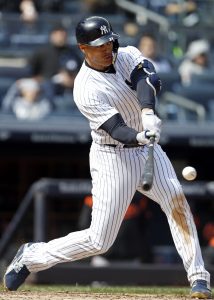
Cashman & Co. evidently subscribe to the belief, however, that when one door closes another opens elsewhere. With the DH spot in the lineup no longer earmarked for Ohtani on his non-pitching days, the Yankees circled back to the Marlins, who’d previously contacted them to gauge their interest in Giancarlo Stanton. To that point, trade talks surrounding the reigning NL MVP had focused on the Giants and Cardinals — a pair of clubs that weren’t on Stanton’s list of desired trade destinations. Stanton kept an open mind in meeting with each organization, but the Yankees’ miss on Ohtani created a new opportunity with a team that Stanton had expressed a desire to land with.
Roughly a week later, the two sides had agreed to arguably the biggest deal of the offseason. Stanton was introduced to the media as the newest Yankee at this year’s Winter Meetings. In exchange for taking on the vast majority of his contract, the Yankees only were required to part with a pair of mid-range prospects and Castro, whose own $22MM commitment helped to offset some of Stanton’s deal.
Stanton’s massive contract, of course, came with plenty of luxury tax concern, which made the inclusion of Castro’s deal important and made the subsequent trade of Chase Headley back to the Padres all the more critical. The Yankees agreed to part with young pitcher Bryan Mitchell and received Jabari Blash in return — a 28-year-old outfielder whom they later designated for assignment. The Headley trade, as far as the Yankees were concerned, was all about shedding the vast majority of his $13MM annual luxury hit. Surrendering four years of club control over Mitchell at an affordable rate was the cost of doing business.
Missing out on Ohtani, though, left the Yankees with at least a modicum of uncertainty in their rotation scene. CC Sabathia and Michael Pineda were no longer in the fold, leaving Luis Severino, Gray, Jordan Montgomery and Masahiro Tanaka (who surprised many by forgoing his opt-out clause) as the top four options in the Bronx. While prospects Chance Adams and Justus Sheffield loom in the upper minors, the Yanks struck a one-year, $10MM deal to put Sabathia back in pinstripes as means of deepening the rotation and ensuring that their prized young arms wouldn’t need to be rushed to the big leagues.
That Castro and Headley were now on new clubs left the Yankees with a pair of openings around the infield. Those vacancies left many Yankees fans eagerly envisioning a high-upside infield of Miguel Andujar at third base, Didi Gregorius at short, Gleyber Torres at second base and Greg Bird at first base. That alignment may very well be the future in New York, but the Yankees understandably had some trepidation about turning the infield over to three inexperienced players. Andujar and Torres had scarcely played above the Double-A level.
In March, Neil Walker told the New York Times that he thought he’d been close to an agreement with the Yankees before they swung a three-team deal with the D-backs and Rays that sent Swiss Army knife Brandon Drury to the Bronx instead. That deal seemed to prolong a surprisingly tepid market for Walker, but in the end, the Yankees came away with both players. As they did with Stanton, the Yanks parted with a pair of mid-range prospects in order to install Drury into their infield mix for the next four seasons, and they later added Walker for just a $4MM guarantee despite his steady track record as a decidedly above-average bat and ability to handle multiple positions.
Questions Remaining
Despite the team’s quick turnaround and Joe Girardi’s general success over a decade-long run at the helm for the Yankees, Girardi was not offered a contract to return for the 2018 season. Rather, the Yankees conducted a search of surprisingly inexperienced managerial candidates and ultimately settled on the least-experienced option interviewed by any of the five clubs who hired new managers this past offseason.
Former Yankee and ESPN broadcaster-turned-manager Aaron Boone has been thrown directly into the fire with the Yankees, managing a club with World Series aspirations, plenty of star power and also a number of key young talents who figure to make their MLB debuts this season. Boone will juggle all of that in the nation’s largest media market while dealing with one of the game’s most vocal fanbases. It’d be a daunting task even for an experienced skipper, and there’ll probably be some bumps along the way.
Most of the other questions facing the Yankees pertain more to their health and finances than the on-field product. Namely, after spending the entire offseason unsuccessfully trying to find a taker for Jacoby Ellsbury, they’ve now watched as a concussion, hip issue and plantar fasciitis have all combined to prevent Ellsbury from taking the field in 2018. Ellsbury was owed more than $68MM with a full no-trade clause even before that slate of injuries, and the possibility of shedding his contract looks increasingly remote.
While many Yankees fans have clamored for the club to simply release him, though, Ellsbury was a perfectly serviceable piece when healthy in 2017. His .264/.348/.402 slash (clearly) wasn’t worth the near-$22MM salary the Yankees are paying him, but he’s also not devoid of on-field value. That’ll be a situation on which Cashman and his charges will have to deliberate at length; at some point, perhaps they’ll simply cut bait, but in doing so they’d be committing to fully paying his luxury tax hit for the next three seasons. If the front office still feels that a healthy Ellsbury can contribute on the field or eventually be moved for some salary relief, then an unconditional release is an understandably unpalatable course of action.
At first base, meanwhile, Bird has already undergone ankle surgery, further raising questions about his ability to remain healthy in the long term. The 25-year-old has legitimate power (16 homers, .250 ISO through 348 MLB plate appearances), but this will be the third straight surgery-shortened season for him. He’s previously had shoulder surgery (2016) and a separate ankle surgery (2017). Walker and Tyler Austin present alternatives (Walker’s poor start notwithstanding), but the 2018 season will be critical for Bird as he looks to establish himself as an infield fixture.
If there’s one area the Yankees are lacking, it’s left-handed relief, with Chasen Shreve and closer Aroldis Chapman constituting the lone southpaw options on the 40-man roster. Oliver Perez is in the organization as a potential veteran option, though, while righties Chad Green and David Robertson have actually dominated lefty opponents more than same-handed hitters.
The rest of the roster looks to be largely set, at least for the coming season. Perhaps if Bird’s ankle injuries linger or if Andujar and/or Torres struggle for a prolonged stretch, they’ll seek additional depth. But the acquisitions of Walker and Drury already offer some measure of contingency plan. Austin Romine‘s career .266 on-base percentage is an eyesore, but the Yanks seem content with his defense and were never rumored to be in the market for an upgrade over him as the backup to Gary Sanchez.
Any deadline needs that pop up for the Yankees figure to be driven by injuries and/or underperformance rather than area of weakness heading into the season. On paper, the club looks stacked, and while dismal starts from Stanton and Sanchez, in particular, have caused some angst, the Yankees look like a potential juggernaut once their bats wake up.
Overview
If Plan A for the Yankees was to land Ohtani, their Plan B of Stanton plus a series of quality depth additions is no small consolation. By midseason, it’s possible that the Yankees’ lineup will feature Stanton, Sanchez, Gregorius, Aaron Judge, Torres, Andujar, Bird, Aaron Hicks and Brett Gardner — a collection of veterans and high-upside talents that could form one of the most productive units in all of baseball. With an exceedingly deep bullpen and a quality rotation backed by prospects like Adams and Sheffield, there should be similar optimism for the pitching staff. Prospect trade chips abound. And because the front office succeeded in not only resetting the luxury tax but dropping beneath the penalty line by roughly $16MM, there’s ample room for the Yankees to upgrade as necessary this summer.
The expectation level has quickly been raised in the Bronx, though, and it stands to reason that anything shy of a deep postseason run will be considered a disappointment.
How would you grade the Yankees’ offseason? (Link to poll for Trade Rumors app users.)
How would you grade the Yankees' offseason?
-
B 40% (1,522)
-
A 35% (1,334)
-
C 13% (503)
-
F 7% (267)
-
D 4% (152)
Total votes: 3,778
Photo courtesy of USA Today Sports Images.
Offseason In Review: Milwaukee Brewers
This is the latest entry in MLBTR’s 2017-18 Offseason In Review series. Click here to read the other completed reviews from around the league.
Milwaukee’s rebuild reaped significant benefits faster than most anticipated in 2017, setting the stage for an active but also puzzling offseason from GM David Stearns & Co.
Major League Signings
- Lorenzo Cain, OF: Five years, $80MM
- Jhoulys Chacin, RHP: Two years, $15.5MM
- Matt Albers, RHP: Two years, $5MM
- Boone Logan, LHP: One year, $2.5MM
- Eric Sogard, 2B: One year, $2.4MM
- Yovani Gallardo, RHP: One year, $2MM (base salary was only partially guaranteed, and Gallardo was paid $500K upon being cut late in Spring Training)
- Dan Jennings, LHP: One year, $750K
- Total Spend: $106.65MM
Trades and Claims
- Acquired OF Christian Yelich from Marlins in exchange for OF Lewis Brinson, OF Monte Harrison, INF Isan Diaz and RHP Jordan Yamamoto
- Claimed RHP Dylan Baker off waivers from Indians, later traded Baker to Dodgers for cash
- Traded C Andrew Susac to Orioles in exchange for player to be named later or cash
Notable Minor League Signings
- Wade Miley, Christian Bethancourt, Ji-Man Choi (made Opening Day roster), J.J. Hoover (since selected, outrighted), Nick Franklin, Jim Henderson, Hiram Burgos, Ernesto Frieri, Radhames Liz
Extensions
- Chase Anderson, RHP: Two years, $11.75MM plus club options for 2020 ($8.5MM) and 2021 ($9.5MM)
Notable Losses
- Brinson, Neil Walker, Matt Garza, Carlos Torres, Jared Hughes (non-tendered), Wily Peralta (non-tendered), Michael Blazek
Needs Addressed
Milwaukee’s needs on the pitching staff received the lion’s share of attention headed into the offseason, which was understandable following staff ace Jimmy Nelson‘s shoulder surgery. But the Brew Crew also had some fairly notable needs on the offensive end of the spectrum as well. The Brewers did hit the seventh-most homers in MLB last year, but they nonetheless ranked 20th in the Majors in runs scored. Their collective output against lefties (.248/.321/.413, 89 wRC+) ranked 24th in the Majors, while their production against right-handers (.250/.323/.434, 94 wRC+) wasn’t dramatically better.
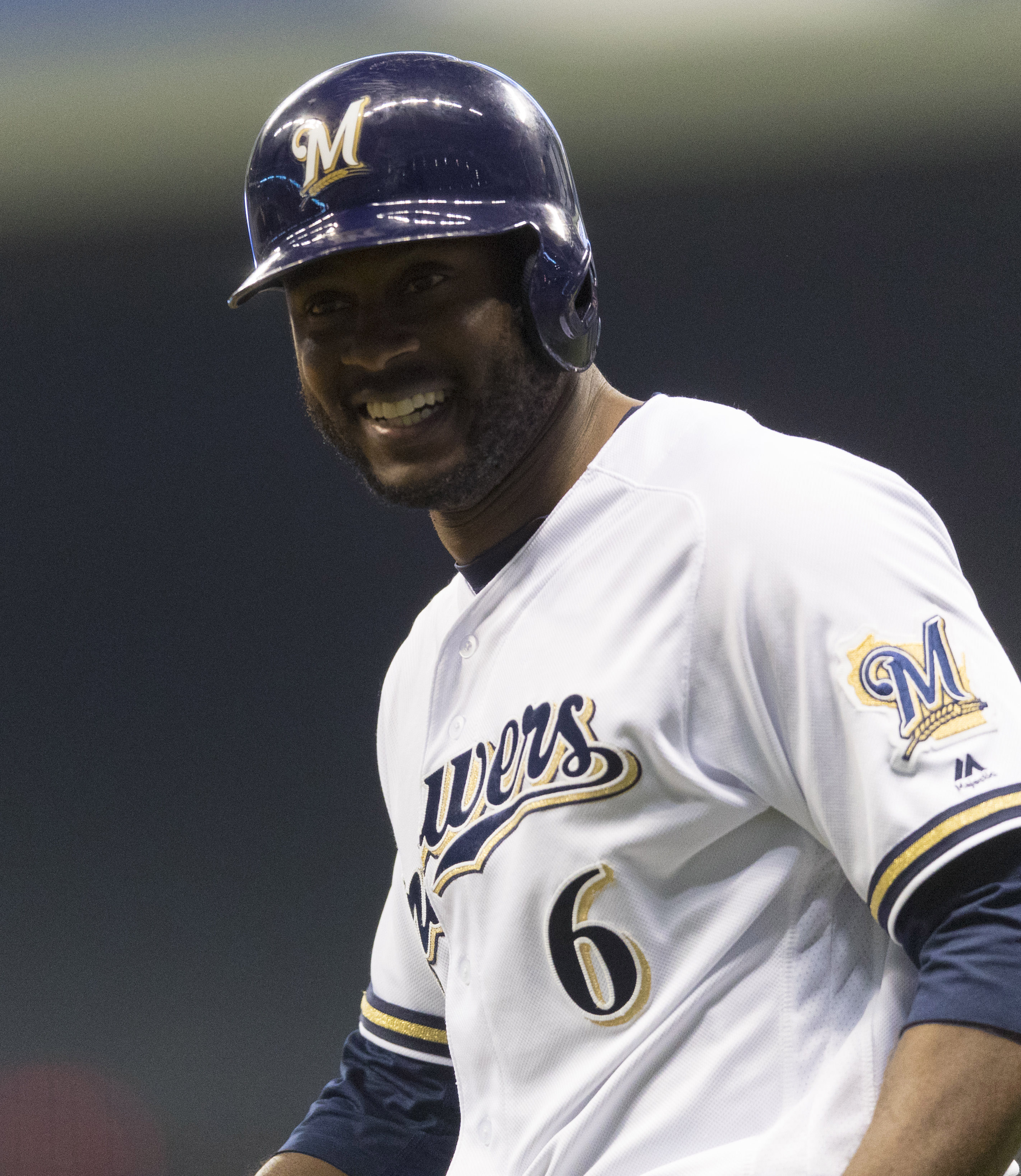
The Brewers’ primary means of bolstering the offense came in effectively swapping out Keon Broxton for Lorenzo Cain, who inked the third-largest contract of any position player this offseason and the fourth-largest overall at five years and $80MM. Milwaukee also shipped out a four-player package headlined by Lewis Brinson and Monte Harrison to acquire a whopping five seasons of Christian Yelich — all of which figure to be prime years.
The outfield, of course, didn’t look like a huge need for the Brewers on paper, and it’s arguable that it wasn’t a need at all. However, manager Craig Counsell should have around 2600 to 2700 plate appearances to divide up primarily between Cain, Yelich, Domingo Santana, Ryan Braun and Eric Thames in a rotation of players in the outfield at at first base (where Braun and Thames will factor most prominently).
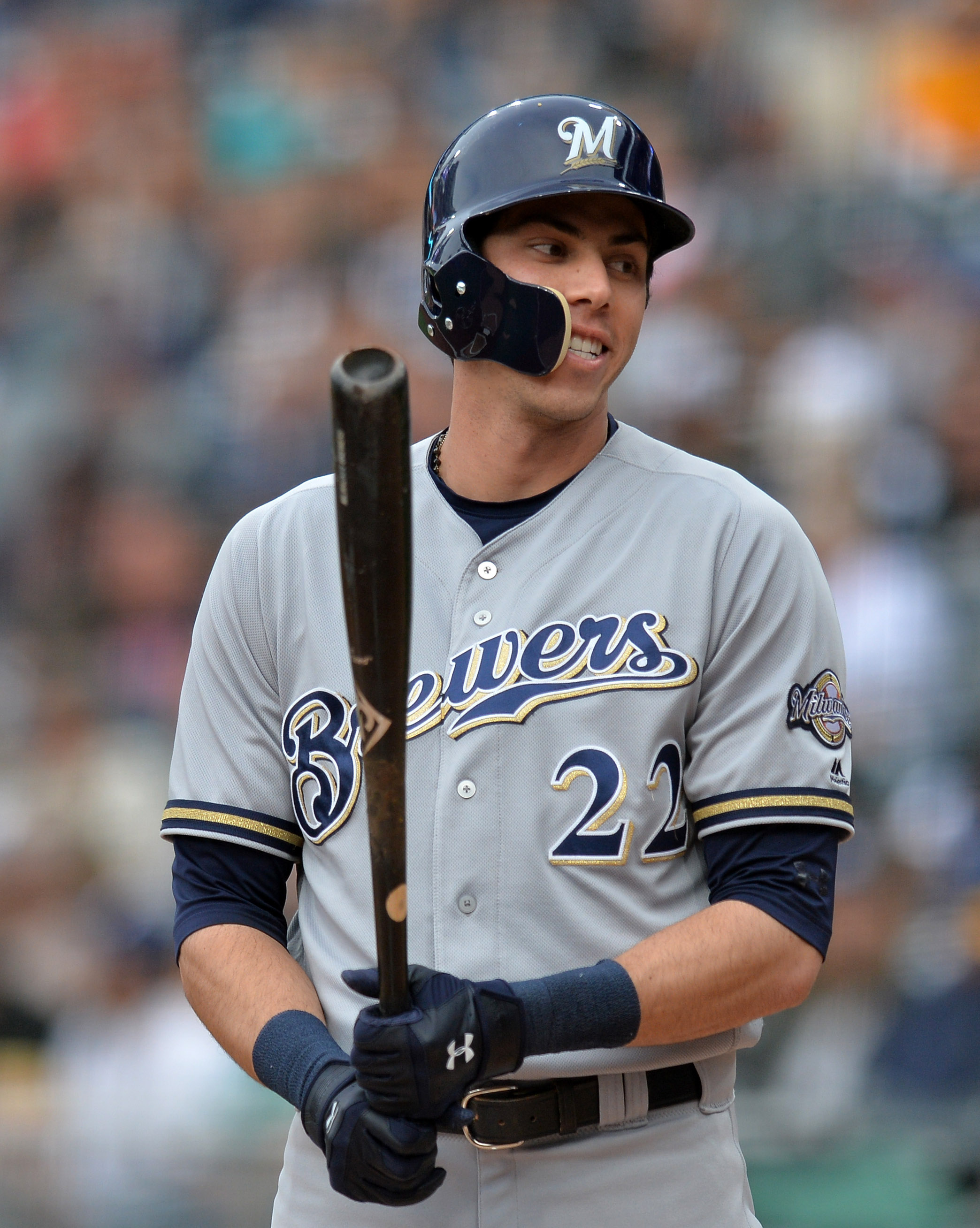
The depth allows Thames (.182/.270/.394 vs. lefties in 2017) to be platooned, and the group of Cain, Braun, Santana and occasional first baseman Jesus Aguilar gives Counsell plenty of possibilities versus lefties. The club has also held onto righty-swinging first bagger Ji-Man Choi after his eye-opening spring, though he’s currently on optional assignment. Plus, Broxton and Brett Phillips are both still on hand as outfield options should injuries necessitate. That level of depth is hard to find throughout the league.
That’s not to say, either, that the Brewers didn’t address their pitching staff at all. Jhoulys Chacin has quietly been a quality arm for the Angels and Padres over the past two seasons. It’s a bit too rudimentary to say Chacin needs to prove he can pitch outside of San Diego — his home/road splits were pronounced with the Halos as well — but he’ll certainly hope to pitch more consistently than over the past two seasons. The bottom-line results for Chacin have tended to even out in the end, though, and he’ll provide a veteran source of innings to an otherwise inexperienced rotation.
In the ‘pen, the Brewers added quantity but did not join in on the Winter Meetings’ relief craze. With premium annual values and multi-year deals for setup men en vogue — the Rockies led the way with more than $100MM worth of bullpen spending — the Brewers went the opposite route. Matt Albers was a late sign at a more traditionally expected rate and will look to prove to his doubters that last year’s brilliant season with the Nats was no fluke. Dan Jennings was a late-Spring steal at $750K, and he’ll pair with veteran Boone Logan (once healthy) and exciting youngster Josh Hader to give Counsell the left-handed depth he sorely lacked in 2017. (Yovani Gallardo was also signed to a non-guaranteed deal, but he didn’t make the cut out of Spring Training.)
Questions Remaining
The common belief once the Brewers acquired Yelich and Cain within mere hours of one another was that the front office would use its newfound outfield depth to trade for a rotation upgrade. Rumors persisted throughout the offseason, and Milwaukee remained connected to the likes of Yu Darvish, Jake Arrieta, Lance Lynn and Alex Cobb throughout their respective time on the open market. In the end, though, Chacin was the lone rotation addition outside of a minor league deal for Wade Miley, who figures to get some starts for the Brewers once he recovers from a groin injury after showing well this spring.
With Nelson out until midseason, then, Milwaukee’s rotation will consist of Chase Anderson, Zach Davies, Chacin and a combination of Brent Suter, Junior Guerra, Brandon Woodruff and, eventually, Miley. Clearly, it’s a group that is rife with uncertainty. Anderson and Davies impressed in 2017, and Chacin should be serviceable, but the rest of the group is less certain. Guerra had a nightmarish 2017 season, while Suter and Woodruff lack much in the way of a big league track record. Miley pitched poorly enough in 2016-17 that he had to settle for a minor league deal despite a history of durability.
Brewers fans and onlookers wondered for the final several months of the winter when Stearns and his staff were going to make some kind of splash on the pitching market, but in retrospect, perhaps the opportunity for a meaningful upgrade on the trade front never materialized. Corner outfielders aren’t exactly in high demand these days, as both the trade and free-agent markets in the past couple of seasons have made abundantly clear.
Santana had a nice season, to be sure, but being a 30-homer bat in a season that saw 74 players swat 25+ big flies doesn’t hold the same appeal as being a 30-homer bat would’ve been even three years prior. Add in a 31 percent career strikeout rate, and it’s plenty plausible that the offers for him simply didn’t include a rotation piece of note. Broxton and Phillips both have significant strikeout issues, and Phillips’ big year was at least somewhat fueled by BABIPs north of .400 in the Majors and the minors. The Brewers undoubtedly could’ve added some depth via trade, but if they felt that the best the market had to offer was arms with similar uncertainty to the ones they already possessed, then the lack of a deal is more justifiable.
As far as free agency goes, a match with any of the big four starters seemed plenty plausible on paper, even as far back as November. Milwaukee never seemed keen on beating the market for one of the top arms, however, with the possible exception of Darvish, who instead went to the Cubs on what would’ve been a record deal for the Brewers.
It’s somewhat of a surprise that Milwaukee seemingly didn’t play for Lynn, even when his market dipped to the point where he could be had on a one-year deal. The Brewers, after all, would’ve only been required to punt a third-round pick to sign Lynn, as they’d already surrendered a second-round pick in order to sign Cain earlier in the winter. Lynn’s strikeout, walk and home-run rates in 2017 were all questionable in 2017, but the Milwaukee rotation would still look more solid with him penciled into the middle.
Elsewhere on the diamond, the Brewers looked to be a quality landing spot for Neil Walker, who thrived in Milwaukee following a trade from the Mets last season. There were longstanding rumors connecting the Crew to Ian Kinsler as well, but he went to the Angels while Walker landed on a one-year, $4MM deal with the Yankees. Milwaukee had already re-signed Eric Sogard, but they’ll now lean on the same mix of Sogard, Jonathan Villar and Hernan Perez that was shaky enough to prompt last August’s trade for Walker in the first place. If 2016 Villar resurfaces, all will be fine. But for a team that stockpiled depth so substantially in the outfield, it’s curious that the Brewers wouldn’t bring Walker back into the fold at a fairly minimal cost. It won’t be a surprise if they’re on the hunt for second base help again in two months’ time.
Overview
Milwaukee’s offense, defense and overall outfield depth should be drastically improved with the additions of Cain and Yelich on long-term commitments. Those two acquisitions should help to deepen the lineup and create a more complete offense than last year’s deceptively home-run-dependent unit. It’s fair to wonder how Cain will hold up into his age-36 campaign, but those questions exist with any long-term deal for a position player. Though second base could eventually be an issue for the club, that’s a position that’ll be fairly easy to address on the trade market if the past couple of years are any indication.
For the 2018 Brewers, the rotation will be the main focus of fans and critics alike. Pundits widely opined that the team was making a misstep by not making further additions. I’m of the mind that, except for a late one-year deal for Lynn that would’ve made some sense, the Brewers’ lack of activity was largely justifiable given that the supply of available outfielders dampened the value of their potential trade chips and given the prices for the other top free agents. But if the group they have in place right now falters and/or Nelson takes longer than anticipated to return, the Brewers will be in the market for rotation help this summer and forced to field questions as to why that need wasn’t more thoroughly addressed in the winter.
How would you grade the Brewers’ offseason? (Link to poll for Trade Rumors app users.)
How would you grade the Brewers' offseason?
-
B 56% (1,564)
-
A 22% (630)
-
C 16% (451)
-
D 3% (90)
-
F 3% (81)
Total votes: 2,816
Photos courtesy of USA Today Sports Images.
MLB Daily Roster Roundup: Cueto, Realmuto, Rizzo, Yelich
ROSTER MOVES BY TEAM
(April 17th)
NATIONAL LEAGUE
- ATLANTA BRAVES | Depth Chart
- Activated from 10-Day DL: RP Chase Whitley
- Whitley was optioned to Triple-A.
- Activated from 10-Day DL: RP Chase Whitley
- CHICAGO CUBS | Depth Chart
- Activated from 10-Day DL: 1B Anthony Rizzo
- Rizzo played 1B and batted 3rd on Tuesday.
- Optioned: 1B/OF Efren Navarro
- Activated from 10-Day DL: 1B Anthony Rizzo
- LOS ANGELES DODGERS | Depth Chart
- Promoted: INF/OF Max Muncy (contract purchased)
- Optioned: INF/OF Breyvic Valera
- Acquisition: RP Ariel Hernandez (acquired from Reds for 1B Ibandel Isabel and RP/SP Zach Neal).
- MIAMI MARLINS | Depth Chart
- Activated from 10-Day DL: C J.T. Realmuto
- Realmuto was the catcher and batted 5th on Tuesday.
- Optioned: C Chad Wallach
- Activated from 10-Day DL: C J.T. Realmuto
- MILWAUKEE BREWERS | Depth Chart
- Activated from 10-Day DL: OF Christian Yelich
- Yelich was not in the starting lineup on Tuesday.
- Optioned: RP Jorge Lopez
- Acquisition: SP/RP Alec Asher (claimed off waivers from Dodgers)
- Activated from 10-Day DL: OF Christian Yelich
- NEW YORK METS | Depth Chart
- Promoted: RP Gerson Bautista
- Optioned: RP Hansel Robles
- SAN DIEGO PADRES | Depth Chart
- Promoted: RP Tyler Webb
- Optioned: RP Kyle McGrath
- SAN FRANCISCO GIANTS | Depth Chart
- Activated from 10-Day DL: SP Johnny Cueto
- Optioned: SP Tyler Beede
- WASHINGTON NATIONALS | Depth Chart
- Placed on 10-Day DL: OF Brian Goodwin (wrist contusion)
- Moises Sierra played LF and batted 5th on Tuesday.
- Promoted: OF Andrew Stevenson
- Placed on 10-Day DL: OF Brian Goodwin (wrist contusion)
—
AMERICAN LEAGUE
- BALTIMORE ORIOLES | Depth Chart
- Promoted: INF/OF Luis Sardinas (contract purchased)
- Sardinas played 2B and batted 8th on Tuesday.
- Optioned: RP David Hess
- Promoted: INF/OF Luis Sardinas (contract purchased)
- KANSAS CITY ROYALS | Depth Chart
- Promoted: RP Scott Barlow
- Barlow was the 26th man for Tuesday’s double-header.
- Promoted: RP Scott Barlow
- NEW YORK YANKEES | Depth Chart
- Placed on 10-Day DL: RP Tommy Kahnle (shoulder tendinitis)
- Promoted: RP Luis Cessa
- Cessa left Tuesday’s game with a strained oblique and will be placed on the 10-Day DL.
- OAKLAND ATHLETICS | Depth Chart
- Promoted: SP Trevor Cahill, RP Lou Trivino
- Designated for assignment: OF Trayce Thompson
- Placed on Family Medical Emergency List: RP Yusmeiro Petit
- SEATTLE MARINERS | Depth Chart
- Promoted: SP Ariel Miranda
- Erasmo Ramirez is close to returning from the DL so it’s possible that Miranda makes only one start before being sent back to Triple-A.
- Optioned: INF/OF Taylor Motter
- Promoted: SP Ariel Miranda
- TAMPA BAY RAYS | Depth Chart
- Placed on 10-Day DL: 3B Matt Duffy (strained hamstring)
- Promoted: INF/OF Brandon Snyder (contract purchased), RP Hunter Wood
- Snyder played 3B and batted 6th on Tuesday (vs LHP).
- Optioned: RP Chih-Wei Hu
- Transferred to 60-Day DL: OF Kevin Kiermaier
- TEXAS RANGERS | Depth Chart
- Placed on 10-Day DL: RP Tony Barnette (shoulder inflammation)
- Promoted: INF/OF Ryan Rua
- TORONTO BLUE JAYS | Depth Chart
- Promoted: SP Joe Biagini
- Biagini started Game 2 of Tuesday’s double-header
- Promoted: SP Joe Biagini
—
FUTURE EXPECTED MOVES
- BOS: SP Drew Pomeranz will be activated from 10-Day DL on Friday April 20th, according to Rob Bradford of WEEI.
- NYY: SP CC Sabathia will be activated from the DL on Thursday April 19th, according to Erik Boland of Newsday.
- SDP: OF Wil Myers is likely to be activated from the DL on Friday April 20th, according to Kevin Acee of the San Diego Union Tribune.
- SEA: OF Ben Gamel will likely be activated from the DL on Wednesday April 18th, according to Ryan Divish of the Seattle Times. C Mike Zunino is expected back from the DL on Thursday April 19th or Friday April 20th, according to Corey Brock of The Athletic.
2018-19 MLB Free Agent Power Rankings
All of our top 50 free agents from the 2017-18 offseason have signed, concluding a free agent freeze the likes of which we’ve never seen in MLBTR’s 12-year history. With Masahiro Tanaka choosing not to opt out and the Indians picking up their option on Michael Brantley, here are the grisly numbers on the 48 free agents from our list.
- Predicted total dollars: $1,650,000,000. Actual total dollars: $1,275,000,000. These 48 free agents received 77.3% of what was predicted for them.
- 37.5% of players received fewer years than expected, 54.2% received exactly as many years as expected, and 8.3% received more years than expected. Mike Moustakas, Lance Lynn, Greg Holland, Logan Morrison, and Addison Reed received at least two fewer years than expected.
- 64.6% of players received fewer total dollars than expected, 6.3% received exactly as many dollars as expected, and 29.2% received more dollars than expected. Tyler Chatwood, Carlos Santana, Eric Hosmer, and Lorenzo Cain exceeded their projections by $10MM or more. 14 players fell at least $10MM short of projections, led by Moustakas ($78.5MM short), Lynn ($44MM short), and J.D. Martinez ($40MM short).
- These seven players had to settle for one-year deals in the $3-6.5MM range despite projections of at least $12MM: Moustakas, Morrison, Jonathan Lucroy, Carlos Gonzalez, Carlos Gomez, Neil Walker, and Jon Jay.
For a laugh, check out the image I had made up on March 14th, 2017 of my top projected free agents. Masahiro Tanaka and Johnny Cueto wisely chose not to opt out after questionable seasons, Lucroy signed for peanuts, and top pitchers Yu Darvish and Jake Arrieta fell short of expectations. At least we had J.D. Martinez and Eric Hosmer at #6-7.
The 2018-19 free agent market will be different. I do think there is an unfortunate new reality for most good-but-not-great veteran free agents. Rockies center fielder Charlie Blackmon, 32 in July, recognized the downside risk and accepted an extension worth five years and $94MM in new money. But this class still looks legendary because of the talent at the top.
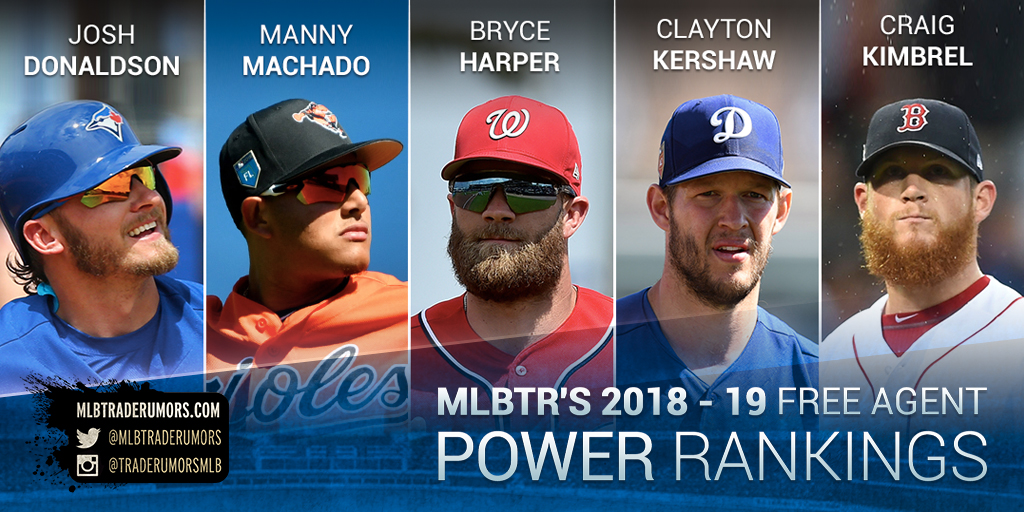
1. Bryce Harper. Before his 2012 Rookie of the Year season, Baseball America called Harper “the most hyped position player prospect in baseball history.” Seemingly groomed for MLB stardom from birth, Harper graduated high school early and fast-tracked himself to make his debut with the Nationals at age 19. He’s only missed the All-Star team once in his career, and won the NL MVP in 2015. Harper stands alongside Mike Trout and Joey Votto as one of the best hitters in baseball, combining power and patience from the left side of the plate. Due to his early debut and avoidance of contract extensions, Harper stands to reach free agency as a 26-year-old.
Aside from the sky-high price tag, only Harper’s injury history could give teams pause. Harper has gone on the disabled list three times in his career, missing anywhere from 35-65 days with each injury. He suffered knee and thumb injuries in 2013 and ’14, respectively, that resulted from his all-out style of play. Both ultimately required surgery. Harper rebounded to play in 300 games from 2015-16, but suffered a bone bruise in his left knee last August that kept him out for a month and a half. Harper is healthy and raking early in 2018, and something close to 150 games played should quiet injury concerns.
Though he understandably refuses to discuss his free agency with reporters this year, MLB fans expect an epic experience with the Winter Meetings taking place in Harper’s hometown Las Vegas. 18 years after opinionated agent Scott Boras brokered Alex Rodriguez‘s precedent-shattering 10-year, $252MM free agent contract with the Rangers, he’ll attempt to raise the bar with Harper. Harper figures to easily surpass the current record contract, Giancarlo Stanton‘s 13-year, $325MM deal from November 2014. Aside from beating that total by more than $100MM, Boras will also aim to destroy the current average annual value record, the $34.4MM Zack Greinke is earning. A half billion dollars could be in play. Harper could land anywhere from $400-500MM over 10-14 years. Opt-out clauses will likely be scattered throughout, allowing Harper the opportunity to later break his own record.
2. Manny Machado. About three months after Harper debuted in 2012, Machado reached the Majors as the Orioles’ third baseman. Just a few months older than Harper, Machado was also a first-round prodigy. Machado’s bat took longer to blossom, with a power surge in his fourth season. Machado is well-known for his defense on the left side of the infield. He came up as a shortstop, but began his big league career at third base to accommodate J.J. Hardy. Machado became an elite defender at the hot corner, winning three Gold Gloves. His ascent was interrupted when he tore the medial patellar ligament in his left knee in September 2013, pushing his 2014 debut into May. Several months later, Machado sprained a ligament in the other knee, also necessitating surgery. The knee injuries are behind him, as Machado averaged 158 games from 2015-17. He played a couple months of shortstop in the summer of 2016 when Hardy got hurt, and convinced the Orioles to shift him back to his natural position for the 2018 season. In addition to establishing himself as an above-average defensive shortstop, Machado must shake off mediocre offensive output from 2017, when he posted a .310 OBP.
Machado endured trade rumors throughout the offseason, and could be dealt this summer if the Orioles fall out of contention. Though he’ll fall short of Harper’s contract, some teams may consider Machado a more balanced player with lower health risk. Since he doesn’t turn 26 until July, Machado is also set up for a monster contract that could top $300MM.
3. Clayton Kershaw. Already an all-time great at age 30, Kershaw has been slowed only by his balky back. He lost 74 days to a back injury in 2016 and another 39 last summer. Kershaw otherwise remains at the top of his game. He’s got three Cy Young awards (and an MVP) under his belt and even finished fifth in the Cy voting in 2016 (149 innings) and second last year (175 innings). By measure of Wins Above Replacement, Kershaw ranks fourth in baseball among pitchers from 2016-17 despite pitching about 100 innings fewer than the three hurlers ranked ahead of him. Logically, barring an in-season extension with the Dodgers, Kershaw will opt out of the remaining two years and $65MM left on his contract and explore free agency for the first time. For teams formulating an offer, the primary forecasting question will be more about Kershaw’s health than his abilities. How much time will the future Hall of Famer miss within the next seven or eight seasons? Will he require back surgery at some point? If Kershaw makes it through this season mostly unscathed, he’ll be primed to sign the largest contract ever for a starting pitcher, topping David Price‘s seven-year, $217MM pact and Greinke’s $34.4MM average annual value.
4. Josh Donaldson. The Cubs drafted Donaldson 48th overall in 2007 as compensation for the loss of free agent Juan Pierre. Donaldson had switched from third base to catcher during college, and Baseball America said he projected “as a .280 hitter with 15-20 homers a season.” He was soon shipped to Oakland in the Rich Harden trade, and before the ’08 season BA noted that “some scouts question if he’ll hit enough to be a big league regular.” Donaldson got a big league look in 2010, but he was still buried on the Athletics’ catching depth chart in 2011 at age 25. His opportunity finally came in 2012 with a preseason injury to A’s third baseman Scott Sizemore. Donaldson bounced up and down that year but started to emerge in the season’s final two months. Finally, in 2013 at age 27, Donaldson established himself as one of the best third basemen in baseball. He combined strong defense with increasing power to become a perennial MVP candidate. The A’s traded him to Toronto in the 2014-15 offseason, and Donaldson won the MVP in his first season with his new team. Last year marked his first appearance on the DL, as he lost more than a month to a calf injury. Currently, he’s on the DL for right shoulder inflammation. As a late bloomer, Donaldson will play his first season on his next contract as a 33-year-old. In discussing his free agency with my MLBTR colleagues, I was the low man on his contract, not fully convinced a player with this profile can secure a four-year deal. At the least, he’s a candidate for an AAV in the $25MM range.
5. Craig Kimbrel. A third round pick of the Braves in 2008, Kimbrel emerged as the best closer in baseball beginning in 2011. Kimbrel racked up 185 saves for the Braves from 2011-14, inking an extension along the way that bought out his first two free agent years. The Padres acquired him in 2015 in a rare April trade, capping off their ill-fated push for contention under A.J. Preller. Seven months later Preller turned around and dealt Kimbrel to the Red Sox. Kimbrel made his fifth All-Star game in his first season with Boston, though his walk rate spiked up to a dangerous level. He more than corrected that problem in a dominant 2017, finishing sixth in the Cy Young voting. Another vintage Kimbrel season may result in the largest reliever contract in baseball history. Aroldis Chapman‘s five-year, $86MM deal is the record, while Wade Davis set the high water mark for AAV at $17.3MM in December winter. Kimbrel will likely be striving for a five-year deal, though he’ll pitch most of 2019 at age 31 (as opposed to Chapman and Kenley Jansen beginning their recent free agent deals at age 29).
6. Patrick Corbin. Corbin, a 28-year-old lefty, was a second-round pick of the Angels in 2009. Near the trade deadline in 2010, he became the third piece headed to the Diamondbacks in the Dan Haren trade. Corbin bounced up and down with Arizona in 2012 and won the team’s fifth starter job out of camp in 2013. At age 23, Corbin authored an excellent All-Star campaign over 208 1/3 innings. In line to start Opening Day 2014, Corbin instead wound up getting Tommy John surgery in March that year. About 15 months later, he was back on a Major League mound and acquitted himself well in 16 starts. Corbin had a surprisingly rough 2016, losing his rotation job in mid-August after seeing his walk and home run rates spike. He bounced back with a healthy 3.0 WAR season in 2017 and is off to a nice start this year. Since that 2016 bottoming out, Corbin has increased his slider usage to the current 46.8%, throwing the pitch more often than any starter other than Chris Archer. Corbin has youth on his side and will compete with Dallas Keuchel to be considered the best free agent starting pitcher, Non-Kershaw Division. At nearly 19 months younger than Keuchel, age is on Corbin’s side. After the 2015-16 free agent starting pitcher bonanza, in which seven pitchers signed for at least five years (excluding Kenta Maeda), only one starting pitcher, Yu Darvish, has reached five years in the past two offseasons. That will likely be Corbin’s goal.
7. Dallas Keuchel. Compared to Corbin, Keuchel has age working against him, but the Astros lefty also has a Cy Young Award on his shelf from 2015. Keuchel is a ground-ball machine when he’s on, including a 66.8% rate last year that was tops among starters with at least 140 innings. Neck injuries caused Keuchel to miss more than two months in 2017, and a healthy season would increase his chances at a strong multi-year deal in free agency. Keuchel’s profile as a soft-tossing southpaw who relies heavily on ground-balls could be spun either way — it’s not as exciting as a power arm with a more strikeout-oriented approach, but it could also be seen as a skill set that will age better than his peers who rely more on premium velocity.
8. Brian Dozier. The Twins drafted Dozier in the eighth round in 2009. In his first Baseball America profile in 2011, they wrote, “His biggest weakness is his lack of power, as he doesn’t project to hit more than 5-10 homers annually.” BA didn’t rate any of Dozier’s tools as above-average at the time, so he was even more of an underdog than Donaldson. Dozier became the Twins’ Minor League Player of the Year that season, and was upgraded to a future Jamey Carroll type. Twins manager Ron Gardenhire championed Dozier as more than a utility man, however, and indeed he took over for Carroll as the team’s starting shortstop in May 2012. The 25-year-old rookie was demoted in August but bounced back to win the Twins’ starting second base job out of camp in 2013. Dozier never looked back, hitting 17 home runs in his final 108 games that year. The second baseman continued ramping up his power output over the years, peaking with 42 bombs in 2016. By WAR, he was the 11th-best position player in baseball from 2016-17, exceeding the output of players like Nolan Arenado and Paul Goldschmidt. Dozier will play most of 2019 at 32, so like Donaldson, his age will work against him in free agency. Alex Gordon‘s four-year, $72MM deal could be a target.
9. A.J. Pollock. Pollock, 30, was taken 17th overall by the Diamondbacks as part of their productive 2009 draft. He made his Major League debut in 2012 upon an injury to Chris Young. A spring 2013 injury to Adam Eaton opened up a door for Pollock, who logged most of the team’s innings in center field that year. Eaton was traded that winter, further cementing Pollock’s position until a Johnny Cueto pitch broke his hand in late May, costing him three months. Health was not a problem in Pollock’s incredible 2015 season, a .315/.367/.498 effort worth 6.8 WAR and MVP votes. In 2016, an elbow injury derailed Pollock’s ascent to stardom. The elbow fracture required surgery, as did a similar injury suffered by Pollock when he was in the minors in 2010. Pollock appeared in just 12 games in 2016, and then lost 50 days in 2017 with a groin injury. A healthy contract year is crucial as Pollock looks to achieve the five-year, $80MM center fielder standard set by Dexter Fowler and Lorenzo Cain.
10. Elvis Andrus. Though Andrus is in his ninth season with the Rangers, he still hasn’t reached his 30th birthday. Signed as an amateur free agent out of Venezuela by the Braves, the Rangers acquired Andrus in the legendary Mark Teixeira trade near the July 2007 deadline. Andrus became the Rangers’ starting shortstop as a 20-year-old in 2009, with Michael Young moving to third base to accommodate the rookie. Renowned for his defense, speed, and makeup, Andrus settled in as a 2-3 WAR shortstop. In April 2013, the Rangers signed Andrus to what GM Jon Daniels called “an unusual deal,” a record extension worth $120MM over eight years. The contract allows Andrus to opt out after the 2018 or ’19 seasons. He’s guaranteed $58MM over the next four years, so opting out this winter isn’t a slam dunk. After serving as an iron man for nine seasons, Andrus will miss 6-8 weeks with a broken elbow that will not require surgery. It’s the first DL trip of his career. Further complicating Andrus’ value is his newfound power. Though Andrus jumped up to a career-high 20 home runs last year, that plateau isn’t as special when 116 other players also accomplished it. The result was a 110 wRC+, which contributed to a career-best 4.3 WAR. Andrus’ safest move might be to avoid free agency, and instead convince the Rangers to guarantee his club/vesting option for 2023.
In addition to these ten players, another eight have a good shot at exceeding a $40MM free agent contract: Garrett Richards, Yasmani Grandal, Daniel Murphy, Cody Allen, Andrew McCutchen, Gio Gonzalez, Drew Pomeranz, and Andrew Miller. Others may very well join that mix as the season progresses. I’ll update these power rankings monthly, and I’m sure they’ll look very different by the time free agency actually begins.
MLB Daily Roster Roundup: Gyorko, Harrison, Hellickson, Kiermaier
ROSTER MOVES BY TEAM
(April 16th)
NATIONAL LEAGUE
- MILWAUKEE BREWERS | Depth Chart
- Placed on 10-Day DL: C Manny Pina (strained calf)
- Jett Bandy played C and batted 8th on Monday.
- Recalled from minors: C Jacob Nottingham
- Placed on 10-Day DL: C Manny Pina (strained calf)
- PITTSBURGH PIRATES | Depth Chart
- Placed on 10-Day DL: 2B Josh Harrison (fractured hand)
- Harrison is expected to miss six weeks.
- Adam Frazier played 2B and batted 1st on Monday.
- Added to 25-man roster: RP Enny Romero (claimed off waivers from Pirates on Saturday)
- Promoted: INF Max Moroff
- Optioned: RP Dovydas Neverauskas
- Placed on 10-Day DL: 2B Josh Harrison (fractured hand)
- ST. LOUIS CARDINALS | Depth Chart
- Activated from 10-Day DL: INF Jedd Gyorko and RP Luke Gregerson
- Optioned: INF/OF Yairo Munoz, RP Mike Mayers
- WASHINGTON NATIONALS | Depth Chart
- Promoted: SP Jeremy Hellickson (contract purchased)
- Optioned: RP Trevor Gott
- Transferred to 60-Day DL: C Jhonatan Solano
—
AMERICAN LEAGUE
- NEW YORK YANKEES | Depth Chart
- Signed: INF/OF Jace Peterson (MLB contract)
- Optioned: RP/SP Luis Cessa
- OAKLAND ATHLETICS | Depth Chart
- Activated from 10-Day DL: INF/OF Chad Pinder
- Optioned: INF Franklin Barreto
- TAMPA BAY RAYS | Depth Chart
- Placed on 10-Day DL: OF Kevin Kiermaier (torn thumb ligament)
- Kiermaier is expected to miss at least 12 weeks.
- Mallex Smith will play CF while Kiermaier is out.
- Recalled: RP Chih-Wei Hu
- Placed on 10-Day DL: OF Kevin Kiermaier (torn thumb ligament)
- TEXAS RANGERS | Depth Chart
- Added to 25-man roster: INF/OF Renato Nunez (claimed off waivers from Athletics on Sunday)
- Nunez played LF and batted 6th on Monday.
- Optioned: INF/OF Ryan Rua
- Added to 25-man roster: INF/OF Renato Nunez (claimed off waivers from Athletics on Sunday)
—
FUTURE EXPECTED MOVES
- BOS: SP Drew Pomeranz will be activated from 10-Day DL on Friday April 20th, according to Rob Bradford of WEEI.
- CHC: 1B Anthony Rizzo will be activated from the DL on Tuesday April 17th, according to Carrie Muskat of MLB.com.
- MIA: C J.T. Realmuto is likely to be activated from the DL on Tuesday April 17th, according to Joe Frisaro of MLB.com.
- NYY: SP CC Sabathia will be activated from the DL on Thursday April 19th, according to Erik Boland of Newsday.
- OAK: SP Trevor Cahill will be recalled from the minors on Tuesday April 17th, according to Jane Lee of MLB.com. He will be making his first start with the A’s since September 2011.
- SEA: OF Ben Gamel will be activated from the DL sometime during the upcoming series versus Houston (April 16th-19th), according to Ryan Divish of the Seattle Times. SP Ariel Miranda will likely be recalled on Tuesday April 17th, according to Greg Johns of MLB.com.
- SFG: SP Johnny Cueto will be activated from the DL on Tuesday April 17th, according to Alex Pavlovic of NBC Sports Bay Area. SP Tyler Beede was optioned to the minors to make room on the 25-man roster.
- TOR: SP Joe Biagini will be recalled from the minors on Tuesday April 17th, according to Richard Griffin of the Toronto Star. He’ll start Game 2 of the double-header.
Offseason In Review: San Diego Padres
This is the latest entry in MLBTR’s 2017-18 Offseason In Review series. Click here to read the other completed reviews from around the league.
The early-offseason buzz on the Padres’ possible interest in adding an impact player came to fruition when Eric Hosmer inked the biggest contract in franchise history. They had also reportedly shown some interest in top free agent pitchers Jake Arrieta and Alex Cobb. While the addition of Hosmer isn’t expected to turn the Padres into an immediate contender — nor would’ve the signing of Arrieta or Cobb, for that matter — it’s another step towards building the organization’s next playoff-caliber roster.
Major League Signings
- Eric Hosmer, 1B: Eight years, $144MM (opt-out clause after 2022)
- Jordan Lyles, RHP: One year, $1MM (includes a $3.5MM club option in 2019 with a $250K buyout)
- Craig Stammen, RHP: Two years, $4.5MM
- Kazuhisa Makita, RHP: Two years, $3.8MM ($500K posting fee)
- Colten Brewer, RHP: Contract details unknown
- Total spend: $153.8MM
Trades and Claims
- Acquired 3B Chase Headley and SP Bryan Mitchell from the Yankees in exchange for OF Jabari Blash.
- Acquired SS Freddy Galvis from the Phillies in exchange for RHP Enyel De Los Santos.
- Traded INF Yangervis Solarte to the Blue Jays for OF Edward Olivares and RHP Jared Carkuff.
- Traded INF Ryan Schimpf to the Rays for INF Deion Tansel.
Extensions
- Brad Hand, LHP: Three years, $19.75MM (includes a $10MM club option in 2021 with a $1MM buyout)
Notable Minor League Signings
Notable Losses
- Erick Aybar, Jhoulys Chacin, Solarte, Schimpf, Travis Wood
Padres 25-Man Roster & Minor League Depth Chart; Padres Payroll Overview
Needs Addressed
The Padres still believe that Wil Myers can take a step forward and live up to the $83MM contract he signed last offseason. And it’s not a stretch, either. He’s averaged 29 homers and 24 stolen bases over the past two seasons and he’s only 27 years old. But he wasn’t comfortable in the role of clubhouse leader, which is partly why the team decided to pursue Hosmer, who filled that role on a Royals team that had a successful three-year run that included back-to-back World Series appearances and a championship.
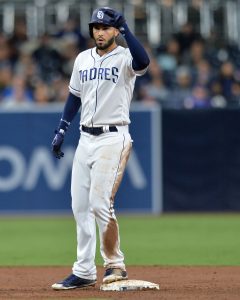
Valuing Hosmer was a topic of ample debate as his trip onto the open market drew near. Ultimately, the Pads and Royals decided he was worthy of a significant investment despite the fact that he’s not an overwhelming offensive force for a first baseman. Age (he’s just 28) plainly played a big role along with Hosmer’s oft-lauded makeup. Nobody questions that Hosmer is a quality big leaguer, and the hefty guarantee is spread over a lengthy term, but this type of signing always represents a notable risk for a lower-budget team.
In addition to Hosmer, the team solidified the left side of its infield by trading for Galvis and Headley. Neither is likely to deliver huge output over the full course of the season, but they’re both steady veterans who will raise the overall standard and provide a benchmark for the team’s youthful assets to measure themselves again. It’s certainly possible that either player could end up on the move over the summer.
The core of the bullpen — a unit compiled smartly from some unlikely places — remains intact. Craig Stammen, a successful reclamation project in 2017, was re-signed to a two-year deal over the winter. He’ll be joined by veteran Japanese hurler Kazuhisa Makita, who also signed an affordable multi-year pact.
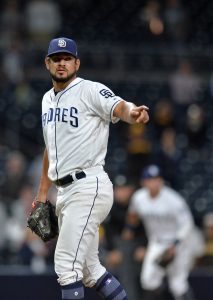
Most notably, though, the Padres decided to keep closer Brad Hand off of the trade block. It had long seemed he’d be moved — it was rather shocking it didn’t happen last summer — after coming out of nowhere to become one of the game’s better high-leverage relievers over the past two seasons. While the potential to plug more young talent into the system was surely tantalizing, the team smartly took advantage of an opportunity to achieve value by investing further in Hand. The extension gives the organization control through the 2021 season at what looks to be quite an appealing rate for a high-quality closer that had already reached arbitration.
Filling out the rotation remained a need even after a late-season move to extend Clayton Richard. The Headley swap was designed primarily to bring in Bryan Mitchell, who has a big arm and will be given a chance to sink or swim in the majors. Veteran Chris Young lost a spring battle to make the staff, but old friend Tyson Ross opened some eyes in camp and has continued to show well early in the season. While the loss of intriguing youngster Dinelson Lamet has put a damper on things, the impressive arrival of 2016 fourth-rounder Joey Lucchesi has created some excitement in the early going. Robbie Erlin‘s return after two seasons mostly lost to injury is also worth watching. He opened with some success in the pen and has now moved into the rotation, though his first start (just this evening) did not go as hoped.
Questions Remaining
Along with Hosmer and Myers, catcher Austin Hedges and center fielder Manuel Margot are all but locked in at their respective positions for the next several seasons. The team’s future double-play combination is expected to be made up of Fernando Tatis Jr. and Luis Urias. Two of the best prospects in the game, both are on the fast track to San Diego, though they’ll have to earn their way up before being anointed. A lot can happen in one season, but it’s easy to imagine that group of players in the same lineup at some point in 2019. That would leave just two future lineup spots, third base and corner outfield, unsettled.
In all likelihood, the corner outfield spot opposite Myers will likely be filled internally by one or more of Franchy Cordero, Jose Pirela and Hunter Renfroe. All three will have a chance to make their case in 2018. Cordero, who dazzled at Triple-A in 2017 with his speed-power combination, did not join the competition right away after opening the year on the DL. But with Margot hitting the shelf with an early injury, Cordero has received a chance and is off to a nice start.
While the return of Headley gives the Padres some stability at the hot corner for at least the next few months, the team’s third baseman during their next window of contention is probably not in the organization at this time. A reunion between Hosmer and Moustakas, who could reach free agency once again next offseason, is intriguing. Filling the spot in-house is a slight possibility, although it would probably take a breakout season from second baseman Carlos Asuaje to convince the team to alter their plans for where Urias and Tatis end up on the diamond. A strong performance from Galvis, who the team could look to re-sign after the season, could also shake things up.
With an abundance of talented pitching prospects who could reach the Majors sometime over the next 2-3 seasons, the Padres are in great shape to fill out their pitching staff without having to add significantly to their payroll. Left-hander Eric Lauer should join Lucchesi at some point in 2018, while the next wave should be ready to make an impact next season. In the meantime, Erlin, Bryan Mitchell and Luis Perdomo will have every opportunity to prove that they can be a part of the rotation for years to come. Lamet will be counted on to reenter the picture at some point in 2019.
Overview
Hosmer is entering a situation that should seem like very familiar territory. As a highly-touted Royals prospect, he made his MLB debut in 2011. He was surrounded by talented young players, including Danny Duffy, Alcides Escobar, Alex Gordon, Mike Moustakas and Salvador Perez. There was a lot of hype surrounding this group, which only made it more frustrating for the fan base when the team suffered its eighth consecutive losing season. And then a ninth. That this group of players would help lead the team to 86 wins by 2013, their first post-season appearance in 19 years in 2014, and a World Series title in 2015, made it all the more special.
This Padres team is in the midst of — you guessed it — seven consecutive losing seasons. The streak is almost certain to reach eight. But they have the resources to turn things around quickly. Their farm system was ranked third in baseball by both Baseball America and ESPN’s Keith Law, while Baseball Prospectus ranked it first. General manager A.J. Preller has done a terrific job stockpiling young talent and still has payroll flexibility even after committing to Myers and Hosmer.
Signing Hosmer was not a pure win-now move, as he’s young enough to contribute for years to come. But it did represent a strong signal of the organization’s near-term aspirations. The organization’s first major outside acquisition since its failed gambit at producing a contender in Preller’s first year in town, Hosmer is evidently a believer. As I wrote in the Padres’ Offseason Outlook back in November, “If he’s convinced that the Padres are a team on the rise and on a road to contend by 2019, he could be willing to sign on.”
He signed on. I guess that means he thinks they can contend next season. But there’s still plenty of work to be done to fully establish a new winning core in San Diego.
How do you grade the Padres’ offseason efforts? (Link for app users.)
Grade the Padres Offseason
-
B 43% (765)
-
C 29% (516)
-
A 12% (223)
-
D 10% (187)
-
F 6% (105)
Total votes: 1,796
Photos courtesy of USA Today Sports Images.
Chat Transcript: Rookies, Angels, Blue Jays, Reds
Click here for the transcript of today’s chat with MLBTR owner Tim Dierkes.
MLB Weekend Roster Roundup: Cobb, Cruz, Schoop, Walker
ROSTER MOVES BY TEAM
(April 14th – April 15th)
NATIONAL LEAGUE
- ARIZONA DIAMONDBACKS | Depth Chart
- Placed on 10-Day DL: SP Taijuan Walker (forearm inflammation)
- Braden Shipley is the leading candidates to take Walker’s rotation spot.
- Promoted: RP Silvino Bracho
- Placed on 10-Day DL: SP Taijuan Walker (forearm inflammation)
- ATLANTA BRAVES | Depth Chart
- Promoted: RP Lucas Sims
- Designated for assigment: RP Luke Jackson
- CINCINNATI REDS | Depth Chart
- Activated from 10-Day DL: SP Brandon Finnegan
- Optioned: RP Zack Weiss
- COLORADO ROCKIES | Depth Chart
- Suspended: 3B Nolan Arenado (5-game suspension; 4/14-4/18)
- Ryan McMahon is playing 3B in Arenado’s absence.
- Suspended: 3B Nolan Arenado (5-game suspension; 4/14-4/18)
- LOS ANGELES DODGERS | Depth Chart
- Placed on 10-Day DL: INF Logan Forsythe (shoulder inflammation)
- Enrique Hernandez played 3B and batted 8th in Sunday’s lineup.
- Recalled: INF/OF Breyvic Valera
- Placed on 10-Day DL: INF Logan Forsythe (shoulder inflammation)
- NEW YORK METS | Depth Chart
- Activated from 10-Day DL: 1B Dominic Smith
- Smith was optioned to Triple-A.
- Activated from 10-Day DL: 1B Dominic Smith
- PITTSBURGH PIRATES | Depth Chart
- Acquired: RP Enny Romero (claimed off waivers from Nationals)
- Corresponding 25-man roster move has not been made.
- Acquired: RP Enny Romero (claimed off waivers from Nationals)
- SAN DIEGO PADRES | Depth Chart
- Suspended: SP Luis Perdomo (5-game suspension; 4/14-4/18)
- Robbie Erlin will start in Perdomo’s place on Monday.
- Acquired: RP Tyler Webb (claimed off waivers from Brewers)
- Webb was optioned to Triple-A.
- Transferred to 60-Day DL: SP Dinelson Lamet
- Suspended: SP Luis Perdomo (5-game suspension; 4/14-4/18)
—
AMERICAN LEAGUE
- BALTIMORE ORIOLES | Depth Chart
- Placed on 10-Day DL: 2B Jonathan Schoop (strained oblique)
- Danny Valencia is playing 3B while Schoop is out with Tim Beckham moving from 3B to 2B.
- Promoted: SP Alex Cobb, RP David Hess
- Optioned: RP Donnie Hart
- Placed on 10-Day DL: 2B Jonathan Schoop (strained oblique)
- MINNESOTA TWINS | Depth Chart
- Promoted: RP Alan Busenitz
- Optioned: OF Ryan LaMarre
- OAKLAND ATHLETICS | Depth Chart
- Activated from 10-Day DL: RP Ryan Dull
- Placed on 10-Day DL: RP Liam Hendriks (adductor tendinitis)
- SEATTLE MARINERS | Depth Chart
- Activated from 10-Day DL: DH Nelson Cruz
- Cruz was the DH and cleanup hitter on Saturday and Sunday.
- Optioned: RP Casey Lawrence
- Activated from 10-Day DL: DH Nelson Cruz
- TEXAS RANGERS | Depth Chart
- Acquired: INF/OF Renato Nunez (claimed off waivers from Athletics)
- Corresponding 25-man roster move has not been made. Nunez was activated from the 10-Day DL prior to being placed on waivers by the Athletics.
- Transferred to 60-Day DL: RP Tim Lincecum
- Acquired: INF/OF Renato Nunez (claimed off waivers from Athletics)
—
FUTURE EXPECTED MOVES
- BOS: SP Drew Pomeranz will be activated from 10-Day DL on Friday April 20th, according to Rob Bradford of WEEI.
- NYY: SP CC Sabathia will be activated from the DL on Thursday April 19th, according to Erik Boland of Newsday.
- SEA: OF Ben Gamel will be activated from the DL sometime during the upcoming series versus Houston (April 16th-19th), according to Ryan Divish of the Seattle Times. SP Ariel Miranda will likely be recalled on Tuesday April 17th, according to Greg Johns of MLB.com.
- SFG: SP Johnny Cueto will be activated from the DL on Tuesday April 17th, according to Alex Pavlovic of NBC Sports Bay Area. SP Tyler Beede will be optioned to the minors to make room on the 25-man roster.
- WSH: SP Jeremy Hellickson will have his contract purchased from the minors on Monday April 18th, according to Dan Kolko of MASN. He’ll start in place of A.J. Cole, who will presumably move to the bullpen.