
Offseason In Review: Baltimore Orioles
Front office controversy generated more headlines in Baltimore than any of the Orioles’ winter moves, as the team had one of the quieter offseasons of any contending team. The O’s will rely on some lower-profile transactions and a return to form from injured stars as they look to defend their AL East crown.
Major League Signings
- Wei-Yin Chen, SP: One year, $4.75MM (club option exercised)
- Darren O’Day, RP: One year, $4.25MM (club option exercised)
- Everth Cabrera, SS: One year, $2.4MM
- Delmon Young, OF/DH: One year, $2.25MM
- Wesley Wright, RP: One year, $1.7MM
- Rey Navarro, MI: One year, $550K (split contract)
- Eddie Gamboa, RP: One year, $525K (split contract)
- Oliver Drake, RP: One year, $508K (split contract)
- Total spend: $17.68MM (counting the three split deals)
Notable Minor League Signings
- J.P. Arencibia, Pedro Beato, Julio Borbon, Cesar Cabral, Dane De La Rosa, Mark Hendrickson, Paul Janish, Steve Johnson, Jayson Nix, Chris Parmelee, Nolan Reimold, Chaz Roe, Matt Tuiasosopo
Trades And Claims
- Acquired OF Travis Snider from Pirates for P Stephen Tarpley and P Steven Brault
- Acquired cash considerations from Pirates for IF Steve Lombardozzi
- Acquired cash considerations from Cardinals for C Michael Ohlman
- Claimed C Ryan Lavarnway from Cubs
- Claimed SP Logan Verrett from Mets in the Rule 5 draft
- Acquired SP Jason Garcia from Astros for cash considerations
- Acquired RP Scott Barnes from Indians for cash considerations (Barnes was then claimed off waivers by the Rangers in December)
- Claimed OF Alex Hassan from Athletics (Hassan was designated for assignment and claimed back by A’s in February)
Extensions
- None
Notable Losses
- Nelson Cruz, Nick Markakis, Andrew Miller, Nick Hundley, Joe Saunders, Lombardozzi, Quintin Berry, Johan Santana
Needs Addressed
Several of the Orioles’ most notable offseason moves were completed before October was even finished. Exercising 2015 options for Wei-Yin Chen and Darren O’Day were virtual no-brainers given how well both men pitched last year, and the O’s kept J.J. Hardy off the free agent market by signing him to a three-year extension before their postseason run was even over.
The outfield and DH spots became major needs for the O’s once Nelson Cruz and Nick Markakis signed elsewhere. The team explored signing or trading for several candidates to fill those spots, ranging from big-name everyday options as Matt Kemp, Justin Upton, Marlon Byrd, Michael Morse and Colby Rasmus, to players better suited for a platoon role, i.e. Jonny Gomes or Chris Denorfia.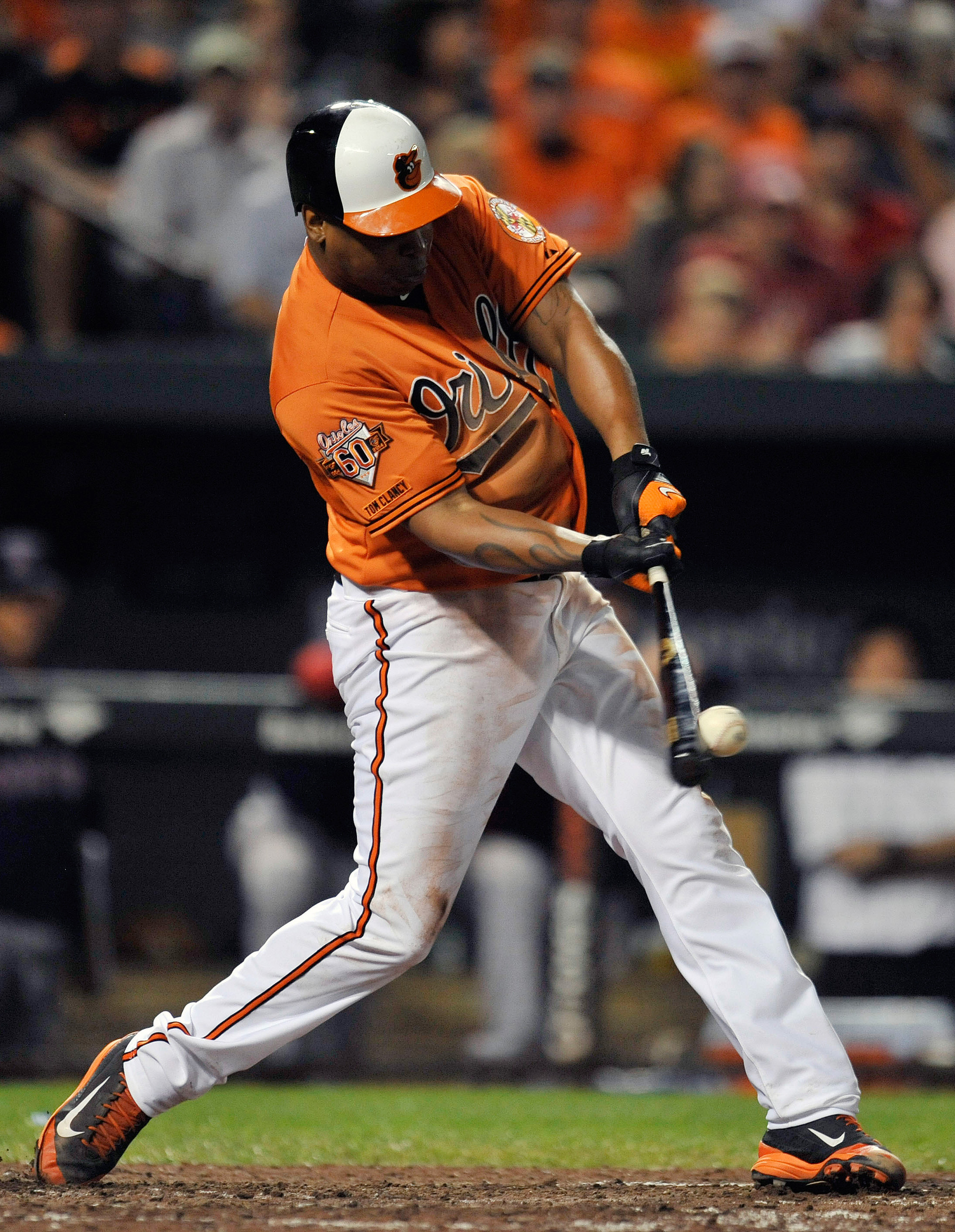
In the end, the Orioles brought back a familiar face in Delmon Young and acquired an intriguing piece in ex-Pirates outfielder Travis Snider. Young hit well (.302/.337/.442 over 255 plate appearances) in a part-time role for the O’s last season and he can play either corner outfield spot, though defensive metrics suggest he’s a better fit for a DH spot. Snider was rated as one of baseball’s top-10 prospects in his days as a Blue Jays minor leaguer, though he never gained a solid foothold in the majors until he posted a .776 OPS over 359 PA for the Pirates last season. Snider is still just 27 and comes with two years of team control, so a breakout isn’t out of the question, and at worst the O’s should have a solid lefty bat.
Overall, manager Buck Showalter has lots of opportunity to mix and match his lineup when it comes to his corner outfield and DH positions. He has Snider, David Lough and Alejandro De Aza as left-handed bats and Young and Steve Pearce hitting from the right side. Pearce is the best bet for regular playing time given his huge 2014 numbers, though the O’s have given themselves some depth should Pearce come back down to earth.
Though Wesley Wright is much more of a lefty specialist than a dominant bullpen southpaw like Andrew Miller, Wright’s signing will help fill the left-handed hole left by Miller in the Orioles’ bullpen. There was speculation that Wright’s signing could have also been made to account for a possible trade of Brian Matusz, though since no move materialized, Baltimore will go into the year with significant left-handed relief depth in Wright, Matusz, T.J. McFarland and closer Zach Britton. Before landing Wright, the O’s also looked into acquiring Antonio Bastardo from the Phillies before he was traded to the Pirates.
While Matt Wieters is expected to be recovered from the Tommy John surgery that cost him all but 26 games of the 2014 season, Baltimore added to its catching depth beyond Steve Clevenger and Caleb Joseph by signing J.P. Arencibia and Ryan Lavarnway to minor league deals. (Michael Ohlman was also in the mix before being dealt to the Cardinals.) Wieters is an important name to watch; not only will his health be a key factor in the Orioles’ success, but he’s also entering the final year of his contract. A big year will make Wieters one of the top names in the 2015-16 free agent class, so his future in Baltimore will be one of the team’s major ongoing storylines.
MLBTR’s Matt Swartz projected that the Orioles would spend $56.9MM to cover the contracts for their whopping 11-player arbitration class. The total ended up being $57.515MM, which included winning a hearing against Alejandro De Aza.
Questions Remaining
The general feeling going into the offseason was that of the Orioles’ three biggest free agents, Miller was sure to leave, Cruz was 50-50 and Markakis was leaning towards re-signing. As it turned out, all three players departed, leaving the O’s with a particular need for lineup reinforcements.
As ESPN’s Jayson Stark recently pointed out, those reinforcements could already be on the roster if Wieters, Manny Machado and Chris Davis are all healthy and productive. Relying on those three, however, is no sure thing. Wieters was already in need of a rebound after a sub-par 2013 season, Machado has now undergone two knee surgeries in as many years and it’s hard to know what to expect from Davis, who went from a 53-homer year in 2013 to being barely above replacement level (0.5 fWAR) in a 2014 season plagued by injuries and a suspension for using Adderall.
It remains to be seen if the platooning rotation at LF/RF/DH can work, as a lot rides on whether Pearce, Young and Snider can continue to hit as well as they did in 2014 rather than struggle as they have in previous seasons. An everyday option like Upton or Byrd would’ve provided more stability, though the Orioles were leery of parting with any significant minor leaguers. In my opinion, this is where you can second-guess Baltimore’s decision to deal Eduardo Rodriguez for Miller at the trade deadline. While Miller undoubtedly helped the O’s win the East, a top-60 prospect was a stiff price to pay for two-plus months of a relief pitcher, and Rodriguez could’ve perhaps been better served as trade bait for a bigger roster piece this offseason.
It seemed as if the Orioles were constantly on the verge of a major move this winter, as in addition to being linked to those notable outfielders and Bastardo, there were also rumors of a Chen-for-Howie Kendrick trade with the Angels. Chen and Bud Norris drew some trade interest, though the Orioles decided to hang onto their starting pitching depth; a wise move in my view given how Ubaldo Jimenez struggled last year.
The biggest development of the Orioles’ offseason (and one that could have ramifications for seasons to come) was the Blue Jays’ pursuit of Dan Duquette to be their new team president and CEO. After roughly six weeks of speculation and negotiations between the two clubs, talks finally ended with the Jays walking away due to Baltimore’s demand for multiple top prospects as compensation for Duquette’s services.
The relationship between Duquette and the Orioles was thought to be as solid as could be, given the team’s two postseason appearances in Duquette’s three seasons as the executive VP of baseball operations and the fact that Duquette had signed an extension that keeps him with the O’s through the 2018 campaign. After this winter, however, questions have to be asked about Duquette’s long-term future in Baltimore, especially given how owner Peter Angelos was reportedly very upset about the situation. For now, it’s a situation to keep an eye on.
Deal Of Note
Since being named to the 2013 All-Star team, Everth Cabrera‘s career has taken a turn for the worse both on and off the field. Cabrera served a 50-game suspension for PED use, posted only a .572 OPS over 391 PA last season and is facing charges for resisting arrest stemming from a suspected DUI last September.
Given all of these recent troubles, it’s no surprise that the Padres non-tendered Cabrera last December. That said, if Cabrera can put his troubles behind him, then he could be yet another unheralded Duquette signing that pays big dividends for the Orioles. Cabrera is controllable through the 2016 season and he still has a minor league option remaining, making his one-year, $2.4MM contract even less of a risk for the team. He’s seen time all around the diamond during Spring Training camp, so the O’s could employ him as a switch-hitting supersub, or they could focus on him as a backup or even a platoon mate for Jonathan Schoop at second base.
Overview
While some fans and pundits think the Orioles’ quiet offseason will lead to a step back in the AL East, it’s worth noting that Duquette’s three previous offseasons running the Orioles were also not particularly newsworthy on paper. It was only in hindsight that some of those under-the-radar moves stood out, ranging from claiming O’Day off waivers or getting good contributions from Jason Hammel or Nate McLouth, to the admittedly more notable steal of Cruz’s 40-homer season on only a one-year, $8MM contract.
In those past offseasons, however, Duquette’s strategy was to tinker around an already-solid core of players. This is the first time Orioles have had to deal with some major losses to that core, as Cruz immediately became a key part of the lineup and Markakis had been a staple for years. That said, the club still has Adam Jones, Hardy, the returning trio of injured stars, an underrated bullpen led by Britton and a solid starting rotation that could get a boost if Kevin Gausman takes a step forward or if Jimenez gets back on track.
While winning the division by 12 games again may be a stretch, it isn’t hard to see the Orioles in playoff contention again. The pressure is on, however — with a whopping 12 players set to hit free agency next winter, this may be this roster’s last chance at a pennant before some inevitable reshuffling for 2016.
Photo courtesy of Joy R. Absalon/USA Today Sports Images
2014-15 Free Agent Market: Overall Spending Declines, AAV Rises
Last year, I compiled a whole lot of data on free agent spending to assess overall spending trends over the 2007-08 to 2013-14 time period. That post was the culmination of a lot of research, and includes plenty of observations about the broader period in question which I will not repeat here.
At the time, the 2013-14 spending season was not quite wrapped up. It was apparent that it would blow the prior years out of the water in most respects, and indeed that proved to be the case. After performing a complete update, the final tab is a shade over $2.043B in overall outlay.
So, how does the current (2014-15) market stack up? Though we may see a few more MLB deals, it seems a reasonable time to assess. I broke out spending by team yesterday, but that only shows us strategic choices across a single market. Now, we’ll look at the market as a whole against prior years.
The first thing you’ll notice is that the total spend has declined for the first time since the 2009-10 period. But as a glance further down the table reveals, that is almost certainly the result of the number of players available (among other factors) than it is some pull-back in spending.
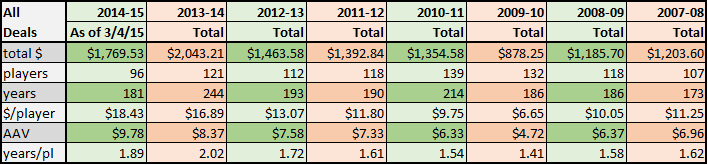 As the graph shows more visually, overall spending rate increases have continued, while the total outlay this season falls in line with a general upward curve.
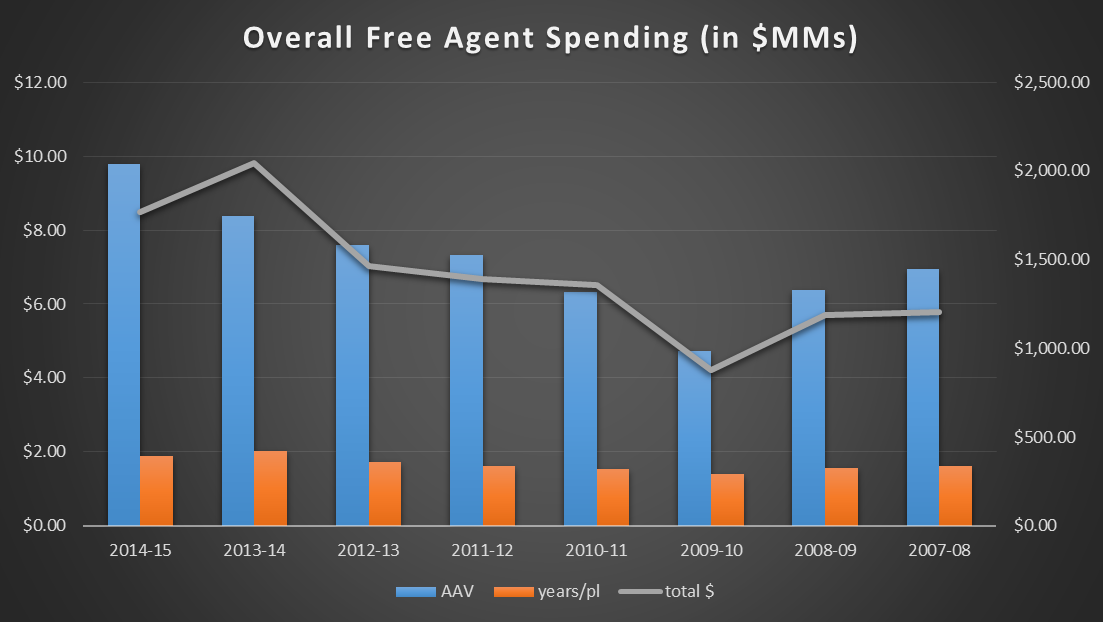
Here are the annual increases and decreases; as you can see, last year’s market pushed a ton of total money over the prior season, but AAV actually grew more year-over-year this time around.

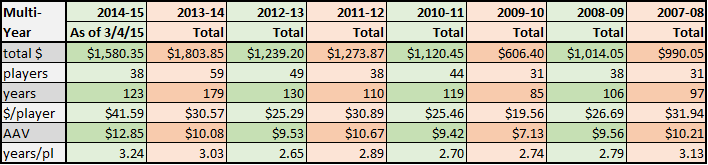
We’ll take a closer look at different classes of players (as I did with regard to the broader time period) in a separate post. But for now, take a look at the overall spending numbers isolated for multi-year contracts only. The total commitment per player and years per player both rose for those free agents who were marketable enough to secure pacts of two or more years in duration.
2014-15 Free Agent Spending By Team
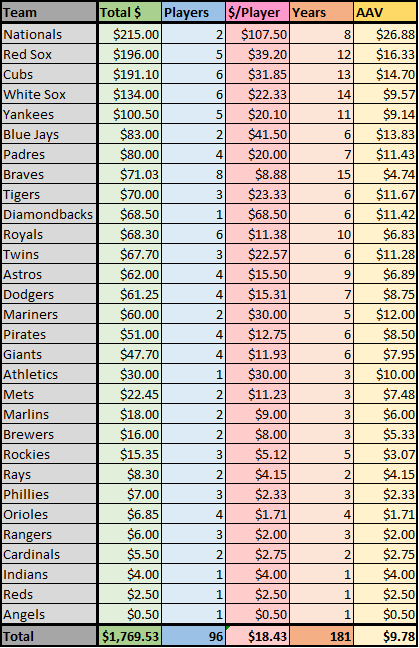
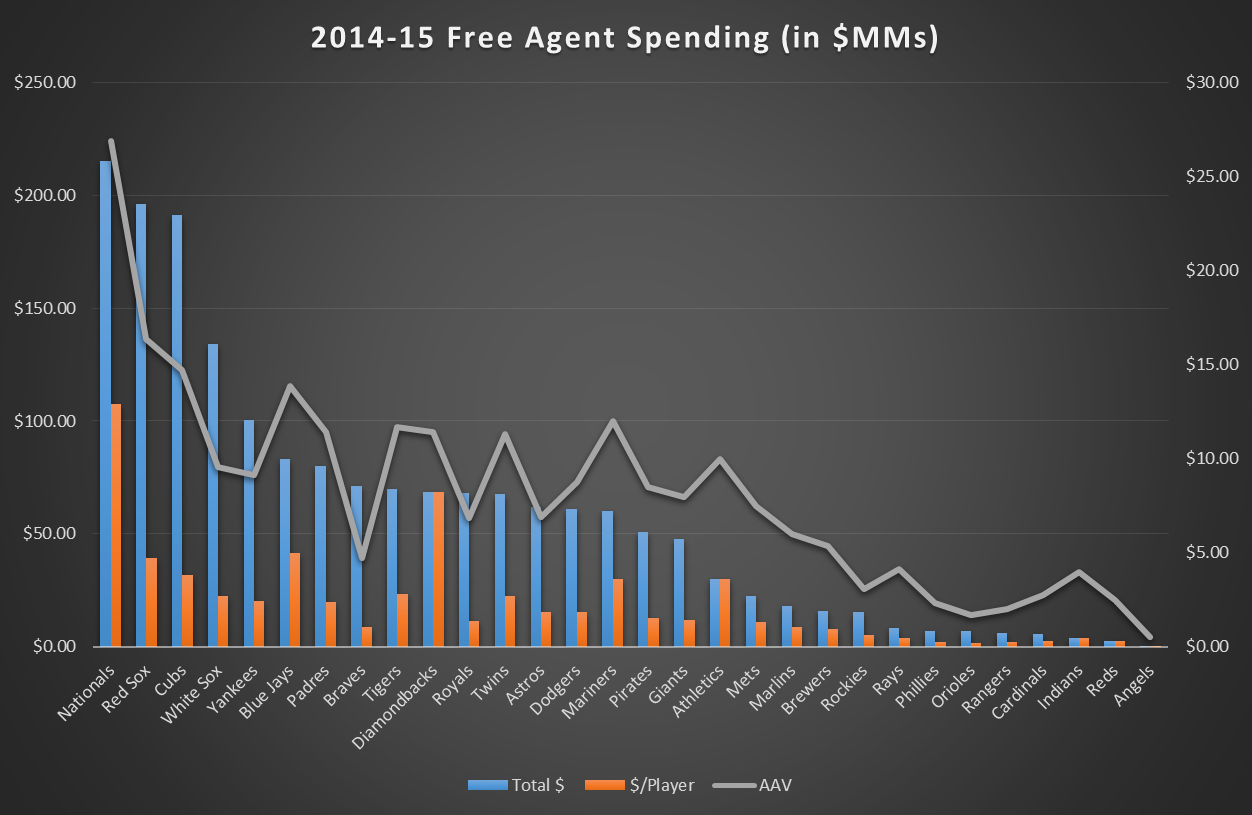
This year’s free agent market is all but over, with only a few players still available who could be candidates for major league deals. Let’s take a look at the overall spending on the year by team to see how it breaks down, using the MLBTR Free Agent Tracker (which I filtered to remove minor league deals, extensions, options, and foreign contracts).
We did the same thing last year, you may recall, and the results are rather different. For one thing, no team came anywhere near the Yankees’ spending (just shy of $500MM). For another, the total spend actually declined by about 13%. As recent historical results show, this year’s overall outlay is still a significant increase over other recent seasons, and differences in the player market may represent the primary explanation. Nevertheless, that fact suggests that further exploration is in order, which I will endeavor to do in the coming weeks.
Without further ado, here are the numbers, in table and chart form:
Offseason In Review: Pittsburgh Pirates
The Pirates spent much of the winter trying to insulate themselves against the potential departures of players who had been keys to their successful 2013 and 2014 seasons. In the end, they spent surprisingly heavily, given their usual thriftiness, signing two familiar starting pitchers and adding a high-profile but largely untested Korean infielder.
Major League Signings
- Francisco Liriano, SP: Three years, $39MM
- Jung-ho Kang, SS: Four years plus club option for 2019, $11MM guaranteed (plus $5,002,015 posting fee)
- A.J. Burnett, SP: One year, $8.5MM
- Corey Hart, 1B/OF: One year, $2.5MM
- Radhames Liz, P: One year, $1MM
- Total spend: ~$67MM
Notable Minor League Signings
Trades And Claims
- Acquired C Francisco Cervelli from Yankees for RP Justin Wilson
- Acquired P Stephen Tarpley and P Steven Brault from Orioles for OF Travis Snider
- Acquired RP Antonio Bastardo from Phillies for Joely Rodriguez
- Acquired UT Sean Rodriguez from Rays for P Buddy Borden and cash
- Acquired the rights to international bonus spending from Athletics for 1B Ike Davis
- Acquired RP Rob Scahill from Rockies for P Shane Carle
- Acquired SS Justin Sellers from Indians for cash
- Acquired RP Arquimedes Caminero from Marlins for cash
- Claimed SS Pedro Florimon from Nationals
Extensions
- None
Notable Losses
- Russell Martin, Edinson Volquez, Snider, Wilson, Davis, Clint Barmes, Gaby Sanchez, Jeanmar Gomez
Needs Addressed
The Pirates lost catcher Russell Martin, a key to their franchise-changing 2013 and 2014 campaigns and a bargain to the franchise when he signed following the 2012 season for two years and $17MM. Martin headed to Toronto at a dramatic markup, with the Pirates receiving only a draft pick in return. In Martin’s place, the Bucs acquired former Yankees backstop Francisco Cervelli, who has struggled to stay healthy and isn’t likely to hit nearly as well as Martin did, since Cervelli’s strong offensive performance in a small sample last year was largely BABIP-fueled. Via StatCorner, however, Cervelli and backup Chris Stewart have both ranked as above-average pitch framers in each of the last four seasons, potentially giving the Pirates an edge that won’t be reflected in their catchers’ offensive numbers. Cervelli and Stewart aren’t likely to replace Martin’s .290/.402/.430 2014 season at the plate, but they could approximate Martin’s value behind it at a fraction of the cost.
The Bucs also faced uncertainties in their rotation, given that Francisco Liriano and Edinson Volquez were eligible for free agency. The Bucs re-signed Liriano for $39MM, more than doubling Martin’s record for the organization’s largest ever free agent contract. To some extent, the Pirates paid heavily for their own handiwork, as their combination of framing, defensive shifts and strong coaching had helped Liriano rebuild his value after he posted consecutive seasons with five-plus ERAs in 2011 and 2012. But the Bucs needed pitching, and there were few better bets on the market, with Brandon McCarthy the only pitcher in the Pirates’ presumed price range who might have been as good a fit for their ground-ball-heavy approach. Liriano’s price was reasonable, too, given that McCarthy and Ervin Santana, pitchers in a similar tier, each got four years and more money (although it should be noted that McCarthy, unlike Liriano and Santana, did not require the loss of a draft pick).
The Pirates’ replacement for Volquez (another pitcher whose value skyrocketed thanks in part to the Bucs’ planning and coaching) fell into their laps in November, when A.J. Burnett told his agent he was only interested in playing in Pittsburgh. Burnett had rejected a $12.75MM player option to remain in Philadelphia, and he took a significant discount to return to the Pirates. Burnett’s peripherals declined with the Phillies, and at 38, he’ll be hard-pressed to repeat his excellent performances with Pittsburgh 2012 and 2013. Like Liriano and Volquez, though, he’s a good fit for the Pirates given his ground ball tendencies and the Bucs’ defense and ballpark, so some rebound from his disappointing, hernia-plagued 2014 season is likely.
The Pirates also allowed Clint Barmes, a light-hitting shortstop whose good glove was often a crucial part of the Bucs’ swarming infield defense, to leave for the Padres via free agency. With Jordy Mercer remaining as the Pirates’ starter, the Bucs first aimed to replace Barmes’ glove by collecting low-cost infielders, including Sean Rodriguez, Justin Sellers, Pedro Florimon and Jake Elmore (who is already out of the organization). Rodriguez, who can also play the outfield, still looks like a fit for the Pirates’ bench, but the Bucs’ plans for the others likely changed in December, when they unexpectedly won the bidding for Korean shortstop Jung-ho Kang. The Bucs then signed Kang to a four-year deal with an option for 2019.
It’s hard to tell what to expect of Kang, the first position player from the KBO to arrive in US baseball via the posting system. The 27-year-old posted a ridiculous .356/.459/.739 line with Nexen in 2014, although the KBO is an extremely hitter-friendly league with a competition level significantly lower than that of the Majors, and there are questions about Kang’s ability to handle shortstop in the big leagues. He’ll likely start the season as a bench option for the Pirates. If he proves he can handle big-league pitching, however, he might not stay there. Mercer has never been a star, first baseman Pedro Alvarez is strikeout-prone and erratic, second baseman Neil Walker has struggled to stay healthy, and third baseman Josh Harrison is versatile and can be moved back into his previous super-utility role, so there could be opportunities for Kang to start at some point in the future.
Kang wasn’t the only player from the KBO the Pirates added, also signing Dominican pitcher Radhames Liz, who pitched for the LG Twins from 2011-2013, to a cheap one-year deal. Liz started in Korea, but the Pirates have already suggested they’re likely to use him in relief — not a surprise, given the 31-year-old’s live arm and history of control issues.
To make up for the departure of lefty Justin Wilson in the Cervelli deal, the Bucs traded lefty prospect Joely Rodriguez to the Phillies for Antonio Bastardo, who they’d also reportedly pursued at the 2014 trade deadline. As a fly ball pitcher, Bastardo doesn’t match the Pirates’ usual pitcher type, but he whiffed 11.4 batters per nine innings last season and should give the Bucs an effective second lefty to pair with Tony Watson.
Finally, the Pirates signed Corey Hart to a cheap deal to provide a right-handed bat at first base and in the outfield. Hart effectively replaces Gaby Sanchez, who struggled while serving as the right-handed side of an underwhelming platoon with Ike Davis in 2014. Hart himself missed the entire 2013 season due to injury and had a terrible 2014 in Seattle, but he was well above average in three straight seasons before that, so he might have some upside that Sanchez doesn’t. At $2.5MM (plus some incentives for plate appearance thresholds he isn’t likely to reach), Hart poses little risk.
Questions Remaining
The Bucs have few obvious holes, but it’s unclear whether they have the talent necessary to topple the Cardinals and hold off the Cubs in the NL Central. (And while the Brewers and Reds aren’t as likely to contend, they won’t be complete pushovers either.) With the departure of Travis Snider in a deal with the Orioles, the Bucs will lean heavily on Gregory Polanco in right field. Polanco, who has stratospheric upside, should certainly start, but he struggled in his rookie season in 2014. He has more than enough talent to make the necessary adjustments, but if he doesn’t, the Pirates’ outfield picture could get interesting, particularly if Kang proves he’s good enough to start somewhere in the infield — in that case, Kang could take over at third with Harrison moving to right.
The Pirates’ new first base platoon of Alvarez and Hart might or might not pan out. Alvarez, who had to be moved off third after a series of throwing misadventures last season, has barely played his new position. And then there’s his offense — he’s only two years removed from a 36-homer 2013 campaign, but he has strikeout issues that dramatically limit his ability to hit for average. He improved his plate discipline in 2014, but his new approach perhaps cost him power, as he went from one home run every 17 plate appearances to one every 25. He’s set to make $5.75MM in his penultimate season before free agency eligibility, and this year could be his last in a Pirates uniform, since the arbitration process threatens to pay him more than he’s worth.
The Pirates will also have to determine who belongs in their rotation. Liriano, Burnett and Gerrit Cole are easy choices, along with Charlie Morton, as long as Morton remains on track after having hip surgery late last season. After that, there’s Vance Worley and Jeff Locke, both of whom are out of options. Worley was the better of the two last season, posting a 2.85 ERA with 6.4 K/9 and 1.8 BB/9, so he could take over the fifth spot. Locke is too valuable to designate for assignment and probably isn’t ideally suited to relief work, so it wouldn’t be a shock to see the Pirates trade him near the end of Spring Training if all their big-league starters are healthy. If they did, it would make sense to get a starting pitcher who has options. The Bucs’ rotation depth took a hit in early March when it was revealed that Brandon Cumpton, a starter on the 40-man roster who figured to begin the year at Triple-A Indianapolis, needed to visit Dr. James Andrews.
The Pirates’ biggest problem, though, is that they’ll have to make up for some individual performances they probably won’t get again. Cervelli is capable, but he’s not Martin. Harrison produced an out-of-nowhere 4.9-WAR season that he’s unlikely to repeat, given his previous performance record, although his breakout was fueled in part by an increase in his line-drive rate that’s probably sustainable to some degree. Andrew McCutchen, Starling Marte and Neil Walker had terrific seasons as well. Breakouts from Polanco or Cole would help offset likely declines at other positions. If flame-throwing rookie reliever John Holdzkom can pitch as well over a full season as he did for the Pirates in September, that would help, too.
Deal of Note
 The Pirates spent most of the offseason accumulating veteran talent where they could, but they went in the opposite direction when they traded Travis Snider to the Orioles for pitching prospects Stephen Tarpley and Steven Brault. They had traded two young pitching prospects, Joely Rodriguez and Buddy Borden, in previous offseason deals, so their return in the Snider deal allowed them to replenish their farm system. But it still seemed like an odd trade — even with the left-handed Polanco projected to take over for the Snider in right field, Snider had a clear role on the team as the Bucs’ only projected lefty bench option. Snider hit a solid .268/.338/.438 and produced 1.7 fWAR in just 359 plate appearances last season, so his loss is a significant one, at least on the surface.
Many projection systems think Snider and minor-leaguer Andrew Lambo will produce at about the same rate next year, though, and Snider had never previously had a big-league season like the one he had in 2014. So perhaps the Pirates thought they sold high on Snider while clearing a space for Lambo, who clobbered Triple-A pitching for the second consecutive season last year. And while trading Snider for prospects seems like the behavior of a rebuilding team, not a contending one, GMs increasingly seem to be pursuing multiple goals at once — not just trying to win now or just trying to win later, but trying to do both at the same time.
Overview
Pirates GM Neal Huntington, his front office, and the Bucs’ coaching staff have now produced two straight teams that were better than they appeared to be on paper. The Pirates target pitchers who induce buckets of ground balls, then get the most out of what seem to be average infield defenses with expert positioning. Add in a pitcher-friendly ballpark and the NL’s lack of the DH, and many Pirates pitchers during the last two years — Burnett, Liriano, Volquez, Charlie Morton, Mark Melancon, Jared Hughes — were probably as likely to succeed with the Pirates as with any other team in baseball. The way the Bucs help pitchers, chronicled in detail in Travis Sawchik’s forthcoming book Big Data Baseball, is specific and sophisticated enough that certain types of pitchers — ground-ballers who can pitch into the Bucs’ shifts — give the Pirates a significant edge on their competition. The number of pitchers it even makes sense for them to pursue in any given offseason is thus fairly small.
Because of their pitcher support system, the Pirates have a good chance at continued success in the future despite payrolls that most of their fans still find frustratingly low. They have a collection of relatively cheap pitching that they are ideally suited to nurture. They have a franchise player, Andrew McCutchen, who’s under control for four more years thanks to one of the most team-friendly contracts in the game, and an emerging star in Starling Marte who’s signed to a team-friendly deal of his own. The Bucs also have one of baseball’s better farm systems, with Tyler Glasnow and Jameson Taillon set to join their rotation by 2016 and Josh Bell perhaps set to take over for Alvarez and Hart at first base around then. By 2018, after which McCutchen is eligible to depart via free agency, maybe those players will be part of a Pirates core headed by Marte, Polanco and Cole.
2014-2015 was about as flashy as Pirates offseasons get, and yet, by the standards of most other teams, they did very little. In fact, with Martin gone, they probably even downgraded. But the Pirates’ plans don’t center on flashy offseason moves. Or, as Huntington puts it, “We’ll never win the offseason.” They probably won’t head into any season in the near future as a favorite to win the World Series, or perhaps even as a runaway favorite to win their division. But they do look like they could continue to contend for the next several seasons, 2015 included.
Photo courtesy of USA Today Sports Images.
Recent March Extensions
It appears that we may already be headed toward our first long-term deal of Spring Training, as Brian Dozier and the Twins are said to be making progress on a long-term deal. Fans should get accustomed to seeing a lot more of this in March, if history is any indication, as Spring Training is often used as a time for teams to negotiate long-term deals with up-and-coming players or to extend the contracts of veterans already under control. Here’s a look at the past couple of years’ worth of action on the March extension front, with an assist from the MLBTR Extension Tracker…
2014 (Extension Tracker link)
- Matt Carpenter, Cardinals agree to six-year, $52MM extension: Fresh off an MVP-caliber season, the 28-year-old Carpenter inked this pact. Like Dozier, he was between two and three years of service time. While he didn’t quite repeat his 2013 success, Carpenter enjoyed a strong season for the Redbirds and made his second straight All-Star team, doing little to suggest that the Cardinals erred in their decision to extend him.
- Glen Perkins, Twins agree to two-year, $14.1375MM extension: Perkins, too, made his second straight All-Star team in 2014, though a late-season forearm strain caused his numbers to dip dramatically (his ERA spike from 2.44 to 3.65 before he was shut down Sept. 16). A Minnesota native, Perkins said at the time of the deal he hoped to remain with the Twins for the long haul. The deal gave him two additional guaranteed years, while the Twins picked up a 2018 club option.
- David Ortiz, Red Sox agree to one-year, $16MM extension: Arguably the face of the Red Sox, Ortiz’s contract eliminated the concern of free agency this past offseason and gave Boston a pair of $10MM club options that can vest at 425 PAs and increase in worth with further PAs. Ortiz launched 35 homers last year, showing no signs of his age.
- Jose Quintana, White Sox agree to five-year, $21MM extension: Quintana’s deal looks like a brilliant move by the Sox on the heels of a second straight 200-inning season. Quintana notched a 3.32 ERA with even better marks in stats like FIP (2.81), and both his strikeout and walk rates trended in the right direction. Quintana secured his first fortune on the deal and can still hit the free agent market at 32 even if a pair of club options are exercised. Quintana’s guarantee is contingent on his Super Two status, and it seems likely that he’d have been a Super Two, meaning the figure will jump from $21MM to $26.5MM. Add in the options, and he can earn $47.5MM over seven years.
- Starling Marte, Pirates agree to six-year, $31MM extension: Marte shook off a rough start to the 2014 season and wound up finishing with better numbers than he did in his breakout 2013. He’s batted .286/.349/.447 over the past two seasons, flashing 15-homer power and 35-steal aptitude on the bases. He’s only 26, so he may have even more in the tank.
- Miguel Cabrera, Tigers agree to eight-year, $248MM extension: Cabrera’s monstrous extension came on the heels of a pair of MVPs and a Triple Crown, but he wasn’t fully healthy in 2014 and his otherworldly numbers dropped to “merely” excellent as a result. However, the notion of paying a 40-year-old Cabrera $32MM is a tough one to get behind, regardless of how great he’s been in his late 20s and early 30s.
- Mike Trout, Angels agree to six-year, $144.5MM extension: Trout didn’t go the Giancarlo Stanton route of signing a potentially lifetime contract, instead opting for a six-year deal that will let him hit free agency entering his age-29 season. If he keeps up his current pace, he could set a free agent record that won’t be touched for quite some time. Still just 23, Trout took home his first MVP last season with a .287/.377/.561 batting line and 36 homers.
- Yan Gomes, Indians agree to six-year, $23MM extension: Gomes wasn’t a household name at the time of the deal and that may still be the case, but he should be one. The Brazilian backstop has emerged as one of baseball’s best catchers, and he combined elite defense with a strong .278/.313/.472 batting line last season.
2013 (Extension Tracker link)
- Chris Sale, White Sox agree to five-year, $32.5MM extension: Sale is on a short list of baseball’s very best pitchers and may have won a Cy Young Award last season were it not for a stint on the disabled list that limited him to 174 innings. His contract allows him to hit the open market at age 31, even if (or, when) both of his options are exercised by Chicago, and in the meantime, the Sox will enjoy a pitcher that has worked to a 2.79 ERA in three full seasons of rotation work.
- Allen Craig, Cardinals agree to five year, $31MM extension: Craig is one of few names on this list whose deal has gone somewhat south. It looked like a sound move in year one, but a foot injury in 2014 resulted in an abymal .215/.279/.315 slash line. There’s still time to rebound and easily justify the deal, but there’s no certainty of that happening at this time, and he’s already been flipped to the Red Sox in the John Lackey trade.
- Carlos Gomez, Brewers agree to three-year, $24MM extension: Gomez was the rare Scott Boras client that signed an extension, and Boras may use Gomez as the poster boy for future clients shying away from long-term deals. In what would have been his walk year, Gomez hit .284/.338/.506 with 24 homers, 40 steals and elite defense. That production, heading into his age-28 season, could have resulted in an enormous contract. However, Gomez still stands to be paid handsomely following the 2016 season; he more or less repeated those elite numbers in 2014 and will hit the open market heading into his age-30 campaign.
- J.A. Happ, Blue Jays agree to one-year, $5.4MM extension: Happ signed a somewhat bizarre extension that bought out his final year of arbitration eligibility at the price of surrendering a year of team control via club option, and the Mariners will be the ones to receive whatever value he provides in that option year, as he was flipped to Seattle for Michael Saunders in a one-for-one swap. Happ recorded a 4.22 ERA in 158 frames last season but will be in a much better pitchers’ park in 2015.
- Adam Wainwright, Cardinals agree to five-year, $97.5MM extension: Wainwright is entering the second season of this deal and his been his typically excellent self since returning from Tommy John surgery in 2012. Some are concerned about the mileage on his arm and his age, but he’s still among the top pitchers in the National League. Wainwright posted a 2.38 ERA in 227 innings last season and finished third in Cy Young voting.
- Buster Posey, Giants agree to eight-year, $159MM extension: Posey signed on to be the face of the franchise in San Francisco, and he’s been just that over the past two seasons (perhaps alongside Madison Bumgarner), hitting .303/.368/.470 in 1200 plate appearances. That production becomes even more impressive when considering it’s coming from a catcher who plays half his games in the cavernous AT&T Park.
- Paul Goldschmidt, Diamondbacks agree to five-year, $32MM extension: Speaking of faces of the franchise, Goldschmidt has undoubtedly become that in Arizona. A fractured hand suffered when he was hit by a pitch cut his 2014 season short, but Goldy’s hit .302/.399/.548 over the past two seasons, homering at a pace of 34 per 162 games played in that time. He’s among baseball’s very best overall hitters.
- Justin Verlander, Tigers agree to five-year, $140MM extension: Verlander was excellent in 2013 before struggling through perhaps his worst season in 2014. He underwent core muscle surgery on his abdomen last January, which may have impacted his season, but he’ll need to bounce back from his 4.54 ERA and see his 6.9 K/9 rebound, because his extension technically begins this year. (He was already controlled through 2014 when he signed.) Verlander will be paid $28MM annually through 2019 — his age-36 season.
MLBTR Originals
A look back at the original reporting and analysis found on MLBTR the last seven days:
- MLB Trade Rumors Podcast featured host Jeff Todd discussing the Red Sox’s signing of Yoan Moncada and the rest of the Cuban market with MLB.com national reporter Jesse Sanchez. MLBTR’s Mark Polishuk then joined Jeff to review this past offseason’s free agent signings with a focus on the White Sox and Pirates. A new edition of MLB Trade Rumors Podcast will be released every Thursday and can be accessed on iTunes, SoundCloud, and Stitcher.
- Steve Adams spoke with Giants Assistant GM Bobby Evans, Braves Assistant GM John Coppolella, and Angels Assistant GM Matt Klentak about a club’s “responsibility” in the arbitration process.
- Tim Dierkes listed the position of MLBTR’s top 2016 free agents on in-season extension talks.
- Jeff named eight potential destinations for Rafael Soriano. More than a quarter of MLBTR readers see the Blue Jays signing the right-handed reliever.
- Jeff was the first to report Wily Mo Pena agreed to a one-year contract with NPB’s Rakuten Eagles.
- Steve hosted this week’s live chat.
- Zach Links assembled the best of the baseball blogosphere for you in Baseball Blogs Weigh In.
Looking At Landing Spots For Rafael Soriano
The last man standing on Tim Dierkes’s Top Fifty Free Agent list is reliever Rafael Soriano. I predicted that he would land two years and $12MM before the offseason started, though I noted that there was a downside scenario where he could earn less. (Check that link for a full write-up of Soriano’s free agent case.)
With pitchers and catchers already reporting around the game, it is even more difficult now to peg the contract — all the more so with a report that some scouts felt his stuff went downhill late last year. The similarly-situated Rodriguez just got $13MM over two years, so there’s still some money to be spent. But that came from the Brewers, perhaps the last team that was intent on making an investment in the back of the bullpen.
We haven’t heard much on Soriano’s market all offseason, and even more recent reports have focused on him as a possible backup option to Rodriguez. While there are strong arguments against all the teams listed below, they seem at least the most hypothetically plausible.
Blue Jays – The front office has heavily downplayed the possibility of a big league deal with a reliever, but the closer role remains open and the club has at least considered going after Soriano.
Dodgers – Kenley Jansen is out for a while and the overall relief corps is not that exciting, but the team just signed Dustin McGowan and preliminary reports of possible interest in Soriano have been contested.
Marlins – They are said not to be likely suitors, but did reportedly make a multi-year offer to K-Rod so obviously have some free cash that could be put into the pen.
Orioles – Zach Britton is left-handed and only has half a year of success in the ninth; Dan Duquette has shown a predilection for jumping on late-market deals.
Rangers – After burning through an unbelievable number of arms last year, Texas is leaning on a relatively recent TJ patient in Neftali Feliz — to say nothing of the less-established arms in camp.
Rockies – With John Axford already joining the fold on a minor league deal as a supplement to LaTroy Hawkins, it doesn’t seem likely, but Colorado could look to make a minor splash if the price is right.
Tigers – Detroit may make eminent sense or none at all, depending on one’s perspective; I find it unlikely but not unimaginable after the signing of Joba Chamberlain.
Twins – Glen Perkins could use some back-up after late-2014 elbow issues, and even if he’s healthy he anchors an otherwise uninspiring unit.
Other – There are other major league teams, as you may know, and all are free to sign Soriano. With plenty of earnings already in his pocket, might Soriano wait for an injury need to open the door to a more significant role?
We may as well take a poll while we’re at it. Which of the above seems most plausible to you?
What Is The Most Likely Landing Spot For Rafael Soriano?
-
Blue Jays 26% (2,288)
-
Dodgers 15% (1,365)
-
Other 13% (1,208)
-
Tigers 11% (1,004)
-
Orioles 10% (903)
-
Marlins 10% (858)
-
Rangers 8% (682)
-
Twins 5% (432)
-
Rockies 2% (218)
Total votes: 8,958
Inside Arbitration: The Responsibility Felt By Teams
This offseason saw more arbitration hearings than any in recent history, with 14 players going to trial to determine their 2015 salaries. Many of the hearings were over relatively small amounts of money, a few hundred thousand dollars, prompting frustration from fans who view the process as a cheap means of cost-savings. However, executives who spoke to MLBTR used a different word — “responsibility” — to describe the process. Not financial responsibility in regards to their own payroll, but rather, responsibility to the rest of the league.
“At some point, there’s a sense of fairness to the fact that this deal not only reflects on this player and this club, but that this deal also reflects on other similar players and similar clubs,” Giants assistant GM Bobby Evans told MLBTR. “So you have somewhat of a responsibility within the market to be reasonable on both sides so you’re maintaining the correct market for a player and not creating an unfair low market or an unfair high market.”
As MLBTR contributor Matt Swartz has explained throughout his Arbitration Breakdown series, arbitration salaries are largely determined based on statistically similar players with similar service time to a player that is currently eligible. “You don’t want to go out there and make a deal that wouldn’t be fair on either side for the players that are not involved in the deal,” said Evans. In a strange way, the result of this sense of responsibility is a sense of collaboration among entities that spend every other waking moment trying to gain an edge over each other.
“It’s the one time of the year — at least in the baseball operations realm — where the clubs are working together,” said an AL exec who preferred not to be named. “Usually we’re competing on the field … we’re competing for player talent in free agency. We’re competing to get the better end of a trade. There’s 30 of us and we’re all trying to win the World Series. But, I feel like there’s a collective responsibility that we all feel to each other in salary arbitration to not try to allow that market to escalate too far.”
It may be puzzling to see a team head to trial over sums as seemingly negligible as $200K (Jerry Blevins) or $450K (Vance Worley), but when it comes to the arbitration process, “There is no such thing as trivial amounts of money,” Braves assistant GM John Coppolella said to MLBTR. “Whatever you negotiate is not only behalf of your club and ownership, but also other teams throughout the league.”
Perhaps of greater concern to fans than the financial implications is the potential to damage the relationship with a player. Arbitration hearings aren’t a friendly process; the player and his representatives are in the room with representatives from the team as the two sides argue back and forth over a player’s strengths and weaknesses. Last year, then-Indians reliever Vinnie Pestano expressed surprise to hear the team use statements he’d made to the media against him in a hearing that he eventually lost. Pestano said at the time that he “definitely” thought it would affect his views going forward, and while he didn’t express any ill will toward the team, it may be telling that he was traded to the Angels roughly six months after his hearing.
“If you look at the history of players who have gone to arbitration hearings, for whatever reason, very few remain with the same team for the long term,” said Coppolella. “I don’t think the hearings are contentious per se, but the process isn’t exactly friendly and heartwarming.” The Braves did have a hearing with Mike Minor this offseason, from which Minor emerged victorious, but Minor told reporters after the fact that it was “just business” and he didn’t have any grudges against the team.
The player’s acceptance of the situation may come down to how the team approaches their side of the hearing. As one former NL GM told MLBTR’s Zach Links, “It was always very important that in any arbitration case … I wanted to see us be straight factually, bottom line. Never ever do anything to diminish the ability or the skills of the player. … What arbitration is all about is reaching a comparative level. … The meeting isn’t the easiest path, but you don’t want to damage any relationships.”
Ultimately, the impact on the player likely varies from case to case, however. As Evans explained, “Some players might just be very curious about the process and therefore not be the least bit offended. … Some players may be inconvenienced by it and irritated that the club wasn’t making an offer to their liking. … It really depends on the spirit of the negotiation.” The aforementioned AL exec had a similar notion: “Some players and some teams are going to be more emotional and more stubborn than others. … Sometimes you know who those players are. You’ll say ‘This guy is not the right guy to take to a hearing. He’s a little soft. This could stick with him for awhile.’ Other players are much more corporate and can handle it.”
I asked Evans if that makes it more difficult to negotiate with players with whom the team does not have a longstanding relationship. For instance, San Francisco acquired third baseman Casey McGehee from the Marlins this offseason and immediately had to begin negotiating a contract in an effort to avoid arbitration. Evans felt that history was secondary to how the two sides handled the negotiation, adding that he was happy to have avoided a hearing.
Another similar case to McGehee is that of the Angels and outfielder Matt Joyce. Angels assistant GM Matt Klentak went a bit more in depth when discussing the pros and cons of negotiating with a player just acquired in an offseason trade. “I think sometimes it’s easier to go to a hearing with a player you’ve never met,” said Klentak (although he was glad to have avoided one with Joyce). He continued that while teams try to be objective in these proceedings, it’s difficult to completely eliminate the bond that has formed when seeing a player develop, triumph and rise through a system to the point where he’s eligible for arbitration. That element is removed when negotiating with new players.
“I still haven’t met Matt Joyce. I’ve negotiated his contract with his agent, we’ve traded for him, but I’ve never personally met him. … I’d really have hated for the first time I met this guy to be wearing a suit, sitting across a table, arguing over a million dollars. But, that is easier when you don’t know the person.”
Arbitration can be contentious, and for onlookers it’s easy to question the motives of a team or of a player when seemingly small gaps are bridged through a potentially inflammatory process like a hearing. But those small gaps compound over time, and the overriding theme when speaking with executives is that the responsibility of managing a market shared by all sometimes makes these hearings a necessary evil.
MLBTR Originals
A look back at the original reporting and analysis found on MLBTR this past week:
- MLB Trade Rumors Podcast featured host Jeff Todd discussing the latest news and notes with guests Ben Nicholson-Smith of Sportsnet and MLBTR’s Tim Dierkes. A new edition of MLB Trade Rumors Podcast drops every Thursday and can be accessed on iTunes, SoundCloud, and Stitcher.
- Tim unveiled the first installment of MLBTR’s 2016 Free Agent Power Rankings. Tim’s top three are Justin Upton, Jason Heyward, and David Price.
- Tim was the first to report left-hander Mike Minor won his arbitration hearing against the Braves earning a 2015 salary of $5.6MM.
- Steve Adams listed five possible destinations for free agent right-hander Chris Young.
- Charlie Wilmoth examined the results of the 14 arbitration hearings held this offseason, the most since 2001.
- Steve hosted the weekly live chat.
- Zach Links gathered the best the baseball corner of the web had to offer in Baseball Blogs Weigh In.
Players Win Six Of 14 Arbitration Hearings
The Mariners’ defeat of reliever Tom Wilhelmsen today ended this offseason’s arbitration season. This year, 14 players went to arbitration hearings, with the players winning six times and teams winning eight. Via MLBTR’s Arbitration Tracker, here are the results.
| Player | Team | Player Amt. | Team Amt. | Player won? |
| Pedro Alvarez | Pirates | $5.750MM | $5.250MM | Yes |
| Jerry Blevins | Nationals | $2.400MM | $2.200MM | Yes |
| Alejandro De Aza | Orioles | $5.650MM | $5.000MM | No |
| Josh Donaldson | Blue Jays | $5.750MM | $4.300MM | No |
| Mat Latos | Marlins | $10.400MM | $9.400MM | No |
| Mike Minor | Braves | $5.600MM | $5.100MM | Yes |
| Jarrod Parker | Athletics | $1.700MM | $0.850MM | No |
| David Phelps | Marlins | $1.875MM | $1.400MM | No |
| Wilin Rosario | Rockies | $3.300MM | $2.800MM | No |
| Mark Trumbo | Diamondbacks | $6.900MM | $5.300MM | Yes |
| Danny Valencia | Blue Jays | $1.675MM | $1.250MM | Yes |
| Neil Walker | Pirates | $9.000MM | $8.000MM | No |
| Tom Wilhelmsen | Mariners | $2.200MM | $1.400MM | No |
| Vance Worley | Pirates | $2.450MM | $2.000MM | Yes |
A few notes:
- Via MLBTR’s 2014 Arbitration Tracker, only three players (Andrew Cashner, Vinnie Pestano and Josh Tomlin) had hearings last year, so 14 hearings this year marks a dramatic spike. No players had hearings in the 2012-2013 offseason, and seven players did in 2011-2012. The number of hearings this offseason was the most since 2001, although not everyone is convinced this is the start of a trend, according to the Associated Press. ”Just as I didn’t think [2012-2013] was the start of a trend when we had no hearings, I do not think any conclusions can be drawn at this point from the increased number of hearings this year,” says MLB chief legal officer Don Halem.
- The Pirates alone took three players to arbitration, as many as all teams combined in the previous two offseasons.
- Teams will pay the 14 players who went to arbitration $57.925MM next season, saving a total of about $1.5MM versus the midpoints between those 14 players’ proposed figures and those of their teams.
- There appears to be no obvious pattern in which players won and which lost (which isn’t necessarily surprising, since the terms of each arbitration hearing are set ahead of time by the teams and agents who determine the figures, and not by the arbitrators). As CBS Sports’ Jon Heyman notes (via Twitter), better established players (like Josh Donaldson, Neil Walker and Mat Latos) mostly lost their hearings, while players coming off mediocre or poor seasons, like Pedro Alvarez, Mark Trumbo and Mike Minor, won theirs.
- In terms of overall dollar value, Donaldson might be the player most affected by the result of his hearing, which he lost. There was a fairly large gap (over $1.4MM) between his proposed figure and that of the Blue Jays. Donaldson is also a Super Two player in the midst of his first year of arbitration eligibility, and his salary for 2015 could impact his salary in the next three seasons after that.