Astros Receive PPI Pick For Hunter Brown’s Top Three Cy Young Finish

The Baseball Writers Association of America is announcing the finalists for the 2025 awards tonight. Astros right-hander Hunter Brown is one of the American League Cy Young finalists, alongside Tarik Skubal of the Tigers and Garrett Crochet of the Red Sox. Since Brown was eligible for the Prospect Promotion Incentive, the Astros will receive an extra pick after the first round of the 2026 draft.

The 2022-2026 collective bargaining agreement between MLB and the MLBPA introduced measures to try to reduce service time manipulation. Previously, teams would often hold their top prospects down in the minors until a few weeks into the start of a season, thus gaining an extra year of club control over the player.

Under the new CBA, if a player is on two of the three top 100 prospect lists from Baseball America, ESPN and MLB Pipeline, then his club promotes him early enough in a season to earn a full service year, that player becomes PPI eligible. If the player wins Rookie of the Year or finishes in the top three of Cy Young or MVP voting in his pre-arbitration seasons, he earns the club an extra draft pick. Each player can only earn a club one extra pick total.

Brown got called up to the majors late in 2022 but maintained rookie status going into the following season, featuring prominently on top prospect lists. The Astros haven’t optioned him to the minors since then, so he’s been a mainstay on their roster for the past three full seasons. By being up for the full 2023 season, he became PPI eligible.

He has been PPI-eligible for the past three years but he didn’t receive any awards votes in 2023 or 2024. Here in 2025, he made 31 starts for Houston, logging 185 1/3 innings. He allowed only 2.43 earned runs per nine. His 28.3% strikeout rate, 7.8% walk rate and 48.1% ground ball rate were all above average.

He will likely finish third in the voting behind Skubal and Crochet but it’s enough for the Astros to get a bonus pick in 2026. That’s a nice bonus for them, as the club’s farm system isn’t especially well regarded at the moment.

Julio Rodríguez, Corbin Carroll and Gunnar Henderson each earned their clubs bonus picks by winning Rookie of the Year. Bobby Witt Jr. didn’t win Rookie of the Year but earned the Royals an extra pick by finishing in the top three of MVP voting in 2024. Drake Baldwin is a finalist for National League Rookie of the Year in 2025 and can net Atlanta an extra pick if he ultimately wins the award.

Photo courtesy of William Purnell, Imagn Images

Brewers Exercise Option On Freddy Peralta; Brandon Woodruff Declines Option

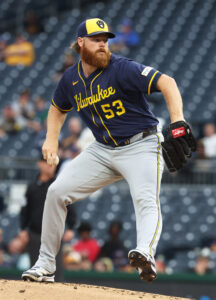
The Brewers announced several roster moves on Monday. The team picked up the $8MM option on righty Freddy Peralta. Right-hander Brandon Woodruff declined his mutual option, while Milwaukee has declined its end of catcher Danny Jansen‘s mutual option. Righty Coleman Crow has been added to the 40-man roster.

Peralta agreed to a five-year, $15.5MM extension ahead of the 2020 season. The deal bought out his remaining years of arbitration and included club options for 2025 and 2026. Milwaukee picked up the $8.1MM option last season and will do so again this year.

The decision to pick up Peralta’s option comes as no surprise after the 29-year-old led the National League in wins and recorded a career-best 2.70 ERA in 2025. He reached career highs in starts (33) and innings (176 2/3) while leading a pitching staff that ranked second in ERA during the regular season.

Peralta began his big-league tenure in a versatile role, bouncing between starting and relieving over his first three seasons. His fastball-led approach generated strikeouts at an elite rate, though he struggled with control. Peralta entered the rotation full-time in 2021. He pitched to a 2.81 ERA over 28 outings and earned his first All-Star bid. Right shoulder inflammation cost Peralta a chunk of 2022, but he’s been healthy since then, topping 30 starts and 165 innings in each of the past three seasons.

Woodruff declined his end of a $20MM mutual option, though the club might’ve done the same given his health struggles in recent years. He had been a fixture in the Milwaukee rotation alongside Peralta, but injuries have limited him to 23 starts since 2023. Shoulder inflammation cost Woodruff three months in 2023 and ultimately led to surgery that offseason. He missed the entire 2024 campaign and the first half of the 2025 season. Woodruff returned in July and delivered a dozen strong starts, posting a 3.20 ERA with an elite 32.3% strikeout rate. His velocity wasn’t at its pre-injury levels, but he was missing bats like he did at his peak.

Unfortunately, Woodruff was bitten by the injury bug once again in September. A lat strain ended his season in late September. The 32-year-old will head into free agency with a solid track record of performance, but a shaky healthy history. The flashes of dominance over this past season, as well as his past success, could be enough to garner a multi-year deal. Woodruff is a two-time All-Star who finished fifth in Cy Young voting in 2021.

Milwaukee acquired Jansen in a July trade with Tampa Bay. He hit well in 25 games with the Brewers, slashing .254/.346/.433. Jansen provided some catching depth for Milwaukee as they tried to ease the defensive load on William Contreras, who was playing through a fractured finger. Contreras has been one of the most durable catchers in the league over recent seasons, so picking up the $12MM option on Jansen likely wasn’t necessary. The Brewers can find a cheaper alternative to fill in for Contreras whenever he hits the bench or serves as DH.

Crow joined the organization in a December 2023 trade that sent Adrian Houser and Tyrone Taylor to the Mets. He posted a strong 2.51 ERA over 10 starts with Double-A Biloxi this year, earning a promotion to Triple-A. He was knocked around in two appearances with the Sounds before going down with a right flexor strain that did not require surgery. Getting added to the 40-man roster today is likely to prevent him from becoming a minor league free agent.

Lucas Giolito Declines Mutual Option

Red Sox right-hander Lucas Giolito has declined his end of a $19MM mutual option, reports Alex Speier of the Boston Globe. He’ll be paid a $1.5MM buyout and return to the open market in search of a new opportunity. The Red Sox will have the right to make him a $22.025MM qualifying offer, as Giolito has not previously received a QO in his career.

Giolito signed a two-year, $38.5MM deal with the Red Sox on the heels of a disappointing platform with the White Sox. He’d posted excellent results from 2019-21 and cemented himself as one of the sport’s most durable starters before logging back-to-back ERAs near 5.00 in 2022-23. Giolito, 32 next July, had hoped to bounce back in Boston and take an opt-out in his contract last offseason.

Instead, the clock struck midnight on the durable right-hander’s arm. He tore the UCL in his pitching elbow during spring training 2024 and didn’t pitch a single inning inning that year. Giolito naturally forwent the opt-out in his contract and returned to Boston for the 2025 season. He stumbled out of the gate, struggling so badly that for a few starts it looked like his entire two-year contract would go down as a bust. By early June, he had an ERA north of 6.00 through seven starts.

Giolito rebounded in terrific fashion, however. Beginning with six shutout innings against the Rays on June 10, he took off on an extended hot streak. From June 10 through season’s end, Giolito posted a 2.51 ERA in 111 1/3 innings. His 20.3% strikeout rate and 9.7% walk rate in that stretch were both worse than average, and his .244 average on balls in play showed plenty of good fortune. Even with some expected regression in his ERA, Giolito looked like a solid mid-rotation starter who’d take a place in Boston’s postseason rotation — at least until the next roadblock arose.

On Sept. 29, manager Alex Cora announced that Giolito was dealing with an elbow issue and would not be on the team’s roster in the Wild Card round of postseason play. The next day, the team indicated that Giolito was unlikely to return at all in 2025, regardless of how deep the Sox advanced in the postseason field. While his surgically repaired UCL was intact, the veteran righty was hobbled by flexor irritation and a bone issue in his elbow.

The Sox had a $14MM club option on Giolito for the 2026 season that they might still have exercised even after the elbow troubles, but when he completed his 140th frame of the season — Giolito totaled 145 innings overall — that option vested instead as a $19MM mutual option. Players tend to make the first call with regard to mutual options, and Giolito is seemingly confident enough in his health that he’ll turn down a net $17.5MM to once again test free agency.

His decision to decline the mutual option also forces the Red Sox into a decision on whether to issue a qualifying offer. They exceeded the luxury tax line in 2025, so they’d only net a compensatory pick after the fourth round of the 2026 draft if Giolito declined and signed elsewhere. That minimal compensation, coupled with more elbow troubles for Giolito, might be enough for the Sox to forgo extending a QO in the first place. If they do, however, Giolito will again have a decision to make — this time on a sum that clocks in a bit over $3MM north of his prior option price. Add in the buyout he’s owed for declining, and a QO could at least net him $4.525MM over the value of the option he declined today.

With Giolito headed toward the market — or at least somewhat up in the air — the Sox project for a rotation including Garrett Crochet, Brayan Bello and a handful of question marks. Top prospects Payton Tolle and Connelly Early impressed late in the season but only have a handful of MLB starts between them. Kutter Crawford missed the entire season due to knee and wrist injuries (the latter of which required surgery). Patrick Sandoval didn’t pitch in 2025 after signing a two-year deal on the heels of his 2024 UCL procedure, but he’ll be in the mix next year. Tanner Houck had Tommy John surgery in August and is likely a nonfactor in 2026.

Given all the uncertainty in the ‘pen, the Sox are expected to pursue rotation help this winter. That could include a reunion with Giolito, but there are plenty of options for them to peruse on both the free agent and trade markets.

Ha-Seong Kim Opts Out Of Braves Deal

Middle infielder Ha-Seong Kim is opting out of his deal with the Braves, reports Jon Heyman of The New York Post. He passes on a $16MM salary to return to the open market.

It’s a disappointing but not entirely unexpected development for Atlanta. The Braves claimed Kim off waivers from the Rays at the beginning of September. They weren’t competing but hoped to lock in their starting shortstop for the ’26 season. They instead wound up taking on the remaining $2MM of Kim’s 2025 salary for the final month of a lost season.

Maybe that’ll still turn out to be a worthwhile decision. President of baseball operations Alex Anthopoulos said in September he hoped that getting Kim acclimated with the Atlanta organization and clubhouse would give them a leg up even if the infielder decided to head back to free agency. They’ll certainly make an effort to bring him back, but Nick Allen is atop the depth chart at shortstop for the time being.

For the second straight winter, Kim hits free agency with significant questions. He had an outside shot at a nine-figure deal over the 2024-25 offseason until he suffered a labrum tear in his right shoulder in August. Kim required season-ending surgery, leading the Padres to decline to issue him a qualifying offer. He signed a two-year deal with the Rays that guaranteed $29MM and allowed him to retest the market after one year.

Kim’s rehab from the shoulder procedure carried into July. He’d wind up going back on the injured list twice more as he battled lower back issues. Those stints were brief, but his time in Tampa Bay consisted of 24 games with a .214/.290/.321 batting line. It’s certainly not what the Rays wanted for what amounted to nearly $11MM on their part. They were happy to shed the contract in the final month, getting them off the hook for the ’26 option.

The brief stint in Atlanta was a little more encouraging. Kim played 24 games with the Braves. He hit three homers with a .253/.316/.368 slash in 98 trips to the plate. That included a 10-game hit streak in the middle of September, though he recorded only two hits in 25 plate appearances in the final week of the season. He concluded with a .234/.304/.345 line across 191 trips to the plate.

Kim’s camp nevertheless feels he’ll be able to find a multi-year contract that is preferable to the $16MM option. They’ll be aided by the lack of middle infield alternatives on the open market. Assuming Trevor Story doesn’t opt out of the two years and $55MM remaining on his contract with Boston, Kim would be the second-best free agent shortstop after Bo Bichette.

He’ll hit the market without any draft compensation, as the Braves are not permitted to make a qualifying offer because he changed teams midseason. Kim could try to max out on a three-year deal or look for another two-year pact with an opt-out similar to the one he got from Tampa Bay. His old team in San Diego could look for a shortstop to push Xander Bogaerts back to second base. The Giants, Tigers, Royals, Pirates and Brewers are other clubs that look for help at one or both middle infield positions.

Pete Alonso Opts Out Of Mets Contract

Pete Alonso has officially opted out of his contract with the Mets, reports Jon Heyman of the New York Post. He declines a $24MM player option and heads back to free agency.

Alonso announced that he’d be doing this as soon as the season ended. There was never much intrigue anyhow. Last offseason’s two-year pillow deal was always designed to get him back to the market this winter. He collected $30MM for the first season — a $10MM signing bonus and $20MM salary — and now takes another shot at finding the long-term deal that didn’t materialize last winter.

The five-time All-Star should be better positioned this time around. He’s coming off a .272/.347/.524 showing with 38 home runs and an NL-leading 41 doubles across 709 plate appearances. Alonso’s 2024 had been a relative down season by his standards, as he’d hit .240/.329/.459 with 34 round-trippers. Last winter also saw his market dragged down by the qualifying offer. That’s not on the table this time. The collective bargaining agreement prevents a player from receiving more than one QO in his career.

Alonso will slot behind Kyle Schwarber and probably NPB superstar Munetaka Murakami as the best power bats in the class. He’s atop the list of free agent first basemen, which also includes Josh NaylorRyan O’HearnLuis Arraez, Josh BellPaul Goldschmidt and Rhys Hoskins. There’ll be teams that prefer Murakami as a first baseman rather than at third base, which has been his primary home with the Yakult Swallows in Japan. Another NBP corner infielder, Kazuma Okamoto, is also coming over via the posting system.

Alonso’s opt-out is one of three resolved option decisions for the Mets so far. Edwin Díaz is also opting out, while A.J. Minter exercised his $11MM player option as he works back from lat surgery. They’re still awaiting official word from Frankie Montas, but he’s obviously going to lock in his $17MM player option after undergoing elbow surgery in August. The Mets could simply release Montas at that point to open a roster spot, but there’s no escaping the money. The team still has to decide on options for Brooks Raley ($4.75MM or a $350K buyout) and Drew Smith ($2MM).

Cody Bellinger Opts Out Of Yankees’ Deal

Outfielder Cody Bellinger has opted out of his contract with the Yankees, reports Jon Heyman of the New York Post. Bellinger had one year and $25MM remaining on his deal. He’ll take the $5MM buyout instead.

Bellinger signed a three-year, $80MM contract with the Cubs ahead of the 2024 season. The deal included opt-outs after each year. Bellinger did not opt out after 2024. He was traded to the Yankees for Cody Poteet that offseason. Chicago also sent cash in the deal, paying $2.5MM of Bellinger’s 2025 salary and another $2.5MM that will now go toward the $5MM buyout.

Bellinger bounced back from a pedestrian season with the Cubs to post a strong 2025 in New York. The friendly confines of Yankee Stadium helped the lefty launch 29 home runs, his most since his 2019 NL MVP season. Bellinger slashed .272/.334/.480 while also grading out as a strong defender.

The standout season in the Bronx made Bellinger’s opt-out decision an easy one. He’ll hit the market as a 30-year-old still capable of playing all three outfield positions and first base. His camp is likely looking for at least a five-year commitment with an asking price above $100MM. Bellinger is not eligible to receive a qualifying offer, since he received one from the Cubs following the 2023 season. The Yankees can’t extend the QO and will not receive compensation if he signs with another team.

Bellinger joins Alex Bregman and Pete Alonso as top bats entering the market after opting out of their current contracts. His next foray into free agency is likely to be more fruitful than his previous attempts. After a pair of injury-plagued years, the Dodgers cut him loose following the 2022 season. Bellinger latched on with the Cubs on a one-year deal for 2023. He earned NL Comeback Player of the Year honors, but the market remained skeptical. Bellinger returned to the Cubs on the aforementioned three-year deal, and didn’t perform well enough in 2024 for an opt-out to be a logical choice. Chicago’s acquisition of Kyle Tucker made a trade seem inevitable, and New York was able to acquire him for a minimal return.

New York’s outfield could look quite different in 2026. Bellinger is joining Trent Grisham in free agency, leaving the Yankees with Aaron Judge, Jasson Dominguez, and then plenty of question marks. Top prospect Spencer Jones is a candidate to earn a job next season. The young lefty could provide the power/speed element that New York would be losing with the Bellinger departure. Grisham is a candidate to receive a qualifying offer, and the roughly $22MM could be enough to entice him back after a career-high 34 home runs.

Edwin Díaz Opts Out Of Mets’ Deal

Right-hander Edwin Díaz has opted out of his deal with the Mets, reports Ken Rosenthal of The Athletic. He was still guaranteed two years and $38MM but will head to the open market in search of more. Díaz becomes the second premier closer to opt out on Monday, joining Robert Suarez.

Díaz signed a five-year, $102MM contract with the Mets following the 2022 season. A knee injury in the World Baseball Classic cost him all of 2023, but he returned to deliver elite results over the past two seasons, tallying 48 saves with a strikeout rate above 38%. Díaz earned his third All-Star nomination this past season.

New York acquired Díaz and second baseman Robinson Cano from Seattle in a December 2018 trade. He was coming off a league-leading 57 saves with the Mariners. Díaz’s first campaign with the Mets was rocky, as he scuffled to a 5.59 ERA over 58 innings. The underlying numbers (3.22 xERA, 3.07 xFIP) suggested he pitched better than the final results. Díaz got back on track in the shortened 2020 season, though the Mets’ last-place team didn’t afford him many save chances. He closed out exactly 32 games in each of the next two seasons. Díaz piled up 96 saves in his first four years with the Mets.

Díaz landed a nine-figure deal in his first taste of free agency. The 31-year-old enters a jam-packed reliever market that includes Suarez,  Devin WilliamsRyan Helsley, and Raisel Iglesias as the top options, plus a slew of capable veterans.

The Mets have a handful of internal options to replace Díaz if they aren’t able to re-sign him this time around. A.J. Minter is exercising his player option to remain with the team. He’s been solid when healthy, though he’s undergone season-ending surgery in consecutive years. Adbert Alzolay saved 22 games for the Cubs in 2023, but had Tommy John surgery in 2024 and missed all of the 2025 season.

Robert Suarez Opts Out Of Padres Contract

Padres closer Robert Suarez has opted out of the final two years and $16MM on his deal with San Diego, according to a report from Jon Heyman of the New York Post. Suarez will now head into the free agent market in search of a new deal.

San Diego signed Suarez to a five-year, $46MM deal ahead of the 2023 season. Injuries limited him to 27 2/3 innings that year, but he broke out as a premier closer the following season. Suarez notched 36 saves in 2024, earning an All-Star nomination. He followed that up with a National League-leading 40 saves in 2025.

Suarez took a roundabout way to MLB stardom. He pitched in the NPB from 2018 to 2021, emerging as a top reliever over his final two campaigns. Suarez piled up 67 saves in two seasons with the Hanshin Tigers, which earned him a look in the big leagues. San Diego brought him over on a major-league deal in December 2021. He made 45 appearances for the Padres that season. Suarez posted an elite 31.9% strikeout rate, but it came with an elevated 11% walk rate. Following his first MLB season, Suarez elected free agency, but returned to San Diego on the aforementioned five-year pact.

The 34-year-old Suarez wraps up his San Diego tenure with 77 saves across 206 appearances. He recorded a 2.91 ERA and a 0.98 WHIP over 210 innings. Suarez earned two All-Star selections.

Suarez is entering a crowded reliever market. Devin WilliamsRyan Helsley, and Raisel Iglesias are among the top names, while Edwin Díaz could join the mix if he opts out of his current deal. Proven veterans Emilio PaganLuke WeaverKenley Jansenand Kyle Finnegan are also available.

San Diego shouldn’t have to look far for Suarez’s replacement. The team landed their closer of the future at the trade deadline, acquiring Mason Miller from the Athletics for a package led by shortstop prospect Leo De Vries. Miller was dominant as a setup man for Suarez, posting a 0.77 ERA with an insane 54.2% strikeout rate in 22 appearances with his new team. The young flamethrower is entering his first year of arbitration, so he should function as San Diego’s stopper for the foreseeable future.

Top 40 Trade Candidates Of The 2025-26 MLB Offseason

The offseason is here! At MLB Trade Rumors, our Top 50 Free Agent List and the contract/team predictions associated with each player has come to be an annual tradition and one of our most anticipated pieces of the year. However, free agency only makes up a portion of the offseason roster reconstruction that MLBTR fans follow so voraciously. Trades are every bit as pivotal to weaving the offseason tapestry, though they’re inherently a bit more difficult to predict, as they involve valuing multiple players and are generally less dependent on precedent.

For the second straight offseason, our list of the top offseason trade candidates will be heavy in St. Louis Cardinals. The Cards opened last offseason by announcing that 2025 would be John Mozeliak’s last year as president of baseball operations and that former Rays/Red Sox exec Chaim Bloom would be stepping into the role. The Cardinals spoke of opening opportunity for young players and trimming payroll, but no-trade clauses for several pricey veterans and a few surprising decisions to hang onto players going into their final season of control largely kept them off the market. This time, things are different. Several Cards veterans have voiced a willingness to waive their no-trade rights, and Bloom figures to be far more aggressive in dealing from the roster he’s now running.

The Twins and Nationals are both prominent presences on the list as well. Minnesota sold off nearly half its roster at the deadline and will probably revisit talks on some of their remaining veterans who didn’t get moved. The Nats fired longtime GM Mike Rizzo after their rebuild not only stalled out but arguably took a step back in 2025. Clubs like the Rays and Brewers, who are always threading the needle between moving increasingly expensive veterans late in their arbitration years and trying to field a contending roster, naturally have some names that’ll be out there as well.

Before we get to the list, a note on methodology. This isn’t a strict ranking of players’ trade value, nor is it solely about likelihood of being moved. We’re trying to balance both of those things, an inherently subjective exercise. All projected salaries for arbitration-eligible players are courtesy of MLBTR contributor Matt Swartz.

1. MacKenzie Gore, LHP, Nationals | projected $4.7MM salary; controlled through 2027 via arbitration

One of the most sought-after names at the 2025 trade deadline, Gore is a former No. 3 overall pick by the Padres who spent several years as one of the top-ranked —  if not the top-ranked — pitching prospects in baseball. His development didn’t go as smoothly as possible, due largely to some mechanical struggles that set him back in his latter minor league seasons.

Now with the Nationals after being shipped to D.C. in the 2022 Juan Soto blockbuster, Gore has established a quality mid-rotation floor but flashed genuine No. 1 upside as well. He’s started 27, 32 and 30 games in his three seasons with the Nationals and pitched to a combined 4.15 ERA, which doesn’t leap out as a particularly eye-catching number. However, Gore has regularly posted strong strikeout rates, including a career-high 27.9% in 2025, and he’s done so with command that’s only a bit worse than average.

The real allure came from the first several months of the 2025 season. Gore was in Cy Young contention through the All-Star break, sitting on a 3.02 ERA with a huge 30.5% strikeout rate against a 7.7% walk rate in 110 1/3 innings. He posted a huge 14.2% swinging-strike rate in that stretch and twice punched out 13 batters in a six-inning start. He ran into a brutal stretch from July 20 through Aug. 5 that saw him yield 23 runs in 15 2/3 innings — and then proceeded to snap back into good form for his final seven starts. He had a brief injured list stint with shoulder inflammation and missed his final start because of an ankle issue, but neither issue is expected to impact his offseason.

Gore hasn’t quite put it all together yet, but he’s a 26-year-old lefty (27 in February) who averages 95-96 mph on his four-seamer and for much of the season sported one of the top swinging-strike rates in MLB while simultaneously running a better-than-average walk rate. He’s been touted as a potential ace dating back to his senior year of high school, when he posted a 0.19 ERA and fanned 158 hitters in 74 1/3 innings. Every rotation-hungry contender in baseball should have interest, and many of them probably think that moving to a club that has more thoroughly embraced data and pitch development than what has been a more “old school” Nationals organization did could be a catalyst for Gore’s true breakout.

The White Sox traded two comparably priced years of Garrett Crochet for a four-player package headlined by a pair of top-100 prospects (Kyle Teel, Braden Montgomery) last offseason. Crochet was coming off much better results but had never held up for a whole season as a starter. Gore has proven the durability aspect and shown flashes of pitching at a Crochet-esque level. The trade value here seems comparable. Washington fired longtime GM Mike Rizzo midseason and has since replaced him with former Red Sox AGM Paul Toboni, who has spoken of focusing on building a “player development monster.” That doesn’t exactly sound like someone whose focus is on fast-tracking a return to contention, and moving Gore could provide a serious jolt to a farm system that’s still in the bottom third of MLB despite being in year four of a rebuild.

2. Joe Ryan, RHP, Twins | projected $5.8MM salary; controlled through 2027 via arbitration

The Pohlad family, which has owned the Twins for more than 40 years, sought to sell the club in late 2024 and early 2025 but found it hard to find a buyer with the franchise having accumulated a reported $400MM+ of debt. That led to the addition of two new, yet-unnamed minority owners whose investment wiped out much or all of that debt. It also likely played a role in an offseason punctuated by payroll restrictions and a deadline focused on gutting the team’s payroll. Minnesota traded a staggering 11 players and ate $33MM of the remaining money on Carlos Correa‘s deal, scaling the budget back to Metrodome-era levels in the process.

One player who drew interest but stayed put was Ryan, one of the team’s top two starters whose salary makes him a raucous bargain. The 29-year-old righty pitched to a 3.42 ERA in 171 innings last year, striking out 28.2% of opponents and logging a terrific 5.7% walk rate. A strained teres major in 2024 limited Ryan to 23 starts, but he took the ball 30 times in ’25 and has averaged 154 frames per season dating back to 2022.

The Twins shed so much money with that fire sale that they could, in theory, spend some money to beef the roster back up and try to contend in 2026 with a core led by Ryan, Pablo Lopez, Byron Buxton and promising young second baseman Luke Keaschall. It seems far likelier, however, that Minnesota leans further into the youth movement and listens to offers on Ryan, Lopez and catcher Ryan Jeffers at the very least (more on the other two later).

The Red Sox were strongly interested in Ryan at the deadline but reportedly didn’t want to part with a major league outfielder like Jarren Duran or Wilyer Abreu in those talks. Boston could revisit that interest, but the Giants, Astros, Yankees, Blue Jays, Orioles, Rangers, D-backs, Padres, Brewers and Mets could all be in the market for starting pitching as well. Due to his salary, track record and two years of remaining club control, Ryan should command more interest — and a larger return — than most names on this list.

3. Brendan Donovan, INF/OF, Cardinals | projected $5.4MM salary; controlled via arbitration through 2027

Donovan, 29 in January, has emerged as one of the top multi-position players in the game. He’s a capable to above-average defender at second base, third base and in the outfield corners, and he’s made brief appearances at shortstop and first base as well. In the batter’s box, he holds a hit-over-power approach that’s served him well. Donovan is a career .282/.361/.411 hitter (119 wRC+) who’s walked in just over 9% of his career plate appearances and fanned at only a 13.5% clip. The 5’11”, 210-pound lefty has never topped 14 homers in a season but has reached a double-digit tally in each of the past three seasons (while hitting 66 doubles over the past two years as well).

That high-contact approach, affordable salary and defensive versatility make Donovan a natural fit on virtually any contender. Tigers president of baseball ops Scott Harris has openly spoken about wanting to cut back on his lineup’s swing-and-miss tendencies, and Detroit could lose second baseman Gleyber Torres to free agency. Houston GM Dana Brown has been open at various points in the past year about wanting to balance out a righty-heavy lineup. The Mariners could lose Jorge Polanco and have long been working to scale back on the strikeouts. The Yankees were connected to Donovan last winter. The Royals have holes at second base and in at least one outfield corner. There are no shortage of fits.

Trading Donovan would both net the Cardinals at least one prospect of note and also open up further infield reps for younger, more controllable players. Top prospect JJ Wetherholt is on the cusp of the majors and could break camp with the club next year. He could handle third base if Nolan Arenado is moved (more on him later), but dealing Donovan would also open up reps at second base. It’d also give the Cards more freedom to get Alec Burleson, Nathan Church and Jordan Walker in the outfield (assuming neither Burleson nor Walker is traded this winter, which admittedly isn’t a given).

4. Mitch Keller, RHP, Pirates | $54.5MM through 2028

Keller survived a summer of frequent trade rumors and continued to post solid results. He pitched 176 2/3 innings with a 4.19 ERA, 20% strikeout rate and 6.8% walk rate. It’s Keller’s fourth straight season with at least 29 starts and an ERA right in this range. The idea of him breaking out as a top-of-the-rotation arm might not carry much weight anymore, but he’s a rock-solid source of dependable innings who’s on a reasonable contract.

Other clubs with better track records of coaxing elite performance out of pitchers might have some ideas on how to tweak his mechanics and repertoire to elicit slightly better results, but even if Keller is who he is — a low-4.00s innings eater — that should have some value on the trade market. It’s not exactly teeming with surplus value, but Keller’s deal is closely in line with Nick Pivetta‘s $55MM deal over in San Diego and looks affordable compared to prior free-agent deals for Jameson Taillon (four years, $68MM), Taijuan Walker (four years, $72MM) and Eduardo Rodriguez (four years, $80MM).

The Pirates are deep in starting pitching, but several of their younger arms will be all but immovable. There’s no chance Pittsburgh moves Paul Skenes this winter, and touted young arms like Bubba Chandler and Jared Jones aren’t going to change hands either. (Chandler has top-of-the-rotation upside, and the Bucs would be selling low on Jones after a year lost to elbow surgery.) Braxton Ashcraft probably isn’t far behind that group in terms of availability (or lack thereof). The Pirates would have a better chance at landing a controllable bat if they traded a young arm like Mike Burrows, but moving Keller whittles down the payroll and perhaps creates some more room to spend on a bat or two.

Keller isn’t going to command a high-end, controllable bat (e.g. Jarren Duran, Jordan Westburg, Tyler Soderstrom), but he could be swapped out for a pricier, solid veteran hitter. Pittsburgh could also move Keller for prospects and use the deepened farm and/or cost savings to pursue bats via trade and free agency.

5. Sonny Gray, RHP, Cardinals | $40MM through 2026 (includes $5MM buyout on $30MM club option for 2027; Gray can opt out if option is exercised)

Gray was prominently featured on this list a year ago but didn’t change hands despite the Cardinals commencing their offseason by signaling a move toward a youth movement. Gray told the team he preferred to stay put. This time around, he’s already publicly acknowledged that he’ll “definitely” consider trade scenarios as the Cardinals lean even further into what looks like a multi-year rebuilding effort. “I signed here two years ago with the expectation of winning and trying to win, and that hasn’t played out that way,” he said in September. “I want to win.”

By today’s standards, Gray is a workhorse. He tossed 180 2/3 innings of 4.28 ERA ball in 2025 and had more encouraging rate stats. With the exception of the shortened 2020 season (when he made 11 of 12 possible starts), the former first-round pick has started at least 24 games every year since 2019, averaging 29 starts per 162-game season in that time. Gray was the AL Cy Young runner-up with the 2023 Twins, and while he hasn’t gotten back to those heights, he’s posted a 4.07 ERA, 28.4% strikeout rate, 5.4% walk rate and 43.2% grounder rate in 347 innings across his first two seasons in St. Louis.

Gray will pitch next season at 36, however, and he’s owed not only a $35MM salary but also a $5MM buyout on his $30MM club option for the 2027 season. A $40MM guarantee is a huge commitment for most clubs. Even some of the teams that can afford that, in theory — e.g. Dodgers, Mets, Phillies — might balk because they’re 110% tax payors under the CBT. Solid as Gray is, even the deep-pocketed Dodgers aren’t forking over an effective $84MM to add him to their rotation for one year.

Gray wouldn’t get $40MM in free agency on a one-year deal. He’d command more than the ~$15MM received by older veterans Justin Verlander, Max Scherzer and Alex Cobb last offseason and likely more than Walker Buehler’s $21.05MM, but he probably wouldn’t top out much beyond $25MM. The Cardinals likely need to eat $10-15MM just to find a trade partner — and perhaps more than that if they want create enough surplus value to net some prospect talent. The 2027 option can’t be sold as much of a perk, either. Gray’s contract stipulates that he can opt out if the option is picked up. That’d spare his team the $5MM buyout, but in essence, if he pitches well in 2026, he’ll likely become a free agent.

6. Pablo Lopez, RHP, Twins | $43.5MM through 2027

Based on how the Twins operated at the deadline, Lopez probably would’ve been gone already if he’d been healthy. Instead, he was on the shelf with a strained teres major. Lopez returned late in the season to make three starts before heading back to the shelf with a forearm strain. An MRI indicated that there was no concern about his UCL, and he’s expected to have a normal offseason, but Lopez still isn’t exactly at peak value presently.

Be that as it may, he’s sure to command ample interest. The Twins acquired Lopez from the Marlins in the Jan. 2023 Luis Arraez trade and quickly extended him on a four-year, $73.5MM deal. Ownership seemed far more comfortable spending money that winter — they also gave Carlos Correa $200MM that offseason — but the subsequent crumbling of their television deal and inability to find a sale partner have changed the trajectory.

Lopez, 30 in March, has been a bargain during his three years in Minneapolis. He’s given the Twins 455 innings with a 3.68 ERA and even more encouraging rate stats (26.8 K%, 5.8 BB%, 43.1% ground-ball rate, 13.6% swinging-strike rate). Dating back to 2020, he’s pitched a total of 795 innings with a 3.61 ERA. Lopez might not be an ace, but as his best he’s a strong No. 2 starter who misses bats and limits walks. In this year’s 14 starts, he produced a 2.74 ERA.

A healthy Lopez would command a $100MM+ deal if he were a free agent this winter. He’s locked up for another two seasons at a below-market annual rate. The types of offers the Twins receive will determine whether he’s moved or stays put. Minnesota has virtually no money on the books beyond Lopez, Byron Buxton and the dead money owed to Correa. There’s little to no financial pressure to move Lopez. If someone is willing to make an offer that treats him as a healthy, full-strength asset, it’s easy to see them making the move. If they’re getting lowball offers, they have the luxury of holding him into the 2026 season and reevaluating in July.

7. Pete Fairbanks, RHP, Rays | $11MM club option for 2026

One year of a reliever — even a good one like Fairbanks — isn’t necessarily a colossal bargain, but he’s still priced a bit below market rate. Fairbanks, 32 in December, pitched a career-high 60 1/3 innings in 2025 and also tallied a career-best 27 saves. This year’s 2.83 ERA is a near mirror image of his 2.87 mark in Tampa Bay dating back to 2020.

There are some red flags of note. Fairbanks’ average fastball sat as high as 99 mph back in 2022 but is now, ahem, “only” 97.3 mph. That’s especially notable for a reliever who has been on the injured list a whopping seven times dating back to 2021. Fairbanks has twice endured absences for lat strains in addition to a shoulder strain, shoulder inflammation, hip inflammation, forearm inflammation and a nerve issue in his right arm. It’s a long list of injuries, and in addition to the somewhat diminished velocity, Fairbanks logged a 24.2% strikeout rate in 2025. That’s still better than league average but is nowhere close to the 34.8% mark he posted from 2020-23. Fairbanks has twice approached or reached a massive 17% swinging-strike rate in a single season but was at 12.6% in 2025. Again, that’s an above-average mark but a long ways from the hard-throwing righty’s peak.

Red flags notwithstanding, Fairbanks gets the job done year after year. His highest ERA in a single season dating back to 2020 is 3.57. He’s also improved upon his once-shaky command, as his walk rate has plummeted from 10.9% in 2023 to a sharp 7.4% in 2025. He’s consistently the Rays’ highest-leverage reliever and ranks right alongside names like Aroldis Chapman and Josh Hader in terms of leverage index over the past three seasons.

Any contender’s bullpen would be better with Fairbanks in it, and trading for him represents an opportunity to add a relatively high-end arm for a price comparable to the Athletics’ $10MM dice roll on Jose Leclerc last winter or the $10MM the Orioles guaranteed to a 35-year-old Andrew Kittredge. Fairbanks will require parting with a prospect or young big leaguer of at least some note, but the acquisition cost shouldn’t be exorbitant.

Fairbanks’ option price is triple the $3.667MM base salary he earned in 2025. The Rays have new owners, but it still seems unlikely a typically budget-conscious Tampa Bay club will want to make that type of commitment to a reliever. Fairbanks stands as one of the likeliest — if not the likeliest — players on this list to be traded.

8. Freddy Peralta, RHP, Brewers | $8MM club option for 2026

For years, Peralta was the third starter among a formidable Brewers trio including Corbin Burnes and Brandon Woodruff. With Burnes traded to Baltimore (and then signing a free agent deal in Arizona) and Woodruff missing much of the past two seasons following shoulder surgery, Peralta stepped up to lead the Milwaukee staff and proved more than up for the task. He’s topped 30 starts and posted a sub-4.00 ERA in three straight seasons, but the 2025 campaign was his best: career-high 176 2/3 innings, 2.70 ERA, 28.2% strikeout rate, 9.1% walk rate, 1.07 HR/9.

With three durable years of high-quality innings, a plus strikeout rate (and even better swinging-strike rates) and a fastball sitting just under 95 mph on average, Peralta is the type of arm who’d appeal to any contending club. Of course, that includes the Brewers, who paced the NL in victories this season (in no small part thanks to Peralta) and who firmly expect to be in contention again.

However, this is standard operating procedure in Milwaukee and has been for some time, whether under former president of baseball operations David Stearns or under Matt Arnold, who was recently promoted from GM to that same president of baseball ops title. Milwaukee has traded notable stars like Burnes, Josh Hader, Devin Williams and Jonathan Lucroy over the years as those cornerstone players have progressed into the late stages of arbitration.

It’s not a given that they’ll trade Peralta. Arnold opted to hold onto shortstop Willy Adames through his entire six-year window of club control and collect a draft pick after Adames rejected a qualifying offer and signed a seven-year deal with the Giants. But with Quinn Priester, Chad Patrick, Logan Henderson, Tobias Myers, Robert Gasser and young flamethrower Jacob Misiorowski all on hand (plus multi-inning relief options like Aaron Ashby and DL Hall), the Brew Crew are relatively deep in controllable arms.

There’s enough depth that Milwaukee will at least listen to offers, but even for one year, the ask will be steep. He doesn’t have a former Cy Young Award under his belt, but Peralta will earn about half what Burnes earned in his final year of control. That trade package — Hall, Joey Ortiz and a Competitive Balance draft pick — might not be far off what it takes to pry Peralta from Milwaukee’s grasp. Ortiz was a top-100 prospect at the time, and Hall wasn’t far removed from being one himself. It’ll be a steep ask, but some teams might think Peralta is worth it. The Brewers could always try to extend him, knowing Peralta signed a team-friendly extension once, but he’s 29 now and will be 30 next June. This is his best chance at a major long-term contract.

9. Ryan Jeffers, C, Twins | projected $6.6MM salary; controlled via arbitration through 2026

In an offseason that’s thin on free-agent catching options, Jeffers stands out as a prime target for teams seeking help behind the dish. Starting catchers are rarely traded midseason, which perhaps helps to explain why the 28-year-old stayed put at this year’s deadline despite Minnesota’s aggressive fire sale, but offseason trades afford backstops the luxury of a full spring training to build a rapport with their new pitching staffs.

Jeffers isn’t a household name but probably deserves more recognition than he gets. He’s a former second-round pick and top-100 prospect who has developed into one of the game’s top offensive performers behind the plate. No one will mistake him for Cal Raleigh, but Jeffers is hitting .254/.338/.434 over the past three seasons. The resulting 117 wRC+ ranks sixth among the 55 big league catchers who’ve taken at least 500 plate appearances in that time. Two of the names ahead of him — Ivan Herrera and Willson Contreras of the Cardinals — weren’t even catchers in 2025. The others are Raleigh, Will Smith and William Contreras — not bad company to keep.

Behind the plate, Jeffers’ once-positive defensive marks have dwindled. Statcast graded him slightly below average in framing and blocking runs (-1 apiece). His 18.6% caught-stealing rate was below the 21.5% league average, but not egregiously so. Statcast still dinged him as one of the least-effective throwing catchers in the game, however, grading him five steals below average based on the leads and speed of the runners who were attempting take a bag against him.

Jeffers isn’t a star, but he’s a slam-dunk starting catcher with a bat-first profile. Teams like the Rangers, Rays, Giants, Padres and Guardians could look for more offense behind the plate, and the Phillies would be a natural fit if J.T. Realmuto signs elsewhere.

10. Sandy Alcantara, RHP, Marlins | $19MM through 2026 (includes $2MM buyout of $21MM club option for 2027)

Alcantara’s return from Tommy John surgery didn’t go as the Marlins hoped. In an ideal setting he’d have snapped back to the form that saw him win the 2022 NL Cy Young Award, drumming up a fervent trade market that netted the team multiple top-tier prospects. Instead, Alcantara struggled to keep his ERA under 6.00 for much of the season. Though his stuff generally rebounded, his command wasn’t as sharp as in the past — particularly early in the season. He issued more walks than usual and generated far fewer grounders than we’ve come to expect, all while serving up an uncharacteristic (albeit not egregious) number of home runs.

That said, Alcantara also finished the year on a high note. In his final eight starts, he logged 53 2/3 innings of 2.68 ERA ball with a vastly improved 25% strikeout rate, 4.8% walk rate and 50% ground-ball rate. A few too many of the fly-balls he did yield still left the yard (14.9% HR/FB), but those final five weeks looked an awful lot more like the Alcantara of old than at any other point in the season.

Marlins president of baseball operations Peter Bendix suggested early in the 2024-25 offseason that he expected Alcantara to be his team’s Opening Day starter in 2025. He took a more vague stance this time around at his end-of-season press conference, sidestepping the question by noting that he didn’t feel it prudent to speculate on any player’s status.

The Marlins had a strong finish to the season and saw several young players take meaningful steps forward. Kyle Stowers, Jakob Marsee, Edward Cabrera, Xavier Edwards, Otto Lopez and Agustin Ramirez all made varying degrees of progress at the plate, on the mound and/or in the field. Ronny Henriquez and Tyler Phillips proved to be excellent low-cost adds to the bullpen. The Marlins are expected to at least dabble in free agency this winter, particularly the bullpen market.

A trade of Alcantara isn’t a given, but he’s going to command interest and the magnitude of his salaries and increasing proximity to the end of his contract mean the Marlins will at least listen. They’d still be selling low, however, so it’s possible the Fish will carry Alcantara into the season and hope a big first half from their ace propels them into contention — knowing all the while that if the team doesn’t perform well, Alcantara would again be a coveted deadline chip.

11. Brandon Lowe, 2B, Rays | $11.5MM club option for 2026

Lowe is entering his final year of club control. The $11.5MM price point on his option makes it a lock to be exercised, but it’s far from guaranteed that means he’ll return to Tampa Bay. The Rays could quickly flip Lowe to another club more willing to spend at that level for his age-31 season, or they could pick up the option and shop Lowe around over the winter as teams look to bolster their lineup and/or address second base needs.

A former third-round pick, Lowe has been a productive offensive player from the day he arrived in the majors. He’s never had a below-average offensive season, by measure of wRC+. He’s strikeout prone (26.9 K% in 2025, 27.3% career) but regularly flashes strong power. This past season’s 31 home runs were the second-best mark of his career and came in a sample of only 553 plate appearances.

Lowe’s defensive grades at second base cratered in 2025 (-14 DRS, -13 OAA), but perhaps that’s not a major surprise for a player who missed time due to oblique and ankle injuries. The latter, in particular, would seem to impact his range at second base. He’s always been more of an average defender than an asset with the glove anyhow. Lowe has experience at both first base and in the outfield corners if another club is genuinely concerned about his glovework at second.

The Rays don’t have a clear heir apparent at second base, but there will be options to consider both in free agency and on the trade market (where more controllable/affordable names than Lowe could be had). They’re also projected for nearly a $100MM payroll after they pick up the options on Fairbanks and Lowe. That number will come down a bit based on non-tenders, but the Rays’ arbitration class doesn’t have any particularly pricey players. Ryan Pepiot‘s projected $3.7MM is their largest one. Moving Fairbanks and Lowe would push payroll back down into more traditional Rays territory while bringing in some talent of note and creating further opportunity for young players.

12-13. Jarren Duran / Wilyer Abreu, OF, Red Sox | $8MM club option for 2026 and pre-arbitration, respectively; Duran controlled through 2028, Abreu through 2029

Duran and Abreu are grouped together as a reflection of the fact that something seems likely to give in the Boston outfield mix this offseason. Both Roman Anthony and Ceddanne Rafaela are signed long-term. Masataka Yoshida is in the DH slot but is a release or salary dump candidate. Top-100 prospect Jhostynxon Garcia is all but ready for a major league look. The Red Sox are looking to add pitching. It’s a crowded mix, and while Boston could simply release/salary dump Yoshida and rotate Abreu, Duran and Anthony through the corners and DH, dealing one of Duran or Abreu could get them access to a compelling and controllable arm to plug into the rotation behind ace Garrett Crochet.

At his best, Duran has been an MVP-caliber performer. He had a pedestrian first few months in 2025 and a torrid July/August run before cooling off in September. The resulting .256/.332/.442 line was comfortably above average but trailed his breakout .285/.342/.492 performance from the year prior by a fairly wide margin. Even if 2024 was an outlier, Duran is a 29-year-old former All-Star who’s posted 13.2 fWAR and 15.4 bWAR over his past three seasons. It’s perfectly reasonable to project him for something around four wins above replacement, and he’ll be quite affordable for at least the first two of his three remaining seasons of control.

Abreu doesn’t have the same offensive ceiling but is a superior defender in right field with an extra year of club control. He’s a career .256/.326/.465 hitter and has justifiably been shielded from lefties in his career (.205/.271/.318 in 145 plate appearances). Duran has notable platoon splits as well, though not in quite such glaring manner.

Still, Abreu is a valuable corner outfielder who can play defense at a Gold Glove level and thump right-handed pitching. Plugging him into the big side of a platoon at a league minimum salary in 2026 and with three arbitration seasons thereafter should hold appeal to small- and large-market teams alike.

The Red Sox could certainly keep their established outfielders and try to build a package for a major league starter around Garcia, but Abreu and Duran are going to draw widespread interest and figure to see their names quite often in trade rumblings.

14. Steven Kwan, OF, Guardians | projected $8.8MM salary; controlled via arbitration through 2027

Kwan is hardly a lock to be traded, but the Guardians listened to offers prior to the deadline — with one report even suggesting that Cleveland was actively shopping the former All-Star amid a down season at the plate.

While Kwan still slashed a respectable .272/.330/.374 (99 wRC+), that’s miles away from 2024’s .292/.368/.425 output (131 wRC+). Plus, nearly all of Kwan’s production in 2025 was contained in the season’s first two months. After a torrid start to the year, the 28-year-old wilted with a .248/.308/.337 line in his final 450 plate appearances.

Kwan is still arguably the best defensive left fielder in MLB and is objectively one of the toughest strikeouts in the game (8.7%). Even for a low-payroll Guardians club, his $8.8MM salary projection is reasonable. That’s all the more true given Cleveland’s need for greater production in the outfield.

That said, if the Guards are worried that Kwan is entering a genuine decline — or simply that 2024 was a peak year he won’t replicate — they could reengage with teams this offseason and look to add either a younger, less proven outfielder or some additional rotation help to a club that presently is much thinner there than we’ve come to expect over the years. Cleveland has Gavin Williams, Tanner Bibee, Logan Allen, Parker Messick and Slade Cecconi lined up for rotation jobs next year, but there’s a fair bit of uncertainty in that quintet. Deadline pickup Khal Stephen gives them one nearly MLB-ready top prospect, but most of the organization’s top minor leaguers are either position players or teenage pitching prospects still in the very low levels of the system.

The Padres, Phillies, Blue Jays and Dodgers were all known to have interest in Kwan this summer, and there are surely plenty of other clubs who’d take a run at him this winter if president of baseball operations Chris Antonetti again listens to offers (or even actively tries to move him). It certainly wouldn’t be the first time we’ve seen Cleveland move a star player as he enters the later stages of his arbitration years.

15-16. Taylor Ward / Jo Adell, OF, Angels | projected $13.7MM and $5.5MM salaries, respectively; Ward controlled through 2026, Adell through 2027

You can debate which Halos outfielder seems likelier to be on the move, but something should give in this outfield/DH logjam. Adell spent the bulk of the 2025 season masquerading as a center fielder despite clearly being better suited in a corner. However, with Mike Trout and Jorge Soler both on the roster as well, the Angels’ right field and DH spots were occupied.

Adell clobbered 36 homers but did so with a sub-.300 on-base percentage thanks to a low batting average and anemic walk rate. His .236/.293/.485 slash was still comfortably better than league average (112 wRC+) — but probably not to the extent one would expect for someone who swatted 36 dingers. His glovework in center, meanwhile, was universally panned. Statcast graded him eight runs below average, whereas Defensive Runs Saved pegged him with an even more bearish minus-13. Those numbers are even more glaring when considering that they’re cumulative, not rate-based, and came in just 724 innings.

Adell drew average or better grades in 1000 right field innings in 2024 (6 DRS, zero Outs Above Average), and a full-time move back to the corner would suit him well. With two years of control, immense raw power and a once-alarming strikeout rate (35.4 K% from 2020-23) that settled in at a far more passable 26.4% in 2025, he’s a sensible target for a team seeking some thump in outfield corners.

Much of that is true of Ward, too, though he has only one more year of club control and will earn substantially more in 2026 as a Super Two player entering his fourth and final year of arbitration. The 31-year-old (32 in December) hit .228/.317/.475 in 2025. That slash line and the resulting 117 wRC+ pretty closely mirror Adell’s production on a rate basis, and the pair connected on an identical 36 round-trippers. Ward walks far more often (11.3%) and is a solid defender in left field. He’d be a fine one-year option for a team hoping to inject some thunder into its lineup.

The Angels could just trade or release Soler and hope for better center field results from Adell in 2026, but given their need for pitching, it seems more prudent to try to swap out one of their 36-homer corner sluggers for some rotation help. Adell’s youth and two years of control might net the Angels a young but unproven option to plug into the back of their staff, whereas Ward seems likelier to be a candidate to be swapped out for a similarly priced veteran. Speaking of which!

17. Brady Singer, RHP, Reds | projected $11.9MM salary; controlled via arbitration through 2026

Reds president of baseball operations Nick Krall has downplayed the idea of dealing from his rotation depth, but Cincinnati is in search of some more punch in its lineup and Singer is the most expensive and least-controllable pitcher on a deep staff. Ace Hunter Greene is signed through 2028 with a ’29 club option. Lefties Andrew Abbott and Nick Lodolo are controlled for an additional three and two years, respectively. Righty Chase Burns, the No. 2 pick in the 2024 draft, made his big league debut late this season and has a chance to join Greene atop the rotation as a dynamic one-two punch. Fellow top prospect and first-rounder Chase Petty made his MLB debut in 2025 as well, and top prospect Rhett Lowder will be back in the fold in 2026 after missing this past season due to forearm and oblique injuries.

The Reds could move Singer and still roll with a rotation of Greene, Abbott, Lodolo, Burns, Petty and Lowder. If they’re worried about the lost innings that’d come by dealing Singer, they could backfill his spot in the rotation with a late offseason addition. Names like Andrew Heaney, Michael Lorenzen, Jose Quintana and Kyle Gibson are just some examples of veteran starters who’ve signed for $7MM or less in the late stages of the offseason over the past couple years.

Krall’s comments notwithstanding, there’s a case for Abbott or Lodolo to be highlighted here as well. Either (Abbott in particular) could bring Cincinnati a more controllable bat that could be installed in the lineup for several seasons. There’s been plenty of speculation about Greene, but the notion of trading an ace-caliber pitcher who’s signed for three years and $41MM with an affordable fourth-year option seems beyond implausible. Optimistic fans of other teams can cling to hope because Krall didn’t outright dismiss the possibility, opting instead to give a non-answer, but those are some mighty short straws at which to grasp.

If the Reds are to move a starter this winter, Singer seems like the clear fit — both because he could bring back a similar short-term veteran (Ward, as one speculative example) or simply be moved for a prospect or two, with his relatively notable salary then being reallocated to the pursuit of a bat or bats.

18-19. Adolis Garcia (OF) / Jonah Heim (C), Rangers | projected $12.1MM and $6MM salaries, respectively; both controlled through 2026

Garcia and Heim aren’t somewhat redundant players at the same position like Ward and Adell in Anaheim, but they’re a pair of teammates who are squarely on the non-tender bubble this winter. Both were key, irreplaceable contributors on the Rangers’ World Series-winning roster in 2023, and both have turned in a pair of subsequently disappointing seasons.

The 32-year-old Garcia (33 in March) ripped 39 homers and slashed .245/.328/.508 (128 wRC+) with plus right field defense back in ’23. He’s since hit .225/.278/.397 (89 wRC+) in two seasons. His combined 44 homers in 1184 plate appearances dating back to 2024 are only nine more than he hit in about half as many turns at the plate in 2023. Garcia isn’t striking out any more frequently than in ’23 and isn’t hitting more ground-balls, but his bat speed has dropped off notably and his chase rate on pitches off the plate has ballooned to worrying levels.

Garcia had a bizarre downward spike in his typically outstanding defensive grades in ’24, but he rebounded in ’25 (16 DRS, 1 OAA). He’s a rangy right fielder with a cannon arm. His plus raw power at the plate has been undercut by increasingly poor swing decisions, however, and a Rangers club that has broadcast some payroll uncertainty and a need to reshape its offensive identity seems quite likely to consider moving on, whether via trade or non-tender. Texas would still have Wyatt Langford and Evan Carter in its outfield mix, and a new right fielder could come via free agency or trade.

It’s a similar story with Heim. He broke out with a .258/.317/.438 line (107 wRC+) and career-best 18 home runs back in ’23. For a catcher who already boasted some of the strongest defensive grades in the game, that offensive performance was enough to earn him a spot on the 2023 All-Star team. In 924 plate appearances since, Heim’s bat has evaporated. He’s hitting .217/.269/.334 since Opening Day 2024.

Heim has also gone from an elite pitch framer and thrower behind the dish to more of an average framer and poor thrower. He nabbed 29.3% of thieves in ’23 but has just a 13.7% caught-stealing rate since. His average pop time has crept north of two seconds, and the average velocity on his throws to second base has fallen from 81.1 mph in 2023 (21st among 67 catchers) to 79.5 mph in 2025 (33rd among 63 catchers).

Even with the downturn on both sides of the ball, Heim is still a 30-year-old switch-hitting catcher with decent framing and blocking skills who’s popped double-digit homers in four straight seasons. His projected salary isn’t much more than the cost to sign an all-glove backup like Austin Hedges. Given the number of teams looking for catching help, another club might roll the dice and hope that a new environment and different coaching can get Heim back on track.

Neither of these two Rangers seems likely to bring a substantial return, but both are clear change-of-scenery candidates.

20. Alec Bohm, 3B, Phillies | projected $10.3MM salary; controlled via arbitration through 2026

The Phillies explored Bohm trade scenarios last winter but put a lofty asking price on him. That seems less likely to be the case this time around. Bohm is down to one year of relatively expensive club control, and he’s coming off a less-productive (though still solid) .287/.331/.409 batting line in 504 trips to the plate. Coupled with below-average defense at third base and a handful of serviceable innings at first base, that made Bohm worth somewhere around one and a half wins, per both FanGraphs and Baseball-Reference WAR.

Bohm is a decent player, but the Phillies are already projected for just under $250MM of luxury tax obligations in 2026, per RosterResource. That’s before considering Jose Alvarado‘s $9MM option and before making a single move on the roster. President of baseball operations Dave Dombrowski is widely expected to be aggressive in his attempts to retain Kyle Schwarber, who’ll command an annual salary north of $25MM and possibly upwards of $30MM. They’ll need to either re-sign J.T. Realmuto or add another catcher via trade/free agency. Ranger Suarez is a free agent, and while the hope is that longtime top prospect Andrew Painter can step up, he struggled in Triple-A during his return year from Tommy John surgery. Zack Wheeler is a question mark after undergoing thoracic outlet surgery. Aaron Nola posted an ERA north of 6.00.

All of that is to say — it feels like the Phillies will need to spend on some rotation reinforcements. They’ll also need to add at least one outfielder and likely invest in some upgrades on what presently looks like a suspect bench.

In all likelihood, the Phillies will be at or approaching the top tier of luxury penalization once again. That means Bohm’s $10.3MM salary projection would come with a 110% tax. Do the Phillies want to spend $21-22MM on a third baseman who can most reasonably be projected for, at best, about two WAR?

It’s also worth considering the possibility that they simply want to upgrade at the hot corner. Bohm has been serviceable but never developed into a star like they might’ve hoped when drafting him third overall. Alex Bregman and Japanese stars Munetaka Murakami and Kazuma Okamoto are all going to be available in free agency this winter. Someone like the aforementioned Donovan could be a trade target. Bohm seems like a better fit on another club (and nearly 70% of MLBTR readers seem to agree).

21. Kyle Freeland, LHP, Rockies | $16MM through 2026 ($17MM vesting player option at 170 innings pitched)

The 32-year-old Freeland doesn’t miss many bats or pile up grounders at plus rates, but he’s a durable innings eater who ranks 13th in the majors in innings pitched dating back to his 2017 debut. He’s reached 29 starts and 155 innings in three of the past four seasons. Freeland’s ERA typically settles into the upper 4.00s or low 5.00s, though playing his home games at Coors Field does him no favors in that regard. He’s spent his whole career with the Rox — not a bad thing, for the Denver native — and has a lifetime 4.89 ERA at home versus 4.22 on the road. The splits were more pronounced in 2025: 5.75 at Coors and 4.37 elsewhere.

Given that $15MM was the going rate for rolls of the dice on aging and/or injured veterans like Alex Cobb, Charlie Morton, Justin Verlander and Max Scherzer last offseason, a $16MM salary for Freeland probably isn’t that egregious. All of those pitchers had higher ceilings but much greater durability concerns. Freeland’s $17MM vesting option might create some hesitation, but if he reaches 170 frames it’ll likely be because his performance has justified it. He’s on a one-year guarantee, so he’s not going to be allowed to reach 170 innings if he’s running up a 5.00-something ERA.

We don’t yet know who’s going to be overseeing the Rockies’ rebuild, but there’s little reason for that person not to consider moving Freeland. He’s not going to command a major return, but moving him sheds some money and could probably net the new president/GM a middle-of-the-road prospect or two. Freeland’s not going to merit a qualifying offer, and his trade value isn’t likely to increase much during the first half of the 2026 season, so the Rox might as well see what the market bears (even if that means including a few million to sweeten the return).

22. Randy Arozarena, OF, Mariners | projected $18.2MM salary; controlled via arbitration through 2026

There’s no firm indication that Arozarena will be on the block this winter. Seattle is coming off a deep postseason run that saw them reach Game 7 of the ALCS. Arozarena is one of the team’s most talented hitters.

However, he’s also one of the team’s most expensive players. MLB.com’s Daniel Kramer speculated that Arozarena is one of the likelier names to be available if there are payroll concerns this winter. The Mariners currently project for about $139MM in payroll next year (after accounting for Andres Munoz‘s option being exercised). President of baseball operations Jerry Dipoto cited this season’s year-end $166MM payroll as a rough “starting point” for a payroll target while leaving open the possibility that the M’s could land around that point and push the number further at next summer’s trade deadline.

Arozarena, 31 in February, hit .238/.334/.426 with 27 homers and 31 steals this past season. His 26.9% strikeout rate was his highest since 2021, though, and his 9% walk rate was his lowest since 2022. He posted tantalizing batted-ball metrics (91.3 mph average exit velo, 11.5% barrel rate, 50.6% hard-hit rate) but also wilted in the final two months of regular-season play (.216/.299/.343, 89 wRC+) and in the postseason (.188/.304/271 in 56 plate appearances).

Trading Arozarena would open a hole in the Mariners’ lineup but also perhaps create more freedom to re-sign Josh Naylor — a stated priority for Dipoto — while pursuing other free agent and trade endeavors.

23. CJ Abrams, SS, Nationals | projected $5.6MM salary; controlled via arbitration through 2028

We’re still not sure how aggressively new president of baseball operations Paul Toboni will be in terms of trading from the roster he inherited, but Abrams is naturally going to draw interest given the state of the organization and his increasing proximity to free agency. The Nats aren’t going to compete in 2026 and are a long shot to be in contention by 2027, so there’s an obvious argument to cash in on a talented but incomplete player.

Abrams could appeal to shorstop-needy clubs in the short term, though he’s defensively overmatched there (-6 DRS, -11 OAA in 2025). He seemingly has decent hands but is prone to erratic throws, evidenced by 18 throwing errors this past season. A slide to second base could mitigate that issue, and he has plenty of bat to play there.

Since 2024, Abrams has slashed .252/.313/.433 — good for a 107 wRC+. He’s been far better than that in the first half of each of those seasons, however. Abrams made the 2024 All-Star team after hitting .268/.343/.489. He tanked over the final two-plus months of the season. It was a similar story in 2025, when he carried a terrific .287/.353/.483 line into the break but faceplanted thereafter.

Even with those inconsistent seasons, Abrams is a former No. 6 overall pick and top prospect. He has star potential if he can ever sustain that first-half production for a whole year. That’s an argument for Washington to keep him, of course, but it could also create a strong market for the 25-year-old’s services. Abrams isn’t at peak value right now. If he can deliver that more consistent performance next year, both his trade value and the Nationals’ chances of returning to contention would soar. On the other side of the coin, if Abrams regresses in 2026 or has another first-half surge followed by a second-half flop, his value will decidedly be lower than it is now.

Given where the Nationals are at the moment, it only makes sense to listen to what’s out there. There’s no urgency to trade Abrams this winter, but the new Toboni-led Nats also can’t entirely dismiss the possibility. Washington’s farm still ranks in the bottom third of the league even after selecting first overall in 2025. They need an influx of young talent.

24. Triston Casas, 1B, Red Sox | projected $1.7MM salary; controlled via arbitration through 2028

The Red Sox discussed Casas in trade talks last winter, though chief baseball officer Craig Breslow emphasized that he wasn’t shopping his slugging first baseman. Casas, who’ll turn 26 in January, followed up on that offseason of trade rumblings with a rough start to his 2025 season. Through three weeks and 83 plate appearances, he posted an anemic .158/.229/.237 batting line. That was due largely to an ugly .200 BABIP, however. Casas wasn’t striking out at an alarming rate and was still hitting the ball hard. He looked to be emerging from his slump when he hit .261/.414/.522 over an eight-game stretch beginning in late April …… and then promptly suffered a gruesome season-ending knee injury when he ruptured the patellar tendon in his left knee on a close play at first base while trying to beat out an infield grounder.

Asked at his end-of-season press conference whether Casas would be his first baseman in 2026, Breslow sidestepped by replying that it doesn’t “[make] a ton of sense on October 6 to say someone is or isn’t our first baseman.”

That certainly doesn’t make a trade likely, nor does it mean Boston will shop Casas. But the Red Sox struggled to score down the stretch after Roman Anthony‘s injury, and they could lose Alex Bregman in free agency. There’s a clear need in the rotation but also a need to deepen the lineup and bench. The Sox were far too top-heavy and too reliant on journeyman platoon options as the season wore on. Boston will surely non-tender Nathaniel Lowe rather than pay him a projected $13.5MM in arbitration, but they could use an upgrade at first base and will have several options from which to choose in free agency (e.g. Pete Alonso, Josh Naylor, Munetaka Murakami, Luis Arraez, Ryan O’Hearn).

The Red Sox spoke to both the Mariners and Twins (presumably among others) about Casas in last offseason’s search for pitching. Both teams have current holes at first base, though Seattle is hoping to re-sign Naylor. The rebuilding Nationals don’t have a long-term answer at first base, and Toboni is plenty familiar with Casas from his time as an AGM in Boston.

25-26. Josh Jung (3B) / Jake Burger (1B), Rangers | projected $2.9MM and $3.5MM salaries, respectively; both controlled through 2028

We have another pair of Rangers teammates, but in a very different situation than the two earlier Texas bats listed here. Neither Jung nor Burger is likely to be non-tendered, but both feel like change-of-scenery candidates.

Jung is a former No. 8 overall draft pick and longtime top prospect. As with teammates Garcia and Heim, he was a key contributor to the ’23 World Series win, slashing .266/.315/.467 with 23 home runs, 25 doubles and quality glovework at the hot corner. Jung’s bat has declined in each subsequent season. Texas optioned him to Triple-A in early July, and the Rangers effectively benched him for a week or so in mid-August. President of baseball operations Chris Young didn’t mince words at the time, telling Evan Grant of The Dallas Morning News:

“There’s been a lot of volatility with Josh. There are times when he’s dialed in and the performance is strong, but when it hasn’t been as dialed in, it’s been a little bit more undisciplined. And just inconsistent. Given the kind of team our team is and the way a lot of guys have struggled this year, you can only tolerate so much volatility.”

Jung went on a blazing hot streak in the final week of August, batting .500 over a period of 35 plate appearances … before stumbling through September with a .217/.250/.326 slash. On top of Young’s comments, new manager Skip Schumaker called out “finding out our real identity as an offensive team” as one of his top priorities on his first day on the job. Furthermore, 19-year-old shortstop Sebastian Walcott (20 in March) is sprinting through the minor leagues and could debut in 2026. He’s a consensus top-10 prospect in the entire sport. Corey Seager is entrenched at short, but either Seager or Walcott could play third base, which only further raises questions about Jung’s outlook.

Burger is newer to the Rangers, having come over at the 2024 Winter Meetings in a trade that didn’t pan out. Texas hoped that Burger would solve the team’s struggles against fastballs, but he posted a career-worst .236/.269/.419 slash (89 wRC+) in 376 plate appearances. Like Jung, Burger was optioned to Triple-A amid prominent struggles — with his demotion coming as early in the season as May 1. Burger returned 11 days later and posted league-average offense for the rest of the season. He then required offseason wrist surgery.

Trading either Jung or Burger would be selling low on a corner infielder with three cheap years of club control remaining. But the Rangers acted aggressively and decisively to reshape their offense last winter, to poor results, and Rangers brass is already speaking publicly about reducing volatility and finding the team’s offensive identity. This isn’t a team that’s committed to the in-house group of bats, and there’s minimal chance of trading Seager or Marcus Semien when they’re on such weighty long-term contracts.

27. JoJo Romero, LHP, Cardinals | projected $4.4MM salary; controlled via arbitration through 2026

It’s a pretty light market for left-handed relievers in free agency this winter. Romero is better than most of that group, and he’s heading into his final season of club control on a team that’s obviously embarking on a rebuild. He’s a prototypical trade candidate, and though the return won’t be franchise-altering, he should still command ample interest and a return of modest note.

The 29-year-old southpaw came to the St. Louis from Philadelphia in 2022 and established himself as a staple in the Cardinals’ bullpen beginning in 2023. Over the past three years, he’s worked 156 2/3 frames with a 2.93 ERA and roughly average strikeout and walk rates (22.9 K%, 8.5 BB%). He sat 93.7 mph with his sinker this past season and kept 53% of his opponents’ batted balls on the ground en route to a sparkling 2.07 ERA.

Romero has been one of the Cardinals’ top leverage relievers, evidenced by a dozen saves and 57 holds across the past three seasons. He also posted career-best numbers against righties this season, limiting them to just a .220/.327/.315 batting line. If you’re looking for a left-handed setup man, this is one of the best available this winter.

28. JJ Bleday, OF, Athletics | projected $2.2MM salary in 2026; controlled via arbitration through 2028

As recently as 2024, Bleday looked like a breakout member of the Athletics’ outfield. He hit .243/.324/.437 (120 wRC+) with 20 home runs, a 10.4% walk rate and a career-low 19.3% strikeout rate. That’s not star production, particularly when considering that he was asked to play a position he can’t handle (center field), but the former No. 4 overall pick looked to have staked a claim to a corner outfield spot in Oakland/Sacramento/Las Vegas.

A lot can change in a year, however. Bleday took a big step back at the plate, hitting just .212/.292/.404 and being optioned to Triple-A multiple times. The A’s enjoyed a mammoth breakout year from likely Rookie of the Year Nick Kurtz at first base, which unseated Tyler Soderstrom from the position. Because Brent Rooker is entrenched at DH, Soderstrom tried his hand in left field. It’s one of the best defensive experiments in recent memory. Soderstrom took to the position like a fish to water. Defensive Runs Saved (10) and Outs Above Average (5) both considered him a plus defender in 867 innings while learning the position on the fly. He’s already a Gold Glove finalist.

Soderstrom now joins Lawrence Butler (who was extended on a seven-year deal last offseason) and defensive wizard Denzel Clarke in the long-term outfield picture. Even if Clarke’s offensive shortcomings prevent him from taking center field on a full-time basis, Bleday isn’t a fit there. Plus, well-regarded outfield prospect Henry Bolte could make his debut in 2026.

Bleday’s downturn at the plate and corner-only profile don’t do much for his trade value, but there’s no real place for him on the A’s roster unless he’s in a bench role. However, he’s a former top pick who’ll play all of next season at age 28. Bleday showed some signs of life down the stretch when he hit .255/.309/.500 with six homers and seven doubles in his final 110 plate appearances. A team looking for cheap corner outfield upgrades (e.g. Pirates, Reds, Guardians) could roll the dice and buy low on a former top prospect who increasingly seems squeezed out of his current organization.

29. Alek Thomas, OF, D-backs | projected $2.2MM salary; controlled via arbitration through 2028

Thomas has seen his named kicked about the rumor circuit for more than a year now. Arizona’s collection of young outfielders (non-Corbin Carroll division) has drawn interest from other clubs at various points and could do so again this winter, though their stock is down across the board. Thomas once again struggled at the dish, and teammate Jake McCarthy might’ve played his way into a non-tender (though you could argue McCarthy also merits mention as a trade candidate if he’s not non-tendered).

The 25-year-old Thomas (26 next April) was a second-round pick in 2018 and for several years ranked prominently among baseball’s top 100 prospects. He was touted as a potential plus defender in center field with above-average power. Thomas’ bat has never come around, however, and while he posted plus defensive marks in 2022-23 (12 Defensive Runs Saved, 10 Outs Above Average), those grades have taken a step back in 2024-25 (-8 DRS, -1 OAA). Thomas runs well but has never been a prominent threat on the basepaths (in part due to a consistently sub-.300 OBP).

In 2025, Thomas logged a career-high 143 games and 469 plate appearances. He hit just .249/.289/.370 (81 wRC+), tying his career-high with nine home runs. He’ll be entering his final option year, and with four shaky performances under his belt plus the recent experiments with top prospect Jordan Lawlar in center field, Thomas increasingly feels like someone who could benefit from a change of scenery.

Thomas’ trade value has significantly deteriorated in recent years, but three seasons of an optionable former top prospect who can handle center field should still hold some appeal to other clubs. The free-agent market for center fielders is almost always thin, and 2025-26’s offseason is no exception. Speculatively, with the Snakes on the hunt for pitching help, perhaps Thomas could be swapped out for a once well-regarded pitching prospect whose stock is also down after multiple years of struggles in his original organization.

30. Nolan Gorman, 2B/3B, Cardinals | projected $2.9MMM salary; controlled via arbitration through 2028

Another former top-tier prospect who has yet to live up to that billing, Gorman has had parts of four seasons to establish himself in St. Louis but has yet to do so. There’s little doubting his power, as Gorman has swatted 74 homers with a .201 ISO (slugging minus average) in 1581 career plate appearances. However, he’s also played poor defense and struck out at an untenable 34% clip.

Gorman drew some pointed criticism from now-former president of baseball operations John Mozeliak late in the 2024 season, leading to speculation about a trade last offseason. The Cardinals opted to hold on, and Gorman responded with a bleak .205/.296/.370 showing in 402 plate appearances.

New president of baseball ops Chaim Bloom didn’t draft Gorman, nor was he with the Cardinals for the slugger’s ascent through the minor leagues. We see regularly following front office shakeups that the incoming regime is less loyal to its inherited young core than their predecessors may have been. Gorman will have a minor league option remaining next year, but the Cards will need to give ample time at third and/or second to 2024 first-rounder JJ Wetherholt, who currently ranks as one of the ten best prospects in MLB.

If the Cards can find a taker for Nolan Arenado, there’ll be more opportunity to take one final look at Gorman. If he remains on the roster in 2026 — Bloom has said he won’t simply release the future Hall of Famer — then it’s much harder to find regular at-bats. Teams looking for cheap infield help and/or left-handed thump could look to buy low on the still-25-year-old this winter.

31-32. Mark Vientos / Luisangel Acuña, INF, Mets | both pre-arbitration; Vientos controlled through 2029, Acuña through 2031

Following the 2024 season, Vientos looked to have solidified himself at an infield corner, whether that was at third base if Pete Alonso returned or at first if Alonso departed in free agency. However the 25-year-old Vientos (26 in December) followed up on 2024’s terrific .266/.322/.516 slash (132 wRC+) with a tepid .233/.289/.413 line. He came to the plate nine more times in ’25 than in ’24 but hit 10 fewer home runs. Along the way, Brett Baty and his .254/.313/.435 performance (.291/.353/.477 in 190 second-half plate appearances) likely moved ahead of him on the third base depth chart.

Acuña, meanwhile, was also ahead of Baty on the early depth chart, logging plenty of time at second base after Baty struggled early in Jeff McNeil‘s absence. But the 23-year-old younger brother of Braves star Ronald Acuña Jr. faltered after impressing for the first few weeks and wound up hitting just .234/.293/.274 in 193 plate appearances at the MLB level. Acuña hit .303 in Triple-A but did with a .347 on-base and just a .385 slugging percentage.

Both Vientos and Acuña are out of minor league options, meaning they need to break camp with the club next year or else be designated for assignment. The Mets are going to be active in free agency and in trades this winter. Neither young infielder — Acuña can also play the outfield — has locked a spot down. Baty and fellow infielder Ronny Mauricio both have minor league options remaining, which buys them some more time even if neither is afforded an immediate opportunity in ’26.

Either Vientos or Acuña could still hold down a bench spot. Acuña’s speed and defensive versatility might make him a valuable utility option. But both are questionable fits who were once lauded prospects and now seem likely to draw interest from younger clubs with more clear-cut opportunity available.

33. Nick Castellanos, OF/DH, Phillies | $20MM through 2026

Castellanos is entering the final season of what was always a puzzling five-year, $100MM contract. The terms themselves weren’t particularly surprising, given the season he had in Cincinnati prior to opting out and returning to free agency, but the Phillies had already signed Kyle Schwarber to a four-year deal that winter. Both are clear negatives with the glove who are best served as a primary designated hitter.

The contract hasn’t panned out at all. Through four years in Philly, Castellanos has been an average hitter with sub-par defense. He’s taken 2477 regular-season plate appearances with the Phils and managed only a .260/.306/.426 batting line (100 wRC+). He did mash 29 homers and plate 106 runs back in 2023, but this isn’t close to the type of production the Phillies hoped to be adding on that weighty deal. Both Baseball-Reference (1.1) and FanGraphs (0.8) peg him at about one WAR over the life of his contract.

With the end of the deal now in sight, the Phillies are expected to release or trade Castellanos this winter. If they’re going to trade him, they’ll need to eat almost the entirety of what’s left on the contract. A team hoping to catch lightning in a bottle might pay $3-5MM for Castellanos’ age-34 season, but it’s hard to envision anyone absorbing much more of the deal than that (unless they’re sending a bad contract back Philadelphia’s way). Castellanos has negative trade value, which runs counter to most of the names on this list, but he’s on here solely because of the likelihood he’s traded or cut loose.

34. Nolan Arenado, 3B, Cardinals | $42MM through 2027 (Rockies paying $5MM of 2026’s $27MM salary)

Arenado’s bat has been declining for several seasons, but he bottomed out in a more notable fashion in 2025. After two years as a slightly better-than-average hitter, the 34-year-old (35 next April) hit just .237/.289/.377 in 436 turns at the plate. Arenado’s 11.2% strikeout rate was a career-low, but his 6.4% walk rate was his lowest mark since 2015 as well. He remains a strong defender at the hot corner, but he’s no longer the all-world defensive player he was when he won the NL’s Platinum Glove each season from 2017-22.

Both FanGraphs and Baseball-Reference pegged Arenado right around one WAR in 2025 — a season in which he was paid $32MM. He won’t be quite so pricey in 2026 and certainly not in 2027 ($15MM), but there’s also decreasing reason to believe Arenado can turn things around. Even this year’s gains in strikeout rate were offset by a continued decrease in his quality of contact. Arenado has now averaged worse than 87 mph off the bat in consecutive seasons, and he’s also posted a sub-4% barrel rate and sub-33% hard-hit rate in each of the past two seasons.

Arenado will still dominate the rumor mill this winter because he’s such a big name. Unfortunately for the Cardinals, he’s more name value than anything else at this point. The 2025 version of Arenado wouldn’t be an upgrade to any contender at third base, which makes a trade difficult, given that he has a full no-trade clause and is likely to prioritize winning as he moves into his mid-30s.

Arenado acknowledged that he’ll need to be open to a broader range of teams this winter than last if a trade is to come to fruition, but no club is going to have interest unless the Cardinals eat the overwhelming majority of his contract. As a free agent, he’d likely be looking at a cheap one-year deal. The Cardinals will need to eat at least $20MM or so of the contract just to find a taker — perhaps closer to $30MM. Even if they paid the entirety of the contract, it’s unlikely that Arenado would command a prospect of any real note.

35. Willson Contreras, 1B, Cardinals | $41.5MM through 2027 (including buyout of 2028 club option)

The longtime catcher’s move to first base in 2025 went off without a hitch. Contreras, 34 next May, turned in a .257/.344/.447 batting line (124 wRC+) with 20 homers in 135 games/563 plate appearances. It’s the type of well above-average production we’ve come to expect from Contreras, who now has six 20-homer seasons under his belt. In terms of glovework, Defensive Runs Saved pegged him as barely shy of average, while Statcast actually credited him with 6 Outs Above Average. It’s not unreasonable to think that he could get a bit better at first base with more experience, either, although some of that potential for gain is offset by his looming 34th birthday and the inevitable decline in athleticism any player faces in his mid-30s.

Contreras is one of three high-priced veterans the rebuilding Cardinals would like to move this winter. Like teammates Gray and Arenado, however, he has a full no-trade clause. Contreras wasn’t open to waiving it last offseason. He’s softened that stance this time around, but only a bit. On the final day of the season, Contreras said that if an opportunity that “makes a lot of sense” for both the Cardinals and for himself arises, he’ll talk with president of baseball operations Chaim Bloom about it. However, he also added that “as of right now, I would just like to be a part of the [rebuilding] process.”

Unlike Gray and Arenado, Contreras’ contract isn’t particularly underwater. It’s in line with the two-year, $40MM deal signed by Anthony Rizzo a few years ago and has roughly the same annual commitment — but on a shorter term — that Christian Walker received on his three-year, $60MM deal in Houston last winter. The option is structured such that it’ll be a net $12.5MM decision for 2028, his age-36 season. It’s not a reach to think that could be an appealing price point a couple years from now.

The Cardinals might not need to pay his contract down much, if at all, but that doesn’t mean there’s a lot of trade value here. Contreras is being paid close to market rate. If the Cardinals want to try to eke out some real prospect value, they’d need to pay a portion of the remaining money. If Contreras had taken a stronger stance on his willingness to accept a trade, as Gray did, he’d place much higher on this list. As it is, it sounds like he’ll be selective about his potential destinations, which dims the chances a bit.

36. Christian Walker, 1B, Astros | $40MM through 2027

Speaking of Walker, it seems there’s a good chance Houston will try to take a mulligan on this contract in the offseason. The Astros reacquired Carlos Correa at the trade deadline and will install him as their everyday third baseman. That pushes Isaac Paredes off his position. Paredes has some experience at second base but is a better fit at first base. Plus, Houston has to decide where Jose Altuve will play. After saying he’d play left field primarily in 2025, Altuve struggled enough on the grass that he split his time pretty evenly between his new position and his traditional spot at second base.

One could argue that the move here is to trade Paredes, not Walker. He’d fetch a return of some note, whereas the Astros would need to pay down some of Walker’s salary after he turned in a .238/.297/.421 batting line. Walker popped 27 homers, but his overall production was about average on a rate basis, thanks largely to that meager .297 on-base percentage. And, after years of ranking as one of the best defensive first basemen in all of MLB, his defensive grades plummeted in his new surroundings.

There’s no easy way to alleviate this logjam of pricey players, but eating some of Walker’s contract and finding a new home for him would be the best path toward fielding a complete roster in 2026. Walker may very well bounce back — he hit .264/.318/.489 (123 wRC+) in his final 305 plate appearances — but Paredes is younger, more affordable and offers more reliable offense.

37. Luis Severino, RHP, A’s | $42MM through 2027 (plus $500K assignment bonus if traded); Severino can opt out after 2026 season

Severino became a much-discussed trade candidate just months into his franchise-record three-year, $67MM contract. The veteran right-hander publicly blasted the Athletics’ makeshift home in West Sacramento’s Sutter Health Park, home of the Triple-A Sacramento River Cats, in June when asked about his pronounced home-road splits.

“[W]e play in a big-league stadium on the road,” Severino told The Athletic’s Brendan Kuty at the time. “We don’t have that at home right now. It’s not the same. It’s not the same atmosphere. We don’t have a lot of fans. Our clubhouse is in left field. So, when we play day games, we have to just be in the sun. There’s no air conditioning there, too. It’s really tough.”

Unsurprisingly, the A’s appeared less than enthused about their free agent acquisition’s comments and explored trade scenarios. However, Severino pitched to a 5.30 ERA through his first 19 starts in 2025 and had only narrowly ducked under the 5.00 mark by the time the deadline rolled around. That performance, coupled with a weighty contract and an opt-out clause following the ’26 season, made trading him a daunting task.

It still won’t be easy to trade Severino — not when he’s owed $20MM this season with a $22MM player option for 2026. However, Severino righted the ship nicely in his final 10 starts, tossing 54 innings of 3.00 ERA ball with vastly improved strikeout and walk rates of 23.1% and 6.3%, respectively. (He’d previously been at just a 15.1% strikeout rate and 7.4% walk rate.) Six of those 10 starts came on the road, but Severino turned in terrific home outings versus both the Mariners and Astros when healthy enough to pitch. (An oblique strain wiped out most of August.)

The A’s might have to pay some of Severino’s contract down or take back another underwater contract to make a swap work out, but Severino’s strong finish and open distaste for pitching in Sacramento both seem like they’ll prompt GM David Forst to revisit the idea of trading him.

38. Luis Castillo, RHP, Mariners | $45.5MM through 2027 (contract includes $25MM vesting option for 2028 based on 2027 innings pitched)

Castillo’s name peppered the rumor mill last winter even though he had full no-trade protection that ran through the completion of the 2025 season. That no-trade provision is now up, though he’d receive a $1MM assignment bonus upon being traded. As with Arozarena, Castillo is a pricey veteran whose salary could be reallocated toward re-signing Naylor and pursuing other infield upgrades. Both MLB.com’s Daniel Kramer and the Seattle Times’ Adam Jude have at least speculated on the possibility of a Castillo trade this winter.

Castillo started 30-plus games and posted a mid-3.00s ERA (3.54) for a third straight season in 2025. But the 2025 season also marked three consecutive years of declining velocity and two consecutive years with a lowered strikeout rate. Castillo also surrendered career-worst marks in opponents’ average exit velocity, barrel rate and hard-hit rate. He’ll turn 33 in December. He’s not a massive, obvious regression candidate, but there are some red flags to consider.

Moving Castillo would open up a hole in a Seattle rotation that doesn’t look as formidable as it did post-2024. Bryan Woo took a big step forward this season, but both Logan Gilbert and George Kirby missed at least a month with injury. Kirby was inconsistent when healthy. Bryce Miller missed nearly half the season with an elbow injury and struggled mightily in the 18 starts he did make. Sixth starter Logan Evans could step into the rotation on a pre-arbitration salary, but if the Mariners were to move Castillo they’d be wise to backfill his spot by bringing in a more affordable veteran. Top prospects Ryan Sloan, Kade Anderson and Jurrangelo Cijntje are rising through the system but won’t be options early in 2026.

A Castillo trade (or an Arozarena trade) really only makes sense if the M’s receive a heavy offer or feel they need to free up cash for a major free agent or trade pursuit. But teams will be trying once again, and it’d be a surprise if we didn’t hear his name throughout the winter.

39. Edward Cabrera, RHP, Marlins | projected $3.7MM salary; controlled via arbitration through 2028

Cabrera is no stranger to seeing his name in trade rumors. Several years ago, he was a top prospect who drew interest while the Marlins looked into veteran additions for what they hoped was a club on the rise. He’s since been seen as something of a buy-low opportunity, struggling both to post effective results and avoid the injured list in the early stages of his career.

While Cabrera again spent time on the IL in 2025, he finally broke through in terms of performance. The 27-year-old turned in a career-best 137 2/3 innings with a sharp 3.53 earned run average. He fanned 25.8% of opponents against a career-best 8.3% walk rate (way south of his prior 13.3% mark) and averaged a gaudy 97 mph and 96.8 mph on his four-seamer and sinker, respectively.

Cabrera’s first injury of the season barely merits mention. He was out for two weeks due to blisters on the middle finger of his pitching hand, and the issue didn’t resurface again. It’s the second career IL stint due to blisters on that same finger, but Cabrera went nearly four years between those two instances. It shouldn’t be a major concern.

The second IL stint, however, saw the right-hander go down with an elbow sprain late in the season. Ominous as that sounds, he missed only three weeks and returned to toss nine innings across his final two appearances of the year. He held opponents to three runs on seven hits and six walks with 10 strikeouts. Cabrera sat 97.7 mph on his four-seamer and 97.9 mph on his sinker during those two starts. It doesn’t seem there are major concerns about his elbow at this time.

The Fish could absolutely put Cabrera on the market as part of their efforts to add some more punch to the lineup. Three years of Cabrera could fetch a notable combination of well-regarded prospects and young big leaguers. At the same time, Miami seems likely to take more serious aim at contending next year following a strong finish and big steps forward from several young players — Cabrera among them.

Alcantara, Cabrera, Eury Perez, Ryan Weathers and Braxton Garrett could form a strong rotation, but Weathers made only eight starts in 2025 and Garrett didn’t pitch at all. Miami has plenty of depth beyond that group, headlined by top prospects Thomas White and Robby Snelling (and also including former top prospects Max Meyer, Dax Fulton and Adam Mazur). That depth gives president of baseball ops Peter Bendix the luxury of listening without needing to feel urgency to trade Cabrera (or Alcantara). Given how much teams covet hard-throwing, controllable starting pitching, it seems quite likely that other clubs will at least try to pry Cabrera loose.

40. Tarik Skubal, LHP, Tigers | projected $17.8MM salary; controlled via arbitration through 2026

Wishcasting on a trade of Skubal from other fan bases began before the Tigers were even eliminated from the postseason. Skubal is entering his final season of club control and is likely to be named American League Cy Young Award winner for the second consecutive season later this month. As a Boras-repped ace with a pair of Cy Youngs under his belt, the chances of him signing an extension range from minuscule to nonexistent. That’s led to plenty of calls — even some from Detroit fans — for the Tigers to cash in on a significant return.

The chances of that actually happening only seem marginally higher than those microscopic chances of an extension, however. The Tigers are firmly in win-now mode. At his end-of-season press conference, president of baseball operations Scott Harris spoke of World Series aspirations and various avenues to improve his club for 2026. Significant as a return for Skubal might be, there’s basically no plausible scenario where the Tigers are better next year after trading their ace.

That we’ve seen several teams move their top players in the final year of club control in recent seasons only fans the flames. The Astros (Kyle Tucker), Brewers (Corbin Burnes, Devin Williams) and Padres (Juan Soto) all come to mind as prominent examples. However, each of those teams was facing considerable financial pressure. Astros owner Jim Crane was seemingly adamant about remaining under the luxury tax in 2025 at the time of the Tucker trade. The Brewers (as previously noted with Peralta) always listen on their top players late in arbitration. The Padres payroll outlook had changed after the unfortunate passing of owner Peter Seidler.

There’s no such pressure in Detroit. Quite the opposite, in fact. Javier Baez and Colt Keith are the only players signed to guaranteed deals beyond the 2026 season. Baez’s contract runs through 2027. Keith’s $4.775MM average annual value is a drop in the bucket. The Tigers may not be likely to extend Skubal before he gets to free agency, but they have the payroll space to sign him long-term even if (when) he reaches the market.

Skubal is included on this list primarily because teams will try to pry him loose. Harris probably won’t expressly turn offers away and isn’t the type of executive who (to this point, anyway) makes definitive public declarations about his players. But the Tigers already have a deep farm — Kevin McGonigle and Max Clark are both top-10 prospects in the entire sport — along with a blank-slate payroll outlook and clear World Series aspirations in the short term. A Skubal trade would be genuinely stunning — the first time in nearly 20 years that the best pitcher in MLB was traded prior to free agency, harkening back to the Twins (another payroll-strapped club) and their 2007 trade of Johan Santana. Other teams can go ahead and try, but it’d be a pretty bold claim for Detroit’s front office to trade far and away their best player and still claim to be in win-now mode.

Gold Glove Winners Announced

Major League Baseball announced the Gold Glove winners tonight, as selected by managers, coaches, and statistical analysis.  Twenty-five percent of the selection total was determined by SABR’s Defensive Index metrics, while the other 75 percent was determined by votes from all 30 managers and up to six coaches from each team.  The utility Gold Glove was determined in a separate fashion, via a defensive formula calculated by SABR and Rawlings.

National League winners

American League winners

Show all