
$5,000 Baseball Opening Day Free Contest At DraftKings
Baseball season opens Thursday with a slate of exciting matchups. Why not kick off the season with a free contest from DraftKings? The contest has a total prize pool of $5,000, with the first 320 finishers getting paid. Click here to enter now!
The goal is to put together the best Opening Day lineup using a $50K salary cap. Lineups are due by 2:05pm central time on Thursday, March 29th. Click here and play now for free!
This is a sponsored post from DraftKings.
Offseason In Review: Chicago Cubs
This is the latest entry in MLBTR’s 2017-18 Offseason In Review series. Click here to read the other completed reviews from around the league.
The Cubs landed the biggest prize of the 2017-18 free agent class, and stayed entirely within free agency for pitching staff upgrades.
Major League Signings
- Yu Darvish, SP: six years, $126MM. Includes opt-out after 2019 season.
- Tyler Chatwood, SP: three years, $38MM
- Brandon Morrow, RP: two years, $21MM. Includes $12MM vesting option for 2020 with a $3MM buyout.
- Steve Cishek, RP: two years, $13MM. May earn up to $1MM more based on appearances.
- Drew Smyly, SP: two years, $10MM. May earn up to $6MM more as a starter or $1MM more as a reliever in 2019.
- Brian Duensing, RP: two years, $7MM. May earn up to $1.25MM more based on appearances in 2019.
- Shae Simmons, RP: one year, $750K
- Dario Alvarez, RP: one year, $545K (later claimed by Mariners)
- Total spend: $216.295MM.
Trades and Claims
- Claimed SP Luke Farrell off waivers from Reds
- Claimed OF Jacob Hannemann off waivers from Mariners
- Claimed RP Randy Rosario off waivers from Twins
- Claimed RP Cory Mazzoni off waivers from Padres
Notable Minor League Signings
- Chris Gimenez, Peter Bourjos, Efren Navarro, Mike Freeman, Taylor Davis, Anthony Bass, Kyle Ryan, Michael Roth, Danny Hultzen, Allen Webster
Notable Losses
- Jake Arrieta, Wade Davis, John Lackey, Jon Jay, Hector Rondon, Justin Grimm, Alex Avila, Koji Uehara, Felix Pena, Rene Rivera, Leonys Martin
Cubs 25-Man Roster & Minor League Depth Chart; Cubs Payroll Overview
Needs Addressed
After the Dodgers denied the Cubs’ bid to return to the World Series, a coaching staff shake-up was the first order of business for Chicago. Longtime pitching coach Chris Bosio was the first casualty, with hitting coach John Mallee being fired shortly thereafter. Jim Hickey, with his history of serving as Joe Maddon’s pitching coach with the Rays, replaced Bosio. Chili Davis takes over for Mallee. The Cubs also lost Dave Martinez, who was hired to serve as the Nationals’ manager.
The Cubs spent much of November and early December courting Japanese phenom Shohei Ohtani. While they were one of seven finalists, the Cubs were a long shot as a National League club located in the Midwest. Once Ohtani chose the Angels, focus turned to the Cubs’ more likely free agent pursuits, which centered entirely on pitching. Starters Jake Arrieta and John Lackey became free agents after making 60 starts for the 2017 club, and the Cubs sought to replace them from outside of the organization. After coming up short on a very different pitcher out of Japan, returning expat Miles Mikolas, the Cubs signed former Rockie Tyler Chatwood to a surprisingly large contract for a pitcher coming off a 4.69 ERA. Cubs president Theo Epstein later explained to Jon Greenberg of The Athletic in late January, “He was really popular. A lot of teams saw beyond his basic performance stats and looked deeper into his ability. He was at the right price point and had a ton of suitors, so that drove the price up.” Now that he’s out of Colorado, Chatwood has several things going for him: his age (28), his ability to induce groundballs, and a fastball approaching 95 miles per hour. Though it was surprising to see Chatwood land at nearly $13MM a year, he’s a solid upside choice to replace Lackey.
Throughout the offseason, the Cubs declined to close the door on former ace Arrieta, though they didn’t make much effort to bring him back, either. Though the Joe Maddon/Jim Hickey connection to free agent Alex Cobb led many to predict a match with the Cubs, the team instead aimed higher for their other rotation addition with a run at Yu Darvish. At the same time, the Cubs quietly made a different free agent signing with a Maddon/Hickey connection, lefty Drew Smyly. Smyly had undergone Tommy John surgery in June of 2017, and was signed with an eye toward the 2019 rotation. If Smyly returns to full health and ability for 2019, the Cubs will have a good kind of problem on their hands in that they’ll have six established starting pitchers under control for that season.
According to Epstein, it was around the December Winter Meetings that the Cubs realized “we might be in a position to end up at least being a contender for Darvish with a contract that we could tolerate,” reported Gordon Wittenmyer of the Chicago Sun-Times. Cubs brass met with Darvish in Texas, and it seemed possible the two sides could hammer out a megadeal before the end of the year. Instead, the Cubs’ December dealings, aside from Smyly, were the bullpen additions of Brandon Morrow and Steve Cishek. Morrow, 33, will serve as the Cubs’ closer. While his contract is reasonable, the risk comes in the Cubs’ reliance upon a pitcher with Morrow’s lengthy injury history and heavy 2017 postseason workload. Given the volatility of relievers, the contract itself is no riskier than those given to Wade Davis, Mike Minor, Jake McGee, Bryan Shaw, Tommy Hunter, Juan Nicasio, and others.
January came and went without a Darvish deal, part of one of the strangest offseasons in this website’s history. Instead, the Cubs spent that month coming to terms with star third baseman Kris Bryant on a record arbitration deal, and also completing their bullpen additions by bringing lefty Brian Duensing back on a mild discount. The Cubs’ bullpen holdovers are Duensing, Carl Edwards Jr., Mike Montgomery, and Pedro Strop. Replacing Wade Davis, Hector Rondon, Justin Grimm, and Koji Uehara are Morrow, Cishek, a full season of Justin Wilson, and perhaps Eddie Butler and a less-established arm. It feels like the Cubs could have added one more late-inning piece to the pen.
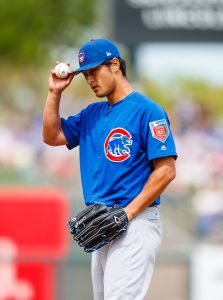
The Cubs saved their biggest splash for February, when they agreed to a six-year, $126MM deal with Darvish. The Dodgers, Twins, and Brewers were among the teams the Cubs beat out for the righty. Darvish’s $21MM average annual value was surprisingly low. We had expected an AAV in the $25-27MM range, given previous contracts signed by David Price, Max Scherzer, Zack Greinke, Stephen Strasburg, and the Cubs’ own Jon Lester. Like other big market teams, the Cubs are intent on staying below the $197MM competitive balance tax threshold, and the sixth year given to Darvish helped accomplish that. From Darvish’s point of view, the opt-out after 2019 has significant value: about $20MM, estimates MLBTR contributor Matt Swartz. Darvish will be 33 when the clause comes due, and he’ll have to decide whether he can top four years and $81MM on the 2019-20 free agent market.
Questions Remaining
The Cubs appear to have $13MM or less for trade deadline acquisitions. Regarding his trade deadline payroll flexibility, Epstein said, “We do have some, not a ton.” Epstein admitted, “One of our goals was to put the team together this year in a way that would maybe allow us to reset under the CBT threshold.” This is not actually a reset, since the Cubs were not over the CBT threshold in 2017. Regardless, it’s possible the luxury tax threshold stopped the Cubs from assembling a super bullpen despite their relief pitching problems in the playoffs. Aside from the health of Morrow, much depends on southpaw Justin Wilson, who flopped after joining the Cubs last year at the trade deadline. It’s difficult to say exactly why the Cubs didn’t acquire additional relievers – it may be that they’re completely satisfied with their bullpen as it stands, or don’t mind waiting until July to re-evaluate. But since the CBT threshold may have been a factor in their bullpen budgeting, let’s explore it further.
The Cubs may be willing to exceed next year’s $206MM CBT threshold, but aim to be considered a “first-time CBT payor.” Second-time payors pay 30% on the overage, while first-time payors pay 20%. Avoiding the CBT threshold in 2018 also affects what the Cubs would have to surrender next year upon signing a qualified free agent. They’d give up their second-highest draft pick regardless, but avoiding the threshold allows them to keep their fifth-highest pick and also have their international signing bonus pool reduced by $500K instead of $1MM. I have to ask of the Cubs, Yankees, and Dodgers: why does this difference in penalties matter so much?
Say the Cubs had gone all out and also signed Addison Reed and Mike Minor this winter, adding $17.7MM to the 2018 payroll. That would put the team’s 2018 payroll at $202MM for luxury tax purposes. Say they spend another $12MM on midseason acquisitions and end at $214MM for 2018. That means they’d pay a tax of…$3.4MM. Basically a rounding error for this franchise. Paying the tax for a potential 2018 overage is irrelevant at this spending level.
Therefore, this has to be all about being a first-time payor in 2019 rather than a second-time payor. If you’ll indulge me, let’s play that out for a team with a massive $275MM payroll in 2019. On a $275MM payroll, a first-time CBT payor is penalized $28.525MM, while a second-time payor is penalized $36.15MM. If a team is conceding being a first-time payor in 2019 (as the Cubs seem to be), being a second-time payor only results in less than $8MM in additional tax, even at a very high payroll level. Carrying that hypothetical payroll level forward for yet another season would result in a larger hit, but it would still be less than $14MM, and from that point forward the tax rate would be the same for an organization that stayed over the luxury line. Ah, but what about the draft pick penalty for exceeding the 2019 second surcharge threshold of $246MM? That’ll knock your 2020 draft pick back a full ten spots. Meaning, a good team has to pick at #37 instead of #27, something like that. Compared to the previous CBA, where draft picks as high as 11th overall were surrendered for signing certain free agents, dropping ten spots doesn’t seem that bad.
Large market teams are treating the CBT thresholds as lines they absolutely cannot cross. Or at least that they cannot cross for consecutive years. Rather than take that at face value, we need to ask whether the CBT thresholds are being used as a convenient excuse to spend less. The tax can be hefty, no doubt, and it is understandable that organizations already facing max penalties — particularly those that often spend well over the threshold — would look for an opportunity to reset. But the timing of entering CBT payor status does not appear to be a particularly compelling limitation on spending in and of itself.
My payroll tangent aside, the Cubs also have the question of a possible position player logjam. On his decision not to trade anyone, Epstein told Greenberg, “We explored a lot of a different possibilities, but in the end there just wasn’t a deal available that would give us a fair return back. We didn’t want to take less talent or control just to add a pitching prospect. Balancing the roster wasn’t that fundamental to make a bad deal happen.” The Cubs can’t be faulted for declining to sell low on Kyle Schwarber, who dedicated himself to an offseason conditioning program in the meantime. If all of the Cubs’ many outfield and second base candidates stay healthy at once, which is unlikely, Maddon may need to make the tough decision to bench his two underperforming veterans, Jason Heyward and Ben Zobrist. Even if that comes to pass, it’s likely preferable to taking less than fair value for a controllable young player or finding the depth lacking if is tested.
Overview
The Cubs were able to use an opt-out clause for Darvish to lower the AAV on his contract, helping the team stay below the competitive balance tax threshold. They were able to accomplish this because other big market teams had even less space under that threshold, and small market teams couldn’t match the Cubs’ bid. They also brought in an intriguing and relatively young fifth starter in Chatwood, resulting in what looks to be the best starting rotation of the Epstein regime. While fresh faces in the bullpen were a given, the volatility of relief pitching makes it unclear whether the Cubs did enough in that area. Otherwise, the team remains stacked with high quality position players. The Cubs will likely tangle with the Nationals and Dodgers for the NL pennant once again.
How would you grade the efforts of Epstein and company? (Link for app users.)
How Would You Grade The Cubs' Offseason?
-
A 42% (2,594)
-
B 40% (2,504)
-
C 12% (720)
-
F 4% (263)
-
D 3% (169)
Total votes: 6,250
Photo courtesy of USA Today Sports Images.
Out Of Options 2018
The following 40-man roster players have less than five years service time and are out of minor league options. That means they must clear waivers before being sent to the minors. I’ve included players on multiyear deals. This list was compiled through MLBTR’s sources when possible, but may be incomplete for a handful of teams. I’ll update the post as confirmed information comes in.
Angels
Jose Alvarez, Cam Bedrosian, Jefry Marte, Blake Parker, Carlos Perez, J.C. Ramirez, Noe Ramirez, Alex Meyer
Astros
Athletics
Liam Hendriks, Raul Alcantara, Renato Nunez, Chris Hatcher
Blue Jays
Braves
Lane Adams, Charlie Culberson, Sam Freeman, Jose Ramirez
Brewers
Jesus Aguilar, Jett Bandy, Oliver Drake, Jeremy Jeffress, Hernan Perez, Manny Pina, Eric Thames, Jonathan Villar, Stephen Vogt
Cardinals
Tyler Lyons, Tommy Pham, Greg Garcia, Sam Tuivailala, Miles Mikolas
Cubs
Eddie Butler, Justin Grimm, Mike Montgomery
Diamondbacks
Brad Boxberger, Chris Herrmann, T.J. McFarland, John Ryan Murphy, Albert Suarez
Dodgers
Tony Cingrani, Wilmer Font, Tom Koehler, Trayce Thompson
Giants
Cory Gearrin, Sam Dyson, Hunter Strickland, Gorkys Hernandez, Jarrett Parker
Indians
Erik Gonzalez, Ryan Merritt, Rob Refsnyder, Giovanny Urshela, Trevor Bauer, Dan Otero, Danny Salazar
Mariners
Marco Gonzales, Mike Morin, Erasmo Ramirez, Nick Vincent
Marlins
Derek Dietrich, Justin Nicolino, Dan Straily, Tomas Telis, Jose Urena
Mets
Wilmer Flores, Rafael Montero, Kevin Plawecki
Nationals
A.J. Cole, Brian Goodwin, Matt Grace, Enny Romero
Orioles
Dylan Bundy, Kevin Gausman, Mike Wright, Gabriel Ynoa
Padres
Brad Hand, Kirby Yates, Matt Szczur, Christian Villanueva, Bryan Mitchell
Phillies
Jorge Alfaro, Luis Garcia, Cesar Hernandez, Adam Morgan
Pirates
Bryce Brentz, Elias Diaz, George Kontos, Felipe Rivero, A.J. Schugel, Nik Turley*
Rangers
Juan Centeno, Jurickson Profar
Rays
Chris Archer, Alex Colome, C.J. Cron, Dan Jennings, Chaz Roe, Jesus Sucre
Red Sox
Brian Johnson, Deven Marrero, Steven Wright, Heath Hembree, Tyler Thornburg, Christian Vazquez, Sandy Leon, Blake Swihart
Reds
Rockies
Royals
Jesse Hahn, Cheslor Cuthbert, Brian Flynn, Wily Peralta, Jorge Soler
Tigers
Mike Fiers, John Hicks, Dixon Machado, Leonys Martin, Drew VerHagen
Twins
Ehire Adrianza, Robbie Grossman, Jorge Polanco, Ryan Pressly, Kennys Vargas
White Sox
Leury Garcia, Matt Davidson, Luis Avilan, Danny Farquhar, Yolmer Sanchez
Yankees
Austin Romine, Chasen Shreve, Dellin Betances, Aaron Hicks, Gary Sanchez
* on restricted list
MLBTR Demographic Survey
If you have a minute, please help us out by completing the anonymous demographic survey below. App users can click here to take the survey.
Secretive Free Agent Camp Now Open
By my count, there are currently around 40 remaining free agents who seem likely to receive Major League contracts eventually. Approximately 70 additional free agents might have been minor league deal candidates even in a normal offseason. This offseason has been decidedly abnormal in the sheer volume of quality unsigned players as spring training camps open around baseball.
As a result of MLB’s Neverending Offseason, the players’ union decided to open up a spring training camp for the many unsigned free agents. The location: IMG Academy in Bradenton, Florida. According to USA Today, the first workout is today. Former Astros manager Bo Porter is set to preside over the proceedings.
We knew going in that the MLBPA decided not to allow media at this camp. But I decided, “What the hell,” and sent veteran reporter Joey Johnston out to IMG this morning in an attempt to find a story. The effort was a total bust. According to Johnston, IMG is a sprawling facility, “almost Disney World-like where you can’t see anything unless you are inside.” There is a fenced-in, guarded gate. When Johnston inquired with a guard if he might wait around the perimeter, his reply was, “We were vehemently told there would be no public access. No one gets in there. No one.”
From what Johnston could tell, the players are housed on-site, so they can’t be spotted driving in or out. No other media or fans were present. Johnston concluded, “If they wanted total lockdown, they appear to have achieved that goal.” That’s also the sense that team personnel are evidently being given. As Ken Rosenthal of The Athletic tweets, a club exec tells him that a special assistant sent to scout “was asked to leave the workout” and “escorted out” of the IMG facility. Of course, as he adds in a follow-up tweet, private workouts can be set up with individual players.
Based on Johnston’s account, the MLBPA’s free agent camp is not some kind of 31st spring training camp. In fact, the situation at IMG runs directly counter to the laid-back, relatively accessible vibes of a typical spring training facility.
Why did the MLBPA decide to conduct their camp this way? I’d have asked director of communications Greg Bouris for comment, but he resigned this week after serving in the role for 19 years. Craig Calcaterra of Hardball Talk recently posited a theory: “I suspect the union does not want its free agents being the subject of sad stories in which they’re cast as hopeless or pathetic or facing the end of their careers.”
I think Craig is on to something. It seems likely the camp itself would come off as a sad affair. We know the Boras Corporation’s clients are not attending, and that includes top free agents in J.D. Martinez, Eric Hosmer, Jake Arrieta, Mike Moustakas, and Greg Holland. I inquired with three additional major agencies with notable free agents, and have come up empty in identifying one who will be in attendance. No one seems to know which or how many players will be attending – not even Bo Porter, according to Bob Nightengale of USA Today.
From afar, it appears that the players’ union is missing an opportunity to win over fans, whether directly by being accessible or by openly letting attending free agents talk to the media. As Meg Rowley noted for FanGraphs on Monday, the general public typically does not side with the players in a labor dispute of this nature, though one possible messaging strategy could be to hammer on the many teams that are not trying to win this year. We established our own evidence of baseball fans’ sentiments last week, when over 73% of the 23,000 respondents in an MLBTR poll said players are overpaid. As I noted in that post, there are plenty of reasons to believe otherwise, but at the moment that message does not seem to be getting through to fans.
Free Special Report: 39 Silent Killers Of Your Fantasy Draft
No matter how long you’ve been playing fantasy baseball, there are dozens of deliberate and subconscious silent draft killers that most of us are unable to avoid. In this FREE 22-page Special Report, fantasy baseball guru Ron Shandler discusses the many roadblocks to success – 39 of them! – and how to overcome them.
With your 2018 drafts right around the corner, make sure all the obstacles are cleared away so you have the best shot at winning.
This is a sponsored post from Ron Shandler.
Are MLB Players Overpaid?
MLB players earned more than $4MM on average in 2017, with some players’ salaries exceeding $30MM. For most people, that’s an unfathomable amount of money. Many people feel that baseball players and other athletes are overpaid, with the median American full-time worker earning around $45K per year.
Why do people object to MLB player salaries? One reason is the nature of the profession – Major League Baseball is a game played for the public’s entertainment, while baseball itself is a game many of us played in our youth for the sheer enjoyment of it. MLB players don’t serve an essential function to society like a teachers or doctors. And to many, the work of an MLB player seems less difficult and much more enjoyable than a typical job. It can be difficult to stomach professional athletes earning 100 times or more than that of a typical American.
Another reason some fans consider players to be overpaid is ticket prices. For a family of four to see the Cubs host the Cardinals on a Saturday in July, sitting in the upper deck, currently costs $565.91 on Stubhub for tickets alone. Of course, context is everything. Go to a Rays-White Sox game on a Wednesday afternoon in April, and a family of four can get in the door for $50 or less. At the heart of the matter: how much do player salaries actually affect ticket prices? I’m not an economist, but I think one would argue that teams will charge what fans are willing to pay. If player salaries were magically cut in half tomorrow, but demand for tickets remained the same, would you expect teams to reduce prices?
The other side of the coin is that, as difficult as it may be to accept given their salaries, MLB players might be underpaid. As an industry, MLB’s revenue has grown to $10 billion. As Nathaniel Grow wrote on FanGraphs a few years ago, the players’ percentage of that pie has dropped from a peak of 56% in 2002 to less than 40% in 2015. No one’s suggesting fans should feel sympathy for wealthy MLB players, but rather that they are entitled to fight for their fair share of the sport’s revenue. After all, without these 1,000 or so players, there’s no MLB. More money for the players doesn’t have to mean higher ticket prices; it would just mean less for the owners. Those on this side of the debate would note that MLB players are highly compensated because there are so few people in the world capable of doing their jobs, and interest in watching them perform drives the sport’s revenue.
As tensions mount between the owners and players, let’s see where MLBTR readers stand. App users can click here to take the poll.
Are MLB players overpaid?
-
Yes 73% (17,846)
-
No 27% (6,474)
Total votes: 24,320
Download Our Free Trade Rumors App
Looking for the best possible MLBTR experience on your mobile device? Check out our free Trade Rumors app, available for iOS and Android! Nine of the top ten free agents somehow remain unsigned with less than a month to go until pitchers and catchers report, so there’s a flurry of hot stove action yet to come. The Trade Rumors app allows you to set up custom feeds and notifications for your favorite teams and players and is the perfect way to stay on top of the news.
Dave Cameron Joins Padres; Marlins Hire Bradley Woodrum
The Padres and Marlins each made a huge acquisition this week, though not the kind we typically cover here on MLBTR. Yesterday, FanGraphs stalwart Dave Cameron announced he will be joining the Padres to help build out their Research and Development department. And this morning, former MLBTR contributor Bradley Woodrum announced he’s joining the Marlins analytics team. Cameron and Woodrum were among the best sabermetric analysts operating in the public sphere, and we’ll sorely miss reading their work.
I first encountered Dave’s work about ten years ago, on U.S.S. Mariner. More than anyone, Dave was able to do incredibly intelligent baseball analysis in an understandable, easy-to-read way. Dave is a pioneer in the field of sabermetrics, and I made a point to read just about everything he wrote. I don’t remember much about the early days of FanGraphs, except that it had more graphs. When Dave joined, his writing made FanGraphs a must-read as well. Of course, the site has brought in countless talented writers and analysts since then. I first reached out to Dave in 2009 in hopes of understanding WAR better. He’s been gracious with his time over the years when I’ve approached him with many questions and has been a longtime friend of MLBTR. Dennis Lin of the San Diego Union-Tribune spoke to Dave, who has had previous interest from MLB teams, about his decision to accept the Padres’ offer.
Back in 2015, Bradley Woodrum applied for a project we were launching on MLBTR: an attempt to create a model that predicts the chance of a pitcher having Tommy John surgery (updated last September). I knew Brad from his stellar work at FanGraphs and The Hardball Times. The Tommy John project was a daunting undertaking, and I was amazed by Brad’s analytical abilities, professionalism, and perseverance in getting the project to the finish line. It took the better part of a year, but Brad delivered what I considered to be the best possible TJS prediction model, given the limitations of public data. I’m proud to have hosted that work on MLBTR. Armed with the superior data of a Major League club, I expect Brad to do great things.
MLBTR wishes the best to Dave Cameron and Bradley Woodrum in their new careers!
MLB Arbitration Tracker For 2018
If a team has a player on its 40-man roster with at least three and less than six years of Major League service time, who is not signed to a multiyear extension, that player is eligible for MLB’s arbitration process. Some players with less than three years are eligible as well; these are called Super Two players. The arbitration process is used to determine the player’s salary, generally by looking at how the player’s traditional statistics stack up with previously established precedents. About 200 players are eligible for arbitration for 2018, including Josh Donaldson, Manny Machado, and Kris Bryant. For many players, the arbitration process is the first major step up in salary prior to free agency.
A player’s agent, with the help of the Players Union, is pitted against the team as they try to settle on a salary. Friday marks the deadline for players and teams to exchange figures, with each side submitting what they think the player’s 2018 salary should be. Many players will agree on a salary in advance of this date; more than a dozen have already. From what I’ve heard, all teams now treat Friday’s deadline as a hard one, meaning if they don’t have a salary agreement by then, they’ll automatically go to a hearing (barring a multiyear extension). Last year, 15 players went to hearings, which occur in February. In an arbitration hearing, each side makes a case for its salary figure in front of an independent panel, and the panel chooses a winner.
For seven years now, MLBTR has been using a proprietary algorithm to project arbitration salaries. We also have a constantly-updated MLB arbitration tracker for 2018, which allows you to filter by team, service time, Super Two status, signing status, and whether the player went to a hearing. You can see and sort by the player and team submissions for those who get to that point, and sort by settlement amount. The tracker has everything you need to keep up with each team’s arbitration class.