
Mark Reynolds Announces Retirement
Veteran slugger Mark Reynolds, who enjoyed a 13-year big league career split between the Diamondbacks, Rockies, Orioles, Indians, Cardinals, Nationals, Yankees and Brewers, announced in an appearance on Mad Dog Sports Radio on SiriusXM that he’s officially retired (Twitter link, with audio).
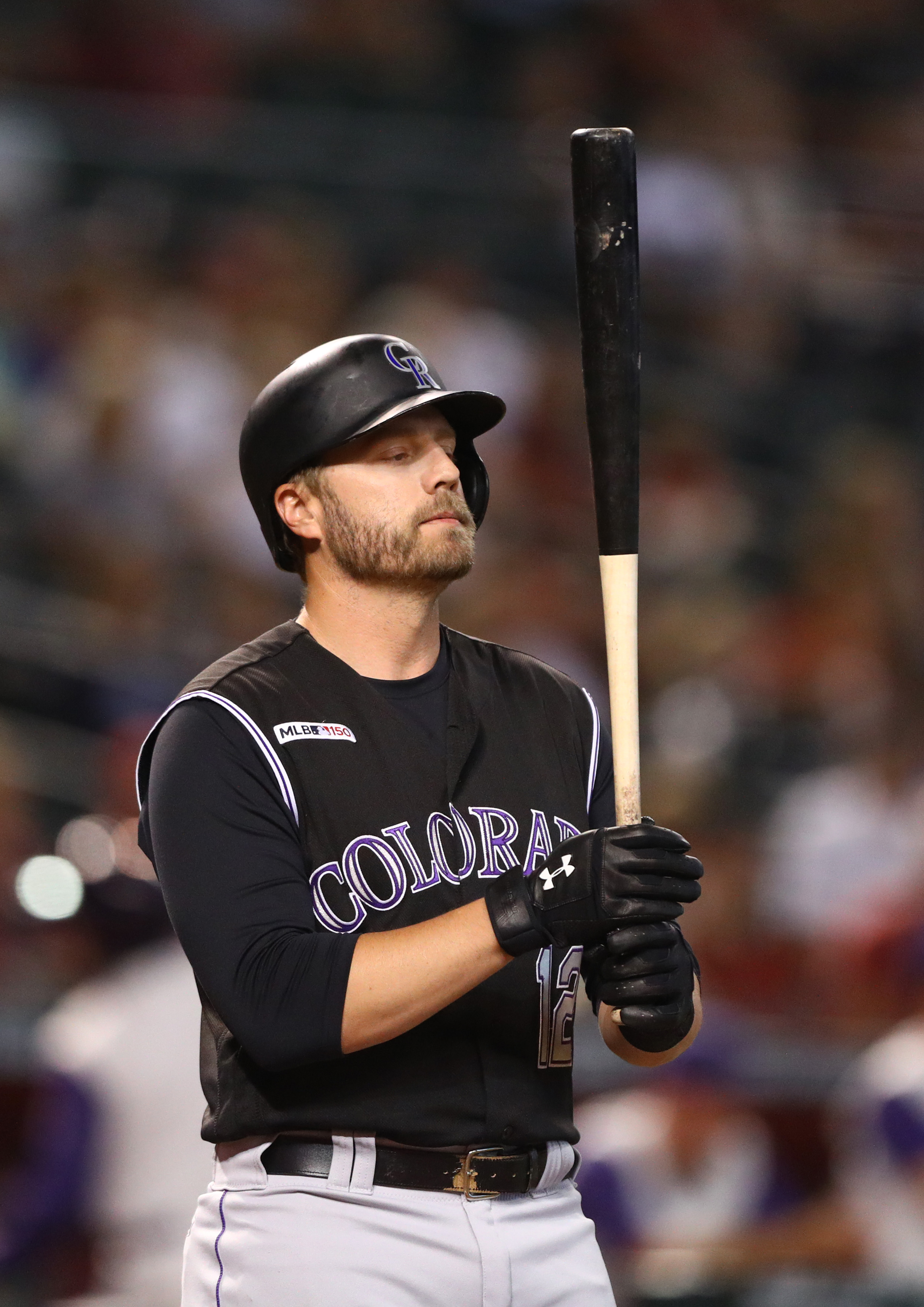
“I’ve moved beyond that,” Reynolds said when asked if he planned to seek another contract once MLB’s transaction freeze has been lifted. “I’ve retired. … I’m really enjoying time with my family, and it’s time for me to move on and find something else to do.”
The 36-year-old Reynolds spent the majority of the 2019 season in the Rockies organization, serving as a part-time first baseman and a bench bat until he was cut loose on July 28. He’d enjoyed a quality season with the Nationals a year prior in 2018, but Reynolds struggled to the lowest offensive numbers of his career with the Rox last year.
Originally a 16th-round pick of the Diamondbacks out of the University of Virginia back in 2004, Reynolds made his big league debut less than three years after being drafted. Reynolds was never considered one of the organization’s premier prospects — his No. 7 ranking on Baseball America’s list of D-backs prospects prior to the ’07 campaign was the only time he broke their top 30 — Reynolds hit the ground running. He was promoted to the big leagues in mid-May and closed out the remainder of the season as a regular in the lineup, hitting .279/.349/.495 with 17 home runs.
By 2008, Reynolds was Arizona’s everyday third baseman. His power was unquestionable, although the same could be said of his questionable contact skills. Reynolds became one of the game’s quintessential boom-or-bust players, regularly headlining home run and strikeout leaderboards alike. From 2008-11, he averaged 35 big flies per season but also led his league in strikeouts each year along the way. At that time, a player who was punching out in roughly a third of his plate appearances was an alarming anomaly; the league average strikeout rate back in Reynolds’ first full year was 17.5 percent — a full six percent lower than 2019’s mark.
Reynolds had a rough year in 2010, prompting the D-backs to trade him to the Orioles in return for reliever David Hernandez and prospect Kam Mickolio. He bounced back with the Birds and helped them to the postseason in 2012, but Baltimore declined an $11MM club option over Reynolds’ final arbitration year that offseason and non-tendered him, making him a free agent for the first time in his career.
Reynolds would bounce from Cleveland to New York to Milwaukee to St. Louis to Colorado to D.C. and back to Colorado on a series of one-year and minor league deals from that point forth. He delivered some productive seasons along the way and even popped 30 homers for the 2017 Rockies before giving the Nationals an absurd 5-for-5, two-homer, 10-RBI day in 2018 (video link).
Reynolds will conclude his playing career with a .236/.328/.453 batting line over the life of 6243 plate appearances and 1688 Major League games. In that time, he belted 298 home runs, 253 doubles, 14 triples and stole 64 bases while also scoring 794 times and knocking in 871 runs. The slugger took home nearly $30MM in career earnings while providing a litany of tape-measure home runs on which we can all fondly look back. Best wishes to Reynolds and his family in whatever lies ahead.
These Players Can Exit Their Contracts After 2020
No matter if a Major League Baseball season takes place in 2020, there are certain players who will be in position to decide whether to exit their current contracts next winter. Whether it be by way of an opt-out clause or a mutual option, here’s a look at the players who will be able to choose to take their chances in free agency…
Opt-Outs
Back when the Marlins extended outfielder Giancarlo Stanton on a historic pact worth $325MM over 13 years in 2014, they included a one-time opt-out for next winter. Stanton has put up at least one phenomenal season since he signed that deal – he won the NL MVP and hit 59 home runs in 2017 – but injuries have hampered him on a regular basis. He’s now a member of the Yankees, who acquired him in a December 2017 deal, but Stanton played in just 18 games last season. He’ll still be owed $218MM for seven years after this season, and for at least the time being, it’s very tough to think of Stanton leaving that money on the table to test free agency.
Designated hitter J.D. Martinez, a member of the Yankees’ archrival in Boston, will have two years and $38.75MM remaining on his contract after this season. He’ll be 33 then, and will continue to be someone who’s known as a defensive liability, so should be opt out? It’s up for debate. The big-hitting Martinez remains an offensive standout, but his production last season fell (granted, he did still slash .304/.383/.557 with 36 home runs in 657 plate appearances). He subsequently chose not to opt out after last season, as doing so would have cost him his $23.75MM salary for this year.
One of Martinez’s former Tigers teammates, outfielder Nicholas Castellanos, will also have to choose whether to revisit free agency next offseason. Castellanos is another defensively challenged slugger, one whom the Reds guaranteed $64MM over four years this past winter. He’ll be 29 by the time the 2021 season rolls around, and by saying goodbye to his Reds pact, he’d be leaving $48MM on the table (including a $2MM buyout in 2024). It’s not easy to determine whether that will happen; some of it depends on how well Castellanos fares in 2020, if a season occurs. Carrying over the tremendous production he posted late last season after the Cubs acquired him from the Tigers may make Castellanos more inclined to try his luck on the market again, but his output at the plate has been more good than great throughout his career.
Mutual Options
For the most part, mutual options don’t get picked up. Either a player’s so effective that he opts for free agency or he’s not useful enough for his team to exercise the option. Rockies first baseman Daniel Murphy and reliever Wade Davis are among those who have mutual option decisions waiting after the season, but they’ve struggled in the club’s uniform so far. With that in mind, Murphy’s on track for a $6MM buyout (as opposed to a $12MM salary), while Davis figures to receive a $1MM buyout instead of a $15MM payday.
Brewers outfielder Ryan Braun ($15MM mutual option, $4MM buyout), Diamondbacks right-hander Mike Leake ($18MM mutual option, $5MM buyout) and Cubs lefty Jon Lester ($25MM mutual option, $10MM buyout) could also find themselves looking for new contracts next winter. The same goes for Mets reliever Dellin Betances, though it’s tougher to say in his case. The former Yankee barely pitched at all season on account of injuries, and if there isn’t a season in 2020, would he turn down a guaranteed $6MM in 2021? And would the Mets buy him out for $3MM? That’s one of the many interesting questions we could face next offseason.
Rockies Provide Timetable On Peter Lambert Injury
Rockies right-hander Peter Lambert, diagnosed with a forearm strain a month ago, is progressing through a rehab program but is still three to four weeks from being cleared to throw, pitching coach Steve Foster tells reporters (Twitter link via Kyle Newman of the Denver Post).
At the time of Lambert’s injury, Colorado declined to put a timetable on his recovery, with reports indicating that he was expected to miss “significant” time. Today’s news from Foster doesn’t provide an expected return to game readiness, but the fact that he’s close to a month from even beginning a throwing program suggests that he’s multiple months away from that point. Any early throwing Lambert does would of course be limited, and he’d need time to ramp up to long toss, throwing off a mound, facing live hitters, etc.
Lambert, 23 next week, is hardly a household name but is a young hurler of some note within the organization’s ranks. He was the club’s second-round pick (44th overall) back in 2015 and steadily rose through the minor league system, ultimately making his big league debut in 2019. He started 19 games for the Rox with woeful results (7.25 ERA, 5.97 FIP), but this time last year, Lambert was considered one of the organization’s best overall prospects. On a national scale, Eric Longenhagen and Kiley McDaniel ranked him as the game’s No. 120 overall prospect heading into the season. At that point, he was fresh off a 2018 season that saw him toss 148 innings of 3.28 ERA ball with a 106-to-27 K/BB ratio and a grounder rate just shy of 50 percent between Double-A and Triple-A.
Even a healthy Lambert wouldn’t have been a lock to begin the year in Colorado’s rotation. Jon Gray, German Marquez and Kyle Freeland seemed like locks, while out-of-options hurlers Antonio Senzatela and Jeff Hoffman were slated to vie for rotation spots along with Lambert, Chi Chi Gonzalez and others (including non-roster invitee Ubaldo Jimenez). The delayed start to the year could conceivably give Lambert enough time to reenter that mix, depending on when (or if) a second training camp is able to come together.
How To Get A Job In Baseball, According To GMs
Working in baseball operations for a Major League team is a dream job for many baseball fanatics. If front office job-seekers are being honest, the pinnacle would be to one day land in the GM’s chair and call the shots on trades, free agent signings, and draft picks. But in such a competitive field, how do you stand out? What should you focus on to become as appealing as possible to an MLB team in a job interview?
Seven years ago, I polled many MLB executives on their advice for high school students with front office aspirations. With so many new executives in the game since then, I decided to move a bit further down the career path and ask this question:
What one piece of advice would you give to a college student who hopes to work in baseball operations one day?
I posed this question to many of MLB’s top-ranking baseball operations executives. Just like the rest of us, these people are currently sheltered in place with their families trying to get some work done in these difficult and strange times. The following ten execs kindly took the time to answer my question: Ross Atkins of the Blue Jays, Jeff Bridich of the Rockies, Ben Cherington of the Pirates, James Click of the Astros, Mike Elias of the Orioles, Derek Falvey of the Twins, Matt Kleine of the Brewers, Dayton Moore of the Royals, Brodie Van Wagenen of the Mets, and Dick Williams of the Reds. Their answers are below.
I always think of the creative examples of how several of the current team’s GMs and Presidents got their foot in the door when asked this question. Without sharing those ideas specifically, I tell the individual who asked to think of something that they can bring to the table today that would be beneficial for a baseball operations team. Is there something that they do or can do that would have an immediate impact even if very small. It could be data analysis, programming, scouting, performance coaching, or leadership/communication application but ideally in the form of a project or deliverable and in a perfect world something that the organization doesn’t already have.
I believe that if those looking to get into baseball have excelled in other arenas they should think about how they have done that and share that in a way that is applicable to baseball as that is usually an attractive approach to those who are deciding to add to their operations teams. – Ross Atkins, Blue Jays Executive Vice President, Baseball Operations & General Manager
In terms of trying to trying to get into the world of baseball operations out of college, mindset and attitude will determine a lot. Create for yourself a mindset built around relentlessness, flexibility and hard work. The typical college school year and/or graduation timeframe do not lineup perfectly with when most Major League teams are hiring. So there could be some lag time between leaving college and getting hired.
Also, there usually are hundreds, maybe thousands, more applicants for jobs than there are jobs available. So chances are you’ll hear a bunch of “Nos” before you hear a “Yes”. That’s where relentlessness, flexibility and work ethic come into play. Your first opportunity in the baseball industry may not come in the perfect shape, size and package that you desire – but that’s OK. Be flexible in what you are willing to do and where you’re willing to work (be that departmentally or geographically).
At some point in your job search, you may feel like you are being annoying or that you’re bothering team employees too often. But know that relentlessness and persistence often pay off. It’s tough to count up how many times we have said over the years, “You have to give that person credit for his/her persistence,” whether we hired that person or not. If the worst outcome is that you are not hired (yet) but you are given credit for your relentless desire to work in the game, then it’s worth it.
Finally, look at the job search process like it is a job in itself. Put in the time. Make sure your resume is as good as it possibly can be. Ask thoughtful questions of any and all people who could help you. And always be ready – after you’ve sent off your resume and applied for a job, you never know when a team might call you. Those people who are ready for an in-depth discussion at a moment’s notice usually make a good first impression. – Jeff Bridich, Rockies Executive Vice President & General Manager
It’s hard to narrow down to one but if I had to I’d say finding opportunities to solve complicated problems in groups. Almost all of the work we do in baseball operations focuses on assessing, predicting, or improving human performance. Human performance is complicated. Almost none of the work we do in baseball is done by ourselves. Just about everything we do is done by teams of people. So I’d say the more practice combining those two things the better. – Ben Cherington, Pirates General Manager
There’s no magic bullet, no secret code to getting into baseball. All of us have a unique story about how we got here, so play to your strengths and put yourself in as good a position as possible to take any job that you’re offered, even if – especially if – it’s not in the area in which you see yourself long term. Every job is an opportunity to show what you can do, a chance to gain valuable experience and perspective on how the game works, and to make sure that this lifestyle is something you want to take on. Finally, don’t get discouraged! It took a lot of us a long time to get into the game, but it’s worth it. – James Click, Astros General Manager
I think there are so many public forums today to showcase your work online. Whether it’s contract analysis, data analysis, or scouting evaluation that you want to do, you can start to build this body of work on your own, before anyone hires you. It is so helpful when we are interviewing when someone has a portfolio already started. It shows how you work and think, but also shows initiative and that you are truly passionate about this line of work. – Mike Elias, Orioles Executive Vice President and General Manager
I’d recommend that you don’t wait around for the perfect opportunity to come your way and instead find a way to create one. People who want to work in baseball will reach out and say they’re just waiting for that “break” to come their way. It’s not uncommon that a year later we’ll hear from them again still waiting for that opening to show up.
My suggestion – dive into a topic within the game that interests you, learn as much as you can about it, and then generate a work product that shows you have the baseline skills and passion to impact a baseball operation as soon as you walk through the door. Don’t be afraid to try something because you might fail. Of all the resumes we get, it’s the ones that are accompanied by a work product (and therefore a willingness to put yourself out there) that generate the most interest. – Derek Falvey, Twins President of Baseball Operations
My advice to students is to create baseball-specific opportunities for yourself. Don’t wait for them to come to you. Volunteer to capture video, analyze data or operate pitch tracking software for your school’s team. Connect with your Sports Information Director and ask how you can help. Learn SQL. Learn Spanish. Contact baseball-centric websites and volunteer your time. Devise your own work product that attempts to solve meaningful questions you believe are currently unanswered within the public sphere. This is especially important because providing MLB clubs with examples of self-driven work product showcases your curiosity, thought process, and reasoning. It’s equally as important – if not more so – than a strong resume.
Students should also understand that our approach to hiring is shaped by our constant pursuit of the next marginal win. How can the next hire help us win games both today and in the future? Students who approach us with hard skills, novel work product and a strong resume quickly move to the front of that line. – Matt Kleine, Brewers Vice President – Baseball Operations
As it pertains to teams and front office, compatibility is the most important trait. This will only exist if you have an above and beyond attitude with the commitment to do the jobs that others simply find meaningless. You must have an “others first” mindset and model that behavior. Finally, never stop looking at this game from the eyes of your youth. – Dayton Moore, Royals Senior Vice President – Baseball Operations/General Manager
1. When interviewing with a prospective employer/executive, be specific about the area in which you want to work. Prove to your audience that you have you done the research in his/her area of focus. This will enable you to be versed enough to hold a meaningful conversation. Those who want a “PARTICULAR job” are much more compelling than those who simply just want “a job.”
2. Be willing to work in any city that has an opportunity to further your pursuits. Don’t let geography limit your search. – Brodie Van Wagenen, Mets Executive Vice President & General Manager
The best way to get your foot in the door is to figure out how you can solve a problem for me that I may not have even known I had. It makes for a much more effective cold call when you email your resume into an organization if you can articulate what you can do that the Reds are not doing today that could make us better. At least it makes us more likely to read further.
Keep abreast of the evolving trends in the industry and tailor your coursework accordingly. If you have baseball experience, focus on adding database management or machine learning or something technical. And if you are technically skilled, work on adding the baseball experience however you can. – Dick Williams, Reds President of Baseball Operations
Examining Rockies’ Ineffective Free-Agent Spending
It hasn’t been an enjoyable 12 months for the Rockies organization. There was plenty of goodwill to go around heading into last season after back-to-back playoff berths and the long-term extension franchise player Nolan Arenado signed. But just about everything has gone in the wrong direction for Colorado since then. The club fell on its face in 2019, winning a meager 71 games, and its higher-ups have since irked Arenado. The five-time All-Star surfaced in trade rumors while making it known that he was unhappy with the Rockies’ inactivity over the winter.
The Rockies used the offseason to sign only one major league free agent – untested right-hander Jose Mujica – and for a relatively paltry $563K. Now, expectations are that they’ll again sit near the bottom of the league in 2020 (if there is a season). One key reason the team has slid down the standings and just might stay there? An utter lack of big-money success on the free-agent market.
Since general manager Jeff Bridich assumed the reins after the 2014 season, the Rockies have signed eight free agents to guarantees worth $10MM or more. All of those deals have been landmines to this point, and five of those players are still eating into the team’s payroll – one that Jason Martinez of Roster Resource and FanGraphs estimates will check in at a franchise-record $156MM on Opening Day. With that much cash already tied up, owner Dick Monfort was unwilling to authorize Bridich to spend in recent months. Maybe that’s a good thing, as you’ll see below…
2015-16 Offseason
Parra came to the Rockies off a solid season divided between Milwaukee and Baltimore, though he was anything but effective as a Rockie. He ended his tenure in Colorado with minus-1.1 fWAR and a .283/.320/.407 line (just a 77 wRC+ when adjusted for ballpark) over 1,249 plate appearances. Motte, meanwhile, didn’t even see his entire deal through. The Rockies cut ties with him after 2016, a year in which he notched a 4.94 ERA/5.68 FIP with minus-0.3 fWAR.
2016-17 Offseaosn
- Ian Desmond, IF/OF: five years, $70MM
- Mike Dunn, RP: three years, $19MM
It was a head-scratcher from the get-go that the Rockies splurged on Desmond to play first base, as he didn’t look to have the bat to handle the offensively charged position and had spent his career to that point as a shortstop/outfielder. The gamble has not paid off at all for the Rox, who still owe Desmond $25MM through 2021 (including a $2MM buyout for ’22). The 34-year-old accounted for a hideous minus-1.7 fWAR during his first three seasons with the team and batted .252/.313/.429 (80 wRC+) in 1,474 PA. The Rockies moved him back to the outfield last year.
Colorado parted with Dunn late in 2019. He’s now retired after serving as a replacement-level reliever (minus-0.1 fWAR) with the club, though that looks like a generous assessment in light of his 5.93 ERA/5.02 FIP across 85 frames. Injuries limited Dunn to just under 35 combined innings in his final two seasons.
2017-18 Offseason
- Wade Davis, RHP: three years, $52MM
- Jake McGee, LHP: three years, $27MM
- Bryan Shaw, RHP: three years, $27MM
Evidenced by the $106MM spent on these three, the Rockies made a sincere effort to bolster their bullpen after 2017. The decision has blown up in their face. Davis, lights-out for most of his career, has been awful since joining Colorado. His contract’s still the largest ever on a per-year basis for a reliever, but his production has tanked. He pitched to an almost 9.00 ERA in 2019 and didn’t last the full season as the Rockies’ closer. Meantime, McGee and Shaw haven’t been much better, if at all. Combined, these three have registered minus-0.3 fWAR in 227 1/3 innings since they signed their contracts.
2018-19 Offseason
Desmond couldn’t solidify first base for the Rockies. Murphy hasn’t been able to, either. Once among the premier hitters in the game, the 35-year-old Murphy could only muster a line of .279/.328/.452 (good for a career-low 86 wRC+) and a personal-worst minus-0.2 fWAR in 478 PA.
__
If you add up the fWAR for all these players, the figure amounts to minus-3.7. The value of the contracts the Rockies handed this group comes to $256.5MM. That’s a lot of wasted money, and it’s part of the reason the Rockies are in such an unenviable position at the moment.
NL West Notes: Martin, Giants, Ubaldo
Right-hander Corbin Martin, one of four players the Astros sent to Arizona in the Zack Greinke blockbuster, had been on the Diamondbacks‘ radar for awhile, writes Zach Buchanan of The Athletic (subscription required). They’d first targeted him in the 2017 draft and again in trade talks with the ‘Stros centered around Paul Goldschmidt — but Houston wasn’t keen on including him in such a deal. At the time, Martin was 22 and fresh off 122 innings of 2.51 ERA ball between Class-A Advanced and Double-A, while Goldschmidt only had a year of control left.
Martin made his MLB debut in 2019 but underwent Tommy John surgery in July and was suddenly on the shelf for a win-now Astros club. Thus, D-backs GM Mike Hazen inquired again, and the Astros were more willing to listen the second time around. A package of Martin, J.B. Bukauskas, Seth Beer and Josh Rojas (plus plenty of cash to help offset Greinke’s salary) got the job done. Martin may not be an option for the Snakes until 2021, but he’s a second-rounder with a career 2.58 ERA in the minors who has ranked on Top 100 lists in both of the past two offseasons, making him an intriguing piece down the road. D-backs and Astros fans alike will want to check out the piece for thoughts from Hazen and assistant GM Amiel Sawdaye on the club’s longstanding interest in Martin.
Some more out of the NL West…
- The Giants‘ release of veteran lefty Jerry Blevins only increased the odds of southpaws Jarlin Garcia and Wandy Peralta making the club, notes Alex Pavlovic of NBC Sports Bay Area. Both pitchers hurled five shutout innings when exhibition games were still being played — Garcia with an 8-to-1 K/BB ratio and Peralta with a 10-to-4 mark. Given that Garcia is out of minor league options, he’d appear a particularly likely candidate to secure a spot in the ‘pen, although there’s certainly room for both. The Giants claimed both lefties off waivers, with Peralta coming over from the Reds in September and Garcia coming over from the Marlins over the winter. Each has had some success in the Majors and is controllable all the way through the 2023 season should things pan out in the Bay Area.
- Baseball’s shutdown put Ubaldo Jimenez‘s comeback attempt with the Rockies on hold, but the right-hander is open to pitching in the minors if play is able to resume, writes Nick Groke of The Athletic in an excellent column on Jimenez’s unexpected bid to revive his career (subscription required). As Groke details, Jimenez received a “fringy” Major League offer in the 2017-18 offseason but opted to stay home in the Dominican with his pregnant wife and soon-to-be-born child. This offseason, wanting to take one last shot, he called Rockies VP of international scouting Rolando Fernandez about using the team’s complex in the Dominican to refine his mechanics. That eventually turned into a solid Dominican Winter League stint, a minor league deal with the Rox and several weeks serving playing the role of wise old sage to younger Rockies pitchers like German Marquez. Manager Bud Black tells Groke that Jimenez was sitting around 91 mph with his heater early in camp. A comeback at age 36 is a long shot but would make for one heck of an in-season storyline to root for.
Latest News & Notes On Coronavirus & Baseball
We’re all pining for the return of baseball. It’d be nice to watch, especially in these trying times. More than anything, though, the start of play would mean that we’ve achieved some amount of control over the spread of the coronavirus — and, perhaps, that there’d be an end in sight to the suffering it has wrought. In the meantime, we join all those around the world in honoring the brave health care professionals, first responders, logistical employees, and others who are doing everything they can to sustain us.
- The unfolding tragedy is particularly acute in New York, the present American epicenter of the COVID-19 crisis. Baseball is an afterthought. Any hope of playing it will depend upon addressing the broader public health need, as Yankees reliever Zack Britton acknowledges (via MLB Network Radio on Sirius XM, on Twitter). “At the end of the day,” he says of talk regarding the scheduling of the 2020 season, “it doesn’t matter until the virus gets under control and cities and people are able just to go back to everyday life, let alone being able to go and watch baseball or us play baseball.” Getting to a point where the spread is manageable seems an obvious prerequisite for sports, even if played without fans. But the league and union are rightly thinking ahead and trying to plan to move back online as soon as possible. Britton says the sides have already begun considering potential neutral sites to stage games, potentially providing alternative venues that could be utilized as needed. The unnamed locations would have the sorts of playing, lodging, and other facilities required to make play possible.
- We’ve seen many MLB players pitch in financially and otherwise. They’re also quite understandably thinking of the needs of their families. Veteran Yankees starter Masahiro Tanaka has headed back to his native Japan with his wife and child while waiting for baseball to resume, Brendan Kuty of NJ.com reports. Tanaka says he felt in “danger” in Florida, where the virus is a growing threat. He also chose against returning to the home he maintains in New York. (There is at least a touch of baseball-specific news on the Yankees’ pitching staff, as we covered here yesterday.)
- Cardinals president of baseball operations John Mozeliak has revealed that one employee of the team has tested positive for COVID-19, as Mark Saxon of The Athletic tweets. The unnamed employee was not on hand at the club’s spring facility during camp; rather, he or she was stationed in St. Louis. MLBTR extends its best wishes for a quick and full recovery. Fortunately, that seems to be just what occurred for legendary former Cardinals and Angels outfielder Jim Edmonds. As Jeff Fletcher of the Orange County Register writes, Edmonds ended up in the hospital for pneumonia and ultimately tested positive for COVID-19. But he’s thankfully already on the mend.
- It’s always worth highlighting the good acts that take place in times of crisis. As Marc Topkin of the Tampa Bay Times writes, the Rays have initiated some assistance to local charity Feeding Tampa Bay, promising $100K and another $150K in matching funds to help spur a food drive. The Feeding Tampa Bay executive director calls it a “tremendous gift.” Meanwhile Rockies first baseman Daniel Murphy is the latest veteran player to make a sizable financial commitment. He’s giving $100K to a “family assistance fund” to assist minor-leaguers who support children or other family members. More on that initiative here.
Rebound Candidate: Kyle Freeland
If you’re of the belief that a pitcher can’t thrive despite calling the hitters’ haven known as Coors Field home, think again. Rockies left-hander Kyle Freeland did so in 2018, a year in which he finished fourth in National League Cy Young voting. He pitched to an excellent 2.85 ERA/3.67 FIP across 202 1/3 innings that season, giving the Rockies and the rest of the baseball world the impression that the club, long starved for solid starting pitching, had a front-line one-two punch on its hands in him and German Marquez. While Marquez did continue to produce last year, Freeland declined to a dramatic extent – no doubt one of the reasons the Rockies went from a playoff team to a bottom feeder.
Things went so awry for Freeland in 2019 that he spent a sizable portion of the season in the minors. The Rockies demoted Freeland to Triple-A Albuquerque on May 31 and didn’t recall him until the middle of July. Freeland wasn’t remotely effective during his time last year in the minors, where he pitched to an 8.80 ERA with 8.5 K/9 and 4.9 BB/9 in 29 innings. He was better in the majors, but that’s not saying much. In fact, it’s hard to find a pitcher who went downhill faster from 2018 to last season than Freeland, who logged a 6.73 ERA/5.99 FIP across 104 1/3 frames as a Rockie.
So what happened? Home runs, for one. The HR bug bit many a pitcher during what was a historically power-happy season. Freeland didn’t elude the long ball, as his HR-to-fly ball rate climbed from 8.5 percent during his Cy Young-contending effort two years ago to 21.7 last season. And Freeland, whose typical fastball sits in the 92 mph range, has never been much for strikeouts, but that was especially the case in 2019. He struck out fewer than seven batters per nine and ranked 12th last among all starters who threw at least 100 innings in strikeout-walk percentage (8.5). The fastball betrayed Freeland, who – according to FanGraphs – dominated with that pitch during his dream ’18. Last season was a different story, though, as Freeland’s heater ranked near the basement of the league in efficacy.
To make matters worse, Freeland wasn’t any kind of Statcast favorite. Rather, he finished below average in just about all of its categories. To list a couple examples, his expected weighted on-base average rose by 62 points from the previous year, while his hard-hit rate jumped by almost 11 percent.
“I didn’t feel confident at all,” Freeland admitted to Shane Monaghan of 5280 Magazine in regards to 2019. “I was just hoping not to give up runs.”
Freeland has since adjusted his delivery, which he and the Rockies hope will do the trick.
“You aren’t going to see the long pause,” manager Bud Black told Monaghan. “It will be a free-flowing, momentum-building delivery.”
It’s quite possible we’ll never see the Cy Young-type version of Freeland again, though it may also be fair to give him the benefit of the doubt. The pedigree’s there (Freeland was the eighth overall pick in the 2014 draft), he’s still just 26 years old and even before his brilliant showing two seasons back, he fared well as a rookie in 2017. Nobody knows whether there will even be Major League Baseball this year, but if there is, Freeland will enter the campaign as one of the game’s most intriguing bounce-back candidates.
Photo courtesy of USA Today Sports Images.
10 Players Switch Agencies
Agent Rafa Nieves’ newly-founded Republik Sports agency will represent several players formerly represented by Nieves at Wasserman. A video published earlier today on Republik’s official Twitter feed reveals the names of 11 players who will continue to be represented by Nieves at this new firm.
We already heard last night that Nationals outfielder Victor Robles (a Nieves client at Wasserman) was joining Republik, and the other ten names cited in the video include a mix of prominent veteran and up-and-coming stars. The list consists of Indians infielder Jose Ramirez, Reds right-hander Luis Castillo, Pirates outfielder Gregory Polanco, Athletics right-hander Frankie Montas, Blue Jays outfielder Teoscar Hernandez, Rockies righty Antonio Senzatela, Padres outfielder Franchy Cordero, Marlins catcher Francisco Cervelli, and White Sox relievers Alex Colome and Kelvin Herrera.
As we’ve seen in several past cases of representatives changing agencies or starting new agencies, it’s quite common for players to continue using the same agent even after that rep becomes part of another company. We saw this in 2017 with Nieves himself, as several of the aforementioned players (namely Ramirez, Robles, Herrera, Colome, Cervelli, Polanco, and Montas) all went with Nieves when the agent moved from the Beverly Hills Sports Council to Wasserman.
The 10 changes have all been updated in our Agency Database. If you see any notable errors or omissions within the database, please let us know via e-mail: mlbtrdatabase@gmail.com.
GM Trade History: Rockies’ Jeff Bridich
It’s not always fair to judge baseball operations leaders for free agent signings. In many cases, the biggest contracts are negotiated to varying extents by ownership. The same can hold true of major extensions. It’s just tough to know from the outside.
There’s obviously involvement from above in trade scenarios as well. But, when it comes to exchanging rights to some players for others, it stands to reason the role of the general manager is all the more clear.
In any event, for what it’s worth, it seemed an opportune moment to take a look back at the trade track records of some of the general managers around the game. After covering the Diamondbacks’ Mike Hazen, former Astros GM Jeff Luhnow, the Brewers’ David Stearns, and the Angels’ Billy Eppler, let’s head to Denver to look at Rockies GM Jeff Bridich. Since he was promoted to the job in October 2014, here are Bridich’s trades (in chronological order and excluding minor deals; full details at transaction link.)
2014-15 Offseason
- Acquired RHP Shane Carle from Pirates for RHP Rob Scahill
- Acquired OF Noel Cuevas from Dodgers for RHP Juan Nicasio (Cuevas was a player to be named later, officially acquired a month after Nicasio was dealt)
- Acquired RHP Austin House and cash considerations from Athletics for 1B/OF Mark Canha (Rockies had selected Canha from Marlins in the 2014 Rule 5 Draft)
- Acquired RHP Jairo Diaz from Angels for IF Josh Rutledge
- Acquired RHPs David Hale and Gus Schlosser from Braves for C Jose Briceno and C Chris O’Dowd
2015 Season
- Acquired SS Jose Reyes and RHPs Jeff Hoffman, Miguel Castro, and Jesus Tinoco from Blue Jays for SS Troy Tulowitzki and RHP LaTroy Hawkins
2015-16 Offseason
- Acquired RHP Yency Almonte from White Sox for RHP Tommy Kahnle
- Acquired LHP Wander Cabrera from Cubs for LHP Rex Brothers
- Acquired LHP Jake McGee and RHP German Marquez from Rays for OF Corey Dickerson and 3B Kevin Padlo
2016-17 Offseason
- Acquired RHP James Farris and $255K in international bonus slot money from Cubs for RHP Eddie Butler
2017 Season
- Acquired RHP Jon Keller from Orioles for RHP Miguel Castro (Keller was a player to be named later, officially acquired six months after Castro was dealt)
- Acquired LHP Zac Rosscup from Cubs for RHP Matt Carasiti
- Acquired RHP Pat Neshek from Phillies for IF Jose Gomez and RHPs J.D. Hammer and Alejandro Requena
- Acquired C Jonathan Lucroy from Rangers for OF Pedro Gonzalez (Gonzalez was a player to be named later, officially sent to Texas a month after Lucroy was dealt)
2018 Season
- Acquired RHP Seunghwan Oh from Blue Jays for 1B Chad Spanberger, 2B/OF Forrest Wall, and RHP Bryan Baker
- Acquired C Drew Butera and cash considerations from Royals for LHP Jerry Vasto
2018-19 Offseason
- Acquired LHP Phillip Diehl from Yankees for OF Mike Tauchman
2019 Season
- Acquired LHP James Pazos from Phillies for IF Hunter Stovall
- Acquired RHP Joe Harvey from Yankees for LHP Alfredo Garcia
2019-20 Offseason
- None
How would you grade Bridich’s history in trades? (Poll link for app users)
Grade Jeff Bridich's Overall Track Record In Trades
-
D 40% (1,757)
-
C 34% (1,493)
-
F 19% (810)
-
B 6% (262)
-
A 1% (45)
Total votes: 4,367