
Projected Arbitration Salaries For 2022
At some point, the MLB lockout will end and teams will be scrambling to address their arbitration eligible players. We’ve updated this post, removing players no longer on 40-man rosters. We’ve also moved traded players to the correct teams and added official service time as well as notes for pre-tender agreements.
Matt Swartz has created a model to project salaries for arbitration eligible players, which we’ve been publishing at MLB Trade Rumors for 11 years.
In the baseball industry, teams and agents determine arbitration salaries by identifying comparable players. To project the entire arbitration class in this way would take a massive amount of time and effort. So, Matt has developed an algorithm to project arbitration salaries that looks at the player’s playing time, position, role, and performance statistics while accounting for inflation. The performance of comparable players matters, but our system is not directly selecting comps for each individual player.
As a disclaimer, I should note that our projections are not to be used as a scorecard for the agent and team on an individual player level. A player doing better or worse than our projection isn’t indicative of anything. Our arbitration projections are created as a tool for our readers to get a general idea of a team’s payroll situation.
The Super Two cutoff is 2.116 in Major League service time. The service time figures below are official. We’ll make adjustments to any projection below the league minimum salary, once a new minimum is established. Also, please note that contracts signed prior to the non-tender deadline aren’t generally considered to be normal arbitration comparables.
If you find MLBTR’s arbitration projections useful, please consider supporting us with a subscription.
Angels (3)
- Max Stassi (5.049) – $2.7MM
- Mike Mayers (4.020) – $2.2MM
- Tyler Wade (3.088) – $700K
Astros (6)
- Rafael Montero (5.138) – $3.1MM
- Aledmys Diaz (5.100) – $4.0MM
- Phil Maton (4.047) – $1.4MM
- Ryne Stanek (4.038) – $2.1MM
- Josh James (3.005) – $700K
- Framber Valdez (2.163) – $3.2MM
Athletics (10)
- Sean Manaea (5.157) – $10.2MM
- Chris Bassitt (5.130) – $8.8MM
- Chad Pinder (5.047) – $2.8MM. Signed for $2.725MM prior to NT deadline
- Matt Chapman (4.109) – $9.5MM
- Matt Olson (4.103) – $12.0MM
- Tony Kemp (4.098) – $2.2MM. Signed for $2.25MM prior to NT deadline
- Frankie Montas (4.015) – $5.2MM
- Lou Trivino (3.163) – $2.9MM
- Deolis Guerra (3.071) – $900K. Signed for $815K prior to NT deadline
- Ramon Laureano (3.014) – $2.8MM
Blue Jays (10)
- Ross Stripling (5.115) – $4.4MM
- Teoscar Hernandez (4.097) – $10.0MM
- Adam Cimber (3.156) – $1.5MM
- Trevor Richards (3.084) – $1.1MM
- Ryan Borucki (3.066) – $800K
- Danny Jansen (3.050) – $1.5MM
- Vladimir Guerrero Jr. (2.157) – $7.9MM
- Tim Mayza (2.156) – $1.2MM
- Trent Thornton (2.150) – $900K
- Cavan Biggio (2.129) – $1.7MM
Braves (10)
- Adam Duvall (5.151) – $9.1MM
- Dansby Swanson (5.047) – $10.1MM
- Luke Jackson (5.019) – $3.8MM
- Guillermo Heredia (4.112) – $1.6MM. Signed for $1MM prior to NT deadline
- A.J. Minter (3.154) – $2.1MM
- Max Fried (3.148) – $7.1MM
- Mike Soroka (3.146) – $2.8MM
- Sean Newcomb (3.123) – $900K
- Tyler Matzek (3.019) – $1.5MM
- Austin Riley (2.138) – $4.3MM
Brewers (12)
- Jace Peterson (5.142) – $1.3MM. Signed for $1.825MM prior to NT deadline
- Omar Narvaez (5.089) – $4.1MM
- Hunter Renfroe (4.165) – $7.6MM
- Brent Suter (4.161) – $2.3MM
- Josh Hader (4.115) – $10.0MM
- Brandon Woodruff (3.161) – $7.1MM
- Willy Adames (3.105) – $4.0MM
- Corbin Burnes (3.049) – $4.0MM
- Eric Lauer (3.033) – $2.7MM
- Jandel Gustave (3.027) – $800K. Signed for $675K prior to NT deadline
- Adrian Houser (3.010) – $2.3MM
- Rowdy Tellez (3.004) – $1.9MM. Signed for $1.94MM prior to NT deadline
- Luis Urias (2.120) – $2.4MM
Cardinals (7)
- Alex Reyes (4.056) – $3.3MM
- Harrison Bader (4.030) – $3.7MM
- Jack Flaherty (4.006) – $5.1MM
- Jordan Hicks (4.000) – $1.0MM
- Giovanny Gallegos (3.085) – $2.8MM
- Dakota Hudson (3.066) – $1.7MM
- Tyler O’Neill (3.059) – $3.5MM
Cubs (3)
- Willson Contreras (5.108) – $8.7MM
- Ian Happ (4.036) – $6.5MM
- Harold Ramirez (2.124) – $1.6MM
Diamondbacks (7)
- Luke Weaver (4.112) – $2.7MM
- Noe Ramirez (4.083) – $1.8MM. Signed for $1.25MM prior to NT deadline
- Caleb Smith (4.078) – $2.1MM. Signed for $2MM prior to NT deadline
- Carson Kelly (3.161) – $3.0MM
- Christian Walker (3.124) – $2.7MM
- Jordan Luplow (3.112) – $1.5MM
- J.B. Wendelken (3.028) – $900K. Signed for $835K prior to NT deadline
Dodgers (4)
- Trea Turner (5.135) – $19.8MM
- Cody Bellinger (4.160) – $16.1MM. Signed for $17MM prior to NT deadline
- Julio Urias (4.117) – $8.8MM
- Caleb Ferguson (3.093) – $700K
Giants (7)
- Dominic Leone (5.168) – $1.5MM
- Curt Casali (5.151) – $2.0MM
- Darin Ruf (4.138) – $2.6MM
- Jarlin Garcia (4.114) – $1.8MM. Signed for $1.725MM prior to NT deadline
- John Brebbia (4.078) – $1.0MM. Signed for $837.5K prior to NT deadline
- Austin Slater (3.147) – $2.0MM. Signed for $1.85MM prior to NT deadline
- Mike Yastrzemski (2.128) – $3.1MM
Guardians (7)
- Austin Hedges (5.166) – $3.8MM
- Amed Rosario (4.062) – $5.0MM
- Franmil Reyes (3.115) – $4.4MM
- Shane Bieber (3.097) – $4.8MM
- Bradley Zimmer (3.077) – $1.5MM
- Cal Quantrill (2.132) – $2.8MM
- Josh Naylor (2.127) – $1.2MM
Mariners (10)
- Adam Frazier (5.075) – $7.2MM
- Mitch Haniger (5.048) – $8.5MM
- Drew Steckenrider (4.094) – $2.1MM
- Tom Murphy (4.092) – $1.7MM
- J.P. Crawford (3.163) – $5.0MM
- Diego Castillo (3.118) – $2.6MM
- Paul Sewald (3.072) – $1.8MM
- Casey Sadler (3.035) – $1.3MM. Signed for $1.025MM prior to NT deadline
- Dylan Moore (3.000) – $1.6MM
- Luis Torrens (2.118) – $1.6MM
Marlins (10)
- Jesus Aguilar (5.082) – $7.4MM
- Richard Bleier (5.074) – $2.5MM
- Joey Wendle (4.088) – $4.0MM
- Garrett Cooper (4.053) – $3.0MM
- Dylan Floro (4.053) – $2.4MM
- Brian Anderson (4.031) – $4.5MM
- Jacob Stallings (3.149) – $2.6MM
- Elieser Hernandez (3.118) – $1.4MM
- Pablo Lopez (3.093) – $2.5MM
- Jon Berti (2.168) – $1.2MM
Mets (13)
- Edwin Diaz (5.121) – $10.4MM
- Seth Lugo (5.082) – $3.7MM
- Miguel Castro (5.079) – $2.6MM
- Brandon Nimmo (5.042) – $6.0MM
- Trevor Williams (5.027) – $3.8MM
- Dominic Smith (3.146) – $4.0MM
- J.D. Davis (3.137) – $2.7MM
- Tomas Nido (3.089) – $900K
- Jeff McNeil (3.069) – $2.8MM
- Joey Lucchesi (3.067) – $1.6MM
- Drew Smith (3.034) – $900K
- Pete Alonso (3.000) – $7.3MM
- Luis Guillorme (2.167) – $700K
Nationals (8)
- Josh Bell (5.053) – $10.0MM
- Joe Ross (5.018) – $3.0MM
- Juan Soto (3.134) – $16.2MM
- Erick Fedde (3.099) – $1.9MM
- Victor Robles (3.033) – $1.7MM
- Austin Voth (2.127) – $1.0MM
- Tanner Rainey (2.127) – $800K
- Andrew Stevenson (2.127) – $900K. Signed for $850K prior to NT deadline
Orioles (6)
- Trey Mancini (5.015) – $7.9MM
- Anthony Santander (3.162) – $3.7MM. Signed for $3.15MM prior to NT deadline
- Jorge Lopez (3.102) – $1.5MM. Signed for $1.5MM prior to NT deadline
- Paul Fry (3.075) – $1.1MM. Signed for $850K prior to NT deadline
- Tanner Scott (3.059) – $1.0MM
- John Means (3.007) – $3.1MM
Padres (8)
- Joe Musgrove (5.063) – $8.9MM
- Dinelson Lamet (4.130) – $4.6MM
- Emilio Pagan (4.091) – $2.3MM. Signed for $2.3MM prior to NT deadline
- Jorge Alfaro (4.083) – $2.7MM
- Victor Caratini (4.051) – $2.1MM
- Tim Hill (3.112) – $1.4MM. Signed for $1.325MM prior to NT deadline
- Austin Adams (3.015) – $1.0MM. Signed for $925K prior to NT deadline
- Chris Paddack (3.000) – $2.1MM
Phillies (4)
- Zach Eflin (5.018) – $6.0MM
- Jose Alvarado (4.088) – $1.9MM
- Rhys Hoskins (4.053) – $7.6MM
- Seranthony Dominguez (3.131) – $800K. Signed for $725K prior to NT deadline
Pirates (4)
- Ben Gamel (5.029) – $2.9MM. Signed for $1.8MM prior to NT deadline
- Chris Stratton (4.100) – $2.2MM
- Kevin Newman (3.046) – $2.2MM
- Bryan Reynolds (2.163) – $4.5MM
Rangers (4)
- Isiah Kiner-Falefa (4.000) – $4.9MM
- Willie Calhoun (3.033) – $1.6MM
- Brett Martin (2.151) – $1.1MM
- Taylor Hearn (2.140) – $1.1MM
Rays (14)
- Matt Wisler (5.042) – $1.8MM
- Manuel Margot (5.012) – $5.0MM
- Tyler Glasnow (4.158) – $5.8MM
- Ji-Man Choi (4.076) – $3.5MM. Signed prior to NT deadline for $3.2MM
- Ryan Yarbrough (3.147) – $4.4MM
- Yonny Chirinos (3.137) – $1.2MM
- Yandy Diaz (3.122) – $2.7MM
- Austin Meadows (3.074) – $4.3MM
- Andrew Kittredge (3.070) – $1.6MM
- Jalen Beeks (3.070) – $600K
- Francisco Mejia (3.062) – $1.5MM
- Jeffrey Springs (3.055) – $1.0MM
- Brett Phillips (3.013) – $1.2MM
- Nick Anderson (3.000) – $900K
Red Sox (7)
- Kevin Plawecki (5.167) – $2.0MM. Signed for $2.25MM after NT deadline
- Ryan Brasier (4.109) – $1.4MM. Signed for $1.4MM prior to NT deadline
- Rafael Devers (4.070) – $11.1MM
- Nick Pivetta (3.166) – $3.2MM
- Alex Verdugo (3.078) – $3.2MM
- Christian Arroyo (3.036) – $1.1MM
- Josh Taylor (2.121) – $1.1MM
Reds (10)
- Tyler Naquin (5.033) – $3.6MM
- Luis Cessa (4.131) – $1.6MM
- Luis Castillo (4.101) – $7.6MM
- Amir Garrett (4.099) – $2.2MM
- Jesse Winker (4.080) – $6.8MM
- Tyler Mahle (4.018) – $5.6MM
- Kyle Farmer (3.129) – $2.2MM
- Jeff Hoffman (3.105) – $1.1MM
- Lucas Sims (3.014) – $1.2MM
- Nick Senzel (2.150) – $1.1MM
Rockies (9)
- Daniel Bard (5.103) – $4.8MM. Signed for $4.4MM prior to NT deadline
- Carlos Estevez (5.022) – $3.2MM
- Kyle Freeland (4.144) – $7.0MM
- Robert Stephenson (4.049) – $1.1MM
- Raimel Tapia (4.020) – $3.9MM
- Ryan McMahon (4.006) – $5.5MM
- Garrett Hampson (3.030) – $1.8MM
- Tyler Kinley (3.014) – $1.0MM. Signed for $1.025MM prior to NT deadline
- Peter Lambert (2.116) – $600K
Royals (7)
- Andrew Benintendi (5.062) – $9.3MM
- Adalberto Mondesi (4.088) – $3.2MM
- Brad Keller (4.000) – $5.2MM
- Cam Gallagher (3.106) – $900K
- Scott Barlow (3.030) – $2.4MM
- Ryan O’Hearn (3.002) – $1.4MM
- Nicky Lopez (2.139) – $2.0MM
Tigers (8)
- Michael Fulmer (5.157) – $5.1MM
- Joe Jimenez (4.061) – $1.8MM
- Jeimer Candelario (4.038) – $5.9MM
- Jose Cisnero (4.020) – $1.9MM
- Victor Reyes (3.075) – $1.3MM
- Spencer Turnbull (3.020) – $1.8MM
- Dustin Garneau (3.015) – $1.6MM
- Harold Castro (2.141) – $1.5MM
Twins (6)
- Taylor Rogers (5.145) – $6.7MM
- Tyler Duffey (5.074) – $3.7MM. Signed for $3.8MM prior to NT deadline
- Mitch Garver (4.045) – $3.1MM
- Caleb Thielbar (3.131) – $1.2MM. Signed for $1.3MM prior to NT deadline
- Jharel Cotton (3.052) – $1.2MM. Signed for $700K prior to NT deadline
- Luis Arraez (2.121) – $2.0MM
White Sox (3)
- Lucas Giolito (4.080) – $7.9MM
- Adam Engel (4.058) – $2.2MM
- Reynaldo Lopez (4.004) – $2.8MM
Yankees (16)
- Jameson Taillon (5.110) – $4.7MM
- Joey Gallo (5.103) – $10.2MM
- Gary Sanchez (5.086) – $7.9MM
- Aaron Judge (5.051) – $17.1MM
- Chad Green (5.050) – $4.1MM
- Wandy Peralta (4.168) – $1.7MM
- Jordan Montgomery (4.153) – $4.8MM
- Gio Urshela (4.127) – $6.2MM. Signed for $6.55MM prior to NT deadline
- Luke Voit (3.169) – $5.4MM
- Gleyber Torres (3.162) – $5.9MM
- Miguel Andujar (3.117) – $1.7MM
- Clay Holmes (3.031) – $1.0MM
- Jonathan Loaisiga (3.022) – $1.7MM
- Domingo German (3.017) – $2.1MM. Signed for $1.75MM prior to NT deadline
- Lucas Luetge (3.015) – $1.1MM. Signed for $905K prior to NT deadline
- Kyle Higashioka (3.005) – $1.2MM
The arbitration projections were originally published 10-11-21. Additional information was added 2-17-22.
MLB Is Trying To Trade Draft Pick Compensation For A Much Tougher Competitive Balance Tax
In a recent article, I tried to make the point that MLB, in general, wants something resembling the status quo in these CBA negotiations. But there’s one area where I was wrong and MLB’s proposals have been clearly worse than the status quo, and that’s the competitive balance tax.
Let’s look at how MLB’s proposed tax rates compare to the status quo from 2017-21.
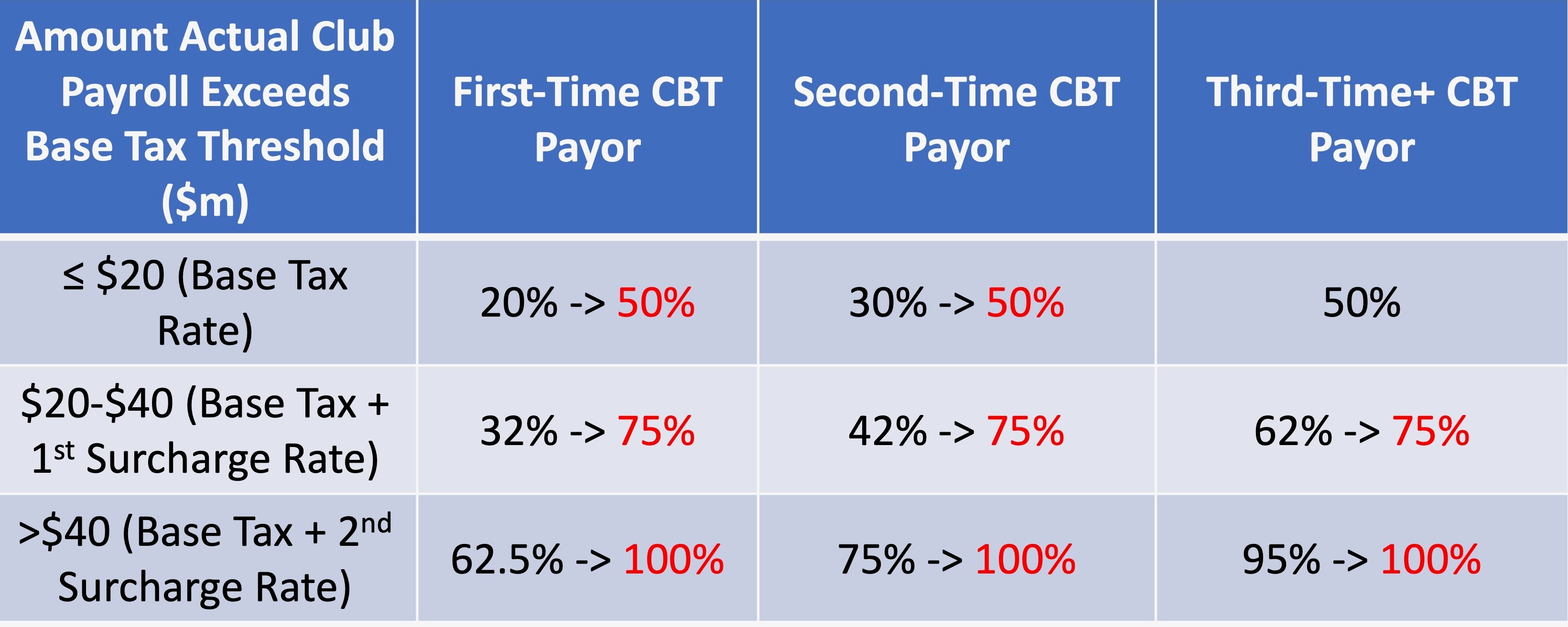
MLB’s goal here is clear: make teams much less likely to exceed the base tax threshold at all. However “soft” of a salary cap this was in the 2017-21, MLB is attempting to harden it. These tax rates say, “If you go over the tax thresholds, we’re really going to make you pay.”
MLB doubled down on the goal of hardening the CBT as a cap by adding new draft pick penalties. The status quo: any club that exceeds the second surcharge threshold ($250MM in 2021) would have its highest available selection in the next draft moved back ten spots. If a team is set to pick in the top six, that is left alone and the second-rounder is moved back ten spots.
MLB’s latest offer is far more extreme than this: a team in the second tier (MLB proposes $234-254MM for 2022) entirely surrenders its second round pick, and a team in the third tier ($254MM+) forfeits its first round pick.
I don’t think anyone would argue with this: MLB’s current proposal is for a much more restrictive competitive balance tax, without even getting into the matter of the thresholds. So, how would they defend it? The answer is that MLB likely feels it’s proposing an even trade by eliminating draft pick compensation for signing free agents.
Every winter, somewhere between six and 20 players at the top of the free agency class receive a qualifying offer. Under this system, the worst possible penalty for signing a qualified free agent is forfeiture of a second and fifth round pick and having your international bonus pool reduced by $1MM. The Yankees, for example, made this sacrifice to sign Gerrit Cole. MLB’s pitch may be that under their new CBT plan, teams would have forfeited fewer draft picks than they gave up to sign free agents during the most recent CBA (something I intend to explore). I think that in MLB’s eyes, they are offering to transfer the burden that a certain number of players at the top of each free agent market bear under the qualifying offer system to the team level as a CBT penalty.
Elimination of the qualifying offer system would remove the Craig Kimbrel/Dallas Keuchel type situations, where those players waited until after the June draft to sign because of the drag caused by draft pick compensation. It would also remove the dynamic where a player accepts a qualifying offer and ultimately earns less in his career as a result, like perhaps Neil Walker.
I would guess that the MLBPA doesn’t consider this an even trade whatsoever, and has likely told MLB as much. The MLBPA likely takes major issue with drastically increased CBT penalties. Consider Giants pitcher Alex Wood, who tweeted,”If penalties increase under the CBT/Luxury tax IT DOES NOT MATTER WHAT THE THRESHOLD IS MY GOD. Make the threshold a billion dollars it doesn’t matter. Teams already don’t spend bc they use the current penalties as an excuse not to. Imagine if the penalties got worse. SMH.”
In a theoretical sense, I disagree with Alex. One could argue that the thresholds matter more than the penalties, because more teams stop right before the base tax threshold than actually pay the tax. In recent years, only two or three teams have typically paid the tax. To take Alex’s example to the extreme, if the base tax threshold actually was a billion dollars, and the penalty for exceeding it was that the team needed to play defense with only eight players on the field at all times, the MLBPA should take that deal because the penalty is irrelevant if teams don’t exceed the base tax threshold.
However, there’s a slippery slope concern here on the side of the MLBPA. History has shown us that once the players surrender something to MLB, it is very hard to claw any of it back. Case in point, the players moved arbitration eligibility from three years to two in 1980 and gave that back in 1985. Since then they’ve only managed to win back 22% of the 2+ class, and MLB is currently drawing a hard line on a return to the pre-1985 arbitration structure.
That’s why the MLBPA will likely draw their own hard line and refuse to further increase the tax rates or the draft pick penalty for exceeding tax thresholds. That might be one of the MLBPA’s non-starter stances. And if the MLBPA thinks elimination of the qualifying offer system is of modest value, keeping it in place would not be a major problem.
MLB should stop proposing this supposedly even trade. It’s like in a fantasy baseball league where a guy keeps making you the same offer over and offer, telling you it’s fair. It’s just not conducive to making a larger deal.
MLB should take increased CBT penalties off the table entirely, and should also propose leaving the qualifying offer system completely intact from the previous CBA. That would be, literally, the status quo. Then, with the clock ticking, the two sides can get down to solving the $51MM gulf between where they think the CBT thresholds should land by 2026.
Why MLB Players Went On Strike In The Past And What It Tells Us About The Current Lockout
A lockout is not a strike. You probably already knew that, but in all of my in-person conversations with casual to moderate baseball fans since the lockout began, none of them knew the difference.
A lockout is a work stoppage initiated by ownership. MLB teams locked out the players back in December, and that’s why we aren’t seeing pitchers and catchers reporting to spring training today. If players were to show up at the stadiums, they’d literally find themselves locked out.
A strike is when employees cease going to work as a group. Since Marvin Miller created the Major League Baseball Players Association 56 years ago, the players have gone on strike five times. Let’s take a look at why they elected to do so.
1972 strike – 86 games lost
The union itself was only six years old. The issue at stake is what Miller called a “modest request” of increases in the players’ pensions and health care contribution to keep up with inflation, part of which meant using an existing surplus in the pension fund. In spring of 1972, Miller felt that an agreement was within reach. Then, ownership surprised the players by taking a position of no increase on the pension, and a reduction on health care. Miller saw this as an “unmistakable signal” that “management was baiting us into a strike.”
Two days prior to the expiration of the pension agreement, Miller proposed solving the dispute by using an independent arbitrator, in an attempt to avoid a strike. The owners declined. Miller was concerned the “still young Association” wouldn’t be able to sustain a strike, and advised the players to postpone it and negotiate during the season. Miller found his players to be “positively militant” about going out on strike, however, so that’s what they did. After 13 days of lost revenue, the owners folded and the first strike in professional sports was over.
1980 strike – 92 exhibition games lost
At this point, free agent compensation was the issue at stake. Free agency had only been around for four years, and the owners felt they needed to add restrictions to it. Specifically, owners felt that signing a free agent should require giving up a Major League player as compensation. Faced with this issue, the players voted to cancel the final week of spring training, return to play Opening Day, and possibly strike on Memorial Day weekend in 1980.
Instead, Miller and MLB negotiator Ray Grebey settled all the other issues, including dropping the salary arbitration requirement from three years to two (something MLB considers a non-starter in these 2022 negotiations). The two sides were able to avoid a regular season strike by kicking the can down the road on free agent compensation, forming a study committee. As part of announcing the 1980 agreement, Grebey “poisoned the bargaining well” (in the words of John Helyar in Lords of the Realm) by telling the press the owners’ compensation plan would go into effect in 1981, which was untrue.
While the cancellation of a week of spring training makes this technically count as a strike, no regular season games were missed, and it was more of a prelude to the 1981 strike. Helyar called it “a lull until the next battle.”
1981 strike – 712 games lost
This was the first major strike in baseball history. The aforementioned free agent compensation study committee produced nothing of value. Miller described ownership’s proposal thusly: “A club signing a free agent could very well lose an established player more valuable than the free agent, or lose a prospect with All-Star potential. The scheme was designed to end free agency and would certainly had succeeded if it had gone into effect.” After the committee issued a report with “two diametrically opposed opinions,” the two sides had 30 days to hammer out an agreement in early 1981. That didn’t happen, allowing owners to unilaterally adopt their free agent compensation proposal. The players were only offering a draft pick as compensation, and over this gap, they went on strike.
Miller called the 1981 strike “the most principled I’ve ever been associated with” and “the Association’s finest hour.” He notes that the union was not making demands; it was ownership seeking what he considered excessive free agent compensation. As the strike dragged on, federal mediator Ken Moffett “never got past first base” with his proposals, as Miller put it. Instead, the MLBPA proposed a system where each team could protect 25 players, and all other players would become part of a pool from which teams losing certain free agents could choose. With the owners’ strike insurance running out, this “pool” free agent compensation plan led to a settlement after 50 days. Four years later in 1985 the owners were already asking for the pool compensation plan’s removal.
1985 strike – no games lost
This two-day strike is similar to 1980 in that it technically counts, but no regular season games were lost. By 1985, Marvin Miller was retired “but remained a power in the union,” according to Helyar. Still, Don Fehr was in charge of negotiations for the MLBPA. With the union under new leadership and solidarity of the players waning, the players’ union agreed to “give-backs” for the first time, as arbitration was rolled back to three years instead of two and the pension formula was changed to the players’ detriment. As Miller put it, “For the first time in its almost twenty years of existence, the Players Association took backward steps.” He added, “Either you push forward or you’re going to get pushed back.” Miller felt that Fehr’s error was “in not instilling in the players the determination to fight the good fight.”
1994 strike – 938 regular season games lost, plus cancellation of the playoffs
In 1994, as Helyar put it, “The players rejected a salary cap as repugnant at any price.” Nonetheless, owner of the small market Brewers and acting commissioner Bud Selig was convinced a salary cap was necessary and convinced the other owners to fight for it. Helyar explains, “The players had to go on the offensive, if only for defensive purposes. If no contract was reached by collective bargaining, the Lords could eventually shove the salary cap down their throats. Federal labor law allowed employers to declare a bargaining impasse, after a decent interval for negotiations, and impose employment terms. The players had to try forcing a deal when they still had some leverage – during the season, when lost games meant lost money for the Lords.”
So, the players went on strike on August 12, 1994. Ultimately the rest of the season, including the playoffs, were canceled. Fehr and Selig wound up in court, and Justice Sonia Sotomayor granted an injunction blocking Selig’s intended use of replacement players to start the ’95 season. The status quo was returned and the strike ended.
Why The Players Went On Strike
I worked through this little history lesson to explain the circumstances under which the players went on the three significant strikes in the 56-year history of their union. In 1972, it was because the owners tried to test a young MLBPA by moving backwards on an issue that was key to players at the time, their pension and health care benefits. In 1981, players went on strike because owners demanded a compensation system that would significantly devalue their newly-won right to free agency. In 1994, players went on strike because Bud Selig attempted to force a salary cap. The common thread: in each instance, ownership was attempting to move the players significantly backward.
How The Owners Have Justified The 2022 Lockout
Now let’s tie this into the present dispute. MLB’s lockout is already affecting spring training and could well lead to canceled games in April, so it’s important to understand why they did it. In his December 2 “letter to baseball fans,” Commissioner Rob Manfred provided two reasons why MLB was “forced to commence” a lockout of the players:
- “We hope that the lockout will jumpstart the negotiations and get us to an agreement that will allow the season to start on time.”
- “We cannot allow an expired agreement to again cause an in-season strike and a missed World Series, like we experienced in 1994.”
It’s pretty easy to dismiss the “jumpstart the negotiations” angle, given that MLB waited 42 days between its lockout and its next proposal. In my opinion, some credibility is lost when you say that and then wait that long to make your next offer.
But let’s examine the second point, about how we can’t allow another strike like ’94. I have already established that historically, MLB players going on strike has been rare, and pretty clearly provoked by ownership each time. However, ownership has not done anything to provoke a strike in 2022.
As Manfred put it, “Baseball’s players have no salary cap and are not subjected to a maximum length or dollar amount on contracts. In fact, only MLB has guaranteed contracts that run 10 or more years, and in excess of $300 million. We have not proposed anything that would change these fundamentals.” Emphasis mine. This is completely true. The MLBPA has plenty of concerns right now with various causes, but they’re not the result of something radical MLB is trying to impose. MLB wants something resembling the status quo. The difference of opinion is on whether the status quo is acceptable.
The Current Issues Are Not Strike-worthy
It’s my opinion that the current differences of opinion, which are mostly in in degrees and not concepts, are not compelling enough to cause the players to strike. Sometimes the degrees of difference are large, like in the case of the competitive balance tax, but it’s still mostly haggling over numbers. To be clear, the idea that the players wouldn’t strike is guesswork based on the historical precedent I’ve laid out in this post. Publicly or even privately, if the players are disinclined to strike over the current differences, they cannot admit it. To do so would be to lose their leverage.
MLB could lift the lockout today and everything would start on time, with negotiations continuing during the season. So for them to keep the lockout in place and risk canceling games, under the justification Manfred provided, MLB really has to feel a midseason strike would have been likely. Let’s game that out and envision a hypothetical strike announcement by MLBPA executive director Tony Clark. For this exercise I’m using the current gaps, even though six months from now those gaps would presumably be smaller.
August 12, 2022: Hypothetical Press Release From Tony Clark On Behalf Of MLB Players
“On this the 28th anniversary of the 1994 strike, I’m devastated to say that MLB players have no choice but to go on strike due to the unreasonable positions of the owners. Our differences are large enough to risk losing the rest of the 2022 season and the World Series if the owners don’t move significantly within the few weeks. Here are the reasons we’re going on strike.
We believe all 30 teams should try to win every year. While we have agreed with MLB on the implementation of a draft lottery, we differ on how many picks should be subject to it (three vs. eight) and whether teams should be penalized for being bad in consecutive years.
We want the best players to be promoted as soon as they’re ready for the Majors. Service time manipulation meant MLB stars like Kris Bryant and Vladimir Guerrero Jr. had their debuts delayed past the point of readiness. Perhaps more importantly to the union, this practice allows teams to control players for nearly seven years instead of the agreed-upon six. MLB has proposed extra draft picks to incentivize teams to put MLB-ready stars on Opening Day rosters, but we don’t think it’s enough to move the needle. We feel that rookies should have the opportunity to earn a full year of service time based on factors like awards voting and WAR. We’re also seeking a $30MM cut in revenue sharing, as we feel these transfers of wealth allow small market teams to be profitable without investing in players and trying to win.
We also believe large market teams should have fewer payroll restrictions. When we agreed in the previous two CBAs to the competitive balance tax increasing by $32MM over a ten-year period, we didn’t anticipate large market teams would treat the base tax threshold as a de facto salary cap. MLB has proposed moving the tax threshold by only $12MM by 2026, but we feel a $63MM increase to $273MM over the next five years is necessary. MLB has proposed increasing the tax rates on overages as well.
As teams have de-emphasized free agency, we need to get players paid earlier in their careers. One key is the minimum salary, which we feel should increase from $570,500 in 2021 to $775,000 in ’22. MLB has proposed $630,000, leaving us $145,000 apart. On a related note, we’re also looking to change salary arbitration so that all players with at least two years are eligible. This would add dozens of players into the arbitration system each year who previously would have been making a salary close to the league minimum.
The third way we’re looking to increase pay for players earlier in their careers is by the implementation of a pre-arbitration bonus pool. MLB has agreed to this concept. We’re proposing each team contribute $3.33MM per year to this pool (a total of $100MM), but MLB is offering only $500K per team (a total of $15MM).
Though the MLBPA is not seeking playoff expansion, we are nonetheless willing to grant MLB an increase to a 12-team field. They’re seeking a 14-team field. We feel that expanded playoffs, plus MLB’s proposed addition of advertising to uniforms, would bring significant additional revenue to the teams.
We find the universal designated hitter to be mutually beneficial, and MLB has agreed to implement it. MLB has also agreed to eliminate the qualifying offer system, which we concede would benefit several players each offseason.
Collective bargaining has been ongoing for nearly 16 months, and we’ve played out the 2022 season without an agreement in place. While we were cautiously optimistic when MLB lifted the lockout six months ago in February, we now feel that our differences are too significant to be resolved through further bargaining. Regretfully, a strike is our only recourse, and we hope it will prompt the required movement from MLB to lead to an agreement and save the ’22 playoffs.”
A Possible Third Motive For MLB’s Lockout
Maybe you’re like me and you can’t see Tony Clark issuing a strike announcement statement similar to the hypothetical I wrote above. Though they wouldn’t admit it, maybe MLB also finds a strike on these grounds to be unlikely. That leads to a third, unstated possible motive for MLB initiating a lockout in December 2021: they did so mainly to gain financial leverage over the players and get a better deal for themselves.
That’s what I think is happening, and it’s MLB’s right to do so. In that case, the current situation boils down to MLB being willing to cancel games in April to get a better agreement.
I know it’s easy to “both sides” the current labor dispute. Feel free to choose from among these commonly-used phrases:
- A pox on both your houses
- Millionaires vs. billionaires
- Where is the fan in all of this
However, only one side can implement a lockout, and only one side can go on strike. Currently, we’re in a lockout, and I don’t think it’s reasonable to blame the players for going on strike unless they actually do, you know, go on strike. If the lockout is lifted and the players go on strike over these issues, then yes, the players would shoulder the lion’s share of responsibility for missed games and/or canceled playoffs. Until then, missed games fall on ownership.
Required baseball labor reading:
- A Whole Different Ball Game by Marvin Miller
- Lords of the Realm by John Helyar
- The Game by Jon Pessah
MLBTR Poll: Where Will Zack Greinke Sign?
The free agent starting pitching market moved very quickly in the early stages of the offseason. A few prominent starters remained unsigned heading into the lockout, though. Among them — Zack Greinke, whose market remains largely undefined.
Greinke is no longer the ace he was at his peak. The six-time All-Star is coming off a 4.16 ERA over 171 innings, his second straight season with an ERA a touch over 4.00. That’s still capable run prevention, but Greinke’s days of posting sub-3.00 marks are probably behind him. His swing-and-miss and strikeout rates regressed last year, and he dealt with some neck soreness down the stretch. Between his age and those trends, teams can’t reasonably expect Grienke to assume the role of Game 1 or Game 2 playoff starter next season.
That said, there aren’t many rotations he wouldn’t still upgrade. He’s still one of the game’s best command artists. Greinke has shown a knack for remaining successful even as his raw stuff has ticked down with age. Even if his production might now be closer to average on a rate basis, the former Cy Young Award winner has continued to soak up innings. He exceeded 200 frames each season from 2017-19, and he’s surpassed 150 innings every year since 2007 (excluding the shortened 2020 schedule).
Immediate contenders could certainly stand to plug Greinke into the middle or back of their starting staff. Rebuilding teams might view signing him as an opportunity to bring aboard a famously cerebral hurler with an elite track record as an example for their younger, controllable arms (although it remains to be seen if the 18-year MLB veteran would be open to signing with a team that doesn’t look like a surefire competitor).
To date, however, we’ve heard very little about where Greinke might end up. He’s not expected to re-sign with the Astros, a testament to their enviable collection of in-house rotation depth. Beyond that, there’s not been any substantive indication in which direction he might be leaning. At the start of the offseason, Bob Nightengale of USA Today tweeted that Greinke “(wanted) to continue pitching for an NL team.”
The rationale for that reported desire to return to the Senior Circuit is unclear. If it were about getting another chance to hit regularly — Grienke has won a pair of Silver Slugger Awards in his career — that’ll probably prove moot. Major League Baseball and the MLB Players Association seem to have mutual interest in implementing a universal designated hitter in the next collective bargaining agreement. If that comes into play, then there’ll be no difference in rules between the leagues. If Greinke just prefers certain National League cities or ballparks and is indifferent about an opportunity to hit, then that could give NL suitors an upper hand.
It’s also at least worth contemplating the possibility Greinke moves on from playing entirely. Nightengale’s report suggests he was planning to continue his career as of a few months ago. He’s still an effective pitcher, even if he’s no longer elite. There’s been no indication he’s not planning to play in 2022, so him stepping away seems unlikely. But Greinke turned 38 years old in October, so one seemingly can’t definitively rule out the possibility he retires until he speaks publicly about his future or puts pen to paper on a new contract.
Where does the MLBTR readership think Greinke will be in 2022? Will he continue playing, and if so, where will he sign?
(poll link for app users)
Where Will Zack Greinke Sign?
-
Cardinals 7% (914)
-
Mets 7% (900)
-
Braves 7% (889)
-
Dodgers 6% (820)
-
Giants 6% (812)
-
Angels 6% (747)
-
Blue Jays 4% (568)
-
Retirement 4% (567)
-
Astros 4% (538)
-
Royals 4% (515)
-
Rangers 4% (470)
-
Tigers 3% (436)
-
Twins 3% (424)
-
Mariners 3% (422)
-
Yankees 3% (418)
-
Cubs 3% (403)
-
Brewers 3% (385)
-
Red Sox 3% (363)
-
Phillies 3% (358)
-
Padres 3% (322)
-
White Sox 2% (320)
-
D-Backs 2% (217)
-
Rays 2% (208)
-
Orioles 1% (173)
-
Nationals 1% (150)
-
Pirates 1% (127)
-
A's 1% (120)
-
Reds 1% (109)
-
Guardians 1% (65)
-
Marlins 0% (53)
-
Rockies 0% (46)
Total votes: 12,859
8 Post-Tommy John Pitchers Who’ll Impact Next Year’s Market
We’ve grown accustomed to seeing headline after headline indicating that a pitcher is slated to undergo Tommy John surgery in today’s game. The procedure has become so commonplace, in fact, that it’s no longer surprising to see teams guarantee multi-year deals to rehabbing pitchers who’ll be sidelined for a full season of that contract as they work back from the injury. Such deals have produced varying levels of success in the past. Nathan Eovaldi‘s two-year deal with the Rays worked out great; Drew Smyly didn’t pitch for the Cubs and posted a 6.24 after being traded to the Rangers.
Heading into the 2022 season, there are a handful of notable pitchers who were either signed under just that circumstance or are now playing for a contract on the heels of a Tommy John surgery that, hopefully, is more or less in the rearview mirror. A strong rebound will position any of this bunch either as a prominent member of next winter’s free-agent crop or, in some cases, to have a lucrative 2023 club option picked up. Here’s a look at a handful of Tommy John recoveries that could have a notable impact on next year’s market.
Starting Pitchers
Mike Clevinger: A marquee addition by the Padres at the 2020 trade deadline, Clevinger made only four regular-season starts and a one-inning postseason cameo before requiring Tommy John surgery in the 2020-21 offseason. San Diego, knowing he’d miss the entire 2021 season, signed him to a two-year, $11.5MM deal that paid him $2MM during his rehab season but will more heavily compensate him in 2022, now that he’s expected to be back to full strength. It was the second Tommy John procedure of Clevinger’s career, as he also had the surgery as a minor leaguer back in 2012.
There’s little questioning Clevinger’s talent, as the now-31-year-old righty was one of the most effective starters in all of baseball from 2017 until the time of his injury in 2020. In 489 1/3 innings over that stretch, Clevinger posted a 2.96 ERA while punching out 28% of his opponents against a 9% walk rate. Among big league pitchers with at least 400 innings thrown during that time, Clevinger ranked seventh in ERA and 14th in FIP (3.39). That said, he’s also only reached 130 innings in a big league season on one occasion, when he threw an even 200 frames in 2019.
That relatively limited workload, coupled with this being Clevinger’s second Tommy John procedure, will surely impact his free agency next winter to an extent. That said, a strong and healthy season out of the righty will still position him as one of the top arms on next winter’s market. Clevinger, teammate Joe Musgrove, Sean Manaea and Noah Syndergaard are among the more prominent free agents still in their early 30s next winter (to say nothing of older veterans with contract options or opt-outs, such as Jacob deGrom, Justin Verlander and Charlie Morton).
James Paxton: Paxton isn’t necessarily playing for a free-agent contract. He signed a complicated multi-year deal with the Red Sox that’ll pay him $6MM in 2022 before he can either trigger a $4MM player option or the team can exercise a pair of $13MM club options for the 2023-24 seasons. For luxury-tax purposes, that should be considered a two-year, $10MM deal, as the player option for 2023 is considered to be guaranteed money. Of course, there’s also the possibility that with a healthy season, the contract will effectively balloon to a contract that pays Paxton $32MM over a three-year term. The deal contains further incentives, as Paxton could boost those 2023-24 salaries by $250K apiece for reaching 12, 14, 16 and 18 starts.
It’s a heavily incentive-laden deal that speaks both to the considerable risk in signing Paxton and the considerable upside he’ll bring to Boston. A healthy Paxton is a high-quality big league starter, evidenced the career 3.50 ERA he carried into an injury-ruined 2020 season with the Yankees. Among the 149 big league starters to toss at least 200 innings from 2017-19, Paxton’s 30.1% strikeout rate ranked seventh, and his 7.3% walk rate was markedly better than league average. His 22.7 K-BB% was among the best in the game, as were his strong ratings in the eyes of fielding-independent metrics like FIP (3.26) and SIERA (3.45).
Since that 2019 season, however, Paxton has undergone back surgery, missed significant time with a forearm strain and eventually undergone Tommy John surgery. Earlier in his career, he’d dealt with lat, forearm and pectoral injuries, among a litany of smaller-scale issues.
There’s probably a scenario where Paxton pitches well enough to turn down his $4MM player option even if the Red Sox decline the effective two-year, $26MM option they hold over him. (We saw a comparable situation play out with Yusei Kikuchi earlier in the winter.) That said, the ideal scenario for Paxton and the Sox is that he pitches well enough to reestablish himself as a quality MLB hurler and boost those two club options to $14MM apiece in total value in the process.
Paxton underwent his Tommy John procedure in late April, so he’s not likely to be ready to help the Red Sox at the beginning of the season. By late May or June, however, he could represent a boost to a rotation that is not exactly shy of other injury concerns.
Justin Verlander: Even though he hasn’t pitched since undergoing Tommy John surgery, Verlander still got a hefty $25MM guarantee from the Astros — plus a conditional $25MM player option that kicks in if he reaches 130 innings pitched. The two-time Cy Young winner and former AL MVP has a track record that speaks for itself; when we last saw Verlander in a full, healthy season, he was edging then-teammate Gerrit Cole for the 2019 AL Cy Young Award.
Verlander has said in the past that he hopes to pitch into his 40s, and he has a good chance at doing so if he can bounce back this coming season. He’ll turn 39 later this week, and if he goes out and looks anything like he did from 2015-20 — 1010 innings, 2.94 ERA, 29.7% strikeout rate, 6% walk rate — Verlander will likely turn down that $25MM option, or at least leverage it into a new multi-year arrangement with the ‘Stros. He was just promised a $25MM guarantee despite having thrown only six innings since Opening Day 2020, so there’s little reason to accept that he’d take a year and $25MM on the heels of a healthy return effort at Minute Maid Park.
Noah Syndergaard: Perhaps it’s not quite fair to label Syndergaard as a Tommy John rehabber; after all, he did make it back to the mound with the Mets late in the 2021 season — albeit for only two innings. That said, this is Thor’s first full season back from that ligament replacement procedure, and he’ll be pitching for a big contract next winter from the moment he suits up in Orange County. Signed by the Angels to a one-year, $21MM contract, Syndergaard will be pitching with a team other than the Mets for the first time in his big league career.
It’s a hefty price to pay, particularly considering the fact that Syndergaard had rejected an $18.4MM qualifying offer, but his career to date is all the evidence needed to suggest that at his best, Syndergaard is plenty worth that gamble. He’s never walked more than 6.1% of his opponents in a given season and has never failed to strike out a batter per inning. Few pitchers can match Syndergaard’s blend of pure velocity, missed bats and impeccable command, and he manages all that while still turning in a ground-ball rate that’s well higher than the league average.
Syndergaard has always felt like he’s one step away from solidifying himself as a bona fide ace, and as Robbie Ray showed in winning the AL Cy Young Award this season, one dominant season for a player with this type of track record can result in a nine-figure payday if things break right. The market has already proven to value Syndergaard at more than $20MM per year, and given that he’d be 30 years old in 2023, it’s not hyperbole to suggest that he’s pitching for a $100MM contract this season.
Luis Severino: As with Syndergaard, Severino may not quite fit the criteria for this list. The 27-year-old (28 later this week, on the same day Verlander turns 39) returned to give the Yankees six innings out of the bullpen late in the 2021 season, and his protracted absence from the team’s pitching staff cannot be solely attributed to Tommy John surgery. Severino has also battled groin, shoulder and lat injuries along the way. That said, Severino really hasn’t pitched since undergoing Tommy John surgery in Feb. 2020, and it’s that operation that is the primary reason for his absence over the past two seasons.
Severino isn’t yet slated to hit the open market at season’s end — at least not before the Yankees make a call on a $15MM club option or a $2.75MM buyout. The resulting $12.25MM net decision would be a straightforward one for general manager Brian Cashman if Severino at all looks like his former self. From 2017-18, Severino gave the Yankees 384 2/3 innings of 3.18 ERA ball with outstanding strikeout and walk rates, prompting the team to sign him to a four-year contract extension that promised him $40MM.
That deal looked like a bargain for the team at the time but has since gone south, due largely to repeated injury woes. Severino made a combined 63 regular-season starts for the Yankees in 2017-18, looking every bit like a foundational piece to the pitching staff, but he’s combined for just 25 starts and another 18 relief appearances in the five seasons surrounding that brilliant run.
With a big season in 2022, Severino could still see that $15MM option picked up, and if he can remain healthy into 2023, he’d hit the open market heading into his age-30 season. There’s a long way to go before that scenario becomes reality, however.
Relievers
Tommy Kahnle: Signed by the Dodgers to a two-year, $4.75MM contract last offseason, Kahnle was never expected to contribute in 2021 — hence the backloaded nature of his contract, which will pay him $3.45MM in 2022. The hard-throwing righty only managed one inning for the 2020 Yankees, meaning this coming season will be the first since 2019 in which he’ll potentially pitch anything resembling a full workload.
The 32-year-old Kahnle has been inconsistent but has dominated more often than he’s struggled. From 2016-20, he logged a combined 3.48 ERA, 32.9% strikeout rate and 9.9% walk rate while averaging 97.1 mph on his heater. That includes a disastrous but also fluky-looking 2018 campaign in which he was tattooed for a 6.56 ERA in 23 1/3 frames. From 2016-20, Kahnle’s 32.9% strikeout rate ranks 17th among the 155 relievers to have thrown at least 150 innings, while his 15.9% swinging-strike rate is tied for sixth.
Kahnle’s Tommy John surgery came way back on Aug. 5, 2020, so there should be no restrictions on him by the time the season gets underway. He’ll be heading into his age-33 season next winter, and a return to his vintage form should position him as one of the top relievers on a free-agent market that is lacking in big-name right-handed relievers.
Ken Giles: Like Kahnle, Giles was signed by the Mariners — two years, $7MM — knowing full well that he would not pitch in 2021. Unlike Kahnle, his contract includes a club option for the 2023 season, which is valued at $9.5MM (with a $500K buyout).
Many of the same superlatives that apply to Kahnle apply even more so to Giles. His 18% swinging-strike rate, for instance, tops Kahnle and sits third among the 155 relievers who totaled at least 150 frames from 2016-20. His 3.33 ERA in that time is a bit more toward the middle of the pack, but Giles misses bats, induces chases outside the zone and throws as hard as nearly any reliever in the sport. He’s had a pair of 4.00-something ERAs sprinkled in amid a series of pristine marks throughout his big league career. Those two blemishes have coincided with spikes in his average on balls in play and dips in his strand rate.
On the whole, Giles is a power arm who can pile up strikeouts in droves. He’s a sometimes forgotten piece of the puzzle when looking at the 2022 Mariners and their hopes of contending, but he’ll join a deep bullpen mix that also features Diego Castillo, 2021 breakout closer Paul Sewald, former Marlins stopped Drew Steckenrider (who enjoyed a tremendous rebound in 2021) and the underappreciated Casey Sadler, who notched a 0.67 ERA in 40 1/3 innings last year.
A healthy Giles would very likely see that $9.5MM club option for the 2023 season picked up, and at his best, he’s a bargain at that price. If Giles is pitching well but things go south for the Mariners, teams will come calling at the trade deadline. Of course, the Mariners are hoping to be squarely in the postseason mix, and they’re likely not done with their offseason shopping just yet.
Jose Leclerc: Armed with a fastball in the mid to upper 90s, Leclerc’s ability to return to form (or his lack thereof) will have major implications for the Rangers moving forward. His four-year, $14.75MM contract extension includes a $6MM club option for the 2023 season and a $6.25MM option for the 2024 season. A rebound effort makes that 2023 option a no-brainer for the Rangers to pick up as they hope to ride a hyper-aggressive offseason into their next competitive window.
Leclerc, 28, has fanned just shy of a third of the hitters he’s faced so far in his big league career and has only allowed a dozen homers in 189 Major League innings (0.57 HR/9). His 14.9% walk rate is far too high, but he looked to be making considerable strides in that department in 2019 when he posted a sub-2.00 ERA, a 38.1% strikeout rate and an 11.2% walk rate. He’ll be a highly intriguing lottery ticket on next year’s market if he pitches poorly enough that the Rangers buy that option out (or if they do so on the heels of another injury). If he rebounds, he’ll be a bargain piece of an on-the-rise Rangers club in 2023-24.
Post-Lockout Trade Candidates: 27 Regulars Who Could Plausibly Change Teams
In recent days, MLBTR has taken a look at some players who could find themselves on the move between the conclusion of the lockout and the start of the season. First, Tim Dierkes looked at the league’s 14 likeliest trade candidates. Steve Adams then ran through some impact players who, to varying degrees, could find themselves in trade rumors whenever transactions resume.
Today we’ll look at other regulars who we could envision changing uniforms in the relatively near future. Acquiring any of the players on today’s list wouldn’t be quite as splashy as landing the stars we covered last week, but it’s easy to envision any one of them assuming an important, regular role on a new team.
Before we get into the list, a quick note on methodology. In defining “plausible” trade candidates, we looked at players we felt had somewhere between a 20% and 50% chance of being dealt before the start of the season. It’s not meant to be an exhaustive list of trade possibilities — almost any player around the league could theoretically move if another team made the right offer — but it’s meant to capture a tier of regulars we wouldn’t be surprised to see change hands. In an exercise of this nature, there has to be a somewhat arbitrary line that delineates the last of the players who, in our view, are “plausible” trade candidates. Players like Gary Sánchez and Jesús Aguilar were discussed internally but fell just on the other side of that line.
Now, on to the list. The players are ordered by what we feel to be their likelihood of getting traded (all arbitration projections via MLBTR contributor Matt Swartz):
John Means, Orioles SP
Buster Olney of ESPN reported in November that the Orioles were “dangling” Means in trade talks. Baltimore’s rebuilding and seemingly amenable to offers on anyone on the roster, but it remains to be seen how actively they’ll push to make their top starting pitcher available. With Means controllable through 2024 and projected for a modest $3.1MM salary, the O’s needn’t force a deal this offseason.
The 28-year-old presents a tricky evaluation for teams. He got off to an excellent start to the season, posting a 2.28 ERA (albeit with a 4.20 FIP) through his first 71 innings. Means then landed on the injured list with a shoulder strain. After returning in July, he posted a 4.88 ERA down the stretch, watching his strikeout rate tumble almost six percentage points in the process. The medical evaluation will be critical, but teams that are comfortable with the state of Means’ shoulder moving forward might expect him to regain the strong mid-rotation form he showed early in the year.
Isiah Kiner-Falefa, Rangers SS/3B
Kiner-Falefa has been a solid regular for the Rangers for the past couple seasons. He spent 2020 at third base, then was tasked with moving up the defensive spectrum to shortstop last year. Defensive Runs Saved loved his glovework at short; Statcast’s Outs Above Average did not. Kiner-Falefa finished third in the 2021 Fielding Bible shortstop award voting. There’s not much question he’s a very good defender at the hot corner, and most teams would probably at least feel comfortable with him moonlighting at shortstop if need be.
Texas remade their middle infield in free agency, signing Corey Seager and Marcus Semien. Kiner-Falefa could kick back to third base, but the Rangers have top prospect Josh Jung nearing big league readiness at the position. Controllable for two more seasons and projected for a $4.9MM salary, he could stick around as a utility guy. But if another team buys him as a plus defender at shortstop, it wouldn’t be a surprise to see Texas ship him somewhere he can continue playing everyday. Kiner-Falefa’s .271/.312/.357 line fits better at the bottom of a lineup, but he brings good contact skills and a solid infield glove to the table. MLBTR’s Steve Adams explored the possibility of a Kiner-Falefa trade at greater length this afternoon.
Raimel Tapia, Rockies LF
Reports out of Denver have suggested the Rockies could look to move Tapia, projected for a $3.9MM salary in his second-to-last arbitration-eligible season. The Rox need to bolster an offense that was among the league’s worst last year, and they’re seemingly planning to make a splash in the corner outfield. That’d probably push Tapia — who’s spent almost his entire MLB career in left field — out of the everyday lineup.
Tapia has never hit at the level one would hope from an everyday left fielder. One could argue he’s better suited for a fourth outfield role regardless. He’s a plus runner with good bat-to-ball skills, though, and he ranked among Baseball America’s top 50 overall prospects back in 2017. It’s certainly not out of the question another team takes a flier on him, particularly if the Rockies are willing to take a minimal return after acquiring his replacement.
Chris Paddack, Padres SP
The pre-lockout agreement with Nick Martínez bumped a bunch of the Friars’ younger arms down a peg on the rotation depth chart. As MLBTR’s Steve Adams recently explored, that could pave the way for them to move one of their controllable starters. If they do, Paddack looks the likeliest of the bunch. He’s arbitration-eligible and projected for a $2.1MM salary. That’s certainly affordable, but the Padres could be looking to open some payroll space after exceeding the luxury tax threshold last year.
Paddack has had back-to-back down seasons after a promising rookie campaign. But he’s still only 26 years old, boasts pristine control, and teams can dream on him recapturing his 2019 form. That he’s controllable for three seasons could be of particular appeal to teams like the Rangers and Nationals (who expressed interest at last summer’s deadline) who might be eyeing 2023 as a more plausible contention year.
Ryan Yarbrough, Rays SP
Yarbrough has been a flexible member of the Rays pitching staff for the past few years. He’s worked variably as a traditional long reliever, a bulk man behind an opener and as a true starting pitcher. Yarbrough posted an ERA of 4.13 or lower in each of his first three seasons, but he scuffled to a 5.11 mark in 2021. That came without meaningful changes to his strikeout and walk numbers, though, and Yarbrough remained excellent at avoiding hard contact.
The Rays likely anticipate the southpaw will return to form, but his price is escalating. Tampa Bay is already projected for a franchise-record payroll, so it wouldn’t be surprising if they move some of their arbitration-eligible players for pre-arb or minor league talent. Yarbrough is projected for a $4.4MM salary and remains under team control through 2024.
Austin Meadows, Rays LF/DH
Marc Topkin of the Tampa Bay Times wrote over the weekend that the Rays could be open to moving Meadows, who is projected for a $4.3MM salary. Controllable through 2024, Meadows would be a long-term option for Tampa Bay or any potential acquiring team, but the Rays have proven willing to field offers on almost anyone on the roster. And with the aforementioned payroll outlook for the typically low-spending club, the front office figures to be amenable to ways to pare back costs.
Meadows is coming off a decent season, in which he hit .234/.315/.458 with 27 homers over 591 plate appearances. That marked a bounceback from a below-average offensive showing during the shortened 2020 schedule, but it’s a fair bit shy of his career-best .291/.364/.558 line the season before that. Meadows isn’t a great defender, so he needs to mash to be a star. He did that in 2019, but he’s otherwise been a good-not-great hitter. That’s still a valuable player to have on hand, but unless the Rays anticipate him replicating his peak season this year, it’d be sensible to listen to offers.
Tony Kemp, Athletics 2B/LF
Kemp has bounced around the league a bit in recent seasons. He plays second base and left field, but advanced metrics have pegged him as a fringy defender at the keystone. Kemp doesn’t bring a ton of power to the table, and he’s already 30 years old. It’s not the easiest profile to make work, explaining why he has yet to find a long-term home.
There’s no questioning Kemp’s 2021 results, though. Over 397 plate appearances, he hit .279/.382/.418. Both FanGraphs and Baseball Reference pegged him as worth around three wins above replacement. Kemp has excellent plate discipline and bat-to-ball skills, and he could be trending towards a late-career emergence in the mold of former A’s second baseman Tommy La Stella. The market for teams on the hunt for second base help is pretty thin. Kemp, who avoided arbitration on a $2.25MM salary and is controllable through 2023, would be an affordable pickup if the A’s move him as part of their anticipated post-lockout efforts to trim payroll and reboot the roster.
Manuel Margot, Rays OF
MLBTR’s Mark Polishuk recently looked at the possibility of the Rays making Margot available. He’s projected for a $5MM arbitration salary as he enters his final year of club control. That’s a reasonable salary for a player of Margot’s caliber, but Tampa Bay has plenty of cheaper, controllable outfielders on hand, and top prospect Josh Lowe looks ready to step into an everyday role somewhere in the grass after a monster season in Triple-A.
It’s not out of the question Tampa trades away multiple outfielders, but if they move the more expensive Kevin Kiermaier, Margot sticking around to handle center field is certainly possible. The latter might have broader appeal around the league, though. Not only is he set to make around a third of Kiermaier’s remaining guarantees, Statcast credited Margot with a league-best +16 Outs Above Average in the outfield last year. He’s never been more than an average hitter, but acceptable offense coupled with Gold Glove caliber defense is a very valuable player. There’s also a dearth of center fielders available in free agency at this point.
Max Kepler, Twins OF
MLBTR’s Mark Polishuk recently broke down Kepler’s trade candidacy at great length. Guaranteed $16.25MM through 2023 and controllable for 2024 via club option, he’d be an affordable target for teams seeking outfield help. Yet Kepler’s offensive production has ticked down towards league average following what seemed to be a breakout showing in 2019. The Twins might prefer to hold onto him in hopes he rediscovers that form, but they just extended Byron Buxton and have former top prospects Alex Kirilloff and Trevor Larnach in the fold as corner outfield options. A Kepler deal could be a creative way to address some of the team’s other issues in the starting rotation or at shortstop.
Danny Jansen/Alejandro Kirk, Blue Jays C
The Jays’ catching depth has been a topic of conversation throughout the offseason. Would Toronto part with one of their controllable backstops to land help in the rotation or infield? The signing of Kevin Gausman probably diminishes their need to land an impact starter via trade, although they’re likely to at least look for depth pieces.
Reese McGuire is a capable backup catcher who’s out of minor league options. Top prospect Gabriel Moreno is rapidly approaching and could be in the majors by the end of the season. Jansen offers a solid bend of power and defensive acumen, while Kirk has otherworldly bat-to-ball skills and an elite minor league track record. Toronto doesn’t have to move anyone from this group, but it could be an opportunity to consolidate their catching depth for help elsewhere on the roster.
Amed Rosario, Guardians SS/CF
Cleveland acquired Rosario from the Mets as part of the Francisco Lindor trade last offseason. His offensive numbers (.282/.321/.409) were fine, although neither Defensive Runs Saved nor Statcast was fond of his glovework at shortstop. Rosario’s aggressive approach at the plate will probably keep him from emerging as the star many envisioned he’d become as a prospect, but he has alright career hitting numbers, runs well and could be an option for teams at any of the up-the-middle positions on the diamond (aside from catcher).
The Guardians have a lot of infield depth, with several talented prospects in the high minors and already on the 40-man roster. With their seemingly annual need for outfield help, a Rosario trade could help balance the roster. Cleveland could also just give him more run in center or left field themselves, but it might be more straightforward to trade him to an infield-needy team with an outfield surplus. Rosario is projected for a $5MM salary and controllable through 2023.
Josh Bell, Nationals 1B
I covered Bell’s trade candidacy in greater length in late December. The Nationals are taking a step back in 2022, and he’s entering his final year of club control. A projected $10MM salary might scare away some suitors, but Bell would be a notable offensive upgrade for many teams around the league. The switch-hitter posted a .261/.347/.476 season-long mark, and he had an excellent 277/.381/.506 line with more walks than strikeouts after the All-Star Break.
Garrett Cooper, Marlins 1B/COF
Cooper has looked like a viable trade candidate for a few seasons. He’s part of a corner outfield/first base rotation in Miami that got a bit more crowded when the Fish signed Avisaíl García. The Marlins have suggested they could use García as their regular center fielder, but that’s less than ideal. If they land a center fielder after the lockout and push García to a more suitable right field role, Cooper might find himself squeezed for playing time.
A late bloomer, Cooper’s already 31 years old. He has quietly been a very productive hitter when healthy, though, including an excellent .284/.371/.478 line (133 wRC+) in 383 plate appearances since the start of 2020. Health is a big caveat for Cooper, who has had stints on the injured list in all five of his MLB seasons and missed the second half of last year with a left elbow injury. As MLBTR’s TC Zencka explored in December, he’d returned to taking batting practice and figures to be ready for 2022. Projected for a modest $3MM salary with an additional season of control thereafter, he could be an interesting flier, particularly for NL teams looking to add offense if/when the universal designated hitter is finalized.
Anthony Santander, Orioles RF/LF
Santander’s name has been floated around the rumor mill in years past. The Orioles are rebuilding, and he’s more of a complimentary piece than a likely member of the long-term core. Santander is limited to the corner outfield and has a very aggressive approach, though, making it crucial he makes plenty of contact and hits for power. He did that in the shortened 2020 season en route to a .261/.315/.575 line, but he couldn’t follow up on that success.
Last season, Santander had a couple injured list stints and struggled to a .241/.286/.433 mark. He signed for $3.15MM to avoid arbitration in November and remains controllable through 2024. Given their competitive window, the O’s would certainly listen to offers on Santander. But it remains to be seen whether there’ll be sufficient demand that Baltimore wouldn’t be better off hanging onto him and hoping he approximates his 2020 performance over the first few months of next season. MLBTR’s Darragh McDonald recently explored Santander’s trade candidacy in greater depth.
Zach Plesac, Guardians SP
Plesac isn’t yet arbitration eligible and he’s controllable for another four seasons. The Guardians might simply prefer to hang onto him, particularly after their 2021 season was derailed by rotation injuries. Yet as mentioned with regards to Rosario, Cleveland has significant concerns in the outfield. They’ve dealt key starting pitchers over the past couple seasons, seemingly confident in their ability to continue to develop less-heralded prospects into capable rotation cogs.
If they were to deal a starter, Plesac would seem the likeliest candidate. The Guardians aren’t about to rebuild, and moving Shane Bieber or Aaron Civale might be too significant a blow to their hopes of contending in 2022. Triston McKenzie and Cal Quantrill might still have upside Cleveland’s hoping to unlock. Plesac’s small sample excellence in 2020 was probably inflated by a regional schedule against Central-division teams that, by and large, weren’t good offensively. That season aside, he hasn’t posted particularly impressive strikeout rates. But he’s got excellent control, gets a decent number of grounders, and should be a solid bet for league average rotation innings over the next few seasons.
Merrill Kelly, Diamondbacks SP
The D-Backs were the worst team in the National League last season. They don’t seem to have the appetite for a full rebuild, but Kelly’s entering his final year of club control. At age 33, he’s probably not an extension candidate, so Arizona figures to be open to moving him.
Kelly’s not an overpowering arm. He posted a 4.44 ERA over 158 innings last season, striking out only 19.5% of batters faced. He throws plenty of strikes, though, and he gets a decent number of grounders. Playing on a modest $5.25MM salary, Kelly would be an eminently affordable pickup for contenders looking to stabilize the back of the rotation.
Mitch Garver/Ryan Jeffers, Twins C
Garver missed a good chunk of last season after suffering a gruesome injury. During his 243 plate appearances, he mashed at a .256/.358/.517 clip with 13 home runs (137 wRC+). That’s two of the past three seasons with some of the best offensive output of any catcher in baseball. He’s controllable for two seasons and projected for a modest $3.1MM salary. Jeffers hasn’t yet hit arbitration-eligibility and still has minor league options remaining. He struck out too often as a rookie, but he hit for power and is a well-regarded defender who entered the year among the sport’s top catching prospects.
As with Kepler, a trade of Garver or Jeffers would probably be about dealing from an area of surplus to address the rotation or shortstop. Both players could plausibly be regular catchers next season, and they’d lose some of their value if penciled into the DH role regularly. Given Garver’s injury troubles, Minnesota might prefer to hold their depth behind the dish.
Elieser Hernández, Marlins SP
The Marlins have reportedly fielded offers on their arbitration-eligible starting pitchers this winter, perhaps in search of controllable outfield help. Miami already thinned their rotation depth a bit by including Zach Thompson in the Jacob Stallings deal, but it wouldn’t be a surprise if they make one more move in that vein.
Over the past two years, Hernández owns a 3.84 ERA in 77 1/3 innings with very strong strikeout and walk rates (26.3% and 5.7%, respectively). He’s an extreme fly-ball pitcher who’s likely to always have some difficulty keeping the ball in the yard. He missed most of 2021 recovering from a pair of long-term injuries (biceps inflammation and a quad strain). Because of those drawbacks, he won’t be in as much demand as rotation mate Pablo López. Yet another team may try to take a shot on Hernández’s promising strikeout/walk profile, particularly since he’s only projected for a $1.4MM salary and controllable through 2024.
Chris Stratton, Pirates RP
I covered Stratton’s trade candidacy at greater length in December. He’s a 31-year-old reliever controllable for two seasons on a rebuilding team. The Bucs aren’t going to view him as a core piece of the rebuild, and it stands to reason they’d welcome the opportunity to pick up an intriguing low-level prospect. Over the past two seasons, Stratton has been the kind of capable if unexciting middle relief piece contending teams need. He won’t bring back a franchise-changing return, but at a projected $2.2MM salary, he should draw some interest.
Cole Sulser, Orioles RP
Sulser had a quietly strong second half with the Orioles, occasionally factoring into their closing mix. A late bloomer, he’ll be 32 by Opening Day. So while they’re under no contractual pressure to move him, the rebuilding O’s would certainly listen to offers. After putting up a 2.70 ERA with a 28.4% strikeout rate, he should be of interest to contenders. Sulser isn’t yet arbitration eligible and can be controlled through 2025.
Adrian Houser/Eric Lauer, Brewers SP
The Brewers certainly aren’t obligated to trade either of Houser or Lauer, both of whom are coming off strong seasons. Still, the Brew Crew already have a vaunted top three of Corbin Burnes, Brandon Woodruff and Freddy Peralta and prospects Aaron Ashby and Ethan Small are at or nearing the big leagues. Might Milwaukee plug one of the younger arms into the rotation and flip a veteran back-end starter for offensive help?
Adalberto Mondesi, Royals 3B/SS
Mondesi’s an enigmatic player. He brings an enviable combination of power and speed and has enough athleticism to play a competent or better shortstop. He also has among the worst strikeout and walk numbers of any regular position player in MLB. Perhaps most alarming, he’s dealt with enough injury issues in recent years that Royals president of baseball operations Dayton Moore expressed some doubt about his ability to play more than 100 games per season regularly.
Nicky Lopez played well enough to supplant Mondesi at shortstop last year. Bobby Witt Jr. will probably take that position early in 2022, pushing Lopez somewhere else on the dirt. Whit Merrifield is still around as a second base option. Kansas City might have enough infield depth to explore a Mondesi trade, although it’d be a bit of a sell-low on a player with obvious physical gifts who’s controllable through 2023. He’s projected for a $3.2MM salary.
Kyle Hendricks, Cubs SP
Hendricks is guaranteed $29.5MM through the next two seasons, with a vesting option that could keep him in Chicago through 2024. The Cubs have moved most of their core players dating back to last offseason, but Hendricks remains on the North Side. That might be attributable to some uncharacteristic struggles, as the righty’s coming off a career-worst 4.77 ERA with unimpressive peripherals.
Hendricks has never struck batters out or fared exceptionally well in the eyes of ERA estimators, though. Until last season, his actual run prevention handily outperformed metrics like FIP and SIERA as he thrived on exceptional command. He’ll probably bounce back, even if he may never recapture his Cy Young-caliber, 2.13 ERA form from 2016. With the amount of teams on the hunt for starting pitching, there’d no doubt still be demand if the Cubs made Hendricks available. Will they? Perhaps, since they’re not likely to compete in 2022. Yet their early-offseason activity — signing Yan Gomes and Marcus Stroman, claiming Wade Miley — has suggested they may not be keen to punt next season entirely.
Trey Mancini, Orioles 1B
The Orioles aren’t going to compete in 2022, and Mancini is ticketed for free agency at the end of the year. Most players in his situation would be very straightforward trade candidates, but the first baseman is a fan favorite and reported clubhouse leader who made an inspiring return to the diamond last year after missing the 2020 campaign battling colon cancer.
That Mancini returned to play in 147 games after facing that kind of life obstacle is a remarkable achievement. It’s undeniable, though, that his production slipped relative to his excellent 2019 campaign. Mancini’s .255/.326/.432 line was only marginally above average, and he played exclusively first base and designated hitter. It certainly wouldn’t be surprising to see him bounce back into a middle-of-the-order presence as he gets further away from beating cancer, but demand for his services might be limited until his production rebounds. If that’s the case, it’s probably not worth it for the O’s to trade him away this offseason. He’s projected for a $7.9MM salary, but Balitmore’s 2022 payroll ledger is wide open.
The Tigers Continue To Benefit From 2017 Deadline Trade
The Tigers and Cubs were going in polar opposite directions in 2017. Detroit was headed towards a last place finish that would kick off the massive rebuild from which they’re only now emerging. Chicago was trying to defend their drought-breaking World Series title, eyeing another division championship as part of what looked to be a dynasty in the making.
Given their respective competitive windows, they made for natural trade partners as that summer’s deadline approached. The Tigers were clearly preparing to sell off some productive big leaguers; the Cubs were willing to part with young talent to bolster their push for another championship. The day before the deadline, they agreed to a deal that sent a pair of veteran role players from Detroit to Chicago in exchange for two young infielders. Catcher Alex Avila and reliever Justin Wilson landed on the North Side, while Jeimer Candelario and Isaac Paredes headed to the Tigers.
Nearly five years later, the Tigers are reaping the benefits of that swap. Candelario, who had logged the briefest of action at the MLB level in each of the previous two seasons, served as a near-ready pickup. A corner infielder, he had no path to playing time on a Cubs team with Kris Bryant and Anthony Rizzo on the roster. But the Tigers could afford to give him regular run, and he was an everyday player by September.
Candelario has been a regular for much of the time since. He played in 144 games in 2018, performing around the league average on both sides of the ball. His 2019 campaign was a disaster, as his power evaporated and he was optioned on and off the active roster a few times throughout the year. That seemed to call his long-term future into question, but Candelario has turned things around over the past couple seasons.
The switch-hitter returned to appear in 52 of the Tigers’ 60 games during the shortened 2020 campaign. He posted career-best numbers, managing a .297/.369/.503 line over 206 plate appearances. That’s a very impressive showing but it’d have been easy to write that off as something of an outlier. Not only were those numbers compiled in an abbreviated schedule, he benefitted from an unsustainable .372 batting average on balls in play.
To his credit, Candelario largely backed up that strong performance last year. He tallied a personal-high 626 plate appearances over 149 games, hitting .271/.351/.443 with 16 home runs and an MLB-best 42 doubles. As expected, a .039 point dip in BABIP dropped his overall numbers a bit relative to 2020. Still, last season’s production checked in 19 percentage points above the league average (119 wRC+), and he did that over a much larger body of work than he had the year before. He now owns a .278/.356/.458 mark (123 wRC+) in 832 trips to the plate going back two seasons.
Nothing Candelario does stands out as excellent, but he has developed into a well-rounded offensive player. His contact rate, hard contact frequency and average exit velocity are all slightly above-average. So too are his line drive and barrel rates, as Candelario has demonstrated a knack for consistently squaring balls up. He’s been effective from both sides of the plate — .299/.350/.473 as a righty hitter; .270/.358/.453 as a lefty — allowing skipper A.J. Hinch to plug him into the lineup no matter the matchup. And while Candelario’s not a great defender at the hot corner, public metrics have considered him competent there. With top prospect Spencer Torkelson soon to assume first base duties in the Motor City, Candelario should be plugged in at third for at least the next couple seasons.
The Tigers’ rebuild has been ongoing for a few years, so Candelario’s recent production has flown a bit under the radar on non-competitive teams. Yet Detroit played reasonably well down the stretch, and this winter’s signings of Eduardo Rodríguez and Javier Báez — coupled with the looming debuts of Torkelson and Riley Greene — indicate they’re hoping to turn the corner in 2022. Candelario now looks like a key piece of that effort, and he remains under club control through 2023 via arbitration.
Paredes, who was in Low-A at the time of the trade, also remains in the Detroit organization. He’s yet to find much MLB success, but he’s coming off an impressive .265/.397/.451 showing over 315 plate appearances with Triple-A Toledo. He still has a pair of minor league option years remaining and could yet develop into a productive infielder himself.
That the deal worked as the Tigers had hoped — at least the Candelario pick-up — doesn’t mean it didn’t pan out for the Cubs. As mentioned, Candelario was going to have a hard time finding playing time in Chicago anyhow. The Cubs obviously didn’t develop into a dynasty, but their acquisitions of Avila and Wilson proved successful enough. The former hit .239/.369/.380 in 112 plate appearances down the stretch, providing a strong on-base presence behind Willson Contreras before departing in free agency. Wilson spent a year and a half in Chicago, posting a cumulative 3.86 ERA/3.66 FIP across 72 1/3 frames of relief. Neither player was a franchise-altering star, but they were never intended to be. Avila and Wilson were brought aboard to fill specific areas on the roster (backup catcher and left-handed relief, respectively), and they both fared reasonably in doing so.
All in all, it seems this trade served both teams well. Going in differing competitive directions, the Cubs’ and Tigers’ needs aligned. Avila and Wilson were short-term but effective players for Chicago, while Candelario has since developed into the solid regular Detroit envisioned. After a significant rebuild, the Tigers are hoping to contend this year. Candelario continuing to perform as he did from 2020-21 would be a quiet but important asset alongside their big-ticket additions and graduating top prospects.
The Rangers’ Underappreciated Trade Chip
The Rangers’ decision to cannonball into the deep end of the free-agent pool this offseason has radically reshaped their infield mix and given them one of the top offensive double-play tandems in Major League Baseball. Corey Seager and Marcus Semien are slated to hold down the shortstop/second base pairing in Arlington for the next seven seasons.
One side effect of that seismic splash is that it leaves Isiah Kiner-Falefa without a clear-cut defensive home. A Gold Glove winner at third base in 2020, Kiner-Falefa played a strong shortstop in 2021 and had been squarely atop the depth chart there prior to the Seager/Semien stunner. That’s no longer the case, though not through any fault of his own. Kiner-Falefa has been an elite fielder by measure of Defensive Runs Saved and finished third among MLB shortstops in the Fielding Bible’s voting this past season. Metrics like Ultimate Zone Rating and Outs Above Average aren’t as bullish, but Kiner-Falefa is at worst regarded as a roughly average defender (and generally agreed upon as a good bit more than that).
Beyond his accolades with the glove, Kiner-Falefa is fairly a solid performer at the plate, albeit in more of an “old school” manner. He’s been 13 percent worse than the average hitter, by measure of both wRC+ and OPS+, over the past two seasons — but that’s primarily due to a lack of power. Kiner-Falefa has still posted a solid .273 batting average and a respectable .316 on-base percentage in that time. He’s only drawn a walk in 4.6% of his past 905 plate appearances, but he’s also only fanned in 13.5% of those trips to the plate.
There’s plenty of value derived from Kiner-Falefa’s ability on the basepaths as well. He went 20-for-25 in stolen-base attempts this past season and ranked in the 75th percentile of MLB players in terms of average sprint speed, per Statcast. On top of that, Kiner-Falefa has played in all but six of the Rangers’ games dating back to 2020. Only six big league players have appeared in more games than Kiner-Falefa over those two years.
He may not be a star, but Kiner-Falefa is a good defender and baserunner who rarely strikes out and, despite a lack of power, at least gives his club solid at-bats. That’s a valuable player, even if the overall skill set is a bit less typical now than it’d have been a generation ago. A simple course of action is to just shift Kiner-Falefa back to the hot corner, where he won that previously mentioned Gold Glove in 2020. That’d be a straightforward means of addressing the infield, were it not for the presence of fast-rising prospect Josh Jung.
The 24-year-old Jung was the No. 8 overall draft pick in 2019 and has done nothing but hit since he made his professional debut. The former Texas Tech star is widely considered to be among the 40 or so best prospects in all of Major League Baseball and is expected to make his debut in 2022. It’s even arguable that with a good Spring Training showing, Jung could merit an immediate look in the big leagues. He posted a dominant .326/.398/.592 slash between Double-A and Triple-A last year, after all, including a ridiculous .348/.436/.652 output with nine home runs and 14 doubles in 156 Triple-A plate appearances.
Jung has played exclusively at third base in the minors, although as The Athletic’s Keith Law noted in ranking Jung 32nd on his Top 100 prospect list, the Rangers did play him at a few different positions in 2020 at their alternate site. Still, Law calls Jung a solid-average third baseman, and scouting reports at Baseball America, FanGraphs and MLB.com have generally agreed that Jung should be able to handle the position from a defensive standpoint.
Even if the expectation is that Jung rises quickly to the big leagues — be it Opening Day, late April or mid-June — the Rangers don’t necessarily need to do anything with Kiner-Falefa. He’s projected by MLBTR contributor Matt Swartz to earn an affordable $4.9MM salary in 2022 and is controllable via arbitration through the 2023 season. Asking Kiner-Falefa to keep the hot corner warm for Jung before moving into a super-utility role is a perfectly sound and defensible course of action for a team that is striving for immediately improved on-field results. Kiner-Falefa has strong defensive ratings at each of shortstop, third base and second base — and while he struggled when trying to work as a catcher early in his career, he does at least have 586 MLB innings at the position. At the very least, he’s a better option there than most emergency catchers.
Still, that versatility and affordability also create another path for the Rangers to take: trade Kiner-Falefa to a team that has an immediate infield need. Even with Seager, Semien, Jon Gray and Kole Calhoun, the Rangers aren’t expected to compete in 2022. They’re likely looking at 2023 and beyond, when Jung, Jack Leiter, Cole Winn and other top prospects will be more seasoned at the MLB level. Trading Kiner-Falefa now for one more jolt of young talent does carry some long-term appeal, even if it perhaps costs Texas a few wins in the forthcoming season.
The Yankees, for instance, have already been linked to Kiner-Falefa. If they’re indeed reluctant to sign one of the remaining premier shortstops (i.e. Carlos Correa, Trevor Story) to a long-term contract as they instead await the arrival of ballyhooed prospect Anthony Volpe, then Kiner-Falefa would make sense as a quality stopgap who could hold the fort down for the entire 2022 season at the least.
New York is far from the only on-paper fit. The Twins don’t have a clear starter at shortstop at the moment, nor do the Angels. The Astros are still planning for how they’ll replace Correa if he ultimately signs elsewhere, and the Phillies could use a defensive upgrade over Didi Gregorius. Looking to other positions that Kiner-Falefa can handle, the White Sox could install him at second base. The Blue Jays could look for help at either third base or second base.
Suffice it to say, there’s a fairly wide swath of teams that could and quite likely will show interest in Kiner-Falefa when the lockout lifts. Will the Rangers actually make a move, though? That much depends on the strength of offers received.
Texas isn’t going to move Kiner-Falefa solely because of his modest arbitration salary and the fact that he could eventually be used in more of a utility role. If a team makes a strong offer, though, the newfound infield depth will surely prompt president of baseball ops Jon Daniels and GM Chris Young to consider the idea. Evan Grant of the Dallas Morning News has suggested a couple of times this month that a trade might be likelier late in Spring Training, once Texas has a better sense of where Jung is and once other clubs know what to make of their internal options around the infield.
However things play out, Kiner-Falefa is now a rather valuable luxury item in Texas: well-rounded enough to start at three different infield positions but still likely one step down the depth chart at each spot by season’s end in 2022. Kiner-Falefa has quietly become an underappreciated trade chip, but if the offers presented to Daniels & Co. aren’t sufficient, it never hurts to have an overqualified depth piece in the event of injuries to big-name veterans or a slow start from a top prospect.
Trade Candidate: Randal Grichuk
Just over one year ago, the Toronto Blue Jays signed George Springer to a six-year, $150MM contract, the largest deal in franchise history. After that signing, it was speculated by many that a trade could follow, given that they already had three other capable outfielders in Lourdes Gurriel Jr., Teoscar Hernandez and Randal Grichuk. Instead, they ended up hanging onto all four players, which may have been the wise choice, as Springer spent significant time on the IL, appearing in just 78 games and only playing center field in 40 of those.
In his absence, center field was largely manned by Grichuk, who spent parts of 96 games there, including 87 starts. Unfortunately, he had arguably the worst season of his career. He’s never been an on-base guy, with a 6.3% walk rate back in 2015 marking his career high. But he slipped even lower in 2021, landing at 5.0%, his lowest since his debut season in 2014. On the positive side, he dropped his strikeout rate to 20.9%, a career best. He also still showed some power by hitting 22 home runs. His center field defense was passable, being rated as just below average by all three of DRS, UZR and OAA. But in the end, his line for the season was .241/.281/.423. His wRC+ of 85 was five points lower than his previous career low, and his 0.4 fWAR was his lowest since his 47-game debut in 2014.
Back in early December, it was reported that the Blue Jays and Brewers had discussions on a trade centered around Grichuk and Jackie Bradley Jr., before the Brewers and Red Sox agreed to a deal with a framework of Bradley and Hunter Renfroe. This suggests the Jays have at least some openness to moving on from the two years and $20.67MM remaining on the extension they inked with Grichuk in April of 2019.
Trading Grichuk now is awkward for a couple reasons, even beyond the lockout. His value is surely at a low ebb, given the disappointing season he just had in 2021. There’s also the fact that the club would be lacking in outfield depth without him. Outside of the aforementioned group of Springer, Gurriel and Hernandez, the only other regular outfielder on the 40-man roster is Josh Palacios, who also missed significant time with injury last year and has only played 16 career Triple-A games and 13 MLB games. Cavan Biggio has seen a bit of time in the outfield, but he’s still pencilled in for significant infield time at the moment. He also dealt with injuries last year, appearing in just 79 games. However, the team could also add some outfield depth after a Grichuk trade, perhaps by bringing back Corey Dickerson, who recently spoke highly of his time with the Jays last year.
One thing that could potentially work in the Jays’ favour is the lack of available free agent center fielders, with the best remaining options being bench/platoon types like Brett Gardner or Kevin Pillar. Grichuk’s poor 2021 notwithstanding, center fielders who play cromulent defense and reliably hit 20-plus home runs per season don’t grow on trees. Teams with designs on competing and questions in center field could perhaps take a chance on him, especially considering he isn’t likely to demand much of a return. The Phillies need help in the outfield and elsewhere, but likely don’t have a ton of money or young talent to trade. The Rockies have designs on competing and need outfield upgrades, having been connected to Kris Bryant and Kyle Schwarber this offseason. If they fail to lure in one of those high profile options, they’ll have to consider alternatives. The Marlins are known to be looking for center field help and don’t usually throw around big bucks in free agency, making them theoretical suitors for a lower-cost option like Grichuk.
Given Grichuk’s contract and mediocre 2021 season, it’s unlikely the Jays are able to line up a trade during what will surely be a frenzy of transactions between the theoretical end of the lockout and the beginning of the season. However, if they can, it would free up some payroll space for them to upgrade their infield and pitching staff, as they look to build off a 91-win campaign in 2021.
This Date In Transaction History: Cubs Sign Yu Darvish
On February 13th, 2018 the Cubs officially announced a six-year, $126MM agreement with free agent Yu Darvish. After splitting the 2017 season between the Rangers and Dodgers, Darvish was the top free agent on MLBTR’s list of available players that winter. Little did we know at the time that Darvish would spent only half the length of that contract in a Cubs uniform.
At the time, Darvish seemed like a much-needed injection of frontline rotation talent for the Cubs. After falling to the Dodgers in the NLCS in their title defense season, swiping Darvish from the Dodgers had the potential to swing a potential rematch in seasons to come.
That rematch wouldn’t come to pass, however. Darvish would make just nine starts for the Cubs in the 2018 season. Though they won 95 games, Joe Maddon’s club stumbled into a wild card spot before losing the wild card game to the Rockies on a Tony Wolters RBI single in the 13th inning.
The timing was never quite right for Darvish and the Cubs. He was better in his second season in Chicago, but not good enough to change the fortunes of their fledgling contender. Darvish finished second for the NL Cy Young during the pandemic-shortened 2020 season, but they fell in the first round of the playoffs to the Marlins.
Though Darvish was incredible during that 2020 season (2.01 ERA/2.23 FIP over 76 innings), the Cubs chose to sell high on their one-time free agent prize, sending him to the Padres for a quartet of teenagers. The Cubs were largely criticized at the time of the deal, though the full impact of the move won’t be known for many years yet. There’s no doubt that Chicago needed an injection of youth for a system that had largely stagnated during their years of contention. Further, in terms of maximizing their assets, Darvish was their most valuable trade piece at the time.
And though Darvish’s arsenal is robust, and he’s among the strikeout leaders on a per batter basis year-by-year, his bottom line run prevention numbers don’t necessarily paint him as one of the best pitchers in the league.
He was certainly a touch disappointing in his first season with the Padres, posting just 1.4 rWAR/2.9 fWAR despite making 30 starts and tossing 166 1/3 innings. The 34-year-old wasn’t bad in 2021, but with a 4.22 ERA/3.90 FIP, Darvish looks more like a solid mid-rotation arm than a true frontline ace, even with an impressive 29.2 percent strikeout rate and 6.5 percent walk rate.
The fact is, outside of his tremendous 2020 season, Darvish has been closer to this 2021 self for most of his Major League career – at least since missing the 2015 season. Still, that makes for a valuable rotation arm that ought to play a valuable role for the Padres over the next two seasons, even in his age-35 and age-36 seasons.
At the same time, it’s hard to fault the Cubs now for selling when they did. MLBTR readers did not like the deal, with the most popular grades being a C and D at the time. But in retrospect, the Cubs were clearly more than a Darvish away from competing last season.
On the whole, even though they traded him halfway through the deal, the Cubs probably still feel pretty good about their decision to sign Darvish. On the field, he gave them 294 2/3 innings over three seasons with a 3.60 ERA/3.77 FIP, totaling 5.8 fWAR. Those aggregate numbers are solid, though they came in the shape of one subpar season, one stellar season, and one middle-of-the-road year in 2019.
Taking a more holistic approach, you can give Darvish credit for also netting the organization four prospects who may still provide a boost to Cubs teams down the road. As of right now, Fangraphs has the four prospects the Cubs got for Darvish ranked as their #3, #5, #37, and #48 ranked prospects in their system. Will those four prospects end up being more valuable than the final three years of Darvish’s free agent deal? That’s a question for a future date. In terms of the free agent deal that was signed four years ago today, the move didn’t turn out exactly the way the Cubs perhaps wanted, but they should count it as a win nonetheless.