
Interesting Players Designated In Advance Of Rule 5 Deadline
Wednesday marked the deadline for teams to protect players from next month’s Rule 5 draft, and the evening didn’t pass without its fair share of activity. Dozens of prospects were ultimately provided shelter on their clubs’ 40-man rosters, but, as expected, many of those moves required some tough decisions on the part of parent clubs.
While gaining a spot on a 40-man roster marks an important step in a young player’s career, it often means that a veteran must be politely shown the organizational door. Sure enough, Wednesday saw several experienced position players and pitchers designated for assignment, traded to rival clubs, or outright released.
With the smoke still clearing on many of these moves, readers may simply be scrambling to make sense of which of their favorite team’s prospects were left unprotected in advance of the Rule 5. But what about the veterans who are currently left floating in DFA limbo as a result of the evening’s activities?
Today offers a good opportunity to examine a few players who, in the coming days, will be available for selection via waiver claim or trade after being designated by their teams last night. While we saw some well-known, oft-injured names either released (Jacoby Ellsbury) or traded (Jose De Leon) by their clubs, we’ll focus instead on DFA’d players who could soon find a place on another MLB roster.
Matt Duffy: Rays GM Erik Neander had a busy night on Wednesday, with his club adding five prospects to its 40-man. While the Rays’ trade of the oft-injured De Leon to the Reds was likely a tough roster-clearing pill for fans to swallow, Duffy’s own designation also brought about a few “what-if” questions. Originally acquired as part of the 2016 package coming back to Tampa in return for Matt Moore, Duffy projected as a controllable, well-rounded infielder who, true to the club’s modus operandi, could play a few positions while hitting well enough to justify his lineup spot. Unfortunately, injuries limited Duffy to just 199 games in a Rays uni since the middle of 2016, and he now hits the waiver wire as a 28-year-old just one year removed from his 2018 batting line of .294/.361/.366 production (107 wRC+).
Nick Goody: The 28-year-old Goody was jettisoned from the Indians roster when the club added outfielder Daniel Johnson, right-hander Triston McKenzie and left-hander Scott Moss to its roster. While the Indians boast enviable pitching depth, it’s easy to see where Goody could fit on a number of MLB rosters. Since making his debut with the Yankees in 2015, the LSU alum has logged a 3.81 ERA supported by a 10.9 K/9 rate; he was superlative in 2017 out of the Cleveland pen, in particular, notching a 2.80 ERA/3.45 FIP across 54 2/3 innings of work. Goody’s 4.62 FIP and 4.9 BB/9 rate in 2019 showed that there was perhaps a bit of rust beneath the veneer of his 3.54 ERA, but the longtime Statcast darling shouldn’t have trouble finding a big league job next season, given the collective strength of his track record.
Nestor Cortes Jr.: Cortes was culled from the Yankees’ active roster on Wednesday, on the heels of a rough 2019 campaign out of the New York bullpen. While his 5.67 ERA across 66 2/3 Bronx innings last year would likely tell you what you need to know, Cortes is still just 24 years old and possesses a solid track record of success in the upper minors. The lefty posited a 3.86 ERA across seven games and six starts for the Triple-A Yankees of Scranton Wilkes-Barre, with decent underlying metrics (9.5 K/9 and 2.5 BB/9). Cortes doesn’t throw hard, with a fastball sitting around 89 mph, but he offers a five-pitch mix and could represent an interesting depth flier for a rebuilding club in search of a back-end starter.
Jharel Cotton: Like Duffy, Cotton’s story is largely defined by injury. Since coming to Oakland from the Dodgers as part of the package received in return for Rich Hill and Josh Reddick, Cotton has loomed as a potential impact arm on the edges of the Athletics rotation. However, his unimpressive 2017 (5.58 ERA in 129 innings) was followed up by Tommy John surgery in 2018, and Cotton ultimately missed most of 2019 due to a hamstring issue that required surgery. The now-27-year-old righty hasn’t thrown a pitch in the majors in two years, but his relative youth and starter’s repertoire could see him latch on with a new team in short order. Cotton was removed from the A’s roster on Wednesday to make room for Daulton Jefferies.
Tim Mayza: Mayza doesn’t bring the former prospect pedigree of some of the other names on this list, and he’s a non-factor for 2020 specifically after undergoing Tommy John surgery. But, for a team interested in signing Mayza to a low-cost two-year deal, what he does offer is a lefty arm and at least some record of effectiveness while pitching in the AL East. While the 27-year-old limped to a 4.91 ERA/4.73 FIP in extended action in 2019, he was far more effective in a more limited feature in 2018. That season saw Mayza log a 3.28 ERA/3.36 FIP through 35.2 innings; not exactly an overwhelmingly convincing sample size, but lefties are at a perpetual premium and Mayza does hold a 10.6 K/9 rate across 104 career innings. Lefties have managed just a 70 OPS+ against Mayza for his career, although it is fair to wonder whether next year’s introduction of a three-batter minimum rule may limit clubs in their deployment of LOOGY types.
Taking Stock Of The Relief Market
Gotta have a top closer! You shouldn’t pay for saves! Deep relief units are cost-efficient! The prevailing sentiment regarding relief pitching has been near as volatile as relief pitchers themselves.
Did you see how the Rays used all those arms to make it into the postseason?! The Nats won the World Series with that bullpen?! The Yankees had a really good, really expensive group of relief hurlers; the Indians had a really good, mostly cheap unit.
Let’s just be honest with ourselves: there’s no single right way to compile a roster and no single, lasting trend in this arena. There are more hard-throwing, talented young arms in the game than ever before. But the craft of pitching is only getting tougher to master. More and better arms, as durable and versatile as possible, in as cost-efficient a manner as possible. That’s what teams are pursuing, first and foremost.
With long flies leaving the yard with startling frequency last year, many organizations were left with odious results from their relief units. The Braves have already acted decisively in favor of veteran hurlers rather than toolsy youngsters. The Yanks doubled down on premier relief ace Aroldis Chapman. Everyone else is left to grab what they can from a free agent and trade market that is short on especially interesting arms.
Could the supply/demand imbalance help boost the earnings for the top-of-class hurlers that remain and the trade returns for the teams with the best-available targets … or will teams stick to their valuations and hope for the best? Will some marginal hurlers end up with surprisingly solid earnings … or are we just going to see a huge array of minor-league signings and camp battles?
That remains to be seen. But these are the players who are now being considered and negotiated over:
Top Available Arms
Did I mention a lack of supply? Ken Giles of the Blue Jays is perhaps the only capital-C Closer that seems likely to remain available at this point in time. He has had his stumbles over the years and had a health blip in 2019, but otherwise turned in excellent results with the peripherals to match and seems an obvious trade candidate with just one season of arbitration control remaining.
There are some major wild cards here. While the Padres want to win in 2020, they’ll have to at least consider scenarios involving Kirby Yates in his walk year. He was exceptionally good last year, completing a surprise San Diego emergence that was reminiscent of former Friars closer Brad Hand … who is himself a conceivable (but by no means certain) trade candidate this winter. We haven’t heard talk of the Indians putting him on the auction block, but it can’t be ruled out with two seasons of control remaining.
Otherwise, Drew Pomeranz may be the most interesting hurler to watch. He and the Brewers seemed to find a formula that worked, as he morphed into Josh Hader Jr. down the stretch. If there’s anyone with the potential to really surprise in earnings, it’s probably DrewPom. Teams that believe he can remain as effective as he was in Milwaukee may see him as a multi-inning monster. It’s hard to get quite as excited at the sheer upside when it comes to free agent Will Harris. He is a durable, high-quality setup man but is already 35 years of age. We predicted this profile to be worth slightly more on the open market than that of Pomeranz, though Harris’s range of reasonably expected contractual outcomes falls in a tighter band.
Second Tier Relievers
Let’s start with free agency, which has a large volume of useful but not great pitchers. Several recent Cubs hurlers warrant consideration here, led by Steve Cishek. Long-time setup man Pedro Strop is something of a bounceback candidate. Brandon Kintzler showed there’s still gas left in the tank after finishing rough in 2018. Though he was dumped in the middle of the season by the Cubbies, Brad Brach had a solid late showing with the Mets. Much like Harris, now-former Astros hurler Joe Smith remains effective into his mid-thirties. There are a few others from the Chicago and Houston ranks to be considered here as well: Collin McHugh, David Phelps, and Hector Rondon (who has pitched for both organizations in recent years).
Daniel Hudson was effective in 2019 and came up big in key moments for the Nationals. He’s a candidate for a solid two-year pact. And how about a pair of former Nats stalwarts? Craig Stammen and Tyler Clippard are both coming off of strong seasons and have reestablished themselves after some tough years. Nats nemesis Sergio Romo is still flinging unhittable sliders and finished with a particularly strong stretch for the Twins.
The market for lefties is rough. Jake Diekman is probably the top option after Pomeranz. The 32-year-old didn’t impress in the earned run department and continues to have big problems with command, but he has a big arm that produces lots of strikeouts. Francisco Liriano, Jerry Blevins, and Derek Holland are arguably the top alternative southpaws.
So … trade market to the rescue? Meh. Volatile Pirates setup man Keone Kela arguably has a closer-worthy ceiling but has struggled with consistency and off-field issues. MLBTR projects him to earn $3.4MM in his final season of arbitration eligibility, so he’s a one-year rental shot. The Marlins have some arms that could draw interest, with Jose Urena and Jarlin Garcia the easiest to imagine moving. Joe Jimenez of the Tigers has reportedly drawn pursuers even though he hasn’t quite turned the corner. Fellow high-K hurler Mychal Givens of the Orioles also had hiccups last year. It’s always possible that other names will be discussed, and no doubt some will change hands, but as things stand it’s tough to identify obvious candidates to be moved.
Bounceback Market
If you’re looking to throw down a dunk off a rebound, Dellin Betances is the top target. The long-excellent Yankees hurler had an agonizing season, making it all the way back from shoulder and lat issues only to blow out his Achilles tendon in his first appearance in the majors.
Otherwise, Blake Treinen is an intriguing target. He’s still under control with the Athletics, who are likely trying to see if they can find a taker in trade before the non-tender deadline. Treinen was a monster in 2018 but reverted to his frustrating form with the Nationals last year and ended up being shut down after experiencing rotator cuff and back problems.
Rehabbing southpaw Tony Cingrani has done some interesting things in recent campaigns and could be of particular interest given the dearth of good lefties. Arodys Vizcaino will hope to be ready for a full 2020 campaign after missing all of 2019 due to shoulder surgery. Can Brandon Morrow make it back from his long layoff? That remains to be seen, but if he can show he’s throwing well he’ll surely draw interest. Sam Dyson will also be looking to return from a shoulder procedure, but likely not until the 2021 campaign. He’s a possible candidate for a rehab-and-return type of contract. A pair of former Phillies relievers, venerable veteran Pat Neshek and younger hurler Edubray Ramos, are also injury recovery targets.
There are also a host of other notable names looking to bounce back from some combination of performance and injury woes. Jeremy Jeffress is a notable possibility. Trevor Rosenthal, Kyle Barraclough, and Carl Edwards Jr. still have interesting arms but are utterly speculative at this point. Veterans including Cody Allen and Luke Gregerson will be available and could always recapture some glory.
Other Possibilities
There’s a reasonable number of other hurlers that could garner consideration for guaranteed contracts or high-priority non-roster deals this winter. Top among them, in my book: Josh Tomlin, Fernando Rodney, Anthony Swarzak, Greg Holland, Jared Hughes, Cory Gearrin, and Yoshihisa Hirano. Though he’ll likely draw consideration as a starter, Andrew Cashner is also an interesting possible target.
Want a full rundown? Check out MLBTR’s list of 2019-20 free agents.
Offseason Outlook: San Francisco Giants
MLBTR is publishing Offseason Outlooks for all 30 teams. Click here to read the other entries in this series.
With a new manager and general manager in the fold, the Giants head into the post-Bruce Bochy era as perhaps a dark horse for some significant offseason business.
Guaranteed Contracts
- Evan Longoria, 3B: $58MM through 2022 (includes $5MM buyout of $13MM club option for 2023)
- Johnny Cueto, SP: $49MM through 2021 (includes $5MM buyout of $22MM club option for 2022)
- Buster Posey, C: $45.8MM through 2021 (includes $3MM buyout of $22MM club option for 2022)
- Brandon Belt, 1B: $32MM through 2021
- Brandon Crawford, SS: $30MM through 2021
- Jeff Samardzija, SP: $19.5MM through 2020
- Tony Watson, RP: $2.5MM through 2020 (exercised player option)
Arbitration-Eligible Players (projections via MLBTR contributor Matt Swartz)
- Kevin Pillar – $9.7MM
- Tyler Anderson – $2.625MM
- Donovan Solano – $1.2MM
- Alex Dickerson – $1.2MM
- Joey Rickard – $1.1MM
- Wandy Peralta – $800K
- Non-tender candidates: Pillar, Rickard, Peralta
Free Agents
- Madison Bumgarner, Will Smith (signed with Braves), Pablo Sandoval, Stephen Vogt, Fernando Abad, Scooter Gennett, Kyle Barraclough, Mike Gerber, Dan Winkler, Pat Venditte
Reports surrounding Will Smith’s three-year, $40MM deal with the Braves contained the detail that Smith’s representatives used the Giants’ $17.8MM qualifying offer as a bargaining chip with other teams. If no rival club was willing to step up and offer Smith the type of multi-year contract he was seeking, Smith would just have accepted the Giants’ one-year offer and returned to San Francisco for the 2020 season.
As it happened, Atlanta came up with a suitable offer and Smith will now be working out of the SunTrust Park bullpen. It’s possible the threat of an accepted qualifying offer was just a negotiating tactic on Smith’s part, but taken at face value, the closer was seemingly willing to be a Giant next year.
It creates an interesting sliding-doors scenario for the Giants as they head into what could be an intriguing offseason. If Smith had remained in the fold, would president of baseball operations Farhan Zaidi have been more inclined to go for it in 2020, showing the same competitive zeal that led him to keep Smith, Madison Bumgarner, Tony Watson and other seemingly surefire trade chips at the deadline? Or, with Smith gone and the Giants now in possession of an extra compensatory draft pick, will Zaidi further focus on rebuilding what is still one of the older teams in baseball, and one that suffered its third straight losing season?
It could be that both avenues will be explored, as Zaidi has indicated he will continue the rebuilding-while-reloading strategy that he has deployed throughout his first year running the Giants’ front office. Zaidi recently said his club is “open to anything” this winter. “We’re still in a mode where we want to compete next year,” he explained. “… But we want to do it in a way that creates flexibility for us and keeps us an organization moving in a positive, healthy direction.”
Zaidi will have a new voice alongside him in the decision-making process, as Scott Harris was hired as the Giants’ new general manager and Zaidi’s top lieutenant. Though Harris has seven years’ experience as the Cubs’ assistant GM and director of baseball operations, he is also only 32 years old, continuing the recent trend of younger executive hirings (Zaidi himself recently turned 43) and more modern approaches to roster-building around the game.
That same direction extended into the team’s search to replace Bochy as manager, as almost all of the names linked to the Giants job were younger coaches who would have been first-time managers. As it happened, the club went with a younger name who did boast some dugout-leading experience, as the 44-year-old Gabe Kapler was hired just over a month after being fired from a two-year stint managing the Phillies.
Kapler’s appointment came with no shortage of controversy and even some dismay from some Giants fans. While in Philadelphia, Kapler amassed only a 161-163 record over two seasons, earning criticism for everything from player discipline issues to questionable in-game tactics and bullpen management. Nonetheless, there’s a long list of managers who improved after struggling in his first job, and Kapler and Zaidi have a long relationship dating back to their days in the Dodgers’ front office.
Zaidi, Harris, and Kapler will go into their first offseason together looking at an everyday lineup that is technically filled at every position. Longtime catcher Buster Posey will look to get back on track now that he’s over a year removed from hip surgery, though the Giants will look to spell him with a backup who could play more often than your average second-stringer. A reunion with Stephen Vogt is already being explored, though the Athletics have also shown interest in bringing Vogt over to the other side of the bay and other organizations are sure to be involved.
The quartet of Brandon Belt, Mauricio Dubon, Brandon Crawford, and Evan Longoria are penciled in around the infield. The Giants’ outfield was a revolving door in 2019 but the team finally unearthed a couple of hidden gems in Mike Yastrzemski and Alex Dickerson, while Kevin Pillar hit 21 homers and provided at least some stability in center field, even if Pillar’s glovework (-1.6 UZR/150, -5 Defensive Runs Saved) has taken a big step back from his defensive heyday in Toronto.
With a $9.7MM projected arbitration salary, Pillar has a big price tag for a player who is seemingly declining on defense and has never been an above-average bat. There are arguments on both sides as to whether San Francisco should retain or non-tender Pillar, and this is one of several positions that the Giants could address in a bold fashion. A trade for the Pirates’ Starling Marte, perhaps, since the Bucs could decide to rebuild under new GM Ben Cherington, though he’s sure to be targeted by multiple contenders and may come at too steep a price. If the Giants prefer a younger player at a lower acquisition cost and salary, they could consider names like Manuel Margot and Michael A. Taylor or look into much less experienced performers. The free agent center field market isn’t teeming with great options, though Japanese star Shogo Akiyama has some intrigue, and his on-base skills would be a big help to a Giants lineup that struggled to get runners aboard.
In fact, the Giants struggled at basically everything on offense last season, so there’s certainly room for upgrades within their everyday lineup. Contractual obligations, however, are a big obstacle to creating space — with Crawford, Belt and Posey all coming off subpar years and Longoria owed $58MM for his age 34-36 seasons, rival teams won’t exactly be lining up to make trade offers. Of that group, Belt probably has the widest trade value since he could be helped the most by a move to a more hitter-friendly ballpark, but he’s also in an era where teams aren’t willing to pay top dollar at first base for anything less than top-flight production. (Belt’s ten-team no-trade clause further complicates matters.)
This isn’t to say that a creative trade couldn’t be found, if the Giants were to eat money to accommodate a deal or perhaps arrange a multi-team swap. Perhaps lightning could even strike twice for Zaidi and he’d find another team willing to entirely absorb one of the Giants’ big salaries, such as how the Braves surprisingly paid full freight on Mark Melancon at last year’s trade deadline.
If the veterans could largely be seen as placeholders, San Francisco will look for some offensive improvement from within, if Dubon hits well in his first full MLB season, or if Yastrzemski and Dickerson continue their hot hitting into 2020. Zaidi has said that the Giants will look to acquire a left-handed hitting infielder who could spell Dubon or Longoria. While rookie Kean Wong has already been claimed off waivers from the Angels, a more proven veteran option would likely be preferred. Options abound in free agency. Donovan Solano (a right-handed hitter) is also on hand for infield depth, looking to build off a very strong performance in part-time duty in 2019.
Neither Yastrzemski or Dickerson have long track records of success, so the outfield depth will again be an area of concern. Dickerson’s injury history makes him more of a question mark, so the Giants could consider him as a fourth outfielder type while looking for a more reliable everyday option (probably a right-handed outfielder, as both Yastrzemski and Dickerson hit from the left side). Cameron Maybin could be brought back for a second consecutive winter, though his pre-season 2019 stint didn’t end in the best of circumstances. Avisail Garcia could be a youthful upside play … or the club could even bring in Yasiel Puig. Odd as it would be to see Puig in a Giants uniform, he does have ties to Zaidi and Kapler.
The Giants could also see this as an opportunity to land a bigger-ticket outfielder. Nicholas Castellanos‘ defensive limitations make him an imperfect fit for Oracle Park’s spacious outfield, though he’d certainly add plenty of pop. Castellanos could be signed without draft pick compensation, while Marcell Ozuna would cost the Giants a pick since he rejected the Cardinals’ qualifying offer.
Spending on an Ozuna, Castellanos, or even a more expensive free agent can’t be ruled out since the Giants are starting to see daylight after being buried under a pile of pricey veteran contracts for the last few years. Longoria is the only player under contract past the 2021 season, and the Giants are in no danger of surpassing the $208MM luxury tax threshold, with an estimated current tax number of slightly under $144.6MM. Then again, Zaidi may not be anxious to slot in future obligations unless he sees a real opportunity for value.
Since San Francisco has the extra Smith pick and potentially another choice coming if Bumgarner signs elsewhere, could they make a splash by signing a QO-rejecting free agent of their own? Anthony Rendon and Josh Donaldson aren’t really options unless third base is opened up by a Longoria trade, though any of the other players who declined the qualifying offer could all fit. Beyond Ozuna in the outfield, Gerrit Cole, Stephen Strasburg, or Zack Wheeler would immediately bolster a shaky Giants rotation.
Such a signing (of the pitchers in particular) would also announce that San Francisco is fully intent on contending for a playoff berth in 2020, and it remains to be seen if Zaidi is willing to make such a big strike this early in his tenure, especially since the Giants are far from being one player away. One major signing that can’t be ruled out is Bumgarner, yet the Giants might balk at a bidding war that could develop, considering how much interest Bumgarner is already generating.
Even if the Giants avoid the top of the pitching market, some rotation help is certainly required. Johnny Cueto and Jeff Samardzija are the only hurlers who seem certain for the Opening Day starting five, and even that might not be set in stone if Samardzija is dealt before the final year of his contract. Tyler Anderson was added on a waiver claim from the Rockies, a move that has some upside potential but is something of a lottery ticket addition for now given Anderson’s lack of big league success. Tyler Beede, Dereck Rodriguez, Shaun Anderson, and Logan Webb are the other contenders for the three open rotation spots, leaving the Giants in need of experienced arms. Names from the second or third tier of the free agent market (i.e. Kyle Gibson, Michael Pineda, Tanner Roark, Jordan Lyles, Rick Porcello, Wade Miley) all make some sense.
After losing Smith to the Braves and Reyes Moronta for much of 2020 due to shoulder surgery, the relief corps got some good news when Watson remained with the Giants by exercising his player option. Watson is by far the senior member of a young bullpen, so some experienced help is a must, and the closer role stands out as the biggest question mark. It stands to reason that trade candidates like the Blue Jays’ Ken Giles could be on the Giants’ radar. Free agents with late-inning experience, such as Steve Cishek or Pedro Strop, could be considered. Former Giant Sergio Romo can’t be ruled out, or the club might take a chance on Brandon Morrow, who was in L.A. with Zaidi and Kapler.
While the Giants’ 77-85 record actually exceeded some expectations in 2019, it’s worth noting that the club only had a winning record in two months (a 14-13 mark in June, and then a scorching 19-6 run in July). Much work needs to be done in order to turn San Francisco into a true wild card contender, and this offseason could potentially look a lot like the last — Zaidi swung multiple low-level signings, waiver claims, and trades to shuffle around the fringes of his roster last winter. This time around, however, Zaidi has a bit more room to maneuver in exploring a higher-priced version of those same transactions.
MLBTR Poll: Which Top Starter Will Sign First?
We’ve seen movement on the relief market already, courtesy of the Braves. But the starting pitching market remains absolutely wide open and loaded with options, even after Jake Odorizzi decided against a full-blown open-market experience in favor of taking the qualifying offer.
Something will have to give at some point. There’s chatter already that some top players prefer not to experience the kind of lengthy waiting game that held sway over much of the market the past two winters. As importantly, the same appears to hold true for some teams. While there’s a lot of rotation supply, there’s also quite a lot of demand.
Indeed, there are so many starters populating MLBTR’s list of the top 50 free agents that it would be silly to consider them all here. We’ll focus on the eight top names — those that we see as having $20MM+ earning power on the open market. Will one of the big guns (Gerrit Cole, Stephen Strasburg) go early and set the market? Or will some team seek to bypass a major bidding war by quickly nabbing one of the next-best names available (Zack Wheeler, Madison Bumgarner, Hyun-Jin Ryu)? Sturdy veterans Dallas Keuchel and Cole Hamels might seek early deals; the former lagged last winter and the latter has made clear he’s willing to do a one-year contract with a contender. Then again, there could be a run on Michael Pineda, who looks to be an interesting upside play.
What do you expect? (Poll link for app users. Response order randomized.)
Which top free agent starter will sign first?
-
Stephen Strasburg 21% (3,130)
-
Zack Wheeler 17% (2,558)
-
Cole Hamels 17% (2,476)
-
Madison Bumgarner 13% (1,888)
-
Hyun-Jin Ryu 11% (1,557)
-
Dallas Keuchel 8% (1,106)
-
Gerrit Cole 7% (1,018)
-
Michael Pineda 7% (984)
Total votes: 14,717
The Braves Suddenly Have A Good But Aging Bullpen
Attentive Braves fans will know not to get their hopes up too much based upon the team’s first early moves. The club got out ahead of the market last year as well, but mostly sat out after making its primary moves. In Alex Anthopoulos’s second year as GM, he has done even more volume right off the bat but hasn’t matched last year’s Josh Donaldson signing in terms of dramatic impact.
Let’s evaluate:
- Will Smith: three years, $40MM (includes buyout of $13MM club option)
- Chris Martin: two years, $14MM
- Tyler Flowers: one year, $4MM
- Nick Markakis: one year, $4MM
- Darren O’Day: one year, $2.25MM (includes buyout of $3.5MM club option)
That’s exactly $30MM in 2020 salary — possibly enough to preclude a more significant payroll addition. The Braves are now over $100MM in commitments for the season to come, which is approaching the limits for an organization that has never topped $122MM in Opening Day payroll and started shy of that figure in each of the past two seasons.
So does this mean that the Braves won’t end up adding a new star to the roster? Maybe! But they’re actually still well positioned to do just that, in one of several ways. The Braves can still play near the upper reaches of the free agent market if they shed some salary. In particular, it wouldn’t be much trouble to move the contracts of Ender Inciarte and Shane Greene (the latter could also be non-tendered if it came to it) if the team prefers to spend elsewhere. That could free something like $14MM in cash. And there’s still also the trade market, through which the Braves can convert prospect capital into lower-salaried talent.
What’s notable about this early run of spending and roster decisions, then, isn’t so much that it means the Braves boosted their relief corps over other moves. Rather, it’s that the Braves — of all teams — have now compiled a rather strong, not especially cheap collection of old guy relievers.
That’s part-joke, part god’s honest truth. The move toward grizzled hurlers began at the 2019 deadline, when Martin, Greene, and Mark Melancon came aboard. Here’s the Opening Day 2020 age and salary of the Braves pen as presently constituted:
- Mark Melancon, 35, $14MM
- Will Smith, 30, $13MM
- Chris Martin, 33, $7MM
- Shane Greene, 31, $6.5MM (projected)
- Darren O’Day, 37, $2MM
- Luke Jackson, 28, $1.9MM (projected)
- Grant Dayton, 32, $800K (projected)
Conspicuously absent from that list: homegrown young hurlers. Sean Newcomb may yet end up in the pen if he isn’t needed or deemed capable of handling a rotation spot. Regardless, it’s certainly not the bullpen look that would’ve been anticipated this time last year. It’s really an interesting shift in approach; even a few weeks ago, it still seemed safe to presume the Braves were still planning on utilizing a rotating cast of younger pitchers to fill out the rotation. Indeed, I wrote that the Braves could “consider their bullpen fully accounted for” after inking O’Day. Wrong!
That is a strong pen on paper. That’s welcome after a messy 2019. Smith has blossomed into one of the game’s better overall relievers. It still feels surprising the Braves took on Melancon’s full remaining salary, but he was very strong overall in 2019. Martin obliterated the rest of the sport with a 13.0 K/BB ratio last year. The peripherals were also excellent for Jackson, even if he faltered at times. O’Day and Dayton have been good before and showed signs of recapturing their form. Though Greene’s late-season run with the Braves wasn’t quite what might’ve been hoped for, it was hardly a disaster and he ended the season with a cumulative 2.30 ERA.
That said, it must be a bit disappointing for the Braves that they’ve ended up needing to commit this kind of cash to get where they feel comfortable in the relief unit. The waves of young arms have thus far largely disappointed outside of a few notable exceptions. The idea had been that the club’s best starting pitching prospects would not only form up an imposing rotation but spill over into the bullpen, linking up with the team’s short-inning pitching prospects to create an overwhelming overall staff.
But this may just set the stage for the next big moves from Anthopoulos. Quite a few young Braves pitchers still hold promise. Not all will get their chance to chase their ceilings in Atlanta. This year’s slate of players requiring Rule 5 protection has pushed the Braves roster nearly to full capacity with other players still to be added. There’s still plenty of talent pressure coming from lower down the farm system, reducing the available opportunities.
I think you see where I’m heading with this. Without bullpen slots available to run out young pitchers, and without ample payroll capacity remaining, the Braves now seem clearly positioned to swap out talented but not-yet-established hurlers for veterans that can make a near-term impact on the MLB roster. When the dust settles, the Braves will still have plenty of pitching depth — some of which will surely end up carrying a significant portion of the relief load this year even after the recent signings — and a good bit of high-end talent still rising. But some of the arms will end up elsewhere. Which? That’s hard to guess. In theory, dozens of Atlanta hurlers — especially those already taking up space on the club’s 40-man roster — could be talked about in trades.
Tomorrow Is The Deadline For Rule 5 Protection
As reflected in MLBTR’s handy list of key offseason dates, November 20th is the deadline for teams to protect otherwise-eligible prospects from this year’s Rule 5 draft. Teams must add such players to their 40-man rosters by 8pm ET tomorrow or risk losing them to competitors when selections are made on December 12th.
Eligibility is determined by reference to the age and timing of entry to the professional ranks. A player that signed at 18 years of age or younger and has five seasons of pro ball is Rule 5 eligible if he is not added to the 40-man roster in advance of the deadline. Players that signed at 19 or older and have four seasons of professional experience are also eligible to be selected if they’re not added to the 40-man roster tomorrow. (In other words, college draftees out of the 2016 class, high school draftees out of the 2015 class and most international amateurs signed in the 2015-16 international period are eligible this year if not protected.)
Teams that make selections in the draft will gain conditional control over the chosen players. To be kept permanently, a player must stay on the MLB roster for an entire season, with at least ninety days spent on the active roster. It’s plausible to imagine that the addition of a 26th active roster spot this year will facilitate the utilization of the Rule 5 process.
Full coverage of the Rule 5 landscape will necessarily await tomorrow’s decisions. The need to make tough calls will prompt some action around the game, though it remains to be seen whether that’ll be the usual run of moves on the margins or if a blockbuster or two could be swung. Baseball America’s J.J. Cooper is as usual champing at the bit, so he has released a prediction of some interesting players that are relatively likely to be left unprotected.
As you might imagine, it’s easier to account for protection of prospects for teams with extra 40-man roster space. But it’s not as simple as having an opening. You also must be able to maintain a player in that spot throughout the winter and into the season. Adding a player that wouldn’t have been selected (or wouldn’t have lasted on an active roster) therefore carries its own risk: if you end up needing the roster space, you might have to expose such a player to outright waivers in the middle of the season. It’s worth noting, too, that some teams have already added players that they wish to protect.
There are tons of factors that go into these decisions, but roster space does still matter. Here are the number of open 40-man spots for each MLB team, as things stand this morning (per MLB.com’s roster pages):
10: Nationals
8: Cubs, Twins
7: Braves, Brewers, Tigers, White Sox
6: Astros, Red Sox
5: Mariners, Diamondbacks, Marlins, Orioles, Phillies, Reds
4: Rangers, Rockies, Yankees
3: Dodgers, Mets, Rays
2: Angels, Cardinals, Indians
1: Pirates
0: Athletics, Blue Jays, Padres, Giants, Royals
Elements of this post are adapted in part from a prior post by MLBTR’s Steve Adams.
Offseason Outlook: New York Mets
MLBTR is publishing Offseason Outlooks for all 30 teams. Click here to read the other entries in this series.
The needs are clearer than the means for the Mets as they enter a critical second offseason under GM Brodie Van Wagenen.
Guaranteed Contracts
- Jacob deGrom: $130.5MM through 2023 (includes $20MM signing bonus, due in two installments on 1/2/20 and 1/4/21)
- Robinson Cano: $81MM through 2023 (excludes $15MM of remaining obligations owed by Mariners)
- Yoenis Cespedes: $29.5MM through 2020
- Jeurys Familia: $22MM through 2021
- Jed Lowrie: $13MM through 2020 (includes $4MM in remaining signing bonus obligations)
- Wilson Ramos: $10.75MM (includes $1.5MM buyout on $10MM 2021 club option)
- David Wright: $9MM through 2020 (excludes estimated $3MM covered by insurance proceeds)
- Justin Wilson: $5MM through 2020
Arbitration-Eligible Players (service time in parentheses; projections via MLBTR contributor Matt Swartz)
- Marcus Stroman – $11.8MM
- Noah Syndergaard – $9.9MM
- Steven Matz – $5.3MM
- Michael Conforto – $9.2MM
- Edwin Diaz – $7.0MM
- Seth Lugo – $1.9MM
- Brandon Nimmo – $1.7MM
- Robert Gsellman – $1.2MM
- Non-tender candidates: None
Free Agents
- Aaron Altherr, Luis Avilan, Brad Brach, Rajai Davis, Todd Frazier, Donnie Hart, Joe Panik, Rene Rivera, Zack Wheeler (declined qualifying offer)
- Juan Lagares (paid $500K buyout in favor of $9.5MM club option)
[New York Mets depth chart | New York Mets Nationals payroll outlook]
The Mets play in New York, as you may already be aware. But the club’s payroll in recent years has not quite matched its top-of-class market size … a fact you’re also likely familiar with if you’re reading this post. As we sit here today, the Mets are already committed to spending as much as or more than they have have in recent seasons, when they have seemingly operated with fairly clear budgetary restrictions.
So, the Mets are tapped out, right? They can try to move money via trades, but that would mean parting with useful players and/or prospects. Tapping into the talent pipeline would be awfully tough to swallow after having already cleared out some of the farm’s most promising youngsters over the past year in other swaps. It seems like a predicament.
Why, then, are we reading articles throwing around concepts of re-signing Zack Wheeler, landing a similarly spendy replacement, risking a good chunk of change on rehabbing reliever Dellin Betances, trading for Mookie Betts, etc? Does Van Wagenen have freedom to pursue such high-priced players or is he limited to value-for-value swaps that don’t add to the team’s existing payroll commitments?
There’s no answer here. It’s all a mystery. The team wouldn’t want the market to know its precise plans, so that’s sensible enough. But it makes it awfully difficult to assess the offseason possibilities and all but impossible to guess some of the key pieces that’ll be available to new skipper Carlos Beltran.
On the one hand, we’ve not been given reason to believe that the Mets organization is on the verge of a big payroll boost. The team seemed in position to do that sort of thing previously — on the heels of a surprise World Series appearance, say — and didn’t really surge in spending. On the other, Van Wagenen actually responded to questions about the $208MM luxury tax line in a manner that suggested it wasn’t completely absurd to ask about. His answer didn’t exactly indicate that the Mets would be ramping up to that level — “if the luxury tax threshold becomes something we have to consider, then we will talk about it at that time” — but the top baseball ops officer could have taken the opportunity to temper expectations and it seems notable that he didn’t.
While we don’t know for sure what financial means the Mets will have to address their needs, we do have a pretty clear idea of what the roster gaps are. And it’s also not hard to identify a few big-league pieces that could be utilized in lieu of prospects to help swing deals. First baseman Dominic Smith is the most obvious candidate to be moved after showing well with the bat but being eclipsed entirely by a large white bear (also known as Rookie of the Year Peter Alonso). And bat-first utilityman J.D. Davis could also be dangled in some scenarios. More on him below. We shouldn’t overstate the value of these players. Smith only had a brief showing last year due to injury; Davis rode a .355 BABIP. Both are limited on the basepaths and in the field. But they’re useful pre-arb performers with clear surplus value who’d hold clear appeal to a good number of rival organizations.
It’s also rather easy to see where the Mets could stand to improve. Let’s start in center field. With the end of the Juan Lagares era, and the failure of the other players brought in last season to supplement/challenge him, there’s a void up the middle. The preference is not to utilize Michael Conforto and/or Brandon Nimmo there, at least in a full-time capacity, so the optimal outcome is to secure the services of a full-time center fielder with a fall-back of getting a right-handed-hitting part-timer to platoon with those existing lefty bats.
Those two paths also play into the question whether Davis ought to be dealt or retained. If the Mets end up with a CF timeshare, then there should be more plate appearances left for Davis to pick up in the corners. But if the Mets find a regular to play in center, then perhaps Davis won’t have as many opportunities as might be preferred in the corner outfield. It’s easier to deal him in that case, perhaps even as part of the swap for the desired center fielder. The Mets could backfill with a low-cost, righty-hitting veteran to serve as a fourth outfielder … or try to dig up the next Davis in another trade. It’s worth pausing to note that Yoenis Cespedes remains a hypothetical candidate to return, though it remains utterly unclear whether and when that might happen. If the Mets have secret cause for optimism on Cespedes, perhaps that also tips in favor of a Davis swap.
So, the options in center … like many teams, the Mets make an ideal fit for Starling Marte of the Pirates. He isn’t cheap, but isn’t so expensive ($11.5MM in 2020 with an option for 2021) that the Mets can’t figure it out. The Bucs have previously chased after MLB-ready pieces rather than prospects, which suits the New York situation. We don’t know if the Pirates will deal Josh Bell, but if they do, Smith would make an awful lot of sense as a target. Trouble is, there ought to be rather intense competition on Marte. And there’s a new front office regime in Pittsburgh, with a shifting mandate that may favor more drastic action.
Rental piece Jackie Bradley Jr. will cost similarly in salary (a projected $11MM) and quite a bit less in return. It’s easy to imagine Ender Inciarte as a fit if the Braves go in a different direction … and decide to deal in their division. Perhaps Manuel Margot would be a nice compromise if something more can’t be done and the Padres decide to move on. He’s priced fairly ($2.1MM projected) as a platoon candidate with some hopeful upside remaining. There isn’t a regular option in free agency, unless you believe in incoming Japanese star Shogo Akiyama. He’s a left-handed hitter who doesn’t seem to have captured the Mets’ interest. Brett Gardner is likewise a lefty bat. The Mets could turn to Cameron Maybin or another righty-swinging part-timer on the open market.
That’s really the bulk of the work on the position player side. Most of the 4-through-6 infield time ought to be accounted for between Jeff McNeil, Amed Rosario, Robinson Cano, and Jed Lowrie — at least, supposing Lowrie can come back from the mystery issues that derailed his first season in New York. Luis Guillorme represents a utility option. Davis can play third base if he remains on hand, though metrics (DRS, especially) have panned his work there. It’s worth noting that top prospect Andres Gimenez is on the rise. He’s just 21 years of age but could crack the majors if he makes strides at Triple-A and there’s a need. You can certainly imagine a bit of supplementation for this group, perhaps in the form of minor-league signings, but the Mets can be rather confident in what they have.
It’s debatable whether that same confidence ought to extend behind the dish, where veteran Wilson Ramos remains a capable hitter and questionable defender. The opposite is true of reserve Tomas Nido. Van Wagenen has indicated he’s not inclined to pursue a major shakeup at the catching position — “we expect to go into the season with Wilson Ramos as our guy” — but will be “in the market looking for backup options.” The Mets could revisit talks with Yasmany Grandal after just missing him last year, but that’d be quite a surprise given those comments and the other, more pressing needs. Expect the Mets to look at the many lower-cost veterans available this year to shore things up behind the plate.
If it was as simple as adding a center fielder and a few complimentary pieces, the budgetary constraints wouldn’t be as worrisome. But the Mets also need arms. The starting staff has four pieces in place but needs several more, particularly given the health scares that some members of the group have had in recent seasons. It’s quite unlikely that the Mets will lure Wheeler back or replace him with an equivalently valuable player — again, unless there’s a much bigger budget to work with than we know. Van Wagenen had names to cite when asked recently about rotation depth. And to be sure, hurlers such as Chris Flexen, Walker Lockett, Corey Oswalt, and recent first-rounder David Peterson do represent near-term options. But it’s tough to rely upon those hurlers for significant contributions, particularly with a full rotation spot as yet unaccounted for. There has been some talk of stretching out Seth Lugo (and also Robert Gsellman), but it seems likely the team will hope Lugo can reprise his excellent relief work from 2019.
Van Wagenen knows that, which is why he has cited a need to improve in the rotation. It’s likely the Mets will try to land multiple pitchers capable of gobbling up innings. New Jersey product Rick Porcello would be the sort of durable bounceback candidate who’d make sense, though he doesn’t figure to be particularly cheap. There are options at every price point on the market this year. No doubt the Mets will be among the many teams prowling patiently as a high-volume class of free-agent starters seeks contracts.
The pen is obviously a need as well. Last year’s unit was one of the worst in baseball. There’s not much choice but to hope that Edwin Diaz figures things out. He could push Lugo back into setup duty with a big spring. Those two hurlers and lefty Justin Wilson will likely make up the key late-inning trio. Jeurys Familia is also going to be given every chance to find his form, though he’s likely destined for a lower-leverage spot to begin the year. Robert Gsellman is another hurler who is looking for redemption. Among the depth options, Paul Sewald stands out. He doesn’t get many swings and misses but got solid results in a brutal Triple-A environment and turned in a 22:3 K/BB ratio in his 19 2/3 MLB innings.
There’s certainly room to improve here. You could argue for two significant additions. But the budget crunch will make it tough to take risks in this area. It’s understandable that some fans would like to see New York native Dellin Betances make a dramatic cross-borough move. But if dollars are tight, that’s a big risk to take. A return for Jersey boy Brad Brach, who was solid late in 2019, would seem more realistic. Fortunately for the Mets, there’s an abundance of solid relief arms that should be available for fairly modest commitments.
In MLBTR’s ranking of the top fifty free agents, we guessed the team would come away with a fifth starter (Ivan Nova) and useful veteran reliever (Craig Stammen). New Yorkers were not especially excited by this — though, to be fair, they were much more upset at our equally ho-hum predictions for the Yankees. There’s no question the Mets can and quite arguably should do more. It’s a tough division, but they’re trying to compete and the window is certainly open. And, yeah, it’s New York.
Substituting out Nova and Stammen in favor of Cole Hamels and Will Harris just might make the difference … and would almost certainly cost an extra $12MM or more in 2020 salary alone. Bringing back Wheeler and adding multiple relievers would be even better … and yet more expensive. We just don’t know how the organization will behave this winter. But we’ll soon find out.
Trade Candidate: Miguel Andujar
The Yankees entered the 2019 season expecting Miguel Andujar to continue establishing himself as one of the best young third basemen in baseball. It wasn’t an unrealistic thought on the Yankees’ part, as Andujar was then just several months removed from a 2018 rookie campaign in which he posted outstanding offensive numbers and seemed capable of hitting a double at will. But this past season ended up serving as a massive disappointment for Andujar, who battled right shoulder problems from the outset and barely factored into the Yankees’ 103-win outburst.
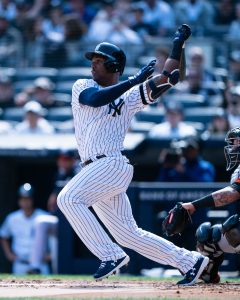
Andujar, owner of a sparkling .297/.328/.527 line with 27 home runs during a 606-PA rookie showing, fell from grace this season over 49 injury-affected trips to the plate. The 24-year-old batted a horrid .128/.143/.128 without a homer, and now it’s fair to wonder if he has walked to the plate as a Yankee for the last time.
General manager Brian Cashman has always advocated for Andujar, and that remains the case, but the executive revealed last week that Andujar – even after a nightmarish season – continues to garner plenty of trade interest. Cashman could easily swat away Andujar suitors, as he has consistently done, but unlike last winter, it wouldn’t be out of bounds to wonder whether the Yankees still have a place for him.
When Andujar’s shoulder troubles put an end to his 2019 in mid-May, there was panic because it didn’t seem the club had an obvious replacement on hand. But it turned out the little-known Gio Urshela was more than up to the task, as the 28-year-old slashed a jaw-dropping .314/.355/.534 and swatted 21 HRs with 3.1 fWAR over 476 PA. Was it a fluke from someone who had never even hit much in the minors? Perhaps. However, when Cashman was discussing the Yankees’ third base plans last week, he suggested the position will remain in Urshela’s hands going into 2020. If Urshela continues clinging to the role, is there any other obvious place to put Andujar – whose defense at third has generated poor reviews thus far? It’s debatable.
Cashman has stated the Yankees are open to trying Andujar at first base or in the corner outfield, but the club also has plenty of talent in those areas. Luke Voit, Mike Ford and even the semi-forgotten, injury-riddled Greg Bird represent options there. Even if you’ve given up on Bird (and who could blame you?), Voit and Ford make for a pair of effective major league bats who are affordable. In the corner outfield, meanwhile, the Yankees have the superstar tandem of Aaron Judge and Giancarlo Stanton with some potential mix of Brett Gardner, Mike Tauchman and Clint Frazier as fallback choices. Would there be space for Andujar there? Maybe, especially as the free agent Gardner (if he re-signs) will likely be the Yankees’ go-to guy in center field with Aaron Hicks recovering from Tommy John surgery. And the Yankees could certainly rotate Andujar in at designated hitter, where they figure to also rely on a capable-looking cast consisting of Voit, Ford, Judge, Stanton, Frazier and catcher Gary Sanchez.
It goes without saying that the Yankees do not have to trade Andujar. He’s a potential offensive star who’ll make a relative pittance for the next couple years and isn’t even on track to reach free agency until after the 2023 season. But for a club that’s targeting starting pitching this offseason, it wouldn’t be stunning to see New York deal from a surplus (offensive talent) to land an arm(s) prior to 2020. If Andujar does indeed end up on the block, teams like the Pirates, Tigers, Rangers, Royals, Brewers, Marlins, Indians, Angels, Braves and Nationals are among those who could end up in pursuit. Cashman’s in the catbird seat, though, as he could simply retain Andujar in hopes of a bounce-back season if nobody makes an offer to his liking.
Photo courtesy of USA Today Sports Images.
Offseason Outlook: Washington Nationals
MLBTR is publishing Offseason Outlooks for all 30 teams. Click here to read the other entries in this series.
Right after wrapping up a dream 2019 season, the Nats are already in the midst of an offseason loaded with big questions and abundant possibilities.
Guaranteed Contracts
- Patrick Corbin: $125MM through 2024 ($10MM deferred)
- Max Scherzer: $70MM through 2021 (all deferred); $30MM in signing bonus payments payable in 2020 and 2021
- Anibal Sanchez: $11MM through 2020 (includes buyout on 2021 club option)
- Adam Eaton: $11MM through 2020 (includes buyout on 2021 club option; Nationals exercised 2020 club option)
- Sean Doolittle: $6.5MM through 2020 (Nationals exercised 2020 club option)
- Kurt Suzuki: $6MM through 2020
Arbitration-Eligible Players (service time in parentheses; projections via MLBTR contributor Matt Swartz)
- Hunter Strickland – $1.9MM
- Javy Guerra – $1.3MM
- Michael A. Taylor – $3.25MM
- Roenis Elias – $1.9MM
- Joe Ross – $1.4MM
- Trea Turner – $7.5MM
- Koda Glover – $700K
- Wilmer Difo – $1.2MM
- Non-tender candidates: Strickland, Guerra, Taylor, Glover, Difo
Free Agents
- Asdrubal Cabrera, Brian Dozier, Jeremy Hellickson, Daniel Hudson, Howie Kendrick, Gerardo Parra, Anthony Rendon, Fernando Rodney, Jonny Venters
- Stephen Strasburg: opted out of remaining contract ($100MM through 2023)
- Matt Adams: paid $1MM buyout in favor of $4MM mutual option
- Yan Gomes: paid $1MM buyout in favor of $9MM club option
- Ryan Zimmerman: paid $2MM buyout in favor of $18MM club option
[Washington Nationals depth chart | Washington Nationals payroll outlook]
Things can change quickly, eh? It wasn’t but a few months ago that the baseball world was shoveling dirt on the 2019 Nationals, with huge and unpredictable ramifications for the organization’s future sure to come. But the Dave Martinez-led troops got back on their feet, dusted themselves off, and ultimately made a stirring run through the postseason to claim a redemptive World Series title. And now, after briefly basking in the glow of that victory … the team’s three longest-tenured stars are free agents, along with a slate of other postseason heroes, contributors, and/or Baby Shark visionaries.
The Nats have never faced a crossroads like this, even when Bryce Harper reached the open market last winter. They’ll come to the intersection wearing a satisfied grin, but make no mistake: there are many difficult decisions soon to be made.
Fortunately, the Nationals have loads of payroll flexibility to work with. The club has carried one of the game’s heftiest commitment levels for the past several seasons, paying some luxury tax in 2018 and barely avoiding it in 2019, and could presumably again top $200MM in payroll in 2020. The Nationals enter the offseason with something like $80MM to $90MM of headroom (depending upon arbitration decisions) beneath the $208MM competitive balance tax line. That should give president of baseball operations Mike Rizzo an awful lot of options to consider. (He’ll also likely be negotiating his own new contract; his current deal runs through 2020.)
It all begins with Rendon and Strasburg, a pair of quiet, Scott Boras-repped stars who each turned in ~6 WAR campaigns in 2019. It was far from inevitable that either would reach free agency this year. Mutual interest in a deal prompted a long-running exchange of offers with Rendon, but never resulted in an extension. And the general consensus, until rather recently, was that Strasburg would be best served staying in his own previously inked extension with the Nats. While there’s some reason to think that each player would prefer to stay in DC, all else being equal, the cost to keep these players will be steep. MLBTR predicted that both would secure $30MM+ average annual values over lengthy commitments. The organization would reportedly prefer to wrap up its talks with these two players early in the offseason, allowing both parties to move on if it isn’t to be.
Should the Nats retain both of these familiar faces, they’ll have committed a big chunk of their spending capacity — but hardly all of it. If either or both players depart, the club will have more cash to spread around. But there are a few open-market alternatives that could cost just as much or even more. If Rendon takes off, the Nationals may look to Josh Donaldson as an alternative. The fiery veteran is not far off from Rendon in present on-field ability and won’t require as lengthy a commitment (or, likely, as big an annual salary). And the loss of Strasburg could lead the Nats to join the pursuit of Gerrit Cole, who’s likely to out-earn all other free agents this winter.
As things stand, we just can’t know how these major decisions will turn out. But they represent major offseason plot twists for these and other teams. An extra thirty or sixty million of spending capacity can open quite a few doors. Rather than trying to guess on Rendon, Stras, et al., we’ll run through the many remaining D.C. roster needs and think about players at different price points that could be fits.
Let’s begin on the position-player side. The Nats are crossing their fingers that Trea Turner will bounce back well from his recent surgery; he’s ensconced at shortstop. It’s mostly fixed in the outfield, where phenom Juan Soto and veteran Adam Eaton will flank Victor Robles. Half of the catching situation is accounted for with Kurt Suzuki. And … that’s really all that’s nailed down at the moment. That’s not to say that we would expect the Nats to have seven new position players on the active roster come Opening Day. But every other spot is at least up for grabs and susceptible to change.
The 3-4-5 spots are especially interesting. We’ve seen indications that Ryan Zimmerman could be slated to return at first base, but the club hasn’t moved to do so yet and would certainly be justified in exploring alternatives after he turned in an injury-limited, offensively marginal (.257/.321/.415) campaign. Top prospect Carter Kieboom could be ready for another shot at the majors after scuffling in an early 2019 look. He has a bright outlook with the bat and could be slotted in at second or third base. Jake Noll is in much the same place from a positional standpoint but doesn’t come as highly regarded at the plate. It’s possible he’ll be bumped from the 40-man rather than seen as a significant piece of the puzzle; the same holds for utility infielders Wilmer Difo and Adrian Sanchez.
It seems fair to presume the Nats will be add at least three players to infield mix. At first base, even if Zimmerman is brought back, he’ll be accompanied by a quality lefty bat. Platoon mate candidates include Adams, Mitch Moreland, Eric Thames, and the switch-hitting Justin Smoak. There’s a lot to love about the bat from Edwin Encarnacion, but he’s not likely to spend enough time in the field to fit on a National League team. It’s tough to identify any quality regular first basemen who’d figure to come available via trade unless the Indians make Carlos Santana available or the Pirates dangle Josh Bell. Perhaps Brandon Belt of the Giants could be an option. Brad Miller, who’s probably best kept at first but can fill in all over the field, could be an under-the-radar target.
Even if Kieboom will be relied upon for a major contribution at second base, there’s a need for a regular at the hot corner and a versatile reserve. Fortunately for the Nats, they’re well-positioned to take advantage of the market’s abundance of veteran free agents at second and third base. Mike Moustakas is the next-best option at third behind Rendon and Donaldson; he’s also now capable of seeing some time at second. Outgoing D.C. free agents Howie Kendrick, Asdrubal Cabrera, and Brian Dozier are all available, as are players such as Todd Frazier, Jason Kipnis, Starlin Castro, Jonathan Schoop, Eric Sogard, and Ben Zobrist (who was targeted by the Nats when last he reached free agency). The trade market isn’t loaded with especially appealing options, but could feature some high-priced veterans that might conceivably fit. Dee Gordon, Jurickson Profar, and Matt Carpenter could all make sense for the Nationals in varying ways. The versatile Whit Merrifield would be a perfect fit, though that’s true of other teams and the Royals don’t appear inclined to sell.
Some of those players would also be potential outfield contributors, which would be nice. The Nats could hang on to Michael Taylor and hope he can handle the fourth outfielder role, though his bat has just never been consistent. The left-handed-hitting Andrew Stevenson had a nice 2019 showing at Triple-A and could also be considered, but he wasn’t trusted with much time in the bigs and doesn’t really fit as a compliment to Eaton. So, where might the Nats fit into the free agent market on the outfield grass? Veterans such as Adam Jones, Hunter Pence, and Cameron Maybin could be considered. The Nats may also just bring in some minor-league free agents to compete for jobs and then adjust mid-season if there’s a need.
Behind the plate, there’s an argument for a relatively modest addition to share time with Suzuki. Jason Castro would make for a nice potential fit. Other left-handed-hitting backstop options are available in the form of Alex Avila and Stephen Vogt (along with switch-hitting old friend Matt Wieters, who doesn’t seem likely to filter back). The open market also features Travis d’Arnaud, Francisco Cervelli, Russell Martin, and Martin Maldonado, among quite a few others. The level of player the team will target could depend upon the degree of confidence in 40-man options Raudy Read and Tres Barrera. The former had quite a nice offensive campaign at Triple-A.
There is one more, yet more intriguing possibility: Yasmani Grandal. Interestingly, he’s a more accomplished hitter than any of the first base options on the open market this winter, so the Nats could conceivably utilize him in a ~50-50 timeshare behind the plate while also giving him time at first. Depending upon how things shake out, Grandal could continue to function in a split capacity or slide back into a full-time catching role once Suzuki departs after the season. It’s an intriguing possibility for a team that will have a boat load of free spending capacity and a need for star position-player talent if it loses Rendon.
Things are somewhat more straightforward on the pitching side. The Nats are clearly in the market for Strasburg or a replacement. For a team that once added Max Scherzer to an already-loaded rotation and rode its starting staff to a title this year, all bets are off when it comes to starters. Anyone and everyone is a potential target if Strasburg heads elsewhere. Even if he returns, the fifth rotation spot will be open for supplementation. Joe Ross, Austin Voth, Erick Fedde, Kyle McGowin, and perhaps Shannon Sharp and Wil Crowe (only the former must be protected from the Rule 5 draft) could battle for the job in camp with a minor-league signee or two. Or the Nats could plug in another veteran. It’s frankly impossible to rule out any single starter as a conceivable potential target.
The relief situation might be more interesting if there were high-end closers out there for the bidding. But with Aroldis Chapman and Will Smith both already locked up, the top available arm is the guy who gave up a monster home run to Kendrick in Game 7. Come to think of it, Will Harris is actually not a bad target for the Nats, who desperately need some added certainty after a season full of nail-biting relief appearances. Daniel Hudson could be brought back after his successful stint. He’s part of a pretty broad group of hurlers lined up behind Harris in the pecking order. If the team is inclined to roll the dice again after whiffing on Trevor Rosenthal, it could take a shot on Dellin Betances in hopes of landing on a late-inning ace to pair with Sean Doolittle. Supposing Roenis Elias can get back to form, there isn’t a particular need for a southpaw, so the Nats can focus simply on getting the best arms for the best price.
How many new pen arms do the Nats need? It’d make sense to secure at least two sturdy new options and perhaps add another if the club decides to cut bait on Hunter Strickland. But that really depends how the club feels about its existing arms, since it’ll surely be forced to shave a few players off of the 40-man if it doesn’t rely upon them. Several of the above-noted starters meet that description, as do some of the other uncertain relievers presently taking up roster spots. Austen Williams is coming off of a rough campaign, James Bourque has both an intriguing arm and a walk problem, and both Aaron Barrett and Koda Glover are major health risks.
So what’ll the Nats do to set the stage for an encore? It’s a question without anything close to a clear answer. All of the above possibilities and more are surely under consideration. Soto and Turner are extension candidates, too, it’s worth noting — with added onus, perhaps, if the organization says goodbye to Rendon, Strasburg, and Zimmerman. Even with all the disappointments now atoned for, the Nationals are perhaps entering their most free-ranging and interesting offseason under Rizzo’s helm. And he has already shown quite a penchant for surprise.
Offseason Outlook: Arizona Diamondbacks
MLBTR is publishing Offseason Outlooks for all 30 teams. Click here to read the other entries in this series.
The Diamondbacks feature quite a few roster chameleons, giving the team plenty of options this winter as it seeks to pursue immediate competitiveness without muddying the long-term outlook.
Guaranteed Contracts
- Ketel Marte: $21MM through 2022 (including buyouts of 2023-24 options)
- Yasmany Tomas: $17MM through 2020
- Eduardo Escobar: $14.5MM through 2021
- Mike Leake: $6MM through 2020 (Cardinals & Mariners pay remainder of contract, including $9MM of salary and $5MM buyout of 2021 option)
- Merrill Kelly: $3.5MM through 2020 (including buyout of 2021 option)
- Diamondbacks also owe $20.667MM of salary to Zack Greinke through 2021
Arbitration-Eligible Players (projections via MLBTR contributor Matt Swartz)
- Taijuan Walker – $5.025MM
- David Peralta – $8.8MM
- Steven Souza Jr. – $4.125MM
- Nick Ahmed – $7.0MM
- Jake Lamb – $5.0MM
- Caleb Joseph – $1.2MM
- Andrew Chafin -$3.2MM
- Robbie Ray – $10.8MM
- Archie Bradley – $3.6MM
- Matt Andriese – $1.4MM
- Abraham Almonte – $900K (already outrighted)
- Non-tender candidates: Peralta, Souza, Lamb, Andriese, Almonte
Free Agents
- Alex Avila, Jarrod Dyson, Wilmer Flores (declined $6MM option in favor of $500K buyout), Yoshihisa Hirano, Adam Jones, Blake Swihart
[Arizona Diamondbacks depth chart | Arizona Diamondbacks payroll outlook]
We heaped on the praise when the D-Backs announced they had re-upped GM Mike Hazen, and for good reason. He came into a tough spot and has both produced a competitive MLB team and improved the team’s talent pipeline. Shrewd moves abound — chief among them: acquiring and then locking up Ketel Marte before his breakout — even if they haven’t all been winners.
The Diamondbacks have played generally winning baseball in a wholesome and sustainable manner. That’s nice. But they were swept out of their 2017 postseason appearance and haven’t been back since. The Dodgers may not have swum in the Snakes’ pool of late, but they still haven’t let anyone join them in the NL West deep end since they splashed around Chase Field in 2013. And it isn’t as if the L.A. organization has monopolized the division through spending alone; it’s doing it in a cost-efficient manner that’s all the more fearsome for the teams chasing them from afar. If nobody is even nipping at their heels, the Dodgers will just keep cruising.
If the D-Backs are to force the issue in the division, or at least to stand out a bit in a crowded NL wild card picture, they will need both to continue making cost-efficient improvements and to find a way to make a Marte-esque leap. They don’t need to rush out and do another Greinke deal, by any means, but as presently constituted the roster is more solid than good — and that’s assuming healthy campaigns from some players that have had recent injury issues. Hazen still hasn’t promised double-digit millions in a single free agent contract. That seems likely to change this winter.
Looking at the payroll, there’s about $47.5MM written in ink. The arbitration outlay will probably more than double that starting point — if every eligible player is tendered. The Snakes can shear about $9MM if they move on from Jake Lamb and Steven Souza … and double that if they were to non-tender or trade David Peralta. If all three are cut loose, the club would have a few additional holes to deal with but could also have over $30MM in free payroll to play with — assuming the team is again comfortable opening with over $120MM on the books. The D-Backs don’t really have any true blue-chip prospects to use as trade assets, but the club has drawn praise for possessing an especially nice volume of farm talent. That should leave a lot of pieces to work with in trade talks.
So where is the work to be done? Not in the rotation, arguably. The D-Backs have turned over much of their starting staff since this time last year. Robbie Ray is the only holdover from before the 2018-19 offseason. The club brought aboard Luke Weaver and Merrill Kelly before the 2019 season and then added Zac Gallen and Mike Leake during that just-finished campaign. It’s not likely to be an overwhelming unit, but the spots seem ably accounted for. The Snakes surely feel they filled in the gaps when they picked up Gallen and Leake over the summer. The Gallen swap looks like a potential heist, though he’ll need to repeat his stunning breakout season and the Marlins surely feel good about what they saw from prospect Jazz Chisholm after picking him up in the deal. Leake can serve the part of veteran innings eater, joining Kelly to deliver a volume of serviceable frames. Ray is a bit of a wild card but is the kind of strikeout pitcher that teams dream on, while Weaver is coming back from injury but turned in a dozen sterling starts in 2019.
So, should the D-Backs go looking for a nice upside play and/or some depth in free agency? Not necessarily. There’s more to the rotation picture. The uber-talented Taijuan Walker will be working back from Tommy John surgery, with hopes he’ll be available for a good portion of the season. Corbin Martin is doing the same, though he’s unlikely to return before later in the year and is probably not a major factor in the 2020 planning. Jon Duplantier got his first taste of the majors last year and will surely be a factor. Taylor Clarke and Alex Young are among the 40-man roster pieces that contributed last year and can again be called upon; J.B. Bukauskas and Taylor Widener are perhaps the most promising upper-level prospects, though both had less-than-ideal results in 2019.
Some of those arms will spill over to the bullpen; Duplantier and Clarke each spent time there last season. But there’s some work to be done in the relief unit. Archie Bradley, Andrew Chafin, and mid-season callup Kevin Ginkel make for a nice trio of arms. Yoan Lopez and Stefan Chricton both got the job done in 2019, though the former had questionable peripherals and the latter has to prove he can do it over a full campaign. Matt Andriese suffered from the BABIP blues and could be asked back, though it’ll cost a bit. Otherwise, it’s Jimmie Sherfy and the leftover starters — good for a band name, but questionable for a contending pen.
There isn’t an overwhelming amount of need, but the D-Backs sure could stand to add at least one established, high-quality reliever to this mix. Having utilized Bradley in a flexible manner in recent years, with the closing job being occupied mostly by short-term signees, the team seems a likely bet to once more lure a veteran to the desert with promises of 9th-inning glory. We posited the club as a potential buyer of top-class relievers in compiling our list of the top 50 free agents, though we ultimately predicted a relatively low-cost accord with the sturdy and experienced Steve Cishek. This is certainly an area the team can spend on, particularly if it ticks off other needs at lower-than-expected expense, though the market isn’t exactly laden with high-end arms. The D-Backs could take a risk on a hurler like Dellin Betances and/or explore trade options.
On the position-player side, Hazen could go in quite a few different directions. Let’s start with what is in place. Carson Kelly will be the primary backstop, with Caleb Joseph and/or some other veteran (the Snakes like to carry three catchers) supplementing him. Marte can be lined up in center or at second base alongside shortstop Nick Ahmed. Either way, two of the three slots up the middle are accounted for. At the infield corners, Eduardo Escobar is a fixture while Christian Walker and Kevin Cron can be called upon at first base pending the arrival of Seth Beer. There’s room for a left-handed-hitting reserve in the mold of Lamb, who seems unlikely to be retained at his arb price point after two consecutive forgettable campaigns. And in the outfield, the D-Backs could rely upon Souza and David Peralta for a big chunk of the action … or they could move one or both of those not-insignificant salaries and go in a different direction entirely.
The Snakes gave a lot of plate appearances to light-hitting performers last year. Lamb, Adam Jones, Jarrod Dyson, Tim Locastro, Ildemaro Vargas, Josh Rojas, and Blake Swihart combined for nearly two thousand trips to the dish; not one was within a dozen points of league average by measure of wRC+. It’s not a stretch to imagine Locastro, Vargas, and/or Rojas playing significant roles in 2020 and beyond. Ditto utility infielder Domingo Leyba. But the Snakes can’t afford to settle for that level of offensive output from such a major segment of the roster. They’ll need to fill in for the departing players and avoiding asking too much of those that remain from this list.
So, how to proceed? There are two key factors to consider here: Marte’s positional malleability and the payroll/roster flexibility in the corner outfield (and to some extent also at first base). With bench space to work with as well, there are quite a few ways in which the club could seek improvement. It was interesting to hear Hazen suggest recently that the team prefers Marte at second base. It would be easier to fill that spot from outside the organization, given the multitude of possibilities, but it appears the Snakes are likeliest to chase after a center fielder.
Put it all together, and it seems the overall focus is squarely on the outfield grass. Asked recently about Shogo Akiyama, Hazen revealed some level of interest in the Japanese center fielder. The meandering nature of the quote also served to underscore the wide-open nature of the offseason. “We think he’s a good player,” says Hazen of Akiyama. ” … We’re in the outfield market, the center-field market specifically. We’re in the entire market.”
The D-Backs do have some options up the middle, especially if they like Akiyama even more than they’ve already let on. He is arguably the only truly intriguing option on the open market, at least unless Brett Gardner considers a departure from the Yankees. But there are some trade possibilities. Starling Marte is the central focus on the trade market. He’ll be sought after by quite a few other teams as well, but there’s an argument to be made that he fits in just the right space (two years of affordable but not cheap control) for the D-Backs. It’s also possible to imagine the club looking at a few other possibilities. Old friend Ender Inciarte could conceivably be made available, depending upon how things develop in Atlanta. And Jackie Bradley Jr. figures to be dangled by the Red Sox; acquiring him might help quench Hazen’s insatiable thirst for Boston products. (We kid, but there’s no shortage of examples.) If the D-Backs can’t sort out an upgrade and are forced to utilize their existing Marte at times in center, they may come away with a timeshare veteran in the nature of Dyson, Leonys Martin, Juan Lagares, or Cameron Maybin. The club could instead utilize the speedy Locastro in such a capacity as well. Any of these fall-back possibilities would feel like a bit of a disappointment unless the Snakes end up securing other significant pieces.
None of the above-noted center field possibilities will bust the budget. Even if the Snakes score a second Marte, there should be cash left to work with to do more. And this is where things could get yet more interesting. Souza is an obvious non-tender candidate after an injury-cancelled campaign on the heels of a disastrous first year in the desert. But the Snakes could simply decide they like him better than any of the options they can get in free agency for a similar price tag. It’s actually a closer call than you might think on Peralta. He’s a rather accomplished hitter, to be sure, but the track record isn’t unassailable and he’s a 32-year-old looking to return from shoulder problems. And Peralta has long struggled against left-handed pitching. The Snakes might reasonably believe they can do more for less in trade or on the open market, though there has been no suggestion to this point that they are considering moving on.
Whether or not one or both of those players is retained — whether through arbitration or in a re-signing following a non-tender — there are many opportunities to consider. This year’s market includes a group of unusually youthful and talented corner outfielders: Nicholas Castellanos, Marcell Ozuna, Avisail Garcia, and Yasiel Puig. It isn’t hard to fall in love with some of those players’ tools; perhaps the D-Backs could consider a somewhat longer, lower-AAV contract if they like one of the group in particular. There are lefty bats in the form of Corey Dickerson, Kole Calhoun, and Yoshitomo Tsutsugo. There aren’t an immense number of obvious trade targets to consider, but the Diamondbacks could look into the likes of Trey Mancini, Clint Frazier, and perhaps even Mookie Betts or Andrew Benintendi, depending upon what the Red Sox end up pursuing. Though the Snakes have mostly worked to remove big veteran salaries, they could consider a player such as Charlie Blackmon — not that an intra-division deal is likely to be sorted out for such a fan favorite. The same issue applies to the Dodgers, who could end up with an extra outfield piece to move. Relieving the Athletics of their obligations to Stephen Piscotty could conceivably work for both teams. It’s not impossible to imagine the Mets talking about Brandon Nimmo, Michael Conforto, or J.D. Davis. There are plenty of other possible scenarios that may be explored but are even more speculative than the ones just listed.
If that feels like relatively short-term patchwork … well, that’s pretty much what’s available. And it’s also what Hazen has done so well thus far. Putting some added financial gusto behind the effort could yield dividends. Exploring moves to bring in a star makes sense, but that’s a necessarily speculative endeavor. That approach could spill over and meld with the first base and broader bench. As noted above, the D-Backs have some younger players they like. In addition to those already listed, catcher/utilityman Daulton Varsho and first baseman/outfielder Pavin Smith could be closing in on the majors. But the former is now recovering from an ankle injury and the latter is still working to re-burnish his prospect standing.
Expecting something from the existing, younger players is sensible. But the Diamondbacks can and should reduce their reliance on them as immediate options without cutting off their paths entirely. Short-term veteran role players abound. Lefty bats seem to make particular sense given the existing array in the infield. Brock Holt is among the utility pieces that could shoulder some of the load all over the field. A lefty slugger makes tons of sense to form a platoon at first base, with Eric Thames representing the top of that market. Perhaps Mike Moustakas could reprise his surprise utility role, appearing all over the infield for the Snakes. If the Cards decide to try to shed some of Matt Carpenter‘s contract to free up payroll and roster space, perhaps the Arizona org could take a chance on the veteran and come away with another desired piece as well.
It’s frankly hard to pin down a simple task list given the adaptable roster and payroll circumstances — a credit to Hazen’s handiwork. The Snakes have some shape-shifting puzzle pieces and blank Scrabble tiles to work with. It makes for a choose-your-own-offseason decision tree that could take any number of different courses over the months to come.