
Phillies Release Didi Gregorius
The Phillies announced a series of roster moves prior to tonight’s game. Deadline pickups Noah Syndergaard and Brandon Marsh have been activated. Pitcher Kyle Gibson has been reinstated from the bereavement list with infielder Jean Segura being activated from the 60-day injured list. Three spots on the active roster were created after last night’s game, with right-hander Mark Appel, left-hander Bailey Falter and outfielder Simon Muzziotti all getting optioned. To create space on both the active and 40-man rosters for Segura, they have released infielder Didi Gregorius.
Gregorius, 32, is perhaps best known for the five-year stretch with the Yankees he had from 2015 to 2019. In that time, he played 660 games, hitting 97 home runs, stealing 27 bases and slashing .269/.313/.446 for a 101 wRC+.
After reaching free agency, he signed a one-year, $14MM deal with the Phillies for 2020, going on to hit 10 homers in the shortened season and producing an overall line of .284/.339/.488, 116 wRC+. After that successful campaign in Philly, the two sides re-upped on a two-year, $28MM deal that unfortunately preceded an incredible downfall in the shortstop’s production.
Last season, Gregorius hit a miserable .209/.270/.370, 68 wRC+, meaning his production was 32% worse than the league average hitter. After that dismal campaign, his grasp on the shortstop position for 2022 seemed tenuous at best. Philadelphia’s president of baseball operations Dave Dombrowski publicly admitted as much in October.
Although there was a superstar class of shortstops available in free agency this winter (Carlos Correa, Corey Seager, Javier Baez, Trevor Story, Marcus Semien), the Phils focussed on upgrading their outfield, adding Kyle Schwarber and Nick Castellanos. Despite apparently losing faith in Gregorius, they felt they had a potential in-house solution at shortstop with prospect Bryson Stott.
Stott cracked the Opening Day Roster and seemed to be in a bit of a competition for infield playing time next to second baseman Jean Segura. With both Gregorious and third baseman Alec Bohm having down years in 2021, Stott was given time at various infield positions to start the year. However, he struggled out of the gate, getting optioned back to the minors April 25. At that time, he was hitting just .133/.161/.167. Those struggles seemed to give Gregorious and Bohm more time to get back on track.
In May, Stott was recalled, which was followed a few weeks later by Segura fracturing his finger, opening up the infield for all three of Stott, Gregorius and Bohm. In that time, Stott and Bohm have improved after sluggish starts while Didi simply has not. Since June 1, Stott has hit seven homers and is slashing .227/.296/.384. That’s still below average production (90 wRC+), but it comes despite a .222 batting average on balls in play. Bohm, meanwhile, scuffled through June but had a monster July, hitting .405/.427/.583 since that month began. Gregorius had an okay start to the year, hitting .288/.338/.356 through May for a wRC+ of 96, but has slashed .181/.234/.284 since, wRC+ of just 42 since the start of June and 57 on the season overall. With Segura’s return and Bohm and Stott looking like better options, the Phils decided to was time to move on from Gregorius as they gear up for a pennant race over the final two months of the season.
Gregorius is making $15.25MM this year as part of that two-year deal he signed, leaving around $5MM left to be paid out. Any team that signs him at that point would only have to pay him the prorated league minimum with the Phillies on the hook for the remainder.
Vin Scully Passes Away
Broadcasting legend Vin Scully passed away today at age 94, according to a Dodgers news release. “He was the voice of the Dodgers, and so much more. He was their conscience, their poet laureate, capturing their beauty and chronicling their glory from Jackie Robinson to Sandy Koufax, Kirk Gibson to Clayton Kershaw. Vin Scully was the heartbeat of the Dodgers – and in so many ways, the heartbeat of all of Los Angeles,” the release stated.
For all of the legendary voices who have called baseball games over the decades, there is little debate that Scully was the best of them all, both for the incredible length of his tenure in the booth, and his unmatched quality over those 66 years of broadcasting Dodgers games. Amazingly, Scully was already a Hall-of-Fame level broadcaster even aside from his work with the Dodgers, as he covered the NFL, pro golf, tennis, and (naturally) postseason and All-Star baseball games for such outlets as CBS, NBC, ABC, and TBS.
From start to finish in his iconic career, Scully was a master storyteller, finding endless inventive and poetic ways to call the action, yet never overwhelmed the play on the field. Scully was on the mic for many of the greatest moments in baseball history, adding to those moments with both wonderful calls and (just as important) poignant silences.
Scully was something of a prodigy, as quite early in his career he began calling Dodgers games in Brooklyn in 1950 on both TV and radio broadcasts. He was then in the booth until the end of the 2016 season, following the Dodgers to Los Angeles. As noted in the press release, “it was Vin as much as anyone who bonded the franchise with its new city. Fans – not only around the city, but at the games themselves in the Los Angeles Memorial Coliseum – would listen on their new transistor radios to Vin and colleague Jerry Doggett.”
On behalf of all of us at MLBTR, we send our condolences to Vin Scully’s family and legions of friends and fans.
Padres Acquire Juan Soto, Josh Bell; C.J. Abrams, MacKenzie Gore, Luke Voit Among Six Players Back To Nationals
The Padres pulled off the biggest deadline deal in years, announcing the acquisition of both Juan Soto and Josh Bell from the Nationals. San Diego sent back a haul of young talent to complete the blockbuster. Rookie shortstop C.J. Abrams and left-hander MacKenzie Gore are headed to Washington, as are a trio of highly-regarded prospects: outfielders Robert Hassell III and James Wood, and pitcher Jarlin Susana. To round out the deal, the Nats are picking up big league first baseman Luke Voit.
It’s a stunning blockbuster, one of the most seismic trades in major league history. There’s almost no precedent for a player of Soto’s caliber being dealt, particularly not with multiple seasons of remaining club control. The lefty-hitting outfielder is among the game’s top handful of players, a superstar performer who has amazingly yet to turn 24 years old. Soto debuted in the big leagues as a 19-year-old in 2018, having played just eight games above A-ball at the time. Even holding his head above water would’ve been impressive in that context, but Soto immediately stepped into the majors as of its best hitters.
Soto hit .292/.406/.517 in 116 games as a rookie. He’s followed that up with successively elite offensive seasons, looking well on his way to being an all-time great hitter. Between 2019-21, Soto hit .304/.440/.561. He averaged more than 25 home runs per year (even with the 2020 schedule being dramatically shortened) and drew plenty more walks than strikeouts. Soto finished in the top ten in NL MVP balloting each season, including a runner-up finish last year. He was an integral part of the Nationals’ World Series winner in 2019, following up a .282/.401/.548 regular season performance with a .277/.373/.554 showing during that year’s postseason. Along the way, Soto claimed a pair of Silver Slugger Awards and was selected to the All-Star Game in 2021.
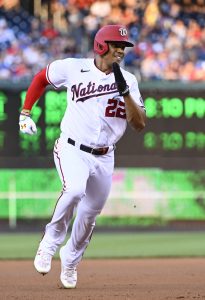
The 2022 campaign hasn’t been Soto’s best, but a “down” season by his standards would be a career year for most players. Through 436 plate appearances, he’s hitting .246/.408/.485. He’s drawn walks in an MLB-best 20.9% of his trips to the dish while striking out just 14.2% of the time. He’s tied for 17th in the majors with 21 longballs, and he’s third among hitters with 200+ plate appearances in on-base percentage (.408). That’s in spite of a .243 batting average on balls in play that’s easily the lowest mark of his career, nowhere close to .330 figure he carried into the season. The lesser ball in play results do reflect a slight downturn in his batted ball quality, but Soto’s batted ball metrics and exit velocities are better than his actual batting average and slugging output might suggest.
It wasn’t long ago that trading a hitter of this caliber would’ve seemed unfathomable. The Nationals are less than three years removed from their aforementioned championship. Even after a last place finish in 2020, Washington was in win-now mode heading into 2021. A swoon just before last summer’s trade deadline dropped them near the bottom of the National League and kicked off a major reboot that saw stars like Max Scherzer, Trea Turner and Kyle Schwarber traded. All those players were within their final season and a half of remaining control, however, while Soto was still more than three years from free agency at the time. There was seemingly never any consideration on the Nats part to dealing him either last summer or over the offseason.
That remained the case just two months ago, when Washington general manager Mike Rizzo flatly declared the club was “not trading” Soto. That was before their latest (and ultimately final) attempt to sign him to a long-term deal. After Soto rejected a 13-year, $350MM extension offer last offseason, the Nationals reengaged with his representatives this summer. Soto again turned down the Nationals overtures — this time a 15-year, $440MM proposal — and the club pivoted to the trade market.
One could certainly argue whether that was the right course of action for the franchise to take. Even if the organization were convinced that signing Soto to an extension was untenable, they didn’t have to move him this summer. Soto is arbitration-eligible through 2024, so Washington could’ve held onto him until next winter or merely proceeded year-by-year through the arb process and tried to put a contending roster back around him. Rizzo and his staff decided against that course of action. The Nationals have a barren farm system and have curtailed payroll in recent seasons while the Lerner family explores a sale of the franchise. Turning around a team with an NL-worst 35-69 record within the next two years would’ve been an immense challenge even with Soto on the roster, and the Nats are now fully embracing a rebuild that’ll likely take multiple seasons.
That decision will be a tough pill to swallow for at least some segment of the fanbase. Washington has now seen the departures of Scherzer, Turner, Anthony Rendon and Soto within the past few years — dramatically overhauling the franchise’s best clubs since it moved to Washington. They’re surely hopeful that players like Josiah Gray, Keibert Ruiz and the package of young players they’re receiving in the Soto deal will comprise a core of another contender down the road, but there’s no denying how quickly the Nationals fell from the top after winning the title three seasons back.
On the other side of the equation, the Padres are landing one of the sport’s preeminent superstars to bolster an already star-studded roster. The Friars have gone in the opposite direction of the Nationals over the past few years, coming out of their rebuild in 2020 with an excellent young core after years of building the farm system. President of baseball operations A.J. Preller and his group have shown a willingness to swing for marquee talent time and again. They’ve signed Manny Machado to a huge free agent contract and swung blockbuster trades for players like Yu Darvish, Blake Snell and Mike Clevinger. For as aggressive as Preller’s been over his eight years running baseball ops, he’s never had a two-day stretch like this. The Friars sent closer Taylor Rogers, righty Dinelson Lamet and two prospects to land star reliever Josh Hader from the Brewers yesterday. He’s now followed up with the kind of blockbuster that’ll define his front office tenure.
The Padres enter play Tuesday with a 58-46 record. They’re in possession of the National League’s second Wild Card spot and a likely playoff team, but even adding Soto and Hader is unlikely to give them much of a chance at erasing a 12-game deficit to the Dodgers in the NL West. The acquisition is both about solidifying their hold on a playoff spot for this season and adding another impact bat alongside Fernando Tatis Jr. and Machado for the next few seasons. The Padres could theoretically try to reengage Soto’s reps at the Boras Corporation about a possible long-term pact, but the more likely scenario would seem to be that he’ll spend the remainder of his arbitration seasons in San Diego.
To get the deal done, the Friars reportedly outbid some of their National League competitors. The Cardinals and Dodgers were generally viewed among San Diego’s top rivals in the bidding for Soto, and there’s surely an added bonus in keeping him away from teams whom San Diego could plausibly meet in the postseason for the next few years. Preller and his staff probably have no small amount of satisfaction in topping the Dodgers’ offers after Los Angeles stepped in to land Scherzer from Washington last summer — not long after reports emerged that San Diego was closing in on a Scherzer agreement with the Nats.
While Soto is obviously the headlining piece of the deal, Bell is far more than an ancillary throw-in. He’s one of the top bats to change hands this summer himself, a player who ranked #3 on MLBTR’s list of the top deadline trade candidates. Bell is one of the more well-rounded hitters in the sport. He’s a switch-hitting power bat who topped out with 37 home runs with the Pirates back in 2019. While that was probably inflated somewhat by the livelier baseball used during that season, Bell has continued to hit for above-average power in the years since then. After a down year in the shortened 2020 campaign, Bell rebounded to connect on 27 longballs during his first season in Washington. He’s hit another 14 homers and 24 doubles through 437 plate appearances this season.
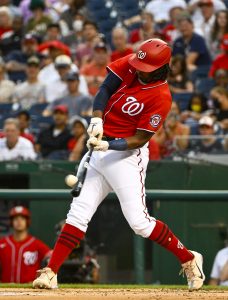
Unlike most power hitters of his ilk, Bell also brings strong bat-to-ball skills to the table. He’s striking out in only 14% of his trips this season, his lowest rate since his rookie year and markedly below the league average. Bell has paired that with quality plate discipline manifesting in an 11.2% walk rate and an overall .302/.384/.493 line. Since being traded to Washington heading into the 2021 season, he’s a .278/.363/.483 hitter in a hair above 1000 plate appearances.
Bell is a pure rental, as he’ll be a free agent for the first time after this season. He’s playing the year on a $10MM salary, around $3.57MM of which is yet to be paid out. He’s limited to first base or designated hitter, but most public metrics agree Bell has played his way to roughly average at first after posting well below-average numbers earlier in his career. While he’s unlikely to ever win a Gold Glove Award, Bell should be a perfectly fine first baseman for the final few months.
A midseason trade not only affords Bell the opportunity to depart a last place club for a contender, it should also boost his free agent stock next offseason. The Nationals were likely to make him a qualifying offer, which would’ve required a signing team to forfeit draft picks and/or international signing bonus space after Bell rejected. Players traded midseason the year before free agency are ineligible for a QO, however, so a trade means Bell’s market won’t be hampered by compensation a few months from now.
Taking on what remains of Soto’s $17.1MM salary (approximately $6.1MM) and Bell’s remaining money — coupled with the Hader trade — is sure to push the Friars beyond the luxury tax threshold. Ownership had reportedly been reluctant to exceed that marker for a second straight year, but the opportunity to add this kind of impact talent compelled them to change their thinking. Jason Martinez of Roster Resource estimates the franchise’s post-trade deadline CBT number around $242MM, a fair bit north of the $230MM base threshold. As a payor for a second straight year, they’ll be taxed at a 30% rate on their first $20MM above the threshold, coming out to approximately $3.7MM in extra fees.
With the chance to transform their roster, majority owner Peter Seidler and company signed off on the addition to an already franchise-record payroll. San Diego presumably plans to remain among the league’s highest-payroll clubs in the coming years, as Martinez projects them for $128MM in guaranteed commitments (with a $157MM CBT figure) for next season. That doesn’t include what’s sure to be another massive arbitration raise for Soto — likely into the $25+MM range — although Bell could depart this winter. It’s a territory with which the franchise is evidently now comfortable, and they’ll be rewarded for their aggressiveness with one of the sport’s most entertaining rosters.
In order to add that kind of star power, the Padres had to be prepared to part with a massive package of young talent. The Nationals had reportedly set an asking price of five-plus young major leaguers and/or prospects in any Soto talks, and that’s what they’ll receive. Abrams is presumably the first player of the deal Washington fans will see at Nationals park, as he’s likely to soon join the MLB roster.
The sixth overall pick in the 2019 draft, Abrams almost immediately played his way towards the top of prospect lists in pro ball. A left-handed hitter with plus bat-to-ball skills and elite speed, he performed quite well in the low minors. The Georgia native missed a fair bit of action, with the cancelation of the 2020 minor league season and a left leg injury that ended his 2021 campaign in July. That kept Abrams to just 42 games above A-ball entering this year, but the Friars nevertheless carried him on the big league roster after losing Tatis to a wrist fracture.
The 21-year-old has struggled in his big league experience to date, hitting .232/.285/.320 through his first 46 games. That’s not unexpected for a player with his lack of experience, though, and Abrams remains a very highly-touted young player. Optioned to Triple-A El Paso midway through the year, he responded with a .314/.364/.507 showing through 30 games to earn another MLB call. He’s played sporadically at each of shortstop, second base and in the outfield with a win-now team in San Diego, but he should have a clearer path to everyday playing time at shortstop on the Nationals.
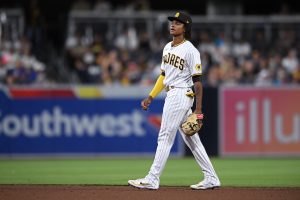
Abrams checked in as the game’s #11 prospect on Baseball America’s recent top 100, with the outlet reaffirming that his bat-to-ball skills and athleticism give him a chance to be a franchise shortstop. Abrams’ relatively narrow frame doesn’t lead to huge power projection, but he’s credited with possible 15-20 homer pop at his peak. There’s some debate whether he’ll stick at shortstop or should eventually move to second base or center field, but he’s certain to play up the middle somewhere and could be a traditional top-of-the-order type.
The Padres decision to option Abrams to Triple-A was quite likely more motivated by his struggles at the MLB level than any kind of service time gaming. It did have the effect, however, of ensuring he won’t reach a full year of service this season. He remains controllable through the end of the 2028 season, and future optional assignments could push that trajectory back even further.
Gore would’ve joined Abrams in soon appearing on the MLB roster, but he’s currently on the injured list due to elbow inflammation. The Padres were targeting a September return for the 23-year-old southpaw, although it’s seemingly possible he doesn’t make it back to the mound this season. That’s largely immaterial for the Nationals, who are obviously looking well into the future anyhow. It doesn’t seem the club has real long-term concerns about Gore’s arm health.
If healthy, Gore is among the more interesting young arms in the sport. The third overall pick in the 2017 draft, he quickly developed into the game’s top pitching prospect after dominating lower level hitters. Then came a rough two-season stretch between 2020-21. Gore reportedly struggled with his mechanics and battled extreme wildness at the alternate training site the former year, then had an up-and-down 2021 season that saw the club send him back to the complex for a stretch to reset in a lower-pressure environment. Gore righted the ship to some extent, returned to an affiliate late in the year, and began this season at Triple-A.
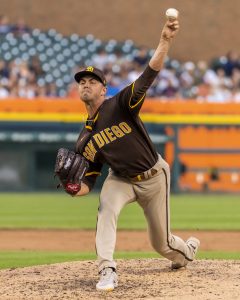
After one appearance, Gore was promoted to make his major league debut. He went on to make 13 starts while the club navigated injuries to Blake Snell and Mike Clevinger, pitching to a 4.27 ERA with a solid 23.1% strikeout rate. Gore’s 11.5% walk percentage remained a bit high, but it wasn’t anywhere near the level of control concerns he’d had in prior seasons. San Diego moved him to the bullpen for three outings in order to keep tabs on his innings, and Gore was hit hard before going on the IL.
Whether the elbow issue played into Gore’s late struggles or not, he’s still a plenty sensible inclusion in the deal for the Nationals. He’s a high-end athlete with a fastball that averages just under 95 MPH and a pair of promising breaking pitches. Gore is likely to eclipse a full year of service in 2022, putting him on track to potentially reach free agency after the 2027 campaign. He still has all three minor league option years remaining, however, and any future optional stints could push back his path to the market.
Alongside the two big leaguers, the Nationals bring in a trio of highly-regarded prospects. Like Abrams, Hassell and Wood are regarded as top five prospects in the Padres farm system and among the top 60 minor league players in the game, according to Baseball America. Susana’s not quite at that level, but BA recently slotted him as the Padres #10 prospect.
Hassell, 21 this month, was the eighth overall pick in the 2020 draft. He’s a lefty-hitting outfielder who brings a generally well-rounded center field profile. The Tennessee native is regarded as a future plus hitter, and while he doesn’t have overwhelming power, he brings strong bat-to-ball skills and plenty of defensive value. Through 346 plate appearances in High-A this season, Hassell owns a .299/.379/.467 line with ten homers, 20 stolen bases, a lofty 11% walk rate and a solid 19.1% strikeout percentage.
Wood, 19, was the Friars second-round pick last season. A toolsy high school outfielder from Florida, he had swing-and-miss concerns as a draft prospect that led to some questions about his ability to consistently tap into his huge power potential. The 6’7″ outfielder has reportedly made major changes to his mechanics since entering pro ball, however, and he’s tearing the cover off the ball in Low-A. Across 236 plate appearances, the lefty-hitting Wood owns a .337/.453/.601 line. He’s popped 10 homers, swiped 15 bases and has a robust 15.7% walk rate against a more than manageable 17.8% strikeout rate. BA suggests he could be a middle-of-the-order bat capable of swatting 30-plus homers annually at his peak.
Susana, 18, just signed in this past international amateur class. A 6’6″ right-hander, he’s already been clocked into the mid-upper 90s with a plus slider. Susana’s youth and distance from the majors — he’s yet to advance past the complex level — make him a high-risk prospect, but BA notes that he’s a similar caliber of prospect as the same-aged high school pitchers who went in the first round of last month’s domestic amateur draft.
Finally, the Nationals round out the return with Voit. A late entrant to the discussions after Eric Hosmer refused to waive his no-trade rights to go to Washington (leading to his subsequent trade to the Red Sox), Voit moves to both replace Bell in the Washington lineup and offset some salary. Acquired from the Yankees over the offseason, Voit has played in 82 games with San Diego. The 2020 home run champ, he hasn’t managed to replicate that kind of production over the last two seasons. He hit a slightly above-average level in the Bronx last year while battling injuries, and it’s been a fairly similar story in San Diego.
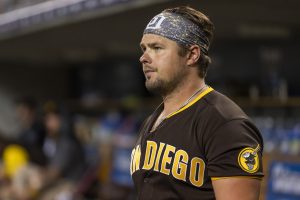
Through 344 plate appearances, Voit owns a .225/.317/.416 line with 13 homers. He’s striking out at a personal-worst 32% rate, but he’s hit for decent enough power to post overall offensive production a bit above par. He’ll presumably see the bulk of first base playing time down the stretch in the nation’s capital. Voit is arbitration-eligible through 2024, although he may be a non-tender candidate, since he’d otherwise be due a raise on this year’s $5.45MM salary.
It’s a blockbuster that’ll have reverberations around the game for years. San Diego is anticipating Soto will go down as one of the most impactful trade pickups in MLB history, and he and Bell will immediately feature in the middle of a lineup the club hopes is set to embark on a long-term playoff run. For the Nationals, it’s an emphatic closing of the book on the franchise’s previous stretch of success — one that brings in an influx of new faces Washington hopes can eventually form the core of another contender in the NL East years down the line.
Bob Nightengale of USA Today first reported the Padres and Nationals were moving close on a Soto deal. Jon Morosi of MLB.com reported the sides had agreed on a deal sending Bell and Soto to San Diego, as well as the inclusion of each of Abrams, Hassell, Wood and Susana. Jim Bowden of the Athletic reported Gore’s inclusion, while Nightengale was first to report Voit was being dealt.
Images courtesy of USA Today Sports.
Braves To Acquire Raisel Iglesias
The Braves pulled off a massive buzzer-beater just before the deadline, acquiring closer Raisel Iglesias from the Angels in exchange for pitching prospect Tucker Davidson and righty Jesse Chavez, reports Robert Murray of FanSided (Twitter link). Ken Rosenthal of The Athletic tweets that the Braves will pay the remainder of Iglesias’ contract — a four-year, $58MM deal that covers the 2022-25 seasons.
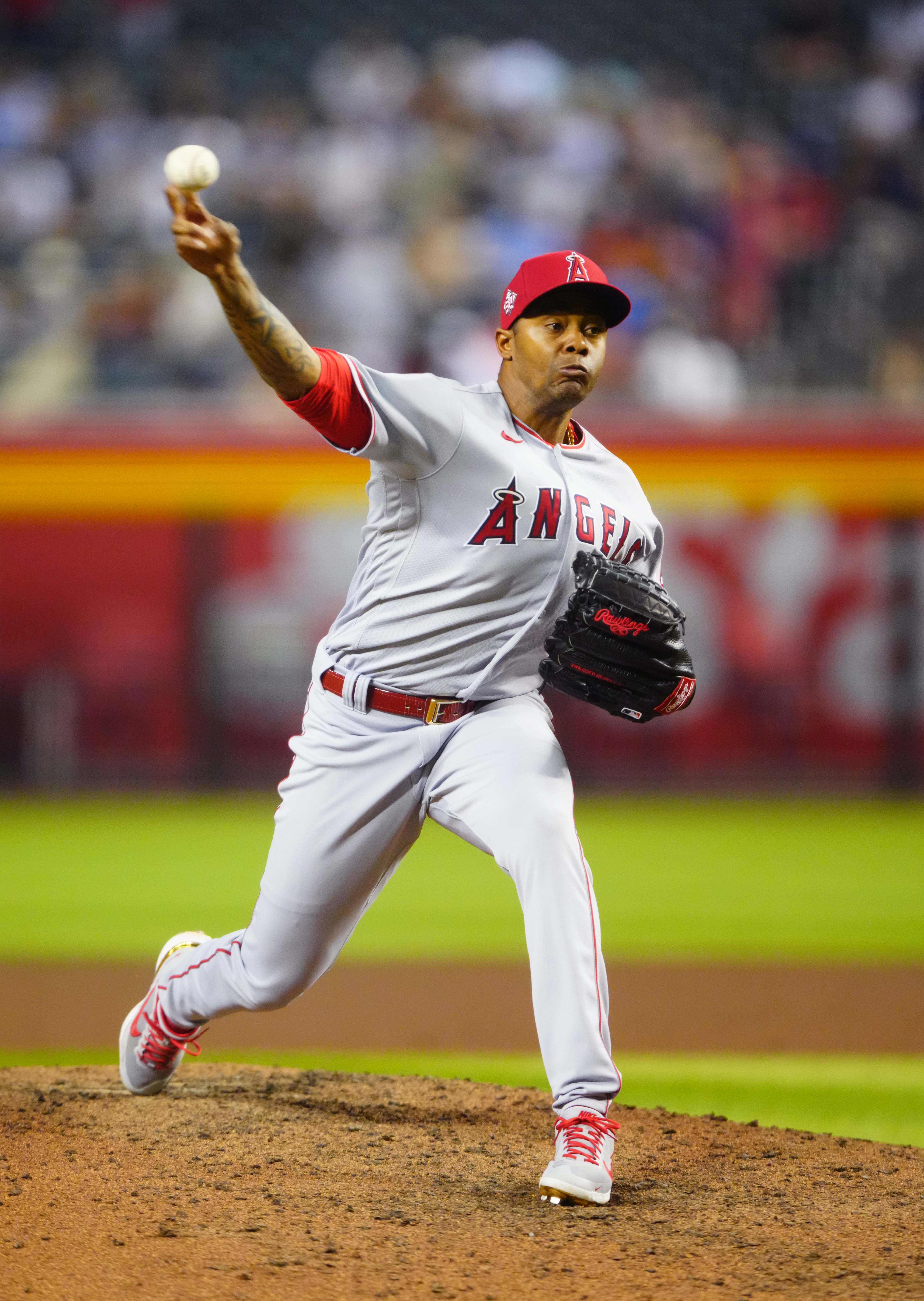
It’s a last-second surprise to bring one the game’s most established late-inning relievers to an already deep Atlanta bullpen. Iglesias has tailed off since an outstanding start to the season but still possesses a reasonable 4.04 ERA with an excellent 32.9% strikeout rate and a 6.2% walk rate so far this season. Dating back to 2017 — Iglesias’ first as a full-time closer (then with the Reds) — he’s pitched to a combined 2.99 ERA while striking out 32% of his opponents against just a 7.1% walk rate.
Iglesias’ 95.3 mph average fastball is down about a mile per hour over the 2021 season, and his 14.9% swinging-strike rate is the second-lowest mark he’s posted as a full-time reliever. Those are both at least minor red flags, particularly when paired with his recent slump, but for most of the season Iglesias has looked the part of a quality leverage reliever, even if his numbers have dipped a bit from last year’s career-best performance.
Braves GM Alex Anthopoulos has a history of acquiring high-priced closers. He recently shipped out the marginalized Will Smith, the top reliever from the 2019-20 free agent class, for starter Jake Odorizzi. In March of this year, he signed Kenley Jansen to a one-year, $16MM deal. The Iglesias trade is reminiscent of a Braves deadline deal from three years ago, when Anthopoulos acquired Mark Melancon from the Giants and was surprisingly willing to take on all of his remaining contract. In Iglesias, the Braves take on over $51MM through 2025. Anthopoulos explained today, “We had a lot of things in the works. Iglesias is someone we had our eye on and it came together really late, like with two minutes to go.”
The Braves now boast a high-priced tandem to close out games in Jansen and Iglesias, as well as A.J. Minter, Collin McHugh, and Tyler Matzek. Rookie Dylan Lee is making an impact as well, succeeding in high leverage spots of late.
For the Angels, the Iglesias deal serves as an escape hatch from an expensive contract. Ultimately the Angels will only pay out about 11% of the contract they entered into eight months ago. The Angels are in an odd place, as they’ll fail to reach the playoffs for the eighth consecutive year. They shed over $58MM in contractual commitments for Iglesias and Noah Syndergaard today, yet they owe over $75MM to Mike Trout and Anthony Rendon next year and only control MVP candidate Shohei Ohtani for two more seasons.
Angels owner Arte Moreno allowed GM Perry Minasian to listen to offers for Ohtani in recent weeks, but decided not to pull the trigger. Ohtani’s future, and the direction of the Angels in general, will be a question looming over their offseason.
Aside from bailing on a large financial commitment, the Halos add Davidson, a 26-year-old southpaw with Major League experience. Prior to the season, Baseball America considered Davidson a 45-grade prospect, a potential back-end starter with perhaps three average pitches. Currently working in his third and longest stint at Triple-A, Davidson has a 4.59 ERA owing to a high home run per flyball rate, but he’s got a strong 20.9 K-BB%.
Chavez, soon to turn 39, returns to the Angels after spending the 2017 season with the team. The Angels are one of nine teams for which the veteran reliever has pitched in his venerable 15-year career.
Red Sox Acquire Eric Hosmer
The Padres and Red Sox have announced a trade that will send first baseman Eric Hosmer to the Red Sox along with prospects Corey Rosier and Max Ferguson, as well as cash considerations. In exchange, the Padres will receive pitching prospect Jay Groome. According to Alex Speier of the Boston Globe, the cash considerations are actually about $44MM, with the Padres paying down the remainder of Hosmer’s contract, apart from the league minimum.

Hosmer previously exercised his partial no-trade clause to veto a deal to the Nationals, temporarily throwing a wrench into the Juan Soto negotiations. The Padres/Nats Soto blockbuster was completed anyhow, sans Hosmer, and Hosmer is now heading to Boston instead.
It’s a fairly stunning sequence of events, but the Red Sox will take advantage of San Diego’s willingness to pay the freight on Hosmer’s underwater contract and take a low-cost look at a former All-Star who’ll help solidify a position of need in the lineup. Boston has been pairing Franchy Cordero and Bobby Dalbec at first base for much of the season, often to disastrous results, and Hosmer should shore up some of the miscues that have become common in the Boston infield. Defensive metrics have never agreed with Hosmer’s four Gold Glove Awards, but even still, he gives the Sox a more solid option than Cordero, who’s made eight errors and been rated five outs below average in just 316 innings (per Statcast) while trying to learn first base on the fly in the Major Leagues.
Bringing Hosmer into the fold in many ways serves as a roadblock to top prospect Triston Casas, though the Sox could certainly have the two split time between first base and designated hitter. It does figure to tamp down rumblings of Rafael Devers eventually moving across the diamond from third base to first base, however, as Hosmer is now penciled in as the primary option at first for the next several seasons.
Hosmer, a former All-Star and 2015 World Series champion, is in the fifth season of an eight-year, $144MM contract signed with the Padres prior to the 2018 season. The deal was near-universally panned at the time of signing and fell into albatross territory almost immediately. Hosmer hit a combined .259/.316/.412 through his first 1344 plate appearances in San Diego — about six percent worse than league-average over that span by measure of wRC+ (which, notably, weights for league context like the juiced-ball season in 2019).
To Hosmer’s credit, his offense has improved a bit over the past three seasons. As leaguewide production has trended downward following the 2019 homer boom, Hosmer has maintained a .273/.336/.411 batting line from 2020-22, which clocks in about seven percent better than average.
That’s still not what the Friars had in mind when signing him to a frontloaded eight-year deal with an $18MM annual value, of course, and Hosmer’s tepid production has pushed the Friars to explore trades for him for more than a year now. In the past, the goal was to find a taker for Hosmer and the bulk of his contract — likely by attaching him to a top prospect — but things have now reached the point where the Padres are simply willing to eat a notable portion of the contract to free up the roster spot for a more productive hitter in Josh Bell, who was acquired alongside Soto.
In order to rid themselves of said albatross, they have parted with Rosier and Ferguson, whom Boston will acquire in exchange for taking Hosmer off the Padres’ hands. Rosier, 22, was a 12th round pick in last year’s draft. The outfielder had a sparkling debut in A-ball last year, hitting .390/.461/.585 along with 13 steals. This year, moving up to High-A, he’s hitting .263/.381/.396 with 33 swipes. Ferguson, 22, is an infielder who was selected in the fifth round last year. He’s split his time this year between A-ball and High-A, slashing .221/.365/.358.
While the Padres have long wanted to be rid of Hosmer’s contract for financial reasons, it seems they eventually gave up on those dreams, since they are eating effectively all of his contract. The club flirted with the luxury tax line all year, seemingly unwilling to cross it. However, the opportunity to get superstar players like Soto, Bell and Josh Hader seemed to be an opportunity too good to pass up, with the club now certain to pay the luxury tax for a second straight season.
Instead of financial relief, the Padres will receive a former first round pick, as Groome was selected 12th overall by the Red Sox in 2016. Baseball America considered him one of the top 100 prospects in the sport once upon a time, with Groome landing at #43 in 2017 and #83 in 2018. Unfortunately, Tommy John surgery wiped out his 2018 season and limited him to just four innings in 2019. That was followed by the pandemic wiping out the minor league seasons in 2020, meaning Groome hardly pitched at all for three straight seasons. He returned to the mound last year, pitching to a 4.81 ERA between High-A and Double-A. He’s shown improved results this year, however, throwing 92 2/3 innings between Double-A and Triple-A with a 3.59 ERA and 24.2% strikeout rate, though a high walk rate of 11.4%. He’ll add some pitching depth for the Padres, who just lost MacKenzie Gore in the Soto deal.
Jeff Sanders of the San Diego Union-Tribune first reported that Hosmer was headed to Boston. Ken Rosenthal of The Athletic first noted that Hosmer’s no-trade list didn’t include the Red Sox. Chris Cotillo of MassLive first reported that this would be a multi-player deal and that Rosier and Ferguson would be included (Twitter links). Robert Murray of FanSided first had Groome’s involvement. Alex Speier of the Boston Globe first reported that the Padres are sending about $44MM to the Red Sox.
Blue Jays Acquire Whit Merrifield
The Blue Jays announced they’ve acquired infielder Whit Merrifield from the Royals, with right-hander Max Castillo and minor league infielder Samad Taylor going to Kansas City,
The deal officially ends a run of more than a decade in the Kansas City organization for Merrifield, who entered pro ball as a 2010 draftee. He reached the big leagues in 2016 and had cemented himself as a regular by the following season. He’d spent the next few seasons as a top-of-the-order presence and consistently productive contact hitter. Merrifield twice led the American League in steals, twice more led the league in hits and was selected to a pair of All-Star Games. As recently as last season, he paced the circuit in doubles and swiped 40 bags, although his overall offensive output had begun to dip.
Merrifield’s production has continued to fall this year, as he’s amidst the worst offensive season of his career. He’s hitting .240/.290/.352 through 420 plate appearances, although that’s largely a reflection of a dismal April in which he hit .141/.190/.179. From May 1 onwards, he has a roughly league average .266/.315/.397 mark, striking out in only 14.9% of his plate appearances. He’s connected on just six home runs, but Merrifield brings a high-contact bat to the Jays lineup.
The 33-year-old is also a versatile defensive option capable of covering either of second base or in corner outfield. Public defensive metrics have been mixed on his performance at the keystone so far this season, but he’s typically a highly-regarded defender there. Santiago Espinal has had a nice season overall as the Jays primary second baseman, but he slumped offensively in July. Merrifield adds some cover there while also adding some extra right-handed depth to a bench that currently skews left-handed.
The Jays are a bit of a surprising destination for Merrifield, who was placed on the restricted list during a recent series while still with K.C. That indicates he wasn’t vaccinated against COVID-19 at the time — and was thus ineligible to cross the border — but Merrifield indicated he was open to receiving the vaccine to contribute to a playoff contender. General manager Ross Atkins declined to comment when asked about Merrifield’s vaccination status this evening (via Ben Nicholson-Smith of Sportsnet), but it’s difficult to imagine Toronto topping the trade market if they weren’t confident he’d be available for half their games.
Merrifield is under contract for another season and a half. He and the Royals agreed to a restructured deal just before Opening Day. He’s making $7MM this season, around $2.5MM of which is still to be paid out. He’ll receive a $6.75MM figure next season, and he’s due a $500K buyout on an $18MM mutual option for 2024. That’s a more than reasonable tab for the Jays if they believe Merrifield has put his rough April behind him.
Kansas City has resisted trade overtures on Merrifield for years, holding onto him throughout their recent rebuild. Amidst another down season and with his window of club control falling, however, president of baseball operations Dayton Moore and his staff finally made him available this summer. In exchange, they bring back a pair of young players with extended windows of club control who could contribute to the major league team shortly.
Castillo has already gotten to the big leagues, making his debut in mid-June. The 23-year-old righty has a 3.05 ERA through his first 20 2/3 frames, primarily working as a multi-inning option out of the bullpen. He’s punched out 24.7% of batters faced, induced grounders on more than half his batted balls, and only walked 6.2% of opponents. The Venezuela native has averaged around 93 MPH on his fastball and leaned heavily on his changeup during his limited big league time.
Baseball America recently named Castillo the #14 prospect in the Jays farm system, praising his feel for pitching and crediting him with average command. The outlet suggests his lack of a true plus offering is likely to relegate him to a back-of-the-rotation or swing role, but there’s still value in that kind of arm while he’s affordable. Castillo won’t reach arbitration-eligibility until 2025 at the earliest, and he still has all three minor league option years remaining. He gives the Jays an affordable rotation depth option for the coming seasons.
Taylor, 24, is an upper minors infielder. A former tenth-round pick, he’s played his way to Triple-A and had a decent season in Buffalo. Through 280 plate appearances, the righty-hitting second baseman owns a .258/.337/.426 line with nine home runs and 23 stolen bases. BA slotted Taylor 23rd in the Toronto farm system, writing that he could be a utility type in the big leagues. He’ll be eligible for the Rule 5 draft if he’s not added to the 40-man roster at the end of the season.
Mark Feinsand of MLB.com first reported the Royals were trading Merrifield, while Jon Heyman of the New York Post was first to report the Jays were the acquiring team. Feinsand was first with the return.
Image courtesy of USA Today Sports.
Yankees, Cardinals Swap Jordan Montgomery For Harrison Bader
The Cardinals are acquiring lefty Jordan Montgomery from the Yankees, tweet Ken Rosenthal and Lindsey Adler of The Athletic. Montgomery will be traded for Harrison Bader, reports Jack Curry of the YES Network. The trade, which has been officially announced by both teams, also includes a player to be named later or cash considerations going to the Yankees, conditional on Bader’s playing time as it pertains to the plantar fasciitis that sidelines him at present.
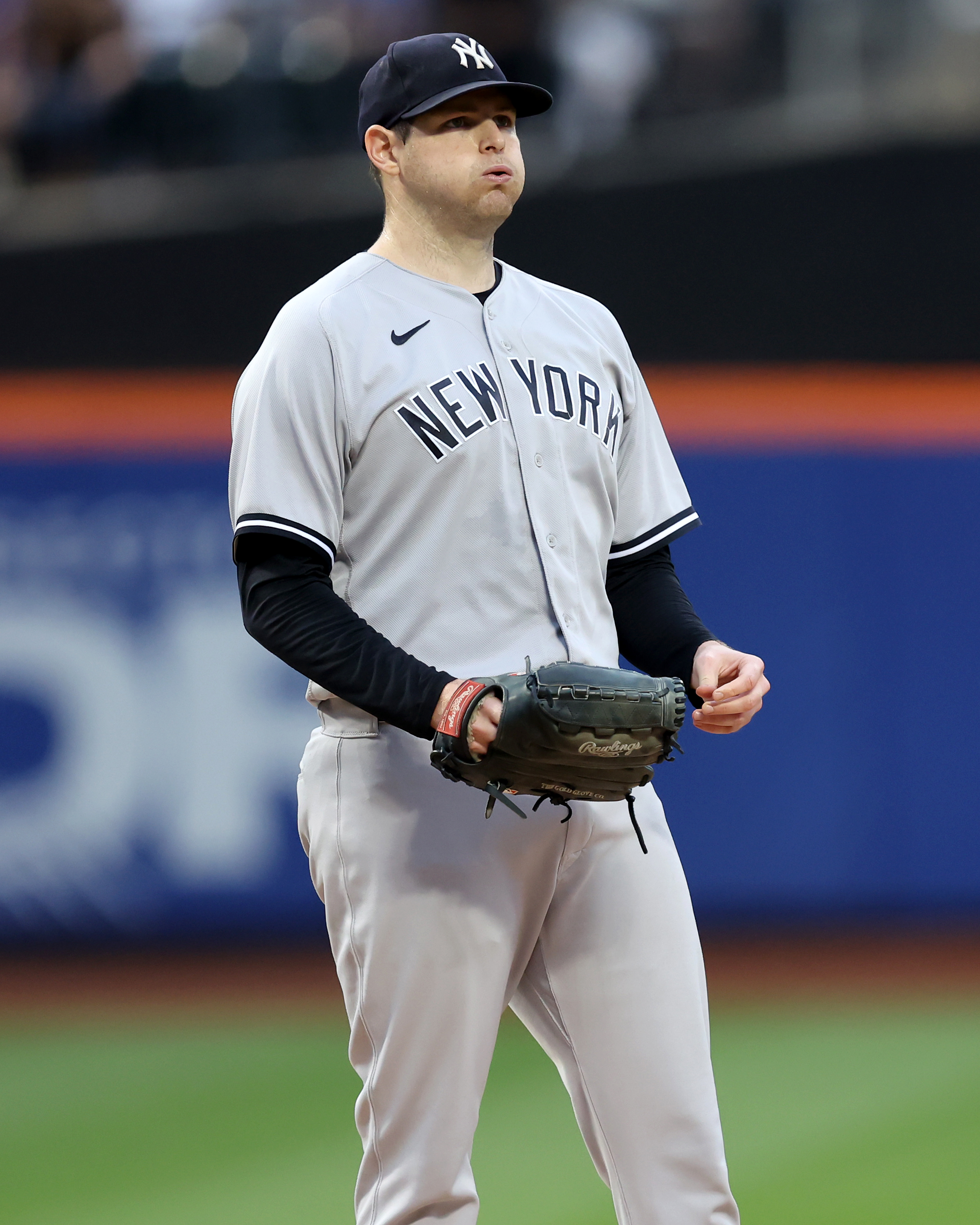
Montgomery, 29, is a big addition to the Cardinals’ rotation. The lefty, a fourth-round draft pick of the Yankees out of the University of South Carolina in 2014, finished sixth in the AL Rookie of the Year voting with a fine 2017 debut, but saw his career derailed by Tommy John surgery the following season. Since 2021, he’s settled in as a dependable member of the Yankees’ rotation, posting a 3.77 ERA in 272 innings across 51 starts. While Montgomery’s strikeout rate has been down this year, so too has his walk rate, and he’s continued to keep his ERA south of 4.00.
Montgomery is earning a reasonable $6MM this year, and he’s due a raise through arbitration in 2023 before becoming eligible for free agency. He was not necessarily thought to be available, but the Yankees just added Frankie Montas to the front of their rotation in a trade with the A’s. Montgomery fits in well with the Cardinals’ pitch-to-contact rotation, which currently features Adam Wainwright, Miles Mikolas, Dakota Hudson, rookie Andre Pallante, and recent addition Jose Quintana. Steven Matz, signed as a free agent in November, is out with a knee injury that could require surgery. Former ace Jack Flaherty won’t be eligible to return from a shoulder strain until late August. Looking ahead to 2023, Adam Wainwright may retire and Quintana could depart as a free agent, but everyone else remains under team control.
At present, the Cardinals sit three games back in the NL Central and are one game back from a wild card spot. In addition to Quintana and Montgomery, the Cardinals also added Chris Stratton to their bullpen via trade. The club reportedly expressed interest in many available starters before landing Montgomery, including Frankie Montas, Jake Odorizzi, Tyler Mahle, and Carlos Rodon. Bader hit the IL for plantar fasciitis in his right foot in late June, with Dylan Carlson starting in center field in his absence. Bader is currently in a walking boot for the injury. Evidently, the Cardinals felt Carlson can handle the gig for at least the remainder of the season. The Cardinals had been involved on Juan Soto, but reportedly hadn’t been willing to pair Carlson with their top prospects.
Bader, 28, is a native of Bronxville, New York, about 11 miles away from Yankee Stadium. He’s served as the Cardinals’ primary center fielder since 2018, when he finished sixth in the NL Rookie of the Year voting. Known for his defense, Bader picked up his first Gold Glove last year and finished second in the Fielding Bible awards voting. Bader’s wRC+ sits at 93 this year, but he was at 111 over 526 plate appearances from 2020-21. Bader, one of the speedier center fielders in the game, was limited to 103 games in 2021 due to a forearm strain and a rib fracture.
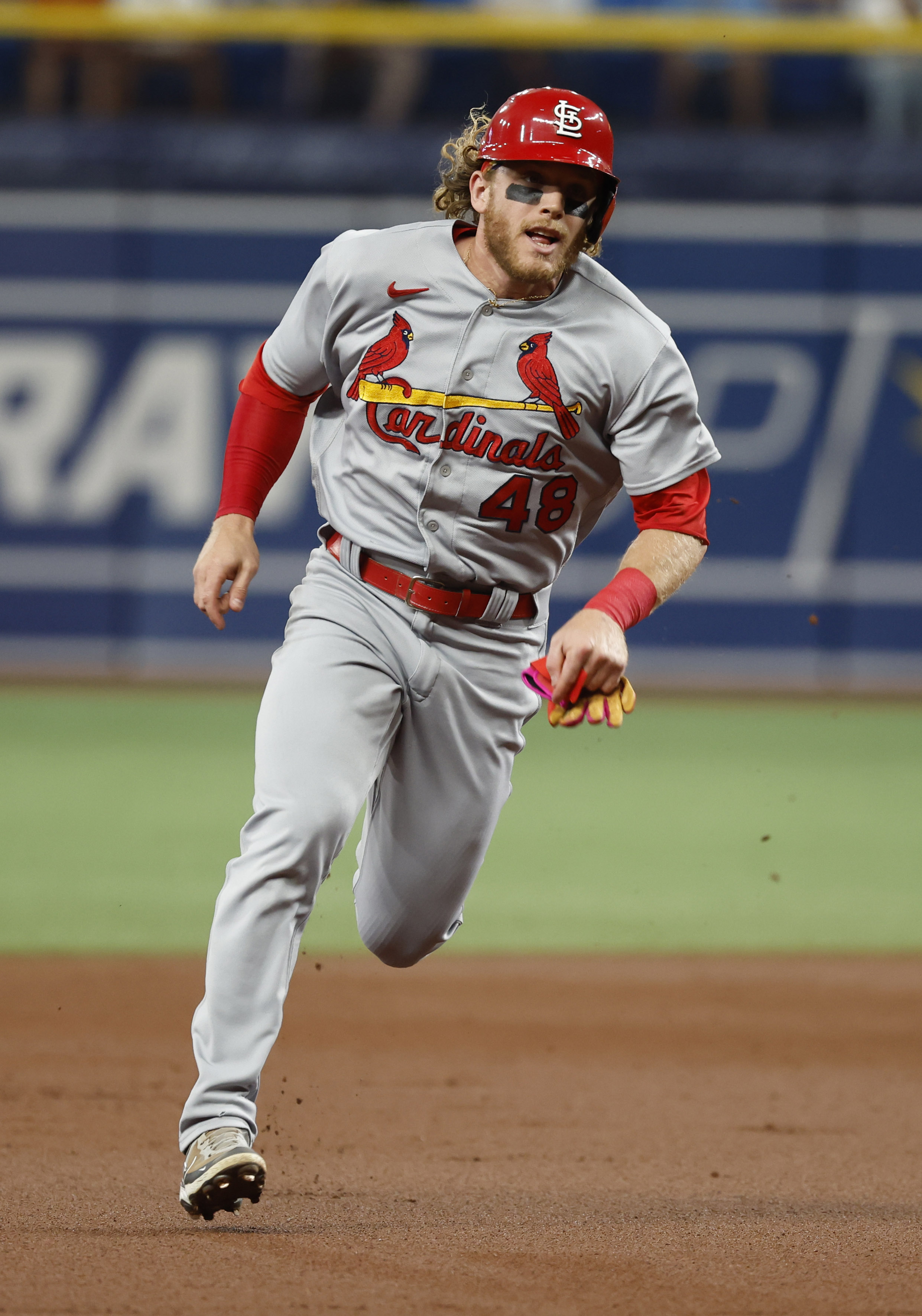
The Yankees have deployed the oft-injured Aaron Hicks as well as MVP frontrunner Aaron Judge in equal proportions in center field thus far this year. Once Bader and Giancarlo Stanton are healthy, Hicks figures to see his playing time reduced. The Yankees also recently added a new left fielder via trade, picking up Andrew Benintendi from the Royals.
Like Montgomery, Bader is under control through 2023. However, due to a two-year extension signed in April, Bader’s salary was locked in at $4.7MM for both the 2022 and ’23 seasons, plus performance bonuses. The Yankees will trim several million dollars off next year’s payroll compared to what Montgomery is projected to earn.
In parting with Montgomery, the Yankees have weakened their rotation for the remainder of the 2021 season, seemingly locking Domingo German into the fifth spot until Luis Severino is able to return. With a 12-game lead in the AL East, that difference hardly matters. Montgomery’s loss could be felt in the playoffs, especially if Severino isn’t able to build back up to a starting role, but evidently the Yankees feel the eventual defensive upgrade in center field is a net win. The decision has, at least, elicited some “head-scratching” within the Yankees’ organization, according to Erik Boland of Newsday.
Mets To Acquire Mychal Givens
The Mets have agreed to acquire right-handed reliever Mychal Givens from the Cubs, SNY’s Andy Martino tweets. Righty Saul Gonzalez is going back to the Cubs, the teams announced upon confirming the deal.
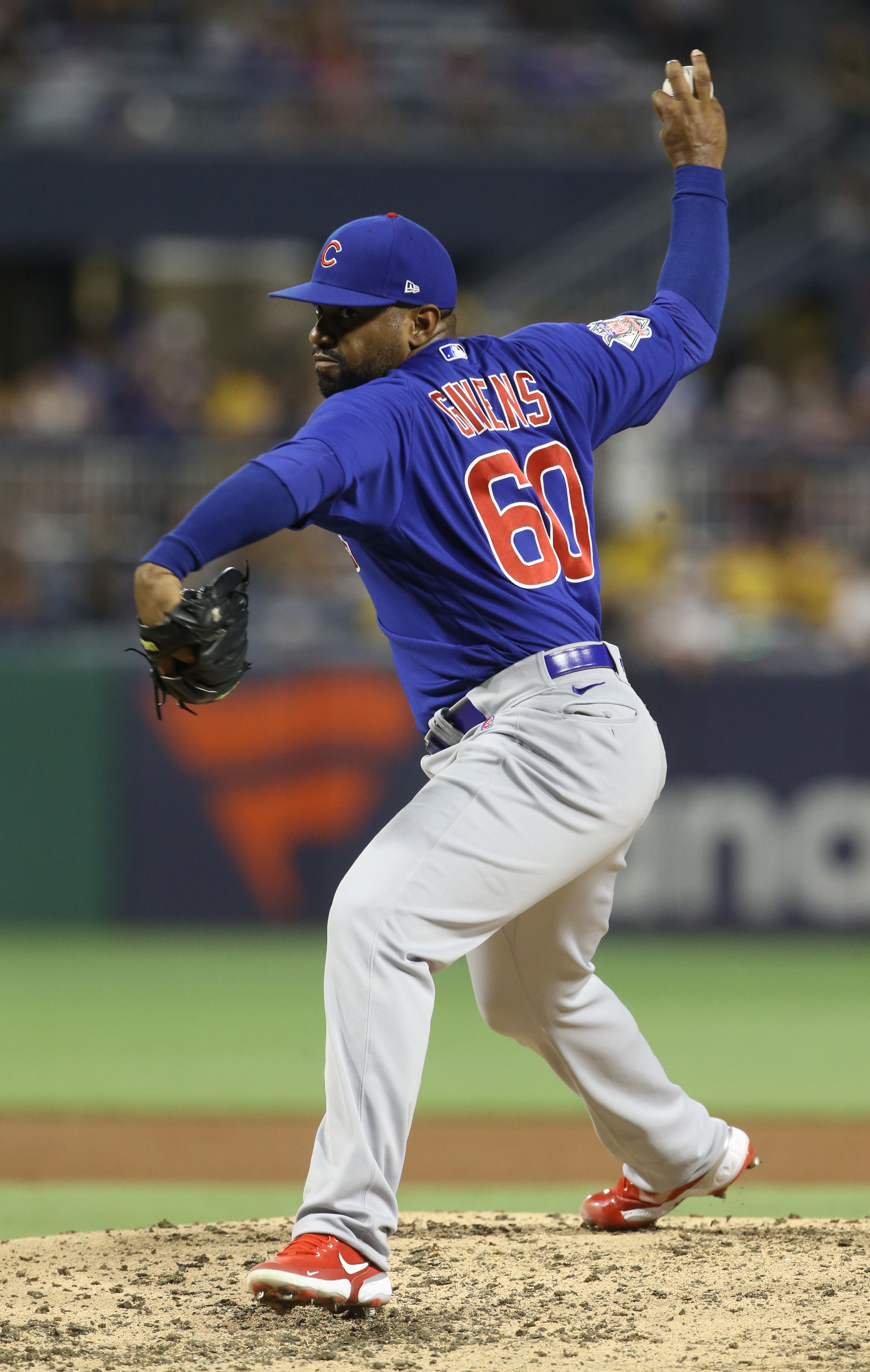
Givens, 32, pitched well for the Cubs this year with a 2.66 ERA, 29.7 K%, 11.0 BB%, and 41.4% groundball rate in 40 2/3 innings. The Cubs signed the longtime Orioles veteran as a free agent to a $5MM deal in March.
The Cubs spent a total of $12.75MM on Givens, David Robertson, Chris Martin, and Daniel Norris. Norris was released in late July, but otherwise the Cubs’ investment (of which they’ve only paid out two-thirds) has netted them the aforementioned Saul Gonzalez as well as pitching prospect Ben Brown from the Phillies in the Robertson deal plus utility man Zach McKinstry from the Dodgers for Martin. The Cubs also added Hayden Wesneski from the Yankees for Scott Effross, a 15th round draft pick of theirs in 2015. The Cubs’ trade deadline is perhaps more notable for who they did not trade, with Willson Contreras and Ian Happ staying put.
For the Mets, Givens joins a bullpen headed by Edwin Diaz, Adam Ottavino, Drew Smith, and Seth Lugo, with rookie Colin Holderman having been sent to Pittsburgh in the Daniel Vogelbach deal. Smith hit the IL last week with a lat strain, while veteran Trevor May will rejoin the Mets tomorrow after missing three months due to a stress reaction in his right humerus. The Mets also have Tylor Megill on the mend, who stands a good chance of working out of the bullpen when he’s able to return from a shoulder injury. Givens is reunited with manager Buck Showalter, under whom he pitched for the first four years of his career, as well as former Orioles teammate Tommy Hunter.
Mets GM Billy Eppler opted for a modest trade deadline after an active offseason, with his team sitting 3.5 games ahead of the Braves in the NL East. The Mets acquired a new DH platoon of Vogelbach and Darin Ruf, also adding utility outfielder Tyler Naquin and reliever Phillip Diehl. The biggest addition may be ace Jacob deGrom, currently making his season debut at Nationals Park against a depleted Nationals lineup. The rival Braves went notably bigger in their bullpen augmentation, adding the pricey Raisel Iglesias in a deal with the Angels.
The pitching prospect the Cubs netted in this trade, Gonzalez, is a 22-year-old righty born in Puerto Rico. The Mets drafted him in the 23rd round back in 2018, and he spent the season working out of the bullpen of the organization’s A-ball affiliate. It’s been a successful 25 2/3 innings for Gonzalez, who sports a 26.7 K% and 6.7 BB%.
Phillies Acquire Noah Syndergaard
The Phillies have announced that they have acquired Noah Syndergaard from the Angels. Outfielders Mickey Moniak and Jadiel Sanchez will head to Los Angeles in return.
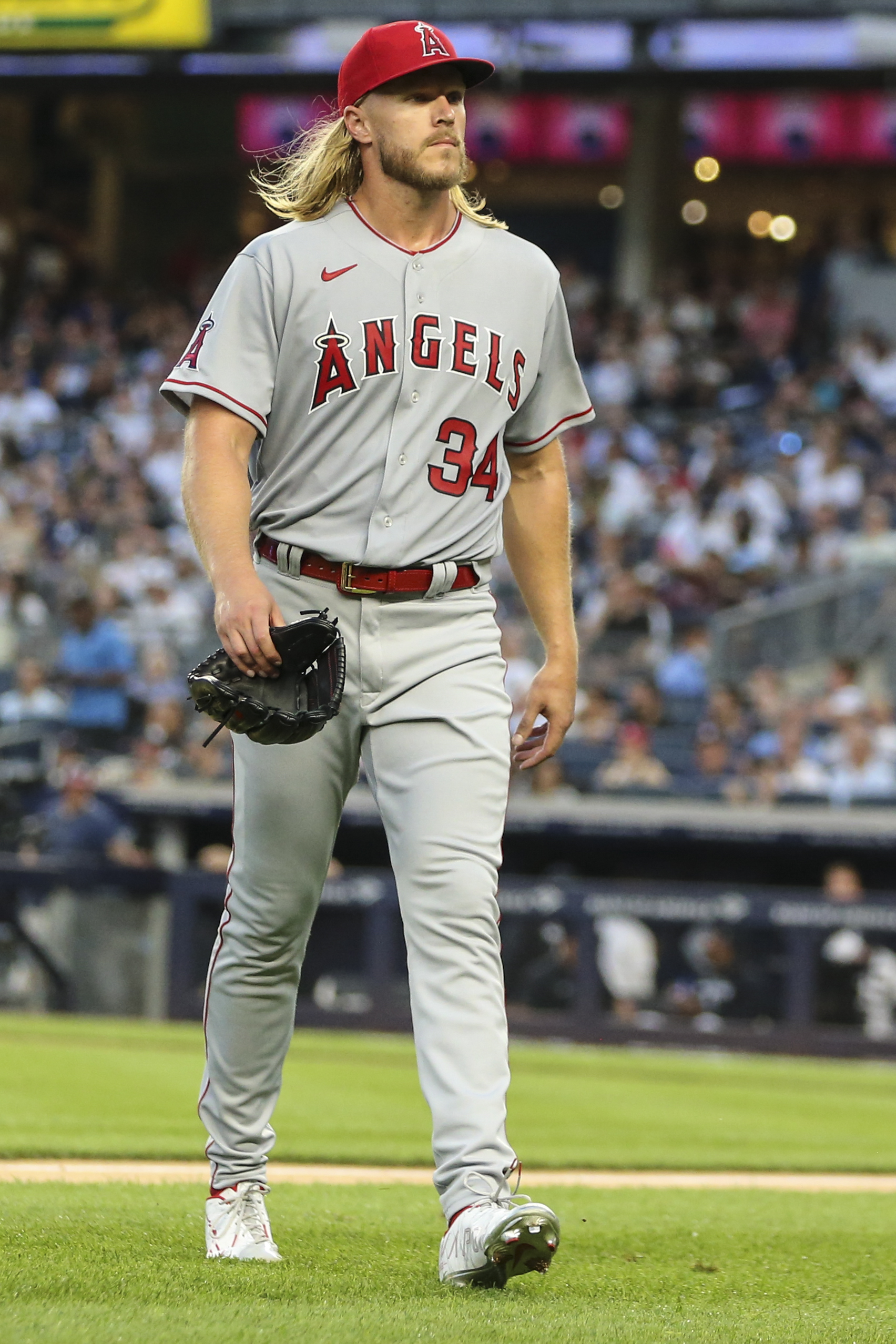
With the Phillies in the thick of a playoff race and the Angels well out of it, they make good trade partners. In fact, this is the second deal of the day between the Angels and Phillies, after they already swapped Brandon Marsh for Logan O’Hoppe.
Syndergaard, 29, was an excellent pitcher for the Mets from 2015 to 2019, with a 3.31 ERA in that time along with a 49.1% ground ball rate, 26.4% strikeout rate and 5.6% walk rate. Unfortunately, Tommy John surgery wiped out his 2020 and almost all of his 2021, with “Thor” returning to pitch just two innings late in the season.
Despite almost no action for two years, the Mets extended an $18.4MM qualifying offer to Syndergaard, which he turned down. The Angels decided to bet on his previous track record and signed him to a one-year, $21MM deal, also surrendering a draft pick in the process.
Syndergaard is having a quality season for the Halos, though not quite up to his previous standard. Through 15 starts and 80 innings on the year, he has a 3.83 ERA, 44.9% strikeout rate, 6.5% walk rate but much-diminished 18.9% strikeout rate. His velocity isn’t quite as strong as before and that strikeout dip is significant, but he’s still filling up the strike zone and keeping runs off the board.
For the Phillies, their rotation has been without Zach Eflin for the past month or so due to a knee injury, and he was transferred to the 60-day injured list earlier today. Syndergaard will take his spot in the rotation next to Aaron Nola, Zack Wheeler, Kyle Gibson and Ranger Suarez.
For the Angels, Moniak essentially becomes a replacement for Marsh, who was dealt to the Phillies earlier today. The first overall pick of the 2016 draft, he hasn’t quite lived up to his prospect hype thus far. In 162 career games over the past three seasons, he’s slashed just .129/.214/.172. However, he can still be optioned for the remainder of this season and another season as well, meaning the Angels can give him plenty of time in Triple-A to try to get back on track. He also had less than a year of MLB service time coming into this season, meaning they can keep him on the team for years to come.
As for Sanchez, 21, the switch-hitting outfielder was selected by the Phillies in the 12th round of the 2019 draft. He landed the #19 spot on Baseball America’s list of top Philly prospects at their most recent update, with BA noting his excellent exit velocity in the minors. In 38 A-ball games this year, he’s hitting .236/.286/.429, wRC+ of 101.
Ken Rosenthal of The Athletic first reported that the Phillies were close to a deal for Syndergaard. Jayson Stark, also of The Athletic, was first on the return (Twitter links).
Twins Acquire Michael Fulmer From Tigers
The Twins announced they’ve acquired reliever Michael Fulmer from the Tigers. Pitching prospect Sawyer Gipson-Long is headed back to Detroit.
Fulmer is one of the better rental relievers available on the summer market. The 29-year-old has worked to a 3.20 ERA across 39 1/3 innings, his second straight season with strong run prevention. Fulmer’s 23.1% strikeout rate and 11.5% swinging strike percentage are more solid than great, but he’s consistently done an excellent job keeping the ball in the yard.
Minnesota can’t count on Fulmer sustaining this season’s 2.2% HR/FB rate, but he also did well to avoid hard contact last year. He’s induced plenty of infield fly balls over the past couple seasons, and he’s held opposite-handed hitters to a woeful .190/.256/.298 line on the season. That’s no doubt appealing to a Minnesota club that only has Jovani Moran as a left-handed bullpen option with Caleb Thielbar on the injured list.
Fulmer is an impending free agent, so he’s a pure stretch run play with the Twins a game ahead of the Guardians in the AL Central. He’s not as impactful an addition as this morning’s pickup of All-Star closer Jorge López from Baltimore, but he becomes a much-needed extra boost to a relief corps that has been the club’s Achilles heel. Fulmer is making $4.95MM, around $1.8MM of which is still to be paid out.
Detroit picks up a 6’4″ right-hander in the deal. Gipson-Long was a sixth-round pick out of Mercer in 2019. He’s split the year between High-A Cedar Rapids and Double-A Wichita, thriving at the former destination while struggling at the latter. Overall, he owns a 4.23 ERA across 87 1/3 innings with a decent 24.2% strikeout rate and a minuscule 5.3% walk percentage.
Jon Heyman of the New York Post first reported the Twins were acquiring Fulmer. Mark Feinsand of MLB.com reported that Detroit would receive Gipson-Long in return.