
The Royals’ Breakout Reliever Should Draw Trade Interest
Heading into deadline season, the Royals’ stance as sellers was obvious — painfully so, for Kansas City faithful. Confirmation of that fact was hardly needed, but the Royals’ early trade of Aroldis Chapman to the Rangers cemented their already obvious status. The widespread expectation is that closer Scott Barlow will be marketed to other clubs over the next couple weeks, and even in something of a down season (by his high standards), his track record and affordable price tag should place him in demand.
The Royals aren’t exactly deep in straightforward trade candidates elsewhere on the roster. Zack Greinke is on the injured list at the moment and seems content to wind down his career in the place where it all began. Offseason signees Jordan Lyles and Ryan Yarbrough haven’t performed well. Last year’s breakout starter, Brady Singer, has regressed significantly. Infielder Nicky Lopez could change hands but would be viewed as a light-hitting utilityman by most contending clubs. He’s not likely to fetch a big return. Royals GM J.J. Picollo has made clear he has no intention of trading Salvador Perez, and Perez has full no-trade rights anyway. Kansas City just released Amir Garrett, who might’ve been an appealing rental trade candidate were it not for a sky-high 17.9% walk rate.
There’s at least one other reliever in the Royals’ bullpen who deserves some attention, however, even if he’s far from a household name. After three seasons floundering while bouncing between the rotation and bullpen, right-hander Carlos Hernandez has stepped up as a setup man to Barlow (now that Chapman’s been traded anyway) and looks the part of an impact late-inning arm.
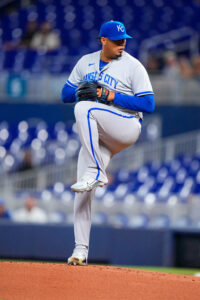
Hernandez, 26, doesn’t exactly have numbers that leap out at first glance. His 3.86 ERA is a bit better than the league-average 4.13 ERA for relievers. His 28.5% strikeout rate is well above-average but isn’t quite elite. Ditto for his 7% walk rate.
A closer look at Hernandez, however, reveals quite a bit more to like. After sitting 97.1 mph with his fastball from 2020-22, he’s up to a massive 99.2 mph in 2023. That places him fifth among all relievers, trailing only Jhoan Duran, Jordan Hicks, Felix Bautista and the aforementioned Chapman. Hernandez is sitting on a 14.5% swinging-strike rate and huge 36% opponents’ chase rate on pitches off the plate — both considerably better than the respective league averages of 11.1% and 31.7%. He’s also excelled at keeping the ball in the yard, yielding just three homers in 46 2/3 innings — and none since April 22.
That’s not the only reason that Hernandez’s April game log is worth taking a closer look at. Five of the 20 earned runs he’s allowed this season came in a single outing that month — a brutal drubbing at the hands of the Rangers on the 18th. Hernandez used his curveball at a season-high 21.4% that day. Since that time, he’s largely shelved the pitch, instead leaning more on his improved fastball, his slider and his splitter.
Through April 18, Hernandez was throwing his curve a bit less than 15% of the time. Since then, he’s thrown the pitch at just a 5.1% clip — including a lowly 2.8% rate dating back to mid-June. Since narrowing his arsenal and ramping up the usage of his heater in mid-April, he’s sporting a 3.12 ERA with a 1.90 FIP, 31% strikeout rate and 5.8% walk rate.
That’s not to say the curveball was necessarily the source of his early struggles in and of itself, but the more focused arsenal and elevated use of his fastball have clearly paid dividends. In general, a reliever scrapping his fourth-best pitch to lean more heavily into his best offering is good practice. And, Hernandez still has an effective splitter to keep lefties off balance and a quality slider he uses against righties. It’s a nice recipe for success, evidenced by southpaws hitting just .195/.247/.276 against him and righties hitting only .202/.258/.345. Handedness hasn’t mattered much for Hernandez this year; he’s been good against everyone.
The Royals don’t need to feel any pressure to trade Hernandez. Beyond the fact that he’s just 26 years of age, he entered the year with one year, 145 days of Major League service time. He’ll pass two years this season and finish out the year at 2.145 years of service. That’ll put him in line as a surefire Super Two player, making him arbitration-eligible four times rather than three, but his salary in 2024 will be minimal — likely in the $1MM range. Furthermore, that limited service time means he’s under team control all the way through the 2027 season.
That said, reliever performance is volatile on a year-to-year basis, and pitchers in general carry greater risk of major injury than their position-player counterparts. And, the four-plus years of club control and minimal salary commitment required in the short-term only makes Hernandez more intriguing to clubs looking for bullpen help not only this year but beyond.
It’s rare but not unheard of for teams to trade relievers with this type of club control; the Cubs traded five years of righty Scott Effross to the Yankees just last summer and received a largely MLB-ready starting pitcher, Hayden Wesneski, in return. Granted Wesneski hasn’t exactly cemented himself in the Chicago rotation, but getting six-plus years of control over a generally well-regarded, MLB-ready prospect was still a strong return for a controllable reliever.
Hernandez has one less year of club control but is arguably equally or even more desirable. He’s two years younger now than Effross was last year and has the type of power arsenal that tends to tantalize modern front offices. Effross did not (91 mph average fastball). It’s certainly plausible that a team would be willing to part with potentially impactful, near-MLB talent to secure four-plus seasons of a 26-year-old with baseball’s fifth-hardest fastball, minimal platoon concern and rapidly improving results.
Broadly speaking, this is the type of trade the Royals have been unwilling to make in recent years. They’ve held onto the majority of their controllable talent even through ongoing rebuilding efforts. For instance, Whit Merrifield drew trade interest for years before the Royals finally traded him last summer, only to command a much lesser return than he otherwise might have had they pulled the trigger a couple seasons prior. The Royals waited until Danny Duffy was a rental player on the injured list to move him at the deadline. They’ve frequently preferred to keep controllable players they feel can contribute to the next contending club, but that contending season has yet to come around (arguably in large part because they’ve opted not to sell controllable pieces at peak value).
That trend, however, was a hallmark of the Dayton Moore-led Royals, and Moore was dismissed from his position as president of baseball operations last year. The Royals stayed in house to replace him, elevating Picollo to the top spot in the baseball operations department, so perhaps he’s philosophically cut from the same cloth as his predecessor and longtime colleague. But we’ve yet to see a full deadline of Picollo at the helm in Kansas City, and it’s at least possible he’ll run things a bit differently.
Even if the Royals don’t want to trade Hernandez, they ought to listen to what other clubs have to say. There’s little doubt that he’ll draw considerable interest, given his breakout and the wide swath of teams in search of bullpen help. For a Royals club with needs all around the diamond and little in the way of meaningful trade chips to peddle on a flawed roster, Hernandez’s well-timed breakout could be an unexpected means of addressing at least one of those needs sooner than later.
Image courtesy of USA Today Sports.
Big Hype Prospects: Crews, Skenes, Amador, Hampton, Mauricio
Nobody runs a stronger Top 100 prospects list than Baseball America. Today, we’ll look at some key updates to their mid-season list that have yet to be reflected by other public outlets. We’ll also check in on recent draftees.
Five Big Hype Prospects
Dylan Crews, 21, OF, WSH (CLG)
258 PA, 18 HR, 6 SB, .426/.567/.713
Crews leads the 2023 draft class, ranking fourth overall among the Top 100 prospects in the game. He’s basically tied with future teammate James Wood. The Nationals have the foundation of a potent outfield in the near future.
If there’s a knock on Crews, it’s a possible weakness to pro-caliber breaking balls. Perhaps the only challenge left to him before his Major League debut is coping with pitchers who can precisely command breaking stuff. Otherwise, he’s a premium all-fields power hitter who can stick in center field. Given the potency of his bat, he’s still valuable as a corner outfielder.
Paul Skenes, 21, SP, PIT (CLG)
122.2 IP, 15.3 K/9, 1.5 BB/9, 1.69 ERA
Skenes outclassed college hitters in a batter-friendly run environment. He’s considered more or less Major League ready and could debut whenever Pittsburgh is ready for him. Between his heavy college workload and violent delivery, don’t expect that to happen this year. The recent trend is to shut down heavy workload college pitchers in their draft year. Skenes’ fastball is a weapon, regularly hitting triple-digit velocity with arm-side run and carry. He’s deadly working up-and-in to right-handed hitters. Southpaws won’t enjoy facing him either. He throws multiple breaking balls and features a quality changeup – a pitch that was all but unnecessary to his college dominance.
Adael Amador, SS, 20, COL (A+)
259 PA, 9 HR, 12 SB, .302/.391/.514
A personal miss of mine, Amador wasn’t much to look at last year despite strong results. We often see players of this ilk thrive in the low minors only to fade as they climb the ladder. It’s a discipline over physical skills profile, though the physical side of his game has improved enough to project a future starting role. Previously, I viewed him as a future oft-used utility guy based on his public measurables. My scouting contacts backed up that assessment with their visual impressions. Amador still primarily makes pulled, ground ball contact. He’ll need to develop more lift in order to make the most of his skills.
Chase Hampton, 21, SP, NYY (AA)
(A+/AA) 74.2 IP, 13.3 K/9, 3.0 BB/9, 3.13 ERA
An afterthought on Yankees lists entering this season, Hampton is sprinting through the minors. He’s added velocity to a five-pitch repertoire of effective offerings. He’s passed Will Warren within the system. Pitchers with at least four average pitches and 50-grade command tend to have long careers (health allowing). The Yankees haven’t shown the best feel for finishing their pitching prospects in recent years – perhaps inspiring their willingness to deal J.P. Sears, Ken Waldichuk, and Hayden Wesneski at the deadline last season. Hampton is seemingly a cut above.
Ronny Mauricio, 21, SS, NYM (AAA)
358 PA, 14 HR, 14 SB, .299/.344/.512
Whether or not you play fantasy baseball, there’s something attractive about guys who mash dingers and raid forts. Mauricio produces wild exit velocities – 92.0 average and 115.8 max. That’s all the more impressive when we consider his Baez-ian discipline. Like early-career Baez, his ability to square pitches out of the zone helps him to recover for objectively abysmal discipline. At this stage of his career, he doesn’t flash Baez’s superlative defensive feats. Had the Mets played as expected, Mauricio is probably traded in the upcoming weeks. As it stands, he should receive an audition at second base before long.
Three More
Ethan Salas, SDP (17): Salas, whom we profiled in more depth last week, jumped from the mid-50s to 18th on the BA Top 100. A precocious defender, the rapid development of his bat has caught even his most ardent supporters by surprise. Few players generate half this much excitement in their age 16 season. How he handles his growing fame will prove instructive.
Sal Frelick, MIL (23): While I’ve soured on Frelick, BA is enthused with a 32nd ranking. Their short blurb references the reason why I’m concerned – a lack of authoritative contact. His 85.2 average and 106.5 max exit velocities are well below average in a year when most guys have artificially inflated Triple-A EVs. The discipline remains pristine.
Wyatt Langford, TEX (22): The other draftee who was widely considered a first-overall caliber prospect, Langford might manage to outhit Crews. However, he’s miles behind defensively despite comparable physical ability. FanGraphs offers a fun comp – Pat Burrell with a jetpack.
Did I miss a detail or nuance? DM me on Twitter @BaseballATeam to suggest corrections.
The Guardians’ Other Potential Rotation Trade Chip
The Guardians have made a habit of moving productive veteran starting pitchers over the past few seasons. Cleveland’s excellent pitching development pipeline has allowed them to consistently backfill the rotation with younger, cheaper starters while adding other MLB talent in trades that sent Corey Kluber, Trevor Bauer and Mike Clevinger elsewhere.
Cleveland graduated another trio of top young pitching talents this year. Tanner Bibee, Gavin Williams and Logan Allen have all gotten to the big leagues and found immediate success. There was some related speculation about the Guardians dealing former Cy Young winner Shane Bieber this summer as a means of adding upper level hitting talent.
That no longer appears viable. Bieber is being shut down from throwing for a couple weeks because of forearm/elbow discomfort. While the club is optimistic he won’t require surgery, he’ll be on the injured list beyond the August 1 trade deadline. It’s hard to envision another team sending Cleveland anything approaching commensurate value for Bieber right now. An offseason deal or move at next year’s trade deadline (when he’d be an impending free agent) is the likelier scenario.
If Cleveland still has interest in balancing the roster by cashing in a starting pitcher, Aaron Civale now stands out as their top candidate. The 28-year-old righty has been an effective mid-rotation arm over parts of five big league campaigns, at least on a rate basis.
The former third-round draftee has started 73 games at the MLB level. He’s worked 410 2/3 innings of 3.88 ERA ball. Civale 21.3% strikeout rate and 42.5% grounder percentage are a hair below league average, but he’s a plus strike thrower who tends to avoid hard contact. While it’s not an overpowering profile, a healthy Civale has been a quality #3/4 option in a rotation.

Civale hasn’t logged the kind of workload typically associated with an innings eater. Some of that is beyond his control. He wasn’t an established MLB starter until late in the 2019 season. He stayed healthy in 2020 but the season was shortened, limiting everyone to 12-13 starts. Civale has lost chunks of the last three years to injury, however, only topping 100 MLB frames once.
In 2021, it was a sprained right middle finger that cost him two months. He lost a few weeks apiece to glute soreness, a right wrist sprain and forearm soreness last season. This year, a left oblique strain took him out of action for around seven weeks between mid-April and the start of June.
While the nagging health issues have kept Civale from amassing a huge workload, they haven’t impacted his per-start performances. His 10 starts this year look much the same as his overall body of work. He owns a 2.65 ERA through 57 2/3 frames, just under six innings per start. Opponents are only hitting .245 on balls in play, which is likely to tick back up closer to the .281 career mark he carried into 2023. Once a few more batted balls drop for hits, Civale should project as the upper-3.00s ERA type he has been in his career.
His 19.7% strikeout rate is narrowly a personal low but not dramatically off his previous level. Despite the slight dip in whiffs, Civale is throwing a little harder this year than in seasons past. He’s averaging 88 MPH on his cutter and narrowly above 92 MPH on his sinker and four-seam, all of which are slightly above his previous career highs.
Those are relatively minor variations. Civale isn’t a burgeoning ace, but he’s a good major league pitcher. He throws strikes and mixes four pitches effectively to keep off barrels. He is solid against hitters from both sides of the plate, keeping lefties to a career .227/.278/.400 line and same-handed opponents to a .255/.307/.439 slash. Aside from the aforementioned injury concerns, the Northeastern product looks like a solid middle or back-end starter.
There’s value in stability. That’s especially true given his affordability. Civale is playing this season on a modest $2.6MM arbitration salary. He’ll go through that process twice more before reaching free agency after the 2025 campaign.
That control window means Cleveland doesn’t simply have to take the best offer this summer. Even as one of the game’s lowest-payroll franchises, the Guardians could retain Civale without issue financially. Yet they’re likely to have a fair bit of starting pitching depth going into next season, particularly if they hold onto Bieber.
Triston McKenzie and Cal Quantrill will hopefully be past injury-riddled ’23 campaigns. Bibee, Allen and Williams could all be rotation fixtures, perhaps with higher upside than Civale possesses. It is tough to rely on Daniel Espino at this point given his shoulder woes, but the 22-year-old righty entered this season as one of the sport’s most exciting pitching prospects.
Cleveland isn’t abandoning hope on 2023. They couldn’t have drawn up a worse weekend to start the second half, though. The Guardians were swept by the Rangers while Minnesota swept the A’s. That wasn’t wholly unexpected — the Twins were playing the worst team in MLB while Cleveland matched up against one of the best — but it dropped the Guardians 2 1/2 games back in a division they almost certainly have to win to make the playoffs.
That’s hardly insurmountable, though the club has never really gotten rolling this season. That’s in large part due to an offense that has scored more runs than only the A’s, Royals and Tigers. José Ramírez and Josh Naylor are the only Cleveland players with 100+ plate appearances and above-average offensive production.
Cleveland’s outfield has been especially troublesome. Steven Kwan has been fine but not recaptured his stellar rookie form. Myles Straw is providing next to nothing at the plate for a second straight season. Will Brennan has been inconsistent as a rookie.
There aren’t a ton of clear sellers this deadline season. That could lead to a few more “baseball” trades, deals between hopeful or fringe contenders to address respective areas of weakness. Civale would be Cleveland’s clearest option to market rotation help to another win-now team that could make a surplus outfielder available. Speculatively speaking, the Orioles (Kyle Stowers) and D-Backs (Jake McCarthy/Dominic Fletcher) could offer intriguing upper level outfielders as part of a Civale package.
Whether Cleveland pulls off a deal of this nature remains to be seen. Bieber was the higher-profile and more enticing trade candidate at this time last week. With that no longer plausible, Civale could be the next target for other teams eyeing the Guardians’ rotation depth.
Image courtesy of USA Today Sports.
The White Sox’ Quietly Dominant Trade Chip
Earlier in the week, I took a look at how the Cubs had scored big in minor league free agency and are now left with the quandary of what to do with Mark Leiter Jr. — a breakout reliever at age 32 with three years of remaining club control beyond the current season. They could sell high or hold onto him in hopes that the breakout is both legitimate and sustainable into his mid-30s. Across town, the White Sox had similarly good fortune in minor league free agency, but there’s no question of how they’ll proceed in the coming weeks.
At some point between now and Aug. 1, it’s extraordinarily likely Keynan Middleton will be traded.
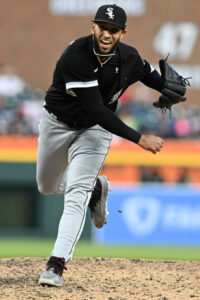
Angels fans are surely familiar with the 29-year-old Middleton, who looked like a bullpen mainstay in Anaheim earlier in his career before injuries — most notably Tommy John surgery — derailed his trajectory. Fans of other clubs, however, may have never had Middleton on their radars and might be surprised to learn that he’s in his final season of club control and will be a free agent this winter. Middleton collected five years of service time prior to the 2023 season — much of it coming on the Major League injured list — despite entering the current season with just 143 2/3 big leagues innings under his belt. As such, he’s a pure rental on a fourth-place White Sox team whose GM has been candid about the team’s chances and the possibility of selling at the deadline.
At the time of his signing, Middleton didn’t command much attention. It was a minor league deal for a reliever issued by a club that had several high-priced veterans in the bullpen (Liam Hendriks, Kendall Graveman, Joe Kelly, Aaron Bummer, Jake Diekman). Middleton hadn’t had big league success since his initial run with the Angels in 2017-19 and looked like a pure depth move. Even when the Sox selected him to the 40-man roster in mid-April, at a time when both Hendriks and Kelly were on the injured list, it seemed like he could just be a short-term stopgap until the Sox got healthier. And perhaps that was indeed the initial plan, but Middleton has become an indispensable member of the bullpen and emerged as a legitimate trade chip.
It’s only 32 innings of work so far, but the right-hander owns a tidy 3.09 ERA on the season. That’s a solid number on its own, but the underlying numbers are even more encouraging. Middleton averaged 94.8 mph with his heater in a short look with the D-backs last year but is back up to 96 mph in 2023 — much healthier and much closer to the 96.8 mph he averaged with the Angels prior to surgery.
There’s far more to like about Middleton than a simple resurgence in velocity. He’s fanned a hefty 31.1% of his opponents, issued walks at a slightly better-than-average 8.3% clip and racked up grounders at a huge 56.4% rate. Even more impressive are his 17.8% swinging-strike rate and 38.4% opponents’ chase rate on pitches off the plate — top-of-the-scale numbers that rank sixth and 14th, respectively, among the 338 pitchers who’ve tossed at least 30 innings during the 2023 season. This has been the best stretch of Middleton’s career, and while the sample is small, he’s arguably been one of the sport’s best relievers in 2023.
The one knock is his 1.41 HR/9 mark, but that’s driven in part by a cozy home ballpark and a 26.3% homer-to-flyball rate that’s bound to regress; in the past decade there have only been 38 instances (out of a possible 4550) where a pitcher with at least 30 innings pitched has run a homer-to-flyball rate that high. Homer-to-flyball rate tends to stabilize in the 12-13% range for most pitchers over a large enough sample. Since 2013, the league-average homer-to-flyball rate for pitchers has fallen between 9.5% (a clear outlier season in 2014) and 15.7% (during the juiced ball season of 2019).
Skeptics might point out that Middleton has struggled over the past month, and it’s a valid concern. He’s been tagged for nine earned runs in his past 10 2/3 innings, due largely to yielding four of the five homers he’s surrendered on the season. It’s also worth pointing out, however, that the rest of Middleton’s profile during that time remains largely unchanged. He’s fanned 27.7% of his opponents, walked 8.5% of them and compiled a 55.2% ground-ball rate. Opponents are also averaging just 86.2 mph off the bat against him during that slump; he’s still rarely giving up hard contact — it’s just that a disproportionate amount of the hard contact he has yielded has resulted in a round-tripper. (For what it’s worth, four of the five homers he’s allowed this year have come in his hitter-friendly home park, too.)
There’s some degree of volatility with all relief pitching, however, and this season Middleton has done pretty much everything modern front offices love to see at a better-than-average (often elite) rate. He throws hard, misses bats at elite levels, limits walks at an average clip and ranks in the 94th percentile of pitchers (min. 30 innings) in ground-ball rate. It’s a recipe for success that checks a lot of boxes. Add in that he originally signed on a low-cost minor league deal and would be affordable for even teams with luxury tax concerns, and Middleton only sounds more appealing.
Of course, given the limited track record coming into the season and the fact that he’s a pure rental, Middleton isn’t going to fetch any club a true top-tier prospect on his own. But we regularly see teams pay relatively steep prices for relievers at the deadline, even for rental arms. The demand for Middleton should be strong, and on his own he should still be able to net the Sox a solid prospect or perhaps a younger player with some club control but no real spot on his current team’s roster.
There are multiple paths for the White Sox to explore as they mull their options with Middleton, but nearly all roads seem like they’ll lead to a trade of some sort. And while Middleton might first seem underwhelming to the fanbase that acquires him, he could wind up being one of the most impactful arms moved at this year’s deadline if he can sustain this level of pitching in the season’s final two and a half months.
This Date In Transaction History: Rays Acquire Pete Fairbanks
Just under three weeks from the trade deadline, it’s still a little early for clubs to make moves of consequence. July is trade season but the majority of key acquisitions take place in the final week or so.
On this date four years ago, the Rays and Rangers lined up a deal that was more an interesting swap of young players than a pivotal deadline move. It was a one-for-one that sent reliever Pete Fairbanks to Tampa Bay and second base prospect Nick Solak to Arlington.
Fairbanks had some MLB experience, but neither player was an established big leaguer at the time of the trade. The right-hander had pitched in eight games for Texas. He averaged over 97 MPH on his heater but had allowed 10 runs in 8 2/3 frames. Solak hadn’t yet gotten to the majors; he was hitting .266/.353/.485 with 17 homers in Triple-A at the time of the deal.
Despite being the player without MLB experience, Solak was probably the more well-known of the two at the time. He’d been a 2nd-round selection of the Yankees a few years before. Solak was already involved in one notable trade, going to Tampa Bay in the 2018 three-team deal that sent Brandon Drury from Arizona to the Bronx.
Prospect evaluators consistently raised questions about Solak’s defensive acumen at second base. There was less trepidation about his offensive upside, though. He’d been an accomplished minor league hitter and was on the doorstep of the majors. Fairbanks had high-octane stuff but spotty control and had twice undergone Tommy John surgery as a minor leaguer, a big reason he was still unestablished by his age-25 campaign.
The initial returns looked promising for Texas. Solak debuted a month later and hit .292/.393/.491 over his first 33 MLB contests. He’d get the Opening Day nod in left field the next season. Fairbanks pitched 13 times for the Rays, allowing 10 runs across 12 1/3 frames.
Beginning in 2020, the deal swung definitively in Tampa Bay’s favor. Fairbanks was excellent in the shortened season, working to a 2.70 ERA while fanning a third of opponents in 27 regular season outings. He pitched nine times during the Rays’ run to the pennant, securing three saves and holds apiece in the playoffs. Fairbanks logged a career-high 42 2/3 innings the next year, working to a 3.59 ERA with 14 holds and a 29.7% strikeout rate.
Solak, on the other hand, never built off that strong debut. He hit .246/.317/.354 in a little more than 800 MLB plate appearances from 2020-22. Concerns about his defense were founded and pushed him more frequently to left field. Texas parted with him at the start of last offseason, trading him to the Reds for cash. Solak has consistently hit well in the upper minors but has bounced around via waivers and small trades since the Rangers moved on. He’s currently in Triple-A with the Tigers.
Fairbanks’ durability concerns have presented themselves over the past two years. He lost the first half of last season to a lat strain. He’s battled Raynaud’s syndrome, a condition that can lead to a cold numbness in the fingers, on a couple occasions. Hip inflammation cost him a few weeks earlier this year.
Still, the Rays have to be pleased with the work they’ve gotten out of Fairbanks. He’s one of their top relievers, owner of a 2.78 ERA in 123 regular season innings since the trade. He has allowed only six runs in 15 postseason frames over three seasons. The Rays signed him to a three-year deal in January, guaranteeing him $12MM to buy out his final three arbitration years and secure a 2026 club option.
No one would argue the Fairbanks trade was as impactful as acquiring the likes of Randy Arozarena or Isaac Paredes. It proved an adept pickup, though. Adding an effective late-inning arm for a young hitter who fell a bit short of expectations has paid off. The front office and coaching staff surely hope Fairbanks will continue to play a key role in postseason runs over the years to come.
The Most Alarming Aspect Of Royals’ Disappointing Season
The Royals are much closer to the worst team in baseball than a playoff spot. While Kansas City wasn’t expected to make the postseason, there’s no question the organization envisioned better results than they had in the first half.
There are a number of reasons for the club’s underperformance. The most concerning theme for the organization has been the down years and/or injury issues for most of their top young talent. Kansas City expected to be further along in the rebuild by now. Instead, a lot of the players they’ve envisioned as a developing core have plateaued or gone backwards.
That’s not unanimously true. Bobby Witt Jr. has stolen 27 bases, connected on 14 home runs and taken a huge step defensively. Even with a modest .300 on-base percentage, he looks like the franchise shortstop the Royals wanted when selecting him with the 2nd overall pick in 2019. Rookie Maikel Garcia has taken over third base with plus exit velocities and strong defense.
Aside from the left side of the infield, the Royals’ young players have mostly underwhelmed, however.
- MJ Melendez, RF/LF/C
Melendez, a 2nd-round selection in 2017, emerged as one of the sport’s top prospects with a 41-homer showing in the upper minors two years ago. The left-handed hitter connected on 18 longballs with a roughly average .217/.313/.393 line as a rookie in 2022. His power production has fallen off this year; he carries a meager .206/.289/.333 mark with six homers in 346 trips to the plate.
While Melendez walks a fair amount, he offsets that with big strikeout totals. He has gone down on strikes nearly 30% of the time this season. That puts a lot of pressure on him to hit for power, no small feat in one of the sport’s most pitcher-friendly home parks. Melendez has a huge 93 MPH average exit velocity and is making hard contact (95+ MPH) on over half his batted balls. There’s clearly power upside in there. He’s not in a great environment to maximize it and is striking out too frequently though.
Were Melendez catching every day, that offensive profile would be more acceptable. With Salvador Perez behind the dish, the Royals have deployed the youngster mostly in the corner outfield. Well below-average offense at a bat-first position means he’s playing at a worse than replacement level rate.
- Brady Singer, RHP
The Royals invested heavily in college pitching in the 2018 draft. Singer was the only member of the group who put together mid-rotation results, seemingly breaking out with a 3.23 ERA over 27 appearances last season. He’s gone in the opposite direction this year.
Over 18 starts, the Florida product is allowing 5.80 earned runs per nine across 94 2/3 innings. His strikeouts and grounders are both at career-worst levels. Singer’s strikeout rate has dropped over six percentage points to a modest 18.1% clip. His swinging strikes are down to a below-average 8.5% of his offerings.
Singer’s arsenal has backed up. His sinker is averaging 92.3 MPH, down a tick and a half from last year’s level. His career-long struggle to find a changeup is still showing up in his results against left-handed hitters. Southpaws have a .292/.373/.489 line in 250 trips to the plate this year.
- Daniel Lynch, LHP
Lynch, the 34th overall selection in the aforementioned college-heavy ’18 draft, has started 50 games in his MLB career. The 6’6″ southpaw has yet to find much success, posting a 5.10 ERA over parts of three seasons. His 4.18 mark through eight starts is a personal low, though he’s paired it with a few alarming underlying indicators.
Most notably, Lynch’s velocity has taken a step back. He’s averaging 92.7 MPH on his heater, down from the 94 MPH range in which he sat in 2021-22. A Spring Training rotator cuff strain could explain that dip, although Lynch’s velocity has fallen even as he’s gotten further removed from the season-opening injured list stint. He averaged a season-low 91.6 MPH on his four-seam during his final start headed into the All-Star Break.
With the drop in speed has come a corresponding hit to his strikeouts. The Virginia product has fanned under 16% of opposing hitters. It’s the lowest rate of his career, down nearly five points from last season. Lynch’s 11.7% swinging strike percentage is still solid, so he’s not losing whiffs on a per-pitch basis, but he’s had a tougher time finishing off at-bats.
Pasquantino’s disappointing year has been more about health than performance. His .247/.324/.437 line was down markedly from a huge .295/.383/.450 rookie showing, but even the diminished version of Pasquantino was one of Kansas City’s top hitters. Unfortunately, the 25-year-old tore the labrum in his right shoulder and underwent surgery last month. His season is finished after just 61 games.
- Nick Pratto, 1B
Pasquantino’s injury has opened regular playing time for the 24-year-old Pratto. Like Melendez, the lefty-hitting first baseman emerged as a top prospect based on huge power production in the upper minors. His profile also comes with significant swing-and-miss concerns, which have resurfaced at the MLB level.
Pratto is hitting .246/.331/.388 with six homers in a career-high 257 plate appearances. That’s better than the bulk of the Kansas City lineup, league average offense by measure of wRC+. Yet he’s needed a .395 average on balls in play to keep that production respectable. He’s striking out at a 37.7% clip, the highest rate among players with 250+ trips to the plate. If he’s to be a long-term regular, especially at a bat-first position, he’ll need to put the ball in play more frequently.
- Drew Waters, CF
By the time the Royals acquired Waters from the Braves almost exactly one year ago, the outfielder’s stock was well down from its peak level. The switch-hitter had been a borderline Top 50 prospect at one point in the Atlanta farm system, but mounting strikeout issues in the upper minors raised questions about his offense. The Royals were buying low to some extent, though they still relinquished the 35th overall pick in last year’s draft (which Atlanta subsequently used on high school righty JR Ritchie) for Waters.
Kansas City wouldn’t have given up a pick that high if they didn’t believe Waters still had a chance to be an everyday player. An offseason trade of Michael A. Taylor cleared a path to center field reps. Waters’ hopes of starting on Opening Day were dashed by a left oblique strain that cost him the first two months of the season.
Since returning, the 24-year-old has put up a .239/.293/.354 line over 37 games. He’s striking out an untenable 37.4% rate. Perhaps there’s some rust to be shaken off after the extended absence, but Waters’ early results aren’t offering much hope he’s on the verge of a breakthrough. Whether he’ll make enough contact to be a regular is still in question.
- Kyle Isbel, CF
With Waters opening the season on the shelf, the 26-year-old Isbel got the Opening Day nod in center field. He has just a .210/.258/.355 line in 37 contests. Isbel is making the most contact of his career but not hitting many line drives, and his overall production closely matches last year’s .211/.264/.340 slash. The former 3rd-round selection has been viewed by most evaluators as a fringe regular, although he still ranked among K.C.’s top ten prospects at Baseball America each season from 2019-22. He looks better suited for fourth/fifth outfield duty than a starting role.
- Michael Massey, 2B
Massey, 25, showed some promise with a .243/.307/.376 line as a rookie late last season. He got the Opening Day nod at second base this year but hasn’t seized the job. The left-handed hitter has a .220/.277/.320 mark with four homers over 220 plate appearances. Opposing pitchers have punched him out 28.2% of the time. Massey is hitting the ball reasonably hard but chasing too many pitches outside the strike zone to post a decent on-base mark.
———————————————
Without much progress from most of their young players, the Royals haven’t had many silver linings. A 26-65 record would be an obvious disappointment regardless of how it was happening, but it’s made more so by the scarcity of controllable players asserting themselves as key pieces for the future. Aside from Witt and arguably Garcia, none of Kansas City’s early-mid 20s talent is staking a firm claim to an important role for next season.
The primary focus for the next few weeks will be which veteran players get moved at the deadline, with closer Scott Barlow standing out as their top trade chip. Once August 1 passes, the final couple months will be about evaluation. Can any of their currently scuffling controllable players turn things around to head into the offseason with positive momentum to build upon?
Where Could The Giants Turn For Middle Infield Help?
The Giants lost second baseman Thairo Estrada for over a month when he fractured his left hand on a hit-by-pitch two Sundays back. San Francisco president of baseball operations Farhan Zaidi told reporters last week that Estrada’s injury could affect the team’s deadline outlook.
“We’ve got to at least evaluate what we have in the middle infield,” Zaid said on Friday. “Kind of just keep an eye on the market and see if there’s someone that can be impactful there and weigh that against continuing to give opportunities to Casey [Schmitt] and Brett [Wisely].”
With Zaidi and his staff examining things, let’s take a look at some potential options. The middle infield market is light on apparent trade candidates. Most of the available short-term solutions are having average or worse seasons. Perhaps a longer-shot name comes available (we’ll take a look at a few potential options at the back of the list), but the likely scenario is that San Francisco sifts through stopgap types.
- Paul DeJong ($9MM salary, controllable through 2025 via club options)
A quality everyday shortstop early in his career, DeJong fell off at the plate by 2021. He combined to hit .182/.269/.352 between 2021-22. The Cards optioned him to Triple-A last summer. He’s rebounded somewhat in 2023, putting together a .231/.302/.434 line with 12 home runs in 245 trips to the plate. Paired with his customary above-average defense, he reclaimed the primary shortstop job in St. Louis.
DeJong’s profile isn’t without flaws. He’s striking out in more than 30% of his plate appearances. His production has been very platoon-dependent. The right-handed hitter is mashing southpaws at a .269/.381/.500 clip but reaching base at a meager .275 rate against righty pitching. He could step in as a short-term replacement for the righty-swinging Estrada at second base while potentially taking a few at-bats against lefty pitching from Brandon Crawford at shortstop later in the year.
- Tim Anderson ($12.5MM salary, $14MM club option for 2024)
MLBTR’s Darragh McDonald recently explored the White Sox’s dilemma regarding Anderson. He’s an All-Star caliber shortstop at his best — a threat to hit over .300 with double-digit homers and steals. That player hasn’t shown up in 2023. Anderson has been among the worst regulars in the sport, hitting .223/.259/.263 without a single round-tripper.
Where does that leave Chicago? They’re 16 games under .500 and preparing to move short-term players. Trading Anderson now would be an obvious sell-low, but this could be their last chance to get a return at all. A $14MM club option that looked like a no-brainer a few months ago is now more borderline. If the Sox are leaning towards buying Anderson out next winter, then a trade would be advisable. He only has two MLB starts at a position other than shortstop but would presumably have to move to second base if San Francisco were interested in buying low.
- Cavan Biggio ($2.8MM salary, arbitration-eligible through 2025) / Santiago Espinal ($2.1MM salary, arbitration-eligible through 2026)
Biggio and Espinal have been pushed out of the everyday lineup in Toronto. Whit Merrifield has taken over as the primary second baseman. Biggio is bouncing between right field and the keystone. Espinal is covering multiple infield spots off the bench.
Neither player is hitting well this season, though they’ve both shown better in the past. Biggio was an above-average bat from 2019-20 thanks to huge walk totals. Espinal was an All-Star a season ago and combines defensive versatility with plus contact skills. The Jays don’t have to move either but could find one of them expendable, particularly if they can bring back immediate pitching help in a trade.
- Ramón Urías (pre-arbitration, controllable through 2026) / Adam Frazier ($8MM salary, impending free agent)
Like Toronto, Baltimore enters deadline season as a buyer. The O’s have plenty of infield depth, however, so they could consider ways to deal from that surplus to address the pitching staff. Urías, 29, established himself as a regular last year when he hit 16 home runs while playing Gold Glove defense at third base. He’s hitting .261/.328/.396 with only four homers in 229 trips to the plate this season. He can play either second or third base and will reach arbitration for the first time next winter.
Frazier’s only two years older than Urías but much further along in his career. The former All-Star is actually Baltimore’s highest-paid position player at $8MM. He’s a bottom-of-the-lineup second baseman hitting .232/.299/.397 with 10 homers over 297 trips to the plate. The recent promotion of top prospect Jordan Westburg to join Gunnar Henderson in the everyday infield leaves fewer at-bats for the likes of Urías, Frazier and Jorge Mateo.
- Nicky Lopez ($3.7MM salary, arbitration-eligible through 2025)
Lopez is a light-hitting defensive specialist who can cover either middle infield spot. He’s a career .249/.312/.319 hitter in just more than 1800 plate appearances. Lopez is tough to strike out but has bottom-of-the-scale power and hasn’t homered since 2021. Public metrics consider him an above-average defender throughout the infield. He’s controllable for two additional seasons, but a last place Kansas City team could put him on the market this summer.
- Tony Kemp ($3.725MM salary, impending free agent)
Kemp is a clear trade candidate as a rental on a terrible A’s team. If Oakland can find any interest this summer, they’ll move him. A left-handed hitter, Kemp has only hit .197/.286/.283 on the season. He’s played fairly well of late after a dreadful first couple months, though. Going back to the start of June, the veteran has a .272/.359/.407 line with eight walks and only six strikeouts in 94 plate appearances. It wouldn’t be the most exciting acquisition, but Kemp could be a short-term option if the Giants want a stopgap until Estrada returns without sacrificing any notable prospect talent.
Longer Shots
- Gleyber Torres ($9.95MM salary, arbitration-eligible through 2024)
Torres is one of the few Yankees’ hitters with slightly above-average offensive numbers on the year. The right-handed hitting second baseman owns a .251/.325/.413 line with 13 homers over 375 trips to the dish. Torres has strong strikeout and walk numbers but modest batted ball marks. He has rated as an average defensive second baseman by measure of both Defensive Runs Saved and Statcast.
New York is a game back in the AL Wild Card picture. They’re likely to look for ways to upgrade the offense in the next few weeks. A Torres trade isn’t especially likely, but it’s not inconceivable. Oswald Peraza is in Triple-A and could soon be an option to step in at second base on a regular basis. The Yankees have short-term questions at third base and in the corner outfield.
The organization is also right up against the fourth luxury tax line at $293MM. They were reportedly reluctant to cross that threshold over the offseason; owner Hal Steinbrenner suggested a few weeks ago it wasn’t a firm cap but implied the team would want an impactful acquisition to go over that mark. Reallocating a few million dollars in a Torres trade could clear some flexibility for a subsequent acquisition.
- Nolan Gorman (pre-arbitration, controllable through 2028) / Brendan Donovan (pre-arbitration, controllable through 2028)
The Cardinals would have to be blown away to part with either Gorman or Donovan. President of baseball operations John Mozeliak conceded yesterday the club would probably part with short-term assets. Gorman and Donovan have the chance to be core players for years to come.
Trading DeJong is the more straightforward path for St. Louis. They have enough infield depth it’s theoretically possible another club could sway them on Gorman, Donovan or Tommy Edman — likely by dangling high-upside young pitching. That’s probably beyond what San Francisco has in mind.
Who Could The Pirates Trade At The Deadline?
The Pirates jumped out to a hot start in 2023, sitting on a 20-9 record at the end of April that made it seem like the days of rebuilding were suddenly in the rearview mirror. Unfortunately, they haven’t been able to maintain that, falling back to earth with an 8-18 record in May. Ownership was still supportive of buying at the deadline as recently as June 21, but the club has continued to slide in the standings.
The Bucs now find themselves with a record of 41-49. They are fourth in the National League Central, well behind the Reds and Brewers. They’re also behind the third-place Cubs, who have the best run differential of the bunch and a soft schedule coming out of the break. FanGraphs currently pegs Pittsburgh’s playoff odds at just 1.4%.
Barring a tremendous surge after the All-Star break, the club will likely have to set their sights on 2024. That will mean having discussions about trading away veterans, both to recoup some younger players to help in future seasons and to open up playing time for the players they already have. Let’s take a look at some options, though there aren’t too many players on the roster who fit the bill.
Rental Players
Hill continues to defy Father Time and is still a reasonably effective starter at the age of 43. He’s tossed 98 innings over 18 starts this year and currently has a 4.78 ERA, striking out 21.1% of batters faced while walking 9% and getting grounders at a 35.9% clip. He’s making $8MM this year, with about $2.6MM still to be paid out when the deadline rolls around.
He won’t command a huge return as a back-end innings eater, but the Bucs could perhaps line up with some club that simply wants a guy to take the ball every five days. Just a couple of years ago, the Nationals were able to get Lane Thomas in return for a 37-year-old Jon Lester and his 5.02 ERA at that time. The Pirates shouldn’t expect that kind of return on Hill, but it serves to demonstrate that they could at least take a flier on someone by putting Hill out there.
Santana, 37, isn’t likely to be a huge deadline addition at this stage of his career. However, it was just a year ago that the Royals were able to trade him to the Mariners for a couple of younger relievers. This year, he’s still showing his good approach at the plate, with his 10.5% walk rate and 18% strikeout rate both better than average. He’s hit nine home runs, but his .233/.311/.390 batting line is a bit below average, translating to a wRC+ of 91.
The switch-hitter has always been a bit better against lefties and that continues to be the case this year, as he’s slashing .260/.348/.416 against southpaws for a wRC+ of 109. There are likely some contenders who would be happy to utilize him as a short-side platoon bat and pinch-hitter off the bench. His first base defense continues to be considered above average. He’s making $6.725MM this year, which will leave around $2.2MM at deadline time.
Choi, 32, appeared in nine games before a strained Achilles tendon in his left foot sent him to the injured list. He was reinstated just before the break, and his form in the next few weeks will likely determine his trade interest. He’s hit .237/.340/.428 in his career with a 13.1% walk rate, leading to a wRC+ of 114. The left-handed hitter has been especially strong with the platoon advantage, hitting .245/.351/.454 against righties in his career for a 124 wRC+. He’s earning $4.65MM this year and about $1.5MM will be remaining at the end of the month.
Hedges has long been considered one of the best defensive catchers in the game but doesn’t provide much with the bat. That’s especially true this year, where he’s hitting just .179/.230/.232. His wRC+ of 26 is dead last in the league among players with at least 170 plate appearances. Yet he continues to get work based on his defensive acumen and strong reputation for working with pitchers.
Trading catchers in midseason is generally tricky, as it can be challenging to learn an entirely new pitching staff on the fly. If the Bucs can’t line up a trade for that reason, they may have to think about moving on from Hedges regardless. Catching prospect Henry Davis is already up with the big league club to get his bat in the lineup but is playing the outfield at the moment. The club’s other top catching prospect, Endy Rodríguez, is in Triple-A and perhaps ready for a promotion. Both Davis and Rodríguez play other positions and it remains to be seen who the club considers its true “catcher of the future,” so perhaps they could use the last few months of the season to get a look at one or both.
McCutchen makes theoretical sense as a trade candidate since he’s 36 years old, an impending free agent and performing well at the plate this year. The Rangers have reportedly expressed interest, but all signs seem to point to Cutch staying put. He’s been quite open about how happy he is to be back in Pittsburgh and plans to spend the rest of his career there. The club is apparently on board with that and doesn’t seem to have any designs on trading him.
Signed/Controlled For One Extra Year
García has a 2.89 ERA dating back to 2019 and had that figure at 3.74 last year but was non-tendered by the Giants. The Bucs swooped in and signed him to a $2.5MM deal with a $3.25MM club option for 2024. Unfortunately, he’s been on the injured list all year due to a biceps injury. Players on the IL can still be traded, but there won’t be much interest unless he shows some progress in the next few weeks.
Longer-Term Players
There are no indications the club has any plans of trading Keller. In fact, he’s the best rotation building block they have, with his 3.31 ERA this year putting him just outside the top 10 in the National League. But although he’s only been breaking out over the past year or so, his control is dwindling since he’s a bit of a late bloomer. Debuting back in 2019, he struggled in his first few seasons before putting things together recently and now has just two seasons of control left beyond this one.
The Bucs are in a similar situation with Keller to where they were with Bryan Reynolds not too long ago. Reynolds was clearly an important member of the club but there was a ticking clock as his free agency was getting closer. In that case, the two sides lined up on an extension to potentially keep him in Pittsburgh through 2031, and a similar decision might have to be made on Keller.
Bednar, 28, continues to cement himself as one of the better relievers in the league. He has a 1.27 ERA this year, striking out 29.8% of hitters while walking just 5%, earning 17 saves in the process. Given the volatility of reliever performance, there could be an argument for the Bucs to cash in while his trade value is high, as they can currently market him with three seasons of control beyond this one. However, Bednar’s a fan favorite, having been born in Pittsburgh and raised in the area. Since the club has shown flashes that suggest the rebuild won’t go on for much longer, it seems unlikely they would consider moving a key piece like Bednar. As with Keller, other teams will still surely try, but he’s likely staying put.
Joe isn’t anywhere close to free agency, as he will have four years of club control remaining after this one. But while many of the players on the club’s roster are in their mid-20s, Joe will be turning 31 next month. He’s also having a decent season, hitting .240/.332/.421 for a wRC+ of 106 while playing first base and the outfield corners. Perhaps the club would be tempted to put him on the trading block now since his trade value will likely only decrease as he ages and becomes more expensive. He’ll finish this year with his service time at 2.136 and could qualify for arbitration as a Super Two player.
_______________
Ultimately, the Bucs don’t have too much to offer as sellers this winter. The veterans they do have will get some interest but won’t be headlining any blockbuster deals. If they get on a hot streak in the next few weeks, perhaps they just decide to hold onto everyone and hope for a strong finish. But their chances of contention should be much stronger next year and they could start lining things up for that.
By moving Hedges, they could get a look at Davis and Rodríguez as catchers at the big league level while continuing to evaluate their bats. By moving Santana, Choi and/or Joe out of the first base/designated hitter/corner outfield mix, they could open up plate appearances for players currently in the minors, whether that’s a prospect like Liover Peguero or a potential late bloomer like Miguel Andujar. The latter struggled in the majors earlier this year but has hit .409/.459/.634 in Triple-A since accepting an outright assignment two months ago. If added to the club’s roster later this year, they could retain him via arbitration for 2024.
The Well-Timed Breakout Of Jordan Hicks
Not a lot has gone right for the Cardinals this year. They came into the season with a talented roster and hopes of contention but have repeatedly struggled to get into a groove. Their record sits at 38-52, placing them 11.5 games back in the National League Central and 11 games back in the Wild Card race. They don’t often find themselves as clear deadline sellers, having only once finished below .500 this century, which was way back in 2007. But barring a massive turnaround in the next three weeks, they will likely be selling this year, something that president of baseball operations John Mozeliak essentially admitted earlier today.
Thankfully, there are some factors that could make this a particularly fruitful sell-off for the Cards. For one thing, the expanded playoffs and some wide-open divisional races are seemingly making this year a seller’s market. The Cards have a number of controllable position players they could move without significantly hurting their chances of returning to contention next year. They also have some impending free agents of note, such as Jordan Montgomery and Jack Flaherty.
Another impending free agent who should be garnering plenty of interest is reliever Jordan Hicks. The fireballer has been in the club’s bullpen since 2018, though Tommy John surgery in June 2019 prevented him from appearing in the latter half of that campaign or at any point in 2020.
His performance in his career has been unusual in that he has elite velocity, averaging over 100 mph on his fastball in his career. But somehow, that hasn’t translated into the huge strikeout numbers one would expect. By the end of the 2022 season, he had tossed 177 2/3 innings over 147 outings, striking out 23% of batters faced. That strikeout rate is right around league average, whereas other gas-spewing pitchers like Aroldis Chapman, Edwin Díaz or Félix Bautista often run their rates into the 40s or even the 50s.

Here in 2023, Hicks seems to have finally unlocked a new level in that department. He’s thrown 36 2/3 innings over 36 outings, punching out 32.9% of batters faced. His 13.8% walk rate is still on the high side but that’s right in line with his previous work and not too dissimilar from other late-inning arms. Chapman has walked 12.4% of batters faced in his career. Josh Hader is at 10.2% in his career and 11.3% since the start of 2020. Hicks is getting fewer ground balls than in previous seasons but his 53.5% rate this year is still well above league average.
The new strikeout rate has helped to lower his ERA to 3.93, compared to 4.84 last year and 5.40 the year before. He likely deserves even better, as his .357 batting average on balls in play is above league average and above his marks in previous seasons. His 3.47 SIERA and 3.12 FIP suggest he could get even better results if that BABIP normalizes going forward. He’s also produced these results while ascending into the closer’s role with Ryan Helsley on the injured list, with Hicks racking up seven saves in the past four weeks.
One thing that might be fuelling this breakout is a change in his pitch mix. He has primarily been a sinker-slider guy in his career, with 90% of his offerings being one of those two pitches, while also occasionally mixing in changeups, cutters and four-seam fastballs. According to Statcast, Hicks had thrown only 20 four-seamers prior to his surgery and then just nine over the past two seasons. He has thrown 73 of them this year. He’s also added a sweeper, throwing 150 of those this year, with opponents batting just .107 and slugging just .250 in plate appearances ending with that offering. The sweeper seems to pair well with his sinker/two-seamer, as shown in this tweet from Rob Friedman, aka the Pitching Ninja.
This is still just a few months of results we’re talking about, but the change in repertoire seems to point to a legitimate progression as opposed to just small sample noise. The Cardinals would surely have preferred to be in contention right now, using this new and improved version of Hicks to bolster their chances in a postseason race. But they will at least have the opportunity to squeeze some extra future value out of it via trade prior to the upcoming deadline. If he had discovered this new level of performance next year instead, they may not have benefited from it at all.
The timing is also potentially significant for Hicks personally, allowing him to go into the open market with a strong platform season if he can maintain it for the next few months. He cracked the Cardinals’ Opening Day roster in 2018 when he was just 21 years old and has never been optioned, putting him on pace to finish this season with exactly six seasons of service time and thus qualify for free agency just after he turns 27 years old in September. Relief pitchers don’t usually secure very long deals in free agency. No one has ever topped five years and contracts of that length are quite rare.
Some clubs may be skeptical given that he has a longer track record of being just okay and will have a much smaller span of time with the improvements. But we have seen clubs take significant gambles on pitchers based on limited samples before. Drew Pomeranz was a starter for much of his career but transitioned into more of a relief role in 2018 and 2019 before getting a four-year, $34MM deal from the Padres. It was a similar story for Liam Hendriks, who had been closing for two years, one of which was the shortened 2020 season, before landing a $54MM guarantee over three years from the White Sox. Robert Suarez spent most of his career in Japan before parlaying one strong MLB season into $46MM over five years.
That’s not to say that Hicks is a lock to secure a contract similar to those, especially since few of those deals have worked out well for the signing clubs, which may lead to more hesitancy in the relief market this offseason. But clubs have shown they are willing to bet on a small sample of improved results when they have reason to believe it could be carried forward. Those three pitchers were all in their early 30s when they secured their deals, whereas Hicks will be significantly younger.
Hicks has always had the velocity and now seems to be figuring out how it deploy it in a more effective way than he ever has before. With his quick rise through the minor leagues and time missed due to his surgery, he’ll be hitting the open market at an usually young age for a relief pitcher and with very few total innings on his arm. For now, he should be able to help the Cardinals recoup some extra value at the deadline before helping himself cash in this winter.
Image courtesy of USA Today Sports.
The Cubs Hit A Jackpot In Minor League Free Agency — Now What?
Since the Cubs’ signing of Craig Kimbrel left them feeling burned for the first two seasons of the contract, ownership and the front office have eschewed spending on the bullpen. Rather than invest in high-priced relief options in free agency, the Cubs have spread out their bullpen investments over a series of small-scale additions, either on low-cost one-year deals or on minor league free agents. At times, they’ve had great success with the strategy (e.g. Andrew Chafin, David Robertson). Others haven’t gone so well (e.g. Brad Boxberger, Brandon Workman). They haven’t been burned by any big relief pitching commitments since Kimbrel, but they also have generally sat out on the top names on the market.
The merits of the strategy can be debated ad nauseum. On the one hand, it’s unequivocally a good thing to avoid being encumbered by any burdensome multi-year deals for relievers. On the other, the Cubs have the financial resources and payroll capacity to take such risks and withstand the missteps more than many of their smaller-payroll rivals. By steering clear of expensive, multi-year commitments they’ve also bypassed a number of quality relief options while trotting out bullpens with ERAs of 4.39 (2021), 4.12 (2022) and 4.01 (2023). Since 2021, Cubs relievers rank 20th in MLB with a 4.21 ERA.
It’s not as simple as stating, “You get what you pay for,” as player development plays an enormous role; the Guardians, for instance, have the second-best bullpen ERA in the past three years (3.30) despite signing just one reliever (Bryan Shaw) as a Major League free agent.
Relying on low-cost bullpen additions increases the importance of developing in-house relievers — which the Cubs have not done all that well — or striking it big in minor league free agency, where teams can potentially land multiple years of an effective reliever who’s not yet burned through his arbitration seasons. The Cubs’ lack of big investments and lack of development from the farm makes their biggest score in minor league free agency all the more important.
Mark Leiter Jr. has been nothing short of a godsend at Wrigley Field.

A 22nd-round pick by the Phillies back in 2013, Leiter (obviously) comes from a prolific baseball family. His father, Mark Sr., enjoyed an 11-year big league career. His uncle, Al, is a two-time All-Star and two-time World Series champion who pitched in 19 Major League seasons. Leiter Jr.’s cousin, Jack, was the No. 2 overall pick in the 2021 draft.
Just two years ago, Leiter Jr. looked to be a footnote in the Leiter family baseball lineage. He didn’t pitch in the Majors from 2019-21, despite solid numbers with the Tigers’ upper minors affiliates in ’21. When he quietly joined the Cubs on a minor league deal during MLB’s lockout — minor league free agency for players who didn’t finish the prior season on a 40-man roster or MLB injured list still continued during the stoppage — few thought much of it. Leiter looked like minor league depth and little more than that.
Perhaps that was how the Cubs saw things, too. Leiter didn’t break camp with the team in 2022 and was only summoned to the big leagues as a spot starter in mid-April. He started three games for the Cubs, yielded nine runs in 9 1/3 innings, and was optioned back to Triple-A Iowa. Over the next couple months, he was optioned back and forth a few different times, eventually moving into a full-time bullpen role.
For much of the season, Leiter was a nondescript swingman on a non-contending Cubs club. Trades of Scott Effross, David Robertson, Chris Martin and Mychal Givens, however, opened enough space in the bullpen for the Cubs to call Leiter back to the big leagues and stick him in the bullpen for good. The results were excellent. Although he carried a 5.35 ERA into last year’s All-Star break, Leiter was summoned to the Majors on July 30 and dominated in the season’s final two months: 29 innings, 2.17 ERA, 3.35 FIP, 27.4% strikeout rate, 9.4% walk rate, 50% ground-ball rate, three saves, four holds.
Even with that big finish to the season, however, Leiter didn’t stick on the Cubs’ 40-man roster all winter. Chicago held onto Leiter into January but ultimately chose to designate him for assignment in order to open a roster spot for Eric Hosmer (who’d eventually be released in June).
Perhaps it was Leiter’s lack of a power fastball, his spotty track record, his status as an out-of-options pitcher, or the fact that most clubs had already filled their 40-man rosters by mid-January and didn’t want to adjust — whatever the reason, Leiter cleared waivers. He elected free agency and re-signed with the Cubs less than two weeks later. President of baseball operations Jed Hoyer, manager David Ross and the rest of the Cubs brass have to be thrilled with that outcome.
This time around, Leiter wound up breaking camp with the team — and it’s hard to imagine where they’d be without him. In 36 2/3 innings, Leiter carries a 3.19 ERA with a career-high 34.7% strikeout rate against a tidy 8.0% walk rate. He’s kept the ball on the ground at a strong 48.8% clip, allowed just three home runs (0.74 HR/9), picked up three more saves and piled up 13 holds. The Cubs were hoping that offseason signees like Brad Boxberger and Michael Fulmer could hold down late-inning roles, but it’s been Leiter who’s stepped up as the team’s most reliable setup man.
Leiter doesn’t throw hard, averaging just 91.8 mph on his heater, but both his four-seamer and sinker take a backseat to his splitter anyhow. It’s a tumbling offering that opponents have hammered into the ground at a 52.9% clip… when they put the ball in play. Leiter carries a mammoth 49.2% whiff rate on the splitter, which is a huge reason that opponents are batting just .088/.186/.132 in the 102 plate appearances he’s ended with that pitch. Unsurprisingly, after throwing the pitch at a 22.7% clip last year (per Statcast), he’s ramped that usage rate up to 35.8% in 2023. It’s now his most-used pitch.
He’s had some rough outings recently, allowing a total of four runs in his past three innings, but the overall results this season have nevertheless been excellent. In fact, dating back to July 30 of last season, when Leiter was called to the big leagues for good, he’s now sporting a 2.74 ERA, 31.5% strikeout rate, 8.6% walk rate, 49.3% grounder rate and 0.69 HR/9 mark. Leiter has been proof that not all high-leverage arms need to feature triple-digit fireballs that blow opponents out of their socks.
Cubs management surely hopes the team can come firing out of the gates and play its way back into contention. The Cubs’ schedule coming out of the break, after all, isn’t exactly formidable. They’ll kick things off with three against the Red Sox before playing their next 13 games against the Nationals, Cardinals and White Sox — three of the worst teams in the Majors this season. It’s quite possible the Cubs can indeed climb back into the division race.
If, however, the Cubs continue to flounder and/or the Reds and Brewers pull away, Leiter is likely to draw some trade interest. Normally, a pitcher with more than three years of club control wouldn’t be a trade candidate for a team like the Cubs, who if not this year hope to contend in 2024. But Leiter is 32 — 33 next March — and only came to them on a minor league deal. If another club is willing to give up some actual prospect value, it’d be hard not to give serious consideration to the scenario.
Leiter’s emergence is a feel-good story — a 22nd-round pick that was never a top prospect despite coming from a high-profile baseball family, he hung on when his career looked lost, clawed back to the big leagues in his 30s and now finds himself as a valuable arm in a big league bullpen. More than that, however, his emergence could put the Cubs in a quandary — if they’re not able to turn their fortunes. Hang onto a quality reliever for his final three years of team control, or sell high and trade a 32-year-old who’s effectively “found money” for them when he’s at peak value? These are the types of decisions the Cubs will face over the next few weeks, making their immediate performance following the deadline a particularly important component of this year’s deadline season.