
Which 2022 Draft Picks Have Teams Gained And Lost From Qualifying Offer Free Agents
Of the 14 free agents to receive qualifying offers this winter, nine have already figured out where they will be playing next season, leading to some noteworthy adjustments to the 2022 draft order. For a refresher on the QO rules, you can check this list of what signing a qualifying offer-rejecting free agent would cost each team, or this list of what teams receive as compensation for losing a QO-rejecting free agent.
Or, for simplicity’s sake, you could just read this post right here as a quick summary of the extra picks gained and lost due to these signings. First of all, four of the nine signed players don’t factor into the discussion, since they are back with their former teams — Brandon Belt accepted the Giants’ qualifying offer in the first place, while Raisel Iglesias re-signed with the Angels, Chris Taylor re-signed with the Dodgers, and Justin Verlander re-signed with the Astros.
For the five other signed QO free agents and the five unsigned QO free agents, here is the breakdown of what their former teams would receive as compensatory picks. The specific order of the compensatory picks is based on the previous year’s record, so the team with the fewer wins would get the superior pick.
- Extra pick after Round 1 of the draft: This is awarded to a team that receives revenue-sharing funds, and whose QO-rejecting free agent signs with another team for more than $50MM in guaranteed salary. The Rockies and Reds would therefore each qualify if Trevor Story (Colorado) or Nick Castellanos (Cincinnati) signed for $50MM+. Since the Reds had the better record between the two teams, the Rockies would pick 32nd overall and the Reds 33rd overall if both clubs indeed ended up in this same category. If Story and/or Castellanos signed for less than $50MM, Colorado and/or Cincinnati would be in the next group…
- Extra pick between Competitive Balance Round B and Round 3: Four picks have already been allotted within this group, comprised of teams who don’t receive revenue sharing funds. The Mets received an extra selection when Noah Syndergaard signed with the Angels, the Blue Jays received two picks when Marcus Semien signed with the Rangers and Robbie Ray signed with the Mariners, and the Red Sox got a pick when Eduardo Rodriguez signed with the Tigers. Like Toronto, the Mets could also receive a second pick if Michael Conforto signed elsewhere. The Braves (Freddie Freeman) and Astros (Carlos Correa) would also land in this category if their respective QO free agents left town. The draft order of this sandwich round based on 2021 record would line up as Mets (77 wins), Braves (88 wins), Blue Jays (91 wins), Red Sox (92 wins), and Astros (95 wins). For the moment, the four picks in this group represent the 75th-79th overall selections in the draft, though that specific order will be altered based on where the other QO players sign, or what other second-round picks might be surrendered as penalties for signing those free agents.
- Extra pick after Round 4: For teams that lose a QO free agent but exceeded the luxury tax threshold in 2021, their compensatory pick is pushed back to beyond the fourth round. Therefore, this is where the Dodgers will make their extra pick in the wake of Corey Seager‘s deal with the Rangers.
Moving on, here is what the four teams who have signed QO free agents had to give up in draft capital…
- Second-highest 2022 draft pick, $500K in international signing pool money: The Angels didn’t receive revenue sharing funds, and didn’t exceed the luxury tax in 2021. As a result, signing Syndergaard will cost the Angels their second-round draft selection and a chunk of their funds for the next international signing period.
- Third-highest 2022 draft pick: The Mariners and Tigers fall into this category, as teams who received revenue sharing payments in 2021. For Seattle, this is simply their third-round selection. For Detroit, their “third-highest pick” won’t be determined until MLB establishes the order for this year’s Competitive Balance Draft. Depending on which of the two CBD rounds the Tigers are drawn into, their cost for the Rodriguez contract could either be their second-rounder or their pick in Competitive Balance Round B.
- Both their second AND third-highest 2022 draft picks, and $500K in international signing pool money: The Rangers splurged by signing both Seager and Semien, and thus faced twice the draft penalty (both their second-round and third-round picks) for landing a pair of QO free agents. Texas would have faced the same penalty as the Angels if it had signed just one of Seager or Semien.
- Second- and fifth-highest 2022 draft picks, $1MM in international signing pool money: The stiffest penalty is reserved for teams who exceeded the luxury tax threshold last season. Therefore, only the Dodgers and Padres would have to give up multiple picks to sign a single QO free agent, which would surely influence any efforts on their part to pursue Correa, Freeman, Conforto, Story, or Castellanos.
Dodgers Re-Sign Chris Taylor
The Dodgers are retaining at least one of their top free agents, announcing agreement on a four-year contract with Chris Taylor. It’s reportedly a $60MM guarantee for the Meister Sports Management client that also contains a 2026 club option which could bring the value of the deal as high as $73MM.
According to reports, Taylor will be paid $15MM salaries in each of the next two seasons, followed by successive $13MM guarantees in 2024-25. He’s also guaranteed at least a $4MM buyout on the 2026 option, which is valued at $12MM. He’d receive a $2MM assignment bonus for every time he’s traded over the course of the deal. Additionally, the value of Taylor’s option season would increase by $3MM if he’s traded within the next two seasons, by $2MM if he’s traded between the end of the 2023 and the end of the 2024 campaigns, or by $1MM if he’s traded between the end of 2024 and the beginning of 2026. The option price would also escalate by $1MM if he tallies 525 plate appearances, earns an All-Star nomination or wins a Silver Slugger Award during the 2025 campaign.
Taylor’s guarantee falls a bit shy of MLBTR’s four-year, $64MM projection entering the offseason. He had hit the market as a fairly atypical free agent, having never settled into one spot on a star-studded Dodgers roster while bouncing around the diamond in a utility capacity. Despite his lack of a settled role, Taylor has gotten into the lineup on a near everyday basis, earning the organization’s trust with rare offensive punch for a utilityman.
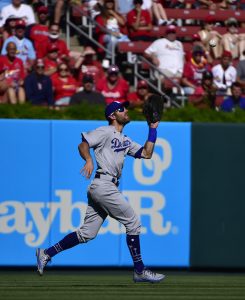
The Dodgers acquired Taylor from the Mariners in a seemingly minor 2016 deal. That proved to be one of the more shrewd pick-ups of president of baseball operations Andrew Friedman’s tenure in L.A., though, as Taylor has been a highly productive player essentially from that moment on. The right-handed hitter has posted above-average offensive numbers (by measure of wRC+) in each of the past five seasons.
Taylor gets to that production with a strong blend of plate discipline and power. He rarely chases pitches outside the strike zone, and he’s become especially adept at drawing walks over the past few seasons. He also brings 15-20 home run power to the table despite playing in a pitcher-friendly environment in L.A. That’s helped Taylor offset higher than average strikeout rates to remain a quality offensive player.
Going back to his 2017 breakout, the Virginia native owns a .265/.343/.461 cumulative line. That’s 16 percentage points above the league average output, not far off his numbers in his platform campaign. Taylor hit .254/.344/.438 with 20 homers in 582 plate appearances in 2021, translating to a 113 wRC+ (13 points above average). He started especially hot, posting a .277/.382/.452 mark through the season’s first half en route to his first career All-Star selection.
While Taylor’s multi-year track record always looked likely to pay him handsomely this offseason, he did seem at one point as though he’d hit the market on a down note. The 31-year-old slumped to a .223/.290/.419 line over the regular season’s second half, seeing his strikeout rate spike to 33.1% in the process. But Taylor put any questions about his tough finish to rest with a monster postseason, popping four homers in 43 playoff plate appearances (including a walk-off shot in the National League Wild Card game) to help the Dodgers to the NL Championship Series.
Valuable as Taylor is offensively, he’s perhaps more well-known for his defense. Taylor has functioned as a true utility player over the years, starting games at every position other than first base and catcher. He spends the bulk of his time at the higher-value positions up the middle of the diamond, particularly at second base and in center field.
His return will give skipper Dave Roberts plenty of flexibility, and it’s likely Taylor will continue to assume that rover role now that he’s back in Dodger blue. Looking at the 2022 roster, it seems the bulk of that time could come at second base.
Taylor played very little at the keystone down the stretch after L.A. acquired Trea Turner from the Nationals at the trade deadline. With Corey Seager now in Texas, Turner looks likely to slide back to his typical shortstop position. That’d leave Taylor and Gavin Lux as the favorites for playing time at second, with either player also capable of spelling the presumptive starting outfield of AJ Pollock, Cody Bellinger and Mookie Betts.
The specific breakdown of Taylor’s deal has yet to be reported, but the $15MM average annual value is the meaningful figure from a competitive balance tax perspective. Luxury tax calculations are based on deals’ AAV’s as opposed to actual payouts structures. After accounting for the Taylor deal, the Dodgers’ 2022 CBT number sits around $231MM, in the estimation of Jason Martinez of Roster Resource. That’d have handily exceeded the $210MM first threshold in 2021, although it’s impossible to know precisely where the CBT markers will land in the next collective bargaining agreement.
The Taylor signing also has an indirect effect on the Dodgers’ 2022 draft. He’d received and rejected an $18.4MM qualifying offer at the outset of the offseason. The Dodgers won’t directly forfeit a pick for re-signing their own free agent, but they are bypassing the pick they’d have received had they allowed Taylor to sign elsewhere. That’s a small price to pay for a player of Taylor’s caliber, though, particularly for the Dodgers. Because they exceeded the CBT threshold in 2021, they’d have only stood to recoup a pick after the fourth round had they allowed Taylor to walk.
Jeff Passan of ESPN first reported the Dodgers and Taylor were making progress on an agreement. Ken Rosenthal of the Athletic first reported the sides had reached an agreement, as well as first with the contract terms. The Associated Press reported the specific breakdown of terms.
Image courtesy of USA Today Sports.
Chris Taylor Drawing Widespread Interest
Super utility player Chris Taylor is drawing interest from various teams and could sign in the coming days, according to MLB Network’s Jon Morosi (Twitter links). He lists the Dodgers, Blue Jays, Mariners, Angels and Nationals as teams that have been in recent contact with Taylor’s camp. The current CBA expires at 11:59pm ET on Wednesday, December 1, leading to a frenzy of transactions in recent days as teams are trying to tick items of their to-do lists before the lockout and transaction freeze that are expected to follow. Morosi says that Taylor could sign by Wednesday, potentially getting in just under the wire.
The fact that various teams are interested in Taylor’s services is no surprise, given his extreme defensive versatility. Over his career, Taylor has spent time at every position on the diamond except for catcher, pitcher and first base. In 2021, he appeared in at least eight games at six different positions, and more than 23 games at four different spots. He’s also been an above-average contributor on the offensive side of the game for five consecutive seasons now, by measure of wRC+. Over those five years, he has hit 78 home runs, stolen 50 bases and hit .265/.343/.461 for a wRC+ of 116. The combination of those factors makes it hard to imagine a team that wouldn’t be upgraded by adding Taylor to supplant the least-productive non-catcher in their lineup and slotting him into whatever position they happen to play.
Taking all this under consideration, as well as the fact that Taylor rejected a qualifying offer from the Dodgers, MLBTR predicted Taylor could earn himself a contract of four years and $64MM, AAV of $16MM. However, the free agent market has been quite robust so far, with the majority of players outearning their projections as teams seem to be rushing to get business done before this week’s expected lockout and subsequent transaction freeze. With that in mind, it wouldn’t be a surprise to see Taylor, 31, surpass that estimate, either in length or dollars.
The Dodgers are a fairly logical suitor, given that they’ve been utilizing Taylor’s skills for the past five-plus seasons. Although they still have one more season of Trea Turner, whom they acquired at the trade deadline, they’ve also just seen Corey Seager sign on with the Texas Rangers. At the moment, Gavin Lux would probably be pencilled in as the second baseman, but he also has positional versatility and could be bumped into a bench/utility role. In the outfield, Mookie Betts and AJ Pollock should have two spots accounted for, with Cody Bellinger likely taking up a third. But after Bellinger’s miserable 2021 campaign, adding Taylor could provide some insurance in case he can’t bounce back to his MVP-winning form from a couple years ago.
Just like the Dodgers, the Blue Jays have also just watched one of their best players depart for Texas, as Marcus Semien is now a Ranger as well. Bo Bichette and Vladimir Guerrero Jr. have two infield spots spoken for, with Cavan Biggio, Santiago Espinal and Breyvic Valera on hand as options for second or third base. Taylor could potentially take Semien’s spot and bump everyone else down on the depth chart.
The Mariners have already brought Adam Frazier into their infield mix this week, but seem determined to add more. Morosi lists Taylor, Kris Bryant and Javier Baez as infielders they are considering. Baez has since reportedly signed with the Tigers, but Taylor and Bryant both make sense as potential adds at third base, with Abraham Toro then platooning with Frazier at second. Taylor also started his career in Seattle before moving to the Dodgers, which would make for a nice homecoming story. The club has been aggressive in trying to build on a strong 2021 campaign, having also added Robbie Ray in recent days.
Just like Seattle, their division rivals in Anaheim have also been active in gearing up for 2022. They’ve added pitchers Noah Syndergaard, Michael Lorenzen and Aaron Loup, as well as acquiring infielder Tyler Wade from the Yankees. Taylor would be an upgrade over Wade or David Fletcher for the middle infield, as well as providing insurance for an outfield with a few unproven options, as youngsters Brandon Marsh and Jo Adell have shown promise but haven’t locked down jobs just yet.
The Nationals winning the bidding would be a surprise, given that they underwent a huge fire sale at the trade deadline and have been fairly inactive so far this offseason. But they seem determined to avoid a lengthy rebuild and will be aiming to return to contention while they still have the elite production of Juan Soto, whom they control for three more seasons. Other than Soto and Josh Bell, there’s almost no certainty in the team’s lineup, making it very easy for Taylor to be slotted in.
There’s one team that’s apparently not in the mix, however, as Chris Cotillo of MassLive reports that the Red Sox don’t seem to be heavily involved.
Marlins In Market For Outfielders Even After Garcia Deal
The Marlins aren’t 24 hours removed from agreeing to a four-year, $53MM contract with free-agent outfielder Avisail Garcia, but MLB Network’s Jon Heyman reports they’re still seeking offensive upgrades (all Twitter links). Outfielders appear the priority, with Heyman listing Nick Castellanos, Kyle Schwarber, Chris Taylor and Eddie Rosario among the possible targets.
Miami already guaranteed $53MM to Garcia over the next four seasons — a hefty splash by their typically modest standards. It’d be a surprise to see them follow that up by signing any of Castellanos, Schwarber or Taylor, as all three are expected to top that four-year deal landed by Garcia. Castellanos is reported to be seeking a contract of as many as seven or eight years in length, though it seems likely he’ll ultimately settle in a bit shy of that mark. Even still, there’s a good chance he’ll double the Garcia total.
Schwarber and Taylor, meanwhile, could both land larger four- or even five-year deals than Garcia signed. Schwarber parlayed a huge season between Washington and Boston into a strong free-agent stock, while Taylor has long been a steady super-utility piece for the Dodgers, He’d give Miami an option in center field for at least the first season or two of the deal — something they very much crave — and he’d give them some cover in the infield as well. That could be particularly appealing to Miami after the Marlins saw each of Miguel Rojas, Jazz Chisholm and Brian Anderson miss significant time in 2021.
Rosario, 30, seems like a more viable fit in Miami than the other names on the list — at least from a price perspective. The longtime Twins outfielder was non-tendered by Minnesota last winter, signed a one-year deal in Cleveland and found himself headed to the Braves in what amounted to a deadline salary dump. Rosario took off in Atlanta, however, returning from the injured list to slash .271/.330/.573 in his final 106 plate appearances. His heater continued into the postseason, where he won NLCS MVP honors. Even with a quiet World Series, Rosario still posted a massive .383/.456/.617 slash in 68 playoff plate appearances.
Streaky play of that nature has been the norm throughout Rosario’s career. In general, he’s a free-swinging left fielder with plenty of power but a low walk rates and dwindling defensive ratings. Dating back to the 2017 season, Rosario is a .278/.315/.484 hitter, but those numbers have tailed off in recent years. Defensive Runs Saved and Ultimate Zone Rating still peg Rosario as a decent left fielder, but not the standout defender he was in 2018. Statcast’s Outs Above Average, however, graded Rosario harshly and ranked him worst among all MLB outfielders (-18).
Both Castellanos and Taylor rejected qualifying offers, meaning they’d cost the Marlins their third-highest pick in next year’s draft. Schwarber and Rosario were ineligible to receive qualifying offers by virtue of being traded midseason (though only Schwarber would’ve commanded one).
Chris Taylor To Reject Qualifying Offer
Utilityman Chris Taylor will reject the Dodgers’ one-year, $18.4MM qualifying offer and test the open market, reports Jon Heyman of the MLB Network (Twitter link). The Meister Sports Management client will presumably set out in search of a multi-year pact, be it with the Dodgers or another club.
That’s not at all surprising, since Taylor should be in plenty of demand. Even with draft pick compensation attached, MLBTR placed the 31-year-old sixteenth on this offseason’s list of top free agents, projecting him to land a four-year deal worth $64MM. Taylor’s ability to play essentially any non-catcher position on the diamond should make him a highly coveted player, with teams seeing him as a potential solution for weaknesses on their current roster at various positions.
While Taylor’s best known for his defensive versatility, he pairs that with strong work at the plate. The right-handed hitter strikes out a fair amount, but he also draws walks and hits for power at high clips despite spending his past few years in one of the game’s more pitcher-friendly home parks. By measure of wRC+, Taylor has been an above-average bat in each of the past five seasons. He slowed down in the second half of the 2021 campaign, but Taylor was scorching hot during the postseason to hit free agency on a high note.
If Taylor doesn’t re-sign with the Dodgers, they’ll stand to receive a compensatory draft choice. As a team that exceeded the luxury tax threshold in 2021, they’ll only add a pick after the end of the fourth round. Teams that sign Taylor (or any other qualified free agent), will surrender draft and potentially international signing bonus capital, with the extent of the forfeiture dependent on the signing club’s market size. MLBTR’s Tim Dierkes broke down which picks each team would forfeit last month.
Latest On Tigers’ Pursuit Of A Shortstop
The Tigers continue to cast a wide net in free agency as they attempt to build off an encouraging 2021 season. MLB Network’s Jon Morosi reports that the team has already spoken to representatives for six of this winter’s premier middle infielders (Carlos Correa, Corey Seager, Marcus Semien, Trevor Story, Javier Báez, and Chris Taylor). Morosi notes in a separate tweet that there’s some industry uncertainty over whether the Tigers would sign a player in the $250MM range, but that may have less to do with the team’s regard for the free agent shortstops and more to do with Detroit’s rotation needs.
It’s commonplace for teams to perform due diligence checks with agents in the offseason, even if the team isn’t optimistic about its chances to sign a certain player. Still, there is a perception among some in the sport that a few teams could be aggressive and move quickly in their pursuit of high-end free agents. The Tigers were among the teams listed as candidates to sign prominent players before the current CBA expires.
Detroit can afford to be opportunistic in the very literal sense that they have a ton of open payroll space. Even after extending Jonathan Schoop and their recent acquisition of Tucker Barnhart, the team has a projected 2022 payroll of just $93MM per Roster Resource. Non-tenders would shrink that estimate even further, and Detroit has a few prominent non-tender candidates (most notably Matthew Boyd) on large projected arb salaries. Given that the Tigers ran out a $200MM roster as recently as 2017, it’s easy to see the current payroll swelling in order to fling open the team’s competitive window.
Owing to this financial flexibility and a middle-infield that collectively posted a sub-.700 OPS last season, it’s understandable why the team would zero in on the solutions presented on the open market. Complicating this approach, however, is that Detroit has a very young rotation that posted middling run-prevention numbers last year.
The high-upside group of starters is likely to tap into some of its potential with more experience, but there’s validity in surrounding this pitching core with more proven commodities. After all, even if the team is hopeful each of Casey Mize, Tarik Skubal, and Matt Manning take a step forward, certain rotation-wide stats like a 4.66 FIP (4.17 ERA) and a low 18.8% strikeout rate portray a staff that is very much headed for regression.
Those three youngsters, of course, were not the only members of this past season’s rotation. Both Boyd and Spencer Turnbull soaked up innings for Detroit in 2021, providing some of the best numbers the pitching staff had to offer. Unfortunately, both players saw their productive seasons end prematurely. Boyd pitched to a personal-best 3.89 ERA across 15 starts for the team before being shut down to undergo forearm surgery that looks likely to lead to him being let go.
The 29-year-old Turnbull was amidst an even stronger season. Through eight starts and 50 innings, the right-hander posted a 2.88 ERA with superb command and ground-ball tendencies, to say nothing of the no-hitter he twirled against Seattle in May. News broke that Turnbull would require Tommy John surgery in July and, similar to Boyd, will likely miss the majority of the 2022 season. While the injury-created voids in next year’s rotation are far from ideal, one silver lining is that Detroit will at least maintain control of Turnbull through the 2024 season (barring changes to the service time structure in the next CBA).
Taking a two-pronged approach to the free agent market makes perfect sense then, since the Tigers can invest just about any level of resources to upgrade their middle infield and then use another chunk of their payroll to buttress their rotation. Detroit has already been linked to a number of mid-rotation starters, giving them multiple avenues to make a splash this offseason.
14 Players Receive Qualifying Offers
Today was the last day for teams to issue qualifying offers to eligible free agents, as teams had to make their decisions by 4pm CT. With the deadline now behind us, here are the players who were issued the one-year, $18.4MM offers…
- Brandon Belt, Giants (link)
- Nick Castellanos, Reds (link)
- Michael Conforto, Mets (link)
- Carlos Correa, Astros (link)
- Freddie Freeman, Braves (link)
- Raisel Iglesias, Angels (link)
- Robbie Ray, Blue Jays (link)
- Eduardo Rodriguez, Red Sox (link)
- Corey Seager, Dodgers (link)
- Marcus Semien, Blue Jays (link)
- Trevor Story, Rockies (link)
- Noah Syndergaard, Mets (link)
- Chris Taylor, Dodgers (link)
- Justin Verlander, Astros (link)
This is the highest number of qualifying offers issued since the 2015-16 offseason, when a record 20 players received the QOs. Only six players received qualifying offers last winter, which was the lowest ever issued in an offseason, yet not really surprising given the pandemic’s impact on the 2020 season and league revenues.
These 14 players now have until November 17 to decide whether or not to accept the offer. If they accept, they’ll receive $18.4MM next season, and can’t be traded until June 15, 2022. They also won’t be eligible to receive a qualifying offer in any future trips to free agency (players are also ineligible for the qualifying offer if they haven’t spent at least one full season with their current team). Since the qualifying offer system was introduced in the 2012-13 offseason, 10 of the 96 players to receive a QO have taken the deal.
If a player rejects the qualifying offer, draft pick compensation is now attached to their market, unless they re-sign with their former team. Teams who sign a QO free agent will have to surrender at least one draft pick, and potentially some international bonus pool money depending on their status as revenue-sharing recipients or whether or not they exceeded the luxury tax threshold. (Here is the list of what every team would have to give up to sign a QO free agent.)
If a QO free agent signs elsewhere, that player’s former team receives a compensatory draft pick based on this criteria….
- A draft pick after Competitive Balance Round B will be awarded if the team losing the free agent did not receive revenue sharing or if the free agent in question signed a contract worth less than $50MM in guaranteed money.
- A draft pick after Round 1 will be awarded if the team losing the free agent received revenue sharing and the free agent in question signed for more than $50MM.
- A draft pick after Round 4 will be awarded if the team losing the free agent paid luxury tax penalties in the preceding season.
As always, several factors are weighed by both teams and players about whether or not to issue or accept qualifying offers. This winter provides yet another wrinkle — this could be the final year of the current qualifying offer system due to the expiration of the current Collective Bargaining Agreement on December 1. It is widely expected that the owners could lock out the players if a new deal isn’t reached by that date. In the event of a lockout, MLB would institute a roster freeze on all transactional business involving Major League players, thus bringing the free agent market to a halt.
With this deadline looming, it is possible we could see some QO recipients (those less certain of landing big multi-year contracts) choose to accept the one-year deal in order to guarantee themselves some financial and contractual security prior to a possible lockout. By that same token, this could make teams warier about extending the qualifying offer to certain players due to a larger suspicion that they would accept…or perhaps a player’s willingness to accept could make a team more inclined to issue a QO to a so-called borderline case.
Jon Gray Has Reportedly Rejected Extension Offer From Rockies
Jon Gray rejected an extension offer the Rockies made him before the end of the regular season, reports Patrick Saunders of the Denver Post. Gray continues to have interest in sticking with Colorado long-term, Saunders adds, although the expectation is now that he’ll at least test the open market.
There’s been reported mutual interest between the Rox and Gray in a long-term deal for months, but the sides have yet to line up on acceptable terms. Saunders suggests the right-hander could target a three or four-year deal with an average annual value in the $9-10MM range on the open market. Whether that kind of deal would be attainable could depend upon whether the Rockies tag Gray with a qualifying offer. Doing so would entitle the Rockies to draft pick compensation were he to sign elsewhere, although he’d be a strong candidate to accept an $18.4MM offer to return in 2022.
Perhaps that’d be a mutually agreeable outcome, since Colorado clearly has interest in retaining Gray. Despite already being out of postseason contention by late July, the Rockies seemingly made Gray unavailable relatively early on trade deadline day. That course of action makes little sense unless the team wants to keep him around, and subsequent reports made clear that’s the case.
Gray bounced back from an injury-plagued 2020 to post a solid season this year. Over 149 innings, the 29-year-old worked to a 4.59 ERA with average or better strikeout (24.4%), walk (9%) and ground-ball (48.4%) rates. He thrived at Coors Field, tossing 78 1/3 frames of 4.02 ERA ball while holding opponents to a .205/.291/.365 line in home starts. With how difficult it has proven for the Rockies to find pitchers capable of succeeding in the game’s most hitter-friendly environment, it’s easy to see why general manager Bill Schmidt and his staff have continually expressed interest in keeping Gray around.
Saunders adds some additional context on Colorado’s offseason priorities, writing that the club is expected to target “at least two impactful players.” What constitutes an impact addition is open to interpretation, but Saunders suggests the club will look for a power-hitting bat this winter, preferably an outfielder. He floats Nick Castellanos (almost certain to opt out of his contract with the Reds), Michael Conforto and utilityman Chris Taylor as possible targets.
That’s a varied collection of potential players of interest. Castellanos looks like a candidate for a nine-figure deal. Taylor has a strong case for a four-year contract in the $65+MM range. Conforto could land three or four years himself, but it’s also possible he looks for a one-year bounceback deal after a mediocre 2021 campaign. Signing any of that group would probably cost the Rockies a draft choice, as they’re all likely qualifying offer recipients.
As for other areas of need for the Rockies, Saunders floats the bullpen and middle infield. Shortstop Trevor Story is expected to reject a QO and sign elsewhere, leaving a middle infield vacancy. Former top prospect Brendan Rodgers has seemingly locked down one spot after hitting .284/.328/.470 across 415 plate appearances this past season. Rodgers is capable of manning either of shortstop or second base, leaving some flexibility for Schmidt and company in addressing the dirt.
Plugging all those position player gaps and/or retaining Gray would certainly make for a costly winter. Earlier this month, Colorado president Greg Feasel said the club was planning to increase payroll over the course of the next two offseasons — eventually pushing from 2021’s $118MM figure closer to their franchise-record $145MM mark from 2019. Colorado should indeed have spending room to work with, as Jason Martinez of Roster Resource estimates they have around $79MM in 2022 commitments at the moment — including projected arbitration salaries.
That financial flexibility should give the front office real room for upgrades, but they’ll have a tall task in constructing a contender. The Rockies have finished in fourth place in the NL West in each of the past three seasons, and the impending departure of Story only makes a return to contention in that loaded division harder. Despite those challenges, Saunders’ report reinforces that the Rockies aren’t planning to take a step back this winter. They’re at least plotting a hopeful win-now course of action that could see them remain in the market for some of the offseason’s top free agent hitters.
Chris Taylor And The Ben Zobrist Contract
Much ink has already been spilled, or pixels illuminated, about the upcoming offseason and the superclass of shortstops. Even though the Mets extended Francisco Lindor and took one of the most intriguing names out of the pool, it’s still going to feature such marquee names as Carlos Correa, Corey Seager, Trevor Story, Javier Baez and Marcus Semien. But there’s one name that’s also on the list that is sometimes overlooked. If you’ve read the headline to this piece, then you already know I’m talking about Chris Taylor.
Perhaps the reason Taylor doesn’t quite fit in with the rest of that group is that he’s not exactly an everyday shortstop like the rest of them. (Semien has been playing mostly second base this year, but only because of the presence of Bo Bichette next to him. He could very easily return to shortstop duty with a new club next season.) Taylor is more of a utility guy who is capable of playing some shortstop, if needed. He’s appeared at the position in each of the past eight seasons, but never more than 81 games. Also, he reached that number back in 2018. In 2019, that number dropped to 39. In the shortened 2020 season, it was 20 games, exactly one third of the 60-game reduced schedule. This year, it’s only been 22 games so far. The fact that he’s not considered an everyday option is at least somewhat borne out by statistics. To give one example, of the 46 players to log at least 1000 innings at shortstop over the past five years, Taylor’s UZR/150 of -7.5 ranks 43rd, in the vicinity of guys who don’t play at short much anymore, such as Aledmys Diaz and Manny Machado.
Still, even though he’s not an everyday option, he has versatility, which is something teams love. Taylor has also played second base, third base and all three outfield positions this year, meaning that he could conceivably be plugged into the lineup of any team in the league and move around to their area of greatest need. That could potentially give him tremendous leverage in free agency this winter, just as it did for Ben Zobrist six years ago. Zobrist was able to use that vast market to net himself a four-year, $56MM contract with the Cubs in December of 2015. Could Chris Taylor get something like that? Well, let’s compare.
For starters, Taylor will have a distinct advantage over Zobrist in one category: age. Zobrist was set to turn 35 in May of 2016, shortly after making his Cubs debut. Taylor just turned 31 two weeks ago. Taylor will be 3 1/2 years younger while on the market this winter than Zobrist was back in 2015, meaning a team could potentially be willing to put an even longer contract in front of Taylor.
Secondly, in terms of defense, although Zobrist had shortstop experience, he didn’t play there in 2015. Then he only logged 15 innings at shortstop over the course of his time with the Cubs. Clearly, the club wasn’t expecting him to provide significant time there. Nor was he an option in center field. His last action there was seven games for the Rays in 2014. Taylor, on the other hand, has played 56 games in center this season and 181 over the past five years. Although much was made of Zobrist’s versatility, he was primarily a second baseman and corner outfielder by the time he signed with the Cubs. Due to Taylor’s ability to play almost everywhere, including premium positions like shortstop and center field, he brings more versatility to the table than Zobrist did at that time.
That’s age and defense, but what about the bat? Since becoming an everyday player in 2017, Taylor has played in 610 games and logged 2,349 plate appearances over those five seasons. His line in that time is .266/.344/.464, which amounts to a wRC+ of 118. In the five years leading up to Zobrist’s contract, he played 742 games and logged 3,229 plate appearances, with a line of .272/.359/.437, wRC+ of 124. Zobrist has the higher batting average but Taylor has more power and ends up with fairly similar production overall.
That’s being a bit unfair to Zobrist because it leaves out his monster 2009 season wherein he hit .297/.405/.543 for a wRC+ of 152 and produced 8.7 fWAR. However, that was a distant memory by the time the Cubs signed Zobrist heading into the 2016 season. You don’t sign a player who’s about to turn 35 based on what he did when he was 28. However, by the same token, one could argue that we shouldn’t be including Taylor’s excellent 2017 season because he was 26 then but is 31 now. If we shrink the sample down to the three years before free agency, Zobrist’s line is .274/.356/413, wRC+ of 117, whereas Taylor’s line is .262/.345/.459, wRC+ of 117.
Okay, so, Taylor is like a younger and more versatile version of 2015-2016 Zobrist, and very similar with the bat. One major unknown at the moment, though, is what kind of momentum he will bring into the offseason. One thing I’ve failed to mention thus far is that Zobrist entered free agency on the heels of an excellent playoff performance, having just helped the Royals win the 2015 World Series. In that postseason, Zobrist played in 16 games, garnering 75 plate appearances, producing a line of .303/.365/.515, wRC+ of 133.
Taylor is in the opposite position right now, slumping terribly over the past month. Since August 13th, he’s hitting .136/.217/.272, wRC+ of 34. It seems this slide could at least be somewhat chalked up to a neck injury that has kept Taylor out of action for almost a week now. But the Dodgers haven’t placed him on the injured list, which suggests they don’t think it’s terribly serious. Teams are surely able to overlook a small, injury-caused slump amidst a solid five-year run of success. Though it would certainly help Taylor’s earning power if he could prove that’s all it is by getting back to being healthy and productive. The window for him to do that is getting narrow, however, since there’s just over two weeks remaining in the regular season. The Dodgers have already clinched a playoff berth of some kind, but they’re 1 1/2 games behind the Giants in the race for the NL West crown, meaning they’re guaranteed only one postseason game.
Another wrinkle is the qualifying offer. Zobrist was traded mid-season in 2015, making him ineligible for it. Taylor, on the other hand, will most likely receive one, assuming his long-term health outlook is okay. That means that any team signing him would have to forfeit their second-highest draft pick, or third-highest, if they are a revenue-sharing recipient. That would certainly dampen his market somewhat.
Taking all of that into account, where does that leave us? Zobrist got four years, $56MM, which is an average annual value of $14MM. Taylor will be more versatile and almost as good at the plate. Bake in a few years of inflation and Taylor could aim for a few extra million per year. Because of his age, and assuming no lingering questions about his health, maybe he gets five years instead of four. So, does some team go to five years, $80MM? That certainly feels high, especially given that DJ LeMahieu just got $90MM from the Yankees before this season. (LeMahieu is also older and less versatile than Taylor but was coming off a tremendous two-year stretch at the plate.)
Perhaps the qualifying offer knocks that down some and Taylor actually can’t quite get to Zobrist levels. Maybe this is a bit too optimistic in Taylor’s favor. Still, despite his recent slump, Taylor’s wRC+ is currently sitting at 118 for the season. Baez is at 121. Trevor Story is at 99. Taylor might not be as much of a household name as those two, but his earning power might be closer to them than you think.
2021-22 Qualifying Offer Candidates
With the trade deadline in the rearview mirror and a little more than six weeks remaining in the regular season, plenty of front offices are turning their attention towards the upcoming offseason. The first notable decision for many clubs will be to decide whether to tag one or more of their top impending free agents with a qualifying offer.
As a reminder, the qualifying offer is a one-year contract offer teams can make to certain impending free agents. The precise value of the QO has yet to be calculated, but it’s determined as the average salary of the game’s 125 highest-paid players. Last season, the QO value was set at $18.9MM. If the player accepts the offer, he returns to his current team on that one-year deal. If he rejects, his previous team would receive draft pick compensation should he sign elsewhere.
Last season, six players (George Springer, Trevor Bauer, J.T. Realmuto, DJ LeMahieu, Kevin Gausman and Marcus Stroman) received qualifying offers. Gausman and Stroman accepted the QO, while Realmuto and LeMahieu re-signed with their current clubs as free agents. The Reds and Astros received compensatory picks (used on Jay Allen and Chayce McDermott, respectively) when Bauer and Springer departed.
The collective bargaining agreement prohibits a player from being tagged with a qualifying offer multiple times in his career. (A list of every active big leaguer who has previously received a QO is available here). Similarly, in order to be eligible, the player must have spent the entire preceding season on the same team. Players traded midseason cannot be tagged with a QO.
With the majority of the 2021 season in the books, we can take a look at the upcoming free agent class to predict which players might wind up receiving qualifying offer this winter.
Locks
- Carlos Correa, Freddie Freeman, Clayton Kershaw, Robbie Ray, Carlos Rodón, Corey Seager, Marcus Semien, Trevor Story
This group is fairly straightforward, as there’s very little chance any of these players would accept a qualifying offer. Correa, Seager and Freeman all have MVP-caliber upside and are locks to pull in long-term deals this winter. Semien didn’t receive a QO from the A’s after a down year in 2020, took a pillow contract with the Jays for almost the value of the QO ($18MM), and has essentially replicated his 2019 form that earned him a third place finish in AL MVP voting. He should find a big multi-year deal this time around.
Story is having a bit of a down year, but there’s no doubt the Rockies will make him a qualifying offer after not trading him at the deadline. Nick Groke of the Athletic wrote this week that Colorado hasn’t given up hope of convincing him to sign a long-term extension, but that seems unlikely given Story’s own bewilderment he wasn’t moved to a contender this summer. Whether Story is willing to return to Denver or not, he’ll receive a QO.
Kershaw, Ray and Rodón will be among the top pitchers on the market. Kershaw has spent the past couple months on the injured list due to forearm soreness, but he’s expected back in September and is in the midst of another fantastic season. So long as he’s healthy, he’s a lock for a QO. Ray and Rodón both had to settle for one-year deals after poor 2020 seasons, but they’ve each been among the best pitchers in the American League this year.
Likely
- Michael Conforto, Jon Gray, Yusei Kikuchi, Eduardo Rodríguez, Noah Syndergaard, Chris Taylor, Justin Verlander
Over the past two seasons, Taylor has somewhat quietly been one of the game’s top 25 qualified hitters by measure of wRC+ and he’s versatile enough to cover any non-catcher position on the diamond. He’s not a true everyday player at any one spot and he’s making contact at a career-worst rate this season, so he falls just short of being an absolute lock for a QO. But the Dodgers would be as willing as any team to shoulder a significant one-year salary were Taylor to accept, and his body of work should be sufficient to warrant a multi-year deal regardless.
The Mets’ players in this group are two of the more interesting free agents in the class. Conforto entered the season looking like a lock for a QO and seemingly having a chance at landing nine figures with a strong platform year. He missed a month with injury, though, and hasn’t made anywhere near his typical level of impact at the plate. He’s shown some life over the past few weeks, and between his track record and age (28), Conforto still seems a good bet to land a long-term deal.
Syndergaard was a top-of-the-rotation starter at his peak, but he hasn’t pitched since 2019 because of Tommy John surgery. He’s eyeing a September return — likely in relief, given his dwindling time to build up arm strength — and his late-season form will obviously be critical to his market. The Mets should run one of the higher payrolls in the league, and Syndergaard has the upside to be an ace if healthy, so New York still seems more likely than not to make the offer.
Similarly, Verlander has essentially missed two full seasons because of his own Tommy John procedure. That’s a scary development for a pitcher who’ll be 39 on Opening Day 2022, but he was still every bit an ace when we last saw him in 2018-19. The Astros are a win-now club that runs high payrolls, so Verlander accepting a QO wouldn’t be the worst thing in the world. If he declines and signs elsewhere, Houston would recoup some much-needed draft compensation after losing their past two first-round picks as punishment for the sign-stealing scandal.
Colorado reportedly showed even less interest in trading Gray than they did with Story at the deadline. There’s apparently mutual interest about working out a multi-year extension, and the QO could serve as a temporary measure to keep Gray in Denver while the Rockies and Gray’s representatives work on a long-term deal.
Rodríguez has bounced back to take the ball every fifth day this year after a scary bout with myocarditis cost him all of 2020. His ERA’s pushing 5.00, but his peripherals are far better than that bottom line run prevention and the southpaw has an established track record of mid-rotation production.
The Mariners are facing a difficult decision regarding Kikuchi, as MLBTR’s Steve Adams explored last month. Seattle must decide whether to exercise a package deal of four successive club options at $16.5MM apiece (essentially a four-year, $66MM extension) this winter. If the Mariners don’t exercise their four-year option, Kikuchi has a $13MM player option to return to Seattle for 2022. If both parties decline their ends, the 30-year-old would hit free agency this offseason, although the M’s could then tag Kikuchi with a qualifying offer.
Given that Kikuchi will only be a free agent if he passes on a $13MM player option, the Mariners would likely make him a QO worth a few million dollars more if it comes to that — either with the expectation he’ll decline in search of a longer-term deal, or with the hope he accepts and Seattle can keep him in the fold next season without committing themselves to the additional three years of guaranteed money.
Possible
The Giants have plenty of payroll space this offseason and seem likely to try to keep most of this season’s core together. Belt has been one of the sport’s most productive offensive players on a rate basis over the past two years. But he’s also 33 years old, has a long injury history and is striking out at the highest rate of his career.
San Francisco bought low on DeSclafani over the winter after he had a tough 2020 season with the Reds. He’s bounced back to post a very strong 3.26 ERA, although his peripherals are closer to average and he’s benefitted from opponents’ .257 batting average on balls in play. The Giants will likely see 4/5 of their starting rotation hit free agency this winter, so they could be eager to bring DeSclafani back, even if that comes via a lofty 2022 salary.
Morton has had another productive season in his first year as a Brave, but his previous two teams (the Astros in 2018 and the Rays in 2020) let him reach free agency without making a qualifying offer despite his consistently strong track record. That’s presumably due to concerns about his past injury history and age. He’ll turn 38 this winter and might check his potential earning power by limiting himself to teams in the Southeastern part of the country — as he reportedly did last offseason. That could inspire the Braves to pass on a QO, but Morton continually reels off above-average performances, and this is an Atlanta front office that has been eager to dole out hefty single-year salaries for key veteran upgrades in recent years.
Iglesias looks like the top impending free agent reliever (assuming the White Sox exercise their option over Craig Kimbrel). He’s sporting an ERA under 3.00 for the fifth time in his six seasons since moving to the bullpen, and he’s never had a single-season SIERA above 3.55. Home runs have been an issue, but Iglesias gets above-average results year in and year out and has some of the best strikeout and walk numbers in the game in 2021.
Long Shots
The Giants hold a $22MM club option (with a $3MM buyout) over Posey’s services for next season. If the front office is willing to commit him a significant salary, they’ll just exercise the option rather than going the QO route. Indeed, they’re reportedly planning to do exactly that (or to potentially pursue a multi-year extension with the franchise icon). Either way, there’s no real reason to involve the qualifying offer here.
Canha would be a very plausible qualifying offer candidate on many teams. He’s been a well above-average hitter and overall performer three years running and is generally one of the game’s more underrated players. The A’s, though, didn’t make a QO to either of Semien or Liam Hendriks last season. Canha’s a Bay Area native, and his age (33 in February) will cap the length of offers he receives from other clubs. Given that, it’s not hard to envision him accepting a QO if offered. The A’s, who perennially run low payrolls and will have a loaded class of arbitration-eligible players this winter, don’t seem likely to take that risk.
Wainwright has had a fantastic 2021 season, and the Cardinals figure to be motivated to keep the franchise icon in St. Louis in some capacity. But that also looked to be true after his strong 2020 campaign, and Wainwright only wound up landing a one-year, $8MM deal. He’d be well-deserved in demanding a raise over that sum to return next season, but it remains to be seen if the Cardinals would be willing to chance more than doubling his salary — particularly if they feel Wainwright’s motivated to remain in St. Louis rather than pursue the highest possible offers in free agency.
Kluber signed an $11MM deal with the Yankees last offseason after back-to-back seasons wrecked by injury. He pitched well through ten starts but has been out since late May with a shoulder strain. Kluber’s nearing a return to action, but his missing nearly three months only adds to prior concerns about his ability to handle a significant workload at this stage of his career.
Kim, García and Wood are all having strong 2021 seasons and could plausibly land solid multi-year deals this winter. Each has enough question marks that their teams don’t seem especially likely to offer a salary in the range of the qualifying offer, though. Kim doesn’t miss many bats; García has had extreme highs and lows throughout his career; Wood has a checkered injury history. García’s contract contains a $12MM club option that vests into a mutual option if he reaches 492 plate appearances this season. If that option doesn’t vest, the Brewers would obviously have no incentive to decline the option only to make a qualifying offer at a higher price point.
Opt-Out Clauses
Each of Arenado (six years, $179MM), Castellanos (two years, $34MM) and Martinez (one year, $19.35MM) has significant guaranteed money remaining on their contracts but can opt out of those deals this winter. Arenado and Castellanos would be locks to reject qualifying offers if they trigger their opt-out provisions, since they’d be foregoing bigger guarantees to test the market.
Martinez’s player option is of similar enough value to the projected value of the qualifying offer that he could plausibly trigger the opt-out but then accept a QO. Even if that proved to be the case, the Red Sox would probably be happy to keep him in the middle of the lineup for another season.
Ineligible
- Javier Báez (midseason trade), Kris Bryant (midseason trade), Alex Cobb (previous QO), Nelson Cruz (previous QO/midseason trade), Danny Duffy (midseason trade), Eduardo Escobar (midseason trade), Kevin Gausman (previous QO), Kendall Graveman (midseason trade), Zack Greinke (previous QO), Kenley Jansen (previous QO), Starling Marte (midseason trade), Anthony Rizzo (midseason trade), Max Scherzer (previous QO/midseason trade), Kyle Schwarber (midseason trade), Marcus Stroman (previous QO)