
Astros Acquire Yusei Kikuchi
The Astros are paying up to get one of the top pitchers on the market. Houston and Toronto announced a trade sending Yusei Kikuchi to the Astros for rookie righty Jake Bloss, outfielder/first baseman Joey Loperfido and minor league infielder Will Wagner. Toronto already had ample 40-man roster space to accommodate the move.
Kikuchi is behind Jack Flaherty as arguably the second-best rental starter on the market. Houston was tied to Flaherty as well as more controllable pitchers like Jameson Taillon, Erick Fedde and Zach Eflin last week. There was never much doubt that the Astros would bring in a starter, as general manager Dana Brown hasn’t been shy about the team’s need for a mid-rotation arm. The asking price on Flaherty always seemed like it might be beyond Houston’s comfort zone, making Kikuchi a sensible fallback.
The 33-year-old Kikuchi has had mixed results this season and throughout his career more broadly. Over 115 2/3 innings this year, he carries a 4.75 ERA that’s right in line with his 4.72 mark in parts of six MLB campaigns. Kikuchi’s strikeout and walk profile is quite a bit more impressive than that run prevention figure suggests. He has punched out 26.2% of opposing hitters while walking only 6% of batters faced. Among pitchers with 100+ innings, Kikuchi ranks 19th in strikeout percentage and 16th in strikeout/walk rate differential. He’s getting swinging strikes at a 12.4% rate that places him among the top 30 in that group.
A .340 average on balls in play and modest 70.6% left on base rate have nevertheless pushed his ERA close to 5.00. Those marks were nearer to league average in 2023, when the Japanese southpaw turned in a 3.86 ERA over 32 starts with similar strikeout and walk rates as he’s posted this season. Houston is betting on positive regression in those sequencing and batted ball results.
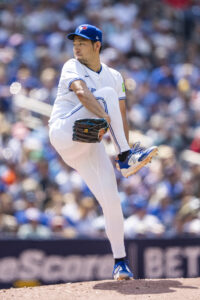
Teams have long been intrigued by Kikuchi, who boasts some of the best raw stuff of any left-hander in baseball. His fastball sits north of 95 MPH and he has the ability to miss bats with all four of his offerings (four-seam, curveball, slider, changeup). Kikuchi has had a difficult time keeping the ball in the park throughout his MLB career, though. He’s allowing homers at an elevated 1.32 clip per nine this season and has given up more longballs than the average pitcher in every full season of his major league tenure. Right-handed batters have generally given him trouble, though he’s holding them a more manageable .280/.323/.441 slash in 409 plate appearances this year.
While Kikuchi isn’t without flaws, he’s a plug-and-play option for the middle of a Houston rotation that certainly needed one. The Astros have been hit hard by starting pitching injuries all year. They lost Cristian Javier and José Urquidy to Tommy John surgery. Depth starter J.P. France went down with a season-ending shoulder issue. Justin Verlander has had two injured list stints and has been shelved since the middle of June because of neck soreness. Lance McCullers Jr. has hit continued snags in his effort to return from a flexor tendon surgery. They had to slow down Luis Garcia in his work back from Tommy John surgery, though he’s again throwing bullpen sessions after being pulled off a minor league rehab stint earlier this month.
Framber Valdez is leading the rotation and has a 3.43 ERA over 18 starts. Hunter Brown has bounced back from a disastrous April and pitched like a top-of-the-rotation arm for the last three months. Ronel Blanco has been a godsend after injuries pushed him into the fifth starter role out of camp. He carries a 2.95 ERA across 119 frames.
While that’s a decent top three, the depth is questionable. Spencer Arrighetti has a 5.58 ERA over his first 19 MLB starts. Houston had pushed Bloss to the majors within a year of drafting him, largely reflecting their lack of alternatives in the upper minors. The Astros are hoping to get Verlander and Garcia (and potentially McCullers) back at some point, but they’ve also pushed Blanco to new workload heights. The 30-year-old righty had never thrown more than 88 innings in a major or minor league campaign before this year. He’s already 31 innings beyond that.
Kikuchi, who hasn’t missed a start in two years, has provided the kind of durability that the Astros have generally lacked. There’s injury risk with any pitcher, of course, but the Astros are no doubt thrilled to land a pitcher who is tied for fifth in MLB in starts going back to last year’s Opening Day.
Doing so comes at a cost. Bloss is arguably the top pitching prospect in a fairly thin Houston farm system. A third-round pick out of Georgetown last summer, the 6’3″ righty quickly pitched his way towards the top of the prospect pipeline. Baseball America recently ranked him the #2 prospect in the organization, while he’s in the overall Top 100 (and second in the organization) at FanGraphs.
BA suggests he’s likely to fit at the back of a rotation, while FanGraphs credits him with mid-rotation potential. Both outlets write that his mid-90s fastball plays especially well at the top of the strike zone because of its backspin and Bloss’ deceptively low release height. He has a pair of solid breaking pitches, while his changeup is a work in progress.
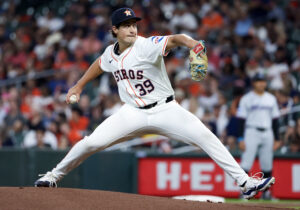
Opponents have hit him hard over his three big league starts. He has given up nine runs on 16 hits (including five homers) over 11 2/3 innings. Were it not for Houston’s injury woes, he probably wouldn’t have made his MLB debut yet. Bloss has pitched very well in the minors this season, working to a 1.64 ERA with a 25.6% strikeout rate across 66 innings. Yet he’d made all of eight starts at Double-A and one Triple-A appearance before being pushed to the big leagues out of necessity. A more typical development path would probably still have him at Double-A right now.
Bloss has all three options remaining. The 23-year-old is under control for at least six seasons beyond this one and could stick around even longer if the Jays send him to the minors for further development. Bloss could factor into next year’s rotation as the Jays try to quickly return to contention, maybe slotting into the rotation spot vacated by Kikuchi’s departure.
Getting Bloss alone would’ve been a strong return for a half-season of Kikuchi’s services. Loperfido, 25, ranked as Houston’s #5 prospect on BA’s latest update. A seventh-round selection out of Duke in 2021, he hit his way to the big leagues earlier this year. Loperfido combined for a .278/.370/.510 slash between three minor league levels last season. He was obliterating Triple-A pitching early this season and owns a .272/.365/.568 mark with 13 homers over 39 games in the Pacific Coast League this year.
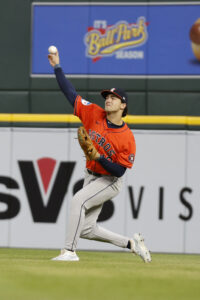
Of course, the PCL is an extremely favorable environment for hitters. BA’s scouting report credits Loperfido with above-average but not elite power. He was striking out an elevated 28% clip against Triple-A pitching. The whiffs have carried over in his first look at MLB arms. Loperfido has fanned in 36.4% of his 118 MLB plate appearances to date. He’s hitting .236/.299/.358 in 38 games.
Loperfido isn’t a great athlete or defensive player. He was drafted as a second baseman but he’s moved off the position entirely this year. Houston has divided his time between the outfield and first base in Triple-A. They haven’t given him any major league starts at first base, which is a bit of a surprise considering the mediocre production they’ve gotten out of the position from Jon Singleton and the since-released José Abreu.
Wagner is the third piece in the deal, but he’s a prospect in his own right. The son of seven-time All-Star Billy Wagner, Will ranks 19th in the Houston system at Baseball America. A former 18th-round pick out of Liberty, Wagner has outperformed his draft stock and is posting huge numbers in Triple-A. He’s hitting .307/.424/.429 with a massive 16.2% walk percentage against a tiny 10.2% strikeout rate across 324 plate appearances.
The left-handed hitting Wagner is old for the level — today is his 26th birthday — but he has little more to prove in the minors. He has divided his time between first, second and third base this year. He’d be eligible for the Rule 5 draft this winter if not selected onto the 40-man roster but could get a look in Toronto before the end of this season.
That’s three controllable players at or near the MLB level. The Astros were fine giving them up while they’re in a tight battle with the Mariners and Rangers for the AL West crown. Beyond the prospects, they’re adding salary to what is already a franchise-high payroll. The Astros had a competitive balance tax estimate around $256MM before the deal (as calculated by RosterResource). Unless there are cash considerations involved, they’ll take on roughly $3.33MM remaining on Kikuchi’s $10MM salary. That pushes them beyond the $257MM threshold that marks the second tier of luxury penalization. They’re taxed at a 32% rate on spending up to $277MM, so they’ll take on roughly $1MM in taxes on top of the money they owe Kikuchi.
Toronto sheds some money from its tax ledger — more than the Astros are taking on. Kikuchi’s three-year, $36MM free agent deal was frontloaded to pay him $16MM in the first season. Toronto’s competitive balance tax hit was nevertheless the contract’s $12MM average annual value, so Kikuchi had a higher CBT hit than actual salary this year.
When a player on a guaranteed contract is traded, the CBT ledger is recalculated based on the salary remaining at the time of the trade. The Astros assume the prorated amount of a $10MM salary while the Jays drop the prorated portion of the $12MM for which Kikuchi had counted against their books — approximately $4MM. That could aid them in trying to slip below the $237MM base threshold this year. Their exact CBT number is pending the reporting of the amount of cash they included in the Justin Turner trade with Seattle this afternoon.
The Athletic’s Jim Bowden first reported the Astros were nearing a deal for Kikuchi that would send Bloss to Toronto. ESPN’s Jeff Passan confirmed a Kikuchi trade was in place. Ken Rosenthal, Kaitlyn McGrath and Chandler Rome of the Athletic reported that the Jays were acquiring two other prospects. Ben Nicholson-Smith and Shi Davidi of Sportsnet first reported Loperfido and Wagner were in the deal.
Images courtesy of USA Today Sports.
NL West Notes: Walker, Duran, Dodgers, Padres, Kikuchi
Christian Walker left tonight’s game with what the Diamondbacks described as left oblique tightness. It isn’t clear when the injury occurred, though Walker struck out swinging during a second-inning at-bat, and Kevin Newman then took over Walker’s spot at first base in the top of the fourth. More will be known about the severity of the injury once Walker undergoes tests, but any sort of oblique issue might hint at a trip to the injured list for the star first baseman.
Losing Walker for any stretch of time would deal a heavy blow to Arizona’s playoff hopes, given his all-around importance to the lineup. Walker is hitting .254/.338/.476 with 23 home runs over 461 plate appearances, and delivering his usual excellent glovework at first base. Beyond what an IL stay might do to the Diamondbacks’ chances in the pennant race, an extended absence also wouldn’t help Walker’s platform for a big free agent contract, as he is scheduled to hit the open market at season’s end. This sudden uncertainty over Walker’s status is an unwelcome wrinkle for the D’Backs in advance of tomorrow’s trade deadline, as the team was planning to focus on pitching rather than any significant position-player adds.
More from around the NL West…
- The Dodgers inquired about Jhoan Duran‘s availability but couldn’t find a match with the Twins, The Athletic’s Dan Hayes reports (links to X). Unsurprisingly, Minnesota wanted a ton in exchange for a closer who is controlled through the 2027 season, and Hayes writes that the Twins are specifically looking for players who can help them win immediately. Los Angeles, by contrast, was only interested in moving prospects rather than MLB-ready talent. As it happened, the Dodgers did move one young player with big league experience as part of a larger trade to obtain relief pitching today, as Miguel Vargas and two prospects were sent to the White Sox as part of the three-team deal with the Sox and Cardinals that brought Michael Kopech and Tommy Edman to Los Angeles.
- Before the Blue Jays traded Yusei Kikuchi to the Astros earlier tonight, the Dodgers and Padres were among the teams showing interest in the left-hander, according to MLB Network’s Jon Morosi (X link). Both NL West teams are known to be looking for starting pitching help, and it’s probably safe to assume that basically any club with rotation needs at least called the Jays about a clear trade candidate like Kikuchi.
Astros Interested In Flaherty, Kikuchi
The Astros are one of the teams most aggressively seeking starting pitching. They’ve already been tied to Jameson Taillon, Erick Fedde, and (before he was traded to Baltimore instead) Zach Eflin. Reporting yesterday also linked Houston to the top two rental starting pitchers on the market.
Jon Morosi of MLB.com tweeted last night that the Astros and Tigers have talked about righty Jack Flaherty. The Athletic’s Chandler Rome writes that Houston has interest in both Flaherty and Toronto southpaw Yusei Kikuchi. Flaherty and Kikuchi are each expected to move before next Tuesday’s deadline. The left-hander told reporters after last night’s start — almost certainly his last in a Jays uniform — that Toronto GM Ross Atkins has already informed him that he’s likely to be traded (link via Keegan Matheson of MLB.com). The Tigers haven’t made quite as strong a declaration on Flaherty, but they’re three games under .500 and 6.5 games back of the American League’s last Wild Card spot.
Flaherty is having the better season of the two. The 28-year-old has been one of the best pitchers in baseball this year. He owns a 2.95 earned run average across 18 starts. He’s averaging nearly six innings per appearance and missing bats at an elite rate. Flaherty has punched out a personal-best 32% of opposing hitters. His walk rate is below 5% for the first time in his career. Among pitchers with 100+ innings, only Garrett Crochet has a bigger gap between his strikeout and walk percentages. Flaherty is fifth among that group in strikeout rate, 14th in ERA and seventh in swinging strike percentage (14.1%).
Kikuchi also has plus strikeout and walk numbers, though he’s not missing quite as many bats as Flaherty has. Kikuchi is 24th in swinging strike rate and ranks 18th with a 26.2% strikeout percentage. He has fired 115 2/3 innings across 22 starts. His 4.75 ERA isn’t all that impressive, yet that mark is inflated by a very high .340 average on balls in play and a modest 70.6% strand rate. Kikuchi’s BABIP and left on base numbers were closer to league average last season, when he worked to a 3.86 ERA over 32 starts.
Astros general manager Dana Brown discussed his rotation pursuit with reporters on Friday afternoon (link via Matt Kawahara of the Houston Chronicle). Brown said the team would be happy with a “a third starter or a fourth starter” who could slot behind Framber Valdez, Hunter Brown and perhaps a healthy Justin Verlander in the rotation. (Ronel Blanco has also had an excellent season, but he’s in uncharted territory in terms of MLB workload.) Brown said it’d be “real difficult” to land someone who slots into the top two spots in the rotation, pointing to the lack of supply in high-end arms this summer.
One can debate whether Flaherty qualifies as a #1/#2 arm. He has certainly pitched at that level this year, but he’s one season removed from running a 4.99 ERA with middling strikeout and walk numbers. Kikuchi fits more clearly into the #3/4 starter bucket which Brown described, as home run issues have kept him from ever reaching a consistent top-of-the-rotation level.
While that could point to Kikuchi being the more likely target, the Astros seem engaged on a number of fronts. Houston has one of the weaker farm systems in the majors, but the limited control window on Flaherty and Kikuchi will cap the return to some extent. Brown noted that while he’d ideally land a pitcher who is controllable beyond this season, the Astros aren’t averse to acquiring a rental. He added that there’s no one in the minor league pipeline he’d consider categorically untouchable, though he indicated he preferred to avoid dealing directly off the MLB roster.
Outfielder Jacob Melton is the only Houston player who made Baseball America’s most recent Top 100 prospect update. The Tigers could justifiably ask for him in a Flaherty deal. Detroit has the ability to make Flaherty a qualifying offer if they don’t trade him this summer. Assuming he signs for more than $50MM next winter, the Tigers would get a compensatory pick after the 2025 first round. They’d need to value any trade package more heavily than they do the pick (plus whatever small chance they have of making a playoff push this year). Jake Bloss, who is currently working out of the big league rotation, is the #2 player on BA’s most recent update of the Astros’ system. He’s followed by 2023 first-round pick Brice Matthews and another current big leaguer, outfielder Joey Loperfido.
Flaherty is playing this season on a $14MM salary, while Kikuchi is making $10MM in the final season of a backloaded three-year deal. The former is due around $4.82M for the stretch run; the latter is still owed around $3.44MM. Any salary the Astros take on would count against their luxury tax ledger, which already sits at a franchise-high $256MM (calculated by RosterResource).
The Astros will be taxed at a 32% rate for salary they absorb when their payroll is between $257MM and $277MM. Brown broadly indicated the team was open to adding salary, saying that owner Jim Crane “understands that it’s important for us to get a starter … so I don’t think payroll is going to hold us back.”
Twins Reportedly Working With Payroll Limitations At Trade Deadline
The Twins are 55-44 and currently in possession of one of the American League Wild Card spots, as well as sitting just four games back of the Guardians in the Central division. That should put them in clear buyer position ahead of next week’s trade deadline but Jeff Passan of ESPN reports that they might have to walk an “add-and-subtract” tightrope due to financial limitations. Per the report, the Twins would have to move out some money if they were able to acquire any player with a notable salary.
Last year, the Twins broke a notable streak, winning their first playoff game since 2004. Though their season was eventually ended by the Astros in the Division Series, it was a relative high note for the franchise. But any optimism for the 2024 season quickly hit an obstacle.
President of baseball operations Derek Falvey told reporters in early November, just days into the offseason, that the payroll would be going down. That was seemingly in connection to the club’s TV revenue situation. The club reportedly received $54MM from Diamond Sports Group in 2023 but that company has been in the process of going bankrupt for a while, casting plenty of uncertainty about how things will play out going forward. The Twins and Diamond agreed to a new deal in February of 2024 but it was only a one-year pact and reportedly with reduced fees coming to the club
Per Cot’s Baseball Contracts, the Twins reached a new franchise high in 2023 with an Opening Day payroll of $154MM. That dropped to $127MM here in 2024 and it seems there’s not much wiggle room to go much higher than that. It’s not clear if the club is in such a tight spot that they can only consider revenue-neutral trades or if they have the ability to take on a small amount of money, but it seems like the budget will have to be front of mind for the club as they navigate the deadline.
If the scenario does come to pass where they need to move money out to bring some in, they would have some options. Manuel Margot might be somewhat expendable in a fairly crowded position player mix and he’s making $10MM this year, though the Twins are only covering $4MM of that after acquiring him from the Dodgers in February. By deadline time, there will be around $1.3MM of that left to be paid out.
Max Kepler is making $10MM and is an impending free agent but is playing every day and in the middle of the lineup. Ditto for Carlos Santana and his $5.25MM salary. Moving either of those two would be a hit to the club’s lineup, though perhaps they feel they have enough internal position players to make up for the lost production. Infielders Royce Lewis and José Miranda are each on the injured list but nearing returns. That could perhaps push Brooks Lee, who has been covering third base lately, to second base. That could theoretically nudge Edouard Julien from second to first base to supplant Santana. Willi Castro, who has been covering shortstop with Carlos Correa also on the IL, could wind up in the outfield if Lewis or Lee covers short. Trevor Larnach has been the club’s regular designated hitter lately but he could perhaps take more outfield time if that crowded infield spills into the DH slot.
Christian Vázquez is in the second season of a three-year, $30MM deal and is currently one of three catchers on the roster alongside Ryan Jeffers and Jair Camargo. The Twins would likely be open to moving Vázquez and had some trade talks regarding him in the offseason but his performance has been declining and the club would likely have to include some prospects in order to get someone to absorb that money. Kyle Farmer is making $6.05MM this year and has a $250K buyout on a mutual option for 2025 but he’s currently on the injured list. Caleb Thielbar has a $3.225MM salary and is an impending free agent but he has a 5.79 ERA this year. Anthony DeSclafani is making $12MM this year but the Mariners agreed to cover $8MM of that as part of the trade that sent him to Minnesota. He’s done for the year but the Twins could theoretically send a prospect or two to another team in exchange for that club paying the remainder of what they owe DeSclafani.
There are plenty of moving parts there and the Twins will ultimately be making decisions based on what kind of offers are coming their way from other clubs, as well as the health or lack thereof among the players currently on the roster. Ideally, a club in a playoff spot would just be looking to add and not have to play this kind of seven-dimensional chess, but the financial situation in Minnesota might make it necessary.
As to what they will be looking to add, Falvey confirmed that the club is looking for pitching, per Bobby Nightengale of the Star Tribune. That aligns with previous reporting from Dan Hayes of The Athletic that the club would be looking to bolster its starting staff, perhaps by taking on rentals. Hayes floated Yusei Kikuchi of the Blue Jays as a possible target and Nightengale reports today that the Twins have shown “at least preliminary interest” in him.
Kikuchi signed a three-year deal with the Jays going into 2022 and is now a few months from returning to free agency. The $36MM guarantee was frontloaded, so the lefty made $16MM in the first season followed by successive $10MM salaries in the final two years. By the time the deadline rolls around, there will be roughly $3.3MM left to be paid out.
That’s not a massive sum by baseball standards but if it’s too rich for the Twins, they could always ask the Jays to keep most of that money on their books. Such an arrangement would require the Twins to part with more prospect capital but that might be the way they have to operate if they don’t have financial wiggle room. It’s unclear if the Jays are going to be focused on adding talent or dipping below the luxury tax, but they’re ten games back of a playoff spot and looking to trade their rental players.
If the two sides can work out those finer details, Kikuchi makes plenty of sense for the Twins. They’ve lost DeSclafani for the year and Chris Paddack is on the injured list due to a right arm issue for the second time this summer. David Festa and Louie Varland have struggled at the major league level and are currently on optional assignment.
The club still has a decent foursome in Pablo López, Joe Ryan, Bailey Ober and Simeon Woods Richardson, but there’s also sense in adding to that group as they need a fifth starter and an injury can also change the calculus at any moment.
Kikuchi’s results have been up and down but he’s having a strong season in the aggregate. He’s thrown 111 innings for the Jays here in 2024 with a 26.4% strikeout rate and 5.9% walk rate. He has a 4.54 ERA but at least part of that appears to be due to a .334 batting average on balls in play. His 3.58 FIP and 3.41 SIERA suggest he’s actually been far better than his ERA would suggest. Most of those numbers are roughly in line with his 2023 season, wherein he posted a 3.86 ERA with a 25.9% strikeout rate and 6.9% walk rate. His .314 BABIP was closer to league average last year and he had a 4.12 FIP and 3.86 SIERA.
Twins Looking Into Rental Starters
The 54-42 Twins enter the second half of the 2024 season sitting a dozen games over .500 and in possession of the second Wild Card spot in the American League. After falling behind both the Guardians and Royals early in the year, they’ve leapfrogged Kansas City (54-45) and sit a manageable four and a half games back of Cleveland (58-37) for the division lead. They’re lining up to act as clear buyers at the deadline, and Dan Hayes of The Athletic reports that Minnesota would like to add another arm in the rotation — likely a rental.
Adding a starter who’s only controlled through season’s end is sensible for the Twins but a departure from the types of rotation arms they’ve targeted at recent trade efforts. It’s worth remembering that Twins ownership slashed payroll meaningfully this past offseason, cutting down from 2023’s mark of around $155MM to this season’s Opening Day mark of about $127.5MM. That came amid uncertainty regarding the future of the Twins’ television contract with Bally Sports, and given that the eventual resolution was a one-year deal to remain with Bally, it’s not surprising that the club might prefer to avoid committing substantial salary to the 2025 books in the form of acquiring a more controllable arm. (Although to be clear, there’s no indication ownership would be staunchly opposed to adding to the ’25 books.)
A short-term stopgap in the rotation is sensible for reasons beyond the 2025 payroll, of course. The Twins could currently use some extra innings in the back half of the rotation, where Chris Paddack has had an inconsistent season as he pushes his workload back to levels he hasn’t seen since 2019 in what is his first season back from a second career Tommy John surgery. Rookie right-hander Simeon Woods Richardson has enjoyed a breakout year but is 23 innings shy of last season’s total of 118 1/3 innings. Bringing in a veteran arm would offer some stability behind the staff-leading trio of Pablo Lopez, Joe Ryan and Bailey Ober.
Adding to the appeal of a rental, the Twins’ entire slate of 2024 rotation options is controlled/signed beyond the current season. Lopez is signed through 2027. Ryan and Ober are controllable via arbitration through that same year. Paddack is signed through 2025 and presumably won’t have as many workload concerns next year. Woods Richardson can’t reach free agency until the 2030-31 offseason.
The organization’s top two pitching prospects, David Festa and Zebby Matthews, are both in the upper minors and could be in the mix for starts next year as well. (Festa has already made his MLB debut in 2024, though he’s been hit hard in a pair of spot starts.) That doesn’t even include hometown righty Louie Varland, who opened the season as the Twins’ fifth starter but has fallen behind Woods Richardson and Festa on the depth chart. He’s still starting in Triple-A for now, but there’s been plenty of speculation about an eventual move to the bullpen for the former top prospect.
Hayes lists Toronto lefty Yusei Kikuchi as one name the Twins “could” target, though it’s not clear just yet whether the two parties have had any meaningful discussions about the southpaw. Kikuchi is in the final season of a three-year, $36MM contract and is widely expected to be traded, with the Jays buried by 14 games in the AL East and only sitting marginally better in the Wild Card hunt (nine and a half games out).
The 33-year-old Kikuchi has logged 106 innings of 4.42 ERA ball with a sharp 26% strikeout rate and excellent 5.8% walk rate that belie his pedestrian earned run average. After a tough first season in Toronto, he’s proven to be a solid pickup in years two and three of the deal, thanks in large part to his revamped curveball. That said, he’s hit a rough patch of late, stumbling to a 6.00 ERA in his past nine starts (45 innings). His strikeout and walk rates have remained excellent, but a longstanding issue with home runs has once again reared its head; Kikuchi has been tagged for 11 round-trippers in that time (2.2 HR/9).
Detroit’s Jack Flaherty is the most highly regarded rental arm likely to be on the market, though he’d likely command a prospect of note and the Twins might balk at sending a touted farmhand to a division rival. Washington’s Trevor Williams would be among the more clearly available rental arms on the market were it not a for a flexor strain that’s sidelined him since late May. There are a number of potential rental arms who could hit the market in the days ahead, depending on how their respective teams play. The Reds (Frankie Montas), Rangers (Michael Lorenzen, Andrew Heaney), Pirates (Marco Gonzales, old friend Martin Perez) and Giants (Alex Cobb) are all within five games of a playoff spot but could make some sell-side moves if they fall into a losing streak coming out of the break.
Blue Jays Reportedly Expressing Openness To Moving Rentals
After another tough loss in San Francisco last night, the Blue Jays enter play this evening at 41-50. They’ve dropped nine games behind the Red Sox for the American League’s final postseason spot. Only the Angels, A’s and White Sox have a worse record in the AL.
With less than three weeks until the deadline, time is running out for the Jays to avoid selling. On June 27, GM Ross Atkins called the next few weeks “exceptionally important” in determining the team’s direction. The Jays have gone 5-7 since then.
Unsurprisingly, that looks like it’ll leave the front office to contemplate dealing short-term pieces. Mark Feinsand of MLB.com wrote last night that the Jays have indicated to other teams that they’re willing to move impending free agents. Feinsand suggested that Toronto is still disinterested in dealing players who are under team control beyond this season. Feinsand left open the possibility of Toronto holding onto players if they author a dramatic turnaround in the next couple weeks, but he noted that the Jays “are prepared to sell” if they don’t reverse course quickly. Including tonight, they have 16 games until the deadline.
A reluctance to trade controllable players aligns with Atkins’ prior public comments. The GM said in early June that moving Vladimir Guerrero Jr. or Bo Bichette — each of whom are slated for free agency at the end of next season — “just doesn’t make any sense for us.” While Atkins didn’t categorically shoot down the idea of moving any other players, a reluctance to deal Guerrero and Bichette indicates the team expects to rebound in 2025.
Even if the Jays focus trade discussions on rentals, the roster could look very different in a few weeks. Toronto has six impending free agents, each of whom has a realistic chance to go. That group is headlined by Yusei Kikuchi, who slots alongside Jack Flaherty as the top rental starting pitchers who should be available.
Kikuchi is coming off one of the best outings of his career. The lefty set a personal high with 13 strikeouts over 7 1/3 innings of two-run ball in San Francisco yesterday. He has allowed an even four earned runs per nine through 101 1/3 innings. Kikuchi has fanned an above-average 26.1% of opponents while cutting his walks to a career-low 5.4% clip. Home runs have always been an issue for the veteran southpaw, particularly against right-handed hitters. Yet Kikuchi is working on a second straight season with an ERA around 4.00 with plus strikeout and walk numbers.
This is the final season of his three-year, $36MM free agent deal. The contract was frontloaded, so Kikuchi is making just $10MM this year. Around $3.28MM would remain at the deadline. That should be affordable for most contenders. Kikuchi would be a realistic qualifying offer candidate if the Jays don’t trade him. If Toronto exceeds the luxury tax threshold, they’d only receive a compensation pick after the fourth round in the 2025 draft if a qualified free agent signs elsewhere.
That’s also a potential factor for Danny Jansen, who is the top impending free agent catcher. Jansen’s free agent and trade appeal looked a lot stronger as recently as a month ago. The righty-hitting backstop carried a .287/.371/.535 batting line into June. He has hit an ill-timed power outage in the past six weeks. Jansen has gone without a homer while running a .122/.241/.162 slash since the end of May. His season line (.217/.315/.377 over 203 plate appearances) is exactly league average, as measured by wRC+.
Despite the slump, the Jays should still get calls on Jansen. There aren’t likely to be many starting caliber catchers available this summer. Jansen has shown that kind of talent throughout his career, though his value has generally been undercut by a lengthy injury history. Even if he’s not currently in top form, Jansen has excellent strike zone discipline with double-digit home run power. He’s a quality receiving catcher but doesn’t have a great arm. The 29-year-old is making $5.2MM in his final arbitration season.
Kevin Kiermaier and Justin Turner are both playing on one-year free agent deals, respectively valued at $10.5MM and $13MM. They’re established veterans who could generate some interest for a bench role on a contender. The Jays would likely need to pay down most of the money to facilitate a trade of either player, though. Kiermaier remains an excellent defensive center fielder but has a career-worst .187/.232/.295 batting line over 181 plate appearances. The 39-year-old Turner is hitting .240/.347/.360 with five homers over 294 trips to the plate. He is working mostly as a designated hitter with sporadic reps at the corner infield spots.
Relievers Yimi García and Trevor Richards are the final two impending free agents. García, who is playing on a $6MM salary, got out to an excellent start to the year. He fired 28 innings of 2.57 ERA ball with a huge 34.6% strikeout rate over 27 appearances. An elbow issue sent him to the injured list in mid-June. García is on a rehab assignment with Triple-A Buffalo. Keegan Matheson of MLB.com tweets that neck stiffness has delayed him but the Jays are hopeful that García will be ready for reinstatement this weekend.
Richards, who is making just $2.15MM in his last arbitration season, owns a 3.40 earned run average in 47 2/3 frames. The changeup specialist has fanned a quarter of opponents against a 9% walk rate. Richards doesn’t have eye-popping velocity and this year’s 10% swinging strike rate is the lowest of his career. He’s best suited for a middle relief role but should have some appeal on the trade market as an affordable multi-inning arm.
Moving the bulk or all of those players could have significant financial ramifications for the organization. RosterResource estimates the organization’s luxury tax commitments just north of $247MM. Cot’s Baseball Contracts calculates the team’s CBT mark closer to $250MM. Those outside projections put the team $10-13MM above this year’s $237MM base tax threshold. An organization’s competitive balance tax number is calculated at the end of the season.
If the Jays commit to selling, they could get close to or below the tax line. They should be able to offload the prorated portions of Kikuchi’s $12MM and Jansen’s $5.2MM respective CBT numbers. If García is healthy, they could probably find a taker for what remains of his contract. Depending on what portion of the Kiermaier and Turner money another team might be willing to eat, there may be a path to getting their CBT number under $237MM. That would reset the team’s tax bracket and free them from the escalating penalties as a repeat payor if they decided to spend back above the tax line in 2025.
Getting under the CBT marker would be much easier if the Jays were willing to go beyond the rentals. Guerrero, Bichette, Chris Bassitt, Kevin Gausman, José Berríos and Chad Green are all on notable arbitration or multi-year salaries. Moving anyone from that group would make a return to competitiveness in 2025 more of an uphill battle, of course. It doesn’t seem that’s an avenue the front office is eager to take. It remains to be seen if they’ll more seriously consider that kind of roster overhaul over the coming weeks.
The One-Year Anniversary Of Yusei Kikuchi’s (New) Curveball
Few pitchers have had an up-and-down career in the majors like Yusei Kikuchi. The former Seibu Lions star made the jump from Nippon Professional Baseball to Major League Baseball in the 2018-19 offseason when he signed a four-year, $56MM contract with the Mariners. That deal contained a series of complicated options that allowed the Mariners to pick up an additional three years of control over Kikuchi — with that decision coming after year three of the contract — but also allowed the left-hander the opportunity to opt out if that three-year option was declined.
For much of Kikuchi’s time in Seattle, the four-year guarantee looked regrettable. Kikuchi made 32 starts in his rookie season but posted an ERA north of 5.00 with a lackluster 16.1% strikeout rate and velocity that didn’t line up with what he’d shown previously in Japan. The 2022 season brought some signs of encouragement, as the southpaw’s average fastball jumped by a hefty 2.5 mph (from 92.6 mph to 95.1 mph). Kikuchi saw a 50% increase in his strikeout rate, climbing from that ugly 16.1% mark to an above-average 24.2%. But his walk rate also jumped to nearly 11%, and he ultimately posted a second straight ERA north of 5.00.
Starting in early 2021, Kikuchi’s results took a turn for the better. He maintained the prior season’s velocity spike and strikeout gains but did so while improving his command. For a stretch of 11 starts in the middle of the 2021 season’s first half, Kikuchi was one of the most effective pitchers in baseball: 69 2/3 innings, 2.33 ERA, 27.5% strikeout rate, 8.3% walk rate, 58% ground-ball rate. Kikuchi was a deserving first-time All-Star and was pitching so well at the season’s midway point that I wrote about how he’d suddenly begun to make the question of whether to exercise a quartet of $16.5MM options one worth pondering. The extra four years and $66MM would’ve brought Seattle’s total commitment to the left-hander to seven years and $109MM in total.
Kikuchi wound up making it an easy call for the Mariners — though not in the way he and the team hoped. From July 5 through season’s end in 2021, the pendulum swung in the completely opposite direction for him. He was rocked for a 6.22 ERA as his walk rate spiked back over 10% and he became problematically homer-prone. Hackneyed as the line may be, 2021 was a true tale of two seasons for Kikuchi. A dominant, All-Star-caliber first half followed by a catastrophic second half in which he had the seventh-worst ERA of any pitcher with at least 60 innings pitched.
The Mariners unsurprisingly opted not to pick up their four-year, $66MM option on Kikuchi. While it originally looked as though Kikuchi would exercise his $13MM player option, he surprised some onlookers by instead declining that guaranteed sum and heading back to the market. There were plenty of critics at the time of his decision, but his eventual three-year, $36MM deal with the Blue Jays proved that he’d come out ahead on the gambit.
Kikuchi’s time in Toronto has been similar to his run with the Mariners. A disappointing first campaign saw him lose his rotation spot at one point and finish out the year with a 5.19 ERA in 100 2/3 innings. Heading into 2023, he wasn’t even guaranteed a spot in the rotation. And through his first 11 starts of the season, Kikuchi was again performing his typical highwire act. His 4.47 ERA was passable, but the lefty was averaging a staggering 2.4 homers per nine frames and showing a diminished 21.5% strikeout rate.
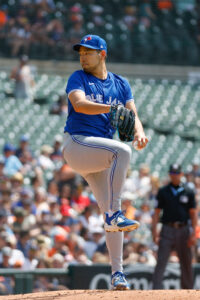
On June 4, something interesting happened. Kikuchi threw a curveball. It’s an unremarkable statement in and of itself, but it was the first time Kikuchi had thrown a hook since his rookie season in Seattle. Scouting reports on Kikuchi when he was headed stateside for the first time praised his curve as one of his top pitches, in fact. But major league hitters absolutely teed off against the pitch in 2019, posting an outrageous .353/.371/.632 slash against the suddenly ineffective curveball.
Kikuchi scrapped the pitch entirely for the 2020-22 seasons and hadn’t thrown it through 11 starts in ’23. For the remainder of the season, just under 13% of Kikuchi’s pitches were curveballs, per Sports Info Solutions. This, however, wasn’t the same curveball he showed in that rookie season. Kikuchi’s 2019 hook averaged just over 75 mph, featuring a huge 63.7 inches of vertical break and 6.9 inches of horizontal break, per Statcast.
The new breaker is a harder, sharper curveball that sits 83 mph with 43.5 inches of vertical break and 4.4 inches of horizontal break. The esteemed Rob Friedman — aka Pitching Ninja — has highlighted the offering on several occasions since last June. Compare that to this video of Kikuchi’s old curveball, and you can see it’s an entirely different pitch. The new curve wasn’t a dominant pitch last year — opponents hit .277/.306/.447 in plate appearances ending with a curveball — but the change in repertoire seemingly helped keep hitters off balance and make his other pitches more effective.
The 2024 season has been another story. Kikuchi has fully embraced the new curveball by throwing it at a 28% clip, and batters have been almost wholly unable to do damage against the pitch. Opponents are hitting .258/.290/.318 in 69 plate appearances that have ended with a curve, and their only four extra-base hits have been doubles. Nearly 53% of batted curveballs against Kikuchi have been grounders. This has helped him tamp down his longstanding struggles against right-handed opponents, and Statcast lauds the curveball as a plus pitch, giving opponents an “expected” .221 batting average, .293 slugging percentage and .240 wOBA against the pitch.
The uptick in curveballs has led Kikuchi to use his slider and changeup at some of the lowest rates of his career. All three of his non-fastball pitches have flummoxed opponents this season. His heater is averaging a career-high 95.6 mph despite Kikuchi pitching in his age-33 season, but it remains hittable and has been his weakest pitches in terms of opponent results. However, the incorporation of an effective curveball also makes it harder for opponents to sit on the heater.
Through 11 starts this season, Kikuchi has posted a 3.25 ERA. He’s totaled 61 innings, fanned 24.1% of opponents against an outstanding 5.1% walk rate and kept the ball on the ground at a solid 44.1% clip. Kikuchi is still giving up a fair bit of hard contact (mostly on that heater) and will surely see his tiny 7.7% homer-to-flyball ratio trend tick upward. League average tends to be in the 12-13% range, and Kikuchi’s career mark is 17.4%. Even with a couple extra homers on his 2024 ledger, however, Kikuchi would look like a clearly above-average starter.
And it’s not just the 2024 season where he’s been effective with this new offering. It’s now been almost one year to the day since Kikuchi broke out the new curveball, and his numbers over the past calendar year could catch some onlookers by surprise. His 3.45 ERA ranks 12th among 78 qualified starting pitchers, and he’s 28th in total innings (172 1/3). By measure of FanGraphs’ version of WAR, which is calculated off his 3.09 FIP rather than his raw run-prevention numbers, Kikuchi has been baseball’s fifth-most valuable pitcher. RA9-WAR, which is simply based on the number of runs he’s allowed (rather than FIP) has Kikuchi tied for 18th.
Regardless of one’s preferred method of pitcher evaluation, Kikuchi has been one MLB’s 10 to 20 best starters over the past calendar year — a remarkable turnaround for someone who entered the 2023 campaign fighting for a rotation spot with the team whose rotation he’s now anchoring.
Kikuchi’s gains are all the more interesting in light of the Blue Jays’ disappointing 2024 campaign. Toronto currently sits at 26729 on the season, placing them last place in the hyper-competitive AL East. They’ve rattled off four straight wins but are still 11.5 games out of first place in the division and 4.5 games out of a Wild Card spot (with three teams standing between Toronto and the third spot, currently held by the Twins). The Blue Jays’ playoff odds are hardly shot, but they’ve undeniably diminished relative to their preseason projections. There’s already speculation about the potential of a sell-off, with names like Bo Bichette and Vladimir Guerrero Jr. the subject of particular wishcasting.
But if the Jays do end up selling, it’s Kikuchi — not Bichette, Guerrero, Chris Bassitt, etc. — who stands as Toronto’s likeliest trade commodity. He’s playing out the final season of that three-year, $36MM deal and earning what now looks like a highly reasonable $12MM salary. The majority of contending clubs should be able to absorb some or all of the remaining salary on his deal, although the Jays could always offer to pay it down in order to sweeten a return. Kikuchi has pitched himself into qualifying offer candidacy, so the Jays would likely need some real prospect value to come their way in order to make the trade, but so long as he continues pitching close to his pace over the past 365 days, that’d also be a reasonable ask.
Further, Kikuchi’s status as an impending free agent makes his past calendar year all the more intriguing. If he can make another 20 or so starts at this pace, he’ll hit the market on the back of an impressive run and be able to stake his claim as one of the better mid-tier starters on the market. He’s not going to elevate himself into the Corbin Burnes or Max Fried tiers of the upcoming free-agent market, but another lucrative three-year deal would be in play. Both Bassitt and Sonny Gray scored three-year pacts at annual rates higher than $20MM covering the same age-34 to age-36 seasons Kikuchi will be peddling.
Kikuchi has a ways to go before he’s squarely in that conversation, his turnaround over the past year has him heading in that direction. It’s worth pointing out that he lasted only three innings during his last start, showing reduced velocity and failing to record a strikeout. That could be a red flag, but it could also just be a blip on the radar. The Jays haven’t pointed to any kind of medical issue for Kikuchi. We don’t know if there’s an injury, illness, pitch tipping or simple fatigue at hand, or whether it was just off day for the lefty.
What we do know is that over the past year, very few pitchers have been more successful and more valuable than Kikuchi. Adding a new pitch isn’t always a ticket to greener pastures, but it certainly has been for Kikuchi, who’s shaping up to be a potential impact deadline arm and a much more appealing free agent than anyone could’ve reasonably expected a year ago.
Photo courtesy of USA Today Sports Images
Two Starters Who Buoyed The Blue Jays In 2023
The 2023 season was something of a disappointment in Toronto, as the club once again was swept out of the AL Wild Card series after a third place finish in the AL East. As the club spent 2023 treading water, several key players such as star first baseman Vladimir Guerrero Jr. (whose struggles MLBTR’s Mark Polishuk discussed last month), catcher Alejandro Kirk, and veteran outfielder George Springer all took significant steps back this year. Meanwhile, the pitching side of the roster faced its own challenges. Right-hander Ross Stripling departed via free agency last offseason for San Francisco and while veteran right-hander Chris Bassitt was a capable replacement this year, 2022 AL Cy Young finalist Alek Manoah was not replaced so easily. Manoah, 25, posted a disastrous 2023 season that saw him sport a 5.87 ERA and 6.02 FIP across 19 starts.
With all the shortcomings of the 2023 squad in Toronto, it might seem somewhat surprising that the club managed to post essentially the same season as they did last year. Fortunately, the Blue Jays managed to turn their starting rotation into a considerable strength this year, even as their best arm from last season was pulled from the starting five due to ineffectiveness. While a solid, 11-start return from veteran lefty Hyun-Jin Ryu and a typically excellent campaign from ace righty Kevin Gausman both were major assets, the steps forward taken by right-hander Jose Berrios and left-hander Yusei Kikuchi did the most to return Toronto to contention in 2023, and provide reason for optimism when looking ahead to 2024.
Both pitchers had their first full seasons in Toronto in 2022: Berrios was acquired at the 2021 trade deadline, while the club signed Kikuchi to a three-year deal in free agency ahead of the 2022 campaign. That season was a difficult one for both players, as each posted an ERA north of 5.00 and the worst full-season fWAR totals of their careers. With Kikuchi under contract for another two seasons and Berrios signed on through 2028, both signings were looking nothing short of disastrous for the Blue Jays after their first year.
Fortunately, however, both pitchers were able to turn things around in 2023, allowing Toronto to absorb the loss of Manoah’s elite production much more easily. Berrios saw his 5.23 ERA in 172 innings last year drop to a much more palatable 3.65 figure in 189 1/3 frames. While he was 26% worse than league average last year by measure of ERA+, he managed to post a season that was actually 16% better than league average by that same metric this season. Kikuchi, meanwhile, saw nearly as drastic an improvement as his similar 5.19 ERA (74 ERA+) improved to a far more respectable 3.86 (110 ERA+) figure. What’s more, after making 12 of his 32 appearances out of the bullpen in 2022, Kikuchi made 32 starts in 2023, allowing his innings total to skyrocket from 100 2/3 to 167 2/3.
As good as those seasons were, of course, they weren’t enough to get the Jays over the hump in 2023. Looking ahead to 2024, the question for GM Ross Atkins and the rest of the front office is a simple one: Just how sustainable were the improvements for their mid-rotation arms? Fortunately for the fans in Toronto, the improvement both players found in 2023 is largely backed up by more advanced metrics.
After striking out just 19.8% of batters faced in 2022, Berrios improved that figure to 23.5% this year while maintaining a low 6.6% walk rate. Both of those numbers are slightly better than his career averages of 23.2% and 7.1%, respectively, which helps lend credence to the idea that Berrios’s return to form could be sustainable. Berrios saw improvements in other areas, too, as his BABIP dropped from .328 in 2022 to just .289 in 2023, while his strand rate rose from 70.9% to 76.4%.
BABIP and strand rate are both typically regarded as fluky year-to-year stats, giving them little value when predicting future performance in such small sample sizes. In this case, however, they back up that Berrios’s 2022 campaign during which he led the league in both earned runs and hits allowed may have simply been an outlier: Berrios’s 2023 BABIP is almost identical to his career .290 mark entering the 2022 campaign. What’s more, advanced metrics such as SIERA indicate that not only were Berrios’s 2022 and 2023 seasons similar to each other in terms of underlying performance, but they were similar to his body of work throughout his entire career. Berrios posting a 4.13 SIERA in 2022 and a 4.08 SIERA this season. While the 2023 figure is a few points better, both are in the same ballpark as his 4.04 SIERA in seven seasons since becoming a major league regular.
While Berrios’s 2023 campaign indicates that 2022 was merely an aberration in what has otherwise been a consistent career as a mid-rotation arm, Kikuchi’s season this year seems to indicate a significant step forward. Among 140 pitchers with at least 100 innings of work in the majors during 2022, Kikuchi’s 5.62 FIP ranked in the bottom three, only better than Jonathan Heasley and Josiah Gray. While Kikuchi struck out an impressive 27.3% of batters faced, he walked a whopping 12.8% of batters faced. What’s worse, those free baserunners Kikuchi offered opposing teams often found themselves scoring on home runs thanks to Kikuchi’s fly balls leaving the year for home runs at an astronomical 23.7% rate that was by far the highest in the majors.
Fortunately, Kikuchi’s command and control issues improved considerably this year, even as his strikeout rate ticked down slightly to 25.9%. He nearly halved his walk rate in 2023, cutting his free passes down to a 6.9% rate that was actually in the 73rd percentile among all qualified pitchers, per Statcast. Kikuchi also managed to make improvements regarding the long ball, though they weren’t as drastic as his cut down on walks. After putting up the league’s worst barrel rate of 14.8% in 2022, Kikuchi managed to cut that figure to 9% this season, good for the 29th percentile among all qualified major leaguers.
While that’s still below average, Kikuchi’s more reasonable 15.3% home run rate allowed him to post a career year in 2023; this year was the first time the 32-year-old managed to post an above average season by both ERA- (8% better than league average) and FIP- (4% better than league average). SIERA, meanwhile, was actually even more bullish on Kikuchi than Berrios this year, as the lefty posted a 3.86 figure that put him in the same range as quality arms like Logan Gilbert and Sonny Gray while outperforming the likes of Corbin Burnes and Blake Snell.
With Berrios once again looking like the quality mid-rotation arm he appeared to be throughout his career in Minnesota and Kikuchi having joined him at a similar status in 2023, the Blue Jays look to be extremely well set up headed into 2024 with a front four of Gausman, Berrios, Kikuchi, and Bassitt in the starting rotation. That should allow them to be aggressive in looking to revamp the club’s offense as they attempt to return to the postseason in 2024 and win their first playoff game since 2016.
Japanese-Born MLB Player Round Up
Many star players from NPB have made their way to MLB to take on a new challenge.
Some of them became household names like Ichiro and Hideki Matsui. Some were consistent and solid players for a long period like Hiroki Kuroda and Koji Uehara. Some failed to meet the hype and lofty expectations like Kei Igawa and Kazuo Matsui. Some became fan favorites like Munenori Kawasaki.
The 2021 AL MVP and two-way superstar Shohei Ohtani headlines the current batch of Japanese big-league players, and rightfully so. These players are a fascinating group that features exciting rookies, experienced veterans, and players looking to make their mark in MLB. Their performances go a long way in promoting the globalization of the sport but also provide fans, scouts, and front offices a better baseline for evaluating future talent from NPB.
How are their respective seasons going? Let’s break it down.
(All stats as of 6/11/2023)
Big surprise, Ohtani is once again among the frontrunners in the AL MVP race with his one-of-a-kind value as a two-way player. At the plate, he is hitting .291/.362/.593 with 50 RBI and an AL-leading 20 homers.
He had a hot start on the mound to start the season, with a 0.64 ERA and a .093 opponent batting average in his first five starts. Since his last start in April against the A’s, Ohtani has really struggled with the long ball. All 11 homers allowed on the season have come since that start.
On the season, Ohtani has a 3.32 ERA in 13 starts, with a 33.3 K% in 76 innings pitched. He has been plagued by shaky control in some starts, and his walk rate is up to 11.1% compared to 6.7% last season.
You can find Ohtani updates, including reports of every start, endorsement deals, and hot stove news on his player page on MLBTR, or shoheiohtanirumors.com.
The Mets signed the 30-year-old right-hander to a five-year, $75MM deal last December. Senga was immediately thrown into the fire in the early weeks of the season as the anchor of a depleted Mets rotation that was impacted by injuries to Justin Verlander and Carlos Carrasco and Max Scherzer’s suspension.
So far, Senga has answered the call and shown the talent that made him one of the most coveted starting pitchers in the 2022 offseason. Senga has a 3.34 ERA in 12 starts and 64 ⅔ innings pitched this season. He had a 4.15 ERA in his first five starts, but he has maintained a 2.79 ERA in his last seven. He is striking out hitters at a strong 28.3% rate, but walking hitters at a 14.3% clip.
Senga’s notorious ‘Ghost Fork’ splitter, which made him a household name in Japan, is no fluke. Hitters are only hitting .108 against the forkball and whiffing at a whopping 59.8% rate, one of the highest in MLB.
The next step in Senga’s transition to MLB is building consistency in control that will allow him to be more efficient and pitch deeper into games. In his final season in NPB, Senga walked 8.6% of hitters, so it’s certainly possible.
The 29-year-old outfielder signed a five-year, $90MM deal with the Red Sox after seven highly productive seasons in Japan for the Orix Buffaloes. The hefty price tag surprised many, given the questions of his slight frame at 5’8″ and power numbers in NPB traditionally not translating well to the big leagues. The ‘Macho Man’ has rewarded the organization’s faith with his patient and disciplined approach, bat-to-ball skills, and sharp swing. Yoshida is now one of the frontrunners in the AL Rookie of the Year race with his borderline All-Star-level production at the plate.
Yoshida is hitting .300/.375/.467 with seven homers, 33 RBI, and a 132 wRC+. After overcoming a nightmarish start (.189/.317/.264 in first 53 at-bats) to his MLB career, he’s been one of the most consistent bats for the Red Sox. Yoshida joined Ichiro as one of only two players this century to have reached base 85+ times and struck out 25 or fewer times in their first 50 career games.
He turned a corner after working with both Red Sox and Orix Buffaloes coaches and making appropriate adjustments, including lowering his hands. He continues to be proactive with his adjustments. After a rare three-strikeout performance against the Diamondbacks, the Sox coaching staff tweaked his approach and Yoshida responded with a .480/.581/.760 line in the next seven games.
Defensively, there is room for improvement for the outfielder. The Statcast metrics are not favorable, as he ranks in the tenth percentile and 12th percentile in outs above average and outfielder jump, respectively. He should be able to make marginal improvements in that area as he continues to familiarize himself with the Green Monster and the unique outfield at Fenway Park. Could he be making his way to Seattle for the All-Star game in July? We shall see.
The 28-year-old outfielder is in the second year of his five-year, $85MM deal with the Cubs. He was limited to 110 games in his first season by injury, hitting .262/.336/.433 along with 14 homers and 46 RBI.
After a slow start in April where he hit .254/.333/.373 and just one home run, Suzuki had an excellent month in May, hitting .319/.417/.560 and five homers. On the season, Suzuki is hitting .278/.367/.450 with six homers, 19 RBI, and 124 wRC+ in 50 games.
So far in his big league career, Suzuki has shown fans glimpses of the five-tool skill set that made him an appealing player in the 2021 offseason but has yet to have his breakout moment.
He has shown excellent plate discipline, walking at a 12.1% rate, and ranks in the 92nd percentile on Statcast chase rate. Despite his plate discipline, Suzuki strikes out quite often, with a 26.1 K%. Suzuki seems to struggle against pitches with movement, hitting just .216 against sinkers and .176 against cutters. Four-seamers with “clean” spin are traditionally more valued over moving pitches in Japan, so it is common for Japanese hitters to struggle with movement since they lack reps.
Suzuki has been as advertised on the defensive end, recording two outs above average, thanks to a 98th-percentile outfielder jump and 92nd-percentile arm strength.
The right-hander signed a five-year, $90MM contract extension in February, keeping him on the team through 2028. Darvish had a self-proclaimed best season of his career in 2022, tossing 194 2/3 innings with a 3.10 ERA, 25.6 K%, and 4.8 BB%.
He hasn’t been at his absolute best in 2023, with a 4.30 ERA, 26.3 K%, 7.5 BB% in 69 innings, but is still putting up above-average peripheral numbers on Statcast and still featuring a unique eight-pitch mix. If you remove his May 28th start against the Yankees where he got knocked around for seven runs in 2 ⅔ innings, his ERA would be 3.53.
He reached the 100 wins mark in his last start against the Rockies on June 9, joining Hideo Nomo as the only Japanese MLB pitchers to reach that mark.
In his second season as a Blue Jay, Kikuchi is still navigating his way to be a consistently productive starter. The left-hander had his worst season in the majors since his rookie season, largely due to poor control and a questionable pitch mix.
Coming into 2023, Kikuchi made subtle changes in his delivery and mechanics, while sporting a new beard and swagger. He was off to a solid start, with a 3.00 ERA in April, but had a tough May where he gave up nine home runs and had a 5.83 ERA. On the season, Kikuchi has a 4.34 ERA, 22.7 K%, and 7.4 BB% in 66 ⅓ innings, while giving up an MLB-worst 18 home runs.
The left-hander is throwing harder than he ever has, with average fastball velocity up to 95.3 mph compared to 92.5 mph his first year in MLB. It hasn’t necessarily translated to a high-quality pitch, however. While Kikuchi is getting whiffs at a 29.7% rate with his fastball, hitters are still getting good contact and hitting .315 against it.
Although Kikuchi has improved his walk rate by five percentage points from last season, his bad starts are still marked by control issues and giving up the long ball while working behind in the count. The Blue Jays will need every solid performance they can get from Kikuchi in a competitive AL East, especially with Alek Manoah being optioned to the Florida Complex League.
The 35-year-old Twins right-hander is attempting a full comeback from Tommy John surgery in 2021. The veteran has faced several setbacks in his recovery. He took a 111.6 mph liner off his left foot against the Red Sox on April 20. In his next start against the Yankees, Maeda gave up a career-worst 10 runs in three innings. He was then placed on the IL with a strained triceps.
Maeda completed his third rehab start for Triple-A St. Paul on June 10. He tossed four shutout innings and struck out five, and will be returning to the big league team in the coming weeks. “The (velocity) was good, the splitter was good, the slider was good. Everything was good,” said St. Paul manager Toby Gardenhire (link via Dean Spiros of the St. Paul Pioneer-Press).
The Athletics signed Fujinami to a one-year, $3MM deal in January, with the A’s front office rolling the dice on Fujinami’s 100 mph fastball and potential plus strikeout stuff, despite control issues.
He opened the season in the rotation but was quickly moved to the bullpen at the end of April after allowing 24 runs in just 15 innings and walking 12 batters. It has been more of the same for the 29-year-old right-hander since moving to the bullpen, with a 11.12 ERA on the season while walking 17% of hitters.
It’s been a struggle for Fujinami to throw strikes to say the least. His 29 total walks is the most in MLB for pitchers under 40 innings thrown. When he does find the strike zone, the 6’6 righty is getting shelled. He has a hard hit percentage of 49%, which ranks in the seventh percentile.
Fujinami has dug himself a deep hole in terms of establishing himself as a big league pitcher, but he’s continuing to get opportunities to prove himself on an A’s pitching staff with minimal depth.
Can These Five Players Sustain Their Strong Starts?
We’re about a month into the 2023 baseball season, and as is always the case there are teams that are over-performing (that’s you, Pittsburgh) and under-performing. It’s not just on the team side either, certain players are off to better than expected starts, and while a month of play isn’t enough to make a definitive judgement on one’s season, it’s certainly enough of a sample size to have a conversation about whether a player has turned a corner.
Let’s take a look at five players who are have performed better than expectations over the first month, and try and predict whether they’ll be able to sustain their strong start. (All stats are up to date entering Saturday’s matches)
Joey Gallo: .265/.368/.796 with seven home runs
The poster boy of the three true outcome hitter, Gallo has frustrated fans from Texas to New York to LA in recent years with his tantalizing power but sky high strikeouts and sub-optimal batting averages. Last year was one of Gallo’s worst, as he posted just a .160/.280/.357 line with a strikeout rate a touch shy of 40% between the Yankees and Dodgers and hit free agency without much fanfare. The Twins brought him in on a one-year, $11MM deal and it already seems to be paying off. Gallo’s shaved almost ten percentage points off his strikeout rate and is still walking at his usual solid clip.
Gallo appears to have a really good feel for the zone at the moment, swinging at more pitches in the zone and taking fewer called strikes. I spoke with Betsy Helfand, Twins beat reporter for the St. Paul Pioneer Press, on the MLBTR Podcast this week and she detailed some changes Gallo had made in his stance over the off-season. Perhaps also he’s benefitting from the shift changes. Gallo is pulling the ball more than in recent years, perhaps freed up to play more of his natural style with teams unable to shift quite so aggressively against him.
In any case, there’s a lot to like about Gallo’s start to the season in Minnesota. It’s probably unlikely he continues to hit a home run every seven at bats, but there’s every chance the Twins have themselves a much better version of Gallo than we’ve seen recently.
Yusei Kikuchi: Five starts, 27 IP, 3.00 ERA, 9.3 SO/9, 2.0 BB/9
Kikuchi came into the season clinging onto the final rotation spot in Toronto, but he’s been a really solid arm for them over the first month. Last season Kikuchi posted a 5.25 ERA in 20 starts for the Blue Jays and wound up out of the rotation by the end of the season. A big reason for his turnaround this year is a significant drop in his walk rate. Last season, Kikuchi was handing out free passes 12.8% of the time. This season? Just 5.7%. He’s also tweaked his pitch mix a bit, leaning less often on his fastball and bumping up the usage of his slider and splitter.
Yet a peak under the hood of Kikuchi’s performance does raise some red flags. He is still giving up far too many home runs, conceding about two every nine innings, much the same as his rate last year. He’s also carrying a sky high 97.2% left on base percentage, which is bound to drop some.
All in all, I’m skeptical Kikuchi holds on to the sort of numbers he’s putting up over his first five starts and expect a decent amount of regression. Maybe that still results in an improvement on last year and provides the Jays with enough to feel comfortable running him out every fifth day, but I still think he ends up with an ERA somewhere in the fours rather than the threes.
Cody Bellinger: .298/.475/.560 with five home runs
After winning the NL MVP in 2019 with the Dodgers, Bellinger has descended into a below average hitter since, putting up a wRC+ of just 78 between 2020-22. That led the Dodgers to non-tender him at the end of last season, and he latched on with the Cubs on a one-year, $17.5MM deal. It looked like an expensive gamble at the time for Chicago, but it appears to be paying off.
Bellinger has almost halved his strikeout rate from a year prior, bumped up his walk rate but still isn’t hitting the ball nearly as hard as he was during his MVP season. In fact his HardHit% is at 31 this year, and was as high as 45.6 in 2019 and 38.1 last year. The huge drop in strikeouts really is the most impressive aspect though, as that’s where Bellinger had come undone in recent years. In 2019 his K rate was just 16.9%, but it rocketed up into the 27% range over the past few seasons, so to bring it back down to an elite rate is a firm indication of some meaningful change in Bellinger’s performance.
So with all that considered perhaps he’s sort of back? Mostly back? Or maybe on the way to being back? Either way, it’s still a hugely productive player for the Cubs and the signs are there that even if he’s not peak-Bellinger he’s still very much turned a corner.
Johan Oviedo: Five starts, 29 2/3 IP, 3.03 ERA, 8.8 SO/9, 3.3 BB/9
Little was made of the return the Pirates received for Jose Quintana when they dealt him to the Cardinals at the deadline last summer. Yet in Oviedo, with a few changes, they may have unearthed a really solid mid-rotation arm. Oviedo had been a ho-hum arm in the Cardinals system getting mixed results and it didn’t appear as though his departure would really change much in St Louis.
Yet since coming over the Pirates, Oviedo has blossomed, and I’ll borrow from my colleague Steve Adams’ analysis in a broader Front Office piece on Pittsburgh’s impressive start to the season, which includes this on Oviedo:
Oviedo has upped his fastball velocity, doubled his curveball usage and morphed from a fringey swingman to what looks like a legitimate Major League starter. He’s not an ace, but the tangible changes here and immediate results are intriguing.
Oviedo’s fastball velocity may be up to 96.6 mph on average, but he’s throwing the pitch at a career-low 33.7% clip, instead heavily favoring his slider and curveball, both of which have a 34% whiff rate in 2023, per Statcast. Fewer fastballs and more breaking pitches have led to a stark increase in ground-ball rate – a well above-average 55.7% in 2023 – and a glut of weak contact. He’s yielded just an 85.6 mph average exit velocity and a paltry 31.1% hard-hit rate.
Steve’s piece is well worth a read, but the key here is that Oviedo and the Pirates coaching staff have made meaningful change to his pitching repertoire and are seeing results. With that in mind, it’s hard not buy this start from Oviedo. Perhaps there’s a bit of regression from the 3.03 ERA, but even if the Bucs have landed themselves a solid third or fourth starter who gives them a chance to win each time he takes the mound, it’s a huge win.
Jarred Kelenic: .325/.380/.663 with seven home runs
Is it finally happening? Kelenic has been one of the game’s top prospects for a number of years now but has failed to make an impact at the highest level. That may be changing. Kelenic has been one of the best hitters on a struggling Seattle team to start 2023, and could be blossoming into the sort of player the team dreamed on when they acquired him from the Mets.
Sure, Kelenic will see some regression from the .385 BABIP he holds right now, but the guy is hitting the ball and hitting it hard. He’s already barreled up ten balls and his HardHit% sits at 57.6%, a full 22 percentage points higher than last year and his exit velocity has shot up from the previous two campaigns.
As Ken Rosenthal of The Athletic details, Kelenic spent the winter in Arizona revamping his swing with Tim Laker, a former Mariners hitting coach and the results are clear. A career .168/.251/338 hitter in the big leagues, Kelenic looks to have finally broken out in 2023. Even if his strikeout and walk rates are largely in line with his previous numbers the fact that he can do more – a lot more – with the contact that he is making is the difference.