
Brewers Designate Clayton Andrews For Assignment
The Brewers are designating left-hander Clayton Andrews for assignment, per Curt Hogg of the Milwaukee Journal Sentinel. That move will open up a spot on the 40-man for right-hander Jakob Junis, who was reported to have signed with the club earlier this week. That deal is now official.
Andrews, 27, just got to make his major league debut last year in cup-of-coffee fashion. He was added to Milwaukee’s roster at the start of July and then was shuttled to Triple-A Nashville and back frequently, getting optioned four times in the back half of the season. He managed to make four major league appearances in there, allowing 10 earned runs in 3 1/3 innings with four strikeouts and two walks.
That’s a tiny sample of work and he spent far more time in Triple-A. He tossed 57 innings at that level last year, allowing 2.53 earned runs per nine innings. His 31.1% strikeout rate was quite strong and he got grounders on 45.7% of balls in play but he also issued walks to 13% of hitters that came to the plate against him.
That walk rate is certainly troubling but Andrews may have been shaking off some rust after a lot of time off. The minor leagues were canceled by the pandemic in 2020 and then Tommy John surgery prevented Andrews from throwing for much of the two following seasons.
His first outings in the majors weren’t great but he had a pretty solid showing in the minors last year, after three years of not being able to pitch much at all. He still has a couple of option years remaining and clubs are often on the lookout for left-handed relief depth. The Brewers will now have one week to try to work out a trade or pass Andrews through waivers. Since he has neither a previous career outright nor three years of service time, he wouldn’t have the right to reject an outright assignment. That means he would stick with the Brewers as non-roster depth if he were to pass through waivers unclaimed.
DL Hall Planning To Compete For Rotation Role With Brewers
The Brewers acquired hard-throwing lefty DL Hall alongside infielder Joey Ortiz from the Orioles in last week’s Corbin Burnes blockbuster. While GM Matt Arnold was noncommittal about Hall’s role in a chat with reporters in the immediate aftermath of the trade, the 25-year-old indicated the organization views him as a starting pitcher.
“When they called me, they asked me how my training had been going, what I was preparing for. Luckily, I was preparing to be a starter. They want me to be a starter,” Hall said in an appearance on Foul Territory yesterday afternoon (YouTube link).
That the Brewers still view Hall as a rotation fit isn’t surprising. If Milwaukee felt the 6’2″ southpaw was unlikely to stick as a starter, they might not have made him one of two key pieces in a return for their ace. That’s not a unanimous opinion among evaluators, however. Some scouting reports on Hall indicate he’s a better fit for the bullpen because of well below-average control.
Over parts of six seasons in the minors, Hall has walked 13.4% of opposing hitters. He handed out free passes at a similarly concerning 13.8% clip over 49 innings for Triple-A Norfolk a year ago. Hall worked in an abbreviated starting capacity early in the Triple-A season, typically going four to five innings in an appearance. He pitched in a traditional single-inning relief role there late in the year, aligning with his usage at the MLB level.
Other than a 3 2/3-inning start in his major league debut in August 2022, Hall has pitched exclusively as a reliever in the majors. He has a 4.36 ERA in 29 appearances, striking out 29% of batters faced. The former first-round pick has shown better control in that limited big league sample, walking a league average 7.6% of his opponents.
Expecting Hall to maintain a sub-8% walk rate over a full season as a starter is likely too optimistic given his minor league numbers. He will very likely need to cut his walks from the minor league levels if he’s to stick as a starter. Only two MLB pitchers logged at least 100 innings while walking more than 13% of opponents a year ago.
One of them, Blake Snell, won the Cy Young, so it’s not impossible to thrive with this kind of scattershot control. It requires absolutely dominating hitters when the pitcher is around the strike zone, though, with Snell fanning over 31% of opponents and holding batters to a pitiful .180 average. (The other pitcher with 100+ innings and a walk rate above 13% was Michael Kopech, who had a 5.43 ERA.) Hall is credited by prospect evaluators with as many as four plus or better pitches. He has the potential to overpower opponents, but he’d have to walk a very tight rope if he doesn’t get the free passes in check.
It’s worth noting that Hall’s comments about competing for a rotation spot came before Milwaukee agreed to a $7MM deal with free agent righty Jakob Junis last night. Even with Junis expected to take a season-opening rotation spot, it’s unlikely Milwaukee’s usage plans for Hall are any different. The Brewers still have one or two jobs up for grabs behind Freddy Peralta, Junis, and Wade Miley. Hall joins righties Colin Rea and Joe Ross and southpaws Aaron Ashby and Robert Gasser in that competition. Prospects Carlos Rodriguez and Jacob Misiorowski could pitch their way into the mix during the season.
Hall still has one option year remaining. The Brewers can move him between Milwaukee and Triple-A Nashville for another season if he doesn’t stake a claim to a permanent rotation role on Opening Day.
Brewers Sign Jakob Junis
The Brewers announced that they have signed free agent righty Jakob Junis to a one-year deal with a mutual option for 2025. Kiley McDaniel of ESPN (X link) initially reported the deal. It’s a one-year, $7MM guarantee for the Wasserman client, reports Ken Rosenthal of the Athletic. Junis will receive a $4MM salary next season and a $3MM buyout on the 2025 mutual option, which The Associated Press reports is valued at $8MM. He’s expected to open the year in Milwaukee’s starting rotation.
Junis hit the open market for the first time coming off a quietly strong platform showing. The 31-year-old pitched 86 innings over 40 appearances as a multi-inning reliever for the Giants a year ago. He turned in a personal-low 3.87 ERA while striking out an above-average 26.2% of opposing hitters. That was the best mark of his career, as was his 11.3% swinging strike rate.

An uptick in velocity played a part in his improved swing-and-miss results. Junis averaged 93.7 MPH on his sinker, above the 91-92 MPH range in which his fastball had sat for his career. He also added a tick to his slider, which clocked in at 84.2 MPH on average after sitting in the 82-83 MPH area in prior years. Adding some speed to the slider was probably more important than the extra life on the fastball. Junis uses the breaking pitch at an atypical rate.
The slider has been his primary pitch in each of the last four seasons. He pushed it to new heights in 2023, turning to the breaker nearly 63% of the time. That didn’t come at the expense of the strong control he’s shown throughout his career. He walked under 6% of opponents for the fourth time out of his five MLB seasons with 40+ innings.
As one might expect given his slider/sinker profile, Junis has been more effective against same-handed hitters. Since the start of 2022, righty batters have a .254/.297/.414 line while striking out nearly a quarter of the time against him. Left-handed bats have fanned at a modest 20.3% rate and turned in a robust .290/.341/.494 showing over that stretch.
It’s easier for a manager to navigate around those platoon issues when Junis is pitching in a relief role, even one in which he frequently works multiple innings. It could be a bigger concern as a starter, although it wouldn’t be surprising if skipper Pat Murphy tends to minimize his exposure to opposing lineups more than twice in an outing.
That’s generally how Milwaukee seems to be approaching the 2024 rotation. They’ve moved on from their pair of co-aces. Brandon Woodruff was non-tendered after the revelation he needed shoulder surgery, while Corbin Burnes was traded last week. That left the Brew Crew with Freddy Peralta as the unquestioned staff ace, followed by pitchers with varying degrees of injury or performance concerns.
Milwaukee re-signed Wade Miley and Colin Rea to factor into the middle of the staff. They took a flier on Joe Ross, who missed most of last season working back from 2022 Tommy John surgery. Hard-throwing southpaw DL Hall came back from Baltimore in the Burnes return. Aaron Ashby is still trying to carve out a rotation role despite various injuries, including a shoulder procedure that wiped out his ’23 season. Prospects Robert Gasser, Jacob Misiorowski and Carlos Rodriguez loom in the upper minors.
It’s unlikely to be the kind of dominant rotation Milwaukee has trotted out in recent seasons, even if there’s a decent amount of intrigue with Junis, Ashby and the aforementioned collection of young pitchers. There aren’t many reliable sources of innings, which could force Murphy to lean heavily on his relief group.
The $4MM salary brings Milwaukee’s payroll projection around $105MM, as calculated by Roster Resource. That’s well below last year’s approximate $119MM mark. It’s unclear whether ownership is willing to match last season’s spending level. If there’s payroll room, the roster could benefit from an additional bench bat and perhaps another left-handed reliever to pair with Hoby Milner.
MLBTR ranked Junis as the offseason’s #47 free agent, predicting a two-year, $15MM guarantee. He comes up short of that figure on a one-year deal. He’ll look to establish himself as a starter before returning to free agency next winter in advance of his age-32 season. The mutual option is essentially an accounting measure that allows the Brewers to push $3MM of the guarantee to the start of next offseason. Mutual options are almost never exercised by both sides, so Junis is very likely to head back to the market a year from now.
Image courtesy of USA Today Sports.
Giants Acquire Ethan Small
The Giants have acquired left-hander Ethan Small from the Brewers for cash, the team announced. Milwaukee had designated him for assignment last week after acquiring Joey Ortiz and DL Hall for Corbin Burnes.
Small was a somewhat surprising DFA who always looked likely to attract interest from another team. He was Milwaukee’s first-round pick in 2019 and initially perceived as one of the better pitching prospects in their organization. While Small’s place in the farm system had fallen in recent years, he’s coming off a reasonably promising showing for their top affiliate in Nashville.
Working as a full-time reliever for the first time in his career, Small pitched to a 3.18 ERA over 51 Triple-A innings a year ago. He punched out an impressive 28.5% of opposing hitters. He paired that with a concerning 11.2% walk percentage. That surely played a part in Milwaukee deciding not to give him much of a shot at the MLB level. Small has only pitched in the big leagues four times, twice apiece in each of the last two years.
The Mississippi State product doesn’t throw especially hard. His fastball averaged 92 MPH in his limited MLB look last season. An atypical over-the-top arm slot adds some deception to his delivery, though, and prospect evaluators have credited him with a plus changeup.
San Francisco had an opening on the 40-man roster after last week’s Bay Area swap sending Ross Stripling to Oakland. They’ll use that to take a flier on Small, at least for the time being. The Giants are reportedly in talks with Jorge Soler and would need to create a roster spot if those discussions result in an agreement. Small has one minor league option remaining, so the Giants could keep him in Triple-A for the upcoming season if he holds his spot on the 40-man.
Orioles Notes: Burnes, Cease, Hicks
The Orioles completed one of the offseason’s biggest trades in landing Corbin Burnes from the Brewers earlier this week, and it was a move that GM Mike Elias said the organization had been “talking about…since when the World Series ended.” It was heavily expected that the O’s would be looking for significant rotation help during the winter, and Elias shared some details on the search when speaking with reporters (including MASNsports.com’s Roch Kubatko and MLB.com’s Jake Rill) on a conference call in the aftermath of the trade.
“Corbin Burnes is exactly what we needed. We were in a dogged pursuit of him the entire offseason,” Elias said. “Obviously, there were other starting pitchers who we pursued, but it’s harder to have somebody higher than Corbin Burnes on your wish list. It’s a tremendous impact.”
Milwaukee’s side of the deal involved two big league-ready young players (Joey Ortiz and DL Hall) with top-100 prospect pedigrees, as well as the Orioles’ Competitive Balance Round draft pick (currently 34th overall in the 2024 draft order). It was a noteworthy amount to give up even for a team as rich in minor league depth as the O’s, but Elias felt it was worth the plunge.
“We’re giving up a lot of long-term talent and also a couple of players that were going to contribute to the 2024 Orioles,” Elias said. “So I mean, this is a risky move, but it lined up for both sides. We weren’t going to force it necessarily, but our wish list was a rotation upgrade and I certainly think that the Cy Young winner and with his body of work qualifies as that. We couldn’t have found a better upgrade and now we just have to go play the games.”
While the Orioles’ offer was enough to sway the Brewers, it apparently wasn’t enough to get the White Sox to move Dylan Cease, another pitcher known to be on Baltimore’s list of potential targets. USA Today’s Bob Nightengale reports that the O’s “offered basically the same package” to White Sox, as well as an unknown additional player. The larger size of the offer probably reflects the fact that Cease is arbitration-controlled through the 2025 season while Burnes is only controlled through 2024, yet it still wasn’t enough to meet Chicago’s asking price for Cease’s services.
Past reports have suggested that the Sox have a particular interest in Jordan Westburg, Heston Kjerstad and Colton Cowser, among many of Baltimore’s top prospects. It can be assumed that none of these blue-chippers weren’t the mystery fourth part of the Orioles’ offer to Chicago, so speculatively, it could be that the White Sox asked for one of the trio as the top position-player piece instead of Ortiz. Considering that the Sox have reportedly been looking for additional pitching in other Cease-related trade talks with the Mariners and Reds, it could also be that the White Sox wanted a better pitcher included than Hall, or perhaps a pitcher as the fourth element if the Orioles had offered a position player.
These talks are again indicative of the very large price tag that the White Sox are demanding for Cease, which isn’t really surprising given how he is their biggest trade asset apart from Luis Robert. It also understandable why the Orioles ultimately pivoted from these talks with Chicago to closing the deal on Burnes, as Burnes provides a higher ceiling as a more consistent ace-level pitcher even if he comes with one less year of control than Cease.
Obviously some of this discussion is just conjecture since we don’t know exactly what the Orioles put on the table for Cease, yet it also speaks to the interesting juggling act Elias has been facing in determining how to put the best “final touch” on the AL East-winning roster. It can be assumed that pretty much every rival team has been asking about the top tier of names in Baltimore’s farm system in any trade talks, so Elias technically has the minor league depth to complete just about any deal, he naturally isn’t going to deplete that depth for just any pitcher.
Speaking of Kjerstad and Cowser, it wouldn’t be surprising to see either youngster play big roles in whatever success awaits the 2024 Orioles, though they’re part of a crowded outfield, first base, and DH picture that also includes Cedric Mullins, Anthony Santander, Austin Hays, Ryan Mountcastle, Ryan O’Hearn, and even more up-and-coming prospects in Coby Mayo and Kyle Stowers, among others. Even with all these options on hand, Nightengale reports that the O’s still had interest in bringing back Aaron Hicks before the veteran outfielder signed with the Angels earlier this week.
After an injury-plagued stint with the Yankees, Hicks revived his career after joining the Orioles last season, hitting .275/.381/.425 over 236 PA and acting as a veteran leader within the young clubhouse. Since the Yankees are still covering Hicks’ previous contract through the 2025 season, the outfielder was available on only a minimum MLB salary to any team this winter, giving him presumably a pretty wide range of suitors.
Though the Orioles are in a better position to contend than the Angels in 2024, it could be that Hicks simply felt he wouldn’t get as much playing time in Baltimore than he would in Los Angeles. Though the Angels have a fair amount of outfield options themselves, Mike Trout‘s injury history and the unproven big league track records of Mickey Moniak and Jo Adell leave more room for Hicks to become a lineup regular.
Arnold: Brewers “Open To More Conversations” Following Burnes Trade
Last night’s trade of Corbin Burnes took baseball by surprise. With spring training less than two weeks away and the Brewers having just spent $34MM to sign Rhys Hoskins for the next two seasons, the general expectation had been that the team planned to hold onto top stars like Burnes, Willy Adames and Devin Williams, despite the trio inching closer to free agency. (Burnes and Adames are free agents next winter, Williams after the 2025 season.) The Orioles, however, clearly came through with an offer that Milwaukee general manager felt he couldn’t turn down, and in the wake of the trade Arnold acknowledged that he’s “certainly open to more conversations” and “wouldn’t shut any conversations down at this point in the offseason” (link via Adam McCalvy of MLB.com).
That’s a far cry from a declaration that the Brewers are open for business, but both Ken Rosenthal of The Athletic and Mark Feinsand of MLB.com report that Williams, in particular, is also a possibility to move. Rosenthal writes that the Brewers have already “entertained” the possibility of moving the star righty.
Williams, 29, is among the game’s most dominant relievers. Over the past four seasons, he’s logged a 1.75 ERA while striking out a staggering 40.5% of his opponents. Williams’ 11.9% walk rate is well above the league average, but his prodigious strikeout ability, strong 49.5% ground-ball rate and knack for inducing weak contact (85.1 mph average exit velocity, 28.2% hard-hit rate) have all combined to help him mitigate that shaky command.
Excellent as he’s been, Williams isn’t the prototypical power-armed closer we see so often in today’s game. That’s not to suggest he’s a soft-tosser, but he doesn’t brandish the triple-digit heater that’s become increasingly common in modern baseball. Williams averaged 94.2 mph on his fastball in 2023 — an exact match with the league average for relievers — and sits at 94.8 mph dating back to 2020. However, Williams has one of the game’s best pitches, an 80-grade changeup nicknamed the “airbender.” Nearly a quarter of the changeups Williams has thrown in his career (23.1%) have generated a swinging strike. Opponents have batted just .137 and slugged only .199 against the pitch in his career.
Beyond his sheer dominance, Williams is eminently affordable. He agreed to a one-year, $7.25MM deal last month and tacked on a $10.5MM club option for the 2025 campaign, thus avoiding the need for an arbitration hearing this year or next. The value of that club option will likely increase based on some escalators that are baked into the contract. Pitching in 52 games would bump the option value by $200K, while reaching 57 and 62 appearances would add $250K each, plus another $300K for 66 games (which would establish a new career-high, topping 2022’s 65 games). Even if Williams unlocks that full $1MM worth of escalators, an $11.5MM option on a reliever of this caliber would still be a clear bargain.
It should be noted and emphasized that there’s no indication Milwaukee is aggressively shopping Williams or anyone else on the roster. This, however, is the manner in which the Brewers (and Arnold’s former organization, the Rays) have continually operated: maintain an openness on star players as their club control dwindles — particularly those who are likely beyond the organization’s comfort level in terms of asking price on an extension.
Flexibility when it comes to moving short-term players with one to two years of club control is a driving factor in how the Brewers have remained competitive regularly despite perennially ranking in the bottom half of the league in terms of payroll. The trade of Josh Hader at the 2022 deadline netted the Brewers left-hander Robert Gasser (one of their current top pitching prospects) and outfielder Esteury Ruiz, who was subsequently flipped for William Contreras, who won a Silver Slugger as Milwaukee’s starting catcher last season. Hader himself came to Milwaukee alongside Adrian Houser in a trade sending Carlos Gomez to Houston. Right-hander Freddy Peralta, now the Brewers’ top starter, was acquired as a 19-year-old in a trade sending first baseman Adam Lind to Seattle. The list goes on.
Any trade involving Williams will surely require a steep asking price — arguably a comparable or even greater return than Burnes commanded, given his extra year of club control and more affordable contract status. And Williams, like Burnes, figures to be a qualifying offer candidate once he’s able to reach free agency, meaning a new team would know that so long as he remains healthy, there’ll be some draft pick compensation to help recoup the value surrendered in order to acquire him in the first place.
It stands to reason that with Burnes out the door and at least a willingness to listen on Williams, the Brewers have similar thoughts on Adames. The 28-year-old broke out almost immediately after being traded from Tampa Bay to Milwaukee in 2021, when the Brewers sent righties Drew Rasmussen and J.P. Feyereisen to the Rays in exchange for Adames and righty Trevor Richards.
In two and a half seasons as a Brewer, Adames has slashed .242/.319/.454 with 75 homers, 86 doubles and a pair of triples in 1668 plate appearances — all while playing strong defense at a premium position. He’s walked at a 10% clip against a 26% strikeout rate and established himself as a power threat who can hit anywhere in the order, evidenced by 2022’s 31-homer showing. Adames has turned in 17 Defensive Runs Saved and 26 Outs Above Average in the past two seasons alone. He’ll earn a reasonable $12.25MM in 2024 before becoming a free agent ahead of his age-29 season.
As with Burnes, Adames will be a slam-dunk qualifying offer candidate next season. He’s extremely likely to receive and reject a QO, and he’d surely sign a contract worth more than $50MM in total with his next team. That’d give Milwaukee a compensatory pick at the end of the first round of the 2025 draft. Any trade offers would need to eclipse that value — and likely by a strong margin.
That said, the acquisition of Joey Ortiz in the Burnes trade makes it easier for the Brewers to listen to offers. Ortiz himself is a shortstop — and an MLB-ready one at that. He struggled in a tiny sample during last year’s MLB debut (34 plate appearances, .212/.206/.242) but is an accomplished upper-minors hitter who’s considered a good defender at shortstop. The 25-year-old Ortiz spent the bulk of the 2023 season in Triple-A Norfolk, where he slashed .321/.378/.507. That marked his second stint in Norfolk, as he also finished out the 2022 season there and hit well in a sample of 115 plate appearances. Overall, in 504 trips to the plate at Triple-A, Ortiz is a .327/.383/.521 hitter with 13 homers, 37 doubles, six triples and 17 steals.
Of course, as a plus defender at shortstop, Ortiz is more than capable of breaking into the big leagues as an everyday second baseman or third baseman. He and Adames can absolutely coexist on Milwaukee’s roster, and Ortiz could easily slide over to shortstop in 2025 if the team hangs onto Adames for the upcoming season. The Brewers surely don’t feel they need to trade Adames, but as Arnold strongly implied, he also won’t be turning anyone away on principle, either.
That willingness to listen could set the stage for another splashy trade or even two between now and Opening Day, but this isn’t an A’s-esque situation where the Brewers will be selling everything that’s not nailed down. Burnes commanded a pair of immediate big leaguers who both have six years of club control remaining. Any trades of Williams, Adames and/or anyone else on the roster would presumably need to afford similar near-term help.
The Brewers’ recent signing of Hoskins and focus on MLB-ready talent even in trading away their ace highlights the fact that this isn’t a team punting on 2024. Rather, they’re trying to thread the needle of remaining competitive on an annual basis without needing to undergo the exact type of teardown that Burnes’ new team underwent for a half decade prior to emerging as a powerhouse in the AL East. Teams will undoubtedly check back in on Williams, Adames and others in the wake of the Burnes blockbuster, but further trades aren’t necessarily a given.
Orioles Acquire Corbin Burnes
The Orioles got their ace. Baltimore announced the acquisition of 2021 NL Cy Young winner Corbin Burnes from the Brewers for rookie infielder Joey Ortiz, left-hander DL Hall, and their 2024 Competitive Balance Round A draft pick (#34 overall). Milwaukee designated lefty Ethan Small for assignment to clear the necessary 40-man roster spot.
There’d been speculation as far back as last offseason about the possibility of the Orioles acquiring a top-end starting pitcher. Baltimore has a loaded farm system that has graduated plenty of young talent over the past two seasons. Most of that has been concentrated on the position player side, making it a natural fit for them to leverage that farm depth to bring in an impact starter.
Burnes certainly qualifies. He established himself in the Milwaukee rotation during the shortened 2020 campaign. The righty has finished in the top 10 in NL Cy Young balloting in each of the past four seasons. He won the award in ’21 thanks to an MLB-best 2.43 ERA across 167 innings. Burnes followed up with a National League-leading 243 strikeouts and a 2.94 ERA across 202 frames the following season.
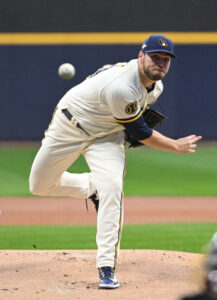
Last season was perhaps his least impressive showing since his 2020 breakout. Yet it could only be classified as a “down” year by Burnes’ immense standards. He remained a top-of-the-rotation pitcher, turning in a 3.39 ERA while logging 193 2/3 innings across 32 starts. His 25.5% strikeout rate was still a few points better than league average, as was his 12.2% swinging strike percentage. He finished eighth in Cy Young voting.
It wasn’t the same level of dominance that Burnes had shown in the preceding three years. He had fanned more than 30% of opponents with a swinging strike rate above 14% in every year from 2020-22. Burnes looked more like his old self down the stretch, however. He carried a 3.94 ERA and a 23.1% strikeout rate into the All-Star Break. In the second half, he fanned 28.6% of opponents while allowing only 2.71 earned runs per nine. Opposing hitters had a pitiful .187/.259/.294 slash line after the Midsummer Classic.
Going back to the start of 2020, Burnes has a 2.86 ERA over 105 appearances. He has punched out nearly 31% of batters faced against a modest 7.1% walk rate. Batters are hitting .197/.262/.308 in nearly 2500 trips to the plate. Neither left-handed nor righty-hitting opponents have had success against him. Outside of a two-week injured list stint early in 2021 because of a finger contusion, he hasn’t missed any time within the last three years.
Burnes is a true ace, one of the 5-10 best pitchers in baseball. He jumps to the top of a rotation that has suddenly gone from Baltimore’s biggest question to one of the higher-upside staffs in the league. Kyle Bradish slots in as the #2 arm after a breakout 2023 campaign in which he worked to a 2.83 ERA over 30 starts. Grayson Rodriguez looks to have turned a corner in the second half. The former top pitching prospect worked to a 4.35 ERA in his rookie season. After being tagged for a 7.35 ERA in his first 10 MLB outings, he turned in a 2.58 mark in his final 13 regular season starts (although he was hit hard in his lone playoff appearance).
That’s a potentially elite top three. Former All-Star John Means returned from Tommy John surgery late last season. Some residual elbow soreness kept him off the club’s playoff roster, but he’s expected to be fully healthy for 2024. If that’s true, he slots in well as the #4 starter. Dean Kremer would likely occupy the final spot, with Tyler Wells and Cole Irvin pushed into season-opening relief roles.
While the O’s could perhaps benefit from another depth addition or two, they’ve landed the true #1 that should represent the finishing move on an already great roster. Baltimore’s loaded young lineup and excellent relief corps led the team to 101 wins and an AL East title a year ago. The O’s lost star closer Félix Bautista to Tommy John surgery at year’s end but moved early in the offseason to sign Craig Kimbrel as a replacement.
It’s likely a one-year acquisition. Burnes will hit free agency next offseason shortly after his 30th birthday. With anything like his typical levels of production, he’ll be in line for a massive contract that could top eight years and $200-250MM. Burnes has been clear about his desire to test his value on the open market. Asked in December about the possibility of signing an extension if he were traded this winter, he said such an offer “would have to be something that would just absolutely blow you away to get you away from testing the free agent market.”
As recently as last week, O’s fans wouldn’t have been able to dream about the organization putting that kind of proposal on the table. Baltimore has dramatically scaled back spending since John Angelos assumed control of the franchise. On Tuesday, the Angelos family agreed to sell the organization to private equity mogul David Rubenstein. How that’ll impact the long-term payroll outlook remains to be seen, but Baltimore fans can be more optimistic about the chances of making significant investments once Rubenstein takes control of the franchise after the sale is approved by MLB in the coming months.
In any case, the primary focus is installing Burnes atop next year’s rotation. The three-time All-Star had settled on a $15.637MM contract with Milwaukee to avoid arbitration in his final season of eligibility. That makes him the highest-paid player on Baltimore’s roster and pushes their 2024 payroll projection to roughly $96MM, as calculated by Roster Resource. It’ll be their highest season-opening payroll since 2018 and is a marked increase over last year’s approximate $60MM mark.
Still, they’re in the bottom third of the league in projected spending. They’re making a push to defend a title in what is annually one of the sport’s most competitive divisions. Their only commitments beyond this season are a $1MM salary for Bautista and a handful of inexpensive option buyouts. Even if this takes them near their spending limit this offseason, they should have flexibility to further bolster the roster near the deadline.
That Baltimore did so without surrendering any of their true top-tier prospects reflects both the strength of their talent pipeline and the value ceiling for any player who is only one year from free agency. Ortiz and Hall are each highly-regarded young players but placed in the back half of Baltimore’s top 10 prospects at Baseball America.
Ortiz, 25, was a fourth-round pick in 2019 out of New Mexico State. He’d drawn praise for his defensive acumen dating back to his time in college. The right-handed hitter has been more productive at the plate than many amateur scouts anticipated. He owns a .286/.357/.449 slash in his minor league career. Ortiz posted even better numbers between the top two levels of the minors a year ago.
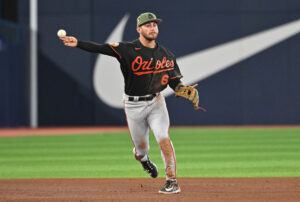
In 389 plate appearances in Norfolk, he hit .321/.378/.507 with nine homers and 30 doubles. Ortiz spent most of his time at shortstop while logging some action at both second and third base. Baltimore promoted him for the first time at the end of April. He nevertheless spent most of the season on optional assignment, appearing in only 15 big league contests. With Jackson Holliday and Gunnar Henderson as the projected left side infield for the foreseeable future, Ortiz would have had a hard time finding much playing time.
Baseball America’s scouting report rates Ortiz as a potential 70-grade (plus-plus) defensive shortstop. Assuming he’s not traded in the next six weeks, Willy Adames will open the season at shortstop. Milwaukee is likely to lose Adames to free agency next winter at the latest, though, leaving a clear path for Ortiz to emerge as the long-term answer. In the short term, he should battle Andruw Monasterio and Owen Miller for playing time at third base. If Monasterio or Miller warrant extended run at the hot corner, Ortiz is an alternative to Brice Turang at second. Turang is a gifted defender but struggled at the plate during his rookie year.
Hall, also 25, was a first-round pick out of a Georgia high school seven years ago. The 6’2″ southpaw has had the same general profile for his entire professional career: huge stuff with worrying control issues. Hall made his MLB debut in 2022 and has logged 33 big league innings over the past two seasons. He owns a 4.36 ERA with a 29% strikeout rate while working almost exclusively in relief.
His 7.6% walk percentage at the MLB level isn’t out of the ordinary. Hall has been a lot less consistent at throwing strikes in the minors, however. He handed out free passes to over 13% of batters faced in 49 innings at Norfolk a year ago, which is right in line with the 13.4% walk rate he owns in his minor league career.
That he also punched out nearly a third of batters faced in Triple-A hints at the excellent arsenal he owns. His fastball averaged nearly 96 MPH in his big league relief work. Hall also worked with a mid-80s slider and changeup while occasionally mixing in a curveball. BA’s scouting report notes that all four of those offerings could be plus or better.
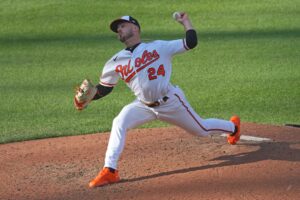
It’s top-of-the-rotation caliber stuff, but Hall’s strike-throwing has led many evaluators to project him as a high-octane reliever. Milwaukee could use him in either capacity. The Brewers have ample opportunity in the rotation behind new staff ace Freddy Peralta. Veteran lefty Wade Miley is a steadying presence. After that, Milwaukee could lean on any of Colin Rea, injury returnees Joe Ross and Aaron Ashby and prospects like Hall and Robert Gasser in the rotation.
Neither Ortiz nor Hall has reached one year of major league service. They’re each under club control for at least six seasons and three years away from arbitration. They’re the kind of high minors players that Milwaukee frequently targets. Their organizational philosophy, much like that of other small-market franchises like the Rays and Guardians, is to eschew traditional competitive windows while building the farm system by trading veterans as they get close to free agency.
GM Matt Arnold stated that trading Burnes isn’t the signal of a traditional rebuild (relayed by Curt Hogg of the Milwaukee Journal-Sentinel). Last week’s signing of Rhys Hoskins to a $34MM free agent deal that allows him to opt out after next season makes clear they’re not giving up on contending in a wide open NL Central. They’ve shown time and again they’ve nevertheless open to offers on most players to try to remain consistently competitive. After trading Josh Hader at the 2022 deadline led to discontent within the clubhouse, the front office suggested they were less inclined to make those kinds of trades during the season.
Between the shoulder injury that led Milwaukee to non-tender Brandon Woodruff and tonight’s move, the Brewers have subtracted their top two starters this offseason. Milwaukee’s payroll projection drops to around $102MM, per Roster Resource. That’s well below last year’s $118MM season-opening mark. That leaves open the possibility of Milwaukee backfilling the rotation in free agency. Arnold was noncommittal as to whether the team planned to reinvest their payroll savings (via Hogg).
Milwaukee should add a third notable young player with the draft choice they acquired. Milwaukee would have received a compensatory pick had they let Burnes depart in free agency — he’ll surely reject a qualifying offer — but that wouldn’t have been until 2025. Baltimore can make Burnes a QO next offseason (and will, unless he suffers a serious injury). As a revenue sharing recipient, they’d land a compensation pick after the first round in 2025 if he signs elsewhere for at least $50MM.
Ken Rosenthal of the Athletic first reported the Orioles were nearing a deal to acquire Burnes. Jon Heyman of the New York Post indicated the deal was agreed upon. ESPN’s Jeff Passan reported that Ortiz and Hall were among the pieces headed to the Brewers. Mark Feinsand of MLB.com reported the inclusion of the draft pick to complete the deal.
Images courtesy of USA Today Sports.
Brewers Designate Ethan Small For Assignment
The Brewers have designated left-hander Ethan Small for assignment, tweets Adam McCalvy of MLB.com. That’s the corresponding 40-man roster move for the two players acquired from Baltimore in the Corbin Burnes trade.
Small was Milwaukee’s first-round pick in 2019 after an excellent college career at Mississippi State. He was initially regarded as one or the better prospects in the organization, but his stock had dipped as he reached the upper minors. Small posted a 4.46 ERA in Double-A in 2022. Milwaukee moved him to the bullpen last year.
The 26-year-old (27 this month) posted decent numbers in relief for Triple-A Nashville. He worked to a 3.18 ERA through 51 innings, striking out 28.5% of opposing hitters. Small also walked 11.2% of batters faced and the Brewers didn’t give him much of an opportunity at the big league level. He pitched twice in the majors last season and has four MLB appearances for his career.
Small doesn’t throw especially hard, averaging 92 MPH on his fastball in his limited MLB work. Prospect evaluators credited him with a plus changeup and his atypical, over-the-top delivery makes him an unconventional look for opposing hitters.
The Brewers will have one week to trade Small or place him on outright waivers. It’s likely he’ll draw interest from another team given his draft pedigree and decent Triple-A résumé. Small has one minor league option remaining. If another team is willing to give him a spot on the 40-man roster, they could keep him in Triple-A for another season.
MLBTR Podcast: The Jorge Polanco Trade, Rhys Hoskins and the Blue Jays’ Plans
The latest episode of the MLB Trade Rumors Podcast is now live on Spotify, Apple Podcasts, and wherever you get your podcasts! Make sure you subscribe as well! You can also use the player at this link to listen, if you don’t use Spotify or Apple for podcasts.
This week, host Darragh McDonald is joined by Anthony Franco of MLB Trade Rumors to discuss…
- The trade sending Jorge Polanco from the Twins to the Mariners (1:10)
- The Brewers sign Rhys Hoskins (8:25)
- The Diamondbacks sign Joc Pederson while the Blue Jays sign Justin Turner (12:05)
- The Tigers sign prospect Colt Keith to an extension (20:30)
Plus, we answer your questions, including…
- Is Cody Bellinger unsigned because of his asking price? Will the Cubs sign him or do they not want to block their outfield prospect? (27:35)
- Should the Mariners sign Blake Snell? Will they? Can they? (31:40)
Check out our past episodes!
- The Broadcasting Landscape, Josh Hader and the Relief Market – listen here
- The Cubs’ Activity, Marcus Stroman And Jordan Hicks – listen here
- Teoscar Hernández Signs With L.A. And The Move-Making Mariners and Rays – listen here
The podcast intro and outro song “So Long” is provided courtesy of the band Showoff. Check out their Facebook page here!
Brewers Sign Rhys Hoskins
January 26: The Associated Press relays the full contract breakdown. Hoskins will make $12MM this year and will be slated for a salary of $18MM in 2025. If he decides to opt out after 2024, he will get a $4MM buyout. The mutual option for 2026 is valued at $18MM and there’s a $4MM buyout on that as well.
January 23: The Brewers announced they have signed free agent first baseman Rhys Hoskins to a two-year deal with an opt-out after 2024 and a mutual option for 2026. It is reportedly a $34MM guarantee for the client of the Boras Corporation.
Hoskins takes a modified pillow contract after missing the entire 2023 season. At the tail end of Spring Training, he tore the ACL in his left knee while retreating to the outfield grass to field a chopper. While he was able to take batting practice by the end of the season, he never quite made it back to the roster. Philadelphia suggested Hoskins may have been activated from the injured list had they advanced to the World Series.
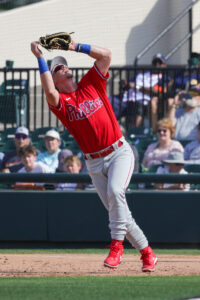
With the Phils coming up a game short of the Fall Classic, the ACL tear marked an unfortunate end to a productive tenure at Citizens Bank Park. Hoskins seemed a potential candidate for the qualifying offer at the beginning of the offseason. The Phils opted against the QO, declaring they were moving Bryce Harper to first base permanently. That made clear Hoskins was headed elsewhere after nearly a decade in the organization.
The Phillies initially selected him in the fifth round of the 2014 draft. Despite the modest draft stock, he hit the ground running in pro ball. He posted huge minor league numbers, mashing his way to the big leagues in the second half of the 2017 campaign.
That excellent production on the farm presaged strong numbers against MLB pitching. Hoskins raked at a .259/.396/.618 clip with 18 home runs over his first 50 games. While he didn’t maintain that pace over any subsequent season, he has been a consistent middle-of-the-lineup presence in Philadelphia.
Hoskins hit between 27 and 34 home runs in his four full seasons between 2018-22. He was on a similar pace in the shortened season, connecting on 10 longballs in 41 games. He has paired that with a walk rate above 10% in every year of his career. That power and patience gives him a solid offensive floor, even if he hasn’t hit above .250 in any season since his rookie year.
Since 2018, Hoskins has posted a .241/.350/.483 batting line. He strikes out in roughly a quarter of his plate appearances. That’s slightly higher than the league average but hardly outlandish, particularly for a player who hits for the kind of power he does. Hoskins has destroyed left-handed pitching at a .250/.399/.522 clip in his career. His .240/.336/.482 slash versus same-handed arms isn’t quite as impressive but remains solidly above average.
The offense carries the overall profile. Hoskins doesn’t offer much as a baserunner. He has graded as a slightly below-average defender throughout his career. It’s unlikely his defense will improve as he’s into his 30s and working back from a significant knee injury.
That’s fine for the Brewers, who needed an offensive upgrade. Milwaukee ranked 17th in runs last season, a subpar figure for a team that plays its home games at hitter-friendly American Family Field. By measure of wRC+, which adjusts for park, Milwaukee ranked 24th in overall hitting production. That was the worst of any playoff team.
First base was particularly problematic. Milwaukee received a dismal .231/.292/.389 showing from the bat-first position. That led the Brew Crew to non-tender Rowdy Tellez. Milwaukee acquired Carlos Santana at the deadline to stabilize first base for the stretch run. The Brewers have remained in contact with Santana this winter, but they’ll instead jump on the opportunity for a more significant lineup upgrade.
The contract aligns with MLBTR’s prediction of two years and $36MM. A few priority rebound targets have landed a two-year guarantee with an opt-out in recent offseasons. That’s appealing for the player, who locks in more security than they’d have received on a straight one-year pact while still allowing them to get back to free agency after one season.
Hoskins’ deal nearly matches the two-year, $36MM pact which Michael Conforto signed with the Giants last winter after missing the ’22 season rehabbing from shoulder surgery. Players like Josh Bell (two years, $33MM) and Lucas Giolito (two years, $38.5MM) have signed similar pacts after terrible finishes to their respective platform seasons. This contract structure isn’t attainable for every bounceback candidate, but it’s one that higher-ceiling free agents of that ilk are increasingly able to secure.
The specific salary structure hasn’t been reported. If the deal guarantees Hoskins $17MM in each season, it’d push Milwaukee’s payroll projection around $122MM, as calculated by Roster Resource. That’s marginally above last year’s $119MM Opening Day mark. Milwaukee’s payroll slate remains manageable even with Hoskins joining Corbin Burnes and Willy Adames (each of whom will make more than $12MM in their final arbitration seasons) on the books.
If Hoskins picks up where he left off before the injury, he’d likely join Burnes and Adames on next year’s free agent market. As with Burnes and Adames, Hoskins would be a candidate for a qualifying offer if he exercises the opt-out. He remains eligible for the QO since Philadelphia opted against the offer this winter. Milwaukee doesn’t have to forfeit any draft picks to add him.
Pete Alonso, Paul Goldschmidt and Christian Walker could all join Hoskins in an interesting first base class next winter. The remaining options for teams this offseason isn’t as robust. Beyond outfielder/first baseman Cody Bellinger, the top first basemen still unsigned are Brandon Belt, Santana, Garrett Cooper and Joey Votto.
Jeff Passan of ESPN first reported that the two parties were closing in on a two-year, $34MM deal with an opt-out next winter (X link). Mark Feinsand of MLB.com reported that they’d finalized the agreement.
Image courtesy of USA Today Sports.