
Offseason In Review: San Diego Padres
The Padres keep trying to find the perfect roster mix to supplement their rising young talent.
Major League Signings
- Drew Pomeranz, LHP: four years, $34MM
- Craig Stammen, RHP: two years, $9MM (includes $1MM buyout of $4MM club option for 2022)
- Pierce Johnson, RHP: two years, $5MM (includes $1MM buyout of $3MM club option for 2022)
- Total spend: $48MM
Trades and Claims
- Acquired OF Tommy Pham and INF Jake Cronenworth from Rays in exchange for OF Hunter Renfroe, INF Xavier Edwards and INF Esteban Quiroz (as PTBNL)
- Acquired RHP Emilio Pagan from Rays in exchange for OF Manuel Margot and C/OF Logan Driscoll
- Acquired OF Trent Grisham and RHP Zach Davies from Brewers in exchange for 2B/SS Luis Urias and LHP Eric Lauer
- Acquired 2B Jurickson Profar from Athletics in exchange for C Austin Allen and OF Buddy Reed (as PTBNL)
- Claimed INF Breyvic Valera off waivers from the Blue Jays
Notable Minor League Signings
- Abraham Almonte, Kyle Barraclough, Gordon Beckham (since released), Brian Dozier, Jerad Eickhoff, Seth Frankoff, Juan Lagares
Notable Losses
- Carl Edwards Jr., Robbie Erlin, Travis Jankowski, Ian Kinsler (retired), Aaron Loup, Kazuhisa Makita, Nick Margevicius, Bryan Mitchell, Chris Stewart, Robert Stock, Adam Warren, Eric Yardley
As usual, the Padres engaged in quite a lot of eyebrow-raising chatter this winter. There was talk at various points that the club was chasing trades involving Mookie Betts (see here), Kris Bryant (see here), Francisco Lindor (see here), Nick Senzel (same link), and Starling Marte (see here). In free agency, the Friars looked at veteran southpaws Madison Bumgarner and Dallas Keuchel … and also considered another in David Price as part of various trade scenarios.
There’s no new star in San Diego, but that probably wasn’t necessary for an organization that last year welcomed Manny Machado and oversaw the emergence of Fernando Tatis Jr. and Chris Paddack. It might have been nice to announce a new, long-term pact with Tatis. The San Diego organization built up some good will by promoting him to start the 2019 season — that’ll also ensure a full season of 2020 service even if the campaign isn’t played — but couldn’t make apparent headway in talks this winter.
While committing distant future money to a franchise star would’ve been possible, the Friars didn’t have much near-term payroll space to work with. The Padres tried but failed to deal Wil Myers to achieve greater flexibility, so for now they’re left saddled with the remaining three years and $61MM on his heavily back-loaded contract. After a bunch of non-tender decisions and some mostly modest salary additions, the team is sitting at about $144MM in cash payroll for 2020.
So, what did Padres GM A.J. Preller accomplish in his sixth offseason at the helm of baseball operations? Much of the work was in a set of four interesting swaps with three value-focused trade partners.
Most of all, Preller swung an outfield overhaul. Tommy Pham and Trent Grisham each came over as part of multi-player trades that defy characterization as “buy” or “sell”-side transactions for either the Padres or their respective trade partners in Tampa Bay and Milwaukee.
Pham is only controlled for two more seasons, but he could contribute a ton of excess value if he keeps hitting. He’ll replace Hunter Renfroe, one of the players for whom he was traded. Grisham brings a lot more long-term control and some real promise but isn’t nearly as established. He’ll slot into the mix at all three outfield spots, perhaps pairing with minor-league signee Juan Lagares to handle much of the work in center. Otherwise, the Friars will shrug and hope for the best from Myers and oft-injured youngster Francy Cordero. Another young left-handed slugger, Josh Naylor, could also factor into the mix. With a strong showing in the upper minors (if a season is played there), well-regarded prospect Taylor Trammell could force his way into the picture at some point.
As is the case for much of the rest of the San Diego roster, it’s possible to imagine the outfield unit playing at quite a high level … or being rather a marginal outfit. There’s decidedly more star power in the infield, though perhaps the outlook comes with the same sort of qualifications.
Barring injury, the left side of the infield will be occupied almost exclusively by aforementioned wunderkind Tatis and top-dollar star Machado. Greg Garcia is the primary reserve/fill-in option, with Ty France and newcomer Jake Cronenworth also on the 40-man. Francisco Mejia and Austin Hedges remain entrenched behind the dish, with hopes one or both will make strides in 2020. At first base, the Pads may ultimately have to decide whether to reduce the time of the disappointing Eric Hosmer. It’s arguable that the best alignment would involve a time share between Hosmer and Myers, however hard that would be to swallow given each former Royal’s weighty contract.
Ian Kinsler’s decision to elect retirement after a tough 2019 showing unexpectedly cleared some salary and seemed to pave a path to regular at-bats for top prospect Luis Urias — but the club obviously didn’t fully believe in him as a replacement. He ended up departing in the Grisham swap. The Padres gave up a bit of young talent to take over the final season of arbitration eligibility of Jurickson Profar, a formerly elite prospect (from back when he and Preller were with the Rangers organization) who was a mostly uninspiring performer in 2019. He’ll battle at second base with minor-league signee Brian Dozier. It wouldn’t be surprising to see that situation ultimately end up in a timeshare (with Garcia, France, and/or Cronenworth potentially involved).
Those aforementioned outfield moves spelled the end of the line for Manuel Margot in San Diego. He ended up being shipped out along with 2019 second-rounder Logan Driscoll in order to acquire reliever Emilio Pagan. The late-blooming Pagan brings highly appealing K/BB numbers and a big swinging-strike rate out west, but it seems rather curious that he will now be on his fourth MLB team in four seasons. Pagan carried an unsustainable strand rate (94.8%) to reach a 2.31 ERA last year and has been rather prone to the long ball (1.58 per nine for his career).
The Padres have visions of Pagan joining closer Kirby Yates to form a powerful combination of late-inning righties. Completing the high-leverage mix is southpaw Drew Pomeranz, who rode his second-half surge to a much bigger-than-expected contract and a surprising return to San Diego. The 31-year-old was flat-out dominant down the stretch, but it was still stunning to see the Friars go to a four-year guarantee to lure him. Further bullpen-building came in the form of more modest two-year pacts to bring back Craig Stammen and add interesting NPB returnee Pierce Johnson, who whiffed 91 hitters through 58 2/3 innings en route to a 1.38 ERA with the Hanshin Tigers in Japan last season.
The depth seems like it’ll be necessary. Young hurlers Andres Munoz and Reggie Lawson were each lost to Tommy John surgery in camp. The Padres can still turn to a host of other young arms, but most come with questions. Southpaw Matt Strahm (who has much better career numbers as a reliever) and converted infielder Javy Guerra seem likely to join the ‘pen once the season begins. Luis Perdomo, Adrian Morejon, Michel Baez, Ronald Bolanos, David Bednar, Jose Castillo, Trey Wingenter, and Gerardo Reyes and sixth starter Cal Quantrill are all 40-man options as well — some with real upside — but you’d have a hard time arguing any as sure things.
That leaves a rotation mix that mostly went untouched over the winter. The Friars did bring in Zach Davies while parting with Eric Lauer as the other half of the Grisham/Urias swap. It’s too much to expect a repeat of his 2019 showing (31 starts of 3.55 ERA ball), but Davies should be a solid part of the staff. The same holds true of Joey Lucchesi, who returns along with the upside-laden trio of Paddack, Garrett Richards, and Dinelson Lamet to form quite an interesting rotation mix. It would be even more exciting to see this group in a full season, when it could be supplemented by top prospects MacKenzie Gore and Luis Patino, but that’s all coming soon enough.
2020 Season Outlook
It’s awfully tough to look at this roster and see a threat to the powerhouse Dodgers. But all bets are off in a short-season format, which is likely all we’ll get if the 2020 season is played at all. And there’s reason for the Padres to hope they’ve done enough at least to compete for a Wild Card spot, though it’s a crowded NL field and it’ll be tough to make mid-season improvements given the (seeming) lack of payroll breathing room.
How would MLBTR fans grade the Padres’ offseason dealings? (Link to poll for Trade Rumors mobile app users)
Grade the Padres' offseason:
-
B 53% (1,338)
-
C 28% (704)
-
A 10% (261)
-
D 5% (132)
-
F 3% (71)
Total votes: 2,506
2020-21 Free Agent Class: Second Basemen
Considering the circumstances, we figure to be in for an unusual free agency period in Major League Baseball next offseason. We’ve already run down the most notable catchers, shortstops, and first basemen who are slated to reach the open market once the winter rolls around in several months. We’ll do the same here with second basemen (players’ listed ages are for the 2021 campaign) …
Top Of The Class
- DJ LeMahieu (32): Some felt the Yankees made a really nice value move when they inked DJLM, but nobody predicted a fourth-place finish in the AL MVP voting. It remains to be seen whether LeMahieu can repeat anything like his whopping 2019 output at the plate, but he has long been a high-end defender.
- Jonathan Villar (30): Another player with a bit of a rollercoaster trajectory, Villar has actually matched LeMahieu in career batting output (97 wRC+). And Villar was quite good in 2019, racking up 4 fWAR despite below-average defensive grades by turning in 162 games of quality hitting and league-leading legwork on the bases.
- Kolten Wong (30): It all came together in 2019 for the longtime Cardinals second bagger, who contributed solid work across the board. With a repeat showing, the club is likely to exercise its $12.5MM club option ($1MM buyout).
Other Regulars (based upon 2019 playing time)
- Cesar Hernandez (31): Even at his best, Hernandez has never been anything close to an overwhelming offensive performer. But he does have a ~3 WAR established ceiling and has received fairly regular playing time over the past five seasons.
- Jurickson Profar (28): The once- super-elite prospect has made it through major injury issues but has never fully come around at the MLB level. 2020 could be something of a make-or-break season.
- Jonathan Schoop (29): Though he rebounded from a down 2018, Schoop wasn’t the 30+ homer slugger of yore. Defensive metrics are split on his fielding ability.
Top Timeshare Candidates
- Asdrubal Cabrera (35): After a rough start to the 2019 season, Cabrera caught fire down the stretch with the Nats. He’s unlikely to be an everyday guy come 2021, but is a trusted veteran who could still be seen as an important contributor.
- Daniel Descalso (34): He’s all but certain to be paid a $1MM buyout rather than playing on a $3.5MM club option, barring a huge bounce back after a terrible first season with the Cubs.
- Brian Dozier (34): It would be a surprise if Dozier returns to his levels of quiet stardom after two-straight down years. But he could have a chance to shine in San Diego if Profar falters.
- Dee Gordon (33): It just hasn’t worked out for Gordon in Seattle. The M’s are sure to pay him a $1MM buyout instead of exercising a $14MM club option. But the speedy veteran could still have another act left.
- Howie Kendrick (37): The bat is still legit, though it’s fair to wonder whether the glove still plays at second base. Odds are he’ll be seen mostly at an option in the corners going forward.
- Jed Lowrie (37): It’s anyone’s guess how Lowrie will look when he finally gets back on the field.
- Brad Miller (31): He surged back to life in a short 2019 run with the Phillies … but consistency has proven elusive over the years.
- Eric Sogard (35): His power outburst with the Blue Jays faded after a mid-season trade to the Rays, but Sogard is still being paid to function as a significant contributor in his latest stint with the Brewers.
Others
Adeiny Hechavarria and Freddy Galvis can be considered candidates at second base, though their real value lies in their ability to handle shortstop. Bounceback candidates include Eduardo Nunez and Chris Owings.
Dr. Anthony Fauci On Possibility Of 2020 MLB Season
Yesterday, MLB commissioner Rob Manfred said that broader considerations would dictate whether and when the league is able to resume play in 2020. He expressed a commitment not only to the safety of those involved directly in staging ballgames, but to relaunching “in a way that will not impact the public health situation adversely.”
Whether that will be possible remains to be seen, but experts aren’t ruling out the possibility of some kind of return. Dr. Anthony Fauci, the longtime director of the National Institute of Allergy and Infectious Diseases and a key voice on the coronavirus pandemic, addressed the potential of baseball resuming play this summer in a podcast appearance with Peter Hamby (who also wrote things up at Vanity Fair).
There’s certainly plenty of important information to digest from the interview, but we’ll focus on some of the aspects relating directly to the game of baseball. Fauci wasn’t willing to give a strong prediction as to whether we’ll see MLB and other sports this year — largely due to the vast remaining uncertainty in dealing with COVID-19. Per Fauci, the feasibility of holding sports is “really going to depend on what actually evolves over the next couple of months.”
Manfred says that Major League Baseball wants to be a key “part of the [economic] recovery … and sort of a milestone on the return to normalcy.” He has thus far backed that up with creative planning efforts (as we discussed in a recent YouTube video) and, far more importantly, with rapid engagement in a critically important study designed to assess the true spread of the disease throughout the United States.
Fauci envisioned a scenario where indeed baseball is able to launch a season by the middle of the summer — sans live fans, of course. “If you could get on television, Major League Baseball, to start July 4,” Fauci suggested, ” … Well, I think you’d probably get enough buy-in from people who are dying to see a baseball game. Particularly me. I’m living in Washington. We have the World Champion Washington Nationals. You know, I want to see them play again.”
Getting there won’t be easy. Fauci spoke of “proposals” involving gathering and isolating players and others associated with putting on the sporting event “in big hotels” near playing sites. It would be necessary to utilize such isolation with frequent testing and other efforts to “make sure they don’t wind up infecting each other or their family.”
If that all sounds familiar, it certainly seems to dovetail with what we’ve heard from reports on MLB efforts to plan out a possible 2020 campaign. The league is known to have consulted with Fauci and other top experts. It’s an approach that carries some obvious (and probably some non-obvious) risks and limitations. But it’s at least somewhat encouraging that Fauci seems to believe it’s conceptually possible. And as he says, “it might be better than nothing.”
Why The Gerrit Cole Trade Wasn’t A Total Bust For The Pirates
We’re past the two-year anniversary of a trade that has made a significant impact on the Pirates, the Astros and perhaps Major League Baseball as a whole. In January 2018, the Pirates sent right-hander Gerrit Cole to the Astros for a package consisting of righties Joe Musgrove and Michael Feliz, third baseman Colin Moran and outfielder Jason Martin.
Was the blockbuster worth it for Houston? Sure. Cole absolutely dominated in their uniform for two years and helped them to an American League pennant last season. But he’s now a member of the Yankees, who signed him to a record contract worth $324MM over nine years last winter. Has it been worth it for Pittsburgh? Debatable. Feliz and Moran haven’t amounted to much more than replacement-level players in the majors, while Martin has failed to register solid numbers at the Triple-A level. There’s at least one silver lining in Musgrove, who has emerged as a quality starter for the Pirates.
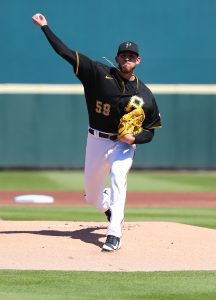
Let’s start by acknowledging that now-former Pirates general manager Neal Huntington was hamstrung by the team’s low budget. As a result of owner Bob Nutting’s unwillingness to commit a relatively enormous amount to any player (to this day, the biggest contract the Pirates have given out belongs to Jason Kendall, who signed a six-year, $60MM deal 20 years ago) there was no way the Pirates were going to be able to extend Cole – a Scott Boras client. And Cole, although a former No. 1 overall pick who logged ace-like numbers at times in a Pirates uniform, was not the Cy Young-level hurler he is now. Cole ate up 203 innings in his final year in Pittsburgh, but he also recorded a 4.26 ERA/4.08 FIP. No question that’s a useful output, but the run prevention was nowhere close to elite.
Whether or not you want to rail against the overall return the Pirates got for Cole, it’s clear they received at least one valuable player in Musgrove. Now 27 years old, Musgrove showed well in Houston from 2016-17 and has held his own in Pittsburgh during his two seasons there. He registered a 4.06 ERA/3.59 FIP in 115 1/3 innings in 2018 and put up similar numbers last year. Musgrove’s 4.44 ERA across 170 1/3 frames doesn’t look amazing, but he was near the top of the league in other important categories. He ranked 22nd in the majors in K/BB ratio (4.03), 24th in FIP (3,82), 30th in fWAR (3.3) and 34th in xFIP (4.31; that tied Madison Bumgarner, whom the Diamondbacks signed to a five-year, $85MM contract in free agency).
None of this is to say that the Pirates emerged from the Cole trade in great shape. They won 69 games last season and haven’t been a playoff team since 2015, after all, but their recent struggles certainly haven’t been the fault of Musgrove. Going forward, he’ll make a rather affordable $2.8MM this season – his third-last arbitration-eligible campaign – and could continue to improve his stock before his team control expires. Just how long Musgrove will stay a Pirate is in question, though; depending in part on whether they return to contention and if he’s amenable to an extension, the Bucs could decide Musgrove’s expendable if they’re not willing to make a long-term commitment to him.
Photo courtesy of USA Today Sports Images.
Offseason In Review: Toronto Blue Jays
The Blue Jays’ quest to overhaul their pitching staff led to one of the biggest signings in franchise history.
Major League Signings
- Hyun-Jin Ryu, SP: Four years, $80MM
- Tanner Roark, SP: Two years, $24MM
- Travis Shaw, IF: One year, $4MM
- Rafael Dolis, RP: One year, $1MM ($1.5MM club option for 2021)
- Total spend: $109MM
International Signings
- Shun Yamaguchi, SP/RP: Two years, $6.35MM (plus $1.27MM to the Yomiuri Giants as a transfer fee)
Trades And Claims
- Acquired SP Chase Anderson from the Brewers for 1B prospect Chad Spanberger
- Acquired cash considerations from the Reds for RP Justin Shafer
- Claimed RP Anthony Bass off waivers from the Mariners
Notable Minor League Signings
- Joe Panik (contract was selected to MLB roster, guaranteeing Panik’s $2.85MM salary), A.J. Cole, Justin Miller, Caleb Joseph, Marc Rzepczynski, Ryan Dull, Jake Petricka, Ruben Tejada, Brian Moran, Patrick Kivlehan, Andy Burns, Phillippe Aumont
Notable Losses
The 2019-20 offseason represented a turning point in the Blue Jays’ rebuild process, as Toronto cast a very wide net in search of upgrades both large and small. The Jays were linked to just about every available pitcher, and also looked into such notable position player trade targets and free agents as Francisco Lindor, Yasmani Grandal, Didi Gregorius, Mike Moustakas, and former Toronto favorite Edwin Encarnacion.
It was a big push from a team coming off three consecutive losing seasons, and one that didn’t necessarily announce an intent to be a full-on contender in 2020. Back in February, Jays president/CEO Mark Shapiro stated that even a “.500 [record] would be a big step forward” for a club that only went 67-95 last season, yet it’s clear that management has a lot of faith that its young core of players can get the Blue Jays back into the playoff hunt sooner rather than later.
This set the stage for Hyun-Jin Ryu’s four-year, $80MM contract. It was the seventh-richest contract given to any free agent this winter in terms of total dollars, and it also marked the third-largest deal the Jays have given to any player. It was a big commitment to make to a 33-year-old pitcher with a lengthy injury history, though Ryu brings genuine top-of-the-rotation ability when healthy. Ryu’s 182 2/3 innings pitched in 2019 was the second-highest total of his career, and he finished second in NL Cy Young Award voting after posting a 2.32 ERA, 6.79 K/BB rate, and 8.0 K/9.
While $80MM is a sizeable expenditure for any team, Ryu’s deal is one the Blue Jays could somewhat comfortably afford to make, given their lack of long-term payroll commitments. By this token, it could be argued that the Jays could have made another splashy signing (or trade) beyond just Ryu, though the counter to that argument is that Toronto perhaps still wants to see what it truly has in its young players. As promising as Vladimir Guerrero Jr., Lourdes Gurriel Jr., Bo Bichette, and Cavan Biggio are, the quartet has combined for only 418 Major League games — the four players have only appeared in the same starting lineup eight times. Between this lack of experience and the fact that the likes of Teoscar Hernandez, Danny Jansen, or Rowdy Tellez have yet to break out, it makes sense that the Jays didn’t want to go overboard in building around a foundation that may not yet be entirely stable.
That said, some extra willingness to build was required given the escalating prices in free agency, and the simple fact that the 2019-20 offseason moved at a much quicker pace than the previous two winters. As noted by Sportsnet’s Shi Davidi back in February, GM Ross Atkins essentially changed tactics midway through the offseason, as failing to adapt to the changing marketplace would have left the Jays without the pitching help they so badly needed.
Ryu was the biggest addition, though Tanner Roark brings some more innings-eating veteran experience to the rotation. The Blue Jays also went overseas to add pitching, signing Shun Yamaguchi to a two-year contract after the right-hander was posted by the Yomiuri Giants. At the time of the COVID-19 shutdown, Yamaguchi was being targeted for the bullpen, though it could have been something of a long relief or swingman role to keep him stretched out for possible starts.
Between these three signings and Chase Anderson (acquired in a trade with the Brewers in early November), Toronto’s pitching situation looks far more solid than it did last season, when injuries and inexperience resulted in the Jays getting just 711 1/3 innings from their starting pitchers, the third-lowest total in baseball. None of Roark, Anderson, Yamaguchi, and Matt Shoemaker are controlled beyond the 2021 season, leaving a lot of flexibility within the rotation for younger pitchers to eventually move into the picture — most prominently, one of the sport’s best pitching prospects in Nate Pearson.
Yamaguchi’s availability in the bullpen helps strengthen a relief corps that also added Anthony Bass, A.J. Cole, old friend Marc Rzepczynski, and Rafael Dolis to the mix. Dolis was the only MLB signing of that trio, inking a $1MM deal to return to North America after four dominant years pitching out of the Hanshin Tigers’ bullpen.
Perhaps the biggest reliever-related headline for the Blue Jays was a move that didn’t happen, as Ken Giles is still in a Toronto uniform. The closer was widely expected to be dealt over the winter, though a lack of early interest seemed to carry through the entire offseason. It could also be that the Jays changed their view on trading Giles after the Ryu signing raised expectations for a competitive season, or at worst, the club figured they could still move him at the trade deadline.
Now, of course, that plan has been entirely altered since we don’t know when a 2020 trade deadline could fall, or whether the 2020 season will be played whatsoever. If the season is indeed cancelled, Giles will still be eligible for free agency as scheduled, leaving the Jays in danger of losing him for nothing. (The Jays could receive a draft pick if Giles rejected a qualifying offer, or Giles could even accept a QO and stay with Toronto, though it remains to be seen if the club would want to pay Giles such a hefty one-year salary.)
Given the flirtations with the likes of Lindor and Moustakas, Travis Shaw could certainly be seen as an underwhelming choice as the Blue Jays’ most notable new position player. Shaw is coming off a terrible 2019 season, though the Jays are betting that year was an aberration considering Shaw’s track record over his previous four MLB campaigns. Shaw will essentially replace Justin Smoak as the regular first baseman, though Shaw’s ability to play third base and second base gives manager Charlie Montoyo the ability to shuffle his lineups.
Multi-position versatility was a stated priority for Atkins heading into the offseason, which also led to Joe Panik being brought aboard to add depth at shortstop and second base. Except for Tellez, the catchers, and maybe Guerrero (who could yet eventually be a first base option), every player on the Blue Jays’ projected roster can play multiple positions, be it an outfielder who can play at least two positions on the grass, or a player like Biggio who could be used all over the diamond.
The catch, however, is that while the Jays have several players who can handle multiple positions, it’s still an open question as to how many can play well at any position. Shaw and Randal Grichuk are coming off rough seasons, while Panik and Brandon Drury have been replacement-level players or worse in each of the last two seasons. As mentioned earlier, the developmental path of so many of Toronto’s young players is still an unknown, so it doesn’t create much of a safety net if the veterans all continue to struggle.
Of the bigger-name position players on the Jays’ target list, Moustakas is perhaps the one that seemed reasonably closest to becoming a reality. Grandal would likely have only been heavily pursued if the Jays had found a good offer for Jansen or Reese McGuire, Toronto’s plan to have Gregorius play second base might not have appealed to the long-time shortstop, and there isn’t much evidence that the Jays’ pursuit of Lindor amounted to anything besides due diligence. (Acquiring Lindor would have also significantly accelerated the Blue Jays’ timeline for contention, since Lindor is only under contract through the 2021 season.)
With Moustakas, however, the Jays were reportedly the second-highest bidder, offering the infielder a three-year, $30MM deal that far surpassed the one-year deals Moustakas had been forced to settle for in the last two free agent markets, and also topped MLBTR’s projected two-year, $20MM contract for him this winter. Considering the Reds went above and beyond all expectations to sign Moustakas to a four-year, $64MM deal, it’s hard to fault the Blue Jays for being outbid by such a massive splurge. Still, if not Moustakas himself, the Jays’ lineup would look a lot more solid had one more proven, above-average hitter been brought into the mix to augment the still-developing younger hitters, rather than just hoping that Shaw can bounce back.
2020 Season Outlook
If some games are played in 2020, there’s a chance a shorter season could be to the Jays’ benefit in terms of actual on-field results. Theoretically, a younger roster could be more suited to handling a compacted schedule with many unusual aspects (regular double-headers, games in minor league or Spring Training parks, etc.) that could be a harder adjustment for a veteran team that is more set in its ways. Also, while it didn’t seem likely that the Blue Jays could hang with the Yankees or Rays over 162 games, keeping pace over something like an 81-game sprint isn’t as far-fetched.
With so many question marks still surrounding the roster, however, the threat of a shortened or altogether canceled 2020 season is particularly tough on the Blue Jays. Not only could all of these questions be kicked down the road into 2021, a reduced or lost season also wipes out invaluable development time for youngsters at both the MLB and minor league levels, and erases the year that the Jays could have most directly counted on as a prime Ryu season.
One significant question that was answered this offseason is that we now have evidence that the Jays are willing and able to make an expensive impact in the free agent market, which was a criticism often directed by Toronto fans towards both club ownership and the Shapiro/Atkins regime. It would have been easy for the front office to respond to the market’s rising price tags by stepping back and making only lower-level signings since the Jays were still in a rebuild phase, yet the team felt the time was right to make the big strike. The Ryu contract is a hint at future aggressiveness down the road, when the Blue Jays are even better positioned to challenge for the postseason.
How would you grade the Blue Jays’ offseason moves? (Link for app users.)
How would you grade the Blue Jays' offseason moves?
-
B 59% (1,392)
-
C 21% (493)
-
A 14% (321)
-
D 3% (81)
-
F 3% (62)
Total votes: 2,349
What Happens To The Mookie Betts Trade If The Season Is Canceled?
If the 2020 MLB season is canceled due to the coronavirus pandemic, players will receive service time equal to the amount they accrued in 2019. That’s a win for any player who received a full year in ’19, as they’d remain on track for free agency as expected. That includes Mookie Betts, George Springer, J.T. Realmuto, Trevor Bauer, and everyone else expected to be in the 2020-21 free agent class.
A canceled season would sting for someone like Dodgers second baseman Gavin Lux, who picked up 28 days of Major League service as a rookie last year but was likely to get a full season in 2020. Lux’s free agency would have arrived after the 2025 season, but if this season is canceled, he’ll project to become a free agent after ’26. And then there are others who didn’t get any MLB service in ’19 but were expected to in ’20, such as Wander Franco, Jo Adell, and Nate Pearson.
It’s worth considering how the balance would shift in recent major trades if there’s no 2020 season. The Betts trade, where the Dodgers’ main acquisition was a star rental player, dramatically shifts toward the Red Sox.
Pre-coronavirus expectations of the Mookie Betts trade:
- Dodgers get one year of Mookie Betts, three years of David Price, $48MM from the Red Sox and can make Betts a qualifying offer after the season
- Red Sox get five years of Alex Verdugo, six years of Jeter Downs and six years of Connor Wong
Canceled season results of the Mookie Betts trade:
- Dodgers get zero years of Mookie Betts, two years of David Price, $32MM from Red Sox and can make Betts a qualifying offer
- Red Sox get four years of Alex Verdugo, six years of Jeter Downs and six years of Connor Wong
The Red Sox had been scheduled to pay $48MM to the Dodgers in 18 equal installments, starting tomorrow. However, MLBTR has confirmed that all cash considerations will be adjusted proportionally to the salary reductions that end up occurring in 2020. So if the Dodgers don’t wind up paying Price in 2020, the Red Sox won’t send money to them. My $32MM figure assumes the 2021 season is played in full.
Price remains a useful pitcher, so it’s not as if the Red Sox gave up nothing of value. And while they’d still pay the Dodgers $32MM in 2021-22, that’s only half what they’d have originally owed Price for his age 35-36 seasons. The Sox might have accepted that arrangement with nothing in return from the Dodgers, but they still get to keep Verdugo, Downs, and Wong. Though a canceled season would mean the Red Sox would lose the chance to reset under the luxury tax in 2020, that will be less challenging in ’21 given the Price trade and the fact that Jackie Bradley Jr. ($11MM) will be coming off the books.
The Dodgers, meanwhile, would find themselves without Betts, Verdugo, or Joc Pederson for the 2021 season (unless they re-sign Pederson as a free agent). They’d lose a crucial year of control of Cody Bellinger, who would likely settle back in as the regular right fielder. That would leave A.J. Pollock as the regular center fielder. The Dodgers would have an even bigger question mark in left, where Pederson, Verdugo, and Pollock combined to take more than half of the innings in 2019. Chris Taylor and Matt Beaty would be the main in-house candidates, so the Dodgers would likely have to make an outfield acquisition.
Betts could still wind up playing meaningful games for the Dodgers if the 2020 season is canceled, as they’d be a top contender for him in what could be a strange free agency period. It would hardly be a shock to see the entire free agent market suffer due to teams’ lost revenue in 2020, forcing Betts to settle for less than he expected prior to the pandemic.
Could the Dodgers receive some sort of recourse on the Betts trade if the season is canceled? I polled MLBTR writers Steve Adams, Jeff Todd, and Connor Byrne, and none of them find that likely. As Steve put it, “If there’s an alteration to the Betts deal, that just seems like opening Pandora’s box. Every team in the league would be clamoring for compensation because almost everyone would be getting screwed to some extent.” Whether it’s the Reds acquiring Trevor Bauer last summer with an eye toward 2020, the Diamondbacks losing one of their two years of Starling Marte, or the Rangers losing a year of Corey Kluber, many teams are dealing with a similar situation.
For more on this topic, check out my new video discussion with Jeff Todd:
2020-21 Free Agent Class: First Basemen
Considering the circumstances, we figure to be in for an unusual free agency period in Major League Baseball next offseason. We’ve already run down the most notable catchers and shortstops who are slated to reach the open market once the winter rolls around in several months. We’ll do the same here with first basemen (players’ listed ages are for the 2021 campaign) …
Top Of The Class
- Anthony Rizzo (31): It would be a huge surprise to see Rizzo become a free agent after next season, as he’s a Cubs icon, a valuable player and someone whose 2021 club option ($14.5MM, compared to a $2MM buyout) looks very reasonable for what he’s able to produce.
- Carlos Santana (35): Santana’s future appears harder to determine than Rizzo’s. On one hand, Santana’s high-on-base ways lead to solid numbers at the plate every year. Still, it’s fair to wonder if the Indians are going to be willing to exercise his pricey option in 2021. They’re a small-market club, after all, and getting rid of Santana’s $17.5MM salary in favor of a $500K buyout would save them a substantial amount of money.
- Yuli Gurriel (37): Gurriel was tremendous last season, a 31-home run, 132 wRC+ performance, but whether it was the product of a juiced ball or a real breakthrough remains to be seen. He wasn’t an offensive dynamo in his previous three major league seasons, and the fact that he’ll be closer to 40 than 30 when he becomes a free agent won’t help his cause.
Other Regulars (based upon 2019 playing time)
- Edwin Encarnacion (38): Encarnacion remains a formidable hitter, but he’s more of a DH than a first baseman nowadays, and the White Sox will be able to keep him for a reasonable $12MM by way of a club option in 2021.
- C.J. Cron (31): While Cron packs a punch (he piled up 55 home runs from 2018-19), he has historically only been a little above average as an all-around offensive player (109 wRC+). As a first baseman, that limits his value.
- Daniel Murphy (36): At this rate, the Rockies seem likely to buy out Murphy for $6MM as opposed to keeping him for $12MM. Although Murphy has typically held his own at the plate, he was a serious disappointment in 2019 in the first season of a two-year, $24MM guarantee with the Rockies. A repeat may limit Murphy to a minor league pact.
- Justin Smoak (34): Smoak wasn’t that productive in his final Blue Jays season last year, yet he was a Statcast favorite. So, if his bottom-line numbers tick upward in 2020 (let’s assume a season actually happens), it wouldn’t be that surprising to see the Brewers keep him for $5.5MM; otherwise, they could buy the switch-hitting Smoak out for $1MM.
Top Timeshare Candidates
- Howie Kendrick (37): Kendrick can flat-out hit, and he may have been the most valuable bench player in the game last year, though age will continue to work against him next time he gets to free agency. That said, Kendrick’s 2019 heroics helped convince the Nationals to re-sign him to a $6.25MM guarantee after a brief trip to the market last offseason.
- Mitch Moreland (35): The Red Sox will be able to retain Moreland for a $3MM option or cut ties with him for $500K in the coming months. Neither outcome would come as a shock. Moreland has typically been something close to a replacement-level player in most seasons, but the Red Sox have shown under multiple administrations that they like him. Whether or not Boston keeps Moreland beyond 2020, it would make sense to largely deploy the left-hander against righties this year, considering he ha sperformed far better against them during his career.
- Todd Frazier (35): A third baseman for the vast majority of his career, Frazier hasn’t even amassed double-digit appearances at first since 2014. The power-hitting Frazier has usually produced well as a third bagger, though, so perhaps the Rangers will bring him back in 2021 on a $5.75MM salary (they could instead buy him out for $1.5MM).
- Ryan Zimmerman (36): The man known as Mr. National probably won’t ever play anywhere but D.C., where he’s an icon. Even if he does, there won’t be a sizable amount of playing time or a large payday for the once-stellar third baseman.
- Brad Miller (31): The left-handed Miller has struggled versus southpaws, and he hasn’t played first since 2018, but he’s decent against righties and has lined up at almost every position on the diamond during his career.
- Neil Walker (35): The longtime second baseman seems to be nearing the finish line, but the switch-hitting Walker has usually been at least a league-average offensive player.
Anderson Espinoza Hires Beverly Hills Sports Council
Padres right-hander Anderson Espinoza has changed agencies and is now a client of the Beverly Hills Sports Council, Jon Heyman of MLB Network tweets. Agent Cesar Suarez will represent Espinoza.
Once among the finest prospects in baseball, Espinoza has fallen on hard times in recent years because of serious injury troubles. He’s a two-time Tommy John surgery patient who more recently underwent the procedure last April. The 22-year-old’s health woes have prevented him from pitching competitively since 2016, the same season the Red Sox traded him to the Padres for lefty Drew Pomeranz. Espinoza hasn’t even advanced beyond the Single-A level, where he owns a 4.59 ERA with 8.4 K/9 and 3.0 BB/9 in 111 2/3 innings.
Despite the adversity Espinoza has faced over the past few years, FanGraphs’ Eric Longenhagen ranked him as the Padres’ 17th-best prospect just last week, writing that he still has “front-end stuff.” However, in light of Espinoza’s “below-average control” and the time he has missed, there’s a chance that he’ll only turn into a reliever or a back-end starter (if anything) in the majors.
Espinoza’s change in representation has been noted in MLBTR’s Agency Database. If you see any notable errors or omissions within the database, please let us know via e-mail: mlbtrdatabase@gmail.com.
MLB Participating In Coronavirus Study
Major League Baseball is doing its part to find a cure for the devastating coronavirus. Twenty-seven of the league’s 30 teams are participating in a study which could test around 10,000 people for coronavirus antibodies, according to Jeff Passan of ESPN.com. Stanford University, the University of Southern California and the Sports Medicine Research and Testing Laboratory are running the study.
“This is the first study of national scope where we’re going to get a read on a large number of communities throughout the United States to understand how extensive the spread of the virus has been,” Stanford Dr. Jay Bhattacharya stated (via Passan), adding: “Why MLB versus other employers? I’ve reached out to others, but MLB moved by far the fastest. They’ve been enormously cooperative and flexible. We’re trying to set up a scientific study that would normally take years to set up, and it’s going to be a matter of weeks.”
Bhattacharya hopes to get the results by week’s end, Ken Rosenthal of The Athletic relays. It’s unclear which teams aren’t partaking in this study, but we have confirmation of some of those that are in the mix. The Pirates (via Jason Mackey of the Pittsburgh Post-Gazette), the Mariners (Greg Johns of MLB.com tweets), the Tigers (according to Jason Beck of MLB.com), the Athletics and Giants (Susan Slusser of the San Francisco Chronicle notes), the Astros (per Chandler Rome of the Houston Chronicle) the Phillies (Scott Lauber of the Philadelphia Inquirer relays) and both New York clubs (Tim Healey of Newsday reports) are among those lending a hand.
It’s clear that the league would stand to benefit financially from baseball returning as soon as possible, but it doesn’t seem that’s its primary focus in taking part in this study. Rather, Dr. Daniel Eichner – the president of Sports Medicine Research and Testing Laboratory – told Passan: “MLB did not partner with us for any selfish reason to get their sport back sooner. They jumped in for public health policy. That was their intention and their only intention.”
Red Sox Provide Updates On Injured Players
Red Sox manager Ron Roenicke and pitching coach Dave Bush held a conference call with reporters Tuesday, providing updates on a trio of injured Sox players (all Twitter links via NESN’s Guerin Austin and MassLive.com’s Chris Cotillo).
Perhaps most notably, Roenicke explained that right fielder Alex Verdugo has been swinging a bat, throwing and running as he rehabs a stress fracture in his lower back. Moving his workouts away from the Red Sox’ spring facility following its shutdown has made it more difficult for the club to closely monitor the 23-year-old’s progress, and Verdugo hasn’t yet been able to undergo an MRI to ascertain that his injury has completely healed. However, the Sox remain hopeful that if play is able to resume this year, Verdugo would be ready to participate fully. The centerpiece in Boston’s return for Mookie Betts and David Price, Verdugo slashed .294/.342/.475 with a dozen homers, 22 doubles and a pair of triples in 377 plate appearances with the Dodgers last year.
[Related: What happens to the Mookie Betts trade if the season is canceled?]
As for right-hander Collin McHugh, he’s moving more slowly through the early stages of a strengthening program. McHugh underwent a nonsurgical elbow procedure over the winter after finishing the 2019 season on the injured list and has been brought along slowly. The Sox aren’t rushing him through anything with the season in limbo at the moment, and Roenicke indicated that the 32-year-old righty, who signed a one-year deal with Boston in early March, still has quite a ways to go in his rehab. Boston’s final couple of rotation spots remain fairly unsettled — Ryan Weber is the likely fourth starter, and there’s no set fifth starter — although given where McHugh is in his rehab, perhaps he’s better viewed as a potential bullpen piece.
Regarding former franchise cornerstone Dustin Pedroia, it doesn’t seem that the shutdown has provided any new optimism that he could make a return. While he’s still under contract through the 2021 season, Pedroia’s 2020 status has been up in the air since he suffered a “significant” setback in his recovery from repeated left knee troubles that have necessitated a trio of surgeries. He’s played in just nine games over the past two seasons thanks to his increasingly problematic knee, and Roenicke was rather blunt in casting doubt on a potential return for the 36-year-old: “He’s still not a point where he’s thinking about trying to be ready to come back and join us.”