
The Best Minor League Deals Of 2021 (So Far): Position Players
Minor league contracts don’t generally draw much of a reaction over the course of a baseball offseason, with some rare exceptions. Everyone loves to see an out-of-the-blue comeback story on a non-guaranteed arrangement, but most minor league deals of any note are injured veterans, struggling former prospects or fringe big leaguers who have never really solidified their status as a contributor at the game’s top level. Every year, however, a handful of these no-risk investments produce solid returns.
We’re about a quarter through the 2021 season, so let’s check in on a handful of non-guaranteed pacts that have already proven to be wise investments for their clubs.
- Tyler Naquin, OF, Reds: Naquin’s signing was met with a collective yawn, but one Ohio club’s leftovers have turned into another’s treasure. The former Indians first-rounder has mashed his way into a regular role in Cincinnati, raking at a .265/.346/.530 clip through 133 plate appearances. Naquin parlayed a strong spring and a March injury to Shogo Akiyama into an Opening Day roster spot, but he’s now fourth on the team in plate appearances and third in wRC+ at 135 (min. 20 PAs). He’s hitting so much better than struggling center fielder Nick Senzel that Cincinnati hasn’t hesitated to move Senzel to the infield in the wake of Joey Votto‘s injury, creating more playing time for Naquin. This doesn’t appear to be a mere small-sample fluke, either. Naquin ranks in the 95th percentile of MLB hitters in average exit velocity and has similarly strong percentile rankings in hard-hit rate (84th), xwOBA (89th), xSLG (93rd) and barrel rate (90th). He’s also controlled through the 2022 season via arbitration. For an Indians club that has gotten virtually no production from its outfield over the past two seasons, watching Naquin’s start in 2021 has to sting, even if they’re happy for their former prospect on a personal level.
- C.J. Cron, 1B, Rockies: Cron’s ability to hit hasn’t really been in question since his 2014 MLB debut, but injuries have dogged him in recent years. Fresh off a season-ending knee surgery in 2020, Cron inked a non-guaranteed pact with the Rockies, made the club out of Spring Training and has unsurprisingly emerged as their primary first baseman. He’s out to an excellent start, hitting .300/.397/.500 in 116 plate appearances. Cron missed 10 days with a back strain and, unlike Naquin, is a free agent at season’s end, so he didn’t grab the top spot on this list. Still, he’s been a bright spot for the Rockies and could give them a summer trade chip if he can stay healthy. It’s still somewhat puzzling that the Tigers didn’t bring him back, given how poorly things have gone at first base in Detroit, but perhaps Cron simply liked the opportunity presented in Colorado better.
- Matt Duffy, 3B, Cubs: Duffy began with his MLB career with a stellar year for the 2015 Giants, in which he hit .295/.334/.428 and finished second behind current teammate Kris Bryant in NL Rookie of the Year voting. He never really followed up on that debut effort, though, as underperformance and injuries knocked him off track over the next two seasons. Duffy rebounded to play fairly well with the Rays in 2018 but wound up released after a difficult 2019 campaign. The veteran infielder spent 2020 at the Yankees alternate training site. This offseason, Duffy attracted interest from a few clubs in a coaching and/or front office capacity, but the Cubs offered him a chance to reinvigorate his playing career and have been rewarded for doing so. Duffy made the Opening Day roster and has come out with a .281/.375/.360 line over his first 104 plate appearances, his top offensive output since the aforementioned rookie season. The right-handed hitter isn’t a power threat, but he’s an above-average defensive third baseman with a good approach who makes plenty of contact. Duffy solidifying the hot corner has allowed Bryant to help out an otherwise shaky, inconsistent outfield.
- Jed Lowrie, 2B, Athletics: There’s something about Lowrie and the A’s that just clicks every time he dons the green and gold. In his third stint with the team after missing practically all of the 2019-20 seasons as a Met, Lowrie is improbably hitting .254/.329/.394 through 158 plate appearances. With offense down around the league and a cavernous home park, that’s good for a healthy 108 wRC+. The veteran switch-hitter’s bat has cooled since a torrid start to the season, but the early return on his no-risk minor league pact has been strong.
- Charlie Culberson, INF/OF, Rangers: A popular utility player wherever he goes, Culberson is well on his way to endearing himself to the Rangers’ fanbase. Through his first 97 plate appearances, the 32-year-old is hitting .264/.316/.429 with three homers. Culberson has made one-off appearances at second base, shortstop and in left field, but the bulk of his playing time has come at third base.
- Pablo Sandoval, INF, Braves: Atlanta fans might’ve groaned when the Braves brought the Panda back on another minor league deal, but Sandoval has thrived as a pinch-hitter and seldom-used bench bat. Sandoval has come to the plate as a pinch-hitter 26 times and homered in four of those plate appearances. On the whole, he’s hitting .250/.372/.583 through 43 plate appearances. No one expects the former All-Star to continue at this pace, and you can certainly argue that since Sandoval is effectively a dedicated pinch-hitter, this isn’t an ideal use of a roster spot. Still, it’s hard to argue with four pinch-hit dingers, and we’re talking about minor league deals here, after all.
We’ll check in on this year’s crop of minor league signees a few months from now, as it’s quite likely that we’ll see the tides turn on some of these (and other) contracts. A hot streak from Travis Shaw in Milwaukee could quickly make his deal look all the more prudent, and Connor Joe is out to a hot start with the Rox in a return from last year’s cancer diagnosis, which is a feel-good story in and of itself. At least through the season’s 25 percent mark, however, this group of bats is paying dividends for the teams that rolled the dice.
MLB Trade Rumors Has A New Agency Database
We have revamped our agency database! The database is now mobile-friendly, so you can search for players’ agencies from your phone. You can search by player name or by agency.
The universe of players in this database is anyone who played in the Majors in the previous three completed seasons, which right now means 2018-20. Once this season ends, it’ll become 2019-21. We have agency info for many players, and we’ll continue to do our best to keep it up-to-date. If you work for an agency and one of your players is blank or incorrect, please drop us a line at mlbtrdatabase@gmail.com.
You may also recall that in October, I decided to stop doing posts on agency changes on MLBTR, with the exception of significant national stories. We are still monitoring agency-related news and we will be entering changes into the database.
The agency database is available for all MLBTR readers. Check it out today!
Previewing 2021-22 Opt-Out Clauses & Player Options
Next year’s free-agent class is a legitimately star-studded group even when focusing only on true free agents who’ll hit the market due to service time or an expiring contract. But the class has the potential to become even stronger depending on the play of this year’s collection of veterans who have opt-out clauses and player options in their contracts. Their performance over the next five months will determine whether they opt for another trip to the free-agent market or simply stick with the remaining salary guaranteed to them on their existing deals.
We’re about a sixth of the way through the season, so it’s worth taking an early look at how this group is faring…
Nolan Arenado, 3B, Cardinals (can opt out of remaining six years, $179MM): Arenado, who was always a better hitter at Coors Field, is yet another example of the manner in which home/road splits are overstated with regard to Rockies players. The 30-year-old is now playing his home games at Busch Stadium and still raking at a .279/.336/.507 clip with top-notch defense at the hot corner. Arenado has stated that he plans “to be a Cardinal the rest of the way” and said there is a “very, very high” chance that will forgo the opt-out clause in his contract. After the Cardinals tacked a year and $15MM onto the original five years and $164MM he had remaining on the deal, there’s less incentive for him to test the market.
Trevor Bauer, RHP, Dodgers (can opt out of remaining two years, $62MM): While some might balk at the notion of Bauer opting out when he’s guaranteed a whopping $45MM next year on this front-loaded contract, the opt-out wouldn’t really be about 2022 — it’d be about improving upon the total guarantee. Right now, if Bauer were to suffer an injury in 2022, he’d have a $17MM player option for the 2023 season. If he opts out this winter, however, he could aim to negotiate something similar to or greater than his original three-year, $102MM guarantee with the Dodgers. Bauer could still secure a huge salary in year one of a new contract but give himself a greater safety net against injury or decline. He also won’t have a qualifying offer to deal with this time and would be entering what most expect to be a market with more teams willing to spend. With a 2.50 ERA, 34.7 percent strikeout rate and 7.3 percent walk rate, the current NL strikeout leader is enjoying the kind of start that will make him think about it.
Nick Castellanos, OF, Reds (can opt out of remaining two years, $34MM): If Castellanos keeps hitting anywhere near this pace, that opt-out clause will assuredly be exercised. His age-29 season has kicked off with an outstanding .303/.346/.607 slash, and he already has 18 extra-base hits (nine homers, eight doubles, one triple) in just 126 plate appearances. Castellanos fizzled after a similarly electric start in 2020, so we’ll have to see if he maintains — but he’s one of the best hitters on the planet right now.
Charlie Blackmon, OF, Rockies ($21MM player option for 2022; $10MM player option for 2023): The Colorado fan favorite has come to life after a woeful start to the 2020 season. Over his past 13 games, Blackmon is hitting .319/.396/.447 with more walks than strikeouts. That surge still only has his season line up to .222/.328/.343 in 125 plate appearances, though, so Blackmon has plenty of work to do before he’d even consider opting out of a $21MM payday in what will be his age-35 season.
J.D. Martinez, OF/DH, Red Sox ($19.375MM player option for 2022): An ugly 2020 season had many wondering whether Martinez was beginning to decline. It seems safe to stop wondering. The first few weeks of the 2021 season have been some of the finest of JDM’s career; offense around the league is down, but he apparently didn’t get the memo, as he’s destroyed opposing pitchers at a .331/.416/.632 clip. His 10 dingers give him a share of the MLB lead. While there were some conflicting reports on the number of opt-outs in his contract at the time of the deal, MLBTR confirmed this week that Martinez has a $19.375MM player option for the 2022 season on his deal, so he’s controlling his own fate, so to speak. If he keeps hitting like this, why wouldn’t he test the market again (or at least parlay his performance into an extension in Boston)?
Jackie Bradley Jr., OF, Brewers ($11MM player option for 2022): The Bradley signing hasn’t panned out for the Brewers just yet. No one should be surprised to hear that Bradley has excellent defensive ratings through his first 260 innings in center field, but he’s hitting a mere .175/.242/.316 in 124 plate appearances. Bradley didn’t sign until a few weeks into Spring Training, and we’ve seen plenty of late signees start slowly in the past, but so far things aren’t going great.
Jurickson Profar, INF/OF, Padres ($6.5MM player option for 2022; $7.5MM player option for 2023): Profar hasn’t been anywhere near the hitter he was in 2020, slashing just .234/.333/.308 through 128 trips to the plate. The investment in Profar was always a risk. He was one of the least-productive hitters in the National League for the first month of the 2020 season and only salvaged his year with a blistering .375/.398/.534 showing in his final 93 plate appearances. That well-timed hot streak rather stunningly earned him a three-year guarantee and multiple opt-out opportunities, and he’ll need some more of that magic if he’s going to consider walking away from the $14MM he’s still owed beyond 2021. Profar is currently on the Covid-related IL for contact-tracing purposes.
Kevin Pillar, OF, Mets ($2.9MM player option for 2022): Pillar entered the season with a sub-.300 OBP for his career, and he’s not doing that mark any favors in 2021. We’re only looking at 66 plate appearances, but his .254/.288/.381 output looks more like his below-average career line than last year’s stronger showing. Pillar found a pretty frosty market for his services even on the heels of last summer’s .288/.336/.462 performance, so if he doesn’t turn things around at the plate, it wouldn’t be a shock to see him pick up the option.
Justin Wilson, LHP, Yankees ($2.3MM player option for 2022; Yankees hold $7.15MM club option/$1.15MM buyout if Wilson declines): Wilson has served up a pair of homers, walked five batters, hit a batter, and yielded a total of six runs in 8 2/3 innings. He also opened the year on the IL due to shoulder soreness, and his average fastball velocity is down at 93.7 mph after sitting at 95.1 mph in each of the past two seasons. A reliever with Wilson’s track record can turn things around in a hurry, but it hasn’t been the start he or the team envisioned. If Wilson exercises his player option, it triggers a 2023 club option valued at $500K over the league minimum, meaning he’d only do so with a particularly poor year on the mound.
Brett Gardner, OF, Yankees ($2.3MM player option for 2022; Yankees hold $7.15M club option/$1.15MM buyout if Gardner declines): The Yankees lifer hasn’t shown much life at the plate in 2021, hitting .190/.284/.238 in 75 turns at the dish. He has just one multi-hit game to his credit so far in 2021 and is being used in his most limited role ever.
Darren O’Day, Yankees, RHP ($1.4MM player option for 2022): The 38-year-old O’Day has been great for the Yankees through nine innings, but he’s currently on the injured list due to a strained rotator cuff in his shoulder. As long as he comes back and demonstrates his health, he should be expected to decline his option in favor of a $700K buyout. He’s only securing himself an additional $700K if he picks the option up — barely more than the current league minimum (which could very well rise in the offseason CBA talks).
Dellin Betances, RHP, Mets ($1-3MM player option depending on number of games pitched): Betances needs to reach 60 games pitched in 2021 for his player option to be valued at $2MM and 70 games for it to check in at $3MM. So far, he’s pitched one. It’s all but certain to be a $1MM player option on the righty, who may still take the deal given how catastrophic the last few years have been. Betances is on the 60-day IL with a shoulder impingement at the moment, and since Opening Day 2019, he’s totaled just 13 2/3 innings due to injuries.
Beyond this group, there’s also a conditional player option in the Mariners’ deal with left-hander Yusei Kikuchi. Seattle has until three days after the World Series wraps up to decide whether it wants to exercise a quartet of one-year, $16.5MM options on Kikuchi — a total of four years and $66MM. All four must be exercised together. If they do not make that sizable investment, Kikuchi then has a one-year, $13MM player option for the 2022 season on which he must decide.
At least based on Kikuchi’s career numbers in MLB, it seems unlikely that the Mariners would pick up their end of the deal. He’s compiled a 5.22 ERA through his first 246 1/3 big league innings. That said, Kikuchi saw a major velocity spike in 2020 that he’s actually improved upon again in 2021. Fielding-independent metrics were much more bullish on him than ERA in 2020 (3.30 FIP, 3.37 xERA, 3.78 xFIP, 4.34 SIERA), and this year’s current 4.30 ERA is respectable. He’s also sporting career-bests in swinging-strike rate, opponents’ chase rate, walk rate and ground-ball rate.
It’s still a long shot that the Mariners will pick up all four years on Kikuchi, who’ll turn 30 in June. However, that may simply set him up for a return to the market. It’s certainly plausible that he pitches well enough to command more than the $13MM salary on his player option but less than the four years and $66MM on the Mariners’ end of the arrangement.
Which Contract Year Players Are Performing The Best?
You’ve seen our 2021-22 MLB Free Agent Power Rankings, but which contract year players are actually performing the best at this point in the young season? These are the top 2021-22 free agents ranked by FanGraphs WAR. Note: I’m using Baseball-Reference’s excellent Span Finder frequently in this post. For the full list of 2021-22 MLB free agents, click here.
Hitters
- Kris Bryant – 1.8 WAR, 180 wRC+ in 124 PA. As good as Bryant has been, this level of production has plenty of precedent for him. He’s hit more than eight home runs in a 29-game span many times, including 12 in a stretch in 2019. It’s not going to be hard to make a case for a huge free agent contract for the 29-year-old Bryant, who may be traded by the Cubs in July.
- J.D. Martinez – 1.8 WAR, 215 wRC+ in 126 PA. Like Bryant, the odd 2020 season is the only recent blip in Martinez’s career. As Boston’s DH continues to light up Statcast, the question becomes whether he should opt out of the remaining $19.375MM on his contract for 2022, which will represent his age-34 season. The universal DH would help.
- Buster Posey – 1.4 WAR, 218 wRC+ in 78 PA. The last time Posey hit seven home runs in 20 games? Late in the 2014 season, when he finished sixth in the MVP voting. He hit seven home runs in 114 games in his previous season in 2019. Clearly, a year off did the 34-year-old Posey good. A multiyear deal is materializing for the Giants legend.
- Nick Castellanos – 1.4 WAR, 166 wRC+ in 114 PA. Castellanos’ early mashing this year is reminiscent of his brief stint with the Cubs, in which he posted a 154 wRC+ in 225 PA. If he keeps it up, the 29-year-old right fielder might find it easy to opt out of the remaining two years and $34MM left on his contract with the Reds after this season.
- Starling Marte – 1.0 WAR, 151 wRC+ in 70 PA. Things were looking up for Marte until he fractured a rib a couple weeks ago, potentially knocking him out until June. Assuming a healthy return, trade partners will begin knocking on the Marlins’ door at that point.
- Other impending free agents playing well in the early going: Yadier Molina, Nelson Cruz, Chris Taylor, Josh Harrison, and Corey Dickerson.
Pitchers
- Clayton Kershaw – 1.3 WAR, 2.95 ERA in 39 2/3 innings. Even after a clunker Tuesday against the Cubs, Kershaw leads free agent pitchers in WAR. Is there any way he’d leave the Dodgers heading into his age-34 season? Max Scherzer is another elder statesman future Hall of Fame pitcher who is off to an excellent start in his contract year.
- Matt Barnes – 1.0 WAR, 2.12 ERA in 17 innings. Generally known for high walk rates, Barnes has posted an excellent 5.1 BB% so far this year. He’s actually had bouts of strong control before, with similar stretches in 2016 and ’17. He’s also whiffed a phenomenal 49.2% of batters in 2021. Barnes got off to a great start in 2019 as well, punching out half the batters he faced and walking only 6% over his first 16 games. He’d go on to walk more than 15% of batters over the remainder of that season. The point is that Barnes’ start could hardly be better, but these 17 innings do not prove he’s become a completely different pitcher. At any rate, he’s positioned for one of the better contracts for free agent relievers. Mark Melancon, Craig Kimbrel, Kendall Graveman, and Ian Kennedy are also getting it done in the early going.
- Danny Duffy – 1.0 WAR, 0.60 ERA in 30 innings. Duffy’s velocity is the highest it’s been since 2016. His peripherals are strong, though he does owe some of his success to a .247 batting average on balls in play and a 6.1% home run per flyball rate. As you might expect, this has been the best five-start stretch of Duffy’s entire 197-start career. Duffy, 32, once tweeted, “Bury me a Royal” in response to December 2017 trade rumors. So you’d think the Royals will find a way to work out a new deal with him.
- Lance Lynn – 0.9 WAR, 1.82 ERA in 24 2/3 innings. Lynn missed a couple weeks with a trapezius strain, but before that he whiffed 21 batters against zero walks in a pair of starts. Lynn turns 34 next week, but if he remains healthy for the rest of the season he’s setting up for at least a three-year deal.
- Carlos Rodon – 0.9 WAR, 0.72 ERA in 25 innings. Lynn’s rotation-mate with the White Sox has been one of the offseason’s best signings at just $3MM. He tossed a no-hitter against the Indians and has given up only two runs all year. Among those with at least 20 innings, Rodon ranks eighth in baseball with a 37.9 K%. He’d never previously whiffed batters at this rate over any prior four-start stretch. Rodon’s 94.9 mile per hour average velocity is the best of his career, and he won’t turn 29 until December. With a clean bill of health, Rodon could be one of the winter’s most intriguing free agent starting pitchers.
- Kevin Gausman – 0.8 WAR, 2.04 ERA in 39 2/3 innings. Gausman, 30, is underlining the fact that his excellent 2020 season for the Giants was no fluke. In the era of five-inning starts, Gausman ranks fifth in MLB at 6.53 per outing. Like Lynn, he’ll come free of a qualifying offer.
- Anthony DeSclafani – 0.8 WAR, 2.00 ERA in 36 innings. Of the six pitchers who have made starts for the Giants so far this year, five of them will be free agents after the season. Four of them have an ERA of 2.04 or lower. The Giants appear to have another successful reclamation project on their hands in DeSclafani.
- Several other impending free agent starters currently sport a sub-3.00 ERA: Johnny Cueto, J.A. Happ, Alex Wood, Marcus Stroman, Michael Pineda, Trevor Bauer, and Wade Miley.
MLBTR Poll: Do You Believe In The Giants?
The Padres beat the Dodgers in extras last night in yet another affirmation of baseball’s hottest rivalry, but there’s another team that sits between the Padres and the division-leading Dodgers out west: the San Francisco Giants.
At 14-8, the San Francisco Giants somewhat surprisingly sit tied with their partners across the bay in Oakland for the second-best winning percentage in baseball. It seems like every year we expect the Giants to bottom out, but under President of Baseball Operations Farhan Zaidi, the Giants put out competitive squads. And yet, they haven’t finished above .500 since 2016. They were 29-31 in 2020, just barely missing out on the final playoff spot in an expanded field.
They’re off to a fantastic start in 2021. Despite a lack of star power, the Giants pitching staff boasts a 2.94 ERA, second only to the Padres league-wide. By fielding independent pitching, the Giants allow 3.59 runs per nine innings, and while that suggests the ball may be bouncing in their favor early on, that’s still the seventh-best mark in the Majors. They’re a top-10 team in limiting free passes with a 7.9 percent walk rate and striking out an above-average 24.9 percent of hitters. Better yet, they’re keeping the ball on the ground at a league-best 49.9 percent groundball rate.
Coming into the season, a rotation pool of Kevin Gausman, Johnny Cueto, Anthony DeSclafani, Alex Wood, Aaron Sanchez, and Logan Webb wasn’t likely first on Pitching Ninja’s teams to watch, especially not in a division with the star-powered rotations in San Diego and Los Angeles. The Giants’ group, by comparison, had former stars, late-developers, and injury perennials. Four turns through the five-man cycle, however, the Giants starters are second overall with a 2.46 ERA, fifth with a 3.16 FIP, and second by volume with 127 2/3 innings. They’re also limiting hard contact with a 28.6 percent hard hit percentage, tied for second overall.
Is regression coming to Oracle Park? They’ve benefited from the seventh-best batting average on balls in play (.256 BABIP), they’ve been best in the game at stranding runners with a 85.2 percent left on base rate, and they’re tied for third with a 9.7 percent home-run-to-fly-ball rate. It’s pretty early to know how “earned” those rankings are.
While the pitching has been about as good as they might have hoped, the offense actually has some room to grow. As a group, their 89 wRC+ is a bottom-10 mark overall, despite a top-10 .176 team ISO. Like the pitching staff, the offense shares a .256 BABIP mark, fourth-lowest among offenses. Mike Yastrzemski‘s potential oblique injury could be a blow, and while it’s been great seeing Buster Posey and Evan Longoria turn back the clock to the tune of 150 wRC+ and 160 wRC+, respectively, they are going to slow down.
This is our third season of Zaidi’s Giants. He can claim a number of savvy, low-key development wins like the star turns from Yaz and Gausman, but while they’ve sniffed around the edges of some significant free agents, they’ve largely let the big-ticket names head elsewhere. With the Giants off to the races in what’s sure to be a competitive division, will Zaidi be more aggressive on the trade market if they stay in the playoff picture?
Will they stay in the playoff picture? Are you bullish or bearish on the Giants’ hot start? April is a time for belief in baseball, so let’s see what y’all believe about the Giants.
(Poll link for app users)
Do You Believe In The Giants?
-
No 30% (2,747)
-
Yes 24% (2,194)
-
I believe they'll fall away after the All-Star break. 18% (1,645)
-
I believe Farhan Zaidi knows what's up. 14% (1,276)
-
I believe they'll be a playoff team. 5% (414)
-
I believe in their pitching. 5% (412)
-
I believe Kevin Gausman is a true "Ace." 2% (193)
-
I believe in Johnny Cueto. 1% (117)
-
I believe in their offense. 1% (59)
Total votes: 9,057
MLBTR Poll: Struggling 2020 Playoff Teams
This season has not started in ideal fashion for the majority of last year’s 16-team playoff field. While the Dodgers, Brewers and Athletics boast terrific records at roughly the 20-game mark, everybody else who qualified for the postseason in 2020 is, at best, hovering around .500. Eight of those clubs currently have more losses than wins (we’ll get to them in a bit).
With a 162-game schedule instead of a 60-game slate, slumping teams have far more time to rebound from slow starts this season. On the other hand, only 10 clubs will make the playoffs in 2021, so teams can ill afford to dig early holes for themselves.
American League
Twins (2020 record: 36-24; 2021 record: 6-11):
- The Twins are coming off an 0-4, COVID-interrupted road trip that came to a horrific end with a 13-12 loss Wednesday, when sloppy defense led to an extra-innings collapse against the A’s. Reliever Alex Colome – the Twins’ keynote bullpen acquisition of the offseason – took the loss, continuing a rough start to the year for him. Meanwhile, ace Kenta Maeda turned in his worst performance of the season (seven earned runs in three innings) and has only gotten past the 4 1/3-frame mark in one of his four starts. The Twins will likely need the Maeda of old back if they’re going to push for a third straight AL Central title, though Jose Berrios and Michael Pineda have helped pick up the slack in their rotation so far. Meanwhile, the Twins’ offense hasn’t been a juggernaut (Josh Donaldson, Max Kepler and Andrelton Simmons have missed time with health issues), but Byron Buxton may be in the early stages of a breakthrough year at the plate and Nelson Cruz isn’t showing signs of slowing down.
Yankees (2020 record: 33-27; 2021 record: 6-11):
- The Yankees were pegged as serious World Series contenders entering the season, but they have looked like bottom-feeders so far. What was supposed to be a high-powered offense has totaled the AL’s fewest runs and put up its second-worst wRC+, owing in part to the absence of injured 2020 home run king Luke Voit. The Yankees’ pitching has been much better than their hitting, but that’s largely thanks to the work of their bullpen – which hasn’t had many leads to protect. Gerrit Cole and, to a much lesser extent, Jordan Montgomery have carried their rotation, while offseason acquisitions Corey Kluber and Jameson Taillon haven’t been all that effective coming off injuries, and Domingo German has struggled mightily in his return from a domestic violence suspension. The Yankees should get former ace Luis Severino back from Tommy John surgery during the summer, but there’s no telling how he’ll perform in the wake of two straight injury-wrecked seasons.
Blue Jays (2020 record: 32-28; 2021 record: 8-10):
- The Jays have dealt with a rash of injuries to their pitching staff, including in their rotation – an area that could be a significant question mark even if everyone’s healthy. They have also had to go without their main offseason acquisition, center fielder George Springer, though he shouldn’t be far off from returning from a quad strain. To the Jays’ credit, they’ve essentially tread water thus far, and their plus-10 run differential does rank third in the AL.
Astros (2020 record: 29-31; 2021 record: 7-10):
- The Astros sneaked into the playoffs last year with a sub-.500 record, though they still came within a game of reaching the World Series for the third time in four seasons. However, the team then got weaker in the offseason with the loss of Springer, whom it didn’t adequately replace, and was dealt another blow when starter Framber Valdez suffered a serious finger injury at the beginning of the spring. The Astros reacted by signing veteran Jake Odorizzi, who has delivered miserable results through his first two starts. Aside from Zack Greinke and Luis Garcia, Astros starters have not gotten the job done, while their bullpen has also been a letdown in the early going. Fortunately, even without Springer, a healthy version of Houston’s offense still brings plenty of firepower to the table.
Which of the above four AL teams do you believe has the best chance to rebound and make the playoffs? (Poll link for app users)
Which AL team is most likely to bounce back?
-
Yankees 45% (3,074)
-
Blue Jays 21% (1,412)
-
Twins 19% (1,305)
-
Astros 15% (1,044)
Total votes: 6,835
National League
Braves (2020 record: 35-25; 2021 record: 8-10)
- The back-to-back-to-back NL East champions have fallen behind in April, thanks in part to injuries to starters Mike Soroka, Max Fried and Drew Smyly. The Braves overcame a series of health problems in their staff last year to earn a trip to the NLCS, of course, but an elite offense led the way then. Their attack has been above average again this year, though Ronald Acuna Jr. and Freddie Freeman are their only regulars who have offered star-caliber production. Conversely, Marcell Ozuna, Ozzie Albies, Dansby Swanson, Travis d’Arnaud have gotten off to brutal starts at the plate.
Cubs (2020 record: 34-26; 2021 record: 8-9)
- The most significant move the Cubs executed over the winter was one that weakened them, at least in the short term. The team said goodbye to Yu Darvish, sending the 2020 NL Cy Young finalist to San Diego for fellow righty Zach Davies and a few prospects. Cutting costs was part of the motivation for that trade and in general when it came to the Cubs’ offseason; as a result, many were bearish on their chances heading into 2021. So far, the preseason pessimism has been warranted. The Cubs have not hit much, evidenced by bottom four National League rankings in runs and wRC+, and their pitching staff owns the NL’s third-highest ERA. Of their starters, only Jake Arrieta and Alec Mills have managed to post an ERA south of 5.00 so far. Surprisingly, the club’s best pitcher has been closer Craig Kimbrel, who’s back in dominant form after he was largely written off before the season.
Cardinals (2020 record: 30-28; 2021 record: 8-10):
- The Cardinals pulled off one of the ultimate headline-grabbing moves of the offseason in acquiring star third baseman Nolan Arenado from the Rockies. The hope then was that Arenado would lift an offense that finished 2020 with a less-than-stellar wRC+ of 93. Arenado has indeed notched solid production so far, yet the Cardinals’ wRC+ sits at an almost identical 94 through 18 games. Meantime, the bottom-line results of the Cardinals’ starters have been a far bigger problem, as their rotation – which is missing the injured Miles Mikolas – has recorded the NL’s fifth-worst ERA.
Marlins (2020 record: 31-29; 2021 record: 8-9):
- As an unexpected playoff entrant a year ago, the Marlins entered this season having to prove themselves all over again. While their record isn’t impressive, the Marlins have outscored their opposition by four runs, logged the NL’s fourth-highest wRC+, and gotten a strong effort from a rotation missing injured righties Sixto Sanchez and Elieser Hernandez. Their starters have handed off to a bullpen that has been a mixed bag – Dylan Floro, Yimi Garcia, John Curtiss, Ross Detwiler and Adam Cimber have kept hitters at bay, but offenses have had their way with Zach Pop, Anthony Bass, Richard Bleier and Paul Campbell.
Which of the above four NL teams do you believe has the best chance to rebound and make the playoffs? (Poll link for app users)
Which NL team is most likely to bounce back?
-
Braves 70% (4,849)
-
Cardinals 21% (1,493)
-
Cubs 6% (393)
-
Marlins 3% (220)
Total votes: 6,955
Carlos Correa vs. Trevor Story
In the comment section on my recent 2021-22 MLB Free Agent Power Rankings, there was a lot of debate about the merits of shortstops Carlos Correa and Trevor Story, who seem to clearly fall behind Corey Seager in the upcoming free agent class. Which player will have greater earning power in free agency?
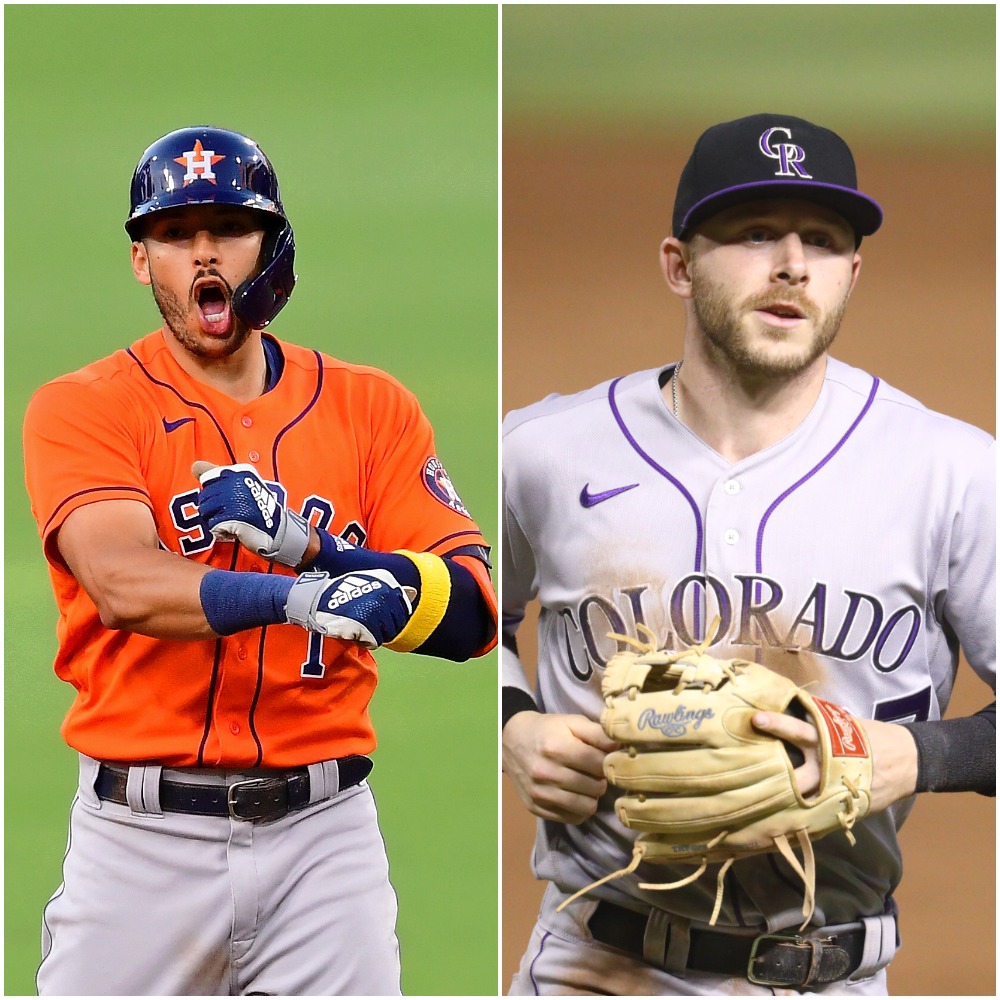
Some points of comparison:
Age on Opening Day 2022
- Correa: 27.54 years
- Story: 29.39 years
- Difference: 1.85 years
Age is a crucial factor in free agent contract length, as teams want to avoid as many decline years as possible. Capturing a player’s age 27 season in free agency is a rare thing. In the cases of Bryce Harper (13 years), Manny Machado (10 years), and Jason Heyward (eight years), teams were actually able to capture age 26. There are not any other recent cases of free agent deals that included age 26 or 27.
Machado signed for ten years and $300MM, while the Mets recently extended Francisco Lindor for ten years and $341MM, albeit with deferred money. The players were paid through age 35 and 37, respectively. A contract running through age 37, as Lindor’s does, is pretty rare. I think teams will be looking to commit to Correa and Story through age 35 or 36, at most. Paying through age 35 would mean a nine-year deal for Correa, though that might be a long shot given his inconsistency and injury history. It’d mean a seven-year deal for Story. Those terms would only be available if the players are considered highly desirable after strong 2021 seasons.
Offense
Rest of 2021 Season ZiPs/Steamer projections in wRC+
- Correa: 125 / 118
- Story: 102 / 103
2019 to present wRC+
- Correa: 126
- Story: 117
2018 to present wRC+
- Correa: 115
- Story: 121
2018 was Story’s best year (128 wRC+) and one of Correa’s worst (101), so whether you include it makes a big difference. But it’s pretty clear that Correa has a higher ceiling, with marks of 136 in 2015, 152 in 2017, and 143 in 2019. As we’ll discuss later, Correa was quite clearly affected after returning from a back injury in 2018, so I think the “2019 to present” numbers are a better reflection of his true ability.
Why use wRC+? It’s park-adjusted, so it neutralizes the fact that Story has played 50.7% of his games in Coors Field. If you cite straight-up numbers with no adjustment, you’d clearly prefer Story. I think any MLB team interested in Story would attempt to neutralize the effects of Coors, though. It is not as simple as looking at Story’s work on the road and assuming that’s how he’d play for a new team in a neutral ballpark. But since 2018, Story does have a huge split: a 136 wRC+ at home, and 105 on the road. In terms of triple slash, Story is at .266/.327/.450 on the road since 2018, and .316/.379/.642 at home.
Story may follow the path of Matt Holliday. From 2005-07, Holliday posted an even more extreme 166 at home and 108 on the road. He was not a 108 wRC+ hitter after leaving Coors, however, putting up an excellent 145 mark from 2008-13, mostly for the Cardinals. Holliday was able to spend all of his 2009 contract year away from Coors, posting a 141 wRC+ for the A’s and Cardinals that likely helped him land the largest contract of the 2009-10 offseason. DJ LeMahieu is another example of a former Rockie who continued to hit well after posting extreme splits.
In the likely event Story is traded this summer, he’ll have a chance to demonstrate his standard 120 wRC+ production in a more neutral environment for a few months. That’s more likely than a Correa trade, and being free of a qualifying offer would be an advantage for Story.
It makes little sense to remove park factors, when Minute Maid Park has suppressed offense (outside of 2019) while Coors Field has inflated it by a minimum of 12% during Story’s career. But for comparison, Correa has hit .276/.352/.483 since 2017 and .258/.334/.453 since 2018. Story stands at .278/.342/.524 since 2017 and .291/.353/.547 since 2018. Story has reached the 35 home run mark twice, while Correa’s career-best is 24.
As for Correa, what about the sign-stealing scandal? According to MLB’s report, the bulk of the Astros’ sign-stealing efforts were in 2017, in which Correa put up a career-best 152 wRC+. He was excellent both at home and on the road, though the scheme is only thought to have occurred at the Astros’ home park. MLB’s report suggested the Astros did not utilize trash-can banging in 2018, when Correa dropped down to 101. That 101 mark may be explained by a back injury, which I’ll get into later. The Astros also weren’t thought to be cheating in 2019, but Correa bounced back to a 143 mark.
Astros fan Tony Adams analyzed home data for the Astros from 2017, and found 140 total trash can bangs for George Springer and 97 for Correa. If potential free agent suitors consider Springer and Correa equally complicit in the sign-stealing, it would bode well for Correa, since the scandal didn’t seem to have much effect on Springer’s market. Ultimately, like Springer, Correa just needs to go out and have a big contract year if he wants to get paid. There’s a solid argument that in a neutral ballpark, he’s a better hitter than Story.
Defense
By measure of UZR/150, Story is at 3.9 since 2018, while Correa sits at -3.5. Story also leads in Defensive Runs Saved (DRS), though that’s a cumulative stat and he played an additional 1,042 innings in the field – 47% more than Correa did. Outs Above Average, which is part of Statcast, is more sophisticated than UZR or DRS, but doesn’t necessarily tell a clear story. Here’s each player’s OAA by year:
- 2016: Story 4 (823 innings), Correa -17 (1355.6 innings)
- 2017: Story 7 (1185.3 innings), Correa -3 (946 innings)
- 2018: Story -5 (1372.6 innings), Correa 17 (959 innings)
- 2019: Story 18 (1257.3 innings), Correa 9 (642.3 innings)
- 2020: Story 2 (491.3 innings), Correa 3 (475 innings)
It would appear that Story’s defense slipped to a below-average level in only one season, 2018, on which OAA and UZR/150 agree. There’s no clear injury in 2018 to explain the lapse, though he miss a few late September games with elbow soreness. Story was able to improve his range and reduce his errors in 2019, and seems to have settled in as an above-average defender.
We’ll talk about durability in the next section, but with Correa we have a player who has tallied 1,000 innings in the field exactly once, in his 2016 sophomore season. UZR suggested he was a bit below average that year, while OAA had him as the game’s worst defensive shortstop.
2018 is particularly odd for Correa, where OAA shows him as the game’s fourth-best defensive shortstop while UZR/150 has him as the fourth-worst. That was a year in which Correa avoided the IL until late June, at which point he missed over a month due to a back injury. He acknowledged that the injury played a role in his plummeting offense, and his OAA was lower after the injury. MLB.com’s Mike Petriello suggested to me that the Astros’ frequent shifting, and UZR’s lack of accounting for that, might account for the difference between the two stats.
Correa suffered another major injury toward the end of May 2019 – a cracked rib that cost him two months – as well as more back pain in late August of that year. Nonetheless, his defense doesn’t seem to have suffered.
Both Story and Correa have been above average defenders since 2019, ranking fourth and ninth respectively in OAA. Story is carried largely by his 2019 season, for which he was voted a Gold Glove finalist for the first time. Though he has dropped off so far this year, Story has often ranked among the top 40 in the game in terms of sprint speed, which is a factor in his defense. I think it’s safe to say that Story is the superior defender. It’s worth noting that Correa has already expressed a willingness to move to third base if needed, while the topic hasn’t really been broached for Story.
Durability
Story was drafted 45th overall by the Rockies out of high school in 2011. As a minor leaguer in 2014, he missed roughly a month due to hairline fracture on his left pinky finger. The Rockies traded longtime shortstop Troy Tulowitzki in July 2015, taking on Jose Reyes in the process. In 2016, Reyes was suspended through May to begin the year under the league’s domestic violence policy, opening the door for Story to make the team out of camp. After becoming the Rockies’ starter in 2016, Story’s season ended on July 30th due to a torn UCL in his left thumb that would require surgery. It was still good for a fourth-place Rookie of the Year finish.
A new injury popped up in May 2017, as Story strained his left shoulder and missed the minimum two weeks. In late September 2018, Story exited a game with right elbow soreness, but he missed only five games. In June of 2019, Story injured his right thumb after a headfirst slide, with the resulting IL stint costing him 11 games.
That’s the full extent of Story’s injury history in his five-plus years. He’s played in 522 games since 2017, 14th in all of MLB. Story was able to recover quickly from minor injuries in 2017, ’18, and ’19, and can safely be penciled in for 145-150 games annually.
Correa was drafted first overall by the Astros out of high school in 2012. He dealt with only minor injuries in the minor leagues until June 2014, when he suffered a fractured right fibula sliding into third base and had to undergo surgery. By January 2015, his ankle was back to 100%.
Correa opened the 2015 season at Double-A, a defensible choice since he’d yet to play at that level. He reached Triple-A by May and went on to make his big league debut on June 8th. The timing worked out well for the Astros to receive part of a seventh year of control of Correa and also avoid Super Two status, but his starting the year in the minors was justified. Correa played 99 dynamic regular season games in 2016, avoiding injury and winning the Rookie of the Year award.
2016, just Correa’s age 21 season, was perhaps the best of his career. He missed three games in June with an ankle sprain and another four with shoulder inflammation, but avoided the IL. Correa would play 153 games in the regular season that year, the only time he’s exceeded 110 Major League games in a season.
Correa’s injury history is significant, but also limited to the three-year period of 2017-19. On July 17th, 2017, according to MLB.com’s Brian McTaggart, “Correa left Monday’s 9-7 loss to the Mariners in the fourth inning after injuring the thumb on a swing, the same thumb he originally hurt sliding head-first into home July 4 in Atlanta.” The torn thumb ligament required surgery and cost him more than six weeks. He returned successfully in September of that year.
Correa’s next IL stint was in June of 2018 due to a back injury. Like the thumb the prior year, this injury cost him about a month and a half. Though he returned in mid-August, the issue lingered and affected his performance for the rest of the season. From 2015-19, 2018 is Correa’s only season with a wRC+ below 123, and it’s easy to attribute his overall 101 mark that year to his back injury. Correa had a 128 wRC+ before the injury, and just a 45 mark thereafter.
Correa’s back healed up and he started yoga in the 2018-19 offseason, but a cracked rib suffered in late May 2019 cost him a full two months. Oddly, Correa said the rib was cracked by what must have been a particularly aggressive massage. After he’d been back for about a month, he went on the IL again due to a back injury. Since then, Correa has avoided the IL, playing in 58 of 60 games in 2020.
Both Story and Correa have been starters since 2016. Story has played in 619 games – 19% more than Correa’s 520. Is Correa, who has yet to reach his 27th birthday, simply an injury-prone player? Or might he settle in at 150 games per year if he avoids headfirst slides and rough massages? If I was looking at signing him, it’s his back that I’d be concerned about, as it cost him roughly two and a half months during the 2018-19 seasons. 150 games this year would go a long way.
Overall Value
Much of Correa’s value is packed into the earlier years of his career, when he put up 13.7 WAR in 361 games from 2015-17. He’s managed only 6.1 WAR since, roughly the same as what Story did in 2019 alone. Career-wise, Correa leads Story 19.8 to 17.9.
From 2018 to present, Correa has been good for 3.7 WAR per 650 plate appearances, while Story is at 5.4. From 2019 to present, those numbers are 4.7 for Correa and 5.5 for Story. But here’s how each player projects for the rest of the season per 650 PA, according to FanGraphs:
- Correa ZiPS: 5.0
- Correa Steamer: 4.1
- Story ZiPS: 3.5
- Story Steamer: 2.9
If you buy those projections, Correa will be the better per-game player moving forward, likely due to the age difference. Aside from the durability question, that is what MLB teams must determine when offering these players contracts: who will be better over the next seven years or so?
With that lengthy comparison of Carlos Correa and Trevor Story, I turn it over to you.
Who will sign for more total dollars?
-
Carlos Correa 53% (2,545)
-
Trevor Story 47% (2,235)
Total votes: 4,780
Who will sign for a higher average annual value?
-
Trevor Story 56% (2,480)
-
Carlos Correa 44% (1,961)
Total votes: 4,441
Who will be the better player over the next seven years?
-
Trevor Story 63% (2,879)
-
Carlos Correa 37% (1,684)
Total votes: 4,563
Offseason In Review: San Diego Padres
The Padres finally put themselves back on the map in 2020. Emboldened by last year’s success, president of baseball operations A.J. Preller spent the winter attempting to assemble a championship-caliber roster. Preller had plenty of money to play with, evidenced by the Padres’ franchise-record $174MM Opening Day payroll.
Major League Signings
- Ha-Seong Kim, INF: Four years, $28MM (mutual option for 2025)
- Jurickson Profar, INF/OF: Three years, $21MM
- Mark Melancon, RHP: One year, $3MM ($5MM mutual option or $1MM buyout for 2022)
- Keone Kela, RHP: One year, $1.2MM
- Brian O’Grady, INF/OF: One year, $650K (split contract)
- Total spend: $54.05MM
Trades And Claims
- Acquired LHP Blake Snell from the Rays for RHPs Luis Patino and Cole Wilcox, C Francisco Mejia and C/1B Blake Hunt
- Acquired RHP Yu Darvish and C Victor Caratini from the Cubs for RHP Zach Davies, INFs Reginald Preciado and Yeison Santana, and OFs Owen Caissie and Ismael Mena
- Acquired RHP Joe Musgrove from Pirates in three-team trade for OF Hudson Head, LHPs Joey Lucchesi and Omar Cruz, and RHPs Drake Fellows and David Bednar
- Acquired LHP James Reeves from the Yankees for OF Greg Allen
- Claimed RHP Jordan Humphreys from the Giants
Notable Minor League Signings
- Nabil Crismatt, Patrick Kivlehan, Parker Markel, Jacob Rhame, Nick Burdi, Nick Ramirez, Wynston Sawyer
Extensions
- Fernando Tatis Jr., SS: 14 years, $340MM
- Mike Clevinger, RHP: Two years, $11.5MM
Notable Losses
- Patino, Mejia, Lucchesi, Trevor Rosenthal, Garrett Richards, Jason Castro, Kirby Yates, Mitch Moreland, Luis Perdomo, Greg Garcia
At 37-23, the Padres finished with the majors’ third-best record last season, but that still left them six games behind the Dodgers – their NL West rival and the reigning World Series champions. With that in mind, Preller and his front office cohorts used the past few months seemingly leaving no stone unturned in an effort to overthrow the Dodgers, who have ruled the division for eight consecutive seasons. The Padres showed interest in a variety of household names both in free agency and trades, and they were successful in reeling in a few big fish.
The always aggressive Preller’s main headline-grabbing acquisitions addressed the Padres’ rotation, which was terrific last year. However, the Padres saw a couple of their top starters – Dinelson Lamet and Mike Clevinger – go down with injuries late in the season, while Garrett Richards then exited in free agency. Lamet hasn’t yet returned from the elbow issues that ended his season in September, though he doesn’t seem far away from his 2021 debut. On the other hand, the Padres learned in November that Clevinger, who was a blockbuster in-season pickup, required Tommy John surgery. He’s not going to pitch at all in the current campaign, but that didn’t stop the Padres from signing Clevinger to a two-year, back-loaded deal with the hope that he’ll factor in come 2022.
In the wake of the Clevinger news, the Padres went to work in a major way. They showed interest ranging from mild to serious in free agents such as Trevor Bauer, Masahiro Tanaka, Tomoyuki Sugano, Adam Wainwright, Kohei Arihara and Martin Perez. Trade targets included Sonny Gray and Lance Lynn, though the Padres instead landed three other high-profile starters via that route.
The first domino to fall for San Diego was the acquisition of former AL Cy Young winner Blake Snell from the Rays. Snell has three years and $39MM of control left, so as you’d expect, the Rays didn’t give him away for cheap. Rather, the package headed to Tampa Bay centered on 21-year-old righty Luis Patino, who ranks among the premier prospects in the sport. The Padres also had to surrender two other quality prospects – righty Cole Wilcox and catcher/first baseman Blake Hunt – as well as a once-heralded farmhand in Francisco Mejia. Acquired from the Indians in the teams’ Brad Hand trade in 2018, Mejia was never able to establish himself with the Padres at catcher, nor did his offense come close to matching the hype.
The Snell swap wasn’t the only late-December present for the Padres or their fans. Shortly after swinging the trade with Tampa Bay, Preller & Co. pried 2020 NL Cy Young finalist Yu Darvish and catcher Victor Caratini from the Cubs. It didn’t cost the Padres nearly as much this time, in part because they ate all but $3MM on the $62MM Darvish is owed over the next three years. The Padres did have to give up one of their best 2020 starters, Zach Davies, but he’ll be a free agent next offseason. Plus, it’s hard not to view Darvish as a clear upgrade over Davies. Along with Davies, San Diego parted with four prospects – shortstops Reginald Preciado and Yeison Santana and outfielders Owen Caissie and Ismael Mena – but all of those players are at least a few years from the majors. That’s if they make it at all.
The addition of Caratini came as welcome news for Darvish, as the former is his personal catcher. Caratini played second fiddle to Willson Contreras in Chicago, but he has typically blended passable offense for his position with well-graded defense. Once Austin Nola returns from a fractured finger, he and Caratini should give the Padres a solid one-two behind the plate with Luis Campusano also in the mix.
No one would have blamed the Padres had they stopped at Snell and Darvish, but they decided there was more to accomplish. Just a few weeks after scooping up those two, the Padres executed yet another eyebrow-raising trade, this time hauling in righty Joe Musgrove from the Pirates. While Musgrove doesn’t carry a Snell- or Darvish-like track record, he did give the Pirates useful mid-rotation production for multiple seasons. Now back in his native San Diego, Musgrove has thrived, having already thrown the first no-hitter in franchise history. He has also yielded just one earned run in his first 19 innings in a Padres uniform.
To pick up Musgrove’s two affordable remaining years of team control, the Padres again sent away a bunch of non-elite prospects (Hudson Head, Drake Fellows, David Bednar and Omar Cruz). The only major leaguer they said goodbye to was Joey Lucchesi, whom the Mets acquired in the three-team deal. Like going from Davies to Darvish, Musgrove gives the Padres an obvious improvement over Lucchesi.
All said, the Padres acquired two front-line starters and another who may be turning into one while moving only a single star prospect (Patino). So, even in spite of dumping double-digit prospects in these deals, the Padres’ farm system is still pretty loaded. In fact, according to MLB.com, it’s the game’s sixth-best system – one that still boasts four top-100 players in lefty MacKenzie Gore (No. 6), shortstop CJ Abrams (No. 8), Campusano (No. 45) and outfielder Robert Hassell III (No. 62).
Along with finding outside starting pitching, taking care of key inside business was among the primary items on the Padres’ offseason checklist. They and the face of their franchise, 22-year-old shortstop Fernando Tatis Jr., made it clear entering the winter that they wanted to hammer out a contract extension. Tatis wasn’t on track to reach arbitration until after 2022 or become a free agent until the end of the 2024 season, but the Padres weren’t going take a chance on losing him in his mid-20s. Instead, in late February, they succeeded in locking up Tatis into his mid-30s.
The agreement with Tatis is historic – a 14-year, $340MM pact that shattered Mike Trout‘s previous record guarantee of $144MM for a pre-arb player. It’s also the second $300MM-plus contract the Padres have doled out over the past couple years, as they previously signed third baseman Manny Machado to a decade-long deal in free agency. The club now has the left side of its infield under wraps with two superstar-caliber players for the foreseeable future.
The rotation improvements and the Tatis extension represented the offseason heavy lifting for the Padres, but they were active in other areas. Most notably, they signed former Korea Baseball Organization standout Ha-Seong Kim to a four-year, $28MM guarantee with a $5.5MM posting fee paid to the Kiwoom Heroes. Kim isn’t an upgrade over Tatis, Machado or second baseman Jake Cronenworth, but the team felt it was a worthwhile risk to spend on a versatile 25-year-old whom many regard as a top-1o0 prospect.
The Kim signing wasn’t the last of the Padres’ depth-bolstering moves in free agency. A few weeks after they won the Kim sweepstakes, the Padres re-upped Jurickson Profar on a three-year, $21MM guarantee. The contract includes a pair of opt-outs, so if Profar plays well enough this year or next, he could elect to return to free agency. For at least another year, though, he’ll continue to give the Padres someone who can play multiple positions and offer league-average or slightly better offense at a reasonable annual cost. Profar’s fourth on the Padres in plate appearances this year, and he has already lined up at four spots (first, second and both corner outfield positions).
The bullpen was also a matter of some offseason importance for the Padres, who faced the losses of relievers Trevor Rosenthal and Kirby Yates in free agency. San Diego showed interest in bringing both back, but they departed for higher paydays elsewhere. The Padres seem to have dodged bullets in both cases, as Rosenthal underwent thoracic outlet surgery earlier this month and Yates had a Tommy John procedure in March.
Rosenthal and Yates signed for a combined $16.5MM in guarantees, but the Padres spent far less on their relief corps, inking Mark Melancon and Keone Kela for a total of $4.2MM. It’s early, but the always steady Melancon has been a bargain for the Padres so far. He’s 5-for-5 in save opportunities and hasn’t allowed a walk or a run in six innings of one-hit ball. Likewise, Kela has been flawless in the runs allowed department, having surrendered none in 5 2/3 frames. The hard-throwing Kela had an impressive three-year stretch of run prevention and strikeouts with the Rangers and Pirates from 2017-19, but a positive COVID-19 test and forearm troubles held him to two innings last season. If healthy, though, he also has a chance to end up as a steal for San Diego. So far, so good.
Although it’s only mid-April, the Padres look as if they’re going to be a force again this year, thanks in no small part to Preller’s offseason moves. So impressed with his work, Padres ownership decided in February to upgrade Preller’s title from general manager to president of baseball ops and extend him through 2026. It appears the Padres are in capable hands with Preller at the helm, but how would you grade their offseason?
(Poll link for app users)
Grade the Padres' offseason
-
A 84% (2,088)
-
B 12% (290)
-
F 2% (62)
-
C 2% (45)
-
D 1% (14)
Total votes: 2,499
Offseason In Review: Tampa Bay Rays
Tampa Bay remodeled its pitching staff as the team prepares to defend its American League pennant.
Major League Signings
- Chris Archer, SP: One year, $6.5MM
- Mike Zunino, C: One year, $3MM (includes $1MM buyout of $4MM club option for 2022)
- Michael Wacha, SP: One year, $3MM
- Rich Hill, SP: One year, $2.5MM
- Collin McHugh, RP: One year, $1.8MM
- Chaz Roe, RP: One year, $1.15MM
- Oliver Drake, RP: One year, $775K
- Total spend: $18.725MM
Trades & Claims
- Acquired SP Luis Patino, C Francisco Mejia, C/1B Blake Hunt, and SP Cole Wilcox from the Padres for SP Blake Snell
- Acquired C/1B/OF Heriberto Hernandez, IF Osleivis Basabe and 1B/OF Alexander Ovalles from the Rangers for 1B/3B Nate Lowe, 1B Jake Guenther, and OF Carl Chester
- Acquired 1B Dillon Paulson and cash considerations/player to be named later from the Dodgers as part of a three-team trade with the Phillies. (Phillies acquired RP Jose Alvarado, Dodgers acquired RP Garrett Cleavinger)
- Acquired SP Chris Mazza and RP Jeffrey Springs from the Red Sox for C Ronaldo Hernandez and IF Nick Sogard
- Acquired 1B Evan Edwards from the Marlins for RP John Curtiss
- Acquired cash considerations/player to be named later from the Angels for RP Aaron Slegers
Notable Minor League Signings
- Andrew Kittredge, Hunter Strickland, Yacksel Rios, David Hess, Kevan Smith, Brian Moran, Joseph Odom, Joey Krehbiel, Chris Ellis, Stetson Allie
Extensions
- None
Notable Losses
- Blake Snell, Charlie Morton, Hunter Renfroe, Aaron Loup, Michael Perez, Edgar Garcia, Nate Lowe, Jose Alvarado, John Curtiss, Aaron Slegers
The Rays began their offseason by, as usual, trimming payroll. Declining club options on Charlie Morton and Mike Zunino removed $19.5MM in potential expenditures off the team’s books, though in Zunino’s case, the two sides only temporarily parted ways. Zunino re-signed with the team for $3MM in guaranteed money, plus another $3MM more in total earnings if the Rays choose to exercise another club option on the catcher for 2022.
In short, the Zunino situation saved the team $1.5MM, and they ended up retaining a player they clearly value as a defender. Zunino has yet to show much of anything at the plate as he enters his third season in Tampa, though as we’ll explore later, Zunino wasn’t the only move the Rays made to address their seemingly neverending quest for catching help.
Declining Morton’s option was a bigger call for the Rays, given how the veteran performed over his two seasons with the club. Yet, as always, general manager Erik Neander and his front office looked to maximize the Rays’ value on what (little) they had available to spend. Exercising Morton’s club option would have cost the Rays $15MM, whereas signing three starters and three relievers (Chris Archer, Rich Hill, Michael Wacha, Collin McHugh, Chaz Roe, Oliver Drake) ended up costing the team a combined $15.725MM. Heading into a season where pitching depth may be more important than ever, the Rays managed to get six free agent arms for the price of one pitcher entering his age-37 season.
This is standard operating practice for the Rays, even when the team is reloading for what they hope will be a return trip to the World Series. Not many pennant winners head into the next season having parted ways with two top-of-the-rotation starters, yet that’s exactly what Tampa Bay did in saying goodbye to Morton and in trading Blake Snell to the Padres.
The Snell trade was one of the offseason’s biggest moves for any team, and there was obviously a financial component. Snell is owed $39MM over the 2021-23 seasons, so the Rays again cleared some money. For moving a former Cy Young Award winner with three years of control, the Rays picked up a four-player package that they believe can help them in the coming years and as early as the 2021 season.
Luis Patino, one of the sport’s top pitching prospects, is expected to be called up at some point during the year to add yet another arm to the Rays’ rotation mix. Francisco Mejia is serving as Zunino’s backup and, should Mejia start to show any of his past top-prospect potential, could end up supplanting Zunino in 2021 and onward as the Rays’ regular catcher. Right-hander Cole Wilcox and catcher Blake Hunt are longer-term pieces that could prove useful down the road and give the Rays a pair of recent early draftees with high ceilings to bolster a perennially strong farm.
Time will tell if the Rays made the correct move in trading Snell when they did, and it could be that the deal only occurred because San Diego was the only team willing (or able, given the Padres’ deep farm system) to meet Tampa Bay’s big asking price. It probably also didn’t hurt that the Rays already had a lot of familiarity with the Padres’ prospects given how the two teams have been frequent trade partners in recent years.
With Morton and Snell gone, Tyler Glasnow and Ryan Yarbrough are the provisional top two starters in the Tampa rotation, with Hill, Archer, and Wacha all signed to one-year contracts to round out the starting five. That initial rotation has already hit a snag since Archer is on the injured list with right lateral forearm tightness, though Archer isn’t expected to miss much time.
Josh Fleming has stepped into the rotation in Archer’s place, providing the first glimpse of the second layer of the Rays’ pitching depth. Fleming, swingman McHugh, Patino, Trevor Richards, Shane McClanahan, and Brent Honeywell Jr. could all end up getting regular starts as the season progresses, or at least handle bulk-pitcher duties behind an opener.
Pitching was very much at the forefront of the Rays’ winter plans, as the team reportedly had interest in such names as Martin Perez, Mike Foltynewicz, Julio Teheran, and Anibal Sanchez. Tampa Bay also made strong bids to sign Corey Kluber and acquire Jameson Taillon from the Pirates, though both Kluber and Taillon ended up on the division-rival Yankees.
While there was risk involved in all of those pitchers on the Rays’ target list, they also ended up rolling the dice on the pitchers they did acquire. Archer missed all of 2020 due to thoracic outlet syndrome surgery and hasn’t pitched well essentially since the moment Tampa dealt the right-hander to Pittsburgh at the July 2018 trade deadline. As fun as it would be (well, for everyone besides Pirates fans) to see Archer reignite his career with his former team, it is still very unclear if the righty can be a notable contributor.
The same can be said of Wacha, as injuries and an increasingly large home run rate have drastically worsened the right-hander’s results in the years since his All-Star peak with the Cardinals. Thanks to his increased velocity and strong swinging-strike numbers, however, Wacha did draw some interest from around the league despite some pretty miserable bottom-line numbers (6.62 ERA) over 34 innings with the Mets in 2020.
Hill is a different story, as the southpaw has continued to pitch effectively even as he enters his age-41 season. Since the start of the 2017 campaign, Hill and Morton have very similar numbers — except Hill has only tossed 375 2/3 innings to Morton’s 563 1/3 innings. Since Hill has proven he can deliver front-of-the-rotation production when healthy, the Rays will be particularly careful with his usage to keep him fresh for what they hope will be some important innings come October.
The bullpen also saw quite a bit of turnover, as McHugh and minor league signing Hunter Strickland were added in free agency, and the duo of Chris Mazza and Jeffrey Springs were acquired in an inter-division trade with the Red Sox. Drake, Roe, and Andrew Kittredge were re-signed to new contracts, while Jose Alvarado, Aaron Loup, Aaron Slegers, and John Curtiss were all shuffled out of the relief corps.
Bullpen reorganization is a Rays staple, and the team will need as much depth as it can find from the farm system due to a number of early injuries. Roe (shoulder strain) and Nick Anderson (partial elbow ligament tear) will be out until at least July, while Drake was re-signed with the knowledge that he’d also be out until around midseason due to a forearm problem. Right-hander Pete Fairbanks is also sidelined until May due to a rotator cuff strain.
Given all these injuries, it isn’t surprising that the Rays are at or near the bottom of several team bullpen categories, but this is a problem that needs to be quickly solved considering how quality relief pitching has been a cornerstone of the Rays’ success. If the bullpen is struggling, it puts even more pressure on the starters to not just post quality innings, but to eat innings altogether, which is doesn’t fit the Rays’ usual pitching strategy.
With so much offseason focus on the rotation and bullpen, Tampa Bay did very little with its group of position players. Besides re-signing Zunino and adding Mejia, the Rays are more or less running it back with the 2020 group intact. This isn’t to say that the team didn’t at least check into some notable acquisitions, as the Rays were linked to Kolten Wong, Yoenis Cespedes, and even Marcell Ozuna at different points in the offseason (though according to reports, Ozuna would have only been a realistic addition if he had been willing to accept a one-year contract).
Hunter Renfroe was let go in free agency, and the only other notable subtraction from the position player mix was Nate Lowe, who was traded to the Rangers as part of a six-player deal. Since the Rays also picked up a couple of other first base prospects in Evan Edwards and Dillon Paulson over the winter, Tampa Bay might have felt it had the depth to part with Lowe, especially since the first base picture on the big league roster was also pretty crowded.
Two weeks into the season, however, Lowe is off to a pretty solid start — .245/.327/.510 with four home runs in 55 plate appearances. Not earth-shattering numbers, though they do stand out considering that Ji-Man Choi is injured and Yoshi Tsutsugo and Mike Brosseau are both in season-opening slumps. Lowe was even an above-average hitter (106 wRC+, 109 OPS+) over 245 PA with Tampa in 2019-20, but the Rays never seemed particularly enamored with the idea of giving him an extended look at first base.
While the Rays haven’t gotten off to a good start as a whole in 2021, it’s obviously way too early to write off a team that has made a habit of overachieving. The Rays’ habit of finding hidden gems in trades or low-level waiver pickups also makes it somewhat difficult to evaluate their moves in the moment. Who would’ve thought that postseason hero Randy Arozarena would end up as the headline acquisition of the 2019-20 offseason, for instance? More pivots and roster alterations are certainly likely to occur over the course of the season, as Tampa Bay is perpetually looking to both build and rebuild even while vying for a playoff berth.
How would you grade the Rays’ offseason? (Poll link for app users)
Grade the Rays' offseason
-
C 39% (784)
-
B 31% (620)
-
D 17% (340)
-
A 7% (136)
-
F 6% (126)
Total votes: 2,006
2020 Rule 5 Draft Update
An abnormal number of picks from the 2020 Rule 5 Draft survived Spring Training and made the Opening Day rosters with their new clubs. The Orioles and Marlins both broke camp with a pair of Rule 5 picks on the active roster, while the Pirates opened the season with one Rule 5 pick on the roster and one on the injured list. Most clubs that are carrying a Rule 5 pick, unsurprisingly, have little in the way of postseason aspirations. There are a few October hopefuls among those still clinging to Rule 5 picks, however, and it’ll take some uncharacteristically strong Rule 5 showings for those players to survive the season.
We’ll take a look at how the surviving Rule 5 draftees are faring periodically throughout the year. Here’s the first glance…
Currently in the Majors
- Brett de Geus, RHP, Rangers (via Dodgers): Injuries throughout the Rangers’ bullpen might have helped the 23-year-old de Geus crack the Opening Day roster in Texas. He’s out to a shaky start, having walked three batters and hit another three against just two strikeouts through his first 5 2/3 innings. On the plus side, 13 of the 15 balls put into play against him have been grounders.
- Akil Baddoo, OF, Tigers (via Twins): Baddoo is one of the best stories (maybe the best) of the young 2021 season. The 22-year-old homered on his first swing in the big leagues as his family rejoiced in the stands, and in less than two weeks’ time he’s added a grand slam, a walk-off single (against his former organization) a 450-foot dinger off Zack Greinke and a fourth homer. Baddoo has a ludicrous 1.342 OPS through his first 29 plate appearances in the Majors, and while he obviously won’t sustain that, he’s forcing a legitimate audition in the Detroit outfield. Baddoo missed nearly all of 2019 due to Tommy John surgery and didn’t play in 2020. Despite that layoff and the fact that he’d never played above A-ball, the Tigers called his name in December. It may have seemed like a stretch at the time, but it doesn’t look that way now.
- Garrett Whitlock, RHP, Red Sox (via Yankees): The Sox would surely love for Whitlock to stick, having plucked him from their archrivals in New York. So far, so good. Better than good, in fact. Through 6 1/3 scoreless innings, Whitlock has yielded three hits and punched out nine batters without issuing a walk. He’s sitting 95.6 mph with his heater and has posted a hefty 16.9 percent swinging-strike rate. Whitlock also had Tommy John surgery in 2019, so even though he’s previously been a starter, it makes sense to monitor his workload ease him into the mix as the Sox hope to get through the year with him in the ‘pen.
- Tyler Wells, RHP, Orioles (via Twins): Wells has allowed a pair of homers and surrendered three total runs on four hits and two walks with five strikeouts in 5 2/3 frames. The O’s aren’t trying to win in 2021, but their bullpen also has four arms that can’t be optioned (Cesar Valdez, Shawn Armstrong, Adam Plutko, Wade LeBlanc). Keeping both Wells and Mac Sceroler (currently on the IL) brings them to six and will hamper their flexibility.
- Zach Pop and Paul Campbell, RHPs, Marlins (via Orioles and Rays): Pop was technically the D-backs’ pick in the Rule 5, but Arizona immediately flipped him to the Marlins for a PTBNL. The 24-year-old didn’t allow an earned run in five spring frames but as I was finishing this post, he served up a three-run homer, bringing his season line to seven runs on three hits, three walks and two hit batters in 3 1/3 innings. Campbell has struggled to a similar extent. He’s surrendered five runs (three earned) and given up four hits and three walks in just 2 2/3 innings. With the Marlins out of tank mode, it’ll be tough to carry both all year.
- Jordan Sheffield, RHP, Rockies (via Dodgers): Sheffield was the No. 36 overall pick in the 2016 Draft, but control issues prevented him from being protected on the Dodgers’ 40-man roster. FanGraphs’ Eric Longenhagen gives Sheffield three plus pitches in his scouting report (fastball, curveball, changeup) but also pegs his command at a 30 on the 20-80 scale. Sheffield has walked or plunked 15 percent of the hitters he faced in the minors. He’s yet to walk anyone 13 batters he’s faced with the Rockies, but he did hit one and has also tossed a pair of wild pitches. That said, he’s also sitting 95.5 mph with his heater and is unscored upon in 3 2/3 frames.
- Luis Oviedo, RHP, Pirates (via Indians): Oviedo was the Mets’ pick at No. 10, but they had a deal worked out to flip him to the Pirates in exchange for cash. Oviedo has been hammered for six runs on six hits (two homers) and two walks with five strikeouts through 4 2/3 innings so far. Even pitching for a tanking club, Oviedo will need to show some improvement in order to stick on the roster all season.
- Will Vest, RHP, Mariners (via Tigers): The Mariners kept last year’s Rule 5 pick Yohan Ramirez for the whole season, but it’ll be tougher to do with a full schedule in 2021. The Mariners’ young core is also beginning to rise to the big leagues, and Vest will need to fend off some intriguing young arms. He’s done a decent job so far, allowing a pair of runs (one unearned) on five hits and four walks with five strikeouts in 7 1/3 innings.
- Trevor Stephan, RHP, Indians (via Yankees): Stephan whiffed 16 of 44 hitters this spring to earn a spot on the Indians’ Opening Day roster, but he’s allowed four runs in his first four MLB frames. The 25-year-old has surrendered five hits (including a homer), walked a pair and hit a batter so far while facing a total of 21 hitters.
- Ka’ai Tom, OF, Athletics (via Indians): Tom, 26, raked at a .310/.412/.552 pace with a homer, two doubles and a triple in 34 spring plate appearances. After that strong audition, however, he’s just 1-for-16 with six strikeouts through his first 16 trips to the plate with the A’s.
On the Major League injured list
- Jose Soriano, RHP, Pirates (via Angels): It wasn’t a surprise to see Soriano open the year on the injured list. He’s still recovering from Tommy John surgery performed in Feb. 2020 and didn’t pitch in a game with the Pirates this spring. He’ll be sidelined for at least the first two months, as the Bucs put him on the 60-day IL to open a 40-man roster spot when they signed Tyler Anderson. Soriano hasn’t pitched above A-ball, but the Pirates aren’t exactly a win-now club, so they can afford to stash him as a seldom-used bullpen piece in order to secure his rights beyond the 2021 season.
- Mac Sceroler, RHP, Orioles (via Reds): Sceroler fanned six hitters in 3 2/3 innings early in the season but also yielded three runs on five hits (two homers), three walks and a hit batter. The Orioles recently placed him on the 10-day injured list due to tendinitis in his right shoulder, although it’s not expected to be too lengthy an absence.
- Dedniel Nunez, RHP, Giants (via Mets): Nunez was hit hard in the Cactus League, surrendering four runs in 3 1/3 innings. He’ll now miss the entire 2021 season after sustaining a UCL tear that required Tommy John surgery this spring. Nunez will spend the season on San Francisco’s 60-day injured list and receive a year of MLB service, but he’ll still be subject to Rule 5 restrictions in 2022 once he’s healthy. He’ll need to spend at least 90 days on the MLB roster before he can be sent to the minors; if he doesn’t last that long, he’ll have to pass through waivers and, if he clears, be offered back to the Mets.
Returned to their original club
- Jose Alberto Rivera, RHP, Angels (via Astros): The Angels didn’t take much of a look at Rivera, returning him to Houston on March 24 after just one inning of official work in Cactus League play.
- Kyle Holder, SS, Reds (via Yankees): The Reds weren’t sure who their shortstop was going to be heading into Spring Training, but they ultimately settled on moving Eugenio Suarez back to that spot, sliding Mike Moustakas back to third base and giving prospect Jonathan India the nod at second base. A strong spring from Holder might have at least given him a bench spot behind that trio, but he hit just .219/.359/.250 in 39 plate appearances. The Reds returned him to the Yankees on March 30.
- Gray Fenter, RHP, Cubs (via Orioles): The Cubs returned Fenter to the Orioles on March 12 after just one spring appearance. He hasn’t pitched above A-ball yet.
- Dany Jimenez, RHP, Athletics (via Blue Jays): The 27-year-old Jimenez was a Rule 5 pick in consecutive offseasons — once by each Bay Area club. The A’s returned him to the Jays on March 15, however, after he yielded four runs (two earned) in three innings of work this spring.