
The Best Fits For Matt Moore, Reynaldo López, Dominic Leone, José Cisnero
Yesterday saw a flurry of players placed on waivers, with the Angels making six players available to other clubs, while the Yankees, White Sox, Mets and Tigers also got in on the act. What those clubs all have in common is that their chances of competing this year are effectively gone, meaning that impending free agents that aren’t qualifying offer candidates have little use to them at this point. Since the trade deadline passed by a month ago, those clubs have no ability to exchange those players for any kind of younger talent, a player to be named later or even cash considerations. But by placing them on waivers, they could perhaps see another team put in a claim and take on the remainder of the salary commitments. For a claiming team, this is perhaps their best way of upgrading their roster after the deadline. As long as the player is acquired prior to September 1, they would be playoff eligible. That’s why all of this is happening now.
Before digging in, let’s clarify the process. This is different than the revocable kind of waivers that existed under the now-defunct August waiver trade system. These waivers are irrevocable, meaning that the players will be gone if any club puts in a claim. But the players have not been designated for assignment nor released. If they are not claimed, they can simply stay on the roster of their current club. Waiver priority will be in reverse order of the standings at the time of the claim and is not league-specific.
MLBTR is breaking it down by position, with this post focusing on the relievers. Let’s start with an overview of who is in that bucket.
_________________________________
Matt Moore, Angels, LHP: $7.55MM salary, approximately $1.3M remaining
Moore, 34, had his ups and downs as a starter but he recently converted to relief work full-time and has been excellent since then. He had a 1.95 ERA with the Rangers last year and is at 2.30 with the Angels this year, coming into today’s action. In both seasons, he struck out more than 27% of opponents. His ground ball rate has fallen from last year, 43.9% to 34.3%, but he’s cut his walk rate from 12.5% to 7.1%. He has the highest salary of this group but has the best numbers and is the only lefty.
Reynaldo López, Angels, RHP: $3.625M salary, approximately $623K remaining
López, 29, was fairly mediocre as a starter but has been much better since his bullpen move, with a 2.76 ERA last year and 3.86 mark this year. He has bumped his strikeout rate this year from last year’s 24.8% rate to 30.7%, though his walk rate also jumped from 4.3% to 12.1%. He’s been the best of the righties on this list and his salary is about half of Moore’s.
Dominic Leone, Angels, RHP: $1.5MM salary, approximately $258K remaining
Leone, 31, has been fairly inconsistent in his career. He has three seasons with an ERA under 2.57 but also three above 6.32. This year, he’s in between at 4.64 while striking out 24% of opponents and walking 10.9%. He’s not having a dominant season but he had a 1.51 ERA as recently as 2021 and has the lightest salary of anyone on this list.
José Cisnero, Tigers, RHP: $2.2875MM salary, approximately $393K remaining
Cisnero, 34, had an incredible 1.08 ERA last year, though with some unsustainable elements in a .242 BABIP and 88.6% strand rate. This year, the wheel of fortune has spun him around the other way, with a .343 BABIP and 66% strand rate. That’s pushed his ERA to 5.36, a huge jump of more than four runs compared to last year. But his FIP, which takes those luck factors into account, went from 3.67 to 4.38. He has a 25.2% strikeout rate and 9% walk rate this year.
_________________________________
Now that we’ve covered the process and the players available, who makes sense to put in a claim? We can start by crossing out all of the non-contending clubs. They have no need to pick up an impending free agent and his salary as they play out the string on a lost season.
Since the waiver order goes from the bottom of the standings towards the top, the fringe contenders will have a greater chance of a successful claim than teams at the top of the standings. Those teams will have to decide whether they want to add some salary to their books in order to obtain a marginal bullpen upgrade for the final month of the season.
The Padres have been on the edges of the playoff race all year but refused to sell off impending free agents like Blake Snell and Josh Hader and even added players like Garrett Cooper and Rich Hill. But they are still 7.5 games back of a Wild Card spot and their playoff odds are dwindling. The financials are also important as both Roster Resource and Cot’s Baseball Contracts have them between the third and fourth CBT threshold. As a third-time payor, that means they are paying a 95% tax on any cash they take on. Given their place in the standings and their financial ledger, it seems like a long shot they would be involved here.
The Red Sox love to cycle through players at the back of their bullpen, frequently making small trades or minor league signings for depth. But they are now 6.5 games back of a playoff spot with the Blue Jays in between. Speaking of the Jays, they are 3.5 games out of a playoff spot but their bullpen is already quite strong. Their relievers have a collective ERA of 3.48, the fourth-best mark in the majors. Rosters expand in a couple of days but they have Chad Green rehabbing and nearing a return from last year’s Tommy John surgery.
The Marlins are three games back of a playoff spot and will certainly be motivated to gain ground, having not made the playoffs in a full season since 2003. Their bullpen has been shaky of late, especially with deadline acquisition David Robertson posting a 7.20 ERA since coming over from the Mets and getting bumped from the closer’s role. Bob Nightengale of USA Today reports that the club is expected to put in a claim on at least one of the Angels’ relievers, though the typically-frugal club might be hesitant to take on some of the larger salaries listed above.
The Braves are last in the waiver priority list and already have one of the best bullpens in the league, making it less likely they will grab someone from this group. The Mariners have enough bullpen depth that they could flip Paul Sewald prior to the deadline and still thrive. The Phillies already have a strong bullpen and are in the second CBT tier and set to be a second-time payor.
As for the clubs that make good sense, there are plenty, as just about any contender could squeeze in a bullpen upgrade from a pure roster construction point of view. The Rangers, Astros, Cubs, Giants, Reds, Diamondbacks, Twins, Brewers, Orioles, Rays and Dodgers are each in postseason position or close to it, with another reliever being a sensible add.
The Rangers were leading their division for much of the year but have recently slid and are now in a cutthroat battle with the Astros and Mariners, with a few recent bullpen meltdowns part of the problem. They are already over the CBT but they have shown plenty of willingness to be aggressive in recent years. The Astros have a strong bullpen but it’s all right-handed, making Moore in particular a logical fit.
The Cubs love to build their bullpen via minor league deals and waiver claims, meaning they are surely intrigued. But Roster Resource and Cot’s have their CBT figure around $228MM, just a bit under the $233MM base threshold. Assuming those estimates are correct, they still have a bit of wiggle room, though those aren’t official. The Giants are one of the most creative clubs at patching together an improvised staff and could fit any of these guys into their budget if they are intrigued.
The Reds have a dynamic position player mix but a flimsy pitching staff that could use any help it can find. The Diamondbacks have a collective bullpen ERA of 4.71 that places them 25th in the majors. They added Sewald at the deadline but there’s room for further upgrades. The Twins’ bullpen is middle-of-the-pack and they are almost a lock for a playoff spot at this point, giving them incentive to further bolster the staff for October. The Brewers have a decent bullpen but have struggled to find second reliable lefty alongside Hoby Milner, which could perhaps lead to them claiming Moore.
The O’s have had a good relief group overall but it’s been a top-heavy unit headlined by Félix Bautista, who now has an injury of some sort to his UCL. The Rays have dealt with a mountain of injuries this year and aren’t shy about cycling through arms in their bullpen throughout the year. The Dodgers have been similarly bit by the injury bug, though these clubs are towards the back of the waiver line and will have to settle for the arms that the others pass on.
The Best Fits For Lucas Giolito
Yesterday’s biggest development was the number of players reportedly on the waiver wire. The Angels, White Sox, Yankees, Mets and Tigers each put impending free agents on irrevocable waivers.
Those clubs are out of contention. The hope is that another team with a path to the playoffs will take what remains of this year’s contract off their hands. It’s particularly meaningful in the Angels’ case, as shedding enough veterans could allow them to limbo back under the luxury tax threshold after their deadline push fell flat.
No other player known to be on waivers has the upside of Lucas Giolito. The right-hander has had a tough time in Orange County, allowing a 6.89 ERA over six starts. Giolito has been the victim of a home run barrage in Southern California, allowing multiple longballs in three of those appearances. Clearly, the past month hasn’t gone as he or the team had envisioned. Yet we’re only four weeks removed from Giolito and reliever Reynaldo López (also now on waivers) fetching two of the Halos’ top prospects in trade. Now, another team could have him for nothing more than the approximate $1.9MM remaining on his arbitration contract.
Giolito isn’t the only starter out there, but he’s by far the most appealing (at least among the players publicly reported to be on waivers). The Mets made Carlos Carrasco available. He has a 6.80 ERA through 20 starts on the season, though. He hasn’t shown much sign of recent progress, allowing 35 runs and a staggering .404/.450/.654 opponents’ batting line in 29 innings since the All-Star Break. It’s hard to imagine him as an upgrade for a contending pitching staff, particularly since there’s still around $2.6MM remaining on his $14MM salary.
Mike Clevinger would be a clearer roster upgrade than Carrasco. He missed a month and a half midway through the year with biceps inflammation. A return one start before the August 1 deadline wasn’t sufficient to drum up trade interest. Clevinger has turned in a solid enough season, though, pitching to a 3.32 ERA over 97 2/3 innings. While his 20.8% strikeout rate and 9.3% walk percentage are each worse than average, it’d be easy enough for a number of hopeful contenders to find room for Clevinger at the back of their rotation — at least from an on-field perspective.
Complicating matters is the structure of the righty’s contract. Clevinger’s $8MM salary isn’t the issue, as most teams could easily accommodate the roughly $1.5MM still to be paid out. Yet there’s also a $4MM buyout on a $12MM mutual option for next season. Clevinger receives the buyout regardless of which side declines the option and is very likely to return to free agency since mutual options are almost never triggered by both sides. A claiming team would have to take on responsibility for the buyout as well — it’s all or nothing for assuming a player’s contract off waivers — so it’d be a nearly $5.5MM investment for a month (and perhaps a playoff run) of Clevinger’s services.
That’s a tough sell for a team. If there were no option buyout, he’d need to be playing this season on a $30MM salary to have that kind of money remaining on his deal. It’s hard to imagine any team views Clevinger as equivalent to a $30MM pitcher, even for just a few weeks.
While Carrasco and Clevinger seem like borderline waiver claims at best, there’s little doubt someone will add Giolito. Despite his recent struggles, he’d be a clear upgrade for fringe contenders with uncertain rotation outlooks.
A few things to remember before taking a look at the likeliest teams to make a claim. It’ll be a club with playoff aspirations. Giolito would be the best pitcher on the A’s, but there’s no incentive for them to add him when he’ll be a free agent in five weeks. Yet he’s probably not going to wind up with one of the three best teams in the sport. Waiver priority is in inverse order of the MLB standings as of tomorrow morning. The Dodgers, Orioles and/or Braves could place a claim, but it’s very likely someone with a worse record will do so as well and beat them out.
Let’s identify potential fits (in expected waiver priority order):
- Padres (62-72)
This could be a test of how much optimism remains in the San Diego front office. The Padres are 10 games under .500 and eight out of the final NL Wild Card spot. A postseason run is hard to envision at this point. Yet the Friars held Blake Snell and Josh Hader at the deadline and acquired Garrett Cooper, Ji Man Choi, Scott Barlow and Rich Hill. If there’s any hope for 2023 left at Petco Park, a Giolito claim would be the last sign. Joe Musgrove and Yu Darvish are on the injured list, leaving Hill and Pedro Avila in the starting five. There’s room for Giolito on the roster. A couple million dollars doesn’t seem much of a deterrent for owner Peter Seidler. The question is simply whether the Padres still think they have a shot.
- Marlins (66-66)
Miami looked into rotation possibilities at the deadline but ultimately brought in just a depth starter in Ryan Weathers. They’ve kept Edward Cabrera in Triple-A for the past month. Johnny Cueto is on the injured list, while it’s unclear if Trevor Rogers will return at all this season. There’s a strong front four in Sandy Alcantara, Jesús Luzardo, Braxton Garrett and rookie Eury Pérez. There’s enough uncertainty with the final rotation spot that Miami could consider a claim.
Notably, the Marlins aren’t guaranteed to remain above the Reds’ in the waiver order. A Marlins win over the Rays paired with a Cincinnati loss in San Francisco would push Miami’s win percentage marginally above that of the Reds.
- Reds (68-66)
The Reds are the first club where it’d be incredibly surprising if they didn’t put in a claim on Giolito. Cincinnati didn’t address their rotation at the deadline despite ranking 27th at the time in rotation ERA. They’ve been no better over the past month, with their starters allowing 5.86 earned runs per nine in 26 games. Hunter Greene returned from the injured list in the intervening weeks but was shelled in his first two starts back. Nick Lodolo — initially expected back from a leg injury at the end of this month — suffered a setback. Even with Graham Ashcraft and Brandon Williamson performing well of late, there’s clear room for more help. The Reds checked in with the White Sox about their rotation before the deadline, presumably at least gauging Chicago’s asking price on Giolito before they sent him to Anaheim.
- Twins (69-65)*
Giolito would be a luxury buy for a Minnesota club that’s on its way to an AL Central title. The rotation is already strong, anchored by Pablo López, Sonny Gray, Kenta Maeda and Joe Ryan. The Twins have gotten decent enough work from Dallas Keuchel that they optioned Bailey Ober to Triple-A. Placing a claim would simply be about deepening the pitching staff for the postseason, where skipper Rocco Baldelli could have quicker hooks for everyone aside from López and Gray.
- Red Sox (69-64)
The Red Sox may feel their rotation is strong enough to pass on Giolito. They’re running with a starting five of Chris Sale, James Paxton, Brayan Bello, Tanner Houck and Kutter Crawford. That’s a pretty good group, although they’re middle-of-the-pack in ERA and strikeout rate since the All-Star Break. Paxton, Sale and Houck have had injury concerns. Houck and Crawford have spent time in the bullpen this season.
Starting pitching isn’t necessarily a need, but adding any kind of talent could be welcome for a club that has fallen 6.5 games out of the last AL Wild Card spot. Boston has roughly $9MM in payroll space before reaching the base luxury tax threshold, as calculated by Roster Resource. They’d only take on the remaining portion of Giolito’s salary if they claimed him, so that shouldn’t be an issue.
- Diamondbacks (69-64)
If Cincinnati, Boston (and everyone else in front of them) passes on Giolito, the D-Backs figure to step in. They’re quite similar to the Reds. Arizona’s a surprise contender that sought but didn’t find rotation upgrades for the deadline. They also touched base with the Sox on Giolito. There’s still very little depth beyond Zac Gallen and Merrill Kelly. Righty Slade Cecconi has five MLB appearances to his name. Brandon Pfaadt has been knocked around as a rookie. Zach Davies probably shouldn’t be starting for a team with playoff aspirations. Tommy Henry, arguably the club’s third-best starter, seems likely to miss the rest of the season with an elbow injury.
*Note: Boston, Minnesota and Arizona could swap places in waiver priority tonight. When multiple clubs have the same record, priority goes to the team in the same league as the team that put the player on waivers. Within leagues, priority goes to the team that had the worse record in prior seasons. If they all have the same record going into tomorrow, the order would go Minnesota (worse record than the Red Sox in 2021) – Boston – Arizona.
—————————–
It’s tough to envision scenarios where Giolito gets past the Diamondbacks. At least one of Miami, Cincinnati and Arizona should be motivated enough to make a claim. Contenders like the Cubs, Rays, Orioles and Dodgers may all have interest, but it’d require inexplicable decisions to pass on the part of a few teams in front of them. Perhaps clubs near the back of the waiver order will consider a flier on Clevinger as a fallback, though the aforementioned contract situation makes that far less appealing than getting Giolito would be.
Paul Blackburn, Now Featuring Strikeouts
The majority of the Athletics’ fire sale has been concluded, with trades of everyone from stars like Matt Olson to little-known relievers such as Sam Moll (flipped to the Reds at this year’s deadline). The most interesting player remaining on the roster might’ve already been moved were it not for some health troubles.
Right-hander Paul Blackburn enjoyed something of a breakout with Oakland last year, pitching to a 2.90 ERA and 3.48 FIP through his first 16 starts and 87 innings. It was a largely out-of-the-blue emergence for a pitcher who’d just a year prior been placed on outright waivers and passed over by every team in Major League Baseball. Blackburn’s 18.8% strikeout rate wasn’t going to wow anyone, but he coupled it with strong command (6.2% walk rate) and a heart 48.7% grounder rate.

Clubs might’ve generally looked at him and seen a fourth starter’s ceiling, but Blackburn was earning scarcely more than the league minimum and came with three more years of club control beyond the 2022 season. Given the perennial demand for controllable starting pitching, there’d surely have been interest.
The injury bug had other plans, however. Blackburn was trounced for six runs by the Astros on July 8, and over his next four appearances he served up another 19 runs. The stretch of 24 1/3 innings with 25 runs allowed sent his ERA careening to 4.28, and shortly after the trade deadline, Blackburn was placed on the injured list. It was eventually revealed that he’d been attempting to pitch through a torn tendon in the middle finger of his pitching hand. He didn’t require surgery, but he didn’t make it back to the mound in 2022.
The A’s likely received at least some trade interest in Blackburn over the winter, but any offers for him were surely diluted by the injury-shortened season and uncertainty about the small sample size of his breakout. They opted to hold onto the right-hander heading into the 2023 season, only for further health troubles to arise. Blackburn tore the fingernail on his right middle finger late in spring training and then had multiple setbacks while waiting for that to heal, including blisters on his pitching hand.
Though the injuries were minor in nature, they kept Blackburn from taking the mound for more than a month to begin the season. Upon returning, the results weren’t sharp — 5.48 ERA through his first eight trips to the mound — but there was a noticeable change in his arsenal that led to promise of not just a turnaround but an improvement over his 2022 performance.
After throwing sliders just 4.5% of the time in 2022, Blackburn is now throwing the pitch at about four times that level. He entered the 2023 season with a career 15.5% strikeout rate but has punched out 23.1% of his opponents this season. His career 8% swinging-strike rate has jumped two percentage points, and his 29.3% opponents’ chase rate has spiked to 34.3% as well. Though Blackburn still has below-average life on his heater, this year’s 91.9 mph average is a career-high mark.
While Blackburn’s first eight starts produced that ugly 5.48 ERA, he was also plagued by a sky-high .374 batting average on balls in play and an abnormally low 67.3% strand rate during that time. Things have trended in the other direction recently. Over his past seven starts, Blackburn touts a 2.79 ERA. He’s still been unlucky on balls in play (.345 BABIP), but his strand rate has climbed back upward and now sits right in line with his 2021-22 levels. Overall, Blackburn has a 4.15 ERA but a 3.44 FIP. He’s getting fewer grounders (40.9%) because he’s throwing fewer sinkers, but that rate paired with Blackburn’s 23.1% strikeout rate and 7.8% walk rate have the look of a legitimate mid-rotation starter. His strikeout, walk and ground-ball rates are all roughly in line with names like Jose Berrios, Jordan Montgomery and Tanner Bibee.
As with any Oakland pitcher, it’s perhaps tempting to assume that a spacious home park is a primary factor to Blackburn’s success. He does, after all, have a 3.77 ERA in Oakland this year compared to a 4.54 mark on the road. But that’s largely a function of a .406 BABIP away from his home environs; Blackburn isn’t giving up gobs of home runs once he leaves his cavernous home setting and pitches in more neutral or hitter-friendly stadiums. He’s actually been more homer-prone at home — both this year and especially last year — than on the road.
Blackburn isn’t the same pitcher he was in 2022, but both versions were serviceable. On the whole, he has a 4.22 ERA in his past 196 innings at the big league level, with better fielding-independent marks — particularly in 2023, as he’s adopted a more slider-heavy approach that’s helped him induce more chases, miss more bats and limit hard contact at an elite level. Blackburn’s 86.8 mph average opponents’ exit velocity is in the 88th percentile of MLB pitchers. His paltry 4.7% barrel rate and 31.2% hard-hit rate rank in the 90th and 92nd percentiles, respectively.
Heading into the offseason, the A’s will have two years of control over Blackburn remaining. He’ll be due a raise on his already modest $1.9MM salary, and the injury that sidelined him into May will tamp down his raise a bit and somewhat limit his earning power. He has the look of an affordable third or fourth starter who can be controlled for another couple seasons. A league-average strikeout rate, above-average command, below-average velocity and plenty of weak contact may not be the sexiest of profiles — but it’s undeniably valuable.
The A’s don’t have much left from their big league roster to peddle in the offseason, and it’s unfortunate for them that Blackburn’s peak trade value could coincide with a deep and talented crop of free-agent starting pitchers this winter. But teams that don’t want to meet those exorbitant open-market prices and are eyeing starters who they can control beyond the 2024 campaign will surely ask Oakland GM David Forst about Blackburn’s availability. This year’s gains in strikeouts and continued strong command likely make him a more appealing arm than he has been in the past.
Image courtesy of USA Today Sports.
Josh Bell’s Turnaround Started Before His Trade To Marlins
The deadline swap that saw the Marlins and Guardians exchange Jean Segura and Josh Bell was generally viewed as an exchange of bad contracts. The Marlins were getting the more productive hitter of the two, though that wasn’t saying much. Bell hit .233/.318/.383 as a member of the Guardians after signing a two-year, $33MM deal in the offseason. Segura hit just .219/.277/.279 with Miami after signing his own two-year deal (worth $17MM) and was immediately released by Cleveland. The Guards used the trade to effectively purchase former first-round pick Kahlil Watson from Miami, who sold low on the former top prospect and took on some cash as a means of adding some life to the lineup.
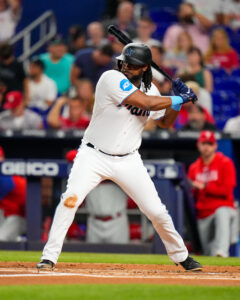
Bell has absolutely exploded in South Florida, however. He turned in below-average offense during his time with Cleveland but has mashed at a .271/.351/.586 pace in a still-small sample of 97 Marlins plate appearances. The eight dingers he’s swatted with the Marlins is already nearly as many as the 11 he totaled in more than quadruple the plate appearances with the Guardians. It’s not as though Bell simply moved to a bandbox either; Miami’s loanDepot Park has been the fourth-worst for home runs over the past three seasons, per Statcast.
The switch-hitting Bell looked wholly unremarkable in more than three months with the Guardians but has not only been one of the National League’s best hitters since the trade — he’s had one of the best months of his entire career. So, what gives? This is perhaps an oversimplification, but the Marlins have succeeded where basically no other club has to date: Bell is finally hitting the ball in the air. A lot. The 45.2% fly-ball rate he’s posted this month is the first month in his entire career that he’s posted a fly-ball rate that high.
The change, however, began well before Bell was traded to Miami. Whether the Marlins keyed in on this or merely jumped at the opportunity to purge Segura’s contract isn’t clear, but the numbers are pretty easy to see. Bell entered the current season with a 50% ground-ball rate in his career and just a 31.9% fly-ball rate — a ridiculous number for a 6’4″, 261-pound first baseman. Bell has never had good speed, and the idea that half of his career batted balls have been beaten into the ground is counterintuitive. He’s far from the only should-be slugger with this type of problem — Eric Hosmer is also a member of this club, for instance — but Bell’s penchant for grounders has regularly undercut his well above-average bat-to-ball skills and what’s clearly above-average or even plus raw power. This is a player who bashed 37 home runs in 2019, after all. Juiced ball or not — that’s a big number.
A look at Bell’s month-to-month splits this year reveals some familiar trends. In April he put a ridiculous 62.3% of his batted balls on the ground, against a 28.6% fly-ball rate. In May, it was 51.6% and 26.6% (with a noted uptick in line drives). If you look in late May, Bell had a stretch of five games where he didn’t hit a single fly-ball. He hit three line drives, and the other 81.8% of his balls in play were grounders. Whether this was a wakeup call or the beginning of Bell trying to make a conscious adjustment, things began to change.
In June, Bell’s fly-ball rate jumped to 37%. In July, it climbed a notch higher, to 38.4%. It’s up to 45.2% in August, and Bell is absolutely mashing. Those might sound like arbitrary numbers, and to some extent they are. However, using that arbitrary 37% cutoff point (his June 2023 fly-ball rate), I scanned back through Bell’s monthly splits for his entire career. He’s only had a monthly fly-ball rate of 37% four times in his career … all coming in 2019, when he hit 37 home runs and posted his career-best .277/.367/.569 batting line.
The results weren’t necessarily there as Bell began elevating the ball more regularly. From May 28 (the first day after that stretch of five games with no fly balls), Bell hit .251/.309/.440. That’s only about seven percent better than league average, by measure of wRC+, but it’s a massive improvement over the .215/.327/.326 slash he produced while pounding an incredible (not in a good way) 59.7% of his batted balls into the ground. At the very least, Bell looked like a hitter on the upswing due to a tangible change in his approach. The Marlins might’ve hoped they were acquiring that somewhat above-average hitter, but Bell has been much, much more than that in Miami. He’s been 50% better than the league-average hitter since being traded.
Of course, it’s an open question whether Bell can sustain this pace. He had four months of fly-ball production in 2019 and then quickly reverted back to the grounder-happy plodder who has often looked on the cusp of stardom but never sustained his pace. It’s encouraging, however, that he’s reeled off three straight months of this fly-ball approach. Even in his career year in 2019, he still posted a 46% grounder rate from July through August. This year, in that same span, he’s at 39.7%. This current stretch is the least grounder-driven span of Bell’s career.
Bell spoke to Craig Mish and Barry Jackson of the Miami Herald about his surge at the plate in Miami, attributing plenty of the success to the manner in which hitting coach Brant Brown preps for games with hitters.
“We watch video together and decide there how the attack plan is going to go and I can work on that in batting practice and it tends to show up in the games,” said Bell, who called Brown’s prep work with Marlins hitters “advanced.” Bell also spoke favorably of loanDepot Park, noting that while the dimensions are pitcher-friendly, the consistency from playing in a stadium with a roof can be advantageous. “With the turf, and with the consistency of the dome, you’ve got the same lighting every inning, every at-bat, and it’s easy to get hits.”
Bell noted to the Herald that his focus has been simply on hitting line drives, but it seems those efforts have translated more into fly balls than the intended liners. His 12.9% line-drive rate with the Fish is actually lower than it was in Cleveland (19%) by a wide margin. Bell is simply elevating the ball at a strong, albeit not elite rate. His 45.2% fly rate since the trade ranks 35th of 173 hitters (80th percentile). But Bell is a big man with plenty of power; when he elevates the ball, good things happen.
Bell’s surge has been a boon for the Marlins and also creates a fascinating scenario to watch down the stretch. If he can continue putting the ball in the air close to this frequently and continue to produce at well above-average levels, the player option he once looked like a lock to exercise could become a borderline call — or, with a strong enough finish, a relatively easy one to decline. The upcoming free agent class is light on hitters, and Bell is flat out raking thanks to a noticeable change in his batted-ball profile. This version of Bell would fetch far more than $16.5MM in free agency, particularly since he can’t be saddled with a qualifying offer and thus won’t be tied to draft pick compensation.
If Bell does decline his player option, it’d wind up looking like a rather deft swap of contracts for the Marlins; at the time of the swap, Miami was effectively surrendering Watson and paying about $9.25MM ($3.25MM in ’23, $6MM in ’24) to upgrade from Segura to Bell. That sum would drop to just $3.25MM in added salary if Bell opts out — all of it coming in 2023 — and a hefty $10.5MM of savings beyond the current season. The Marlins would be off the hook entirely next year, while the Guards would remain on the hook for Segura’s $8.5MM salary and $2MM buyout on a $10MM club option for 2025. It’s doubtful even Marlins GM Kim Ng and her staff expected Bell to perform this well early on, but their ostensible bet on Bell’s change in approach is already a boost to the team’s playoff hopes and now has the possibility to provide substantial payroll benefit in the future.
Charlie Morton’s Continued Late-Career Success
Shortly before the start of last offseason, the Braves checked off a key part of their winter checklist. Atlanta agreed to preemptively exercise a $20MM option on Charlie Morton at the end of September. In exchange, the veteran righty gave the club a matching option for the ’24 campaign.
It was a fairly typical move for an organization that has both been very aggressive on doling out in-season extensions and adept at securing future option years. At the same time, the decision was met with a fair bit of skepticism from a chunk of the fanbase (as evidenced by the comment section on MLBTR’s post). It was a relatively lofty salary — albeit on just a one-year commitment — for a pitcher who carried a 4.29 ERA during his age-38 campaign at the time of signing.
The Braves bet on Morton’s more impressive peripherals and sustained mid-90s velocity in projecting his ERA to improve this year. They’ve been proven right in that evaluation, as the 16-year veteran is turning in one of the better seasons of his career. Morton carries a 3.37 ERA across 141 2/3 innings over 25 starts. He’s averaging 5 2/3 frames per appearance, a bit better than last season, and is on his way to a fifth sub-4.00 showing in the seven years since his late-career breakout for the 2017 Astros.
Morton has been particularly good of late. In 10 starts dating back to the beginning of July, he owns a 2.70 ERA across 56 2/3 innings. He’s reeled off three straight scoreless outings in his last trio of appearances, fanning 25 hitters in the process. Those starts have admittedly come against the plummeting New York offenses, but it’s still a promising sign for Atlanta as they set their pitching staff for October.
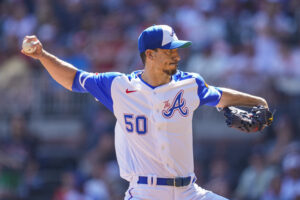
On the whole, the two-time All-Star has performed as the front office had envisioned. His strikeout rate has taken a slight step back, dipping from 28.2% a season ago to 25.5% this year. That’s still a couple points above the 22.1% league mark for starting pitchers. Morton has compensated for the slight dip in punchouts with a few more grounders.
His repertoire looks as strong as it had been. Morton’s 94.9 MPH average four-seam fastball speed exactly matches last year’s mark. His curveball velocity is up a tick. He’s getting whiffs on both those offerings at a similar clip as he did in 2022. Morton’s overall swinging-strike rate is trending to land between 12% and 13% for a fifth consecutive season.
The only quibble with his performance has been spotty command. The righty has battled walks intermittently throughout his career, particularly since finding the velocity surge that has enabled his productive second act as a power pitcher. He’s walking just under 11% of opposing hitters this year, which would be his highest full-season rate since his 2008 rookie campaign. No National League pitcher has plunked more batters than Morton, who has hit 10 opponents. That’s a decent amount of free passes, but he hasn’t had any issue working around those extra baserunners thanks to his strikeouts and general lack of authoritative contact allowed.
Keeping Morton has taken on extra importance for an Atlanta team that has needed to tap into its rotation depth more than it did a year ago. The Braves had nine players log at least 10 innings out of the rotation in 2022; they’re already at 12 such arms this season. Extended absences for Max Fried and Kyle Wright have left the Braves rotating a number of players through the two spots not locked down by Spencer Strider, Morton and Bryce Elder. Fried is back and Wright is on a minor league rehab stint, so things are trending up with a month to go before the postseason, but Morton’s durability was key for Atlanta in building their essentially insurmountable NL East lead.
As the season winds down, president of baseball operations Alex Anthopoulos and his front office are faced with an identical decision on Morton as they had last summer: whether to bring him back for another season at $20MM. There’s a strong case for them doing so. If the Braves (correctly) felt Morton would live up to that sum last September, they could make a similar calculation this time around. His stuff looks the same and he’s been better at keeping runs off the board. Even with a few more walks, it’s easy to argue Morton is a comparable or better pitcher than he was at this time a year ago.
His age is a relevant factor for any contract questions. Morton turns 40 next offseason. At some point, as happens to almost every player, his performance will fall off. There’s nothing beyond the general risk of any 40-year-old pitcher to suggest Morton is nearing a cliff, though. If he decides to suit up for a 17th season, he’d enter next year again looking like a quality mid-rotation arm.
Atlanta has control over every starting pitcher on the roster. Fried and Wright are eligible for arbitration. Strider is already signed through 2028 (plus a 2029 option) under last year’s extension, while Elder and their host of younger rotation options (AJ Smith-Shawver, Jared Shuster, Dylan Dodd) are in their pre-arbitration seasons. Roster Resource projects the club’s 2024 guaranteed commitments around $133MM, roughly $70MM south of this year’s franchise-record Opening Day payroll. Exercising Morton’s option would bring them to approximately $153MM, while an arbitration class including Fried, Wright and A.J. Minter tacks on something in the $25-30MM range. Exercising Morton’s option and a $9MM option for Eddie Rosario — which could be a borderline call — would leave the Braves within $20MM of this year’s payroll entering the offseason.
Of course, they’d also virtually be retaining the entirety of what looks to be the best team in the majors. The Braves did almost nothing in free agency last winter and have excelled regardless thanks to their incredible internal core and the Sean Murphy trade acquisition (and subsequent six-year extension). The organization could be content with a similar approach during the upcoming winter.
Assuming Morton wants to continue playing, will the Braves bring him back at another $20MM price point?
(poll link for app users)
Will The Braves Exercise Charlie Morton's Option?
-
Yes. 86% (2,247)
-
No. 14% (366)
Total votes: 2,613
Image courtesy of USA Today Sports.
Have The Tigers Found A Hidden Gem Of A Slugger?
The 2022 Tigers were baseball’s worst offensive team, as the lineup’s near-total lack of production was the chief cause (even beyond a staggering number of pitcher injuries) for a hugely disappointing 66-96 record in what was supposed to be a return to contention. “Best batter on the 2022 Tigers” is pretty faint praise, and Kerry Carpenter‘s 113 plate appearances last season didn’t even make him a qualified hitter, yet Carpenter still took the dubious honor by posting a team-leading 124 wRC+ over his 31 games of work in his rookie season.
While Carpenter hadn’t really been on Detroit’s radar last year amidst the bigger-name veterans or more highly-touted prospects on the roster, a club so suddenly desperate for hitting could hardly afford to look past a promising bat. This earned him a larger share of playing time heading into 2023, though Carpenter had a modest .217/.280/.464 slash line over his first 75 PA this season. He was then dealt another setback when he sprained his right shoulder at the end of April, resulting in about six weeks on the injured list.
Upon returning from the IL, however, Carpenter has not just been the Tigers’ best batter, but also quietly one of the most productive bats in baseball. Since Carpenter was activated on June 9, only nine qualified hitters have topped his 159 wRC+, as he has slashed .317/.380/.575 over 245 PA. He joined the 20-homer club this past Wednesday, with a grand slam that represented all of Detroit’s offense in a 6-4 loss to the Cubs.
These types of numbers are impressive for anyone, but especially for a 19th-round draft pick from the 2019 draft. Carpenter hit well in his first pro season, but likely due to the canceled 2020 minor league campaign, he took a bit of a step back in 2021 with a .752 OPS over 461 PA for Double-A Erie. Carpenter returned to Erie to begin the 2022 season, but he started to tear up pitching at both the Double-A and Triple-A levels, finishing 2022 with a .313/.380/.645 line and 30 homers over an even 400 PA for the two affiliates.
In this sense, Carpenter didn’t exactly come out of nowhere, though few would’ve predicted that he would’ve kept swinging a hot bat in the majors. And, it is worth noting that Carpenter has still totaled only 433 PA in the big leagues — too small a sample size to clearly state that he is truly for real. Carpenter’s walk and strikeout rates are also a bit below the league average, and he has some significant splits, as his left-handed swing is lot more productive against right-handed pitching (.938 OPS) than against southpaws (.724 OPS). Carpenter has also benefited from a .328 BABIP this season, and his .382 wOBA is well above his .362 xwOBA.
That said, a .362 xwOBA ranks in the 87th percentile of all batters, so Carpenter’s production would be very notable if he was “only” delivering at that expected level. His contact and barrel rates are both well north of average, so it isn’t like he is getting lucky on soft contact. And, while we’re still operating within a small overall sample size of career at-bats, Carpenter is doing much better against left-handed pitching in 2023 than he did in 2022.
On the defensive side, Carpenter has made some positive strides as a corner outfielder, spending most of his time in right field this year. A Gold Glove isn’t necessarily in Carpenter’s future, but public metrics have rated his right field work as just a touch below average. The UZR/150 and Defensive Runs Saved metrics have been more impressed by his 72 1/3 innings in left field, though Carpenter’s solid throwing arm probably makes him a better fit in right field. While more DH at-bats will be available in Detroit once Miguel Cabrera retires, Carpenter certainly looks like at least a passable corner outfielder, which gives the Tigers more flexibility in how they’ll manage their roster going forward.
Detroit’s 2023 offense is still near the bottom of the league, but there have at least been some signs of life with Carpenter’s production, and solid showings from former top draft picks Riley Greene and Spencer Torkelson. Blue-chip star prospects like Greene and Torkelson have been the faces of the Tigers’ lineup of the future, but striking paydirt on a less-regarded player or two has always been a key element of any successful rebuild. It looks like the Tigers might have found at least an MLB regular with their 19th-round selection, and Carpenter’s elite production over the last few months might also hint at a higher ceiling.
Bobby Witt Jr. Is Reaching His Potential
There hasn’t been much positive to say about the Royals this season. They’ve posted a brutal 41-90 record to this point in the season that places them a whopping 26.5 games back even in the extraordinarily weak AL Central, saved from sporting the worst record in baseball only by an abysmal A’s team. To make matters worse, they’re one of just two organizations without a top-100 prospect on MLB.com’s most recent rankings, joined only by the Astros, an organization that not only was stripped of its first- and second-round picks during the 2020 and 2021 drafts but also had a prospect in the top 100 until they dealt him to the Mets to reacquire Justin Verlander.
With a terrible record and a barren farm system, it’s been a difficult year for fans in Kansas City. While they entered the 2023 campaign with an interesting core of young position players, most of them have battled either injury or ineffectiveness this year- first basemen Vinnie Pasquantino and Nick Pratto are currently on the injured list, while MJ Melendez hasn’t turned out to be the successor to Salvador Perez behind the plate many thought he could become. On the pitching side of things, last year’s impressive season from right-hander Brady Singer now appears to have been a mirage and an exciting start to the season from lefty Kris Bubic was cut short by Tommy John surgery after just three starts.
Despite all the disappointments of the 2023 campaign for the Royals, there’s been one undeniable bright spot for this organization in 2023. Bobby Witt Jr. was the club’s pick with the second overall selection in the 2019 draft and tore through the minor leagues, eventually becoming the top-rated prospect in all of baseball according to both MLB.com and Baseball Prospectus ahead of the 2022 campaign. He ultimately had a respectable first season in the major leagues, playing in 150 games while slashing .254/.294/.498, an offensive performance that clocked in just below league average with a 98 wRC+.
While he managed to swipe 30 bags in 37 attempts, brutal defense at both third base and shortstop combined with an uninspiring performance on offense saw the AL Rookie of the Year favorite coming into the season slide to fourth place when all was said and done, finishing behind not only fellow exciting youngsters Julio Rodriguez and Adley Rutschman, but a relative unknown in Steven Kwan of the club’s division rival Guardians. Unfair as it may be to expect top prospects to immediately reach their projected excellence upon reaching the major leagues, Witt’s debut season was disappointing relative to the sky-high expectations in place for the 22-year-old rookie.
Early in the 2023 campaign, it appeared Witt was on base for moderate improvements, but nothing particularly eye-catching. Through the first half of the season, Witt’s defense had improved substantially as he settled in as the Royals’ everyday shortstop and he was already on his way to beating 2022’s stolen base total with 23 bags swiped in 29 attempts, but his bat was lagging behind the rest of the package. In his first 351 trips to the plate this season, Witt slashed just .244/.288/.415 with a strikeout rate just over 20%, an eerily similar slash line to the one he had posted the previous season.
Things changed dramatically for Witt once the calendar flipped to July, however. In nine games prior to the All Star break, he slashed .382/.410/.782 in 40 trips to the plate. While his strikeout rate remained elevated during this stretch, at 22.5%, his six extra base hits in so few games were virtually unheard of for him to that point in his major league career. Witt stayed hot following the break, and ended the month with an impressive July slash line of .327/.346/.633.
As impressive as Witt’s July was, he’s been even better in August. In 100 plate appearances this month, Witt has slashed a sensational .359/.410/.707 with a strikeout rate of just 11%. He has more extra base hits (15) than strikeouts (11) this month, has gone 8-for-9 on the basepaths to bring his stolen base total this year to 37. Even his walk rate, which sits at just 5% for his career, has ticked up to 8% this month. In all, Witt has slashed .347/.378/.668 with 14 homers, 14 stolen bases, and a 15.1% strikeout rate since the beginning of July.
Of course, the past two months account for just 205 plate appearances, just over a third of his total trips to the plate this year. Even so, his season-long numbers are looking mighty impressive at this point. At the plate, he’s slashed .280/.321/.508 overall this season, with a 119 wRC+ that’s a substantial improvement over last year’s below-average mark. By season’s end, he appears to be a veritable lock for at least 30 home runs and 40 stolen bases. Those offensive numbers leave out his incredible glovework this season, as well. Witt’s +13 Outs Above Average in 2023 trail only Dansby Swanson among all major leaguers. While DRS isn’t quite as enamored with Witt’s glovework this season, giving him a figure of just -2, that’s still an incredible improvement from last season, when his -22 DRS was second-worst in the majors.
Between his recent offensive explosion and season-long excellence with the glove, Witt has accumulated 5.1 fWAR through 127 games this season. That phenomenal figure places him behind only Shohei Ohtani among AL players, ahead of players in the midst of phenomenal seasons such as Rodriguez, Marcus Semien, and Luis Robert Jr. By the numbers, Witt has been virtually the same player as Mets star Francisco Lindor in terms of value, with Lindor boasting slightly better offense (124 wRC+) in exchange for slightly weaker fielding and baserunning numbers.
Perhaps most exciting of all for Royals fans is that Witt, still just 23 years old, is under team control through the end of the 2027 season. With four more seasons of their budding superstar in a Royals uniform to look forward to, the Royals still have several years to build a contender around their budding superstar and make a run at their first playoff appearance since winning the World Series in 2015 before his team control runs out and he has the option to depart in free agency.
Kansas City’s odds are particularly good considering the weak division they play in; after all, the Twins have a commanding lead for the AL Central crown this year despite a mediocre 67-63 record, and the division’s biggest spenders in the White Sox are clearly trending in the wrong direction at the moment. Despite the 2023 team’s brutal record and a farm system without clear impact talent on the way, all is not lost for the Royals going forward, and their franchise shortstop is perhaps the primary reason why.
2023-24 MLB Free Agent Power Rankings: August Edition
We’re now about three quarters of the way through the regular season, and the free-agent landscape has changed considerably since our last power rankings back in June. With the trade market passed, we now know who will and won’t be eligible to receive a qualifying offer at season’s end. (Traded players cannot receive a QO.) Max Scherzer needn’t be listed at the back of the list or among the honorable mentions now that he’s agreed to pick up next year’s player option as part of the condition of his trade to Texas. Injuries, performance trends — both good and bad — and many other factors all contribute to shifts in market expectation.
As a reminder, our Power Rankings are based primarily on perceived earning power. This is an exercise intended to provide a snapshot of where the top end of the free agent class is currently sitting. One player being ranked higher than another does not necessarily indicate we feel he’s the better player. Age, health, qualifying offer status, market scarcity and myriad other factors all impact what a player can expect to earn in free agency.
Our Power Rankings are compiled collaboratively. MLBTR owner Tim Dierkes and writers Anthony Franco and Darragh McDonald all weighed in for this update. Players with opt-out clauses and player options are included, even if they’ve previously given indications they may forgo the opportunity to return to the market.
*=Player option/opt-out opportunity
**=Currently playing in Japan’s Nippon Professional Baseball
1. Shohei Ohtani, DH/SP, Angels
Eligible for qualifying offer
The baseball world is still reeling from this week’s news that Ohtani has been diagnosed with a torn ulnar collateral ligament for the second time in his career. He won’t pitch again this season, and surgery — be it Tommy John or an internal brace — is firmly on the table. For now, he’ll continue to serve as the Angels’ DH as he and the team receive outside opinions on his damaged ligament.
There’s no way around the fact that Ohtani’s injury represents a massive blow to his earning power — but perhaps not to the extent that many fans would think. Ohtani is still the best player on the planet, doing things that we simply haven’t seen in our lifetimes — arguably ever before. The 29-year-old’s .304/.409/.659 batting line puts him 80% ahead of the league-average hitter, by measure of wRC+, and prior to his injury, he’d run up 132 innings of 3.14 ERA ball.
Ohtani ranks seventh in the Majors in batting average, second in on-base percentage, first in slugging percentage (by more than 60 points), tenth in ERA and third in strikeout percentage (as a pitcher). We’ve grown almost accustomed to this level of excellence, but the manner in which he permeates both the offensive and pitching leaderboards in Major League Baseball is nothing short of prodigious.
Certainly, it’s an open question as to whether Ohtani will pitch at all next year. By the time he’s reached free agency, we’ll likely know the answer to that question. Depending on whether he needs surgery — and, if so, which surgery he requires — it’s possible he’ll miss the beginning of the 2024 season. Bryce Harper had offseason Tommy John surgery this past year and returned to the Phillies on May 2. Ohtani himself had his first Tommy John surgery in October 2018 and was back on the field as a designated hitter on May 7 the following year.
Even if Ohtani is ruled out from pitching next year, any team signing him would be paying for one of the game’s best hitters — and for a potential return to the mound in 2025. It’s fair to wonder just how long Ohtani can continue pitching and hitting simultaneously and do so at elite levels, but he’s spent the past three years proving those who doubted his preternatural talents wrong. The ultra-competitive Ohtani will surely try to do so again; there’s little reason to think he’d move on from pitching due to a second surgery. What shape that eventually takes — limiting him to five innings most starts, affording him extra rest throughout the season, moving him to the bullpen, etc. — will likely depend on the team with which he eventually signs.
Regardless of Ohtani’s future on the mound, he’ll probably still set the record for largest free agent contract ever. That may sound outlandish to some at first glance, but consider the fact that Ohtani will reach the market two years younger than Aaron Judge was when he scored a $360MM guarantee. Judge landed that record sum as a 31-year-old who ostensibly only had three competitive bidders: the incumbent Yankees, his hometown Giants, and the late-bidding Padres. Ohtani will draw interest from a larger number of teams. And, as marketable as Judge is, Ohtani is even more so. The additional revenues he’d generate from his global fan base can’t be overlooked.
Moreover, Ohtani only seems to be getting better at the plate. After striking out at 28.1% clip through his first four seasons, he dropped that number to 24.2% last year. The lowered strikeout rate also came with a dip in walk rate (down to 10.8%), but this year he’s maintained that improved strikeout rate while bumping his walk rate back to 14.2%. Ohtani is also just two home runs shy of his career-high and looks like a lock to reach 50 home runs. His .360 ISO (slugging minus batting average) is a career-high. Ohtani’s 94.9 mph average exit velocity trails only Judge, and his 118.3 mph maximum exit velo this season trails only Matt Olson. No player has hit a ball further than Ohtani’s MLB-best 493 feet, per Statcast.
Ohtani’s second UCL tear could shorten his 2024 season and might necessitate extra care for his arm when he returns to the mound — be that late in the 2024 season or early in the 2025 campaign. But he’s probably going to pitch again — he’ll certainly try to — and even if he doesn’t, he’s hitting the market as one of baseball’s premier offensive players in advance of his age-29 season. Plus, if Ohtani were to ever give up pitching, he wouldn’t be “just” a designated hitter, as many detractors have suggested. Ohtani is no stranger to the outfield, having played there during his NPB days. Statcast still credits him with 65th percentile sprint speed, and there’s no questioning his raw athleticism and arm strength. There’s little reason to think he couldn’t at least be a serviceable corner outfielder.
Age and elite offensive performance on their own still ought to push Ohtani past Judge this winter. The only question will be how far beyond Judge he can ultimately club. Securing the first $400MM free agent contract in history feels attainable even with the questions surrounding his arm. Time will tell if $500MM+ remains on the table.
2. Cody Bellinger, CF/1B, Cubs
Eligible for qualifying offer
Bellinger jumps from unranked on our last list to the No. 2 spot in a matter of just two months. At the time of our June list, he’d just been reinstated from the injured list and was mired in what turned out to be a fleeting slump. We listed Bellinger as an honorable mention and considered him for a spot near the bottom of the list, but felt he needed to improve his stock a bit. He’s done that — and then some.
Not many one-year, make-good deals have gone as well as Bellinger’s remarkable bounceback season. Non-tendered by the Dodgers after shoulder surgery left him a shell of his former Rookie of the Year and MVP self from 2021-22, Bellinger now looks to be back in a big way. The 2019 Most Valuable Player is batting .320/.368/.552 with 20 home runs, 21 doubles, a triple and 17 steals in 20 tries. The most alarming element of his downturn in 2021-22 was a strikeout rate that ballooned to 27.1%, but Bellinger is now punching out at a career-low 15.5% rate.
Bellinger’s rebound isn’t without red flags, as I noted last week when profiling his season at greater length. He missed more than a month with a knee injury, and in more under-the-radar fashion, the quality of his contact is just nowhere near as good as it was at his peak. Bellinger is averaging 87.2 mph off the bat — four miles per hour slower than during his MVP season. A hefty 45.6% of his batted balls left the bat at 95 mph+ in 2019; he’s at 30.8% in 2023. He’ll also receive and reject a qualifying offer, though for free agents of this caliber, that’s rarely a significant deterrent.
The Cubs have played Bellinger both at first base and in center field this season, and he’ll draw interest from teams with visions of playing him at first base and across all three outfield spots. He drew plus ratings from Defensive Runs Saved and Outs Above Average in his return to first base, and he’s been credited with +4 OAA in center field this year. Teams will see Bellinger as a versatile and above-average defender at multiple spots on the field.
The other factors to consider with Bellinger are age and market scarcity. He won’t turn 29 until July 13 of next season, meaning next year will technically be considered his age-28 season. (July 1 is the typical cutoff for such designations.) He’s considerably younger than the standard free agent, and he happens to hit the market in a year where there’s not only a lack of quality outfielders/first baseman — but a lack of quality bats overall.
Bellinger is at least two years younger than each of Kris Bryant ($182MM), Brandon Nimmo ($162MM) and George Springer ($150MM) were when they hit free agency. He’s having a better offensive platform year than any of that group at the plate. Bellinger and Scott Boras will likely be seeking $200MM+ in free agency this time around, and there’s a real chance he’ll get it.
3. Yoshinobu Yamamoto, SP, Orix Buffaloes**
Ineligible for qualifying offer
At the time of our June list, Yamamoto was sitting on a 1.98 ERA in 68 1/3 frames, positioning him to potentially finish the season with his fourth sub-2.00 ERA in the past five years. Since that time, he’s allowed five total runs in 51 2/3 frames. His 0.87 ERA in that stretch has dropped his season mark to 1.50 over the life of 120 innings. He’s averaging seven innings per start in NPB this year.
If age was worth mentioning with regard to Bellinger, it’s worth focusing on in near-singular fashion with Yamamoto, who turned 25 just last week. Yamamoto is one of the most accomplished pitchers in NPB — widely regarded as the second-best league in the world — despite the fact that he’s around the same age as some of the yet-to-debut names that populate top prospect lists here in North America. He went straight from the NPB draft into the Buffaloes’ rotation, and while his 5.32 ERA as a rookie wasn’t exactly captivating, Yamamoto followed with a 2.10 ERA in 2019 and has been established as an ace-caliber pitcher ever since.
Most MLB free agents hit the market between 29 and 31 years of age. There are occasional 28-year-old free agents, and even more rarely we’ll see a 27-year-old or even 26-year-old, if said player reached the big leagues as some kind of youthful phenom. Yamamoto will be signing a contract beginning with his age-25 season — a virtually unprecedented age for a top-of-the-rotation arm to reach the market. A six-year deal for him would run through only his age-30 season — the same age at which many MLB free agents are just getting to market. It’s always hard to predict how the market might react to star players coming over from NPB or the Korea Baseball Organization, but Yamamoto’s blend of age and performance is basically unprecedented. It’s easy to envision him receiving offers of eight years — possibly even more — based on his youth. Presumably, Yamamoto’s camp could look to work some opt-out opportunities into any deal as well.
Yamamoto isn’t a true free agent; he’ll need to be posted by the Buffaloes, though it’s widely expected they’ll do just that. Any team that signs Yamamoto would owe his former club a release fee equal to 20% of the contract’s first $25MM, 17.5% of the next $25MM and 15% of any money thereafter (including options, incentives, awards bonuses, etc.). On a $200MM deal, for instance, the signing team would owe an additional $31.875MM release fee.
Predicting contracts for foreign stars is always something of a dice roll — far more than standard MLB free agents, where precedent is more abundant. Yamamoto lacks any true comparables in terms of market context seasons, but the demand for him should be fierce.
4. Julio Urias, SP, Dodgers
Eligible for qualifying offer
To call the 2023 season an “uneven” one for Urias would be a bit of an understatement. The southpaw got out to a strong start through his first four turns on the mound, stumbled badly over his next five appearances, and hit the injured list with a hamstring strain. Urias was set to return after just a few weeks but suffered a setback and wound up missing nearly two months with the injury. Upon his return, he was rocked for five runs in three innings, sending his ERA ballooning to 4.94. He was dominant for his next two turns (one run in 12 innings with a 15-to-2 K/BB ratio) … then blown up for eight runs in Baltimore.
The pendulum swung back in the other direction following that outing, and Urias is still on the upswing. In his past five starts, he’s posted a 2.03 ERA. Overall, Urias has a 4.15 ERA on the season and a 3.88 ERA since returning from the injured list. Much of the damage done against him this season has been confined to five brutal outings.
Urias isn’t a power arm. He’s averaging 92.9 mph on his fastball this season — a career-low, but barely down from the 93.1 mph he averaged in 2022 when he posted a 2.16 ERA in 175 frames. He’s never been a huge strikeout pitcher, and this year’s 24.1% rate is in line with his previous levels: solidly above average, but far from elite. However, he’s always boasted exceptional command, and his 4.9% walk rate in 2023 is the best of his career. His walk rate ranks 10th among the 93 pitchers who’ve thrown at least 100 innings this season and is only 0.1% behind the three pitchers ahead of him on the list (Joe Ryan, Miles Mikolas, Zack Wheeler).
Urias is a tough free agent to peg. From 2018-22, he logged a brilliant 2.61 ERA in 499 1/3 innings, but due largely to a .252 BABIP and 79.8% strand rate, fielding-independent metrics were far less bullish (3.42 FIP, 3.80 SIERA). And, because of early-career shoulder surgery, Urias’ workload was limited aggressively until the 2021 season. He’s only made 30 starts in a season twice (2021 and 2022), and he won’t reach that level in 2023. Urias was also arrested in May 2019 after video reportedly showed him shoving a female companion to the ground. Major League Baseball subsequently suspended him for 20 games under the joint domestic violence, sexual assault and child abuse policy. Though it was several years ago, that still figures to weigh into the evaluation process for many teams.
The biggest factor Urias will have on his side in free agency will be age. Because he debuted as a 19-year-old, he’s reaching the open market at just 27 years of age. He won’t turn 28 until next August. Because of that youth, Urias could be in line for a lengthier contract than the standard pitcher, which is why he and Yamamoto stand as the top non-Ohtani pitchers on this ranking. Even an eight-year deal would only run through the left-hander’s age-34 season.
5. Matt Chapman, 3B, Blue Jays
Eligible for qualifying offer
Chapman’s first month of the 2023 season was something to behold. When I wrote about his brilliant start to the season in early May, the two-time Platinum Glove winner was raking at a .338/.425/.579 clip. He’d “only” homered five times in six weeks but was already up to 17 doubles. As noted at the time, he’d struck out at a considerably lower rate than past seasons in April but had begun to swing and miss more in May. “If Chapman can avoid allowing his recent uptick in whiffs to snowball, then a return to peak levels or even the establishment of a new peak output is firmly in play,” I wrote at the time.
Unfortunately — the whiffs indeed snowballed. Chapman fanned at just a 22.8% clip through the end of April, but he’s gone down on strikes in 29.5% of his plate appearances since that time. Since that look at Chapman’s sensational start to the season … he’s batted .212/.302/.373 (88 wRC+).
On the whole, Chapman’s season has still been productive. His .250/.339/.435 slash is 15% better than league average, by measure of wRC+. He’s ripped 15 home runs, 35 doubles and a triple in 507 plate appearances and drawn walks at a very strong 11% clip. More encouraging is the fact that when Chapman makes contact, he’s absolutely scorching the ball. This year’s 93.7 mph average exit velocity is in the 97th percentile of MLB hitters. Only Aaron Judge and Matt Olson have put a higher percentage of their batted balls in play at 95 mph or more than Chapman’s outrageous 57.2%.
That batted-ball profile will undoubtedly intrigue many teams. Chapman will be viewed as something of an “upside” play with the bat, which is a strange way to characterize someone who we’re ranking fifth in earning power among this year’s free agents. That said, Chapman’s power, ability to draw walks and elite defense give him a high floor, and the elite level of his contact and his prior track record suggest something closer to an MVP-level ceiling. Defensive Runs Saved credits Chapman at +11 this year, while Outs Above Average is at +4. He’s never ranked as a negative in either category.
Both Trevor Story (six years, $140MM) and Dansby Swanson (seven years, $177MM) secured deals well north of $100MM due in large part to their strong gloves and offensive ceilings. Kris Bryant landed $182MM coming off a comparable (albeit better) offensive year — despite lacking anything close to Chapman’s defensive value. Story and Swanson got those contracts despite having turned down qualifying offers. Chapman will turn down a QO as well, and even with the way his bat has sputtered since the first month of the season, he’ll still have a case to end up somewhere in this general range.
6. Jordan Montgomery, SP, Rangers
Ineligible for qualifying offer
Few pitchers have elevated their stock more than Montgomery in recent seasons. The 30-year-old southpaw — 31 in December — missed most of the 2018-19 seasons due to Tommy John surgery and posted a 5.11 ERA in 10 starts during the shortened 2020 campaign. Montgomery’s strikeout, walk and grounder rates all remained sharp during that ugly season, though, creating some optimism that he could yet bounce back.
He’s done more than bounce back in the three years since. Montgomery reestablished himself as a viable big league starter in 2021, but he’s steadily elevated himself to No. 2-3 starter status — and he only seems to be getting better. Dating back to 2021, Montgomery has piled up 482 2/3 innings and recorded an impressive 3.49 ERA with a 22.8% strikeout rate, 6.3% walk rate, 45.5% grounder rate and just 1.01 HR/9. He spent two weeks on the Covid-related injured list in 2021 but has otherwise avoided the IL entirely since returning from Tommy John surgery.
The 2023 season, in particular, is shaping up to be the best of Montgomery’s career. He’s posted a minuscule 1.73 ERA in four starts since being traded from the Cardinals to the Rangers, dropping his season-long mark to a career-best 3.12. Montgomery’s 93.6 mph average fastball is the best of his career. He’s striking hitters out at only a league-average level but also limiting walks at a considerably better-than-average rate and inducing grounders at an above-average clip.
Montgomery may not stand out in any one way, but he boasts average or better skills across the board and has shaken off that early ligament replacement surgery to establish himself as a durable mid-rotation starter. His results, peripherals and general durability are all superior to those of Jameson Taillon (four years, $68MM) and Taijuan Walker (four years, $72MM) last offseason. Because he was traded midseason, he can’t receive a qualifying offer.
Many will be tempted to lump Montgomery into the Walker/Taillon bucket, but he’s been the best pitcher of that trio and is heading into free agency on a high note. Taillon and Walker feel like more of a floor than anything else for Montgomery, who ought to be able to command a fifth guaranteed year. With a strong and healthy finish to the season, he could secure a nine-figure deal.
7. Aaron Nola, SP, Phillies
Eligible for qualifying offer
Nola, who turned 30 this summer, has been a standard of durability for the past six years. He hasn’t gone on the injured list with a non-virus issue since 2017. No pitcher has started more games or logged more innings since the start of 2018. For the bulk of that time, he has paired that league-best durability with at least high-end #2 starter results.
The right-hander has six sub-4.00 ERA seasons under his belt, including a 3.25 mark over 205 innings a season ago. From a run prevention perspective, he’s struggling through a relative down year in 2023. Nola has allowed 4.49 earned runs per nine through 26 appearances. The longball has been the big culprit, as he has already surrendered a personal-high 29 homers in 160 1/3 innings (1.63 HR/9).
Nola has lost a few punchouts as well, although he’s still missing bats at an above-average rate. His 25.2% strikeout percentage is his lowest rate in six years but above the 22% league mark for starters. While his whiffs were way down early in the season, he has a characteristic 28.2% strikeout rate going back to the start of June. The homers have become even more of an issue as the summer has drawn on, but Nola’s strikeout and walk profile of the past three months has resembled that of his entire career.
A pitcher’s home run rate can vary season-to-season. Nola’s ground-ball percentages have nosedived over the past couple years, though. This looks as if it’ll be his second campaigns in the last three years with a middling ERA, as he posted a 4.63 mark in 2021. Nola’s ERA has been above estimators like FIP and SIERA for three years running. Will teams attribute that primarily to poor luck and the lackluster defenses the Phils have turn out behind him, or to something in Nola’s repertoire that makes him more hittable than his strikeout and walk profile would suggest?
The Phils and Nola had some extension conversations during the spring but didn’t appear to get close to a deal. He’ll receive and reject a qualifying offer. A five or six year deal topping nine figures should still be attainable, but it’d be easier to project Nola approaching or beating the $162MM which Carlos Rodon received last winter were it not for the home run concerns.
8. Lucas Giolito, SP, Angels
Ineligible for qualifying offer
Aside from the unique cases of Ohtani and Yamamoto, Giolito was the top pitcher in our late-June rankings. The right-hander was sitting on a 3.41 ERA at the time but has allowed a 5.92 mark in nine starts since that point. That’s primarily a reflection of two absolute clunkers — an eight-run drubbing by the Mets on July 18 and nine runs at the hands of the Braves during his first start as an Angel on August 2.
Largely because of those outings, Giolito’s season ERA has jumped to 4.32. Home runs have been an issue, particularly since he landed in Anaheim, but the rest of his profile is generally solid. Giolito hasn’t maintained the form he flashed from 2019-20, when he struck out a third of opponents in consecutive seasons with a sub-3.50 ERA. He now looks the part of a solid #3 starter, fanning a quarter of opponents against an 8.2% walk rate while averaging just under six innings per start.
His velocity is right in line with last year’s mark. His 12.2% swinging strike rate — while down from its 2019-21 peak — is a bit better than average. While Giolito’s small sample ERA with the Angels sits at 6.67, his repertoire, whiffs and control are all in line with his early-season work in Chicago. It’s likely teams will consider his tough first month in Orange County a blip and more or less continue to view him as an above-average, durable starting pitcher.
Giolito turned 29 last month. He’s a year younger than Nola, Snell and Montgomery but markedly older than Urias and Yamamoto. Since he was traded midseason, clubs wouldn’t have to forfeit a draft choice to sign him (as they would for Snell, Nola and Urias). While the past month has been a disaster for the Angels, Giolito’s free agent stock shouldn’t be much different than it was six weeks ago. Given his age, a six-year deal still seems plausible.
9. Blake Snell, SP, Padres
Eligible for qualifying offer
Snell, the 2018 American League Cy Young winner, has become the veritable embodiment of the “mercurial” and “volatile” adjectives that are often used to describe pitchers. The 30-year-old looked lost early in the season, logging a 5.40 ERA and 13.4% walk rate in his first nine starts. Since then, he’s been perhaps the most dominant pitcher in baseball. Over his past 17 starts, Snell has pitched 97 innings with a 1.48 ERA.
One might be tempted to assume that Snell has corrected the command troubles that dragged him down early on — but that’s not the case. Snell has continued walking more than 13% of his opponents during this stretch, with the primary difference being a massive spike in strikeouts (from 23.8% up to 34.8%) and grounders (37% to 49.7%). Snell has scaled back the usage of his heater in that time, deferring to more changeups and curveballs. The formula has worked beautifully. Snell ranks seventh in the Majors in Baseball-Reference’s version of WAR (3.7) and trails only Arizona’s Zac Gallen with 4.8 RA9-WAR.
Ace-level results from Snell aren’t exactly anything new. Again, he’s a former Cy Young winner. However, Snell has struggled to stay healthy, and his penchant for deep counts and walking batters has frequently led to early exits from games. Snell has averaged under 5 1/3 innings per start in his big league career. That’s not exactly a reflection of the Rays’ affinity for quick hooks on their starting pitchers either; Snell’s 5.17 innings per start since his trade to the Padres is nearly identical to his 5.15 innings per start in Tampa Bay. Even during this year’s dominant effort, he’s averaging just over 5 1/3 innings per outing.
In terms of his per-inning performance and his overall raw stuff, Snell is one of the most appealing pitchers in baseball. But he’s also lacked both consistency and efficiency throughout his career, and he’s been on the injured list due to an adductor strain (twice), a fractured toe, loose bodies in his elbow and gastrointeritis since winning that 2018 Cy Young Award. This year’s 142 innings are already the second-highest total of his career. Snell will also have to contend with a qualifying offer, which he’ll surely reject in search of a longer-term deal.
Snell undoubtedly has his flaws, but over the past calendar year he’s made 33 starts and posted a 2.51 ERA with a 31.8% strikeout rate, 12.4% walk rate, 42.8% grounder rate and just 0.84 homers per nine innings. He’s pitched 183 innings in that time — just shy of 5 2/3 frames per outing. There’s plenty of reason for caution, but Snell at his best is a legitimate Game 1 starter in a postseason series. Volatility notwithstanding, he could land a nine-figure deal of five or more years in length.
10. Josh Hader, RP, Padres
Eligible for qualifying offer
While some of the names on this list have struggled since the June edition of our Power Rankings, Hader has been the opposite. He’s tossed 16 shutout innings since that day, allowing just six hits and punching out 44.6% of his opponents. The 29-year-old now boasts a career-low 0.81 ERA in 44 2/3 innings on the season. He’s carrying a 39.9% strikeout rate, and while his 13.5% walk rate remains high, that’s easier to get away with when two out of every five hitters that come to the plate fall to a strikeout.
There was some concern surrounding Hader as he slumped in the weeks preceding and immediately following last year’s trade to the Padres. He righted the ship following a six-run meltdown in late August, however. Since shaking off that disastrous outing, Hader has pitched 61 1/3 innings of 0.74 ERA ball with a 39.7% strikeout rate and an 11.3% walk rate. He’s still primarily a fly-ball pitcher, but Hader’s 36.3% ground-ball rate is a pretty big jump from the 27.4% mark he posted from 2018-22. He’s using the sinker he implemented in 2022 more than ever this year, and while his 2.6% homer-to-flyball rate is bound to regress, this year’s pristine 0.20 HR/9 is also at least partially influenced by that uptick in grounders.
Hader will receive and reject a qualifying offer. That’s a risk for most relievers, but it’s a slam dunk for Hader, who could become the highest-paid relief pitcher ever within the next few months. He’ll be a year older in free agency than Edwin Diaz was when he set the reliever record on a five-year, $102MM contract (which includes multiple opt-outs). That slight age gap will matter, but Hader has the longer and steadier track record of the two and could benefit from his handedness. Barring a catastrophic collapse or a disastrously timed injury, Hader will take aim at making Diaz’s record and have a good chance at making it short-lived.
Honorable Mentions (listed alphabetically): Harrison Bader (OF), Jeimer Candelario (3B), Sonny Gray (SP), Teoscar Hernandez (OF/DH), Shota Imanaga (SP)**, Michael Lorenzen (SP), Yuki Matsui (RP)**, Eduardo Rodriguez (SP)*, Jorge Soler (DH/OF)*, Marcus Stroman (SP)*
MLBTR Poll: AL West Winner
Heading into play Tuesday, there’s only one division where the lead is two games or fewer. That’s the AL West, which has a pair of teams within two games of the frontrunner. Whoever wins the division is very likely to get a first-round bye — all three teams are at least five games clear of the AL Central-leading Twins — adding extra incentive for the clubs to secure more than a Wild Card spot.
With the Angels now 11 games out and the A’s on their way to 110+ losses, we’ll take a look at the three remaining teams with a plausible path to contention:
Texas Rangers, 72-53 (lead division by 1.5 games)
The Rangers have had a share of the division lead for all but one day of the season. They’ve been in sole possession of first place going back to May 6, stretching their margin out to 6.5 games in the final week of June. Texas has allowed the gap to close in recent weeks, playing slightly below .500 ball between June and July. They rebounded to win 10 of 11 to start August but have dropped six of eight since then (including five in a row).
Texas has been far and away the best offensive team in the division. They trail only Atlanta overall in runs and all three slash stats. They’ve cooled off a bit following a scorching start, ranking eighth in scoring since the All-Star Break. Even after losing Jacob deGrom, the rotation has held up remarkably well — and deadline acquisitions Max Scherzer and Jordan Montgomery couldn’t have performed much better through their respective first four starts in a Ranger uniform.
The biggest question mark, as has been the case the entire season, is the bullpen. Texas relievers rank 25th in ERA overall; they’re 24th with a 4.96 figure since the start of the second half. The front office added to the relief corps this summer, bringing in Aroldis Chapman and Chris Stratton. They’ve each been effective (although Chapman blew a save in last night’s extra-inning loss in Arizona) but the group has been shaky enough overall to contribute to a handful of frustrating defeats.
Texas is 9-17 in one-run contests and 2-5 in games that go to extra innings. There’s probably some amount of poor fortune baked into that mark, but it’s hard to attribute those struggles all to luck (particularly after the Rangers were a staggering 15-35 in one-run games a season ago).
Among all major league teams, only the Braves have a superior run differential to the Rangers’ +184 mark. Few teams are capable of bludgeoning an opponent the way Texas can. Can they lock down enough tight games to hold off their two top competitors?
Houston Astros, 71-55 (1.5 games back of Texas, 0.5 ahead of Seattle)
The defending World Series winners entered the season as the favorites to capture another AL West crown. Yet this year’s Houston club, while very good, hasn’t played at the same level as last year’s 106-win squad.
That’s primarily a reflection of a step back on the pitching front. Last year’s club finished the regular season eighth in run scoring; they’re sixth in that regard this season. Their run prevention has regressed a bit, as they’ve dropped from second to fifth in ERA. After finishing second in the majors with a 26% strikeout rate a season ago, they’re down to ninth (at 24%) this year.
It’s certainly not a bad pitching staff — Houston is still in the upper third of the league in most categories — but injuries slowed them early in the year. Luis Garcia won’t return from Tommy John surgery. They got nothing from Lance McCullers Jr. because of persistent forearm issues. Allowing Justin Verlander to depart in free agency subtracted the defending Cy Young winner for the season’s first few months. He’s back in the fold but hasn’t been as dominant in 2023 as he was a year ago. José Urquidy missed a couple months with shoulder issues, while Cristian Javier has been inconsistent after an excellent start to the year.
Strong rookie showings from Hunter Brown and J.P. France were instrumental in keeping the club afloat while Garcia, McCullers and Urquidy were on the injured list. With Urquidy now healthy and Verlander back, Houston’s rotation again runs six deep. The lineup is nearing full strength with Jose Altuve and Yordan Alvarez healthy and Michael Brantley on a rehab stint. First baseman José Abreu is in an uncertain spot because of a back injury, though he hasn’t produced even when healthy.
The Astros have never really had a chance to fire on all cylinders. They haven’t spent a single day with even a share of first place since losing on Opening Day. They’ve hung around, though, and they’re getting closer to trotting out the roster they’ve more or less envisioned.
Seattle Mariners, 70-55 (2 games back of Texas, 0.5 back of Houston)
The Mariners have been the hottest team in the American League over the past two months. Seattle had been remarkably average for the first few months, never winning nor losing more than four consecutive games through the end of July. Even after going 17-9 in July, the M’s trod an uncertain course at the deadline. They dealt away closer Paul Sewald to add MLB-ready but more controllable offensive help in the form of Dominic Canzone and Josh Rojas. Unlike their division rivals in Arlington, Houston and even Anaheim, the Mariners didn’t make any headline-grabbing deadline acquisitions.
No matter, Seattle is an AL-best 15-4 since the calendar flipped to August. They’ve rattled off separate win streaks of seven-plus games (the latter of which is ongoing) this month. Part of the front office’s logic in trading Sewald was their confidence the bullpen was deep enough to remain excellent; the relief corps is indeed fourth in ERA and fifth in strikeout rate since the deadline.
Seattle’s rotation has been among the league’s best all year. They lead the majors in innings and rank sixth in ERA. Rookies Bryce Miller and Bryan Woo have stepped in well behind the star trio of George Kirby, Luis Castillo and Logan Gilbert. The biggest recent turnaround has been the offense. A lineup which president of baseball operations Jerry Dipoto frankly conceded four weeks ago was “an average major league offense” trails only Atlanta and Philadelphia in scoring this month.
After accounting for the pitcher-friendly nature of T-Mobile Park, they lead the league in wRC+ in August. They’ve gotten contributions throughout the batting order. Of the 11 Seattle hitters with 40+ plate appearances, only Rojas has posted below-average numbers. Julio Rodríguez has arguably been the best player on the planet over the past three weeks, while Ty France and Teoscar Hernández have caught fire after previously underwhelming seasons by their standards.
All of a sudden, the Mariners are firmly within striking distance of what could be their first division title since 2001. They’ll control their own destiny into the season’s final week and a half. As Mike Petriello of MLB.com observed (on Twitter), Seattle’s final three series are against the clubs they’re trying to track down. They’ll finish the regular season with a three-game set in Arlington, three at home against Houston, and then four more against the Rangers at T-Mobile Park.
———————
How does the MLBTR readership envision things playing out? Which team will take home the division crown, and for good measure, how many teams from the AL West will snag a Wild Card berth?
(poll links for app users)
Which Team Will Win The AL West?
-
Mariners 40% (2,168)
-
Rangers 30% (1,632)
-
Astros 29% (1,559)
Total votes: 5,359
How Many AL Wild Card Teams Will Come From The West?
-
2 71% (2,643)
-
1 29% (1,069)
Total votes: 3,712
Big Hype Prospects: Schanuel, Winn, Marte, Harrison, Salas
We’ve reached the point of the season when prospect call-ups won’t expend their rookie status due to time spent on the roster. It’s still technically possible for such players to pass the plate appearance or innings pitched thresholds.
In any event, this marks an opportunity for teams to offer their young players time to acclimate in the Majors ahead of a Rookie of the Year bid in 2024. We saw similar with Corbin Carroll and Gunnar Henderson last season. Let’s cover a few such players along with others on the ascent.
Five Big Hype Prospects
Nolan Schanuel, 21, 1B, LAA (MLB)
14 PA, .250/.357/.250
Schanuel was summoned by a desperate Angels club to cover for the absence of C.J. Cron. The 2023 draftee has over twice as many walks as strikeouts in limited professional action. In a perfect world, he likely would have spent more time in the minors working on achieving higher-quality contact. There isn’t a spot on the Angels roster for both Cron and Schanuel. In other words, we can expect Schanuel to return to the minors if and when Cron recovers from his lower-back tightness. Until then, we’ll see if Schanuel can learn to complement his discipline and feel for contact with better lift and exit velocities.
Masyn Winn, 21, SS, STL (MLB)
(AAA) 498 PA, 18 HR, 17 SB, .288/.359/.474
A high-probability league-average shortstop with upside for more, Winn is now 11 plate appearances into his Major League career. The well-rounded shortstop makes up for a lack of carrying traits (besides his impressive throwing arm) with an equal lack of weaknesses. There’s only one knock against him: merely adequate exit velocities. Adequacy is hardly damning praise. For a 21-year-old to possess his skills and traits means he has countless ways to take the next step from acceptability to stardom. He could do it on defense, through feel for contact, burgeoning power, speed on the basepaths, or a little bit of everything.
Noelvi Marte, 21, 3B, CIN (MLB)
(AA/AAA) 389 PA, 11 HR, 18 SB, .281/.360/.460
Marte was one of the first prospects covered by this column last season. I noted a slight souring among evaluators who were beginning to see him as more of a core performer than a future star. His performance this season remains prime for disagreement. The surface level stats are good-not-great, and his peripherals are a mixed bag. He’s a tad prone to swinging strikes. Even so, he avoids strikeouts while showing plus discipline. He also produces exciting top-end exit velocities for a 21-year-old. Some scouts think he’s close to physically maxed out. Others see room for further growth.
Broad strokes, the outlook is similar to Winn albeit from a lesser defensive position. There are so many ways for Marte to find his way to star-caliber production. The floor resembles a Major League core performer.
Kyle Harrison, 22, SP, SFG (MLB)
(AAA) 65.2 IP, 14.39 K/9, 6.58 BB/9, 4.66 ERA
Harrison makes for one of the toughest evals in the minors. He has a feel for missing bats along with the repertoire of a high-ceilinged starting pitcher. He also happens to struggle with command and control. Of his 21 starts, Harrison reached five innings exactly once. He never faced 20 or more batters. The relief risk is ooey-gooey tangible, but the Giants have every incentive to give him more time in the rotation. Presently, Harrison is expected to join a unit consisting of Logan Webb and a handful of struggling veterans like Alex Cobb, Alex Wood, Sean Manaea, and Jakob Junis. The Giants will be playing bullpen games from here through the end of the season.
Ethan Salas, 17, C, SDP (AA)
(A/A+) 257 PA, 9 HR, 5 SB, .257/.335/.447
At the tender age of 17 years, 2 months, and 20 days, Salas finds himself in Double-A. This latest promotion is virtually unprecedented, made all the more so because Salas hit just .200/.243/.229 in 37 High-A plate appearances. It doesn’t require an active imagination to wonder what else is going on here. Perhaps the Padres Double-A affiliate has a desirable instructor or facilities. Maybe, like a baby bird, he imprinted on one of the other players the Padres promoted to Double-A yesterday. Could a long-term contract be in the offing?
In any event, Salas is now the youngest player to grace Double-A in recent memory. He’s considered a precocious receiver with the potential to become a quality hitter too.
Three More
Carson Williams, TBR (20): The Rays promoted Williams from High-A straight to Triple-A. The move allows for Junior Caminero’s (Double-A) development to remain unaffected. Williams is 1-for-13 with two walks and six strikeouts. He’s running a 22.2 percent swinging strike rate with poor exit velocities. Note the tiny sample.
Samuel Zavala, SDP (18): Though not quite on the Salas-track, Zavala earned a promotion to High-A yesterday after hitting .267/.420/.451 with 14 home runs and 20 steals in 459 Low-A plate appearances. He has issues adjusting to pitches in certain parts of the strike zone, especially up-and-away.
Paul Skenes, PIT (21): Earlier today, the Pirates announced Skenes would join the Double-A club, skipping High-A in the process. Whether this move is in preparation for a 2023 or 2024 debut, it won’t be long before we see Skenes grace a big league mound.
Did I miss a detail or nuance? DM me on Twitter @BaseballATeam to suggest corrections.