
Big Hype Prospects: Moreno, Ortiz, Casas, Perez, Rafaela
This week on Big Hype Prospects, we catch up on some pre-holiday shopping.
Five BHPs In The News
Gabriel Moreno, 22, C, ARI (MLB)
(AAA) 267 PA, 3 HR, 7 SB, .315/.386/.420
Moreno headlined the Diamondbacks return in the Daulton Varsho trade. FanGraphs describes him as “the most athletic catcher to come along since J.T. Realmuto.” Last season, Moreno continued to put his contact skills on display. A brief 73 plate appearance trial in the Majors yielded a high batting average and tiny 11.0 percent strikeout rate. He generally produces modest exit velocities with a low angle of contact. In plain english, power isn’t a big part of his game, but he’ll be a valuable hitter all the same. He’ll need to make substantial adjustments to ever become a regular 20 homer threat.
There are questions about his ability to carry a full workload given that he’s never topped 350 plate appearances in a season. He’s considered an above average defender with sufficient athleticism to improve. With Carson Kelly still in-house, the Diamondbacks can consider platooning Moreno between catcher and designated hitter while working on his durability.
Luis Ortiz, 23, SP, PIT (MLB)
(AA) 114.1 IP, 9.92 K/9, 2.68 BB/9, 4.64 ERA
The lightbulb clicked for Ortiz partway through the 2022 campaign. His command improved as he became more aggressive with his domineering stuff leading to a successful 10 inning stint in Triple-A followed by 16 more frames in the Majors. Given his lack of Triple-A experience, it’s understandable why the Pirates have gone out of their way to delay Ortiz’s arrival via the signings of Vince Velasquez and Rich Hill. Ortiz has impressive Statcast measurables. Health permitting, he’s on pace to soon form a potent one-two punch with Roansy Contreras in the Pirates rotation.
Triston Casas, 22, 1B, BOS (MLB)
(AAA) 317 PA, 11 HR, .273/.382/.481
Virtually everybody in baseball is ready to see Casas sink or swim as the Red Sox first baseman of the present and future. The only barrier entering this offseason was a certain veteran. Removing Eric Hosmer from the roster ensures manager Alex Cora won’t have to juggle any difficult decisions. Casas had a mixed 95 plate appearance debut last season, showing power and discipline but posting a poor .197 batting average. In this case, his .208 BABIP appears especially fluky. If anything, his batting profile is that of a high-BABIP hitter. Some of his at bats felt like he was selling out for contact (my personal observation, not that of a scout), a common “mistake” among debut hitters. Look for him to further refine his approach and consistency in 2023.
Eury Perez, 19, SP, MIA (AA)
75 IP, 12.72 K/9, 3.00 BB/9, 4.08 ERA
On the shortlist with Andrew Painter for most exciting teenaged pitching prospect, Perez is one of the reasons the Marlins are shopping Major League starting pitchers. He’s on pace to arrive in the second half of 2023. Scouts laud his excellent fastball command and biting slider. He’s a skyscraper of a man whose very size ensures a unique look. Scouts believe his changeup can develop into a weapon as well. His curveball is seen as a less competitive offering that can play up based on the effectiveness of his other pitches.
It’s worth mentioning this is the organization that, a decade ago, jumped a 20-year-old Jose Fernandez straight from High-A to the Majors. Of course, none of those decision-makers remain on hand, making it highly unlikely we see a repeat with Perez.
Ceddanne Rafaela, 22, OF, BOS (AA)
(A+/AA) 522 PA, 21 HR, 28 SB, .299/.342/.539
The Red Sox are reportedly shopping their prospects for upgrades with Rafaela serving as the most-highly valued of the bunch. Rafaela wasn’t a consensus top prospect in the Red Sox system prior to last season. Now he’s widely considered their third-best farmhand behind Marcelo Mayer and Casas. He displayed a tantalizing mix of power and speed last season, though there are still worrisome signs with his offensive stats. He lacks discipline and carries a high swinging-strike rate. Hitters who thrive with the Javy Baez profile are few and far between.
Should his discipline and whiff issues become an impediment, Rafaela has super utility man potential. He’s presently being trained as a center fielder. He also played 12 games at shortstop last season and has prior experience at second and third base. He’s considered an above average outfielder. I do not have reports on his infielding acumen.
Three More
Corbin Carroll, ARI (22): Although there was little doubt Carroll would start for the 2023 Diamondbacks, the Varsho trade all but ensures an Opening Day role. A line drive machine with excellent discipline in the minors, Carroll had a mixed debut. His 130 wRC+ in 115 big league plate appearances belied below average exit velocities and merely average discipline. Look for those traits to dramatically improve throughout 2023.
Dominic Fletcher, ARI (25): Another “winner” of the Varsho trade, Fletcher no longer has an entire squadron of outfielders ahead of him on the depth chart. Should Alek Thomas continue to struggle and Jake McCarthy suffer a sophomore slump, then Fletcher might just worm his way into the Arizona lineup. Likelier, he’ll serve as trade bait. The Diamondbacks still need pitching depth.
Kumar Rocker, TEX (22): Kumar made his debut in the Arizona Fall League, pitching 14 innings with mixed results. His 18 strikeouts were encouraging, but they were offset by 12 walks and a 4.50 ERA. He appeared in the news this last week in connection to Carlos Correa’s delayed contract with the Mets. New York selected Rocker in the first round of the 2021 draft only to back out of their deal over concerns with his physical.
MLBTR Poll: Where Will Michael Wacha Sign?
With Nathan Eovaldi agreeing to a deal with the Rangers, the top remaining starting pitcher on the free agent market (per MLBTR’s rankings) is Michael Wacha. In fact, Wacha is the only remaining starting pitcher left from the Top 50 free agents.
As things stand, the Orioles are the only known team to have checked in on the 31-year-old, who’s coming off his best season in a while for the Red Sox. Wacha made 23 starts for Boston last season, working to a 3.32 ERA across 127 1/3 innings. That mark did come with a fairly pedestrian 20.2% strikeout rate, and a solid 6% walk rate. Further, his .260 opponent BABIP suggests a bit of good fortune was involved, and sure enough Wacha’s FIP sat at 4.14 for the season. Nonetheless, it was a far more improved showing than in recent times for Wacha.
Between 2020-21, Wacha tossed 158 2/3 innings for the Mets and Rays, working to a 5.39 ERA. Those two seasons came with better strikeout rates, but his HardHit% were comfortably the highest of his career, as were his home run rates.
Wacha was once a highly touted prospect in the Cardinals system. Drafted 19th overall in 2012, Wacha made his big league debut as a 21-year-old in 2013. Over his first three seasons, he’d toss 353 innings of 3.21 ERA ball, and picked up the 2013 NLCS MVP award for his efforts in that series against the Dodgers. He was never a big strikeout pitcher, but kept the ball on the ground enough, limited the walks and induced enough soft contact to be a highly effective starter.
Those three seasons turned out to comfortably be Wacha’s best, and since the 2016 campaign he’s hurled 800 2/3 innings of 4.42 ERA ball. He’s signed one-year deals the past three seasons, but that solid campaign last season could well see him get a modest two-year guarantee this winter. MLBTR predicted a two-year $16MM pact for Wacha and there certainly seems a good chance he matches that at least, particularly given how well starting pitching has done in free agency this winter.
As for who could be interested, the Orioles are not only the only reported team to have checked in (though there have surely been others), but they do make a lot of sense as well. They have been linked to a number of mid-tier starters this winter, and signed Kyle Gibson to a one-year, $10MM pact. Still, the backend of their rotation has a few options but most are light on MLB experience and adding someone like Wacha would provide them with a bit more stability.
The Angels and Padres were both linked to Eovaldi before he signed with the Rangers, so it makes sense to take a look at them as possible fits for the next best option. The Angels have a pretty solid five-man rotation, with Shohei Ohtani and Tyler Anderson at the top, and southpaws Reid Detmers, Patrick Sandoval and Jose Suarez rounding it out. LA has often worked with a six-man rotation to manage Ohtani’s workload though, and Wacha could fit in nicely as another starting option for them.
The Padres, too, appear to have the foundations of a starting five in place, but like the Angels could do with a sixth option. Joe Musgrove, Blake Snell and Yu Darvish are locked in to the first three spots, with Nick Martinez and Seth Lugo penciled in to fill out the rotation. Reports have suggested San Diego plans to utilize the latter two as starters, but both have typically worked as relievers recently, so adding Wacha could give them some insurance against those two failing to lockdown a starting spot.
A return to Boston could also be an option. They do have Chris Sale, Corey Kluber, James Paxton, Nick Pivetta and Garrett Whitlock lined up to handle the starting duties. Yet Sale and Paxton have had a wretched run of injuries (and the team is reportedly listening to offers on Sale), while Whitlock has fared much better in the bullpen. Youngster Brayan Bello is also an option to join the rotation at some point, so there’s not a clear need to add someone like Wacha, but it wouldn’t be a complete surprise if he did wind up back in Boston.
While those three teams all have ambitions to compete in 2023, Wacha could also be a fit on rebuilding teams. Even if it requires a two-year deal to sign him, a rebuilding club could hope that he builds off his solid 2022 campaign and turns himself into a valuable trade chip either at the deadline or next winter. At worst, it’s unlikely it’d be an onerous commitment to sign him and even if he doesn’t pitch himself into a trade chip he could still work as an innings-eater for a rebuilding team with a younger roster.
In that case, perhaps a team like the Reds could be amenable to bringing him in if the price is right. Luis Cessa is the veteran in the Reds’ rotation as things stand, but he’s typically worked as a long reliever. Outside of Cessa, it’s a young rotation for all of uncertainty, and adding a veteran like Wacha could solidify things and take a bit of the pressure off their younger arms.
There’s a fair few other possible fits, and any of the Twins, Royals, Tigers, and White Sox could make some sense. Where do you see Wacha signing this winter?
Where Will Michael Wacha Sign?
-
Baltimore Orioles 17% (1,999)
-
Boston Red Sox 15% (1,805)
-
St Louis Cardinals 11% (1,245)
-
Los Angeles Angels 8% (909)
-
San Diego Padres 5% (585)
-
Toronto Blue Jays 4% (445)
-
Chicago Cubs 4% (414)
-
Minnesota Twins 3% (395)
-
Cincinnati Reds 2% (279)
-
San Francisco Giants 2% (268)
-
Atlanta Braves 2% (266)
-
Pittsburgh Pirates 2% (258)
-
Los Angeles Dodgers 2% (243)
-
Washington Nationals 2% (241)
-
Philadelphia Phillies 2% (228)
-
Detroit Tigers 2% (219)
-
Chicago White Sox 2% (208)
-
Kansas City Royals 2% (189)
-
New York Yankees 2% (178)
-
Texas Rangers 1% (168)
-
New York Mets 1% (147)
-
Oakland Athletics 1% (146)
-
Arizona Diamondbacks 1% (129)
-
Milwaukee Brewers 1% (129)
-
Cleveland Guardians 1% (124)
-
Tampa Bay Rays 1% (122)
-
Seattle Mariners 1% (113)
-
Houston Astros 1% (112)
-
Colorado Rockies 1% (91)
-
Miami Marlins 0% (45)
Total votes: 11,700
Which Teams Are Slated To Pay The Luxury Tax In 2023?
The highest number of teams to pay the competitive balance tax in a single season is six, which occurred in 2016 and 2022. It’s possible that 2023 could be a record-breaking season in that regard, as Roster Resource currently has six teams already over the $233MM base threshold, while the Dodgers are a rounding error away from the line and another handful of teams not too far off.
These numbers are still unofficial, especially considering the arbitration salaries are mostly still estimates. Teams can also change their status by making trades throughout the year, either adding or subtracting from their ledger, but consider this a rough snapshot of where things currently stand.
Top Tier – CBT Above $293MM
The Mets are not just beyond the top CBT tier, they’re on another planet. Owner Steve Cohen has shown that he doesn’t care too much about what it costs to put a competitive team together, with their payroll currently projected for $376MM and a CBT figure of $390MM. They are currently slated to pay over $116MM in taxes alone, which is more than the total 2023 payroll of 11 teams.
CBT Between $273MM and $293MM
The Yankees are alone in this tier, but are just barely under the top threshold. Roster Resource currently has their CBT figure at $291.8MM, giving them very little room for further additions without going over. If they stay above the $273MM line, both the Yankees and Mets will see their top pick in the 2024 draft moved back by 10 spots. Both the Mets and Dodgers were more than $40MM above the base threshold in 2022, meaning their top draft picks will be moved back in the upcoming draft.
CBT Between $253MM and $273MM
The Padres are the only club in this section, with their CBT number currently pegged at $267MM. Since they paid the tax in 2021 and 2022, they are set to be third-time payors in 2023. That means they are currently slated for a 62% tax on spending over the $253MM line and will continue to do so for any further additions. Jumping over the $273MM line would lead to a huge spike to a 95% rate, as well as their top 2024 draft pick being pushed back 10 slots.
CBT Between $233MM and $253MM
The Phillies, Braves and Blue Jays are currently in this group, with the Phils ahead of the other two at $251MM. The Phillies also paid the tax in 2022, setting them up to be a second-time payor. That means they are currently set to be taxed at a 30% rate, with that rate jumping to 42% for spending that goes over the $253MM line.
Both the Braves and Blue Jays would be paying the tax for the first time in their respective histories, putting them each in line for a 20% tax rate on spending over the line. The Jays are only a hair over right now, with Roster Resource calculating their number at $233.2MM, with Atlanta at $240MM.
Just Under The $233MM Threshold
The Dodgers are currently calculated for a CBT figure of $232.9MM, just barely under the lowest line. It’s been rumored they would like to limbo under the line in order to reset their status, since that would allow them to go into 2024 as a “first-time” payor. Doing so will be a challenge at this point unless they move something off their books.
A few other teams are within range of the Dodgers and could have to start thinking about the tax line if they make another significant signing or trade. The Rangers and Angels are each at $220MM, the Cubs at $214MM, the Red Sox $212MM, Astros at $209MM, Giants at $208MM and White Sox at $205MM.
Free Agent Profile: Adam Duvall
Thanks to a busy month of December, most of the top free agents from this offseason are off the board, assuming the Carlos Correa deal with the Mets eventually gets over the finish line. From MLBTR’s list of the top 50 free agents, only three remain unattached: Jurickson Profar, Andrew Chafin and Michael Wacha. That means that teams still looking for upgrades will have to sift through the remainders, looking for talent that other clubs have overlooked.
One interesting candidate who deserves a look is Adam Duvall, who hasn’t been written about on MLBTR since August. If any teams have interest in him, it hasn’t been leaked to the public yet. It’s not especially shocking that his market has been quiet to this point. His 2022 was cut short in July when he required season-ending wrist surgery. He also limped to a .213/.276/.401 line in the first few months of the season while striking out in 32.1% of his plate appearances. That production was 13% below league average, as indicated by his 87 wRC+.
That’s certainly not an ideal platform for a trip into free agency, but there are still things to like about Duvall. The plate discipline issue has always been there, as he has a career 6.7% walk rate and has never finished a season above 8.7%. He’s struck out in 28.5% of his career trips to the plate and has been at 25.8% or above in each season of his career. For reference, this year’s league averages were an 8.2% walk rate and 22.4% strikeout rate. However, he’s always paired that with tremendous power, topping 30 home runs in a season three times. He also hit 16 in the shortened 2020 season and 12 this year prior to being shut down.
He’s also considered to be a strong defensive outfielder. He’s tallied 58 Defensive Runs Saved on the grass in his career, 28 Outs Above Average and has a 22.7 from Ultimate Zone Rating. His DRS and UZR slipped to below average in 2022, but OAA still was quite bullish, placing him in the 88th percentile in the league. His arm strength placed in the 78th percentile, his outfielder jump in the 74th and his sprint speed 67th.
If 2022 showed Duvall’s profile at its worst, 2021 showed how valuable it can be. He struck out in 31.4% of his plate appearances and walked in only 6.3% of them, but he launched 38 home runs, stole five bases, led the National League in RBIs with 113 and provided excellent defense. He got a 9.9 from UZR, 19 DRS and +4 OAA. That DRS figure was tied with Michael A. Taylor for best in the league among all outfielders while the UZR score was in the top five. That was primarily corner outfield work, but 210 2/3 innings out of his 1155 total innings came in center field. He was awarded the National League Gold Glove award for right field. All told, FanGraphs calculated him to be worth 2.7 wins above replacement for the year.
Duvall is now 34 years old and coming off a down year, both in terms of health and performance. It would be easy to roll one’s eyes at the idea of a team bringing him aboard and giving him a significant role. However, the pickings in free agency are getting slim and every player still out there is going to have flaws in one way or another. Duvall likely won’t earn a tremendous salary in free agency due to his struggles this year, but he has the ability to provide strong corner outfield defense while playing center field on occasion. His plate discipline isn’t great but he has tremendous power. It’s also possible that the upcoming shift bans will boost his batting average by a few points, since he was shifted in 71.7% of his plate appearances this year despite hitting right-handed. Even with his struggles at the plate in 2022, he was still worth 0.9 fWAR in 86 games before the wrist issue put him out for the second half. He isn’t likely to kill you in a platoon capacity either, as his career splits aren’t drastic, with a 101 wRC+ against lefties and a 94 otherwise. For a team looking for a low-cost flier to find some sneaky value this late in the offseason, they could do much worse.
Which Free Agents Remain For Teams Seeking Rotation Help?
With the holiday slowing down what had become a very rapid offseason, it works as a natural point to take stock of what players clubs could target in the coming weeks. On Monday, MLBTR looked through the remaining free agent relievers coming off the best 2022 campaigns (one of whom has since signed a major league deal). Now we’ll take stock of the rotation options who are still out on the open market.
There aren’t as many starting pitchers for clubs to sort through as there were bullpen targets, with 19 remaining hurlers who tallied at least 20 rotation innings this past season. We’ll look at the top half of that group by various metrics to determine who teams figure to prioritize as they seek starting pitching depth.
Note: all figures cited, including league averages, are looking solely at pitchers’ outings as starters.
ERA (league average — 4.05)
- Johnny Cueto (RHP), 3.29
- Michael Wacha (RHP), 3.32
- Wade Miley (LHP), 3.34
- Bryan Garcia (RHP), 3.54
- Zack Greinke (RHP), 3.68
- Devin Smeltzer (LHP), 4.02
- Zach Davies (RHP), 4.06
- Aníbal Sánchez (RHP), 4.28
- Drew Hutchison (RHP), 4.52
Strikeout rate (league average — 21.6%)
- Chase Anderson (RHP), 24.6%
- Matt Swarmer (RHP), 22.4%
- Bryan Garcia, 20.2%
- Michael Wacha, 20.2%
- Chris Archer (RHP), 19.2%
- Wade Miley, 18.4%
- Zach Davies, 17.9%
- Chad Kuhl (RHP), 17.8%
- Mike Minor (LHP), 16.7%
Strikeout/walk rate differential (league average — 14.1 percentage points)
- Michael Wacha, 14.2 points
- Matt Swarmer, 13.1 points
- Dylan Bundy (RHP), 11.1 points
- Chase Anderson, 10.6 points
- Johnny Cueto, 10.5 points
- Wade Miley, 9.2 points
- Michael Pineda (RHP), 9 points
- Aaron Sanchez (RHP), 9 points
- Zach Davies, 8.8 points
Ground-ball rate (league average — 42.5%)
- Wade Miley, 54.2%
- Aaron Sanchez, 51.3%
- Chase Anderson, 50.9%
- Dallas Keuchel (LHP), 50.2%
- Jared Koenig (LHP), 47.2%
- Chris Archer, 43.7%
- Zach Davies, 42.9%
- Johnny Cueto, 42.5%
- Zack Greinke, 41.3%
FIP (league average — 4.04)
- Johnny Cueto, 3.76
- Wade Miley, 4.00
- Zack Greinke, 4.03
- Michael Wacha, 4.14
- Chase Anderson, 4.37
- Chris Archer, 4.49
- Aaron Sanchez, 4.61
- Dylan Bundy, 4.66
- Zach Davies, 4.83
Innings pitched
- Johnny Cueto, 153 1/3
- Dylan Bundy, 140
- Zack Greinke, 137
- Chad Kuhl, 137
- Zach Davies, 134 1/3
- Michael Wacha, 127 1/3
- Chris Archer, 102 2/3
- Mike Minor, 98
- Drew Hutchison, 89 2/3
The Top Remaining Free Agents
The current offseason has been one of the busiest in recent years. Over the past few seasons, it wasn’t uncommon for a few of the top free agents to linger on the open market after the calendar had flipped over to a new year. That won’t be the case this year, as today’s agreement between Corey Kluber and the Red Sox means that 46 of MLBTR’s Top 50 Free Agents are off the board, including all of the top 32.
However, that doesn’t mean there aren’t still some notable players still out there. Below is a list of some of the most intriguing names on the open market for clubs still hoping to make upgrades to their roster before Opening Day. The number next to the player’s name represents their placement on the MLBTR top 50 list.
Quick caveat that some of those free agents have reached agreements with clubs that are not official. This wouldn’t normally be worth mentioning, as those deals end up getting completed in the vast majority of cases. However, the Carlos Correa situation has shown that it’s not impossible for a deal to fall through after being agreed upon. He and the Giants agreed to a 13-year, $350MM deal but their physical examination raised concerns about the status of his right leg. Correa then agreed to a 12-year, $315MM deal with the Mets, whose physical raised similar concerns. The deal is still not official but the latest reporting suggests that Correa will likely still end up a Met, though perhaps with some extra provisions in the contract.
33. Jurickson Profar
Profar, 30 in February, has had a mercurial career but he’s coming off a solid season. He hit 15 home runs, walked in 11.1% of his plate appearances and struck out in just 15.7% of them. Outs Above Average wasn’t keen on his left field defense but Defensive Runs Saved and Ultimate Zone Rating both thought it was above average.
Profar isn’t a superstar but he succeeds in enough different ways to be useful. FanGraphs pegged him as being worth 2.5 wins above replacement in 2022. It’s also possible that the upcoming shift limitations benefit his contact-based approach. He opted out of his deal with the Padres, which would have seen him make $7.5MM in 2023. By taking the $1MM buyout instead, he just needs to find $6.5MM in free agency to break even. MLBTR predicted he could secure a two-year, $20MM deal.
39. Andrew Chafin
Over the past six years, Chafin has been one of the best relievers in the sport, with his left-handedness only making him more appealing. He has a 3.05 ERA in that time, striking out 26.9% of batters faced, walking 8.8% of them and getting grounders on 48.7% of balls in play. That includes a nightmare 2020 season in which he posted a 6.52 ERA in 9 2/3 innings.
He could have stuck with the Tigers for 2023 on a $6.5MM salary but declined his player option and returned to free agency. MLBTR predicted that to be a wise decision, pegging him for a two-year, $18MM deal. He’ll turn 33 in June.
40. Jean Segura
Somewhat similar to Profar, Segura is a guy who does a lot of things well but isn’t really elite at anything. Over the last six seasons, his wRC+ has been between 105 and 111 in five of them, the lone exception being a dip to 91 in 2019. He hit between 10 and 14 home runs in the past five full seasons. Though he posted bigger stolen base totals earlier in his career, he’s been between nine and 13 in the past three full campaigns. He doesn’t walk much but doesn’t strike out much either. Defensively, he can play shortstop in an emergency but is essentially a full-time second baseman, with advanced metrics generally considering him above average there. He was predicted for two years and $18MM. He’ll turn 33 in March.
41. Michael Wacha
Wacha, 31, posted ERAs of 4.76, 6.62 and 5.05 in the previous three seasons but got that mark down to 3.32 in 2022. That was encouraging but might not be entirely sustainable. His .260 BABIP and 80.3% strand rate surely helped him offset a pedestrian 20.2% strikeout rate and 41% ground ball rate. He did avoid the free passes, however, limiting them to a 6% rate, and was in the 70th percentile in terms of hard hit rate.
Injuries have prevented him from cracking 130 innings in any of the past five seasons but he’s still capable of producing solid work at the back of a rotation. He was predicted for a two-year deal worth $16MM.
Honorable mentions
The bottom of MLBTR’s top 50 list also featured many “honorable mentions” that are still available. Those that are still free agents are listed below in alphabetical order.
HM: Elvis Andrus
Andrus, 34, was miserable at the plate from 2018 to 2021 but is coming off a nice bounceback. He hit 17 home runs in 2022 and finished with a batting line of .249/.303/.404 for a wRC+ of 105. He also stole 18 bases and was considered an above-average defensive shortstop by Ultimate Zone Rating and Outs Above Average.
HM: Brandon Belt
Belt, 35 in April, produced a batting line of .285/.393/.595 over 2020 and 2021. That production was 62% above league average, as evidenced by his 162 wRC+. Only Juan Soto and Bryce Harper were ahead of him in that department, among hitters with at least 550 plate appearances.
2022, however, saw him battle knee injuries all season long and hit .213/.326/.350 for a wRC+ of 96. He eventually underwent season-ending knee surgery in September, the third knee surgery of his career. That makes him a high-risk, high-reward play, as he’s occasionally been one of the best hitters on the planet but injuries often derail his productivity.
HM: Johnny Cueto
Cueto, 37 in February, is coming off his strongest season in years. He tossed 158 1/3 innings for the White Sox in 2022, his highest such tally since 2016. His 3.35 ERA was also his lowest since that time, outside of a 3.23 mark over a nine-start showing in 2018. His 15.7% strikeout rate this year was well below average but he kept his walks to a 5.1% rate and was good at limiting hard contact.
Fujinami, 29 in April, is a real wild card in free agency. He debuted in Japan’s NPB as a teenager back in 2013 and seemed to be cementing himself as a star. He posted a 2.40 ERA over 199 innings in 2015 as a 21-year-old. However, serious control problems have derailed him since. In 2021, he walked 16.8% of batters faced, helping him produce a 5.21 ERA on the year. He made gains in 2022, getting his walk rate down to 7.6% and his ERA to 3.38. He was posted by the Hanshin Tigers and is eligible to sign with MLB teams, who would have to also pay a posting fee to the Tigers on top of what they pay Fujinami.
HM: Michael Fulmer
Fulmer, 30 in March, won the American League Rookie of the Year in 2016 by making 26 starts with a 3.06 ERA. His results slipped in subsequent seasons and Tommy John surgery wiped out his 2019 campaign entirely. He’s since moved to a bullpen role and thrived. He made 67 appearances in 2022 with a 3.39 ERA, 22.1% strikeout rate, 10.1% walk rate and 35.4% ground ball rate. Those rate stats are all fairly underwhelming, but Fulmer’s best attribute is limiting damage. He was in the 91st percentile in 2022 in terms of barrel rate, 61st percentile in terms of hard hit rate and 55th in average exit velocity.
HM: Zack Greinke
Greinke is now 39 and isn’t the ace he once was, but he’s still got a knack for keeping runs off the board. He posted a 3.68 ERA across 137 innings and 26 starts in 2022. His 12.5% strikeout rate was barely half the league average but he kept walks down to a 4.6% rate and had a 60th percentile barrel rate.
HM: Evan Longoria
Longoria, 37, has slowed down with age, last reaching 90 games played in a season back in 2019. However, he’s still been productive at the plate when healthy enough to step up to it. In 589 plate appearances over the past two seasons, he hit 27 home runs and slashed .252/.333/.466 for a wRC+ of 118.
HM: Trey Mancini
Mancini, 31 in March, was excellent in 2019, hitting 35 home runs and producing a batting line of .291/.364/.535 for a 132 wRC+. A battle with colon cancer wiped out his 2020 but he was able to make an inspiring return in 2021. Over the past two years, he’s hit .247/.323/.412 for a wRC+ of 104. That’s a drop from his 2019 form but still above average, and he’s also considered an above-average defender at first base who can move to the outfield corners on occasion.
HM: Matt Moore
Moore, 34 in June, was once a highly-touted prospect and had a few good years as a starter for the Rays about a decade ago. That was followed by years marred by injuries and underperformance, but a full-time move to the bullpen led to an excellent 2022. He made 63 relief appearances with the Rangers, posting a 1.95 ERA, 27.3% strikeout rate, 12.5% walk rate and 43.9% ground ball rate.
HM: Gary Sánchez
Sánchez, 30, earned a reputation as a bat-first catcher when he hit 53 home runs over 2016 and 2017. His batting line over that two-year stretch was .284/.354/.568 for a wRC+ of 143. He’s since cooled off at the plate, posting a 96 wRC+ in the five seasons since, including an 89 in 2022. Despite that tepid platform year at the plate, his previous production should still lead to some interest. He also posted average or better numbers on the defensive side of his game in 2022.
Which Remaining Free Agent Relievers Are Coming Off The Best Seasons?
The offseason floodgates opened this month, with an avalanche of free agent activity once the Winter Meetings got underway. Things have quieted down in recent days thanks to the holidays, but clubs are likely to again get back to attacking the free agent market in earnest this week.
Most of the winter’s top names are off the board, leaving teams to mostly look through lower-cost options as they search for upgrades on the margins of the roster. There are still a number of experienced options available, particularly for teams seeking to round out the bullpen. Using MLBTR’s free agent list, we find 47 pitchers who tossed at least 20 innings out of a team’s bullpen in 2022 and remain unsigned.
We’ll sort the remaining free agent relievers by various metrics of 2022 performance to identify some of the top arms. There are obviously other factors for teams to consider — quality of raw stuff, pre-2022 track record, the player’s injury history, etc. — but a brief snapshot on the top bullpen arms by last year’s performance should provide a decent starting point for players teams might target moving forward. (All figures cited, including league averages, are looking solely at pitchers’ outings as relievers).
ERA (league average — 3.86)
- Matt Moore (LHP), 1.95
- Alex Young (LHP), 2.08
- Matt Wisler (RHP), 2.23
- Wily Peralta (RHP), 2.72
- Brad Hand (LHP), 2.80
- Andrew Chafin (LHP), 2.83
- David Phelps (RHP), 2.87
- Ralph Garza Jr. (RHP), 3.34
- Jackson Stephens (RHP), 3.38
- Michael Fulmer (RHP), 3.39
Strikeout rate (league average — 23.6%)
- Daniel Norris (LHP), 30%
- Darren O’Day (RHP), 27.7%
- Andrew Chafin, 27.6%
- Matt Moore, 27.3%
- Aroldis Chapman (LHP), 26.9%
- Steve Cishek (RHP), 25.8%
- Chasen Shreve (LHP), 25.4%
- Will Smith (LHP), 24.9%
- David Phelps, 23.9%
- Noé Ramirez, 23.7%
Strikeout/walk rate differential (league average — 14.5 percentage points)
- Andrew Chafin, 19.8 points
- Daniel Norris, 19 points
- Darren O’Day, 17 points
- Chasen Shreve, 16.7 points
- Steve Cishek, 16.4 points
- Craig Stammen (RHP), 15.7 points
- Will Smith, 15.3 points
- Matt Moore, 14.8 points
- Ross Detwiler (LHP), 14.8 points
- Luke Weaver (RHP), 13.8 points
Ground-ball rate (league average — 43.5%)
- Luis Perdomo (RHP), 62.5%
- Joe Smith (RHP), 57.5%
- Alex Young, 55.7%
- Alex Colomé (RHP), 55.6%
- T.J. McFarland (LHP), 53%
- Craig Stammen, 52.6%
- Garrett Richards (RHP), 52.4%
- Bryan Shaw (RHP), 51.8%
- Andrew Chafin, 51.3%
- Jacob Barnes (RHP), 50.7%
FIP (league average — 3.86)
- Luke Weaver, 2.46
- Alex Young, 2.65
- Matt Moore, 2.98
- Andrew Chafin, 3.06
- David Phelps, 3.11
- Garrett Richards, 3.16
- Jackson Stephens, 3.45
- Michael Fulmer, 3.57
- Brad Hand, 3.93
- Darren O’Day, 4.04
Innings Pitched
- Matt Moore, 74
- Caleb Smith (LHP), 69
- Steve Cishek, 66 1/3
- Michael Fulmer, 63 2/3
- David Phelps, 62 2/3
- Hunter Strickland (RHP), 62 1/3
- Will Smith, 59
- Andrew Chafin, 57 1/3
- Bryan Shaw, 54
- Jackson Stephens/Hirokazu Sawamura (RHP), 50 2/3 each
Assessing The Yankees’ Options In Left-Field
The Yankees have been one of baseball’s busier teams this winter, bringing back Aaron Judge on a franchise-record nine-year, $360MM deal, while also adding Carlos Rodon and Tommy Kahnle and bringing back first-baseman Anthony Rizzo on a two-year pact. There’s no guarantee more moves are on the way for New York, but it seems if there is one move to make it’ll come in left-field.
Ten players saw time in left for the Yankees in 2022. Of the players who made more than ten appearances there, Joey Gallo, Andrew Benintendi and Miguel Andujar have new teams, Tim Locastro and Marwin Gonzalez are free agents, while Aaron Hicks remains on the roster. While there’s been reports of the Yankees trying to move Hicks this winter, he remains on the team and at this point figures to have some role to play in 2023. Given his presence, it makes sense to take a look at the internal candidates to man left in 2023, before taking a look at what options the Yankees have externally if they do go down that route.
Internal Options
- Aaron Hicks: The 33-year-old had a disappointing campaign in 2022, slashing .216/.330/.313 with eight home runs in 130 games. That was good for a 90 wRC+ (ten percentage points below league average), and was the second straight year Hicks has been below-average offensively. He was a solid contributor from 2017-20, but has seen his power numbers drop off significantly in recent years. Hicks did benefit from a move from center to left, and was worth 8 Defensive Runs Saved in 413 innings there in 2022. He has three years and $30.5MM (including a buyout on a $12.5MM team option in 2026). Should the Yankees opt against bringing a left-fielder in, Hicks seems to be the most likely player to be manning the position on opening day.
- Oswaldo Cabrera: Cabrera acted as something of a spark plug for the Yankees after receiving his first big league call up in August this year. Down the stretch, Cabrera played in 44 games, slashing .247/.312/.429 with six home runs while appearing in every position bar center-field and catcher. Despite having played just 34 outfield innings in the minors, Cabrera spent the bulk of his big league time in the corner spots, impressing to the tune of 9 Defensive Runs Saved in 278 2/3 innings. While Cabrera certainly put a strong case forward to be an everyday outfielder going forward, he may have more value to the Yankees as utility-type given his ability to play just about any position.
- Giancarlo Stanton: The veteran spent the most time on the grass in a season since 2018, logging 312 2/3 innings after being restricted to the DH spot almost exclusively in recent years. The bulk of that came in right-field, where Stanton was worth -4 Defensive Runs Saved. It’s unlikely to be a better picture in left, and while Stanton remains a strong offensive threat, it seems more likely that the Yankees will keep him in the DH spot more often than not and use him in the outfield only occasionally.
- Estevan Florial: The 25-year-old has been stuck in the upper minors for a while now, tallying just 63 big league plate appearances in the last three seasons. During that time he’s hit .185/.302/.278 with a single home run. The former top-100 prospect hit .283/.368/.481 with 15 home runs and 39 stolen bases at Triple-A last year. He’s out of options now, so the Yankees would have to expose him to waivers if they want to take him off the big league roster. There’s a chance the Yankees keep him around as an outfield option on the bench, but they haven’t seen enough in recent years to give him an extended look in the majors and it’s unlikely they’d do that now.
Free Agents
- David Peralta/Trey Mancini/Andrew McCutchen: The free agent market for left-fielders has been largely cleared out, but if the Yankees were to go down that path this trio of hitters would likely be the best remaining options. With perhaps the exception of Mancini, they could likely have these players on one-year deals. Peralta’s left-handedness could make him more appealing in Yankee Stadium, but ultimately all three have limitations that make it unlikely the Yankees would go down this route. At the end of the day, if the Yankees are to upgrade left-field it’d surely be for someone that vastly improves their current options. The trade market certainly has those options, but it doesn’t appear that free agency does anymore.
Trade Market
- Bryan Reynolds: The switch-hitting Pirates star has been linked to the Yankees in recent weeks since requesting a trade out of Pittsburgh. There’s no guarantee the Pirates trade Reynolds, and it appears they’re asking for a significant haul (headlined by a top pitching prospect) in return. The top of the Yankees’ farm system is heavy in position players, which may make a match tricky but Reynolds would fit their needs. He’s under control for three more seasons and will earn $6.75MM in 2023. That’s a highly affordable rate for a player who’s amassed 12.5 fWAR in four seasons. It’d be a big swing for the Yankees to go out and trade for Reynolds, and they’d have to give up a lot of prospect value, but it’d certainly put them in a strong position over the next few seasons.
- Max Kepler: Kepler is under control for another season at $9.5MM (including a buyout on a $10MM 2024 team option). He experienced a down year at the plate last season, hitting just nine home runs and slashing .227/.318/.348. He’s a left-handed pull hitter, so there’s a chance that a combination of Yankee Stadium’s short porch and the restrictions on defensive positioning can boost his offensive numbers, but a lot of his value is in his glove. While he has been playing right-field in Minnesota, he’s been worth 19 Defensive Runs Saved there over the past two seasons. The cost to acquire him would be less than Reynolds, but the production would likely be less too. While Kepler makes some sense, the Yankees may wonder whether it’s worth carrying both Hicks and Kepler on the same roster.
- Arizona’s Outfielders: Even after dealing Daulton Varsho to Toronto, the Diamondbacks are still stocked with outfielders, especially given they acquired one – Lourdes Gurriel Jr. – in that trade. Corbin Carroll, Alek Thomas and Jake McCarthy are all young outfielders that project as the future of Arizona’s outfield. They’ve been mentioned in trades and certainly could appeal to New York, but perhaps they could be motivated to flip Gurriel to New York. He slashed .291/.343/.400 with five home runs for Toronto last season, and is under control for one more season at $5.8MM. The Snakes are building a strong young roster, and while Gurriel is a solid player, his one year of remaining team control probably doesn’t align with Arizona returning to contention.
Ultimately, there’s a few different options for the Yankees to go down. As poor as Hicks was in 2022, he was still worth 1.5 fWAR and if the Yankees can’t trade him and don’t want to go after a clear upgrade like Reynolds, it does make some sense to at least start the season with him in left. That way they can see if he can rebound at the plate, and look to make a move depending on how that goes at the trade deadline mid-season.
Who Will Be The Yankees' Opening Day Left-Fielder?
-
Oswaldo Cabrera 23% (3,762)
-
Bryan Reynolds 22% (3,570)
-
Aaron Hicks 22% (3,529)
-
Max Kepler 7% (1,160)
-
Other 7% (1,131)
-
Lourdes Gurriel Jr. 6% (948)
-
Giancarlo Stanton 5% (745)
-
Andrew McCutchen 4% (597)
-
Estevan Florial 2% (372)
-
David Peralta 2% (334)
Total votes: 16,148
2022-23 MLB Free Agents
The following players are currently eligible for free agency. Players’ ages for the 2023 season are listed in parentheses. Generally, the cutoff for this list is at least 50 plate appearances or 20 innings pitched in 2022.
Updated 3-28-23
Catchers
Robinson Chirinos (38)
Kevin Plawecki (32)
Austin Romine (34)
Gary Sanchez (30)
First Basemen
Franchy Cordero (28)
Miguel Sano (30)
Second Basemen
Robinson Cano (40)
Charlie Culberson (34)
Cesar Hernandez (33)
Andrelton Simmons (33)
Jonathan Villar (32)
Shortstops
Alcides Escobar (36)
Didi Gregorius (33)
Andrelton Simmons (33)
Dee Strange-Gordon (35)
Jonathan Villar (32)
Third Basemen
Charlie Culberson (34)
Phil Gosselin (34)
Jonathan Villar (32)
Left Fielders
Albert Almora (29)
Franchy Cordero (28)
Center Fielders
Albert Almora (29)
Odubel Herrera (31)
Rafael Ortega (32)
Right Fielders
Albert Almora (29)
Luis Barrera (27)
Kole Calhoun (35)
Travis Demeritte (28)
Nomar Mazara (28)
Designated Hitters
Gary Sanchez (30)
Justin Upton (35)
Starting Pitchers
Chris Archer (34)
Dallas Keuchel (35)
Mike Minor (35)
Michael Pineda (34)
Anibal Sanchez (39)
Right-Handed Relievers
Archie Bradley (30)
Jhoulys Chacin (35)
Kyle Crick (30)
Ken Giles (31)
Will Harris (38)
Corey Knebel (30)
Reyes Moronta (30)
Garrett Richards (35)
Hansel Robles (32)
Joe Smith (39)
Left-Handed Relievers
Zack Britton (35)
Ross Detwiler (37)
Marc Narducci: My Hall Of Fame Ballot
Marc Narducci spent 37 years covering all sports for The Philadelphia Inquirer before recently retiring in July. He covered everything from high school sports to the Phillies winning the World Series and the Eagles winning the Super Bowl. A lifelong Southern NJ resident, he remains a freelance writer and broadcaster. Once again, Marc reached out to see if MLB Trade Rumors would be interested in publishing his Hall of Fame ballot. I am happy to do it and hope it can be an interesting topic of debate for our readers. Here’s Marc…
Let’s get it out of the way first.
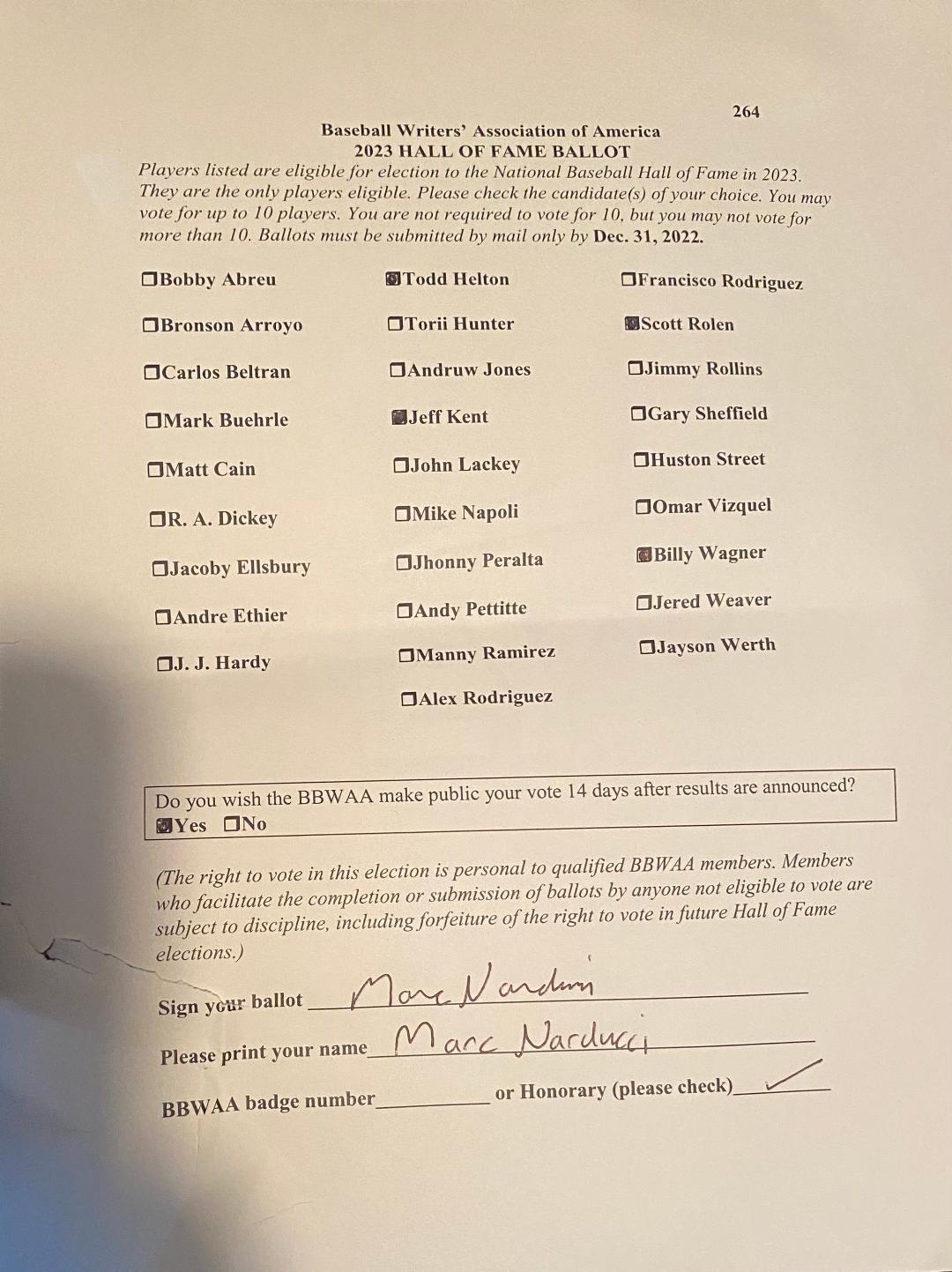
Last season while writing for MLB Trade Rumors about my Hall of Fame ballot, the case was presented that there was no room for the steroid players.
As anybody can see from the comments, my ears were burning as the overwhelming majority of the readers disagreed.
That’s fine. A little discourse is good, and while Barry Bonds, Sammy Sosa and Roger Clemens are off the ballot, and while there are still players on the ballot linked to steroids, the biggest controversy this year centers around Carlos Beltran, albeit, not steroid related.
It was Beltran who MLB said was the mastermind of the Houston Astros cheating scandal in 2017 when they won the World Series. MLB said Houston used an intricate electronic method to steal signs and the only player named as the ringleader was Beltran.
It cost him the job of the New York Mets manager and at least for now, is costing him this vote.
Beltran has a strong resume, a nine-time all-star, three-time Gold Glove winner who, put up a career 279/.350/486 line with 435 home runs and 1,587 RBI.
In 65 postseason games, he hit .307/.412/609 line with 16 home runs and 42 RBI over 256 plate appearance.
Beltran himself said that the Astros World Series title was “stained” by the scandal.
The fact that he was the mastermind, well, that was cheating the game. He was not a slam dunk candidate before this occurred, but he did have a lot in his favor. For now, he will remain off this ballot.
Should all the Astros be punished?
That will be answered later, but for being the mastermind, Beltran pays the price on this ballot.
And for those who don’t think it was a big deal, both the Yankees and Dodgers, who lost to Houston in seven-game series in the ALCS and World Series respectively, didn’t hold back on their criticism of the Astros.
Now back to the ballot, with the players listed in alphabetical order.
One can talk all they want about the advantage for Colorado Rockies hitters in Coors Field and there is some obvious truth, but it’s also difficult to play on the road after hitting in that altitude.
If a player had a .287/.386/469 line for a career, that would open some eyes. The fact that it was Helton’s road total shows what a good hitter he was. At Coors it was .345/.441/.607.
That gave him a career mark of .316/.414/.539.
He was a first baseman who wasn’t known for his power, but he still hit 369 home runs and had 1,406 RBI, while playing all 17 seasons for the Rockies.
He was a five-time All-Star, a four-time Silver Slugger winner and a three-time Gold Glove recipient.
For those who give all the credit to the hitting atmosphere in Coors Field, he has a 133 career OPS+ and a 132 WRC+.
He also won the batting title in 2000, hitting, .372.
Again, while some suggest batting average is an outdated measure to evaluate players, it should be remembered how difficult it is to hit .300. In 2022, only 11 total players from both leagues hit .300 or better. Helton did it for his career.
This is his fifth season on the ballot and his percentage of votes has increased each year. Last year he received 52% of the vote. It may be too big a jump to make the needed 75% threshold this year, but Helton, a former quarterback with Peyton Manning at Tennessee, appears to one day be headed to Cooperstown.
This is Kent’s 10th and final year on the ballot and it doesn’t appear as if he will come close to getting elected by the writers.
Last season he received his highest vote total, 32.7 percent, so unless he has a miracle surge this year, Kent won’t make it.
Still, being the best power hitting second baseman in history is a main reason he made this ballot.
We know Kent was a below average fielder, but nobody hit more home runs as a second baseman in MLB history.
Kent hit 377 home runs, including 351 as a second baseman. The closest second baseman was Rogers Hornsby, who hit 301.
We acknowledge that Hornsby had 325 fewer at-bats than Kent, but the 50- home run difference (as second basemen) is still jaw dropping, especially for a position that isn’t known for power.
While RBI are downgraded by many in the sabermetrics community, most of the top players in the league each season are among the RBI leaders. Kent is third among second basemen in the Hall of Fame with 1,518 RBI.
Only three HOF second basemen have hit more than Kent’s 560 doubles.
Among HOF second basemen, he is second only to Hornsby with a .500 slugging percentage. (Hornsby had an insane .577 slugging percentage).
Kent’s career B-WAR is just 55.4, thanks largely to a -0.1 DWAR.
His .855 OPS is fifth among HOF second basemen.
He not only hit for power, but for average. His had a career line of .290/.356/.500.
Kent was the 2000 MVP, a five-time All-Star, and four-time Silver Slugger recipient.
He was a solid, if not spectacular postseason performer, but qualified for the playoffs seven times with four different teams.
In 49 career postseason games, Kent hit .276/.340/.500 with nine home runs and 23 RBI in 189 plate appearances.
Just a great hitting career, one that was HOF worthy.
Scott Rolen continues to make good progress in his attempt to earn a HOF berth. This is his sixth season on the ballot and last year he received 63.2% of the vote.
He is a player who was as great defensively as he was offensively, maybe even better. There have only been 17 third basemen selected to the HOF, the least among all positions, with the exception of relief pitchers.
Rolen is somebody whose offensive stats weren’t overwhelming, but they were more than good enough to complement his outstanding defense.
First off, he accumulated 70.1 B-WAR, 10th best all-time among third basemen. Of the other nine, eight are in the Hall of Fame and Adrian Beltre is expected to earn induction when he becomes eligible next year.
Just eight Hall of Famer third basemen have a higher career OPS than Rolen’s .855. Ten HOF third baseman have a better OPS+ than Rolen’s 122.
Rolen had a .281/361/.490 line with 316 home runs and 1,287 RBI.
He was a seven-time All-Star, the 1997 National League Rookie of the Year and an eight-time Gold Glove winner and earned one Silver Slugger award in 2002.
Rolen played in the postseason five different times and won a World Series in 2006 with the St. Louis Cardinals. He hit .421/.476/.737 in the Cardinals’ World Series win in five games over the Detroit Tigers.
The 6-4, 245-pound Rolen had great defensive range, even more impressive for somebody his size. He also had a great arm.
He has improved his percentage of votes each year and Rolen is considered to have a good chance to be voted in by the writers, whether it is this year or possibly next.
Like Kent, Wagner’s time is dwindling. This is his eighth year on the ballot, although he had his best showing last year, earning 51.0% of the vote.
The biggest argument against Wagner is his lack of innings. There are eight relief pitchers in the HOF and all have pitched more than the 903 innings that Wagner threw.
Yet Wagner’s 11.9 strikeouts per nine innings is best in MLB history (minimum of 750 innings pitched).
He actually had more strikeouts (1,196) than the greatest reliever of all time, Mariano Rivera. Rivera struck out 1,173 in 1,282 2/3 innings.
According to MLB.com, Wagner had 422 saves in 476 opportunities (88.6 percent). Only two Hall of Fame relievers have a higher save percentage, Rivera (89.1%) and Trevor Hoffman (88.8%).
Wagner also has a higher strikeout ratio (33.2%) than any reliever in the HOF. The closest is Hoffman (25.8%).
Wagner finished with a 2.37 ERA and a 187 adjusted ERA and Rivera is the only HOF relief pitcher who bettered those totals.
Wagner was a seven-time all-star and besides the lack of innings, his other blemish is his postseason performance.
He qualified for the postseason seven times and had a 10.03 ERA in 14 appearances totaling 11 2/3 innings. His postseason WHIP was 1.971.
Yikes.
Still that is a small sample size even if it is in the most pressurized setting.
Even with the lack of innings and a shaky postseason, Wagner’s dominance in the regular season, puts him on this ballot.