
Knocking Down The Door: Burnes, Granite, Mahle, Moya, Smith
“Knocking Down the Door” is a weekly feature that identifies minor leaguers who are making a case for a big league promotion.
Corbin Burnes, SP, Milwaukee Brewers (Double-A Biloxi)
The Brewers’ starting rotation has been much better than expected and, arguably, the biggest reason why they’re sitting atop the NL Central with a 41-37 record. But while their five starters are healthy and performing well at the moment, the team’s rotation depth has taken a hit as of late. Top prospect Josh Hader was moved to a relief role in order to balance out a right-handed heavy bullpen, and Brandon Woodruff landed on the disabled list when he suffered a strained hamstring just before his MLB debut. All of a sudden, Burnes is not only rocketing up the prospect lists with his impressive performance in 2017, he could actually help a playoff-contending Brewers team at some point.
A fourth-round pick in last year’s draft, Burnes posted a 1.05 ERA in 10 High-A starts before a June promotion to Double-A. The 22-year-old right-hander hasn’t slowed down one bit, allowing two earned runs and 10 hits over 23 2/3innings in his four Southern League starts. He threw close to 140 innings in 2016 between the NCAA and the Minor Leagues, so it’s realistic that he can exceed 150 innings this year—he’s currently at 83 2/3—and that some of those innings might actually be thrown at the Major League level.
—
Zack Granite, OF, Minnesota Twins (Triple-A Rochester)
The Twins’ patience with Byron Buxton paid off as he was productive over a 146 plate appearance stretch (.746 OPS from April 21-June 14) after a slow start. But he’s gone ice cold again—he’s 5 for his last 38 with no extra bases and 13 strikeouts—while the Twins have been one of the worst offenses in baseball this month. If they’re looking for a spark, and a player who can at least spell Buxton occasionally in center field, it’s becoming clear that Granite could be a solution.
After his third consecutive two-hit game on Monday, the 24-year-old has a Triple-A slash line of .365/.419/513 in 48 games. His 17 walk-to-22 strikeout ratio might be his most enticing stat considering that Buxton and left fielder Eddie Rosario have combined for 34 walks and 127 strikeouts.
—
Tyler Mahle, SP, Cincinnati Reds (Triple-A Louisville)
Mahle is the first player to earn “Knocking Down The Door” honors for a second time in 2017, although he was dominating at the Double-A level when I pegged him as a potential call-up in early May. This time around, he’s coming off of an impressive Triple-A debut in which he pitched four-hit ball over six innings with no earned runs allowed and nine strikeouts.
A struggling Reds’ rotation was hoping for a shot in the arm with Homer Bailey and Brandon Finnegan both back from the disabled list. But Bailey’s 2017 debut was disastrous (1 2/3 IP, 8 ER) and Finnegan is headed back to the DL with a shoulder injury. The Reds have already used an NL-leading 12 starting pitchers and are certain to dip into their farm for reinforcements again at some point. Will the 22-year-old Mahle be the 13th?
—
Gabriel Moya, RP, Arizona Diamondbacks (Double-A Jackson)
Fernando Rodney and Archie Bradley have been the keys to solidifying what appeared to be a very suspect Diamondbacks bullpen heading into the season. But, will it hold up down the stretch as they try to lock down their first playoff berth since 2011? It would be a surprise if general manager Mike Hazen didn’t acquire some late-inning help prior to July 31st, but they could also take a look at some potential in-house options prior to the deadline. Moya, a 22-year-old who has been close to unhittable as the Double-A closer, should be considered.
The left-hander out of Venezuela has allowed a run in only two of his 26 appearances while holding opponents to a .139 batting average and walking only 12 hitters with 52 strikeouts in 34 1/3 innings. Right-handed hitters have a .107 batting average against him, which is at least an indication that he could be more than a situational reliever.
—
Caleb Smith, SP, New York Yankees (Triple-A Scranton/Wilkes-Barre)
With Chance Adams still waiting for a much-deserved and much-anticipated MLB call-up, Smith’s work in Triple-A has gone relatively unnoticed. The 25-year-old lefty has made 14 starts in 2017 and has allowed two earned runs or less twelve times, including back-to-back gems (13 IP, 0 ER, 7 H, 2 BB, 13 K) to lower his ERA to 2.84 with impressive peripherals across the board (6.5 H/9, 2.3 BB/9, 8.5 K/9).
Finding The Red Sox A Third Baseman
The Red Sox are currently locked in a battle for the AL East with the Yankees, with all three other divisional opponents within five and a half games of first. For a Boston organization that has invested heavily in adding quality veterans, it’s buy time at the deadline.
It doesn’t take much analysis to identify the Sox’ chief need: third base. We needn’t belabor the point; just click on this leaderboard and keep scrolling to the bottom. Simply put, Boston improve more by getting better at the hot corner than by upgrading any other area of the roster.
That analysis, in and of itself, doesn’t mandate a trade. There are always internal possibilities — in this case, quite a few — and that’s always the first place to consider. So, we’ll start there and then cycle through the outside solutions.
Internal Options
Right now, the Red Sox are trotting out light-hitting youngsters Deven Marrero and Tzu-Wei Lin. The former carries a sub-.500 OPS at all levels over the past two seasons. And while the latter has had an emergent year at Double-A, slashing .302/.379/.491, he had never played above that level prior to his call-up and has never finished a minor-league campaign with an OPS of over .659 (with that coming in a short sample at Rookie ball). Both of these players are gap fillers, at least for 2017.
The disabled list includes some notable names, of course. Brock Holt is a question mark as he deals with vertigo; Josh Rutledge has just gone on the DL with lingering concussion issues. It’s hard to trust either of those two moving forward, though either could provide a boost in a utility role later in the season. Marco Hernandez is shelved for the year after shoulder surgery.
That brings us to the panda in the room. The struggling Pablo Sandoval went on the DL with an inner ear infection. A quality regular would surely be right back up once the illness passed, but he’s heading out for rehab work at Triple-A. There, he’ll compete with veteran Jhonny Peralta for a possible chance at going back to the majors and earning a more extended opportunity. The outlook isn’t great for either player, as both have shown poorly in the field and at the plate for extended stretches. Sandoval owns a .237/.286/.360 batting line over his three years in Boston, while Peralta has declined steadily over the past few seasons before falling off a cliff (.204/.259/.204) early in 2017.
Even if one of those players shows enough to be trusted with a roster spot beyond the deadline, the Red Sox will surely decide to add a complementary piece. If there’s a conceivable everyday player in the organization, it’s 20-year-old top prospect Rafael Devers. He’s performing quite well at Double-A, with a robust .291/.354/.550 slash and 14 home runs. The organization has not seen fit to move him up to Pawtucket, though other impressive young players have bypassed Triple-A on their way to Boston in the past. Devers is definitely worth keeping an eye on, but even if he’s the man, you’d probably expect some kind of contingency or veteran complement.
So, let’s look elsewhere to see what the Red Sox could find via trade:
Potentially Available Veterans
The most obvious trade candidate on the hot corner market is Todd Frazier. His once-potent bat has cooled since he landed with the White Sox at the start of 2016, as he has struggled to maintain a palatable on-base percentage while also maintaining his power output. Last year, Frazier swatted forty bombs but made it aboard at a subpar .302 clip. He’s up to a .322 OBP in 2017, with his walk rate climbing all the way to 13.6%, but that’s accompanied by a .212 batting average and lessened power output (.216 ISO; 13 home runs).
Frazier has hit better in June, and can still handle third, but he’s also earning $12MM; with approximately $9MM in available space before hitting the luxury tax, adding his full salary might hamstring the team’s efforts to add other pieces. While the White Sox would no doubt be willing to hold onto some of the cash, that’d increase the prospect pain to get a rental player who comes with quite a few questions.
There are some alternatives, of course, though some potential trade candidates currently don’t look like options. With the Royals streaking, Mike Moustakas no longer seems likely to be made available. The Angels sit two games over .500, so the steady but unspectacular Yunel Escobar is probably staying put. Neil Walker of the Mets could conceivably move over to third, though he hasn’t played there at all since 2010, but he’s dealing with a significant hamstring injury and is owed $17.2MM this year.
More likely targets include old friend Jed Lowrie (Athletics), the sturdy Howie Kendrick (Phillies), Eduardo Nunez (Giants) and seemingly disgruntled ex-shortstop Asdrubal Cabrera (Mets). With Oakland engineering a youth movement, Lowrie is eminently available; he has hit well and stayed mostly healthy this year. Kendrick has excelled at the plate and brings wide defensive versatility, though he has lined up at third for just 132 innings in his lengthy career. Nunezm who will soon return from a minor leg injury, has emerged as a solid hitter bat and brings some defensive versatility to the table. With the Giants buried in the NL West, Nunez, who is a free agent at season’s end, seems like a good bet to be traded. As for Cabrera, his beef with the Mets involves a desire to remain at shortstop, but perhaps he’d still be amenable to lining up elsewhere. A solid hitter, Cabrera has barely seen any action at third in the majors, though he has spent plenty of time on the left side of the infield.
Beyond this group, it requires a bit more creative thinking. Zack Cozart is a wizard at short who the Reds will no doubt be shopping. He has hit quite well this year and is a pure rental piece. With questions about market demand at the more demanding position, perhaps he could slot in at the hot corner. But Cozart is currently on the DL, as is Padres infielder Yangervis Solarte. In his case, he’d be a solid addition, but his cheap future control likely increases the asking price. Boston may or may not have much interest in paying for those future rights; the contract could always be flipped in the winter, though again that’s a complicating factor. Pirates veteran David Freese could be a steady addition, though he has cooled after a strong start to the year. Then again, the Bucs aren’t yet buried and likely see added value in his affordable contract given the vast uncertainty surrounding Jung Ho Kang. If the club elects to pursue more of a utility option, Freddy Galvis of the Phillies could conceivably be considered, though he owns a lifetime .282 on-base percentage. While the Marlins would surely like to move the sizable contract of Martin Prado, he has been hurt and/or ineffective for much of the season and is owed a hefty $28.5MM over the two ensuing campaigns.
Aiming Bigger
If noted deal-maker Dave Dombrowski decides to set his sights higher, he’ll likely have his work cut out for him. The two teams bringing up the rear in the AL East — the Blue Jays and Orioles — just happen to control two of the very best third basemen (and overall players) on the planet. But there’s no indication at this time that either Josh Donaldson or Manny Machado are available, let alone that these organizations would be pleased to send them to a division rival for the next one-and-a-half years. The prospect haul would be astronomical in either case, and there’d be competition from other organizations, though surely Dombrowski would be involved if there’s any possibility of adding such a premium player.
Perhaps the best fit, from the Sox’ perspective, would be the legendary Adrian Beltre. He’s not cheap, with an $18MM salary this year and next, but he’s back to playing at a top level after missing the first part of the year due to injury. Unless the Rangers completely fall apart over the next several weeks, though, he’s staying put. (Even if they do fall out of the Wild Card hunt, he could be retained.) Similarly, while the Cardinals are in a tenuous postseason position, they don’t seem to be primed for a major tear-down. That makes Jedd Gyorko a questionable target in terms of availability.
We touched upon the Bucs above, but their more attractive hot-corner possibility would also be harder to get. Josh Harrison is in the midst of a resurgent 2017 season, with an excellent .291/.369/.458 batting line. Plus, his outstanding versatility and athleticism, along with an affordable contract, makes him an asset that would give any team roster flexibility in the seasons to come. The Pirates know that, too, which is why he’d likely command a rather significant return.
The other more significant possibilities seem like real stretches. Maikel Franco could be made available by the Phillies, but that’s only because he has struggled so badly; that doesn’t make him a terribly sensible player to pursue. Tigers second baseman Ian Kinsler would be a nice addition to the lineup, and comes with a palatable option for 2018, but he hasn’t seen significant action on the left side of the infield since he was in A ball. (Kinsler also has a ten-team no-trade clause, though it’s not known if it includes the Red Sox.)
Overview
If the above effort tells us anything, it’s that there are loads of options out there. Just what direction the Sox take will be dictated by some of the internal developments as well as the way the market moves. Working in Dombrowski’s favor here, it seems, is the fact that few other contenders will be looking specifically at third base. At the end of the day, even if Sandoval or one of the other current Red Sox players play a part in the rotation at third, it seems quite likely that there’ll be some kind of addition on or before July 31st.
Taking Inventory: New York Mets
This is the 11th entry in MLBTR’s Taking Inventory Series. Click for entries on the White Sox, Royals, Phillies, Pirates, Giants, Padres, Reds, Braves, Tigers, and Marlins.
The Mets never expected to be in a selling position this year, but underperformance and a spate of significant injuries have destroyed any hopes of contention. Were it not for the runaway NL Wild Card race, New York might still have hope of staying in the hunt, but as things stand it seems quite likely they’ll move a few veterans.
Let’s see what’s in the cupboard for the Mets:
Rentals
Addison Reed, RH Reliever | Salary: $7.75MM
Reed has completely turned his career around since landing in New York in 2015. He has given up a few more home runs this season than he did in his dominant 2016 campaign, but otherwise has been much the same pitcher. With 9.2 K/9 (13.9% swinging-strike rate) and just 1.2 BB/9, Reed is thriving even as he has lost half a tick on his average fastball velocity. It probably doesn’t hurt that he’s back to working in the closer’s role, too. All things considered, Reed is quite possibly the club’s biggest trade chip.
Jay Bruce, OF | Salary: $13MM
Bruce only just turned 30 and is posting a strong .270/.339/.543 slash on the season, with twenty long balls already in the bank through just seventy games. He doesn’t run like he used to, but Bruce has received positive defensive grades this year after several seasons of questionable glovework.
Curtis Granderson, OF | Salary: $15MM
That’s quite a lot of coin for a 36-year-old corner outfielder who’s only hitting near the league average. But Granderson can also still play some center and has gotten hotter and hotter at the plate as the season has progressed. The respected veteran could be quite a useful piece for the right team.
Lucas Duda, 1B | Salary: $7.25MM
If there’s enough demand, Duda could potentially bring back something interesting. He has returned to posting strong on-base and slugging numbers after a lost 2016 season, and would represent a middle-of-the-order bat for a contender.
Neil Walker, 2B | Salary: $17.2MM
If he can make it back from a hamstring tear before the deadline, Walker could draw real interest. The veteran remains a quality hitter and was on a tear when he got hurt. That said, demand doesn’t figure to be strong at second base, and the big salary will present an obstacle.
Fernando Salas, RH Reliever | Salary: $3MM
He seemed like a solid value after a strong finish last year with the Mets, but Salas has struggled badly in 2017. Teams may still take a shot since he’s generating strikeouts (9.9 per nine) with a 12.5% swinging-strike rate. While his walks are way up, Salas has been unfortunate to carry a 5.88 ERA; he’s being tagged for a .357 BABIP and has stranded just 64% of the runners to reach base against him.
Jose Reyes, INF | Salary: $535K
The meager salary is nice, but Reyes just isn’t producing. After turning in a solid part-year with the stick in 2016, Reyes currently owns a meager .191/.266/.323 batting line — due in some part, at least, to a .202 batting average on balls in play. Though he runs well, his defense is a bit shaky. With the stain of a domestic violence suspension also potentially a factor, it’s not clear that there’ll be any real market here.
Rene Rivera, C | Salary: $1.75MM
The 33-year-old is a respected defender who is slashing a respectable .268/.305/.423 over his 131 plate appearances on the year. While he’s obviously not the sort of player who’s going to draw a major return, he could hold appeal to a contending team in need of some depth behind the dish.
Controlled Through 2018
Jerry Blevins, LH Reliever | Salary: $5.5MM; $7MM club option ($1MM buyout) for 2018
Like Reed, the 33-year-old has never looked better than he has when pitching out of the Mets’ pen. He’s currently setting down 13.0 batters per nine via strikeout with a 14.1% swinging-strike rate that’s easily his personal best. Blevins is also hitting the zone much less frequently than usual while battling through a league-leading 39 appearances. His value is enhanced quite a bit by the reasonably priced option year; the Mets have plenty of leverage, too, since they’d no doubt like to have him at that rate.
Asdrubal Cabrera, INF | Salary: $8.25MM; $8.5MM club option ($2MM buyout) for 2018
After publicly requesting a trade and airing some complaints about the team’s handling of his move off of shortstop, it’s no longer clear that Cabrera is in the Mets’ 2018 plans. At the same time, he’s not exactly at the height of his appeal as a trade chip. While he’s still hitting in range of his typically slightly-above-average rate, Cabrera isn’t a great baserunner or defender.
Longer-Term Assets
It seems rather unlikely that the Mets will really go out looking for deals for any longer-term pieces, at least for core players such as Yoenis Cespedes and Jacob deGrom. Pitchers Josh Edgin, Hansel Robles, and Rafael Montero could conceivably end up changing hands, though none seem likely to be targeted by contenders. Juan Lagares could hold some appeal, but he’s probably slated for some kind of timeshare in center at Citi Field next season. It’s anyone’s guess just how things will turn out with Matt Harvey in the long run, but he’s on the DL at present with another fairly significant arm injury.
Taking Inventory: Miami Marlins
This is the 10th entry in MLBTR’s Taking Inventory Series. Click for entries on the White Sox, Royals, Phillies, Pirates, Giants, Padres, Reds, Braves and Tigers.
While the Marlins have played better of late, they face an uphill climb just to get to within striking distance of postseason contention. The signs point to moving some veteran assets, but there’s also a significant complication. As ownership continues to explore a sale of the team, it’s unclear how that process could bear on the decisions at the trade deadline. One thing is for certain: Adeiny Hechavarria looks to be on the way out the door in the next day or so, with the Rays standing as the rumored front-runner to acquire his services. That move is reportedly driven by an ownership push to clear his salary, so perhaps Jeffrey Loria will continue to shed payroll in the weeks to come.
Here are the Miami players who’ll likely draw some trade consideration:
Rentals
Dustin McGowan, RHP (reliever) | Salary: $1.75MM
The 35-year-old McGowan has revived his career with the Marlins over the past two seasons, tossing a combined 107 innings of 2.78 ERA ball with 8.2 K/9, 2.0 BB/9 and a ground-ball rate of nearly 53 percent. McGowan’s velocity is down this season, but his control has improved as well. A team in need of middle relief help wouldn’t have to part with much to pick him up.
A.J. Ellis, C | Salary: $2.5MM
Ellis hasn’t played much this year, totaling just 63 plate appearances, and in that time he’s batted .200 with a .290 OBP and no extra-base hits. Barring a revival of some sort at the dish, which will be difficult with such limited playing time, he’s unlikely to generate much interest.
Controlled Through 2018
Adeiny Hechavarria, SS | Salary: $4.35MM, arb-eligible 2018
As previously noted, Hechavarria seems decidedly likely to move in the next day or so. The Marlins reportedly are hoping to move him before Tuesday’s series opener, when he’d have to be activated from the DL and would force a corresponding roster move. The Rays and Padres are among the teams currently linked to him, but Hechavarria’s salary and lack of offense should limit the return.
Edinson Volquez, RHP (starter) | Salary: $9MM in 2017, $13MM in 2018
After a terrible start to the season, Volquez has turned it on. His turnaround was highlighted by a June 3 no-hitter against a stacked Diamondbacks lineup, but Volquez was pitching fairly well even before that outing. He’s posted a 3.86 ERA with a 44-to-27 K/BB ratio across his past nine starts, spanning 54 2/3 innings. Volquez is an innings-eater at worst and a slightly above-average starter at best, and his contract, while not a bargain, isn’t outlandish.
David Phelps, RHP (reliever) | Salary: $4.6MM in 2017, arb-eligible 2018
The 30-year-old Phelps broke out as a dominant late-inning weapon for the Marlins in 2016, and while he hasn’t been quite as good in 2017, he’s still a highly desirable bullpen piece. Through 34 innings this season, he’s posted a 3.65 ERA with 9.2 K/9 against an improved 3.4 BB/9 and a 44.9 percent ground-ball rate. And dating back to last season, Phelps has a 2.69 ERA in 123 2/3 innings. Phelps has experience as a starter, including five starts in 2016, so he can definitely handle a multi-inning role. Some teams may even have interest in trying him in the rotation once again.
Tom Koehler, RHP (starter) | Salary: $5.75MM, arb-eligible 2018
The Marlins have reportedly been open to trading Koehler for roughly a month. The righty is currently in Triple-A after a brutal start to the season (7.28 ERA in 38 1/3 innings), and he’s allowed just two runs with a 22-to-5 K/BB ratio in 15 2/3 innings there. Koehler, 30, is hardly teeming with upside, but from 2013-16 he logged a perfectly respectable 4.14 ERA with 6.8 K/9 against 3.7 BB/9. His 2017 performance has probably torpedoed his modest trade value, but Koehler has a fourth starter’s track record and wouldn’t require any notable young talent to acquire.
Brad Ziegler, RHP (reliever) | Salary: $7MM in 2017, $9MM in 2018
Miami’s highest-profile bullpen addition of the offseason, Ziegler has been surprisingly ineffective in 2017 and is currently on the disabled list with a back injury. Ziegler’s ground-ball rate remains elite, and he’s inducing more pop-ups in 2017 as well. But, his strikeout and walk rates have both gone in the wrong direction, and his combination of salary and injury makes it difficult to envision a move at this juncture.
AJ Ramos, RHP (reliever) | Salary: $6.55MM in 2017, arb-eligible 2018
The Marlins’ closer since 2015, Ramos routinely posts gaudy strikeout totals with questionable control. That’s truer than ever in 2017, as he’s currently sporting a career-high 12.2 K/9 against a lackluster 4.9 BB/9. The 30-year-old’s strikeout rate and reasonable salary should create some trade value if Miami looks to move him, though it’s interesting that the Nationals, perhaps baseball’s most bullpen-needy contender, reportedly don’t have all that much interest.
Junichi Tazawa, RHP (reliever) | Salary: $5MM in 2017, $7MM in 2018
Like Ziegler, Tazawa inked a two-year deal in Miami as a free agent this winter but has been a bust to this point in the season. Tazawa’s 6.88 ERA, 6.4 K/9, 4.8 BB/9 and 27.5 percent ground-ball rates are all career-worsts. Right now, he looks more like a DFA candidate than a trade candidate, though he did just return from a month-long stint on the DL, so perhaps he can get back on track now that he’s been deemed healthier. Those numbers, after all, come in a sample of just 17 innings, so it won’t take too long for Tazawa to turn the tide.
Jeff Locke, LHP (starter/reliever) | Salary: $3.025MM, arb-eligible 2018
Non-tendered by the Pirates this past winter, Locke signed a one-year deal with the Fish and missed the first two months of the year with tendinitis in his biceps. He’s healthy now but hasn’t looked much better than he did prior to this offseason’s non-tender. Through 23 2/3 innings, Locke has a 20-to-9 K/BB ratio with an improved 53.8 percent ground-ball rate. He does have a history of serviceable work as a fifth starter and can probably be had for little more than salary relief.
Controlled Through 2019
Marcell Ozuna, OF | Salary: $3.5MM in 2017, arb-eligible through 2019
Ozuna may be the best combination of trade value and actual plausibility of a trade. Ozuna has just two years of control left and a price tag that should soar in arbitration thanks to a career year in ’17, so the Marlins may look to cash in and acquire a haul in return for his bat this summer. Through 74 games/316 plate appearances, Ozuna has hit .319/.383/.575 with 20 homers and 13 doubles. He’s already just three big flies short of his career-high and looks like a virtual lock to clear 30 homers this year. On top of that, Ozuna is capable of playing center field and has played considerably above-average defense in left field thus far in 2017 (+5 Defensive Runs Saved, +4.4 Ultimate Zone Rating). If he’s moved this summer, the Marlins would likely be selling near his peak value.
Martin Prado, 3B | $11.5MM in 2017, $28.5MM through 2019
Re-signed prior to hitting the open market last year, Prado has missed time this season with a pair of hamstring injuries. He’s batted just .278/.301/.392 in 83 plate appearances even when healthy, the Marlins are known to love his clubhouse presence, and his remaining salary looks untradeable at the moment. All of that is to say, Prado seems likely to stay in Miami for now.
Tyler Moore, 1B/OF | $1MM in 2017, arb-eligible through 2019
Moore has belted six homers in a tiny sample of 81 plate appearances while posting an overall .263/.284/.566 batting line. The Marlins picked him up on a minor league deal this winter, and he’s already cleared waivers once. Moore is the type of asset that is routinely flipped for cash or a player to be named later, and he could potentially help another team’s bench in 2017.
Longer-Term Assets
Giancarlo Stanton, Christian Yelich, Dee Gordon, J.T. Realmuto, Kyle Barraclough, Justin Bour, Dan Straily, Derek Dietrich, Wei-Yin Chen, Adam Conley
Stanton may find his way into some trade rumors this summer, but the reality is that he’s still guaranteed a total of $295MM through the 2027 season and can opt out of his contract following the 2020 campaign. It’s exceptionally difficult to imagine any club taking that contract on, and even if the Marlins find a team that’s interested (and/or if they agree to pay down a huge portion of the deal), Stanton has a full no-trade clause as well. If the Marlins sell, there will be tons of speculation, but Stanton is likely staying put.
Yelich, on the other hand, doesn’t have a no-trade clause but would come with an enormous price tag in a trade a cost-controlled young star on an affordable deal. His offense is down in 2017, but he’s still drawing walks and is actually striking out less than in recent years. Yelich has spent his whole career playing his home games in a pitcher-friendly environment yet still owns a lifetime .289/.366/.424 triple slash in the Majors, to say nothing of quality baserunning skills and excellent left field defense (though he’s playing center in 2017). Yelich is still just 25 years old and is owed $44.5MM from 2018-2021, and his contract has an option for the 2022 season as well.
Gordon, meanwhile, isn’t producing as he did in 2015, though he’s still a nightmare for opposing pitchers on the basepaths and an above-average defender at second base. He’ll earn $38MM from 2018-20 and has an option for the 2021 season, though teams will undoubtedly be a bit wary of Gordon following last year’s PED suspension.
As was the case for the Reds in 2017, Straily has beaten expectations and proven to be a bright spot in the rotation. He boasts a 3.43 ERA with career-best K/9 (9.2) and BB/9 (2.9) rates in addition to a 38.1 percent ground-ball rate. Straily is still controlled through 2020, and though his .259 BABIP looks like it’s due for regression, it’s actually right in line with his career .255 mark. He’s likely improved his trade stock in Miami, and he’ll be arb-eligible for just the first time this winter.
It’s tough to see the Marlins having much interest in moving either Realmuto or Bour, both of whom are healthy, playing terrifically, and are controlled through the 2020 season. Each will be arbitration-eligible for the first time this winter and should maintain an affordable salary. Barraclough is a bit easier to envision simply due to his control issues and the volatile nature of relievers, but he’s controlled through 2021 and has posted some of baseball’s best strikeout numbers since debuting in 2015.
Dietrich was an above-average bat (.261/.355/.427) without much defensive value from 2014-16, but now he’s not hitting, either. As such, it’s difficult to envision him garnering much interest, though maybe a team in need of a bench piece would be intrigued by his track record and look to buy low. Chen, meanwhile, is completely immovable due to the $52MM remaining on his deal from 2018-20 and a partially torn ulnar collateral ligament that might not allow him to pitch again this season. Conley has pitched to a 7.53 ERA in the Majors this year and a similarly troublesome 6.42 mark in Triple-A. He’s still in his pre-arbitration years, so Miami wouldn’t get any cost savings from dealing him.
MLBTR Originals
Here is the week’s original content from the MLB Trade Rumors team…
- Jeff Todd’s latest edition of the Top 50 Trade Deadline Candidates featured several changes from the previous list, published just over a week ago, as various players have entered and exited the rankings based on their teams’ fortunes. One constant has been White Sox closer David Robertson, who has topped all three of Jeff’s Top 50 rankings.
- Trevor May is providing MLBTR readers with a running diary of his rehabilitation process from Tommy John surgery. In his latest entry, the Twins right-hander deals with the complications of having both a balky right arm and left leg (the tissue used to repair May’s UCL was taken from his left knee’s gracilis tendon).
- In the latest three installments of the Taking Inventory series, Connor Byrne explored possible trade chips on the Reds and Tigers rosters, while Jeff looked at who the Braves could shop in the lead-up to the trade deadline.
Taking Inventory: Detroit Tigers
This is the ninth entry in MLBTR’s Taking Inventory series. Click for entries on the White Sox, Royals, Phillies, Pirates, Giants, Padres, Reds and Braves.
The Tigers entered the 2017 campaign with the seemingly realistic goal of contending for a playoff spot, but their season has gone off the rails in recent weeks. Losers of eight straight, the Tigers own the American League’s worst record (32-42) and sit seven games out of a wild-card spot and 7.5 games behind AL Central-leading Cleveland. With the trade deadline approaching, Detroit looks like a seller in the making, which general manager Al Avila essentially admitted earlier this week when he indicated he’d listen to teams’ offers for his veteran players.
Rentals
J.D. Martinez, RF | Salary: $11.75MM
As an impending free agent in the midst of his fourth straight excellent season at the plate, the 29-year-old Martinez stands out as the Tigers’ most obvious trade chip. A foot injury suffered in spring training kept Martinez out of action until May, but he has returned to slash a red-hot .288/.373/.626 with 12 home runs and a .338 ISO in 161 plate appearances. While those power numbers will regress (he slugged .540 and posted a .241 ISO from 2014-16), Martinez will remain a significant offensive threat when they do. Few major leaguers are hitting the ball harder than Martinez this year, per Statcast (via Baseball Savant), and he’s also running what’s easily a career-high walk rate (12.4 percent). Dating back to last season, Martinez has been rather weak in the field, where he registered minus-22 defensive runs saved and a minus-17.2 Ultimate Zone Rating in 2016 (and has already been worth minus-5 DRS this year). Despite that, teams in need of an offensive jolt will show pre-deadline interest in the reasonably priced slugger.
Alex Avila, C | Salary: $2MM
As impressive as Martinez’s batted-ball numbers are, Avila’s might be even better. The resurgent 30-year-old, who’s the son of Detroit’s GM, trails only Aaron Judge and Miguel Sano in average exit velocity (93.9 mph) and paces the majors in rate of balls hit at least 95 mph (62 percent). That has led to a ridiculous .320/.438/.588 line in 185 PAs for the lefty-swinging Avila, who has emerged as one of the newest poster boys in baseball’s fly ball revolution. Avila’s fly ball rate has nearly doubled since last season (from 22.8 percent to 41 percent), and he has cut down on strikeouts while managing an elite-level walk rate for the third straight year. As with Martinez, some regression is in order (Avila won’t sustain a .433 batting average on balls in play, for instance), and Avila’s pitch-framing numbers leave plenty to be desired on the defensive side. But the onetime All-Star’s offensive revival looks worthy of betting on, especially given his cheap salary. A contender like the Red Sox could clearly use more offensive production from behind the plate, and their president of baseball operations, Dave Dombrowski, is quite familiar with Avila after previously serving as the Tigers’ GM.
Controlled Through 2018
Ian Kinsler, 2B | Salary: $11MM in 2017; $10MM club option (or a $5MM buyout) in 2018
It would make sense for the Tigers to shop the 35-year-old Kinsler, who’s amid another solid season, but moving him won’t be easy. He can block deals to 10 teams, for one, and wasn’t interested in waiving his no-trade rights over the winter unless a contract extension came with it. Also, barring injuries, it doesn’t look as if second basemen will be in high demand prior to the deadline.
Justin Wilson, RP | Salary: $2.7MM in 2017; arbitration eligible in 2018
Teams might not line up for Kinsler should he land on the block, but given the ever-increasing importance of bullpens in today’s game, the same won’t be true for Wilson if the Tigers shop him. The 29-year-old left-hander took over for the just-released Francisco Rodriguez as Detroit’s closer earlier in the season, and while save opportunities have been scarce, Wilson has still offered quality production when the team has turned to him. After averaging more than a strikeout per inning in each season from 2014-16, Wilson’s K/9 has increased to a career-best 12.84, and he’s running a palatable 2.96 ERA/3.50 FIP/3.58 xFIP trio. There are some concerns here, including an elevated walk rate (3.95 per nine, up from 2.61 last season) and a career-low ground-ball percentage (35.0, down from 54.9 in 2016), but effective, low-priced relievers who throw hard are hot commodities.
Jose Iglesias, SS | Salary: $4.1MM in 2017; arbitration eligible in 2018
It’s unclear whether the Tigers will market Iglesias. If they do, though, the Marlins’ return for the on-the-block Adeiny Hechavarria will be worth watching for Detroit. Hechavarria is a similar player to Iglesias and comes with matching team control and a nearly identical salary (Hechavarria makes $4.35MM). Like Hechavarria, Iglesias is a defense-first shortstop, though the latter was once a league-average hitter. That has changed over the past two seasons, as the 27-year-old Iglesias has combined to bat just .255/.306/.366 with four homers across 513 PAs. To his credit, Iglesias has saved 12 runs (including nine already this year) and posted a 16.3 UZR over that time.
Longer-Term Assets
Justin Upton, Miguel Cabrera, Justin Verlander, Shane Greene, Alex Wilson
Of the three-high priced names on this list (Upton, Cabrera and Verlander), Upton is the only one with iffy team control status. At the end of the season, the left fielder will have the chance to opt out of the remaining four years and $88MM left on his contract, which won’t do his trade value any favors. The 29-year-old Upton has rebounded from a disappointing 2016, his first season in Detroit, to slash .268/.354/.496 with 14 long balls in 288 trips to the plate to perhaps make an opt-out a bit more realistic than it previously looked. The odds of a trade, on the other hand, appear remote.
Cabrera and Verlander are on even larger salaries than Upton over the next several years, and both have earned full no-trade rights. Those factors make potential trades complicated enough, but when you add in that both are 34 and now look downright mortal relative to their usual selves, in-season deals for either probably aren’t happening.
It’s debatable whether the Tigers should shop Greene or Wilson (or any other inexpensive assets), as they’ll need cheap contributors to step up in their forthcoming efforts to cut spending. Avila did listen to offers for Greene last winter, though, and he could continue to pique bullpen-needy teams’ interest as a hard thrower who’s making a near-minimum salary and comes with three arbitration-eligible years of control. Greene, 28, has pitched to a 3.57 ERA and posted 9.68 K/9 against 4.58 BB/9, with a 46.7 percent grounder rate, over 35 1/3 innings this season. Wilson also carries some appeal as a high-velocity righty with an affordable salary this season ($1.175MM) and two arb-eligible years. He doesn’t bring Greene’s bat-missing ability to the table, but the 30-year-old Wilson has survived a below-average K/9 (5.77) during his 230 2/3-inning career to post a 2.93 ERA (3.69 this season).
Top 50 Trade Deadline Candidates For 2017
With trade season entering full swing, we’ll be doing these lists with greater frequency. We last checked in about a week ago. Click here for the first one, including an explanation of the approach. Basically, we’re looking at both trade likelihood and trade value (in all its facets).
There’s quite a lot of change in the new list, in large part reflecting some shifts in the standings — and shifts in apparent stances from a few key organizations. Just because a team moves into a likely or plausible selling position, though, doesn’t mean that it will necessarily be open to dealing away all of its shorter-term assets. I considered every organization’s strategic position closely in making the list, with the result that some big names snuck in and others did not. That’s all open to debate — and also to modification, as new information reaches the market.
On to the rankings:
1. David Robertson, RH Reliever, White Sox (LR: 1): The results are still there, though Robertson doesn’t carry the same kind of lock-down profile that several top relief trade candidates did last summer. Still, he’s an obvious trade piece for the White Sox and continues to hold down the top spot.
2. J.D. Martinez, OF, Tigers (LR: 14): The Tigers are streaking in the wrong direction, and Martinez is doing the opposite. He’d be an impact rental bat for any lineup and isn’t even all that expensive.
3. Pat Neshek, RH Reliever, Phillies (LR: 4): He hasn’t allowed a run since mid-May and could be the likeliest pitcher in all of baseball to be traded.
4. Jed Lowrie, 2B/3B, Athletics (LR: 8): The writing is on the wall with Franklin Barreto up and in the lineup at second base today. Given Oakland’s aggressive paring of veterans, a deal could conceivably come at any time.
5. Jose Quintana, SP, White Sox (LR: 4): “Q” is finally on a bit of a roll, with a 2.25 ERA and 24:8 K/BB ratio over 24 innings in his last four starts.
6. Yonder Alonso, 1B, Athletics (LR: 3): It’s not clear just how realistic the extension chatter is, but that does create some alternative to a trade. He’s also on a bit of a cold streak at the plate, though in the aggregate the stock is still up.
7. Addison Reed, RH Reliever, Mets (LR: NR): With the news that New York is likely lining up to sell, Reed becomes their top trade asset. The 28-year-old has been somewhat susceptible to the long ball, but otherwise has dominated and will be a top rental reliever.
8 (tie). Justin Wilson, LH Reliever, Tigers (LR: NR): With rising strikeout (12.8 K/9) and swinging-strike (13.8%) rates, and a power arsenal from the left side, Wilson looks like a very appealing chip. He’s also earning just $2.7MM this year with another year of arb control remaining.
8 (tie). Brad Hand, LH Reliever, Padres (LR: 7): Since surrendering a four-spot two weeks ago, Hand has turned in six straight scoreless outings. While he’s holding steady, there are alternatives for teams looking at southpaw relievers.
10. Sonny Gray, SP, Athletics (LR: 4): While the A’s are clearly lining up sales, and do have a variety of young pitchers to use in the rotation, it’s still a bit unclear where things are headed with Gray. He has looked quite good at times, but was knocked around in his last two outings and has generally failed to find consistency.
11 (tie). Ryan Madson (RH Reliever) & Sean Doolittle (LH Reliever), Athletics (LR: 13, 27): With solid peripherals (8.6 K/9, 1.8 BB/9, 53.8% GB) and good results (2.45 ERA), Madson continues to look like a nice target for contenders. Meanwhile, a dominant return from the DL has Doolittle rising. While the A’s are clearly selling, though, his health history and advantageous contract make his status a bit uncertain as the deadline ramps up.
11 (tie). David Phelps & A.J. Ramos, RH Reliever, Marlins (LR: 15, 18): There have been some ups and downs, and the command remains a concern, but Ramos has been at his best in June. Over 8 2/3 innings, he has racked up 13 strikeouts against three walks while allowing only two earned runs on five hits. Phelps has been touched a few times of late, but still has strong peripherals and looks to be a nice, sturdy pen piece. Both pitchers are reasonably affordable and come with an added season of arb control.
15. Howie Kendrick, LF/2B, Phillies (LR: 8): The steady veteran is hitting as well as ever, but it’s not yet clear when he’ll be made available and just how much demand there’ll be, especially with other corner outfielders and utility infield types available.
16. Adeiny Hechavarria, SS, Marlins (LR: NR): Miami seems to be itching to deal Hech, in large part to save some of the $2MM+ he’s still owed in 2017. He’s a gifted defender who doesn’t hit all that much, but would represent a useful fill-in at short who could then slide into a utility role for a contender.
17. Todd Frazier (3B) & Melky Cabrera (OF), White Sox (LR: 11 (tie)): Chicago has little reason not to simply get what it can for these expensive veterans, though other organizations may well first prefer to look into other options.
19. Marcell Ozuna, OF, Marlins (LR: 13): It’s still anyone’s guess whether Miami will look to deal Ozuna with the franchise up for sale, but he’d be a big trade chip if he’s shopped.
20. Ian Kinsler (2B) & Justin Upton (OF), Tigers (LR: NR): In Kinsler’s case, there’s a ten-team no-trade clause to be hurdled — particularly if he continues to seek an extension to waive it (see here and here) — but that may not be as big an obstacle now as it was in the winter. While he isn’t producing like he did last year, and doesn’t play a position that figures to come with much demand, Kinsler is a solid veteran who can be controlled for just $10MM next year. As for Upton, he has yet to turn 30 and is posting a strong .267/.352/.494 batting line through 284 plate appearances. He’ll either hit the open market or stick around for $22.125MM a year through 2021; while that’s quite a drastic difference, perhaps the opt-out clause isn’t as big a barrier to a trade in his case as it is in that of an older pitcher.
22. Tony Watson & Juan Nicasio, RP, Pirates (LR: 19): Neither pitcher has been at his best over the month of June, but both will draw interest.
24. Jerry Blevins, LH Reliever, Mets (LR: NR): He doesn’t have to be moved, as he comes with a pretty appealing option for 2018, but Blevins could be a nice chip. He’s a power lefty who is in the midst of a strong season, with a 2.13 ERA and 37:12 K/BB ratio over 25 1/3 innings.
25. Brad Brach, RH Reliever, Orioles (LR: NR): Though the O’s still aren’t buried in the standings, their play has been nothing short of awful of late and the rotation is showing little sign of supporting a turnaround. At this point, though, there’s no indication that the Orioles’ biggest stars will be marketed. It would likely be easier to part with players such as Brach, who have plenty of trade value but aren’t considered core pieces. The organization could face some soul-searching over the coming five weeks, but won’t rush into any moves.
26. Lucas Duda (1B), Jay Bruce (OF), Curtis Granderson (OF), Mets (LR: 24, 24, NR): Duda and Bruce hold steady, with the resurgent Granderson joining them. While a Mets sell-off seems increasingly likely, the markets for these veterans may be somewhat limited. Still, they all could represent notable additions for organizations dealing with an injury or significant performance issue.
29. Andrew McCutchen, OF, Pirates (LR: 22): It’s tough to know just what to make of Cutch’s improved play. On the one hand, it certainly increases his appeal. On the other, perhaps it makes it difficult for the Pirates to sell him if the demand isn’t strong — especially with an Austin Meadows call-up seemingly off the table in the near-term and Starling Marte still suspended.
30. Welington Castillo, C, Orioles (LR: NR): Teams looking for a real upgrade behind the plate — though it’s not quite clear there will be many — will surely be taking a hard look at Castillo, who owns a productive .287/.320/.451 batting line entering today’s action. He has had some injury troubles and hasn’t been great since his latest DL stint, but the overall production is strong. Castillo is likely a rental, as his deal includes a $7MM player option that probably won’t be exercised barring a significant fall-off.
31. Alex Avila, C, Tigers (LR: NR): While he’s more of a part-time player and comes with some long-term injury questions, it’s tough to ignore the otherworldly stat line that Avila has put up. He’s slashing a ridiculous .315/.436/.584 with ten long balls on the year — numbers reminiscent of his long-forgotten 2011 campaign. It helps that Avila is a lefty bat and is earning just $2MM under the free-agent deal wisely negotiated by his proud father, Tigers GM Al Avila.
32. Stephen Vogt, C/1B, Athletics (LR: NR): This is something of a temporary placement. His struggles are well-documented, but Vogt is rather likely to find another home via trade now that he’s in DFA limbo.
33. Lance Lynn (SP) & Seung-hwan Oh (RH Reliever), Cardinals (LR: NR): Like some other organizations moving players onto this list, it’s going to be tough for St. Louis to pull the trigger on a sale. And honestly, if they’re still just five games out of the division lead on July 31st, they may not do it. But the possibility is there, especially since the Wild Card race is currently a laugher. If the Cards look to deal, pending free agents Lynn and Oh seem the clear pieces to move. (Trevor Rosenthal could also be a candidate, but he comes with another year of control and could step back into the closer’s role.)
35. Asdrubal Cabrera, INF, Mets (LR: NR): A move off of shortstop has Cabrera asking for a trade, and he may get his wish. Though the Mets could still pick up his $8.25MM option and use him elsewhere on the diamond — as the team has long seemed fairly likely to do, rather than paying a $2MM buyout — a trade now seems rather plausible given Cabrera’s recent comments. He hasn’t hit as much this year as last, and isn’t likely to be used at short by a contender, but still profiles as at least an average hitter who brings some defensive versatility. For the right organization, the option would be a nice bonus.
36. Drew Storen, RH Reliever, Reds (LR: 26): He’s less than thirty years old, doesn’t cost much, and has been mostly effective despite diminished velocity. Storen isn’t a late-inning option anymore for a first-division team, but could deepen a lot of pens.
37. Edinson Volquez (Marlins), Clayton Richard (Padres), Jaime Garcia (Braves) & Scott Feldman (Reds), SP (LR: 32, 33, 17, NR): Volquez has struggled badly in two straight outings after a string of gems. Demand likely won’t be huge, but Miami could be motivated by the opportunity to shed some salary obligations. As for Richard, he’s still providing solid innings for San Diego and might be an appealing southpaw swingman for the right contender. Garcia has been tagged in his last two starts, pushing his ERA up to 4.03 and back in line to what his peripherals suggest. Finally, Feldman could help deepen a staff down the stretch; he’s earning just $3.2MM and owns a typically solid 4.20 ERA through 83 2/3 innings.
41. Jeff Samardzija (Giants), Johnny Cueto (Giants), Gerrit Cole (Pirates), Justin Verlander (Tigers), SP (LR: 34, 35, 37, NR): It’s tough to gauge the trade statuses of these four established hurlers. San Francisco is a clear seller, but may hold Samardzija for the future and may find it hard to deal Cueto with his opt-out clause. As for Cole, the Bucs will likely listen but may not pull the trigger given his future control. And while the Tigers would likely prefer to make a trade for Verlander, his situation is as complicated as they come: he hasn’t been great in 2017, has full no-trade protection, is an all-time great in the organization, and is owed $28MM annually from 2017 through 2019.
45. Ervin Santana (SP) & Brandon Kintzler (RH Reliever), Twins (LR: NR): It still feels wrong to really think of the Twins as sellers, given that the team is just 1.5 games out of the division lead entering action today. But it seems the tide may have turned in the AL Central and it’s not difficult to see a path to seller status. If that ends up being the case, Santana will be a nice asset, though he still wouldn’t be a certainty to be dealt with the Twins hoping to make further strides in 2018. Kintzler will be a free agent after the year, and while he’s not likely to be viewed as a closer by other organizations, it’s hard not to like the 3.05 ERA he has turned in over his 85 2/3 innings since coming to Minnesota.
47. Seth Smith, OF, Orioles (LR: NR): The veteran represents a solid left-handed-hitting bench bat and corner outfield option. He’s not the most exciting deadline asset, but could hold appeal for the right organization. Hyun Soo Kim also warrants consideration but just hasn’t hit much over the course of the season and doesn’t seem as likely to be targeted.
48. Marco Estrada, SP, Blue Jays (LR: NR): Like the division-rival Orioles, the Jays won’t rush to make any trades, and it’s arguable that Toronto has greater hopes of staying in contention. At this point, though, it’s reasonable to anticipate at least some modest selling for Toronto, and Estrada seems the likeliest candidate. His ERA is up to 4.98 due to more homers and a much higher BABIP than usual, but he’s also posting a career-best 10.2 K/9 with just 2.5 BB/9. Francisco Liriano and J.A. Happ are also possibilities among Jays starters, but the former has been maddeningly inconsistent and the latter has another year left on his deal.
49. Raisel Iglesias (Reds) & Tommy Kahnle (White Sox), RH Relievers (LR: 49, NR): Both of these high-powered relievers come with control, so they don’t need to be traded. But there’s a possibility of acquiring a significant future-oriented piece, perhaps these rebuilding clubs ought to consider it.
Falling Out
Lorenzo Cain, Mike Moustakas, Eric Hosmer, Kelvin Herrera, Jason Vargas & Joakim Soria, Royals: The Royals’ surge has taken their players out of trade contention; remarkably, after a victory today, K.C. sits one game over .500.
Jarrod Dyson, Mariners: This’ll continue to ebb and flow, but for now the M’s are playing well and firmly in Wild Card contention.
Matt Kemp, Nick Markakis, Brandon Phillips & Kurt Suzuki, Braves: While Atlanta still seems like a marginal playoff contender, the team is playing well and may not be supremely motivated to deal away veterans that won’t bring much in return and who lack obvious replacements.
Daniel Nava, Phillies: He comes with limited trade value upside and has cooled off at the plate.
Alex Cobb, Rays: Tampa Bay is now four games over .500.
Derek Holland, White Sox: He was battered again in his most recent start.
Inactive
Nate Jones (White Sox), Trevor Cahill (Padres), Bartolo Colon (Braves), Neil Walker (Mets), Cesar Hernandez (Phillies), J.J. Hardy & Zach Britton (Orioles), Zack Cozart (Reds), Bud Norris (Angels), Yangervis Solarte (Padres), Victor Martinez (Tigers), Eduardo Nunez & Hunter Strickland (Giants), Phil Hughes & Hector Santiago (Twins), Joe Smith (Blue Jays), Brad Ziegler (Marlins)
Also Considered
Angels: Yunel Escobar, Cameron Maybin, J.C. Ramirez, Jesse Chavez, Ricky Nolasco, Yusmeiro Petit, David Hernandez
Athletics: Rajai Davis, Matt Joyce, Santiago Casilla, John Axford
Blue Jays: Jose Bautista, Justin Smoak, Josh Donaldson, J.A. Happ, Francisco Liriano, Roberto Osuna, Aaron Loup
Braves: Jim Johnson, Arodys Vizcaino, R.A. Dickey, Bartolo Colon, Julio Teheran, Matt Adams
Cardinals: Michael Wacha, Trevor Rosenthal
Giants: Aaron Hill (DFA limbo), Nick Hundley, Hunter Pence, Matt Cain, Mark Melancon, Denard Span, George Kontos, Joe Panik
Mariners: Nelson Cruz, Carlos Ruiz, Marc Rzepczynski, Steve Cishek
Marlins: Dan Straily, Kyle Barraclough, Tom Koehler, Adam Conley, Christian Yelich, Giancarlo Stanton, Junichi Tazawa
Mets: Fernando Salas, Josh Edgin, Jose Reyes
Orioles: Manny Machado, Hyun Soo Kim, Wade Miley, Mychal Givens, Darren O’Day
Padres: Jhoulys Chacin, Ryan Buchter, Brandon Maurer, Craig Stammen
Phillies: Freddy Galvis, Joaquin Benoit, Hector Neris, Jeremy Hellickson
Pirates: Josh Harrison, Ivan Nova, Wade LeBlanc, David Freese, Jordy Mercer
Rangers: Yu Darvish, Jonathan Lucroy, Mike Napoli, Carlos Gomez, Adrian Beltre, Andrew Cashner, Tyson Ross, Jeremy Jeffress
Rays: Chris Archer, Jake Odorizzi, Corey Dickerson, Logan Morrison, Alex Colome, Erasmo Ramirez, Danny Farquhar
Reds: Billy Hamilton, Tony Cingrani
Royals: Alcides Escobar, Brandon Moss, Jason Hammel, Mike Minor, Ian Kennedy
Tigers: Miguel Cabrera, Jose Iglesias, Shane Greene, Alex Wilson
Twins: Robbie Grossman
White Sox: Miguel Gonzalez, Jose Abreu, Anthony Swarzak, James Shields, Avisail Garcia, Mike Pelfrey
Navigating Life Post-Surgery: When Your Right Arm and Left Leg Don’t Work
It’s the second installment of the Trevor May MLB Trade Rumors experience y’all, let’s get to it! (Those who missed the first one can check it out here.) Before I get into the meat of my “week of woe” post-surgery guide, let me start with some good news:
- I was on a mound the other day! Well, kind of. No arm motions yet, but footwork was on point. And, as you can imagine, I looked cool as hell.
- Those boys in Minnesota can play some baseball! Two games over .500 and right in the division hunt. As someone who is able to witness the combination of talent, work ethic and character on a daily basis, take my word when I tell you that special things are happening.
Moving on! Anyone who has had major surgery knows that life is a little bit more difficult when you wake up. Tommy John is no exception. There’s a lot that you may already assume, like “everything hurts,” pain meds that leave you loopy, and leaving in wheelchairs. (I’m sure many of you are imagining this.)
Tommy John surgery, the gift that keeps on giving, checks all of these boxes, but there’s plenty you may not know. For example, the first location for the IV was my hand. This did not work. Ten minutes on the table, my hand is already swollen. When I woke up from surgery on March 20 in my woefully under-sized hospital gown (no, I won’t prove it), the nurse asked me how I feel.
“Yeah my arm is sore, but my knee is KILLLLLLLLING ME!”
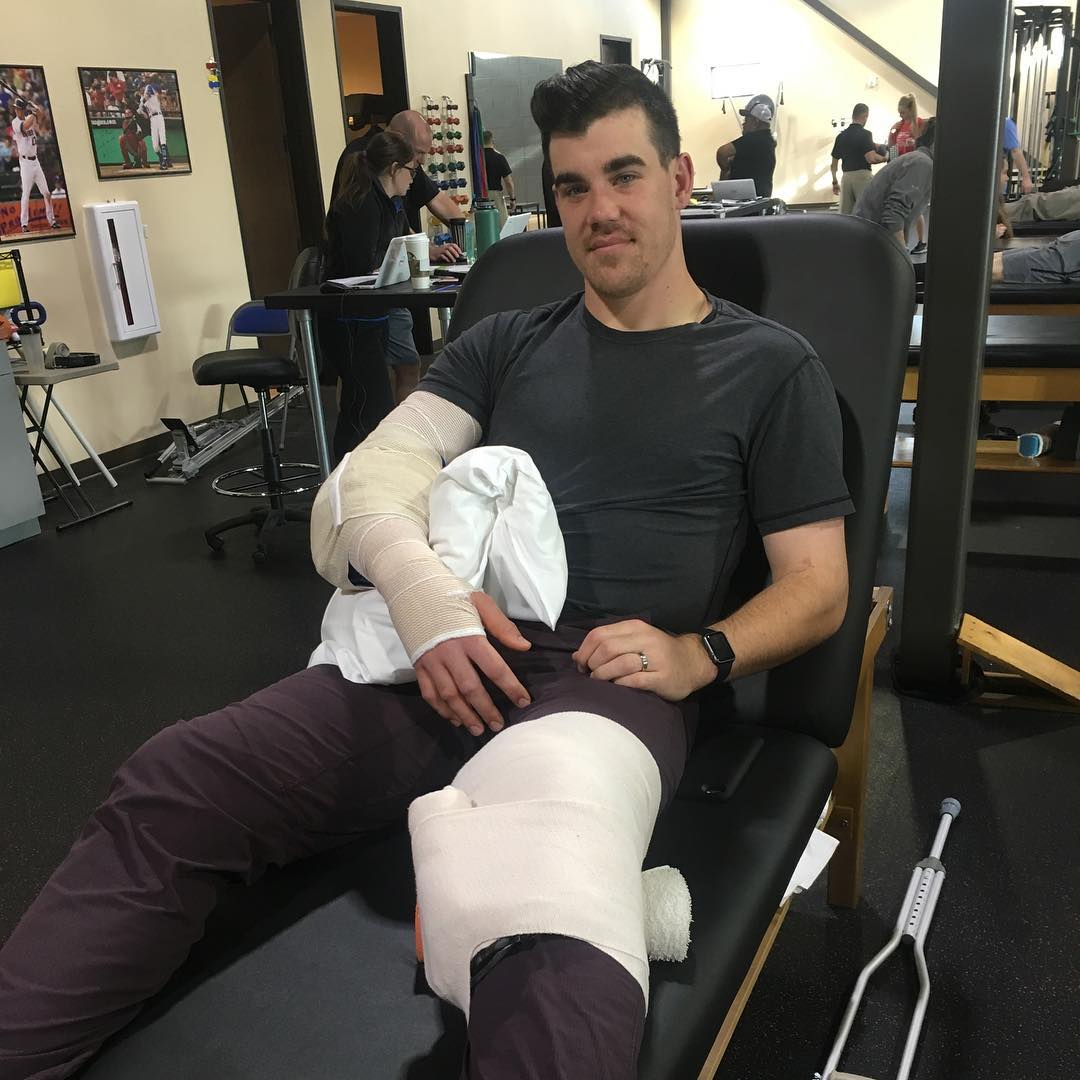
Medical context (Warning: I am not a doctor and am only 40% sure that I’ve accurately spelled the words in the following paragraph. Time to test the surprisingly friendly MLBTR editors!):
In order to repair your ulnar collateral ligament, the ligament must be replaced by another healthy piece of connective tissue from somewhere else in your body. Commonly, the tendon used is from one of your wrists. Unfortunately, some of us don’t possess that option. Like me. Option two then becomes a harvest of your gracilis tendon, which wraps from the front of your knee to the hamstring. I’ve been told it regenerates to some extent, like a salamander’s tail. Cool!
Well folks, NOT cool. The knee is far and away the suckiest part of the surgery. I fancy myself a tough hombre, but being rendered unable to move myself was new. No stair is easy, no car is accessible, no bed is comfortable.
So, having had the experience, I’ve designed my own guide to Navigating Life Post-Surgery: When Your Right Arm and Left Leg Don’t Work.
- Brushing your teeth. Invest in a Sonicare or some other type of electric toothbrush and practice using it for some time before surgery.
- Showering. You’re not allowed to get your incisions wet, so invest in a nice, high-quality roll of plastic wrap and trash bags. (Glad works well and smells nice! *Thumbs up*) Also, it helps to have a low expectations for what you’re going to be able to reach. Just do your best.
- Stairs. Try not to count them. Just take it one step at a time, leading with your immobile leg. The good leg is better for pushing off. This applies to descending stairs as well.
- Putting on Socks. Well, I cheated. My wife did it for me. Invest in slip-ons that don’t need socks (New Balance makes some solid options). As always, take your time.
- Combing/Styling your hair. I have two new hats. Lululemon to the rescue.
- Eating. Chopsticks are out, anything handheld is in. This might have been the best part. Seriously, I had Culver’s like, six times.
Note: If you know anyone at these companies, I know a guy that is fairly shameless and loves making commercials. *Wink*
These six things, approached correctly, keep life moving right after surgery. Here I am, 13 weeks out, typing all of this out a full speed (24 words per minute). Heck, I ran for 30 minutes yesterday! Improvement is a daily phenomenon, and the process is in full swing. One finally-not-so-painful step at a time.
Let me finish with a short off-field update. I’ve recently formed two companies that are going to revolutionize E-Sports analytics. I’m also working to build several tournament series for competitive gamers to begin increasing their income, and I have several charity events planned involving both gaming and baseball! On the charity side of things, the next step will be a live-streamed marathon of MLB: The Show, where I challenge five players to take on me and the Twins! More details on that are here for those that are interested.
You can follow me on Twitter, Instagram, YouTube and Twitch for updates on all of that and, of course, for great conversation!
Taking Inventory: Atlanta Braves
This is the eighth entry in MLBTR’s Taking Inventory series. Click for entries on the White Sox, Royals, Phillies, Pirates, Giants, Padres, and Reds.
Entering today’s action, the Braves sat in a tie for the second spot in the National League East. Had they been asked before the season, the organization would’ve been thrilled to learn that fate. But the sheen is decidedly lessened by the context: Atlanta still sits six games under .500 and is more than ten games out of a postseason spot of any kind.
Despite the placement in the standings, then, the Braves are highly likely to be in a position to sell at the trade deadline. That doesn’t mean, though, that the club will be terribly willing to consider dealing its more controllable players. It doesn’t even necessarily mean that certain veterans will be sold off for a reasonable return. And it’s still possible that Atlanta will at least look into dealing away some prospects to acquire an established starter with long-term control. With the organization determined to embark upon real contention in 2018, and to leave a good impression on fans even as the excitement of a new ballpark begins to wear off, a major tear-down isn’t likely.
Let’s take a look at some of the possible trade assets on the MLB roster:
Rentals
Jaime Garcia, SP | Salary: $12MM
Garcia looks to be the class of the Atlanta rental crop. He’s through 82 2/3 innings with a 3.59 ERA, so he has been both healthy and effective. While the southpaw is producing less strikeouts (6.5 per nine) and more walks (3.4 per nine), he’s running a 56.5% groundball mate that’s an exact match for his career mark. It’s unlikely Garcia will be viewed as a mid-3.00 pitcher at the deadline, and he’s likely due for a bit of regression before that point, but he ought to hold real appeal.
Bartolo Colon, SP | Salary: $12.5MM
Colon’s pinpoint command just hasn’t been there in his age-44 season. He’s working at nearly double the average walk rate he carried over the prior five seasons and has been in the zone just 43.5% of the time (against a 52.4% career average). That is perhaps showing up in other ways, too, as Colon hasn’t allowed this frequency of long balls since he was pitching for the Angels. There’s likely also some poor fortune baked in the hefty .353 BABIP opposing hitters are carrying against Colon, as well as his meager 48.5% strand rate, but at this point he has minimal trade value after 59 innings of 7.78 ERA ball.
Brandon Phillips, 2B | Salary: $1MM (remainder of $14MM salary paid by Reds)
Phillips carries an attractive .306/.351/.431 batting line, but that’ll drift back as his .342 BABIP faded. Since he’s no longer an elite defender, Phillips just doesn’t profile as a first-division regular. That said, he’s cheap and comes with plenty of experience, so it’s easy to imagine interest — though it’s anybody’s guess whether he’d be happy playing in a bench role.
Kurt Suzuki, C | Salary: $1.5MM
The veteran receiver has been dealt twice at the deadline before (and probably should have been a third time). He’s swinging a pretty good stick for a catcher — .227/.342/.402 through 118 plate appearances — and could fill a gap for an organization that ends up thin at the position.
Jason Motte, RP | Salary: $535K (remainder of $5MM salary paid by Rockies)
As his 35th birthday approaches, Motte owns a seemingly resurgent 1.86 ERA. But even a quick glance behind the results shows that it’s likely a mirage. He is averaging less than six strikeouts per nine with 3.7 BB/9 while benefiting from a very low BABIP (.192) and 100% strand rate. It’s still imaginable another club will like how he’s throwing the ball, but the offers may not be significant enough to make it worth it for the Braves to make a move.
Controlled Through 2018
Jim Johnson, RP | Salary: $5MM in 2017; $5MM in 2018
Atlanta could have a somewhat difficult decision to make on Johnson, who is pitching quite well but might also help solidify the back of the bullpen next year. He’s generating a 9.7% swinging-strike rate — best of his career — to complement his typically excellent groundball induction efforts (56.0% groundball rate, currently). Johnson profiles as a setup man on a contending team, which could have a fair bit of value.
Nick Markakis, OF | Salary: $11MM in 2017; $11MM in 2018
The veteran keeps on posting roughly league average offensive seasons, so you generally know what you’re going to get. Currently, he’s getting on base at a nice clip (.371) but showing a total lack of power (.092 isolated slugging). Unless the Braves are willing to pay down quite a bit of money, it’s hard to see rival organizations getting too excited at that profile from an older corner outfielder.
R.A. Dickey, SP | Salary: $8MM in 2017; $8MM club option ($500K buyout) in 2018
Dickey is outperforming Colon, but that’s about where the plaudits end. He owns a 5.35 ERA through 77 1/3 innings, with his strikeout and walk rates each heading in the wrong direction. Dickey’s 7.6% swinging-strike rate is the lowest he has carried since his Cy Young campaign. All said, it’s hard to see where the interest would come from, and the Braves might hold in case a second-half turnaround makes the option appealing.
Tyler Flowers, C | Salary: $3MM in 2017; $4MM club option ($300K buyout) in 2018
After a strong offensive season in 2016, Flowers has opened the current year with a blistering .333/.435/.473 slash. There are lots of reasons to think that won’t last, but the 31-year-old doesn’t need to hit at that pace to be a significant offensive threat for a catcher. He’ll likely draw some interest, but Atlanta needs a catcher for 2018 and seems likely to hold.
Matt Adams, 1B | Salary: $2.8MM; arb-eligible in 2018
The 28-year-old has thrived since finding a second chance in Atlanta, though his overall profile as a hitter hasn’t changed much. It’s not clear there’ll be a ton of demand, though it’s also not clear what the Braves will do with Adams once Freddie Freeman returns.
Longer-Term Assets
Julio Teheran, Matt Kemp, Arodys Vizcaino
Plenty of sub-.500 teams have interesting calls to make on controllable veterans, but it’s not clear that holds true for Atlanta. Freeman is hurt and wouldn’t be dealt anyway. (Neither will Ender Inciarte and Dansby Swanson.) Teheran is back on the downturn after a strong 2016 and is needed for the future anyway with multiple rotation spots unaccounted for past this season. Though Kemp is mashing, he has had some injury troubles and still looks like a defensive liability; plus, the Braves don’t have replacements lined up and surely like the idea of carrying him as a middle-of-the-order star heading into 2018.
And then there’s Vizcaino, who may be the most likely of this group to be traded at the deadline. He’s throwing well again, with a 1.93 ERA and 10.6 K/9 against 2.9 BB/9 through 28 frames, and the Braves control him for only two more years. There’s surely no need for Atlanta to push the flamethrower out the door, but it may be worth cashing in on a somewhat volatile asset if there’s a good enough offer on the table.
Taking Inventory: Cincinnati Reds
This is the seventh entry in MLBTR’s Taking Inventory series. Click for entries on the White Sox, Royals, Phillies, Pirates, Giants and Padres.
After entering the season expected to finish as one of the majors’ worst teams, the Reds got off to a hot start and then hung around .500 through late May. But since holding a 19-15 mark on May 11, the Reds have lost 24 of 34 to fall to 29-39 and plummet to last place in the National League Central. Now, with the trade deadline approaching, they look like surefire sellers.
Rentals
Zack Cozart, SS | Salary: $5.325MM
There are questions regarding how much demand there will be for shortstops at this year’s deadline, which could hinder the Reds’ efforts to net a quality return for Cozart. Nevertheless, the impending free agent has done his part to drive up his value. The 31-year-old served as a roughly league-average player from 2012-16, but he’s now in the midst of a shockingly great season. Cozart has slashed .320/.404/.562 across 255 plate appearances. Thanks to that output and his typically effective work in the field (four Defensive Runs Saved, 8.5 UZR/150), he’s tied with three established superstars – Joey Votto (his teammate), Bryce Harper and Mookie Betts – and Yankees outfielder Aaron Hicks for fourth among position players in fWAR (2.9). That figure represents a career best for Cozart, whose trade value could increase if interested teams feel he can play another position. The Red Sox, for example, are set at shortstop but have a glaring need at third base. Cozart has spent his entire career at short since debuting in 2011.
Drew Storen, RP | Salary: $3MM
Realizing they weren’t going to compete this year, it’s fair to say the Reds signed Storen with the goal of flipping him at the deadline. The 29-year-old has pitched well enough this season to make that a real possibility, having recorded a 2.45 ERA, 7.67 K/9, 3.99 BB/9 and a stellar 54.1 percent ground-ball rate in 29 1/3 innings. Storen’s velocity has continued on a downward plane, and his ERA estimators aren’t nearly as kind as his actual run prevention numbers (3.82 FIP, 4.00 SIERA, 4.71 xFIP), but it’s a good bet that some playoff hopeful(s) will want the former closer.
Scott Feldman, SP/RP | Salary: $2.3MM
As with Storen, Feldman has seemed like a very short-term Band-Aid for the Reds since the minute they took a cheap flyer on him in the offseason. While Feldman, 34, has emerged as the ace of the Reds’ staff this year, that merely indicates how poor and injury plagued their rotation has been. To Feldman’s credit, he has performed like a bona fide back-end type, with a 4.29 ERA/ 4.28 FIP, 7.18 K/9 and 3.13 BB/9 over 77 2/3 frames. Feldman’s probably not going to interest playoff contenders searching for mid-rotation starters, but he could garner looks from teams that want someone to competently soak up innings from the rotation and/or the bullpen down the stretch. That was the case at the deadline last year, when the postseason-bound Blue Jays sent a teenage pitcher, Lupe Chavez, to the Astros for Feldman.
Controlled Through 2018
Devin Mesoraco, C | Salary: $7.325MM in 2017; $13.125MM in 2018
Mesoraco broke out in 2014, hitting .273/.359/.534 with 25 home runs, leading the Reds to sign the offense-first backstop to a four-year, $28MM extension. Little went right over the next two years for Mesoraco, whom injuries limited to 106 PAs and a woeful .158/.245/.500 line with no homers. Mesoraco became somewhat of an afterthought as a result, but the 28-year-old has quietly rebounded this season to slash .235/.343/.518 with six homers and career highs in walk rate (12.1 percent) and isolated power (.282) across 99 trips to the plate. That’s an admittedly small sample, though, and it’s debatable how much in-season trade value he’d have as a somewhat expensive player fresh off a couple of lost years.
Blake Wood, RP | Salary: $1.275MM in 2017; arbitration eligible in 2018
The 31-year-old righty was decent last year, his first with the Reds, and has contributed respectable production again this season. The hard-throwing Wood entered Sunday ranked ninth among relievers in grounder rate (60.9 percent), and he’s currently running a career-best 3.63 ERA through 34 2/3 frames. Wood has also registered acceptable strikeout (9.09) and walk (4.15) rates per nine. With all of that considered, it’s easy to imagine a bullpen-needy playoff contender with a capable infield defense and/or a small ballpark having interest in the grounder-heavy, inexpensive Wood.
Longer-Term Assets
Joey Votto, 1B; Raisel Iglesias, RP; Billy Hamilton, CF; Adam Duvall, OF; Scott Schebler, OF; Eugenio Suarez, 3B; Anthony DeSclafani, SP; Brandon Finnegan, SP; Scooter Gennett, IF/OF; Michael Lorenzen, RP; Wandy Peralta, RP
Votto, who inked a 10-year, $225MM contract extension in 2012, is both the Reds’ most expensive player and the crown jewel of the franchise. The potential Hall of Famer is enjoying yet another all-world season and would improve most (or all) big-spending contenders’ situations at first base. Votto has a no-trade clause, though, and suggested over the winter that he’d like to mimic retired San Antonio Spurs superstar Tim Duncan and the New England Patriots’ Tom Brady by playing his entire career in one place. Before that, Reds general manager Dick Williams stated he hadn’t had any discussions with Votto about waiving his no-trade clause. The reality is, Votto’s not going anywhere.
The rest of the Reds’ longer-term assets are probably safe bets to at least last the season in Cincinnati. Of course, there was interest this past offseason in Hamilton, whose fading team control (he’s signed through 2019) could make him a legitimate trade candidate soon. The 26-year-old has continued his light-hitting ways this season, but the baserunning brilliance and defensive excellence that have made him valuable throughout his career remain intact.
Hamilton’s outfield mates, Duvall and Schebler, are much different players than the speedster. But the two sluggers have turned into real finds for Cincinnati and emerged as viable regulars. The 26-year-old Schebler isn’t even eligible for arbitration until 2020, while Duvall (28) won’t go through the arb process until 2019. Given both their cheap control and production, the two corner outfielders would likely warrant quality returns in trades, but there’s no indication the Reds are interested in moving either player.
Similarly, both Suarez and Gennett have been solid pickups for the Reds, with the former in the midst of what could be a breakout year and the latter having recently turned in the first four-home run game in team history. That was an anomaly for Gennett (as it would be for any player, but especially one who has never been much of a power threat), who’s nonetheless in the midst of a nice season and previously put up a couple league-average campaigns in Milwaukee. Although the 27-year-old Gennett joined the Reds via waivers at the end of March, he has probably at least built some trade value since then. The utilityman’s affordable this season ($2.525MM) and controllable through 2019. Suarez is under wraps through 2020 and currently on a near-minimum salary ($595K), but the 25-year-old seems a lot likelier than Gennett to be part of the Reds’ long-term core. Assuming Cozart doesn’t stick around, Suarez could shift to shortstop (his previous position) when highly touted third base prospect Nick Senzel eventually comes up to the majors.
Elsewhere, the Reds have several young starting pitchers, but DeSclafani and Finnegan stand out as the most promising. A sprained ulnar collateral ligament has kept DeSclafani out all season, however, and he might not debut until August. Finnegan, meanwhile, has been out since April on account of a shoulder issue. While he’ll be back sooner than DeSclafani, the Reds aren’t going to sell low on either of these two this season.
Conversely, the Reds would be selling high on some of their top bullpen assets – Iglesias, Lorenzen and Peralta. Iglesias has turned into a premier reliever since shifting from the Reds’ rotation last season, and the 27-year-old signed a very reasonable contract with the club in 2014 after fleeing his native Cuba. Of course, Iglesias only went to the bullpen in the first place because of shoulder problems, so there’s a case to be made that Cincinnati should at least listen to any offers that might come in for the dominant righty prior to the deadline. While Lorenzen and Peralta aren’t on Igleslias’ level, they’re good and cheap. The former won’t hit arbitration for the first time until the upcoming offseason and the latter is a pre-arb player through the 2019 campaign. Each of these 25-year-olds would intrigue teams looking for relievers, but there’s nothing to suggest that Williams is going to put either on the block.