
Taking Inventory: Oakland Athletics
This is the 12th entry in MLBTR’s Taking Inventory Series. Click for entries on the White Sox, Royals, Phillies, Pirates, Giants, Padres, Reds, Braves, Tigers, Marlins and Mets.
With the July 31 non-waiver trade deadline just over three weeks away, the Athletics are unsurprisingly in position to sell. At the outset of the season, there were no realistic expectations that the A’s would contend for a playoff spot, and they’ve since stumbled to a 39-49 mark to rank as one of the American League’s worst teams. Along the way, Oakland has lost a couple potential veteran trade candidates in third baseman Trevor Plouffe and catcher Stephen Vogt, both of whom received their walking papers last month and are now in different uniforms. As bleak as things may seem for the A’s, some of their other likely trade chips have turned in encouraging performances this year, and moving those players in the coming weeks could produce returns that benefit the franchise for years to come.
Rentals
Yonder Alonso, 1B | Salary: $4MM
It was somewhat of a surprise last offseason when the A’s elected to tender a contract to Alonso, who was among the majors’ worst first basemen in 2016. Now, three months into the current campaign, it’s fair to say executive vice president of baseball operations Billy Beane and general manager David Forst made a wise decision to stick with Alonso. An underwhelming hitter for most of his career, the 30-year-old has changed to a fly ball-first approach this season and posted a tremendous .278/.374/.569 line across 294 plate appearances. Thanks largely to a 49.5 percent fly ball rate (up from 33.3 percent last year), Alonso has swatted a career-high 20 home runs – two more than he combined for in 1,222 PAs from 2014-16 – and recorded the majors’ eighth-best ISO (.290). There’s clearly a lot to like here, though it’s uncertain how much trade value Alonso will have because of a possible lack of leaguewide demand at first base (granted, the Yankees look like a logical match). If the A’s are unable to net a satisfactory offer for Alonso, perhaps they’ll keep him and try to work out an extension. Both sides have interest in staying together.
Rajai Davis, OF | Salary: $6MM
It’s difficult to imagine the A’s finding a taker for Davis without at least absorbing some of his salary. The 36-year-old is in the midst of a career-worst offensive season, after all, having hit a meek .210/.267/.308 in 244 plate trips. At a cheaper price tag, he could entice a playoff-bound team looking for a late-game threat on the base paths. Davis is one of the greatest baserunners of all-time, per FanGraphs’ BsR metric, and has made effective use of his legs this year with a 3.4 BsR and 15 steals. Although unlikely, perhaps Davis’ wheels will cancel out his less-than-stellar offensive and defensive production (minus-one DRS, minus-12 UZR/150 this season) on the trade market. And hey, the ex-Indian’s not far removed from hitting one of the most memorable home runs in postseason history.
Adam Rosales, UTIL | Salary: $1.25MM
Even though he struck out in 35.5 percent of PAs last year, the then-Padre rode a bloated home run-to-fly rate (21.7 percent) and an 11.7 percent walk rate to a .229/.319/.495 line and a guaranteed contract with the A’s. Unfortunately, Rosales has given back those gains this season (7.4 percent HR-to-FB rate, 4.3 percent walk rate) and continued to strike out over 30 percent of the time. Consequently, the 34-year-old has hit a subpar .233/.271/.347 in 210 tries. But Rosales has offered a passable bat versus left-handed pitching, as he typically has throughout his career, and has the ability to play all over the diamond. At his low salary, then, Rosales could potentially bring back a small return in a trade.
John Axford, RP | Salary: $5.5MM
Good luck dealing the somewhat expensive Axford, who has pitched to a woeful 5.95 ERA over 19 2/3 innings this season. To his credit, the 34-year-old Axford is running appealing strikeout (9.15 K/9) and ground-ball rates (54.1 percent). However, the former Milwaukee closer has cancelled out the positives with control problems (6.41 BB/9) and issues keeping the ball in the park (21.4 percent HR-to-FB rate).
Controlled Through 2018
Ryan Madson, RP | Salary: $7.5MM in both 2017 and ’18
After a mediocre 2016 in Oakland, his first year with the club, Madson has rebounded to resemble the reliever who was a significant asset in both Philadelphia and Kansas City earlier in his career. Across 35 2/3 frames, the hard-throwing, 36-year-old right-hander has notched a 2.27 ERA with 8.58 K/9 and 1.51 BB/9. Moreover, Madson owns impressive ground-ball and infield pop-up rates of 56.2 percent and 11.8 percent, respectively. In sum, he’s striking out hitters at a decent clip while limiting walks and rarely yielding threatening contact. Pitchers who can do those things simultaneously are valuable commodities, and bullpen-needy contenders have taken notice of Madson’s success this season.
Jed Lowrie, 2B/SS/3B | Salary: $6.5MM in 2017; $6MM club option (or $1MM buyout) in 2018
Health problems, including poor sleep (via FanGraphs’ Eno Sarris), derailed Lowrie in recent seasons. But the 33-year-old is enjoying a career renaissance in 2017, having logged a .282/.350/.464 line and nine homers in 354 PAs. As a result, there’s interest in Lowrie, whom the A’s seem likely to part with in an effort to open up a spot in the middle infield for well-regarded prospect Franklin Barreto.
Santiago Casilla, RP | Salary: $4.5MM in 2017; $5.5MM in 2018
In his first year back with the A’s, with whom the closer formerly known as Jairo Garcia pitched from 2004-09, Casilla has saved 15 of 19 opportunities and registered a so-so 3.82 ERA over 33 innings. There are some troubling signs that have contributed to the ex-Giant’s mediocre run prevention, including a K/9 that has fallen from 10.09 last season to 8.18 this year, a plummeting grounder rate (40.8 percent, compared to 47.6 percent in 2016) and a decline in infield flies (a still-respectable 10.8 percent; the righty was at 13.2 percent a year ago). Despite his unexciting production and advanced age (37 later this month), Casilla still looks both inexpensive enough and decent enough to generate looks in the coming weeks.
Matt Joyce, OF | Salary: $5MM in 2017; $6MM in 2018
The 32-year-old is in the middle of a typical season relative to his career, having mixed an adequate left-handed bat (.219/.330/.406 with 11 HRs and a 13.8 percent walk rate in 297 PAs) with unspectacular outfield defense (minus-three DRS, minus-9.2 UZR/150). Joyce offers an affordable but bland skill set, one that probably won’t have playoff hopefuls beating down the A’s door for him leading up to the deadline.
Longer-Term Assets
Sonny Gray, SP | Salary: $3.575MM in 2017; arbitration eligible through 2019
As the crown jewel of Oakland’s trade candidates, Gray has frequently graced MLBTR’s pages in recent weeks and will continue to be a popular name on this site as the deadline nears. The likelihood is that the A’s will soon say goodbye to the 27-year-old Gray, who has put a rough, injury-laden 2016 behind him to post a 4.00 ERA (3.58 FIP) with 8.47 K/9 and 2.86 BB/9 through 78 2/3 innings. Gray’s strikeout and walk numbers are the best they’ve been since his outstanding debut in 2013, and he has complemented those figures with career-best chase, contact and swinging-strike rates (11.5 percent) – not to mention a 55.3 percent ground-ball mark. Add all of that to Gray’s affordable team control, and it’s clear someone is going to pay a high price for him. In case you missed it, MLBTR’s Steve Adams deftly laid out plausible fits for Gray on June 30.
Khris Davis, LF/DH | Salary: $5MM in 2017; arbitration eligible through 2019
Contrary to Gray, there’s no talk of Davis going anywhere. Additionally, the righty-swinger has made it clear that he’d like to be an Athletic for the long haul. The Beane-led franchise has made surprising deals in the past, though, and bear in mind that Davis is a soon-to-be 30-year-old whose price tag will continue to rise in the arbitration process. There’s an outside chance those factors could make him a candidate to switch teams soon, as the A’s don’t look close to contention and aren’t exactly big spenders. Arbitration rewards players who hit homers, drive in runs and accrue PAs – all things Davis has done since he joined the A’s prior to last year. The former Brewer has already smashed 24 dingers and racked up 60 RBI in 364 PAs this year, giving him a shot at his second straight 40-HR, 100-RBI season, and his overall line (.246/.335/.517) is terrific. An on-the-block Davis would probably garner a fair amount of attention, but whether the A’s would be receptive to giving him up is unknown.
Sean Doolittle, RP | Salary: $2.6MM in 2017; $4.35MM in 2018; club options with $500K buyouts in 2019 ($6MM) and 2020 ($6.5MM)
Shoulder issues have hampered Doolittle in recent seasons, but there’s no doubt he’s among the game’s most formidable left-handed relievers when he’s able to take the mound. While Doolittle has only eaten 19 1/3 innings this season, the 30-year-old has done plenty with them, having put up a 3.72 ERA (2.58 FIP) with all-world strikeout and walk rates (13.03 K/9 and .93 BB/9). Among relievers who have thrown at least 10 innings – a very small sample, granted – Doolittle ranks third in K/BB ratio. He has also induced infield pop-ups on a ridiculous 23.8 percent of batted balls, thereby offsetting a low grounder rate (35.7 percent). Doolittle’s past arm troubles have likely dented his trade value somewhat, but his effective pitching/palatable contract combination should warrant a quality return if the A’s decide to go in another direction.
Liam Hendriks, RP | Salary: $1.1MM in 2017; arbitration eligible through 2019
Hendriks prevented runs with aplomb as a Blue Jay and Athletic from 2015-16, though his ERA has spiked from 3.34 over that 129 1/3-inning period to 5.40 across 36 2/3 frames this year. If you look beyond that, though, there’s a desirable, hard-throwing reliever here. Like Doolittle, the 28-year-old Hendriks has posted a superb K/9 (12.03, with a playable 3.44 BB/9), adding a career-best swinging-strike mark (12.8 percent) and a decent grounder rate (45.5 percent). Hendriks’ .351 batting average on balls in play, 65.2 percent strand rate and 13.9 percent homer-to-fly ball rate are largely to blame for his bloated ERA, which shouldn’t necessarily be a deterrent to all playoff contenders in search of bullpen help. The righty has usually been a capable option against both same- and opposite-handed hitters, which, combined with his low salary and team control, ought to have him on clubs’ radars.
MLBTR Originals
Here’s a recap of the original content featured at MLBTR over the past week:
- Jeff Todd increased his trade deadline candidates list from 50 to 60 players, ranking them based on both value and the likelihood of a deal. Tigers right fielder J.D. Martinez took over the top position from White Sox closer David Robertson, who dropped a few spots since last time.
- In light of a report that the Royals are looking for short-term rotation help, Steve Adams examined which impending free agent hurlers would be logical pre-deadline targets for the club.
- With the Yankees having gotten little from their first basemen this year, I took a look at several possibilities for the Bombers if they attempt to upgrade at the position in the coming weeks.
- Steve checked in on the performances of the eight players who will be able to opt out of their contracts after the season. Giants right-hander Johnny Cueto, Yankees righty Masahiro Tanaka, Tigers left fielder Justin Upton and Rockies closer Greg Holland are among those with postseason decisions to make on their futures.
Royals In Market For Pitching Upgrades, May Pursue Rotation Rentals
On the heels of a 22-10 run over their past 32 contests, the Royals are in the market for upgrades in both their rotation and the bullpen, reports FanRag’s Jon Heyman.
“We’re evaluating the landscape, and paying close attention to what may be available in the pitching market,” GM Dayton Moore tells Heyman. “…We’re looking to improve our roster and make it more balanced for the second half. … I don’t know why anyone thought we’d be sellers.” Those comments largely back up recent statements made by manager Ned Yost on MLB Network Radio on SiriusXM and to reporters following last night’s game (link via the Kansas City Star’s Rustin Dodd).
Heyman goes on to add that the Royals aren’t likely to have too much payroll flexibility due to the fact that they entered the season with a franchise-record $145MM payroll. However, there’s a belief that Kansas City is open to adding a veteran starter on an expiring contract, according to Heyman. A look at MLBTR’s list of 2017-18 free agents shows starters that fit the bill, though obviously not all of those arms are available in trades, and some may not fit into an apparently tight Royals budget.
The following names are purely my own speculation, but if the Royals are aiming to add affordable rotation rentals, any of this bunch could make some sense (listed from lowest salary to highest salary):
- Trevor Cahill: Cahill was only just activated off the disabled list after missing seven weeks due to a strained right shoulder. While he doesn’t come with much in the way of name value these days, Cahill has broken out in his return to a big league rotation, throwing 45 2/3 innings with 10.8 K/9, 3.7 BB/9 and a 62.3 percent ground-ball rate. That’s led to a 2.96 ERA that is backed by a 2.98 FIP, 3.25 xFIP and 3.51 SIERA. He’s earning just $1.75MM in 2017, so from a financial standpoint, he’s an ideal fit.
- Jhoulys Chacin: Teammates with Cahill, Chacin is also earning $1.75MM this year. He’s been the more durable of the two, and although he posted terrible numbers early in the year, he’s logged a 2.98 ERA with a 39-to-15 K/BB ratio and a 50.4 percent grounder rate over his past 42 1/3 innings. He’s hardly an impact upgrade, but right now it doesn’t look like there’ll be an impact rental available at all.
- Scott Feldman: The 34-year-old has been the Reds’ best starter this season, turning in 102 2/3 innings of 3.94 ERA ball. Feldman’s 7.5 K/9 mark is the best of his career, and he’s averaging a reasonable 2.9 walks per nine innings with a 45 percent ground-ball rate. Despite playing his home games at Great American Ball Park, he’s managed to limit home runs (1.1 HR/9). Feldman has a cheap $2.3MM base salary, though he’s already added $1.3MM worth of incentives and will tack on another $300K after his 20th start. Since this is all speculative anyhow, the Reds have a number of shorter-term bullpen pieces that could move (e.g. Drew Storen, Blake Wood) plus a shortstop that would be a significant upgrade for the Royals’ infield.
- Alex Cobb: It’s worth debating whether Cobb will even be available because of the fact that the Rays are contending, but Tampa Bay will almost certainly lose him for nothing this offseason as a free agent rather than make him a qualifying offer that could top $18MM. Cobb carries a 4.01 ERA with 6.1 K/9, 2.4 BB/9 and a 44.6 percent grounder rate in 107 2/3 innings. He hasn’t been the borderline ace that he was prior to Tommy John surgery, but he’s earning an affordable $4.2MM. From the Rays’ vantage point, they’ll get Matt Andriese back in August while Jose De Leon and Blake Snell wait in the wings for full-time rotation spots. And, Jacob Faria has already laid claim to a starting job with five brilliant starts.
- Derek Holland: Holland has given the division-rival White Sox 16 starts of 4.52 ERA ball and a total of 87 1/3 innings, but his production has cratered over the past month or so. He’s averaging 7.8 K/9 but 3.7 BB/9 and 1.75 HR/9. Metrics like FIP, xFIP and SIERA all actually feel that he’s been somewhat fortunate to hold down that 4.52 ERA. Holland is affordable, though, with a $6MM base salary and $2MM worth of incentives ($1MM for reaching 150 innings and another $1MM for 200 frames).
- Lance Lynn: As is the case with Cobb, Lynn is no lock to be available. The Cards are a manageable 5.5 games out of the NL Central lead and may take their deadline course of action down to the wire. However, they could also simply slide Luke Weaver into Lynn’s rotation spot, so there’s room to move him even if they still aim to contend. Lynn has a 3.87 ERA with 8.6 K/9, 3.5 BB/9 and a 42.3 percent ground-ball rate through 95 1/3 innings in his first year back from Tommy John. But, he’s also been torched for 1.9 HR/9, as 19.6 percent of the fly-balls he’s yielded have left the yard. That’s a 10 percent departure from his career mark of 9.3 percent, so perhaps the home run spike is somewhat fluky. If the Royals (or another club) believes him capable of reigning in the homers, Lynn’s $7.5MM salary is hardly backbreaking.
- Jaime Garcia: Garcia has bombed over his past four starts, allowing five runs or more in each outing. He’s still sporting a 4.55 ERA on the season with a 54.3 percent ground-ball rate, 6.7 K/9 and 3.4 BB/9. None of those are especially eye-catching, and the Royals may well wish the Braves to pay down some of the $5.7MM that remains on his $12MM salary. The Braves, though, are surely open to moving Garcia, who looks to be a steadier option than the Royals’ current fifth starter, Travis Wood.
Other potentially available rentals include Jeremy Hellickson, Johnny Cueto, Marco Estrada and Francisco Liriano, though each of that bunch makes more than anyone listed here and/or has struggled on the mound thus far. Yu Darvish would be the only potential ace that’d be available as a rental, but he’s reportedly likely to stay put even if the Rangers fall out of the race, and the asking price on him would be exorbitant anyhow.
From a broader perspective, Moore’s comments seem to throw cold water on any suggestion that Kansas City would entertain the thought of trading key impending free agents like Eric Hosmer, Mike Moustakas, Lorenzo Cain, Jason Vargas and Mike Minor. (Alcides Escobar, too, is a free agent, though his lack of production makes him a tough sell as a trade candidate anyhow.) Those names have all recently fallen off of MLBTR’s list of this summer’s top 60 trade candidates.
Finding The Yankees A First Baseman
With lefty-swinging spring training masher Greg Bird and powerful right-hander Chris Carter, the Yankees appeared to have a promising first base tandem on hand at the outset of the season. Instead, the position has been an utter disaster throughout 2017 for the playoff-contending Bombers, whose first basemen entered Wednesday with a putrid .175/.271/.331 batting line and the majors’ second-worst fWAR (minus-1.2).
Bird hit a ghastly .100/.250/.200 in 72 plate appearances before going on the disabled list with a foot injury at the beginning of May. The 24-year-old hasn’t played since, and there’s a real chance he won’t return at all this season. Meanwhile, after clubbing a National League-leading 41 home runs with the Brewers last year, Carter has batted a weak .201/.284/.370 with eight homers in 208 PAs with the Yankees, who added him on a $3.5MM deal in February. The 30-year-old’s output has been so poor that the Yankees have booted him off their 40-man roster twice since late June, including on Tuesday. Now in DFA limbo, it’s possible Carter won’t put on a Yankees uniform again.
With the Bird-Carter duo having flopped and injuries having limited Tyler Austin to 15 PAs, the Yankees are down to Ji-Man Choi at first base. In his first taste of major league action last year, Choi hit a non-threatening .170/.271/.339 in 129 trips to the plate with the Angels. While the 26-year-old homered in his Yankees debut Wednesday, there’s nothing to suggest that the offseason minor league signing is capable of holding down a regular job in the majors, especially for a team with playoff hopes. So, with the July 31 non-waiver trade deadline approaching, New York is probably going to have to find an established first baseman over the next three-plus weeks. Fortunately for Yankees general manager Brian Cashman, there shouldn’t be a shortage of attainable options.
Potential Rentals:
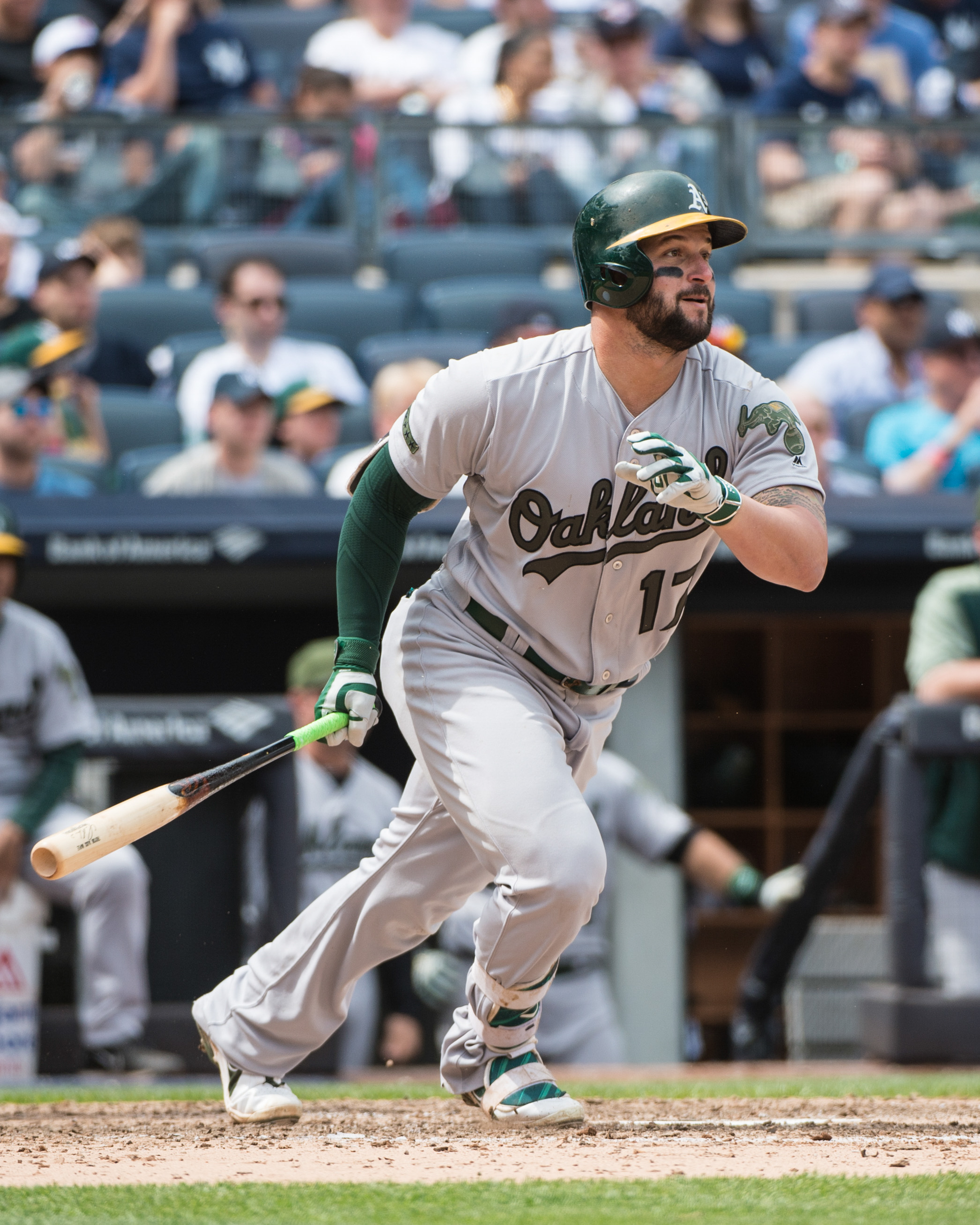
Yonder Alonso, Athletics: The out-of-contention A’s are open to dealing Alonso, who’s enjoying a career year as an impending free agent. Previously a disappointment at the plate, the former top prospect bought into the fly ball revolution over the winter and has since produced a fantastic .283/.377/.575 line with 19 homers in 276 PAs this season. As a lefty-swinger with a 50 percent fly ball rate (up from 32.6 percent between 2010-16), the 30-year-old is an obvious fit for Yankee Stadium and its short porch in right field.
Lucas Duda, Mets: Another left-handed hitter, the slugging Duda has a longer track record than Alonso and is in the midst of another fine season (.249/.359/.548 with 14 HRs in 231 PAs). On paper, he makes plenty of sense for the Yankees, but would the Mets help their crosstown rivals strengthen their roster for a playoff run? The Queens-based club is reportedly open to moving players on expiring contracts, and Duda is among several of its veterans scheduled to hit free agency in the offseason.
John Jaso, Pirates: Jaso doesn’t offer the upside of either Alonso or Duda, but the 33-year-old has still logged respectable offensive numbers throughout his career. That includes the current season, in which Jaso has posted a .251/.330/.467 line 188 PAs. Jaso has packed more of a punch than usual this year, having recorded a .216 ISO (his career high is .180) and seven homers, putting him on pace to surpass the personal-best 10 he hit in 2012. Like Alonso, Jaso’s hitting more fly balls (48 percent, up from a career 34 percent), so it seems he’d also benefit from a move to Yankee Stadium.
Controllable Possibilities:
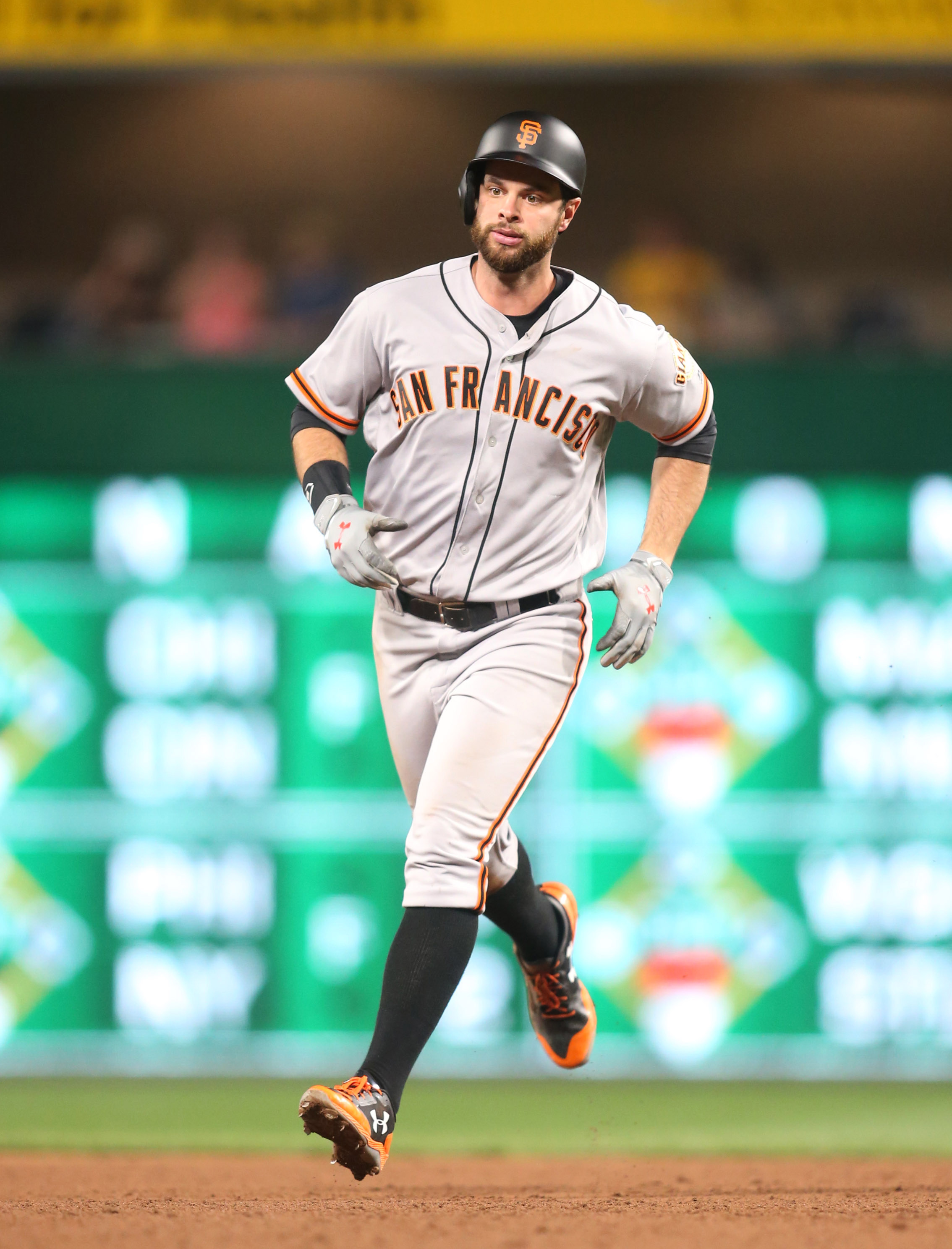
Brandon Belt, Giants (signed through 2021): Belt, 29, is in the first season of a five-year, $72.8MM contract, which is an eminently reasonable deal when you consider what he has accomplished during his career. Nevertheless, the last-place Giants might listen to offers for Belt, who has been one of their few bright spots this season. While Belt’s numbers have taken steps backward this year, he has still put up an attractive .235/.343/.464 line with 16 long balls in 353 trips to the plate. Considering Belt’s track record and affordable contract, San Francisco should be able to acquire a solid prospect haul if it actually does move him. Whether the Yankees would be willing to part with multiple quality prospects for a first baseman is unclear, but the idea of Belt going from a ballpark that suppresses left-handed power to one that accentuates it is intriguing.
Justin Bour, Marlins ($552,500 salary this year; arbitration eligible through 2020): The left-handed, hulking Bour calling Yankee Stadium home is also enticing, and the Bombers have shown interest in him this year. As is the case with Belt, Bour’s combination of productivity and affordability would make him a fairly expensive target. Unlike in previous seasons, the Marlins have given Bour a legitimate chance to play against same-handed pitchers this year, and he hasn’t disappointed. Overall, Bour has slashed .285/.361/.546 with 18 homers and a .261 ISO in 280 PAs.
Jose Abreu, White Sox ($10.825MM salary this year; arbitration eligible through 2019): Acquiring both Abreu and left-hander Jose Quintana from the White Sox would take care of two needs at once for the Yankees, whose rotation could use a short- and long-term upgrade. Quintana would provide that, while Abreu would lock down first and/or designated hitter through 2019, but reeling in the pair would cost a prospect bounty. Chicago would presumably ask a lot just for the 30-year-old Abreu, who has been an adept hitter since coming over from Cuba prior to the 2014 season. The righty’s at .290/.340/.512 with 16 HRs and a career-best 16.7 percent strikeout rate across 362 PAs this year.
Matt Adams, Braves ($2.8MM salary this year; arbitration eligible through 2018): The Braves surrendered very little when they acquired Adams from the Cardinals in late May, but the 28-year-old has since hit an outstanding .290/.337/.594 in 169 PAs. The lefty has been so good that the Braves are experimenting with longtime first baseman and franchise cornerstone Freddie Freeman at third base as a way to keep Adams’ bat in the lineup. The 40-42 Braves remain well out of a playoff spot, though, so it would behoove them to listen to offers for Adams in the coming weeks and see if they can flip him for more than they gave up. Adams’ track record shows he’s more of a decent hitter than a great one, but even average production from first would be a sizable improvement over what the Yankees have gotten from the position this year.
Tommy Joseph, Phillies (not arbitration eligible until after the 2019 season): With big-hitting first base prospect Rhys Hoskins trying to force his way to the majors, Joseph might not be a Phillie for much longer. Whether the 25-year-old would be a worthwhile target for the Yankees is up for debate, though. The Yankees may already have a Joseph of their own in the soon-to-return Austin, another righty-hitting 25-year-old. As such, trading assets for Joseph might not make be logical from their standpoint. While Joseph is more established than Austin, the former hasn’t been anything special in the big leagues. He’s batting a so-so .245/.303/.442 through 304 PAs this year. Of course, in fairness to Joseph, his output has been far better than the numbers Yankees first basemen have compiled in 2017.
Overview
After beginning the year an AL East-best 38-23, the Yankees have dropped 16 of 22 to fall to 44-39. They’re now second in their division, a lofty 4.5 games behind the Red Sox, and only have a one-game lead on a wild-card spot. First base has been one of the major reasons for the Yankees’ recent downfall, so they’ll have to do something in the coming weeks to improve an area that has been a black hole all season. With no obvious in-house solutions (no, they’re not going to move towering right fielder and AL MVP front-runner Aaron Judge to first), there’s a good chance one of the above names will end up in the Bronx by month’s end.
Photos courtesy of USA Today Sports Images.
Top 60 Trade Deadline Candidates For 2017
With trade season entering full swing, we’ll be doing these lists with greater frequency. We last checked in about a week ago. Click here for the first one, including an explanation of the approach. Basically, we’re looking at both trade likelihood and trade value (in all its facets).
Since last we looked, several players have gone on or off the DL, while others have exhibited trends that warrant consideration. The standings have shifted the calculus, too.
On to the rankings (“LR” = “last ranked”):
1. J.D. Martinez, OF, Tigers (LR: 2): Maybe I’m just itching to name a new top dog, but at some point it’s hard to ignore the fact that Martinez represents a potentially season-altering rental piece. The OPS remains over 1.000.
2. Sonny Gray, SP, Athletics (LR: 10): After two straight gems, Gray jumps back up the board. Teams aren’t just hanging on his every start, of course, but that serves to show that things are generally coming together for Gray. The results are beginning to match the improved peripherals he has sported this year, and the A’s seem ready to make this long-debated move.
3. Addison Reed, RH Reliever, Mets (LR: 7): He’s been dominant since taking over the 9th for the Mets and could be the best right-handed reliever available. Barring a stunning run, New York looks to be a clear seller, with the deadline representing a nice consolation opportunity to cash in on some players who’ll be free agents at year end.
4. David Robertson, RH Reliever, White Sox (LR: 1): Still the market’s most obviously available Certified Closer, Robertson is pitching quite well. But he has been overtaken by the above three players, with his large contract continuing to impact his value.
5. Zack Cozart, SS, Reds (LR: INJ): Cozart is back from the DL, sporting top-line offensive numbers as an outstanding up-the-middle defender. Even with a few contenders suffering injuries to shortstops, demand remains unclear, and there’s even some chatter that the team could explore an extension. Odds are, though, that Cozart will end up on the move.
6. Justin Wilson (Tigers) & Brad Hand (Padres), LH Reliever, (LR: 8): Wilson has eight strikeouts in his last 4 1/3 innings. In Hand’s most recent appearance, he struck out Francisco Lindor, Michael Brantley, and Edwin Encarnacion in succession.
8. Yonder Alonso, 1B, Athletics (LR: 6): Entering play yesterday, Alonso hadn’t swatted a long ball since June 15th and was in clear (albeit still brief) lull at the plate. He responded with two July 4th dingers. Teams will no doubt retain a bit of skepticism as to whether Alonso can maintain the full-throated breakout he has displayed to this point, but that doesn’t mean he won’t be valued in the market.
9. Jed Lowrie, 2B/3B, Athletics (LR: 4): Lowrie is a useful player with some defensive versatility who remains eminently available.
10. Jose Quintana, SP, White Sox (LR: 5): The consistency just hasn’t been there for Quintana. While Chicago still seems rather likely to trade him, his value is certainly not at its peak.
11. Pat Neshek, RH Reliever, Phillies (LR: 3): Neshek finally turned in a dud of an outing, but even after allowing three earned he owns a 1.39 ERA on the year.
12. Alex Avila, C, Tigers (LR: 31): Trade rumors have picked up on the veteran catcher, whose suddenly potent left-handed bat might add real impact down the stretch. Sure, his .424 BABIP is bound to fall, but Avila has shown real power before and he’s also walking at an excellent 16.8% clip.
13. Todd Frazier, 3B, White Sox (LR: 17): Frazier mashed in June. Several contenders seem in need of help at third. And it’s not clear any better alternatives will be available. Those factors ought to boost the prospect return and cost savings that’ll be available to the White Sox.
14. Lucas Duda (1B), Jay Bruce (OF), Curtis Granderson (OF), Mets (LR: 26): All three are hitting even as the Mets’ season collapses. Granderson is banged up but hasn’t required a DL stint.
17. Trevor Cahill, SP, Padres (LR: INJ): Cahill carried an impressive 3.27 ERA with 51 strikeouts through 41 1/3 innings when he hit the DL with a shoulder strain. He threw rather well in his first start back and has plenty of time to show that the joint is at full health. Cahill is a cheap rental piece (one-year, $1.75MM contract) who is posting a 13.2% swinging-strike rate and 62.3% groundball rate. Interest should be robust if he can keep that going over his next few starts.
18. Juan Nicasio, RH Reliever, Pirates (LR: 22): He’s working near his peak career levels in terms of velocity and whiff rate, with the results to match. Nicasio’s affordable contract increases his appeal.
19. Ryan Madson (RH Reliever) & Sean Doolittle (LH Reliever), Athletics; David Phelps & AJ Ramos, RH Reliever, Marlins (LR: 11): I’m keeping these four pitchers bunched together for the time being; different arms, to be sure, but they seem to fall in a similar asset class and situation. All play for clear sellers; all are generally pretty danged good relievers; and all come with some warts that dent their trade value (respectively: contract; health; inconsistency; wildness).
23. Andrew McCutchen (Pirates) & Marcell Ozuna (Marlins), OF (LR: 29, 19): The Bucs are now seven games off the NL Central pace with three teams ahead of them in the standings. McCutchen’s season OPS has risen from .631 on May 26th to .894 (!) entering action today. Ozuna has kept the fire going all year long and comes with two years of arb control. But nobody knows whether either will really be marketed.
25. Justin Verlander, SP, Tigers (LR: 41): Chatter is building on Verlander even as his struggles continue. It’ll be tough for the Tigers to deal such a central figure for an unexciting return, but at some point some tough calls will need to be made if the team is serious about trimming its payroll and getting younger.
26. Jerry Blevins, LH Reliever, Mets (LR: 24): Blevins has been knocked around a bit of late, taking some of the sheen off of his body of work this year, but he’s still a quality lefty who’ll hold broad interest. With an appealing option for 2018, New York won’t feel compelled to move him.
27. Tony Watson, LH Reliever, Pirates (LR: 22): Watson has struggled to keep runners off the bags all year long, but he has mostly maintained the peripherals that have made him a reliable late-inning arm for several years.
28. Melky Cabrera, OF, White Sox (LR: 17): The offensive work continues to improve for the veteran, who’s a clear trade piece. But others have moved past Cabrera given his limitations in the field and big salary.
29. Scott Feldman (SP), Drew Storen (RH Reliever), Tony Cingrani (LH Reliever), Reds (LR: 37, 26, NR): The steady veteran has separated himself a bit from the herd of back-of-the-rotation starters with a run of strong performances. His season ERA is down to 3.78 and he’s also quite affordable ($3.2MM salary). Storen still looks like a solid option to bolster a contender’s middle relief corps. And Cingrani enters the list after returning strong from a DL stint.
32. Welington Castillo (Orioles) & Jonathan Lucroy (Rangers), C (LR: 30, NR): With top prospect Chance Sisco waiting in the wings, the O’s could conceivably try to find some value for Castillo without punting a shot at a postseason berth altogether. The Rangers seem to be open to considering deals for Lucroy, a pending free agent, as he struggles through a down year while Robinson Chirinos produces.
34. Marco Estrada & Francisco Liriano, SP, Blue Jays (LR: 48, NR): The Jays are fading and these two veterans just aren’t performing. But each comes with his share of upside and would be fairly easy to move (so long as Toronto eats some salary) as rental assets.
36. Ian Kinsler (2B) & Justin Upton (OF), Tigers (LR: 20): I covered some of the nuances involved in these veterans in the last ranking, so we won’t repeat that here. Both are coming off of productive stretches over the month of June and could represent notable additions, but come with contract complications.
38. Brandon Kintzler, RH Reliever, Twins (LR: 45): While the team is holding firmly in contention, and could still look to add controllable pieces, Kintzler would likely be the first player to be made available in the event that the Twins decide to sell.
39. Zach Britton (LH Reliever) & Brad Brach (RH Reliever), Orioles (LR: INJ): Forearm injuries have limited Britton (he’s only just back from a second DL stint) and he hasn’t been as dominant as he was last year when he has been healthy. And even if Baltimore ultimately decides to move some players, it needn’t deal a pitcher with another year of arbitration remaining. But … if Britton can show over the next three weeks that he’s again capable of being an unholy groundball/strikeout monster and the AL Wild Card race begins to resolve against the Orioles’ favor, then perhaps there’s a chance he could be a significant part of the deadline tapestry. Brach could also, or alternatively, be shopped; he has been quite good in his own right and comes with one more year of arb control as well.
41. Jeff Samardzija (Giants), Johnny Cueto (Giants), Gerrit Cole (Pirates), Ervin Santana (Twins) & J.A. Happ (Blue Jays), SP (LR: 41, 41, 41, 45, NR): Happ joins this group of quality starters, all of whom would hold clear trade interest– if they are made available. Their respective teams’ inclinations remain unclear; while the Giants would no doubt be glad to achieve a return on Cueto, his situation remains complicated by his pending opt-out clause.
46. Asdrubal Cabrera, INF, Mets (LR: 35): He’s swinging the bat well and affords defensive versatility, but he and the team have been making nice since a recent spat and the Mets could well decide to pick up his 2018 option.
47. Seth Smith (Orioles), Matt Joyce (Athletics) & Daniel Nava (Phillies), OF (LR: 47, NR): All are left-handed-hitting platoon outfielders (Nava’s a switch-hitter who’s better against righties) who could fill a need elsewhere.
50. Edinson Volquez & Tom Koehler (Marlins), Clayton Richard (Padres), Jaime Garcia (Braves), Jeremy Hellickson (Phillies) SP (LR: 37): These five are subjecting their teams to roller coaster rides. It’s plausible to imagine trade scenarios, but none figure to be in particularly heavy demand. Teams looking for innings may shop here, though.
55. Yu Darvish, SP, Rangers (LR: NR): Darvish would be the top rental starter if made available. While the team continues to stall out, it likely won’t sell unless the Wild Card is truly out of reach. And even then, it seems there’s at least some belief within the organization that holding onto Darvish will help with efforts to re-sign him over the winter — perhaps helping also to draw fellow Japanese star Shohei Otani.
56. Josh Donaldson, 3B, Blue Jays (LR: NR): Speaking of trade candidates of dubious availability, the Toronto superstar would be a hot commodity if marketed. But Toronto has not yet shown signs of being willing to part with such a key player. Donaldson has another arb year left; it’d undoubtedly take a big return (likely including young MLB assets) to pry him loose.
57. Raisel Iglesias, RH Reliever, Reds (LR: 49): He won’t be shopped, but could probably had for a compelling offer.
58. Rajai Davis, OF, Athletics (LR: NR): While he hasn’t hit much, Davis has been better of late and has the profile of a player who could make an impact on a postseason roster. He’d also represent a possible August trade candidate.
59. Matt Adams, 1B, Braves (LR: NR): It’s still tough to guess at how things will shake out with Atlanta. But if Sean Rodriguez does return as now seems to be expected, and Freddie Freeman isn’t a really comfortable fit at third base, then perhaps the club will deem the timing right to get some value out of Adams at the deadline.
60. Freddy Galvis, SS, Phillies (LR: NR): Galvis has been hitting rather well this year and is a quality shortstop who can also line up elsewhere in the infield.
Falling Out
Tommy Kahnle (White Sox): A few rough outings make it seem more likely that Chicago will hold onto him and hope he can continue to establish himself as a quality late-inning arm.
Adeiny Hechavarria (Marlins) & Stephen Vogt (Athletics): Both were traded (to the Rays and Brewers, respectively).
Lance Lynn & Seung-hwan Oh, Cardinals: A surge has the Cards firmly in the NL Central mix.
Inactive
Nate Jones (White Sox), Neil Walker (Mets), Cesar Hernandez & Vince Velasquez (Phillies), J.J. Hardy (Orioles), Yangervis Solarte (Padres), Eduardo Nunez & Mark Melancon (Giants), Joe Smith (Blue Jays), Brad Ziegler (Marlins), Chris Coghlan (Blue Jays), Howie Kendrick (Phillies), Hector Santiago (Twins)
Also Considered
Angels: Yunel Escobar, Cameron Maybin, J.C. Ramirez, Jesse Chavez, Ricky Nolasco, Yusmeiro Petit, David Hernandez, Bud Norris
Athletics: Rajai Davis, Matt Joyce, Santiago Casilla, John Axford
Blue Jays: Jose Bautista, Justin Smoak, Francisco Liriano, Roberto Osuna, Aaron Loup
Braves: Jim Johnson, Arodys Vizcaino, R.A. Dickey, Julio Teheran, Matt Adams, Matt Kemp, Nick Markakis, Brandon Phillips & Kurt Suzuki
Cardinals: Michael Wacha, Trevor Rosenthal
Giants: Nick Hundley, Hunter Pence, Matt Cain, Denard Span, George Kontos, Joe Panik
Mariners: Nelson Cruz, Carlos Ruiz, Marc Rzepczynski, Steve Cishek, Jarrod Dyson
Marlins: Dan Straily, Kyle Barraclough, Adam Conley, Christian Yelich, Giancarlo Stanton, Junichi Tazawa
Mets: Fernando Salas, Josh Edgin, Jose Reyes
Orioles: Manny Machado, Hyun Soo Kim, Wade Miley, Mychal Givens, Darren O’Day
Padres: Jhoulys Chacin, Ryan Buchter, Brandon Maurer, Craig Stammen, Kirby Yates
Phillies: Joaquin Benoit, Hector Neris
Pirates: Josh Harrison, Ivan Nova, Wade LeBlanc, David Freese, Jordy Mercer
Rangers: Mike Napoli, Carlos Gomez, Adrian Beltre, Andrew Cashner, Tyson Ross, Jeremy Jeffress
Reds: Billy Hamilton
Tigers: Miguel Cabrera, Jose Iglesias, Shane Greene, Alex Wilson, Victor Martinez
Twins: Robbie Grossman, Phil Hughes
White Sox: Miguel Gonzalez, Jose Abreu, Anthony Swarzak, James Shields, Avisail Garcia, Mike Pelfrey, Derek Holland
2017 Opt-Out Clause Update
It’s been more than a month since we last looked in on the crop of eight players that can opt out of their current contracts and reenter the free-agent market following the 2017 campaign. With more than half the season in the books, a few cases look relatively certain, but there are plenty of questions surrounding several such players…
[Related: 2018 Vesting Options Update]
- Greg Holland, RP, Rockies: Holland’s $10MM mutual option became a $15MM player option when he finished his 30th game of the season for the Rox a little more than a week ago. His recent brush with wildness is of mild concern, but Holland has a ridiculous 1.48 ERA with 11.9 K/9, 4.2 BB/9 and a 39.7 percent ground-ball rate. In a year when homers are being hit more than ever and he’s tackling Coors Field for the first time, Holland has managed to limit opponents to just one big fly in 30 1/3 innings. So long as his arm holds up for the remainder of the season — no sure thing considering this is his first year back from 2015 Tommy John surgery — he’ll 100 percent turn down that player option in search of a huge multi-year deal. Agent Scott Boras will undoubtedly look to vault Mark Melancon‘s four-year, $62MM pact and could seek a five-year deal.
- Johnny Cueto, SP, Giants: Cueto is still a workhorse, by today’s standards, as he’s on pace to reach 200 innings for the fourth straight year if he can make 33 starts. He’s logged a 3.97 ERA in eight starts since we last looked at the opt-out crop, though he continues to be abnormally homer prone (though that’s a league-wide trend, as homers are up across the board). Cueto has a 4.26 ERA with 8.2 K/9, 2.7 40BB/9 and a 40.3 percent ground-ball rate. If he can rediscover his pinpoint control and/or his grounder rate from previous years (1.8 BB/9, 50.2 GB% in 2016), he could make this an easier decision come October. Cueto still ranks third on MLBTR’s Free Agent Power Rankings, and FanRag’s Jon Heyman has reported that he’s still planning to opt out of the remaining four years and $84MM on his deal. I think there’s a decent chance he once again hits the open market in search of a five-year deal in the Jordan Zimmermann mold.
- Welington Castillo, C, Orioles: Castillo’s bat has seen a precipitous decline in effectiveness since our mid-May check-in on opt-out clauses, as he’s batted .205/.250/.349 in 88 plate appearances since that time. He perhaps deserves somewhat of a pass, given the cringe-inducing groin injury he suffered on an ill-placed foul ball deflection that landed him on the DL for 10 days in late May/early June. His overall .272/.307/.439 slash is solid for a catcher, and he’s thrown out a ridiculous 48 percent of opposing stolen base attempts (12-for-25). Framing will probably never be his strong suit, but he’s made some incremental improvements in recent years (though he still grades out below average). With a fairly small one-year, $7MM player option on his deal, it’s certainly plausible that Castillo hits free agency this winter and scores a better payday than that option would afford.
- Justin Upton, LF, Tigers: I understand the doubt around the possibility of Upton turning away an extra four years and $88.5MM to once again test free agency this winter; he’s 30 years old with questionable defensive value and a strikeout that has soared since his peak year in Arizona. Corner-limited sluggers also fared quite poorly on last year’s market, for the most part. Nonetheless, Upton is having his best offensive season since 2014 and is hitting .267/.351/.500 with 15 homers. Dating back to last year’s All-Star break, he’s slashing .264/.344/.537 with 37 bombs in 575 plate appearances. He’d need a big finish to be confident enough to top four years and $88MM, but that’s the same mark Hanley Ramirez signed for in Boston when he was a year older. If Upton’s camp feels that there’s a chance to approach the $110MM that Yoenis Cespedes received on a four-year pact last winter (again, when he was a year older than Upton), Upton’s reps could elect to search elsewhere. He can’t receive a qualifying offer this time around.
- Matt Wieters, C, Nationals: Wieters is hitting .205/.224/.328 through 125 plate appearances since the last time we checked in on this group. Overall, he’s batting .244/.293/.384 with a substandard 22 percent caught-stealing rate and the worst framing marks of his career. It’s possible that the one year, $10.5MM player option on his contract is still beatable in a thin market for catching this coming winter, but opting into the deal and remaining with a competitive team is going to look pretty appealing if he can’t get his bat going once again.
- Masahiro Tanaka, SP, Yankees: Tanaka has picked a poor time to have the worst season of his career, though he’s showing signs of life on the mound. He’s tossed 14 innings with a 14-to-4 K/BB ratio and a huge ground-ball rate in his past two starts and also gone without a home run allowed in that brief stretch. Tanaka is still sitting on a 5.56 ERA with an awful 2.1 HR/9 mark, but he’s averaging 8.9 K/9 and 2.5 BB/9 with a 49.3 percent ground-ball rate. xFIP is much more favorable than his ERA at 3.87, and SIERA agrees with a 3.91 mark. Three of his past four starts have been brilliant, and if he can continue that momentum he could still do better than the three years and $67MM remaining on his contract and hit the open market in search of a larger deal. Age is on his side as well. He’ll turn just 29 this winter.
- Ian Kennedy, SP, Royals: The 32-year-old Kennedy’s walk and strikeout rates have gone in the wrong direction by a substantial amount this season, and he’s more homer-prone than ever (1.9 HR/9). Starting pitching is almost always in heavy demand on the free-agent market (as Kennedy’s five-year, $70MM deal and opt-out clause illustrate), but he’s sporting a 4.72 ERA with FIP, xFIP and SIERA marks all well north of 5.00. Barring a miraculous turnaround, he’s not topping the remaining three years and $49MM on his deal as a free agent this winter, so expect him to stay in Kansas City.
- Wei-Yin Chen, SP: Marlins: Chen hasn’t thrown a single pitch since we last checked in on May 22, as he continues to attempt to work his way back from a partially torn ulnar collateral ligament in his pitching elbow. With three years and $52MM remaining on his contract, he’s a lock to forgo his opt-out provision.
MLBTR Originals
Here’s a recap of the original content featured at MLBTR over the past week:
- Tim Dierkes updated his free agent power rankings for the first time since mid-May, listing the 10 players likely to earn the most money if they hit the open market in the offseason. Rangers right-hander Yu Darvish is No. 1, as he was in the previous edition, while teammate Jonathan Lucroy was among those who dropped out of the top 10.
- Athletics righty Sonny Gray could end up elsewhere by this month’s trade deadline, so Steve Adams searched for a fit for the affordable 27-year-old. As Steve detailed, there are plenty of clubs that could involve themselves in a possible Gray sweepstakes.
- The Red Sox have a gaping hole at third base, leading Jeff Todd to look for hot corner upgrades for the first-place club. As Jeff noted, there are lots of pre-deadline possibilities for Boston but not much demand elsewhere for third basemen, which could be advantageous for president Dave Dombrowski in trade discussions.
- Jeff took a look at 2018 vesting options, offering updates on Greg Holland, Gio Gonzalez, Ricky Nolasco, Matt Cain, Hisashi Iwakuma, Andre Ethier, Matt Garza and J.J. Hardy.
- Jason Martinez highlighted rising prospects from the Brewers, Twins, Reds, Diamondbacks and Yankees in this week’s version of his Knocking Down The Door series.
- In the latest editions of MLBTR’s Taking Inventory series, Jeff analyzed potential trade chips for the Mets, and he and Steve also broke down which Marlins could soon be on the move.
Looking For A Match In A Sonny Gray Trade
For the third consecutive July, Sonny Gray‘s name figures to permeate headlines at MLBTR and throughout the industry, as the Athletics are well out of the race for the American League West and for an American League Wild Card spot.
Interest in Gray figures to be heightened in 2017 given that he’s looked more impressive on the mound than he did in an injury-shortened 2016 season. While it has to be noted that Gray did miss the month of April due to a strained lat muscle, the 27-year-old has returned to throw 64 2/3 innings of 4.45 ERA ball. Obviously, that’s not an especially appealing number, but most front offices in today’s game aren’t overly swayed by ERA, and the underlying stats with Gray are considerably more intriguing.
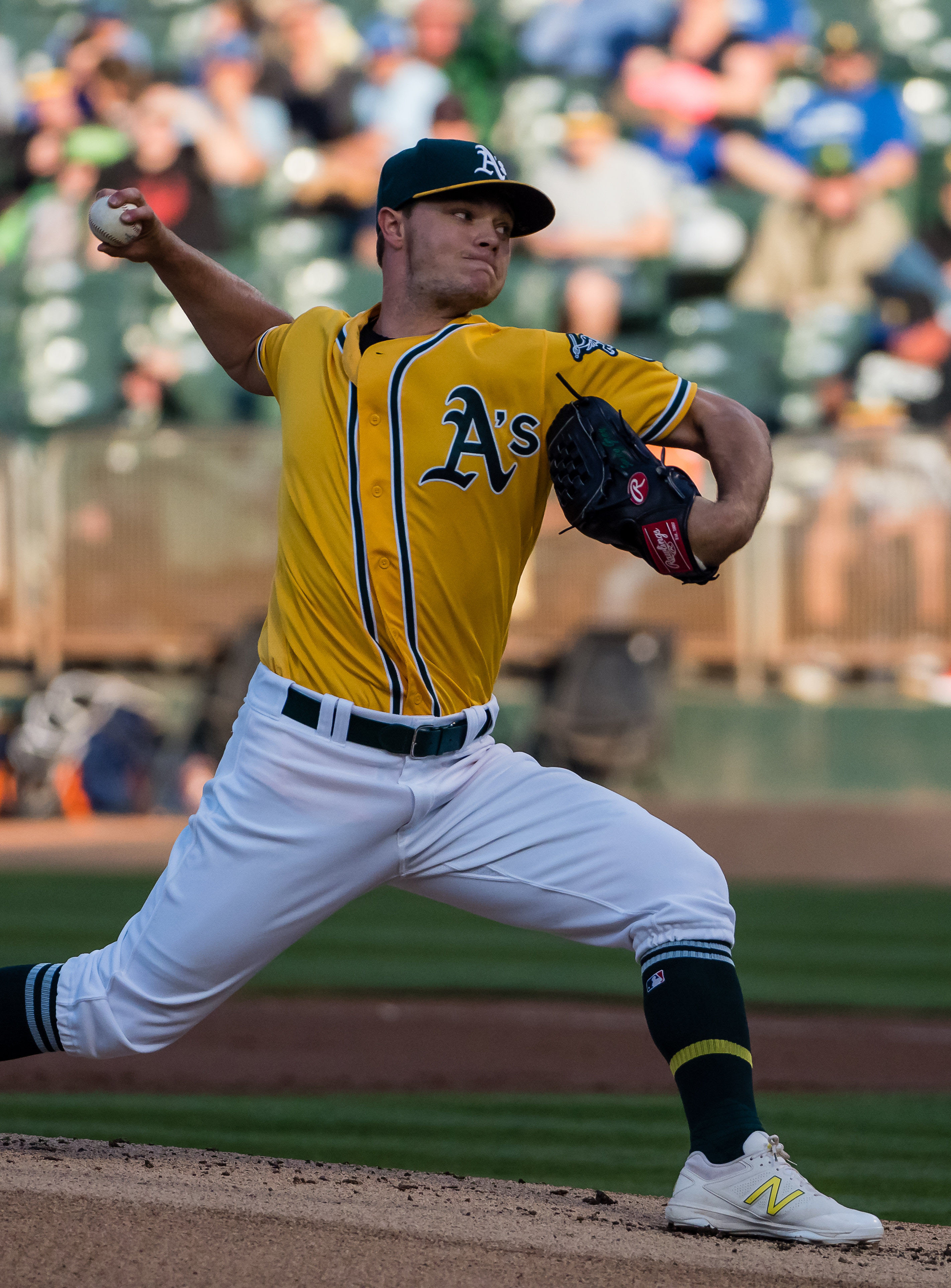
Gray has averaged 9.1 strikeouts (his highest since his rookie season) and 3.1 walks per nine innings pitched while inducing grounders at a 54.9 percent clip thus far in the season. His 93.4 mph average fastball velocity is still strong, and he’s inducing more chasing outside the strike zone (31.4 percent) than he ever has in his career. Perhaps unsurprisingly, his swinging-strike rate (12 percent) and opponents’ contact rate (74.2 percent) have both improved accordingly. Each of those marks is also a career-best for Gray.
Moreover, while Gray gets some benefit from playing in the spacious O.Co Coliseum, whatever help he receives is largely mitigated by the fact that the Athletics are the worst defensive team in baseball. Oakland’s -47 mark in Defensive Runs Saved is eight runs worse than the closest team (the Giants) and 19 runs worse than the 28th-ranked Blue Jays. Ultimate Zone Rating tells a similar story, grading the A’s at an MLB-worst -31.7. All of that has played prominently in his elevated ERA, as Gray’s .320 BABIP is the highest mark of his career to date.
Last year’s health troubles obviously have to be a concern to interested teams, but there’s a small silver lining: Gray’s price in arbitration was dramatically impacted both by his lack of innings in 2016 and his substandard results. He’s earning at an eminently affordable $3.575MM rate in 2017 and is controllable for two more years, through his age-29 season, before hitting free agency.
All of this is to say, of course, that the asking price for Gray will be steep. In spite of recent injury troubles, the paucity of controllable starters that will be available on the market and the vast number of teams looking to swing a deal for a player that can help their rotation beyond 2017 figure to result in a huge return for the A’s if they ultimately decide to move their ace.
Any team that’s seriously considering a run at Gray will have to have a fairly strong farm system and/or some young, MLB-ready talent with less than a year of club control on the table in talks. The A’s almost certainly aren’t going to move Gray for anyone that’s within arm’s reach of arbitration eligibility. The endgame here is to pick up multiple long-term assets that won’t have any real earning power for several more years.
Oakland, after all, has a wave of young prospects hitting the Majors right now and undoubtedly hopes that those assets can quickly help to form the core of a contender. Ryon Healy arrived on the scene last year, while this season has brought forth names like Matt Chapman, Matt Olson, Franklin Barreto, Jaycob Brugman and Bruce Maxwell, among others. It doesn’t seem likely that the A’s would be open to moving Gray for a package of high-ceiling 19-year-olds that are three years away from the Majors.
All of that probably puts fringe contenders like the Orioles, Angels, Mariners and Royals at a disadvantage. It’s feasible that Seattle could make a run in the wake of Drew Smyly‘s Tommy John surgery, but their system is pretty light on top-end talent, the A’s are a division rival, and their lone shot in 2017 is to get into the playoffs via Wild Card. That Gray is controlled through 2019 no doubt appeals to them, but I have to imagine that other clubs could put together more enticing offers.
It’s likely fair to also cross off any of the Giants, Padres, Reds, Phillies, Mets, Tigers, Marlins and White Sox. Each is well under .500, and many of those clubs are in the midst of a rebuild. Looking to some clear contenders that are in win-now mode, however, there are lots of readily apparent suitors for Gray…
Astros: Houston has been the most oft-linked team to Gray, as many pundits expect that they’ll add a front-line arm to join Dallas Keuchel and Lance McCullers in the playoff rotation. The Astros have plenty of high-end pitching prospects that aren’t yet proven in the big leagues (e.g. Francis Martes, David Paulino) as well as upper-level position prospects that don’t necessarily have a clear path to regular at-bats in the Majors (e.g. Kyle Tucker, Derek Fisher, Teoscar Hernandez). Houston also spent very aggressively on this past year’s international market, so they’ll have some potential impact talent rising through the ranks to replenish the system if they trade from their upper levels.
Cubs: Virtually the entire Chicago rotation has taken a step back in 2017, and whether it’s due to a potential “hangover” effect of last year’s lengthy postseason run or simply the year-to-year volatility that comes with pitchers, they’re in need of help. The Cubs entered the year with a questionable fifth slot in the rotation to begin with, and they’ve now lost Kyle Hendricks to the DL while Jake Arrieta, John Lackey and Jon Lester are all offering reduced production, to varying extents. Chicago is rife with young position players that could appeal to the A’s, though they’re reportedly not especially amenable to trading any of their young big league bats.
Yankees: The Yankees will be without CC Sabathia for awhile, and Masahiro Tanaka has struggled for much of the season. Michael Pineda‘s home run problems are more pronounced than ever, though he’s still managed to turn in solid overall results. However, the Yankees could lose Pineda, Sabathia and Tanaka at season’s end, leaving them with significant holes to fill in the rotation. Jordan Montgomery may very well be emerging as a long-term option, but he also threw just 139 innings last year, so at some point they’ll want to monitor his workload. Like the Cubs, the Yankees’ farm is stuffed with intriguing prospects. And for New York, there’s an additional (albeit entirely speculative) scenario to consider: with first base being a clear point of weakness, could they line up a package deal to land both Gray and Yonder Alonso in the same trade?
Dodgers: Rich Hill hasn’t looked like the 2015-16 version of himself this year, and Julio Urias will miss this season and possibly much of next year due to an ominous shoulder surgery. Gray would slot directly into a playoff rotation alongside Clayton Kershaw and breakout star Alex Wood, and the Dodgers aren’t lacking for appealing trade chips. Cody Bellinger is assuredly off limits, but prospects like Alex Verdugo, Willie Calhoun and others would likely pique Oakland’s interest.
Rockies: Colorado has leaned heavily on young pitching this season, but those inexperienced arms have begun to labor in recent weeks. Antonio Senzatela and Kyle Freeland come with some rather dubious peripherals, and lefty Tyler Anderson is now out for a month or so due to arthroscopic knee surgery. Jon Gray is returning from the DL, and Jeff Hoffman looks terrific, but there’s virtually no experience in the rotation beyond Tyler Chatwood and, to a lesser extent, the other Gray (Jon). Perhaps some of the young but raw arms that Colorado has leaned upon this year (e.g. German Marquez) could entice the A’s, and Colorado has prospects like outfielder Raimel Tapia and infielder Ryan McMahon that are somewhat blocked at the big league level. Per Nick Groke of the Denver Post, however, Brendan Rodgers is almost entirely off limits.
Diamondbacks: The rotation isn’t a clear area of need for the D-backs. In fact, it’s been one of the team’s strengths. They also have a weak farm system and may prefer to simply stick with the arms that have gotten them this far, so perhaps this is too much of a long shot for serious consideration. But, there also aren’t many holes on the Diamondbacks’ roster, and they’d currently turn to one of Zack Godley, Patrick Corbin or Taijuan Walker as the third starter behind Zack Greinke and Robbie Ray in a playoff rotation. Arizona might not have expected to be in this position, but they’re firmly in the hunt for the division and look, at worst, to be a Wild Card favorite. The core that’s propelled them will be around through at least 2018 — and most of it through at least 2019 — meaning Gray aligns well with the rest of their roster.
Indians: Like the Cubs, the Indians have seen a number of their pitchers take a step back in 2017. They, too, entered the year with a questionable setup at the very back of the rotation, and Danny Salazar‘s sharp decline, paired with the struggles of Trevor Bauer and Josh Tomlin, creates a need for rotation help as Cleveland finds itself in a surprising race with the Twins and Royals for top billing in the AL Central. Last year’s deal for Andrew Miller thinned out the farm, but they’re hardly hurting for top-end prospects. Bradley Zimmer‘s impressive play in the Majors probably removes him as a consideration in trades, but Cleveland has some potentially blocked assets in Tyler Naquin and Yandy Diaz as well as a number of upper-level prospects that have yet to break into the bigs.
Red Sox: Third base will probably be Boston’s primary area of focus, but they’ve already been linked to Gray on the rumor circuit. The Boston rotation is already stacked with high-profile names, but David Price‘s elbow issues and early struggles make him something of a question mark, and Rick Porcello hasn’t replicated his 2016 Cy Young form yet. Eduardo Rodriguez, meanwhile, is dealing with knee issues, while Steven Wright is out for the season and Doug Fister is a wild card. Chris Sale will join Price and Porcello in a potential playoff rotation for the Sox, though, so the notion of adding Gray to the mix might be a stretch, especially with the aforementioned greater need at the hot corner.
Each of those clubs looks to be firmly in “win-now” mode, but there are also a few teams that are walking the line between winning in the present while also building for the future. They may be a bit more of a stretch, but each has reason to at least explore the possibility of pursuing Gray.
Twins/Brewers: These two teams are in a fairly similar position. Both entered the year with a long-term outlook in mind, but both now surprisingly find themselves contending sooner than expected. Mortgaging the future wouldn’t be prudent if it meant acquiring a rental piece, but adding an affordable arm that can be controlled through 2019, when each team’s core has gained more experience, could hold appeal. Milwaukee has the better farm system of the two and has more outfielders than it knows what to do with, but the Twins still have some Top 100 prospects as well as some younger pieces that have yet to solidify themselves in the Majors. It’s worth noting, too, that Minnesota GM Thad Levine has already expressed an openness to acquiring long-term assets.
Braves: David O’Brien of the Atlanta Journal-Constitution recently linked the Braves to Gray, and while he’s reportedly not atop their wish list, his controllable nature should hold appeal to GM John Coppolella, who has never been shy about brokering trades. Depending on your prospect list of choice, the Braves have roughly 10 percent of the game’s Top 100 prospects in their ranks, so if they do decide that Gray is worth the considerable price, they’ll have plenty of pieces to entice Oakland president Billy Beane and GM David Forst.
Photo courtesy of USA Today Sports Images.
2017-18 MLB Free Agent Power Rankings
Most MLB teams are a few games shy of the halfway point in the regular season. We last checked in on the projected 2017-18 free agent class on May 18th, and since then plenty has changed. Below, the projected free agents are ranked based on their current earning power. To view the full list of players eligible for free agency after the season, click here.
1. Yu Darvish. Darvish is in the midst of a fine, healthy season. Post-Tommy John surgery, he’s logged 34 starts with a 3.26 ERA and 10.7 K/9 in 207 1/3 innings. While the 30-year-old righty may not be one of the ten best starters in MLB right now, he’ll likely be paid like it this winter. He has a shot at topping the six-year, $155MM contract Jon Lester signed with the Cubs in December 2014. According to Yahoo’s Jeff Passan on June 19th, Darvish is “very likely to end the season in a Rangers uniform.” While Texas is firmly in the AL Wild Card mix at present, Passan suggested that the Rangers would keep Darvish even if they fall out of contention by the trade deadline, to maximize their chances of re-signing their ace.
2. J.D. Martinez. Martinez, 30 in August, has established himself as the best hitter in this free agent class. Despite missing the first month and a half of the season, Martinez has a good shot at finishing with 30+ home runs for the second time in his career. For a team looking to add a right-handed middle of the order masher this winter, a six-year offer is possible. Consider Chris Davis and Shin-Soo Choo, who managed to land seven-year contracts in free agency. Martinez’s Tigers are currently long shots for the playoffs this year, and the club stands to net only a fourth-round pick if he rejects a qualifying offer and signs elsewhere this winter. So Martinez is a strong candidate to be traded a month from now, unless the Tigers surge.
3. Johnny Cueto. Cueto vs. Arrieta is an interesting argument. Born 20 days apart in 1986, both righties are having disappointing, home run-prone seasons. As MLBTR’s Steve Adams suggests, Cueto has the edge given his excellence in 2016 and an ability to go deeper into games this season. With the Giants completely out of contention, Cueto could be one of the best available starting pitchers on the trade market this summer. However, the pitcher’s opt-out clause adds downside risk for an acquiring team. Cueto is simply a rental if he opts out, as Jon Heyman of FanRag Sports says he’s “planning” to do, but the pitcher would still reserve the right to stick with his remaining four years and $84MM in the event of an injury or further downturn in performance. The Giants could reduce their asking price on Cueto to accommodate this risk, or better yet, allow a negotiating window to see if the pitcher would provide his potential new team more certainty about his future.
4. Jake Arrieta. Arrieta’s supporting stats suggest he’s better than his current 4.67 ERA, but his days as one of baseball’s best starters may be behind him. In five of his 16 starts, Arrieta has failed to make it out of the fifth inning. I’m currently projecting a five-year deal, though we haven’t seen that happen recently with a free agent pitcher entering his age-32 season, outside of Zack Greinke‘s outrageous six-year pact. Agent Scott Boras put out his Arrieta talking points to reporters about a month ago, but if they aren’t convincing to you and I, they probably won’t work on MLB GMs either.
5. Eric Hosmer. How low was Hoz on April 24th? An 0-for-4 against Miguel Gonzalez and the White Sox had dropped his season line to .192/.253/.247 through 79 plate appearances. This was following a very bleak second half in 2016. But since April 24th, Hosmer has been on fire, hitting .344/.402/.540 in 234 PAs. For the season as a whole, he’s back at “Good Hosmer” levels – a high-average hitter with some pop. At the moment, I’m projecting a solid five-year deal for Hosmer. He doesn’t turn 28 until October, broadening his appeal. However, there are two other first basemen who could threaten Hosmer’s market: Yonder Alonso and Logan Morrison. Both have come from out of nowhere to post monster first halves and could offer the allure of better production than Hosmer at a lower price in free agency. Interest in Hosmer could be further crowded out by Lucas Duda, Mark Reynolds, and Mitch Moreland.
6. Justin Upton. Though they go about it in different ways, Upton has been a similar value hitter to Hosmer over the last several years. While neither player is regarded as a great fielder, it’s a little harder to find a left fielder than a first baseman. Upton, however, is two years older than Hosmer and faces a decision on his opt-out clause. If Upton can top four years and $88MM in free agency, it might not be by a ton. Upton may make the safer choice to stick with his Tigers deal. On May 25th, Jon Heyman wrote that the possibility of Upton opting out seems “beyond remote,” with a rival GM in agreement. If the Tigers are to consider trading Upton, they’ll be faced with the same issue the Giants have with Cueto.
7. Mike Moustakas. With 20 home runs this season, Moustakas is already threatening his career high of 22. A 40-homer season isn’t entirely out of the question, given his production to date, and Moose can hold down the hot corner acceptably. He doesn’t turn 29 until September, and with a strong second half, a five-year deal could be in play. Older players such as Ian Desmond, Dexter Fowler, Russell Martin, and Brian McCann were all able to land five years in free agency.
8. Lorenzo Cain. Cain’s bat has bounced back so far this year, and the Royals’ speedy center fielder makes his first appearance in our top ten. Cain turns 32 next April, which may put a five-year deal out of reach. Still, he looks like the best available center fielder this winter. Like all of the Royals on this list, Cain could be traded in late July if the team falls out of contention.
9. Masahiro Tanaka. While Tanaka once seemed a lock to opt out of the remaining three years and $67MM on his Yankees contract, his rough start to the season has brought that into question. Tanaka, who turns 29 in November, sports a 5.56 ERA and has allowed a whopping 21 home runs in 90 2/3 innings. That’s good for the fourth-worst home run rate among all qualified starters. Tanaka’s performance has been extremely erratic this year. He doesn’t look like a $22MM pitcher in free agency, but with a strong second half, a four or five-year deal could be back on the table.
10. Michael Pineda. Prior to this year, Pineda’s home run problems could be mostly chalked up to Yankee Stadium. But this year, in his six road starts, Pineda has somehow seen 30% of fly-balls allowed leave the yard. The 28-year-old remains as maddening as ever, as three clunkers in June have pushed his ERA up to 4.12. Pineda is still young and talented enough to score a four-year deal in free agency, as he’s the type of pitcher teams can dream on.
A pair of dominant relievers just missed the top ten. Wade Davis and Greg Holland have been excellent and will likely be vying for four-year deals in excess of $60MM this winter. The aforementioned Alonso and Morrison have reinvented themselves and could threaten the top ten before the season is out. And despite a DL stint for a strained quad, Reds shortstop Zack Cozart still leads all projected free agents with 2.8 wins above replacement this year.
Jonathan Lucroy was arguably the best-hitting catcher in baseball last year, but his bat has gone ice cold in 2017. Lucroy turned 31 this month, and his performance has put a four-year deal in jeopardy.
2018 Vesting Options Update
We already took a preliminary look at the vesting option scenarios playing out around the game, but we’ve now gained quite a bit of clarity over the last six weeks. Generally, vesting options are club options that can become guaranteed based on the player’s health and/or performance. Typically, achieving contractually defined thresholds (such as for plate appearances or games finished) takes the decision out of the team’s hand, with some clauses also requiring certain health standards to be triggered.
Here’s where things stand at present:
Already Vested
- Greg Holland: That was fast! Holland has already racked up thirty games finished, meaning that what was a $10MM mutual option for 2018 has been converted into a $15MM player option. With a league-leading 25 saves in the bank, along with 29 1/3 innings of 1.53 ERA pitching, it seems unlikely that Holland will take that cash rather than testing the open market — though he could also have to turn down a qualifying offer and hit free agency weighed down a bit by draft compensation. (Notably, too, Holland is cracking into some hefty contract incentives. He is on track to earn most or all of the $11MM in available bonus money.)
On Track To Vest
- Gio Gonzalez: While Gonzalez is pitching well enough to make it a foregone conclusion that the Nationals would pick up his 2018 option at $12MM, that step won’t be necessary if he ends the regular season with 180 innings on his ledger. Working deep into games has been an issue for Gonzalez in recent years, but he has already topped 100 frames through just 16 starts thus far in 2017. Barring an injury, this one looks quite likely to vest.
Unlikely To Vest
- Ricky Nolasco: The 34-year-old faces an uphill battle, but he’s at least keeping it interesting. Nolasco can turn a $13MM club option ($1MM buyout) into a player option if he gives the Halos 202 1/3 frames this year. That’s a big number, but Nolasco has managed to log 90 2/3 innings through 16 outings, leaving 111 2/3 left to achieve. Even if he takes the ball another 16 times the rest of the way, he’d need to go seven innings per start — a pace typically achievable only by a few top aces around the game. (Currently, Max Scherzer and Chris Sale top the leaderboard with 113 2/3 frames.)
- Matt Cain: The Giants are sure to pay Cain a $7.5MM buyout rather than picking up his $21.5MM option for the 2018 campaign. But the veteran righty could take that decision out of the team’s hands if he’s able to reach 200 innings this year and stay off of the DL at season’s end. Cain has made all 16 of his starts so far, but he has accumulated only 84 innings. While it’s a theoretical possibility, then, it’s all but certain that this option won’t vest — and the Giants have every incentive to see that it doesn’t.
- Hisashi Iwakuma: When the season started, it seemed reasonably likely that Iwakuma would trigger his second vesting season — as he did last year with the first. After compiling 199 innings in 2016, he needed to accumulate only 125 more (and avoid an unspecified injury) to lock up a $15MM payday. But Iwakuma is currently parked on the DL with just 31 frames in the bank; even if he is able to work deep in most of his remaining starts, he almost certainly won’t have enough to accumulate the 94 additional innings he needs. If he doesn’t get there, then Seattle will decide between a $10MM salary and a $1MM buyout.
Will Not Vest
- Andre Ethier: Ethier’s $17.5MM club option vests upon 550 plate appearances in 2017. He has been shelved for the entire first half of the season, so he’ll have to take home a $2.5MM buyout as a consolation prize.
- Matt Garza: This one is complicated, but here’s the bottom line: Garza cannot possible make enough starts to reach 110 in total from 2014-17 (he’s currently at 82), so his option cannot vest at $13MM. At the same time, it’s no longer possible for him to miss 130 or more days of action to the DL this year, so the club won’t get a shot at a $1MM option for his 2018 rights. Instead, the deal reverts to a club option at $5MM. See? It’s simple.
- J.J. Hardy: The extension that Hardy signed with the O’s a few years back includes a $14MM club option (or a $2MM buyout), but that would vest if Hardy ended the 2017 campaign with 600 plate appearances on his stat sheet. That always seemed a stretch, but with his recent DL placement it’s no longer even possible.