
Let’s Name The Defining Trade Of The Past Decade
Back at the start of the year, I ran down the most memorable trades of the preceding decade. It was tough to nail down the swaps that I found most compelling; many folks wrote in with others that I added in an honorable mention section. In some cases, people suggested deals that were highly notable to them but relatively unexciting to me. Just as with the game itself, we all experience the hot stove differently.
At the time, I was gathering up the most notable deals. I thought about doing a ranking, but dismissed the idea. It was tough enough to pull together a list. Now I’ve come to wonder … in spite of our differing experiences, and the inherent subjectivity of it all, can we find some amount of consensus on the topic?
I don’t want to spread this too thin, so I’m not going to include every deal mentioned in the original post. Oh, and I went ahead and included a new entrant! You should read the original post on the subject — or click the links below to the deals themselves — for more details on the swaps. I’ll present them here in chronological order.
Brewers Acquire Zack Greinke (12/19/10)
Royals Acquire James Shields, Wade Davis (12/9/12)
Red Sox, Dodgers Complete Nine-Player Blockbuster (8/25/12)
Blue Jays, Marlins Complete 12-Player Blockbuster (11/13/12)
Blue Jays Acquire Josh Donaldson (11/28/14)
Padres Acquire Craig Kimbrel (4/5/15)
Wilmer’s Tears: Astros Acquire Carlos Gomez, Mike Fiers / Mets Acquire Yoenis Cespedes (7/31/15)
Diamondbacks Acquire Shelby Miller (12/9/15)
Cubs Acquire Aroldis Chapman (7/25/16)
Red Sox Acquire Chris Sale (12/6/16)
Astros Acquire Justin Verlander (9/1/17)
Marlins Trio: Yankees Acquire Giancarlo Stanton / Cardinals Acquire Marcell Ozuna / Brewers Acquire Christian Yelich (12/17-1/18)
Dodgers Acquire Mookie Betts, David Price (2/9/20)
You have a baker’s dozen to choose from. The response order is randomized in the poll. Let’s name the defining trade of the past decade! (Poll link for app users.)
Defining Trade Of The Past Decade
-
Red Sox, Dodgers Complete Nine-Player Blockbuster 27% (3,332)
-
Astros Acquire Justin Verlander 17% (2,030)
-
Marlins Outfield Trio 14% (1,689)
-
Cubs Acquire Aroldis Chapman 13% (1,613)
-
Red Sox Acquire Chris Sale 5% (581)
-
Blue Jays Acquire Josh Donaldson 5% (554)
-
Wilmer's Tears 4% (521)
-
Royals Acquire James Shields, Wade Davis 4% (477)
-
Blue Jays, Marlins Complete 12-Player Blockbuster 3% (420)
-
Dodgers Acquire Mookie Betts, David Price 3% (374)
-
Diamondbacks Acquire Shelby Miller 2% (266)
-
Brewers Acquire Zack Greinke 2% (210)
-
Padres Acquire Craig Kimbrel 1% (71)
Total votes: 12,138
Dr. Christopher Ahmad Warns Of Rash Of Tommy John Surgeries
Dr. Christopher Ahmad, the Yankees team physician, warns in a Medium post that the resumption of baseball could bring a new wave of Tommy John procedures.
Essentially, the point is that many typical concerns during a pitching ramp-up will end up being amplified when the game re-starts. Ahmad writes that “the coronavirus pandemic may greatly compound and exaggerate the risk factors associated with the spring Tommy John surgery spike.”
The warning isn’t exclusively or even primarily aimed at MLB or high-end minor-league hurlers, whose training regimens remain closely monitored by teams. Amateur players and lesser-regarded pros are perhaps at greater risk of falling into the traps that Ahmad identifies.
But the potential concerns could ensnare any pitcher. And the broader TJS epidemic, as Ahmad labels it, is of concern to the game even when it involves lower-level players.
Ahmad, who is one of the top TJ specialists in the world, delivers three primary points in the post. Pitchers should build up conditioning now, rather than waiting for what might be a rushed resumption of play. Any injury or soreness in the body should be taken seriously, due to the potential for compensation to lead to strain on the elbow. And any pain or other issues in or around the elbow ought to be treated seriously, even if it means a disappointing halt to play just after it finally re-started.
The post is worth reading for anyone involved on the pitching side of the sport at any level. It’s also a good reminder of the sort of considerations MLB teams have surely been weighing as they guide and monitor their players and think about how to get them ready for an entirely unique 2020 season.
A Front-Line Starter Who Got Away From The Rangers
Going back to his first season in the majors in 2014, just 11 other starters have outdone Cubs right-hander Kyle Hendricks‘ 3.14 ERA. That owes largely to an ability to limit walks, as Hendricks has issued just a bit over two free passes per nine innings during his career, as well a penchant for preventing damaging contact. Even though his typical fastball only clocks in around 86 mph, hitters can’t seem to square up Hendricks. Just last season, he ranked in the majors’ 97th percentile in exit velocity and its 88th percentile in hard-hit rate. It went down as yet another quality effort by Hendricks, who turned in a 3.46 ERA/3.61 FIP with his second-highest fWAR (4.1) across 177 innings.
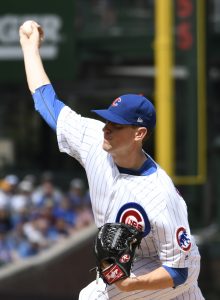
Not many could have expected Hendricks to pan out this well. The Rangers chose the former Dartmouth standout in the eighth round in 2011 (keep that in mind when unpicked players start signing after this year’s truncated five-round draft); although he went on to put up great production at the lower levels with the Rangers, he was never seen as a can’t-miss prospect. And at the July 2012 trade deadline, a little over a year after the Rangers drafted Hendricks, they traded him and third baseman Christian Villanueva (then a top 100-caliber prospect but now a member of Japan’s Nippon Professional Baseball) to the Cubs for veteran righty Ryan Dempster.
Dempster, who originally entered the pros as a third-rounder of the Rangers in 1995, got off to a strong start in 2012 before the Cubs traded him back to his original franchise. As MLBTR’s Tim Dierkes wrote when the swap occurred: “Dempster posted a 2.25 ERA with 7.2 K/9, 2.3 BB/9 and a 42.1% ground ball rate in 104 innings with the Cubs this year.”
Unfortunately for Texas, Dempster was unable to carry his Windy City effectiveness to the Lone Star State. While the Rangers did earn a playoff berth in 2012, they didn’t make it past the one-game wild-card round, and Dempster didn’t play much of a role in their regular-season success. He wound up tossing 69 innings of 5.09 ERA ball with the team before leaving for the Red Sox in free agency during the ensuing offseason. That proved to be a wise move for the last year of his career, as Dempster ended up as part of a World Series-winning Red Sox roster.
Dempster didn’t play a major role in Boston’s title, but Hendricks has gone on to be a key part of a championship winner since switching organizations. The Cubs took home their first World Series in 108 years in 2016, a season in which Hendricks recorded a league-best 2.13 ERA in 190 frames and added an jaw-dropping 1.42 ERA in 25 1/3 playoff innings. Three years later, the Cubs locked up Hendricks to what has always looked like an eminently reasonable contract extension, inking him to a $55.5MM guarantee over four seasons prior to the 2019 campaign.
We don’t know when we’ll see Major League Baseball again, but considering Hendricks’ track record, it seems safe to assume the 30-year-old will continue to hold his own when it does return. He’s one of the most valuable players on the Cubs, but he’s also one who got away for the Rangers.
Photo courtesy of USA Today Sports Images.
MLB To Hold 5-Round Draft
MLB has decided upon a five-round draft this summer, according to Jeff Passan and Kiley McDaniel of ESPN.com (links to Twitter). The union had previously agreed to the possibility of a draft as short as five rounds, though more recently had pushed for a lengthier process.
Commissioner Rob Manfred laid down the decision when MLB and the MLBPA could not come to an agreement on the particulars. Interestingly, Passan notes, a ten-round draft was also preferred by baseball operations departments. The version on offer from the league would’ve effectively separated the draft into two five-round sections with greater spending limitations on the latter half, along with a cap on undrafted signings.
Ultimately, it seems, owners were more concerned with avoiding the cost of additional bonuses than they were intrigued by the potential to acquire more high-end talent in the later stages of the draft. Draft-eligible players that are not selected in the five rounds will be eligible to sign for a maximize bonus of $20K.
Teams may struggle to woo players they don’t select. Typically, later-round choices can be paid quite a bit more than $20K. With collegiate play a viable alternative, many will elect to await a (hopefully) more lucrative professional starting point.
Then again, perhaps teams will find some success competing with geography, promises of advancement and opportunity, and other creative inducements. Manfred will no doubt need to be proactive in policing this arena. There’s huge potential upside to be had, which creates some potentially worrying incentives.
Finding value in the draft has long been a chief aim of baseball ops departments. Now they’ll have never-before-seen chances to sign an unlimited number of players for bargain prices. That’ll involve recruitment, of course, but there’s a rare possibility for major imbalance in the talent haul.
Even putting aside worries of rule-breaking behavior, there’ll be potential for havoc. Joel Sherman of the New York Post notes (Twitter link) the possibility of pressure on “late”-round picks to take what they can get or face a $20K cap. There’s also a sense that innumerable soft factors could sway large numbers of players in varying directions, as Chris Cotillo of MassLive.com notes on Twitter. There’ll certainly be downstream effects for players that choose to enter or remain in the collegiate and JuCo ranks.
Tigers Get A Good Run From A Budget Pickup
Niko Goodrum‘s lone brush with free agency lasted all of eight days. Cut loose by the Twins at the end of the 2017 season after eight largely uninspiring seasons in the minors, Goodrum signed a minor league deal with the rebuilding Tigers. A last-place club signing a little-known non-prospect drew about as much attention as you’d expect: virtually none. Goodrum got a quick 115-word write-up here at MLBTR after his agents announced the signing on Twitter. You’d be hard-pressed to find any sort of lengthy column penned at the time of the signing. It was a garden-variety minor league depth pickup.
Goodrum somewhat surprisingly broke camp with the Tigers in 2018 and received sparse playing time that April (19 games, 10 starts). By mid-May, he was hitting under .200 with a sub-.600 OPS. It wouldn’t have been a surprise to see the Tigers cut bait, but the versatile switch-hitter slowly began to turn things around. After his OPS bottomed out at .597 two years ago to the day — Goodrum bounced back with a .253/.320/.450 slash in his final 428 plate appearances. Along the way, he played all four infield positions and both outfield corners. He finished out the season with a slightly above-average batting line, per wRC+, coupling that with good baserunning.
An average hitter whose manager feels comfortable slotting him pretty much anywhere on the diamond would be a shoo-in for most rosters, and given the state of the Tigers, it was clear that Goodrum had punched his ticket to a 2019 roster spot. Goodrum added center field to his defensive resume early in the 2019 season, but as the year wore on and Jordy Mercer struggled with injuries, he found himself seeing more and more time at shortstop.
The Tigers surely value Goodrum’s versatility, but his strong work at short in sporadic batches this past season should ensure that he opens the year as the Tigers’ everyday option at that position. In just 326 innings there, Goodrum tallied 4 Defensive Runs Saved, a 3.2 Ultimate Zone Rating and 6 Outs Above Average. Among the 38 players who played at least 300 innings at shortstop this past season, Goodrum’s 8.6 UZR/150 ranked seventh.
With the bat, Goodrum took a slight step back but still turned in a solid enough .248/.322/.421 with 12 homers and 12 steals apiece. There’s some reason for additional optimism, too, as Goodrum had an above-average hard-hit rate and upped his walk rate from 8.5 percent in 2018 to 9.7 percent in 2019. And despite an unassuming stolen base total, Goodrum ranked in the 92nd percentile of MLB players in terms of average sprint speed. He’s been successful in 77 percent of his career stolen base attempts (24-for-31), so there’s room for him to create some additional value on the basepaths. Making consistent contact has been a problem for Goodrum, though it’s also worth pointing out that his spike in punchouts last year coincided with some knee and groin injuries over the summer. He still whiffed in 26.8 percent of his 2018 plate appearances, so contact will probably continune to be an issue, but last year’s near-30 percent mark might be higher than should be expected.
If there’s work to be done for Goodrum, it’s in handling certain pitches. The 28-year-old feasted on fastballs (.320/.412/582) and curvevalls (.280/.321/.460) but took home a participation award against most other offerings. Changeups befuddled him (.193/.230/.337), and sliders were downright unfair to him (.157/.214/.216). Given those woeful slash lines, it’s not surprising to see that Goodrum had a swinging-strike rate greater than 20 percent against both those pitch types.
Goodrum clearly isn’t a star, but the Tigers can control him for four more seasons and he won’t be arbitration-eligible until this winter. A plus defensive shortstop with high-end speed and even average skills at the plate is a nice piece to have, though, and if Goodrum can maintain his stellar glovework at short over a larger sample, he’s the type of player who could surprise a lot of onlookers with a three- or four-WAR season. The Tigers have reportedly received trade interest in him in the past, and given the positives laid out here, that’ll likely continue in the future.
Goodrum’s trajectory in some ways mirrors that of Marwin Gonzalez (sans the trash can, presumably), as he’s slowly risen from a versatile defender without much bat to an average switch-hitter who can be be played pretty much anywhere. With the Tigers, that’ll continue to be shortstop, but if he’s eventually traded, he could resume his jack-of-all-trades role. We hear a lot about some of the Tigers’ misses and missed opportunities these days, so it’s only fair to give them credit here for finding an asset that the Twins probably wish they hadn’t let slip through their fingers. They’re the ones who ultimately signed Gonzalez, after all. While it hasn’t been a bad signing, that $21MM might’ve been spent elsewhere if Goodrum were still in the fold.
Dodgers, Turner Hadn’t Discussed Extension Prior To Transaction Freeze
Justin Turner is in the final season of his four-year, $64MM contract with the Dodgers, but the star third baseman tells Jorge Castillo of the Los Angeles Times that he hasn’t discussed a contract extension with the team yet. Extension talks are prohibited while the league is under a transaction freeze, but it’s nevertheless notable that they’d not yet broached the topic of a new contract when such negotiations were permissible.
Turner missed some time back in 2018 due to a fractured wrist and a hamstring strain but has mostly avoided the injured list in recent seasons. While he’ll turn 36 in the offseason, he’s been nothing short of excellent at the plate. Given all the star power up and down the Dodger lineup, it’s easy for Turner to get lost in the shuffle. Over the past three seasons, he’s posted an outstanding .307/.397/.519 batting line with 62 homers, 87 doubles and a triple. He’s been one of the toughest players in the league to strike out in that time — just 13 percent — while drawing a walk in just over 10 percent of his trips to the plate. Since 2017, the only qualified hitters in baseball with a better OBP are Mike Trout, Joey Votto, Juan Soto, Aaron Judge and Christian Yelich.
The Dodgers have some internal options. Edwin Rios and Chris Taylor are both capable of playing third base, and on a speculative basis, Corey Seager could slide over with Gavin Lux taking over at shortstop. Max Muncy has also appeared in at least 30 games at the hot corner in each of the past two seasons.
On the one hand, Turner’s outstanding offensive production and the relatively short-term commitment he’d command due to his age make a reunion a sensible pursuit for the Dodgers. Then again, the club pursued Anthony Rendon this winter with an eye toward Turner changing positions, so perhaps the preference is to lock in a younger third base option with better defensive contributions. (Turner once rated as a premium defender but has seen his numbers deteriorate a bit in his mid-30s.)
[Related: 2020-21 Free Agent Third Basemen]
If Turner ultimately reaches the open market, he’ll be among the best bats available in free agency, although he spoke fondly of the Dodgers when chatting with Castillo. “Obviously there’s a possibility that there’s no season and my Dodger career could’ve ended last year in the playoffs, which would be tough,” said Turner. “It would be sad. Sad to think about.”
Wainwright Discusses Playing Beyond 2020
Adam Wainwright has been a fixture on the Cardinals’ pitching staff since 2006, and while the right-hander’s career looked to perhaps be drawing to a close a few years ago, he now tells Ken Rosenthal of The Athletic (subscription required) that he hopes to return to the Cardinals for another go in 2021.
Wainwright, who’ll turn 39 in August, details that as recently as 2017, “my arm hurt taking a spoonful of cereal.” Had the current shutdown occurred back then, the three-time All-Star candidly acknowledges that he “would have retired so fast it wouldn’t have been a second thought.” Now, however, his arm feels as healthy as it’s been since 2013-14. Wainwright is playing long toss with newly signed Cards lefty Kwang-hyun Kim from distances of close to 300 feet.
The improved health in his arm is apparent in his results on the field as well. The 2019 season marked just the second time since 2014 that Wainwright has been able to make 30 starts, and last year’s 171 2/3 frames were his second-highest single-season total of the past five years. Wainwright worked to a 4.19 ERA last year, averaging 8.0 K/9, 3.4 BB/9 and 1.15 HR/9 to go along with a 48.8 percent ground-ball rate. He was slightly better than the league-average hurler, per ERA+ (102), and he was right at the league average in terms of FIP- (100).
Certainly, it’s a far cry from the Cy Young-caliber ace that Wainwright once was, but the Cardinals weren’t asking him to be that — nor were they compensating him as such. Young Jack Flaherty has taken up the mantle as the team’s ace, while Wainwright gave the Cards 171 league-average frames while pitching on a $2MM base salary and maxing out an incentives package that earned him another $8MM. He re-upped on a one-year, $5MM deal this winter (with another set of incentives), as the organization hoped he could again serve as a steady source of innings and mentor for the younger pitchers.
While he’s open to and even hopeful of playing another year in 2021, Wainwright didn’t sound like a player who has much interest in relocating to another club. Longtime teammate Yadier Molina recently went on the record to state a newfound willingness to play anywhere next season, but Wainwright focused his comments specifically on another year with the Cards:
My wife loves St. Louis. My family loves St. Louis. As long as (the Cardinals) will have me, I’d love to play again next year.
Presumably, Wainwright will play out the remainder of his career on a series of one-year deals in St. Louis, with similar incentives packages to those negotiated over the past two offseasons. Interestingly, both contained incentives based on both starting and relieving, so it seems that a return to the ‘pen hasn’t been entirely ruled out for the longtime starter. For now, though, the expectation is that he’ll serve as a starter whenever play is able to resume.
Astros Hope To Extend George Springer
Whether a game is played in 2020 or not, George Springer is slated to become a free agent for the first time this coming winter. The Astros, however, hope to broker a long-term deal with their star outfielder, per Chandler Rome of the Houston Chronicle. While he was overseeing the baseball ops department in between the firing of Jeff Luhnow and hiring of new GM James Click, owner Jim Crane “made it clear” to Springer’s representatives at Excel Sports Management that his club was interested in a long-term deal, Rome writes. Such talks aren’t permitted during the league’s transaction freeze, though the two sides can come back to the table once that freeze is lifted.
Crane made that desire clear not only in his words but also through his actions. As we noted at the time the two sides avoided arbitration, it’s uncommon these days for a team and player to agree on a one-year arrangement after arbitration numbers are filed. But Crane not only bucked the “file-and-trial” trend that permeates the game with regard to Springer — he inked the slugger at a $21MM rate that checked in north of the $20MM midpoint between Springer’s $22.5MM submission and the club’s $17.5MM figure.
Paired with Rome’s report on the situation, that seems like a clear show of good faith that the club hopes to keep Springer around for the long haul — keeping him in Houston alongside already-extended stars Alex Bregman and Jose Altuve. Bregman’s five-year, $100MM extension and Altuve’s $151MM extension both run through the 2024 campaign.
Keeping Springer would be a critical move for the Astros, who currently stand to lose four of their nine 2019 everyday players to free agency this winter. Beyond Springer, each of Michael Brantley, Josh Reddick and Yuli Gurriel is slated to hit the open market. While top prospect Kyle Tucker should be ready to slot into one of those outfield vacancies and Abraham Toro could perhaps occupy first base, that still leaves the club with a pair of holes in the lineup.
The financial feasibility, of course, remains to be seen. Houston has $116MM on the books in 2021 — including $134MM in total luxury tax obligations. That’s not including what should be significant arbitration raises to Roberto Osuna (earning $10MM in 2020), Carlos Correa ($8MM in 2020) and Lance McCullers Jr. ($4.1MM in 2020) — plus smaller raises for Chris Devenski ($2MM in 2020), Aledmys Diaz ($2.6MM in 2020) and Joe Biagini ($1MM in 2020). The Astros barely spent in free agency this winter as the team seemingly eyed a 2021 dip under the luxury threshold, but there’s certainly room to pay Springer on a long-term deal and still successfully make that luxury maneuver next season.
Springer, 31 in September, landed third on MLBTR’s Free Agent Power Rankings back in late February — trailing only Mookie Betts and J.T. Realmuto. Skeptics will surely question the legitimacy of his excellence at the plate in the wake of the team’s sign-stealing scandal — and it’s only fair to point out that Springer had one of his best seasons amid that trash-can scandal in 2017. But the slugger’s best season was actually in 2019, when he laid waste to opposing pitching with a .292/.383/.591 slash line (150 OPS+, 156 wRC+) and ripped 39 home runs in just 122 games/556 plate appearances.
It should also be emphasized that while Springer and his teammates surely benefited from that sign-stealing operation, his offensive ability has never been in doubt. He was the 11th overall pick in the 2011 draft and posted an OPS of .900 or better at each minor league level (plus in the Arizona Fall League) on his way to the big leagues. Springer posted a 129 wRC+ in three seasons prior to that nefarious 2017 campaign and, over the course of his MLB career, has been 31 percent better than the league average hitter per OPS+ and 33 percent better per wRC+. He also rates well defensively in both center field and right field.
A long-term deal for Springer would be likely be expected to cover at least five years under normal circumstances, although the loss of revenue presents some uncertainty as to what to expect with regard to contract negotiations — extensions and free agency alike — whenever transactions do resume.
2 Years Ago, The Mets Cut Ties With A Former Star
It seems like ancient history now, but right-hander Matt Harvey used to be considered among the majors’ elite players. A 2010 seventh overall pick of the Mets, Harvey debuted in the bigs in 2012 and truly broke out the next season with 178 1/3 innings of 2.27 ERA ball. From his first taste of MLB action until 2015, Harvey posted a 2.53 ERA with 9.46 K/9 and 1.98 BB/9 over 427 frames, earned an All-Star bid and was part of a pennant-winning team. Harvey, Noah Syndergaard and Jacob deGrom were supposed to form an unstoppable trio atop the Mets’ rotation for the long haul, but it wasn’t to be, as Harvey experienced a dramatic fall from grace during his time in their uniform.
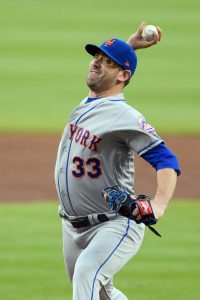
Injuries have been an all-too-common problem for Harvey, who underwent Tommy John surgery on his pitching elbow in October 2013 and sat out all of of the next season. Harvey made a triumphant return to win NL Comeback Player of the Year honors in 2015 – the latest season in which the Mets went to the World Series – but it wasn’t a campaign devoid of controversy for the hurler who became known as the Dark Knight. He and agent Scott Boras pushed for a limit of 180 innings for the year, but Harvey ended up exceeding that amount with ease, tossing 189 1/3 frames in the regular season and racking up another 26 2/3 in the playoffs. The workload may have been too heavy for his taste, but Harvey was actually great that October – including an eight-inning, two-run effort in a Fall Classic-deciding, Game 5 defeat to the Royals. Little did anyone know that shining moments would be so few and far between for him since then.
Rewinding to 2016, you’d have a hard time finding many regular starters who have been worse than Harvey. He underwent thoracic outlet surgery in July of that year, and that now looks like a death knell in hindsight. Now 31 years old, Harvey’s the owner of a 5.56 ERA – the third-highest figure among all qualified starters – in his most recent 390 innings.
Having seen enough of Harvey, the Mets – once justified in believing he was a true ace – gave up on him exactly two years ago. It was on May 8, 2018, that the Mets traded Harvey to the Reds for catcher Devin Mesoraco – another once-promising player who didn’t pan out as hoped. Harvey turned out OK as a Red, contributing 128 innings of 4.50 ERA ball en route to an $11MM guarantee with the Angels during the next period of free agency. Likewise, Mesoraco wasn’t horrible as a member of the Mets, with whom he batted .222/.306/.409 in 229 plate appearances. But neither player is even in baseball at this point.
Mesoraco has all but retired after sitting out the 2019 campaign. Harvey could still resume his career, but it’s not looking good. The former front-end starter was so ineffective in his lone year with the Angels that they released him in July. Harvey did catch on with the Athletics on a minor league contract after that, but he didn’t crack their big league roster at all, and there have been few rumblings about him since he elected free agency at the outset of offseason. In fact, MLBTR’s archives have just two somewhat recent news items on Harvey – one on how he auditioned for the Blue Jays as a reliever during the winter and another saying the Mets aren’t interested in reuniting with him. It’s a stunning descent for a pitcher who was among the best during his Mets heyday.
Photo courtesy of USA Today Sports Images
Choi’s The (Ji-) Man
Rays first baseman Ji-Man Choi has been a quietly productive member of the team’s offense over the past couple seasons. The Korea-born Choi – previously with the Mariners and Orioles – got off to a slow major league start with the Angels in 2016, evidenced by an unimpressive .170/.271/.339 line in 129 plate appearances in his first taste of MLB experience. That caused the Angels to outright Choi for the second time, and he wound up declining that assignment to join the Yankees prior to the 2017 season.
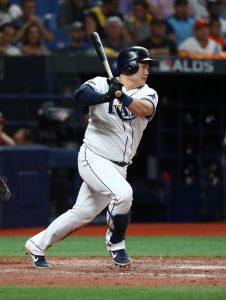
Choi only totaled 18 plate appearances with the Yankees, who then became the latest team to kick him off their 40-man roster in July 2017. While Choi joined the Brewers on a minor league contract in the ensuing offseason, they didn’t give him much of a chance in the majors. After he took 30 at-bats with the big club, the Brewers traded Choi to the Rays in June 2018 for infielder Brad Miller.
The Choi-Miller deal didn’t come off as an exciting one when it occurred, but it’s clear who came out on the better end in hindsight. Miller, now a Cardinal, amassed a mere 74 at-bats as a Brewer in his lone year with the team and was unable to produce much of anything in his brief time with the club. On the other hand, the Rays have stumbled on a pretty good offensive piece in the 28-year-old Choi, who has batted .263/.365/.472 (127 wRC+) with 27 home runs and 3.0 fWAR in 676 plate appearances since he first donned a Tampa Bay uniform.
Last year, his first full season in the bigs, Choi hit .261/.363/.459 (121 wRC+) with 19 homers in 487 PA to help the Rays to 96 wins and a playoff berth. If we’re to believe Statcast, it was not a fluky showing, considering Choi ranked well above average in categories such as expected weighted on-base average, exit velocity and hard-hit percentage. Meanwhile, FanGraphs estimates that Choi’s performance in 2019 gave the Rays $15.5MM in value, far outweighing the league-minimum salary he made.
The Rays could continue to profit from Choi’s presence in future seasons, as he’s controllable for four more years and one more pre-arbitration season, but that’s not to say he’s without obvious flaws. The clearest problem is that the left-handed Choi has had issues versus southpaw pitchers. The sample size isn’t large (125 PA), but lefties have held Choi to a woeful .185/.288/.296 (64 wRC+) since he got to the majors. That’s clearly not going to get the job done, though the well-constructed Rays are flexible enough that they should be able to shield Choi from facing lefties going forward. The offseason acquisition of righty first baseman Jose Martinez – a renowned destroyer of lefties – ought to help matters.
In typical Rays fashion, Choi and Martinez should provide the small-budget club great production at a minimal cost. Martinez will make less than $2.5MM this season, giving the Rays a potentially terrific offensive tandem at first base for around $3.3MM. You have to get especially creative in building a roster when you don’t have much money to spend, and the Rays’ front office has done just that time and again. The Choi acquisition, although it looked unimportant at the time, is one of many reasons the Rays could enter 2020 (if there is a season) as one of the teams to beat.
Photo courtesy of USA Today Sports Images.