
Sorting Through The Brewers’ Outfield Options
The Brewers’ outfield is going to have a different flavor this year compared to 2022. Lorenzo Cain was released in June of last year, Andrew McCutchen reached free agency at season’s end and has since signed with the Pirates, while Hunter Renfroe was dealt to the Angels. That leaves room for some fresh faces to step up and take over. Let’s take a look at some of the options.
The Lock
Yelich, 31, is the one constant in the Milwaukee outfield picture, as his contract runs through 2028. He was one of the best players in the league in 2018 and 2019, winning National League Most Valuable Player in the first of those two seasons. In each of those two campaigns, he posted a wRC+ of 167 or higher, stole at least 22 bases and was worth 7.2 fWAR or more. His production has dropped off from those incredible heights over the past three years, but he’s still a solidly above-average player. Last year, he hit 14 home runs, stole 19 bases and walked in 13.1% of his plate appearances. That led to a .252/.355/.383 batting line, a 111 wRC+ and 2.3 fWAR.
His contract and past performance ensure that he’ll be part of the team on a regular basis, though he’ll likely serve as the designated hitter a few times, leaving plenty of outfield playing time for others. The last time he played the field in more than 115 games in a season was 2019. Since the club is invested in Yelich for the long haul, they’ll want to continue giving him the occasional breather to keep him healthy. Advanced defensive metrics are also split on his glovework, with Defensive Runs Saved and Outs Above Average both grading him as subpar last year and for his career, while Ultimate Zone Rating is much more encouraged.
Short-Term Vets
Winker, 29, is looking for a bounce back after a down season. In 2020 and 2021 with the Reds, he hit 36 home runs and produced a batting line of .292/.392/.552. Of all the hitters in the league with at least 650 plate appearances in that stretch, his 145 wRC+ was one of the 10 best. His work was even stronger with the platoon advantage, as he hit righties to the tune of .321/.417/.619 for a 167 wRC+, with only Juan Soto and Bryce Harper ahead of him in that department. He was traded to the Mariners prior to 2022 but struggled, hitting just 14 home runs last year and slashing .219/.344/.344 overall for a wRC+ of 109.
The Brewers acquired him as part of the Kolten Wong trade and will hope that a second change of scenery will suit Winker better than the first. It’s possible that injuries played a role as Winker required left knee surgery and a second procedure to address a bulging disc in his neck in October, though Ryan Divish of the Seattle Times has also reported that Winker’s work habits were a concern in Seattle. Regardless of the cause, Milwaukee is considered to be a much more favorable offensive environment than Seattle, which should work in his favor.
It remains to be seen how much the Brewers want to rely on Winker as a defender. His glovework has generally been rated poorly in his career and his numbers declined in that department in 2022. That could have been impacted by his health situation, but it’s possible he spends more time as the DH than in the field. However, as mentioned, Yelich will likely see his share of time in the DH slot as well, which will likely require Winker to spend at least a bit of time in the field. Winker is slated for free agency at season’s end.
Anderson, 30 in May, is also looking for a bounceback like Winker. From 2018-20, he hit 42 home runs for the Marlins and produced a line of .266/.350/.436, 115 wRC+. But the past two seasons have seen injuries diminish his playing time and performance. He got into just 165 total games over 2021 and 2022, hitting .233/.321/.359 for a 93 wRC+. He was eligible for one more pass through arbitration but the Marlins non-tendered him instead, with Anderson then signing a one-year deal with the Brewers.
Anderson has a bit more time at third base in his career than the outfield, and he told reporters last month he expects to see more time at third base than in the outfield. Milwaukee has Luis Urías to man the hot corner, through. That should leave Anderson in the mix for some outfield time, perhaps in a platoon role. He hits from the right side while Yelich and Winker both his left-handed, as do some of the guys below him on this list. Anderson has modest reverse splits for his career but did hit lefties better last year. Defensively, in over 1,500 outfield innings, Anderson has a -8 OAA but 8 DRS and 9.3 UZR. Even though he was hurt last year, his arm strength was still considered to be in the 99th percentile by Statcast, which could serve him well at third base or in the outfield.
Controllable Guys With Some Experience
Taylor, 29, has been largely a part-time option for the Brewers in recent years but took on a larger role last year as Cain was gradually phased out. He got into 120 games in 2022 and provided enough power to overcome some lackluster work at the plate otherwise. He struck out in 25.2% of his plate appearances and drew walks at just a 5.4% clip, but he did hit 17 long balls in 405 plate appearances. The result was a .233/.286/.442 batting line and a wRC+ of 102.
That work at the plate was just above average but he was much stronger on the other side of the ball. He played all three outfield positions but mostly in center, earning 6 DRS, 6 OAA and 2.0 UZR overall. It wasn’t a superstar performance but was competent in enough areas to produce 2.1 fWAR on the year. He’s set to reach arbitration for the first time after this year and can be retained through the 2026 campaign.
Mitchell, 24, was only drafted in 2020 but has already cracked the majors. He hit .287/.377/.426 between Double-A and Triple-A last year for a wRC+ of 118. He was selected to the major league club in August and was somehow even better in the big leagues. He hit .311/.373/.459 for a wRC+ of 136 in his first 68 MLB plate appearances. That’s a small sample size, however, and he did strike out 41.2% of the time. His defensive work was also graded as above average and he stole eight bases in 28 games.
Mitchell is a real wild card in this bunch since his 2023 could seemingly go in many different ways. On the one hand, he’s shown impressive results in all facets of the game and could be an immediate center field solution, pushing Taylor into a corner role. On the other hand, he has played less than 50 games above Double-A, the strikeouts are a real concern and his .548 batting average on balls in play will require serious regression.
Bolt, 29, and Harrison, 27, are in a similar boat to each other. They have both posted some solid minor league numbers but struggled in the majors. They’re now both out of options and had to settle for minor league deals for 2023. Bolt has a career batting line of .156/.205/.266 while Harrison’s is .176/.253/.294. They’ll likely only get a shot if the club gets bit by the injury bug a few times. Neither has reached arbitration yet and could theoretically be retained well into the future if they carve out a role.
Infielders That Can Play Some Outfield
Brice Turang/Mike Brosseau/Keston Hiura
With Wong having been traded to the Mariners, the second base job is up for grabs. Turang is one of the club’s top prospects and had a strong season in Triple-A last year, making him the favorite to take the job at the keystone despite not having cracked the majors yet. He played a bit of center field in Triple-A last year but is primarily a middle infielder. Brosseau can play all over and will be in a super utility role, allowing the club to pencil him in for any regular that requires an off-day. Hiura’s not quite as versatile, having only played first base, second base and left field in his big league career so far. He has tremendous power but has struck out in 36% of his plate appearances thus far, which will make it hard for him to carve out meaningful playing time.
On The Cusp Of A Debut
Perkins, 26, has long been considered a glove-first player but his bat seemingly took a step forward last year. Splitting his time between Double-A and Triple-A in the Yankees’ system, he stole 21 bases, hit 15 home runs and slashed .246/.357/.456 for a wRC+ of 120. He wasn’t added to that club’s roster at any point but the Brewers were intrigued enough to sign him onto their 40-man roster in November. He’ll likely be in the minors waiting for an opportunity to get called up, but he should have a decent floor thanks to his defense and speed. If the power he showed last year was a real development, he could be a well-rounded contributor.
Frelick, 23 in April, was the club’s first round pick in the 2021 draft but has quickly climbed the minor league ladder. Last year, he went from High-A to Double-A to Triple-A, hitting .331/.403/.480 for a wRC+ of 137, stealing 24 bases in the process. He doesn’t have much power but he’s very tough to strikeout, hitting 11 home runs last year but getting punched out at just an 11.2% rate. He’s still not on the 40-man roster but he’s considered one of the club’s top prospects and could force his way into the picture soon.
Wiemer, 24 this weekend, is the inverse of Frelick with big power but strikeout concerns. He hit 21 home runs last year between Double-A and Triple-A but went down on strikes 26.8% of the time. The result was a .256/.336/.465 batting line and a 109 wRC+. Despite being a power hitter, he has sneaky speed, swiping 31 bags last year. Like Frelick, he’s not on the 40-man yet but is on the doorstep. Both he and Frelick are considered capable of playing center field.
Top Prospect That Could Show Up This Year
Chourio is arguably the most exciting of this whole bunch but he might require patience since he’s very young, still over a month away from his 19th birthday. Last year, despite being just 18 years old, he went through Low-A, High-A and Double-A, hitting 20 home runs and stealing 16 bases in 99 games. His .288/.342/.538 batting line resulted in a 135 wRC+ and he got strong reviews for his glovework in center field.
Based on those excellent results at such a young age, he’s now considered the #3 prospect in the league by Baseball America, #8 by MLB Pipeline and #5 at FanGraphs. Given his youth and the fact that he’s played just six Double-A games, he won’t be a solution for the Brewers in the short term. Even reaching the big leagues by the end of the season seems like a long shot, but it probably can’t be completely discounted given the tremendous talent he seems to possess.
_____
There’s a ton of young talent here, including about a half dozen plausible center fielders. That puts the Brewers in great shape for the long haul, though it might take some time to allow these guys to sort themselves out. Chourio isn’t close, while Wiemer, Frelick and Perkins still haven’t made it to the majors. Mitchell had a great debut but will need a longer stress test. Taylor should be solid for now but isn’t elite at anything and could be surpassed by the younger guys in time. Winker and Anderson will both be free agents after this year but it seems like the club could easily replace them from within.
In the future, it seems likely the Brewers will not only have a strong outfield but will likely have enough options to make trades that address other areas of the roster. We already saw one such move when they included Esteury Ruiz in the three-team deal that netted them William Contreras as their potential catcher of the future. Not all young players end up panning out as hoped, of course, but the quality and quantity both appear to be strong here. If the club can keep pace with the Cardinals in the division this year and there’s enough development from this group, perhaps the Brewers could be key players for deadline deals to help them push to return to the postseason after missing last year for the first time since 2017.
Big Hype Prospects: Cowser, Bleday, Alvarez, Outman, Steer
Pitchers and catchers report in 10 days, at which point we’ll have more to discuss in virtually every facet of the sport. Until then, let’s review more prospects tangentially connected to the news. Today’s episode coincidentally includes a number of left-handed hitters with holes in their swing.
Five BHPs In The News
Colton Cowser, 22, OF, BAL (AAA)
(A+/AA/AAA) 626 PA, 19 HR, 18 SB, .278/.406/.469
In a recent radio spot, Orioles general manager Mike Elias indicated a belief Cowser will debut later this season. A recent review of the Baltimore farm system published by FanGraphs’ Eric Longenhagen offers modest cause for concern. There are now questions about Cowser’s ability to perform against low-in-the-zone breaking balls and inside fastballs. Those are two very large holes for a big league hitter, indicating Cowser might require a carefully managed role once he is promoted. The lower-half stiffness noted by Longenhagen is a new issue and might relate to the workload Cowser shouldered last season. In order to improve and adjust, Cowser could require a long stint in Triple-A.
JJ Bleday, 25, OF, MIA (MLB)
(MLB) 238 PA, 5 HR, 4 SB, .167/.277/.309
The left-handed hitting slugger has two massive issues to overcome – a weakness against up-and-away fastballs and a pulled, fly-ball-oriented approach lacking in high-quality exit velocities. Both issues were on full display in Bleday’s first season, and he has used up his rookie eligibility. Bleday is currently expected to compete with Jesus Sanchez and Bryan De La Cruz for playing time in left field. Unless he improves upon both shortcomings, the former fourth-overall pick will be limited to heavily scripted usage against right-handed sinkerballers. Achieving such an adjustment will likely require a new swing and a return to Triple-A to digest the changes.
Francisco Alvarez, 21, C, NYM (MLB)
(AA/AAA) 411 PA, 27 HR, .260/.374/.511
A burly backstop who frequently draws hitting comps to Salvador Perez, Alvarez will need to play his way onto an Opening Day roster that already includes catchers Omar Narvaez and Tomas Nido. While neither player is expected to block Alvarez, he also has a second pathway onto the roster – designated hitter. As we learned yesterday, the Mets are carrying a veteran tandem of Daniel Vogelbach, Darin Ruf, and Tommy Pham in part to leave a door open for Alvarez and Brett Baty (covered last week) to get at-bats as part of the revolving door at DH.
As a hitter, Alvarez appears primed for the Show. There is near-term concern about his rate of contact and occasional lapses into over-selectivity. Even so, these are small issues to polish rather than fatal flaws.
James Outman, 25, OF, LAD (MLB)
(AA/AAA) 559 PA, 31 HR, 13 SB, .294/.393/.586
Although the Dodgers have made peace with crossing the first luxury tax threshold, they’ve done little to fortify their left field mix. Outman will compete with the likes of Chris Taylor and Jason Heyward for a regular role this spring. Outman’s approach could serve as a roadmap for Bleday. The left-handed hitting Outman makes frequently pulled, fly ball contact, but he isn’t nearly as extreme as the similarly built Marlins outfielder. Outman also consistently delivers line drives which allows him to post above-average BABIPs. Toss in above-average plate discipline, and he has a chance to hit for average, OBP, and power despite expectations of a 30 percent strikeout rate.
Spencer Steer, 25, 3B, CIN (MLB)
(AA/AAA) 427 PA, 23 HR, 4 SB, .274/.364/.515
Acquired as part of the return in the Tyler Mahle trade, Steer looks the part of a future second-division starter or frequently-used utility man. The Reds are in a year of transition with Steer eyeing a role as the regular third baseman. Long-term, he’ll need to contend with the likes of Elly De La Cruz, Edwin Arroyo, Noelvi Marte, and Matt McLain – whichever among those doesn’t take over at shortstop. Steer is considered a well-rounded hitter with a feel for contact, above-average plate discipline, and an ability to pop mistakes. The cozy confines of Great American Ballpark should help his power production. One question he’ll need to answer relates to his consistency of contact quality. In a 108-plate appearance trial last season, Steer posted an 84.7-mph average and 104.4-mph max exit velocity, which were well below Major League average.
Three More
George Valera, CLE (22): After managing a league-average batting line at Triple-A last season, Valera is on pace to debut at some point in 2023. He won’t be making the Opening Day roster due to a recent hamate injury. Such injuries are hard to predict, as the recovery is speedy in some cases, but some players are left with lesser bat control for weeks or months after returning. Occasionally, as with Alex Kirilloff, a secondary issue can linger indefinitely.
Kyle Stowers, BAL (25): Currently in the outfield and designated hitter mix for Baltimore, Stowers has a brief window to cement a role as a righty-masher before a flood of high-ceiling prospects joins the roster. Stowers is patient, strikeout-prone, and powerful, rendering him a Three True Outcomes option. Such hitters are volatile as they’re heavily reliant on hitting home runs at just the right time.
Grayson Rodriguez, BAL (23): General manager Mike Elias reiterated his belief that Rodriguez will make the Opening Day rotation. There’s still the messy part of actually navigating Spring Training, especially since Rodriguez’s stuff had declined at last look, though he was returning from a lat injury at the time. Even the September version of Rodriguez looked like a future rotation mainstay.
Sorting Through The Orioles’ Rotation Options
The Orioles headed into the winter intent on adding a pair of veterans to the rotation, and while there was a substantial layoff between their first and second additions, with Kyle Gibson signing a one-year deal back on Dec. 5 and Cole Irvin not joining the staff until last Friday’s trade. That gives the O’s a pair of veterans who are plenty capable of eating up innings while still also leaving a fairly wide-open window for several younger arms to pitch their way into the team’s plans.
In all likelihood, the Orioles will wind up using ten or more starters over the course of the season. It’s commonplace for teams to cycle through far more than the five (or six) members of the Opening Day rotation — particularly younger teams like Baltimore, where the rotation will be composed primarily of yet-unproven starters and/or prospects whose workloads will be handled with care.
Locks
Kyle Gibson, RHP: Whether by design or by happenstance, the decision to bring in Gibson over 2022 staff innings leader Jordan Lyles wound up being a cost-neutral gambit, which will lead to inevitable comparisons between the two. The Orioles bought Lyles’ $11MM club option out for $1MM, then turned around and invested the exact same $10MM they saved into a one-year deal with Gibson.
The 35-year-old Gibson, like Lyles, is a workhorse by today’s standards. He’s averaged 29.875 starts per 162-game season, dating back to 2014, and made a full slate of 12 starts in the shortened 2020 season. He has a below-average strikeout rate with solid command and above-average ground-ball tendencies. The O’s are going to count on him for 30-plus starts and 160-plus innings, although if they’re not in contention when the trade deadline rolls around, it’s easy to see them putting Gibson on the market.
Cole Irvin, LHP: For the second time in as many weeks, I’m listing Irvin as a “lock” in a team’s rotation while profiling their various options on the back end of the staff. As noted on that rundown of the A’s rotation, there was always a chance that Irvin could be moved, though a midseason deal felt likelier. The O’s instead jumped to add Irvin as a durable source of innings.
Over the past two seasons, he’s made 62 starts of 4.11 ERA ball with a well below-average 16.8% strikeout rate but a superb 5.2% walk rate as a member of Oakland’s rotation. That’ll be the type of production they’re looking for not just this year but for the next several seasons. Irvin is controlled for another four years and won’t even be arbitration-eligible until next offseason.
There’s some risk in acquiring Irvin, who’s had far more success at the spacious Oakland Coliseum than on the road. Dating back to Opening Day 2021, the lefty owns a 3.44 ERA pitching in Oakland, where opponents have batted just .243/.288/.355 against him in nearly 800 plate appearances. In that same timeframe, Irvin’s road ERA is a more alarming 4.88, and opponents have pounced on him for a .285/.330/.491 slash. The O’s recently made their left field dimensions quite a bit more pitcher-friendly, but Irvin will still be facing some righty-heavy lineups within the AL East.
Pitchers who made 15+ starts in 2022
Dean Kremer, RHP: Kremer, 27, finished second on the Orioles with 125 1/3 innings pitched and notched a tidy 3.23 ERA last season despite a tepid 17% strikeout rate. Kremer, acquired from the Dodgers in the Manny Machado trade, doesn’t miss bats or keep the ball on the ground, but he has a better-than-average walk rate. Any regression in his 0.79 HR/9 mark or his 77.8% left-on-base rate — he entered the season at 2.12 and 65.1%, respectively — could spike his ERA closer to his 4.54 SIERA. That said, Kremer at least looks the part of a back-of-the-rotation arm. And, now that he’s poised to take on a larger workload, he should at least be a decent source of average-ish innings.
Kyle Bradish, RHP: One of four minor leaguers acquired in the trade sending Dylan Bundy to the Angels, Bradish ranked third on the 2022 O’s with 117 2/3 innings pitched. He missed more bats and generated more grounders than Kremer but was also more prone to both walks and home runs. Bradish’s 4.90 ERA isn’t much to look at, but while fielding-independent metrics feel Kremer had some good fortune in ’22, the opposite is true of Bradish, whose FIP, SIERA, etc. are all quite a bit lower than his earned run average. Both pitchers seem capable of turning in an ERA in the low- or mid-4.00s over 150-plus innings.
Spenser Watkins, RHP: A former 30th-round pick by the Tigers, Watkins signed with the O’s as a minor league free agent in Jan. 2021 and debuted as a 29-year-old rookie later that season. He tallied 105 1/3 innings for the 2022 Orioles, posting a 4.70 ERA along the way. Among the 156 pitchers with at least 150 innings thrown since 2021, no one has posted a lower strikeout rate than Watkins’ 13.7%. His 7.9% swinging-strike rate is fifth-lowest among that group. Watkins has good command and has posted solid numbers in Triple-A over the past two seasons, but he feels like more of a depth option based on his big league work to date.
Tyler Wells, RHP: Baltimore’s most effective starter for much of the 2022 season, Wells carried a 3.09 ERA through his first 16 starts but needed a .225 average on balls in play to get there. That minimal BABIP and a 16.7% strikeout rate made the ERA look fairly dubious, and Wells indeed struggled mightily over his final few starts of the season. It should be noted that he missed more than a month due to a side injury and landed back on the shelf due to shoulder trouble to close out the year, but he nonetheless yielded a 7.39 ERA over his final 28 innings (seven starts). None of Wells, Kremer or Bradish miss bats at a particularly high level, nor do they possess elite command or ground-ball tendencies. They each have some appealing traits, however, and any of this trio could be a viable fourth/fifth starter.
Austin Voth, RHP: Continuing on that trend, Voth is another fly-ball pitcher with passable but not eye-catching strikeout and walk numbers. Claimed off waivers from the Nationals in early June, Voth made 17 starts and five relief appearances, pitching to a 3.04 ERA in that time. He’s not going to keep stranding 82% of the baserunners he allows — that’s 10 percentage points above the league average and above Voth’s career mark prior to 2022 — but he has the makings of a back-end starter, as he’s shown on occasion with the Nats in the past. Voth is out of minor league options, so he’s going to be on the roster either as a starter or as a swingman.
The Top Prospects
Grayson Rodriguez, RHP: The arm on which so many Orioles fans are pinning their hopes, the 23-year-old Rodriguez might have already made his big league debut were it not for a lat strain that sidelined him for half the 2022 season. Rodriguez, selected with the No. 11 pick of the 2018 draft, ranks among the sport’s top 15 overall prospects at each of Baseball America (6), MLB.com (7), ESPN (12) and The Athletic (15). A 6’5″, 220-pound righty armed with a four-pitch mix that’s headlined by an upper-90s heater and elite changeup, Rodriguez has genuine front-of-the-rotation potential.
Rodriguez is regarded as one of the sport’s five best pitching prospects, and now that the new CBA actually reward teams for promoting prospects via potential draft compensation based on Rookie of the Year voting, Rodriguez will have a legitimate chance to make the Opening Day rotation. The O’s may want to be cautious, as that lat strain limited him to just 75 2/3 innings in 2022 and a jump to a full season of MLB starts would probably more than double that total. Rodriguez might be the organization’s best starter right now, even though he hasn’t made his MLB debut. He posted a combined 2.62 ERA across three minor league levels and did so with a mammoth 36.6% strikeout rate against a 9.3% walk rate. He’s going to make his MLB debut in 2023 — it’s just a matter of when.
DL Hall, LHP: Unlike Rodriguez, Hall has already made his debut at the MLB level, although it didn’t go as the team had hoped. The former No. 21 overall pick pitched in 11 games — 10 of them relief appearances — but was tagged for nine runs on 17 hits and six walks. The resulting 5.93 ERA wasn’t particularly encouraging, but Hall fanned 19 opponents (29.7%) and issued walks at a lower clip in the Majors than he had in Triple-A (9.4% versus 14.2%).
Command issues have long been the primary flaw scouts see in Hall — a 6’2″ lefty with a heater that averaged 96.4 mph during that MLB debut and multiple plus or better secondary pitches. Baseball America pegs Hall’s fastball as an 80 on the 20-80 scale, while also crediting him with a plus-plus slider, a plus curve and a plus changeup. Unfortunately, all of that is accompanied by well below-average command. Hall has walked 13.4% of his opponents in the minors, and in his 18 minor league starts this past season, he completed six innings just once. Some of that is the Orioles being cautious with an arm they hold in high regard, but Hall averaged 75 pitches per outing despite averaging under four innings per start. Certainly, he could stand to be more efficient.
Last year’s 98 innings were a career-high for Hall, who’s also missed ample time due to injury in his pro career. Between the lack of innings and the shaky command, many scouting reports feel he’s likelier to be a dynamic reliever than a starter, but the O’s will likely give him some considerable leash as a starter because the ceiling is so high.
Other options on the 40-man
Mike Baumann, RHP: The 27-year-old Baumann was one of the organization’s best pitching prospects as recently as two years ago, but a flexor strain cost him time and he hasn’t topped 100 innings in either of the past two seasons. The O’s have begun working Baumann out of the bullpen more frequently, and given the number of rotation options the organization has, that could be a better path to the big leagues for him. There’s benefit to keeping him stretched out as a starter, of course, but Baumann made just 13 starts to 20 relief appearances last year.
Bruce Zimmermann, LHP: A local product the O’s acquired in the trade that sent Kevin Gausman and Darren O’Day to the Braves back in 2018, Zimmermann has pitched in parts of three seasons for the O’s but never posted an ERA south of 5.00. In 145 MLB frames, he carries a 5.69 ERA (5.78 FIP, 4.43 SIERA) with a low 17.6% strikeout rate but a strong 5.7% walk rate. Zimmermann has averaged just 91.3 mph on his heater, and opponents have teed off on both that pitch and his changeup, clubbing an average of 2.23 homers per nine innings against the southpaw. Zimmermann still has a pair of option years remaining and has been good in Triple-A over the past two seasons, but he needs to find a way to curtail his issues with the long ball.
Drew Rom, LHP: The O’s selected Rom to the 40-man roster back in November to protect him from the Rule 5 Draft. The 2018 fourth-rounder split the 2022 season between Double-A and Triple-A, logging a combined 4.43 ERA with a 27.1% strikeout rate, 8.9% walk rate and solid ground-ball tendencies. He’s not an overpowering lefty, but he’s pretty close to big league ready and the O’s clearly felt he’d have been poached in the Rule 5 had he gone unprotected. There are a lot of candidates for innings in Baltimore, but he’ll be in the mix to debut this year.
Recovering from injury
John Means, LHP: Baltimore’s best starter from 2019-21, Means logged a 3.73 ERA in 345 1/3 innings during that time and was named the Orioles’ Opening Day starter in 2022. He made just two starts last year before an elbow injury shelved him, however, and Means underwent Tommy John surgery in late April. That’ll take him out of the equation early in the year, but the O’s can hope for Means to return at some point over the summer. He only has two years of club control remaining.
—
As things stand, the Orioles have two veteran locks (Gibson, Irvin), a series of righties who achieved solid results despite middling K/BB and batted-ball profiles in 2022 (Kremer, Bradish, Wells, Voth) and a pair electric prospects (Rodriguez, Hall) — the former of which is arguably the top pitching prospect in baseball.
It’s a promising group, but the O’s will need to convert on Rodriguez and either see Hall improve his command or another young arm (e.g. Cade Povich) take a pronounced step forward in 2023. Baltimore’s system is rife with high-end bats but less stocked with arms. A rotation featuring Rodriguez (assuming he hits the ground running) and a host of No. 4 types is enough to compete, but it’s still a bit surprising that the team didn’t land a higher-profile arm this winter in an effort to bolster the starting staff. Perhaps the O’s are confident that an incumbent arm is on the cusp of a breakout, but right now Baltimore’s lineup looks more formidable than its rotation.
Was Brad Hand Good Or Lucky Last Year?
There seems to be a holdup in the market for left-handed relievers. Though pitchers like Taylor Rogers and Matt Strahm have signed deals, others like Andrew Chafin, Matt Moore and Zack Britton are still out there. Ken Rosenthal of The Athletic recently wrote about the situation, listing 10 clubs that were interested in that trio of available lefties. But that means at least seven clubs will miss out on that group and will need to consider other options, with one of those being Brad Hand.
Hand, 33 in March, had a dominant run in the second half of the last decade but seems to have aged into a different kind of pitcher in the past few years. From 2016 to 2020, he made 306 appearances with a 2.70 ERA, striking out 33.3% of batters faced while walking 8.1% and getting ground balls at a solid 41.2% clip. That strikeout rate was third among relievers with at least 250 innings in that time, trailing only Edwin Diaz and Kenley Jansen.
Those punchouts got away from him in 2021, as his rate dropped all the way down to 21.9%. He kept his ERA at a respectable 3.90 for the season, though was clearly not at the same level as years prior. He signed with the Phillies for 2022 and saw his rate stats continue in the wrong direction, though with better results overall. He tossed 45 innings last year, striking out just 19.2% of opponents and walking 11.6% of them. However, he was able to find ways to limit the overall damage and finished the year with a 2.80 ERA.
Whether that limiting of damage was skill or luck is a matter of debate. Hand’s batting average on balls in play last year was 2.71, slightly better than his .284 career mark and the .289 league average last year. It’s a similar situation with his strand rate, which was 75.9% last year, just ahead of the 72.6% league average and his 73.6% career rate. That perhaps points to a bit of good fortune, and advanced metrics were unanimous in thinking Hand deserved worse, such as a 3.93 FIP, 4.40 xERA and 4.51 SIERA. He also only allowed two home runs on the year, a difficult feat to repeat.
But it does seem as though Hand is doing something to keep hitters off balance. Among the 444 pitchers with 100 or more batted ball events last year, Hand’s average exit velocity of 87.2 mph came in 93rd. His rate of barrel per BBE was 88th, barrels per plate appearance 77th, while his 26.9% hard hit rate was fourth. In that latter category, he trailed only Lucas Luetge, Brusdar Graterol and Caleb Thielbar, and was just ahead of Devin Williams, Jason Adam, Ryan Tepera and Tyler Anderson.
This all might hinge on his slider, which is his primary pitch. He’s thrown it more than any other pitch in each season since 2017, per Statcast data. He used to get huge swing-and-miss numbers off it, with a whiff rate over 40% in three straight years from 2017 to 2019. However, that dipped to 38.6% in 2020 and then 27.9% and 22% over the past two seasons. That lack of whiffs hasn’t translated into more significant contact, however. The pitch had a hard hit rate of 29.5% in 2019 but he lowered that to 16.9% in 2022. Opponents hit just .222 against the pitch last year and slugged .321, with Hand using the slider 52.1% of the time.
It’s perhaps a function of the diminished power he has on the pitch, which he threw in the 81-85 mph range from 2016 to 2019 but has been more 79-80 in the past three years. It also has a bit less spin, as he got his RPM up to 2629 in 2017 but has dropped in subsequent years, with 2022’s spin rate coming in at 2282 RPM. That’s resulted in missing fewer bats but hitters aren’t doing much damage when they do make contact.
With less whiffs, Hand’s contact rate has naturally gone up in kind. While batters made contract on 71% of his pitches from 2016-2020, it’s been 81.7% in the past two years. But it seems as though that extra contact is coming outside the strike zone. His Z-contact rate was 82.4% during those prime years and ticked up to 87% over the past two. But his O-contact rate, for pitches outside the zone, jumped to 71% in the past two seasons after being at 53.6% in his peak years. Hitters are swinging at those pitches outside the zone a bit less, which correlates with Hand’s increased walk rate last year, but it’s possible hitters are just turning some of Hand’s whiffs into weak contact.
What teams will have to decide is whether Hand has been making this happen or merely getting away with something. He’s been working with diminished stuff in recent years but has found ways to avoid disaster, with that 3.90 ERA in 2021 and 2.80 last year. Pitching to contact is a risky proposition but Hand has found ways to make it work. The upcoming ban on defensive shifts could theoretically make it even more risky, though Hand only pitched in front of a shifted defense 20.8% of the time last year, below the 33.6% league average. If metrics like FIP, xERA and SIERA are right, he’s due for some regression, but he’s kept his ERA below those numbers two years in a row now. Perhaps he’d be best suited to a club that has strong faith in its defense and pitcher-friendly ballpark, with the Cardinals jumping out as a nice fit. But his market has been quiet this winter and Spring Training kicks off in just over a week.
The Dodgers’ Outfield Gambles
It’s been a fairly quiet offseason by Dodgers’ standards, as they have shied away from the top-of-the-market commitments they’ve embraced in prior years. Los Angeles re-signed Clayton Kershaw, brought in J.D. Martinez, Noah Syndergaard and Shelby Miller on one-year free agent pacts, and acquired Miguel Rojas from the Marlins to bolster their middle infield depth. They watched Trea Turner, Tyler Anderson, Andrew Heaney and Cody Bellinger depart.
While it’s still one of the sport’s strongest rosters top to bottom, the Dodgers have a few more question marks than they’ve had in recent years. That’s especially true in the outfield. Mookie Betts is a superstar; the two other positions are more up in the air. Bellinger was cut loose after two straight dismal offensive seasons, leaving a center field vacancy the organization hasn’t subsequently addressed.
Their relatively restrained winter was seemingly tied to a desire to dip under the $233MM luxury tax threshold. That would have reset their payor status and avoid the associated escalating penalties if/when they went back above that mark next offseason. The reduction of Trevor Bauer’s suspension put more than $22MM back onto the books and pushed them narrowly back above the threshold, which they doubled down on with the Rojas trade. Fabian Ardaya of the Athletic suggested as part of a reader mailbag last week the team no longer seems likely to try to limbo underneath the tax line.
That theoretically opens the potential for further spending, since the Dodgers’ projected $238MM CBT figure is quite a bit lower than those of their previous two seasons. There hasn’t been much indication Los Angeles plans to make any meaningful additions between now and Opening Day though. The Dodgers monitored the center field market earlier in the winter but have come up empty. That’s now virtually barren, aside from a potential trade for Minnesota’s Max Kepler (who’s more familiar with right field) or a long shot deal involving Pittsburgh’s Bryan Reynolds. The corner outfield market still has Jurickson Profar and depth types like Ben Gamel and David Peralta available in free agency and perhaps trade possibilities like Anthony Santander or Seth Brown. The Dodgers haven’t been publicly linked to anyone in that group.
If this is the outfield, the team will go into the season with more notable questions than they’ve had in the past couple years. Betts is still one of the top five players in the sport. His projected outfield mates all have talent but come with easy to spot downside. Let’s run through the group who could join Betts on the Dodger Stadium grass.
Taylor’s equally capable of playing the infield but seems ticketed for outfield work, particularly in the wake of the Rojas pickup. President of baseball operations Andrew Friedman told MLB Network Radio on SiriusXM over the weekend that was the plan. Freddie Freeman, rookie Miguel Vargas, Gavin Lux, Max Muncy and Rojas figure to cover the infield if everyone’s healthy, with J.D. Martinez manning designated hitter.
A year ago, Taylor playing everyday in left or center field would’ve been a perfectly comfortable solution. While it might play out that way, it’s no longer as safe a bet after he struggled in the first season of a new four-year deal. For the first time in his six seasons in Southern California, Taylor posted a below-average slash line. He hit .221/.304/.373 with 10 home runs across 454 plate appearances, missing around a month midseason with a foot fracture.
Taylor still drew a decent number of walks with a slightly above-average hard contact percentage, but his contact rate cratered. He struck out in over 35% of his plate appearances, the highest rate of any player with 450+ trips. It was a similar story on a per-pitch basis. Taylor made contact on only 62.1% of his swings, again the worst mark among hitters who logged as much playing time as he did.
One poor season doesn’t entirely negate the .265/.343/.461 line he managed between 2017-21. He’s certainly talented enough to play better than he did in 2022. Yet given last year’s struggles, the Dodgers may need a contingency plan in the event he again battles significant swing-and-miss concerns. That’s particularly true given the Dodgers’ questionable center field composition.
Thompson is probably going to get the first crack at that job with the team not making any additions. In one regard, the 31-year-old is in the opposite boat as Taylor. He had an incredible 2022 season that belied his lack of an established MLB track record before last year. That said, the main concern with Thompson is the same as it for L.A.’s presumptive left fielder: strikeouts.
Acquired from the Tigers in a seemingly minor June trade, Thompson got into 80 games for L.A. down the stretch. He was given 255 plate appearances, his most in a big league campaign since 2016, and was one of the team’s most effective hitters. He put up a .256/.353/.507 line with 13 home runs. Thompson made hard contact on a massive 47% of his batted balls while walking at an excellent 12.7% clip. That kind of power and plate discipline are intriguing, though his 36.5% strikeout percentage was even higher than Taylor’s.
It wouldn’t matter that Thompson’s striking out at that rate if he’s reaching base and driving the ball the way he did last season. Whether he can maintain that kind of form over a full schedule is unclear. Thompson has never played more than 80 MLB games in a year and carried a career .208/.283/.405 line into last season. He’s shown the physical tools to impact a lineup at his best and enough swing-and-miss to result in an unplayable on-base percentage at his worst.
The 25-year-old Outman is probably the first man up in the event of an injury or performance struggles from Thompson. He played in four big league games last year but spent most of the season in the upper minors. It was a breakout year for the former 7th-round draftee. Between Double-A Tulsa and Triple-A Oklahoma City, Outman connected on 31 home runs and doubles apiece while posting a cumulative .294/.393/.586 slash in 559 plate appearances. He walked at a 12.5% clip while striking out 27.2% of the time.
Again, it’s an offensive profile driven by power and walks with concerning whiff totals. Outman is a good prospect, checking in 10th on Baseball America’s offseason write-up of a strong Dodgers’ system. The outlet praises Outman’s power and suggests he’s athletic enough to be an above-average center fielder. There’s a chance he’s an everyday player, though BA suggests he might be better suited in a role-playing or platoon capacity given his propensity for whiffs on breaking pitches. Even the latter outcome would be a great return on a 7th-round pick and a testament to Outman’s excellent minor league résumé but it raises concerns about his viability as an everyday player on a team with championship aspirations.
Overall Outlook
There are things to like about each of Taylor, Thompson and Outman. It’s certainly not an outfield devoid of upside. Yet it’s not as stable as the rest of the Dodgers’ roster or the outfields L.A. has run out in previous years. That’s reflective of Bellinger’s unexpected offensive collapse that led to his non-tender and the club’s comparatively modest offseason overall.
Barring a late-winter pickup, the onus may fall on skipper Dave Roberts to patch things together more than he’s needed in the past. A platoon of the lefty-swinging Outman and right-handed Thompson might suffice in center field. Vargas can play some left field on days when he’s not in the infield, and perhaps Martinez will log a little corner outfield work in addition to his DH reps.
Andy Pages is a quality power-hitting prospect who is already on the 40-man roster. He may still be a year away after a fine but unexceptional showing in Double-A. Michael Busch is another highly-regarded offensive player whose defensive questions at second base could push him to left field, but he’s barely played there as a professional. Jonny DeLuca is on the 40-man roster as a potential depth player. Veteran Bradley Zimmer will be in camp as a non-roster invitee and another minor league deal or two seems plausible.
There are plenty of players who could work their way into consideration. Outman, Pages, Busch and Vargas are highly-regarded prospects and highlight the kind of farm depth the Dodgers could leverage in trade midseason if the current group doesn’t pan out. While things are far from dire, the Dodgers look prepared to take more of a gamble in the outfield than they have in years past.
Extension Candidate: Dylan Cease
A few weeks back, White Sox pitcher Dylan Cease was speaking with members of the media, including Scott Merkin of MLB.com. Cease indicated that he would be open to a long-term deal with the Sox but that there were no ongoing extension talks he was aware of. “I would always be open to something that’s a fair, good deal,” he said.
It’s possible the sides have started the talks in the weeks since that statement was made. Whether negotiations are taking place or not, there would be good reasons for the Sox to try. For one thing, Cease has emerged as one of the better pitchers in the league. Over the past two seasons, he’s made 64 starts and tossed 349 2/3 innings with a 3.01 ERA. His 10% walk rate in that time is a bit above average, but he paired that with a 31.1% strikeout rate. That ERA was the 11th-best among all qualified starters in that time and the strikeout rate was fourth, trailing only Gerrit Cole, Corbin Burnes and Max Scherzer.
Keeping that ace-level performance around is obviously appealing in a vacuum, but it would also make sense for a club with little long-term certainty in their rotation. Lucas Giolito is currently slated to reach free agency after the upcoming season. Lance Lynn is also in the last guaranteed year of his contract. The club has an $18MM option over his services for 2024 with a $1MM buyout, but it’s not a lock to be picked up. Lynn is about to turn 36 and missed a few months last year due to knee surgery. He’ll have to stay healthy and effective in 2023 for the Sox to want him back at that price point for his age-37 campaign. Michael Kopech can be controlled via arbitration through 2025 but his own injury issues and opting out of 2020 have limited him to just 203 career innings since debuting in 2018, making him a bit tough to project right now. Mike Clevinger is on a one-year deal and is under investigation after domestic violence allegations were made against him.
There’s also not an obvious wave of talent coming from the farm to replace those guys in the immediate future. The club’s system isn’t terribly well regarded overall, with Baseball America recently ranking them 24th in the league, MLB.com 26th and FanGraphs 27th. Most of their top prospects are position players while many of the starters on the prospect lists are young and likely a few years away from making it to the majors.
That doesn’t necessarily create urgency around locking up Cease, since he’s still under club control for the upcoming season and two more, set to reach free agency after 2025. However, he is starting to increase his earning power. He reached arbitration for the first time this winter and agreed with the club on a $5.7MM salary for 2023, with further raises to come in the two following seasons. As players approach the open market, it usually takes more money to convince them to spurn that opportunity in favor of sticking with their current club. That might be especially true in the case of Cease, since he also got some extra financial security from the new collective bargaining agreement. The CBA that was just agreed to in March featured a new $50MM bonus pool to be dispersed to the best pre-arbitration players in the league each season. In the inaugural year of that new feature, Cease was the player who got the biggest piece of that pie, getting just under $2.5MM.
As mentioned, Cease is three years from the open market. He just turned 27 in December, meaning he’ll be a free agent between his age-29 and age-30 seasons. The most recent comparison for a player in this position who signed an extension into his free agent years is Sandy Alcantara. In November 2021, he and the Marlins agreed to a five-year, $56MM extension with a club option for a sixth season. He was also in between three and four years of service time, though he was one year younger than Cease is now, having just turned 26. That deal was somewhat similar to one signed about three years earlier when Aaron Nola and the Phillies agreed to a four-year, $45MM extension with a club option. Nola was just 25 at the time but about to turn 26 in the early parts of the 2019 campaign.
Nola had posted a 2.89 ERA over 380 1/3 innings in the previous two seasons. His 26.8% strikeout rate was below what Cease has done recently but his 7% walk rate was much better and his 50.2% ground ball rate much stronger than Cease’s 36.1%. Over 2019-21, Alcantara posted a 3.48 ERA over 445 innings, striking out 21.2% of batters faced while walking 7.9% and getting grounders at a 48.9% clip. He was worth 7.4 fWAR in those two-plus seasons, while Nola was worth 10 fWAR in 2017-18. Cease has been in a similar range recently, with 8.9 fWAR accrued in the past two years.
Getting an extension done with Cease in the next month or two would likely require a similar deal to what Alcantara and Nola got, but the price would quickly jump if the Sox wait. Jacob deGrom signed an extension with the Mets when he was between four and five years of service time. That was a four-year deal with a $120.5MM guarantee, which was on top of the $17MM salary he had already agreed to for 2019. deGrom was on another planet in terms of performance, having just produced 9.0 fWAR in 2018, but it shows how quickly earning power ramps up. For guys between five and six years of service time, recent deals include the five-year, $100MM deal for Joe Musgrove, seven years and $131MM for José Berríos, and five years and $85MM for Lance McCullers Jr.
The White Sox have done some notable extensions in recent years, but of a different flavor to these. They extended Tim Anderson, Luis Robert, Eloy Jiménez and Yoán Moncada not too long ago, but those were all position players who were still in their pre-arbitration years or yet to even debut in the majors. Their most notable recent extensions for pitchers have gone to Aaron Bummer, who is a reliever and was still in his pre-arbitration seasons then, and Lynn, who was a couple of months from free agency but 34 years old at the time.
Of all those extensions, the highest guarantee was the $70MM that went to Moncada back in March 2020. It’s possible they could get something done with Cease now and stay under that line, but waiting another year would push them beyond that comfort zone as long as Cease has another healthy and effective season. The club’s long-term payroll is fairly open, with Yasmani Grandal also set to reach free agency after this year alongside Giolito and perhaps Lynn. By 2025, the only players guaranteed salaries are Robert and Andrew Benintendi, though there will be club options for Moncada, Jiménez and Bummer to be considered. Taking all that into account, perhaps it’s time for the Sox to pick up the phone and start talking to Cease, if they haven’t already.
Which Aaron Hicks Will Show Up In 2023?
After struggling at the plate in his first few major league seasons, Aaron Hicks seemed to break out in 2017. The switch-hitting outfielder went to the injured list a few times due to oblique issues and only got into 88 games, but he hit 15 home runs and stole 10 bases. He also drew walks in 14.1% of his plate appearances, well beyond that year’s 8.5% league average. His .266/.372/.475 batting line led to a 128 wRC+, indicating he was 28% better than the league average hitter. His defense was also graded well, allowing him to produce 2.7 wins above replacement per the calculations of FanGraphs, despite playing barely half a season.
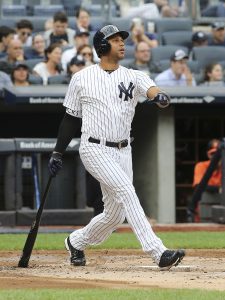 The next year, he stayed healthy enough to get into 137 games and largely repeated his results over a larger sample. He launched 27 homers, swiped 11 bags and walked in 15.5% of his trips to the plate. His .248/.366/.467 batting line led to a 129 wRC+ and 4.3 fWAR. The Yankees felt they had a well-rounded player that was worth locking up, agreeing to give Hicks a seven-year, $70MM extension with a club option for 2026.
Things have been up-and-down for Hicks in the four seasons since that extension was signed, however. In 2019, he made multiple trips to the injured list and only got into 59 games. When healthy enough to play, his offensive output was diminished though still above average, as he finished the season with a 103 wRC+. He bounced right back in the shortened 2020 campaign, getting into 54 of the club’s 60 games. He only hit six home runs but he walked in 19.4% of his plate appearances, producing a slash line of .225/.379/.414 and a 124 wRC+. 2021 was another low point, however, as a wrist injury limited him to 32 games of poor production before surgery in May that he wasn’t able to return from.
2022 was the first time Hicks was healthy over a full season since that excellent 2018 campaign, though he wasn’t able to properly return to form, hitting just eight home runs in 130 games. He still walked at a healthy 13.7% clip and stole 10 bases, but his overall production was down. His .216/.330/.313 line amounted to a wRC+ of 90. He also lost the center field job, as the Yanks frequently ran Aaron Judge out there instead and acquired Harrison Bader at the trade deadline even though Bader was injured at the time and wouldn’t be able to take the spot until mid-September. Hicks’ work in left field was graded well which, along with his speed, still allowed him to tally 1.5 fWAR on the year. That’s not disastrous but it was a far cry from his previous form.
There are still three guaranteed years remaining on that extension, and the Yanks have reportedly been fielding trade offers on Hicks this offseason without finding a deal to their liking. With Bader and Judge set to be in center and right, the club was open to finding external additions in left but didn’t end up doing so. That leaves Hicks battling for the job next to younger players like Estevan Florial and Oswaldo Cabrera.
So, what can be expected out of Hicks in 2023? Was 2022 some kind of outlier or just a reasonable expectation of the kind of player Hicks is now? If one wanted to be optimistic and charitable, they could point to the fact that Hicks was coming off three stunted seasons, wrist surgery and then a lockout-interrupted offseason where he was not able to communicate with team staff. His power was diminished but he still got on base and was able to contribute in other ways. Hicks told Dan Martin of The New York Post in September that he tried to come back from wrist surgery lean and athletic to stay healthy but that it backfired by sapping his power. “I wanted to get faster and healthy, but me playing at 200 pounds isn’t it,’’ Hicks said. “I haven’t been impacting the ball like I wanted to. It’s really showed, with my power down. I wanted to be quicker and it didn’t work out that way.” He told Martin that he was looking forward to adding more strength in the offseason and coming into 2023 with the power restored.
The more pessimistic view is that Hicks hasn’t been both good and healthy over an extended period of time since 2018. It’s not his fault there was a pandemic-shortened campaign in there and that he happened to be injured on either side of it, but the fact of the matter is that he’s now 33 and natural age-based regression is working against him. Statcast has some mixed opinions on his 2022 results. His hard hit rate was only in the 14th percentile and his barrel rate just 29th. His average exit velocity was in the 31st percentile, though he did get to the 57th for maximum exit velo, suggesting there’s still some power in there but he wasn’t tapping into it often enough. It’s possible that his plan to bulk up in the offseason and get his strength back could lead to him hitting the ball with more authority in 2023, but there’s no real guarantee that will work.
Regardless of whether that plan comes to fruition, Hicks should still be valuable in some way. As mentioned, even with his down year in 2022, he produced 1.5 fWAR thanks to his speed, defense and ability to draw walks. It’s possible that speed plays up a bit with the new rule changes that will encourage base stealing going forward. He could also get a boost from the ban on extreme defensive alignments as he was shifted in 92.6% of his plate appearances as a lefty and just 6.5% as a righty. He has mild platoon splits for his career, producing a 103 wRC+ as a righty and a 96 as a lefty, with the new rules perhaps leading to more balanced results there.
The major unknown will be that power and if it can come back. Hicks hit 27 home runs in 2018 and had similar results on a rate basis in his injury-marred 2017 and 2019 seasons. But he’s been well shy of that pace for three years running now. If it doesn’t come back, he’s a solid but unexciting regular or perhaps an overqualified fourth outfielder. If it does come back, he’d return to being the well-rounded player the Yanks were so excited about a few years ago. Since no trade has been made, it seems Hicks will get a chance to prove himself this year. Whether he succeeds or not could be significant in a hotly-contested AL East where every win could matter, in this year and the two years still remaining on his contract.
Image courtesy USA Today Sports.
Free Agent Profile: Dylan Bundy
There has been very little chatter on free agent right-hander Dylan Bundy since the Twins declined his $11 million club option for 2023 back in early November. The 30-year-old managed to stay mostly healthy last season in Minnesota, outside of a short COVID-19 IL stint in May, but that run of better health didn’t exactly yield the kind of bounceback campaign that the Twins — and now other teams — were looking for.
Across his 29 starts, covering 140 innings, Bundy struggled to a 4.89 ERA (79 ERA+, 21 points below league average) and he also registered by far the lowest strikeout rate of his career. His measly K/9 of 6.04 ranked third-worst among the 71 major leaguers who logged at least 140 innings in 2022. Granted, veteran starter Johnny Cueto was even more inferior in that regard (5.75 K/9) and yet he managed to score a one-year, $8.5MM contract from the Marlins that can max out at two years, $16.5MM if Miami also picks up his option for 2024.
The one calling card for Bundy, if he can’t recapture a bit more swing-and-miss, is that he does have impeccable control. He ranked in just the 8th percentile of all MLB pitchers last year in strikeout percentage and finished in the 15th percentile in whiff rate, but his BB percentage of 4.7 was a 93rd-percentile triumph of sorts. On the flip side there, he served up 151 hits and 24 home runs to the 595 batters he faced. Pitchers that are forced into more of a contact-inviting approach must ensure that it is soft contact, and Bundy did not meet that objective. That he’s being forced into a change at all at a relatively young age doesn’t speak well of the long-term outlook for the No. 4 overall pick from the 2011 MLB Draft. His fastball continues to lose velocity (89.2 mph average last year, compared to 93.8 mph in 2016) and his slider, curveball and changeup have all been rendered rather ineffective as out-inducing offerings.
Bundy is probably looking to land in a pitcher-friendly environment, but he had that with the Twins and it sure seems like he won’t get much of a choice of destinations in the end. Maybe the Cardinals would like to build out better rotation depth before camp gets underway in Jupiter, Florida? They’re asking a lot of Jack Flaherty, Steven Matz and a 41-year-old Adam Wainwright as that roster currently stands. Or perhaps the White Sox might be a fit, what with Mike Clevinger currently under investigation following allegations of domestic violence and child abuse. Keep in mind that this is a World Baseball Classic year and the door to a job on a contender could suddenly swing open.
The long list of projected non-contenders with rotation holes includes the Pirates, Nationals, Royals … and, well, the Rockies. Boston, sitting kind of on the borderline between contention and non-contention for 2023, could come into the picture here if things fall flat with Michael Wacha, who is still on the hunt for a multi-year deal. We’ve already seen how a younger and stronger version of Bundy plays in the AL East, and it was rarely pretty, but it’s not like there are a ton of established MLB starters languishing out on the open market. Wacha is the only one left that cracked MLBTR’s Top 50 list.
Bundy’s best showing on the mound came in 2020, the COVID-shortened season, when he rolled to a 3.29 ERA with 72 strikeouts (and only 17 walks) in 65 2/3 innings for the Angels. He received one third-place vote and one fifth-place vote for the AL Cy Young Award that year, the only time in his career that he’s been included on any BBWAA ballots. Shane Bieber ultimately took home the hardware in unanimous fashion, with Bundy placing 9th. And, again, this current version of Bundy looks quite different than that one.
Big Hype Prospects: Baty, Colas, Waters, Grissom, Hernaiz
Late January is a sluggish period in the baseball transactions calendar. As has occurred in other slow weeks this offseason, we’ll be generous with our definitions of “Big Hype” and “Prospects” in order to cover interesting players recently in the news.
Five BHPs In The News
Brett Baty, 23, 3B, Mets (MLB)
(AA/AAA) 420 PA, 19 HR, 2 SB, .315/.410/.533
Baty’s future role with the Mets has shifted a few times this offseason. When it appeared the club was set to sign Carlos Correa, Baty shifted from a potential cost-controlled building block to trade bait. The division-rival Marlins even reportedly explored a trade for Baty involving either Jesus Luzardo or Edward Cabrera. With Correa crossed off the acquisition list, Baty is back in the picture for third base reps. From a roster management perspective, an Opening Day role will likely require either a monstrous Spring Training or an injury to incumbent third baseman Eduardo Escobar. While Baty had an excellent season in the minors, he only recorded 26 plate appearances in Triple-A. He then skipped to the Majors where his issues with ground-ball contact were on display in 42 plate appearances. Encouragingly, he posted above-average exit velocities. He profiles as a high-floor future Major League regular, though he’ll need to hit more balls in the air to access a star-caliber ceiling.
Although Baty is currently a below-average defender, he has the raw tools to improve to league average with sufficient effort. For the sake of comparison, Baty’s range, throwing skills, and athleticism are superior to those of Phillies third baseman Alec Bohm.
Oscar Colas, 24, OF, White Sox (AAA)
(A+/AA/AAA) 526 PA, 23 HR, 3 SB, .314/.371/.524
Colas had an encouraging stateside debut, blitzing through High- and Double-A before finishing with a power show over 33 plate appearances at Triple-A. Despite hitting .387/.424/.645 in that brief taste of Triple-A, Colas also recorded a 36.4 percent strikeout rate and 21.6 percent swinging-strike rate. The White Sox have done little to resolve an opening in right field, leaving the position an open battle between Gavin Sheets, Eloy Jimenez, Leury Garcia, and others. Colas is expected to have a legitimate opportunity to make the Opening Day roster. The left-handed slugger has a couple traits in common with Baty – namely, he produces high exit velocities with too many ground balls. There are also questions about his plate discipline, breaking ball recognition, and feel for contact. Overall, Colas has a volatile profile – the sort one could picture winning Player of the Week honors and experiencing an 0-for-30 slump in the same season.
Drew Waters, 24, OF, Royals (MLB)
(MLB) 109 PA, 5 HR, .240/.324/.479
A former top prospect in the Braves system who lost his luster in recent seasons, Waters is another volatile outfielder with a wide range of plausible outcomes. The Royals found 109 plate appearances for him last season. He’s primed to start in 2023 following the trade of Michael A. Taylor. Since joining the Royals in the middle of 2022, Waters has posted uncharacteristically high walk rates – possibly an important sign of improvement. Long considered an undisciplined hitter, he’s always had issues with low walk and high strikeout rates. It’s worth noting his swinging-strike rate improved along with the improved walk rate. Waters can produce an above-average maximum exit velocity, but his 84.1-mph average exit velocity was among the league’s worst. All told, there are a lot of moving parts to Waters’ profile. The 2023 campaign should prove instructive for his future role.
Vaughn Grissom, 22, SS/2B, Braves (MLB)
(MLB) 156 PA, 5 HR, 5 SB, .291/.353/.440
Like teammate Michael Harris, Grissom skipped Triple-A last season and still managed to perform remarkably well. He’s an effective Spring Training away from an Opening Day role in the Braves’ middle infield. While he’s no longer a rookie, there’s no question he’s still a developing young player. Per reports, infield coach Ron Washington is encouraged by his development as a shortstop this offseason. That’s a necessary improvement, as defensive metrics indicate he struggled as a second baseman last season. Presently, the Braves’ shortstop options amount to Grissom, Orlando Arcia, Ehire Adrianza, and Hoy Park. It’s possible opposing scouts figured out how to exploit Grissom at the plate late last season. His final 53 plate appearances amounted to a .174/.264/.196 triple-slash. He also struck out in all three postseason plate appearances.
Darell Hernaiz, 21, SS, Athletics (AA)
(A/A+/AA) 452 PA, 12 HR, 32 SB, .273/.341/.438
The Athletics’ return in yesterday’s Cole Irvin trade with the Orioles, Hernaiz was considered by both clubs to be more valuable than Irvin despite the pitcher’s success in the Majors. Hernaiz’s path to a regular role in Baltimore was narrow and unlikely to be achieved. He’s praised for his work ethic and baseball acumen, leading most scouts to consider him a future utilityman as a floor. He could stand to improve his plate discipline, though it isn’t a fatal flaw like with many aggressive, young hitters. He has above-average feel for contact and has shown unexpected growth in the power department. He’s expected to remain a contact-over-power hitter. As a defender, he’s sure-handed but might lose the footspeed necessary to remain at shortstop – especially in a post-shifts era.
In my opinion, this was an intelligent move by both clubs. The Athletics landed an up-and-coming prospect who would have remained overshadowed had he stuck in the Orioles’ farm system.
Three More
Connor Norby, Orioles (22 years old): For most clubs, Gunnar Henderson and Jordan Westburg would serve as an enviable middle infield prospect duo with Jackson Holliday offering a down-the-road reinforcement. Baltimore has additional depth, rendering Hernaiz a practically unusable luxury. Norby is Major League adjacent and hit 29 home runs across three levels last season. I get vague Chase Utley vibes from him – meaning his production comfortably exceeds his appearance. After a few looks, you’ll come to expect clutch hits in big spots.
Joey Ortiz, Orioles (24): Ortiz is also Major League adjacent. A gritty gamer, Ortiz seems destined to fill an oft-used utility role in the Orioles’ loaded infield. The club is enamored with Ortiz and may struggle to find another team that likes him as much as them, even though he’d project as a starter in most systems. His presence could help them feel comfortable dealing Westburg if and when a blockbuster opportunity emerges.
Jose Salas, Twins (19): Acquired as ballast in the Luis Arraez trade, Salas is considered a high-probability future big leaguer. As with most developing teenagers, there’s a wide degree of plausible outcomes ranging from emergency bench depth to future front-line starter. A switch-hitter, there are still exploitable holes in his swing from both sides of the plate. It’s also unclear how his power will develop.
Who Else Could The Royals Trade?
It’s been a quiet offseason for the Royals on the whole, but they’ve taken up a prominent position on the trade market in the past few days, shipping center fielder Michael A. Taylor to the division-rival Twins in exchange for relief prospects Evan Sisk and Steven Cruz, and flipping infielder Adalberto Mondesi to the Red Sox in exchange for reliever Josh Taylor the following day.
Those might not be the only trades in store for general manager J.J. Picollo in his first offseason atop the team’s baseball operations hierarchy. The Royals have reportedly discussed infielder Nicky Lopez with the White Sox in what would be a second intra-division swap. More broadly, USA Today’s Bob Nightengale reported yesterday that Kansas City still had “a couple more deals” that they’re in the process of “lining up.” With that in mind, it’s worth taking a look at some of the names the Royals could potentially ship out in the days and weeks leading up to spring training.
First and foremost, it should be pointed out that both Taylor and Mondesi were a year away from reaching the open market. They represented short-term assets for a Royals team that knows itself to be, at best, a long shot to contend in 2023. Lopez is more of of a mid-range player in terms of remaining club control, as he’s arbitration-eligible through the 2025 season. Presumably, the Royals won’t want to surrender much more team control than that. Players like Bobby Witt Jr., MJ Melendez, Vinnie Pasquantino and Nick Pratto are all controllable through at least the 2028 season; it’s unlikely the Royals would give much consideration to moving anyone from that group.
Onto some more plausible names, beginning with the focus of yesterday’s White Sox rumors…
Nicky Lopez, 2B/SS | Age: 27 (28 in March) | Contract: Signed for $3.7MM, arb-eligible through 2025
Lopez has been an all-glove player outside a 2021 season that currently looks anomalous in nature. He posted a .300/.365/.378 batting line in 565 plate appearances that season but did so with a .347 batting average on balls in play that’s 53 points higher than his career mark of .294. Lopez is a career .252/.309/.321 hitter in more than 1600 plate appearances. To say he doesn’t hit the ball hard would be an understatement; Lopez ranked 246th of 252 qualified hitters with an 84.9 mph average exit velocity and 250th with a 22.9% hard-hit rate. Statcast ranked him in the third percentile of MLB hitters in terms of “expected” slugging percentage.
That’s not a ringing endorsement of Lopez by any stretch, but he has plenty of positive attributes: namely his bat-to-ball skills and prodigious defensive prowess. Lopez fanned in just 13.1% of his plate appearances in each of the past two seasons, exhibiting strong contact skills. He doesn’t take especially lengthy at-bats (average 3.66 pitcher per plate appearance, compared to the league-average 3.9), but Lopez puts the ball in play and runs fairly well, ranking in the 58th percentile of MLB players in terms of sprint speed, per Statcast.
Defensively, there are few better players in the game — at least in the estimation of Statcast. He’s been an above-average but not elite defender by measure of Defensive Runs Saved, but Statcast’s Outs Above Average credits Lopez with excellent marks at second base (12) and particularly at shortstop (31) in his career. The sure-handed Lopez has made just 20 errors as a big leaguer and shown aptitude at both middle infield slots as well as in briefer sessions at the hot corner.
With three more years of club control remaining, there’s no urgency to trade Lopez. However, the Royals have Witt at shortstop and want to give 24-year-old Michael Massey a chance to claim the second base job.
Scott Barlow, RHP | Age: 30 | Contract: Signed for $5.3MM, arb-eligible through 2024
Likely the most popular potential trade chip on the Royals, Barlow has stepped up as the team’s closer and solidified himself as a quality late-game option in Kansas City. He’s pitched matching totals of 74 1/3 innings over the past two seasons, logging a combined 2.30 ERA with a 28.2% strikeout rate, 8.4% walk rate, 43.3% grounder rate, 0.79 HR/9 mark and 40 saves.
Over the past two seasons, Barlow is tied for 22nd among 138 qualified relievers with a 15% swinging-strike rate. His 36.9% chase rate on pitches outside the strike zone ties him for 15th in that same set of hurlers. Barlow has also excelled at hitting spots and freezing batters (18.1% called-strike rate), and his combined 33.1% called strike-plus-whiff rate is eighth among MLB relievers since 2021. He limits hard contact extremely well (86.4 mph average exit velocity, 30.3% hard-hit rate in 2022), has plus spin on his heater and generates plus extension with his delivery, per Statcast.
It’s not all roses with Barlow, however. He saw his average fastball dip from 95.3 mph in 2021 to 93.7 mph in 2022. In conjunction, both his strikeout rate and swinging-strike rate saw notable drops. This past season’s 1.09 HR/9 mark was the worst he’s posted in a full season, and (likely because of the drop in strikeouts) Barlow needed a charitable .240 average on balls in play to get to his sparkling 2.18 ERA; that’s 75 points lower than his 2021 mark and 84 points lower than the career mark he carried into 2022. It’s not likely to be repeated, so if the velocity and strikeouts remain at their 2022 levels, Barlow’s ERA is going to be in for quite a bit of regression.
Even with some modest red flags in 2022, Barlow remains a quality reliever who can be controlled at a relatively affordable rate for the next two seasons. If he were a free agent this winter, he’d surely have commanded a good bit more than the $12-14MM or so he’ll command in his final two arbitration seasons. There’s surplus value here, and if the Royals are (understandably) pessimistic about their chances in 2023, Barlow’s trade value will be at its apex either now or this summer.
Taylor Clarke, RHP | Age: 29 (30 in May) | Contract: Signed for $1.15MM, arb-eligible through 2025
Cut loose by the D-backs after the 2021 season, Clarke signed a surprising Major League deal with Kansas City and proved a shrewd pickup, tossing 49 innings with a 4.04 ERA. Clarke logged 10 holds and a trio of saves but worked more in low- and medium-leverage spots than in high-leverage scenarios.
It might be a middle relief profile, but if you squint there’s perhaps a bit more here. Clarke’s 3.9% walk rate was elite, and he posted career-best marks in strikeout rate (23.6%), swinging-strike rate (12.2%) and opponents’ chase rate (36.5%) — all while averaging 95.7 mph on his fastball. Fielding independent metrics felt he was far better than his ERA (3.30 FIP, 3.15 xERA, 3.16 SIERA). He doesn’t immediately jump out as a trade candidate, but three affordable years of control on a hard-throwing reliever who’s trending in the right direction might pique another team’s interest.
Amir Garrett, LHP | Age: 30 (31 in May) | Contract: Signed for $2.65MM, free agent after 2023 season
The Royals picked up Garrett in the March trade that sent lefty Mike Minor to Cincinnati. It didn’t work out particularly well for either side. Garrett pitched 45 1/3 innings and limped to a 4.96 ERA as his longstanding command woes spiked to new heights. Garrett walked 16.3% of his opponents last year, plunked another five batters and threw seven wild pitches. His 94.2 mph average fastball was his lowest mark since moving to the bullpen full-time.
Garrett still whiffed a quarter of his opponents, however, and he somewhat incredibly didn’t give up a home run all season. Unsustainable as that feat may be, its reflective of the fact that Garrett didn’t really get hit hard in Kansas City (88.3 mph exit velo, 30% hard-hit rate). Hard-throwing lefties who can miss bats are always going to find work, and Garrett’s salary is quite affordable.
At his best, Garrett logged a 3.03 ERA with a 33% strikeout rate in 74 1/3 innings from 2019-20. Another club might look at him as a bargain power arm who could be fixed.
Brad Keller, RHP | Age: 27 | Contract: Signed for $5.775MM, free agent after 2023 season
It’s been a rough couple seasons for Keller, who from 2018-20 looked like one of the best Rule 5 Draft picks in recent memory. Keller logged a 3.50 ERA through his first three seasons, going from a long reliever to an entrenched member of the Kansas City rotation. His 2021-22 seasons, however, have gone the opposite direction. Since Opening Day 2021, Keller has a 5.24 ERA in 273 1/3 innings. His walk rate has crept upward, and his once solid abilities to avoid hard contact have seemingly evaporated; Keller’s 1.15 HR/9 mark over the past two seasons is nearly double the 0.60 rate he turned in from 2018-20. His opponents’ barrel and hard-hit rates have exploded from 4.5% and 35.7%, respectively, to 8.7% and 42.8%.
Those struggles notwithstanding, Keller’s only trip to the Major League injured list (Covid-related list excluded) was in 2021 when he missed the final month of the season due to a lat strain. That didn’t seem to linger into the 2022 campaign, as Keller avoided the IL entirely while making 22 starts and another 13 relief appearances. At the very least, he should be viewed as a durable, affordable, innings-eating rental. And, if a team can restore his once-plus slider to its previous form, there’s bargain potential for the righty, who won’t turn 28 until late July.
Hunter Dozier, 1B/3B/OF | Age: 31 | Contract: Guaranteed $17.5MM through 2024, plus $10MM club option for 2025
Dozier’s outstanding 2019 season feels like a distant memory. He slashed .279/.348/.522 with 26 home runs that season, clocking in at 23% better than league-average, by measure of wRC+. (If that seems low, recall that 2019 is widely regarded as a season in which MLB juiced the baseballs, resulting in unprecedented levels of offense throughout the game.)
Since that time, Dozier has recorded a tepid .226/.297/.391 batting line. His authoritative batted-ball profile from that 2019 season has wilted and now looks quite pedestrian, and Dozier doesn’t have the defensive skills to offset his now lackluster offense. He’s posted respectable defensive grades at first base but ranks as one of the worst third basemen and right fielders in the sport, according to both Defensive Runs Saved and Outs Above Average.
With $17.5MM in guaranteed money left on his contract, Dozier’s deal is underwater. He could potentially be swapped out for another bad contract, although the Royals typically haven’t made that type of move in the past.
Longer Shots
There are, of course, others who could potentially be of interest to other clubs. The Royals control Brady Singer for another four seasons, and he just enjoyed what looks like a breakout 2022 campaign. Given that glut of remaining club control, however, there’s little reason to entertain the idea of moving Singer unless another team makes a staggering offer. For different reasons, reliever Josh Staumont also seems unlikely to go. The Royals control Staumont through 2025, and from 2020-21 he looked like a long-term piece in the bullpen. Staumont’s walk rate spiked to an awful 16.5% last year, though, and he missed a combined seven weeks with a neck strain and biceps tendinitis. Trading him now would be selling low on a potential power-armed, leverage reliever.
Behind the plate, Salvador Perez is entrenched as the effective captain of the Royals. Ken Rosenthal of The Athletic wrote earlier in the offseason that the Royals have no interest in moving Perez, who’s owed $64MM over the next three seasons. That’s not at all surprising, given his status within the organization. Some might naturally think that means young catcher and recent top prospect MJ Melendez could be available, but the Royals have worked Melendez into the outfield and DH mix as well. With six years of club control remaining, there’s little reason to think he’d be available, particularly on the heels of a down season. Melendez isn’t the type of player on whom the Royals would sell low.