
MLBTR Chat Transcript: Cole, Happ, Extensions
Click here to read the transcript of today’s chat with Tim Dierkes.
Offseason In Review: Toronto Blue Jays
This is the latest post of MLBTR’s annual Offseason in Review series, in which we take stock of every team’s winter dealings.
The Blue Jays added some veteran stopgaps to their roster, while saying goodbye to some of the best-known members of their 2015-16 playoff teams.
Major League Signings
- Freddy Galvis, SS: One year, $5MM (includes $1MM buyout of $5.5MM club option for 2020)
- Matt Shoemaker, SP: One year, $3.5MM
- Clay Buchholz, SP: One year, $3MM
- David Phelps, RP: One year, $2.5MM (plus 2020 club option worth between $1MM-$7MM, based on games pitched)
- Daniel Hudson, RP: One year, $1.5MM
- Total spend: $15.5MM
Trades And Claims
- Acquired minor league SS Ronny Brito and minor league RHP Andrew Sopko. from the Dodgers for C Russell Martin and $16.4MM of Martin’s 2019 salary
- Acquired LHP Clayton Richard from the Padres for minor league OF Connor Panas
- Acquired RHP Trent Thornton from the Astros for IF Aledmys Diaz
- Acquired RHP Jason Adam from the Royals for cash considerations
- Acquired $500K in international bonus pool money from the Orioles for outfielder Dwight Smith Jr.
- Claimed RHP Elvis Luciano from the Royals in the Rule 5 Draft
Notable Minor League Signings
Notable Losses
- Martin, Diaz, Troy Tulowitzki, Marco Estrada, Yangervis Solarte, Tyler Clippard, Jake Petricka, Jose Manuel Fernandez
[Blue Jays Organizational Depth Chart; Blue Jays Payroll Outlook]
Needs Addressed
The rotation was Toronto’s clearest area of need going into the offseason, and as expected, the Blue Jays added some inexpensive veteran arms to bolster a very young crop of starting pitchers. Matt Shoemaker, Clayton Richard, and (eventually) Clay Buchholz will all take turns in the rotation, backing up the incumbent top two of Marcus Stroman and Aaron Sanchez.
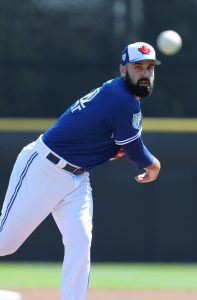
Naturally, there’s a lot of uncertainty baked into that mix given the lengthy injury histories of Shoemaker, Buchholz, Sanchez, and even Stroman and Richard last season. There’s also the looming possibility that any of these pitchers could find themselves on new teams by the trade deadline. As such, Ryan Borucki is expected to receive plenty of starts throughout the course of the year, though Borucki himself will miss some time to begin the season. One of Sean Reid-Foley, Thomas Pannone, Sam Gaviglio, and the newly-acquired Trent Thornton will fill in while Borucki is out and until Buchholz gets game-ready, and these younger arms are likely to get their share of innings before 2019 is out.
Could Toronto’s rotation end up being a quiet strength for the team? It would require a lot of bounceback years, though it isn’t out of the question, especially if Stroman is healthy after an injury-filled 2018 and Sanchez has finally gotten over the finger/blister problems that have plagued him over the last two years. Shoemaker’s last two seasons have been marred by injuries, though when he did pitch last season, his peripheral numbers were much better than his 4.94 ERA over 31 innings for the Angels would indicate. Buchholz delivered an eye-popping 2.01 ERA over 98 1/3 innings of work for Arizona last season before a flexor mass strain in September ended his year.
Beyond the rotation, the Jays made their now-annual additions of relievers who could very well become midseason trade chips. In the tradition of such past names as Joe Smith, Seunghwan Oh, and John Axford, this winter’s crop of bullpen signings included David Phelps, Daniel Hudson, Bud Norris, and temporarily Axford again, though he was released in the wake of elbow problems that will sideline the Canadian right-hander for at least a month. (It wouldn’t be surprising, though, to see the Jays re-sign Axford to a new contract in short order.)
It should be noted that Hudson is the only of this group who is entirely healthy. Norris has been limited in Spring Training, while Phelps won’t be back until midseason due to his recovery from March 2018 Tommy John surgery. This timeline likely means that Phelps may not be dealt at all; his contract contains a flexible club option for 2020, as both the Blue Jays and the right-hander are seemingly approaching this year as something of an extended recovery period.
As with the new starters, the new relievers also have some upside. Norris was the Cardinals’ closer for much of 2018, and Phelps was a strong contributor for the Marlins and Mariners in 2016-17 before undergoing surgery. The combination of Hudson, Norris, Ryan Tepera (if healthy, that is) and closer Ken Giles gives the Jays a pretty solid end-game mix, and a recovered Phelps will only improve that group. Sergio Romo and Adam Warren were a couple of the other bullpen names considered by the Blue Jays this winter.
After Aledmys Diaz was traded to Houston for Thornton, and Troy Tulowitzki was given an outright release, the shortstop position was seemingly cleared for Lourdes Gurriel Jr. Instead, however, it now looks like the Jays have an eye towards playing Gurriel all over the diamond since he might not be ready for the defensive challenge of being an everyday shortstop. (Indeed, it looks like Gurriel will begin the year as a second baseman, since Devon Travis is again sidelined with knee problems.)
Minor league signing Eric Sogard could end up filling the utility infield void, and for the regular shortstop role, the Blue Jays turned to Freddy Galvis. The former Phillies and Padres infielder is the picture of durability (he has played in every game in the last two seasons and averaged 158 games per year since 2015), and he brings more defensive stability up the middle. How much stability is perhaps a question depending on which of Galvis’ strangely divergent defensive metrics you believe, as he went from a +3.2 UZR/150 and minus-5 Defensive Runs Saved in 2017 to minus-3.8 UZR.150 and +7 DRS last season. Even just average glovework, however, represents an upgrade for a Jays team that was one of the league’s worst defensive clubs in 2018.
Questions Remaining
The Blue Jays moved squarely into rebuild mode last season, and this winter continued to be about setting the table for their future young talent. To that end, the Jays bid adieu to some stalwart veterans — Marco Estrada departed in free agency, Tulowitzki was released, and Russell Martin was dealt to the Dodgers.
The latter two moves were more about roster clearance than financial flexibility, as the Jays are still on the hook for just under $54MM total owed in remaining contract obligations to Martin (through 2019) and Tulowitzki (through 2020). Naturally, the team had little hope of finding a trade partner to eat even more of that figure given that Tulowitzki missed all of 2018, while Martin struggled to just a .194/.338/.325 slash line through 352 plate appearances.
Even accounting for these two big contracts and the $12MM remaining on Kendrys Morales‘ contract, the Jays have very little in the way of future salary obligations; Gurriel is the only player owed money beyond the 2020 season. This led to some speculation that Toronto could explore some of the bigger-name players available this winter, and the Jays did indeed raise some eyebrows when they were linked to some major Scott Boras clients (Bryce Harper, Dallas Keuchel, Marwin Gonzalez, Yusei Kikuchi) on the rumor mill. While it seems like the Blue Jays made a legitimate bid for Kikuchi, the other talks were perhaps exploratory at best, and only Harper and Kikuchi would have fit as a true longer-term asset for a Jays club that doesn’t appear ready to contend until 2021.
Until then, the Jays will focus on determining which of their group of highly-touted young players will be part of this next core. 2019 will finally see the debut of Vladimir Guerrero Jr. on the Major League stage, as attention can finally turn to Guerrero’s prodigious on-field talents, rather than his status (perhaps shared with Kris Bryant) as the poster child for clubs keeping top prospects in the minors just long enough to gain an extra year of team control. The situation became a moot point in Guerrero’s case, since his recovery from an oblique strain will keep him out until at least mid-April anyway. Still, “oblique” might also be a good description of Jays executives’ increasingly far-flung arguments for why Guerrero wasn’t ticketed for the Opening Day roster, since obviously they couldn’t openly mention service time considerations.
The Jays’ plan is to deploy Brandon Drury at third base until Guerrero arrives, then move Drury to second base, perhaps in a timeshare with Gurriel or (if healthy) Travis. Alternatively, Gurriel could split time between second base, shortstop, and left field, joining Teoscar Hernandez and Billy McKinney in the left field mix. Outfielder Anthony Alford has enjoyed a big Spring Training, and he’ll get a longer look sometime this season if he proves capable of staying healthy and gets some more minor league seasoning.
As with the rotation, the Blue Jays’ position player mix is pretty fluid since at least some of the club’s veterans (Morales, Galvis, Randal Grichuk, Justin Smoak, Kevin Pillar) are likely to be wearing different uniforms come September. Smoak and Pillar each received a bit of trade buzz over the winter, with Smoak getting some attention from the Rockies and Pillar from the Giants, though no moves involving that group have ultimately been made. (A deal prior to Opening Day is still technically possible.)
Since Toronto faces a steep uphill battle in the AL East, it wouldn’t be surprising to see the team start shopping its veterans relatively early, potentially to get the jump on other sellers. Especially now that the August trade period is no more, one wonders if the Jays might be open to trading Smoak, Pillar, and to a somewhat lesser extent Grichuk or Galvis at any time this season, rather than waiting until the July 31 trade deadline.
The same could be said of Stroman, Sanchez, or Giles, who project as Toronto’s top potential trade chips. The Jays were reportedly open to dealing Giles this winter, while Stroman and Sanchez each received attention. Stroman in particular drew significant interest from such teams as the Reds and Padres. Stroman has made it clear he wants to stay in Toronto and was displeased at the lack of contract extension talks as well as the fact that the team wasn’t making a bigger push to contend in 2019.
Since the Jays’ asking price for the two starters was, in the words of Sportsnet’s Ben Nicholson-Smith, found by some suitors to be “uncomfortably high,” it makes more sense for Toronto to keep Stroman and Sanchez for at least the opening portion of the season. This allows the two right-handers to rebuild their value by proving that they’re both recovered from their rough 2018 seasons. If the Blue Jays see Stroman and Sanchez as part of the rebuild process rather than rotation cornerstones of their next contending roster, the team surely wants to maximize its return in potential trades, particularly after receiving relatively little for Martin and Josh Donaldson. With both Stroman and Sanchez controlled through 2020, a healthy version of either pitcher would draw widespread interest.
2019 Season Outlook
Another year in the 73-78 win range seems likely for the rebuilding Jays, as a very tough division schedule will make it hard for even an improved team to gain much traction in the AL Wild Card race. If Guerrero comes close to matching his incredible projected numbers, however, it’ll be an exciting year for Toronto fans.
How would you grade the Blue Jays’ offseason moves? (Link for app users.)
How Would You Grade The Blue Jays' Offseason?
-
C 41% (1,307)
-
D 26% (826)
-
B 17% (545)
-
F 14% (437)
-
A 3% (83)
Total votes: 3,198
Photo courtesy of USA Today Sports Images
Offseason In Review: Oakland Athletics
This is the latest post of MLBTR’s annual Offseason in Review series, in which we take stock of every team’s winter dealings.
After surprising their way to the the majors’ fourth-best record in 2018, the low-budget Athletics made a series of short-term commitments this past offseason.
Major League Signings
- Joakim Soria, RP: two years, $15MM
- Mike Fiers, RHP: two years, $14.1MM
- Marco Estrada, RHP: one year, $4MM
- Robbie Grossman, OF: one year, $2MM
- Brett Anderson, LHP: one year, $1.5MM
- Chris Herrmann, C: one year, $1MM
- Total spend: $37.6MM
Options Exercised
Trades And Claims
- Acquired IF Jurickson Profar in a three-team trade that sent $750K in international allotments and IF Eli White to the Rangers and RP Emilio Pagan and Oakland’s Competitive Balance Round A selection in 2019 to the Rays
- Acquired RHP Tanner Anderson from the Pirates for RHP Wilkin Ramos
- Claimed RHP Parker Bridwell from the Angels
Notable Minor League Signings
- Jerry Blevins, Nick Hundley, Cliff Pennington, Wei-Chung Wang, Jake Buchanan, Tyler Alexander, Beau Taylor, Kyle Crockett, Corban Joseph, Eric Campbell, Brian Schlitter
Notable Losses
- Pagan, Jonathan Lucroy, Jed Lowrie, Matt Joyce, Trevor Cahill, Jeurys Familia, Shawn Kelley, Edwin Jackson (still unsigned), Richie Martin, Cory Gearrin, Danny Coulombe, Kendall Graveman, Chris Hatcher, Jake Smolinski
[Athletics Offseason Depth Chart | Athletics Payroll Information]
Needs Addressed
A spate of injuries devastated the A’s rotation in 2018 and forced them to rely heavily on inexpensive signings Trevor Cahill, Edwin Jackson and Brett Anderson – three veterans whose best days looked long gone when the club added them. As it turned out, though, the trio held up reasonably well over a combined 282 1/3 innings and helped the upstart A’s to a wild-card berth. Cahill, the most effective member of the group, parlayed his strong 2018 into a $9MM guarantee with the division-rival Angels over the winter. Oakland also waved goodbye to Jackson, who hasn’t landed a deal with anyone despite his resurgent season, though it did bring back Anderson. Injuries have been a consistent problem during the 31-year-old Anderson’s career, including during his 80 1/3-inning showing last season, yet the A’s decided to gamble on him again for a mere $1.5MM salary.
Accompanying Anderson in the A’s rotation are fellow free-agent signees Mike Fiers and Marco Estrada, who started the club’s season-opening losses to the Mariners in Japan. The 33-year-old Fiers first joined the A’s in a trade with the Tigers last August, after which he logged solid numbers across 53 frames. While Oakland then non-tendered Fiers in lieu of paying him a projected $9.7MM via arbitration, it quickly brought him back on what it regards as more team-friendly numbers (two years, $14.1MM).
Estrada took an even more palatable pact – a guaranteed $4MM – as he seeks a rebirth after a couple down seasons in Toronto. For a pitcher who posted an abysmal 5.64 ERA/5.44 FIP last season, Estrada looks like a shrewd signing for the Athletics, as his fly ball-heavy skill set should mesh with their cavernous home park. Among pitchers who threw at least 100 innings in 2018, no one managed a lower groundball percentage (24.0) than Estrada, who’s now shifting to a stadium that was death on fly balls last year. Plus, having generated truckloads of infield pop-ups in recent years, Estrada stands to benefit from the enormous foul territory at the Oakland Coliseum.
Estrada and the other members of the A’s revamped rotation will turn the ball over to a bullpen that was a premier unit in 2018, largely owing to elite closer Blake Treinen‘s presence. In-season acquisitions Jeurys Familia and Shawn Kelley also helped the cause, and even though the A’s showed interest in re-signing both right-handers, they departed in free agency. Oakland still came away with a well-known bullpen prize on the open market, though, as its most expensive offseason deal went to longtime standout Joakim Soria. The 34-year-old looks as if he’ll be the primary setup man for the team, which also features other established choices in Ryan Buchter, Fernando Rodney, Yusmeiro Petit and Lou Trivino. Unsurprisingly, then, ZIPS projects the A’s to once again boast one of the majors’ most formidable bullpens this year.
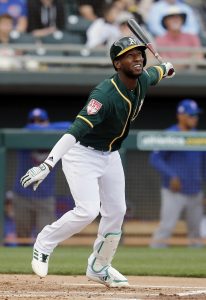
On the position player side, a particularly notable offseason change came at second base, where the A’s bid adieu to Jed Lowrie in free agency but welcomed Jurickson Profar in a trade with the division-rival Rangers. Lowrie enjoyed an excellent pair of seasons in Oakland from 2017-18, though his age (34) and extensive injury history likely factored into the A’s decision to switch things up at the keystone. A few weeks after the Athletics landed Profar, Lowrie accepted a two-year, $20MM offer from the Mets, with whom he is already battling an injury. Profar is also under control for the next two seasons – albeit at a much lower rate ($3.6MM) in the wake of a somewhat disappointing Texas tenure. Although Profar has struggled for the majority of his career thus far, the light bulb may have gone on in 2018. To close out his time in Arlington, the switch-hitting Profar accounted for 2.9 fWAR over 594 plate appearances, hit .254/.335/.458 with 20 home runs and 10 steals, and struck out in just 14.8 percent of PAs.
Oakland also welcomed new faces at catcher, where it brought in Chris Herrmann on a big league deal and Nick Hundley on a minors pact, as well as in the outfield (Robbie Grossman, $2MM). Herrmann underwent knee surgery earlier this month, though, meaning he’ll open the season on the 60-day injured list. His absence paved the way for Hundley to earn a spot alongside holdover Josh Phegley. Now, the 35-year-old Hundley is filling the grizzled vet role Jonathan Lucroy took on last season. Lucroy joined Cahill in bolting for Anaheim in free agency, but the former’s production should be easier to replace. The respected Lucroy was a hit behind the scenes in Oakland, but the ex-star’s numbers on both ends left much to be desired. Of course, it’s up in the air whether the unexciting trio of Herrmann (when healthy), Hundley and Phegley will provide much of an upgrade over Lucroy.
Similarly, Grossman isn’t the most compelling addition. To the former Astro and Twin’s credit, however, he gets on base – a skill everyone knows the Athletics have long valued – which should make him an improvement over the 2018 version of the now-departed Matt Joyce. Grossman compiled a superb .371 OBP during his 1,310-PA stint with the Twins, thanks mostly to a 13.9 percent walk rate. But the switch-hitting 29-year-old brings minimal power to the table, which was especially true in 2018 (five home runs, .111 ISO in 465 PAs), and historically hasn’t provided much either in the field or on the bases. Despite his flaws, Grossman’s likely to play an important role in the A’s outfield – especially with Nick Martini recovering from a knee injury.
Questions Remaining
Concerns are plentiful in Oakland’s rotation, which will rely on a series of iffy options to begin the season. At this point, there’s nothing resembling a front-line starter among the quintet of Anderson, Fiers, Estrada, Frankie Montas and Chris Bassitt, though the 25-year-old Montas has at least provided reason for optimism this spring. More realistically, electrifying lefty Jesus Luzardo, 21, is the A’s best hope to conjure up an ace from within. However, in what has become an all-too-typical occurrence for the A’s, Luzardo’s on the shelf with an arm injury (a rotator cuff strain, to be exact).
If healthy, Luzardo could have cracked the A’s season-opening rotation, but he’ll instead miss at least the first several weeks of the campaign. Likewise, Sean Manaea, A.J. Puk, Jharel Cotton, James Kaprielian and Daniel Gossett will sit out some or all of 2019, leaving Oakland in a similar position to last year. The A’s still found a way to adapt and survive then, thanks in part to the decision to mimic the Rays’ opener strategy down the stretch. The role proved beneficial for veteran reliever Liam Hendriks, who came back from a demotion off the A’s 40-man roster late in the season to thrive (playoff loss to the Yankees notwithstanding). We could see more of Hendriks & Co. at the start of games in 2019 if Oakland’s not content with its collection of traditional starters.
As mentioned earlier, the A’s pitchers are slated to throw to a weak-looking mix of catchers. Relative to his position, Hundley has been fine at times with the bat, but his defensive numbers have been poor for the most part; Phegley has been one of the worst hitters in baseball since 2017 (59 wRC+); and Herrmann’s a journeyman who hasn’t offered much as either as a batter or a defender across 898 major league PAs. No matter, Oakland’s leaning on that behind-the-plate trio as it counts down to the arrival of 24-year-old prospect Sean Murphy – a player Eric Longenhagen and Kiley McDaniel of FanGraphs believe could blossom into “an above-average regular” in the bigs. It’s possible Murphy’s forthcoming promotion prevented the A’s from making a splashier offseason pickup behind the plate. They did show interest in Wilson Ramos and Kurt Suzuki, but both signed affordable deals elsewhere. Meanwhile, even though Yasmani Grandal languished on the market before settling for a shockingly reasonable guarantee (one year, $18.25MM with Milwaukee), Oakland never pursued the former Padre and Dodger.
Aside from catcher, it appeared the A’s were going to enter the season without any massive concerns in their position player group. Unfortunately, that changed this week with the news that first baseman Matt Olson underwent right hand surgery, which will cost him at least the first month of the season. While manager Bob Melvin had the luxury of writing Olson’s name into his lineup 162 times last year, he’ll have to temporarily make do with a Profar-Mark Canha platoon at first, according to executive vice president Billy Beane. Profar’s the team’s No. 1 second baseman, though, which means it’ll turn to Chad Pinder or Franklin Barreto at the keystone when he has to occupy Olson’s spot. When Olson does come back, it’s anyone’s guess whether he’ll suffer any ill effects from his injury; if not, an infield consisting of him, Profar, superstar third baseman Matt Chapman and shortstop Marcus Semien looks enviable on paper. Meanwhile, although the Athletics lack a Chapman-type franchise player or a Khris Davis-esque masher among their main outfielders, Stephen Piscotty, Ramon Laureano, Canha, Pinder, Grossman, Barreto, Martini, Luis Barrera, Skye Bolt and Dustin Fowler do comprise a deep and respectable group of 40-man possibilities.
2019 Season Outlook
Oakland has somewhat frequently overcome the odds during the long-running Beane era, and it’ll have to do the same in 2019. Even before the Athletics lost Luzardo, Olson and the first two games of their season, they weren’t a popular pick to repeat their 2018 success. Indeed, on the heels of a modest offseason, PECOTA projects the A’s for just 78 victories – 19 fewer than last year’s total.
How would you grade the Athletics’ offseason moves? (Link for app users.)
How would you grade the A's offseason?
-
C 45% (1,195)
-
B 31% (829)
-
D 15% (385)
-
A 4% (115)
-
F 4% (115)
Total votes: 2,639
Photo courtesy of USA Today Sports Images.
MLBTR Chat Transcript: Mike Trout Deal
Mike Trout is closing in on the largest deal in baseball history, and that was a major focus of today’s chat with MLBTR owner Tim Dierkes. Read the transcript here.
Offseason In Review: Milwaukee Brewers
This is the latest post of MLBTR’s annual Offseason in Review series, in which we take stock of every team’s winter dealings.
The fruits of a relatively short rebuilding effort in Milwaukee manifested with an NL Central division title, a NLCS run against the Dodgers and dramatic increase in expectations after years of mediocrity.
Major League Signings
- Yasmani Grandal, C: One year, $18.25MM (includes $2MM buyout on 2020 mutual option)
- Mike Moustakas, 2B/3B: One year, $10MM
- Cory Spangenberg, 2B/3B/OF: One year, $1.2MM (split Major League contract)
- Jake Petricka, RHP: $900K (split Major League contract)
- Total spend: $30.35MM
Trades and Claims
- Acquired RHPs Bobby Wahl, RHP Adam Hill and 2B Felix Valerio from the Mets in exchange for OF Keon Broxton
- Acquired LHP Alex Claudio from the Rangers in exchange for Competitive Balance Round A draft pick
- Acquired OF Ben Gamel, RHP Noah Zavolas from Mariners in exchange for OF Domingo Santana
Notable Minor League Signings
Notable Losses
- Gio Gonzalez, Wade Miley, Joakim Soria, Curtis Granderson, Jonathan Schoop, Jordan Lyles, Xavier Cedeno, Dan Jennings
[Milwaukee Brewers depth chart | Milwaukee Brewers payroll outlook]
Needs Addressed
Entering the offseason with a pair of catchers who combined to hit .246/.296/.379, the Brewers had a clear need behind the plate. While Manny Pina and Erik Kratz gave the Brewers quality defense behind the dish in terms of framing and controlling the running game, their lack of offense was a clear negative. Brewers president of baseball operations David Stearns and his staff clearly agreed, and while they didn’t feel strongly enough to make a significant play for a free agent on a multi-year contract, they deftly swooped in and secured Yasmani Grandal, the open market’s top catcher, on a one-year deal worth $18.25MM after Grandal apparently didn’t find any multi-year offers that were to his liking (despite numerous reports indicating that he received substantial multi-year offers from the likes of the Mets, Twins and White Sox).
Maybe Grandal was stung a bit by recency bias — his postseason showing was nightmarish on both sides of the ball — but the 30-year-old finished second among MLB catchers in total home runs and led all MLB backstops (min. 300 PAs) with a hefty .225 ISO (slugging minus batting average). Salvador Perez is the only catcher with more home runs than Grandal over the past four seasons, and among qualified backstops, only Gary Sanchez and Robinson Chirinos have higher ISO marks. That the Brewers were able to add one of baseball’s most powerful catchers — one who consistently rates as a premium framer with a solid caught-stealing rate — on a one-year pact is a feather in an already plumage-laden cap for the front office.
Entering the 2018 season, much was made of Milwaukee’s glut of outfielders, and that relative logjam came into greater focus this winter with both Domingo Santana and Keon Broxton out of options and clearly lacking a path to playing time with the Brewers. Broxton and Santana were turned into a potential bullpen piece — Bobby Wahl, though he’s since unfortunately suffered an ACL tear — and another interesting outfielder with a minor league option remaining: Ben Gamel. Stearns & Co. further bolstered the ‘pen by swapping their Competitive Balance draft pick for lefty Alex Claudio. Unlike many other trades in which teams have shipped off those rare, tradeable picks for marginal assets or even pure salary relief, the Brewers landed a useful left-handed arm who’ll make their club better in 2019 and beyond, as Claudio can be controlled through 2021.
In need of infield help after spending an otherwise successful season jamming square pegs into second-base, third-base and shortstop-shaped holes, the Brewers did sign a pair of infielders in the form of a returning Mike Moustakas and former Padre Cory Spangenberg. The return of “Moose” will at the very least bolster an already formidable Milwaukee lineup by adding a bat that’s swatted 66 long balls over the past 300 games.
Questions Remaining
The Moustakas addition seems like an apt place to transition from the “needs addressed” to the “questions remaining” section, given that it’s anyone’s guess as to how Moustakas will adjust to his new role as a second baseman. He’s never played the position in the past but is getting his feet wet this spring in preparation for serving as Milwaukee’s everyday option at the position. It’s an unorthodox move but one that is backed by at least some logic. Milwaukee is typically aggressive in its infield shifting. Moustakas has played on the right side of the infield in the past when shifting there against left-handed hitters as a third baseman. The position may not ultimately feel *that* foreign to him.
Some may argue that the Brewers swooped in on Moustakas in a similar manner to the way they did Grandal. But Grandal was a more unique asset, whereas the Brewers paid a fairly sizable (but still reasonable) sum to once again play a veteran infielder out of position. For the same $10MM they promised to Moustakas, the Brewers could’ve signed Brian Dozier or brought Jonathan Schoop back aboard to play his natural position. Even if the Brewers weren’t keen on a bounceback candidate at the position, Moustakas’ $10MM guarantee is the same as Jed Lowrie‘s annual rate on his two-year pact with the Mets. It’s only slightly shy of the $12MM annual value on DJ LeMahieu‘s two-year deal with the Yankees. Even at his more natural third base, Moustakas would only be projected to be worth two or two-and-a-half wins above replacement. For this price, it seems like the Brewers could’ve gotten a natural second baseman without incurring much long-term risk.
For the second straight spring, however, the largest question many have regarding Milwaukee is whether the team should have added more starting pitching. Jhoulys Chacin, last winter’s lone big league signing, is slated to take the ball on Opening Day. But the Brewers didn’t add a starter this winter after bidding adieu to both Wade Miley and Gio Gonzalez, instead banking on the return of a healthy Jimmy Nelson and doubling down in their faith in young righties Corbin Burnes, Brandon Woodruff and Freddy Peralta — each of whom tallied significant innings in the Majors last season. That group, paired with holdovers Chase Anderson, Zach Davies and Junior Guerra, will be tasked with rounding out the starting staff and at least getting the Brewers to the trade deadline.
It’s a lot to ask from a unit full of pitchers that either have lacked consistency (Anderson, Davies, Guerra) or lack MLB starting experience (Burnes, Woodruff, Peralta), but the group undeniably features plenty of talent. A healthy Nelson in 2017 was one of the National League’s most valuable starting pitchers. Burnes and Woodruff were well-regarded as prospects and both impressed in bullpen roles last season, with Burnes in particular showing off-the-charts spin on his fastball and curveball. Peralta was serviceable in 14 starts last season with secondary stats that were more impressive than his pedestrian 4.25 ERA.
It’s technically possible that the Brewers could make one final late-offseason splash, bringing in Dallas Keuchel or striking some kind of surprise trade, but the Brewers have continually showed faith in their internal arms by eschewing significant free-agent splashes over the past two offseasons. Owner Mark Attanasio would need to further push up an already club-record $128MM Opening Day payroll projection, and any new free-agent addition would need time to get up to speed and get into game-ready shape. Frankly, another addition doesn’t seem all that likely, but if Milwaukee’s starting staff is in tatters early in the year, there’ll be no shortage of people wondering why the reigning division champs opted to forgo a more stable addition.
Looking beyond the rotation, there’s even a bit of uncertainty within the team’s vaunted bullpen. Specifically, Jeremy Jeffress is battling a shoulder issue that has limited him substantially in Spring Training. Jeffress was a major part of getting the Brewers to the postseason in ’18, forming a dominant trio with Josh Hader and Corey Knebel. Those two should still be a powerful one-two punch late in games, but any relief corps is going to look a bit less imposing when you subtract a reliever who posted a 1.29 ERA in 76 2/3 regular-season innings.
2019 Season Outlook
Rotation questions aside, the Brewers will boast a formidable lineup with quality overall defense (particularly from Lorenzo Cain, Christian Yelich, Travis Shaw and Orlando Arcia) and a bullpen featuring two of the game’s top strikeout specialists. A return to health for Nelson and even one of the aforementioned young arms cementing himself as a viable mid-rotation starter would quiet a substantial portion of fan concern regarding the pitching staff, and if two members of that youth movement step up, the Brewers will look wise to have shown restraint.
A much-improved Reds roster, the Cardinals’ acquisition of Paul Goldschmidt and potential returns to health for Kris Bryant and Yu Darvish in Chicago should make the NL Central an even tougher division for all five clubs in 2019. But the Brewers could be getting a star of their own back (Nelson), and they’ll still head into the upcoming season not just with an eye on defending the division crown but with legitimate World Series aspirations. They’ll quite likely need another acquisition or two at baseball’s now-single trade deadline on July 31 — there won’t be another run of August acquisitions for Stearns & Co. — but I’ll be surprised if Milwaukee isn’t firmly in the postseason hunt once again this summer.
How would you grade the Brewers’ offseason? (link to poll for Trade Rumors app users)
How would you grade the Brewers' offseason?
-
B 51% (2,229)
-
C 26% (1,119)
-
A 14% (621)
-
D 5% (227)
-
F 4% (166)
Total votes: 4,362
Offseason In Review: Texas Rangers
This is the latest post of MLBTR’s annual Offseason in Review series, in which we take stock of every team’s winter dealings.
Even though they’re in a rebuild, the Rangers are entering the 2019 season off an active winter. The club welcomed a new manager (former Dodgers third base coach Chris Woodward) and a bevy of free agents, lost the iconic Adrian Beltre to retirement and put an end to the Jurickson Profar era.
Major League Signings
- Lance Lynn, RHP: three years, $30MM
- Jesse Chavez, RP: two years, $8MM
- Jeff Mathis, C: two years, $6.25MM
- Asdrubal Cabrera, INF: one year, $3.25MM
- Shawn Kelley, RP: one year, $2.75MM
- Shelby Miller, RHP: one year, $2MM
- Zach McAllister, RP: one year, $1MM
- Total spend: $53.25MM
Trades And Claims
- Acquired INF Eli White, LHPs Brock Burke and Kyle Bird, RHP Yoel Espinal and $750K in international bonus allotments in a three-team trade that sent INF Jurickson Profar to the Athletics and RHP Rollie Lacy to the Rays
- Acquired LHP Drew Smyly and a player to be named later from the Cubs for a player to be named later
- Acquired 2019 competitive balance pick from the Brewers for RP Alex Claudio
- Acquired 3B Patrick Wisdom from the Cardinals for UTIL Drew Robinson
- Acquired OF Zack Granite from the Twins for RHP Xavier Moore and cash considerations
- Acquired international bonus allotments (amount unreported) from the Orioles for RHP David Lebron
- Acquired the White Sox’s Rule 5 pick, RHP Jordan Romano, for cash considerations
- Selected Chris Ellis from the Cardinals in the Rule 5 Draft, then traded him to the Royals for cash considerations
- Claimed RHP Luke Farrell off waivers from the Cubs
- Claimed INF Carlos Asuaje from the Padres, then sold his rights to the Lotte Giants of the Korea Baseball Organization
- Claimed INF Jack Reinheimer from the Cubs, then lost him on waivers to the Orioles
- Claimed OF John Andreoli from the Mariners, then lost him on waivers to the Giants
Extensions
- Jose Leclerc, RP: four years, $14.75MM
Notable Minor League Signings
- Hunter Pence, Logan Forsythe, Matt Davidson, Jason Hammel, Ben Revere, Adam Moore, David Carpenter, Jett Bandy, Matt Bush, Jeanmar Gomez, Ricardo Rodriguez, Danny Santana, Rafael Montero, Zac Curtis, Chase d’Arnaud, Michael Tonkin, Adrian Sampson, Jack Leathersich, Ariel Hernandez, Nolan Fontana
Notable Losses
- Beltre, Profar, Claudio, Robinson, Robinson Chirinos, Doug Fister, Matt Moore, Tony Barnette, Bartolo Colon, Yovani Gallardo, Martin Perez Ryan Rua, Austin Bibens-Dirkx, Eddie Butler
[Texas Rangers Depth Chart | Texas Rangers Payroll Outlook]
Needs Addressed
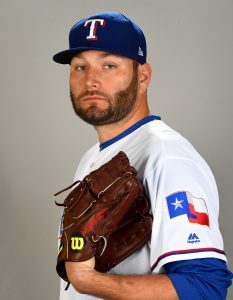
Few teams’ rotations were worse off in 2018 than the Rangers’, whose starters posted a bloated 5.37 ERA with a similarly horrid 5.18 FIP. Among their regular rotation possibilities, only Mike Minor and Cole Hamels, the latter of whom went to the Cubs in a midseason trade, offered passable production. Consequently, the rotation was an area of major emphasis for general manager Jon Daniels during the offseason.
Daniels swung yet another deal with the Cubs, landing southpaw Drew Smyly in a November trade that amounted to a cost-cutting move for Chicago, and then signed fellow veteran starters Lance Lynn and Shelby Miller in free agency. Smyly, Lynn and Miller are now penciled into the Rangers’ season-opening rotation alongside Minor, who frequented trade rumors during the winter but ultimately stayed put, and Edinson Volquez. It’s not the most inspiring group on paper, especially considering Smyly, Miller and Volquez are each coming off back-to-back injury-wrecked years; still, it does look like a clear improvement over last year’s rotation – one that received flat-out awful numbers from almost every member of an eight-man crew consisting of Bartolo Colon, Yovani Gallardo, Martin Perez, Doug Fister, Matt Moore, Ariel Jurado, Yohander Mendez and Drew Hutchison. Of that octet, which combined for 99 starts in 2018, only Jurado and Mendez are still members of the Texas organization.
When enemy offenses chased Rangers starters from games last season, they turned to a mediocre bullpen that got worse when the team dealt Keone Kela, Jake Diekman and Jesse Chavez at the July 31 non-waiver trade deadline. The Rangers followed those deals by trading yet another key reliever, Alex Claudio, in December, acquiring a top 40 draft pick from the Brewers for his three years of control. It’s anyone’s guess whether that selection will bear fruit for the Rangers, but it’s a worthwhile return for what the non-contending team believed was a superfluous reliever.
To help make up for their departed relievers, the Rangers are turning back to the 35-year-old Chavez, whom they reunited with in free agency on a reasonable contract. Chavez was terrific last season, though more so with the Cubs than the Rangers, while fellow veteran addition/inexpensive signing Shawn Kelley logged quality numbers between Washington and Oakland. The same wasn’t true for the Rangers’ other major league bullpen signing, Zach McAllister, who bombed in Cleveland and Detroit. But the hard-throwing McAllister entered 2018 with a nice track record, and on a $1MM salary, he’s worth a try for Texas. The Rangers’ hope is that Chavez, Kelley and McAllister will help form a capable bridge to lights-out closer Jose Leclerc, who tore through opposing lineups during a jaw-dropping 2018 en route to a team-friendly contract extension.
Leclerc and the other holdovers from the Rangers’ 2018 staff are adjusting to a new regular catcher, free-agent signee Jeff Mathis, who’s succeeding Robinson Chirinos. The swap may be a boon to the Rangers’ pitchers, as Chirinos – whom the club cut in November – is nowhere near Mathis’ level defensively. Whereas Chirinos has been a minus defender throughout his career, particularly in 2018, Mathis has been regarded as a top-notch backstop during his long tenure in the majors.
Defense has been the main calling card for Mathis, but it was only part of the all-around greatness of Beltre, who closed the door on both an eight-year Texas tenure and a Hall of Fame career in November. In the wake of Beltre’s exit, Daniels was tasked with trying to replace a Rangers legend, one who was a cornerstone on the field and a revered leader in the clubhouse. Stepping in for Beltre is an unenviable gig, then, and veteran free-agent signing Asdrubal Cabrera and largely untested trade pickup Patrick Wisdom figure to get first dibs.
Once the crown jewel of the Rangers’ farm system, Profar saw plenty of action with Beltre in the Rangers’ infield in recent seasons. It took the 26-year-old Profar until 2018 to turn into a real major league asset, though, and once Beltre left, he looked like the in-house favorite to man third base. Instead, unable to extend Profar, the Rangers decided in December to send him and his remaining two seasons of control to the division-rival Athletics for a futures package. Of the players Texas landed in the trade, two – righty Brock Burke (No. 9) and infielder Eli White (No. 16) – are now among their top 20 prospects at MLB.com.
While it appears the Rangers’ post-Beltre and Profar infield will consist of Cabrera and Wisdom at third, Logan Forsythe could also see time at the hot corner, among other spots. Forsythe was a valuable player with the Rays from 2015-16, an 1,182-plate appearance span in which he totaled 6.7 fWAR, but he faded with the Dodgers and Twins between 2017-18 (1.6 fWAR over 855 PAs). As a result, Forsythe had to settle for a minor league contract. He’s one of several well-known veterans who accepted minors pacts from Texas, which also signed outfielder Hunter Pence, infielder/pitcher Matt Davidson and righty Jason Hammel in recent months. Pence is back in Texas, where he stood out with the Astros from 2007-11, and trying to put two straight horrendous seasons with the Giants in the rearview. It seems he and Hammel will make the Rangers’ Opening Day roster, while Davidson’s battling with Forsythe to do the same. As a league-average, high-strikeout hitter who offers little defensive value, Davidson’s unexciting in a conventional role. However, the ability to serve as a mop-up man makes Davidson unique and could help him earn a spot over Forsythe.
Questions Remaining
As a club coming off a 67-win season, questions unsurprisingly abound in Texas. For one, there isn’t a surefire star in their position player group, as only three returnees (Joey Gallo, Rougned Odor and Shin-Soo Choo) posted at least 2.0 fWAR in 2018. Meanwhile, fellow holdovers Elvis Andrus, Nomar Mazara, Ronald Guzman and Delino DeShields are all back in starting roles after notching below-average production in 2018, and the newcomers bring their own question marks.
As good as he is behind the plate, Mathis has never resembled a big league-caliber hitter, which means the Rangers will miss Chirinos in that regard. At $4.5MM, it was surprising the Rangers jettisoned the offensively solid Chirinos, defensive shortcomings be damned. Then there’s the 33-year-old Cabrera, who only has 67 third base appearances on his resume and has become a defensive disaster in the middle infield as he has aged. To Cabrera’s credit, he has been well above average as a hitter over the past few seasons, which is more than can be said for most of the other Rangers slated for prominent roles this year.
On the pitching side, it’s up in the air whether the Rangers’ starters can hold up and perform effectively. Lynn has generally done both, though the 31-year-old did have an up-and-down 2018 split between the Twins and Yankees. Smyly was quite promising during his tenures with the Tigers and Rays earlier in his career, but he hasn’t pitched since 2016 and is returning from 2017 Tommy John surgery. Miller’s a former standout prospect who prevented runs at an excellent clip with the Cardinals and Braves from 2012-15, but he has been awful since then and, like Smyly, underwent Tommy John surgery in 2017. He then missed nearly all of last season on account of elbow problems. And Volquez, yet another TJ patient from 2017, sat out all of last year. That aside, the 35-year-old journeyman has never been the picture of consistency in the majors.
With the Rangers unlikely to contend in 2019 and all of their starters (with the exception of Lynn) under control for two or fewer years, any of them could turn into midseason trade chips if they stay healthy and turn in respectable production. No one else on the roster – not even Leclerc – looks untouchable either, though Choo would be especially difficult to move because of the $42MM coming his way through 2020. It’s also possible the Rangers would rather extend players like Gallo and Mazara, whom they hope are true linchpins, than part with them. There may be less urgency with the power-hitting Gallo, who has four years of control left (including one more pre-arb season) compared to Mazara’s three. But the 25-year-old Gallo has unquestionably been the better major leaguer to this point. Mazara, 23, is teeming with upside, yet he has managed an unspectacular 92 wRC+ with 1.5 fWAR in 1,720 plate appearances.
Given that neither Mazara nor anyone else in Texas has come to the fore as a franchise player, there’s a case that the team should have pursued Bryce Harper and Manny Machado during their months-long trips to free agency. Both players recently ended up with historic contracts – the Phillies gave $330MM to Harper, and the Padres committed $300MM to Machado – but it’s possible the Rangers could’ve afforded either. After all, the franchise has been an above-average spender since Ray Davis and Bob Simpson purchased it in 2010, and Andrus and Odor are the lone pricey long-term commitments on its books. Moreover, either Harper or Machado could have generated further excitement for the Rangers as they gear up to open a new ballpark in 2020. Ultimately, though, the players’ high asking prices scared off the Rangers, who – like the rest of baseball – won’t have a chance to bid on a pair of 26-year-old superstar free agents again in the near future. It seems like a missed opportunity for Texas, which is devoid of a headlining major leaguer and, per ESPN’s Keith Law, only has the game’s 20th-best farm system.
2019 Season Outlook
If the Rangers are going to push for a playoff spot in 2019, a ton of things have to go exactly right, including health and effectiveness from their rickety rotation and high-caliber performances from position players such as Gallo, Odor, Andrus, Mazara and Willie Calhoun. More realistically, a third straight lean year seems to be in the offing for Texas, which hasn’t sniffed the .500 mark since 2016. That said, it could still be a productive campaign for the Rangers if some of their young players prove to be legit building blocks and expendable veterans boost their stock leading up to the trade deadline.
How would you grade the Rangers’ offseason moves? (Link for app users.)
How would you grade the Rangers' offseason?
-
C 39% (1,287)
-
B 23% (758)
-
D 22% (724)
-
F 12% (384)
-
A 4% (132)
Total votes: 3,285
Photo courtesy of USA Today Sports Images.
Offseason In Review: Colorado Rockies
This is the latest post of MLBTR’s annual Offseason in Review series, in which we take stock of every team’s winter dealings.
The Colorado ballclub only added a few pieces to its depth chart this winter, but that doesn’t mean the offseason lacked for consequential decisions.
Major League Signings
- Daniel Murphy, 1B: two years, $24MM (includes mutual option)
- Total spend: $24MM
Trades And Claims
- Acquired RHP Jordan Foley from Yankees in exchange for RHP Jefry Valdez
- Acquired C Chris Rabago from Royals in exchange for cash considerations (selected in Triple-A Rule 5 from Yankees)
Notable Minor League Signings
Extensions
- Nolan Arenado, 3B: seven years, $234MM (had previously agreed to $26MM arbitration contract for 2019)
Notable Losses
- Drew Butera, Carlos Gonzalez (still unsigned), Matt Holliday (still unsigned), DJ LeMahieu, Adam Ottavino, Gerardo Parra
[Colorado Rockies Depth Chart | Colorado Rockies Payroll Outlook]
Needs Addressed
The Rockies are coming off of repeat postseason appearances for the first time in franchise history. While the club was bounced in the play-in game in 2017 and was swept in the NLDS last year by the Brewers, fans still savored the first full playoff series since 2009. If they’re to make it back into the tourney for a third-straight campaign, the Rockies will have to do so without a few key members of their recent squads — and without any major outside reinforcements.
This is an organization that has bet on its own players more than most in recent years. GM Jeff Bridich doesn’t swing many trades, preferring instead to hang onto and promote the club’s homegrown talent. His two biggest contracts have come via extensions, not free agent signings. Last year, it was outfielder Charlie Blackmon who secured a big payday to forego the chance to test the open market at the end of the season. This time around, the club took on the much more difficult task of working out a deal with franchise centerpiece Nolan Arenado.
Perhaps the game’s best third baseman, Arenado is a premium defender and excellent power hitter who is only entering his age-28 season. His new deal includes a hefty $33.4MM average annual salary for its newly guaranteed seasons, a record for a position player. And it provides him with full no-trade rights and an opt-out opportunity after the third year. The terms hardly represent a bargain for the Rox, who’ll bear the risk of injury or performance issues that arise during the season to come. But the team surely had legitimate concerns about what it would take to retain Arenado if he was allowed to test the open market.
The Rockies also reached another, less-consequential late-February extension by working out a new deal with manager Bud Black. He’s now under contract through 2022. Black, Bridich, and owner Dick Monfort have seemed to be on the same wavelength since the former took over for Walt Weiss before the 2017 season. It’s hard to argue with the results.
There’s a hypothetical world where second baseman DJ LeMahieu also ended up staying around. The club had interest, but it always seemed a bit lukewarm after a club-wide offseason letdown in 2018. LeMahieu ultimately signed with the Yankees for the same guarantee that the Rockies gave his replacement, Daniel Murphy.
Though he’s closing in on his 34th birthday and wasn’t fully himself last year after returning from knee surgery, Murphy looks to be a clear upgrade with the bat. He’s nowhere near LeMahieu’s class with the glove, but the Rockies won’t be asking him to line up at second base. Instead, the club will slot Murphy in at first while moving around some other pieces to fill in other areas. (More on that below.)
Otherwise, the Rockies’ only outside acquisitions rate mostly as depth. Mark Reynolds may crack the roster as a bench bat, while Alec Asher and Chi Chi Gonzalez boost the pitching ranks. In a manner of speaking, the team addressed one other need by bidding adieu to veterans Carlos Gonzalez and Gerardo Parra. That’s no slight to the players — both have certainly had their moments through the years and could still be useful contributors. But the organization probably ought to have exchanged pleasantries with Gonzalez for good last winter. Doing so now, while also letting Parra walk, cleared out a left-handed-hitting logjam in the outfield for some younger, cheaper, higher-upside players.
Questions Remaining
We just touched upon (but didn’t name) a few players whose changing status in the Colorado organization could make or break the coming season. Outfielders David Dahl and Raimel Tapia now have an opening to seize major roles. The same holds true for second base/utility candidates Ryan McMahon and Garret Hampson. There’s a fair bit of ceiling for that foursome, though it’s still anyone’s guess which of them will turn out, and to what extent.
Putting real trust in these players carries obvious risk, though it also made good sense. It’s a deserving slate of players. And the Rockies were pressed for payroll space after making some fairly significant outlays on the open market in recent seasons. Mid-season trades can always be considered; it’s worth noting, too, that prized youngster Brendan Rodgers could force his way into the infield picture.
Dahl and Tapia are highly cost-efficient, interesting young players. But neither hits from the right side, meaning that the Rockies again have a skewed outfield mix. That was addressed in part by one other roster shift related to the Murphy-for-LeMahieu substitution. Ian Desmond will move off of first base and into center field, bumping Blackmon to a corner role. That’s a much more sensible alignment, though it remains to be seen how Desmond will handle the work up the middle now that he’s 33 years of age and is a few seasons removed from his previous (and only) season of work in center. Of greater consequence: can Desmond finally emerge from his doldrums at the plate and will Blackmon decline further from a productive-but-not-peak showing in 2018?
If there’s a glaring weakness on this roster, it’s behind the dish. Chris Iannetta is closing in on his 36th birthday and suffered through down season last year both with the bat and in the framing department. Tony Wolters is younger and scored well at earning strikes for his pitchers last year, but has been a dreadful hitter the past two seasons. While Tom Murphy remains an intriguing player given his offensive output in the minors, he’s a bit of a wild card. All things considered, it’s a bit surprising that the Rockies didn’t find a way to improve the catching situation this winter.
The bullpen is the other area of concern on paper. Adam Ottavino was the team’s best reliever last year, but he was never a realistic target in free agency. The club had little choice but to put its hope in a group of arms in which it is heavily invested. Wade Davis, Jake McGee, Bryan Shaw, and Mike Dunn are all earning big bucks; only Davis was a quality performer last year, and he wasn’t at this best. Seunghwan Oh succeeded after a mid-season trade; the team will cross its fingers that he and Scott Oberg can repeat their strong seasons and that Chris Rusin can rediscover his form. Otherwise, we’ll see some younger arms in action. Antonio Senzatela will be sidelined to open the season but could factor in again once he’s up to speed; Yency Almonte, DJ Johnson, Harrison Musgrave, Carlos Estevez, Rayan Gonzalez, and Jesus Tinoco are among the options on the 40-man.
So … we’ve made it this far in a Rockies discussion without talking about the rotation? That’s a good thing, as the unit didn’t need upgrading and looks rather interesting once again. German Marquez and Kyle Freeland will hope to repeat as a quality 1-2 punch, with the talented Jon Gray still a threat to overtake both. Tyler Anderson and Chad Bettis seem like reasonable choices at the back of the staff. Perhaps Jeff Hoffman can still tap into some upside; Peter Lambert could make himself a factor. Otherwise, there’s some depth in some of the hurlers listed already above, along with Ryan Castellani and minor-league signees Chi Chi Gonzalez, and Alec Asher.
2019 Season Outlook
Overtaking the Dodgers in the NL West will be a very tough task, but the Rockies probably have the best shot to do so of the rest of the teams in the division. The Wild Card won’t be an easy back-up plan, either, as a densely packed National League figures to be full of competition. It’s clear that the Rockies believe their window is open, as it continues to set payroll records and is probably on track to do so again next year (when including reasonable guesses at arbitration salaries). That could set the stage for some interesting trade deadline decisions.
How would you grade the Rockies’ offseason moves? (Link for app users.)
How would you grade the Rockies' offseason?
-
C 39% (1,169)
-
B 34% (1,040)
-
D 14% (409)
-
A 9% (258)
-
F 5% (143)
Total votes: 3,019
Offseason In Review: Houston Astros
This is the latest post of MLBTR’s annual Offseason in Review series, in which we take stock of every team’s winter dealings.
It was a relatively quiet winter on the transaction front for the Astros, but an action-packed offseason wasn’t necessary for the back-to-back American League West champions. Although Houston has lost more notable players than it has gained in recent months, the team will nonetheless enter the 2019 season as the runaway favorite in its division and a legitimate World Series contender.
Major League Signings
- Michael Brantley, OF: two years, $32MM
- Robinson Chirinos, C: one year, $5.75MM
- Wade Miley, LHP: one year, $4.5MM
- Total spend: $42.25MM
Trades And Claims
- Acquired IF Aledmys Diaz from the Blue Jays for RHP Trent Thornton
- Acquired 2B Luis Santana, OF Ross Adolph and C Scott Manea from the Mets for IF/OF J.D. Davis and IF Cody Bohanek
- Claimed C/OF Chris Herrmann from the Mariners, then non-tendered him
Notable Minor League Signings
- None
Notable Losses
- Dallas Keuchel (still unsigned), Charlie Morton, Marwin Gonzalez, Evan Gattis (still unsigned), Brian McCann, Martin Maldonado, Tony Sipp, Jandel Gustave
[Astros Depth Chart | Astros Payroll Information]
Needs Addressed
A world-class rotation was a staple for the Astros during their two-year run of dominance from 2017-18, a span in which their starters ranked third in the majors in ERA (3.58) and second in fWAR (37.3). While right-handed aces Justin Verlander and Gerrit Cole have been at the helm of the group lately, they weren’t in the mix for the entire two-year period. Dallas Keuchel, Charlie Morton and Lance McCullers Jr. were around for the full run, but the Astros entered the offseason in danger of losing Keuchel and Morton to free agency. Meanwhile, president of baseball operations Jeff Luhnow & Co. knew the club would have to get through 2019 sans McCullers, who underwent Tommy John surgery in early November.
Given the uncertain statuses of Keuchel and Morton and the unavailability of McCullers, the Astros figured to be aggressive in addressing their rotation during the offseason. However, with Opening Day approaching, they haven’t made any headline-stealing additions to their starting five. That could change if the Astros re-sign Keuchel, who stunningly remains available and whom they have interest in bringing back, but it seems a reunion will only occur if the 2015 Cy Young winner accepts a short-term contract. Unlike Keuchel, Morton’s long gone, having taken a two-year, $30MM offer from the Rays back in November. The 35-year-old’s exit from Houston ended a fruitful tenure which began when it signed him to what became a bargain deal (a two-year, $14MM guarantee) entering its World Series-winning 2017 campaign. Even though Morton blossomed in Houston after several mediocre and/or injury-filled seasons elsewhere, the Astros didn’t regard him as a must-keep piece, evidenced by their choice not to issue him a qualifying offer and their subsequent one-year contract proposal.
While Morton was unwilling to say yes to the Astros’ single-year offer, the same wasn’t true for left-hander Wade Miley, whom they reeled in for $4.5MM at the start of February. Now 32, Miley is only a year removed from having to settle for a minor league contract with the Brewers after two straight woeful seasons divided between Seattle and Baltimore. However, the longtime innings eater ultimately pitched his way back to relevance in Milwaukee, where he posted a terrific 2.57 ERA/3.59 FIP over 16 starts and 80 2/3 frames. Now, thanks to his 2018 renaissance, Miley’s a lock for the Astros’ season-opening rotation.
It appears Miley and the Astros’ other hurlers will work primarily with Robinson Chirinos, whom they brought in on a low-risk pact after the in-state rival Rangers parted with him. Chirinos, 34, is stepping in for free-agent departures Brian McCann and Martin Maldonado – the latter of whom rejected the Astros’ two-year offer toward the beginning of the offseason. The Astros tried to pull in bigger fish at the position, though, as they showed interest in J.T. Realmuto before the Marlins traded him to the Phillies and pursued Yasmani Grandal prior to his one-year, $18.25MM commitment to Milwaukee. Either Realmuto or Grandal would have given the Astros a clear-cut No. 1 catcher, which they may not have at the moment. Chirinos has typically lived up to the role as an offensive player, to his credit, but he’s no world-beater behind the plate. Conversely, backup Max Stassi carries more questions as an offensive player than a defender. While Stassi was an elite defender in 2018 who also managed solid offensive numbers in the aggregate, his production with the bat careened off a cliff after a red-hot April/May. Nevertheless, having lost out on Realmuto and Grandal, the Astros are banking on the disparate skill sets of Chirinos and Stassi complementing one another in 2019.
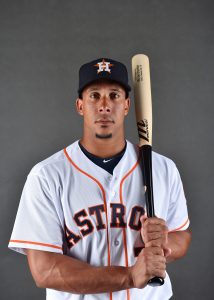
Chirinos is one of two new regulars in Houston’s starting lineup, but the other – left fielder Michael Brantley – comes with much more fanfare. The Astros’ headlining offseason acquisition, Brantley inked a two-year, $32MM deal which fell short of contract predictions from both MLBTR and FanGraphs. The longtime Indian has generally performed like a big-money player since his breakout 2014 season, though he was seldom available from 2016-17, when shoulder and ankle injuries robbed him of all but 101 games and stunted his numbers.
Fortunately, Brantley bounced back during his platform season, appearing in 143 games and slashing .309/.364/.468 (124 wRC+) over 631 plate appearances. Along the way, he struck out a paltry 9.5 percent of the time – the second-best rate in the majors – thereby continuing a career-long trend. It’s worth noting the Astros’ lineup was a bear to strike out even before Brantley showed up, as their offense registered the majors’ second-lowest percentage (19.5) in 2018. Now, an attack which already boasted Jose Altuve, Alex Bregman, Carlos Correa and George Springer should be all the more frightening with Brantley’s arrival. Plus, as a rare lefty in a righty-heavy lineup, the 31-year-old will give Houston a bit of variety at the plate.
The Astros had a need for Brantley thanks in part to the free-agent status of switch-hitting utilityman Marwin Gonzalez, whom they’ve since lost to the Twins on a two-year, $21MM accord. Gonzalez’s contract looks like a more-than-reasonable pact Houston easily could have afforded, and the team did show interest in re-signing him. But long before Gonzalez exited in February, the Astros found a contingency plan in Aledmys Diaz, a mid-November acquisition from the Blue Jays. The Astros are preparing Diaz for a super-utility role to help make up for Gonzalez’s loss, yet it may be a lot to ask of the 28-year-old. After all, Diaz has only seen extensive major league action at a pair of positions – shortstop and third base – and is just two seasons removed from a dreadful offensive showing. The good news is that the righty-swinging Diaz rebounded in 2018 to essentially match Gonzalez’s output at the plate (.263/.303/.453 in 452 PAs vs. .247/.324/.409 in 552 attempts). A repeat of that production would be welcome for the Astros, whom Luhnow noted could afford to trade young righty Trent Thornton for Diaz thanks to a backlog of “upper-level pitching.” So, even though it’s anyone’s guess what the Astros will get from Diaz, the trade seems like a worthwhile gamble on the team’s part – especially considering he’s controllable for four years.
Questions Remaining
The presences of Verlander and Cole surely give the Astros’ rotation a high floor, though it’s evident this is a riskier group than last season’s. Missing are Keuchel, Morton and McCullers, who spun a combined 572 innings of above-average pitching in 2018. No single member of that trio – let alone all three – will be easy to replace, though all-world prospect Forrest Whitley, 21, could be one of the rotation’s saviors sometime this season and there are multiple other intriguing young hurlers at or near MLB readiness. Regardless, it would be unwise to rule out further moves from Luhnow, who swung brilliant deals for Verlander and Cole in the recent past and who has at least tried to bring in another mid- to high-caliber arm since last season ended.
The Astros have been connected to Keuchel, James Paxton, Nathan Eovaldi, Robbie Ray, J.A. Happ and Lance Lynn at times dating back to November. The Diamondbacks’ Ray is the lone member of that group who hasn’t changed teams since then, and Houston could circle back to him (or look to another starter on the trade market) during the season if its rotation falls flat. As things stand, it appears the Astros will open the season with Miley, Collin McHugh and Brad Peacock backing Verlander and Cole. Despite the stellar run prevention numbers he put up last season, it’s hard to trust Miley, whose strikeout and walk numbers underwhelmed (5.58 K/9, 3.01 BB/9) and who benefited from an unsustainable home run-to-fly ball rate (5.2 percent, compared to 12.2 percent lifetime). He’s an obvious candidate for negative regression, even if he’s able to continue using his cutter to induce out-friendly contact. Less skepticism is deserved in regards to McHugh and Peacock, who have held their own as both starters and relievers in the majors.
On paper, the losses of McHugh and Peacock from the Astros’ bullpen will hurt the unit, but that’s not to say the club is set up poorly at the end of games. Quite the contrary, actually, as it’s due to receive full seasons from Roberto Osuna and Ryan Pressly – who joined the team in trades last summer – and continues to boast other healthy, established veterans in Hector Rondon, Will Harris and Chris Devenski. They could be joined by electrifying 26-year-old Josh James, who looked like a front-runner for a starting job before suffering a strained right quad in late February. James, like the rest of the aforementioned relievers, is a righty, and if there’s one quibble with the Astros’ bullpen, it’s the lack of a proven lefty. The team didn’t bring back Tony Sipp, who just signed for a relative pittance with the Nationals, even though he devastated both left- and right-handed hitters last season. The Sipp-less Astros will hope for breakouts from Cionel Perez and Reymin Guduan, a couple hard-throwing southpaws with minimal major league experience.
Meanwhile, with Altuve, Bregman, Correa, Springer and Brantley in the fold, the Astros will once again have a top-tier offense supporting their pitching staff. There are still some questions in their position player group, however, including: Will last year’s weak defensive showing carry over (Chirinos in, Maldonado out won’t help matters)? Will Diaz emerge as a reasonable facsimile of Gonzalez? Will well-compensated right fielder Josh Reddick rebound from a below-average 2018? How will designated hitter Tyler White follow up a 237-PA season in which he slashed an eyebrow-raising .276/.354/.533 (144 wRC+)?
White won’t have to approach last season’s numbers to properly replace ex-Astro and current free agent Evan Gattis, whose offensive production was pedestrian in 2018. Yuli Gurriel was similarly mediocre, though he remains the Astros’ preferred option at first base. Gurriel doesn’t seem to have a stranglehold on his position (and nor does White on his), however, considering the Astros reportedly pursued Paul Goldschmidt, Nelson Cruz, Edwin Encarnacion, Jose Martinez and Jose Abreu over the winter. Luhnow has also demonstrated previous interest in Tigers slugger Nicholas Castellanos, who could again end up on the Astros’ radar in the coming months if they’re not content with their 1B/DH situation. Otherwise, should the Astros need an in-season offensive boost, perhaps they’ll shift Brantley to first/DH or relegate Reddick to the bench to make room for standout corner outfield prospect Kyle Tucker.
2019 Season Outlook
While there are clearly some legitimate concerns with elements of the Astros’ roster, and it’s arguable the team should have been more aggressive to improve it over the winter, the star-laden outfit still looks well-equipped to continue as a major league superpower and a division champion in 2019. Plus, with Whitley and Tucker among the talented youngsters in the fold as potential in-season reinforcements, Houston should only grow stronger as the year progresses, potentially setting it up for another title run.
How would you grade the Astros’ offseason moves? (Link for app users.)
How would you grade the Astros' offseason?
-
C 42% (1,419)
-
B 37% (1,280)
-
D 11% (381)
-
A 5% (185)
-
F 4% (151)
Total votes: 3,416
Photo courtesy of USA Today Sports Images.
Offseason In Review: Tampa Bay Rays
This is the latest post of MLBTR’s annual Offseason in Review series, in which we take stock of every team’s winter dealings.
After a surprising 2018 season, the Rays prepared for a full return to contention with some intriguing trades and the priciest free agent signing in club history.
Major League Signings
- Charlie Morton, SP: Two years, $30MM (plus vesting option for 2021 that could be worth as much as $15MM depending on time spent on injured list)
- Avisail Garcia, OF: One year, $3.5MM
- Total spend: $33.5MM
Trades And Claims
- Acquired C Mike Zunino, OF Guillermo Heredia, and minor league LHP Michael Plassmeyer from the Mariners for OF Mallex Smith and minor league OF Jake Fraley
- Acquired IF Yandy Diaz and RHP Cole Sulser from the Indians as part of a three-team trade also involving the Mariners. (Indians acquired 1B Carlos Santana and $6MM from Seattle, and 1B/OF Jake Bauers from Tampa Bay. Mariners acquired $5MM from Tampa Bay, and 1B/DH Edwin Encarnacion and a Competitive Balance Draft Round-B pick from Cleveland.)
- Acquired RHP Emilio Pagan and Competitive Balance Draft Round-A pick from the Athletics, and minor league RHP Rollie Lacy from the Rangers as part of a three-team trade. (A’s acquired IF Jurickson Profar from Texas. Rangers acquired minor league IF Eli White and $750K in international bonus money from Oakland, and minor league right-hander Yoel Espinal and minor league LHPs Brock Burke and Kyle Bird from Tampa Bay.)
- Acquired RHP Oliver Drake from the Blue Jays for cash considerations
- Acquired minor league IF Gionti Turner from the Indians for RHP Chih-Wei Hu
- Acquired minor league RHP Caleb Sampen from the Dodgers for RHP Jaime Schultz
Notable Minor League Signings
- Jake Smolinski, Emilio Bonifacio, Luis Santos, Tyler Cloyd, Ryan Merritt, Casey Sadler, Ryan Sherriff, Ricardo Pinto, Jason Coats
Notable International Signings
- Sandy Gaston, RHP: $2.61MM signing bonus
Notable Losses
[Tampa Bay Rays Depth Chart | Tampa Bay Rays Payroll Outlook]
Needs Addressed
The Rays enjoyed great success with the “opener” strategy in 2018, and they’ll continue to use openers to account for two of their five rotation spots this season. Joining reigning Cy Young winner Blake Snell and promising but still rather unproven righty Tyler Glasnow is an established veteran, yet one that still seems somewhat “young” in the sense that we’re only entering the third season of the reinvented Charlie Morton.
After nine seasons of decent but unspectacular work for the Braves, Pirates, and Phillies, Morton breathed new life into his career as a member of the 2017-18 Astros. The soft-tossing groundball specialist suddenly turned into a strikeout machine with a 95mph fastball, whiffing 364 batters in just 313 2/3 innings for Houston.
Since Morton turned 35 last November, however, his earning outlook was limited. It was the Rays who made a rare free agent splash to land the right-hander, agreeing to a sizable contract that doesn’t come with risk of long-term entanglements. Geography played a role (Morton and his family live in nearby Bradenton, Florida), though Morton was undoubtedly intrigued at the possibility of joining another young team that may be on the cusp of contention. This isn’t to say that the Rays are about to enjoy a 2017 Astros-esque level of success, yet the club has further established itself as a legitimate contender to reach the postseason, something that would’ve been sounded wild a year ago at this time.
Both last offseason and throughout 2018, Tampa Bay unloaded virtually all of its highest-paid veteran players, yet thrived by acquiring and developing unheralded young replacements who largely outproduced those more established names. This allowed the Rays to feel comfortable in making a big expenditure on Morton — his $15MM salary is almost a quarter of Tampa’s entire payroll.
This financial flexibility allowed the Rays to take a bit of a deeper look into the free agent and trade markets. Beyond Morton, Tampa Bay also had interest in such free agent names as slugger Nelson Cruz and second baseman DJ LeMahieu, while the Rays were also one of the many teams who discussed a J.T. Realmuto swap with the Marlins.
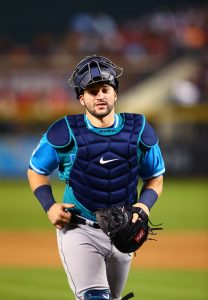 The Rays ended up doing in a different direction to address that latter need at catcher….well, as much as a Rays/Mariners trade can be described as “different” given the two clubs’ extensive history of deals. This time, the Rays and M’s combined on a five-player swap that saw Mallex Smith go to Seattle, while Tampa Bay added Guillermo Heredia to more or less take Smith’s place in the outfield, plus acquired catcher Mike Zunino to bring some stability behind the plate.
Zunino is well-known as one of the better defensive catchers in baseball, with outstanding pitch-framing and an increasing knack for throwing out baserunners. At minimum, the Rays will add some strong defense and some added pop to their catcher’s spot, as Zunino has 90 homers over the last five seasons. It seemed as if Zunino was rounding into becoming a true offensive force with a .251/.331/.509 season in 2017, yet he took a big step backwards to his old low-average and low-OBP ways last year, with just a .201/.259/.410 slash line over 405 plate appearances. The Rays as a whole cut back on their strikeout rate (25% to 22.4%) from 2017 to 2018, so there’s some hope that a new environment can help Zunino regain some of his 2017 patience.
Such a rebound would also be welcomed from Avisail Garcia, who turned in a huge 2017 but otherwise hasn’t completed a full season with an OBP of over .309. Garcia followed up his career year with a disappointing .236/.281/.438 performance over 385 PA, leading the White Sox to decline tendering a contract. The outfielder was hampered by injuries last year, however, leading the Rays to take a relatively inexpensive risk ($3.5MM) to see if Garcia can get on track.
The Rays’ offseason was also highlighted by a pair of three-team trades, one of which involved the Indians and (again) the Mariners. Tampa Bay’s involvement in the trade saw the Rays essentially swap former top prospect Jake Bauers for former Cleveland infielder Yandy Diaz, giving the Rays a bit more multi-positional versatility since Diaz can also play some third base, while matching Bauers’ skillset as a first baseman and corner outfielder. Minor league righty Cole Sulser and his eye-opening 12.3 K/9 at Triple-A also came to Tampa in the deal, giving the Rays another bullpen depth option.
A few years after being linked to Jurickson Profar in trade rumors, Tampa Bay was finally part of a Profar deal, only as the third team in the mix while the Athletics ended up with the infielder. The Rays’ contribution was three minor league pitchers to the Rangers, while picking up righty Emilio Pagan and a Competitive Balance Round-A draft pick (currently the 39th overall selection) from Oakland. Pagan will help fill the void left by veteran Sergio Romo in the bullpen, though Pagan’s tendency to allow a lot of fly balls and home runs will be tested in the AL East.
Questions Remaining
This is just speculative, but since the Rays picked up an extra draft pick in the Profar trade, perhaps that might make the team more open to surrendering a high pick to sign a qualifying offer free agent….like, for instance, Craig Kimbrel. The Rays are at least keeping an eye on Kimbrel’s market to see if the closer would be willing to take a shorter-term (one or two years) contract, though it may still be something of a longshot that Kimbrel ends up at Tropicana Field.
Adding Kimbrel would certainly be a major way of addressing a closer position that otherwise didn’t seem like a big priority for the Rays this winter. The team seems comfortable using Jose Alvarado as its primary ninth-inning option, though it’s fair to assume that several others will get some save opportunities as Tampa mixes and matches its arms. Ryne Stanek and Diego Castillo, for instance, could be used in the ninth inning when they’re not being used as openers.
Beyond just the personnel involved, the bigger question might be simply whether lightning can strike twice for the Rays and their opener strategy. Opponents have now had more time to get a book on Tampa Bay’s young relief corps, of course, and the uniqueness of the opener may fade now that other teams are also planning to use a one-or-two inning “starter” for one of their rotation spots. Adding Morton to chew up quality innings should help keep the bullpen fresh, though the Rays will again be performing a constant juggling act of their relievers, including a frequent shuttle to and from Triple-A Durham.
The same question could be asked of the position players. Only five Rays players topped the 400-PA plateau last season, in part due to some key names being added or subtracted in trades, but also due to the team’s roster full of players with multi-position capability, able to be moved in and out of the lineup as a game situation warrants. This season’s Rays have more of a set starting lineup on paper, though it will require some players to prove themselves capable of regular duty.
Trading Smith, for instance, puts pressure on Austin Meadows (a former top prospect) to take the leap in his second MLB season. Shortstop Willy Adames is being counted on for his own second-year improvement, while Joey Wendle will have to avoid a sophomore slump. Garcia is a total wild card. Ji-Man Choi delivered big numbers over 189 PA for Tampa last season, and will now have to produce over a full year as a frequent choice as the designated hitter. For Kevin Kiermaier and Matt Duffy, their primary challenge will simply be to stay healthy (Duffy has already run into problems in this regard).
As noted earlier, the Rays looked at some bigger names this winter, and did come away with Morton to help stabilize the rotation. Zunino also fills a need behind the plate, even if he isn’t Realmuto. For the remainder of the everyday lineup, however, it’s hard to argue that signing someone like Nelson Cruz wouldn’t have provided a clearer hitting upgrade. After Edwin Encarnacion was dealt from Cleveland to Seattle as part of that three-team deal, there was speculation that Encarnacion would then be flipped to Tampa, though such a follow-up move never materialized.
The Rays ended up with the much less-experienced first base/DH combination of Diaz and Choi, with others (Wendle, Brandon Lowe, Nate Lowe) likely to cycle through first base and much of the roster likely getting a DH day when warranted. Still, despite Choi’s impressive 2018 and Diaz’s highly-touted exit velocity numbers, Tampa might not have made much of a step up from Bauers and C.J. Cron, let alone the boost that a Cruz or Encarnacion would have provided.
The Rays designated Cron for assignment and watched him leave on waivers rather than pay him a projected $5.2MM arbitration salary. Bauers was moved after just one MLB season, following two years as a top-100 ranked prospect. It says something about Tampa Bay’s belief in Diaz that the team was willing to move Bauers this early in his career, though it could also speak to the sport’s general devaluation of players (like Bauers) who are limited to playing only first base and a little bit of subpar corner outfield.
2019 Season Outlook
The Red Sox and Yankees are both at least a few steps ahead of the Rays in the AL East, though Tampa Bay compares pretty favorably to the rest of the American League’s wild card contenders. Given the front office’s penchant for reshaping its roster on the fly, it wouldn’t be a surprise to see the Rays attempt a big midseason trade if they’re in the playoff hunt.
How would you grade the Rays’ offseason moves? (Link for app users.)
How Would You Grade The Rays' Offseason?
-
B 49% (1,881)
-
C 27% (1,052)
-
A 12% (464)
-
D 7% (287)
-
F 5% (192)
Total votes: 3,876
Photo courtesy of USA Today Sports Images
Largest Contract In Franchise History For Each MLB Team
Here’s our list of the largest contract each of the 30 MLB teams has ever signed. Each contract is linked to its MLBTR post, with the exception of those that predate the site’s existence.
- Angels: Albert Pujols – 10 years, $240MM (plus personal services contract valued at $6,841,811). Signed 12-8-11.
- Astros: Jose Altuve – 5 years, $151MM. Signed 3-20-18.
- Athletics: Eric Chavez – 6 years, $66MM. Signed 3-18-04.
- Blue Jays: Vernon Wells – 7 years, $126MM. Signed 12-18-06.
- Braves: Freddie Freeman – 8 years, $135MM. Signed 2-4-14.
- Brewers: Ryan Braun – 5 years, $105MM. Signed 4-21-11.
- Cardinals: Matt Holliday – 7 years, $120MM. Signed 1-7-10.
- Cubs: Jason Heyward – 8 years, $184MM. Signed 12-15-15.
- Diamondbacks: Zack Greinke – 6 years, $206.5MM. Signed 12-8-15.
- Dodgers: Clayton Kershaw – 7 years, $215MM. Signed 1-17-14.
- Giants: Buster Posey – 8 years, $159MM. Signed 3-29-13.
- Indians: Edwin Encarnacion – 3 years, $60MM. Signed 1-7-17.
- Mariners: Robinson Cano – 10 years, $240MM. Signed 12-12-13.
- Marlins: Giancarlo Stanton – 13 years, $325MM. Signed 11-18-14.
- Mets: David Wright – 8 years, $138MM. Signed 12-4-12.
- Nationals: Max Scherzer – 7 years, $210MM (present-day value of $191.4MM at time of signing). Signed 1-21-15.
- Orioles: Chris Davis – 7 years, $161MM. Signed 1-21-16.
- Padres: Manny Machado – 10 years, $300MM. Signed 2-19-19.
- Phillies: Bryce Harper – 13 years, $330MM. Signed 2-28-19.
- Pirates: Jason Kendall – 6 years, $60MM. Signed 11-18-00.
- Rangers: Alex Rodriguez – 10 years, $252MM. Signed 12-12-00.
- Rays: Evan Longoria – 6 years, $100MM (team also exercised three club options from previous contract, which had a total value of $30MM). Signed 11-26-12.
- Red Sox: David Price – 7 years, $217MM. Signed 12-4-15.
- Reds: Joey Votto – 10 years, $225MM. Signed 4-2-12.
- Rockies: Nolan Arenado – 7 years, $234MM. Signed 2-26-19.
- Royals: Alex Gordon – 4 years, $72MM. Signed 1-6-16.
- Tigers: Miguel Cabrera – 8 years, $248MM. Signed 3-31-14.
- Twins: Joe Mauer – 8 years, $184MM. Signed 3-21-10.
- White Sox: Jose Abreu – 6 years, $68MM. Signed 10-29-13.
- Yankees: Alex Rodriguez – 10 years, $275MM. Signed 12-13-07.