
Orioles Notes: Santander, Vavra, Odor, Farm System
The Orioles have been getting right fielder Anthony Santander some practice at first base and could play him on the infield at least occasionally down the stretch, manager Brandon Hyde told reporters this weekend (link via MASNsports.com’s Roch Kubtako). That shift could be accompanied by other changes in the infield, which began yesterday with Rougned Odor moving to third base in deference to 25-year-old Terrin Vavra, who received his first big league start at second base.
Santander, 27, has never played a Major League game at first base but did get some minor league work there several years ago. He generally rates as an above-average defender in right field, per both Defensive Runs Saved and Outs Above Average, although his ratings have slipped this season. With several young outfielders rising through the system including MLB-ready Kyle Stowers and fast-rising 2021 top pick Colton Cowser, it’s of extra note that Santander could reacclimate to another spot on the diamond. Austin Hays and Cedric Mullins are generally locked into outfield spots, so shifting Santander around certainly makes some sense.
Of course, even moderately enhancing Santander’s defensive versatility will also potentially make him a bit more appealing on the offseason trade market. The switch-hitting Santander drew some interest this summer, as he’s done for the past couple seasons, but the O’s hung onto him and for now can continue to enjoy his .255/.334/.452 output. Santander is on pace to set new career-highs in plate appearances, home runs and doubles this season, provided he remains healthy down the stretch. He’s also trimmed his strikeout rate from 23.1% last season to 18.6% this season and upped his walk rate from 5.3% to a career-best 8.2%.
Santander is earning $3.15MM this season and remains under club control through the 2024 campaign via arbitration. He’s already been through that process twice as a Super Two player and will be due another pair of raises before hitting the open market just after his 30th birthday in the 2024-25 offseason.
As for the move of Odor to the hot corner, it’s only sensible to get as long a look as Vavra as possible down the stretch in 2022. Second base is Vavra’s primary (and best) position, and after he hit .312/.425/.444 through 229 minor league plate appearances this season (mostly in Triple-A), he appears ready for a look in the big leagues. However, the O’s also have fellow infield prospect Jordan Westburg knocking on the door of the big leagues, if not late in 2022 then likely early in the 2023 season. Westburg, who landed 98th on Baseball America’s latest top 100 rankings, has posted a combined .255/.332/.470 slash between Double-A and Triple-A this season. He’s seen his walk rate cut in half jumping from Double-A to Triple-A and perhaps has some strikeout issues to sort through (26.1% this year), but given his general proximity to the big leagues, taking a proactive look at Vavra makes sense.
It seems fair to question just how much longer the veteran Odor will factor into the plans at all, given that the longtime Rangers infielder has posted just a .193/.257/.365 batting line in 331 plate appearances this year. The lefty-swinging Odor has actually posted worse results against right-handers than against southpaws and turned in below-average defensive grades at second base (-5 DRS, -2.9 UZR, -5 OAA).
From a broader perspective, veterans of the Odor ilk will have a more difficult time finding opportunity in Baltimore at all before too long. Despite graduating former No. 1 overall prospect Adley Rutschman to the Major League roster, the O’s still have baseball’s best all-round farm system, ESPN’s Kiley McDaniel opined in today’s updated rankings of the game’s 30 minor league systems. Some of that is due to another No. 1 overall pick being added to the system this season, but it’s also due largely to the rise of shortstop prospect Gunnar Henderson, whom Baseball America tabs as its new No. 1 overall farmhand in another just-released set of rankings.
Henderson, like Westburg, has split the 2022 season between Double-A and Triple-A, slashing at a combined .304/.429/.556 clip with 17 home runs, 20 doubles, six triples, 16 steals (in 19 tries), a huge 16.7% walk rate and a 20.8% strikeout rate. With 205 Triple-A plate appearances already under his belt, it’s at least feasible that he could also be an option late in the season — and, if not, then certainly early in 2023. However things pan out in the short-term, the looming presence of Henderson, Westburg, Vavra and others figures to directly impact Odor, Ramon Urias, Jorge Mateo and other infield options before too long.
Latest On Orioles’ Deadline Outlook
The Orioles surprisingly enter deadline season with some questions about the course of action they could take over the next few weeks. Baltimore looked like a slam-dunk seller as recently as ten days ago, but an eight-game win streak that has pulled them within two games of a Wild Card spot at least raises the possibility of the club reconsidering that approach.
It’s unfamiliar territory for general manager Mike Elias, who has been overseeing a complete rebuild since he was hired in November 2018. The baseball operations leader acknowledged as much in a chat with Ken Rosenthal of the Athletic yesterday, saying the O’s could be in position for “one of the more flexible trade deadlines that we’ve encountered.” Elias acknowledged the club’s playoff chances remain low given the strength of the AL East but noted the next few weeks of games could have an impact on the team’s plans.
Even if the O’s continue to play well through the end of the month, the front office is unlikely to push many chips in to add impending free agents. Both Rosenthal and Mark Feinsand of MLB.com float the possibility of Baltimore looking to acquire players under control beyond this season, though. Elias told Rosenthal the front office is of the belief the O’s “2023 picture is increasingly bright,” and Rosenthal writes that team officials have downplayed the chance of parting with controllable core pieces like Cedric Mullins and Austin Hays in the wake of their solid run.
The Orioles are one of a handful of teams in the middle-ground of the standings that could resist strict bucketing into “buyer” or “seller” territory. There’s room for the club to explore dealing away players on shorter-term contracts — particularly if they stumble over the next three weeks and fall a bit out of the playoff picture — while remaining open to opportunities to add more controllable talent. In such a scenario, first baseman Trey Mancini would seemingly be the top trade candidate, as he’s likely to decline his end of a mutual option and hit free agency at the end of the season.
Mancini is the only notable impending free agent on the roster, but Roch Kubatko of MASNsports.com notes that starter Jordan Lyles could be made available as well. The right-hander signed a one-year, $7MM guarantee over the offseason. That deal contains an $11MM club option for next season, but that seems likelier to be bought out. Through 17 starts, Lyles has tossed 98 innings of 4.50 ERA ball. He’s thrown plenty of strikes but posted below-average strikeout (18.9%) and ground-ball (40.6%) rates. Lyles is a durable source of innings, and Kubatko writes he’s been a strong veteran mentor for the team’s younger starters. Nevertheless, the Orioles aren’t likely to take him off the table if they field offers on short-term veterans.
As for the possibility of simultaneously looking to add controllable talent, infield and/or rotation pickups could be areas of interest. Rosenthal suggests the O’s may be a fit for Blake Snell if the Padres look to deal a starter to free breathing room against the luxury tax. Whether San Diego is willing to subtract from its rotation depth remains to be seen, but the Friars have virtually no payroll space to accommodate midseason additions if they’re intent on not surpassing the base tax threshold.
San Diego is expected to seek outfield help this summer, and Rosenthal reports they’ve had interest in Baltimore’s Anthony Santander in the past. Santander is playing this season on a $3.15MM salary and is arbitration-eligible through 2024; Snell is counting for $10MM against the Friars’ tax ledger, although his actual salary is a bit higher at $13.1MM. He’s under contract for $16.6MM next year before hitting free agency. Baltimore seems unlikely to accept a straight Snell for Santander swap, but they have virtually no commitments on the books next season and could look into an opportunity to buy low on Snell as part of a larger deal.
Feinsand, meanwhile, hears industry chatter the O’s might try to make a push for Marlins starter Pablo López. Unlike Snell, López is eminently affordable ($2.45MM salary) and arbitration-eligible through 2024. It’s easy to see the appeal for Baltimore, but the vast majority of teams around the league would be involved in Miami were to make López available. The Fish entered play Tuesday four games back in the National League Wild Card race and don’t seem likely to shop the 26-year-old over the next few weeks anyhow.
In either event, Snell and López serve as examples of myriad possibilities Elias and his staff could consider. Baltimore probably won’t be motivated enough to outbid bona fide contenders for top-of-the-market trade candidates like Luis Castillo or Frankie Montas, but they’re at least in position to entertain a wide range of outcomes for the first time in a long while.
Should The Orioles Rethink Their Trade Deadline Approach?
Few teams in baseball are playing as well as the Orioles lately. That’s not what anyone would have imagined entering the season or as recently as a couple weeks ago. As the calendar flipped to July, Baltimore was 35-43 and separated by six teams in the American League Wild Card standings. They were among the handful most clear-cut deadline sellers in the sport. Six Baltimore players were placed among MLBTR’s Top 50 trade candidates last Friday.
Fast forward just a few days, and the O’s have done everything in their power to make the front office think twice about selling. They’ve rattled off successive sweeps of the Rangers and Angels and carry an eight-game win streak. Pair that with a dreadful past week and a half for teams like the Blue Jays and Guardians — who were at or near the top of the Wild Card heap — and Baltimore has closed a stunning amount of ground. They head into play Monday two back of the final AL playoff spot, which is currently shared by the Mariners and Jays. They’ll have a chance to climb back to .500 tomorrow evening against the Cubs.
The Orioles aren’t going to continue winning indefinitely, of course. Their successive sweeps came against two below-average teams, and the Angels in particular have been in an absolute tailspin. Yet their solid play hasn’t been confined just to the past week and a half. They’re 22-14 since the start of June, outscoring opponents by 29 runs (170-141) over that stretch. That’s an arbitrary cutoff, and one can’t dismiss a 7-14 April that buried them in the standings right out of the gate. Yet this has at least been the best stretch of play for the franchise since their rebuild began in 2018, and they’ve gotten themselves into the playoff picture.
Will that be enough to deter the front office from moving some players off the roster for future talent? General manager Mike Elias struck a cautious tone speaking with reporters last week (link via Roch Kubatko of MASNsports.com). “Everything that I do or that we do has tradeoffs, and all I can say is, we do everything from a very global, a very thoughtful perspective about what is the right thing to do for the health of the Orioles’ franchise,” Elias said. “I don’t know what’s going to happen, but I’m saying we’re taking a look at everything as we make these decisions and we’ll see what happens.”
The front office certainly doesn’t seem ready to declare the rebuild over and part with high-end talent to add pieces for the 2022 stretch run. Each of FanGraphs and Baseball Reference has the club’s odds of reaching the playoffs below 10%. Even as they’ve played their way back into the picture, it’s fair to wonder whether the roster — the starting rotation especially — can hold up for another two and a half months. Few would argue the Orioles are a better team than the Blue Jays, Mariners, Rays or Red Sox, yet they’ll have to outplay multiple members of that group (and hold off a handful of teams just behind them) to get to the playoffs. Even were they to add some rotation help and/or upgrade on any of Jorge Mateo, Ramón Urías or Rougned Odor around the infield, the O’s would remain postseason longshots.
If Elias and his staff aren’t likely to pivot and aggressively add before the deadline, there’s still room for them to stay the course without selling. By and large, the O’s current core can be kept around beyond this season. Baltimore has just three impending free agents on the roster. Odor and backup catcher Robinson Chirinos aren’t going to attract trade interest anyhow, meaning the only key rental for the O’s to decide upon is Trey Mancini. (His deal technically contains a $10MM mutual option for 2023, but he’s likely to decline that and seek a multi-year free agent deal).
Mancini is having a good season, carrying a .281/.353/.420 line across 331 plate appearances. He’d attract a decent amount of interest as one of the better rental bats available were the Orioles to shop him over the next few weeks. Still, as an impending free agent with defensive limitations, he won’t bring back an eye-popping return. Baltimore almost certainly wouldn’t recoup a prospect generally regarded as a top 100 caliber player in a deal. In all likelihood, they’d land a couple of players most evaluators view as middle-tier prospects from another organization.
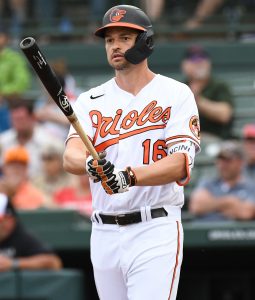
A Mancini trade would add talent to an already-deep farm system, but would there be enough appeal to pull the trigger if the Orioles remain within three or four games of a Wild Card spot by the August 2 deadline? In addition to his on-field value, the 30-year-old first baseman is generally regarded as a strong clubhouse presence. He’s a fan favorite, and his overcoming a 2020 battle with colon cancer makes him one of the sport’s easiest players to support. Dealing Mancini if the Orioles were 10+ games back would’ve been unpopular with some segment of the fanbase; trading him if the team continues playing well and remains on the fringes of contention would be even more so. That’d be equally true in the clubhouse.
Baltimore’s highest-value assets are under a longer window of club control. Outfielders Cedric Mullins and Austin Hays can be kept around through 2025. They looked unlikely to change hands no matter how this season’s first half went, and that’s all the more true with the club showing signs of life. Closer Jorge López could be more likely to move given the inherent volatility with relief pitching, but he’s arbitration-eligible through 2024. That’s also true of corner outfielder Anthony Santander, who’d have more modest interest than any of Mullins, Hays or López given his defensive shortcomings and up-and-down career track record at the dish.
Things should get harder for the O’s over the next few weeks. After a two-game set with Chicago, they’ll split their next ten games between the Rays (seven) and Yankees (three). Their final series of July will be in Cincinnati, followed by one pre-deadline matchup with Texas. Drop ten or 11 of those contests, and the O’s probably end up as sellers, at least parting with Mancini. If they can go 8-8 or 9-7 over that stretch, though, Elias and his staff will have to decide on a team hovering around .500 and likely within shouting distance of a playoff spot for the first time in six years.
The front office is certainly going to remain mindful of the long-term outlook. They’re not going to suddenly jump into the Luis Castillo or Frankie Montas bidding, although perhaps they could entertain the idea of adding a lower-impact starter with a lengthier window of remaining control. Yet the team has played well enough of late to give themselves a shot to avoid subtractions. Much will depend on how they play over the next three weeks, but the Orioles may not be as motivated to deal as they’d seemed just a few days ago. That’s a credit to their surprisingly strong play over the past month-plus. The team has given themselves a shot to make the front office rethink their deadline outlook, and the next 15 games should be the franchise’s most important in a half-decade.
Image courtesy of USA Today Sports.
East Notes: Castillo, Jays, Orioles, Marte, Kiermaier, Nationals
Luis Castillo was a Blue Jays trade target last winter, and unsurprisingly, Toronto continues to have interest in Castillo’s services, according to USA Today’s Bob Nightengale. Though Castillo missed the first month of the season due to shoulder soreness, he has been in strong form with a 2.92 ERA over 71 innings, even if his Statcast numbers aren’t quite as reflective of top-notch performance. Castillo’s walk rate and hard-contact numbers are only okay, though his strikeout rate (25.3%) is well above league average and he still has elite fastball velocity.
The Reds right-hander is one of the very best players (let alone pitchers) expected to be available as the deadline approaches, making him a natural fit for a Toronto club in sore need of pitching upgrades. Between Hyun Jin Ryu‘s Tommy John surgery and underwhelming performances from Jose Berrios and Yusei Kikuchi, the faulty rotation has been the chief reason for the Jays’ struggles in the last month, which is why Nightengale writes that the Blue Jays “are expected to be the most aggressive team pursuing starting pitching help.” Last summer’s trade for Berrios is an example of how the Toronto front office hasn’t been hesitant to pay a big price for a player they want and need, though the Blue Jays will face plenty of competition for Castillo’s services.
More from both the AL East and NL East…
- Also from Nightengale, the Orioles‘ surprisingly strong play seemingly hasn’t changed the club’s long-term plans, as Baltimore is “expected to unload” several notable veterans. The list of names includes both impending free agents like Trey Mancini, Rougned Odor, and Jordan Lyles, plus more controllable players like Anthony Santander and All-Star closer Jorge Lopez. It’s safe to assume that the price tag will be a lot higher for Lopez and Santander than the others, but regardless, the O’s likely aren’t going to change course and start thinking about a playoff push.
- Starling Marte left Saturday’s game due to a groin injury, and Marte wasn’t in the Mets lineup on Sunday. However, Marte is only day-to-day, as manager Buck Showalter told reporters (including MLB.com’s Anthony DiComo) that an MRI revealed only minor inflammation and no serious damage. Marte has been a big contributor in his first year in New York, and his first-half performance earned him a slot on the NL All-Star team earlier today. With this groin injury lingering, however, Marte might opt to skip the game to rest up over the break.
- Kevin Kiermaier was placed on the 10-day injured list earlier today, marking the second time this month that a nagging hip injury has put the Rays outfielder on the shelf. Kiermaier told reporters (including Marc Topkin of the Tampa Bay Times) that he received a cortisone shot during his first IL stint, but now that the issue has returned, he’ll be visiting a specialist to further explore the injury. “There’s just a lot of unknowns right now with what’s to come….I don’t really know what the future holds, to be quite honest,” Kiermaier said, noting that surgery was a possibility. A major procedure could quite possibly end Kiermaier’s season, and thus maybe his tenure with the Rays altogether, as 2022 is the final guaranteed year of his contract. Kiermaier has spent all 13 of his pro seasons in the Tampa organization, though that tenure has involved several injury absences.
- There hasn’t been much public information revealed about the Nationals‘ possible sale, but billionaire Michael B. Kim is the first name linked to the list of potential buyers, according to Barry Svrluga and Chelsea Janes of The Washington Post. Kim and another bidding group have met in person with team officials already, and a third group is also slated for in-person meetings later in July. Though there seems to be an increasing feeling that the Lerner family will indeed sell the Nationals, it is still early in the process, since “as many as five or six individuals or groups are expected to meet with club officials.”
Orioles Notes: Mancini, Santander, Lopez
As has been the case the past few summers, the Orioles enter deadline season among the game’s likeliest sellers. Baltimore has been amidst a full rebuild, and they’re again all but certain to finish at the bottom of the American League East. The O’s have shown signs of progress, graduating top prospect Adley Rutschman to the big leagues and going 14-12 last month, but they’re still set to field offers on a number of players.
Among the likeliest to be dealt are first baseman/designated hitter Trey Mancini and corner outfielder Anthony Santander. Mancini is set to hit free agency at the end of this season, and as of Spring Training, the club had not engaged his representatives in talks about a potential long-term deal. Barring an out-of-the-blue extension coming together over the next few weeks, the O’s figure to flip Mancini to a contender for this season’s final couple months. (Mancini’s agreement with the O’s to avoid arbitration this spring included a $10MM mutual option for 2023. Given the caliber of season he’s having, he seems unlikely to trigger his end of the pact and forego a possibility at a multi-year free agent deal).
The Mets are among the teams that has checked in on Mancini, reports Jon Heyman of the New York Post. New York skipper Buck Showalter is plenty familiar with the Notre Dame product, having managed in Baltimore through 2018. That encompassed Mancini’s first two full seasons as a big leaguer, so Showalter had an up-close look at his clubhouse fit and work habits.
Mancini is amidst one of the better seasons of his career. Through 295 plate appearances entering play Friday, the 30-year-old is hitting .280/.356/.421. Mancini has only hit seven home runs, but his 20% strikeout rate is a career-low. While his power output has dipped, particularly relative to his 35-homer 2019 breakout campaign, his hard contact rate is still well above-average.
Pete Alonso is having a great season at first base for the Mets, but the club figures to look into external possibilities at designated hitter. New York has gotten a .230/.311/.383 showing from the DH position, exactly league average production by measure of wRC+. Between Dominic Smith and J.D. Davis, the Mets entered the season with a seeming surplus of bat-first players who could serve as the team’s DH. Smith has instead struggled for a second straight season, hitting .194/.283/.265 in 113 MLB plate appearances and spending some time in Triple-A. Davis has a .243/.333/.345 line over 171 trips to the dish, hitting only two homers in 51 games. Like Mancini, Davis has far better batted ball metrics than his power results would suggest though.
The Mets are one of plenty of teams that either already has or will check in with O’s general manager Mike Elias regarding Mancini. Santander also figures to attract some amount of interest, and Heyman writes in a separate piece that Baltimore is willing to make him available. After a down 2021, he’s hit 14 home runs through this season’s first half. The switch-hitting outfielder owns a .235/.329/.424 line in just under 300 trips to the plate.
For the first time in his career, Santander has an on-base percentage above the league average, a testament to an approach overhaul that has allowed him to work more free passes. After swinging at more than half the pitches he’d seen in every season of his career through 2021, Santander has cut his swing rate to just over 46% this year. With that more patient approach has come a 10.5% walk rate that’s more than double the 5.1% clip he’d posted in his career through last season.
While the O’s are under time pressure to extend or trade Mancini, the club could elect to hold onto Santander if they don’t receive offers to their liking. The 27-year-old entered this season with three-plus years of big league service. He’s controllable through the end of 2024 via arbitration and making a modest $3.2MM this season. As for Baltimore’s other controllable outfielders, Heyman unsurprisingly writes the team would “have to be blown away” to move either Cedric Mullins or Austin Hays. Baltimore can keep each of Mullins and Hays through 2025.
Aside from Mancini and Santander, Baltimore’s next-most likely trade candidate may well be breakout closer Jorge López. As MLBTR’s Steve Adams explored yesterday, López has transformed from struggling starter to lights-out reliever. Through 37 innings, the right-hander has a microscopic 0.73 ERA. He’s struck out 27.1% of opponents and generated ground-balls at a massive 64% clip, a combination that is sure to lead to plenty of calls from teams looking to add a late-game weapon.
As part of a reader mailbag, Roch Kubatko of MASNsports.com writes that Baltimore would listen to offers on López, at least as a matter of due diligence. Controllable through 2024 and playing this season on a $1.5MM salary, the 29-year-old could affordably stick around for the next few seasons. It’d no doubt take a significant haul for Elias and his staff to pull the trigger on a deal, but other clubs will try to pry López away before the August 2 deadline.
Orioles Reinstate Anthony Santander, Keegan Akin
JUNE 17: As expected, Santander and Akin have been reinstated from the restricted list before this evening’s game against the Rays. Stowers and Garcia have been returned to the minor leagues and are off the 40-man roster.
JUNE 13: The Orioles announced they’ve selected outfielder Kyle Stowers and right-hander Rico Garcia onto the major league roster as designated COVID-19 “substitutes.” In corresponding moves, they’ve placed outfielder Anthony Santander and lefty Keegan Akin on the restricted list. That’s the standard practice for players who haven’t been vaccinated against COVID-19 on teams headed for a series in Toronto. The Canadian government prohibits unvaccinated athletes from crossing the border, so Santander and Akin will miss the next four games.
Stowers is the more notable of the two call-ups, as he’s now in line to make his major league debut. A supplemental second-round pick out of Stanford back in 2019, the left-handed hitter has been one of the organization’s most interesting prospects since that point. Stowers appeared among the top 30 farmhands in a quality Baltimore system each season from 2020-22, according to Baseball America, with the outlet recently placing him as the O’s #9 minor league talent.
Primarily a corner outfielder, Stowers’ calling card is his bat speed and power potential. BA graded his raw power as plus-plus (a 70 on the 20-80 scouting scale), and he popped 27 home runs and 23 doubles across three minor league levels last season. Stowers drew plenty of walks as well but struck out in more than 30% of his plate appearances at each stop, and both Baseball America and Keith Law of the Athletic raised questions about how often he swings through pitches inside the strike zone.
To Stowers’ credit, he’s cut back on his strikeout rate thus far in the 2022 campaign. Through 209 plate appearances at Triple-A Norfolk, he’s hitting .253/.356/.545 with 12 homers and a more manageable 25.4% strikeout percentage. That’s still a few points north of the league average, but it’s unquestionably an improvement relative to last season and hasn’t come at the cost of any of Stowers’ extra-base impact.
Garcia, meanwhile, is headed to the majors for the first time in two years. The Honolulu native suited up with the Rockies and Giants between 2019-20, tossing 16 innings of 7.31 ERA ball between the division rivals. Garcia missed all of last season recovering from Tommy John surgery, and he was limited to a minor league deal this past winter. He has a 1.93 ERA across 18 2/3 innings between three levels, striking out an excellent 37.2% of opponents along the way.
That Baltimore specified both Stowers and Garcia are COVID replacements is notable, as they’ll each be occupying a temporary spot on the 40-man roster. Both players can be taken off the roster and returned to Norfolk when Santander and Akin are eligible to return on Friday, and that seems the likeliest course of action.
Stowers, in particular, figures to land a permanent roster spot in the relatively near future, though. He’ll need to be added to the 40-man at the start of next offseason to keep him from being taken in the Rule 5 draft, and Baltimore could bring him up for an extended look against big league arms before too long given his strong high minors showing.
In other O’s news, the club announced that infielder Chris Owings has passed through release waivers unclaimed. He’s now a free agent. Baltimore designated Owings for assignment last week after a .107/.254/.143 start to the season.
Post-Lockout Trade Candidates: 27 Regulars Who Could Plausibly Change Teams
In recent days, MLBTR has taken a look at some players who could find themselves on the move between the conclusion of the lockout and the start of the season. First, Tim Dierkes looked at the league’s 14 likeliest trade candidates. Steve Adams then ran through some impact players who, to varying degrees, could find themselves in trade rumors whenever transactions resume.
Today we’ll look at other regulars who we could envision changing uniforms in the relatively near future. Acquiring any of the players on today’s list wouldn’t be quite as splashy as landing the stars we covered last week, but it’s easy to envision any one of them assuming an important, regular role on a new team.
Before we get into the list, a quick note on methodology. In defining “plausible” trade candidates, we looked at players we felt had somewhere between a 20% and 50% chance of being dealt before the start of the season. It’s not meant to be an exhaustive list of trade possibilities — almost any player around the league could theoretically move if another team made the right offer — but it’s meant to capture a tier of regulars we wouldn’t be surprised to see change hands. In an exercise of this nature, there has to be a somewhat arbitrary line that delineates the last of the players who, in our view, are “plausible” trade candidates. Players like Gary Sánchez and Jesús Aguilar were discussed internally but fell just on the other side of that line.
Now, on to the list. The players are ordered by what we feel to be their likelihood of getting traded (all arbitration projections via MLBTR contributor Matt Swartz):
John Means, Orioles SP
Buster Olney of ESPN reported in November that the Orioles were “dangling” Means in trade talks. Baltimore’s rebuilding and seemingly amenable to offers on anyone on the roster, but it remains to be seen how actively they’ll push to make their top starting pitcher available. With Means controllable through 2024 and projected for a modest $3.1MM salary, the O’s needn’t force a deal this offseason.
The 28-year-old presents a tricky evaluation for teams. He got off to an excellent start to the season, posting a 2.28 ERA (albeit with a 4.20 FIP) through his first 71 innings. Means then landed on the injured list with a shoulder strain. After returning in July, he posted a 4.88 ERA down the stretch, watching his strikeout rate tumble almost six percentage points in the process. The medical evaluation will be critical, but teams that are comfortable with the state of Means’ shoulder moving forward might expect him to regain the strong mid-rotation form he showed early in the year.
Isiah Kiner-Falefa, Rangers SS/3B
Kiner-Falefa has been a solid regular for the Rangers for the past couple seasons. He spent 2020 at third base, then was tasked with moving up the defensive spectrum to shortstop last year. Defensive Runs Saved loved his glovework at short; Statcast’s Outs Above Average did not. Kiner-Falefa finished third in the 2021 Fielding Bible shortstop award voting. There’s not much question he’s a very good defender at the hot corner, and most teams would probably at least feel comfortable with him moonlighting at shortstop if need be.
Texas remade their middle infield in free agency, signing Corey Seager and Marcus Semien. Kiner-Falefa could kick back to third base, but the Rangers have top prospect Josh Jung nearing big league readiness at the position. Controllable for two more seasons and projected for a $4.9MM salary, he could stick around as a utility guy. But if another team buys him as a plus defender at shortstop, it wouldn’t be a surprise to see Texas ship him somewhere he can continue playing everyday. Kiner-Falefa’s .271/.312/.357 line fits better at the bottom of a lineup, but he brings good contact skills and a solid infield glove to the table. MLBTR’s Steve Adams explored the possibility of a Kiner-Falefa trade at greater length this afternoon.
Raimel Tapia, Rockies LF
Reports out of Denver have suggested the Rockies could look to move Tapia, projected for a $3.9MM salary in his second-to-last arbitration-eligible season. The Rox need to bolster an offense that was among the league’s worst last year, and they’re seemingly planning to make a splash in the corner outfield. That’d probably push Tapia — who’s spent almost his entire MLB career in left field — out of the everyday lineup.
Tapia has never hit at the level one would hope from an everyday left fielder. One could argue he’s better suited for a fourth outfield role regardless. He’s a plus runner with good bat-to-ball skills, though, and he ranked among Baseball America’s top 50 overall prospects back in 2017. It’s certainly not out of the question another team takes a flier on him, particularly if the Rockies are willing to take a minimal return after acquiring his replacement.
Chris Paddack, Padres SP
The pre-lockout agreement with Nick Martínez bumped a bunch of the Friars’ younger arms down a peg on the rotation depth chart. As MLBTR’s Steve Adams recently explored, that could pave the way for them to move one of their controllable starters. If they do, Paddack looks the likeliest of the bunch. He’s arbitration-eligible and projected for a $2.1MM salary. That’s certainly affordable, but the Padres could be looking to open some payroll space after exceeding the luxury tax threshold last year.
Paddack has had back-to-back down seasons after a promising rookie campaign. But he’s still only 26 years old, boasts pristine control, and teams can dream on him recapturing his 2019 form. That he’s controllable for three seasons could be of particular appeal to teams like the Rangers and Nationals (who expressed interest at last summer’s deadline) who might be eyeing 2023 as a more plausible contention year.
Ryan Yarbrough, Rays SP
Yarbrough has been a flexible member of the Rays pitching staff for the past few years. He’s worked variably as a traditional long reliever, a bulk man behind an opener and as a true starting pitcher. Yarbrough posted an ERA of 4.13 or lower in each of his first three seasons, but he scuffled to a 5.11 mark in 2021. That came without meaningful changes to his strikeout and walk numbers, though, and Yarbrough remained excellent at avoiding hard contact.
The Rays likely anticipate the southpaw will return to form, but his price is escalating. Tampa Bay is already projected for a franchise-record payroll, so it wouldn’t be surprising if they move some of their arbitration-eligible players for pre-arb or minor league talent. Yarbrough is projected for a $4.4MM salary and remains under team control through 2024.
Austin Meadows, Rays LF/DH
Marc Topkin of the Tampa Bay Times wrote over the weekend that the Rays could be open to moving Meadows, who is projected for a $4.3MM salary. Controllable through 2024, Meadows would be a long-term option for Tampa Bay or any potential acquiring team, but the Rays have proven willing to field offers on almost anyone on the roster. And with the aforementioned payroll outlook for the typically low-spending club, the front office figures to be amenable to ways to pare back costs.
Meadows is coming off a decent season, in which he hit .234/.315/.458 with 27 homers over 591 plate appearances. That marked a bounceback from a below-average offensive showing during the shortened 2020 schedule, but it’s a fair bit shy of his career-best .291/.364/.558 line the season before that. Meadows isn’t a great defender, so he needs to mash to be a star. He did that in 2019, but he’s otherwise been a good-not-great hitter. That’s still a valuable player to have on hand, but unless the Rays anticipate him replicating his peak season this year, it’d be sensible to listen to offers.
Tony Kemp, Athletics 2B/LF
Kemp has bounced around the league a bit in recent seasons. He plays second base and left field, but advanced metrics have pegged him as a fringy defender at the keystone. Kemp doesn’t bring a ton of power to the table, and he’s already 30 years old. It’s not the easiest profile to make work, explaining why he has yet to find a long-term home.
There’s no questioning Kemp’s 2021 results, though. Over 397 plate appearances, he hit .279/.382/.418. Both FanGraphs and Baseball Reference pegged him as worth around three wins above replacement. Kemp has excellent plate discipline and bat-to-ball skills, and he could be trending towards a late-career emergence in the mold of former A’s second baseman Tommy La Stella. The market for teams on the hunt for second base help is pretty thin. Kemp, who avoided arbitration on a $2.25MM salary and is controllable through 2023, would be an affordable pickup if the A’s move him as part of their anticipated post-lockout efforts to trim payroll and reboot the roster.
Manuel Margot, Rays OF
MLBTR’s Mark Polishuk recently looked at the possibility of the Rays making Margot available. He’s projected for a $5MM arbitration salary as he enters his final year of club control. That’s a reasonable salary for a player of Margot’s caliber, but Tampa Bay has plenty of cheaper, controllable outfielders on hand, and top prospect Josh Lowe looks ready to step into an everyday role somewhere in the grass after a monster season in Triple-A.
It’s not out of the question Tampa trades away multiple outfielders, but if they move the more expensive Kevin Kiermaier, Margot sticking around to handle center field is certainly possible. The latter might have broader appeal around the league, though. Not only is he set to make around a third of Kiermaier’s remaining guarantees, Statcast credited Margot with a league-best +16 Outs Above Average in the outfield last year. He’s never been more than an average hitter, but acceptable offense coupled with Gold Glove caliber defense is a very valuable player. There’s also a dearth of center fielders available in free agency at this point.
Max Kepler, Twins OF
MLBTR’s Mark Polishuk recently broke down Kepler’s trade candidacy at great length. Guaranteed $16.25MM through 2023 and controllable for 2024 via club option, he’d be an affordable target for teams seeking outfield help. Yet Kepler’s offensive production has ticked down towards league average following what seemed to be a breakout showing in 2019. The Twins might prefer to hold onto him in hopes he rediscovers that form, but they just extended Byron Buxton and have former top prospects Alex Kirilloff and Trevor Larnach in the fold as corner outfield options. A Kepler deal could be a creative way to address some of the team’s other issues in the starting rotation or at shortstop.
Danny Jansen/Alejandro Kirk, Blue Jays C
The Jays’ catching depth has been a topic of conversation throughout the offseason. Would Toronto part with one of their controllable backstops to land help in the rotation or infield? The signing of Kevin Gausman probably diminishes their need to land an impact starter via trade, although they’re likely to at least look for depth pieces.
Reese McGuire is a capable backup catcher who’s out of minor league options. Top prospect Gabriel Moreno is rapidly approaching and could be in the majors by the end of the season. Jansen offers a solid bend of power and defensive acumen, while Kirk has otherworldly bat-to-ball skills and an elite minor league track record. Toronto doesn’t have to move anyone from this group, but it could be an opportunity to consolidate their catching depth for help elsewhere on the roster.
Amed Rosario, Guardians SS/CF
Cleveland acquired Rosario from the Mets as part of the Francisco Lindor trade last offseason. His offensive numbers (.282/.321/.409) were fine, although neither Defensive Runs Saved nor Statcast was fond of his glovework at shortstop. Rosario’s aggressive approach at the plate will probably keep him from emerging as the star many envisioned he’d become as a prospect, but he has alright career hitting numbers, runs well and could be an option for teams at any of the up-the-middle positions on the diamond (aside from catcher).
The Guardians have a lot of infield depth, with several talented prospects in the high minors and already on the 40-man roster. With their seemingly annual need for outfield help, a Rosario trade could help balance the roster. Cleveland could also just give him more run in center or left field themselves, but it might be more straightforward to trade him to an infield-needy team with an outfield surplus. Rosario is projected for a $5MM salary and controllable through 2023.
Josh Bell, Nationals 1B
I covered Bell’s trade candidacy in greater length in late December. The Nationals are taking a step back in 2022, and he’s entering his final year of club control. A projected $10MM salary might scare away some suitors, but Bell would be a notable offensive upgrade for many teams around the league. The switch-hitter posted a .261/.347/.476 season-long mark, and he had an excellent 277/.381/.506 line with more walks than strikeouts after the All-Star Break.
Garrett Cooper, Marlins 1B/COF
Cooper has looked like a viable trade candidate for a few seasons. He’s part of a corner outfield/first base rotation in Miami that got a bit more crowded when the Fish signed Avisaíl García. The Marlins have suggested they could use García as their regular center fielder, but that’s less than ideal. If they land a center fielder after the lockout and push García to a more suitable right field role, Cooper might find himself squeezed for playing time.
A late bloomer, Cooper’s already 31 years old. He has quietly been a very productive hitter when healthy, though, including an excellent .284/.371/.478 line (133 wRC+) in 383 plate appearances since the start of 2020. Health is a big caveat for Cooper, who has had stints on the injured list in all five of his MLB seasons and missed the second half of last year with a left elbow injury. As MLBTR’s TC Zencka explored in December, he’d returned to taking batting practice and figures to be ready for 2022. Projected for a modest $3MM salary with an additional season of control thereafter, he could be an interesting flier, particularly for NL teams looking to add offense if/when the universal designated hitter is finalized.
Anthony Santander, Orioles RF/LF
Santander’s name has been floated around the rumor mill in years past. The Orioles are rebuilding, and he’s more of a complimentary piece than a likely member of the long-term core. Santander is limited to the corner outfield and has a very aggressive approach, though, making it crucial he makes plenty of contact and hits for power. He did that in the shortened 2020 season en route to a .261/.315/.575 line, but he couldn’t follow up on that success.
Last season, Santander had a couple injured list stints and struggled to a .241/.286/.433 mark. He signed for $3.15MM to avoid arbitration in November and remains controllable through 2024. Given their competitive window, the O’s would certainly listen to offers on Santander. But it remains to be seen whether there’ll be sufficient demand that Baltimore wouldn’t be better off hanging onto him and hoping he approximates his 2020 performance over the first few months of next season. MLBTR’s Darragh McDonald recently explored Santander’s trade candidacy in greater depth.
Zach Plesac, Guardians SP
Plesac isn’t yet arbitration eligible and he’s controllable for another four seasons. The Guardians might simply prefer to hang onto him, particularly after their 2021 season was derailed by rotation injuries. Yet as mentioned with regards to Rosario, Cleveland has significant concerns in the outfield. They’ve dealt key starting pitchers over the past couple seasons, seemingly confident in their ability to continue to develop less-heralded prospects into capable rotation cogs.
If they were to deal a starter, Plesac would seem the likeliest candidate. The Guardians aren’t about to rebuild, and moving Shane Bieber or Aaron Civale might be too significant a blow to their hopes of contending in 2022. Triston McKenzie and Cal Quantrill might still have upside Cleveland’s hoping to unlock. Plesac’s small sample excellence in 2020 was probably inflated by a regional schedule against Central-division teams that, by and large, weren’t good offensively. That season aside, he hasn’t posted particularly impressive strikeout rates. But he’s got excellent control, gets a decent number of grounders, and should be a solid bet for league average rotation innings over the next few seasons.
Merrill Kelly, Diamondbacks SP
The D-Backs were the worst team in the National League last season. They don’t seem to have the appetite for a full rebuild, but Kelly’s entering his final year of club control. At age 33, he’s probably not an extension candidate, so Arizona figures to be open to moving him.
Kelly’s not an overpowering arm. He posted a 4.44 ERA over 158 innings last season, striking out only 19.5% of batters faced. He throws plenty of strikes, though, and he gets a decent number of grounders. Playing on a modest $5.25MM salary, Kelly would be an eminently affordable pickup for contenders looking to stabilize the back of the rotation.
Mitch Garver/Ryan Jeffers, Twins C
Garver missed a good chunk of last season after suffering a gruesome injury. During his 243 plate appearances, he mashed at a .256/.358/.517 clip with 13 home runs (137 wRC+). That’s two of the past three seasons with some of the best offensive output of any catcher in baseball. He’s controllable for two seasons and projected for a modest $3.1MM salary. Jeffers hasn’t yet hit arbitration-eligibility and still has minor league options remaining. He struck out too often as a rookie, but he hit for power and is a well-regarded defender who entered the year among the sport’s top catching prospects.
As with Kepler, a trade of Garver or Jeffers would probably be about dealing from an area of surplus to address the rotation or shortstop. Both players could plausibly be regular catchers next season, and they’d lose some of their value if penciled into the DH role regularly. Given Garver’s injury troubles, Minnesota might prefer to hold their depth behind the dish.
Elieser Hernández, Marlins SP
The Marlins have reportedly fielded offers on their arbitration-eligible starting pitchers this winter, perhaps in search of controllable outfield help. Miami already thinned their rotation depth a bit by including Zach Thompson in the Jacob Stallings deal, but it wouldn’t be a surprise if they make one more move in that vein.
Over the past two years, Hernández owns a 3.84 ERA in 77 1/3 innings with very strong strikeout and walk rates (26.3% and 5.7%, respectively). He’s an extreme fly-ball pitcher who’s likely to always have some difficulty keeping the ball in the yard. He missed most of 2021 recovering from a pair of long-term injuries (biceps inflammation and a quad strain). Because of those drawbacks, he won’t be in as much demand as rotation mate Pablo López. Yet another team may try to take a shot on Hernández’s promising strikeout/walk profile, particularly since he’s only projected for a $1.4MM salary and controllable through 2024.
Chris Stratton, Pirates RP
I covered Stratton’s trade candidacy at greater length in December. He’s a 31-year-old reliever controllable for two seasons on a rebuilding team. The Bucs aren’t going to view him as a core piece of the rebuild, and it stands to reason they’d welcome the opportunity to pick up an intriguing low-level prospect. Over the past two seasons, Stratton has been the kind of capable if unexciting middle relief piece contending teams need. He won’t bring back a franchise-changing return, but at a projected $2.2MM salary, he should draw some interest.
Cole Sulser, Orioles RP
Sulser had a quietly strong second half with the Orioles, occasionally factoring into their closing mix. A late bloomer, he’ll be 32 by Opening Day. So while they’re under no contractual pressure to move him, the rebuilding O’s would certainly listen to offers. After putting up a 2.70 ERA with a 28.4% strikeout rate, he should be of interest to contenders. Sulser isn’t yet arbitration eligible and can be controlled through 2025.
Adrian Houser/Eric Lauer, Brewers SP
The Brewers certainly aren’t obligated to trade either of Houser or Lauer, both of whom are coming off strong seasons. Still, the Brew Crew already have a vaunted top three of Corbin Burnes, Brandon Woodruff and Freddy Peralta and prospects Aaron Ashby and Ethan Small are at or nearing the big leagues. Might Milwaukee plug one of the younger arms into the rotation and flip a veteran back-end starter for offensive help?
Adalberto Mondesi, Royals 3B/SS
Mondesi’s an enigmatic player. He brings an enviable combination of power and speed and has enough athleticism to play a competent or better shortstop. He also has among the worst strikeout and walk numbers of any regular position player in MLB. Perhaps most alarming, he’s dealt with enough injury issues in recent years that Royals president of baseball operations Dayton Moore expressed some doubt about his ability to play more than 100 games per season regularly.
Nicky Lopez played well enough to supplant Mondesi at shortstop last year. Bobby Witt Jr. will probably take that position early in 2022, pushing Lopez somewhere else on the dirt. Whit Merrifield is still around as a second base option. Kansas City might have enough infield depth to explore a Mondesi trade, although it’d be a bit of a sell-low on a player with obvious physical gifts who’s controllable through 2023. He’s projected for a $3.2MM salary.
Kyle Hendricks, Cubs SP
Hendricks is guaranteed $29.5MM through the next two seasons, with a vesting option that could keep him in Chicago through 2024. The Cubs have moved most of their core players dating back to last offseason, but Hendricks remains on the North Side. That might be attributable to some uncharacteristic struggles, as the righty’s coming off a career-worst 4.77 ERA with unimpressive peripherals.
Hendricks has never struck batters out or fared exceptionally well in the eyes of ERA estimators, though. Until last season, his actual run prevention handily outperformed metrics like FIP and SIERA as he thrived on exceptional command. He’ll probably bounce back, even if he may never recapture his Cy Young-caliber, 2.13 ERA form from 2016. With the amount of teams on the hunt for starting pitching, there’d no doubt still be demand if the Cubs made Hendricks available. Will they? Perhaps, since they’re not likely to compete in 2022. Yet their early-offseason activity — signing Yan Gomes and Marcus Stroman, claiming Wade Miley — has suggested they may not be keen to punt next season entirely.
Trey Mancini, Orioles 1B
The Orioles aren’t going to compete in 2022, and Mancini is ticketed for free agency at the end of the year. Most players in his situation would be very straightforward trade candidates, but the first baseman is a fan favorite and reported clubhouse leader who made an inspiring return to the diamond last year after missing the 2020 campaign battling colon cancer.
That Mancini returned to play in 147 games after facing that kind of life obstacle is a remarkable achievement. It’s undeniable, though, that his production slipped relative to his excellent 2019 campaign. Mancini’s .255/.326/.432 line was only marginally above average, and he played exclusively first base and designated hitter. It certainly wouldn’t be surprising to see him bounce back into a middle-of-the-order presence as he gets further away from beating cancer, but demand for his services might be limited until his production rebounds. If that’s the case, it’s probably not worth it for the O’s to trade him away this offseason. He’s projected for a $7.9MM salary, but Balitmore’s 2022 payroll ledger is wide open.
Trade Candidate: Anthony Santander
After getting limited big league playing time in 2017 and 2018, Anthony Santander showed signs of breaking out in 2019. Just 24 years old at the time, he hit 20 home runs in 93 games, slashing .261/.297/.476. The lack of walks kept his wRC+ just below league average at 97, but given his youth, power and ability to hit from both sides of the plate, there was a lot to feel good about.
In the pandemic-shortened 2020 campaign, he took his game up a notch. He improved his walk rate from 4.7% to 6.1%, still below average, but progress nonetheless. His strikeout rate dropped from 21.2% to 15.2%, and he hit 11 home runs in just 37 games, slashing .261/.315/.575 for a wRC+ of 130.
Unfortunately, 2021 was a step backwards, with multiple trips to the IL limiting his playing time and production. In 110 games, he still showed his power potential with 18 home runs, but his walk rate dropped to 5.3% and his strikeout rate ticked up to 23.1%. The defensive metrics also largely viewed him as below average, after being near or above in the previous two seasons. He finished the year with a wRC+ of 92 and 0.6 fWAR.
The Orioles are deep in rebuilding mode, having finished below .500 for five straight seasons and last in the AL East for four of those, with their lone step out of the basement being when the Red Sox slipped to just one game behind the O’s in the shortened 2020 campaign. Although the farm system is now well regarded and has many top prospects nearing MLB readiness, there’s still a long path ahead to competitiveness, as the club finished last year with a record of 52-110, 39 games behind the fourth place Blue Jays.
Santander has three years of club control left and can be retained by Baltimore through the 2024 season. Although it’s possible the club is rebuilt by then, it would also make sense for them to entertain trade scenarios. Even if they are capable of contending in the 2024 season, Santander will be in his final year of control and turn 30 in October of that year. For a club clearly prioritizing the long term, it would be logical to consider a swap that brings back players that can help beyond that three-year timeframe. The O’s also have Cedric Mullins and Austin Hays likely to be occupying two of the three outfield spots on a regular basis, meaning that dealing Santander could free up one slot for the team to give some playing time to other options, such as DJ Stewart, Ryan McKenna, Yusniel Diaz or Kyle Stowers.
The Orioles don’t need to rush into a deal, as Santander isn’t breaking the bank. He qualified for arbitration last year as a Super Two, earning a salary of $2.1MM, and has already agreed to a contract of $3.15MM for this year. Given his down year in 2021, it makes sense for the club to hang onto him for now, hoping he can get back to the form he showed in 2020 before dealing him at the trade deadline or even next winter.
Santander played a bit of center field in 2019 but is primarily a corner outfielder. Any team that needs help in the outfield but isn’t likely to splurge on an expensive free agent like Nick Castellanos, Kris Bryant, Kyle Schwarber or Seiya Suzuki could be intrigued, especially if he’s healthy and playing up to his potential this year.
The Rockies are looking for outfielders, having been connected to Bryant and Schwarber this offseason. The Padres need outfield help and might be facing a budget crunch after going over the luxury tax line last year and still not finding a taker for Eric Hosmer‘s contract. The Guardians certainly need outfielders and almost never land high-paid free agents, plus Cleveland has a bundle of young and controllable arms that would surely appeal to a Baltimore team desperate for pitching. The Giants have been connected to Suzuki but are apparently looking to avoid big free agent expenditures and could pivot to other options if they’re outbid. The Phillies have Bryce Harper in right but could use upgrades in center and left — trading for someone like Santander could allow them to spend more on other areas, such as the infield and bullpen.
Clubs like the White Sox, Marlins, Rangers and Braves could also make sense, as well as a handful of other teams, depending on what other transactions take place in the coming months. There’s also the possibility of further suitors emerging as the season progresses, if injuries create a need on a team that isn’t an obvious fit at the moment.
Tender Deadline Signings: 11/30/21
With the deadline to tender contracts to arbitration-eligible players looming tonight at 8pm ET — the MLBPA and MLB jointly agreed to move the deadline up a couple days due to the looming expiration of the collective bargaining agreement — we’ll likely see a slew of arbitration-eligible players signing one-year deals.
It’s commonplace for a large batch of players to sign deals in the hours leading up to the tender deadline. “Pre-tender” deals of this nature often fall shy of projections due to the fact that teams use the looming threat of a non-tender to enhance their leverage. Arbitration contracts at this juncture are often take-it-or-leave-it propositions, with the “leave it” end of that arrangement resulting in the player being cut loose. Given the widely expected lockout, there could be more incentive than usual for borderline non-tender candidates to take those offers rather than being cast out into free agency just hours before a transaction freeze is implemented.
As a reminder, arbitration contracts are not fully guaranteed. In a typical year, a team can cut a player on an arb contract at any point before the halfway point in Spring Training and only be responsible for 30 days’ termination pay (about one-sixth of the contract). Releasing a player in the second half of Spring Training bumps the termination pay to 45 days of his prorated salary.
MLBTR contributor Matt Swartz projected salaries for each team’s arbitration-eligible players last month, although for many of the players listed below, this isn’t so much avoiding arbitration as it is avoiding a non-tender. Here’s a look at today’s agreements…
- The Yankees have agreed to deals with infielder Gio Urshela and right-hander Domingo German, reports Mark Feinsand of MLB.com (Twitter links). Urshela will make $6.55MM, while German has agreed to a $1.75MM deal. Urshela has two seasons of control remaining; German is controllable for three years. Urshela is coming off a .267/.301/.419 showing while playing third base and shortstop. German tossed 98 1/3 innings of 4.58 ERA ball.
- The Twins have signed three arbitration-eligible pitchers, per reports from Feinsand and Darren Wolfson of SKOR North (on Twitter). Right-hander Jharel Cotton signed for $700K, reliever Caleb Thielbar lands $1.3MM and reliever Tyler Duffey signs for $3.8MM. Thielbar and Duffey were both productive members of the Minnesota relief corps in 2021. Cotton was recently claimed off waivers from the Rangers.
- The Giants have agreed to terms with outfielder Austin Slater on a $1.85MM deal, reports Ken Rosenthal of the Athletic (Twitter link). The 28-year-old (29 next month) appeared at all three spots on the grass while hitting .241/.320/.423 over 306 plate appearances in 2021.
- Reliever Emilio Pagan and the Padres have agreed on a $2.3MM deal, reports Rosenthal (on Twitter). The 30-year-old worked 63 1/3 innings of 4.83 ERA/3.93 SIERA ball this past season.
- The Diamondbacks agreed to a $2MM deal with left-hander Caleb Smith, reports Zach Buchanan of the Athletic (via Twitter). The 30-year-old posted a 4.83 ERA/4.68 SIERA across 113 2/3 innings in a swing capacity in 2021.
Orioles Place Anthony Santander On Injured List
The Orioles announced they’ve reinstated left-hander Bruce Zimmermann from the 60-day injured list. He’ll start this evening’s game against the Red Sox. They’ve also recalled corner infielder/outfielder Tyler Nevin from Triple-A Norfolk and placed right-hander Chris Ellis and outfielder Anthony Santander on the 10-day IL. To create space on the 40-man roster for Zimmermann, Baltimore transferred lefty Keegan Akin, who underwent abdominal surgery last week, from the 10-day to the 60-day injured list.
Zimmermann is back after missing around two and a half months due to left biceps tendinitis. The 26-year-old appeared in twelve games (eleven starts) before going on the IL, tossing 59 2/3 innings of 4.83 ERA/4.48 SIERA ball. Zimmermann posted a below-average 20.2% strikeout rate and gave up nearly as much hard contact as any pitcher in baseball, but he pounded the strike zone and posted a ground-ball rate just a bit below the league average.
That’s not the most exciting production, but only John Means posted better numbers among O’s hurlers with 50+ innings this season. That looks to give Zimmermann a decent shot at landing a season-opening rotation spot next year, although the O’s front office will at least add a low-cost veteran option or two to that mix this offseason.
Santander’s season comes to a close a few days early because of a right knee sprain. The 26-year-old mashed in last year’s shortened campaign, but he couldn’t follow up on that over a larger body of work. Through 438 plate appearances, Santander hit .241/.286/.433. He hit for a decent amount of power for a third consecutive year, popping 18 home runs, but Santander’s tiny 5.3% walk rate and career-worst 23.1% strikeout percentage (excluding his 13-game rookie year) contributed to serious on-base issues.
This offseason, Santander will be eligible for arbitration for the second of four times. If tendered a contract, he’d be in line for a raise on this year’s $2.1MM salary. The Orioles have no guaranteed money on the books next season, so they could certainly shoulder a few million dollar tab for Santander. Still, that was true last offseason of Renato Nuñez — another low-OBP, power bat — and Baltimore elected to non-tender Nuñez. The front office will have to make a similar call on Santander this winter.