
Twins, Marlins Swap Luis Arraez For Pablo Lopez In Four-Player Trade
Months of rumors about the Marlins’ rotation have finally resulted in some action, as the Marlins have traded right-hander Pablo Lopez, top infield prospect Jose Salas and outfield prospect Byron Chourio to the Twins in exchange for reigning AL batting champion Luis Arraez, per announcements from both clubs.
The core of the trade, for immediate purposes, will see the Twins swap out three years of Arraez for two seasons of Lopez, who’ll immediately be an upgrade to their rotation. The 26-year-old Lopez has come into his own as a quality big league starter over the past three seasons, pitching to a 3.52 ERA with a 25% strikeout rate, a 7% walk rate and a 47.4% ground-ball rate in 340 innings.
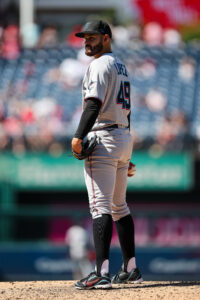
Lopez has dealt with some injury issues in his career, thrice landing on the injured list due to shoulder strains. The most recent of those three injuries came in the summer of 2021 and wiped out more than two months of Lopez’s season, but he was injury-free in 2022 when pitching to a career-high 180 innings over the life of 32 starts. Last year’s performance netted Lopez a still eminently affordable $5.45MM salary. He’ll be due one more raise in arbitration in the 2023-24 offseason before reaching free agency following the 2024 campaign — barring an extension, of course.
The newly acquired Lopez will step into a Twins rotation that also includes Sonny Gray, Joe Ryan and Tyler Mahle. Though it was easy to wonder whether Lopez could push Kenta Maeda into a bullpen role after he missed the entire 2022 season on the heels of internal brace surgery on his right elbow in Sept. 2021, The Athletic’s Dan Hayes tweets that Maeda will remain a starter.
The likeliest odd man out of conventional five-man rotation is 27-year-old Bailey Ober, but the towering righty has pitched to a sharp 3.82 ERA in 31 starts to begin his big league career — including a 3.21 mark in 56 innings last season. (Ober missed more than three months due to a severe groin strain.) Alternatively, the Twins could look to deploy a six-man rotation that would help them manage Maeda’s workload and hopefully lead to better health among a starting staff that was generally hampered by injury throughout the 2022 season.
Meanwhile, with Arraez now subtracted from the Twins’ lineup, they’ll lose their leadoff man, one of their best hitters and one of their primary options at first base and designated hitter. His departure likely opens the door for 25-year-old Alex Kirilloff to slot in as the primary first baseman. Kirilloff, a former first-round pick, ranked as one of the sport’s 10 to 15 best prospects prior to his big league debut, but he’s now undergone wrist surgery in each of the past two seasons, derailing the start to his career. There’s quite a bit of upside there, but quite a bit of risk as well. It’s always possible the Twins look to add another established hitter to help soften the blow of losing Arraez, but the first base and DH markets in free agency have been largely picked over, so if that’s the route they choose, it’ll likely have to come via another trade.
On the other side of the swap, the Marlins will get a left-handed bat to help balance out a heavily right-handed lineup. Arraez brings to Miami perhaps the most impeccable bat-to-ball skills in Major League Baseball, having fanned in just 8.3% of his plate appearances since debuting as a 22-year-old back in 2019. He doesn’t walk at an especially high clip, but Arraez’s mark of 8.7% is still higher than both his strikeout rate and this past season’s league-average 8.2% walk rate.
Arraez, 26 in April, hit .316/.375/.420 with a career-high eight home runs in 2022 and is a lifetime .314/.374/.410 hitter in the Major Leagues. His contact skills are second to none and will likely always allow him to hit for a high average, but the rest of his game is rather limited. Arraez is lacking in power, evidenced by a career .096 ISO (slugging minus batting average), and his average sprint speed is below average, per Statcast.
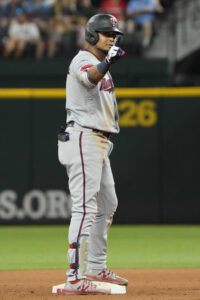
While he debuted as a second baseman, defensive struggles have left Arraez as something of a position-less nomad. He’s bounced between second base, first base, third base and left field, delivering lackluster defensive grades at each of those spots other than first base. He’ll primarily play second base in Miami, with general manager Kim Ng subsequently announcing that Jazz Chisholm Jr. is moving to center field.
Like Lopez, Arraez has some worrying injury issues on his resume. A torn ACL during his prospect days torched his 2017 season, and he’s been on the injured list three times since Opening Day 2020 due to knee troubles as well. Arraez also spent a week on the 7-day concussion IL in 2021 and missed nearly three weeks of that season due to a shoulder strain.
Arraez is arbitration-eligible for the second time this offseason and, as a Super Two player, still has two years of arbitration remaining beyond the current campaign. He and the Twins couldn’t come to terms on an agreement prior to last week’s deadline to exchange arbitration figures; the Twins filed at a $5MM mark, while Arraez’s camp countered with a $6.1MM submission. Now that he’s with a new team, it’s possible Arraez could agree to a one-year deal somewhere between those points, or perhaps even discuss a lengthier pact. If not, his subsequent arbitration raises will take his salary north of $10MM by his final year of club control, in 2025.
For the Marlins, dropping Lopez from the rotation positions them to deploy a starting five of Sandy Alcantara, Jesus Luzardo, Trevor Rogers, Edward Cabrera and Braxton Garrett, with several intriguing arms still waiting in the wings behind that quintet. Arraez will deepen and strengthen what’s been a lackluster Miami lineup, and the organization’s rotation depth is strong enough to withstand the loss of Lopez.
There’s little doubting, however, that the defense will suffer from both the acquisition of Arraez and last week’s trade of Miguel Rojas. The Marlins now look set to play Joey Wendle at shortstop, while Chisholm will have to learn a brand new center field position on the fly. Overall, the gambit of dropping Rojas and adding Arraez in the name of balancing and improving the lineup could have the unfortunate side effect of dropping Miami from a middle-of-the-pack defensive club to one of the worst in the National League.
The prospects in the deal are both long-term plays for the Twins, making them somewhat curious secondary pieces for a team that’s clearly bidding for immediate contention in the wake of their stunning deal to re-sign Carlos Correa. That said, recent trades for Mahle, Gray and others have thinned out the Twins’ system in considerable fashion, so backfilling with some youthful talent helps straddle the line of building for both the short- and long-term.
Salas is particularly well regarded, originally signing for a $2.8MM bonus and currently ranking fourth in Miami’s system at Baseball America. He’s a shortstop for the time being, though BA’s scouting report suggests a move to third base is possible, depending on the extent to which his still-lean frame grows. The switch-hitting Salas batted .250/.339/.384 against vastly older competition in 2022, splitting the year between Class-A and Class-A Advanced despite only turning 19 this past April.
Salas connected on nine homers and swiped 33 bases in 109 games. Scouting reports on Salas tout his work ethic, his feel for contact and the potential for at least average power. He’ll immediately become one of the Twins’ top overall prospects, but he won’t add any value to their 2023 club (aside from perhaps giving them more flexibility when it comes to negotiating additional trades).
Chourio is even younger, having just signed as an amateur out of Venezuela one year and five days ago. Despite playing the season at just 17 years old, the switch-hitting outfielder took the Dominican Summer League by storm, raking at a .344/.429/.410 clip with a homer, nine doubles, 19 steals and nearly as many walks (25) as strikeouts (27) in 217 plate appearances.
Chourio won’t even turn 18 until May, so even wildly optimistic projections would have him three years away from being a legitimate big league possibility, and it’s quite likely that he’s even further off than that. Still, there’s plenty to like about him despite the lack of proximity to the Majors. In addition to his eye-catching pro debut, Baseball America’s Ben Badler touted Chourio’s physical projection, strong throwing arm, center field instincts and balanced swing when reviewing the Marlins’ international signing class last year.
Today’s trade puts an end to months of speculation and rumors regarding Lopez, who finally knows where he’ll spend at least the next two seasons of his career. It remains possible, given Miami’s depth and the needs they have elsewhere on the roster, that they could further tap into that group in an effort to bolster the lineup and reshape an increasingly questionable defense. On the Twins’ end of things, Lopez isn’t clearly better than any of their in-house options, but they’ll add another mid-rotation arm to a starting staff deep in comparable talents, helping to safeguard against injury and adding some stability beyond the current season, when each of Gray, Mahle and Maeda can become free agents. They’ll also restock a farm system that’s been taxed by recent trades, but the swap feels more like a next step than the final piece of an offseason puzzle.
Ken Rosenthal and Dan Hayes of The Athletic first reported the two teams were progressing toward a deal involving Arraez and Lopez. ESPN’s Jeff Passan reported the deal was done. Craig Mish of SportsGrid and the Miami Herald reported the names of the two prospects going back to Minnesota (Twitter links).
Marlins To Move Jazz Chisholm To Center Field
The Marlins made their long-awaited swap of a starting pitcher for a hitter this afternoon, sending Pablo López to Minnesota as part of a deal for Luis Arraez. Shortly after the trade was finalized, Miami general manager Kim Ng told reporters (including Craig Mish of SportsGrid) the newly-acquired infielder would take over as the primary second baseman. All-Star Jazz Chisholm Jr. will move from the keystone to center field.
It’s an interesting gambit for Miami, who’ll indirectly address their uncertain center field mix with today’s trade. Arraez has plenty of experience as a second baseman. He came up through the minors at the position and has logged more MLB innings there than at any other position. Over parts of four seasons, Arraez has spent a bit more than 1200 innings at the keystone.
Public defensive metrics have been mixed on his effectiveness. Defense Runs Saved rated him as nine runs below average in just 390 innings there as a rookie in 2019. Over the three seasons since then, DRS has pegged him as a slightly better than average second baseman. Statcast hasn’t been quite so optimistic. While it also feels he’s improved since a poor rookie showing — an estimated -7 runs in 2019 — it has rated him a little below par in two of the last three years.
Statcast has graded Arraez’s arm strength as slightly above-average for the position. Scouts have raised questions about his lateral quickness and athleticism since his time as a prospect, though. Minnesota pushed him primarily to first base work last season, starting him 31 times at the keystone compared to 60 times at first base (with a handful of games at third also mixed in). Of course, Minnesota’s signing of Carlos Correa solidified shortstop and ensured Jorge Polanco would play almost exclusively at second base. The Twins felt more comfortable with Polanco’s glove than Arraez’s up the middle, but it’s possible they’d have given the latter more second base time if they hadn’t landed one of the sport’s best shortstops.
It does come as a surprise to see Miami move Chisholm out of the middle infield. The 24-year-old (25 next month) established himself as the organization’s top position player with a .254/.325/.535 first half before suffering a season-ending stress fracture in his back. He also later underwent surgery to repair a meniscus tear in his right knee.
Signed as a shortstop prospect out of the Bahamas, Chisholm has only ever played the middle infield as a professional. He’ll take on the outfield on the fly during the upcoming season, with a month-plus of Spring Training action to acclimate to the new position.
With zero outfield experience, it’s impossible to know how Chisholm will take to the different reads and angles he’ll need to learn as an outfielder. Miami is clearly confident he’ll polish those aspects of his game quickly while relying on his elite athleticism in the interim. Chisholm was long credited by scouts with plus speed, and Statcast placed him in the league’s 94th percentile in that regard last season. He would’ve tied for 19th among 74 center fielders in sprint speed, so he certainly shouldn’t have issue covering the spacious outfield at Marlins Park from that perspective.
Prospect evaluators also praised Chisholm for an above-average throwing arm. He hasn’t shown that at the MLB level, though it’s not fair to compare his throwing speeds as a second baseman to those of center fielders. Chisholm obviously had quicker releases and much shorter distances to throw on the right side of the infield than he will from center field.
It’s a gamble for the Fish nonetheless, given the challenge of projecting how quickly he’ll develop the kind of reads needed to be a solid defensive center fielder. Yet it’s one Miami will take after missing out on their chances to directly upgrade the position from outside the organization. The free agent market at the position was mostly limited to depth players beyond Brandon Nimmo, Cody Bellinger and Kevin Kiermaier. Trades only offered a few more obvious candidates, with the Pirates sticking to a massive asking price on Bryan Reynolds and even reports of a somewhat significant ask from the Royals on a glove-first option like Michael A. Taylor.
Rather than run things back with players like Jesús Sánchez, Bryan De La Cruz and JJ Bleday — all of whom are better suited in the corner outfield — they’ll turn things over to Chisholm. Their younger outfielders will vie for a spot in the corner opposite Avisaíl García, while Arraez looks like to be joined by Joey Wendle, Jean Segura and Garrett Cooper in the primary infield.
Marlins, Twins Continue To Discuss Trade Possibilities Involving Luis Arraez, Pablo Lopez
The Marlins and Twins continue to explore trade possibilities involving Minnesota infielder Luis Arraez and Miami’s surplus of starting pitching, reports Dan Hayes of the Athletic. Jon Heyman of the New York Post first wrote last week that Arraez’s name had come up in discussions involving Marlins righty Pablo López but suggested the Twins were uninterested in parting with the infielder.
Hayes similarly hears that Minnesota isn’t willing to pull the trigger on a one-for-one swap of Arraez and López. However, Hayes characterizes Minnesota as willing to entertain larger possibilities involving Arraez and controllable starting pitching targets. While the Twins aren’t actively shopping him, they’re apparently keeping an open mind to broader trade permutations. There’s no indication anything is imminent, and Hayes notes that the sides haven’t directly spoken in several days even as a general line of communication between the clubs seemingly remains open.
The Marlins’ willingness to dealing from the rotation has dated back at least as far as the 2021-22 offseason. Miami has yet to make a major trade but is still generally expected to subtract a starter for an offensive addition between now and Opening Day.
Reports have suggested the Fish were amenable to offers on any of López, Jesús Luzardo, Trevor Rogers and Edward Cabrera. While there’s no indication that’s officially changed, it seems talks are focusing in on the most experienced member of the group. Barry Jackson and Craig Mish of the Miami Herald wrote this afternoon that López has moved the forefront of Miami’s trade discussions around the league. According to the Herald, discussions on Rogers and Cabrera have “cooled” of late.
That’s not an especially surprising development. López is down to two seasons of remaining club control. Rogers and Luzardo are each controllable for four years, while Cabrera can be retained for another six seasons. That has made López the most straightforward trade candidate in the Miami rotation all along, although early reports this winter suggested the Fish might instead look towards a Rogers deal while keeping López in the fold.
Even with the comparatively lesser control window, López is a highly appealing trade chip for Miami general manager Kim Ng and her staff. The Venezuelan-born righty has posted a sub-4.00 ERA in each of the last three seasons. He hasn’t walked more than 7.5% of batters faced in any of those campaigns and has posted at least a 23.6% strikeout rate in all three seasons. López sits in the 93-94 MPH range with his fastball and owns one of the game’s better changeups. He misses bats and keeps the ball on the ground at an above-average clip and generally manages solid results against right and left-handed hitters alike.
He’ll play the 2023 campaign on a $5.45MM salary after avoiding arbitration last week. The 26-year-old will be due one more raise the following year before hitting free agency over the 2024-25 offseason.
Acquiring a starter who’s controllable beyond next season is apparently on the wishlist for a Minnesota club that could see a notable chunk of its rotation depart next winter. Tyler Mahle, Sonny Gray and Kenta Maeda are all slated for free agency after the 2023 campaign. Of their current starting five, only Joe Ryan and Bailey Ober are controllable beyond next season. Minnesota extended their window of control over righty Chris Paddack by an extra season last week, signing him through the end of 2025. He’ll likely get another rotation opportunity at some point but is currently on the mend from the second Tommy John procedure of his career. Young pitchers like Simeon Woods Richardson, Josh Winder and Louie Varland could play their way into the mix at some point but are far from established.
While it’s easy to see the appeal of adding a quality pitcher like López who’d stick around through 2024, Minnesota remains unwilling to do so in a straight swap for Arraez. The left-handed hitter is arbitration eligible for one season longer than López, controllable through 2025. His 2023 salary remains undefined — he and the club look to be headed for an arbitration hearing after not reaching an agreement last week — but will check in between $5MM and $6.1MM.
Arraez is fresh off his first All-Star campaign. He claimed the American League batting title by hitting .316 and reached base at a .375 clip overall. The 25-year-old only hit eight home runs in 603 plate appearances but is among the sport’s best pure hitters. No qualified hitter struck out less often than Arraez, who went down on strikes in only 7.1% of his trips. He was one of six qualified batters with more walks than strikeouts, drawing free passes at a decent 8.3% rate.
A second base prospect throughout his time in the minors, Arraez has assumed more of a bat-first utility role in recent years. Public defensive metrics have given him mixed reviews for his work at the keystone, and Minnesota turned to him more often at first base in deference to Jorge Polanco last season. Arraez can also play some third base and rotate through designated hitter. Miami has Jazz Chisholm Jr. and Jean Segura to play second and third base, respectively. There’d be room for Arraez to join right-handed power bats Garrett Cooper and Jorge Soler in the first base/DH mix, and he’s the archetype of the high-contact bat the Miami front office has reportedly sought.
If Miami and the Twins can’t bridge the gap in their trade discussions, the Marlins would find no shortage of interest in López elsewhere. The Padres and Cardinals have also been linked to the hurler this offseason while a number of others checked in at last summer’s trade deadline. Derrick Goold of the St. Louis Post-Dispatch implied this afternoon (on Twitter) there wasn’t much momentum between the Fish and Cardinals on López right now, though, suggesting that Miami’s interest in St. Louis outfielder Lars Nootbaar has been rebuffed.
Requested Salary Figures For 33 Players Who Didn’t Reach Agreements By Arbitration-Filing Deadline
January 13 was the deadline for teams and arbitration-eligible players to exchange salary figures in advance of possible hearings, and as usual, the large majority of players worked out one-year agreements (or extensions) for their 2023 salaries. MLBTR’s Arbitration Tracker detailed these agreements, though there is still quite a bit of unfinished business, as 33 players still don’t have their deals settled, and thus their 2023 salaries could be determined by an arbiter.
Typically, arb hearings take place in February or March, yet there isn’t anything officially preventing a team from still reaching an agreement with a player up until the moment an arbiter makes their ruling. However, most clubs employ the “file and trial” strategy as a way of putting more pressure on players to accept agreements prior to the figure-exchange deadline. In short, once the deadline passes, teams head to hearings with no more negotiation about a one-year salary, though clubs are typically still willing to discuss multi-year extensions.
Here are the 33 players who have yet to reach an agreement on their 2023 salaries, as well as the players’ requested salary and the team’s counter-offer. As always, clubs (and the league as a whole) pay very close attention to arbitration salaries, since any outlier of a number can serve as a precedent in the future, thus raising the bar for both one particular players and perhaps players as a whole. This is why teams are generally adamant about the “file and trial” tactic and taking the risk of a sometimes-awkward arb hearing, even in cases where there is a relatively small gap between the club’s figure and the player’s figure.
[RELATED: Arbitration projections from MLBTR contributor Matt Swartz]
Nineteen of the 30 teams have at least one unsettled case remaining, with the Rays (by far) leading the way with seven players on pace to reach hearings. Given that Tampa Bay entered the offseason with an enormous 19-player arbitration class, it perhaps isn’t surprising that the Rays still have a lot of work to do, even after trimming that initial class size with non-tenders and trades. Teoscar Hernandez’s $16MM is the largest figure submitted by any of the 33 players, while Kyle Tucker and Bo Bichette have the largest gap between submitted figures, each with a $2.5MM difference between their hoped-for salaries and the numbers respectively submitted by the Astros and Blue Jays.
The total list (which will be updated as settlements are reached and hearing results become known)….
- Hunter Renfroe: $11.9MM in desired salary….Angels offered $11.25MM
- Gio Urshela: $10MM….Angels $8.4MM
- Luis Rengifo: $2.3MM….Angels $2MM
- Kyle Tucker: $7.5MM….Astros $5MM
- Cristian Javier: $3.5MM….Astros $3MM
- Bo Bichette: $7.5MM….Blue Jays $5MM
- Max Fried: $15MM….Braves $13.5MM
- Corbin Burnes: $10.75MM….Brewers $10.01MM
- Ryan Helsley: $3MM….Cardinals $2.15MM
- Genesis Cabrera: $1.15MM….Cardinals $950K
- Josh Rojas: $2.9MM….Diamondbacks $2.575MM
- Tony Gonsolin: $3.4MM….Dodgers $3MM
- Jon Berti: $2.3MM….Marlins $1.9MM
- Agreed to one-year, $2.125MM deal with 2024 club option
- Jesus Luzardo: $2.45MM….Marlins $2.1MM
- Teoscar Hernandez: $16MM….Mariners $14MM
- Diego Castillo: $3.225MM….Mariners $2.95MM
- Dylan Moore: $2.25MM….Mariners $1.9MM
- Jeff McNeil: $7.75MM….Mets $6.25MM
- Victor Robles: $2.6MM….Nationals $2.3MM
- Austin Voth: $2MM….Orioles $1.7MM
- Agreed to one-year, $1.85MM deal with 2024 club option
- Jose Alvarado: $3.7MM….Phillies $3.2MM
- Agreed to one-year, $3.45MM deal; later signed additional two-year, $18.55MM extension
- Seranthony Dominguez: $2.9MM….Phillies $2.1MM
- Ji-Man Choi: $5.4MM….Pirates $4.65MM
- Yandy Diaz: $6.3MM….Rays $5.5MM
- Jeffrey Springs: $3.55MM….Rays $2.7MM
- Harold Ramirez: $2.2MM….Rays $1.9MM
- Colin Poche: $1.3MM….Rays $1.175MM
- Pete Fairbanks: $1.9MM….Rays $1.5MM
- Ryan Thompson: $1.2MM….Rays $1MM
- Jason Adam: $1.775MM….Rays $1.55MM
- Brady Singer: $3.325MM….Royals $2.95MM
- Luis Arraez: $6.1MM….Twins $5MM
- Won hearing against Marlins (who acquired him in trade after figures were exchanged)
- Gleyber Torres: $10.2MM….Yankees $9.7MM
Marlins, Twins Have Discussed Trade Possibilities Involving Pablo Lopez, Max Kepler
The Marlins and Twins have discussed trade scenarios involving Miami starter Pablo López, writes Jon Heyman of the New York Post. Heyman reports that Minnesota outfielder Max Kepler and infielder Luis Arraez were among the names who’d come up in those discussions but adds the Twins aren’t interested in parting with Arraez.
Minnesota’s interest in López isn’t a new development. Ted Schwerzler of Twins Daily first reported in mid-December the Twins were in touch with the Fish about López. Obviously, nothing has yet come together and Heyman’s report doesn’t suggest there’s anything particularly close between the two clubs.
López, 27 in March, has been a frequent target in trade rumors for well over a year. The right-hander has posted a sub-4.00 ERA in each of the last three seasons. He hasn’t walked more than 7.5% of batters faced in any of those campaigns and has posted at least a 23.6% strikeout rate in all three seasons. López sits in the 93-94 MPH range with his fastball and owns one of the game’s better changeups. He misses bats and keeps the ball on the ground at an above-average clip and generally manages solid results against right and left-handed hitters alike.
That kind of consistent mid-rotation production has piqued the interest of a number of contenders but Miami has held onto López so far. That’s in spite of a reported willingness to deal from their stable of quality starting pitchers to address a lackluster lineup. While the Venezuelan-born righty has been the most frequently mentioned trade candidate in the Miami rotation, the Fish are reportedly open to offers on any of Trevor Rogers, Edward Cabrera and Jesús Luzardo as well.
That latter trio of pitchers all come with longer windows of club control and high-octane stuff. None has the consistent multi-year track record López has established, though, making him an ideal fit for a team firmly in win-now mode and looking to upgrade its starting five. López is in his second season of arbitration eligibility. MLBTR contributor Matt Swartz projects him for a $5.6MM salary next season; he’ll earn a raise on that during his final trip through the process before reaching free agency for the first time after 2024.
The Twins don’t strictly need a starter, though there’s enough uncertainty in their group they could accommodate another acquisition. That’s particularly true for a pitcher of López’s caliber, as he’d arguably step in as their best arm on staff. Minnesota is set to open the 2023 season with a top five of Joe Ryan, Tyler Mahle, Sonny Gray, Bailey Ober and Kenta Maeda. That group was hit hard by injuries last year, with Ryan leading the way at 147 innings. Mahle, Gray and Ober each had multiple injured list stints, including a two and a half month absence for Ober thanks to a groin strain. Maeda missed the whole season recovering from September 2021 Tommy John surgery.
There’s a decent amount of upside. Young arms like Simeon Woods Richardson, Louie Varland and Josh Winder have potential as depth options and Chris Paddack could return in the season’s second half from last May’s Tommy John procedure. Yet it’s equally easy to see the risk associated with the group considering their collective injury histories. Bringing in another quality starter would be a nice boost to a Minnesota club looking to build off their surprising new agreement with Carlos Correa and could push one or two of the touted young arms into a bullpen that seems the roster’s biggest question mark.
Minnesota has plenty of high-level outfield depth from which they could deal to bolster the pitching. They’re particularly deep in left-handed hitters, with Kepler, Nick Gordon, Alex Kirilloff, Trevor Larnach and Matt Wallner all factoring into the mix around star center fielder Byron Buxton. Kepler is the only member of the group who isn’t still in his pre-arbitration seasons. That has made him the most frequently speculated upon trade candidate but also arguably the least desirable target of the group for other clubs.
Like López, Kepler comes with two remaining seasons of club control. He’ll make $8.5MM this year and is guaranteed at least a $1MM buyout on a $10MM club option for 2024. He turns 30 in February and is headed into his ninth big league season.
Kepler looked to have broken out in 2019, when he connected on 36 home runs and posted a .252/.336/.519 line through 596 trips to the plate. He’s always had quality contact skills and plate discipline, and the seeming power spike elevated his offensive profile enough he secured some down-ballot MVP votes that year. In retrospect, that season seems an anomaly at least partially attributable to the extremely lively ball the league used. Kepler has been fine but unspectacular in the three years since then, hitting .220/.314/.392 in over 1100 plate appearances.
That includes a .227/.318/.348 line with just nine homers last season. His walk and strikeout rates remained excellent but he posted the worst power numbers of his career. Kepler also consistently runs very low batting averages on balls in play. That’s in part thanks to a pull-happy, grounder-heavy offensive profile that has made him susceptible to overshifts. The forthcoming limitations on defensive positioning could lead to a few more base knocks but isn’t likely to help him rediscover his power stroke.
Even with middling offense, Kepler is a valuable player. He’s an elite defensive right fielder who has also held his own in more than 1100 career innings in center field. Buxton, arguably the sport’s best defensive outfielder when healthy, relegates Kepler to the corner in Minnesota. Yet he’d be a viable candidate for everyday center field work on another club. That’s the case for Miami, where younger players like JJ Bleday, Bryan De La Cruz and Jesús Sánchez rotated through center field work in 2022. Each of them is better suited for a corner and has a limited offensive track record at the MLB level. Miami hasn’t addressed center field this winter, currently leaving that trio as an imperfect solution to take up-the-middle reps alongside Avisaíl García and perhaps Jorge Soler in the corners.
Kepler is a sensible trade target for the Marlins, particularly given their reported preference for higher-contact bats. It’s clear, however, that he alone wouldn’t convince general manager Kim Ng and her staff to part with López. An upper mid-rotation starter is going to hold more appeal than an outfielder coming off three roughly average offensive seasons, even one as defensively gifted as Kepler. That’s true even before considering López is a few years younger and will make a bit less over the next two seasons than Kepler will. Including Kepler in a deal involving López could make sense for both sides, but the Twins would have to offer additional young talent to convince Miami to pull the trigger.
Arraez, however, is apparently a bridge too far for Minnesota’s liking. The reigning AL batting champion would certainly fit Miami’s desire for a high-contact hitter and he’s coming off a .316/.375/.420 line over 603 trips to the plate. He’s controllable for three more seasons and projected for a $5MM arbitration salary. The Athletic’s Dan Hayes reported last month the Twins had given some consideration to making Arraez available in a deal that brought back a “top-tier starting pitcher” who was controllable beyond next season.
One could argue whether López fits that description, but it doesn’t seem the Twins feel he’s at the level that’d inspire them to part with one of their best hitters. Arraez is presently penciled in as Minnesota’s primary first baseman, though he’ll also work as a designated hitter and spell Jorge Polanco and José Miranda at second and third base, respectively.
Twins Rumors: Correa, Arraez, Rotation, Catcher
The Twins are set for another in-person meeting with Scott Boras this week to discuss Carlos Correa, Darren Wolfson of SKOR North Radio and 5 Eyewitness News reports in his latest podcast (Correa/Twins talk beginning at 10:10). The Twins have already discussed various contract structures with Boras and Correa, reportedly putting forth multiple offers.
Correa, of course, has a broad range of interest, having been connected to the Giants, Phillies, Cubs, Padres, Orioles and Dodgers, among others. ESPN’s Jeff Passan wrote last week that Correa could be the first of the four big-name shortstops to come off the board, calling his market “excellent” and noting that the Twins have been “making a strong push to re-sign him and build their franchise around” Correa. If, however, Correa ultimately signs elsewhere, Minnesota’s upcoming meeting with Boras could serve dual purposes; Boras also represents Xander Bogaerts, who is reportedly of interest to the Twins in the event that Correa departs.
While Correa is the focus at this point, pitching upgrades have been a perennial need at Target Field as well. The team has a decent rotation group consisting of Sonny Gray, Joe Ryan, Tyler Mahle, Kenta Maeda and Bailey Ober, but each of Gray, Mahle and Maeda can become a free agent next winter. (Maeda is also returning from 2021 Tommy John surgery, so his workload could well be monitored.) The Twins have quite a few MLB-ready arms behind that group — Josh Winder, Simeon Woods Richardson, Matt Canterino — and could also get Chris Paddack back from Tommy John surgery next summer.
That said, the potential departure of three starters next winter and lack of proven options behind them at least has the Twins thinking creatively about ways to add high-end, controllable pitching. To that end, The Athletic’s Dan Hayes reports that Minnesota’s front office has at least discussed the possibility of trading reigning AL batting champion Luis Arraez — if the deal could net them a high-end rotation upgrade. To be clear, there’s no indication that the team plans to aggressively shop Arraez.
Arraez, 25, enjoyed an outstanding .316/.375/.420 output at the plate in 2022, tallying eight home runs, 31 doubles and a triple in 603 plate appearances. Since making his MLB debut in 2019, he’s been one of baseball’s hardest players to strike out, fanning in just 8.3% of his plate appearances and walking at an even-higher 8.7% clip. Arraez’s bat-to-ball skills are practically unmatched, and he’s been fairly disciplined, walking at a roughly league-average clip.
Defensively, Arraez climbed through the minors as a second baseman but has settled into a more nomadic position on the Twins’ roster. With Jorge Polanco locked in at second base (and unlikely to move back to shortstop, where he was a sub-par defender even before a pair of right ankle surgeries), Arraez has logged time at both infield corners, at designated hitter and in left field over the past few seasons. The Twins deployed him primarily at first base in 2022, due in part to injuries to Miguel Sano and Alex Kirilloff. Despite a lack of experience, he handled the position quite well in the estimation of Defensive Runs Saved (4), Ultimate Zone Rating (2.2) and Outs Above Average (1).
Excellent as Arraez is on the whole, however, it might be tough for him alone to net the Twins the type of impact arm they’d require to actually consider moving him. At this point, while Arraez is still young, he’s already “only” under club control for another three seasons. MLBTR contributor Matt Swartz projects him to earn $5MM next season in his second year of arbitration as a Super Two player.
Given that the point of even considering an Arraez deal would be to acquire pitching they can control beyond the upcoming season, they’d likely be looking for at least two years of control in said starting pitcher; giving up three years of Arraez isn’t likely to return a high-end starter with multiple years of club control remaining — particularly not when (as Hayes lays out in greater detail), Arraez has a history of knee troubles dating back to a torn ACL as a minor leaguer in 2017. The Twins could add in some minor league talent to help sweeten any deal, but that’d only further complicate the equation. It’s certainly of note that they’re open to the idea, and it’d be a surprise if other teams didn’t reach out to see just what it might take to pry Arraez loose, but an actual trade seems like a long shot at this time.
The Twins’ other focus as they look toward the 2023 season and beyond has been behind the plate. President of baseball operations Derek Falvey has said he’d like to add another catcher to the mix, and the Twins have spoken at multiple points about wanting to deploy a timeshare behind the plate, splitting time fairly evenly between incumbent Ryan Jeffers — who thrives against left-handed pitching — and a new acquisition. A left-handed bat would best fit the bill, but any catcher who can provide some more offense against right-handed pitching would make some sense.
Wolfson suggests that the Twins don’t appear to be after Willson Contreras as of right now but have spoken to the Athletics, Blue Jays and Braves about their catching depth. The A’s are expected to trade Sean Murphy as the next step in their rebuilding process, while the Jays are dealing with something of a surplus, having Danny Jansen, Alejandro Kirk and Gabriel Moreno as MLB-caliber options on the 40-man roster. Atlanta has Travis d’Arnaud signed for $8MM this coming season plus a 2024 option at the same price, and William Contreras‘ breakout could make it easier to part with d’Arnaud, speculatively speaking. The Braves also have veteran Manny Pina signed at a year and $4.5MM, but he played just five games last year before requiring season-ending wrist surgery and, as a career-long defensive-minded backup, wouldn’t fit the Twins’ stated preference of adding a catcher who can provide more offense.
As far as free agents go, Ken Rosenthal of The Athletic reports that the Twins are among the many teams with some interest in Christian Vazquez. While Vazquez is similar to Jeffers as a right-handed hitter who handles lefties better than righties, his career platoon splits are more even than those of Jeffers, who tattoos lefties but has been vastly below-average against right-handed opponents.
Vazquez, 32, is regarded as a premium defensive option as well, which further adds to his appeal. He’s thrown out a hefty 34% of opponents who attempt to steal against him, consistently drawn plus framing marks, and more broadly has been credited with 51 Defensive Runs Saved in parts of eight MLB seasons. Vazquez was a glove-first player for much of his early big league tenure, but dating back to 2019 he’s turned in a .271/.318/.416 batting line. We predicted a three-year, $27MM deal for Vazquez on our annual Top 50 Free Agent rankings, and Rosenthal reports that Vazquez is indeed likely to command a three-year deal based on the current interest.
However things shake out, it’s shaping up to be another active offseason for the Twins, who are going to be quite involved in both the shortstop and (to a lesser extent) catcher markets in the coming weeks. With their current projected payroll of about $98MM sitting more than $40MM shy of where they opened the 2023 season — and no indication that number serves as a ceiling — the Twins should have the latitude to pursue just about any target they choose, but it’s quickly become clear that their general offseason direction hinges on Correa.
Twins Reinstate Luis Arraez, Option Jose Godoy, Transfer Chris Paddack to 60-Day IL
The first-place Twins made a flurry of moves this afternoon, the team announced, including reinstating infielder Luis Arraez from the COVID IL and optioning catcher Jose Godoy to Triple-A St. Paul. They also appointed right-hander Cole Sands as the 27th man for today’s game against the Astros (allowed as a result of the suspension of last night’s Twins-Astros tilt in the fourth inning) and transferred right-hander Chris Paddack, who’s been out since Tuesday with elbow inflammation, to the 60-day IL.
Arraez, who’d been out since Friday, had gotten off to a hot start to the season, slashing .301/.378/.370 while logging significant time at first, second, and third. He’ll return to his role as manager Rocco Baldelli‘s super-utility man, though he could also serve as the Twins’ primary first baseman with Miguel Sano set to miss a significant chunk of the season after undergoing surgery to repair a torn meniscus in his left knee. He’s shared time there with top prospect Jose Miranda and outfielder Alex Kirilloff since Sano hit the IL.
Given the relatively short duration of Arraez’s absence, perhaps the more significant news in Minnesota is Paddack’s transferral to the 60-day injured list, which could signal that the recently acquired righty will undergo a second Tommy John surgery — as had been feared since his departure in the third inning of Sunday’s game against the A’s. This hasn’t been confirmed, though the timing is ominous: Dan Hayes of The Athletic reported yesterday morning that the former Padre would get a second opinion by today. Regardless, Paddack will now be on the shelf until at least July — and quite likely until at least next year. In 22 1/3 innings across five starts prior to the injury, Paddack posted a 4.03 ERA (1.73 FIP) for a Twins staff already without Bailey Ober, Dylan Bundy, and Kenta Maeda.
Sands, selected out of Florida State by the Twins in the fifth round of the 2018 amateur draft, has mostly started in the minors. While he’s off to a rough start to the season at Triple-A St. Paul, he did turn in a strong 2021, logging 80 1/3 innings with a 2.46 ERA and solidly more than a strikeout per inning for Double-A Wichita. The call-up marks his second stint in the majors this year; he covered two innings (and allowed two earned runs) in an early May blowout of the Rays.
Godoy, who made his big-league debut with the Mariners last year, appeared in only a single game for the Twins. The 27-year-old backstop will return to Triple-A to serve as injury cover Ryan Jeffers and Gary Sanchez.
Twins To Place Luis Arraez, Dylan Bundy On COVID List
Twins infielder Luis Arraez and right-hander Dylan Bundy have both tested positive for COVID-19, bench coach Jayce Tingler told Betsy Helfand of The St. Paul Pioneer Press (Twitter links) and other reporters. Manager Rocco Baldelli has also tested positive for the virus, so Tingler is serving as the team’s acting manager.
Tingler and GM Thad Levine addressed the media today about the situation, with Levine saying that the club is waiting on the results of several other tests of team personnel. If this wasn’t enough, outfielder Max Kepler is also under the weather due to another non-COVID illness that is floating around the clubhouse.
It is quite possible that more names could join Arraez and Bundy on the COVID list, but even in the best-case scenario that those are the only positive tests within what may be a minor outbreak, losing even two more players isn’t good for a Twins team that already has several key figures on the regular injured list. Bundy will join Bailey Ober and Sonny Gray as rotation members on the 10-day IL, though Gray is on the verge of a return. Utilityman Arraez was already plugging another hole, playing first base while Miguel Sano is out due to knee surgery.
As per the 2022 version of the league’s COVID protocols, Arraez and Bundy will miss at least the next 10 days, though they may make an earlier return if they meet three criteria — two negative PCR tests, at least 24 hours without a fever, and approval from a team doctor and a MLB/MLBPA joint committee of two other physicians.
Twins, Luis Arraez Avoid Arbitration
7:21PM: Arraez will earn $2.125MM this season, Jon Heyman of The New York Post reports (Twitter link). This is the exact midpoint between each side’s submitted figure.
7:03PM: The Twins and utilityman Luis Arraez have agreed to a one-year contract for the 2022 season, according to The Athletic’s Dan Hayes and Katie Woo (Twitter link). The two sides will avoid an arbitration hearing, as a deal wasn’t reached between Arraez and the Twins prior to the deadline for filing arb figures.
Terms of the deal aren’t yet known, but Arraez filed for a $2.4MM salary, while the Twins countered with $1.85MM. (MLBTR’s Matt Swartz projected Arraez for a $2MM salary.) This is the first of four arbitration-eligible years for the 25-year-old, who gained an extra arb year as a Super Two player.
As per the usual “file or trial” tactic, teams usually don’t agree to one-year contracts with players after the filing deadline, preferring to head to a hearing unless a multi-year extension could be struck. However, the unusual nature of this year’s baseball calendar (due to the lockout) might have made the Twins more open to just a one-year pact with Arraez, perhaps simply to avoid the extra awkwardness of a hearing over a month into the season.
Since making his big league debut in 2019, Arraez has been an extremely valuable member of the Minnesota roster due to both his production at the plate and his versatility in the field. While playing mostly as a second baseman, Arraez has bounced around to fill in at third base and left field, plus a handful of appearances as a shortstop and first baseman (much of Arraez’s first base time has come this very week, as he has stepped in for the injured Miguel Sano).
At the plate, Arraez is arguably baseball’s best contact hitter, with only an 8.9% strikeout rate over his first 1036 career plate appearances. This strikeout rate is less than his 9.1% walk rate, and this extreme contact rate has translated to a very solid .313/.375/.403 career slash line (114 wRC+, 115 OPS+). Arraez doesn’t offer much power or even hard contact, yet the sheer volume of contact has allowed him to become a productive offensive player.
Gary Sanchez is now the Twins’ only remaining arbitration-eligible player whose case has yet to be settled. As per MLBTR’s Arbitration Tracker, there are 23 players around baseball who are still headed for in-season arb hearings unless a deal can be worked out before the meeting with the arbiters.
Twins Place Michael Pineda On Injured List
The Twins announced Monday that they’ve placed righty Michael Pineda (right elbow inflammation) and infielder/outfielder Rob Refsnyder (hamstring strain) on the 10-day injured list. In a pair of corresponding moves, they’ve reinstated Kenta Maeda and Luis Arraez from the injured list. Center fielder Byron Buxton has not yet been activated, though Betsy Helfand of the St. Paul Pioneer Press tweets that he traveled with the team to Seattle, which suggests a return is near.
The loss of Pineda is notable on multiple levels. The big righty has been one of the Twins’ few effective starters so far in 2021. He also stands out as one of the more obvious trade candidates on the roster for a disappointing Minnesota club that looks more and more likely to sell veteran pieces as the summer wears on.
Pineda, 32, was terrific for the first two months of the season, pitching to a 2.62 ERA with a 26.7 percent strikeout rate and a 6.8 percent strikeout rate. However, Pineda had one start pushed back this month, and he exited another — his most recent outing — with elbow discomfort after just four innings. He’s followed up that terrific April/May run with a three-start stretch that has seen him total just 11 1/3 innings while yielding 10 runs.
On the whole, Pineda still has plenty respectable numbers. He’s accumulated 56 innings on the year and posted a 3.70 earned run average with a 22.1 percent strikeout rate, a 6.5 percent walk rate and a 38.1 percent ground-ball rate. That type of production would help to bolster just about any rotation in baseball, and given that Pineda is playing out the second season of a two-year, $20MM contract, his salary is manageable enough for the majority of contenders. The Twins may not want to commit to selling just yet, but at 26-39 and 15 games back of the division lead, that’s the likeliest outcome.
Refsnyder, 30, was a pleasant surprise for an injury-ravaged Twins club. The journeyman utilityman signed a minor league deal over the winter but unexpectedly gave the Twins a .321/.371/.500 batting line in 62 trips to the plate before going down with his own injury. He’s taken on a good bit of the workload in center field while Buxton has recovered from a hip flexor strain.
In Maeda and Arraez, the Twins will be getting back a pair who were expected to play significant roles on a division contender. Maeda finished runner-up to Shane Bieber in last summer’s Cy Young voting, but he hasn’t looked right at all this season.
In nine starts before landing on the injured list with a groin injury, he pitched to a 5.27 ERA that was nearly double last season’s 2.70 mark. Maeda’s strikeout rate plummeted from 32.3 percent last year to 20.5 percent in 2021, while his walk rate has jumped from four percent to 5.8 percent. Most problematically, he’s given up home runs at the highest rate of his career (1.90 HR/9). Time will tell whether the stay on the IL can get the righty back on track.
Arraez, meanwhile, got out to a blistering start but saw his bat go ice-cold for several weeks before injuring his shoulder on a slide into second base. The versatile Arraez hit .331/.390/.429 with more walks than strikeouts in 487 plate appearances from 2019-20, but that output has slipped to .278/.358/.333 so far in 2021.