
Rays Trade Brett Wisely Back To Braves
The Braves announced they’ve reacquired infielder Brett Wisely from the Rays for cash. Atlanta placed reliever Joe Jiménez on the 60-day injured list with what they termed a “left articular cartilage injury” to open a spot on the 40-man roster. Atlanta had traded Wisely to Tampa Bay a month ago.
Wisely finished the ’25 season in Atlanta. The Braves had claimed him off waivers from the Giants with a couple weeks remaining in the season. He appeared in four games, starting three of them at second base, and went 0-6 with three walks. The rest of Wisely’s MLB work came in San Francisco, where he hit .217/.263/.324 across 457 plate appearances spanning three seasons.
The lefty-hitting infielder has a better minor league track record. He’s a .275/.372/.433 hitter in more than 800 Triple-A plate appearances. Wisely has shown decent contact skills and a reasonable plate approach but doesn’t have much power in a 5’9″ frame. His exit velocities are at the lower end of the league and he has seven home runs in 168 career games.
Wisely is stretched defensively at shortstop but has logged nearly 300 career innings there. He has experience throughout the infield and in both left and center field. Second base is his most natural position, and both Defensive Runs Saved and Outs Above Average have graded him well in a little more than 700 innings.
The 26-year-old is out of minor league options, meaning the Braves need to keep him on the big league club or send him back into DFA limbo. They designated him for assignment a month ago and flipped him to the Rays, the team that initially drafted him back in 2019. Tampa Bay squeezed him off the roster when they traded for outfielder Victor Mesa Jr. last week.
The intervening acquisition of utility player Ben Williamson in the Brendan Donovan trade made it unlikely Wisely would break camp. There’s a better opportunity in Atlanta with Ha-Seong Kim beginning the season on the injured list. That pushed Mauricio Dubón into the starting shortstop spot. Jorge Mateo is their top utility option, but Wisely could push Nacho Alvarez Jr. for the final bench spot.
The corresponding move confirms that Jiménez is in for another extended absence. The big righty missed the entire 2025 season after undergoing surgery to repair cartilage damage in his left knee the previous November. President of baseball operations Alex Anthopoulos announced early this offseason that Jiménez required another procedure. Anthopoulos called that a “cleanup” but didn’t provide any kind of return timeline.
Jiménez evidently isn’t going to be available before the end of May at the earliest. He’s making $9MM in the final season of a three-year free agent contract that started promisingly but has been beset by the injuries. The Braves also placed starter Spencer Schwellenbach on the 60-day IL this morning after revealing that he experienced elbow inflammation during his preparation for Spring Training. AJ Smith-Shawver, Danny Young and Kim are 60-day IL candidates themselves, so the Braves will probably be busy on the waiver wire and potential DFA trades over the next few weeks.
Rays Sign Nick Martinez
The Rays announced the signing of righty Nick Martinez to a one-year deal with a mutual option. It’s reportedly a $13MM guarantee for the Boras Corporation client that takes the form of a $9MM base salary and a $4MM buyout on the option, which is valued at $20MM. Reliever Manuel Rodríguez was placed on the 60-day injured list in a corresponding move. He’s working back from elbow surgery that was performed last July.
Martinez is the second free agent swingman whom the Rays have added this offseason. They signed lefty Steven Matz to a two-year, $15MM deal at the Winter Meetings. Matz was already expected to win a job at the back of the rotation. Tampa Bay subsequently traded Shane Baz to the Orioles, leaving another rotation spot available.
The 35-year-old Martinez enters camp as the favorite to work as Kevin Cash’s fifth starter. He lands behind Drew Rasmussen, Ryan Pepiot, Shane McClanahan and Matz on the depth chart. That could push Ian Seymour and Joe Boyle back to Triple-A Durham while keeping the out-of-options Yoendrys Gómez in a long relief role for which he’s better suited. They’ll need way more than five starters to navigate the season given the injury histories for Rasmussen and McClanahan — the latter of whom hasn’t thrown an MLB pitch since August 2023 and will be on some kind of innings count.
Matz and Martinez each have ample experience working out of the bullpen. Either could transition to relief if Seymour or top prospect Brody Hopkins force their way into the rotation. The versatility has been a huge selling point for Martinez, in particular. He can start, work multiple innings out of the bullpen, or pitch short relief in high-leverage situations as needed.
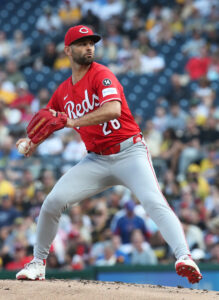
Martinez has found a strong second act in his 30s after spending four seasons in Japan. This will be his fifth season since he returned to MLB on a deal with the Padres over the 2021-22 offseason. He posted a sub-4.00 earned run average in each of the first three years, working mostly out of the bullpen. Martinez spent the first two seasons in San Diego before signing a two-year free agent contract with Cincinnati. He had the best year of his career in 2024, firing 142 1/3 innings of 3.10 ERA ball while starting 16 of 42 appearances.
The righty triggered an opt-out but returned to Cincinnati after the Reds surprisingly extended a $21.05MM qualifying offer. That’s probably a move the Reds wished they had back. Martinez did pick up a career-high 165 2/3 innings while starting 26 of 40 games, but his production was that of a back-end starter. He allowed 4.45 earned runs per nine while striking out just 17% of opposing hitters, his lowest strikeout rate since he returned from Japan.
Although Martinez has never had huge swing-and-miss stuff, his strikeout rates between 2022-24 hovered around league average. He had a more difficult time getting hitters to chase pitches off the plate last year. His stuff wasn’t that much different than it had been, however, and Martinez’s biggest strength has been his ability to command a legitimate six-pitch mix. He uses each of his cutter, four-seam, sinker, changeup, curveball and slider at least 10% of the time. He’s able to attack the strike zone with any of those offerings, but the changeup is the only plus pitch in his arsenal.
The diverse repertoire has allowed Martinez to avoid any kind of platoon splits. He hasn’t been great at turning lineups over a third time but should be a capable five-inning starter. Martinez gets a decent number of weak fly-balls, an approach that might play more favorably at Tropicana Field than at Cincinnati’s Great American Ball Park. He did a solid job avoiding the longball overall, but his two worst months last season (June and August) were driven largely by home run spikes.
RosterResource estimated the Rays payroll around $79MM before the signing. The option buyout delays some of the payout but the $13MM guarantee will very likely make Martinez their highest-paid player in 2026. It’ll push their payroll estimate into the low-$90MM range after they opened the ’25 season just north of $79MM.
Jon Heyman and Joel Sherman of The New York Post first reported Martinez and the Rays had an agreement. Marc Topkin of The Tampa Bay Times reported that it was for one year with a mutual option and had the salary breakdown. Mark Feinsand of MLB.com had the $13MM guarantee. Image courtesy of Charles LeClaire, Imagn Images.
Rays Hire Joe Hudson, Beau Sulser In Player Development Roles
The Rays have hired Joe Hudson and Beau Sulser to the team’s player development ranks, Marc Topkin of the Tampa Bay Times reports. The hirings presumably indicate that Hudson and Sulser have ended their playing careers.
Hudson began his pro career as a sixth-round pick for the Reds in the 2012 draft, and his MLB career consisted of 19 games over parts of four seasons. The catcher suited up for the Angels, Cardinals, and Mariners during the 2018-20 seasons, and after three full years in the minors, Hudson returned to the Show for a single appearance with the Mets during the 2024 campaign. Over Hudson’s 33 plate appearances, he hit .167/.219/.200 with one double and one RBI.
Beyond the four teams Hudson played with at the Major League level, he played for several other organizations in the minors, including the 2022 season spent with the Rays’ Triple-A affiliate in Durham. It is fair to assume Hudson made a good impression on Rays officials during that season, resulting in this new role now that Hudson has decided to hang up the cleats at age 34.
Sulser never played for Tampa during his 12 pro seasons, though there is a family connection by way of his older brother Cole, who is in his second stint in a Rays uniform. Beau was a 10th-round pick for the Pirates in the 2017 draft, and the right-hander spent the majority of his career with Pittsburgh over four different stints with the organization.
Sulser’s only taste of the majors came in 2022, when he tossed 22 1/3 innings across 10 appearances with the Pirates and Orioles. Sulser had a 3.63 ERA over that cup of coffee in the Show, as well as a 4.47 ERA across 485 1/3 innings in the affiliated minor leagues. The 31-year-old’s career also includes three stops overseas, as Sulser pitched in the Australian Baseball League (in 2020), the KBO League (in 2023), and the Chinese Professional Baseball League (last season).
Injury Notes: McClanahan, Canning, Kemp
Rays fans have been waiting two years to see Shane McClanahan on a big-league mound. The electric lefty missed all of 2024 while recovering from Tommy John surgery, then lost another season to a nerve issue in his triceps. McClanahan is on track to be ready for the 2026 campaign, according to Marc Topkin of the Tampa Bay Times, though the southpaw will likely have his workload capped in some fashion.
McClanahan was solid in his 2021 debut, then morphed into an AL Cy Young candidate the following season. He put together 28 starts of a 2.54 ERA with more than a strikeout per inning in 2022. McClanahan capped off the year with a strong start against the Guardians in the Wild Card round. He tossed seven innings of two-run ball, but was outdueled by Shane Bieber.
Even if he faces some sort of innings limit, adding McClanahan back to the rotation will be a welcome sight for a depleted Rays staff. Drew Rasmussen and Ryan Pepiot sit atop the group, but the certainties end there. Shane Baz tied for the team lead with 31 starts last season, but he is now pitching in Baltimore. Veterans Zack Littell and Adrian Houser are no longer in the organization. Taj Bradley was sent to Minnesota at the trade deadline. Joe Boyle, free agent signee Steven Matz, and trade acquisition Yoendrys Gomez are candidates to fill out the rotation, and Littell could also potentially come back in free agency.
Griffin Canning is recovering from his own major injury. The free agent right-hander is working his way back from a ruptured Achilles tendon suffered with the Mets last season. Canning threw for interested teams on Friday and hit 93 mph on the radar gun, Will Sammon of The Athletic reports.
The Cardinals, White Sox, and Mets have been mentioned as possible destinations for Canning. The veteran was putting together a strong campaign before going down in June. Canning had a career-best 3.77 ERA through 16 starts after signing a modest one-year, $4.25MM deal with New York. He ramped up his slider usage while tweaking the characteristics of the pitch with his new team, and Canning added more than three inches of vertical drop and 1.5 inches of horizontal movement to his primary breaking ball. He also made adjustments to his changeup. The tweaks helped Canning regain some of the strikeout ability he lost in his final season with the Angels.
On the position player side, utilityman Otto Kemp is expected to be a full go for the upcoming season. Kemp fractured his kneecap less than two weeks after getting called up last year. He played through the injury for the rest of the campaign. Kemp underwent offseason surgery to fix the issue and also had a cleanup procedure done on his shoulder. He told NBC Sports Philadelphia in an interview that he’s bouncing back well from the operations.
“Feeling back to 100%, which is awesome,” Kemp said. “It’s refreshing to feel that way after playing a lot of baseball banged up.”
The now 26-year-old provided some pop in his first taste of the big leagues, hitting eight home runs in 62 games. He finished with a .411 SLG, though it came with a strikeout rate above 30%. Kemp is among the internal options to compete for platoon work alongside Brandon Marsh in the outfield.
Rays Designate Brett Wisely For Assignment
The Rays announced that they have designated infielder Brett Wisely for assignment. That’s the corresponding move for them to acquire outfielder Víctor Mesa Jr. from the Marlins, a move that was previously reported.
Wisely, 27 in May, has been riding the DFA carousel for quite a while. The Giants designated him for assignment in the middle of September. He was claimed off waivers by Atlanta but got another DFA from that club in January. The Rays sent cash considerations to get both Wisely and Ken Waldichuk from Atlanta but subsequently bumped both from the roster. Waldichuk was claimed off waivers by the Nationals earlier this week.
The hope with Wisely is seemingly to get him to the minors as non-roster depth. He is out of options and can’t be sent to the minors without first clearing waivers. If he were to pass through unclaimed, he would not have the right to elect free agency since he has less than three years of service time and does not have a previous career outright.
Wisely has taken 466 trips to the plate so far in his big league career but has produced a tepid .214/.265/.319 line. Despite that lack of offense, his defensive versatility is appealing. He has experience at all four infield spots and has a little bit of outfield experience as well. It’s also possible there’s a bit more in the bat, as he has hit .276/.375/.436 in the minors over the past three years, leading to a 113 wRC+.
DFA limbo can last as long as a week. The waiver process takes 48 hours, so the Rays could take five days to explore trade interest. If they hope to pass Wisely through waivers, they will probably put him on the wire sooner rather than later. The 60-day injured list opens up next week, adding some extra roster spots which could potentially be used for moves like waiver claims.
Photo courtesy of Matt Krohn, Imagn Images
Marlins Trade Victor Mesa Jr. To Rays
Major League Baseball’s two Florida clubs made a small trade Friday, with Miami sending outfielder Victor Mesa Jr. to Tampa Bay in exchange for minor league infielder Angel Brachi. The Marlins had designated Mesa for assignment earlier in the week. Both teams have announced the swap.
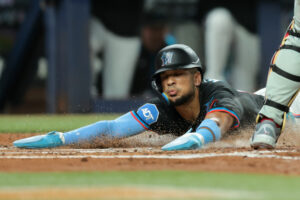
Mesa and his older brother, Victor Victor Mesa, are the sons of Cuban baseball legend Victor Mesa, who had a 19-year career in Cuba’s top league and who has previously managed Team Cuba in the World Baseball Classic. Both, particularly the older Mesa brother, were high-profile international prospects back in the 2018-19 offseason, but neither panned out after signing together with Miami. Victor Victor never reached the majors, and Mesa Jr. was designated for assignment after just 38 plate appearances in The Show.
All of those plate appearances for the younger Mesa brother came in 2025. He appeared in 16 games and hit .188/.297/.344 with a homer, two doubles and as many walks as strikeouts (five apiece). He had a nice showing in 171 Triple-A plate appearances (.286/.352/.460), but that was the first time Mesa Jr. has hit at even an average level in the minors.
The 24-year-old Mesa Jr. is regarded as a solid defensive outfielder and has shown more pop than some expected him to at the time of his signing. He ripped 18 homers in 123 games during the 2023 season, popped 13 round-trippers in just 83 games in ’24 and added another seven in 42 Triple-A contests last season (plus the one home run in 38 MLB plate appearances).
Mesa Jr. still has a minor league option remaining. He’ll give the Rays another candidate to take some at-bats in a somewhat patchwork outfield. The Rays signed Cedric Mullins and Jake Fraley to one-year deals this winter and figure to plug them into center field and right field, respectively, at least against right-handed pitching. Left fielder Chandler Simpson is baseball’s fastest player and most prominent base-stealing threat, but he’s not a good defender, rarely walks and has no power of which to speak. Jonny DeLuca, Justyn-Henry Malloy, Richie Palacios, Ryan Vilade and top prospect Jacob Melton are the other outfield options on the 40-man roster.
Brachi is something of a lottery ticket — a 19-year-old former high-profile international signee who has spent the past two seasons in the Dominican Summer League. He did not rank among Tampa Bay’s top 30 prospects on Baseball America’s recent update on their sytem.
The Rays signed Brachi for an $800K bonus out of his native Dominican Republic. He struggled badly there as a 17-year-old in ’24 (.247/.348/.276 with no homers, three doubles and one triple in 206 plate appearances). Brachi had a breakout at the plate repeating that level in 2025, however, erupting for a .337/.453/.408 batting line in a larger sample of 228 turns at the plate.
Brachi has virtually no power at the moment and isn’t projected to grow into much. His immense Summer League OBP is a bit misleading, as he’s only walked in 8.7% of his plate appearances but has somewhat incredibly been plunked 30 times in 434 overall plate appearances. Brachi is a plus runner who’s still a bit inefficient on the basepaths (35 steals in 48 tries) but could develop into a big running threat. He’s played shortstop, second base and third base in pro ball.
Francys Romero first reported that Mesa was headed to Tampa Bay. Kevin Barral of Fish On First reported that it was a trade (not a waiver claim) and that Miami was receiving one prospect in return.
Edwin Uceta Wins Arbitration Hearing
Right-hander Edwin Uceta won his arbitration hearing against the Rays, Ari Alexander of 7News reports. He’ll be paid the $1.525MM salary figure he and his agent at Nova Sports submitted rather than the $1.2MM sum submitted by the team. Players have now won the first four arbitration hearings of the 2026 season.
The 28-year-old Uceta is the latest success story for Tampa Bay’s pitch lab. The Rays were the journeyman right-hander’s fifth organization in three years when they got their hands on him in 2024. He came to the Rays organization with a career 5.80 ERA in 40 1/3 frames across parts of three seasons.
Tampa Bay near immediately unlocked something in the hard-throwing righty. Uceta exploded for 41 2/3 innings of 1.51 ERA ball with a mammoth 35.8% strikeout rate against a minuscule 5% walk rate in 2024. He followed that by tossing a team-leading 76 innings out of the ‘pen in 2025. His 3.79 ERA was up from the year prior but still plenty serviceable. His rate stats trended in the wrong direction — 32.1 K%, 8.4 BB% — but were still strong marks overall, particularly the strikeout rate.
Overall, Uceta has a 2.98 ERA with terrific strikeout and walk rates in 113 2/3 innings with the Rays. His breakout has quickly thrust him into a high-leverage role. He’s saved six games and picked up 28 holds in his two years as a Ray, and with longtime closer Pete Fairbanks out the door, Uceta could find himself stepping into Tampa Bay’s ninth-inning vacancy before long. That role, coupled with this week’s arbitration win, would position him nicely for future raises moving forward.
This is Uceta’s first trip through the arbitration process. He’s a Super Two player (2.150 years of service), meaning he’s controllable through 2029 and will be arb-eligible four times instead of the standard three.
Latest On Rays’ Stadium Pursuit
The Rays have new owners and the major order of business is to build a new stadium. It was reported last month that the club had signed a non-binding memorandum of understanding with the board of trustees at Hillsborough College as the club pursues the college’s Dale Mabry campus. Some more details on the potential next steps were discussed this week, as covered in columns at the Tampa Bay Times by Marc Topkin, Nicolas Villamil, and Nina Moske, Villamil, Lucy Marques, and Topkin. The club also released renderings of the proposed site today, per Topkin.
The club plans a mixed-use development of 113 acres, including a stadium but also other real estate elements, with comparisons to The Battery in Atlanta. The sticker price is apparently about $2.3 billion, with the club willing to cover about half, while asking for public funding to cover the other half. The club would be on the hook for overruns, repairs and maintenance. That sticker price is just for the ballpark. The team is reportedly willing to invest $8 to $10 billion in the mixed-use area around the ballpark. Florida governor Ron DeSantis said recently that the land would be conveyed to the college to negotiate its use.
With the request for funding, there’s an implied threat of relocation if it doesn’t get done. “You know Orlando wants this,” DeSantis said this week. MLB commissioner Rob Manfred was less direct but also seemed to stress the urgency of the situation. “It’s time to call the question here,” Manfred said. “There are alternatives in Florida,” he added. “We’re at a point in the history of the club that something needs to get done.”
This is often the situation when a team is looking for public money for stadium funding. Sometimes, the threat is real, as fans of the Athletics know. The A’s were unable to get a funding agreement to build a new stadium in Oakland and decided to move to Las Vegas. The threat can also be idle. Royals owner John Sherman recently floated the idea of the club leaving town. He lated admitted that he was advised to imply that threat in an attempt to influence a ballot measure.
The Rays’ stadium pursuit has been an ongoing saga for years. Previous owner Stu Sternberg pursued options within Tampa in Hillsborough County, as well as in St. Petersburg in Pinellas County, the latter being the current home of the Rays’ longtime home of Tropicana Field.
Not too long ago, Sternberg had an agreement in place with St. Pete’s and Pinellas to fund a plan which would involve the building of a new stadium on the site where The Trop currently sits. The Rays were set to pay for about half of that project with public funding covering the other half. That’s the same framework being considered now, though the sticker price of the previous deal was $1.3 billion, barely half of the current proposal.
Hurricane damage to The Trop late in 2024 led to disagreements about how to move forward, ultimately quashing the deal. The relationship between Sternberg and local government officials was generally seen as untenable, which led him to sell to a group led by Patrick Zalupski.
The new ownership group is working on tight timelines. The Rays didn’t play at The Trop in 2025 due to the aforementioned hurricane damage, playing in a minor league park instead. The Trop is expected to be ready to use again in time for Opening Day 2026 but the club’s lease only runs through 2028. Getting a new stadium financed and built in the next three years is going to be a challenge, especially when government officials seem to be hesitant to get on board.
Tampa Mayor Jane Castor has frequently spoken out against the possibility of city funds being used for a stadium. Hillsborough County commissioners voted unanimously this week to pursue stadium negotiations with the club but many commissioners expressed concerns about using tax money to fund a stadium.
“We promised everyone on the public record that the CIT (Community Investment Tax) numbers would be ineligible,” commissioner Joshua Wostal said about funding professional sports stadiums. “We have not even began to collect that tax, and here is a suggestion that we already deceive the taxpayers that we made a promise to no less than two years ago.” If the CIT is a sticking point, that could be crucial.
“This agreement does not happen without the CIT,” said commissioner Ken Hagan, a proponent of doing a deal with the Rays. “It just doesn’t.” The Rays have also proposed that funding come from a tourist tax on short-term rentals and hotel stays, revenue from a property tax assessed to the area around the stadium, a fee on hotel bills near the stadium and bonds for infrastructure issued through a community development district.
The developments in Central Florida are obviously significant for the Rays but also the rest of the league. Manfred has long stated that he would like to get the ball rolling on expanding from 30 to 32 teams before his contract is up in January of 2029. He has also said that expansion won’t be viable until the A’s and Rays have their future homes figured out. The A’s are building a new stadium in Vegas with a planned opening at the start of the 2028 season.
The aforementioned memorandum of understanding gives Hillsborough College an exclusive negotiating window with the Rays for 180 days. It’s unclear what happens if no deal is in place after that time has elapsed.
Photo courtesy of Nathan Ray Seebeck, Imagn Images
Nationals Claim Ken Waldichuk, Designate George Soriano For Assignment
The Nationals have claimed left-hander Ken Waldichuk off waivers from the Rays, according to announcements from both clubs. Tampa had designated him for assignment a few days ago to make room for infielder Ben Williamson, acquired as part of the three-team trade headlined by Brendan Donovan. To open a spot for Waldichuk today, the Nats have designated right-hander George Soriano for assignment.
Waldichuk, 28, was once a notable prospect but his stock is down. When his stock was high, the Yankees traded him to the Athletics as part of the Frankie Montas deal. Over 2021 and 2022, between those two clubs, he tossed 205 minor league innings with a 2.94 earned run average, 35.3% strikeout rate and 10.2% walk rate. Baseball America ranked him as Oakland’s #5 prospect going into 2023.
He got a lengthy run in the majors in 2023 but posted a 5.36 ERA. Tommy John surgery wiped out his 2024 and part of his 2025. When he returned last summer, the A’s sent him to the minors, where he put up an 8.65 ERA in 51 Triple-A innings.
That performance has pushed him into the DFA carousel but teams clearly still have some faith in a bounceback. The A’s designated him for assignment in December when they acquired Jeff McNeil. He was claimed by Atlanta, who later designated him for assignment and traded him to the Rays for cash.
The Nats may try to pass him through waivers later but they would be a good landing spot for him if he can hang onto a roster spot. Their rotation has very little certainty, especially now that MacKenzie Gore has been traded to the Rangers. They project to have a largely unproven group consisting of Josiah Gray, Cade Cavalli, Foster Griffin, Brad Lord, Jake Irvin, Mitchell Parker and others. Waldichuk still has options and could be sent to Triple-A as depth while the Nats experiment with the guys in that group.
Soriano, 27 in March, spent his entire career with the Marlins until recently. He tossed 118 innings for Miami over the past three seasons with a 5.95 ERA. He exhausted his three option seasons in that time, which nudged him onto the DFA carousel.
Teams are clearly still intrigued, despite the lack of major league success thus far. That’s probably because he is coming off a strong season in the minors. He threw 42 2/3 Triple-A innings last year with a 2.32 ERA, 28.8% strikeout rate, 8.8% walk rate and 55.7% ground ball rate. Since the end of last season, he has gone from Miami to Baltimore, Atlanta and Washington via the waiver wire.
Since he’s out of options, those teams have tried to get him through waivers to become non-roster depth. He has less than three years of service time and doesn’t have a previous career outright, so he wouldn’t have the right to reject an outright assignment in favor of electing free agency. The Nats can take as long as five days to explore trade interest before putting him on the wire but could be motivated to do so sooner. The 60-day injured list opens up next week, which will provide teams greater flexibility for fringe roster moves.
Photo courtesy of Kiyoshi Mio, Imagn Images
MLBTR Podcast: Twins Front Office Shake-Up, The Brendan Donovan Trade, Eugenio Suarez, And More!
The latest episode of the MLB Trade Rumors Podcast is now live on Spotify, Apple Podcasts, and wherever you get your podcasts! Make sure you subscribe as well! You can also use the player at this link to listen, if you don’t use Spotify or Apple for podcasts.
This week, host Darragh McDonald is joined by Steve Adams of MLB Trade Rumors to discuss…
- The Twins parting ways with president of baseball operations Derek Falvey (2:10)
- The Mariners getting Brendan Donovan in a three-team trade with the Cardinals and Rays (18:15)
- The Reds signing Eugenio Suárez (35:50)
- The Pirates reportedly just missing on Suárez and what they could still do at this late stage of the offseason (39:20)
- The Giants having an agreement Luis Arráez and also Harrison Bader (49:20)
- The White Sox acquiring Jordan Hicks from the Red Sox (58:35)
- The Athletics signing Jacob Wilson to an extension (1:12:20)
- Several players not being allowed to participate in the World Baseball Classic due to insurance issues (1:16:05)
Check out our past episodes!
- Examining MLB’s Parity Situation – Also, Bellinger, Peralta, Robert, And Gore – listen here
- What The Tucker And Bichette Contracts Mean For Baseball – Also, Nolan Arenado And Ranger Suarez – listen here
- The Cubs Land Cabrera And Bregman, Remaining Free Agents, And Skubal’s Arbitration Filing – listen here
The podcast intro and outro song “So Long” is provided courtesy of the band Showoff. Check out their Facebook page here!
Photo courtesy of Joe Puetz, Imagn Images